 Facile Synthesis and in vitro Antitumor Activity of 5,7-Dihydroxy-3-(4hydroxybenzyl)-6-methylchroman-4-one
Abstract
5,7-Dihydroxy-3-(4-hydroxybenzyl)-6-methylchroman-4-one, a biologically relevant chroman-4-one derivative previously identified from natural sources, was synthesized through a concise and efficient multi-step route starting from phloroglucinol. The synthetic sequence involves Friedel-Crafts acylation, Knoevenagel condensation, intramolecular Michael addition, and acid-catalyzed cyclization, providing practical access to this scaffold in good overall yield. The structure of the synthesized compound was unambiguously confirmed by nuclear magnetic resonance (NMR), Fourier transform infrared (FTIR), Raman spectroscopy, and high-resolution mass spectrometry (HRMS). The compound exhibited notable antioxidant activity, as evidenced by its effective free radical scavenging performance in standard assays. In vitro cytotoxicity evaluation against a panel of human cancer cell lines revealed moderate to strong inhibitory effects, with halfmaximal inhibitory concentration (IC50) values of 16.7 ± 0.11 μM (HeLa), 24.6 ± 0.20 μM (HepG2), 39.2 ± 0.26 μM (A549), and 38.9 ± 0.19 μM (SGC-7901). These values represent a significant improvement compared to the parent chroman-4-one scaffold (IC50 > 96 μM for all tested cell lines) and are comparable to those of apigenin, a representative flavonoid reference compound. This study highlights an efficient synthetic approach and provides systematic in vitro antioxidant and cytotoxicity data for this chromanone derivative, supporting its relevance as a useful scaffold for further mechanistic studies and lead optimization.
Keywords:
homoisoflavonoid synthesis; phloroglucinol; antioxidant activity; cytotoxicity
Introduction
Despite the promising potential of highly substituted homoisoflavonoids in bioactivity research, their complex molecular architectures, densely substituted positions, and diverse stereochemistry present significant challenges for efficient synthesis. Moreover, naturally occurring highly substituted homoisoflavonoids are typically found in very low concentrations, rendering extraction costly and purification labor-intensive.1-3 Furthermore, their availability is frequently affected by factors such as plant growth conditions, geographic origin, and harvesting season, thereby limiting systematic studies and drug development efforts.4,5 Therefore, the development of environmentally friendly, efficient, and highly selective total synthesis methodologies is imperative not only to secure adequate quantities of highly substituted homoisoflavonoids and their derivatives but also to enable structural modification, comprehensive structure-activity relationship (SAR) studies, and facilitate novel drug discovery.
Currently, the predominant synthetic approaches toward homoisoflavonoids rely on chalcone intermediates, which undergo baseor Lewis acid-catalyzed cyclization to construct the homoisoflavonoid core.6,7 Owing to their mild reaction conditions and concise synthetic sequences, these strategies are effective for assembling unsubstituted or moderately substituted homoisoflavonoid frameworks. However, when extended to densely substituted systems, such approaches often suffer from intermediate instability, competing side reactions, and diminished overall yields. To address these limitations, transition metal-catalyzed C-C bond-forming reactions, particularly palladium-catalyzed intramolecular Heck and Suzuki couplings, have been developed to enable regioselective installation of complex substituents, especially on the B-ring of highly substituted homoisoflavonoids.8,9 In parallel, intramolecular lactonization and oxidative cyclization strategies have been explored for C-ring construction, improving stereochemical control and expanding structural diversity. Despite these advances, the efficient synthesis of specific homoisoflavonoid-related chroman-4-one derivatives remains challenging. Notably, 5,7-dihydroxy3-(4-hydroxybenzyl)-6-methylchroman-4-one has previously been isolated from natural sources and reported to exhibit antiinflammatory activity, as described by Zhao et al.10 However, access to this compound has largely relied on extraction from plant material, where its low natural abundance and variability in plant sources restrict systematic biological investigation. Additionally, intramolecular lactonization and oxidative cyclization strategies have been utilized to construct the C-ring, enhancing stereoselectivity and expanding structural diversity in the synthetic process.11,12
To streamline the synthetic process and improve atom economy, multicomponent reaction (MCR) strategies have been introduced by some researchers. These approaches enable the one-pot assembly of key heterocyclic intermediates, effectively minimizing separation and purification steps while enhancing overall synthetic efficiency.13 Moreover, recently developed enzymatic synthesis methods, notable for their high selectivity and environmental sustainability, provide promising new avenues for the synthesis of highly substituted homoisoflavonoids. For instance, enzymecatalyzed selective coupling of hydroxyacetophenones with phenolic substrates not only avoids concerns related to metal residues but also demonstrates potential for scalable industrial applications.14,15 Nevertheless, significant challenges persist in controlling regioselectivity, constructing chiral centers, and precisely defining the stereochemical configurations of target molecules. This is especially true for the synthesis of multiply substituted homoisoflavonoids, where interactions among various functional groups complicate site-specific modifications. Furthermore, systematic SAR studies on substitution patterns and pharmacological properties remain limited. Therefore, further exploration of structural diversity through the synthesis of extensive compound libraries, integrated with molecular modeling and high-throughput screening, is essential to unlock the full therapeutic potential.
Addressing these challenges, the present study employs phloroglucinol (1,3,5-trihydroxybenzene) as a readily available and cost-effective starting material to develop a concise and efficient synthetic route for 5,7-dihydroxy3-(4-hydroxybenzyl)-6-methylchroman-4-one. This synthetic strategy leverages the unique substitution pattern of phloroglucinol to streamline the assembly of the chromanone core with precise hydroxylation and methylation. The approach simplifies the synthetic procedure while improving overall yield and selectivity, providing a practical pathway to produce this biologically relevant scaffold in appreciable quantities. Biological evaluation revealed that the synthesized compound exhibits significant antioxidant activity, effectively scavenging free radicals, attributable to its multiple hydroxyl groups. Moreover, in vitro cytotoxicity assays demonstrated potent anticancer activity against a panel of human cancer cell lines, including HeLa (human cervical cancer), HepG2 (human hepatocellular carcinoma), A549 (human lung carcinoma), SGC-7901 (human gastric cancer), with inhibitory concentrations substantially lower than those of the parent scaffold. The combined antioxidant and antitumor properties highlight the therapeutic potential of this compound, justifying further mechanistic investigations and its development as a lead candidate for drug discovery.
Experimental
Chemicals
All reagents and solvents were purchased from commercial suppliers (Energy Chemical, Shanghai, China) and used without further purification unless otherwise specified. Reactions involving airor moisture-sensitive compounds were conducted under an argon atmosphere in flame-dried glassware using standard syringe techniques. 1H and 13C nuclear magnetic resonance (NMR) spectra were recorded on a Bruker 600 MHz spectrometer (AVANCE NEO 600M, Berlin, Germany). Chemical shifts (d) were reported in parts per million (ppm) relative to internal tetramethylsilane (TMS, d 0.00 ppm) or the residual solvent signals of deuterated dimethyl sulfoxide (DMSO-d6, d 2.50 ppm for 1H and d 39.52 ppm for 13C). High-resolution mass spectrometry (HRMS) data were obtained on an Agilent 1100 LC/QTOF mass spectrometer (San Francisco, CA, USA). Fourier transform infrared (FTIR) spectra were recorded on a Nicolet iN10 infrared microscope (Thermo Fisher Scientific, USA). Raman spectra were obtained using a DXRxi Raman imaging microscope (Thermo Fisher Scientific, USA). Ultraviolet visible (UVVis) absorption spectra were measured on a T6 UV-Vis spectrophotometer (Beijing Persee, China). HeLa, HepG2, A549, and SGC-7901 cell lines were obtained from the American Type Culture Collection (ATCC, Rockville, MD, USA). The cells were maintained in Dulbecco’s Modified Eagle Medium (DMEM, Sigma-Aldrich, St. Louis, MO, USA) supplemented with 10% fetal bovine serum (FBS), 100 U mL-1 penicillin, and 0.1 mg mL-1 streptomycin. The cultures were incubated at 37 °C in a humidified atmosphere containing 5% CO2.
Synthesis of 1-(2,4,6-trihydroxy-3-methylphenyl) ethan-1one
2,4-Dihydroxy-6-methylacetophenone was synthesized via a Friedel-Crafts acylation. In a 100 mL round-bottom flask equipped with a magnetic stir bar, benzene-1,3,5-triol (1.27 g, 10 mmol), anhydrous AlCl3 (1.80 g, 13.5 mmol), and anhydrous CH2Cl2 (20 mL) were added under a nitrogen atmosphere. The mixture was cooled to 0 °C in an ice bath, and acetyl chloride (0.94 mL, 12 mmol) was added dropwise over 10 min. The reaction was stirred at room temperature for 4 h, then quenched with ice water (50 mL). The mixture was extracted with EtOAc (3 × 30 mL), washed with brine, dried over Na2SO4, and concentrated under reduced pressure. The crude product was decolorized with activated charcoal and purified by recrystallization from ethanol or flash column chromatography (petroleum ether / EtOAc 4:1) to give the desired ketone as a yellow solid. Yield: 1.54 g (82.3%).
Synthesis of (E)-3-(4-hydroxyphenyl)-1-(2,4,6-trihydroxy-3-methylphenyl) prop-2-en-1-one
The above ketone (1.02 g, 5 mmol) and 4-hydroxybenzaldehyde (0.68 g, 5 mmol) were dissolved in ethanol (20 mL), followed by the addition of NaOH (0.02 g, 0.5 mmol, 10 mol%). The mixture was stirred at room temperature to 50 °C for 6 h. After completion, the reaction mixture was poured into cold water (50 mL), and the resulting yellow solid was collected by vacuum filtration, washed with cold water, and dried. The crude product was purified by recrystallization from ethanol or diethyl ether to afford the chalcone intermediate. Yield: 1.49 g (90.5%); 1H NMR (600 MHz, DMSO-d6) d 7.97 (d, 1H, J 15.9 Hz, -CH=CH-), 7.86 (s, 1H, -OH), 7.61-7.48 (m, 3H, -CH=CH-, Ph-H, Ph-H), 7.43 (s, 1H, -OH), 6.84-6.77 (m, 2H, Ph-H, Ph-H), 6.12 (s, 1H, Ph-H), 2.04 (s, 3H, -CH3); 13C NMR (150 MHz, DMSO-d6) d 195.93, 164.14, 163.49, 163.06, 159.95, 144.45, 131.07, 127.20, 124.70, 116.38, 105.33, 104.20, 98.18, 8.10.
Synthesis of 5,7-dihydroxy-3-(4-hydroxybenzyl)-6-methylchroman-4-one
The chalcone intermediate (1.49 g, 5 mmol) was suspended in glacial acetic acid / water (3:1, total 20 mL) and refluxed at 120 °C for 8 h. The reaction progress was monitored by thin layer chromatography (TLC). After completion, the mixture was cooled and poured into cold water (50 mL) to precipitate the product. The yellow solid was collected by filtration, washed with water, and dried. Purification by column chromatography (petroleum ether / EtOAc 4:1) afforded the chromanone product. Yield: 1.29 g (86.7%); 1H NMR (600 MHz, DMSO-d6) d 8.21 (s, 1H, -OH), 7.94 (t, 1H, J 1.0 Hz, Pyran-H), 7.61 (s, 1H, -OH), 7.15 (dt, 2H, J 8.5, 1.0 Hz, Ph-H, Ph-H), 6.78-6.72 (m, 2H, Ph-H, Ph-H), 6.42 (s, 1H, Ph-H), 3.71 (q, 2H, J 1.0 Hz, -CH2-), 2.03 (s, 3H, -CH3); 13C NMR (150 MHz, DMSO-d6) d 184.16, 162.92, 161.01, 156.36, 156.23, 154.32, 130.70, 130.62, 125.47, 115.68, 106.22, 105.37, 94.53, 33.60, 7.80.
Synthesis of 5,7-dihydroxy-3-(4-hydroxybenzyl)-6-methylchroman-4-one
The chromanone compound (1.29 g, 5 mmol) was dissolved in ethanol (20 mL), and 10% Pd/C (50 mg) was added. The mixture was stirred at room temperature under H2 atmosphere for 6 h or overnight. After completion, the reaction mixture was filtered through a celite pad to remove the catalyst, and the filtrate was concentrated. The residue was dried and purified by silica gel chromatography (EtOAc / n-hexane) to yield the final benzyl-substituted chromanone as a pale yellow solid. Yield: 1.26 g (91.4%); FTIR (KBr) n / cm-1 3454.0, 3316.8, 3060.1, 2991.8, 1723.6, 1644.2, 1609.8, 1389.5, 1297.3, 819.0; 1H NMR (600 MHz, DMSO-d6) d 12.44 (s, 1H, -OH), 10.74 (s, 1H, -OH), 9.24 (s, 1H, -OH), 7.02 (d, 2H, J 8.4 Hz, Ph-H, Ph-H), 6.69 (d, 2H, J 8.4 Hz, Ph-H, Ph-H), 5.9 (s, 1H, Ph-H), 4.03-4.20 (m, 2H, J 4.5, 11.3 Hz, Pyran-H, Pyran-H), 2.92-2.99 (m, 2H, J 4.9, 13.9 Hz, -CH2-), 2.58 (d, 1H, J 9.7, 13.9 Hz, Pyran-H), 1.86 (s, 3H, -CH3); 13C NMR (150 MHz, DMSO-d6) d 198.37, 164.90, 161.49, 160.66, 156.34, 130.39, 130.3, 128.55, 115.71, 115.71, 103.78, 101.44, 94.5, 69.24, 46.16, 31.75, 7.44; LC-HRMS (ESI) m/z, calcd. for [C17H16O5 + H]+: 301.0998, found: 301.1070.
The UV-Vis spectrum of 5,7-dihydroxy-3-(4-hydroxybenzyl)-6-methylchroman-4-one exhibits two prominent absorption maxima at 293.60 and 213.20 nm (see Figure S6 presented in the Supplementary Information (SI) section). The absorption band centered at 293.60 nm is characteristic of π→π* electronic transitions within the extended conjugated system of the homoisoflavonoid skeleton, particularly associated with the aromatic A and B rings and the C2-C3 double bond in conjugation with the carbonyl group at C4. This band corresponds to the so-called Band I in flavonoid UV-Vis classification, which typically arises from cinnamoyl-like chromophores and is sensitive to the degree of conjugation and substitution pattern on the aromatic rings. The second absorption maximum at 213.20 nm falls within the deep UV region and is attributed to π→π* transitions of isolated aromatic rings and σ→σ* transitions from C-C and C-H bonds, as well as contributions from benzene ring derivatives. This band is generally associated with the benzoyl-like moiety of the homoisoflavonoid core and is influenced by substituents that alter electron density distribution in the aromatic rings. The coexistence of these two characteristic bands confirms the presence of the conjugated aromatic-carbonyl system typical of homoisoflavonoids, supporting the proposed molecular structure of 5,7-dihydroxy-3-(4-hydroxybenzyl)6-methylchroman-4-one.
Cytotoxic activity
(i) Phosphate buffered saline (PBS) buffer solution: 17.8 g of Na2HPO4, 1.0 g of KH2PO4, 1.0 g of KCl, and 40.0 g of NaCl, were weighted then dissolved in 500 mL of ultrapure water. The solution waas sterilized under high pressure at 121 °C for 30 min. After sterilization, the solution was placed in a laminar flow cabinet to cool, filtered through a 0.22 µm filter head, sealed with sealing tape, and stored at 4 °C.
(ii) 0.25% Trypsin solution: 0.25 g of trypsin was weighted then dissolved in 100 mL of PBS buffer solution. After thorough dissolution, the solution was filtered using a 0.22 µm filter head, sealed with sealing tape, and stored at 4 °C.
(iii) 3-(4,5-dimethylthiazol-2-yl)-2,5-diphenyltetrazolium bromide (MTT) solution: 0.05 g of MTT powder was weighted and added to an Eppendorf tube. In a laminar flow cabinet, dissolve the MTT powder in 100 mL of PBS buffer solution prepared in a sterilized saline bottle. The solution was filtered through a 0.22 µm filter head, sealed with sealing tape, and stored at 4 °C. The solution was freshly prepared before use.
(iv) Roswell Park Memorial Institute (RPMI)-1640 culture medium: in a 1000 mL beaker, with approximately 800 mL of ultrapure water, RPMI-1640 powder was slowly added in small amounts while continuously stirring until fully dissolved. 2 g of NaHCO3 were weighted and added to the beaker, stirring until completely dissolved. The solution was then adjusted to a final volume of 1000 mL. The pH was adjusted to 7.2-7.4 using concentrated hydrochloric acid. The solution was filtered through a 0.22 µm filter head, sealed, and stored at 4 °C.
Cytotoxicity evaluation using a viability assay was then performed. For antitumor assays, the tumor cell lines were suspended in a medium at a concentration of 5 × 10⁴ cells per well in 96-well tissue culture plates, then incubated for 24 h. The tested compounds were then added into 96-well plates to achieve 12 concentrations (0, 0.2, 0.5, 1, 2, 4, 8, 16, 32, 64, 128, 256 μM) for each compound. After incubating for 24 h, the numbers of viable cells were determined by an MTT test. Briefly, the media was removed from the 96-well plate and replaced with 100 μL of fresh culture RPMI 1640 medium without phenol red, after which 10 μL of the 12 mM MTT stock solution was added to each well, including the untreated controls. The 96-well plates were then incubated at 37 °C and 5% CO2 for 4 h. An 85 μL aliquot of the media was removed from the wells, and 50 μL of DMSO was added to each well and mixed thoroughly with the pipette, incubating at 37 °C for 10 min. Then, the optical density was measured at 590 nm with a microplate reader (Molecular Devices, SpectraMax iD5, USA) to determine the number of viable cells, and the percentage of viability was calculated according to equation 1.
where ODt refers to the mean optical density of wells treated with the tested sample and ODc is the mean optical density of untreated cells.
Antioxidant activity
The antioxidant activity of 5,7-dihydroxy-3-(4-hydroxybenzyl)-6-methylchroman-4-one was evaluated spectrophotometrically based on the discoloration of an ethanolic solution of 2,2-diphenyl-1-picrylhydrazyl (DPPH) at its maximum absorbance wavelength (λmax = 516 nm). Owing to the low solubility of the synthesized compounds in ethanol, stock solutions were first prepared in DMSO. For each assay, 1 mL of the compound stock solution was mixed with 9 mL of an ethanolic DPPH solution to obtain a final reaction volume of 10 mL. The mixtures were incubated in the dark at room temperature for 30 min. As a control, 10 mL of 80 μM DPPH solution was similarly incubated in the dark for 30 min. The absorbance of each sample was then recorded at 516 nm against a blank.
The other antioxidant activity of 5,7-dihydroxy3-(4-hydroxybenzyl)-6-methylchroman-4-one was measured spectrophotometrically from the discoloration of ethanolic solution of 2, 2’-azino-bis (3-ethylbenzothiazoline6-sulfonic acid) (ABTS) at the lambda maximum of its color (734 nm).
where SR is used to evaluate the free radical scavenging ability of the samples.
Ascorbic acid was used as the standard antioxidant for comparison. Data were represented as means ± standard deviations of triplicate experiments.
Results and Discussion
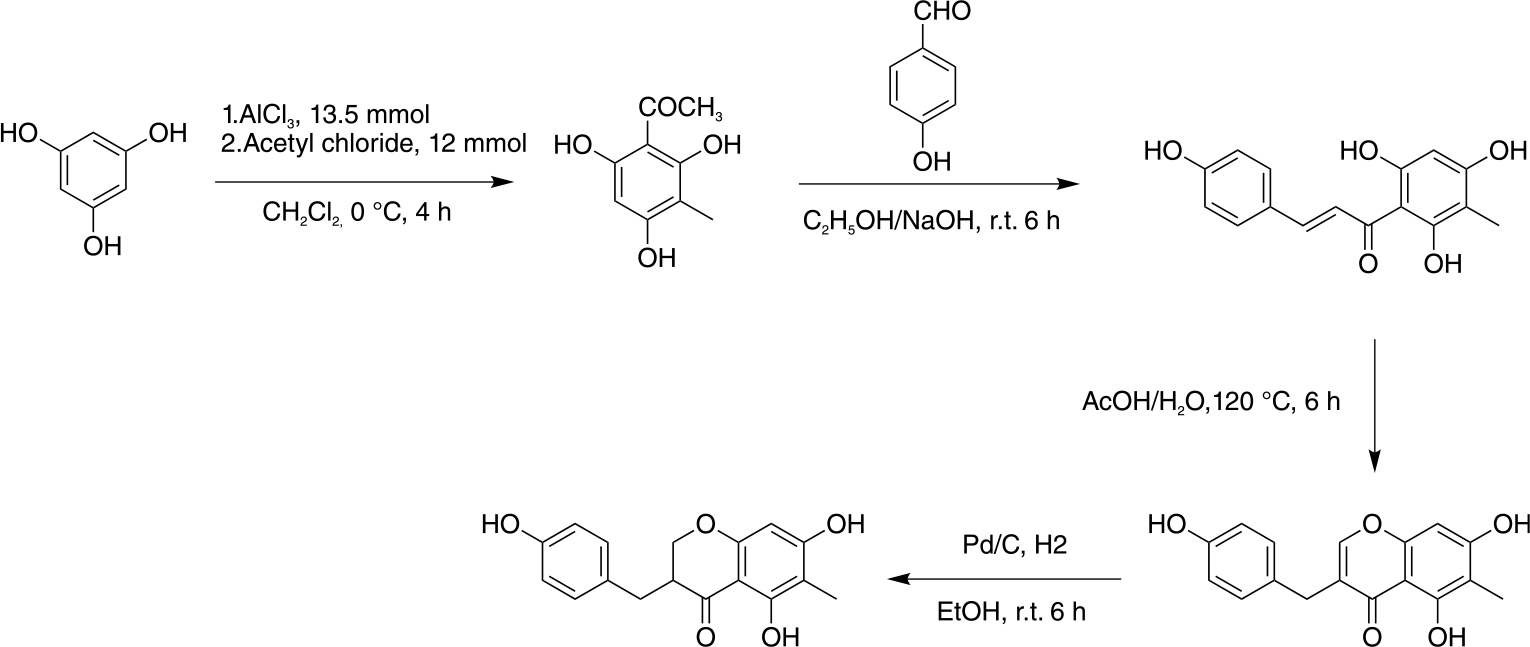
The target compound, 5,7-dihydroxy-3-(4-hydroxybenzyl)-6-methylchroman-4-one, was synthesized from phloroglucinol through a concise multi-step route involving Friedel-Crafts acylation, Knoevenagel condensation, intramolecular Michael addition, acidcatalyzed cyclization, and final catalytic hydrogenation, affording the desired benzyl-substituted chromanone in good overall yield (Scheme 1).

The structure of the final compound was unambiguously confirmed by comprehensive spectroscopic analyses, including FTIR, NMR, HRMS, Raman, and UV-Vis spectroscopy. The FTIR spectrum showed characteristic absorptions corresponding to phenolic O-H, carbonyl C=O, and aromatic functionalities. The 1H and 13C NMR spectra were fully consistent with the proposed chroman-4-one framework, displaying signals attributable to hydrogenbonded phenolic protons, aromatic rings, the chromanone methine and benzylic methylene units, as well as the methyl substituent. High-resolution mass spectrometry revealed a molecular ion peak consistent with the calculated molecular formula. Raman and UV-Vis spectra further supported the presence of the conjugated chromanone system. Detailed spectroscopic data and assignments are provided in the SI section (Figure S5).
The pharmacological evaluation of the newly synthesized compound, 5,7-dihydroxy-3-(4-hydroxybenzyl)-6-methyl chroman-4-one, was conducted to assess its antioxidant capacity and cytotoxic potential. Antioxidant activity was determined using both DPPH and ABTS radical scavenging assays. Additionally, the cytotoxic effects were evaluated against a panel of human cancer cell lines including HeLa, HepG2, A549, and SGC-7901.
As summarized in Tables 1 and 2, 5,7-dihydroxy3-(4-hydroxy benzyl)-6-methylchroman-4-one exhibited significant inhibitory effects in both antioxidant and cytotoxic assays. Compared to the control groups, the compound demonstrated markedly enhanced radical scavenging activities, indicative of potent antioxidant properties. Furthermore, it showed notable cytotoxicity against all tested cancer cell lines, with dose-dependent inhibition of cell viability observed. These results suggest that the compound possesses promising dual functionality as both an effective antioxidant and a potential anticancer agent.
DPPH and ABTS radical scavenging activity screening results and statistical analysis of 5,7-dihydroxy-3-(4-hydroxybenzyl)-6-methylchroman-4-one
IC50 values of 5,7-dihydroxy-3-(4-hydroxybenzyl)-6-methylchroman-4-one against the growth of HeLa, HepG2, A549, SGC-7901, and L02 cells in vitro with statistical analysis
The antioxidant activity of 5,7-dihydroxy-3-(4-hydroxybenzyl)-6-methylchroman-4-one was evaluated by DPPH and ABTS radical scavenging assays, with half-maximal inhibitory concentration (IC50) values determined as 16.57 ± 0.36 and 8.36 ± 0.29 μM, respectively. For comparison, the reference antioxidant ascorbic acid exhibited IC50 values of 12.72 ± 0.27 μM (DPPH) and 5.09 ± 0.21 μM (ABTS) (Table 1). Although the radical scavenging activities of the compound are slightly lower than those of ascorbic acid, the observed values indicate a potent antioxidant capacity. The moderately higher IC50 values relative to ascorbic acid may arise from differences in molecular structure and the nature of the hydroxyl groups involved in electron donation. Unlike ascorbic acid, which has a highly reactive enediol structure that facilitates rapid hydrogen donation, the antioxidant mechanism of the chromanone derivative relies primarily on the stabilization of phenoxyl radicals through resonance delocalization of its multiple hydroxyl substituents (at positions 5, 7, and 4’). Additionally, the performance of compound in the ABTS assay (IC50 = 8.36 μM) demonstrates enhanced radical scavenging relative to DPPH (IC50 = 16.57 μM), consistent with its ability to interact with both hydrophilic and lipophilic radicals. Overall, these results confirm that 5,7-dihydroxy-3-(4-hydroxybenzyl)-6-methylchroman4-one possesses substantial antioxidant potential, approaching that of ascorbic acid, and merits further investigation for therapeutic applications. These differences were statistically significant (p < 0.001), confirming that the synthesized compound exhibited comparatively lower antioxidant potency than the reference standard.
The cytotoxic potential of the synthesized compound was systematically assessed against a panel of human cancer cell lines, including HeLa, HepG2, A549, and SGC-7901 (Table 2). The IC50 values, determined by MTT assay, are summarized in Table 2. The compound demonstrated pronounced inhibitory effects with IC50 values ranging from 16.7 ± 0.11 to 39.2 ± 0.26 μM, markedly outperforming the parent scaffold chroman-4-one in all tested cell lines. Among the cell lines, HeLa cells exhibited the greatest sensitivity, with an IC50 of 16.7 ± 0.11 μM, representing an approximate six-fold enhancement in potency relative to chroman-4-one (96.4 ± 0.56 μM). This activity is on par with apigenin, a natural flavonoid known for its anticancer efficacy (IC50 = 19.8 ± 0.98 μM). Similar trends were observed in HepG2 cells, where the compound displayed an IC50 of 24.6 ± 0.20 μM versus 112.8 ± 0.36 μM for chroman-4-one. In the A549 and SGC-7901 lines, the compound maintained superior cytotoxicity compared to the scaffold, albeit with slightly higher IC50 values (39.2 ± 0.26 and 38.9 ± 0.19 μM, respectively). The enhanced cytotoxicity of the target compound can be rationalized by several structural and biochemical factors. First, the modification of the chroman-4-one core likely increases its cellular uptake and bioavailability, thereby facilitating higher intracellular concentrations. Additionally, substituent groups on the chromenone scaffold may improve binding affinity to critical molecular targets involved in cancer cell proliferation. Furthermore, given its structural resemblance to apigenin, the compound may potentially exert biological effects through mechanisms analogous to those reported for apigenin, such as interference with signaling pathways involved in tumor growth and survival (e.g., NF-κB-related signaling, angiogenesis, and oxidative stress regulation). These proposed interactions are speculative and are presented as prospective hypotheses that warrant further targeted mechanistic investigations. The relatively lower IC50 values in HeLa and HepG2 cells might be attributed to cell type-specific expression profiles of these molecular targets, making them more susceptible to the mechanism of action of the compound. Collectively, these findings highlight the target compound as a promising anticancer agent with significant in vitro cytotoxic activity across multiple human cancer cell lines. The marked improvement over the parent chroman-4-one scaffold underscores the importance of targeted chemical modifications in drug design. Future investigations involving mechanistic studies at the molecular level, such as apoptosis assays, cell cycle analysis, and target validation, will be essential to fully elucidate the anticancer mechanism and therapeutic potential of this compound. Notably, the compound did not exert a significant inhibitory effect on normal human liver L02 cells, highlighting its low toxicity toward nonmalignant cells. This observation underscores the potential therapeutic advantage of the compound in selectively targeting cancer cells while sparing normal hepatocytes, thereby reducing the risk of off-target cytotoxicity. The cytotoxic activities of the synthesized compound, the parent chroman-4-one, and apigenin were further evaluated against various cancer cell lines, including HeLa, HepG2, A549, and SGC-7901, as well as the normal hepatic L02 cells. As shown in Figures S11a-S11e, the inhibitory effect increased in a dose-dependent manner across all tested cell lines. The synthesized compound exhibited notably higher antiproliferative activity toward cancer cells compared with the parent chromanone core and apigenin, while maintaining relatively low cytotoxicity toward normal L02 cells, demonstrating its favorable selectivity index. In addition, the antioxidant capacities were examined using DPPH and ABTS assays (Figure S11f), where the compound displayed comparable or superior radicalscavenging efficiency relative to ascorbic acid, confirming its dual antioxidant and anticancer potential. The statistical analysis confirmed that the synthesized compound exhibited significantly lower IC50 values toward HeLa, HepG2, A549, and SGC-7901 cancer cells compared with both the parent chroman-4-one and apigenin (p < 0.001). However, no significant cytotoxic difference was observed in normal L02 hepatocytes (p > 0.05), indicating selective anticancer activity of the synthesized derivative.
Conclusions
In this study, 5,7-dihydroxy-3-(4-hydroxybenzyl)6-methylchroman-4-one was synthesized via a concise and efficient multi-step strategy starting from phloroglucinol, providing practical access to a biologically relevant chroman-4-one scaffold. The synthetic route employs readily available starting materials and reliable transformations, enabling the preparation of the target compound in sufficient quantities for systematic in vitro evaluation. Antioxidant assays demonstrated that the synthesized compound exhibits appreciable free-radical scavenging activity, which is plausibly associated with the presence of multiple phenolic hydroxyl groups. This behavior is consistent with previous reports on structurally related chromanone and homoisoflavonoid derivatives, supporting its relevance in oxidative stressrelated biological contexts. In addition, cytotoxicity assays against several human cancer cell lines (HeLa, HepG2, A549, and SGC-7901) revealed enhanced in vitro inhibitory activity compared with the parent chroman-4-one scaffold, with IC50 values comparable to those of a representative flavonoid reference compound, apigenin. Taken together, these results suggest that benzyl substitution and hydroxyl functionalization of the chromanone core can effectively enhance in vitro antioxidant and cytotoxic activities. While the present study is limited to a single compound and does not address detailed mechanisms of action, the findings provide useful preliminary insight into structure-activity relationships within this class of chromanone derivatives. Overall, this work establishes a practical synthetic route and a set of systematic in vitro biological data, offering a valuable foundation for future mechanistic investigations and expanded structure-activity relationship studies.
Supplementary Information
Supplementary data (NMR, HRMS, FTIR, UV-Vis and Raman spectra) are available free of charge at http://jbcs.sbq.org.br as file.
Acknowledgments
This work was supported by the Fundamental Research Project of Basic Scientific Research Operating Expenses of the Department of Education of Heilongjiang Province (2024-KYYWF-0585) and the Young Innovative Talent Training Program of Jiamusi University (JMSUQP2022026). We also appreciate the support from the Key Laboratory of Pharmaceutical Sciences of Heilongjiang Province.
Data Availability Statement
The data that support the findings of this study are available from the corresponding author upon reasonable request.
References
-
1 Ibáñez, M.; Hasler, R.; Liu, Y.; Dobrozhan, O.; Nazarenko, O.; Cadavid, D.; Cabot, A.; Kovalenko, M. V.; Chem. Mater. 2017, 29, 7093. [Crossref]
» Crossref -
2 Bustamante-Rangel, M.; Delgado-Zamarreño, M. M.; Pérez-Martín, L.; Rodríguez-Gonzalo, E.; Domínguez-Álvarez, J.; Compr. Rev. Food Sci. Food Saf. 2018, 17, 391. [Crossref]
» Crossref -
3 Sun, Q.; Zhang, H. J.; Wang, H.; Ji, G.; Zhao, Y. H.; Li, G. C.; Guo, S. S.; Lin, L. F.; Jin, Y. J.; Zhang, X. L.; Nan, X. Y.; Liu, C. C.; Liu, G. B.; Front. Bioeng. Biotechnol. 2025, 13, 1639117. [Crossref]
» Crossref -
4 Mengheres, G.; Rice, C. R.; Olajide, O. A.; Hemming, K.; Bioorg. Med. Chem. Lett. 2021, 34, 127761. [Crossref]
» Crossref -
5 Adem, F. A.; Mbaveng, A.; Kuete, V.; Heydenreich, M.; Ndakala, A.; Irungu, B.; Yenesew, A.; Efferth, T.; Phytomedicine 2019, 58, 152853. [Crossref]
» Crossref -
6 Wang, N.; Li, Z.; Shi, H.; Wang, M.; Che, Y.; Tan, F.; Zhang, C.; Dong, H.; J. Nat. Prod. 2025, 88, 2000. [Crossref]
» Crossref -
7 Kwesiga, G.; Greese, J.; Kelling, A.; Sperlich, E.; Schmidt, B.; J. Org. Chem. 2023, 88, 1649. [Crossref]
» Crossref -
8 Laddha, A. P.; Kulkarni, Y. A.; Phytother. Res. 2023, 37, 6, 2578. [Crossref]
» Crossref -
9 Wang, X.; Pan, H.; Sagurthi, S.; Paris, V.; Zhuo, C.; Dixon, R. A.; Commun. Biol. 2022, 16, 1249. [Crossref]
» Crossref -
10 Zhao, J. W.; Chen, D. S.; Deng, C. S.; Wang, Q.; Zhu, W.; Lin, L.; BMC Complementary Altern. Med. 2017, 17, 7. [Crossref]
» Crossref -
11 Kydd, L.; Shiveshwarkar, P.; Jaworski, J.; ACS Synth. Biol. 2022, 11, 3575. [Crossref]
» Crossref -
12 Dong, H. B.; You, Y. W.; Yang, X. L.; Mei, L.; Che, Y. F.; Wang, N.; Peng, T.; He, Y. J.; J. Nat. Prod. 2025, 88, 94. [Crossref]
» Crossref -
13 Bains, O.; Kumar, A.; Kamal, R.; Kumar, R.; Kumar, R.; Rom, T.; Paul, A. K.; Asian J. Org. Chem. 2024, 13, e202400336. [Crossref]
» Crossref -
14 Dulak, K.; Sordon, S.; Matera, A.; Wilczak, A.; Huszcza, E.; Popłoński, J.; Sci. Rep. 2024, 14, 18217. [Crossref]
» Crossref -
15 Penha, C. B.; Falcão, H. G.; Ida, E. I.; Speranza, P.; Kurozawa, L. E.; Food Res. Int. 2020, 137, 109624. [Crossref]
» Crossref -
16 Zang, J. L.; Bu, M.; Yang, J. F.; Han, L.; Lv, Z.; J. Braz. Chem. Soc. 2021, 32, 1780. [Crossref]
» Crossref
Edited by
-
Editor handled this article:
Albertina Moglioni (Associate)