 An Uncommon Ocimene/Terpineol-Rich Chemotype of Algerian Artemisia herba-alba Asso. with Significant Fumigant Toxicity against Cydia pomonella
Abstract
The codling moth, Cydia pomonella (L.), is a globally significant pest of apple orchards. Its developing resistance to conventional pesticides necessitates the exploration of alternative control agents, particularly for post-harvest protection. This study characterizes the chemical composition and evaluates the fumigant toxicity of an essential oil (EO) extracted from an ecotype of Artemisia herba-alba Asso. previously unstudied in the Aurès region (Algeria). The hydrodistillation yielded 0.36 ± 0.01% (v/m) of a pale-yellow oil. Gas chromatography-mass spectroscopy (GC-MS) revealed an uncommon ocimene/terpineol-rich chemotype, distinct from ordinary camphor or thujone-dominated profiles. The relative amounts (semi-quantitative) were dominated by alloocimene (31.13%), α-terpineol (23.67%), and 4 thujanol (17.12%). Bioassays against fifth-instar larvae demonstrated significant fumigant toxicity, with a 24 h LC50 (lethal concentration) value of 25.81 μg mL-1 air. This efficacy is comparable to that of other plant derived insecticides reported in the literature, confirming the oil potential as a viable botanical fumigant. The discovery of this uncommon chemotype not only expands the known chemical diversity of A. herba-alba but also positions its EO as a promising, eco friendly candidate for integration into post-harvest integrated pest management strategies against C. pomonella.
Keywords:
Cydia pomonella; biopesticides; Artemisia herba-alba; chemotype
Introduction
Apple (Malus domestica Borkh.) is a fruit crop of paramount global economic and agricultural importance.1,2 In Algeria, particularly in the Aurès region, its cultivation holds significant socio economic value.3,4 However, the sustainability of this industry is critically threatened by the codling moth, Cydia pomonella (L.), a highly damaging invasive pest present in apple growing areas worldwide.5 The larvae cause direct damage by burrowing into the fruit, creating characteristic tunnels that render the produce unmarketable, with potential yield losses reaching 60 95% in the absence of effective control.6,7 Managing this pest is exceptionally challenging due to its complex biology, including 1-4 overlapping generations per year and a cryptic larval stage that feeds internally within the fruit, thereby limiting the window for effective chemical intervention.8,9
Historically, control has relied heavily on conventional insecticides, which still constitute over 70% of applications in commercial orchards.10,11 This dependence has led to the widespread development of resistant C. pomonella populations. Resistance emerged in the mid-1990s12 and has since expanded to include major insecticide classes, such as neonicotinoids and bio-rational compounds, including avermectins.13,14 Alarmingly, resistance has also been reported against the leading biocontrol agent, the Cydia pomonella granulovirus (CpGV), first documented in Europe15,16 and more recently in the USA.17 This escalating resistance crisis underscores the urgent and continuous need for novel control agents with distinct modes of action.18 This need is particularly acute for post-harvest protection, where hidden fifth-instar larvae can cause significant storage losses, and traditional fumigants, like methyl bromide, have been phased out due to environmental concerns.19,20
In this context, botanical insecticides, particularly essential oils (EOs) from aromatic plants, have emerged as promising, eco-friendly alternatives aligned with principles of sustainable agriculture.21,22 Their insecticidal activity is often attributed to volatile monoterpenoids, which can disrupt physiological functions through mechanisms such as acetylcholinesterase inhibition.23 Artemisia herba-alba Asso. (white wormwood or “shih”) is a notable aromatic species recognized for its insecticidal potential against various pests, including C. pomonella.24,25
A defining characteristic of A. herba-alba, and a critical factor for its bioactivity, is its remarkable intraspecific chemical variability. The composition of its EO is highly influenced by geographic and climatic factors, resulting in distinct chemotypes.26 For instance, while populations from Algeria are typically dominated by camphor, those from Morocco are often rich in thujone isomers.27,28 This chemotypic plasticity suggests that unexplored regional ecotypes may harbor unique bioactive profiles with potentially enhanced or novel insecticidal properties.
Beyond its volatile fraction, A. herba-alba is a rich source of non-volatile bioactive constituents that contribute to its overall biological activity. These include significant levels of phenolic compounds, such as flavonoids and phenolic acids, as well as sesquiterpene lactones, all of which are known for their diverse pharmacological and biocidal properties.29,30 A comprehensive understanding of the plant bioactivity thus requires consideration of both its volatile EO and non-volatile fractions.
Despite the demonstrated efficacy of some A. herba alba EOs against pests, the specific chemical profile and consequent insecticidal potential of the ecotype native to the Aurès Mountains of Algeria remain entirely unexplored. This represents a significant knowledge gap, as the local chemotype may have a distinct composition compared with those reported from other regions.
Therefore, to address this gap, the present study aimed to: (i) characterize the chemical composition of the EO hydrodistilled from the aerial parts of an A. herba-alba ecotype collected in the Aurès region (Algeria) using gas chromatography-mass spectrometry (GC-MS) for identification and semi-quantitative (relative amount) analysis; (ii) evaluate its fumigant toxicity against the critical post-harvest stage, fifth-instar larvae of C. pomonella; and (iii) compare the chemotypic profile and insecticidal effectiveness of this ecotype with those reported in the literature to assess its potential as a source for botanical insecticide development.
Experimental
Plant material
The amount of 3 kg of fresh A. herba-alba aerial parts was collected from numerous individual plants at the same site during the flowering period in July 2024 from the T’kout Mountains, located in the Aurès region of Batna Province, northeastern Algeria. The collection site coordinates are 35°06’14’’ N, 6°21’34’’ E, at an elevation of 1,505 meters above sea level. After harvesting, the plant material was dried in the shade at ambient temperature (20 25 °C) for three weeks.31 This standardized drying protocol is commonly used in ethnobotanical and phytochemical studies. This duration was necessary to ensure the material reached a constant dry weight (critical for accurate v/m yield calculations) and to prevent microbial degradation during storage. While this standard preparation method may result in the loss of some highly volatile components, it reflects the typical state of stored material. Furthermore, it allows for direct comparison with numerous previous studies that employed similar preparation methods. The dried material was then kept in cloth bags until the oil extraction.
Insect material
To collect fifth-instar larvae of C. pomonella, 10 cm wide corrugated cardboard bands were wrapped around the trunks of about 50 selected trees (40 cm above ground level and below the first branch). These traps, which provide shelter for pupation and overwintering, were installed in mid July, and collections were conducted in November 2024. Upon collection, traps were placed in plastic containers with fine-mesh covers to facilitate airflow. The larvae were then maintained under standard laboratory conditions: 18 ± 2 °C, 60 ± 5% relative humidity (RH), and a 16:8 light:dark (L:D) photoperiod. The species identity was confirmed by Professor Laamari Malik from University of Batna 1, Algeria. The fifth-instar larval stage was selected for bioassays because it is the stage most likely to be found in stored fruit, and its greater physiological tolerance provides a conservative and stringent test for evaluating fumigant efficacy.
Methods
Extraction of essential oil
The essential oil was extracted from the dried aerial parts of the plant by hydrodistillation. The extraction was performed in triplicate (n = 3), each using a 100 g sample of plant material immersed in 500 mL of distilled water in a 1 L flask.31 This 1:5 (m/v) ratio was optimal, ensuring sufficient water for efficient steam circulation without overfilling. Distillation was carried out for 4 h using a Clevenger-type apparatus. The oils from the three replicates were pooled to form a single, uniform batch for subsequent GC-MS and bioassay analyses. The average EO yield was 0.36 ± 0.01% (v/m). Following distillation, the collected oil was dried over anhydrous sodium sulfate to remove any residual moisture. The purified EO was stored in sealed amber glass vials at 4 °C until analysis.
GC-MS analysis
The essential oil was analyzed chemically using an Agilent Technologies gas chromatograph (GC MS2) coupled to a quadrupole mass spectrometer, operated with MassHunter GC/MS Acquisition software. A 3 µL sample of the undiluted EO was injected in split mode at a 50:1 split ratio, with the injector temperature set to 250 °C. The separation was carried out chromatographically on an HP 5MS capillary column (30 m in length, 0.25 mm internal diameter, and 0.25 µm film thickness), employing helium as the carrier gas at a steady flow rate of 1.00 mL min 1. The oven temperature was programmed as follows: an initial hold at 50 °C for 5 min, ramped at 5 °C min-1 to 100 °C and held for 10 min, and finally, ramped at 5 °C min-1 to 240 °C and held for 8 min. In electron ionization (EI) mode at 70 eV, the mass spectrometer was operated with an ion source temperature of 280 °C, an interface temperature of 300 °C, and a mass scan range of m/z 40 400. Component identification was performed by matching mass spectra to data from the Wiley 7th edition mass spectral library. For minor constituents, where automated library matching was insufficient, a tentative assignment was conducted through the manual interpretation of mass fragmentation patterns and comparison with the relative elution order documented in the database for non-polar phases.32 This methodology is standard in EO research. It provides reliable identification when supported by high match-quality scores (typically exceeding 85% for key constituents).33-35 While experimental retention indices (RI) were not determined. Gas chromatography with flame ionization detection (GC-FID) was not employed for quantification; the identifications of the major compounds are considered robust due to the high spectral match quality, and consistency with established phytochemical data. Semi quantitative data, based on relative amount, were determined by area normalization according to the international standard.36
Laboratory bioassays
The fumigant toxicity of A. herba-alba EO was evaluated against fifth-instar C. pomonella larvae using a sealed-container bioassay. Circular filter paper discs (2 cm diameter) served as evaporative substrates. Four EO concentrations were prepared: 0.25, 0.50, 1.0, and 2.0 µL per 60 mL container, corresponding to 3.86, 7.73, 15.46, and 30.93 µg mL-1 air, respectively (based on EO density of 0.928 g mL-1).
Each experimental unit was assembled following a strict sequence: (i) placement of ten larvae, (ii) suspension of a clean filter paper disc, (iii) direct in situ application of EO onto the disc using a micropipette, and (iv) immediate sealing (within 3-5 s). The sealing moment was defined as time-zero (t = 0). The in situ application method prevented vapor loss during disc transfer. Parafilm reinforced the seal to maintain a constant fumigant concentration.
Each concentration was tested in five independent replicates (n = 50 larvae). Control containers received untreated discs. All containers were maintained at 18 ± 2 °C and 60 ± 5% RH under a 16:8 h light:dark cycle.
Larval mortality was assessed by a single observer through the container walls at predetermined intervals over 216 h (1, 3, 6, 12, 24, 48, 72, 96, 120, 144, 168, 192, and 216 h). A larva was considered dead if it exhibited no spontaneous movement and showed no response to gentle container agitation (tilting / rotation).
Data analysis
To express fumigant concentrations in mass/volume units as recommended, all concentrations were converted from μL L-1 to μg mL-1 (equivalent to ppm) using the density of A. herba-alba EO (0.928 g mL-1) reported in the literature.37 Statistical analyses were performed using IBM SPSS Statistics for Windows (version 27.0, IBM Corp., Armonk, NY), with a significance threshold of p < 0.05. Before analysis, the normality of the data was verified using the Shapiro-Wilk test. To achieve variance stabilization, mortality data (expressed as percentages) were transformed using an arcsine square root function. A two-way analysis of variance (ANOVA) was then performed to evaluate the effects of the independent variables (EO concentration and exposure time) on the mortality rate of C. pomonella larvae.
After performing ANOVA, Tukey honestly significant difference (HSD) post-hoc test was applied for pairwise comparisons of means, where significant differences were observed. Finally, lethal concentration (LC50) and lethal time (LT50) values, along with their respective 95% confidence limits (CL), were calculated using probit analysis. Although significant χ2 values indicate some deviation from the probit model, the consistent dose-response relationships across concentrations provide robust evidence of the toxic effects of the essential oil.
Use of artificial intelligence
To aid in contextualizing our findings, the artificial intelligence model Gemini 2.5 Pro was used. Its role was limited to organizing the main ideas and assisting in comparing the experimental results with previously published data, thereby facilitating a more comprehensive discussion. The tool was not used to generate, analyze, or interpret scientific data, nor to formulate any scientific conclusions. Following the use of this tool, the authors reviewed and edited the content as needed and assumed full responsibility for the final publication.
Results and Discussion
Results
GC-MS analysis revealed a distinctive chemical profile for the A. herba-alba EO, characterized by its major constituents listed in Table 1.
Chemical constituents of the essential oil extracted from the aerial parts of Artemisia herba-alba
Essential oil yield and GC-MS analysis
When A. herba-alba aerial parts were hydrodistilled, a yellow EO was obtained, with a yield of 0.36 ± 0.01% (v/m). GC-MS analysis identified 13 compounds, accounting for 99.08% of the total chemical composition. This includes constituents identified through both automated library matching, with match quality scores typically exceeding 85% for key constituents, and tentative assignments based on the manual interpretation of mass fragmentation and elution. The two main classes dominating the chemical profile were monoterpene hydrocarbons (42.55%) and oxygenated monoterpenes (55.91%). Alloocimene was the most abundant compound (31.13%), followed by α-terpineol (23.67%) and 4-thujanol (17.12%). The mass spectra confirming the identities of these key compounds are provided in Supplementary Information (SI) section (Figures S5, S10, and S4, respectively). Notably, minor deviations in the standard elution order of certain isomers were observed, consistent with specific chromatographic parameters.38
Other components were also identified in significant amounts, including terpinen-1-ol (9.73%) and terpinolene (6.40%). Sesquiterpene hydrocarbons, such as longifolene, accounted for a minor fraction of the oil, representing 0.62% (Table 1).
It should be noted that these compositional data are semi-quantitative, based on relative amount from GC-MS analysis, as GC-FID was not used for precise quantification. All relative percentages were calculated by area normalization according to the international standard36 for the analysis of EOs.
Fumigant toxicity against Cydia pomonella Larvae
Larvicidal effect, LC50 and LT50 of A. herba-alba oil on the mortality rate of the fifth-instar of C. pomonella
The results demonstrate a significant toxic effect of A. herba-alba oil versus the larvae of fifth instar C. pomonella. Both oil concentration and exposure time significantly increased the mortality rate (F = 12.38; p < 0.001). After 96 h of exposure to the highest concentration (30.93 µg mL-1 air), the larval mortality reached 100%, while at the lowest concentration (3.86 µg mL-1 air), it took 216 h to achieve the same result. In contrast, the control larvae showed no signs of mortality (Figure 1). Toxicity values are summarized in Tables 2 and 3. The LC50 value was 25.81 µg mL-1 air after 24 h of exposure (Table 2). The LT50 values ranged from 32.01 to 107.12 h at air concentrations of 30.93 and 3.86 µg mL-1, respectively (Table 3). The goodness-of-fit analysis showed that the probit model was a good fit for the data at shorter time points (p > 0.05), while a significant deviation from the model was observed at longer exposure durations (p < 0.01) (Table 2).
The lethal concentration (LC50) of Artemisia herba-alba essential oil for the fifth-instar stage of Cydia pomonella
The lethal time (LT50) of Artemisia herba-alba essential oil for the fifth-instar of Cydia pomonella (L.)
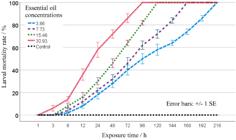
Mortality rate of fifth-instar Cydia pomonella (L.) larvae following fumigant exposure to varying concentrations of A. herba-alba essential oil over 216 h; the error bars indicate the standard error (± SE).
Discussion
Yield
The hydrodistillation yield of the A. herba-alba ecotype from the Aurès mountains was 0.36 ± 0.01% (v/m). This value is at the lower end of the well-documented global yield range for this species, which spans roughly 0.2% to over 2.3% across its Mediterranean and West Asian distribution.26,39 It is significantly lower than yields often reported for A. herba-alba from other Algerian regions, where values are typically above 0.6% and can reach up to 1.73% in arid zones.25,40-42
The significant variation in yield within A. herba alba highlights the strong influence of geographic and bioclimatic factors on secondary metabolism.26 In our study, this modest yield, along with the unique chemotype, supports the idea of an ecotype-specific resource allocation trade-off43 and aligns with the growth-differentiation balance framework.44 For the Aurès ecotype, specifically, the interaction of local genetic adaptations, the high-altitude semi-arid climate (1,505 m), and distinct soil conditions43 likely shaped metabolic investment. This agrees with the well-established understanding that environmental pressures are critical factors that can qualitatively change secondary metabolite profiles, including EO composition, either independently of or at the expense of overall yield.45 Therefore, the observed yield may be interpreted as part of an adaptive ecophysiological response that prioritizes the production of the distinctive alloocimene/terpineol blend. This relationship underscores that precise geographic origin and local adaptation are key determinants of the bioactive potential of botanical resources, emphasizing their value not only in quantitative yield but also in their qualitative chemical signature.
Chemotypes
Consistent with the ecophysiological trade-off reflected in the modest yield, the essential oil of the Aurès ecotype exhibited a distinctive and uncommon chemical profile. It is characterized by the dominance of oxygenated monoterpenes (55.91%) and monoterpene hydrocarbons (42.55%), with a unique composition of three main components: alloocimene (31.13%), α terpineol (23.67%), and 4-thujanol (17.12%).
This chemotypic signature differs notably from the main regional patterns in A. herba-alba. The species is well-known for two common chemotypes: a camphor-dominant profile across eastern Algeria and Tunisia, and a thujone-dominant profile in Morocco and southwestern Algeria (see Table 4 for a systematic overview). Detailed quantitative comparisons with major documented chemotypes are provided in Table S2 (complete dataset of 24 geographical entries; see References S1-S7 in the SI section). In contrast, the compounds characterizing our sample (alloocimene, α-terpineol) are typically reported only as minor constituents (< 10%) in these common chemotypes. The dominance of alloocimene (31.13%) is particularly noteworthy. While its retention behavior showed slight deviations from standard database sequences, this was identified as a characteristic peak inversion related to our specific temperature programming, as supported by the principles of non-isothermal gas chromatography.38
Comparative chemotypic profiles of Artemisia herba-alba and related species, highlighting an uncommon ocimene/terpineol-rich ecotype from the Aurès Region, Algeria
A thorough comparative analysis, including related species (Table 4), highlights the uniqueness of this profile. First, it does not match any other documented minor chemotypes within A. herba alba, such as the davanone-rich type from Spain or the verbenol/bisabolone type from Morocco. Second, and more definitively, it remains distinct from the typical profiles of sympatric Artemisia species. For example, regional A. campestris populations often contain high levels of germacrene D or β-pinene, while A. absinthium is usually dominated by thujone or camphor. The observed specific ratio of alloocimene to α-terpineol (accounting for over 54% of the total oil) has no known equivalent in the chemotaxonomic literature on North African Artemisia.
Therefore, based on this comprehensive evaluation, the EO from the Aurès ecotype clearly represents an uncommon ocimene/terpineol-rich chemotype of A. herba alba. This discovery highlights the species notable chemical plasticity and the uneven distribution of genetic variability, shaped by a complex interplay of genetic background, geographic isolation, and local ecological pressures.26,29 This uncommon chemotype not only expands the known chemical diversity of A. herba-alba but also prompts us to evaluate its bioactivity against a major apple pest, as described in the following section.
It is important to note that quantification using GC-FID was not performed; therefore, the GC MS compositional data presented are semi-quantitative (based on relative amount).
Fumigant toxicity and selectivity
The EO exhibited significant fumigant toxicity against C. pomonella larvae, with an LC50 of 25.81 µg mL-1 air after 24 h of exposure. This result indicates high susceptibility and supports the conclusions of who reported an LC50 of 12.52 µg mL-1 air for the same pest, confirming the oil efficacy.25
The selectivity of this EO becomes apparent when its efficacy is compared against various insect species. On one hand, C. pomonella larvae are far more sensitive than highly resistant stored product pests. As an illustration, both the red flour beetle, Tribolium castaneum, and the Indian meal moth, Plodia interpunctella, required considerably higher concentrations, with LC50 values of 99.5 and 150.40 µg mL-1 air, respectively.24,56 Ephestia kuehniella, the Mediterranean flour moth, exhibited even greater tolerance, with an LC50 of 888.4 µg mL-1 air.56
Conversely, the oil efficacy against C. pomonella falls within the range reported for other highly susceptible species. Pests such as Callosobruchus maculatus (LC50 = 7.15 µg mL-1 air) and Bruchus rufimanus (LC50 = 7.70 µg mL-1 air) exhibited similar sensitivities.31 Notably, species like the sawtoothed grain beetle, Oryzaephilus surinamensis (LC50 = 2.83 µg mL-1 air), and larvae of the carob moth, Ectomyelois ceratoniae (LC50 = 0.761-1.355 µg mL-1 air), were found to be exceptionally susceptible.57,58
In this current endeavour, the concentration-dependent lethal time (LT50) for C. pomonella larvae ranged from 107.12 to 32.01 h. This indicates a slower toxic action than the range of 59.35 19.52 h reported by Mahi et al.25 for the same pest. Furthermore, this effect is considerably slower than that observed on the exceptionally susceptible sawtoothed grain beetle, Oryzaephilus surinamensis, which had an LT50 of just 3.73 h.57
Overall, these comparisons demonstrate that although A. herba-alba oil exhibits significant fumigant toxicity, its speed of action varies with the target pest susceptibility. Its efficacy as a natural fumigant against key lepidopteran pests is promising. This spectrum of bioactivity can be mechanistically attributed to the unique chemical composition of the Aurès ecotype and its multi target mode of action, as explored in the following section.
Mode of action
As indicated by the toxicity and selectivity patterns described earlier, the fumigant efficacy of the Aurès ecotype EO is due to its distinctive chemical composition and multi-target neurotoxic action. The significant insecticidal effect observed in this research can be directly attributed to the uncommon chemical profile of the Aurès ecotype, which is rich in alloocimene (31.13%), α-terpineol (23.67%), and 4-thujanol (17.12%). The higher concentration of these lipophilic monoterpenes likely facilitates rapid penetration of the insect cuticle and respiratory system.59,60 The primary mode of action is presumed to be neurotoxic, resulting from a multi-target attack. Specifically, α-terpineol is a known inhibitor of acetylcholinesterase (AChE), leading to paralysis by disrupting synaptic transmission.61,62 Concurrently, compounds like 4-thujanol, an isomer of the biologically active convulsant thujone, could act on additional neural targets, such as gated chloride channels gated by gamma aminobutyric acid (GABA),63 while the hydrocarbon alloocimene could contribute to overall neurotoxicity or interfere with other physiological processes like respiration.64
Importantly, the higher efficacy of this EO is likely not due to any single compound, but rather to synergistic Interactions between its primary and secondary constituents.65,66 This multi-target approach often makes the complete oil more effective than its isolated components.67 Despite the absence of traditionally cited biocides like camphor, the notable toxicity of this uncommon chemotype underscores the existence of highly effective alternative insecticidal pathways in nature.
Conclusions
In summary, this study reveals an uncommon ocimene/terpineol-rich chemotype in Artemisia herba-alba from the Aurès region, Algeria. While the essential oil yield was modest (0.36 ± 0.01% v/m), it demonstrated significant fumigant toxicity against Cydia pomonella larvae (LC50 = 25.81 µg mL-1 air). This discovery expands the documented chemical diversity of the species and underscores the critical role of geographic origin in shaping unique, bioactive phytochemical profiles.
From an applied perspective, this ecotype EO is a promising natural candidate for developing sustainable biopesticides, especially for eco-friendly post-harvest protection of apple crops.
The present work represents an initial characterization. Its main limitations include the use of semi-quantitative GC-MS analysis without supplementary GC-FID quantification or experimental retention indices.
Consequently, future research must progress through defined steps: first, enhance analytical rigor via GC FID and retention indices; second, and most critically, conduct thorough in vitro cytotoxicity assays to establish a comprehensive safety profile for humans and the environment, a non-negotiable prerequisite for any development; and finally, advance to field trials and formulation studies to assess practical viability. This structured pathway is essential for transforming this botanical finding into a reliable and safe pest management tool.
Supplementary Information
Supplementary data (GC-MS spectra and figures) are available free of charge at http://jbcs.sbq.org.br as PDF file.
Supplementary material 1
Acknowledgments
The authors would like to thank Professor Laamari Malik for his expertise in confirming the species identification of Cydia pomonella.
Data Availability Statement
The data that support the findings of this study are available within the article.
References
-
1 Aroua, K.; Mellal, H.; Abdessemed, N.; Kaydan Mehmet, B.; Hanoun, S.; Aiche Mohamed, A.; Ouanes, M.; Naili, O.; Khemili, A.; Bensizerara, D.; Mayouf, N.; Boukhobza, L.; Biche, M.; Entomol. News 2025, 132, 424. [Crossref]
» Crossref -
2 Pires, T. C. S. P.; Dias, M. I.; Barros, L.; Alves, M. J.; Oliveira, M. B. P. P.; Santos-Buelga, C.; Ferreira, I. C. F. R.; Food Chem. 2018, 240, 701. [Crossref]
» Crossref -
3 Statistiques| FAO | Organisation des Nations Unies pour l’alimentation et l’agriculture. [Link] accessed in February 2026
» Link -
4 Zeroual, I.; Benaziza, A.; Adjal, F.; Kheloufi, A.; Ann. Valahia Univ. Târgovişte, Agric. 2024, 16, 10. [Crossref]
» Crossref -
5 Basoalto, A.; Ramírez, C. C.; Lavandero, B.; Devotto, L.; Curkovic, T.; Franck, P.; Fuentes-Contreras, E.; Insects 2020, 11, 285. [Crossref]
» Crossref -
6 Kuyulu, A.; Genç, H.; COMU J. Agric. Fac. 2018, 6, 85. [Crossref]
» Crossref -
7 Öztemi̇z, S.; Küden, A.; Nas, S.; Lavkor, I.; Turk. J. Agric. For. 2017, 41, 201. [Crossref]
» Crossref -
8 Balaško, M. K.; Bažok, R.; Mikac, K. M.; Lemic, D.; Pajač Živković, I.; Insects 2020, 11, 38. [Crossref]
» Crossref -
9 Zhang, J.; Huang, S.; Zhao, S.; Wang, X.; Yang, X.; Zhao, H.; Gao, P.; Li, Y.; Yang, X.; Insects 2023, 14, 615. [Crossref]
» Crossref -
10 Franck, P.; Guérin, F.; Loiseau, A.; Sauphanor, B.; Mol. Ecol. Notes 2005, 5, 99. [Crossref]
» Crossref -
11 Hu, C.; Wang, W.; Ju, D.; Chen, G.; Tan, X.; Mota-Sanchez, D.; Yang, X.; Pest Manage. Sci. 2020, 76, 1039. [Crossref]
» Crossref -
12 Pajač, I.; Barić, B.; Šimon, S.; Mikac, K. M.; Pejić, I.; J. Food Agric. Environ. 2011, 9, 459. [Link] accessed in February 2026
» Link -
13 Reyes, M.; Franck, P.; Charmillot, P.; Ioriatti, C.; Olivares, J.; Pasqualini, E.; Sauphanor, B.; Pest Manage. Sci. 2007, 63, 890. [Crossref]
» Crossref -
14 Ju, D.; Mota-Sanchez, D.; Fuentes-Contreras, E.; Zhang, Y.-L.; Wang, X.-Q.; Yang, X.-Q.; Pestic. Biochem. Physiol. 2021, 178, 104925. [Crossref]
» Crossref -
15 Schulze-Bopp, S.; Jehle, J. A.; J. Appl. Entomol. 2013, 137, 153. [Crossref]
» Crossref -
16 Sauer, A. J.; Fritsch, E.; Undorf-Spahn, K.; Nguyen, P.; Marec, F.; Heckel, D. G.; Jehle, J. A.; PLoS One 2017, 12, e0179157. [Crossref]
» Crossref -
17 Fan, J.; Jehle, J. A.; Rucker, A.; Nielsen, A. L.; Insects 2022, 13, 533. [Crossref]
» Crossref -
18 Lakhova, T. N.; Tsygichko, A. A.; Klimenko, A. I.; Ismailov, V. Y.; Vasiliev, G. V.; Asaturova, A. M.; Lashin, S. A.; Int. J. Mol. Sci. 2024, 25, 7146. [Crossref]
» Crossref -
19 Galinato, S. P.; Gallardo, R. K.; Granatstein, D. M.; Willett, M.; HortTechnology 2018, 28, 651. [Crossref]
» Crossref -
20 Dhouibi, M. H.; Lagha, A.; Bensalem, A.; Hammami, Y.; Int. J. Agric. Innov. Res. 2015, 3, 1697. [Link] accessed in February 2026
» Link -
21 Baudry, J.; Pointereau, P.; Seconda, L.; Vidal, R.; Taupier-Letage, B.; Langevin, B.; Allès, B.; Galan, P.; Hercberg, S.; Amiot, M.-J.; Am. J. Clin. Nutr. 2019, 109, 1173. [Crossref]
» Crossref -
22 Giampieri, F.; Mazzoni, L.; Cianciosi, D.; Alvarez-Suarez, J. M.; Regolo, L.; Sánchez-González, C.; Capocasa, F.; Xiao, J.; Mezzetti, B.; Battino, M.; Food Chem. 2022, 383, 132352. [Crossref]
» Crossref -
23 Krzyżowski, M.; Baran, B.; Lozowski, B.; Francikowski, J.; Insects 2020, 11, 344. [Crossref]
» Crossref -
24 Boukraa, N.; Ladjel, S.; Benlamoudi, W.; Goudjil, M. B.; Berrekbia, M.; Eddoud, A.; Biocatal. Agric. Biotechnol. 2022, 45, 102513. [Crossref]
» Crossref -
25 Mahi, T.; Harizia, A.; Elouissi, A.; Pérez-Izquierdo, C.; Benguerai, A.; Canelo, T.; Bonal, R.; Biocatal. Agric. Biotechnol. 2023, 50, 102742. [Crossref]
» Crossref -
26 Belhattab, R.; Amor, L.; Barroso, J. G.; Pedro, L. G.; Figueiredo, A. C.; Arabian J. Chem. 2014, 7, 243. [Crossref]
» Crossref -
27 Amor, G.; Caputo, L.; La Storia, A.; De Feo, V.; Mauriello, G.; Fechtali, T.; Molecules 2019, 24, 4021. [Crossref]
» Crossref -
28 Benarab, H.; Fenni, M.; Louadj, Y.; Boukhabti, H.; Ramdani, M.; Acta Sci. Nat. 2020, 7, 86. [Crossref]
» Crossref -
29 Mohamed, A. E.-H. H.; El-Sayed, M.; Hegazy, M. E.; Helaly, S. E.; Esmail, A. M.; Mohamed, N. S.; Rec. Nat. Prod. 2010, 4, 1. [Link] accessed in February 2026
» Link -
30 Touil, S.; Benrebiha, F. T.; Hadj Sadok, T.; Int. J. Food Prop. 2019, 22, 843. [Crossref]
» Crossref -
31 Titouhi, F.; Amri, M.; Messaoud, C.; Haouel, S.; Youssfi, S.; Cherif, A.; Ben Jemâa, J. M.; J. Stored Prod. Res. 2017, 72, 11. [Crossref]
» Crossref - 32 Adams, R. P.; Identification of Essential Oil Components by Gas Chromatography Mass Spectroscopy, 4th ed.; Allured Publishing Corp.: Carol Stream, IL, USA, 2007.
-
33 Vernin, G.; Merad, O.; Vernin, G. M. F.; Zamkotsian, R. M.; Párkányi, C.; Dev. Food Sci. 1995, 37, 205[Crossref]
» Crossref -
34 Al-Asmari, A. K.; Athar, M. T.; Al-Faraidy, A. A.; Almuhaiza, M. S.; Asian Pac. J. Trop. Biomed. 2017, 7, 147. [Crossref]
» Crossref -
35 Barhouchi, B.; Menacer, R.; Bouchkioua, S.; Mansour, A.; Belattar, N.; Arabian J. Chem. 2023, 16, 104939. [Crossref]
» Crossref -
36 ISO 7609:1985: Essential Oils - Analysis by Gas Chromatography on Capillary Columns - General Method [Link] acessced in February 2026
» Link -
37 Amara, L.; Zairi, M.; Achemaoui, A.; Meziani, S.; Demmouche, A.; Int. J. Second. Metabolite 2025, 12, 710. [Crossref]
» Crossref - 38 Blumberg, L. M.; Temperature-Programmed Gas Chromatography, 1st ed.; Wiley: Hoboken, NJ, USA, 2010.
-
39 Salido, S.; Valenzuela, L. R.; Altarejos, J.; Nogueras, M.; Sánchez, A.; Cano, E.; Biochem. Syst. Ecol. 2004, 32, 265. [Crossref]
» Crossref -
40 Bertella, A.; Benlahcen, K.; Abouamama, S.; Pinto, D. C. G. A.; Maamar, K.; Kihal, M.; Silva, A. M. S.; Ind. Crops Prod. 2018, 116, 137. [Crossref]
» Crossref -
41 Fekhar, N.; Moulay, S.; Asma, D.; Krea, M.; Boutoumi, H.; Benmaamar, Z.; Chem. J. Mold. 2017, 12, 50. [Crossref]
» Crossref -
42 Ouguirti, N.; Bahri, F.; Bouyahyaoui, A.; Wanner, J.; Nat. Volatiles Essent. Oils 2021, 8, 27. [Crossref]
» Crossref -
43 Elwardani, H.; Oubihi, A.; Haida, S.; Ez-Zriouli, R.; Kabous, K. E.; Ouhssine, M. ; Chem. Data Collect. 2024, 50, 101118. [Crossref]
» Crossref -
44 Stamp, N.; Q. Rev. Biol. 2003, 78, 23. [Crossref]
» Crossref -
45 Isah, T.; Biol. Res. 2019, 52, 39. [Crossref]
» Crossref - 46 Medjeldi, S.; Essid, R.; Jellouli, S.; Fares, N.; Amel, D.; Amrani, A.; Tabben, O.; Nat. Prod. Commun. 2024, 19, 1. [Crossref]
-
47 Amri, I.; De Martino, L.; Marandino, A.; Lamia, H.; Mohsen, H.; Scandolera, E.; De Feo, V.; Mancini, E.; Nat. Prod. Commun. 2013, 8, 113. [Crossref]
» Crossref -
48 Younsi, F.; Trimech, R.; Boulila, A.; Ezzine, O.; Dhahri, S.; Boussaid, M.; Messaoud, C.; Int. J. Food Prop. 2016, 19, 1425.[Crossref]
» Crossref -
49 Ez-Zoubi, A.; Ez Zoubi, Y.; Bentata, F.; El-Mrabet, A.; Ben Tahir, C.; Labhilili, M.; Farah, A.; J. Chem. 2023, 3830819. [Crossref]
» Crossref -
50 Abdelali, S.; Souttou, K.; Kacimi-Elhassani, M.; Aissaoui, L.; Bendachou, H.; Actual. Biol. 2022, 45, 12. [Crossref]
» Crossref -
51 Tilaoui, M.; Mouse, H. A.; Jaafari, A.; Aboufatima, R.; Chait, A.; Zyad, A.; Rev. Bras. Farmacogn. 2011, 21, 781. [Crossref]
» Crossref -
52 Bouaziz, A.; Aissaoui, L.; Saoudi, B.; Int. J. Trop. Insect. Sci. 2025, 45, 601.Crossref]
» Crossref -
53 Mammeri, B.; Bahri, F.; Kouidri, M.; Boudani, B.; Arioui, F.; J. Appl. Biol. Sci. 2022, 16, 230. [Crossref]
» Crossref -
54 Benkhaled, A.; Boudjelal, A.; Napoli, E.; Baali, F.; Ruberto, G.; Asian. Pac. J. Trop. Biomed. 2020, 10, 496. [Crossref]
» Crossref -
55 Bouchenak, F.; Degaichia, H.; Lamgharbi, A.; Benrebiha, F.; Agrobiologia 2018, 8, 886. [Link] accessed in February 2026
» Link -
56 Bouzeraa, H.; Bessila-Bouzeraa, M.; Labed, N.; Sedira, F.; Ramdani, L.; J. Entomol. Zool. Stud. 2018, 6, 145. [Link] accessed in February 2026
» Link -
57 Bachrouch, O.; Ferjani, N.; Haouel, S.; Jemâa, J. M. B.; Ind. Crops Prod. 2015, 65, 127. [Crossref]
» Crossref -
58 Ben Chaaban, S.; Mnaffed, A.; Mahjoubi, K.; Ben, J. M.; Int. J. Agric. Innov. Res. 2019, 7, 2319. [Link] accessed in February 2026
» Link -
59 Gnankiné, O.; Bassolé, I. H. N.; Molecules 2017, 22, 1321. [Crossref]
» Crossref -
60 Prates, H. T.; Santos, J. P.; Waquil, J. M.; Fabris, J. D.; Oliveira, A. B.; Foster, J. E.; J. Stored Prod. Res. 1998, 34, 243. [Crossref]
» Crossref -
61 Chaubey, M. K.; Herba Pol. 2014, 60, 41. [Crossref]
» Crossref -
62 Saad, M. M. G.; Abou-Taleb, H. K.; Abdelgaleil, S. A. M.; Appl. Entomol. Zool. 2018, 53, 173. [Crossref]
» Crossref -
63 Priestley, C. M.; Burgess, I. F.; Williamson, E. M.; Fitoterapia 2006, 77, 303. [Crossref]
» Crossref -
64 Pugazhvendan, S. R.; Ross, P. R.; Elumalai, K.; Asian Pac. J. Trop. Dis. 2012, 2, S16. [Crossref]
» Crossref -
65 Bakkali, F.; Averbeck, S.; Averbeck, D.; Idaomar, M.; Food Chem. Toxicol. 2008, 46, 446. [Crossref]
» Crossref -
66 Dhifi, W.; Bellili, S.; Jazi, S.; Bahloul, N.; Mnif, W.; Medicines 2016, 3, 25. [Crossref]
» Crossref -
67 Olmedo, R. H.; Herrera, J. M.; Lucini, E. I.; Zunino, M. P.; Pizzolitto, R. P.; Dambolena, J. S.; Zygadlo, J. A.; Agriscientia 2015, 113. [Crossref]
» Crossref
Edited by
-
Editor handled this article:
João Henrique Ghilardi Lago (Associate)