 Ultrasound-induced dormancy breaking in Arachis pintoi Krapov. & W.C. Greg.: enzymatic and physiological insights
ABSTRACT:
Forage peanut is an important crop for animal feed; however, seed dormancy hinders field establishment. This study aimed to identify effective methods to overcome seed dormancy and improve germination. The experiment was conducted in a factorial design with three dormancy-breaking methods (ultrasound, gibberellic acid, and ethephon), three ultrasound exposure times (10, 15, and 20 minutes), and three drying periods (3, 6, and 9 days), in addition to a control. Germination, seedling growth, biomass, and enzymatic activity were evaluated. The experimental design was completely randomized. Data were analyzed using ANOVA, followed by the Scott-Knott test (5%) and Dunnett’s test, and enzymatic profiles were interpreted using zymograms and the ImageJ software. The most effective treatment was ultrasound for 15 minutes, followed by drying the seeds at 50 °C for 9 days, which increased germination to approximately 60%. Higher concentrations of ethephon caused phytotoxicity, while gibberellic acid showed low effectiveness. Enzymatic profiles varied among treatments; the highest alpha-amylase and esterase activities in the ultrasound treatments indicated greater mobilization of seed reserves.
Index terms:
enzymes; ethylene; forage peanut; gibberellic acid
RESUMO:
O amendoim forrageiro é uma cultura importante para a alimentação animal, porém a dormência das sementes dificulta seu estabelecimento em campo. Este estudo teve como objetivo identificar métodos eficazes para superar a dormência das sementes e melhorar a germinação. O experimento foi conduzido em esquema fatorial com 3 métodos de quebra de dormência (ultrassom, ácido giberélico e ethefom), 3 tempos de exposição ao ultrassom (10, 15 e 20 minutos) e 3 tempos de secagem (3, 6 e 9 dias), além de uma testemunha. Foram avaliados germinação, crescimento de plântulas, biomassa e atividade enzimática. O delineamento experimental utilizado foi inteiramente casualizado. Os dados foram analisados por ANOVA, seguido dos testes de Scott-Knott (5%) e Dunnett, e os perfis enzimáticos foram interpretados por zymogramas e por meio do software ImageJ. O tratamento mais eficaz foi ultrassom por 15 minutos, seguido de secagem das sementes a 50 °C por 9 dias, elevando a germinação para aproximadamente 60%. Concentrações mais altas de ethefon causaram fitotoxicidade, enquanto o ácido giberélico apresentou baixa eficácia. Os perfis enzimáticos variaram entre os tratamentos; a maior atividade de alfa-amilase e esterase nos tratamentos com ultrassom indicou maior mobilização das reservas das sementes.
Termos para indexação:
enzimas; etileno; amendoim forrageiro; ácido giberélico
INTRODUCTION
Arachis pintoi Krapov. & W.C. Greg. is a stoloniferous perennial legume native to South America, widely cultivated in tropical and subtropical regions due to its high forage quality, persistence under grazing, and adaptability to a range of soil and climate conditions (Assis et al., 2012; Magnani and Cardoso, 2023). In addition to its use in pastures, A. pintoi contributes to soil protection through erosion control, nutrient cycling, and biodiversity enhancement, making it an important species in agroecological systems.
Despite its agronomic benefits, the successful establishment of A. pintoi from seed remains a major challenge due to intense seed dormancy. This dormancy arises from both physical and physiological mechanisms, particularly the impermeability of the seed coat, which prevents water absorption and delays germination (Gao et al., 2020; Silva et al., 2021). In legumes, physical dormancy is commonly attributed to specialized structures in the palisade cell layer of the seed coat, requiring mechanical or chemical disruption to allow imbibition and germination (Taiz et al., 2024).
To overcome these barriers, several pre-germinative treatments have been tested, including mechanical scarification, thermal exposure, and the application of phytohormones such as gibberellic acid (GA₃) and ethylene-releasing compounds (Corbineau et al., 2014; Khan et al., 2017). However, the effectiveness of these methods varies across species and even within seed lots, depending on the dormancy intensity and seed physiological status.
Among emerging techniques, ultrasonic treatment has gained attention as a non-chemical and efficient alternative for dormancy alleviation. Ultrasound waves can induce microstructural changes on the seed surface through acoustic cavitation, enhancing permeability and possibly triggering early activation of metabolic pathways related to germination (Gong et al., 2024; Huang et al., 2024). In A. pintoi,Souza et al. (2017) demonstrated that ultrasound, when combined with ethephon, significantly increased germination, although the physiological mechanisms involved were not fully elucidated.
Building on these findings, the present study aims to deepen the understanding of how physical and hormonal treatments influence seed metabolism during dormancy breaking. Specifically, we investigate the effects of ultrasound, GA₃, and ethephon, under different drying conditions, on the germinative performance and enzymatic profiles of A. pintoi seeds. By combining germination assays with biochemical analyses of hydrolytic and antioxidant enzymes, this work seeks to clarify the physiological responses underlying dormancy release in this species.
MATERIAL AND METHODS
The seeds were collected at the experimental farm of the Department of Animal Science (DZO) at the Universidade Federal University de Lavras (UFLA), in Lavras, Minas Gerais, Brazil.
Botanically, the forage peanut produces fruits that develop underground and are classified as indehiscent capsules. These capsules typically contain a single seed with a pericarp, which may vary in both quantity and size. Therefore, in the present study, the harvested material will be referred to as seed.
After harvest, the seeds were washed with water and air-dried for two days to remove surface moisture. They were then transported to the Central Laboratory for Seed Research (LCPS) of the Department of Agriculture (DAG), UFLA, for laboratory analysis.
In the laboratory, the seeds were disinfected in a 1% sodium hypochlorite solution for 2.5 minutes and then air-dried again for one day until they reached a moisture content of 6% on a wet basis (Araújo et al., 2004). For the preparation of the treatments, the seeds were divided into three samples. Each sample, consisting of approximately 400 seeds, was subjected to a specific drying period in a forced-air oven. The first drying period was 3 days, the second 6 days, and the third 9 days. The oven was maintained at a constant temperature of 50 °C (Assis et al., 2013).
Next, to obtain the treatments, the seeds were subjected to ultrasonic bath (US) (for 10, 15, and 20 minutes), ethephon (ETH) using the commercial product Ethrel® (Bayer®, Belford Roxo, Brazil) at concentrations of 0.3, 0.6, and 0.9 mL.L-1, and powdered gibberellic acid (GA₃) at concentrations of 0.5, 1.0, and 1.5 mg.L-1, totaling 28 treatments including the control (no treatment).
For the ultrasonic bath, the seeds were immersed in distilled water in a 4.5 L container of the ultrasound equipment manufactured by Ningbo SCIENTZ Biotechnology Co., Ltd., operating at a constant frequency of 40 kHz. The seeds were exposed to electromagnetic waves for 10, 15, and 20 minutes at room temperature (Venâncio and Martins, 2019).
The seeds were also exposed to ethephon at three concentrations: 0.3 mL.L-1, 0.6 mL.L-1, and 0.9 mL.L-1 for 16 hours at room temperature (Assis et al., 2018). In addition, the seeds were immersed in powdered gibberellic acid solutions at three concentrations: 0.5 mL.L-1, 1.0 mL.L-1, and 1.5 mL.L-1 for 24 hours at room temperature (25 °C) (Carvalho et al., 2005). After exposure to the different treatments, the seeds were subjected to the following tests:
To determine the moisture content, the oven-drying method at 105 °C for 24 hours was used (Brasil, 2025). Approximately 10 seeds were placed in each container, with four replications for each treatment. The results were expressed as a percentage.
The germination test was conducted with four replications of 25 seeds per treatment. The seeds were sown on germination paper moistened with distilled water in an amount equivalent to 2.5 times the weight of the dry substrate (Brasil, 2025). The seeds were kept in a Biological Oxygen Demand (BOD) chamber under an 8-hour light and 16-hour dark photoperiod at alternating temperatures of 20-30 °C, following the methodology established for the botanical species Arachis hypogaea (Brasil, 2025). At the end of the test, after 21 days (Rossetto and Alves, 2008) the number of normal seedlings, abnormal seedlings, dead seeds, dormant seeds, and protruded seeds was recorded (Assis et al., 2013).
Seeds considered dead at the end of the test showed softened and deteriorated tissues. Dormant seeds, although capable of absorbing water, did not protrude. Dormancy was confirmed through the tetrazolium test, following the methodology described by Assis et al. (2012).
To evaluate seedling length, the seedlings classified as normal at the end of the 21-day germination test were measured manually using a graduated ruler. The variables measured were shoot length and radicle length. The results were expressed in cm per plant.
After the measurements, the seedlings were separated into shoot and radicle using a scalpel and weighed on a high-precision scale to determine fresh mass. Subsequently, the seedlings were placed in a forced-air oven at 50 °C until they reached a constant weight, after which they were weighed again to assess the dry mass of the respective parts.
For the analysis of enzyme expression in seeds, treatments that showed the best results in the physiological tests were selected from among the 28 treatments, as described in Table 1.
Selected treatments for the evaluation of enzyme expression in seeds subjected to drying in a 50 °C oven and to different exposure methods for dormancy breaking.
For enzyme extraction, the seeds were removed from the pericarp, ground in a porcelain mortar with polyvinylpyrrolidone (PVP, an antioxidant) and liquid nitrogen, and stored in a deep freezer at -86 °C until extraction was performed. For each enzyme analyzed, 100 mg of the ground material was used, to which 250 µL of extraction buffer (0.2 M Tris-HCl, pH 8.0) and 0.1% β-mercaptoethanol were added. The microtubes were then vortexed and kept overnight at 4 °C.
The samples were then centrifuged at 16,000 rpm for 30 minutes at 4 °C. Subsequently, 80 µL of the supernatant from each sample was applied to a polyacrylamide gel consisting of 7.5% separating gel and 4.5% stacking gel. The gel/electrode buffer system used was Tris-glycine at pH 8.9, and electrophoresis was carried out for 5 hours at a constant voltage of 120 V. At the end of the run, the gels were stained for the following enzyme systems: esterase (EST) (EC 3.1.1.1), α-amylase (EC 3.2.1.2), catalase (CAT) (EC 1.11.1.6), superoxide dismutase (SOD) (EC 1.15.1.1), malate dehydrogenase (MDH) (EC 1.1.1.37), alcohol dehydrogenase (ADH) (EC 1.1.1.1), and pyruvate decarboxylase (PDC) (EC 4.1.1.1) (Alfenas, 2006).
The analysis of enzyme activity was qualitative, taking into account the presence or absence and the intensity of each band on the zymogram. For the quantitative analysis, the ImageJ image analysis software was used with measurements expressed in pixel2 .(Schneider et al., 2012).
The experiment was conducted in a completely randomized design (CRD) in a 3×3×3 factorial scheme plus one control, with four replications of 25 seeds per treatment (n = 100), involving three drying periods in a forced-air oven at 50 °C (3, 6, and 9 days), three exposure methods (ultrasonic bath, ethephon, and GA₃), and three different concentrations/exposure times for each method: ultrasound (10, 15, and 20 minutes), gibberellic acid (0.5 mg.L-1, 1.0 mg.L-1, and 1.5 mg.L-1 for 24 hours), and ethephon (0.3 mL.L-1, 0.6 mL.L-1, and 0.9 mL.L-1 for 16 hours), plus the control, totaling 28 treatments. The data were subjected to analysis of variance (ANOVA), and means were grouped using the Scott-Knott test at a 5% significance level, with the aid of SpeedStat 3.4 software (Carvalho et al., 2020). To compare the dormancy-breaking treatments with the control, Dunnett’s test was applied (Dunnett, 1955).
RESULTS AND DISCUSSION
The initial seed moisture content averaged 6%, with a maximum variation of 0.5%, suitable for physiological tests since uniform moisture ensures reliable results (Krzyzanowski et al., 2020).
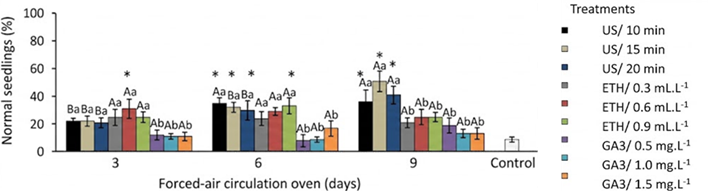
At 21 days (Figure 1), treatments combining ultrasound with forced-air oven drying at 50 °C for 6 and 9 days showed significant increases in normal seedlings compared to the control. Similar effects occurred with ethephon at 0.6 mL.L-1 after 3 days and 0.9 mL.L-1 after 6 days. For ultrasound, exposure time caused no statistically significant differences (p < 0.05) among drying periods, but nine days in the oven combined with 15-20 min of ultrasound yielded higher germination, with a 40% increase in normal seedlings relative to the control.
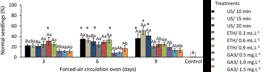
Percentage of normal seedlings obtained after dormancy-breaking treatments in forage peanut seeds. The periods of 3, 6, and 9 days correspond to the duration the seeds were kept in a forced-air oven at 50 °C, after which they were subjected to different ultrasound exposure times and concentrations of ethephon and gibberellic acid. Means followed by the same uppercase letter, when comparing each treatment across drying periods in the forced-air oven, and means followed by the same lowercase letter within each drying period, were grouped by the Scott-Knott procedure (5% probability). * Indicates a significant difference compared to the control, according to Dunnett›s test at a 5% probability level.
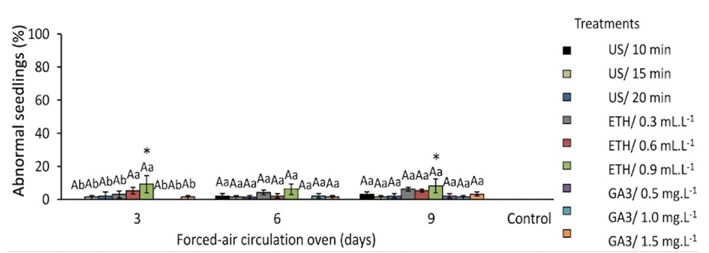
Average germination in treatments combining ultrasound with 6-9 days of oven drying ranged from 40-60%. Most of the seeds produced normal seedlings (Figure 1), and the phytotoxic effect resulting from the methods used was not reflected in the formation of abnormal seedlings (Figure 2); therefore, no significant difference was observed when compared with the control treatment.
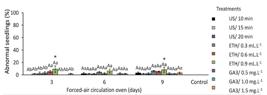
Percentage of abnormal seedlings obtained after dormancy-breaking treatments in forage peanut seeds. The periods of 3, 6, and 9 days correspond to the duration the seeds were kept in a forced-air oven at 50 °C, after which they were subjected to different ultrasound exposure times and concentrations of ethephon and gibberellic acid. Means followed by the same uppercase letter, when comparing each treatment across drying periods in the forced-air oven, and means followed by the same lowercase letter within each drying period, were grouped by the Scott-Knott procedure (5% probability). * indicates a significant difference compared to the control, according to Dunnett’s test at a 5% probability level.
For enzymatic analysis, all ultrasound treatments were selected due to their consistently high effectiveness (Table 1). For Ethephon and gibberellic acid, only the treatments showing the best and worst performance were chosen, in order to capture the range of biochemical responses and facilitate comparative analysis (Table 1).
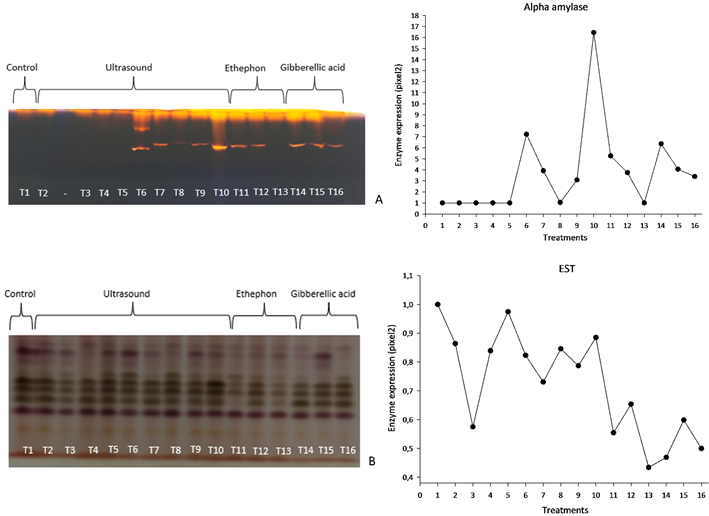
This effect may result from enhanced cell wall permeability and hydrolytic enzyme activation, such as α-amylase, induced by ultrasonic cavitation (Alfalahi et al., 2022). The zymogram (Figure 3A) confirms greater α-amylase activity in seeds dried for 9 days and exposed to ultrasound for 15-20 min, with the longest exposure showing the highest enzyme expression. These treatments also produced the greatest percentages of normal seedlings (Figure 1), similar to those observed after 10 min of exposure.
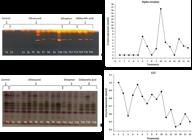
Patterns of α-amylase (A) and esterase (B) enzymes. The numbers correspond to the following treatments: 1 - Control, 2 - US/10 min, 3 days, 3 - US/15 min, 3 days, 4 - US/20 min, 3 days, 5 - US/10 min, 6 days, 6 - US/15 min, 6 days, 7 - US/20 min, 6 days, 8 - US/10 min, 9 days, 9 - US/15 min, 9 days, 10 - US/20 min, 9 days, 11 - ETH/0.6 mL.L-1, 3 days, 12 - ETH/0.6 mL.L-1, 6 days, 13 - ETH/0.6 mL.L-1, 9 days, 14 - GA₃, 1.0 mg.L-1, 3 days, 15 - GA₃, 1.0 mg L-1, 6 days, 16 - GA₃, 1.0 mg L-1, 9 days.
Dormancy reduction and increased shoot and root growth occurred in seeds subjected to longer oven and ultrasound exposure times (Figures 4-6). Lower α-amylase expression appeared in treatments with 10 min of ultrasound following 3-9 days of drying (T2-T5, T8), ethephon at 0.6 mL.L-1 after 9 days (T13), and the control (T1). In seeds dried for 9 days and treated with ethephon 0.6 mL.L-1 (T13), one isoform disappeared that had been present after 3 and 6 days (T11, T12). Although forage peanut seeds have low starch content, α-amylase still shows notable activity, as reserves are mobilized in the order carbohydrates, lipids and proteins, consistent with their approximately 40% lipid content (Zhao et al., 2018).
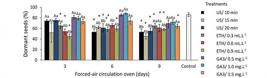
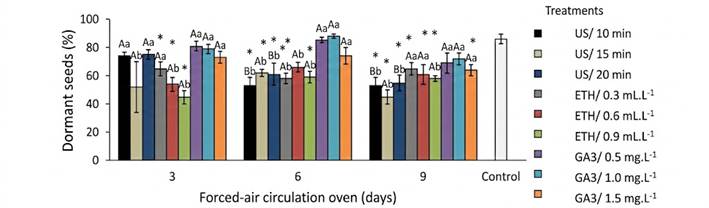
Percentage of dormant seeds obtained after dormancy-breaking treatments in forage peanut seeds. The periods of 3, 6, and 9 days correspond to the duration the seeds were kept in a forced-air oven at 50 °C, after which they were subjected to different ultrasound exposure times and concentrations of ethephon and gibberellic acid. Means followed by the same uppercase letter, when comparing each treatment across drying periods in the forced-air oven, and means followed by the same lowercase letter within each drying period, were grouped by the Scott-Knott procedure (5% probability). * indicates a significant difference compared to the control, according to Dunnett’s test at a 5% probability level.
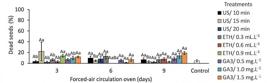
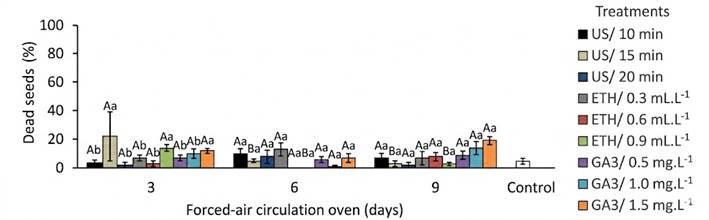
Percentage of dead seeds obtained after dormancy-breaking treatments in forage peanut seeds. The periods of 3, 6, and 9 days correspond to the duration the seeds were kept in a forced-air oven at 50 °C, after which they were subjected to different ultrasound exposure times and concentrations of ethephon and gibberellic acid. Means followed by the same uppercase letter, when comparing each treatment across drying periods in the forced-air oven, and means followed by the same lowercase letter within each drying period, were grouped by the Scott-Knott procedure (5% probability).* indicates a significant difference compared to the control, according to Dunnett’s test at a 5% probability level.
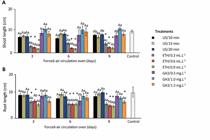
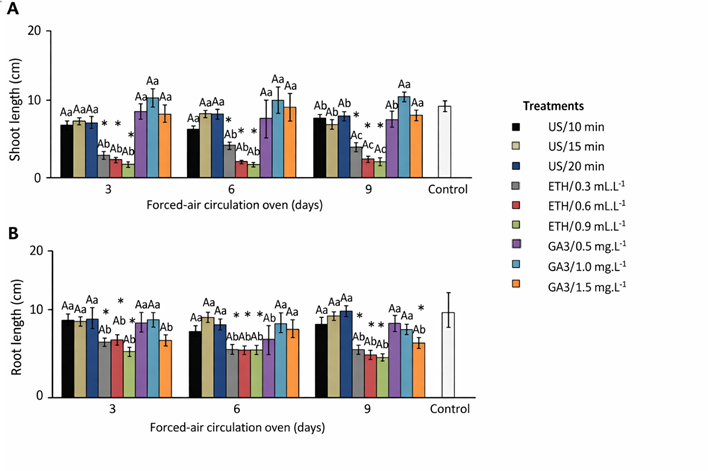
Length in centimeters of shoot (A) and root (B) of normal seedlings after dormancy-breaking treatments in forage peanut seeds. The periods of 3, 6, and 9 days correspond to the duration the seeds were kept in a forced-air oven at 50 °C, after which they were subjected to different ultrasound exposure times and concentrations of ethephon and gibberellic acid. Means followed by the same uppercase letter, when comparing each treatment across drying periods in the forced-air oven, and means followed by the same lowercase letter within each drying period, were grouped by the Scott-Knott procedure (5% probability).* indicates a significant difference compared to the control, according to Dunnett’s test at a 5% probability level.
Ultrasonic waves improve water and oxygen absorption, altering seed structure and enhancing germination (Nazari et al., 2014). The results of this study on α-amylase activity indicate that treatments enhancing enzymatic activity also promoted greater seedling vigor. Similarly, in maize, ultrasonic treatment at 20-40 kHz for 40 s increased germination. High-vigor seeds germinate more efficiently, with faster starch hydrolysis and reserve mobilization under saline stress, linked to elevated α-amylase and phytase activities (Sommer et al., 2024). Reduced α-amylase expression correlates with low seed quality (Oliveira et al., 2013; Timóteo and Marcos-Filho, 2013), whereas higher activity indicates greater vigor and germination (Lopes et al., 2017).
Ethephon (0.6 mL.L-1 after 3 days; 0.9 mL.L-1 after 6 days) increased germination by 20-40%, while the control remained below 10% (Figure 1). Magnani and Cardoso (2023) found a rise from 76 to 98% germination of dormant Melocactus zehntneri seeds using 24-h ethephon soaking, confirming its efficiency in dormancy breaking. However, in the present work, after 9 days in the oven, ethephon reduced normal seedlings, vigor, and esterase activity (Figure 3). This reduction may be associated with excessive ethylene release, which can accelerate senescence processes and disrupt membrane stability, leading to impaired lipid mobilization. As a result, enzymatic activity and seedling development are negatively affected.
Although GA₃ can promote dormancy release by altering the hormonal balance between gibberellins and abscisic acid, the impermeable seed coat likely limited its absorption. Consequently, even though GA₃ treatments exhibited high α-amylase activity (Figure 3), this enzymatic response was not sufficient to enhance germination. The restricted uptake of GA₃ probably prevented the hormone from reaching the embryo tissues where it stimulates reserve mobilization, resulting in incomplete activation of metabolic pathways required for seedling development, as also observed by Assis et al. (2018).
Dormancy levels in the control treatment exceeded 90%, higher than the 60-80% reported by Assis et al. (2013). Treatments with GA₃ showed no improvement, in agreement with Costa et al. (2011), who reported that storage was more effective than GA₃ or scarification for promoting germination of Urochloa humidicola (sin. Brachiaria humidicola) seeds. Among the treatments, ethephon was the only one to reduce dormancy in seeds dried for 3 days, whereas ultrasound applied to seeds dried for 9 days achieved the highest dormancy-breaking efficiency (Figure 4).
At 6 and 9 days of oven drying, ultrasound treatment for 15 minutes and ethephon both improved dormancy release without increasing seed mortality (Table 1 and Figure 5). However, seedling length data presented in Figure 6 showed reduced shoot and root growth under ethephon treatment. This effect may not indicate phytotoxicity but rather a physiological response to elevated ethylene levels. Excess ethylene can trigger the triple response, characterized by inhibited elongation of shoots and roots, radial swelling, and altered growth orientation, which collectively reduce apparent vigor (Khan et al., 2017).
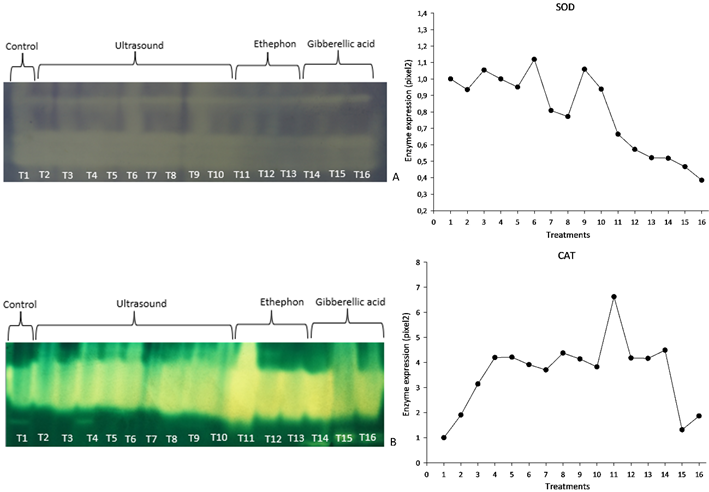
Consistent with these physiological responses, the superoxide dismutase (SOD) isoenzyme profile (Figure 7A) showed distinct responses among dormancy-breaking treatments, indicating that oxidative metabolism was differentially regulated during early germination. Seeds subjected to ultrasound treatments after 6 and 9 days of oven drying exhibited more intense activity compared with the control, suggesting an increase in reactive oxygen species production associated with enhanced respiratory activity. In this context, SOD plays a central regulatory role by maintaining redox homeostasis and preventing oxidative damage while still allowing the metabolic activation required for germination (Bailly, 2019). These results suggest that ultrasound promoted a controlled oxidative environment that supported metabolic reactivation without triggering deleterious stress responses.
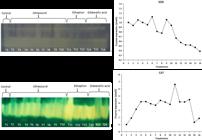
Patterns of superoxide dismutase (A) and catalase (B) enzymes in forage peanut seeds subjected to different treatments: 1 - Control, 2 - US/10 min, 3 days, 3 - US/15 min, 3 days, 4 - US/20 min, 3 days, 5 - US/10 min, 6 days, 6 - US/15 min, 6 days, 7 - US/20 min, 6 days, 8 - US/10 min, 9 days, 9 - US/15 min, 9 days, 10 - US/20 min, 9 days, 11 - ETH/0.6 mL.L-1, 3 days, 12 - ETH/0.6 mL.L-1, 6 days, 13 - ETH/0.6 mL.L-1, 9 days, 14 - GA₃, 1.0 mg.L-1, 3 days, 15 - GA₃, 1.0 mg.L-1, 6 days, 16 - GA₃, 1.0 mg.L-1, 9 days.
In contrast, seeds treated with ethephon maintained SOD activity, but a marked increase in catalase expression was observed (Figure 7B), indicating a stronger activation of antioxidant defenses, likely driven by ethylene-induced ROS signaling. Although ROS act as signaling molecules in dormancy release, an excessive antioxidant response may reflect the onset of stress conditions (Puglia, 2024). This interpretation is supported by the reduced seedling growth observed under these treatments. Together, these findings suggest that, under ethephon treatment, the redox balance may have shifted from regulated signaling toward a stress-associated response that ultimately constrained seedling development.
The association between antioxidant balance and seedling performance has also been reported in other species. Acila et al. (2024) observed that germinated seeds of Cucurbita pepo exposed to heavy metal stress showed reduced SOD activity in embryonic axis tissues, which negatively affected seedling growth and vigor. Despite the activation of antioxidant mechanisms, stress conditions limited seedling establishment. This evidence strengthens the interpretation that disturbances in antioxidant regulation are closely linked to subsequent seedling performance.
Treatments with gibberellic acid showed limited modulation of SOD activity, reinforcing the hypothesis that restricted hormone uptake due to seed pericarp impermeability impaired coordinated metabolic activation. The absence of expressive changes in antioxidant enzyme activity indicates that gibberellic acid did not effectively stimulate the oxidative metabolism required for dormancy release. The efficiency of dormancy-breaking treatments appears to be closely associated with the magnitude and regulation of oxidative metabolism activation during early germination.
Catalase activity (Figure 7B) increased with ethephon at 0.6 mL.L-1, reflecting enhanced reactive oxygen species (ROS) metabolism associated with ethylene signaling. This enzymatic response may result from ethylene-induced cell wall loosening and early senescence processes rather than direct oxidative stress (Souza et al., 2024). Similar ROS modulation was reported in sunflower seeds treated with ethephon (El-Maarouf-Bouteau et al., 2015).
Seeds treated with ultrasound after 6-9 days showed higher shoot and root mass than the control, particularly after 9 days of ultrasound for 15 minutes (Table 1 and Figure 6). In related studies, water absorption promoted by ultrasound has been shown to enhance enzymatic activity and seedling growth (Nazari et al., 2014). Both plasma-activated water (PAW), which is treated with cold plasma to increase reactive oxygen and nitrogen species, and ultrasound at 28 kHz for 5 minutes have been reported to enhance root development in soybean and improve germination and vigor in rice, respectively (Xia et al., 2020; Guragain et al., 2021).
Isoenzyme analyses revealed greater catalase activity in ethephon treatments, indicating more stress than with ultrasound or GA₃ (Figure 7B). Esterase activity varied by treatment, being lowest under ethephon and GA₃ but highest in T3 (3 days + 15 min ultrasound) (Table 1). Reduced esterase likely impaired lipid mobilization and energy supply (Figure 3). Similar responses under saline stress were seen in cotton, ultrasound promoted higher enzymatic activity and vigor (Sun et al., 2023) and canola (Ding et al., 2023).
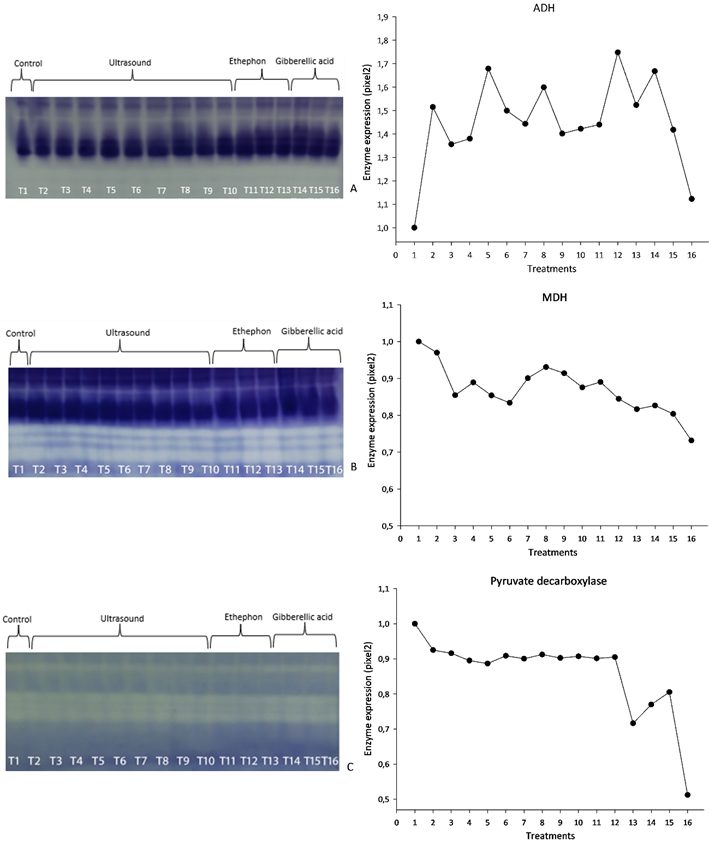
Zymograms (Figure 8) showed differential expressions of alcohol dehydrogenase (ADH), malate dehydrogenase (MDH), and pyruvate decarboxylase (PDC). ADH, which plays a key role in anaerobic ATP production, exhibited the lowest activity in the control (T1) and in seeds treated with GA₃ after 9 days of drying (T16), both treatments also showed reduced vigor. This enzyme is known to be induced under stress conditions or limited oxygen availability (Lim et al., 2023). MDH activity remained relatively stable among treatments, except for reduced expression in T16, consistent with the low germination observed in this treatment. PDC expression was also lowest in T16 (index 0.51 vs. 1.0 in control), indicating diminished anaerobic energy metabolism. During early germination, when oxygen availability is limited, PDC, ADH, and MDH contribute to maintaining ATP production and cellular redox balance. Specifically, PDC converts pyruvate into acetaldehyde, which is subsequently reduced to ethanol by ADH, regenerating NAD⁺ and allowing glycolysis to continue. Meanwhile, MDH participates in the malate-oxaloacetate shuttle, supporting energy homeostasis and metabolic recovery as aerobic respiration is gradually reestablished (Qu et al., 2020).
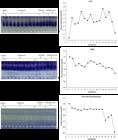
Patterns of alcohol dehydrogenase (A), malate dehydrogenase (B), and pyruvate decarboxylase (C) enzymes. The numbers correspond to the following treatments: 1 - Control, 2 - US/10 min, 3 days, 3 - US/15 min, 3 days, 4 - US/20 min, 3 days, 5 - US/10 min, 6 days, 6 - US/15 min, 6 days, 7 - US/20 min, 6 days, 8 - US/10 min, 9 days, 9 - US/15 min, 9 days, 10 - US/20 min, 9 days, 11 - ETH/0.6 mL.L-1, 3 days, 12 - ETH/0.6 mL.L-1, 6 days, 13 - ETH/0.6 mL.L-1, 9 days, 14 - GA₃, 1.0 mg.L-1, 3 days, 15 - GA₃, 1.0 mg.L-1, 6 days, 16 - GA₃, 1.0 mg.L-1, 9 days.
This study provides clear evidence that physical treatments, particularly ultrasound combined with 9 days of oven drying, effectively break dormancy and enhance both metabolic activity and seedling vigor in forage peanut. These findings underscore the potential of non-chemical strategies to improve seed quality, offering practical applications in seed technology and sustainable crop production.
Hormonal treatments, however, were constrained by seed coat permeability, and excessive ethylene from ethephon reduced seedling growth, emphasizing the critical role of treatment timing and dosage. Collectively, the results advance our understanding of the physiological and biochemical mechanisms underlying dormancy release and highlight promising approaches for optimizing seed performance. Future studies should evaluate these treatments under field conditions and explore their long-term effects on seedling establishment and crop yield.
CONCLUSIONS
Ultrasound applied after oven drying for 9 days (15 min exposure) was the most effective treatment for breaking dormancy and enhancing germination and seedling vigor in forage peanut seeds. Ethephon improved germination in a dose- and time-dependent manner, while GA₃ had limited effect. Ultrasound stimulated α-amylase and esterase activities, supporting reserve mobilization, whereas ethephon increased catalase activity without enhancing growth. Overall, physical treatments, particularly ultrasound after prolonged drying, more effectively modulate seed metabolism and dormancy release than hormonal treatments.
ACKNOWLEDGMENTS
The authors acknowledge CNPq, CAPES, and FAPEMIG for the financial support provided to the undergraduate and graduate students involved in this research.
This study was supported by the National Council for Scientific and Technological Development (CNPq) project 444587/2024; Coordination for the Improvement of Higher Education Personnel (CAPES); Minas Gerais Research Foundation (FAPEMIG), Federal University of Lavras (UFLA), Central Laboratory of Seed Research (Laboratório Central de Pesquisa em Sementes - LCPS) and the Graduate Program in Crop Science at the Federal University of Lavras (UFLA).
REFERENCES
-
ACILA, S.; DEROUICHE, S.; ALLIOUI N. Embryo growth alteration and oxidative stress responses in germinating Cucurbita pepo seeds exposed to cadmium and copper toxicity. Scientific Reports, v.14, n.1, p.8608, 2024. https://doi.org/10.1038/s41598-024-58635-1
» https://doi.org/https://doi.org/10.1038/s41598-024-58635-1 -
ALFALAHI, A.O.; ALOBAIDY, B.S.; ALMARIE, A.A.; DHANOON, O.M.; QASEM, J.R.; ALMEHEMDI, A.F.; NAJDA, A. Ultrasonic treatment enhances germination and affects antioxidant gene expression in soybean (Glycine max L. Merr). Agronomy, v.12, n.10, p.2446, 2022. https://doi.org/10.3390/agronomy12102446
» https://doi.org/https://doi.org/10.3390/agronomy12102446 - ALFENAS, A.C. Eletroforese e marcadores bioquímicos em plantas e microrganismos Viçosa: UFV, v.1., p.627, 2006.
-
ARAÚJO, A.E.S.; CASTRO, A.P.G.; ROSSETTO, C.A.V. Avaliação de metodologia para detecção de fungos em sementes de amendoim. Revista Brasileira de Sementes, v.26, p.45-54, 2004. https://doi.org/10.1590/S0101-31222004000200007
» https://doi.org/https://doi.org/10.1590/S0101-31222004000200007 -
ASSIS, G.M.L.; KRZYZANOWSKI, F.C.; AZEVEDO, H.N. Superação de dormência em sementes de amendoim forrageiro cv. BRS Mandobi. Circular Técnica 70, p.7, 2018. Embrapa https://www.infoteca.cnptia.embrapa.br/infoteca/bitstream/doc/1036738/1/25922.pdf
» https://www.infoteca.cnptia.embrapa.br/infoteca/bitstream/doc/1036738/1/25922.pdf -
ASSIS, G.M.L.; KRZYZANOWSKI, F.C.; VERZIGNASSI, J.R.; VALENTIM, J.F. Viabilidade de sementes de Arachis pintoi Comunicado Técnico 124, 2012. Embrapa https://www.infoteca.cnptia.embrapa.br/infoteca/bitstream/doc/942648/1/CT124.pdf
» https://www.infoteca.cnptia.embrapa.br/infoteca/bitstream/doc/942648/1/CT124.pdf -
ASSIS, G.; SILVA, R.; AZEVEDO, H. Período para condução do teste de germinação em sementes de amendoim forrageiro (Arachis pintoi). EMBRAPA Acre, p.1, 2013. https://www.embrapa.br/busca-de-publicacoes/-/publicacao/971399/periodo-para-conducao-do-teste-de-germinacao-em-sementes-de-amendoim-forrageiro-arachis-pintoi
» https://www.embrapa.br/busca-de-publicacoes/-/publicacao/971399/periodo-para-conducao-do-teste-de-germinacao-em-sementes-de-amendoim-forrageiro-arachis-pintoi -
BAILLY, C. The signalling role of ROS in the regulation of seed germination and dormancy. Biochemical Journal, v.76, n.20, p.3019-3032, 2019. https://doi.org/10.1042/BCJ20190159
» https://doi.org/https://doi.org/10.1042/BCJ20190159 -
BRASIL. Regras para Análise de Sementes (RAS) Ministério da Agricultura e Pecuária - MAPA, Brasília, 2025. https://wikisda.agricultura.gov.br/pt-br/Laborat%C3%B3rios/Metodologia/Sementes/RAS_2025/Amostragem
» https://wikisda.agricultura.gov.br/pt-br/Laborat%C3%B3rios/Metodologia/Sementes/RAS_2025/Amostragem -
CARVALHO, A.M.X.D.; MENDES, F.Q.; MENDES, F.Q.; TAVARES, L.D.F. SPEED Stat: a free, intuitive, and minimalist spreadsheet program for statistical analyses of experimentsBLE]. Crop Breeding and Applied Biotechnology, v.20, n.3, 2020. https://doi.org/10.1590/1984-70332020v20n3s46.
» https://doi.org/https://doi.org/10.1590/1984-70332020v20n3s46 -
CARVALHO, J.; CASTRO, J.P.; FURTADO, C.M.; SUASSUNA, T.M.F.; SANTOS, J.W.; SILVA SANTOS, T. Regeneração de germoplasma de amendoim (Arachis hypogea) in vitro. Embrapa Algodão, Comunicado Técnico 237, p. 4, 2005. https://www.infoteca.cnptia.embrapa.br/infoteca/handle/doc/275959
» https://www.infoteca.cnptia.embrapa.br/infoteca/handle/doc/275959 -
CORBINEAU, F.; XIA, Q.; BAILLY, C.; EL-MAAROUF-BOUTEAU, H. Ethylene, a key factor in the regulation of seed dormancy. Frontiers in Plant Science, v.5, p.539, 2014. https://doi.org/10.3389/fpls.2014.00539
» https://doi.org/https://doi.org/10.3389/fpls.2014.00539 -
COSTA, C.J.; ARAÚJO, R.B.; VILLAS BÔAS, H.D.C. Tratamentos para a superação de dormência em sementes de Brachiaria humidicola (Rendle) Schweick. Pesquisa Agropecuária Tropical, v.41, p.519-524, 2011. https://doi.org/10.5216/pat.v41i4.15100
» https://doi.org/https://doi.org/10.5216/pat.v41i4.15100 -
DING, Y.; XING, L.; XU, J.; JIANG, T.; TANG, X.; WANG, Y.; HUANG, S.; HAO, W.; ZHOU, X.; ZHANG, Y. Genome-wide exploration of the GDSL-type esterase/lipase gene family in rapeseed reveals several BnGELP proteins active during early seedling development. Frontiers in Plant Science , v.14, p.1139972, 2023. https://doi.org/10.3389/fpls.2023.1139972
» https://doi.org/https://doi.org/10.3389/fpls.2023.1139972 -
DUNNETT, C. W. A Multiple comparison procedure for comparing several treatments with a control. Journal of the American Statistical Association, v.50, n.272, p.1096-1121, 1955. https://doi.org/10.1080/01621459.1955.10501294.
» https://doi.org/https://doi.org/10.1080/01621459.1955.10501294 -
EL-MAAROUF-BOUTEAU, H.; SAJJAD, Y.; BAZIN, J.; LANGLADE, N.; CRISTESCU, S.M.; BALZERGUE, S.; BAUDOUIN, E.; BAILLY, C. Reactive oxygen species, abscisic acid and ethylene interact to regulate sunflower seed germination. Plant, Cell & Environment, v.38, n.2, p.364-374, 2015. https://doi.org/10.1111/pce.12371.
» https://doi.org/https://doi.org/10.1111/pce.12371 -
GAO, Y.; ZHU, M.; MA, Q.; LI, S. Dormancy breakage in Cercis chinensis seeds. Canadian Journal of Plant Science, v.100, n.6, p.666-673, 2020. https://doi.org/10.1139/cjps-2019-0229
» https://doi.org/https://doi.org/10.1139/cjps-2019-0229 -
GONG, M.; KONG, M.; HUO, Q.; HE, J.; HE, J.; YAN, Z.; LU, C.; JIANG, Y.; SONG, J.; HAN, W.; LV, G. Ultrasonic treatment can improve maize seed germination and abiotic stress resistance. BMC Plant Biology, v.24, n.1, 2024. https://doi.org/10.1186/s12870-024-05474-x.
» https://doi.org/https://doi.org/10.1186/s12870-024-05474-x -
GURAGAIN, R.P.; PRADHAN, S. P.; BANIYA, H.B.; PANDEY, B.P.; BASNET, N.; SEDHAI, B.; DHUNGANA, S.; CHHETRI, G.K.; JOSHI, U.M.; SUBEDI, D.P. Impact of Plasma-Activated Water (PAW) on Seed Germination of Soybean. Journal of Chemistry, v. 2021, p.1-12, 2021. https://doi.org/10.1155/2021/7517052.
» https://doi.org/https://doi.org/10.1155/2021/7517052 -
HUANG, S.; ASHRAF, U.; DUAN, M.; REN, Y.; XING, P.; YAN, Z.; TANG, X. Ultrasonic seed treatment improved seed germination, growth, and yield of rice by modulating associated physio-biochemical mechanisms. Ultrasonics Sonochemistry, v.104, p.106821, 2024. https://doi.org/10.1016/j.ultsonch.2024.106821.
» https://doi.org/https://doi.org/10.1016/j.ultsonch.2024.106821 -
KHAN, N.A.; KHAN, M.I.R.; FERRANTE, A.; POOR, P. Ethylene: a key regulatory molecule in plants. Frontiers in Plant Science , v.8, p.1782, 2017. https://doi.org/10.3389/fpls.2017.01782
» https://doi.org/https://doi.org/10.3389/fpls.2017.01782 - KRZYZANOWSKI, F.C.; VIEIRA, R.D.; FRANÇA-NETO, J.B.; MARCOS-FILHO, J. (Eds.). Vigor de sementes: conceitos e testes Londrina: Abrates, 2020. 601p.
-
LIM, J.M.; JUNG, S.; IN, J.S.; PARK, Y.I.; JEONG, W.J. Heterologous overexpression of the cyanobacterial alcohol dehydrogenase sysr1 confers cold tolerance to the oleaginous alga Nannochloropsis salina Frontiers in Plant Science , v.14, 2023. https://doi.org/10.3389/fpls.2023.1045917
» https://doi.org/https://doi.org/10.3389/fpls.2023.1045917 -
LOPES, C.A.; DE CARVALHO, M.L.M.; SANTOS, H.O.; DE ANDRADE, D.B. Importance of amylases for physiological quality in maize seeds. Biotemas, v.30, n.3, p.1-7, 2017. http://dx.doi.org/10.5007/2175-7925.2017v30n3p1
» https://doi.org/http://dx.doi.org/10.5007/2175-7925.2017v30n3p1 -
MAGNANI, M.F.C.; CARDOSO, J.C. Light and ethephon overcoming seed dormancy in friar’s crown (Melocactus zehntneri, Cactaceae), a Brazilian Cactus. Plants, v.12, n.24, p.4127, 2023. https://doi.org/10.3390/plants12244127
» https://doi.org/https://doi.org/10.3390/plants12244127 -
NAZARI, M.; SHARIFIFAR, A.; ASGHARI, H. R. Medicago Scutellata seed dormancy breaking by ultrasonic waves. Plant Breeding and Seed Science, v.69, n.1, p.15-24, 2014. https://doi.org/10.1515/plass-2015-0002.
» https://doi.org/https://doi.org/10.1515/plass-2015-0002 -
OLIVEIRA, G.E.; PINHO, R.G.V.; ANDRADE, T.; PINHO, É.V.R.V.; SANTOS, C.D.; VEIGA, A.D. Qualidade fisiológica e expressão das enzimas amilases em sementes de milho. Ciência e Agrotecnologia, v.37, p.40-48, 2013. https://doi.org/10.1590/S1413-70542013000100005
» https://doi.org/https://doi.org/10.1590/S1413-70542013000100005 -
PUGLIA, G.D. Reactive oxygen and nitrogen species (RONS) signalling in seed dormancy release, perception of environmental cues, and heat stress response. Plant Growth Regulation, v.103, p.9-32, 2024. https://doi.org/10.1007/s10725-023-01094-x
» https://doi.org/https://doi.org/10.1007/s10725-023-01094-x -
QU, C.; ZHANG, S.; ZHAO, H.; CHEN, J.; ZUO, Z.; SUN, X.; CHENG, Y.; XU, Z.; LIU, G. Analysis of the energy source at the early stage of poplar seed germination: verification of Perl’s pathway. 3 Biotech, v.10, n.10, p.418, 2020. https://doi.org/10.1007/s13205-020-02413-z.
» https://doi.org/https://doi.org/10.1007/s13205-020-02413-z -
ROSSETTO, C.A.V.; ALVES, E.P. Tratamentos pré-germinativos em sementes de Arachis pintoi Ciência e Agrotecnologia , v.32, p.174-179, 2008. https://doi.org/10.1590/S1413-70542008000100025.
» https://doi.org/https://doi.org/10.1590/S1413-70542008000100025 -
SCHNEIDER, C.A.; RASBAND, W.S.; ELICEIRI, K.W. NIH Image to ImageJ: 25 years of image analysis. Nature Methods, v.9, n.7, p.671-675, 2012. https://doi.org/10.1038/nmeth.2089.
» https://doi.org/https://doi.org/10.1038/nmeth.2089 -
SILVA, R.C.; CASTRILLON, S.K.I.; FERNANDEZ, J.R.C.; DE MORAIS, F.F.; MORINI, A.A.E.T.; SILVA-NUNES, J. R. Overcoming dormancy in seeds of Pterodon pubescens (Benth.) Benth.(Leguminosae, Papilionoideae). Research, Society and Development, v.10, n.1, p.e3221019144, 2021. https://doi.org/10.33448/rsd-v10i1.9144
» https://doi.org/https://doi.org/10.33448/rsd-v10i1.9144 -
SOMMER, Â.S.; COELHO, C.M.M.; PADILHA, M.S.; NERLING, D. Hydrolytic enzyme activity (phytase and α-amylase) is decisive in the germination metabolism of maize seeds under salt stress. Ciência e Agrotecnologia , v.48, p.e003224, 2024. https://doi.org/10.1590/1413-7054202448003224
» https://doi.org/https://doi.org/10.1590/1413-7054202448003224 -
SOUZA, A.C.D.; COSTA, M.C.; FIGUEIREDO, M.A.D.; PEREIRA, C.C.; COELHO, S.V.B.; VILELA, A.L.O.; PEREIRA, D.D.S.; ROSA, S.D.V.F. Steps of cryopreservation of coffee seeds: physiological responses and antioxidant systems. Ciência Rural, v.54, n.2, 2024. http://doi.org/10.1590/0103-8478cr20220480
» https://doi.org/http://doi.org/10.1590/0103-8478cr20220480 -
SOUZA, F.H.D.D.; ASSIS, G.M.L.D.; VALENTIN, J.F.; CAVARIANI, C. Longevity of Arachis pintoi cv. BRS Mandobi seeds stored under different conditions. Journal of Seed Science, v.39, n.3, p.288-296, 2017. https://doi.org/10.1590/2317-1545v39n3179562.
» https://doi.org/https://doi.org/10.1590/2317-1545v39n3179562 -
SUN, K.; MEHARI, T.G.; FANG, H.; HAN, J.; HUO, X.; ZHANG, J.; CHEN, Y.; WANG, D.; ZHUANG, Z.; DITTA, A. Transcriptome, proteome and functional characterization reveals salt stress tolerance mechanisms in upland cotton (Gossypium hirsutum L.). Frontiers in Plant Science , v.14, p.1092616, 2023. https://doi.org/10.3389/fpls.2023.1092616
» https://doi.org/https://doi.org/10.3389/fpls.2023.1092616 - TAIZ, L.; ZEIGER, E.; MOLLER, I.M.; MURPHY, A. Fisiologia e Desenvolvimento Vegetal 7th ed. [S. l.]: Artmed, p. 818, 2024.
-
TIMÓTEO, T.S.; MARCOS-FILHO, J. Seed performance of different corn genotypes during storage. Journal of Seed Science , v.35, p.207-215, 2013. https://www.scielo.br/j/jss/a/GnMRvGyQqdCxr5gvddDMxjm/
» https://www.scielo.br/j/jss/a/GnMRvGyQqdCxr5gvddDMxjm/ -
VENÂNCIO, R.S.D.S.; MARTINS, A.C.G. Overcoming dormancy of Senna multijuga seeds with an ultrasonic probe the comparison with ultrasound and sulfuric acid baths. Ciência Rural , v.49, n.9, 2019. https://doi.org/10.1590/0103-8478cr20180904.
» https://doi.org/https://doi.org/10.1590/0103-8478cr20180904 -
XIA, Q.; TAO, H.; LI, Y.; PAN, D.; CAO, J.; LIU, L.; ZHOU, X.; BARBA, F.J. Characterizing physicochemical, nutritional and quality attributes of wholegrain Oryza sativa L. subjected to high intensity ultrasound-stimulated pre-germination. Food Control, v.108, p.106827, 2020. https://doi.org/10.1016/j.foodcont.2019.106827
» https://doi.org/https://doi.org/10.1016/j.foodcont.2019.106827 -
ZHAO, M.; ZHANG, H.; YAN, H.; QIU, L.; BASKIN, C.C. Mobilization and role of starch, protein, and fat reserves during seed germination of six wild grassland species. Frontiers in Plant Science , n.9, p.234, 2018. https://doi.org/10.3389/fpls.2018.00234
» https://doi.org/https://doi.org/10.3389/fpls.2018.00234
There is no additional data; it has all been presented in this file.