 Timing of herbicide application during reproductive stages affects seed quality and storability in Enlist® soybean crops
ABSTRACT:
Herbicide applications during field production may affect crop performance even in genetically tolerant cultivars. Among the potential effects, impacts on seed physiological quality particularly under seed production systems-remain poorly understood. The objective of this study was evaluate the effects of post-emergence herbicide applications at different reproductive stages on the physiological quality and storability of Enlist® soybean seeds, tolerant to glyphosate, 2,4-D and ammonium glufosinate. A field trial was conducted using a randomized complete block design with three replications in a 3 × 5 + 1 factorial scheme: three herbicides (glyphosate, 2,4-D and ammonium glufosinate) applied at five reproductive stages (R2, R4, R5, R6 and R7), plus an untreated control. Seed quality was evaluated using germination, accelerated aging and electrical conductivity tests, conducted both before and after 6 months of storage. Applications of these herbicides in the early reproductive (R2 and R4) resulted in less deterioration of seed physiological quality, whereas later applications (R5 and R7) were associated with significant quality deterioration deterioration, even in tolerant cultivars. These findings underscore the critical importance of proper herbicide timing to safeguard seed vigor and enhance storability in herbicide-tolerant soybean systems.
Index terms:
herbicide-tolerant; phytotoxicity; seed production; vigor; weed management
RESUMO:
Aplicações de herbicidas durante a produção em campo podem afetar o desempenho da cultura, mesmo em cultivares geneticamente tolerantes. Entre os potenciais efeitos, os impactos na qualidade fisiológica das sementes, particularmente em sistemas de produção de sementes, permanecem pouco compreendidos. O objetivo do estudo foi avaliar os efeitos da aplicação de herbicidas pós-emergência em diferentes estágios reprodutivos sobre a qualidade fisiológica e a armazenabilidade de sementes de soja Enlist®, tolerante a glifosato, 2,4-D e glufosinato de amônio. Um ensaio de campo foi conduzido usando um delineamento em blocos casualizados com três repetições em um esquema fatorial 3 × 5 + 1: três herbicidas (glifosato, 2,4-D e glufosinato de amônio) aplicados em cinco estágios reprodutivos (R2, R4, R5, R6 e R7), além de um controle sem aplicação. A qualidade das sementes foi avaliada usando testes de germinação, envelhecimento acelerado e condutividade elétrica, conduzidos antes e após 6 meses de armazenamento. Aplicações desses herbicidas nos estádios reprodutivos iniciais (R2-R4) levaram a uma menor deterioração da qualidade fisiológica das sementes, enquanto aplicações tardias (R5-R7) foram associadas a uma deterioração significativa da qualidade. Esses resultados ressaltam a importância do momento adequado da aplicação de herbicidas para proteger o vigor das sementes e aumentar a capacidade de armazenamento em sistemas de soja tolerantes a herbicidas.
Termos para indexação:
tolerância a herbicidas; fitotoxicidade; produção de sementes; vigor; controle de plantas daninhas
INTRODUCTION
Soybeans are among the economically important crops in Brazilian agriculture, the main source of foreign exchange generation through exports. This status currently places Brazil as one of the leading soybean producers, notable as the largest exporter of this grain (USDA, 2025).
One of the key factors driving the increase in soybean production in Brazil is the adoption of modern biotechnological tools by farmers, particularly genetically modified cultivars with tolerance to specific herbicides, which facilitate weed control. A notable example is the widespread adoption of Roundup Ready (RR) soybeans, which have become essential for managing production systems and improving productivity. However, the intensive use of herbicides with the same mechanism of action has exerted strong selection pressure on weed populations, resulting in the emergence of resistant biotypes. This scenario has prompted the development of modern technologies and alternative management strategies, including cultivars with stacked traits conferring tolerance to different herbicide molecules, such as the Enlist® soybean system, which combines tolerance to glyphosate, 2,4-D and ammonium glufosinate (Duenk et al., 2023; Singh et al., 2025). These multi-tolerant cultivars expand rotation possibilities, improve weed control and contribute to delaying resistance evolution when integrated into diversified management programs (Yadav et al., 2023).
Although Enlist® technology expands herbicide rotation and improves weed control, the effects of herbicide applications during reproductive stages on seed physiological quality remain poorly understood, particularly in seed production systems. Recent studies have evaluated the selectivity of herbicides in Enlist® soybeans primarily during vegetative stages (V3-V6), showing minimal phytotoxicity and no yield losses when recommended doses are used (Garcia et al., 2020; Oliveira et al., 2024; Singh et al., 2025). However, the effects on seed quality when herbicides are applied during reproductive stages remain understudied. To date, most studies have focused on applications at late reproductive stages with the specific objective of pre-harvest desiccation (Botelho et al., 2019; Zuffo et al., 2020; Albrecht et al., 2022), in which herbicides are intentionally applied to accelerate plant senescence and promote uniform harvest maturity. In these desiccation studies, the use of desiccant herbicides frequently reduced germination and vigor when applied before physiological maturity in RR soybeans. In Enlist® soybeans, applications during vegetative stages did not cause phytotoxicity, without losses in yield or seed quality (Garcia et al., 2020).
Recent advances in Enlist® soybean technology have generated increasing interest in understanding the effects of herbicides on seed production systems. Ferreira et al. (2025) evaluated the tolerance of Conkesta E3® soybeans to increasing doses of 2,4-D, confirming the genetic tolerance of these cultivars while also highlighting potential sub-lethal effects that warrant investigation in seed production contexts.
Therefore, considering the recent adoption of Enlist® cultivars in the Brazilian production system, understanding the effects of herbicides recommended for this technology is essential not only for maintaining crop productivity but especially for ensuring seed quality in seed production fields. Unlike previous studies focused on pre-harvest desiccation applications, this study aimed to evaluate the effects of post-emergence herbicide applications as part of weed control programs at different reproductive stages (R2-R7) on the physiological quality and storability of Enlist® soybean seeds. We hypothesize that herbicide applications during critical seed development periods (R5-R6) result in greater seed quality deterioration than earlier applications (R2-R4), even in genetically tolerant cultivars.
MATERIAL AND METHODS
The experiment was conducted at the Centro de Desenvolvimento e Transferência de Tecnologia (CDTT) of the Universidade Federal de Lavras, in Ijaci, MG, Brazil, latitude 21°C 9’24’’ S, longitude 44°C 55’34’’ W and 832 m above sea level. The climate is classified as Cwa, according to the Köppen (1936) climate classification. Seed quality analyses were performed at the Laboratório Central de Análise de Sementes, ESAL, UFLA, Lavras, MG, Brazil.
Soybean seeds from the cultivar B5710 CE were used, relative maturity degree 7.1, indeterminate growth type, with Conkesta E3® biotechnology that includes genes for expressing two Bt proteins (Cry1F and Cry1Ac), providing resistance to insects and genes for tolerance to three herbicide active ingredients (AI): glyphosate, 2,4-D and ammonium glufosinate.
The seeds were treated with the fungicide Maxim Advanced® (100 mL per 100 kg-1 of seeds) and the insecticides Cruiser 350 FS® (200 mL per 100 kg-1 of seeds) and Fortenza 600 FS® (60 mL per 100 kg-1 of seeds), polymer (100 mL per 100 kg-1 of seeds) and drying powder (100 g per 100 kg-1 of seeds).
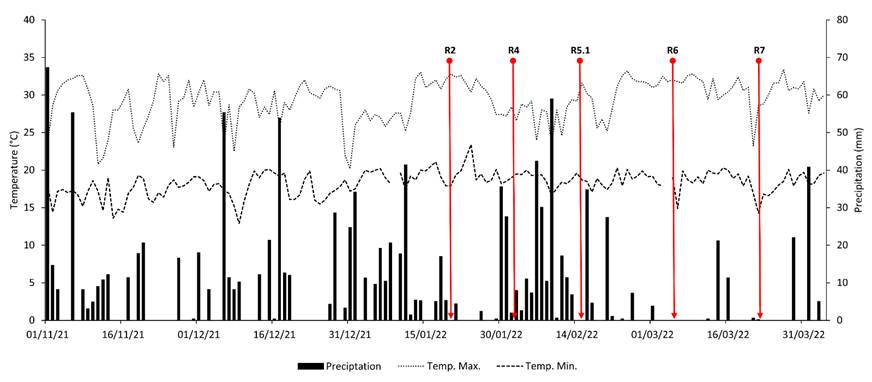
Soil preparation consisted of two harrowings, and furrows for sowing were opened using mechanized traction. Sowing was performed on November 12, 2021, manually, followed by thinning to adjust the stand to 16 plants per linear meter, totaling 320,000 plants.ha-1. At the time of sowing, the seeds were inoculated with Bradyrhizobium japonicum (Nitragin Cell Tech®), at a dose of 200 mL per 100 kg-1 of seed (SEMIA 5079 and 5080 strains, concentration of 3 x 10⁹.mL-1). The soil of the experimental area is classified as Typic Red Latosol (Embrapa, 2018) and fertilization was conducted according to soil analysis and crop recommendations by Ribeiro et al. (1999), applying 120 kg of P₂O₅, 40 kg of K₂O and 2 kg of boron at sowing. Temperature and precipitation data for the season are shown in Figure 1.

Precipitation and maximum and minimum temperature patterns during the experimental period (November 12, 2021, to March 29, 2022), in Ijaci, Minas Gerais, Brazil, 2021-2022 growing season.
The experimental plots consisted of four plant rows, each 5 m long, spaced 0.5 m apart. The two outer rows served as borders and the two central rows constituted the usable lines, totaling 10 m² per plot, with 5 m² as the usable area. A randomized complete block design with three replications was used, comprising a factorial 3 × 5 + 1, with three different herbicides (glyphosate, 2,4-D, ammonium glufosinate) applied at five phenological stages (R2, R4, R5.1, R6 and R7) and an additional control treatment without herbicide application.
Weed control before sowing and during vegetative stages was standardized across all plots. Pre-seeding application included the herbicide Heat® - saflufenacil 700 g.kg-1 (28 g of AI.ha-1) 10 days before planting. Post-emergence at the V3 stage was conducted using Roundup Original® herbicide - glyphosate 356 g.kg-1 (1.246 g of acid equivalent (a.e.) ha-1).
The herbicides used in applications during reproductive stages were: Nufosate® - glyphosate isopropylamine salt 360 g.kg-1, at a rate of 1.080 kg of a.e. ha-1, Colex-D® - 2,4-D choline salt 456 g.L-1, at a rate of 1.368 L a.e. ha-1 and Fascinate Br® - ammonium glufosinate 200 g.L-1, at a rate of 600 g AI.ha-1, all mixed with 0.5 L.ha-1 of Assist® mineral oil. Applications were conducted using a CO2-powered backpack sprayer operated at constant pressure, equipped with XR110002-VP nozzles, at a pressure of 2.0 kgf.cm-2 and a spray volume of 150 L.ha-1. These herbicides were applied individually and only once, using a physical barrier to prevent drift to adjacent plots. The applications were made at the reproductive stages: R2 - full bloom, R4 - fully developed pod, R5 - beginning of seed formation, R6 - full seed, R7 - beginning of maturation (Fehr et al., 1971; Embrapa, 2020). The precipitation and temperature patterns recorded during the field experimental period are shown in Figure 1.
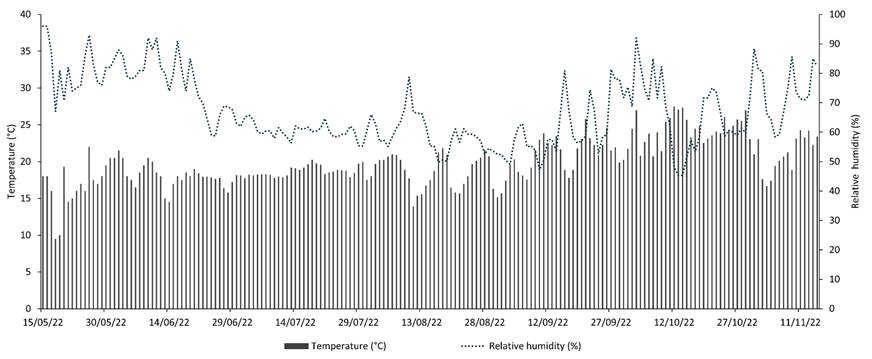
Harvest was conducted manually when the seeds reached 15% moisture content (wb), on April 4, 2022. Subsequently, natural drying (sun drying) was performed until the seeds reached approximately 13% moisture content (wb). Seed processing was done manually, followed by packaging in multi-layer paper bags with a capacity of 5 kg. A portion of the seeds was used for quality analysis immediately after processing, while another portion was stored for six months at the Seed Conditioning Unit (UBS) of UFLA, under uncontrolled temperature and local relative humidity conditions. Storage occurred between the second half of May and November 2022, with environmental conditions monitored using a data logger placed among the packages (Figure 2).
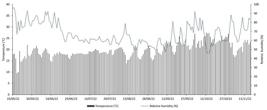
Temperature (°C) and relative humidity (%) monitored by a data logger during the storage period at the Universidade Federal de Lavras, Lavras, MG, Brazil.
Seed physiological quality was assessed using germination, first germination count, accelerated aging, electrical conductivity and seed moisture content tests. Field plots were used as replicates, each comprising two subsamples, totaling six replications per treatment.
Moisture content, germination and first germination count were determined according to the Rules for Seed Testing (Brasil, 2025) and the results were expressed as the percentage of normal seedlings. Accelerated aging was conducted following Marcos-Filho (2020), with seeds arranged in a single layer in plastic boxes containing 40 mL of water, at 42 °C for 48 h, after which the seeds were subjected to the germination test as described above. Electrical conductivity was determined according to Vieira and Marcos-Filho (2020), the seed samples were weighed and immersed in 75 mL of deionized water at 25 °C for 24 h and the readings obtained with a conductivity meter were expressed in μS.cm⁻¹.g⁻¹. Seed moisture content was determined using the oven method at 105 °C for 24 h and the results were expressed as a percentage.
Statistical analyses were conducted separately before storage and after six months of storage.
Statistical analyses were performed using R® software with the ‘Tratamentos.ad’ package (Azevedo, 2022). Analysis of variance was performed using the F-test and means were compared using the Scott-Knott test to compare the factorial design and Dunnett’s test was used to compare the additional control with the other treatments, at a 5% significance level.
RESULTS AND DISCUSSION
For moisture content, with an average of 11.36%, no source of variation had a significant influence.
It is important to emphasize that our study differs fundamentally from research on pre-harvest desiccation. While desiccation studies intentionally apply herbicides at late reproductive stages (typically R6-R8) to accelerate plant senescence and standardize ripening at harvest (Zuffo et al., 2020; Albrecht et al., 2022), our research evaluates herbicide applications during the reproductive period (R2-R7) as part of standard post-emergence weed control programs. Despite these different objectives and application times, both approaches share common concerns about the deterioration of seed quality when herbicides are applied during sensitive developmental stages. Recent research with Enlist® soybeans has demonstrated good herbicide selectivity during vegetative phases (Garcia et al., 2020; Oliveira et al., 2024), but information on applications during the reproductive phase is still limited, particularly regarding the physiological quality and storability of the seeds.
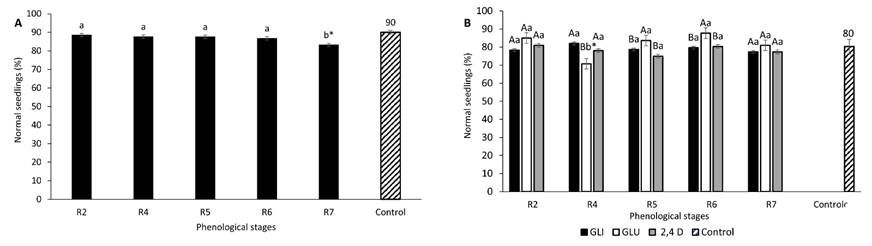
For the germination, considering the interaction between plant developmental stages and herbicides, lower seed germination values were observed when 2,4-D and ammonium glufosinate were applied at the R6 stage. For the other treatments, no differences were observed (Figure 3 A). No differences were detected between any treatment and the untreated control. These results indicate that herbicide applications during the reproductive stages of Enlist® soybeans do not affect seed viability immediately after harvest.
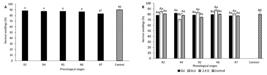
Results of the germination test (A) and first germination count (B) of soybean seeds produced under applications of glyphosate (GLI), 2,4-D and ammonium glufosinate (GLU) at different reproductive stages. Means followed by the same uppercase letter among herbicides within the same phenological stage and by the same lowercase letter among phenological stages for the same herbicide do not differ significantly according to the Scott-Knott test at the 5% significance level. *Indicates a difference from the control according to Dunnett’s test at the 5% significance level. Error bars represent the standard error of the mean.
For the first germination count, glyphosate application resulted in the lowest vigor values at the R5 stage. For ammonium glufosinate, the lowest values were at R2, R5, R6 and R7, whereas for 2,4-D, the lowest values were at R4 and R6 (Figure 3B).
Comparable results were reported by Castilho and Lazarette (2023) who evaluated the application of glyphosate at different phenological stages (R5, R6 and R7). They observed no effects on the germination of RR soybean seeds; however, vigor was affected and on average, and overall yield was considered adequate.
Compared to the control, seed vigor in the first germination count test was not affected by applications of ammonium glufosinate and 2,4-D. However, seed vigor was reduced when glyphosate was applied at the R5 stage, with a 17.33% decrease in normal seedlings at five days after sowing compared to the control (Figure 3B).
Thus, a detrimental effect of glyphosate at this reproductive stage on seed quality is inferred, even in glyphosate-tolerant cultivars such as those carrying the Enlist® trait. Albrecht et al. (2011) demonstrated changes in the chemical composition of RR soybean seeds, including alterations in protein content, associated with glyphosate application during the reproductive period. Complementary evidence from Silva et al. (2018) indicates that, although second-generation glyphosate-tolerant soybeans (IPRO, containing cp4-EPSPS and cry1Ac genes) exhibit higher tolerance to post-emergence applications, physiological seed quality may still be affected depending on the dose and timing of herbicide use. More recently, Moraes et al. (2024) demonstrated that glyphosate exposure alters seedling morphology and exerts mitodepressive effects on the cell cycle, even in tolerant cultivars, highlighting that the herbicide can compromise seedling development at both macroscopic and cytogenetic levels.
Albrecht et al. (2022) observed that the application of ammonium glufosinate and diquat-based herbicides for pre-harvest desiccation before physiological maturity negatively affected the seed quality of RR soybeans. Although their study focused on pre-harvest desiccation, rather than weed control, the pattern of seed quality deterioration with applications at reproductive stages is consistent with our results in Enlist® soybean, in which applications at stages R5 and R6 also resulted in reduced seed vigor.
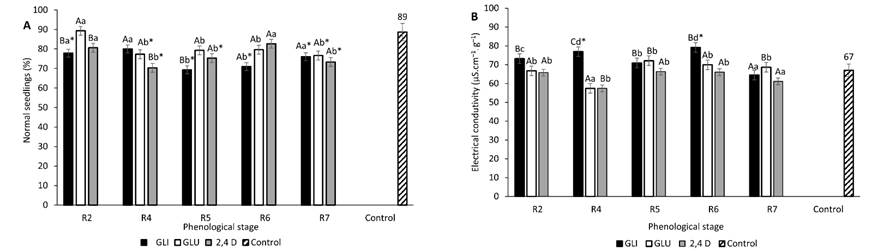
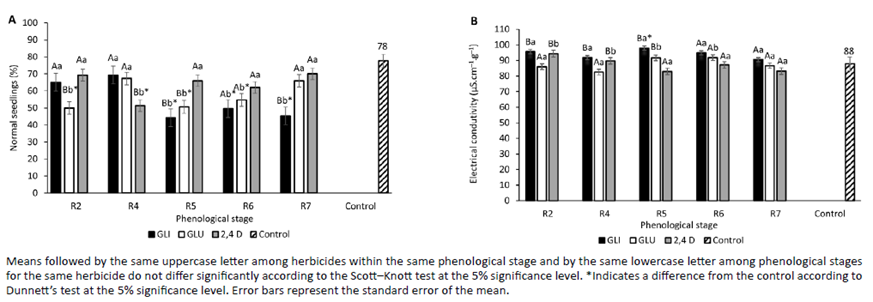
For vigor assessed through the accelerated aging test on paper, glyphosate application proved to be more detrimental when applied at stages R4 and R5, ammonium glufosinate from R4 onwards and 2,4-D at stages R4, R5 and R7 (Figure 4A). For all herbicides, application at stage R5 consistently resulted in seeds with lower vigor. These results indicate that herbicide applications at this reproductive stage are the most detrimental to seed quality. The R5 stage is characterized by the beginning of seed formation, which may enhance phytotoxic effects due to the high rate of photoassimilate translocation from leaves (source) to seeds (sink).
The greater reduction in seed vigor observed with glyphosate and 2,4-D applications at the R2, R4 and especially R5 stages can be explained by the systemic nature of these herbicides and their translocation via the phloem. During reproductive development, soybean plants intensify the allocation of photoassimilates and nitrogenous compounds to developing pods and seeds, increasing the likelihood that systemically translocated herbicides reach reproductive sinks. Although soybean cultivars carrying Enlist E3™ or Conkesta E3® technologies exhibit agronomic tolerance to glyphosate and 2,4-D, previous studies have shown that these molecules can induce physiological stress responses even at recommended doses, such as reductions in chlorophyll content and temporary phytotoxicity (Ferreira et al., 2025). Furthermore, the selectivity of Enlist E3™ soybean has been shown to be dose-dependent, with growth and yield penalties occurring when application limits are exceeded (Oliveira et al., 2024). In contrast, applications performed at vegetative stages do not compromise seed physiological quality (Garcia et al., 2020), reinforcing that phenological timing of application is a critical factor. In this context, the present study provides evidence that applications of systemic herbicides during stages close to pod formation and early seed development may impair seed vigor, even in tolerant cultivars, highlighting that physiological tolerance does not necessarily ensure the preservation of seed quality. On the other hand, ammonium glufosinate consistently showed better vigor results among herbicides. This effect may be related to the herbicide’s characteristic of acting near the point of contact with the plant after absorption, due to either the lack of mobility or extremely low mobility within the plant (Carvalho, 2013). This outcome could also be associated with efficient metabolic detoxification of ammonium glufosinate, mediated by the pat gene, which confers elevated levels of herbicide tolerance observed during vegetative stages in Liberty Link® transgenic soybeans. This tolerance may contribute to improved seed physiological quality (Albrecht et al., 2020).
Higher electrical conductivity values were observed in seeds from plants treated with glyphosate, indicating membrane system disorganization at stages R4 and R6. Regarding ammonium glufosinate, lower conductivity values were observed when applied at stage R4 and for stage R7 (Figure 4B). Among the herbicides, glyphosate resulted in higher electrical conductivity values when applications were made at stages R2, R4, R5 and R6. However, differences compared to the control (67 µS.cm-1.g-1) were observed only for glyphosate applications at stages R4 and R6, with values of 76.94 µS.cm-1.g-1 and 79.12 µS.cm-1.g-1, respectively (Figure 4B).
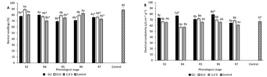
Percentage of normal seedlings in the accelerated aging test on paper (A) and electrical conductivity (µS.cm⁻¹.g⁻¹) (B) of soybean seeds produced under applications of glyphosate (GLY), 2,4-D and ammonium glufosinate (GLU) at different reproductive stages.Means followed by the same uppercase letter among herbicides within the same phenological stage and by the same lowercase letter among phenological stages for the same herbicide do not differ significantly according to the Scott-Knott test at the 5% significance level. *Indicates a difference from the control according to Dunnett’s test at the 5% significance level. Error bars represent the standard error of the mean.
In general, for most physiological tests such as the first germination count and the first emergence test, glyphosate proved to be more detrimental to seed quality. Thus, it can be observed that glyphosate caused greater seed deterioration, increased electrolyte leakage into the external medium, resulting in greater membrane disorganization and, consequently, reduced seed physiological quality.
Zuffo et al. (2020) reported that the use of desiccants affected the physiological quality of soybean seeds, with electrical conductivity being altered. Differences were observed among desiccant products, where higher electrical conductivity values in seeds were found for plants desiccated with paraquat and ammonium glufosinate compared to those treated with diquat and saflufenacil, indicating potential damage to plasma membranes and increased permeability.
According to Prado et al. (2019), electrical conductivity values should be below 70 to 90 µS.cm-1.g-1 in batches of high vigor soybean seeds. However, Carvalho et al. (2014) suggest that electrical conductivity values between 70 to 80 µS.cm-1.g-1 indicate seeds with a tendency toward medium vigor and values below 65 µS.cm-1.g-1 indicate high vigor seeds. It is important to note that these thresholds may vary depending on the characteristics of soybean genotypes.
Our findings complement recent research on Enlist® soybean systems. Garcia et al. (2020) evaluated the physiological attributes of Enlist E3™ soybean seeds subjected to herbicide applications at the V6 stage, reporting minimal effects on seed quality when herbicides were applied during vegetative development. Similarly, Oliveira et al. (2024) demonstrated good selectivity of 2,4-D choline salt, glyphosate and ammonium glufosinate at the V3 and V6 stages when recommended doses were used, with plants showing recovery from transient phytotoxicity symptoms. These studies, which focused on vegetative stage applications, contrast with our findings for applications during reproductive stages, in which timing proved critical for seed quality preservation. The differential response between vegetative and reproductive stages reflects the physiological transition from vegetative growth to seed filling, during which metabolic pathways are redirected toward the accumulation of storage compounds in developing seeds.
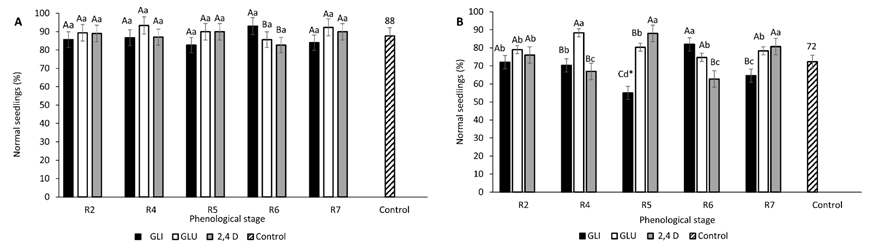
After storage, no differences in germination were observed among the different herbicide treatments. However, applications with herbicides at stages R2, R4, R5 and R6 resulted in higher germination values compared to R7, which showed 83% germination and was also lower than the control (Figure 5A).
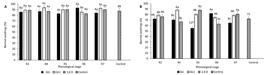
Average results of the germination test (A) and first germination count (B) of soybean seeds produced under applications of glyphosate (GLY), 2,4-D and ammonium glufosinate (GLU) at different reproductive stages after 6 months of storage. Means followed by the same uppercase letter among herbicides within the same phenological stage and by the same lowercase letter among phenological stages for the same herbicide do not differ significantly according to the Scott-Knott test at the 5% significance level. *Indicates a difference from the control according to Dunnett’s test at the 5% significance level. Error bars represent the standard error of the mean.
For the first germination count test, no differences were observed among phenological stages or glyphosate or 2,4-D applications. However, lower seed vigor values were observed for ammonium glufosinate when applied at the R4 stage (Figure 5B).
Among the herbicides, ate the R4 stage, ammonium glufosinate resulted in lower seed vigor, differing even from the control. However, at the R5 and R6 stages, this herbicide led to better physiological quality compared to the other herbicides.
Glyphosate and 2,4-D negatively affected seed vigor when applied at stages corresponding to the beginning of seed formation (R5) and when seeds were fully developed but still attached to the mother plant (R6). A reduction of up to 8% in normal seedlings at five days was observed compared to seeds obtained from plants treated with ammonium glufosinate (Figure 5B). This finding highlights the greater detrimental effect of these systemic herbicides when applied during developmental stages characterized by high phloem translocation to storage organs, such as R5 and R6.
Albrecht et al. (2018) reported that ammonium glufosinate causes visual injury and reduces chlorophyll content in soybean cultivars, although plants can recover depending on the applied dose. Within the tested range, doses of up to 750 g AI.ha⁻¹ were considered completely selective for Liberty Link® (LL) soybeans, with no effects on yield or seed physiological quality. LL soybean plants exhibited high glufosinate metabolism, lower ammonia accumulation and no reduction in dry matter compared to RR2 soybeans following the application of high glufosinate doses (Albrecht et al., 2020).
For vigor assessed through the accelerated aging test, glyphosate resulted in the lowest values when applied from the R5 stage onward. For ammonium glufosinate, seed vigor was lower when applied at the R2, R5 and R6 stages, whereas for 2,4-D, the lowest value was observed at the R4 stage (Figure 6A).

Percentage of normal seedlings in the accelerated aging test on paper (A) and electrical conductivity (µS.cm⁻¹.g⁻¹) (B) of soybean seeds produced under applications of glyphosate (GLY), 2,4-D and ammonium glufosinate (GLU) at different reproductive stages after 6 months of storage.
Among the herbicides, differences were observed at all stages. At the R2 stage, ammonium glufosinate resulted in the lowest seed vigor. At the R4 stage, 2,4-D showed the lowest vigor, whereas at the R5 and R6 stages, both glyphosate and ammonium glufosinate exhibited lower vigor compared to the control. At the R7 stage, only glyphosate resulted in lower vigor than the control (Figure 6A).
An adverse effect of glyphosate application was observed from the R5 stage onward, a pattern also identified in pre-storage analyses. The detrimental effect of this herbicide at the onset of seed formation is reinforced and is associated with the translocation and metabolism of glyphosate into the phytotoxic compound AMPA (aminomethylphosphonic acid), a byproduct of glyphosate degradation (Reddy et al., 2004), which accumulates in seeds (Duke et al., 2003). Harmful effects of glyphosate desiccation on soybean seeds have also been demonstrated by accelerated aging test results (Toledo et al., 2014), showing that applications prior to physiological maturity result in lower germination rates (Lacerda et al., 2003), with these effects persisting after storage.
Few studies have investigated the potential negative effects of applying 2,4-D, either alone or in combination with glyphosate and ammonium glufosinate, on tolerant soybean cultivars. Chahal et al. (2015) reported that applications of 2,4-D, alone or in mixture with glyphosate, can be performed up to the R2 growth stage in tolerant soybeans, at a maximum rate of 2,185 g a.e. ha⁻1.
Negative impacts on seed vigor have also been reported following glyphosate application in RR soybeans at the V6 and R2 stages (Albrecht et al., 2012), with the detrimental effects attributed to the direct injurious action of glyphosate or its metabolites, such as AMPA, on seed physiology. According to Reddy et al. (2004), the loss of seed quality may be associated with the toxicity of aminomethylphosphonic acid (AMPA), as transgenic soybeans exhibit partial degradation of glyphosate into this phytotoxic metabolite.
In RR soybeans, glyphosate application does not inhibit the EPSPS enzyme, thereby preventing plant death. However, studies indicate that, after absorption, glyphosate is translocated throughout the plant, accumulating in tissues with high meristematic and metabolic activity, such as developing seeds and grains, where it can induce phytotoxic effects (Rodrigues et al., 2021; Reddy et al., 2004). AMPA is the primary product of glyphosate metabolism. Bohm et al. (2008), in evaluating glyphosate residues in grains, found that the compound accumulates proportionally to increasing application rates, with higher AMPA levels particularly associated with late applications, especially near harvest (Duke et al., 2003), thereby enhancing the phytotoxic effect of this metabolite.
Herbicide metabolism in transgenic soybeans depends not only on genotype but also on soil and climatic conditions during cultivation, which may lead to the presence of trace sublethal amounts in grains (Bohm et al., 2008). These molecules are transported via the phloem and xylem, along with amino acids, particularly during periods of high demand for photoassimilates. In the case of 2,4-D, sublethal doses can interfere with WOX gene expression and disrupt the polar transport of auxin mediated by PIN proteins, resulting in impaired asymmetric embryo division and the occurrence of embryonic abnormalities (Palovaara and Hakman, 2009).
Regarding the electrical conductivity results after storage, no differences were observed among phenological stages for glyphosate application. For ammonium glufosinate, higher electrical conductivity values were observed when applications were performed at the R5 and R6 stages, whereas for 2,4-D, higher values were observed at the R2 and R4 stages (Figure 6).
At the R2, R4 and R5 stages, where differences among herbicides were observed, glyphosate consistently showed among the highest electrical conductivity values, along with 2,4-D applied at full bloom (R2) and at the full pod stage (R4). At the R5 stage, glyphosate and ammonium glufosinate resulted in the highest electrical conductivity values (Figure 6B).
Compared to the control, which showed an electrical conductivity of 87.81 µS.cm⁻¹.g⁻¹, only glyphosate differed at the R5 stage, where conductivity reached 97.90 µS.cm⁻¹.g⁻¹ (Figure 6B). This result indicates that the application of this herbicide at this developmental stage may have compromised membrane integrity and reduced seed vigor, as observed in other tests.
Botelho et al. (2019) reported that electrical conductivity values after storage were higher in desiccated seeds compared to the control, indicating that desiccation with ammonium glufosinate and other herbicides can impair membrane integrity and directly affect seed vigor.
Herbicide molecules exhibited distinct effects on membrane deterioration depending on the phenological stage, as evidenced by increased electrical conductivity after storage, indicating greater membrane permeability and solute leakage into the solution.
The results of this study have important practical implications for seed production systems using Enlist® technology. Although genetic tolerance to herbicides allows plant survival and grain production, our findings demonstrate that such tolerance does not guarantee the absence of sublethal effects on seed physiological quality and storability. Cardoso et al. (2024), in studying quality acquisition in seeds from plants subjected to desiccation, emphasized that the timing of herbicide application critically influences the development of seed vigor and longevity, showing that herbicides can disrupt the natural acquisition of physiological quality. This supports our results, which indicate that applications at the R5-R6 stages coincide with critical periods of seed maturation. For seed production systems, in which physiological quality and storage potential are essential, herbicide applications should preferably be completed before the seed formation stage to minimize quality deterioration during storage.
CONCLUSIONS
The application of glyphosate, 2,4-D and ammonium glufosinate at reproductive stages from R2 onward affects seed quality in Enlist®-tolerant soybeans, with more pronounced detrimental effects observed at stages close to seed formation, such as R5 (early seed formation) and R6 (fully developed seeds).
Among the herbicides evaluated, glyphosate was the most detrimental to seed physiological quality, followed by 2,4-D, whereas ammonium glufosinate showed the least negative impact.
These effects were more pronounced after six months of storage, indicating that herbicide applications during reproductive stages compromise not only the initial quality of the seeds but also their long-term storability.
ACKNOWLEDGMENTS
The authors would like to thank the National Council for Scientific and Technological Development (CNPq), the Coordination for the Improvement of Higher Education Personnel (CAPES), the Minas Gerais Research Support Foundation (FAPEMIG) and Corteva Agriscience™ for their support of this research, including scholarships and a research productivity grant (CNPq).
REFERENCES
-
ALBRECHT, A.J.P.; BRITO, I.P.F.S.; ALBRECHT, L.P.; SILVA, A.F.M.; MATOS, A.K.A.; CARBONARI, C.A.; VELINI, E.D. Metabolic changes, agronomic performance and quality of seeds in soybean with the pat gene after application of glufosinate. Weed Science, v.68, n.6, p.594-604, 2020. https://doi.org/10.1017/wsc.2020.74
» https://doi.org/https://doi.org/10.1017/wsc.2020.74 -
ALBRECHT, L.P.; ALONSO, D.G.; CONSTANTIN, J.; OLIVEIRA JR., R.S.; BRACCINI, A.L.; ALBRECHT, A.J.P. Qualidade fisiológica das sementes de soja RR em resposta ao uso de diferentes tratamentos contendo glyphosate em aplicação sequencial. Bioscience Journal, v.27, n.2, p.211-220, 2011. https://seer.ufu.br/index.php/biosciencejournal/article/view/7605
» https://seer.ufu.br/index.php/biosciencejournal/article/view/7605 -
ALBRECHT, L.P.; ALBRECHT, A.J.P.; MUNDT, T.T.; WAGNER, F.G.; BOTTCHER, A.A.; ARAUJO, G.V.; LORENZETTI, J.B.; DANILUSSI, M.T.Y. Soja transgênica Libertylink® e o seu manejo. Journal of Agronomic Sciences, v.7, n.especial, p.33-42, 2018. https://www.researchgate.net/publication/336702424_SOJA_TRANSGENICA_LIBERTYLINKR_E_O_SEU_MANEJO
» https://www.researchgate.net/publication/336702424_SOJA_TRANSGENICA_LIBERTYLINKR_E_O_SEU_MANEJO -
ALBRECHT, L.P.; YOKOYAMA, A.S.; ALBRECHT, A.J.P.; KOSINSKI, R.; MILLEO, R.; SILVA, A.F.M. Glufosinate and diquat in pre-harvest desiccation of soybean at four phenological stages and their impact on seed quality. Chilean Journal of Agricultural Research, v.82, n.3, p.448-456, 2022. http://dx.doi.org/10.4067/S0718-58392022000300448
» https://doi.org/http://dx.doi.org/10.4067/S0718-58392022000300448 -
ALBRECHT, L.P.; BARBOSA, A.P.; SILVA, A.F.M.; OLIVEIRA JR., R.S.; BRACCINI, A.L.; ALBRECHT, A.J.P. RR soybean seed quality after application of glyphosate in different stages of crop development. Revista Brasileira de Sementes, v.34, n.3, p.373-381, 2012. https://doi.org/10.1590/S0101-31222012000300003
» https://doi.org/https://doi.org/10.1590/S0101-31222012000300003 -
AZEVEDO, A.M. Tratamentos.ad: package for the analysis of experiments with additional controls R package, version 0.2.4, CRAN, 2022. Available at: https://cran.r-project.org/web/packages/Tratamentos.ad/index.html
» https://cran.r-project.org/web/packages/Tratamentos.ad/index.html -
BOHM, G.M.B.; GENOVESE, M.I.; PIGOSSO, G.; TRICHEZ, D.; ROMBALDI, C.V. Resíduos de glifosato e ácido aminometilfosfônico e teores de isoflavonas em soja BRS 244 RR e BRS 154. Food Science and Technology, v.28, p.192-197, 2008. https://doi.org/10.1590/S0101-20612008000500030
» https://doi.org/https://doi.org/10.1590/S0101-20612008000500030 -
BOTELHO, J.F.E.; OLIVEIRA, J.A.; VON PINHO, E.V.R.; CARVALHO, E.R.; RESENDE, M.P.M.; REIS, L.V. Quality of soybean seeds with different lignin content obtained from desiccated plants. Revista Brasileira de Ciências Agrárias, v.14, p.1-7, 2019. https://doi.org/10.5039/agraria.v14i1a5616
» https://doi.org/https://doi.org/10.5039/agraria.v14i1a5616 -
BRASIL. Ministério da Agricultura, Pecuária e Abastecimento. Regras para análise de sementes Brasília: MAPA, 2025. https://wikisda.agricultura.gov.br/pt-br/Laborat%C3%B3rios/Metodologia/Sementes/RAS_2025/Amostragem
» https://wikisda.agricultura.gov.br/pt-br/Laborat%C3%B3rios/Metodologia/Sementes/RAS_2025/Amostragem -
CARDOSO, C.P.; PERISSATO, S.M.; BIANCHI, L.; DIAS, D.C.F.S. Characterization of acquisition of physiological quality in soybean seeds from desiccated plants. Journal of Seed Science, v.46, e202446009, 2024. https://doi.org/10.1590/2317-1545v46280620
» https://doi.org/https://doi.org/10.1590/2317-1545v46280620 -
CARVALHO, E.R.; MAVAIEIE, D.P.R.; OLIVEIRA, J.A.; CARVALHO, M.V.; VIEIRA, A.R. Alterações isoenzimáticas em sementes de cultivares de soja em diferentes condições de armazenamento. Pesquisa Agropecuária Brasileira, v.49, n.12, p.967-976, 2014. https://doi.org/10.1590/S0100-204X2014001200007
» https://doi.org/https://doi.org/10.1590/S0100-204X2014001200007 - CARVALHO, L.B. Herbicidas 1. ed. Lages, SC: Edição do Autor, 2013. 62p.
-
CASTILHO, C.; LAZARETTI, N.S. Morfofisiologia de sementes de soja Intacta sob o manejo com glifosato. Revista Cultivando o Saber, v.16, p.21-31, 2023. https://cultivandosaber.fag.edu.br/index.php/cultivando/article/view/1103
» https://cultivandosaber.fag.edu.br/index.php/cultivando/article/view/1103 -
CHAHAL, P.S.; AULAKH, J.S.; ROSENBAUM, K.; JHALA, A.J. Growth stage affects dose response of selected glyphosate-resistant weeds to premix of 2,4-D choline and glyphosate. Journal of Agricultural Science, v.7, n.11, p.1-10, 2015. https://doi.org/10.5539/jas.v7n11p1
» https://doi.org/https://doi.org/10.5539/jas.v7n11p1 -
DUENK, E.; SOLTANI, N.; MILLER, R.T.; HOOKER, D.C.; ROBINSON, D.E.; SIKKEMA, P.H. Multiple-herbicide-resistant waterhemp control in glyphosate/glufosinate/2,4-D-resistant soybean with one- and two-pass weed control programs. Weed Technology, v.37, n.1, p.34-39, 2023. https://doi.org/10.1017/wet.2023.6
» https://doi.org/https://doi.org/10.1017/wet.2023.6 -
DUKE, S.O.; RIMANDO, A.M.; PACE, P.F.; REDDY, K.N.; SMEDA, R.J. Isoflavone, glyphosate and aminomethylphosphonic acid levels in seeds of glyphosate-treated, glyphosate-resistant soybean. Journal of Agricultural and Food Chemistry, v.51, p.340-344, 2003. https://doi.org/10.1021/jf025908i
» https://doi.org/https://doi.org/10.1021/jf025908i -
EMBRAPA. Sistema Brasileiro de Classificação de Solos 5. ed. Brasília, DF: Embrapa, 2018. https://www.embrapa.br/busca-de-publicacoes/-/publicacao/1176834/sistema-brasileiro-de-classificacao-de-solos
» https://www.embrapa.br/busca-de-publicacoes/-/publicacao/1176834/sistema-brasileiro-de-classificacao-de-solos -
EMBRAPA. Tecnologias de produção de soja: sistemas de produção Londrina: Embrapa Soja, 2020. 347p. https://www.embrapa.br/busca-de-publicacoes/-/publicacao/1123928/tecnologias-de-producao-de-soja
» https://www.embrapa.br/busca-de-publicacoes/-/publicacao/1123928/tecnologias-de-producao-de-soja -
FEHR, W.R.; CAVINESS, C.E.; BURMOOD, D.T.; PENNINGTON, J.S. Stage of development descriptions for soybeans, Glycine max (L.) Merrill. Crop Science, v.11, n.6, p.929-931, 1971. https://doi.org/10.2135/cropsci1971.0011183X001100060051x
» https://doi.org/https://doi.org/10.2135/cropsci1971.0011183X001100060051x -
FERREIRA, Y.C.G.; FERRAZ, G.A.J.; SANTANA, L.S.; FIGUEIREDO, V.C.; OLIVEIRA, M.S. Agronomic performance of Conkesta E3® soybean to increasing doses of 2,4-D herbicide. Revista Agrogeoambiental, v.17, e20252000, 2025. https://agrogeoambiental.ifsuldeminas.edu.br/index.php/Agrogeoambiental/article/view/2000
» https://agrogeoambiental.ifsuldeminas.edu.br/index.php/Agrogeoambiental/article/view/2000 -
GARCIA, J.R.; VARGAS, A.A.M.; PERBONI, L.T.; SOUZA, A.E.; CAVASSIM, J.E.; CHRISTOFFOLETI, P.J. Physiological attributes of Enlist E3™ soybean seed submitted to herbicides application. Planta Daninha, v.38, e020216471, 2020. https://doi.org/10.1590/S0100-83582020380100064
» https://doi.org/https://doi.org/10.1590/S0100-83582020380100064 -
KÖPPEN, W. O sistema geográfico de climatologia Berlim: Gebrüder Borntraeger, 1936. https://commons.wikimedia.org/wiki/File:Das_geographische_System_der_Klimate_(1936).pdf
» https://commons.wikimedia.org/wiki/File:Das_geographische_System_der_Klimate_(1936).pdf -
LACERDA, A.L.S.; LAZARINI, E.; DE SÁ, M.E.; VALÉRIO FILHO, W.V. Armazenamento de sementes de soja dessecadas e avaliação da qualidade fisiológica, bioquímica e sanitária. Revista Brasileira de Sementes , v.25, n.2, p.97-105, 2003. https://doi.org/10.1590/S0101-31222003000400014
» https://doi.org/https://doi.org/10.1590/S0101-31222003000400014 - MARCOS-FILHO, J. Teste de envelhecimento acelerado. In: KRZYZANOWSKI, F.C.; VIEIRA, R.D.; FRANÇA-NETO, J.B.; MARCOS-FILHO, J. (Eds.). Vigor de sementes: conceitos e testes . Londrina: ABRATES, 2020. p.185-246.
-
MORAES, I.C.; NOVAIS, H.O.; TECHIO, V.H.; PEREIRA, W.A. Effects of glyphosate on the morphology and cell cycle of soybean seedlings tolerant and sensitive to the herbicide. Pesquisa Agropecuária Brasileira , v.59, e03432, 2024. https://doi.org/10.1590/S1678-3921.pab2024.v59.03432
» https://doi.org/https://doi.org/10.1590/S1678-3921.pab2024.v59.03432 -
OLIVEIRA, T.S.; MARTINS, H.L.; CARREGA, W.C.; BARROSO, A.A.M.; ALVES, P.L.C.A. Selectivity of 2,4-D choline salt, glyphosate, glufosinate and their mixtures for Enlist E3™ soybeans. African Journal of Agricultural Research, v.20, n.8, p.693-701, 2024. https://doi.org/10.5897/AJAR2024.16683
» https://doi.org/https://doi.org/10.5897/AJAR2024.16683 -
PALOVAARA, J.; HAKMAN, I. Wox2 and polar auxin transport during spruce embryonic pattern formation. Plant Signaling & Behavior, v.4, n.2, p.153-155, 2009. https://doi.org/10.4161/psb.4.2.7684
» https://doi.org/https://doi.org/10.4161/psb.4.2.7684 -
PRADO, J.P.; KRZYZANOWSKI, F.C.; MARTINS, C.C.; VIEIRA, R.D. Physiological potential of soybean seeds and its relationship to electrical conductivity. Journal of Seed Science , v.41, p.407-415, 2019. https://doi.org/10.1590/2317-1545v41n4214988
» https://doi.org/https://doi.org/10.1590/2317-1545v41n4214988 -
REDDY, K.N.; RIMANDO, A.M.; DUKE, S.O. Aminomethylphosphonic acid, a metabolite of glyphosate, causes injury in glyphosate-treated, glyphosate-resistant soybean. Journal of Agricultural and Food Chemistry , v.52, n.16, p.5139-5143, 2004. https://doi.org/10.1021/jf049605v
» https://doi.org/https://doi.org/10.1021/jf049605v - RIBEIRO, A.C.; GUIMARÃES, P.T.G.; ALVAREZ V., V.H. (Ed.). Recomendações para o uso de corretivos e fertilizantes em Minas Gerais: 5ª aproximação Viçosa, MG: Comissão de Fertilidade do Solo do Estado de Minas Gerais, 1999. 359p.
-
RODRIGUES, N.R.; SOUZA, A.P.F.; MORAIS, P.P.P.; BRAGA, D.P.V.; CRIVELLARI, A.C.; FAVORETTO, L.R.G.; BERGER, G.U. Residues of glyphosate and aminomethylphosphonic acid (AMPA) in genetically modified glyphosate tolerant soybean, corn and cotton crops. Ciência Rural, v.51, n.1, e20190244, 2021. https://doi.org/10.1590/0103-8478cr20190244
» https://doi.org/https://doi.org/10.1590/0103-8478cr20190244 -
SILVA, A.F.M.; ALBRECHT, A.J.P.; ALBRECHT, L.P.; PELLICCI, V.A.; GIOVANELLI, B.F.; GHIRARDELLO, G.A.; VIANA, H.R.M.; VICTORIA FILHO, R. Glyphosate in agronomic performance and seed quality of soybean with cp4-EPSPS and cry1Ac genes. Journal of Plant Protection Research, v.58, n.4, p.345-353, 2018. https://doi.org/10.24425/jppr.2018.124644
» https://doi.org/https://doi.org/10.24425/jppr.2018.124644 -
SINGH, N.; MILLER, R.P.; PETERS, T.J.; NAEVE, S.L.; SARANGI, D. Effect of herbicide application timing and sequence on waterhemp (Amaranthus tuberculatus) and common lambsquarters (Chenopodium album) control, Enlist E3® soybean yield and economic returns. Weed Technology , v.39, e73, 2025. https://doi.org/10.1017/wet.2025.3
» https://doi.org/https://doi.org/10.1017/wet.2025.3 -
TOLEDO, M.Z.; ISHIZUKA, M.S.; CAVARIANI, C.; FRANÇA-NETO, J.B.; PICOLI, L.B. Pre-harvest desiccation with glyphosate and quality of stored soybean seeds. Semina: Ciências Agrárias, v.35, n.2, p.765-774, 2014. https://doi.org/10.5433/1679-0359.2014v35n2p765
» https://doi.org/https://doi.org/10.5433/1679-0359.2014v35n2p765 -
USDA - UNITED STATES DEPARTMENT OF AGRICULTURE. Brazil soybean production and exports Foreign Agricultural Service, 2025. https://ipad.fas.usda.gov/cropexplorer/pecad_stories.aspx?ftype=prodbriefs®ionid=br
» https://ipad.fas.usda.gov/cropexplorer/pecad_stories.aspx?ftype=prodbriefs®ionid=br - VIEIRA, R.D.; MARCOS-FILHO, J. Teste de condutividade elétrica. In: KRZYZANOWSKI, F.C.; VIEIRA, R.D.; FRANÇA-NETO, J.B.; MARCOS-FILHO, J. (Eds.). Vigor de sementes: conceitos e testes . Londrina: ABRATES , 2020. p.333-388.
-
YADAV, R.; JHA, P.; HARTZLER, R.; LIEBMAN, M. Multi-tactic strategies to manage herbicide-resistant waterhemp (Amaranthus tuberculatus) in corn-soybean rotations of the U.S. Midwest. Weed Science , v.71, n.2, p.141-149, 2023. https://doi.org/10.1017/wsc.2023.10
» https://doi.org/https://doi.org/10.1017/wsc.2023.10 -
ZUFFO, A.M.; AGUILERA, J.G.; CARVALHO, E.R.; TEODORO, P.E. Harvest times with chemical desiccation and the effects on the enzymatic expression and physiological quality of soybean seeds. Revista Caatinga, v.33, n.2, p.361-370, 2020. https://doi.org/10.1590/1983-21252020v33n209rc
» https://doi.org/https://doi.org/10.1590/1983-21252020v33n209rc
Additional data will be made available by the authors upon reasonable request.