Influence of Cold Deformation on the Behavior of Short Time Low Temperature Aging of Superduplex Stainless Steel UNS S39274
Abstract
The main characteristics of a superduplex stainless steel (SDSS) are the biphasic microstructure composed by ferrite and austenite, and the pitting resistance equivalent (PRE) higher than 40. The mechanical properties and corrosion resistance are optimized with austente:ferrite proportions close to 1:1, and the absence of other phases. The UNS S39274 grade is a W-alloyed SDSS used in critical services in the Exploration & Production of the Oil & Gas Industry, such as in Oil Country Tubular Goods (OCTG). This material can be used for tubes that work with high pressure (until 138MPa) and corrosive environments (with CO2 and H2S). To achieve a high mechanical strength, the seamless tubes are cold drawn. Short duration and low temperature aging can further improve the mechanical resistance of SDSSs. This work was focused on the investigation of short duration aging at 400 and 475oC of the UNS S39274 steel, comparing two initial conditions: cold worked and solution treated. The objective and main contribution of this study was to determine the effect of work hardening on the low-temperature aging, specifically the ferrite phase decomposition by δ→α+α' reaction, where α’ is a nanometric Cr-rich precipitate. The effects on mechanical properties (hardness, tensile, and impact toughness) and pitting corrosion resistance were determined. The activation energy for precipitation (Ea) was obtained through Differential Scanning Calorimetry (DSC). In addition, Transmission Electronic Microscopy (TEM) images show the presence of α' inside ferrite grains of specimen aged at 475oC for 8 hours.
Keywords:
Superduplex Stainless Steel; Cold-drawing; 475 embrittlement; DSC; Mechanical properties
1. Introduction
Superduplex Stainless Steels (SDSS) are corrosion resistant alloys (CRAs) with a microstructure of approximately equal parts of two phases, γ-austenite and δ-ferrite phases; thus, they are also named austenitic-ferritic stainless steels. The SDSS combines beneficial properties of both phases, austenite, and ferrite, showing good corrosion resistance, weldability, and high mechanical strength. This performance is obtained due to its chemical composition and microstructure1,2. These steels contain 24.0% to 26.0% chromium, 4.5% to 8.0% nickel, 2.5% to 5.0% molybdenum, 0.08% to 0.32% nitrogen, and a maximum of 0.03% carbon. The UNS S39274 SDSS also has 1.5% - 2.5% W, achieving a Pitting Resistance Equivalent Number with Tungsten (PRENW) in the range of 39 to 473. These improved properties make the SDSS widely suitable to components exposed to highly corrosive conditions with high strength requirements, such as oil and gas (in critical services in OCTG systems), nuclear, chemical and petrochemical units, food industries, among others when compared to standard austenitic and ferritic stainless steels1,4-6.
However, these types of SDSSs are intrinsically subjected to thermal embrittlement and loss of corrosion resistance when exposed to temperatures above 300oC due to undesired changes in the steel microstructure. Those changes are related mainly to different solid-state precipitation reactions, which set an upper limit to the recommended service temperature of the material2,5,7,8. Depending on their chemical composition, austenitic-ferritic steels are less or more susceptible to precipitation processes9. The susceptibility to these precipitations when exposed from 300 to 1000oC can result in detrimental effects in these materials. In certain temperature ranges, the first precipitates form rapidly. The aging in a range of 500 to 1000oC causes changes in the microstructure, such as the precipitation of intermetallic phases (sigma (σ), R, chi (χ)), carbides, and nitrides, which lower mechanical properties and reduce corrosion resistance. Aging below 500ºC can also lead to the worsening of toughness. However, the precipitation of deleterious phases is slower at this temperature, and the loss of properties takes more time to occur2,9. Exposure to temperatures between 300 and 550ºC, with a peak embrittlement rate near 475oC, can lead to so called "475oC embrittlement", causing loss of toughness and ductility. Those changes are primarily related to transformations within the ferrite phase, associated with steel hardening due to the formation of the α’-phase rich in Cr, resulting essentially from the spinodal decomposition of ferrite5,9,10.
The α’-phase is a chromium-rich precipitate, and its formation occurs inside ferrite grains, presenting a body-centered cubic (BCC) structure coherent with the ferritic matrix. Due to its low interface energy with ferrite, it presents a high resistance to coalescence11. The embrittlement results from a miscibility gap in the ferritic Fe-Cr alloy system within which the ferrite may decompose into Fe-rich δ-phase and Cr-rich α’-phase8,10,12. This δ – α' phase separation occurs in the ferrite grains of SDSS and can occur by spinodal decomposition, depending on the ferrite phase chemical composition and the aging temperature11,13. The spinodal decomposition of ferrite is related to a local atomic reorganization of Fe and Cr, leading to the formation of clusters in ferrite with a wide fluctuation in the local compositions of these elements. This mechanism occurs to reduce the Gibbs free energy of the system and, consequently, promote a thermodynamically more stable state. The precipitation of α’-phase is associated with the diffusion of chromium and, therefore, promotes the formation of poor regions in chromium around it11. Furthermore, the formation of the α’-phase causes a cross-stitch displacement, leading to a decrease of dislocations mobility, which results in a hardness increase in the ferrite phase, an improvement in the yield point and ultimate tensile strength (UTS), besides a loss of toughness and elongation of the material11,13. The dislocation structure with a cross-stitch pattern is significant since it provides strong support to suggest that the immobilization of dislocations in δ-ferrite is detrimental to toughness7.
It is pointed out here that relatively long aging durations were used in many of the papers to study the effects of the long thermal exposure of SDSSs to temperatures in the range of 350-550ºC. The literature points out that there are negative consequences of the ferrite decomposition by spinodal mechanism (δ → α’ + α”) due to 475oC embrittlement during a long time of thermal aging in service, such as thousands of hours, days, or months. Those prolonged use in relatively low temperatures can lead to progressive embrittlement and corrosion resistance decay, especially on pitting resistance. However, in the last years, it has been suggested that "short-term" spinodal decomposition treatment in the 475oC embrittlement temperature range may be a viable strengthening method for DSSs14,15. Short-duration treatments at 475oC may be an interesting way to increase the hardness, yield strength (σYS), and ultimate tensile strength (σUTS) without a decrease of corrosion resistance of SDSSs, i.e., α’-phase precipitation would also cause a progressive hardening effect detectable in the initial stages of aging15.
In the reaction kinetics, the activation energy can be considered the minimal energy necessary to begin a reaction or a phase transformation, such as forming the σ- or α'-phases in the SDSS. This energy can describe a phase transformation numerically. The kinetics equations are used to determine the time of each phase transformation in the alloys16. Activation energies of phase transformations in duplex or superduplex stainless steels or other highly alloyed steels have been presented only in a few numbers of publications in the last years17-19, especially in which these energies are determined by the Kissinger plot method20. That method is based on thermal analysis measurements, such as differential scanning calorimetry (DSC) or differential thermal analysis (DTA). The determination of activation energies by DSC and DTA thermal analysis measurements is made by measuring the shift of peak temperatures as different heating rates are applied19.
The aim of this work is to evaluate the effects of heat treatments on short duration aging at 400 or 475oC (up to 12 h). Two initial conditions of the SDSS UNS S39274 were used: i) as received cold-drawn condition; ii) after solution annealing heat treatment at 1150oC followed by fast cooling. These two conditions were selected with the objective of investigate the changes caused by cold work in short-duration aging at low temperatures. The work focused ont the influence of Cr-rich α’-phase precipitation on the mechanical properties (hardness, tensile, and impact toughness) and pitting corrosion resistance. The activation energy for α’-phase precipitation was obtained using the Kissinger plot method using DSC thermal analysis. The choice to study the aging at 400oC and 475oC is justified as follows. The α’ precipitation is faster and more intense at 475oC, as determined by previous works6,14. At this aging temperature the material undergoes embrittlement and corrosion resistance decay. The aging at 400oC can be used to obtain some hardening and minimize the collateral effects of the α’ precipitation.
2. Experimental
The steel studied in this work was from a seamless pipe (with an outside diameter of 169.0 mm and wall thickness of 10.0 mm), with chemical composition and PRENW value shown in Table 1, achieving the UNS S39274 SDSS requirements. The seamless pipe was provided in cold-drawn condition to achieve a yield strength of 862 MPa, necessary for 125ksi grade. The effective (or equivalent) strain applied by cold drawn was 15%, as reported by the supplier. The material's chemical composition was verified using optical emission spectroscopy and combustion methods, the last one only for N, C, and S.
Parts of the tube were cut and roughly machined before heat treatments to approximate dimensions of hardness, tensile, and subsize Charpy impact tests. A set of specimens was solution treated at 1150oC for 40 minutes with water cooling. These samples and the ones as received (cold drawn) were aged at 400oC and 475oC for different periods of time.
After heat treatments, the materials were machined to the final dimensions for tensile specimens (gauge length 16.0mm and diameter 4.0mm), subsize V-notched Charpy specimens (55 x 10 x 7.5 mm3), according to ASTM A37021, and the hardness test specimens.
Table 2 shows the identification of specimens, the heat treatments, and the respective tests performed.
Heat treatments and tests performed (H = Vickers hardness, I = Impact Charpy, T = Tensile, P = Potentiostatic technique, D = DSC).
All tensile and Charpy impact test specimens were longitudinal. Tensile and hardness tests were conducted at (25 ± 1)oC. Tensile tests were performed with a 0.5 mm/min rate in an Instron 5582 servo-mechanical machine with a capacity of 100 kN. Charpy impact tests were performed at -46oC using an universal pendulum with a maximum capacity of 300 J. Tensile and Charpy impact tests were performed in duplicate for each heat treatment condition. Vickers hardness tests with load 10 kgf (HV10) were performed in the cross section planes of the tube, with six measurements in each specimen. The Charpy impact test specimens were analyzed after the tests in a FEI Inspect S50 model scanning electron microscope (SEM), with tungsten filament at high vacuum operation (≈ 1.56 x 10⁻² Pa), beam voltage of 20 kV and secondary electron detectors (ETD/SE).
The Critical Pitting Temperature (CPT) was evaluated using a potentiostatic technique and a temperature scan according to ASTM G15022 standard. The tests were controlled by a μ-AUTOLAB Type III potentiostat. The measurements were conducted in a three-electrode cell using a Pt foil as auxiliary electrode, a saturated calomel electrode (SCE) as reference electrode, and the working electrode made with the specimens embedded in epoxy resin. Before the tests, the working electrodes were prepared by grinding with emery paper (up to 1200 mesh) and then polished with diamond pastes (6, 3, and 1µm). In order to avoid crevice corrosion in the steel during the test, the interface between the steel and the resin was painted, with a window of 1 cm2 remaining uncoated to be subjected to the test. The tests were started with the specimen exposed in the electrochemical cell to a 1M NaCl solution, initially at 0°C. After the initial temperature stabilization time, about 60 seconds before the start of the temperature sweep, the specimen is anodically polarized at a constant potential of 700mVSCE. At the same time, the electrochemical cell solution is heated at a constant rate of 1°C/min. The current is monitored during the temperature scan, and when it increases abruptly, the CPT of the material in the electrolyte can be defined as that temperature at which the current density has exceeded 100μA/cm2 for 60 seconds.
The Differential Scanning Calorimetry (DSC) technique was applied to study the effects of the heating in the specimens to determine the activation energy by the Kissinger equation17,19 (equation 4) for precipitation in the temperature range from 100 to 600oC at four different heating rates (5, 10, 15 and 20oC/min) in an inert gas atmosphere, and after cooling at a constant rate until room temperature. These tests were carried out in a calorimeter SDT Q600 TA Instruments.
where β is each heating rate (dT/dt) [K/min] parameter; Tp is the temperature of peak [K] of the respective phase in a heating rate; Ea is the activation energy [kJ/mol]; R is the universal gas constant [8.3145 J · mol-1 · K-1], and A is a constant.
The activation energy (Ea) for a phase transformation is obtained from the slope of the linear relationship between plot, requiring only the values of the peak temperatures (assumed to be the temperature at which the transformation rate is maximum) for a minimum of three different heating rates17,19.
Transmission Electronic Microscopy (TEM) investigations were performed using a Philips CM20 transmission electron microscope operating at 200kV. The thin foils of the analyzed materials were prepared by twin-jet electropolishing in a chemical solution of 10% perchloric acid (HClO4), 20% glycerin ((HOCH2)2CHOH), and 70% ethanol (CH3CH2OH) at voltage 25V and temperature of -30oC. In this research, only the CW/SA475-8 specimen was analyzed.
3. Results and Discussion
The effects of short time aging (up to 12h) and low temperatures (at 400 and 475oC) in the mechanical properties on the previously cold-drawn and solution heat treatments at 1150oC conditions are presented in Table 3. The choice of these aging temperatures is due to the Cr-rich α’ precipitation range starting from 400 to 500oC, since the transformation rate is usually the highest around 475oC, often referred to as “475oC-embrittlement”6,14.
3.1. Mechanical properties
Table 3 presents the average Vickers hardness result, the tensile properties (yield strength (σYS), ultimate strength (σUTS), elongation, reduction area, and stress x strain (σ x ε) area). The toughness measurements by Charpy impact tests at -46oC with subsize specimens are also shown in Table 3. Figure 1(a) shows the σ x ε curves for all conditions analyzed. Figure 1(b) shows the increase of hardening with the increase of aging temperature from 400oC to 475oC and time, and the same trend is observed in the behavior of σYS and σUTS (Fig.1(c)). Fig. 1(d) shows that the short duration aging decrease the impact toughness, but this trend in not accompained by the elongation nor the σ x ε area in the tensile tests (Table 3).

(a) Tensile curves; (b,c,d) Influence of aging condition on hardness, yield and ultimate stresses, impact toughness and elongation.
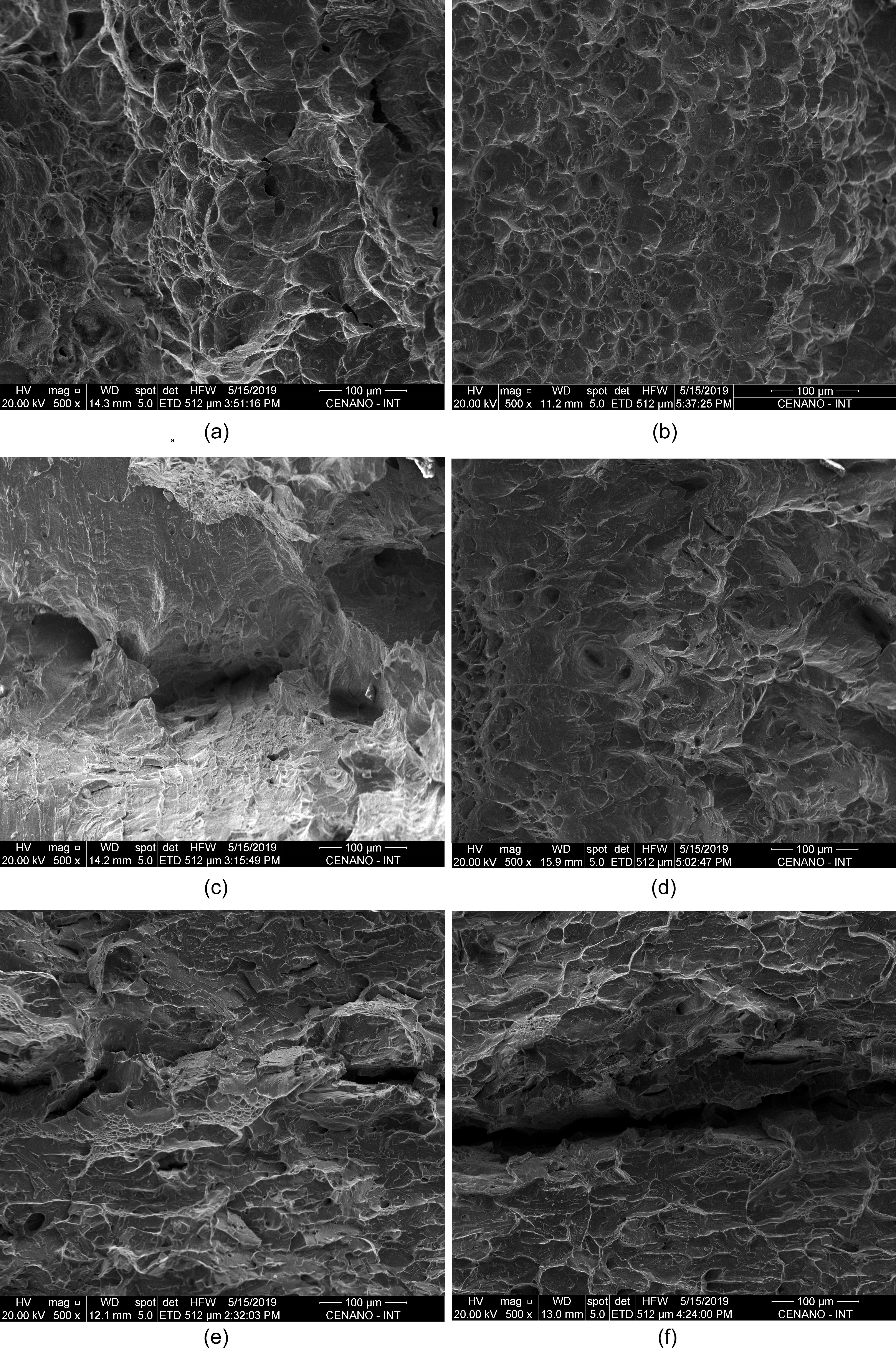
The stress x strain curves (Figure 1 (a)) show that the solution heat treatment significantly reduced the σYS and σUTS mechanical properties. This fact demonstrates the importance of the work hardening effect in achieving the required mechanical properties in duplex steel pipes for applications in the oil and gas industry, especially in oil country tubular goods (OCTG) applications. The results also indicate that the gain in mechanical strength with the cold working condition causes a slight reduction in the material's ductility, decreasing elongation and σ x ε area in comparison to the solution annealing treatment. However, it is noted that the impact toughness at -46 is not affected. Figure 2 shows the fracture surface of Charpy specimens. A ductile fracture with dimples is visible in both conditions (Figure 2 (a) and (b)).

Fracture surface of Charpy impact specimens tested at -46oC: (a) AR-CW; (b) ST-1150; (c) CW/SA400-8; (d) ST-150/SA400-8; (e) CW/SA475-8; (f) ST-1150/SA475-8.
The aged samples present a hardening, which is most noticeable at the temperature of 475°C and in the solution heat treatment condition. The cold work samples presented an increase in the yield strength of around 3% for aged made at 400°C and around 10% for aged made at 475°C. However, the samples in solution heat treatment conditions presented an increase in the yield strength of around 8% for aged made at 400°C and around 44% for aged made at 475°C. Extending the aging time from 8 to 12 hours had little influence on the cold work material, although, in solution heat treatment condition was an important variable. Figure 1 (b) demonstrates that hardness, yield strength, and ultimate strength vary in the same trend. The increase in mechanical strength caused by aging is accompanied by a loss in Charpy impact toughness at -46 (Figure 1 (c)). The ductile fracture mechanism observed in the unaged samples changes to a brittle cleavage fracture aspect after aging at 475°C (Figure 2). This direct relationship is not observed when analyzing the elongation and σ x ε area properties. This effect can be attributed to two factors that make the impact test more severe: the high strain rate and the lower temperature used in the test.
The hardening and embrittlement can be attributed to the α’-phase precipitation. The solution treated sample presents a more pronounced hardening than the cold working conditions. In another article published by our research group23, as-received cold worked (AR-CW) presented dislocation densities higher than solution treated (ST-1150). It was found by8 that cold-deformation can change the spinodal decomposition mechanism of the δ → α’ + α”, depending on the aging temperatures. Plastic deformation favors spinodal decomposition due to dislocations that may break down coherency strains, which act as barriers to the spinodal process, and an increased dislocation density raises the temperature below which spinodal decomposition can occur8,24. The formation of small α’-phase precipitates by spinodal decomposition can be considered a method of precipitation strengthening. Moreover, the nm-scale precipitates can be sheared by dislocations. However, the increase in mechanical strength is linked to a loss in ductility, and therefore, the spinodal decomposition has been termed "475°C embrittlement", leading to a substantial increase in hardness25.
3.2. Pitting corrosion resistance
Figure 3 shows the current density versus temperature curves obtained to determine CPT values. Comparing the un-aged samples, the cold worked steel has a higher CPT than the annealed steel. This is probably related to the high amount of chromium nitrides observed in the material solution treated at 1150oC, as reported in26. Now analysing the effect of aging on the cold deformed steel, the aging at 400oC did not change significantly the CPT, and a small increase was observed with the aging at 475oC by 8 hours. This can be related to an improved electrochemical character of the ferrite, due to the diffusion of pitting corrosion resistance beneficial elements (Cr, Mo, and W) in the ferrite in the initial stages of aging15,27. The increase of the aging time would probably provoke the drop of CPT, as observed in15. The aging of the annealed steel at 400oC also provoked a small increase of the CPT, and the explanation is also related to the Cr, Mo and W redistribution by diffusion. The aging at 475oC, on the other hand, caused a very small negative variation of the CPT in relation to the un-aged annealed condition.

Current density versus temperature curves obtained to determine CPT according to ASTM G150 standard procedure.
3.3. Microstructural characterization
It is known that the α’-phase is a Cr-rich phase, which causes embrittlement and hardeningduring aging at 475oC in the SDSS. Because of Fe and Cr partitioning at an extremely fine scale (nanometric scale), the microstructural features of α’-phase should be interpreted carefully. The consequence is that the nanometric α’-phase is not visible by optical microscopy and/or scanning electron microscopy (SEM), requiring the use of higher resolution techniques such as transmission electronic microscopy (TEM) to observe them7,28,29. TEM bright field micrographs (Figure 4) were used to investigate the detailed nano-scaled structure of the cold work followed by aging treatment at 475oC during 8h (CW/SA475-8), and at 400oC during 8h (CW/SA400-8), specimens. It was possible to observe a mottled contrast, which has the appearance of an orange peel, in the ferrite associated with the spinodal decomposition caused by compositional fluctuations associated with the formation of Cr-rich and Cr-poor phases in the aging treatment5,7,12. It is also noted that the orange peel appearance is much more prominent in the sample aged at 475°C (Figure 4(a)), compared to the sample aged at 400°C (Figure 4(b)), indicating that aging at 475°C provided the formation of a more significant volume fraction of α’-phase, in agreement with the changes observed in the mechanical properties. When spinodal decomposition occurs, the ferrite will decompose into a nanometer-scaled modulated structure of the α” and α’Cr domains that are enriched in Fe and Cr, respectively. The lattices of both α” and α’Cr are body-centered cubic (bcc), and both are of extremely fine scales, with a difference in lattice parameter between the Cr-rich and Fe-rich very small7,12,24. The bcc Cr-rich phase (α’-phase) is coherent with the bcc Fe-rich matrix (α”-phase), which forms a typical complex interconnected network structure, and it is suggested that the locking of dislocations in the modulated structure leads to the severe embrittlement7,12.

TEM bright field images: (a) CW/SA475-8 with modulated structure in ferrite grains; (b) specimen CW/SA400-8 much less pronounced modulated structure.
3.4. Thermal analysis
In order to identify the δ → α’ + α” phase transformation reaction that occurred at each of the conditions, AR-CW and ST-1150, DSC measurements at different heating rates were performed from 100 to 600oC. The results of DSC tests are presented in Figure 5, where one exothermic reaction was revealed for all samples at temperatures just above 500oC. Following Berecz et al.19, since these peak temperatures can be found in the formation temperature ranges of the α’-phase, it has been supposed that the exothermic peak on the DSC curve indicates the α’-phase formation. The peaks of DSc curves of some of the heating rates, especially for AR-CW, were shown as smooth peaks, requiring it to expand the range of the peak temperature in Figure 6 (a-h) to note the exothermic peaks.


DSC curves from highlighting the α’-phase peak temperature (Tp (α’)) in each of the AR-CW and ST-1150 samples: (a) AR-CW (5 oC/min); (b) ST-1150 (5 oC/min); (c) AR-CW (10 oC/min); (d) ST-1150 (10 oC/min); (e) AR-CW (15 oC/min); (f) ST-1150 (15 oC/min); (g) AR-CW (20 oC/min); (h) ST-1150 (20 oC/min).
Using the temperature peaks from Figure 6 (a-h), Figure 7 shows the plots of . The slope of the plotted fitting lines allows to determine that the activation energies for transformation δ → α’ + α” are 281.3 and 285.6 kJ/mol (Table 4), for AR-CW and ST-1150, respectively. In phase transformations, the activation energy can be compared with the activation energy of diffusion, containing contributions of some defects, such as vacancy formation and migration for diffusion mediated phase transformations13. The actual activation energy values significantly depend on the chemical composition of alloys as well as dislocation density17.

Kissinger plots of the α’-phase transformation peaks with their coefficients for AR-CW and ST-1150 samples.
Kinetic parameters to determine the Activation Energy (Ea) of the α’-phase by the spinodal decomposition using DSC thermal analysis (Kissinger model).
Berecz et al.19 mesured 261 kJ/mol for α’ formation and 243 kJ/mol for σ phase precipitation in a UNS S32750 superduplex steel. In this paper, the cold deformation by drawing with 15% of effective strain caused a small variation in the activation energy. The dislocation densities of the ferrite phase of AR-CW and ST-1150 samples before aging were 4.03.1015cm/cm3 and 2.90x1015cm/cm3, respectively, as measured by XRD method in a previous work22. Judging from these results of dislocation densities, a higher difference in the Ea values would be expected. Studying the influence of cold work on the activation energy of σ-phase precipitation in UNS S32750 steel, Mészáros et al.16 also measured small variations, with Ea decreasing from 302 kJ/mol to 296 kJ/mol with the increase of cold redutction from 0 to 60%. It can be inferred from these results that the activation energy for α’ and σ in superduplex stainless steels hardly depends on the cold deformation.
4. Conclusions
The main conclusions about the effect of short duration aging at 400 and 475 oC for up to 12h after two initial conditions (cold worked and solution treated) of the UNS S39274 SDSS samples are:
-
Aging caused an increase in mechanical strength and hardness, accompanied by a decrease in ductility and toughness. The changes in properties were more prominent at 475°C when compared to 400°C, and the effects were more noticeable in the solution-treated samples compared to the cold worked ones.
-
The pitting corrosion resistance of the UNS S39274 steel was not decreased by the short aging at 400oC and 475oC, in relation to the un-aged conditions.
-
DSC measurements at different heating rates for cold worked (AR-CW) and solution treated (ST-1150) specimens established peak temperatures from 505 to 537 oC. Using the Kissinger model the activation energies for α’-phase transformation of the cold worked (AR-CW) and solution treated (ST-1150) specimens were 281.3 and 285.6 kJ/mol, respectively. This result suggests that the cold deformation by drawing had small influence on the activation energy for α’ formation in superduplex stainless steel UNS S39274.
5. Acknowledgments
A. R. Pimenta thanks to Fundação de Amparo à Pesquisa do Estado do Rio de Janeiro (FAPERJ, E-26/211.412/2021 and E-26/200.122/2023). S. S. M. Tavares thanks to Fundação de Amparo à Pesquisa do Estado do Rio de Janeiro (FAPERJ, E-26/200.423/2023). This study was financed in part by the Coordenação de Aperfeiçoamento de Pessoal de Nível Superior — Brasil (CAPES) - Finance Code 001 (308244/2022-2).
-
Data Availability
The full dataset supporting the findings of this paper is available upon request from the corresponding author (ssmtavares@id.uff.br).
6. References
- 1 Elsabbagh FM, El-Sabbagh A, Hamouda RM, Taha MA. Analysis of super duplex stainless steel properties as an austenite-ferrite composite. Mater Sci Appl. 2015;6:1121-36.
- 2 Topolska S, Labanowski J. Impact-toughness investigations of duplex stainless steels. Mater Tehnol. 2015;49:481-6.
-
3 ISO: International Organization for Standardization. ISO 13680:2020(en): Petroleum and natural gas industries — Corrosion-resistant alloy seamless tubular products for use as casing, tubing, coupling stock and accessory material — Technical delivery conditions [Internet]. Geneva: ISO; 2020 [cited 2025 Jan 9]. Available from: https://www.iso.org/obp/ui/#iso:std:iso:13680:ed-4:v1:en:sec:F.5.1
» https://www.iso.org/obp/ui/#iso:std:iso:13680:ed-4:v1:en:sec:F.5.1 - 4 Gutiérrez-Vargas G, López VH, Carreón H, Kim J-Y, Ruiz A. ACPD detection and evaluation of 475 °C embrittlement of aged 2507 super duplex stainless steels. AIP Conf Proc. 2017;1806:110018.
- 5 Örnek C, Idris SAM, Reccagni P, Engelberg DL. Atmospheric-induced stress corrosion cracking of Grade 2205 Duplex Stainless steel: effects of 475 °C embrittlement and process orientation. Metals (Basel). 2016;6:167.
- 6 Hsieh Y-C, Zhang L, Chung T-F, Tsai Y-T, Yang J-R, Ohmura T, et al. In-situ transmission electron microscopy investigation of the deformation behavior of spinodal nanostructured δ-ferrite in a duplex stainless steel. Scr Mater. 2016;125:44-8.
- 7 Weng KL, Chen HR, Yang JR. The low-temperature aging embrittlement in a 2205 Duplex stainless steel. Mater Sci Eng A. 2004;379:119-32.
- 8 Hättestrand M, Larsson P, Chai G, Nilsson J-O, Odqvist J. Study of decomposition of ferrite in a duplex stainless steel cold worked and aged at 450-500 °C. Mater Sci Eng A. 2009;499:489-92.
- 9 Łabanowski J, Świerczyńska A, Topolska S. Effect of microstructure on mechanical properties and corrosion resistance of 2205 Duplex stainless steel. Pol Marit Res. 2015;21:108-12.
- 10 Sahu JK, Krupp U, Ghosh RN, Christ H-J. Effect of 475 °C embrittlement on the mechanical properties of duplex stainless steel. Mater Sci Eng A. 2009;508:1-14.
- 11 Dainezi I, Borges SH, de Sousa LL, Mariano NA. Temperature and time effect of thermal aging treatment on microstructure and corrosion resistance of UNS S31803 duplex stainless steel. Res Soc Dev. 2021;10:e24910817369.
- 12 Chan KW, Tjong SC. Effect of secondary phase precipitation on the corrosion behavior of duplex stainless steels. Materials (Basel). 2014;7:5268-304.
- 13 Tucker JD, Miller MK, Young GA. Assessment of thermal embrittlement in duplex stainless steels 2003 and 2205 for nuclear power applications. Acta Mater. 2015;87:15-24.
- 14 Ai WJ, Kuan HC, Dong JJ, Kwok CT, Lo KH. Short-term spinodal decomposition – its effects on corrosion behaviour of a duplex stainless steel and feasibility as a strengthening treatment. Mater Corros. 2017;68:395-404.
- 15 Tavares SSM, Loureiro A, Pardal JM, Montenegro TR, da Costa VC. Influence of heat treatments at 475 and 400 °C on the pitting corrosion resistance and sensitization of UNS S32750 and UNS S32760 superduplex stainless steels. Mater Corros. 2012;63:522-6.
- 16 Mészáros I, Bögre B. Complex study of eutectoidal phase transformation of 2507-type super-duplex stainless steel. Materials. 2019;12:2205.
- 17 Berecz T, Fazakas É, Mészáros I, Sajó I. Decomposition kinetics of ferrite in isothermally aged SAF 2507-Type Duplex Stainless steel. J Mater Eng Perform. 2015;24:4777-88.
- 18 Hajra RN, Tripathy HP, Rai AK, Vijayashanthi N, Raju S, Saroja S. Study of high temperature phase stability and phase transformation kinetics of sigma and parent alpha phase in Fe55Cr45 (wt. %) alloy. J Alloys Compd. 2017;727:940-7.
- 19 Berecz T, Fazakas É, Fábián ER, Jenei P, Maróti JE. Investigation of thermally induced deterioration processes in cold worked SAF 2507 type duplex stainless steel by DTA. Crystals. 2020;10:937.
- 20 Kissinger HE. Reaction kinetics in differential thermal analysis. Anal Chem. 1957;29:1702-6.
-
21 ASTM: American Society for Testing and Materials. ASTM A370-24a: test methods and definitions for mechanical testing of steel products. West Conshohocken: ASTM; 2024.http://dx.doi.org/10.1520/A0370-24A
» http://dx.doi.org/10.1520/A0370-24A -
22 ASTM: American Society for Testing and Materials. ASTM G150-18: test method for electrochemical critical pitting temperature testing of stainless steels. West Conshohocken: ASTM; 2018.http://dx.doi.org/10.1520/G0150-18
» http://dx.doi.org/10.1520/G0150-18 -
23 Gonzaga AC, Tavares SSM, Cardoso ASM, Dille J, Malet L, Pimenta AR. Dislocation density measurements from x-ray diffraction of austenite and ferrite phases in superduplex UNS S39274. J of Materi Eng and Perform 2024. http://dx.doi.org/10.1007/s11665-024-10051-2
» http://dx.doi.org/10.1007/s11665-024-10051-2 - 24 Lo KH, Shek CH, Lai JKL. Recent developments in stainless steels. Mater Sci Eng Rep. 2009;65:39-104.
- 25 Krupp U, Söker M, Giertler A, Dönges B, Christ H-J, Wackermann K, et al. The potential of spinodal ferrite decomposition for increasing the very high cycle fatigue strength of duplex stainless steel. Int J Fatigue. 2016;93:363-71.
-
26 Tavares SSM, Pimenta AR, Loureiro RCP, Dille J, Malet L. Investigation of chromium nitride precipitation in UNS S39274 stainless steel. J of Materi Eng and Perform. 2024;33:6686-92 http://dx.doi.org/10.1007/s11665-023-08381-8
» http://dx.doi.org/10.1007/s11665-023-08381-8 - 27 Örnek C, Engelberg DL, Lyon SB, Ladwein TL. Effect of “475°C Embrittlement” on the Corrosion Behaviour of Grade 2205 Duplex stainless steel investigated using local probing techiques. Corros Manag. 2013; 9-11.
- 28 Lima HMLF, Bastos IN, Araújo WS, Martins M. Heat treatment effects on ASTM A890/A 890M GR 5A super duplex stainless steel passivity. Mater Res. 2018;20:775-85.
- 29 Matias JVS, Tavares SSM, Pardal JM, Ribeiro RSA. Embrittlement and corrosion decay of a cast duplex stainless steel. Mater Res. 2017;20:279-83.
Edited by
-
Associate Editor:
Igor Vasconcelos.
-
Editor-in-Chief:
Luiz Antonio Pessan.
The full dataset supporting the findings of this paper is available upon request from the corresponding author (ssmtavares@id.uff.br).