Productive and economic performance of an indoor intensive culture of Penaeus vannamei: comparing biofloc versus recirculating systems
ABSTRACT
This study evaluated the productive performance and economic feasibility of intensive indoor culture of Penaeus vannamei in 2,500 L fiberglass tanks, comparing a recirculating aquaculture system (RAS) and a biofloc technology system (BFT). A 56-day experiment was performed at a stocking density of 750 ind/m3, with four replicates per treatment. Shrimp reared in RAS showed significantly superior growth, reaching greater total length (8.73 ± 1.72 cm) and final body weight (11.22 ± 0.74 g) than those cultured in BFT (5.94 ± 1.29 cm and 9.91 ± 0.71 g, respectively; p = 0.004 and p = 0.002). Feed conversion ratio was significantly lower in RAS (1.42 ± 0.12) than in BFT (1.89 ± 0.15; p = 0.0006), resulting in higher productivity (10.8 ± 0.54 vs. 8.6 ± 0.42 kg/m3; p = 0.0003). Survival did not differ significantly between systems (86.7 ± 2.52% in RAS and 84.1 ± 3.21% in BFT; p = 0.21). Inferior performance of BFT was attributed to limitations associated with small-volume tanks, particularly suspended solids accumulation and biofloc instability which likely impaired oxygen availability and feed utilization. Conversely, RAS provided greater environmental stability, supporting more efficient biomass deposition and consistent growth. An economic analysis based on RAS performance and extrapolated to a commercial-scale scenario estimated an annual production cost of US$ 24,249.24 for six production cycles. Feasibility was confirmed by internal rates of return ranging from 19.12% to 68.01% and net present values between US$ 5,290.48 and US$ 49,226.62, depending on shrimp survival (80-90%) and market price (US$ 7.00-8.00 kg-1). Under optimal conditions, the payback period was 1.8 years. Overall, RAS showed clear biological and economic advantages over BFT for intensive shrimp farming with reduced water use.
Keywords:
Aquaculture sustainability; BFT; Carbon:nitrogen ratio; RAS; Shrimp farming
INTRODUCTION
Aquaculture has been consolidated as the fastest growing source of aquatic protein production worldwide, currently accounting for over 50% of fish and shellfish destined for human consumption (FAO, 2024). This expansion is driven by the increasing global demand for aquatic food products, in contrast with the stagnation or decline of natural fishery stocks. However, the intensification of aquaculture production systems has introduced significant challenges, including higher organic loading in rearing environments, increased susceptibility to disease outbreaks, and potential environmental impacts (Avnimelech, 2015; Boyd and McNevin, 2021).
In this context, super-intensive aquaculture systems, particularly zero water exchange systems (ZWES), have emerged as promising alternatives to reconcile biosafety, production efficiency, and environmental sustainability (Emerenciano et al., 2022). Such systems, often operated indoors under controlled environments, reduce the risk of pathogen introduction, allow precise monitoring of hydro chemical variables, and mitigate the discharge of nutrient rich effluents into natural ecosystems (Emerenciano et al., 2013).
Notable among the main strategies employed in ZWES is biofloc technology (BFT). BFT relies on manipulating the carbon-to-nitrogen (C:N) ratio to stimulate the growth of heterotrophic microbial communities capable of recycling nutrients, reducing toxic nitrogenous compounds, and generating microbial biomass that can be directly consumed by cultured organisms (De Schryver et al., 2008; Sun et al., 2023). This microbial biomass supplements formulated feed, improves feed conversion efficiency, reduces feed costs, and contributes to animal health via competitive exclusion of pathogens (Xu et al., 2022).
Pacific white shrimp (Penaeus vannamei) is the most relevant species for super-intensive culture due to its physiological plasticity, high tolerance to stocking density, and efficient feed utilization (Shao et al., 2017). Recent studies have shown that P. vannamei reared under BFT conditions may achieve higher growth rates, improved survival, and better feed efficiency while reducing environmental impacts compared with conventional recirculating systems (Liu et al., 2024; Sun et al., 2023).
However, Gou et al. (2019) and Ramiro et al. (2024) highlight that each system presents relative advantages and drawbacks, pointing out the lack of comparative studies integrating biological, metabolic, and economic performance under controlled small-scale conditions. Although the economic and environmental sustainability of intensive shrimp systems has been widely discussed, most evaluations have been conducted under field or commercial-scale conditions, leaving a knowledge gap regarding the combined productive and financial responses of these systems when tested experimentally (Rego et al., 2017).
In this context, this study compared two intensive indoor shrimp culture systems (BFT and RAS) operated under identical environmental conditions and experimental scale while applying system-specific management strategies. This experimental approach allows for a more controlled assessment of system performance, minimizing confounding environmental effects while preserving the operational characteristics inherent to each technology.
Given the functional principles of biofloc systems, BFT was expected, due to its capacity to recycle nutrients and generate microbial biomass, to result in superior growth performance and improved economic efficiency compared with RAS, representing a more sustainable alternative for small scale intensive shrimp production. However, given the potential instability of biofloc formation in small-volume tanks, RAS was expected to outperform BFT under such constrained conditions.
This study contributes to the broader understanding of sustainable aquaculture by comparing two intensive but environmentally conscious systems. The results provide insights not only for optimizing production performance but also for improving water use efficiency and environmental sustainability of shrimp farming.
METHODS
EXPERIMENTAL CONDITIONS
The experiment was conducted at the Mariculture Reference Laboratory Unit, Fisheries Institute (ULR Mariculture), Santos, São Paulo, Brazil (23º59’23”S; 46º18’23”W). Seawater was pumped from Santos Bay, stored in sedimentation tanks, sand filtered, and sterilized by ultraviolet radiation before use.
Experimental period lasted 56 days, with potential for six cycles per year. The laboratory system was structured in closed circuits composed of four independent batteries, each consisting of nine 2500 L fiberglass tanks. Each tank was considered an independent production unit (PU; n = 9 per battery), totaling 18 tanks per system.
The number of replicates (four per treatment) was defined based on previous trials performed under similar conditions (Emerenciano et al., 2022; Ramiro et al., 2024), which indicated that four replicates per treatment were sufficient to detect significant differences (α = 0.05) in growth and feed conversion with power ≥ 0.8, considering the expected intra-treatment variability (<15%). This sample size also balances statistical robustness and operational feasibility in small-scale controlled systems.
To avoid pseudo replication, mixed effect statistical models were applied, considering “battery” as a random effect and “treatment” as a fixed effect.
Each battery was connected to two biofiltration tanks (5000 L each). Two batteries were operated in RAS (treatment 1), and two under BFT without water renewal and without biofiltration (treatment 2).
In the RAS configuration, the water recirculation rate was maintained at approximately 4.5 system turnovers per hour (equivalent to 11,2 L/h per battery), ensuring constant oxygenation and removal of particulate matter. Biofiltration units were equipped with a dual stage system: mechanical filtration using sand and fiber cartridges, and biological filtration using high surface area plastic media (500 m2/m3) colonized by nitrifying bacteria. Water returned to the production tanks via gravity flow. In BFT tanks, no filtration or water renewal occurred, and aeration was provided exclusively by radial blowers to maintain floc suspension.
STOCKING AND FEEDING MANAGEMENT
Tanks were stocked with P. vannamei post larvae (PL20) at 750 ind/m3, corresponding to an initial biomass of 2.8 g/L. In BFT tanks, molasses was applied as a carbon source to maintain a C:N ratio of 12:1 - 15:1, as recommended by De Schryver et al. (2008). Commercial molasses (45% organic C) was applied daily at 5 mL/m3, with adjustments based on total ammonia nitrogen (TAN) concentration. C:N ratio was monitored weekly to remain within the target range.
Feeding initially corresponded to 10% of biomass, gradually reduced to 3% at the final stage, distributed into four daily meals using commercial feed for P. vannamei. During the first 30 days, a crumbled feed containing 40% crude protein was supplied (Rubalcava Márquez et al., 2021), later replaced by feed with 35% protein (Darodes de Tailly et al., 2021). Feed allowance was adjusted weekly according to estimated biomass per tank (Qt = Biomass × feeding rate), discounting the estimated nutritional contribution of biofloc.
WATER QUALITY MONITORING
Physicochemical variables (pH, temperature, salinity, and dissolved oxygen) were monitored daily using a YSI Proplus multiparameter probe (±0.1 accuracy). Nitrite was analyzed every four days using the colorimetric method by Solórzano (1969). Total suspended solids (TSS) were determined by filtering 500 mL water samples through GF/F membranes, followed by drying at 60°C and weighing (Khanjani et al., 2024a). Biofloc volume (mL/L) was measured using Imhoff cones, in triplicate per tank (Avnimelech, 2015). Total ammonia nitrogen (TAN) was analyzed every four days using the colorimetric method described by Solórzano (1969).
GROWTH PERFORMANCE AND PHYSIOLOGICAL MONITORING
Weekly samples were performed on 30 shrimp per tank. On day 20, subsamples were collected for metabolic analyses. Oxygen consumption assays were performed in 2 L respirometers containing five shrimp, maintained at 23 ± 0.5°C, with 30 min acclimation and 3 h incubation. Dissolved oxygen was measured at the beginning and end of the assays using the modified Winkler method (Barbieri et al., 2002). Oxygen consumption was expressed as mg O2/g/h and corrected for blanks. Ammonia excretion was determined using the Solórzano (1969) method and normalized to biomass.
O:N ratio represents the relationship between oxygen consumption and nitrogen excretion and was calculated to evaluate energy metabolism. Lower values indicate a greater reliance on protein catabolism, whereas higher values reflect increased utilization of lipids and carbohydrates for energy production (Alves et al., 2022; Barbieri et al., 2015). At harvest, survival, productivity, and FCR were calculated for each tank.
STATISTICAL ANALYSES
To evaluate differences in water quality parameters between treatments over time, repeated measures analyses were applied, since physicochemical variables were measured repeatedly in the same tanks throughout the experimental period. Data normality was first assessed using the Shapiro-Wilk test (p < 0.05). For normally distributed variables, repeated ANOVA measures were used considering treatment as a fixed factor and time as the within subject factor. When the assumptions of normality or sphericity were violated, nonparametric Friedman test was applied as an alternative. When significant effects were detected, post-hoc comparisons were performed using Tukey’s HSD test (parametric data) or Dunn’s test with Bonferroni correction (nonparametric data), adopting a significance level of p ≤ 0.05. This approach allowed identifying which physicochemical parameters and time patterns contributed most to differences between culture systems.
Survival and performance parameters were compared between treatments. Biometric relationships were fitted using allometric models (Wt = aLb) and growth was described by the von Bertalanffy model (Zar, 2010).
To explore the temporal dynamics of shrimp growth and to detect specific differences between treatments throughout the experimental period, nonparametric statistical analyses were conducted on R (v.4.3). For each sampling day, the Mann-Whitney U test (Wilcoxon rank-sum test) was applied to compare the two treatments (RAS and BFT) for total length and body weight. This test was chosen because it does not assume normal data distribution and is suitable for independent samples. Analyses identified whether significant differences existed between treatments at each culture day, and the corresponding p-values were adjusted using the Benjamini-Hochberg (FDR) correction to control for multiple comparisons. Results were represented graphically as boxplots displaying medians, quartiles, ranges, and outliers, with significance levels indicated by asterisks (p ≤ 0.05, p ≤ 0.01, p ≤ 0.001, p ≤ 0.0001). Additionally, the relations between water quality parameters and shrimp performance (FCR and growth rate) were examined using Pearson correlation analyses, allowing integrated interpretation of physicochemical and biological variables (Zar, 2010)
The von Bertalanffy growth model (VBGF) was fitted to describe shrimp growth in total length (mm) over the 56-day culture period for each treatment (RAS and BFT). The model used was L(t)=L∞(1−e−K(t−t0)), in which L∞ is the asymptotic length, K the growth coefficient, and t0 the theoretical time when length equals zero. Parameter estimation was performed by non-linear least squares using the Levenberg-Marquardt algorithm (nlsLM function, minpack.lm package on R, see Elzhov et al., 2023). Initial values were set as L∞ = 1.05 × maximum observed mean length, K = 0.05, and t0 = 0. The model was independently fitted for each treatment using the mean lengths obtained at each sampling day, and fitted curves were plotted together with observed data to visually assess goodness of fit (Aragón-Noriega et al., 2017).
ECONOMIC ANALYSIS
Since shrimp cultured under RAS achieved superior performance, an economic analysis was performed considering commercial-scale exploitation using all 36 laboratory tanks (PUs). Economic performance was evaluated using a discounted cash flow approach grounded in classical investment theory and widely applied in aquaculture production analyses (Bjørndal et al., 2024; Shang, 1990; Vergara‐Solana et al., 2018).
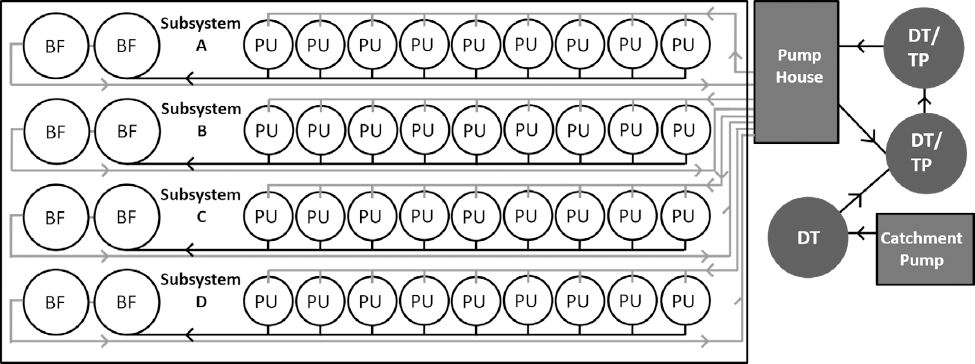
Production facility was designed with a 120 m2 warehouse including tanks, filters, storage area, and a 20 m2 machine room containing a diesel generator and radial blowers (Figure 1). Capital expenditures included infrastructure, equipment, and system-specific components, whereas operational expenditures comprised feed, post-larvae, energy, labor, water use, and routine maintenance.

Layout of the recirculating aquaculture system for marine shrimp production. Arrows indicate water flow. Black lines - seawater collected and stored in decantation (DT) and transition tanks (TP); grey lines - water filtered through biofilters (BF); dashed lines - effluents from production units (PU); pump house - including one 1 HP water pump per subsystem, a 5 HP radial blower for the entire system, a UV sterilization unit, and a sand filter.
Economic indicators included: Effective Operating Cost (EOC), Total Operating Cost (TOC), and Total Production Cost (TPC) (Matsunaga et al., 1976), as well as Gross Revenue (GR), Operating Profit (OP), Gross Margin (GM), and Profitability Index (PI) (Martin et al., 1998). Feasibility was assessed using Net Present Value (NPV), Internal Rate of Return (IRR), and Break-Even Point (BEP), considering two survival rates (80% and 90%) and two shrimp market prices (US$ 7.00 and US$ 8.00/kg). Cost and revenue estimates were derived from the experimental productivity data obtained during the experiment and projected over a 10-year operational lifespan, consistent with economic assessments of intensive aquaculture systems (Almeida et al., 2021; Asche et al., 2018; Shang, 1990).
Economic indicators included: Effective Operating Cost (EOC), Total Operating Cost (TOC), and Total Production Cost (TPC) (Matsunaga et al., 1976), as well as Gross Revenue (GR), Operating Profit (OP), Gross Margin (GM), and Profitability Index (PI) (Martin et al., 1998). Feasibility was assessed using Net Present Value (NPV), Internal Rate of Return (IRR), and Break-Even Point (BEP), considering two survival rates (80% and 90%) and two shrimp market prices (US$ 7.00 and US$ 8.00/kg). Cost and revenue estimates were derived from the experimental productivity data obtained during the experiment and projected over a 10-year operational lifespan, consistent with economic assessments of intensive aquaculture systems (Almeida et al., 2021; Asche et al., 2018; Shang, 1990).
Sensitivity analyses simulated financial risks associated with partial or total production loss within a culture cycle, a realistic scenario in aquaculture operations. Additionally, uncertainty and investment risk were addressed using a deterministic sensitivity analysis, in which key economic variables, feed cost, energy cost, shrimp sale price, and system productivity, were individually varied by ±10% and ±20% while all other parameters were held constant, following established recommendations for project evaluation in aquaculture (Bjørndal et al., 2024; Shang, 1990).
Minimum acceptable rate of return (MARR) was set at 12% per year, based on interest rates from bank investments. This value exceeds the returns from conventional financial applications in Brazil and the subsidized government loan rates available for agribusiness financing. Returns below this threshold are generally unattractive to investors (Engle, 2023). This MARR was therefore adopted as the baseline discount rate to represent the opportunity cost of capital and to incorporate technical, market, and operational risks typically associated with small-scale intensive aquaculture ventures.
To contextualize the economic evaluation within Brazilian aquaculture, energy and feed costs were calculated based on average national market values for 2025, which remain among the major expenses for small-scale producers. Such contextualization enhances the applicability of the financial analysis to local production scenarios, and is essential to ensure that the economic indicators reflect realistic production conditions and support decision making in regional aquaculture investments (Asche et al., 2018).
RESULTS
WATER QUALITY
Physicochemical parameters remained within the ranges recommended for P. vannamei (Rocha et al., 2022) throughout the 56-day experiment, ensuring suitable conditions for shrimp growth (Table 1). Temperature (RAS: 23.50 ± 2.1°C; BFT: 23.50 ± 2.6°C), salinity (RAS: 30.30 ± 0.54; BFT: 30.30 ± 0.61), and pH (RAS: 7.92 ± 0.24; BFT: 7.71 ± 0.28) did not differ significantly between systems.
Dissolved oxygen concentrations remained above 6 mg/L in both systems; however, mean values were significantly higher in RAS (6.94 ± 0.41 mg/L) than in BFT (6.10 ± 0.69 mg/L), indicating more efficient oxygen management by RAS under high stocking density conditions.
Total suspended solids (TSS) in BFT averaged 424 ± 95 mg/L, a typical level (Khanjani et al., 2024a), but one that may have increased biological oxygen demand. Nitrite concentrations differed significantly between systems, with higher values recorded in RAS (0.35 ± 0.08 mg/L) compared with BFT (0.22 ± 0.05 mg/L).
Shrimp-specific ammonia excretion rates were significantly higher under BFT (0.26 ± 0.04 mg/L/g/h) than RAS (0.16 ± 0.06 mg/L/g/h), possibly reflecting reduced nitrogen assimilation efficiency under biofloc conditions. Conversely, total ammonia nitrogen (TAN) concentrations in the culture water were significantly lower in BFT (0.32 ± 0.09 mg/L) compared with RAS (0.48 ± 0.11 mg/L), indicating enhanced assimilation of inorganic nitrogen by heterotrophic and nitrifying microbial communities in BFT.
Oxygen consumption did not differ significantly between systems (RAS: 4.10 ± 0.21 mg/O2/g/h; BFT: 4.94 ± 0.26 mg/O2/g/h). However, the O:N ratio was significantly higher in shrimp reared under BFT conditions (28.61 ± 0.61) compared with RAS (20.17 ± 0.82), suggesting a greater relative contribution of lipids and carbohydrates to energy metabolism. Nitrifying and heterotrophic bacteria present in the BFT likely contributed to reduced ammonia availability and, consequently, to the observed increase in O:N ratio (Table 1). Collectively, these results indicate that although BFT favored metabolic energy utilization, fluctuations in water quality, particularly associated with suspended solids, may have constrained overall production efficiency.
GROWTH PERFORMANCE AND PHYSIOLOGY
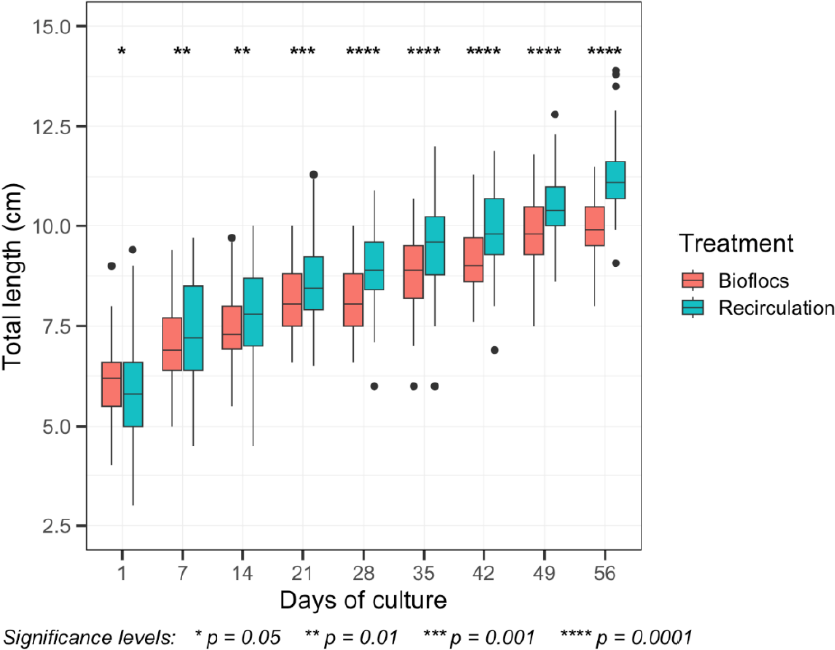
At day 56, the hypothesis that biofloc would provide higher productivity was not confirmed. Shrimp reared under RAS (Treatment 1) exhibited greater total length and body weight compared with those farmed under BFT (Treatment 2) (Figures 2 and 3). Both differences were statistically significant according to the Mann-Whitney non-parametric test (p < 0.001).
Medians, quartiles, ranges, and outliers of total length (cm) of Penaeus vannamei reared indoors for 56 days under two treatments: recirculating aquaculture system (RAS) and biofloc (BFT). Statistical differences between treatments at each sampling day were evaluated using the Mann-Whitney (Wilcoxon rank-sum) test, with significance levels indicated by asterisks.
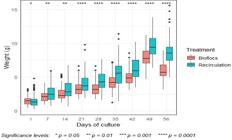
Medians, quartiles, ranges, and outliers of total weight (g) of Penaeus vannamei reared indoors for 56 days under two treatments: recirculating aquaculture system (RAS) and biofloc. Statistical differences between treatments at each sampling day were evaluated using the Mann-Whitney (Wilcoxon rank-sum) test, with significance levels indicated by asterisks.
Weekly biometrics indicated faster shrimp growth in RAS from the early stages, a difference that became consolidated by the end of the cycle (Figures 2 and 3). At harvest, shrimp reared in RAS reached an average length of 8.73 ± 1.72 cm and mean weight of 11.22 ± 0.74 g, significantly higher than those in BFT (5.94 ± 1.29 cm; 9.91 ± 0.71 g; p < 0.001). These results reveal that despite the nutritional potential of biofloc, the more stable control of environmental variables in RAS promoted higher biomass deposition.
Table 2 summarizes the main production indicators for both systems, facilitating comparative interpretation of performance and efficiency metrics.
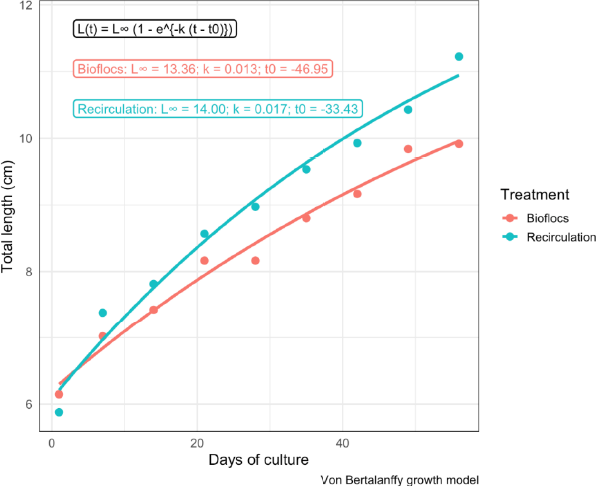
Figure 4 presents the von Bertalanffy growth model fitted to the total length of Penaeus vannamei over the 56-day culture period under RAS and BFT treatments. The model adequately described shrimp growth in both systems, revealing a faster growth rate and higher asymptotic length in RAS (L∞=14.00; K=0.017) compared with BFT (L∞=13.36; K=0.013). Negative t0 values in both systems indicate the theoretical time at which growth would begin, consistent with expected biological patterns for crustaceans. Overall, shrimp reared under RAS showed superior growth performance relative to those in BFT.
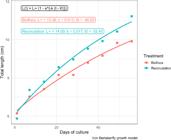
Von Bertalanffy growth model fitted to the total length (cm) of Penaeus vannamei reared for 56 days under two treatments (Bioflocs and Recirculation). Solid lines represent the fitted curves for each treatment, and the equation and estimation parameters of the model is shown within the plot.
Survival rates remained high in both systems (80-90%). However, the higher variability in growth observed under BFT suggests that heterogeneous tank conditions may have affected cohort uniformity which directly impacts market value.
PRODUCTIVITY
Productivity was directly influenced by final average body weight, reaching 10.8 ± 0.5 kg/m3 in RAS and 8.6 ± 0.4 kg/m3 in BFT. Feed conversion ratio (FCR) was significantly lower in RAS (1.42 ± 0.12) compared with BFT (1.89 ± 0.15; U = 15, p = 0.002). Although survival did not differ significantly between systems, the greater biomass achieved in RAS resulted in higher production per unit volume. This productive efficiency gain has direct implications for cost reduction, as larger shrimp dilute fixed expenses like labor and energy, ultimately improving profit margins for small-scale producers.
ECONOMIC ANALYSIS
Since shrimp cultured in RAS achieved superior productive performance, the economic analysis conducted considered a commercial-scale operation using all 36 production units.
Initial capital investment was primarily allocated to rearing tanks which represented approximately 58% of the total fixed capital required for system implementation (Table 3). This distribution reflects the intensive nature of small-scale indoor RAS operations, in which tank volume and durability are critical determinants of production capacity and system longevity. Total initial investment amounted to US$ 17,185.74, with annual depreciation and interest costs of US$ 2,968.59, highlighting the relevance of capital costs in the overall economic structure of intensive systems.
Cost structure analysis indicated that operational expenditures represented the largest percentage of total production costs, with feed and energy most contributing to the Effective Operating Cost (EOC) and Total Operating Cost (TOC), whereas infrastructure and equipment were reflected in the Total Production Cost (TPC) (Table 4).
Table 5 synthesizes the production costs and return on investment indicators for P. vannamei cultivated in RAS under the evaluated commercial-scale scenarios, detailing the distribution of Effective Operating Cost (EOC), Total Operating Cost (TOC), and Total Production Cost (TPC). Return on investment indicators provide the quantitative basis for subsequent comparisons of economic feasibility across survival and market price scenarios, serving as the reference framework for the discounted cash flow analysis and sensitivity assessments discussed below.
Gross Revenue (GR), Operating Profit (OP), Gross Margin (GM), and Profitability Index (PI) varied consistently across the evaluated scenarios, reflecting differences in shrimp survival rates (80% and 90%) and market prices (US$ 7.00 and US$ 8.00/kg). Higher survival and increased sale prices resulted in proportional gains across all profitability indicators, whereas scenarios combining lower survival and lower market prices showed reduced margins and operating returns (Table 6).
Economic feasibility indicators derived from discounted cash flow analysis further highlighted these differences. Net Present Value (NPV), Internal Rate of Return (IRR), and Break-Even Point (BEP) showed strong sensitivity to both biological and market related variables (Table 6). Under scenarios characterized by higher survival rates and higher shrimp prices, NPV values were positive and IRR estimates exceeded the minimum attractive rate of return (MARR = 12%), indicating favorable investment conditions. Conversely, less favorable combinations produced marginal or negative NPV values and IRR estimates approaching or falling below MARR, signaling increased financial risk (Table 7).
A deterministic sensitivity analysis based on the observed economic scenarios was performed to better quantify the robustness of these outcomes (Table 8). A reduction in shrimp sale price from US$ 8.00 to US$ 7.00/kg resulted in a 44.6% decrease in net present value (NPV) and a 34.4% reduction in internal rate of return (IRR) relative to the baseline RAS scenario. Similarly, scenarios associated with reduced survival and system productivity led to pronounced economic losses, with reductions exceeding 80% for NPV and 70% for IRR, underscoring the dominant influence of biological performance on economic feasibility.
Sensitivity analyses simulating partial or total production losses within a culture cycle also revealed substantial declines in profitability indicators (Table 9). These results indicate that although the system can be economically viable under favorable biological and market conditions, its financial sustainability is highly vulnerable to reductions in productivity and market price volatility. Feed and energy costs, while representing major components of operational expenses, showed comparatively lower proportional impacts on NPV and IRR than revenue related variables.
Overall, the economic results show that biological efficiency and market conditions are the primary drivers of economic performance in intensive RAS based shrimp production while reinforcing the importance of risk-aware management strategies, cost control, and productivity optimization to ensure investment viability at small commercial scales.
DISCUSSION
WATER QUALITY AND SYSTEM STABILITY
Water quality is a critical factor in intensive shrimp farming, as small fluctuations in physicochemical parameters may compromise metabolism and survival. Here, temperature, salinity, and pH remained within recommended ranges for P. vannamei (Rocha et al., 2022), confirming adequate experimental management. However, key differences emerged between systems. BFT displayed higher TSS (424 ± 95 mg/L) within the recommended range (200 - 600 mg/L; Avnimelech, 2015; Khanjani et al., 2024a), but likely increasing competition for oxygen between heterotrophic microorganisms and shrimp. Episodes of dissolved oxygen depletion below 6 mg/L, the recommended minimum for P. vannamei, may occur in BFT due to elevated TSS and shrimp biomass, approaching hypoxic thresholds (Araujo et al., 2025). Such conditions can compromise growth performance.
Studies by García-Guerrero et al. (2022) and Wafi et al. (2021) revealed strong interactions among key abiotic factors, including temperature, salinity, and ammonia concentration, and shrimp oxygen consumption in closed aquaculture systems. These interactions indicate that metabolic oxygen demand is highly sensitive to relatively small variations in environmental conditions, particularly under intensive rearing scenarios. In BFT systems, this sensitivity is further amplified by elevated microbial activity and suspended solids which collectively increase biological oxygen demand. Consequently, any interruption in aeration can rapidly disrupt oxygen availability, leading to critical conditions. As reported by Khanjani et al. (2024a), aeration failure in BFT systems may result in lethal oxygen depletion within 30 min, a risk that becomes especially pronounced under high TSS concentrations, highlighting the narrow operational safety margin of small-scale BFT systems.
Ammonia excretion was significantly higher in BFT (0.26 mg/L) compared with RAS (0.16 mg/L), likely due to reduced microbial assimilation in BFT. However, biofiltration maintained safe nitrogen levels (Khanjani et al., 2024a). Higher O:N ratios in BFT (28.61) suggested greater reliance on lipids and carbohydrates as energy substrates, consistent with Xu et al. (2022). Yet, microbial instability and TSS variability may have reduced the nutritional efficiency of biofloc, negatively impacting growth (Liu et al., 2024; Sun et al., 2023).
Moreover, the uneven microbial consortium development in small volume BFT tanks could have led to bacterial community collapses or dominance shifts, impairing nitrogen recycling and causing temporal instability in dissolved oxygen and carbon availability. Such microbiological imbalances often result in reduced floc digestibility and increased maintenance metabolism in shrimp, decreasing feed efficiency (Shao et al., 2017).
GROWTH PERFORMANCE AND PHYSIOLOGY
Growth in penaeid shrimp is shaped by environmental, biological, and culture-system factors (Emerenciano et al., 2022). Here, RAS produced significantly larger shrimp (8.73 cm, 11.22 g) than BFT (5.94 cm, 9.91 g; p < 0.001). These findings contrast with classical reports on BFT superiority in super-intensive systems (Avnimelech, 2015; Emerenciano et al., 2013) which typically involve large-scale tanks with intensive floc management. In small-volume tanks, high TSS accumulation can hinder performance, aligning with our results.
BFT success depends heavily on C:N management, floc composition, and microbial stability (El-Sayed, 2020). Poorly managed systems may perform worse than RAS, as observed here. High TSS levels can impair gill function, reduce feed intake, and increase FCR, particularly in small tanks (Zhang et al., 2025). These factors explain the consistent superiority of RAS in our experiment.
RAS offers greater water-quality stability due to sedimentation and biofiltration processes that reduce solids and convert toxic nitrogenous compounds (Avnimelech, 2006; Barbieri et al., 2014; Santos et al., 2014). This minimizes physiological stress and improves feed efficiency. Conversely, BFT requires constant aeration as interruptions >30 min can cause critical oxygen depletion (Khanjani et al., 2024b), increasing risk in facilities with limited infrastructure.
Additionally, the microbial diversity in BFT systems can vary widely according to organic carbon sources and floc maturation stage (Xu et al., 2022). Early-stage flocs are often dominated by opportunistic heterotrophs with low stability, whereas mature flocs host nitrifying and denitrifying bacteria that contribute to nitrogen cycling (Gou et al., 2019). The short 56-day experimental period may not have allowed for complete microbial succession, partially explaining the lower growth rates observed in BFT.
PRODUCTIVITY AND PRACTICAL IMPLICATIONS
Survival remained high in both systems (80 and 90%), but larger shrimp produced in RAS translated into higher productivity and market value. Larger shrimp reduce unit production costs by diluting fixed expenses such as labor and energy (Ruiz-Velazco et al., 2021). Here, production costs in RAS (US$ 4.46 - 6.24/kg) were below prevailing national market prices, highlighting its economic feasibility.
From a practical standpoint, these findings have direct implications for small scale producers. By ensuring continuous biofiltration and oxygen stabilization, RAS configuration provides a more predictable environment that supports faster growth and consistent yields (Gupta et al., 2024). Conversely, small BFT systems require more frequent monitoring of solids and microbial balance which demands higher technical expertise (De Schryver et al., 2008). Thus, producers operating in limited spaces or under unstable power conditions may benefit more from compact RAS units equipped with automated controls for aeration and recirculation.
ECONOMIC VIABILITY AND RISKS
RAS economic performance was primarily driven by its superior productive efficiency, expressed as higher final biomass, improved feed conversion efficiency, and greater volumetric productivity. These biological attributes resulted in lower unit production costs and more favorable profitability indicators when projected to a commercial scale operation. This correlation reflects a fundamental characteristic of intensive shrimp farming systems, in which economic viability is tightly coupled to biological performance (Asche et al., 2018; Shang, 1990).
Despite the relatively high initial capital investment required for RAS implementation, mainly associated with infrastructure and rearing units, capital intensity alone did not constrain economic feasibility. Under scenarios characterized by stable survival and favorable market conditions, investment recovery occurred within short timeframes. This outcome highlights that, in capital-intensive aquaculture systems, operational efficiency and production stability are more influential than absolute investment costs in determining financial attractiveness (Bjørndal et al., 2024; Engle, 2023).
Operational costs were largely determined by feed, labor, and energy, with feed constituting the dominant expenditure. Accordingly, the improved feed conversion efficiency achieved by RAS substantially reduced production costs per unit of output. Enhanced feed efficiency increased the dilution of fixed and variable costs over total harvested biomass, reinforcing feed management as a key determinant of economic sustainability in intensive systems (Shang, 1990; Vergara-Solana et al., 2019).
Profitability indicators exhibited high sensitivity to variations in survival rates and shrimp market prices, reflecting the combined influence of biological reliability and external economic drivers. Scenarios associated with reduced survival or lower sale prices resulted in marked declines in economic returns. This sensitivity underscores the limited buffering capacity of intensive shrimp production systems when exposed to biological or market disturbances, as reported in previous economic risk assessments (Rego et al., 2017).
Evaluation of production loss scenarios showed that failure of a single production cycle can significantly affect long-term economic performance, particularly under unfavorable price conditions. These findings indicate that economic resilience depends not only on average productivity but also on the temporal consistency of production. From a management standpoint, this reinforces the importance of robust biosecurity protocols, system redundancy, and contingency planning in intensive shrimp farming operations (Boyd and McNevin, 2021).
Sensitivity analyses further indicated that reductions in survival and system productivity exerted a stronger negative effect on profitability than comparable increases in feed or energy costs. While feed and energy remain relevant cost components, revenue related variables dominated economic outcomes, emphasizing that biological optimization provides greater financial stability than cost minimization strategies alone (Bjørndal et al., 2024; Henriques et al., 2022; Shang, 1990).
Market price variability emerged as a critical external source of economic risk, as relatively modest declines in sale price produced substantial reductions in economic returns. This result highlights the exposure of intensive shrimp farming to broader market dynamics and reinforces the relevance of commercialization strategies aimed at stabilizing revenues, particularly in small-scale coastal aquaculture contexts (Asche et al., 2018).
The lower growth performance and reduced feed efficiency achieved by the biofloc system limited its economic competitiveness under the evaluated small-scale conditions. Although biofloc technology offers recognized environmental benefits, its economic performance remains strongly dependent on system scale, solids management, and microbial stability (Avnimelech, 2015; Khanjani et al., 2024a). Under constrained volumes, these factors may offset potential cost savings, as reported in recent comparative assessments (El-Sayed, 2020; Ramiro et al., 2024).
Overall, the integrated interpretation of biological and economic outcomes indicates that economic viability in intensive shrimp farming is primarily governed by survival stability, feed efficiency, and productivity, rather than by isolated reductions in operational inputs. Although RAS entails higher energy demand and initial capital investment, its greater environmental control and production predictability supported more robust economic performance and reduced financial risk under the evaluated conditions, reinforcing its suitability for small-scale, land-based shrimp farming systems in coastal regions.
PERSPECTIVES AND RECOMMENDATIONS
Under the evaluated controlled conditions, RAS showed greater technical reliability and economic consistency over BFT, particularly in small-volume intensive production units. Although BFT is widely recognized for its potential to recycle nutrients and reduce water use, its performance in this study was constrained by elevated suspended solids concentrations (>400 mg/L) which likely impaired feed intake and feed conversion efficiency, as previously reported (El-Sayed, 2020). Conversely, the greater stability of water quality provided by RAS resulted in superior growth, lower FCR, and higher productivity, compensating for its higher operational costs, in line with recent comparative studies (Ramiro et al., 2024). Thus, RAS currently represents a more predictable and lower-risk option for small-scale indoor shrimp farming, whereas BFT remains a promising alternative when operated under conditions that allow improved solids control and microbial stabilization.
CONCLUSIONS
This study shows that RAS provides superior biological and economic performance for small-scale intensive shrimp farming. Nevertheless, optimizing carbon management and microbial dynamics could enhance BFT competitiveness, particularly in regions facing water scarcity or environmental constraints. These findings offer practical guidance for producers and policymakers seeking to balance profitability with sustainability in marine shrimp aquaculture.
Overall, our results provide valuable guidance for producers and aquaculture managers aiming to enhance productivity and economic returns while supporting the transition to low footprint shrimp farming systems that comply with global sustainability goals.
DATA AVAILABILITY STATEMENT
The data that support the findings of this study are available from the corresponding author.
SUPPLEMENTARY MATERIAL
There is no supplementary material.
ACKNOWLEDGMENTS
There are no acknowledgments.
REFERENCES
-
Almeida, M. S., Carrijo-Mauad, J. R., Gimenes, R. M. T., Gaona, C. A. P., Furtado, P. S., Poersch, L. H., Wasielesky Jr, W. & Fóes, G. K. 2021. Bioeconomic analysis of the production of marine shrimp in greenhouses using the biofloc technology system. Aquaculture International, 29(2), 723-741. DOI: http://dx.doi.org/10.1007/s10499-021-00653-1
» http://dx.doi.org/10.1007/s10499-021-00653-1 -
Alves, K. V. B., Martinez, D. S. T., Alves, O. L. & Barbieri, E. 2022. Co-exposure of carbon nanotubes with carbofuran pesticide affects metabolic rate in Palaemon pandaliformis (shrimp). Chemosphere, 288, 132359. DOI: https://doi.org/10.1016/j.chemosphere.2021.132359
» https://doi.org/10.1016/j.chemosphere.2021.132359 -
Aragón-Noriega, E. A., Mendivil-Mendoza, J. E., Alcántara-Razo, E., Valenzuela-Quiñónez, W. & Félix-Ortiz, J. A. 2017. Multi-criteria approach to estimate the growth curve in the marine shrimp Penaeus vannamei Boone, 1931 (Decapoda, Penaeidae). Crustaceana, 90(11-12), 1517-1531. DOI: https://doi.org/10.1163/15685403-00003729
» https://doi.org/10.1163/15685403-00003729 -
Araujo, A. N., San Andres, C. F., Nguyen, K. Q., Corby, T. L., Rhodes, M. A., García, J. & Davis, D. A. 2025. Effects of minimum dissolved oxygen setpoints for aeration in semi-intensive pond production of Pacific white shrimp (Litopenaeus vannamei). Aquaculture, 594, 741376. DOI: https://doi.org/10.1016/j.aquaculture.2024.741376
» https://doi.org/10.1016/j.aquaculture.2024.741376 -
Asche, F., Cojocaru, A. L. & Roth, B. 2018. The development of large-scale aquaculture production: A comparison of the supply chains for chicken and salmon. Aquaculture, 493, 446-455. DOI: https://doi.org/10.1016/j.aquaculture.2016.10.031
» https://doi.org/10.1016/j.aquaculture.2016.10.031 -
Avnimelech, Y. 2006. Bio-filters: the need for a new comprehensive approach. Aquaculture Engineering, 34(3), 172-178. DOI: https://doi.org/10.1016/j.aquaeng.2005.04.001
» https://doi.org/10.1016/j.aquaeng.2005.04.001 - Avnimelech, Y. 2015. Biofloc technology: a practical guide book. Baton Rouge, World Aquaculture Society.
-
Barbieri, E., Oliveira, I. R. & Cerralheiro, P. C. S. 2002. The use of metabolism to evaluate the toxicity of dodecil benzen sodium solfonate (LAS-C12) on the Mugil platanus (Mullet) according to the temperature and salinity. Journal of Experimental Marine Biology and Ecology, 277(2), 109-127. DOI: https://doi.org/10.1016/S0022-0981(02)00236-8
» https://doi.org/10.1016/S0022-0981(02)00236-8 -
Barbieri, E., Bondioli, A. C. V., Melo, C. B. & Henriques, M. B. 2014. Nitrite toxicity to Litopenaeus schmitti (Burkenroad, 1936, Crustacea) at different salinity levels. Aquaculture Research, 47(4), 1260-1268. DOI: https://doi.org/10.1111/are.12583
» https://doi.org/10.1111/are.12583 -
Barbieri, E., Medeiros, A. M. Z. & Henriques, M. B. 2015. Oxygen consumption and ammonia excretion of juvenile pink shrimp (Farfantepenaeus paulensis) in culture: temperature effects. Marine and Freshwater Behaviour and Physiology, 49(1), 19-25. DOI: https://doi.org/10.1080/10236244.2015.1108057
» https://doi.org/10.1080/10236244.2015.1108057 -
Bjørndal, T., Dey, M. & Tusvik, A. 2024. Economic analysis of the contributions of aquaculture to future food security. Aquaculture, 578, 740071. DOI: https://doi.org/10.1016/j.aquaculture.2023.740071
» https://doi.org/10.1016/j.aquaculture.2023.740071 - Boyd, C. E. & McNevin, A. A. 2021. Aquaculture, resource use, and the environment. Oxford, Oxford University Press.
-
Darodes de Tailly, J. B., Keitel, J., Owen, M. A., Alcaraz-Calero, J. M., Alexander, M. E. & Sloman, K. A. 2021. Monitoring methods of feeding behaviour to answer key questions in penaeid shrimp feeding. Reviews in Aquaculture, 13(4), 1828-1843. DOI: https://doi.org/10.1111/raq.12546
» https://doi.org/10.1111/raq.12546 -
De Schryver, P., Crab, R., Defoirdt, T., Boon, N. & Verstraete, W. 2008. The basics of bio-flocs technology: the added value for aquaculture. Aquaculture, 277(3-4), 125-137. DOI: https://doi.org/10.1016/j.aquaculture.2008.02.019
» https://doi.org/10.1016/j.aquaculture.2008.02.019 -
El-Sayed, A.-F. M. 2020. Use of biofloc technology in shrimp aquaculture: a comprehensive review, with emphasis on the last decade. Reviews in Aquaculture , 13(1), 676-705. DOI: https://doi.org/10.1111/raq.12494
» https://doi.org/10.1111/raq.12494 -
Elzhov, T. V., Mullen, K. M., Spiess, A. & Bolker, B. 2023. minpack.lm: R interface to the Levenberg-Marquardt non-linear least-squares algorithm found in MINPACK, plus support for bounds. R package version 1.2-4. Available from: Available from: https://CRAN.R-project.org/package=minpack.lm Access date: 19 Feb. 2026.
» https://CRAN.R-project.org/package=minpack.lm -
Emerenciano, M., Gaxiola, G. & Cuzon, G. 2013. Biofloc technology (BFT): a review for aquaculture application and animal food industry. In: Matovic, M. D. (Ed.). Biomass Now - Cultivation and Utilization (pp. 302-329). IntechOpen: London. DOI: https://doi.org/10.5772/53902
» https://doi.org/10.5772/53902 -
Emerenciano, M. G., Rombenso, A. N., Vieira, F. D. N., Martins, M. A., Coman, G. J., Truong, H. H., Noble, T. H. & Simon, C. J. 2022. Intensification of penaeid shrimp culture: an applied review of advances in production systems, nutrition and breeding. Animals, 12(3), 236. DOI: https://doi.org/10.3390/ani12030236
» https://doi.org/10.3390/ani12030236 -
Engle, C. R. 2023. The economics of recirculating aquaculture systems. Journal of the World Aquaculture Society, 54(4), 782-785. DOI: https://doi.org/10.1111/jwas.13004
» https://doi.org/10.1111/jwas.13004 - FAO (Food and Agriculture Organization of the United Nations). 2024. The state of world fisheries and aquaculture 2024. Rome, FAO.
-
García-Guerrero, M., Avilés-Espinoza, N., Lizarraga-Sanchez, G., Herrera-Rodríguez, G., Valdez-Martínez, D. & Hernández-Sandoval, P. 2022. Maximum critical temperature and oxygen consumption during thermoregulation in Macrobrachium americanum (Bate, 1868) adult prawns. Latin American Journal of Aquatic Research, 50(2), 301-309. DOI: http://dx.doi.org/10.3856/vol50-issue2-fulltext-2824
» http://dx.doi.org/10.3856/vol50-issue2-fulltext-2824 -
Gou, J., Hong, C. U., Deng, M., Chen, J., Hou, J., Li, D. & He, X. 2019. Effect of carbon to nitrogen ratio on water quality and community structure evolution in suspended growth bioreactors through biofloc technology. Water, 11(8), 1640. DOI: https://doi.org/10.3390/w11081640
» https://doi.org/10.3390/w11081640 -
Gupta, S., Makridis, P., Henry, I., Velle-George, M., Ribicic, D., Bhatnagar, A., Skalska-Tuomi, K., Daneshvar, E., Ciani, E., Persson, D. & Netzer, R. 2024. Recent developments in recirculating aquaculture systems: a review. Aquaculture Research , 2024(1), 6096671. DOI: https://doi.org/10.1155/are/6096671
» https://doi.org/10.1155/are/6096671 -
Henriques, M. B., Castilho-Barros, L., Souza, M. R., Barbieri, E., Silva, N. J. R., Nunes, F. A. A. & Sanches, E. G. 2022. Is the small-scale aquaculture of lambari Deuterodon iguape (Eigenmann 1907) for live bait in recirculating systems economically profitable? Aquaculture, 546, 737335. DOI: https://doi.org/10.1016/j.aquaculture.2021.737335
» https://doi.org/10.1016/j.aquaculture.2021.737335 -
Khanjani, M. H., Mohammadi, A. & Emerenciano, M. G. C. 2024a. Water quality in biofloc technology (BFT): an applied review for an evolving aquaculture. Aquaculture International , 32, 9321-9374. DOI: https://doi.org/10.1007/s10499-024-01618-w
» https://doi.org/10.1007/s10499-024-01618-w -
Khanjani, M. H., Sharifinia, M. & Emerenciano, M. G. C. 2024b. Biofloc technology (BFT) in aquaculture: what goes right, what goes wrong? A scientific‐based snapshot. Aquaculture Nutrition, 30(1), 7496572. DOI: https://doi.org/10.1155/2024/7496572
» https://doi.org/10.1155/2024/7496572 -
Liu, G., Verdegem, M., Ye, Z., Zhao, J., Xiao, J., Liu, X. & Zhu, S. 2024. Advancing aquaculture sustainability: a comprehensive review of biofloc technology trends, innovative research approaches, and future prospects. Reviews in Aquaculture , 17(1), e12970. DOI: https://doi.org/10.1111/raq.12970
» https://doi.org/10.1111/raq.12970 - Martin, N. B., Serra, R., Oliveira, M. D. M., Ângelo, J. A. & Okawa, H. 1998. Sistema integrado de custos agropecuários - CUSTAGRI. Informações Econômicas, 28, 7-28.
- Matsunaga, M., Bemelmans, P. F., Toledo, P. E. N., Dulley, R. D., Okawa, H. & Pedroso, I. A. 1976. Metodologia de custo de produção utilizado pelo IEA. Agricultura em São Paulo, 23, 123-139.
-
Ramiro, B. O., Wasielesky, W. Jr., Pimentel, O. A. L. F., Sun, T., McAlhaney, E., Urick, S., Gonçalves, F. H., van Senten, J., Schwarz, M. H. & Krummenauer, D. 2024. Assessment of water quality, growth of Penaeus vannamei, and partial budget in super-intensive BFT and RAS: a comparison between sustainable aquaculture systems. Sustainability, 16(24), 11005. DOI: https://doi.org/10.3390/su162411005
» https://doi.org/10.3390/su162411005 -
Rego, M. A. S., Sabbag, O. J., Soares, R. & Peixoto, S. 2017. Risk analysis of the insertion of biofloc technology in marine shrimp Litopenaeus vannamei production in a farm in Pernambuco, Brazil: a case study. Aquaculture, 469, 67-71. DOI: https://doi.org/10.1016/j.aquaculture.2016.12.006
» https://doi.org/10.1016/j.aquaculture.2016.12.006 -
Rocha, J. L., Pereira, A. C. P., Correia, A. M., Giumbelli, L. D., Brunetto, G., Loss, A. & Arana, L. A. V. 2022. A new strategy to study pond soil chemistry in intensive and extensive cultures of Litopenaeus vannamei: a case study in Brazil. Aquaculture, 549, 737785. DOI: https://doi.org/10.1016/j.aquaculture.2021.737785
» https://doi.org/10.1016/j.aquaculture.2021.737785 -
Rubalcava Márquez, R. C., Antonio, E. M., Ruíz, P. Á., Hernández, R. C., Ruíz, H. M. & Magallón Barajas, F. J. 2021. Performance of Litopenaeus vannamei at different levels of daily protein intake and carbohydrate/protein ratios in low fishmeal content feeds. Biotecnia, 23(3), 30-37. DOI: https://doi.org/10.18633/biotecnia.v23i3.1412
» https://doi.org/10.18633/biotecnia.v23i3.1412 -
Ruiz-Velazco, J. M., González-Romero, M. A., Estrada-Perez, N. & Hernandez-Llamas, A. 2021. Evaluating partial harvesting strategies for whiteleg shrimp Litopenaeus vannamei semi-intensive commercial production: profitability, uncertainty, and economic risk. Aquaculture International , 29, 1317-1329. DOI: https://doi.org/10.1007/s10499-021-00695-5
» https://doi.org/10.1007/s10499-021-00695-5 -
Santos, D. B., Barbieri, E., Bondioli, A. C. & Melo, C. B. 2014. Effects of Lead in white shrimp (Litopenaeus schmitti) metabolism regarding salinity. O Mundo da Saúde, 38(1), 16-23. DOI: https://doi.org/10.15343/0104-7809.20143801016023
» https://doi.org/10.15343/0104-7809.20143801016023 - Shang, Y. C. 1990. Aquaculture economic analysis: an introduction. Baton Rouge, World Aquaculture Society .
-
Shao, J., Liu, M., Wang, B., Jiang, K., Wang, M. & Wang, L. 2017. Evaluation of biofloc meal as an ingredient in diets for white shrimp Litopenaeus vannamei under practical conditions: effect on growth performance, digestive enzymes and TOR signaling pathway. Aquaculture, 479, 516-521. DOI: https://doi.org/10.1016/j.aquaculture.2017.06.034
» https://doi.org/10.1016/j.aquaculture.2017.06.034 -
Solórzano, L. 1969. Determination of ammonia in natural waters by the phenol-hypochlorite method. Limnology and Oceanography, 14(5), 799-801. DOI: https://doi.org/10.4319/lo.1969.14.5.0799
» https://doi.org/10.4319/lo.1969.14.5.0799 -
Sun, Y., Hou, H., Dong, D., Zhang, J., Yang, X., Li, X. & Song, X. 2023. Comparative life cycle assessment of whiteleg shrimp (Penaeus vannamei) cultured in recirculating aquaculture systems (RAS), biofloc technology (BFT) and higher-place ponds (HPP) farming systems in China. Aquaculture, 574, 739625. DOI: https://doi.org/10.1016/j.aquaculture.2023.739625
» https://doi.org/10.1016/j.aquaculture.2023.739625 -
Vergara‐Solana, F., Araneda, M. E. & Ponce‐Díaz, G. 2018. Opportunities for strengthening aquaculture industry through multicriteria decision‐making. Reviews in aquaculture, 11(1), 105-118. DOI: https://doi.org/10.1111/raq.12228
» https://doi.org/10.1111/raq.12228 -
Wafi, A., Ariadi, H., Muqsith, A., Mahmudi, M. & Fadjar, M. 2021. Oxygen consumption of Litopenaeus vannamei in intensive ponds based on the dynamic modeling system. Journal of Aquaculture and Fish Health, 10, 17-24. DOI: https://doi.org/10.20473/jafh.v10i1.18102
» https://doi.org/10.20473/jafh.v10i1.18102 -
Xu, W., Wen, G., Su, H., Xu, Y., Hu, X. & Cao, Y. 2022. Effect of input C/N ratio on bacterial community of water biofloc and shrimp gut in a commercial zero-exchange system with intensive production of Penaeus vannamei. Microorganisms, 10(5), 1060. DOI: https://doi.org/10.3390/microorganisms10051060
» https://doi.org/10.3390/microorganisms10051060 - Zar, J.H. 2010. Biostatistical analysis. Upper Saddle River, Pearson Prentice-Hall.
-
Zhang, H., Cao, X., Wu, X., Yu, Y., Zhang, Y., Yang, L. & Zhang, Y. 2025. Pilot-scale investigation of an advanced biofloc technology for treating Pacific white shrimp effluent: performance and insight mechanisms. Aquaculture, 595, 741552. DOI: https://doi.org/10.1016/j.aquaculture.2024.741552
» https://doi.org/10.1016/j.aquaculture.2024.741552
-
AI USE DISCLOSURE
AI tools (ChatGPT) were used to format and standardize the bibliographic references and to review the English writing.
-
FUNDING
This research was funded by the National Council for Scientific and Technological Development (CNPq, Brazil, productivity research grants number 302705/2020-1 and 303859/2023-7).