Distribution extension of invader Palometa Serrasalmus maculatus (Kner, 1858) and first record of Pygocentrus nattereri (Kner, 1858) (Characiformes: Serrasalmidae) at the Patos Lagoon System, Rio Grande do Sul State, Brazil
ABSTRACT
This study documents the southern expansion of Serrasalmus maculatus and the first record of Pygocentrus nattereri in the central portion of Patos Lagoon, Brazil. Four individuals of S. maculatus were caught in the central and southern areas of the lagoon, whereas one sexually mature P. nattereri was found in its central region. Both species occur naturally in the Uruguay River basin and are considered allochthonous in the Patos Lagoon. Their presence in this lagoon could have been facilitated by artificial water channels associated with agricultural activities and exacerbated by high rainfall and river discharge, which are triggered by the El Niño phenomenon. Such predatory species pose a potential threat to local biodiversity due to their adaptable diets and the lagoon’s habitat diversity, which is potentially suitable for such invaders.
Keywords:
Invasive species; Biological invasions; Aquaculture; El Niño; Freshwater
The Serrasalmidae Family has approximately 101 recognized species (Fricke et al., 2023). The fish in this Family generally inhabit lentic environments, which typically occur in lakes and reservoirs, and feed mainly on fish (Agostinho and Júlio Júnior, 2002; Ferreira et al., 2014). The genus Serrasalmus Lacepède, 1803, popularly known as “piranhas” or “palometas” (in Portuguese) consists of 33 valid species, which have a wide distribution in the main drainage basins of South America. Palometas are commonly found in shoals and widely distributed throughout South American basins such as the Amazon, Orinoco, and Uruguay basins (Bertaco and Azevedo, 2013; Gimênes Júnior and Rech, 2022; Loureiro et al., 2023). There are two species of piranha in the Rio Grande do Sul State: Serrasalmus maculatus Kner, 1858 and Pygocentrus nattereri Kner, 1858, which are natives to the Uruguay River basin.
Recently, S. maculatus was identified as an invasive species in Patos Lagoon, occupying the northern region of the system (Bertaco et al., 2022). Therefore, this study aims to document the southern expansion of S. maculatus in this lagoon, as well as to record the occurrence of P. nattereri near its central area.
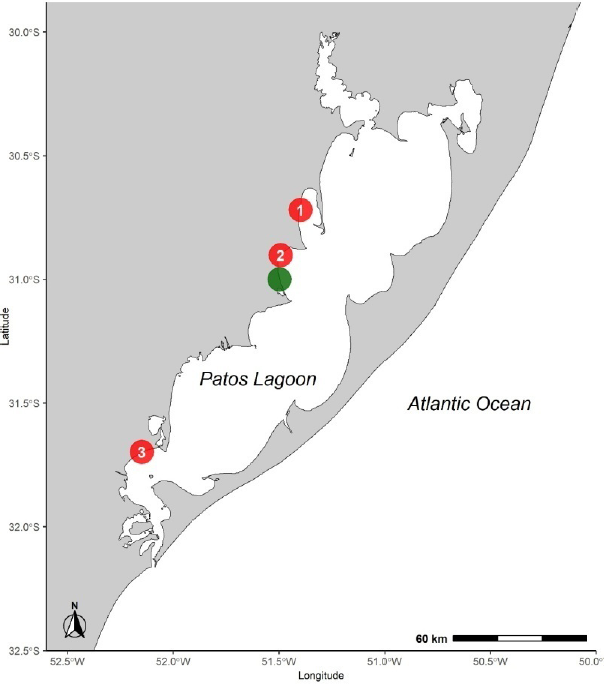
The Patos Lagoon (Figure 1), located in southern Brazil, is the largest coastal lagoon in Latin America (~10,000 km²) and a favorable environment for the colonization of invasive species due to its great heterogeneity. This system is home to a wide variety of natural habitats, flooded fields, marshes, lakes, rivers, and an extensive estuarine region (~1,000 km²), which provides abundant food, favorable conditions for spawning, growth, and refuge for more than one hundred fish species (Fontoura et al., 2016; Mai and Possamai, 2022; Vieira et al., 2010). Studies have shown the vulnerability of this system to the establishment of invasive fish species (e.g., Garcia et al., 2004a; Troca and Vieira, 2012).
Map showing the location of the Patos Lagoon in South America. The red dots correspond to the occurrence of Serrasalmus maculatus (red dot 1 - individual A; red dot 2 - individuals B, C; red dot 3 - individual D). The green dot corresponds to the Pygocentrus nattereri.
The individuals were caught by local artisanal fishermen between October 2023 - May 2024 using gillnets and later given to the researchers for analysis. They were immediately preserved on ice for analysis at the Federal University of Rio Grande (FURG) at the Laboratory of Ichthyology. Each specimen was measured for weight and length using a caliper. Table 1 shows details of the morphometric and meristic data. The fish were identified according to Gimênes Júnior and Rech (2022) and Loureiro et al. (2023). One main morphological feature distinguishing both species is the shape of their head, S. maculatus has a concave-shaped head, whereas P. nattereri has a convex one. Gimênes Júnior and Rech (2022) also point out that S. maculatus has three to five teeth on the palate, whereas P. nattereri adults are toothless, as well as the number of spines on the ventral keel, S. maculatus has 21-24 and P. nattereri has 13-21, followed by six to ten post-pelvic (Gimênes Júnior and Rech,2022).
Morphometric and meristic data of the palometa specimens Serrasalmus maculatus (A, B, C and D), and Pygocentrus nattereri (E) caught in Patos Lagoon.
The gonads of P. nattereri were removed and histologically processed according to the protocol by Beçak and Paulete (1976) and the total fecundity was estimated using a gravimetric method (Vazzoler, 1996). The specimens are preserved in the scientific collection of the Laboratory of Ichthyology, FURG (Serrasalmus maculatus: CIFURG #2956, #2957, #2958, #2959; Pygocentrus nattereri: CIFURG #2960).
Four individuals of S. maculatus were caught (Figure 2), in which one was in the municipality of Tapes (S 30’ 39.084’ W 51º 23.113) (Figure 2A), two were in the municipality of Arambaré (S 30’ 55.411’ W 51º 29.589’) (Figure 2B, 2C), and one was in the municipality of Pelotas (S 31°41’ W 52º 08’) (Figure 2D). Pygocentrus nattereri was caught in Arambaré (S 30’ 55.411’ W 51º 29.589’) (Figure 2E).

Individuals of Serrasalmus maculatus caught in Patos Lagoon system, in southern South America: (A) Tapes, (B,C) Arambaré, (D) Pelotas. Scale bar: 50mm. (E) Individual of Pygocentrus nattereri caught in Arambaré, Patos Lagoon system, in southern South America, (F) macroscopic detail of mature gonads and (G) histological section of ovary showing high frequency of oocytes with complete vitellogenesis (Hematoxylin-Eosin). Scale bar: 50mm.
The macroscopic and histological analysis revealed the P. nattereri ovaries were in an advanced stage of development with numerous vitellogenic follicles (Figure 2F, 2G). The fecundity of P. nattereri was 31,779 oocytes (TL = 254mm, TW = 586,4g and gonad weight = 114g).
Both species (S. maculatus and P. nattereri), which were recorded in this work for the first time within the central and southern portion of Patos Lagoon, are native to the Uruguay River basin (Nion et al., 2016). Hence, their presence in Patos Lagoon characterizes them as allochthonous species, which have already invaded the Patos Lagoon, such as Acestrorynchus pantaneiro (Saccol-Pereira et al., 2006). Studies assessing the impact of exotic species cultivated in the vicinity of Patos Lagoon have identified the presence of species that are already considered allochthonous to this ecosystem, such as the Hoplias lacerdae (Troca, 2013; Troca and Vieira, 2012).
Fish farming and artificial water channels are two hypotheses that should be considered to explain the presence of such species in this lagoon system. Fish farming is particularly vulnerable to incidents when they escape into nearby waterways, especially during periods of intense rainfall associated with El Niño (Fontana and Berlato, 1997; Garcia et al., 2004a). For instance, in 2007 there was a case in which fish raised in artificial ponds in the municipality of Cristal were swept into the Camaquã River (Troca, 2009). However, artificial water connections built for agricultural and water supply purposes can promote artificial links between small tributaries within the drainage basin favoring fish dispersion. In 2015, three individuals of the banjo Pseudobunocephalus iheringii were caught in an artificial irrigation channel that connects the Tramandaí basin to Patos Lagoon (Silveira et al., 2017), which suggests that such water channels made by humans may facilitate the invasion of species to another basin.
When exotic species, such as S. maculatus and P. nattereri, are found in an aquatic system, their spread may be influenced by factors such as the absence of natural predators (Latini et al., 2016). The dispersion of exotic fishes into Patos Lagoon may be favored by the hydrological effects associated with El Niño. During such climatic events, higher rainfall occurs in southern Brazil and consequently increases river discharges into Patos Lagoon (Garcia et al., 2004b; Grimm et al., 2000), which favors the displacement of freshwater fish towards the estuarine region in its southern portion (Garcia et al., 2003; Possamai et al., 2018). Hence, it seems plausible to assume that the dispersion of palometa towards the southern portion of the lagoon was favored by the hydrological conditions associated with the 2023-2024 El Niño episode (Climate Prediction Center/NOAA, 2024). This could explain why Palometa S. maculatus invaded Patos Lagoon from the north and quickly spread southward, reaching the northern reaches of its estuarine region.
Several authors showed that the presence or expansion of an invasive species can change the dynamics of local ecosystems (e.g. Bernery et al., 2022; Omondi and Merceline, 2023; Peller and Altermatt, 2024). For example, S. maculatus and P. nattereri are predatory species and have feeding habits that vary from smaller fish and invertebrates to occasional plants (Andrade and Braga, 2005; Behr and Signor, 2008; Ferreira et al., 2014; Miguel et al., 2022). This varied diet combined with the high habitat heterogeneity of Patos Lagoon provides favorable conditions for the species’ adaptation to new environments and exerts potentially significant pressure on available local food resources. Such scenario could result in direct competition with native species, which can have serious implications for biodiversity and the ecological balance of the region.
In summary, this work reports, for the first time, the occurrence of Palometa S. maculatus in three locations of Patos Lagoon, from its central area (Tapes municipality; S 30’ 39.084’ W 51º 23.113) to its estuarine region in the southern reaches of the lagoon (Pelotas municipality; S 31°41’ W 52º 08’). Palometa S. maculatus has been currently recorded in the Jacuí river basin, in the Patos Lagoon system (Bertaco et al., 2022), but there are no studies regarding the occurrence of this species in aquatic environments from coastal river basins of Rio Grande do Sul, mainly for the Patos Lagoon estuary. The first individual of P. nattereri with mature gonads in the central portion of the lagoon is reported (Arambaré municipality; S 30’ 55.411’ W 51º 29.589’). Considering the invasive capacity of these species, the presence of sexually mature individuals, and the characteristics of Patos Lagoon with a diverse mosaic of habitats suitable for freshwater fishes, preventive measures are important to avoid an invasive process, which could have serious ecological and economic consequences for the Patos Lagoon system and its rich biodiversity.
ACKNOWLEDGMENTS
We thank the fishermen Luardi and Gustavo “Sapo” for their assistance in obtaining the analyzed species. We are also grateful to Dr. João Paes Vieira for his valuable suggestions on an early draft of the manuscript.
REFERENCES
- Agostinho, C. S. & Júlio Júnior, H. F. 2002. Observation of an invasion of the piranha Serrasalmus marginatus Valenciennes, 1847 (Osteichthyes, Serrasalmidae) into the Upper Paraná River, Brazil. Acta Scientiarum Biological Sciences, 24(2), 391-395.
-
Andrade, P. M. & Braga, F. M. D. S. 2005. Diet and feeding of fish from Grande River, located below the Volta Grande reservoir, MG-SP. Brazilian Journal of Biology, 65(3), 377-385. DOI: https://doi.org/10.1590/S1519-69842005000300002
» https://doi.org/10.1590/S1519-69842005000300002 - Beçak, W. & Paulete, J. 1976. Técnicas de citologia e histologia. Rio de Janeiro, Nobel.
-
Behr, E. R & Signor, C. A. 2008. Distribuição e alimentação de duas espécies simpátricas de piranhas Serrasal musmaculatus e Pygocentrus nattereri (Characidae, Serrasalmidae) do rio Ibicuí, Rio Grande do Sul, Brasil. Inheringia, Série Zoologia, 98(4), 501-507. DOI: https://doi.org/10.1590/S0073-47212008000400014
» https://doi.org/10.1590/S0073-47212008000400014 -
Bernery, C., Bellard, C.,Courchamp, F., Brosse, S.,Gozlan, R. E., Jarić, I., Teletchea, F. & Leroy, B. 2022. Freshwater fish invasions: A comprehensive review. Annual Review of Ecology, Evolution, and Systematics, 53, 427-456. DOI: https://doi.org/10.1146/annurev-ecolsys-032522-015551
» https://doi.org/10.1146/annurev-ecolsys-032522-015551 -
Bertaco, V. A. & Azevedo, M. A. 2013. Fishes from Rio Ibirapuitã basin, environmental protection area of Ibirapuitã, Pampa biome. Check List, 9(5), 966-972. DOI: https://doi.org/10.15560/9.5.966
» https://doi.org/10.15560/9.5.966 -
Bertaco, V. A., Becker, F.G, Azevedo, M. A., Ferrer, J., Behr, E. R., Moraes, T. R., Fagundes, N. J. R. & Malabarba, L. R. 2022. The record and threats of the invasion of palometa Serrasalmus maculatus (Characiformes: Serrasalmidae) in the Patos lagoon drainage, Southern Brazil. Journal of Fish Biology, 101(4), 1098-1103. DOI: https://doi.org/10.1111/jfb.15169
» https://doi.org/10.1111/jfb.15169 -
Ferreira, F. S.,Vicentin, W., Costa, F. E. S. & Súarez, Y. R. 2014. Trophic ecology of two piranha species, Pygocentrus nattereri and Serrasalmus marginatus (Characiformes, Characidae), in the floodplain of the Negro River, Pantanal. Acta Limnologica Brasiliensia, 26(4), 381-391. DOI: https://doi.org/10.1590/S2179-975X2014000400006
» https://doi.org/10.1590/S2179-975X2014000400006 - Fontana, D. C. & Berlato, M.A. 1997. Influência do El Niño Oscilação Sul sobre a precipitação pluvial no Estado Rio Grande do Sul. Revista Brasileira de Agrometeorologia, 5(1), 127-132.
-
Fontoura, N. F., Vieira, J. P., Becker, F. G., Rodrigues, L. R., Malabarba, L. R., Schulz, U. H., Möller, O. O., Garcia, A. M. & Vilella, F. S. 2016. Aspects of fish conservation in the upper Patos Lagoon basin. Journal of Fish Biology , 89(1), 315-336. DOI: https://doi.org/10.1111/jfb.13005
» https://doi.org/10.1111/jfb.13005 -
Fricke, R., Eschmeyer, W. N. & Van Der Laan, R. (Ed.). 2023. Eschmeyer’s Catalog of Fishes: Genera, Species, References. Available from: Available from: https://researcharchive. calacademy.org/research/ichthyology/catalog/ fishcatmain.asp Access date: 06/25/2024.
» https://researcharchive. calacademy.org/research/ichthyology/catalog/ fishcatmain.asp -
Garcia, A. M., Raseira, M. B., Vieira, J. P., Winemiller, K. O. & Grimm, A. M. 2003. Spatiotemporal Variation in Shallow-Water Freshwater Fish Distribution and Abundance in a Large Subtropical Coastal Lagoon. Environmental Biology of Fishes, 68, 215-228. DOI: https://doi.org/10.1023/A:1027366101945
» https://doi.org/10.1023/A:1027366101945 -
Garcia, A. M., Loebmann, D., Vieira, J. P. & Bemvenuti, M. A. 2004a. First records of introduced carps (Teleostei, Cyprinidae) in the natural habitats of Mirim and Patos Lagoon estuary, Rio Grande do Sul, Brazil. Revista Brasileiro de Zoologia, 21(1), 157-159. DOI: https://doi.org/10.1590/S0101-81752004000100027
» https://doi.org/10.1590/S0101-81752004000100027 -
Garcia, A. M., Vieira, J. P., Winemiller, K. O. & Grimm, A. M. 2004b. Comparison of 1982-1983 and 1997-1998 El Niño Effects on the shallow-water fish assemblage of the Patos Lagoon Estuary (Brazil). Estuaries, 27, 905-914. DOI: https://doi.org/10.1007/BF02803417
» https://doi.org/10.1007/BF02803417 - Gimênes Junior, H. & Rech, R. 2022. Guia ilustrado dos peixes do Pantanal e entorno. Campo Grande, Julien Design.
-
Grimm, A. M., Barros, V. R., & Doyle, M. E. 2000. Climate Variability in Southern South America Associated with El Niño and La Niña Events. Journal of climate, 13, 35-58. DOI: https://doi.org/10.1175/1520-0442(2000)013<0035:CVISSA>2.0.CO;2
» https://doi.org/10.1175/1520-0442(2000)013<0035:CVISSA>2.0.CO;2 -
Latini, A. O., Resende, D. C., Pombo, V. B. & Coradin, L. (Ed.). 2016. Espécies Exóticas Invasoras de Águas Continentais no Brasil. Brasília, DF, Ministério do Meio Ambiente. Available from: Available from: https://www.gov.br/mma/ptbr/assuntos/biodiversidade-e-biomas/biodiversidade1/ aguas_continentais_final.pdf Access date: 09/09/2024.
» https://www.gov.br/mma/ptbr/assuntos/biodiversidade-e-biomas/biodiversidade1/ aguas_continentais_final.pdf - Loureiro, M., Gonzálex-Bergonzoni, I. & Teixeira de Mello, F. 2023. Peces de água dulce de Uruguay. Montevideo, Universidad de la República.
-
Mai, A. C. G. & Possamai, B. 2022. Categorizing estuarine fish assemblage in the warm temperate southwestern Atlantic Province: the case of Patos Lagoon Estuary. Brazil Regional Studies in Marine Science, 54. DOI: https://doi.org/10.1016/j.rsma.2022.102482
» https://doi.org/10.1016/j.rsma.2022.102482 -
Miguel, B. S., Franceschini, L., Manoel, L. O., Kliemann, B. C. K., Delariva, R. L. & Ramos, I. P. 2022. Parasites and diet of Serrasalmus maculatus in a hydroelectric reservoir in Brazil. Revista Brasileira de Parasitologia Veterinária, 31(1), e019221. DOI: https://doi.org/10.1590/S1984-29612022013
» https://doi.org/10.1590/S1984-29612022013 - Nion, H., Rios, C. & Menses, P. 2016. Peces del Uruguay: Lista sistemática y nombres comunes. Montevideo, Dinara.
-
NOAA (National Oceanica and Atmospheric Administration). 2024. Cold & Warm Episodes by Season. Available from: Available from: http://cpc.ncep.noaa.gov/products/analysismonitoring/ensostuff/ensoyears.shtml Access date: 04/09/2024.
» http://cpc.ncep.noaa.gov/products/analysismonitoring/ensostuff/ensoyears.shtml -
Omondi, O. A. & Merceline, A. 2023. Invasive Specis and their Impacts on the Ecology of Lake Victoria: A Rapid Review. Pan Africa Science Journal, 2(3). DOI: https://doi.org/10.47787/pasj.v3i02.22
» https://doi.org/10.47787/pasj.v3i02.22 -
Peller, T. & Altermatt, F. 2024. Invasive species drive cross-ecosystem effects worldwide. Nature Ecology & Evolution, 8, 1-11.DOI: https://doi.org/10.1038/s41559-024-02380-1
» https://doi.org/10.1038/s41559-024-02380-1 -
Possamai, B., Vieira, J. P., Grimm, A. M. & Garcia, A. M. 2018. Temporal variability (1997-2015) of trophic fish guilds and its relationships with El Niño events in a subtropical estuary. Estuarine Coastal and Shelf Science, 202, 145-154. DOI: https://doi.org/10.1016/j.ecss.2017.12.019
» https://doi.org/10.1016/j.ecss.2017.12.019 -
Saccol-Pereira, A., Milani, P. C. C. & Fialho, C. B. 2006. Primeiro registro de Acestrorynchus pantaneiro Menezes, 1992 (Characiformes, Acestrorynchidae) no sistema da laguna dos Patos, Rio Grande do Sul, Brasil. Biota Neotropica, 6(3). DOI: https://doi.org/10.1590/S1676-06032006000300017
» https://doi.org/10.1590/S1676-06032006000300017 -
Silveira, R. A., Ferrer, J., Becker, F. G. & Hartz, S. M. 2017. Biological invasion at an early stage? First record of the banjo catfish Pseudobunocephalus iheringii (Siluriformes: Aspredinidae) in the Tramandaí river basin, Brazil and the potential invasion pathway to this system. Brazilian Journal of Biology , 77(4), 890-892.DOI: https://doi.org/10.1590/1519-6984.01716
» https://doi.org/10.1590/1519-6984.01716 -
Troca, D. F. A. 2013. Análise de risco de invasão de peixes exóticos cultivados no entorno da lagoa dos Patos (RS). (Doutorado em Oceanografia Biológica). São Lourenço do Sul: Universidade Federal do Rio Grande. Available from: Available from: https://repositorio.furg.br/handle/123456789/11772?show=full Access date: 09/01/2024.
» https://repositorio.furg.br/handle/123456789/11772?show=full -
Troca, D. F. A. 2009. Levantamento dos cultivos de peixes exóticos no entorno do estuário da lagoa dos Patos (RS) e análise de risco de invasão (Mestrado em Oceanografia Biológica). São Lourenço do Sul: Universidade Federal do Rio Grande. Available from: Available from: https://peld.furg.br/images/stories/pdf/debora%20troca.pdf Access date: 09/01/2024.
» https://peld.furg.br/images/stories/pdf/debora%20troca.pdf - Troca, D. F. A. & Vieira, J. P. 2012. Potencial invasor de peixes não nativos cultivados na região costeira do Rio Grande do Sul, Brasil. Boletim do Instituto de Pesca, 38(2), 109-120.
- Vazzoler, A. E. A. M. 1996. Biologia da reprodução de peixes teleósteos: teoria e prática. Maringá,EDUEM.
- Vieira, J. P., Garcia, A. M. & Moraes, L. E. 2010. A assembleia de peixes. In: Seeliger, U., Odebrecht, C. (Ed.). O estuário da Lagoa dos Patos: um século de transformações (pp.79-88). Rio Grande: FURG.
-
DATA AVAILABILITY STATEMENT
The data that support the findings of this study are available from the corresponding author upon reasonable request.
-
SUPPLEMENTARY MATERIAL
No supplementary material is associated with this article.
-
FUNDING
This study was funded by the Brazilian Long-Term Ecological Research Program (PELD - Pesquisas Ecológicas de Longa Duração), site 8 - Patos Lagoon estuary and adjacent marine region. AMG is supported by a research fellowship from CNPq (Proc. 313008/2021-3).
The data that support the findings of this study are available from the corresponding author upon reasonable request.