Do human impacts and environmental factors shape intertidal meiobenthic communities across freshwater, estuarine, and oceanic beaches in Uruguay?
ABSTRACT
Meiofauna comprises small benthic metazoans that play a crucial role in aquatic ecosystems and reflect the ecological condition of marine, estuarine, and freshwater environments. In this study, intertidal meiobenthic communities were examined across three coastal environment types along the Uruguayan coast (freshwater, estuarine, and oceanic), and the influence of anthropogenic impact on biodiversity and community structure was evaluated. Three pairs of dissipative sandy beaches were sampled (one impacted and one less impacted per environment type), and the main meiobenthic taxa were quantified and richness, Shannon diversity, Pielou’s evenness, total abundance, and nematode abundance were calculated. Physicochemical water variables (dissolved oxygen and pH) and sediment characteristics (mean grain size and organic matter content) were also measured. Generalized linear models showed that biodiversity indices were significantly associated with sediment properties and water parameters, with richness and abundance increasing in finer sediments and with higher organic matter content, and diversity and evenness decreasing under higher organic enrichment. Dissolved oxygen was positively related to richness, Shannon exponential diversity, and evenness. Nematodes, copepods, gastrotrichs, turbellarians, and nauplii dominated the assemblages, with nematodes being the most abundant group overall. Multivariate analyses (NMDS based on Bray-Curtis dissimilarities, PERMANOVA, and beta-dispersion) revealed a clear structuring of communities according to environmental type and the level of anthropogenic impact. In particular, less impacted beaches exhibited a more homogeneous community composition (lower dispersion), whereas impacted beaches showed greater heterogeneity (higher dispersion), reflecting increased variability in composition among their samples. Indicator value analysis identified taxa associated with specific environments and impact levels. Overall, these results highlight that meiobenthic communities on Uruguayan sandy beaches respond to both natural environmental gradients and human disturbance, supporting the use of meiofauna as a sensitive tool for coastal ecosystem assessment.
Keywords:
Sandy beaches; Meiobenthos; Environment factors; Anthropogenic impacts; Diversity Patterns
INTRODUCTION
Meiofauna comprises small benthic metazoans that play a crucial role in aquatic ecosystems, reflecting the ecological condition of marine, estuarine, and freshwater environments (Alves et al., 2013; Balsamo et al., 2012; Coull, 1999; Giere, 2009; Milner et al., 2003; Somerfield and Warwick, 2013). Their high biodiversity and abundance, particularly in intertidal zones, make them essential components of food webs and key contributors to matter and energy flow in coastal ecosystems (Coull and Chandler, 2001; Schratzberger and Ingels, 2018).
Due to their small body size, short life cycle, and close association with sediments, meiofauna is highly sensitive to both natural and anthropogenic changes, making it valuable for ecosystem assessment (Alves et al., 2013; Kennedy and Jacoby, 1999; Leasi et al., 2021; Moreno et al., 2008; Schratzberger et al., 2023; Warwick et al., 1990; Zeppilli et al., 2015; Zhou et al., 2023). The sensitivity of meiobenthos to environmental variability makes biodiversity indices important indicators for evaluating ecosystem condition (Brannock et al., 2023; Checon et al., 2023; Leasi et al., 2021; Palmer et al., 2000; Ruellet and Dauvin, 2007; Warwick et al., 1990; Zhou et al., 2023). Among the most relevant environmental factors are salinity and sediment properties, which have a significant effect on the composition and structure of meiobenthic communities (Baia et al., 2021; Broman et al., 2019; Giere and Schratzberger, 2023). Sediment grain size also plays a critical role, as certain organisms prefer finer sediments, promoting the dominance of more adaptable groups (Giere, 2009). Fine-grained sediments particularly benefit nematodes, which can reach densities of thousands per 10 cm² (Bezerra et al., 1997; Kandratavicius et al., 2015; Pinto and Santos, 2006). In contrast, coarser grain sizes tend to reduce meiofaunal densities and shift dominance toward other groups, such as harpacticoid copepods, tardigrades, and turbellarians (Bezerra et al., 1997; Kandratavicius et al., 2015). Altogether, these factors highlight the complex interactions that shape meiofaunal communities (Zeppilli et al., 2015).
In addition to environmental factors, human activities, such as urbanization and agriculture, have significantly altered coastal environments, affecting the biodiversity of benthic communities (Barros, 2001; Brown and McLachlan, 2002; Pagán et al., 2017). The Uruguayan coast, characterized by sandy beaches, beach arcs, and rocky headlands, encompasses a wide variety of ecosystems resulting from the confluence of the Rio de la Plata with the Atlantic Ocean, forming a unique estuarine region (Calliari et al., 2003; Defeo et al., 2009; García-Alonso et al., 2019; Lercari and Defeo, 2003). In this context, a high degree of anthropogenic disturbance is observed, mainly associated with urbanization and agriculture (García-Alonso et al., 2019; Muniz et al., 2015; Orlando et al., 2020; Vermeiren et al., 2021). The Rio de la Plata’s freshwater beaches, such as those in Colonia city with a harbor, are expected to have potential impacts, although no studies on benthic communities have been reported. The estuarine coast, particularly Montevideo’s beaches, faces severe environmental degradation due to contamination and urban expansion, negatively impacting micro-, meio-, and macro-benthic communities (Castiglioni et al., 2018; Felix et al., 2016; García-Alonso et al., 2017; Piccini and García-Alonso, 2015). On the oceanic coast, a freshwater discharge with agrochemical pollutants impacts the quality and benthic fauna of La Coronilla beach (Jorge-Romero et al., 2019; Lercari and Defeo, 1999; Lercari et al., 2002; Sauco et al., 2010).
This study aims to examine meiobenthic communities across different intertidal coastal ecosystems (freshwater, estuarine, and oceanic) and to evaluate how specific human activities influence meiofauna, using response variables such as diversity indices and community structure to explain spatial and environmental patterns. Biodiversity indices are hypothesized to be influenced by environment types, with higher taxonomic richness and diversity (Shannon index) in oceanic environments and lower values in freshwater environments. Similarly, impacted beaches are predicted to exhibit reduced richness, diversity, and evenness (Pielou index) compared to less impacted beaches. Regarding taxonomic composition, greater similarity is anticipated among beaches belonging to the same environmental type and among those with lower levels of anthropogenic impact, reflected in greater homogeneity of community composition. In contrast, beaches exposed to higher levels of anthropogenic impact are expected to exhibit greater heterogeneity in community composition, expressed as higher dispersion among samples, reflecting differential community responses to the intensity or type of anthropogenic disturbance.
Finally, it is proposed that the structure of meiobenthic communities is determined by both physicochemical water variables and sediment characteristics. Specifically, higher dissolved oxygen (DO) levels and pH values close to neutrality are predicted to promote greater richness and diversity, whereas low DO and extreme pH conditions are associated with reduced diversity and changes in community composition. Concerning sediment properties, fine- to medium-grained sands are expected to support higher meiobenthic richness, abundance, and diversity due to their greater capacity to retain organic matter (OM).
METHODS
STUDY AREA AND SAMPLING DESIGN
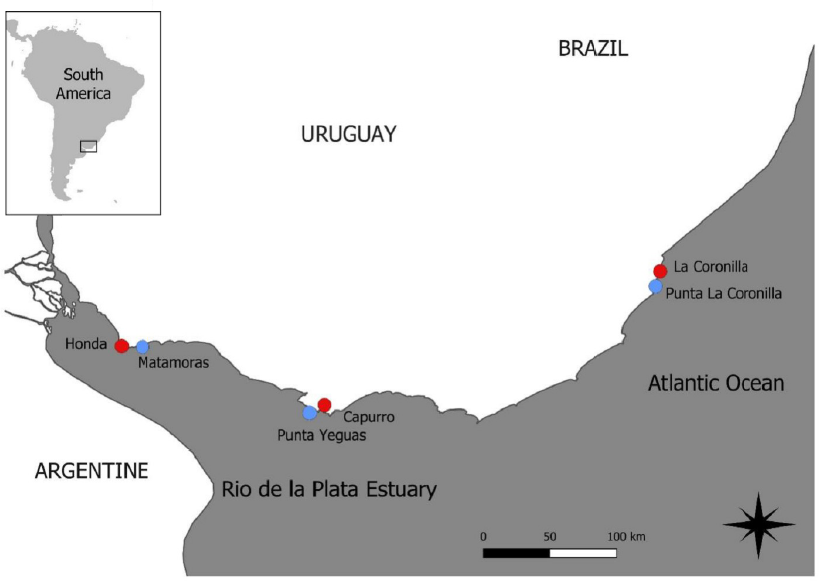
Three pairs of dissipative sandy beaches along the Uruguayan coast were selected to represent different environmental contexts and levels of anthropogenic impact: two freshwater beaches (Honda and Matamoras, Colonia), two estuarine beaches (Punta Yeguas and Capurro, Montevideo), and two oceanic beaches (Punta La Coronilla and La Coronilla, Rocha). Each pair consisted of one impacted and one less impacted beach (Figure 1). At each beach, three sampling sites were selected in the swash zone of the intertidal area to represent the corresponding beach arc. At each site, three random replicates were collected for meiofauna analysis (nine total per beach), along with a sediment sample (three total per beach). For analyses focused on biodiversity indices, replicate values were averaged at the site level and then across the three sites per beach, considering the beach as the unit of analysis. In contrast, for analyses focused on community composition and variability among beaches, individual replicates from each site were used, allowing a more detailed assessment of community structure and dispersion within each beach. For the statistical analysis, conductivity was not considered as a continuous variable in the association between meiofauna and environmental factors. Instead, it was categorized according to the different environments (freshwater, estuarine, and oceanic), as salinity in estuarine beaches fluctuates significantly on a daily basis. This decision is justified because the study constitutes a snapshot, i.e., a single-time assessment of the natural conditions of each environment at the moment of sampling. Although this approach may reduce resolution, it avoids spurious associations driven by short-term estuarine variability and is consistent with the snapshot nature of the sampling design. This design aims to evaluate how meiobenthic communities respond to different natural environmental conditions and levels of anthropogenic impact.
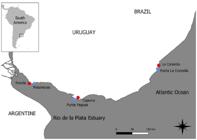
Map of the study area with sampling location at the Rio de la Plata and Atlantic coast. Honda and Matamoras beaches (freshwater), Punta Yeguas and Capurro beaches (estuarine), Punta La Coronilla and La Coronilla beaches (oceanic). Impacted beaches are shown in red, while less impacted ones are shown in blue.
Honda (freshwater), Capurro (estuarine) and La Coronilla (oceanic) were designated as impacted beaches due to their proximity to urban areas, industrial zones, ports, or pollution sources, including agrochemical runoff (Castiglioni et al., 2018; Muniz et al., 2004; Piccini and García-Alonso, 2015; Sauco et al., 2010). Honda is an urban freshwater beach near the port of Colonia, which receives approximately 3,300 vessels per year (ANP, 2024). Capurro, located in the urban bay of Montevideo, is close to an oil refinery and streams contaminated with solid waste and high nutrient loads (Muniz et al., 2004; Piccini and García-Alonso, 2015; Castiglioni et al., 2018). La Coronilla Beach is affected by artificial freshwater discharge and agricultural runoff from a 270,000-ha watershed created in the late 19th and early 20th centuries (Jorge-Romero et al., 2019; Lercari et al., 2002; Sauco et al., 2010). In contrast, Matamoras (freshwater), Punta Yeguas (estuarine), and Punta La Coronilla (oceanic) were identified as less impacted beaches, located away from urban and industrial activities. Matamoras is a lightly urbanized beach with natural areas, Punta Yeguas has green spaces and camping areas, and Punta La Coronilla is part of the Cerro Verde National Protected Area (Table 1).
Classification of beaches, categorized by environments and degree of anthropogenic impact. Impacted (+) or less impacted (-). Additionally, a brief description and georeferencing of each beach are provided.
COLLECTION OF SAMPLES, LABORATORY ANALYSIS, AND MEIOFAUNA IDENTIFICATION
DO, pH, conductivity, and temperature were measured in situ using a Thermo multiparameter (Orion Star A325) and a Thermo oximeter (Orion Star A223). Sediment samples for grain size and OM content analysis were collected using a 15 cm diameter PVC corer inserted 10 cm into the sediment. Grain size analysis followed the mechanical method described by Suguio (1973), using a Ro-Tap (RX-29-16) with a series of sieves with mesh sizes differing by 1 Ø (phi). Each sediment fraction was weighed to 0.01 g with a precision balance, and the Gradistat program was used to estimate the percentage of each fraction and the mean grain size (µm).
OM was estimated using the Loss on Ignition (LOI) technique (Byers et al., 1978). Two grams of wet sediment were dried at 60 °C for 48 hours, followed by calcination at 450 °C for 3 hours. Total OM was estimated as the weight difference between the dried and calcined samples and expressed as a percentage.
Meiofauna was collected using a 2.7 cm diameter “mini corer” inserted 5 cm into the surface sediment (Higgins and Thiel, 1988). Samples were preserved in 4% formaldehyde in phosphate buffer solution, transported to the laboratory, and stored at room temperature until analysis.
In the laboratory, a small amount of Rose Bengal was added to the meiofauna samples to achieve a final concentration of 1%. Samples were processed using the elutriation method by sieving the sediment through 500 µm and 63 µm meshes and separating organisms from the sand based on density differences (Boisseau, 1957; Platt and Warwick, 1983). Meiobenthic organisms were counted, and the main taxonomic groups were identified following Higgins and Thiel (1988) and Giere (2009). Identification focused on the principal taxa according to the World Register of Marine Species (WoRMS, www.marinespecies.org) as meiofauna identification at finer taxonomic levels is complex and time-consuming (Heip et al., 1988). Taxonomic identification is essential to understand meiofaunal community structure and to highlight compositional differences, particularly in response to disturbances (Gee et al., 1985; Heip et al., 1988; Herman and Heip, 1988; Kandratavicius et al., 2015; Quintana et al., 2010; Warwick and Clarke, 1993). Rare taxonomic groups representing less than 1% of the total abundance were also considered.
The number of individuals per sample was quantified as ind/10 cm², assuming a homogeneous distribution of the fauna and following Higgins and Thiel (1988); selected taxa were photographed using topographic magnification.
BIODIVERSITY INDICES AND STATISTICAL ANALYSIS
The composition of the meiobenthic community was assessed, and several biodiversity indices were calculated, including richness (number of taxa), Shannon (exponential), Pielou’s evenness, total abundance per beach (ind/10 cm²), and absolute abundance of nematodes per beach. The Shannon index was transformed into its exponential form (Shannon exponential) to express diversity as the effective number of equally abundant taxa, facilitating ecological interpretation and enabling meaningful comparisons among beaches (Jost, 2006).
These indices were fitted to different probability distribution functions using distribution curves and QQ-plots (Figures S1, S2). Richness was evaluated using Poisson and negative binomial distributions, with Poisson ultimately selected as the most appropriate. The Shannon exponential index, total abundance, and absolute abundance of nematodes were modeled using a Gamma distribution. Pielou’s evenness index was assessed with a Beta distribution, a family of continuous distributions defined on the interval (0, 1).
Generalized linear models (GLMs) were constructed for each group of explanatory variables based on a priori ecological hypotheses (Inchausti, 2023; Zuur et al., 2009). Continuous variables included water parameters (DO and pH) and sediment characteristics (OM and mean grain size). Categorical factors, namely Environment (freshwater, estuarine, and oceanic) and Impact (impacted vs. less impacted), were analyzed in separate models because they represent distinct ecological hypotheses.
Given the limited number of beaches (n = 6), it was not feasible to perform a full multimodel inference in the univariate analyses. However, the models were structured to incorporate the main a priori identified explanatory abiotic variables. Their relative importance was assessed within these global models, also considering the Akaike Information Criterion (AIC) to compare model fit. This approach allows a robust ecological interpretation of variable effects, avoiding reliance solely on single-variable GLMs. Post-hoc Tukey comparisons were performed for models involving the categorical variables “Environment” and “Impact”.
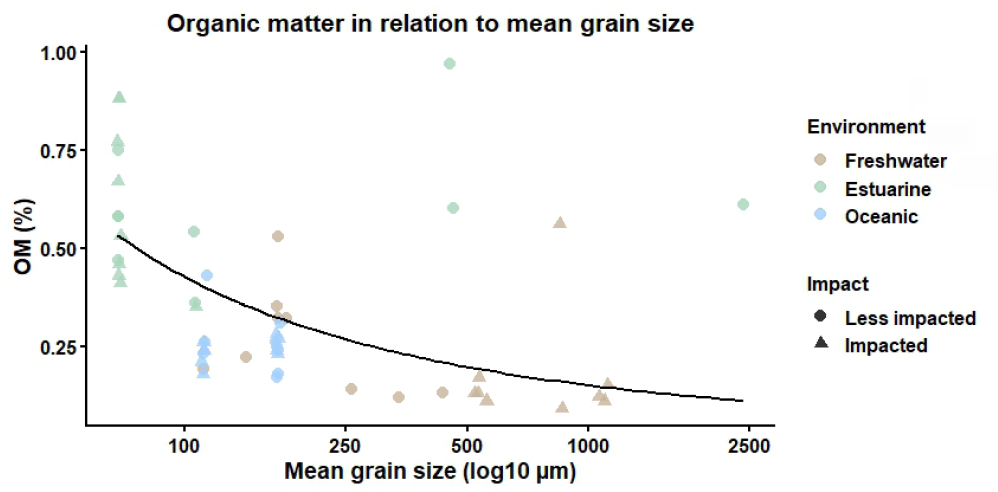
Before including the explanatory variables in the GLMs, pairwise correlations among the continuous abiotic variables (DO, pH, OM, and mean grain size) were assessed to rule out potential multicollinearity issues. All correlation coefficients were below 0.7, indicating the absence of problematic collinearity (Table S1); therefore, these variables were retained in the models. For the sediment variables, an interaction term (OM* mean grain size) was additionally included because the ecological effect of OM enrichment on the meiofauna may vary depending on sediment grain size (Figure 2).
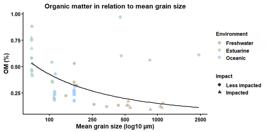
Organic matter concentration (%) in relation to mean sediment grain size (µm, logarithmic scale) at intertidal sandy beaches along the Uruguayan coast. Colors indicate environment type and symbols represent anthropogenic impact. The curve shows the general trend, with higher organic matter associated with finer sediments.
MULTIVARIATE ANALYSIS OF COMMUNITY COMPOSITION AND WITHIN BEACH VARIABILITY
To complement the univariate analyses, differences in meiobenthic community composition and variability among beaches were evaluated. A Bray-Curtis dissimilarity matrix was calculated from square-root-transformed taxa abundances. Community composition ordination was performed using non-metric multidimensional scaling (NMDS) to visualize patterns of similarity and separation among beaches according to different environments type (freshwater, estuarine, and oceanic) and levels of impact (impacted vs. less impacted). Continuous environmental variables, including OM, pH, and DO, were fitted onto the NMDS ordination to aid in interpreting the main environmental gradients structuring community patterns.
Differences in community composition among environments and impact levels were assessed using PERMANOVA, based on the same Bray-Curtis dissimilarity matrix. Additionally, a beta-dispersion analysis (betadisper) was applied to evaluate how similar or variable meiobenthic communities are within each category. Specifically, this analysis estimates the degree of dispersion of samples within each environment (freshwater, estuarine, and oceanic) and within each impact level (impacted and less impacted beaches). Lower dispersion reflects more homogeneous communities, whereas higher dispersion indicates greater variability in community composition among samples within the same category.
To complement these multivariate analyses, an indicator value analysis (IndVal) was conducted to identify taxa significantly associated with each type of environment or impact level, enabling the detection of organisms representative of specific environmental conditions or anthropogenic disturbance.
Analyses were conducted using R version 4.1.2 software.
RESULTS
ABIOTIC CHARACTERIZATION OF THE BEACHES
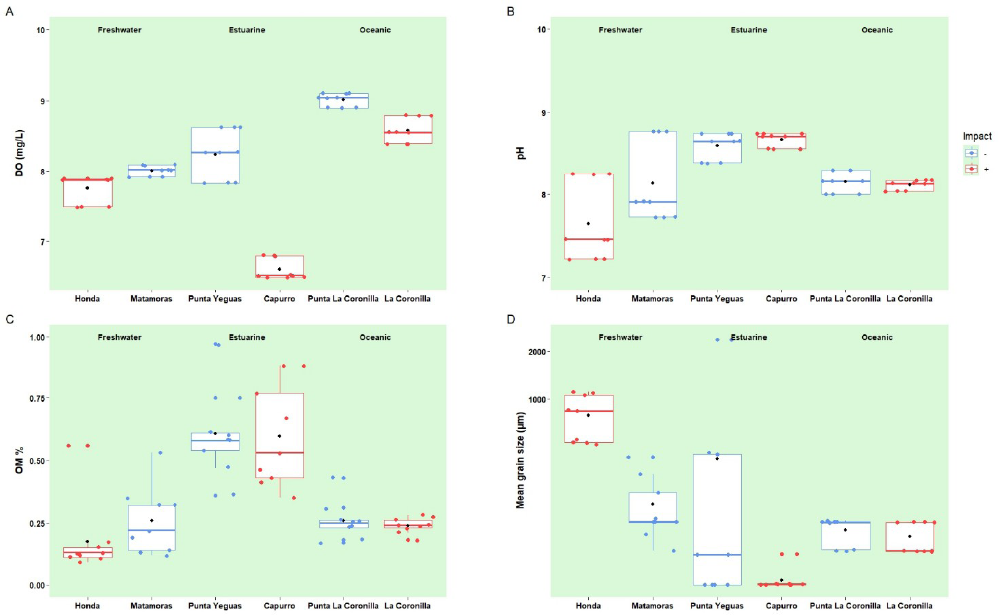
On the sampling day, the observed mean conductivity values were 0.20, 42, and 45 mS/cm for freshwater, estuarine, and oceanic beaches, respectively. The high salinity in estuarine beaches suggests marine water intrusion during this period. This likely reflects the strong short-term salinity variability typical of the Río de la Plata estuary and does not necessarily represent long-term average conditions. The remaining abiotic characteristics of the studied sandy beaches are shown in Figure 3. DO levels ranged from 6.6 to 9 mg/L at Capurro and Punta La Coronilla, respectively (Figure 3A). Impacted beaches exhibited lower DO concentrations compared to those classified as less impacted. pH values were lowest in freshwater environments, with Honda beach recording the minimum value of 7.64 (Figure 3B). Most beaches were categorized as fine to medium grained sands based on mean grain size (Figure 3D). Freshwater beaches showed the largest mean grain size, with Honda averaging 790.5 µm, composed mainly of 65.8% coarse sand, 16.7% medium sand, and 12.3% gravel. Matamoras followed with a mean grain size of 219.8 µm, composed of 25.2% coarse sand, 15.6% medium sand, and 6.4% gravel. The remaining beaches showed higher proportions of fine and medium sand; however, Punta Yeguas (estuarine) had a mean grain size of 423 µm, with the highest proportion of gravel among all beaches (13.7%). Among the three ecosystems, the lowest average OM content in the sediment was found in freshwater and oceanic beaches, while the highest concentrations were observed in estuarine beaches (Figure 3C).
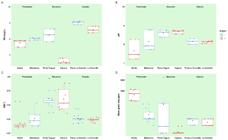
Abiotic descriptions of intertidal sediment from sandy beaches from different environments (freshwater, estuarine, and oceanic). Mean (black dots), median, interquartile range, and outliers of A, dissolved oxygen (DO); B, pH; C, organic matter (OM) percentage; D, mean sediment grain size (µm). Impacted beaches are shown in red, while less impacted ones are shown in blue.
MEIOBENTHIC COMMUNITY
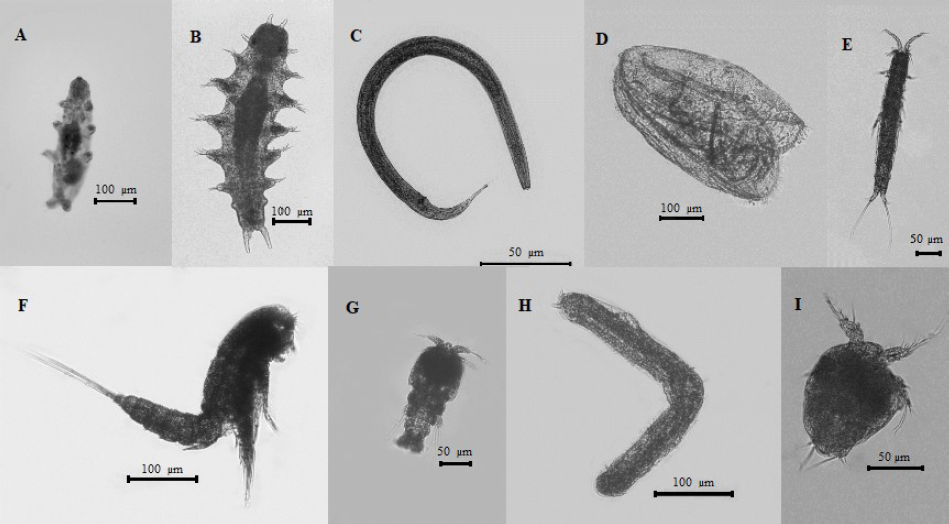
A total of 25,712.13 ind/10 cm² were identified, comprising 19 taxa distributed across 11 invertebrate phyla. Some of these organisms were photographed under topographic magnification (Figure 4). The lowest taxonomic richness was observed at Capurro Beach (estuarine, impacted), while the highest was recorded at Punta La Coronilla (oceanic, less impacted). The total abundance of individuals varied among beaches, with Punta Yeguas (estuarine, less impacted) showing the highest abundance (8,110.51 ind/10 cm²) and Honda (freshwater, impacted) the lowest (995.63 ind/10 cm²; Table 2).
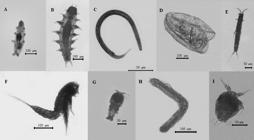
Photomicrographs of different taxa found on beaches from various environments (freshwater, estuarine, and oceanic) along the Uruguayan coast. A: Tardigrade; B: Polychaete; C: Nematode; D: Ostracod; E, F, G: Copepods; H: Gastrotrich; I: Nauplii.
Means of absolute abundances and standard deviations (SD) of each taxon (ind/10 cm²) found on the analyzed beaches, categorized by environment type (freshwater, estuarine, oceanic) and degree of impact (impacted + and less impacted -). The total abundance of organisms per beach (total abundance¹) is presented, as well as the total abundance of each organism across all beaches (total abundance²). Additionally, taxon richness (the number of taxa present on each beach) is included. Total taxon richness 19* denotes the overall count of unique taxa identified.
The total abundance of individuals varied among beaches, with Punta Yeguas (estuarine, less impacted) showing the highest abundance (8110.51 ind/10 cm²) and Honda (freshwater, impacted) the lowest (995.63 ind/10 cm²; Table 2).
Nematodes, copepods, gastrotrichs, turbellarians, and nauplii (of copepods) accounted for 95.5% of the total abundance. Oligochaetes, polychaetes, and ostracods made up 3.6%, with the remaining 0.8% represented by groups considered rare (gastropods, priapulids, bivalves, insects, aplacophorans, tardigrades, gnathostomulids, amphipods, mites, sipunculids, and bryozoans). Nematodes were the most abundant taxon, representing 58.14% of the total abundance (14714.35 ind/10 cm²). Copepods accounted for 12.6% (3267.87 ind/10 cm²), gastrotrichs made up 9.13% (2165.8 ind/10 cm²), and nauplii represented 7.94% (2054.07 ind/10 cm²). Turbellarians represented 7.6% of the total abundance (1937.71 ind/10 cm²). Oligochaetes, polychaetes, and ostracods each accounted for approximately 1% of the total, with individual abundances of 798.62, 260.47, and 276.34 ind/10 cm², respectively (Table 2).
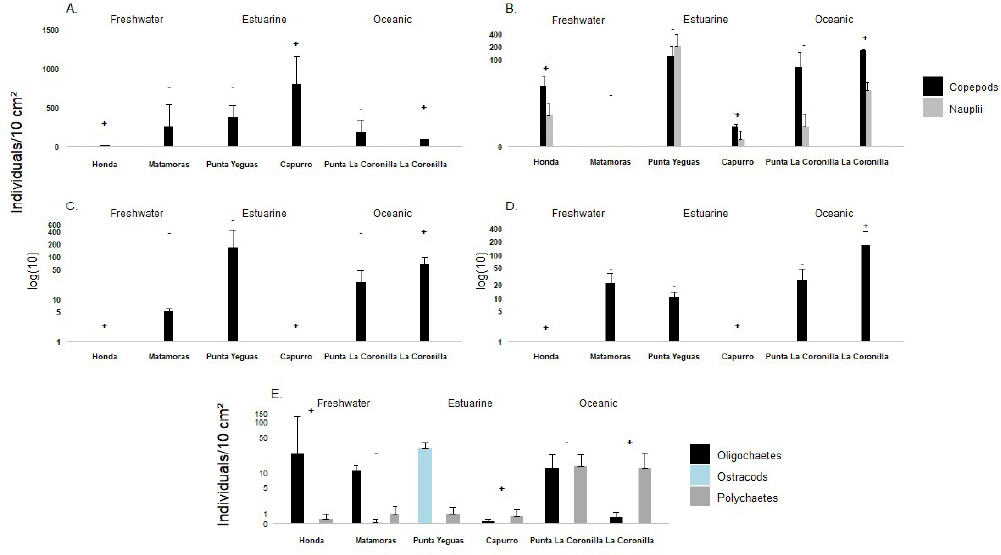
Nematodes dominated four of the six beaches: Capurro (96.6%), Matamoras (86.5%), Punta La Coronilla (54.3%), and Punta Yeguas (43%) (Table 2, Figure 5A). At Honda Beach, copepods and oligochaetes were the most abundant, each representing 34% of the total abundance (Table 2, Figure 5B and E). In contrast, turbellarians (31.5%) and copepods (31.1%) were the most abundant taxa at La Coronilla (Table 2, Figure 5 B and D). Within the “rare” taxa group (<1% of the total abundance), the main representatives were gastropods (30.3%), priapulids (30%), bivalves (14.6%), insects (7.2%), and aplacophorans (6.4%) (Table 2). The remainder included tardigrades (3.6%), gnathostomulids (3%), amphipods (2.5%), acari (1.8%), and bryozoans (0.6%) (Table 2).
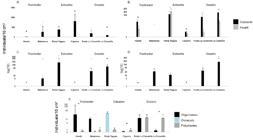
Mean absolute abundances of the most and intermediately abundant taxa in intertidal beaches across various environments (freshwater, estuarine, and oceanic) ± SD. Data are expressed as the number of individuals per 10 cm² of sediment. A: Nematodes; B: Copepods + Nauplii; C: Gastrotrichs; D: Turbellarians; and E: Oligochaetes, Ostracods, and Polychaetes. Impacted beaches are indicated by ‘+’ and less-impacted beaches by ‘-’.
MEIOFAUNA COMPOSITION AND ENVIRONMENTAL DESCRIPTORS
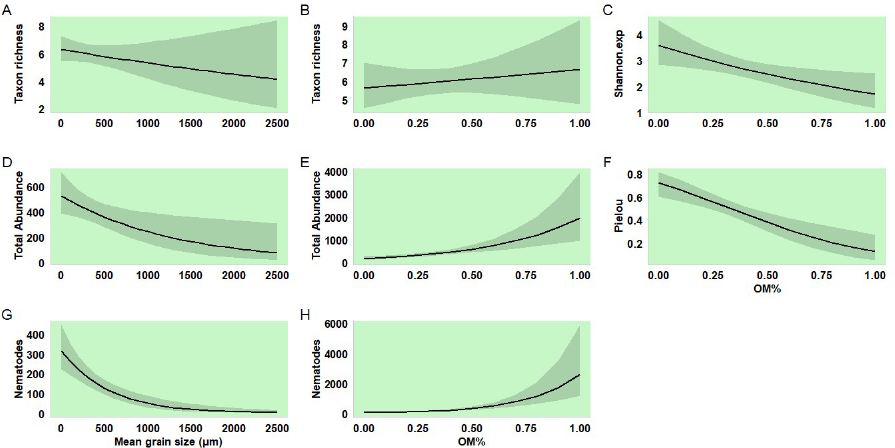
Biodiversity indices were significantly correlated with at least one of the two sediment variables analyzed: mean grain size (µm) and OM content (Figure 6, Table S2). Taxonomic richness was inversely related to mean grain size and positively associated with OM concentration (Figures 6A and 6B). The exponential Shannon index and Pielou’s evenness index showed a negative relationship with OM concentration (Figures 6C and 6F).
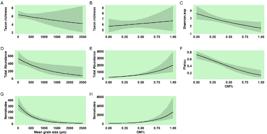
Predicted association of biodiversity indices with the sediment characteristics on intertidal beaches from different environments (freshwater, estuarine, and oceanic) and with varying levels of human impact. A, nTaxas with mean grain size (µm); B, nTaxas with organic matter (OM) (%); C, Shannon exponential with OM; D, Total abundance with mean grain size; E, Total abundance with OM; F, Pielou with OM; G, Nematodes with mean grain size; and H, Nematodes with OM.
Additionally, total abundance per beach and nematode abundance were significantly negatively associated with mean grain size and positively associated with OM concentration (Figures 6D, 6E, 6G, and 6H).
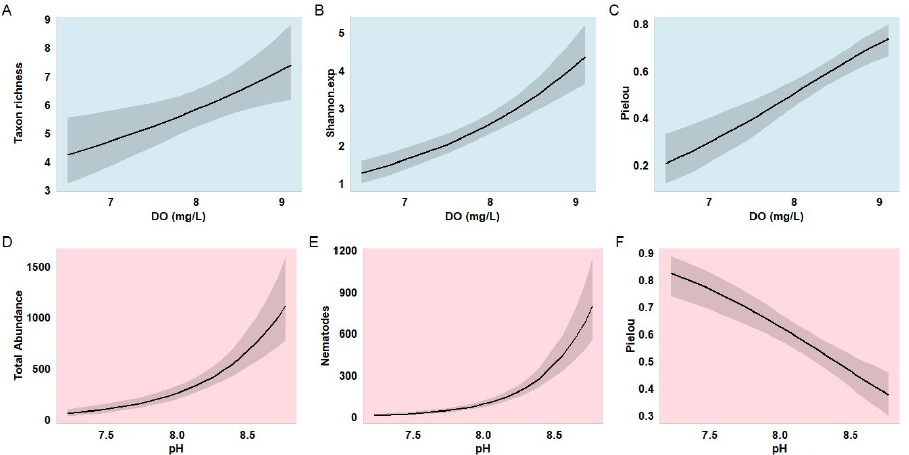
Taxonomic richness, the exponential Shannon index, and Pielou’s evenness index were positively related to DO concentration (Figure 7A, 7B, and 7C, Table S3). Regarding pH values, Pielou’s index was negatively correlated, whereas total abundance and nematode abundance showed a positive association (Figure 7D, 7E, and 7F).
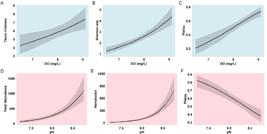
Predicted association of biodiversity indices with water predictors across different environments (freshwater, estuarine, and oceanic) with varying levels of human impact. A, nTaxas; B, Shannon exponential; C, Pielou with DO; D, nTaxas; E, Shannon exponential; and F, Pielou with pH.
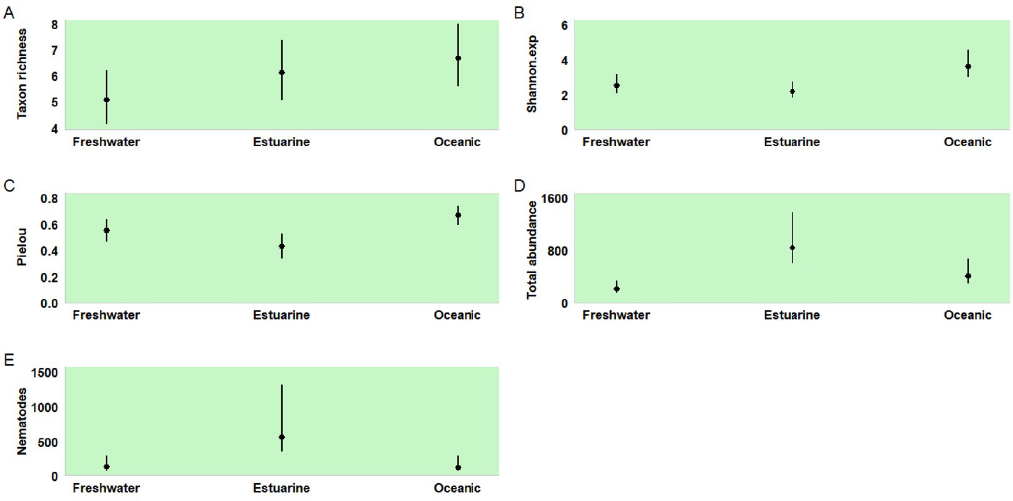
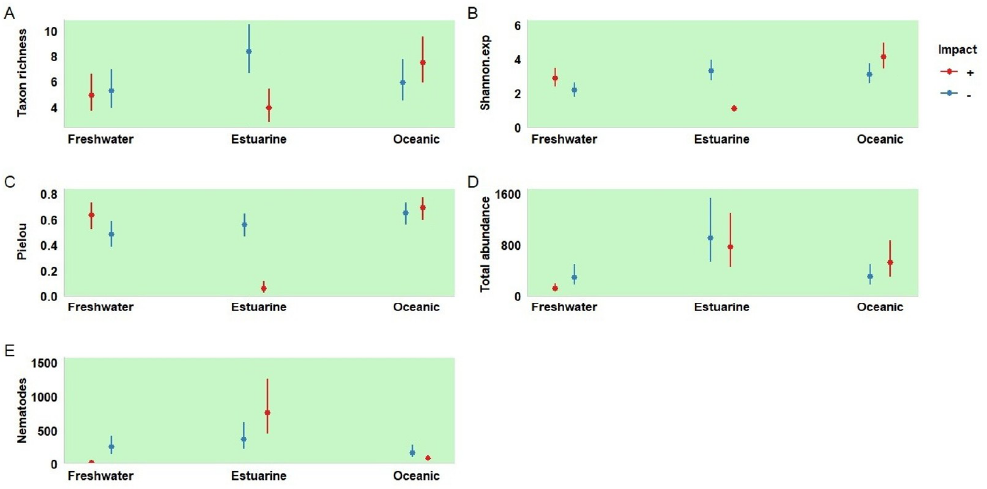
The analyzed biodiversity indices were significantly associated with different types of coastal environments (Figure 8, Table S4). Significant differences in taxonomic richness were observed between freshwater and oceanic environments, with the lowest and highest richness recorded, respectively (Figure 8A). Oceanic environments showed the highest exponential Shannon index values, significantly different from freshwater and estuarine environments (Figure 8B). Pielou’s evenness index was lowest in estuarine environments, showing significant differences compared to freshwater and oceanic environments (Figure 8C). Estuarine environments also exhibited the highest total abundance (Figure 8D). Nematodes followed a pattern similar to total abundance, with no significant differences observed between oceanic and freshwater beaches (Figure 8E).
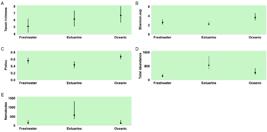
Association of biodiversity indices in relation to the different environments: freshwater, estuarine, and oceanic. A mean value for each pair of beaches is shown.
The impact of anthropogenic activities on the intertidal meiobenthic community was assessed by comparing pairs of beaches within each environment type (freshwater, estuarine, and oceanic) along the coast. In estuarine beaches, taxonomic richness and the meiofauna Shannon index were significantly lower at the impacted Capurro Beach compared to Punta Yeguas (Figure 9A, Table S5). Similarly, the Shannon index showed significant differences between oceanic beaches Punta La Coronilla (less impacted) and La Coronilla (impacted), with the latter having the highest value (Figure 9B). Regarding evenness, Capurro presented the lowest Pielou index, which significantly differed from Punta Yeguas (Figure 9C). Total abundance also varied notably among freshwater beaches (Figure 9D). Nematode abundance showed significant differences between estuarine and freshwater beaches, being higher at Capurro and lower at Honda (Figure 9E).
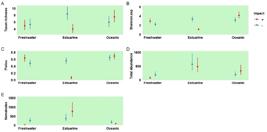
Association between biodiversity indices and beach environments with differing levels of anthropogenic impact: red denotes impacted beaches, while blue represents less impacted beaches. Mean values are shown for each pairwise comparison.
MULTIVARIATE ANALYSIS OF COMMUNITY COMPOSITION
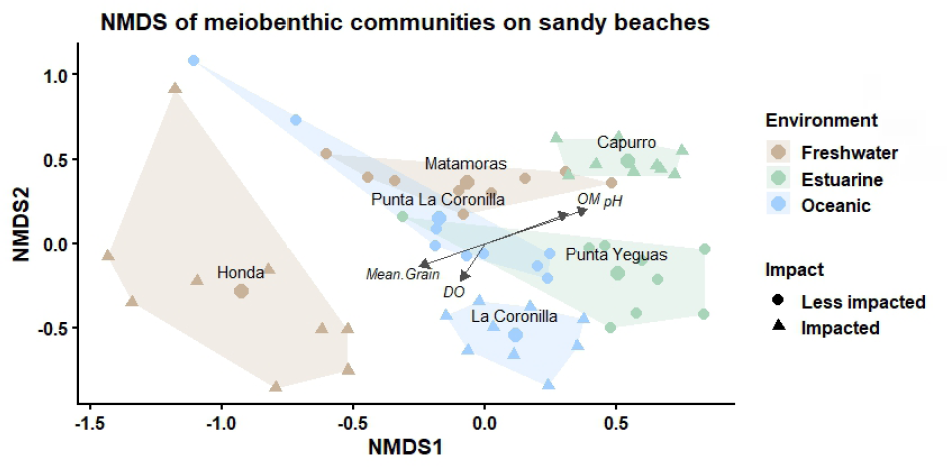
The bidimensional ordination using NMDS, based on a Bray-Curtis dissimilarity matrix calculated from square root transformed taxa abundances, showed a clear separation of meiobenthic communities among environments (freshwater, estuarine, and oceanic) and between impact levels (impacted vs. less impacted beaches), indicating distinct community structures for each category (Figure 10, stress = 0.15). Particularly, environmental variables such as mean grain size explained a considerable portion of the variation in community structure, especially at Honda beach.
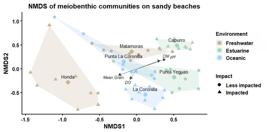
NMDS of meiobenthic communities at intertidal sandy beaches along the Uruguayan coast. Colors indicate environment type and symbols represent anthropogenic impact. Large circles correspond to group centroids, and polygons delineate the clustering of the beaches. The axes represent the two NMDS dimensions. Arrows indicate environmental variables (mean grain size, organic matter, dissolved oxygen, and pH), showing their direction and strength of association with the ordination. Stress = 0.15.
PERMANOVA showed that environmental type and impact level significantly influenced community composition (Table S6). Beta-dispersion analysis revealed significant differences in community variability among environments and between impact levels (Table S7): less impacted beaches showed lower dispersion (more homogeneous communities), whereas impacted beaches exhibited higher dispersion (greater heterogeneity). Differences in dispersion were also detected among environments, suggesting contrasts in the internal heterogeneity of meiobenthic communities along the environmental gradient.
Indicator value analysis (IndVal) identified taxa significantly associated with specific environments and impact levels (Table S8). Among environments, the main indicator taxa were oligochaetes in freshwater beaches, ostracods in estuarine beaches, and turbellarians, polychaetes, and priapulids in oceanic beaches. Some taxa, such as gastropods and bivalves, were associated with both freshwater and estuarine environments, while copepods, nauplii, and gastrotrichs were linked to estuarine and oceanic environments, indicating their capacity to thrive under varied environmental conditions. In less impacted beaches, the main indicator taxa were gastrotrichs and ostracods, characteristic of communities under lower anthropogenic pressure, supporting inferences derived from the multivariate analyses regarding the structure of meiobenthic communities.
DISCUSSION
The results of this study provide a comprehensive understanding of the spatial variability of meiobenthic communities on Uruguayan sandy beaches through the analysis of biodiversity indices and community composition, highlighting how environmental and anthropogenic factors can modulate the structure of these communities.
WATER AND SEDIMENT PARAMETERS
Salinity, categorized into freshwater, estuarine, and oceanic environments, was representative of the environmental conditions of each beach, reflecting spatial and temporal dynamics influenced by meteorological, hydrological, oceanographic, and topographic factors (Garcia-Alonso et al., 2019). DO levels remained within expected ranges, with the lowest values observed at the impacted estuarine beach Capurro (Figure 3A), likely associated with the urban and industrial influence of Montevideo Bay (Gray and Elliott, 2009; Muniz et al., 2015).
These low oxygen levels may result from organic enrichment that stimulates bacteria production and, consequently, increases oxygen consumption, affecting benthic and meiobenthic communities (Kandratavicius et al., 2018; Piccini and García-Alonso, 2015).
The range of pH values found was similar to those reported in monitoring studies by García-Alonso et al. (2017) and Castiglioni et al. (2018) on beaches along the Uruguayan coast. Water pH can be used to detect contaminated areas (Pérez-Castillo and Rodríguez, 2008). In this case, the urbanized freshwater beach Honda exhibited the lowest pH values. In most samples, pH remained close to neutrality, with a slight tendency toward more basic values in more saline environments (Figure 3B), which likely reflects patterns of water alkalinity associated with the salinity gradient, rather than effects of anthropogenic impact.
Fine to medium-grained sands, typical of dissipative beaches (García-Alonso et al., 2017; Lercari and Defeo, 2006; Short and Jackson, 2013), predominated at most study sites. However, Honda beach exhibited coarser sediments, probably due to coarse sand, whereas Punta Yeguas showed greater grain size heterogeneity, with fine sand predominating alongside pebbles (Figure 3D).
The sediment OM content was higher in estuarine beaches, consistent with the characteristics of these environments, where variations in salinity and pH favor the deposition of suspended particles (Gray and Elliott, 2009). However, despite this trend, no significant differences in OM content were observed between paired beaches, suggesting that OM accumulation may be influenced not only by local factors but also by larger scale processes, such as hydrodynamics and human activities along the Uruguayan coast (García-Alonso et al., 2019). The higher OM in estuarine beaches, compared to freshwater and oceanic beaches (Figure 3C), may be attributed to the predominance of fine sediments in these environments, which have a greater capacity to retain OM, as noted by Nybakken (1996) and Giere (2009), and is reflected in the relationship shown in Figure 2.
STRUCTURE OF MEIOBENTHIC COMMUNITY AND ENVIRONMENTAL FACTORS
In general, the biodiversity patterns of the meiobenthic community on beaches along the Uruguayan coast were consistent with those previously reported for beaches on the southwestern Atlantic coast (Coppo et al., 2024). At the estuarine beaches of the Rio de la Plata (Capurro and Punta Yeguas), richness was higher than in the meiobenthic communities of estuarine coastal lagoons in Uruguay (Kandratavicius et al., 2015).
Nematodes and copepods were the most abundant taxa on Uruguayan beaches (Figures 5A, B, Table 2), which aligns with previous studies highlighting their dominance in various coastal environments (Coull et al., 1979; Giere, 2009; Kandratavicius et al., 2015; Nicholas, 2001). Nematodes, which often represent more than half of the total meiofauna abundance (Dye, 1983; Kotwicki et al., 2005; Pinto and Santos, 2006; Silva et al., 1997), are highly adaptable organisms capable of occupying interstitial spaces, tolerating various stressors, and employing diverse feeding strategies (Kandratavicius et al., 2015, 2024). They are especially abundant in fine sediments, whereas other groups, such as copepods and ostracods, tend to prevail in coarser sediments (Gourbault et al., 1995; Kandratavicius et al., 2015). These patterns were observed when analyzing both freshwater and estuarine beaches. In particular, Matamoras and Capurro exhibited smaller mean grain sizes and higher average OM content compared to their counterparts, Honda and Punta Yeguas. Matamoras and Capurro showed higher nematode abundance and lower copepod abundance, whereas Honda and Punta Yeguas, characterized by larger mean grain sizes and lower OM content, exhibited higher abundances of copepods and nauplii relative to nematodes. These results are consistent with previous studies highlighting sediment grain size and OM content as key factors structuring meiobenthic communities (Kandratavicius et al., 2015, 2024).
According to Alongi (1987), free-living flatworms (also known as “turbellarians”) can be as abundant as nematodes, but they are often underestimated due to sampling and processing techniques that tend to destroy them, resulting in inaccurate abundance estimates. We found the highest mean abundance of this taxon (160.6 ind/10 cm², Table 2) at the oceanic beach of La Coronilla (Figure 5D), and they were also observed at all less impacted beaches. The freshwater input from the artificial Andreoni channel does not appear to influence the turbellarian community. Therefore, at La Coronilla, it is not possible to determine whether the turbellarians present originate from freshwater input or oceanic source. The observation that turbellarians are absent from impacted urban beaches such as Honda (freshwater) and Capurro (estuarine) (Figure 5D), but present at less disturbed sites, suggests that this taxon may be sensitive to anthropogenic disturbances. This pattern is consistent with previous studies indicating that some freshwater planarians serve as bioindicators of environmental quality (Alonso and Camargo, 2011).
A similar pattern was observed for gastrotrichs (Figure 5C), a group described as one of the most abundant taxa within meiobenthic communities of intertidal sandy beaches (Giere, 2009; Martínez et al., 2025). Despite their ecological importance, gastrotrich populations are often overlooked in monitoring studies (Schmidt-Rhaesa et al., 2019). It is noteworthy that they exhibit high temporal variability, as observed throughout the year on intertidal beaches of southern Brazil (Coppo et al., 2024), which may result in their underrepresentation depending on the timing of sampling. According to the IndVal results, gastrotrichs are mainly associated with less impacted beaches, as presented in the following multivariate analysis section (Table S8).
Biodiversity indices, including taxon richness, total abundance, and nematode abundance, were positively correlated with finer sediment grain sizes and higher OM content (Figure 6, Table S1).
Shannon diversity and Pielou’s evenness indices were negatively correlated with OM, suggesting that high levels of OM, associated with organic enrichment, may reduce biodiversity. High levels of OM alter the redox conditions of the sediment, favoring the development of microbial communities tolerant to organic enrichment, which in turn alters the meiobenthic community by promoting the predominance of tolerant taxa, such as nematode species resistant to these conditions (Kandratavicius et al., 2018; Pearson and Rosenberg, 1977; Venturini et al., 2012).
A similar trend was observed across all beaches: richness, Shannon exponential index, and Pielou’s evenness showed a positive association with DO. Low DO levels, indicative of organic enrichment that drives oxygen consumption, were associated with lower biodiversity indices (Kandratavicius et al., 2018). These results, observed at the impacted estuarine beach Capurro, are consistent with previous studies documenting DO reduction associated with industrial pollution sources and organic enrichment (Gray and Elliott, 2009) and were reinforced by the higher OM concentration at this beach compared to others. In particular, nematodes, known for their tolerance to low DO levels (Veit-Köhler et al., 2009; Vopel et al., 1998), were more abundant at Capurro under hypoxic conditions, whereas harpacticoid copepods, which are more sensitive to environmental stress (Kotwicki et al., 2005), were less abundant (Table 2). These patterns support our hypotheses that fine sands and higher OM favor taxonomic richness and abundance of nematodes, whereas coarser sediments tend to favor mobile interstitial groups such as harpacticoid copepods and other taxa adapted to larger pore spaces. Similarly, higher levels of DO were associated with greater overall diversity, confirming the importance of both sediment and water variables in structuring the meiobenthic community.
When evaluating the meiobenthic community across the two beaches, regardless of anthropogenic impact, it was observed that community responses, both in terms of biodiversity indices and composition, were influenced by salinity, which varied among these environment types along the Uruguayan coast. This environmental gradient (freshwater, estuarine, and oceanic) was mainly reflected in taxon richness, with oceanic and estuarine environments showing higher richness compared to freshwater environments (Figure 8A). This is consistent with previous studies that indicate that oceanic environments exhibit greater diversity than freshwater ones (Broman et al., 2019). As expected, oceanic beaches showed higher values of richness and Shannon exponential (Figure 8A and 8B). In contrast, freshwater beaches exhibited the lowest richness values. However, the Shannon exponential index did not follow this pattern, but showed lower values in estuarine beaches. Estuarine beaches, characterized by fluctuating salinity and higher OM content, showed reduced biodiversity, likely due to the high abundance of a few euryhaline species, particularly nematodes, capable of tolerating these conditions (Elliott and Whitfield, 2011). The dominance of these tolerant taxa appears to suppress the occurrence of less resilient species, explaining the observed decrease in overall biodiversity. These patterns support our hypothesis that biodiversity indices are influenced by the type of environment, with higher taxonomic richness and diversity expected in oceanic environments and lower values in freshwater environments.
IMPACT OF ANTHROPOGENIC ACTIVITIES ON THE MEIOFAUNAL COMMUNITY
Impacted beaches, such as Capurro Beach, exhibited lower species richness and diversity (Figures 9A and 9B), with nematodes as the dominant group (Figures 5A and 9D). In contrast, Punta Yeguas, which is less impacted, showed higher biodiversity, with a more diverse community that included ostracods, copepods, and gastrotrichs (Figures 5 and 9B). Crustaceans such as copepods and ostracods have been reported as sensitive to pollutants and are therefore considered reliable indicators of anthropogenic impacts (Amorri et al., 2022; Ruiz et al., 2005; Van Damme et al., 1984), which partly explains the observed patterns.
Oceanic beaches, characterized by stable salinity and lower human disturbance, generally displayed greater biodiversity. In particular, La Coronilla may be receiving exogenous meiofauna through freshwater input from the artificial Andreoni canal, which could contribute to the high values observed in richness and diversity indices. This external influence contrasts with what was recorded at Punta La Coronilla Beach (Figure 9B), which, although classified as a less impacted environment, showed lower values for these indices (Figures 9A and 9B). This suggests that, beyond the level of anthropogenic impact, other factors such as hydrological connectivity and the influx of organisms from adjacent environments could play an important role in shaping meiofaunal community structure. This pattern partly contrasts with the expected reduction in diversity at impacted sites, suggesting that site-specific processes such as hydrological connectivity and exogenous inputs may override the general impact signal.
Beaches such as Honda, which exhibited the lowest meiofaunal densities but higher evenness compared to Matamoras (Figures 9C and 9D), had communities dominated by oligochaetes and copepods. The dominance of oligochaetes reflects their tolerance to chemical and physical pollution resulting from urban runoff and crushed stone substrates (Armendáriz et al., 2011). In contrast, the presence of copepods, organisms generally more sensitive to chemical pollution (Amorri et al., 2022), appears to be more influenced by sediment type than by chemical contamination itself. This pattern may be related to human activities and the prevalence of disturbance-tolerant taxa. Overall, these observations support our hypothesis that within the same environmental type, more impacted beaches show lower taxonomic richness, lower Shannon diversity, and lower Pielou evenness, while tolerant taxa are more abundant in impacted sites. It should be noted that “impact” encompasses different stressor types across sites, and thus the observed responses likely reflect a combination of pressure-specific mechanisms.
MULTIVARIATE ANALYSIS AND INDICATOR TAXA
Multivariate analyses showed that meiobenthic communities are clearly structured by both environment type and the level of anthropogenic impact (Broman et al., 2019; Leasi et al., 2021; Schratzberger et al., 2023; Zeppilli et al., 2015; Zhou et al., 2023). Accordingly, NMDS ordinations consistently separated communities based on these categories, revealing well-defined patterns in community composition. PERMANOVA results confirmed that both environment type and anthropogenic impact act as significant predictors of community composition.
The inclusion of continuous environmental variables strengthened the interpretation of these patterns. Mean grain size emerged as a key factor structuring freshwater beaches, particularly at Honda, in agreement with the characteristics of the meiofauna recorded in this environment. In estuarine beaches, organic matter content and pH were relevant variables, reflecting the greater capacity of these systems to accumulate organic matter and generate distinctive physicochemical conditions (Giere, 2009; Nybakken, 1996). In contrast, dissolved oxygen contributed partially to community structuring on oceanic beaches, consistent with the high hydrodynamic energy and the generally well-oxygenated conditions characteristic of these environments (McLachlan and Defeo, 2017).
Beta-dispersion analyses indicated that less impacted beaches harbored more homogeneous communities at the scale of the overall sample set, whereas impacted beaches exhibited higher within-group dispersion, reflecting increased heterogeneity, possibly associated with different types or intensities of anthropogenic disturbance. In this context, exploratory inspection of the NMDS ordinations allowed broad visualization of intrabeach variability, suggesting differences in replicate-level dispersion within beaches that may reflect differential community responses to disturbance intensity or type; however, this pattern should be interpreted with caution and is presented here for descriptive purposes only. At a broader conceptual level, such patterns have been associated with local disturbances that generate mosaics of microhabitats with variable physicochemical conditions, thereby increasing community variability (Gray and Elliott, 2009; Pearson and Rosenberg, 1977). In contrast, the higher homogeneity observed in less impacted beaches may reflect more stable conditions, in which natural environmental filters consistently select the taxa present. Nevertheless, these inferences should be interpreted with caution, as the sampling design and the spatial scale considered impose certain limitations, which are addressed in the “Limitations and perspectives” section.
In this context, indicator value (IndVal) analyses complemented the multivariate patterns by identifying taxonomic associations consistent with both environment type and impact level. Oligochaetes were identified as characteristic taxa of freshwater environments, ostracods showed affinity for estuarine beaches, whereas turbellarians, polychaetes, and priapulids were mainly associated with oceanic beaches. In addition, gastrotrichs and ostracods were preferentially linked to less impacted beaches, while dominant nematodes were associated with disturbed sites, in agreement with their well-documented relative tolerance to organic and chemical pollution. Altogether, these results reinforce the value of meiofauna as an integrated bioindicator of the ecological status of coastal environments (Alonso and Camargo, 2011; Kandratavicius et al., 2018; Leasi et al., 2021).
LIMITATIONS AND PERSPECTIVES
A major limitation of this study was the small sample size, which restricted the use of full multimodel inference and model averaging approaches to evaluate predictor importance. Therefore, the results should be interpreted as exploratory but ecologically consistent patterns, grounded in a priori hypotheses and supported by convergent univariate and multivariate analyses. To minimize overfitting, models were defined a priori based on ecological hypotheses, with continuous environmental variables (DO, pH, mean grain size, and OM) analyzed separately from categorical factors (Environment and Impact). It should be noted that, within each environment type, the degrees of freedom for the Impact factor were limited to one; thus, interpretations of its effect should be made with caution.
Future studies could increase the number of sampled beaches and apply more detailed impact scales at each site, allowing finer-resolution analyses of human impacts. Additionally, the use of molecular tools (e.g., eDNA or metabarcoding) could complement traditional meiofauna surveys by improving taxonomic resolution and detecting cryptic or rare taxa. Expanding sample size and methodological approaches would enable the application of full multimodel inference to explore both within and between beach variation more thoroughly.
CONCLUSION
The structure of meiobenthic communities on sandy beaches along the Uruguayan coast appears to reflect a combination of natural factors (including differences among coastal environment types associated with the salinity gradient, sediment grain size, organic matter content, and oxygen availability) and potential anthropogenic stressors. Fine sediments and higher organic matter levels generally support greater total and nematode abundances, whereas coarser sediments tend to favor copepods and other meiofaunal groups. In contrast, organic enrichment and reduced dissolved oxygen-particularly on impacted beaches-are associated with lower diversity and evenness, often resulting in nematode-dominated assemblages.
Multivariate analyses showed that meiobenthic community composition is structured by both environment type and level of anthropogenic impact. Less impacted beaches, considered as a group, exhibited more homogeneous communities, whereas impacted beaches showed greater compositional dispersion, reflecting increased heterogeneity associated with disturbance. Indicator taxon analyses identified groups characteristic of specific environments and, in particular, taxa associated with less impacted beaches, suggesting that these organisms are sensitive to anthropogenic disturbance and may serve as indicators of more conserved environmental conditions.
This study provides the first integrated evidence of how anthropogenic pressures, together with natural environmental gradients, shape meiobenthic communities along the Uruguayan coast. These findings highlight the value of meiofauna as effective bioindicators for monitoring the ecological health of sandy beach ecosystems and establish a baseline for future studies incorporating broader spatial coverage, temporal replication, and higher taxonomic resolution.
DATA AVAILABILITY STATEMENT
The data that support the findings of this study are available from the corresponding author upon reasonable request.
SUPPLEMENTARY MATERIAL
Figure S1:
Figure S2:
Table S1:
Table S2:
Table S3:
Table S4:
Table S5:
Table S6:
Table S7:
Table S8:
The supplementary material associated with this article is available in the Zenodo repository at: https://doi.org/10.5281/zenodo.18706796
ACKNOWLEDGMENTS
We thank the staff of the Laboratorio de Oceanografía y Ecología Marina, Facultad de Ciencias, UdelaR, for laboratory access. Special thanks to B.Sc. Guillermo Pastorino for his help during sampling surveys and to Dr. Pablo Inchausiti for his valuable assistance and collaboration in the statistical analyses.
REFERENCES
-
Amorri, J., Veit-Köhler, G., Boufahja, F., Abd-Elkader, O. H., Plavan, G., Mahmoudi, E. & Aïssa, P. 2022. Assessing metallic pollution using taxonomic diversity of offshore meiobenthic copepods. Sustainability, 14(23), 15670. DOI: https://doi.org/10.3390/su142315670
» https://doi.org/10.3390/su142315670 -
ANP (Administración Nacional de Puertos). 2024. Buques Colonia. Available from: Available from: https://www.anp.com.uy/sites/default/files/archivos/parrafo-colapsable/2025-01/12-%202024%20Enero-%20Diciembre%20Buques%20COL.pdf Access date: 19 Feb. 2026.
» https://www.anp.com.uy/sites/default/files/archivos/parrafo-colapsable/2025-01/12-%202024%20Enero-%20Diciembre%20Buques%20COL.pdf -
Alonso, Á. & Camargo, J. A. 2011. The freshwater planarian Polycelis felina as a sensitive species to assess the long-term toxicity of ammonia. Chemosphere, 84(5), 533-537. DOI: https://doi.org/10.1016/j.chemosphere.2011.04.030
» https://doi.org/10.1016/j.chemosphere.2011.04.030 -
Alongi, D. M. 1987. Intertidal zonation and seasonality of meiobenthos in tropical mangrove estuaries. Marine Biology, 95(3), 447-458. DOI: https://doi:10.1007/bf00409574
» https://doi:10.1007/bf00409574 -
Alves, A. S., Adão, H., Ferrero, T. J., Marques, J. C., Costa, M. J. & Patrício, J. 2013. Benthic meiofauna as indicator of ecological changes in estuarine ecosystems: The use of nematodes in ecological quality assessment. Ecological Indicators, 24, 462-475. DOI: https://doi.org/10.1016/j.ecolind.2012.07.013
» https://doi.org/10.1016/j.ecolind.2012.07.013 -
Armendáriz, L. C., Capítulo, A. R. & Ambrosio, E. S. 2011. Relationships between the spatial distribution of oligochaetes (Annelida, Clitellata) and environmental variables in a temperate estuary system of South America (Río de la Plata, Argentina). New Zealand Journal of Marine and Freshwater Research, 45(2), 263-279. DOI: https://doi.org/10.1080/00288330.2011.556652
» https://doi.org/10.1080/00288330.2011.556652 -
Baia, E., Rollnic, M. & Venekey, V. 2021. Seasonality of pluviosity and saline intrusion drive meiofauna and nematodes on an Amazon freshwater-oligohaline beach. Journal of Sea Research, 170, 102022. DOI: https://doi.org/10.1016/j.seares.2021.102022
» https://doi.org/10.1016/j.seares.2021.102022 -
Balsamo, M., Semprucci, F., Frontalini, F. & Coccioni, R. 2012. Meiofauna as a tool for marine ecosystem biomonitoring. Marine ecosystems, 4, 77-104. DOI: https://doi.org/10.5772/34423
» https://doi.org/10.5772/34423 -
Barros, F. 2001. Ghost crabs as a tool for rapid assessment of human impacts on exposed sandy beaches. Biological Conservation, 97(3), 399-404. DOI: https://doi.org/10.1016/S0006-3207(00)00116-6
» https://doi.org/10.1016/S0006-3207(00)00116-6 - Bezerra, T. N. C., Genevois, B. & Fonsêca-Genevois, V. G. 1997. Influência da granulometria na distribuição e adaptação da meiofauna na praia arenosa do istmo de Olinda-PE. In: Absalão, R. S. & Esteves, A. M. (Ed.). Ecologia de praias arenosas do litoral brasileiro (pp. 107-116). Rio de Janeiro: Oecologia Brasiliensis.
-
Brannock, P. M., Demopoulos, A. W., Landers, S. C., Waits, D. S. & Halanych, K. M. 2023. Metabarcoding analysis of meiobenthic biodiversity along the Gulf of Mexico continental shelf. Estuarine, Coastal and Shelf Science, 285, 108303. DOI: https://doi.org/10.1016/j.ecss.2023.108303
» https://doi.org/10.1016/j.ecss.2023.108303 -
Broman, E., Raymond, C., Sommer, C., Gunnarsson, J. S., Creer, S. & Nascimento, F. J. 2019. Salinity drives meiofaunal community structure dynamics across the Baltic ecosystem. Molecular Ecology, 28(16), 3813-3829. DOI: https://doi.org/10.1111/mec.15179
» https://doi.org/10.1111/mec.15179 -
Brown, A. C. & McLachlan, A. 2002. Sandy shore ecosystems and the threats facing them: some predictions for the year 2025. Environmental Conservation, 29(1), 62-77. DOI: https://doi.org/10.1017/S037689290200005X
» https://doi.org/10.1017/S037689290200005X - Boisseau, J. P. 1957. Technique pour l’etude quantitative de la faune interstitielle des sables. Comptes Rendus du Congr´es des Soci´et´ es Savantes de Paris et des D´epartements, 1957, 117-119.
-
Byers, S. C., Mills, E. L. & Stewart, P. L. 1978. A comparison of methods of determining organic carbon in marine sediments, with suggestions for a standard method. Hydrobiologia, 58(1), 43-47. DOI: https://doi.org/10.1007/BF00018894
» https://doi.org/10.1007/BF00018894 -
Calliari, D., Defeo, O., Cervetto, G., Gómez, M., Giménez, L., Scarabino, F., Brazeiro, A. & Norbis, W. 2003. Marine life of Uruguay: critical updates and priorities for future research. Gayana, 67(2), 341-370. DOI: https://doi.org/10.4067/S0717-65382003000200015
» https://doi.org/10.4067/S0717-65382003000200015 -
Castiglioni, D., Rezende, C. E., Muniz, P., Muir, A. I. & García-Alonso, J. 2018. Trace metals bioavailability approach in intertidal estuarine sediments and bioaccumulation in associated nereidid polychaetes. Bulletin of Environmental Contamination and Toxicology, 100, 472-476. DOI: https://doi.org/10.1007/s00128-018-2301-0
» https://doi.org/10.1007/s00128-018-2301-0 -
Checon, H. H., Corte, G. N., Esmaeili, Y. S., Muniz, P. & Turra, A. 2023. The efficacy of benthic indices to evaluate the ecological quality and urbanization effects on sandy beach ecosystems. Science of The Total Environment, 856, 159190. DOI: https://doi.org/10.1016/j.scitotenv.2022.159190
» https://doi.org/10.1016/j.scitotenv.2022.159190 -
Coppo, G. C., Pereira, A. P., Netto, S. A. & Bernardino, A. F. 2024. Meiofauna at a tropical sandy beach in the SW Atlantic: the influence of seasonality on diversity. PeerJ, 12, e17727. DOI: https://doi.org/10.7717/peerj.17727
» https://doi.org/10.7717/peerj.17727 -
Coull, B. C. 1999. Role of meiofauna in estuarine soft‐bottom habitats. Australian Journal of Ecology, 24(4), 327-343. DOI: https://doi.org/10.1046/j.1442-9993.1999.00979.x
» https://doi.org/10.1046/j.1442-9993.1999.00979.x -
Coull, B. C. & Chandler, G. T. 2001. Meiobenthos. In: Encyclopedia of Ocean Sciences (pp. 1705-1711). Available from: Available from: https://www.sciencedirect.com/referencework/9780122274305/encyclopedia-of-ocean-sciences Access date: 19 Feb. 2026.
» https://www.sciencedirect.com/referencework/9780122274305/encyclopedia-of-ocean-sciences -
Coull, B. C., Bell, S. S., Savory, A. M. & Dudley, B. W. 1979. Zonation of meiobenthic copepods in a southeastern United States salt marsh. Estuarine and Coastal Marine Science, 9(2), 181-188. DOI: https://doi.org/10.1016/0302-3524(79)90113-0
» https://doi.org/10.1016/0302-3524(79)90113-0 -
Defeo, O., McLachlan, A., Schoeman, D. S., Schlacher, T. A., Dugan, J., Jones, A., Lastra, M. & Scapini, F. 2009. Threats to sandy beach ecosystems: a review. Estuarine, Coastal and Shelf Science , 81(1), 1-12. DOI: https://doi.org/10.1016/j.ecss.2008.09.022
» https://doi.org/10.1016/j.ecss.2008.09.022 -
Dye, A. H. 1983. Composition and seasonal fluctuations of meiofauna in a southern African mangrove estuary. Marine Biology , 73(2), 165-170. DOI: https://doi.org/10.1007/BF00406884
» https://doi.org/10.1007/BF00406884 -
Elliott, M. & Whitfield, A. K. 2011. Challenging paradigms in estuarine ecology and management. Estuarine, Coastal and Shelf Science , 94(4), 306-314. DOI: https://doi.org/10.1016/j.ecss.2011.06.016
» https://doi.org/10.1016/j.ecss.2011.06.016 -
Felix, G., Marenzi, R. C., Polette, M. & Netto, S. A. 2016. Landscape visual quality and meiofauna biodiversity on sandy beaches. Environmental Management, 58, 682-693. DOI: https://doi.org/10.1007/s00267-016-0735-x
» https://doi.org/10.1007/s00267-016-0735-x -
García-Alonso, J., Lercari, D., Araujo, B. F., Almeida, M. G. & Rezende, C. E. 2017. Total and extractable elemental composition of the intertidal estuarine biofilm of the Río de la Plata: Disentangling natural and anthropogenic influences. Estuarine, Coastal and Shelf Science , 187, 53-61. DOI: https://doi.org/10.1016/j.ecss.2016.12.018
» https://doi.org/10.1016/j.ecss.2016.12.018 -
García-Alonso, J., Lercari, D. & Defeo, O. 2019. Río de la Plata: A Neotropical Estuarine System. Coasts and Estuaries, 45-56. DOI: https://doi:10.1016/b978-0-12-814003-1.00003-4
» https://doi:10.1016/b978-0-12-814003-1.00003-4 -
Gee, J. M., Warwick, R. M., Schaanning, M., Berge, J. A. & Ambrose Jr., W. G. 1985. Effects of organic enrichment on meiofaunal abundance and community structure in sublittoral soft sediments. Journal of Experimental Marine Biology and Ecology, 91(3), 247-262. DOI: https://doi.org/10.1016/0022-0981(85)90179-0
» https://doi.org/10.1016/0022-0981(85)90179-0 -
Giere, O. 2009. Introduction to Meiobenthology. Meiobenthology. Springer, Berlin. DOI: https://doi.org/10.1007/978-3-540-68661-3_1
» https://doi.org/10.1007/978-3-540-68661-3_1 - Giere, O. & Schratzberger, M. 2023. New horizons in meiobenthos research. Springer, Cham.
- Gray, J. S. & Elliott, M. 2009. Ecology of marine sediments: from science to management. Oxford, Oxford University Press.
- Gourbault, N. E., Warwick, R. M. & Helléouet, M. N. 1995. A survey of intertidal meiobenthos (especially Nematoda) in coral sandy beaches of Moorea (French Polynesia). Bulletin of Marine Science, 57(2), 476-488.
-
Heip, C., Warwick, R. M., Carr, M. R., Herman, P. M. J., Huys, R., Smol, N. A. & Van Holsbeke, K. 1988. Analysis of community attributes of the benthic meiofauna of Frierfjord/Langesundfjord. Marine Ecology Progress Series, 46, 171-180. DOI: https://doi.org/10.3354/meps046171
» https://doi.org/10.3354/meps046171 -
Herman, P. M., & Heip, C. 1988. On the use of meiofauna in ecological monitoring: who needs taxonomy? Marine Pollution Bulletin, 19(12), 665-668. DOI: https://doi.org/10.1016/0025-326X(88)90386-4
» https://doi.org/10.1016/0025-326X(88)90386-4 - Higgins, R. P. & Thiel, H. 1988. Introduction to the study of meiofauna. Smithsonian Institution Press.
-
Jost, L. 2006. Entropy and diversity. Oikos, 113(2), 363-375. DOI: https://doi.org/10.1111/j.2006.0030-1299.14714.x
» https://doi.org/10.1111/j.2006.0030-1299.14714.x - Inchausti, P. 2023. Statistical modeling with R: a dual frequentists and Bayesian approach for the life sciences. Oxford, Oxford University Press .
-
Jorge-Romero, G., Lercari, D., Ortega, L. & Defeo, O. 2019. Long-term ecological footprints of a man-made freshwater discharge onto a sandy beach ecosystem. Ecological Indicators , 96, 412-420. DOI: https://doi.org/10.1016/j.ecolind.2018.09.024
» https://doi.org/10.1016/j.ecolind.2018.09.024 -
Kandratavicius, N., Muniz, P., Venturini, N. & Giménez, L. 2015. Meiobenthic communities in permanently open estuaries and open/closed coastal lagoons of Uruguay (Atlantic coast of South America). Estuarine, Coastal and Shelf Science , 163, 44-53. DOI: https://doi.org/10.1016/j.ecss.2015.05.030
» https://doi.org/10.1016/j.ecss.2015.05.030 -
Kandratavicius, N., Ward, C. P., Venturini, N., Giménez, L., Rodriguez, M. & Muniz, P. 2018. Response of estuarine free-living nematode assemblages to organic enrichment: An experimental approach. Marine Ecology Progress Series , 602, 117-133. DOI: https://doi.org/10.3354/meps12699
» https://doi.org/10.3354/meps12699 -
Kandratavicius, N., Giménez, L., Ward, C. P., Venturini, N. & Muniz, P. 2024. Linking Biodiversity and Functional Patterns of Estuarine Free-Living Nematodes with Sedimentary Organic Matter Lability in an Atlantic Coastal Lagoon (Uruguay, South America). Diversity, 16(11), 688. DOI: https://doi.org/10.3390/d16110688
» https://doi.org/10.3390/d16110688 -
Kennedy, A. D. & Jacoby, C. A. 1999. Biological indicators of marine environmental health: meiofauna-a neglected benthic component? Environmental Monitoring and Assessment, 54, 47-68. DOI: https://doi.org/10.1023/A:1005854731889
» https://doi.org/10.1023/A:1005854731889 -
Kotwicki, L., Troch, M. D., Urban-Malinga, B., Gheskiere, T. & Węslawski, J. M. 2005. Horizontal and vertical distribution of meiofauna on sandy beaches of the North Sea (The Netherlands, Belgium, France). Helgoland Marine Research, 59(4), 255-264. DOI: https://doi.org/10.1007/s10152-005-0001-8
» https://doi.org/10.1007/s10152-005-0001-8 -
Leasi, F., Sevigny, J. L. & Hassett, B. T. 2021. Meiofauna as a valuable bioindicator of climate change in the polar regions. Ecological Indicators , 121, 107133. DOI: https://doi.org/10.1016/j.ecolind.2020.107133
» https://doi.org/10.1016/j.ecolind.2020.107133 -
Lercari, D. & Defeo, O. 1999. Effects of freshwater discharge in sandy beach populations: the mole crab Emerita brasiliensis in Uruguay. Estuarine, Coastal and Shelf Science , 49(4), 457-468. DOI: https://doi.org/10.1006/ecss.1999.0521
» https://doi.org/10.1006/ecss.1999.0521 -
Lercari, D. & Defeo, O. 2003. Variation of a sandy beach macrobenthic community along a human-induced environmental gradient. Estuarine, Coastal and Shelf Science , 58, 17-24. https://doi.org/10.1016/S0272-7714(03)00043-X
» https://doi.org/10.1016/S0272-7714(03)00043-X -
Lercari, D. & Defeo, O. 2006. Large-scale diversity and abundance trends in sandy beach macrofauna along full gradients of salinity and morphodynamics. Estuarine, Coastal and Shelf Science , 68(1-2), 27-35. DOI: https://doi.org/10.1016/j.ecss.2005.12.017
» https://doi.org/10.1016/j.ecss.2005.12.017 -
Lercari, D., Defeo, O. & Celentano, E. 2002. Consequences of a freshwater canal discharge on the benthic community and its habitat on an exposed sandy beach, Marine Pollution Bulletin , 44, 1397-1404. DOI: https://doi.org/10.1016/S0025-326X(02)00304-1
» https://doi.org/10.1016/S0025-326X(02)00304-1 - McLachlan, A. & Defeo, O. 2017. The Ecoloby of Sandy Shores. Academic press.
-
Martínez, A., Kohler, S., García-Cobo, M., Kurtz, M. N., Fontaneto, D. & Macher, J.-N. 2025. Meiofauna as sentinels of beach ecosystems: A quantitative review of gaps and opportunities in beach meiofauna research. Estuarine, Coastal and Shelf Science , 313, 109092. DOI: https://doi.org/10.1016/j.ecss.2024.109092
» https://doi.org/10.1016/j.ecss.2024.109092 -
Milner, A., Rundle, S. D., Robertson, A. & Schmid-Araya, J. 2003. Freshwater meiofauna: biology and ecology. Journal of the North American Benthological Society, 22(1), 164-165. DOI: https://doi.org/10.2307/1467985
» https://doi.org/10.2307/1467985 -
Moreno, M., Vezzulli, L., Marin, V., Laconi, P., Albertelli, G. & Fabiano, M. 2008. The use of meiofauna diversity as an indicator of pollution in harbours. ICES Journal of Marine Science, 65(8), 1428-1435. DOI: https://doi.org/10.1093/icesjms/fsn116
» https://doi.org/10.1093/icesjms/fsn116 -
Muniz, P., Danulat, E., Yannicelli, B., Garcia-Alonso, J., Medina, G. & Bicego, M. C. 2004. Assessment of contamination by heavy metals and petroleum hydrocarbons in sediments of Montevideo Harbour (Uruguay). Environment International, 29(8), 1019-1028. DOI: https://doi.org/10.1016/S0160-4120(03)00096-5
» https://doi.org/10.1016/S0160-4120(03)00096-5 -
Muniz, P., Venturini, N., Martins, C. C., Munshi, A. B., García-Rodríguez, F., Brugnoli, E., Dauner, A. L. L., Bícego, M. C. & García-Alonso, J. 2015. Integrated assessment of contaminants and monitoring of an urbanized temperate harbor (Montevideo, Uruguay): a 12-year comparison. Brazilian Journal of Oceanography, 63(3), 311-330. DOI: https://doi.org/10.1590/S1679-87592015088506303
» https://doi.org/10.1590/S1679-87592015088506303 -
Nicholas, W. 2001. Seasonal variations in nematode assemblages on an Australian temperate ocean beach; the effect of heavy seas and unusually high tides. Hydrobiologia , 464, 17-26. DOI: https://doi.org/10.1023/A:1013985732009
» https://doi.org/10.1023/A:1013985732009 - Nybakken, J. 1996. Marine biology: an ecological approach. Harper & Row, New York.
-
Orlando, L., Ortega, L. & Defeo, O. 2020. Urbanization effects on sandy beach macrofauna along an estuarine gradient. Ecological Indicators , 111, 106036. DOI: https://doi.org/10.1016/j.ecolind.2019.106036
» https://doi.org/10.1016/j.ecolind.2019.106036 -
Pagán, J. I., López, I., Aragonés, L. & Garcia-Barba, J. 2017. The effects of the anthropic actions on the sandy beaches of Guardamar del Segura, Spain. Science of The Total Environment , 601-602, 1364-1377. DOI: https://doi.org/10.1016/j.scitotenv.2017.05.272
» https://doi.org/10.1016/j.scitotenv.2017.05.272 -
Palmer, M. A., Swan, C. M., Nelson, K., Silver, P. & Alvestad, R. 2000. Streambed landscapes: evidence that stream invertebrates respond to the type and spatial arrangement of patches. Landscape Ecology, 15(6), 563-576. DOI: https://doi.org/10.1023/A:1008194130695
» https://doi.org/10.1023/A:1008194130695 - Pearson, T. A. & Rosenberg, R. 1977. Macrobenthic succession in relation to organic enrichment and pollution of the marine environment. Oceanography and Marine Biology: An Annual Review, 16, 229-311.
- Pérez-Castillo, A. G. & Rodríguez, A. 2008. Índice fisicoquímico de la calidad de agua para el manejo de lagunas tropicales de inundación. Revista de Biología tropical, 56(4), 1905-1918.
-
Piccini, C. & García-Alonso, J. 2015. Bacterial diversity patterns of the intertidal biofilm in urban beaches of Río de la Plata. Marine Pollution Bulletin , 91(2), 476-482. DOI: https://doi.org/10.1016/j.marpolbul.2014.08.039
» https://doi.org/10.1016/j.marpolbul.2014.08.039 - Pinto, T. K. D. O. & Santos, P. J. P. D. 2006. Meiofauna community structure variability in a Brazilian tropical sandy beach. Atlântica, 28(2), 117-127.
- Platt, H. M. & Warwick, R. M. 1983. Free living marine nematodes. Part I: British Enoplids. Cambridge, Cambridge University Press.
-
Quintana, C. O., Yoshinaga, M. Y. & Sumida, P. Y. 2010. Benthic responses to organic matter variation in a subtropical coastal area off SE Brazil. Marine Ecology, 31(3), 457-472. DOI: https://doi.org/10.1111/j.1439-0485.2010.00362.x
» https://doi.org/10.1111/j.1439-0485.2010.00362.x -
Ruellet, T. & Dauvin, J.-C. 2007. Benthic indicators: analysis of the threshold values of ecological quality classifications for transitional waters. Marine Pollution Bulletin , 54(11), 1707-1714. DOI: https://doi.org/10.1016/j.marpolbul.2007.07.003
» https://doi.org/10.1016/j.marpolbul.2007.07.003 -
Ruiz, F., Abad, M., Bodergat, A. M., Carbonel, P., Rodríguez-Lázaro, J. & Yasuhara, M. 2005. Marine and brackish-water ostracods as sentinels of anthropogenic impacts. Earth-Science Reviews, 72(1-2), 89-111. DOI: https://doi.org/10.1016/j.earscirev.2005.04.003
» https://doi.org/10.1016/j.earscirev.2005.04.003 -
Sauco, S., Eguren, G., Heinzen, H. & Defeo, O. 2010. Effects of herbicides and freshwater discharge on water chemistry, toxicity and benthos in a Uruguayan sandy beach. Marine Environmental Research, 70(3-4), 300-307. DOI: https://doi.org/10.1016/j.marenvres.2010.06.002
» https://doi.org/10.1016/j.marenvres.2010.06.002 -
Schmidt-Rhaesa, A., Lee, M., Scherf, M., Figueroa, T., Sellanes, J. & Cañete, J. I. 2019. First report of marine gastrotricha from Chilean beaches. Latin American Journal of Aquatic Research, 47(4), 684-693. DOI: http://dx.doi.org/10.3856/vol47-issue4-fulltext-1
» http://dx.doi.org/10.3856/vol47-issue4-fulltext-1 -
Schratzberger, M. & Ingels, J. 2018. Meiofauna matters: the roles of meiofauna in benthic ecosystems. Journal of Experimental Marine Biology and Ecology, 502, 12-25. DOI: https://doi.org/10.1016/j.jembe.2017.01.007
» https://doi.org/10.1016/j.jembe.2017.01.007 - Schratzberger, M., Danovaro, R., Ingels, J., Montagna, P. A., Rohal Lupher, M., Semprucci, F. & Somerfield, P. J. 2023. Hidden players - Meiofauna mediate ecosystem effects of anthropogenic disturbances in the ocean. In: Giere, O. & Schratzberger, M. (Ed.). New Horizons in Meiobenthos Research: profiles, patterns and potentials (pp. 175-255). Cham: Springer International Publishing.
-
Short, A. D. & Jackson, D. W. T. 2013. Beach morphodynamics. In: Shroder, J. F. (Ed.). Treatise on geomorphology (pp. 109-118). Academic Press. DOI: https://doi:101016/b978-0-12-374739-6.00275-x
» https://doi:101016/b978-0-12-374739-6.00275-x -
Silva, V. M. A. P., Grohmann, P. A. & Esteves, A. M. 1997. General aspects of sandy beaches meiofauna study. Oecologia Australis, 3, 67-92. DOI: https://doi.org/10.4257/oeco.1997.0301.05
» https://doi.org/10.4257/oeco.1997.0301.05 -
Somerfield, P. J. & Warwick, R. M. 2013. Meiofauna techniques. In: Elefthriou, A. (Ed.). Methods for the Study of Marine Benthos (pp. 253-284). Chichester, Wiley-Blackwell. DOI: https://doi:10.1002/9781118542392.ch6
» https://doi:10.1002/9781118542392.ch6 - Suguio, K. 1973. Introdução à sedimentologia. São Paulo, Edgard Blucher.
-
van Damme, D., Heip, C. & Willems, K. A. 1984. Influence of pollution on the harpacticoid copepods of two North Sea estuaries. Hydrobiologia , 112(2), 143-160. DOI: https://doi.org/10.1007/BF00006919
» https://doi.org/10.1007/BF00006919 -
Vermeiren, P., Lercari, D., Munoz, C. C., Ikejima, K., Celentano, E., Jorge-Romero, G. & Defeo, O. 2021. Sediment grain size determines microplastic exposure landscapes for sandy beach macroinfauna. Environmental Pollution, 286, 117308. DOI: https://doi.org/10.1016/j.envpol.2021.117308
» https://doi.org/10.1016/j.envpol.2021.117308 -
Veit-Köhler, G., Gerdes, D., Quiroga, E., Hebbeln, D. & Sellanes, J. 2009. Metazoan meiofauna within the oxygen-minimum zone off Chile: results of the 2001-PUCK expedition. Deep Sea Research Part II: Topical Studies in Oceanography, 56(16), 1105-1111. DOI: https://doi.org/10.1016/j.dsr2.2008.09.013
» https://doi.org/10.1016/j.dsr2.2008.09.013 -
Venturini, N., Pita, A. L., Brugnoli, E., García-Rodríguez, F., Burone, L., Kandratavicius, N., Hutton, M. & Muniz, P. 2012. Benthic trophic status of sediments in a metropolitan area (Rio de la Plata estuary): Linkages with natural and human pressures. Estuarine, Coastal and Shelf Science , 112, 139-152. DOI: https://doi.org/10.1016/j.ecss.2011.08.016
» https://doi.org/10.1016/j.ecss.2011.08.016 -
Vopel, K., Dehmlow, J., Johansson, M. & Arlt, G. 1998. Effects of anoxia and sulphide on populations of Cletocamptus confluens (Copepoda, Harpacticoida). Marine Ecology Progress Series , 175, 121-128. DOI: https://doi:10.3354/meps175121
» https://doi:10.3354/meps175121 -
Warwick, R. M. & Clarke, K. R. 1993. Comparing the severity of disturbance: a metaanalysis of marine macrobenthic community data. Marine Ecology Progress Series , 92, 221-231. DOI: https://doi:10.3354/meps092221
» https://doi:10.3354/meps092221 -
Warwick, R. M., Platt, H. M., Clarke, K. R., Agard, J. & Gobin, J. 1990. Analysis of macrobenthic and meiobenthic community structure in relation to pollution and disturbance in Hamilton harbour, Bermuda. Journal of Experimental Marine Biology and Ecology, 138(1-2), 119-142. DOI: https://doi.org/10.1016/0022-0981(90)90180-K
» https://doi.org/10.1016/0022-0981(90)90180-K -
Zeppilli, D., Sarrazin, J., Leduc, D., Arbizu, P. M., Fontaneto, D., Fontanier, C., Gooday, A. J., Andrew, J., Fernandes, D., Sørensen, M. V., Vanreusel, A., Thébalt, J., Mea, M., Allio, N., Andro, T., Arvigo, A., Castrec, J., Danielo, M., Foulon, V., … & Fernandes, D. 2015. Is the meiofauna a good indicator for climate change and anthropogenic impacts? Marine Biodiversity, 45, 505-535. DOI: https://doi.org/10.1007/s12526-015-0359-z
» https://doi.org/10.1007/s12526-015-0359-z -
Zhou, H., Abdul, K. M., Yu, Q., Liu, X., Hua, E., Lou, Y., Uddin, S. M. D., Montero-Taboada, R. & Zhang, Z. 2023. Detection of global change with meiofauna and its benthic environment in a shelf sea cold water mass ecosystem. Regional Studies in Marine Science, 62, 102918. DOI: https://doi.org/10.1016/j.rsma.2023.102918
» https://doi.org/10.1016/j.rsma.2023.102918 -
Zuur, A. F., Ieno, E. N., Walker, N. J., Saveliev, A. A. & Smith, G. M. 2009. Mixed effects models and extensions in ecology with R. New York, Springer. DOI: https://doi.org/10.1007/978-0-387-87458-6
» https://doi.org/10.1007/978-0-387-87458-6
-
AI USE DISCLOSURE
The authors declare that no artificial intelligence tools were used in the writing or editing of this manuscript.
-
FUNDING
This work was supported by CSIC, University of the Republic (UdelaR), Uruguay. Financial support for NK and JG-A was provided by PEDECIBA Geociencias and SNI-ANII, Uruguay.