High incidence of anomalies in sagittal otoliths of Stellifer naso (Sciaenidae) may reflect contamination linked to the largest Brazilian environmental disaster
Abstract
Otolith morphology is shaped by intrinsic factors, such as physiological processes and ontogeny, or by environmental factors, including salinity, temperature, and depth. Thus, environmental changes and physiological processes may result in a permanent malformation of the otolith. Here, we investigated sagittal otolith morphology of Stellifer naso based on contour shape and internal structures. Thirty-eight specimens were collected at Conceição da Barra, State of Espírito Santo, and their otoliths were extracted for analysis. Sagittal otoliths were photographed to outline their contours, with images taken from both sides: inner and outer faces. Twenty-three of the otoliths analyzed (60.5%) showed anomalies of varying complexity and volume. These anomalies were more frequently located in the ventral midpoint of the otoliths and caudal margins of the sulcus acusticus. The anomalous otoliths exhibited greater morphological variation, as revealed by the PCA and confirmed by the lowest reclassification rates for anomalous otoliths. The reclassification rate was about 20% higher for the outer than the inner face. We also found intraspecific variation in the shape of the predorsal spine. The pointed shape was more common, and the rounded shape was found only in two otoliths. These variations and anomalies may be related to the collapse of iron ore mine tailings into the Doce River, which has caused severe ecological damage in recent years. Complementary methods, such as 3D radiodensity and chemistry analysis in otoliths, could elucidate the factors underpinning these anomalies.
Keywords:
Cangoá; Morphological variation; Stardrums; Otolith
Environmental state can be assessed using physicochemical indicators or biological community-based indicators, including morphological anomalies in organisms (Lobo et al., 2004; Salomoni et al., 2006). In fish, anomalies have increasingly been recorded in skeletal structures (Giora et al., 2022), gonads (Lin and Chen, 2023), and otoliths (Carvalho et al., 2019; Lapuch et al., 2022). Because otolith shape and chemical composition are affected by surrounding waters and fish conditions, anomalies in these structures can serve as a proxy for assessing environmental conditions (Gagliano and McCormick, 2004; Lombarte and Lleonart, 1993). However, by adding noise to the dataset, these anomalous otoliths may produce inconsistent results at both microecological and macroevolutionary scales and are typically ruled out of routine otolith shape analysis (Vignon, 2017). Otolith anomalies are commonly categorized into crystallization anomalies (e.g., vaterite replacement with aragonite) and morphological or structural deformities, including malformation and atrophy (Carvalho et al., 2019; Chen and Zhu, 2023; Manizadeh et al., 2018; Vignon, 2019).
Anomalous otoliths have usually been found in marine and reared fish species, owing respectively to stressful environmental conditions and to genetic disorders triggered by high endogamy (Béarez et al., 2005; Bowen II et al., 1999). Studies suggest that these anomalies are also linked to stressful environments, caused by factors such as salinity fluctuations, acidification, and temperature changes (Béarez et al., 2005; Manizadeh et al., 2018). Fluctuating asymmetry refers to small, random deviations from perfect bilateral symmetry in paired structures and is commonly interpreted as an indicator of developmental instability. Although it may arise from genetic and physiological factors, numerous studies have linked increased levels of fluctuating asymmetry in otoliths to environmental stressors, including human-induced pollution (Gao et al., 2025; Giora et al., 2022). These polluted habitats may cause stressful conditions for the fish and, consequently, anomalies in the otolith. Such environmental stressors, particularly abrupt environmental changes, can easily impact population dynamics, leading to local extinction or alterations in body condition, as individuals cannot adapt to such rapid changes (Alley et al., 2003).
The largest Brazilian environmental impact occurred in November 2015, when the rupture of the Fundão dam released tons of iron ore mining tailings into the Doce River (Escobar, 2015). Mass mortality of local biota occurred immediately after the disaster, and long-term impacts are predicted to persist for a long time (Queiroz et al., 2018). Signals of nutrient enrichment (i.e., high abundance of cyanobacteria) and iron contamination imprinted in fish otoliths have been documented in the region (Daros et al., 2022; Francini-Filho et al., 2019). These outcomes raise concerns about cascading ecological effects on the ecosystem. Such disturbances can impose stressful environmental conditions on basal organisms in the food web, such as small-bodied, demersal fishes. Stellifer naso (Sciaenidae) is a species occurring along the Brazilian coast, especially in the northeastern region (Rosa et al., 2023), and one of the most abundant in the region surrounding the Doce River mouth (Oliveira RL 2025, pers. comm.). Like other Stellifer species, it is associated with soft bottoms, and its life cycle is primarily in estuarine waters (Camargo and Isaac, 2004, 2005). This makes the species a promising model for evaluating environmental conditions.
Here, we aim to evaluate the level of anomaly in the shape of the sagitta otoliths of Stellifer naso (Sciaenidae), describing otolith shape and associated anomalies. Additionally, this evaluation will help us determine if there is an interaction between environmental conditions and the distribution limits of species.
Thirty-eight specimens were collected at the mouth of the São Mateus River (Figure S1), near the municipalities of Conceição da Barra and São Mateus, State of Espírito Santo, in May 2022 (72-124 mm SL, 98.4 mm SL ± 13.84). Otoliths (sagitta) were accessed through the opercle opening and were removed from all specimens using forceps. The otoliths were cleaned under water and stored dry in plastic vials. For the photographs, we positioned the otoliths with the rostrum up, right side, and photographed them under a black background to outline their contour. Images were taken using a Leica M205A stereomicroscope at a magnification of 17-22×; photos were taken from both sides (inner and outer faces) to investigate a possible predominance of anomaly. We adjusted photo settings (e.g., brightness, contrast, black and white) to generate a high-contrast outcome and cleaned the background; all edits were made using Adobe® Photoshop® software. The contour of the otoliths was quantified using elliptical Fourier descriptors (EFDs), following a protocol to remove the allometric effect (shapeR package - Libungan and Pálsson, 2015). The EFDs were subjected to Principal Component Analysis (PCA) to describe the dispersion of the multivariate data and complemented with the ‘leave-one-out’ reclassification technique. We applied the Mann-Whitney test to PCA scores (PC1 and PC2) to test for group differences. We used the shape of congeners, based on Chao (1978; Larimus breviceps and Nebris microps) and Santos et al. (2022; Stellifer gomezi, S. menezesi, S. punctatissimus), to evaluate whether those projections were anomalies or regular otolith components. Thus, we consider the normal condition of otolith morphology in Stellifer naso (Fig. 1) to be characterized as having an oval shape with a sulcus acusticus and an ostium typical of Stellifer, a blunt predorsal spine, a strong dorsal angle, and the outer face nearly smooth, except for an outward projection on its dorsal margin (Chao, 1978; Oliveira et al., 2019). All specimens were deposited at the Museu Nacional (MNRJ) under the catalogue number MNRJ 54490. Collection permits were issued by the Instituto Chico Mendes de Conservação da Biodiversidade (SISBIO permit#14258/4).
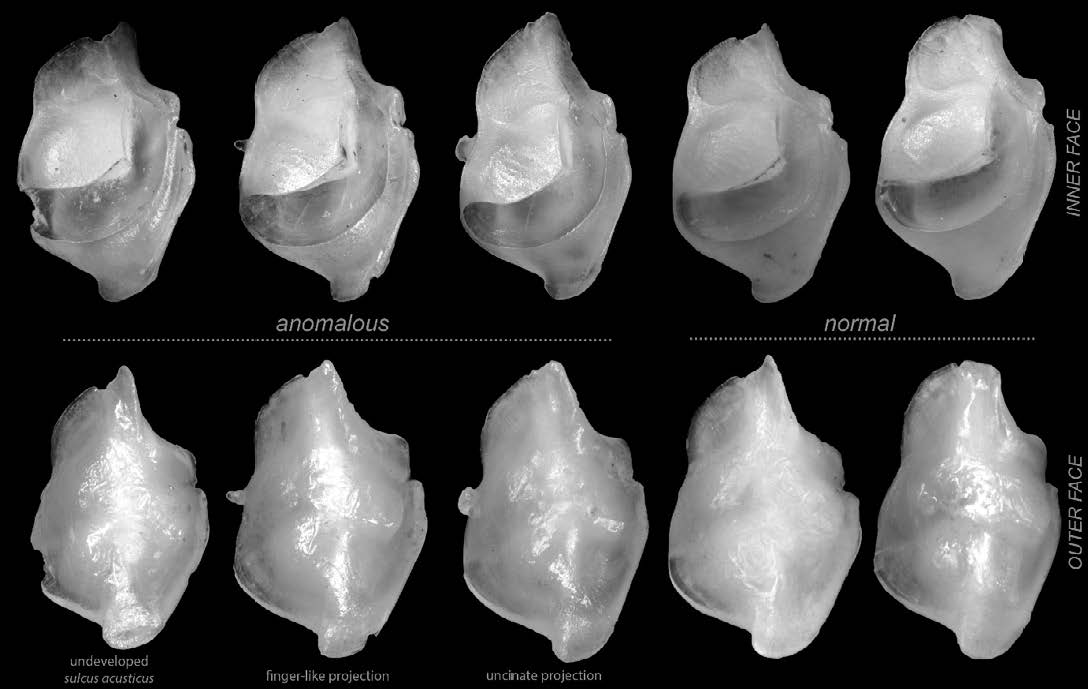
Herein, we record an undefined projection on the mid-ventral section of otoliths (outer face). Of the 38 otoliths analyzed, 23 (60.5%) showed anomalies of varying complexity and volume. This percentage of otolith anomalies is the highest reported in coastal fishes in Brazil (Table 1), suggesting that a key factor is driving this high incidence (see further below). These anomalies were more frequently located in the ventral midpoint of the otoliths and caudal margins of the sulcus acusticus. Although the shape varies, the anomaly on the outer face could generally be defined as uncinate. Other anomalous otoliths exhibited a finger-like projection. In addition, we found a malformation of the sulcus acusticus caudal margin; all of these are treated as anomalies hereafter (Figure 1).
1. Comparison of the percentage of otolith anomalies recorded in fishes along the Brazilian coast based on published data.
Representative otoliths (sagitta) of Stellifer naso (Jordan 1899) showing their inner face (top) and outer face (bottom). From right to left, otoliths range from normal to anomalous morphotypes. MNRJ 54490 (72-124 mm Standard length).
These anomalous projections differed from the well-defined projections recorded on the mid-dorsal section in other species of Stelliferinae. For instance, a projection was described for the Stellifer punctatissimus complex and showed species-specific variation that yielded proper species identification (Santos et al., 2022). The projections recorded for the S. punctatissimus complex have a large base; thus, they appear to be part of regular otolith growth and were present in all specimens. In contrast, the anomalous projections found in S. naso are characterized by a thin body (i.e., a combination of the base and projection tip) and were not found in all specimens. To the best of our knowledge, the projection recorded here also did not correspond to any Stellifer species, and the shape differs from the umbo found in other sciaenids (e.g., Béarez et al., 2005).
However, this anomaly seems like other records found, for instance, in Engraulidae. A halter-like structure (“balancín” in the original), like our finger-like finding, has been recorded in otoliths of Engraulis ringens (Engraulidae) (Oré-Villalba, 2017: fig. 227). It is most likely that such a structure represents an anomaly. Despite being from entirely distinct fish groups, we suggest that a similar causal process might have formed them. Béarez et al. (2005) argue that stress caused by upwelling events might have induced this type of anomaly.
Additionally, we recorded an anomaly in the sulcus acusticus that has an invaginated shape on its caudal margin. This anomaly could be classified as an undeveloped sulcus acusticus, also documented in Leiognathidae by Manizadeh et al. (2018). In the present study, only one otolith exhibited this anomaly; another otolith had a small notch in the same location, but it did not reach the sulcus acusticus and was not classified as such. Another point of interest was the predorsal spine, which displayed shape variation that we classify as intraspecific variation. The predorsal spine was pointed in most otoliths and rounded in only two. Oliveira et al. (2019) also recorded this pointed shape on specimens from the Northern Brazilian Coast, which may be the general shape for S. naso. However, whether this intraspecific variation is linked to the anomalies or if it is merely a matter of local variation is still unclear.
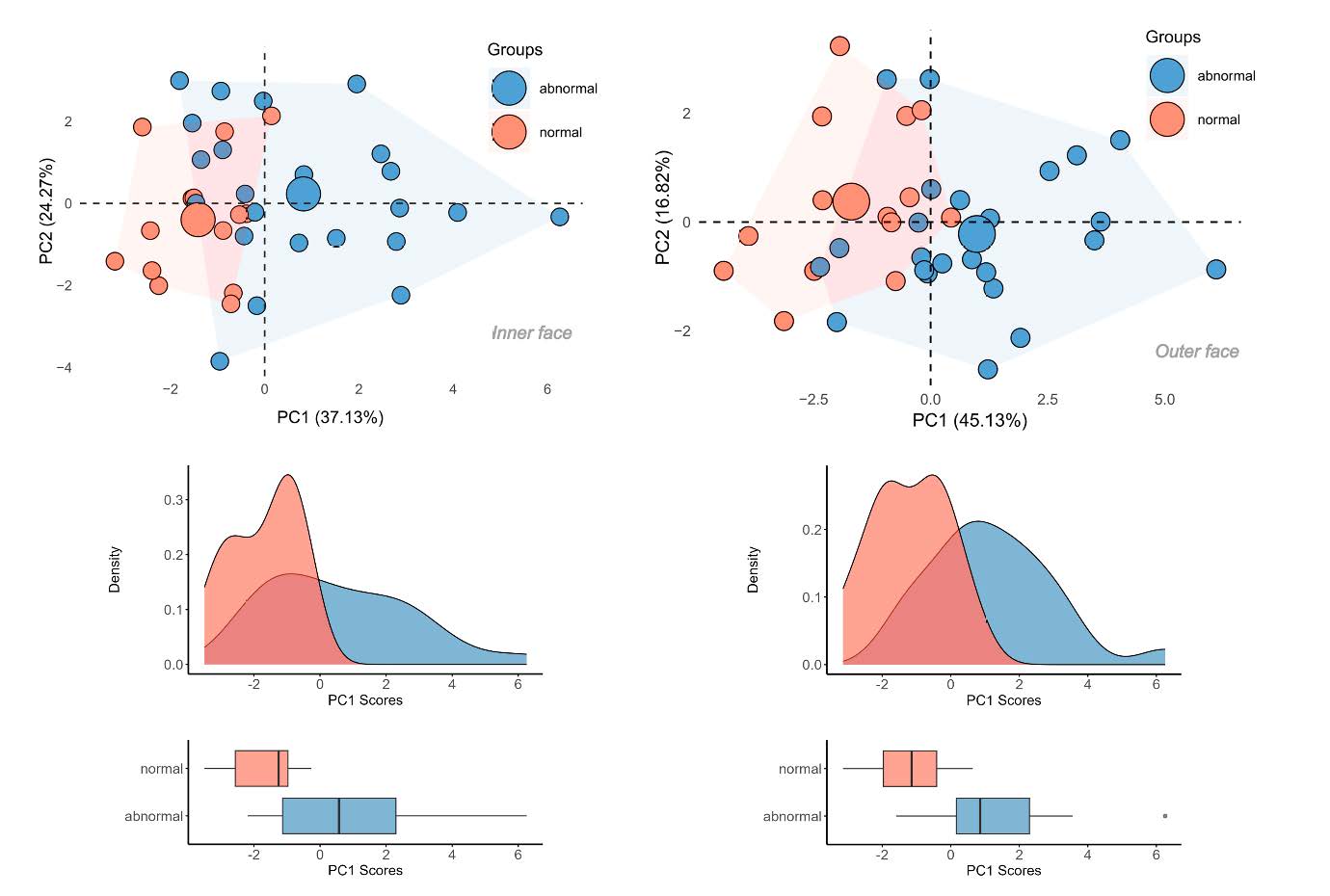
Overall, the PCAs revealed that these anomalous otoliths generated a greater morphological variation than normal ones (Figure 2). Indeed, two distinct groups were found (abnormal and normal) based on the PC1 scores (Mann-Whitney test, W = 279, p = 0.001042 - Inner; W = 283, p = 0.000047 - Outer). These groups are further supported by the lower reclassification rates for anomalous otoliths (Table S1). Additionally, our results corroborate the finding that aragonitic (“normal”) otoliths occupy a smaller morphospace than anomalous vateritic otoliths (Vignon, 2017). However, we have no data on altered crystallization, so it should be evaluated whether these anomalies are in fact vaterite replacement, as we speculate.
The mean reclassification rate was 65.9% for the inner face and 84.16% for the outer face, which is likely explained by the greater visibility of anomalies on the outer face. However, a rather small portion of both outer and inner abnormal otoliths were reclassified as their respective counterparts. These rates suggest that, despite lower misclassification rates in the outer face, otolith shape analysis still has limitations when it comes to identifying fine-scaling anomalies.
In terms of causal origins, fine-scale anomalies in otoliths occur in stressful environments and/or in larger specimens. For instance, Béarez et al. (2005) found that water temperature and salinity were the main drivers of otolith crystalline growth in Peruvian species. In this case, upwelling events may have caused recorded anomalies. Additionally, they dismissed human-induced pollution as the cause of the anomalies due to the absence of external morphological evidence of malformations in the affected fish specimens (Béarez et al., 2005). However, it has been suggested that the presence of otolith-only anomalies is induced by pollution (e.g., Gao et al., 2025), rather than being the result of natural physiological disorders. We agree with the argument that a physiological disorder, rather than upwelling, could alter the endolymph and lead to unusual crystallization on the outer surface of the otoliths (Béarez et al., 2005; Payan et al., 2004). In the case of S. naso, we found additional museum specimens that exhibit body malformations that might have an association with the same pollution process (J.A.S, unpublished study), contradicting the hypothesis proposed by Béarez et al. (2005) about the origin of anomalies.
Principal component analysis (PCA) using Elliptical Fourier Descriptors (EFDs) to depict otolith shape. Density and boxplots based on PC1 scores.
Although several factors (e.g., temperature fluctuations, salinity stress) may explain anomalies in otoliths, we emphasize that the Doce River disaster is probably the major cause of environmental changes due to its physicochemical and genotoxic effects (Francini-Filho et al., 2019; Queiroz et al., 2018). Unlike other cases of anomalies (e.g., Béarez et al., 2005; Manizadeh et al., 2018), the region where we observed this anomaly did not experience marked oceanic processes, such as upwellings. Therefore, the most recent major event that could have caused this anomaly was the Fundão Dam collapse, the worst environmental disaster in Brazil (Escobar, 2015). Bioaccumulation of heavy metals has been detected in several fish species and in catfish otoliths in the area affected by wastewater (Daros et al., 2022; Weber et al., 2020). Species associated with soft bottoms are known to be more prone to bioaccumulation and morphological alterations (Andrades et al., 2021). Like other Stellifer species with inferior mouths, S. naso inhabits estuarine waters around soft bottoms. Estuarine residents and bottom-dwelling species are at risk during the remobilization of pollutants (Andrades et al., 2021). Therefore, we believe that the iron ore mine tailings carried down the river are the leading driver affecting the S. naso populations that we recorded. Studies suggest that these heavy metals carried downriver could have a prolonged effect (Gomes et al., 2017), which could explain the time frame between the disaster (November 2015) and the sampling of our specimens (May 2022). Finally, these anomalies may be associated with the combined impact of the Doce River disaster and yet unidentified genetic effects on species distribution edges, which require further research.
Supplementary material:
Supplementary data associated with this study can be found on the Zenodo repository at https://doi.org/10.5281/zenodo.19441084.
Supplementary Material 1
Supplementary Material 2
Acknowledgments
We would like to thank Maurício Hostim-Silva, Rafael Oliveira, Ester Barbosa, and Mario Condini for collecting and kindly donating the specimens. We would like to thank Durval Santos and Anna Salles (MNRJ) for their curatorial support. We would like to thank Julia Giora for suggestions on an earlier version of this manuscript, and the two anonymous reviewers for their helpful comments, which improved our manuscript. RM thanks CNPq-FACEPE [APQ 1487/5.06-22] and CAPES/COFECUB [88887.994646/2024-00] for the postdoctoral fellowships.
Data Availability:
The data that support the findings of this study are available from the corresponding author upon reasonable request.
References
-
Alley, R. B., Marotzke, J., Nordhaus, W. D., Overpeck, J. T., Peteet, D. M., Pielke, R. A. Jr., Pierrehumbert, R. T., Rhines, P. B., Stocker, T. F., Talley, L. D. & Wallace, J. M. 2003. Abrupt climate change. Science, 299(5615), 2005-2010. DOI: https://doi.org/10.1126/science.1081056
» https://doi.org/10.1126/science.1081056 -
Andrades, R., Martins, R. F., Guabiroba, H. C., Rodrigues, V. L. A., Szablak, F. T., Bastos, K. V., Bastos, P. G. P., Lima, L. R. S., Vilar, C. C. & Joyeux, J.-C. 2021. Effects of seasonal contaminant remobilization on the community trophic dynamics in a Brazilian tropical estuary. Science of the Total Environment, 801, 149670. DOI: https://doi.org/10.1016/j.scitotenv.2021.149670
» https://doi.org/10.1016/j.scitotenv.2021.149670 -
Béarez, P., Carlier, G., Lorand, J.-P. & Parodi, G.-C. 2005. Destructive and non-destructive microanalysis of biocarbonates applied to anomalous otoliths of archaeological and modern sciaenids (Teleostei) from Peru and Chile. Comptes Rendus Biologies, 328(3), 243-252. DOI: https://doi.org/10.1016/j.crvi.2005.01.003
» https://doi.org/10.1016/j.crvi.2005.01.003 -
Bowen II, C.A., Bronte, C. R., Argyle, R. L., Adams, J. V. & Johnson, J. E. 1999. Vateritic sagitta in wild and stocked lake trout: applicability to stock origin. Transactions of the American Fisheries Society, 128(5), 929-938. DOI: https://doi.org/10.1577/1548-8659(1999)128<0929:VSIWAS>2.0.CO;2
» https://doi.org/10.1577/1548-8659(1999)128<0929:VSIWAS>2.0.CO;2 -
Camargo, M. & Isaac, V. J. 2004. Food categories reconstruction and feeding consumption estimates for the sciaenid Macrodon ancylodon (Bloch & Schneider), and the congeneric fishes Stellifer rastrifer (Jordan) and Stellifer naso (Jordan) (Pisces, Perciformes) in the Caeté estuary, northern coast of Brazil. Revista Brasileira de Zoologia, 21(1), 85-89. DOI: https://doi.org/10.1590/s0101-81752004000100015
» https://doi.org/10.1590/s0101-81752004000100015 -
Camargo, M. & Isaac, V. J. 2005. Reproductive biology and spatio-temporal distribution of Stellifer rastrifer, Stellifer naso and Macrodon ancylodon (Sciaenidae) in the Caeté Estuary, Northern Brazil. Brazilian Journal of Oceanography, 53, 13-21. DOI: https://doi.org/10.1590/s1679-87592005000100002
» https://doi.org/10.1590/s1679-87592005000100002 -
Carvalho, B. M., Volpedo, A. V., Albuquerque, C. Q. & Fávaro, L. F. 2019. First record of anomalous otoliths of Menticirrhus americanus in the South Atlantic. Journal of Applied Ichthyology, 35(6), 1286-1291. DOI: https://doi.org/10.1111/jai.13979
» https://doi.org/10.1111/jai.13979 -
Carvalho, B. M., Barbieri, Y., Spach, H. L. & Volpedo, A. V. 2023. Crystallographic characterization of otoliths from Larimus breviceps Thalassas: An International Journal of Marine Sciences, 39, 1027-1031. DOI: https://doi.org/10.1007/s41208-023-00574-1
» https://doi.org/10.1007/s41208-023-00574-1 -
Carvalho, B. M., Albuquerque, C., Vieira, B. B., Lisboa, V., Matias, J. N. & Silva, G. 2026. First record of anomalous otoliths in farmed dusky grouper Epinephelus marginatus (Lowe, 1834). Journal of the Marine Biological Association of the United Kingdom, 106, e30, 1-5. DOI: https://doi.org/10.1017/S0025315426101234
» https://doi.org/10.1017/S0025315426101234 - Chao, L. N. 1978. A basis for classifying western Atlantic Sciaenidae (Teleostei: Perciformes) - NOAA Technical Report NMFS Circular 415. Washington, D.C., Department of Commerce.
-
Chen, Y. & Zhu, G. 2023. Using teacher-student neural networks based on knowledge distillation to detect anomalous samples in the otolith images. Zoology, 161, 126133. DOI: https://doi.org/10.1016/j.zool.2023.126133
» https://doi.org/10.1016/j.zool.2023.126133 -
Daros, F. A., Condini, M. V., Altafin, J. P., Ferreira, F. O. & Hostim-Silva, M. 2022. Fish otolith microchemistry as a biomarker of the world’s largest mining disaster. Science of the Total Environment, 807, 151780. DOI: https://doi.org/10.1016/j.scitotenv.2021.151780
» https://doi.org/10.1016/j.scitotenv.2021.151780 -
Escobar, H. 2015. Mud tsunami wreaks ecological havoc in Brazil. Science, 350(6265), 1138-1139. DOI: https://doi.org/10.1126/science.350.6265.1138
» https://doi.org/10.1126/science.350.6265.1138 -
Francini-Filho, R. B., Cordeiro, M. C., Omachi, C. Y., Rocha, A. M., Bahiense, L., Garcia, G. D., Tschoeke, D., Almeida, M. G., Rangel, T. P., Oliveira, B. C. V., Almeida, D. Q. R., Menezes, R., Mazzei, E. F., Joyeux, J.-C., Rezende, C. E., Thompson, C. C. & Thompson, F. L. 2019. Remote sensing, isotopic composition and metagenomics analyses revealed Doce River ore plume reached the southern Abrolhos Bank reefs. Science of the Total Environment, 697, 134038. DOI: https://doi.org/10.1016/j.scitotenv.2019.134038
» https://doi.org/10.1016/j.scitotenv.2019.134038 -
Gagliano, M. & McCormick, M. I. 2004. Feeding history influences otolith shape in tropical fish. Marine Ecology Progress Series, 278, 291-296. DOI: https://doi.org/10.3354/meps278291
» https://doi.org/10.3354/meps278291 -
Gao, S., Yi, D., Zhang, S., Fu, G. & Lu, J. 2025. Comparison of otolith fluctuating asymmetry in relation to standard length and habitats of three different species in Haizhou Bay, China. Marine Pollution Bulletin, 217, 118056. DOI: https://doi.org/10.1016/j.marpolbul.2025.118056
» https://doi.org/10.1016/j.marpolbul.2025.118056 -
Giora, J., Silva, A. C. T., Cavalheiro, L. W., Wingert, J. M. & Fialho, C. B. 2022. Long-term aquatic biomonitoring in a southern Brazil urban center: the Guaíba Lake fish community structure through the years. Environmental Biology of Fishes, 105, 605-622. DOI: https://doi.org/10.1007/s10641-022-01272-2
» https://doi.org/10.1007/s10641-022-01272-2 -
Gomes, L. E. O., Correa, L. B., Sa, F., Rodrigues Neto, R. & Bernardino, A. F . 2017. The impacts of the Samarco mine tailing spill on the Rio Doce estuary, eastern Brazil. Marine Pollution Bulletin, 120(1-2), 28-36. DOI: https://doi.org/10.1016/j.marpolbul.2017.04.056
» https://doi.org/10.1016/j.marpolbul.2017.04.056 -
Lapuch, I. C., Carvalho, B. M. D. & Metri, C. B. 2022. First record of anomalous otoliths in Atherinella brasiliensis Journal of Applied Ichthyology, 38(1), 109-113. DOI: https://doi.org/10.1111/jai.14255
» https://doi.org/10.1111/jai.14255 -
Libungan, L. A. & Pálsson, S. 2015. ShapeR: an R package to study otolith shape variation among fish populations. PLoS ONE, 10(3), e0121102. DOI: https://doi.org/10.1371/journal.pone.0121102
» https://doi.org/10.1371/journal.pone.0121102 -
Lin, Y.-J. & Chen, H.-M. 2023. Directional asymmetry in gonad length indicates moray eels (Teleostei, Anguilliformes, Muraenidae) are “right-gonadal”. Scientific Reports, 13, 2963. DOI: https://doi.org/10.1038/s41598-023-30172-y
» https://doi.org/10.1038/s41598-023-30172-y - Lobo, E. A., Bes, D., Tudesque, L. & Ector, L. 2004. Water quality assessment of the Pardinho River, RS, Brazil, using epilithic diatom assemblages and faecal coliforms as biological indicators. Vie et Milieu, 54, 115-126.
-
Lombarte, A. & Lleonart, J. 1993. Otolith size changes related with body growth, habitat depth and temperature. Environmental Biology of Fishes, 37, 297-306. DOI: https://doi.org/10.1007/BF00004637
» https://doi.org/10.1007/BF00004637 -
Manizadeh, N., Teimori, A., Hesni, M. A. & Motamedi, M. 2018. Abnormal otoliths in marine fishes collected from the Persian Gulf and the Gulf of Oman. Acta Ichthyologica et Piscatoria, 48(2), 143-151. DOI: https://doi.org/10.3750/AIEP/02350
» https://doi.org/10.3750/AIEP/02350 -
Morais, I.S. & Azevedo, J.S. 2021. The first report of abnormal age rings in otoliths lapillus of ariids catfish. Boletim do Instituto de Pesca, 47, e615. DOI: https://doi.org/10.20950/1678-2305/bip.2021.47.e615
» https://doi.org/10.20950/1678-2305/bip.2021.47.e615 -
Oliveira, R. R. S., Andrade, M. C., Machado, F. S., Cunha, E. J. S., Freitas, F. S., Klatau, A. G. C. M., Giarrizzo, T. & Saint-Paul, U. 2019. Biometric relationships between body size and otolith size in 15 demersal marine fish species from the northern Brazilian coast. Acta Amazonica, 49(4), 299-306. DOI: https://doi.org/10.1590/1809-4392201900571
» https://doi.org/10.1590/1809-4392201900571 - Oré-Villalba, D. O. 2017. Catálogo fotográfico de otolitos de peces marinos y dulceacuícolas del Perú. Boletín Instituto del Mar del Perú, 32(2), 136-213.
-
Payan, P., Pontual, H., Bœuf, G. & Mayer-Gostan, N. 2004. Endolymph chemistry and otolith growth in fish. Comptes Rendus Palevol, 3(6-7), 535-547. DOI: https://doi.org/10.1016/j.crpv.2004.07.013
» https://doi.org/10.1016/j.crpv.2004.07.013 -
Queiroz, H. M., Nóbrega, G. N., Ferreira, T. O., Almeida, L. S., Romero, T. B., Santaella, S. T., Bernardino, A. F. & Otero, X. L. 2018. The Samarco mine tailing disaster: a possible time-bomb for heavy metals contamination? Science of the Total Environment, 637, 498-506. DOI: https://doi.org/10.1016/j.scitotenv.2018.04.370
» https://doi.org/10.1016/j.scitotenv.2018.04.370 -
Rosa, R. S., Medeiros, A. P. M., Felinto, A., Brito, C., Santana, E. F. C., Albuquerque, F. V., Santos, J. A., Lustosa, J., Viana, K. M. P., Silva, M. B., Menezes, R., Velásquez, V. M., Marceniuk, A. P., Francini-Filho, R., Rocha, C. R., Rocha, L. A. & Figueiredo-Filho, J. M. (2023). Marine teleost fishes of the northeastern Brazilian coast: 166 years of compiled data. Systematics and Biodiversity, 21(1), 2228314. DOI: https://doi.org/10.1080/14772000.2023.2228314
» https://doi.org/10.1080/14772000.2023.2228314 -
Salomoni, S. E., Rocha, O., Callegaro, V. L. & Lobo, E. A. 2006. Epilithic diatoms as indicators of water quality in the Gravataí River, Rio Grande do Sul, Brazil. Hydrobiologia, 559, 233-246. DOI: https://doi.org/10.1007/s10750-005-9012-3
» https://doi.org/10.1007/s10750-005-9012-3 -
Santos, J. A., Menezes, R., Rosa, R. S. & Ramos, T. P. A. 2022. Otolith shape analysis supports three cryptic species in the Stellifer punctatissimus complex (Acanthuriformes: Sciaenidae). Neotropical Ichthyology, 20(3), e220005. DOI: https://doi.org/10.1590/1982-0224-2022-0005
» https://doi.org/10.1590/1982-0224-2022-0005 -
Vignon, M. 2017. Investigating morphospace occupation in multi-scale ecological and evolutionary data using regression tree: case studies and perspectives. Evolutionary Biology, 44, 120-134. DOI: https://doi.org/10.1007/s11692-016-9386-3
» https://doi.org/10.1007/s11692-016-9386-3 -
Vignon, M. 2019. When the presence of a vateritic otolith has morphological effect on its aragonitic partner: trans-lateral compensation induces bias in microecological patterns in one-side-only vateritic otolith. Canadian Journal of Fisheries and Aquatic Sciences, 77(2), 285-294. DOI: https://doi.org/10.1139/cjfas-2019-0066
» https://doi.org/10.1139/cjfas-2019-0066 -
Weber, A.A., Sales, C.F., Faria, F. S., Melo, R. M. C., Bazzoli, N. & Rizzo, E. 2020. Effects of metal contamination on liver in two fish species from a highly impacted neotropical river: a case study of the Fundão dam, Brazil. Ecotoxicology and Environmental Safety, 190, 110165. DOI: https://doi.org/10.1016/j.ecoenv.2020.110165
» https://doi.org/10.1016/j.ecoenv.2020.110165
-
AI Use statement:
While preparing this study, the authors used DeepL Write and DeepL Translator to check for spelling errors and improve readability. After using these tools, the authors reviewed and edited the content as needed and take full responsibility for the published article’s content.
-
Funding:
This research was supported by the Coordenação de Aperfeiçoamento de Pessoal de Nível Superior Brasil (CAPES 88887.713302/2022-00, 23038.004195/2022-59) and by the Society for Systematic Biologists’ 2022 Graduate Student Research Award.
Edited by
-
Associate Editor:
Margit Wilhelm