 Soybean yield gap in integrated crop-forest, conventional, and no-tillage systems in sandy soil1
Abstract
Sustainable agriculture is essential for increasing land use and food security by reducing the yield gap. This study quantified yield gap components in integrated crop-forest (ICF), no-tillage (NT), and conventional tillage (CT) systems of soybean cultivated during the 2021/2022 and 2022/2023 growing seasons, in soil with 84 % of sand, over a degraded pastureland. The actual yield, leaf nutrients, soil properties, potential and attainable yields were estimated. The potential yield averaged 10,560 kg ha-1, whereas the attainable yield reached 6,401 kg ha-1 for NT. The actual yield averaged 5,065 kg ha-1 in NT, 4,394 kg ha-1 in ICF and 1,958 kg ha-1 in CT. The agricultural efficiency reached 80 % in NT, 70 % in ICF, and 32 % in CT. In ICF, the total yield gap was 44 % (agricultural management - 20 %; land allocation to trees - 14 %; interspecific competition - 10 %). The climate efficiency ranged from 45 %, in 2021/2022, under severe water deficit, to 81 %, in 2022/2023, under a better rainfall distribution. The water availability was the main factor driving the seasonal yield variability, with NT being the most efficient system, whereas ICF showed an intermediate performance, but with both improving the soil quality. ICF achieved an agricultural efficiency comparable to the national average for soybean, demonstrating its potential to a sustainable grain and wood production in sandy soil.
Keywords:
Soil management; climate variability; degraded pastureland.
RESUMO
A agricultura sustentável é essencial para ampliar o uso da terra e a segurança alimentar, reduzindo a lacuna de produtividade. Este estudo quantificou os componentes da lacuna de produtividade em sistemas de integração lavoura-floresta (ILP), plantio direto (PD) e preparo convencional (PC) de soja cultivada nas safras 2021/2022 e 2022/2023, em solo com 84 % de areia, sob pastagem degradada. Foram avaliados a produtividade real, nutrientes foliares, propriedades do solo, produtividade potencial e atingível. A produtividade potencial média foi de 10.560 kg ha-1, enquanto a maior produtividade atingível alcançou 6.401 kg ha-1 no PD. A produtividade real média foi de 5.065 kg ha-1 no PD, 4.394 kg ha-1 no ILP e 1.958 kg ha-1 no PC. A eficiência agrícola foi de 80 % no PD, 70 % no ILP e 32 % no PC. No ILP, a lacuna total alcançou 44 % (manejo - 20 %; alocação de área para árvores - 14%; competição interespecífica - 10%). A eficiência climática variou de 45 %, em 2021/2022, sob severo déficit hídrico, a 81 %, em 2022/2023, com melhor distribuição das chuvas. A disponibilidade hídrica foi o principal fator determinante da variabilidade produtiva entre as safras, sendo o PD o sistema mais eficiente, enquanto o ILP apresentou desempenho intermediário, mas ambos promoveram melhoria na qualidade do solo. O ILP alcançou eficiência agrícola comparável à média nacional para a soja, demonstrando potencial para produção de grãos e madeira em solo arenoso.
PALAVRAS-CHAVE:
Manejo de solo; variabilidade climática; pastagem degradada.
INTRODUCTION
The integrated crop-forestry system (ICF) has emerged as an approach for sustainable agricultural intensification (van der Linden et al. 2018), particularly in tropical regions, such as Brazil, being an alternative to the single crop production under tillage or no-tillage systems. ICF is especially relevant in sandy soils, as it presents substantial challenges such as low water and nutrient retention capacity, which limit agricultural productivity and compromise sustainable land use (Diamantis et al. 2020, Gondek et al. 2020).
Implementing ICF in sandy soils requires a careful approach, due to the complex interactions between plants and soil, which can mitigate or exacerbate the limitations imposed by these edaphic conditions (Lemos-Junior et al. 2016). There is competition for resources, such as water and nutrients, between trees and crops (Mesquita et al. 2023), resulting in a significant yield gap (Henderson et al. 2016, Barretto & Bonini Neto 2022). Competition is exacerbated during periods of water stress, requiring management practices to minimize losses and maximize the resource use efficiency (Battisti & Sentelhas 2014, Donagemma et al. 2016).
The yield gap is quantified using crop models calibrated for high-yield reference environments (Lobell et al. 2009), in which yield is primarily determined by edaphoclimatic conditions and management-related constraints are minimized (Battisti et al. 2017a). Applying this framework to single-crop systems, the yield gap by water deficit and agricultural management were 18.5 and 44.7 %, respectively, for soybean (Marin et al. 2022), and 37 and 36 %, respectively, for eucalyptus (Elli et al. 2019), the main annual and tree crops used in ICF. However, to the best of our knowledge, quantitative assessments of yield gap components remain scarce for ICF.
The presence of trees in ICF reduces the area available for annual crops, which reduces the agricultural efficiency per hectare and affects the economic viability of the system. This loss can be offset by the additional production of forest biomass and animals in advanced growing seasons (Pezzopane et al. 2019) and improvements in soil quality and carbon sequestration, which are fundamental for long-term sustainability (Gondek et al. 2020, Barretto & Bonini Neto 2022).
This study aimed to determine the amount and partitioning of yield gaps using ICF, no-tillage, and conventional tillage systems in two growing seasons, as well as their impacts on soil properties. This approach provides a deeper understanding of the limitations and potential of integrated systems in sandy soils, offering guidelines for optimizing agricultural management practices in tropical regions.
MATERIAL AND METHODS
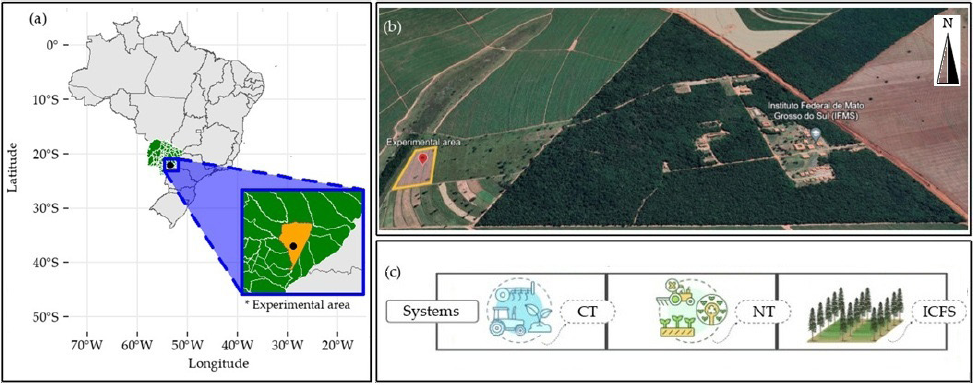
The study was carried out in Nova Andradina, Mato Grosso do Sul state, Brazil (22º04’48”S, 53º28’14”W, and altitude of 345 m) (Figure 1a). According to the Köppen-Geiger classification system, the climate is mesothermal type Cwa, with dry winters and hot summers (Alvares et al. 2013). The maximum and minimum mean temperatures during the soybean growing seasons were 34.1 and 16.3 ºC, respectively, and the average annual rainfall was 1,460 mm.
Location of the field experiment in Nova Andradina, Mato Grosso do Sul state, Brazil (a); field experiment landscape (b); and overview of no-tillage (NT), conventional tillage (CT), and integrated crop-forest (ICF) (c) systems.
The soil was classified as a sandy-textured Typic Haplorthox, which corresponds to Oxisol (USDA 2022). The soil granulometric analysis indicated clay, silt, and sand proportions of 100, 60, and 840 g kg-1, respectively. The soil chemical properties were determined using the methodology described by van Raij et al. (1997), as follows: pH (CaCl2 0.01 M) = 4.6; P = 0.90 mg dm-3 (Mehlich-1); B = 0.20 mg dm-3 (hot water); Cu = 0.10 mg dm-3 (DTPA); Fe = 15.0 mg dm-3 (DTPA); Mn = 13.0 mg dm-3 (DTPA); Zn = 0.75 mg dm-3 (DTPA); K = 0.50 mmolc dm-3 (resin); Ca = 8.0 mmolc dm-3 (resin); Mg = 2.0 mmolc dm-3 (resin); H + Al = 14.0 mmolc dm-3 (SMP buffer); CEC = 24.5 mmolc dm-3.
Three cultivation systems were installed in October 2021, over a degraded pastureland (Figure 1b): no-tillage (NT), conventional tillage (CT), and integrated crop-forest (ICF). The treatments were arranged in a systematic layout along the slope gradient, selected based on the homogeneous soil conditions and the nature of the applied treatments. Each treatment was established in an experimental area of 1.2 ha. Data collection was performed using four experimental units of 0.06 ha, with each composed of 3 subsamples. In ICF, subsampling points were distributed along the tree gradient line, capturing the spatial variability between trees rows. A description of the management practices is presented in Table 1.
Description of management practices for integrated crop-forest (ICF), no-tillage (NT), and conventional tillage (CT) systems.
Soybean (TMG 7062 IPRO cultivar) was sown on 15 Nov. 2021 and 01 Dec. 2022 and harvested on 15 Mar. 2022 and 21 Mar. 2023. The soybean seeds were treated with fungicides (carboxin + thiram at 100 g + 100 g a.i. 100 kg-1 of seeds) before the inoculation and sowing. Seed inoculation was performed 1 h before sowing by evenly coating the seeds with an appropriate amount of inoculant containing SEMIA 5079 (Bradyrhizobium japonicum) and SEMIA 5080 (Bradyrhizobium diazoefficiens). Phytosanitary treatments were carried out based on the needs and recommendations for soybean (Seixas et al. 2020). At the beginning of the soybean sowing, carbonate was applied to raise the base saturation to 70 % (van Raij et al. 1997). Soybean fertilization is described in Table 1.
Soil samples were collected at the soybean harvest in both growing seasons, to evaluate the soil physical properties, using an undisturbed structure at a soil depth of 0.0-0.10 m, with 100-cm³ volumetric cores of 0.05 m in height × 0.05 m in diameter. These samples were saturated with water by capillarity for 48 h. After saturation, the weight of each sample was measured, and the samples were subjected to matric potentials of -1 and -10 kPa, using a tension table. Once equilibrium was reached, as indicated by the cessation of water drainage, the sample masses were measured again. The samples were subsequently oven-dried at approximately 105 ºC, for 24 h, and the final sample weight was recorded. Soil porosity in the macropore domain, soil water storage, and air storage capacity were determined following the methodology of Reynolds et al. (2009), and soil bulk density was calculated as described by Grossman & Reinsch (2002).
Nutrient concentrations were analyzed in soybean leaves at full flowering (R2 soybean phenological stage) (Fehr & Caviness 1977). The third fully expanded leaf from the shoot apex was sampled. Leaves were dried in an oven at 65 ºC to a constant weight, and then ground in a Willey-type mill with 1-mm screen for macro- and micronutrient analyses. Nitrogen was extracted by sulfuric acid digestion, and the content was determined using the Kjeldahl method (Santos et al. 2015). P, K, Ca, Mg, and S were extracted using nitroperchloric acid digestion and determined by atomic absorption spectroscopy (Santos et al. 2017). At harvest, the grain yield was evaluated based on the mass of grains with a standard water content of 130 g kg-1 obtained from 3 subsamples (5.4 m²) in each experimental unit. The potential and attainable yields were obtained using the FAO-Agroecological model adapted and calibrated for soybean across Brazilian growing conditions with higher management efficiency. The calibration used for the crop model had a relatively mean absolute error of 17 % and Willmott index of 0.91 (Battisti et al. 2017b, 2018). The daily weather data, including solar radiation, air temperature, wind speed, and relative humidity, for the field experiment were obtained from NASAPOWER (Stackhouse 2024) and validated by Battisti et al. (2024), whereas rainfall was obtained from Agritempo (2024). The water balance proposed by Thornthwaite and Mather was used to quantify the water deficit and surplus throughout the growing season.
The simulation was performed for three land-use systems (ICF, NT, and CT), considering two growing seasons (2021/2022 and 2022/2023). The total water available to the crop in the soil was obtained using the pedotransfer function described by Medrado & Lima (2014), based on the soil bulk density and clay, sand, silt, and organic matter contents in each land-use system and growing season, and input in the crop model. The maximum root depth was defined as 60 cm, based on local observations, and was used to calculate the total water available to the crop.
The potential, attainable, and actual yields were used to estimate the yield gap (Battisti et al. 2018). The difference between potential and attainable yield defined the yield gap by water deficit, and the difference between attainable and actual yield defined the yield gap by management. The relationship between attainable and potential yield and between actual and attainable yield defined the climate efficiency and agricultural management efficiency, respectively. The land-use systems were compared by quantifying the absolute and relative yield gap by management using the maximum attainable yield across systems as the reference and ranking systems according to the actual yield.
In ICF, the yield gap associated with area reduction due to tree occupation was quantified by comparing the total land area with the effective available area for soybean cultivation, resulting in the area-adjusted agricultural management efficiency. The yield gap attributed to intercropping competition was estimated as the difference in actual yield between NT and ICF, without considering the yield gap associated with area reduction. The yield gap attributed to intercropping competition was considered a component of yield gap by management in ICF, and yield gap associated with area reduction was an additional yield gap, since the actual yield in ICF was normalized to exclude area losses for comparative purposes.
Statistical analysis followed the randomized block design, due to the adopted systematic experimental layout (Alvarez & Alvarez 2013). Analysis of variance (Anova) and the Scott-Knott mean test (5 %) were applied to evaluate the effects of the production system and growing seasons on field data, including the actual yield, leaf nutrient concentration, soil bulk density, macroporosity, soil water storage capacity, and soil air storage capacity. Statistical analyses were performed using the R software (R Core Team 2024), with the ‘ExpDes’ package (Ferreira 2014).
RESULTS AND DISCUSSION
The potential yield averaged 10,560 kg ha-1 across the growing seasons, with 12,060 kg ha-1 in 2021/2022 and 9,060 kg ha-1 in 2022/2023 (Table 2). Potential yield represents the interaction among air temperature, solar radiation, and growth cycle length linked to different sowing dates and climate conditions between growing seasons (Sampaio et al. 2020). The attainable yield was 6,392; 6,401; and 6,264 for ICF, NT and CT, respectively, after penalizing the potential yield by water deficit (Table 2). The water deficit led to a yield reduction greater than 6,625 kg ha-1 in the 2021/2022 growing season and lower than 1,707 kg ha-1 in the 2022/2023 season. This aligns with Hatfield & Dold (2018), who identified water availability as one of the main determinants of yield variation in agriculture.
Potential (PPy), attainable (ATy), and actual yield (ACy) and yield gap (YG) by water deficit (WD), management (MG), area reduction (AR), and intercropping competition (IC) for soybean under integrated crop-forest (ICF), no-tillage (NT), and conventional tillage (CT) systems, during the 2021/2022 and 2022/2023 growing seasons.
The actual yield for ICF, NT, and CT was 4,185; 4,824; and 1,865 kg ha-1, respectively, in the 2021/2022 growing season, and 4,604; 5,306; and 2,051 kg ha-1, respectively, in the 2022/2023 growing season (Table 2). The actual yield was statistically different between the growing seasons in the same land-use system, and NT was superior to ICF, whereas CT had the worst performance. NT and ICF had advantages over CT, because these systems had a no-tillage soil management. Management affects the total water available to the crop calculated as input in the model, which was 67.62 and 67.29 mm in NT, 67.05 and 66.71 mm in ICF, and 58.68 and 58.62 mm in CT, in the 2021/2022 and 2022/2023 growing seasons, respectively. Compared to CT, the difference in the total water available to the crop was 15 and 14 % higher in the 0-10-cm layer for NT and ICF, respectively. This result is similar to the 17-25 % increase observed by Assis et al. (2015) in areas with clay soil under ICF, when compared to degraded pasture.
The higher available water under NT and ICF showed an improvement in the soil physical properties. A greater macroporosity, water retention, and air storage capacity have been observed in the NT system (Moraes et al. 2020, Mulazzani et al. 2024), even with a short implementation period. These characteristics contribute to an enhanced soil structure, promoting a better water infiltration, root development, and soil health (Salton et al. 2014).
The yield gap by management had a mean of 1,998; 1,335; and 4,306 kg ha-1 for ICF, NT, and CT, respectively, when considering the use of 100 % of the area by soybean in ICF (Table 2). The yield gap by management for ICF includes yield gap by intercropping competition, which was quantified as 671 kg ha-1, representing a reduction of 13 % in relation to NT. Additionally, ICF had a yield gap of 14 %, due to the reduction of the growing area for soybean by tree growth, reducing the absolute yield in 879 kg ha-1, totalizing a yield gap by management of 2,877 kg ha-1, which represents 44 % of the attainable yield.
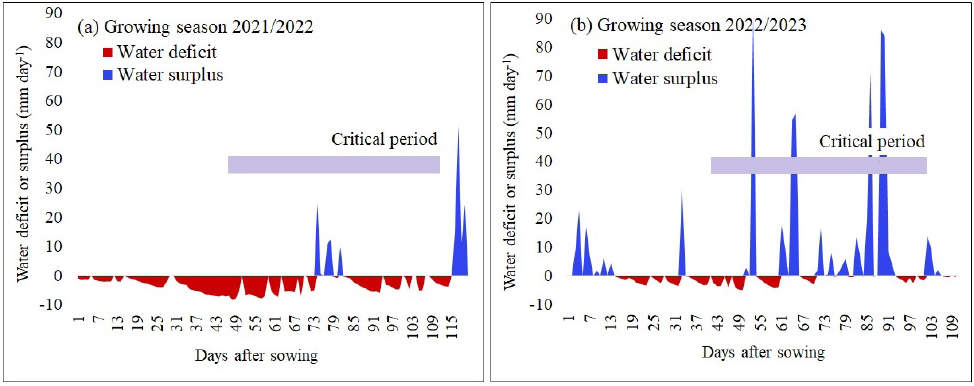
The 2021/2022 and 2022/2023 growing seasons had different conditions to water availability, showing, respectively, a climate management (attainable yield/ potential yield) of 45 % (5,379/12,060 kg ha-1) and 81 % (7,325/9,060 kg ha-1) (Tables 2 and 3). The 2022/2023 growing season had a better rainfall distribution during the critical crop phase (Figure 2b), resulting in an optimal climate efficiency above 80 % (Battisti et al. 2018). The variability in water availability during the two growing seasons reflects the sensitivity of the cropping systems, as soil management is crucial for mitigating water deficits (Hatfield & Dold 2018).
The water deficit occurred during the soybean’s critical period in the 2021/2022 growing season (Figure 2a), resulting in a total water deficit of 367 mm. The soybean had a potential evapotranspiration of 730 mm, and only 362 mm were supplied. The 2022/2023 growing season showed a lower water deficit (Figure 2b), in which the crop had an actual evapotranspiration of 468 mm from a potential of 584 mm, showing a water deficit of 115 mm and water surplus of 689 mm, when compared to 162 mm in the previous season.
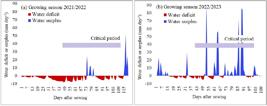
Water deficit and surplus obtained from the water balance for the 2021/2022 (a) and 2022/2023 (b) soybean growing seasons. The critical period was defined as the period between the start of flowering (R1) and the end of grain filling (R6).
The agricultural management efficiency was 77, 89, and 35 % for ICF, NT, and CT, respectively, in the 2021/2022 growing season (Table 3). However, when the land lost to trees was included in ICF, the area-adjusted agricultural management efficiency dropped to 62 %. The agricultural management efficiency was lower in 2022/2023 than in 2021/2022, even with better climate conditions, leading to an agricultural management efficiency of 62, 72, and 25 % for ICF, NT, and CT, respectively, and an area-adjusted agricultural management efficiency of 50 % for ICF (Table 3). The reduction in agricultural management efficiency under conditions of greater water availability is associated with a higher attainable yield, which demands more precise management to fully exploit the increased yield (Battisti et al. 2018). Moreover, improved water availability is often linked to higher rainfall, which intensifies management challenges, including increased disease and pest pressure, and constraints related to planting and harvesting operations (Santos et al. 2021).
Climate (CE), agricultural management (AE), and agricultural management adjusted (AEa) efficiencies for soybean under integrated crop-forest (ICF), no-tillage (NT), and conventional tillage (CT) systems, in the 2021/2022 and 2022/2023 growing seasons.
On average, the area-adjusted agricultural management efficiency was 56 % for ICF, with a difference of 24 % from NT. NT reached an agricultural management efficiency of 80 %, whereas CT had an agricultural management efficiency of 32 %. The mean agricultural management efficiency was 70 % for ICF and 80 % for NT (Table 3). This shows that the competition between soybean and eucalyptus in ICF resulted in an agricultural management efficiency reduction of 10 %. The competition was 2 % higher in the drier growing season (2021/2022) than in the wet season (2022/2023). The presence of trees can, in some contexts, improve the water-use efficiency due to their ability to access deeper water resources (Ong et al. 2002, Sanz et al. 2020). However, in sandy soil, competition between the shallow roots of annual crops and trees can be detrimental, significantly reducing yield (Garcia et al. 2022).
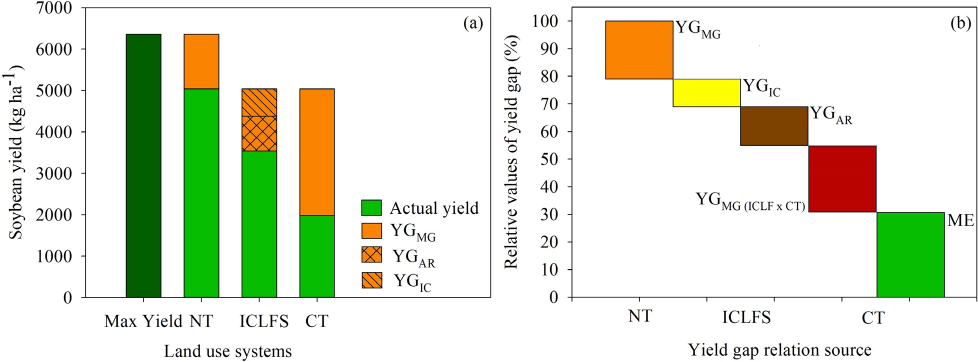
The maximum yield simulated for soybean was 6,401 kg ha-1, when considering the average attainable yield across growing season in the NT (Figure 3a). NT was the best land-use system, resulting in a yield gap by management of 1,320 kg ha-1 and actual yield of 5,040 kg ha-1. ICF had an actual yield of 3,540 kg ha-1, leading to a difference of 1,500 kg ha-1 from NT, of which 840 kg ha-1 were due to land-area loss by tree establishment and 660 kg ha-1 due to interspecific species competition (Figure 3a). A higher yield difference was observed between NT and CT, as CT had an actual yield of 1,980 kg ha-1, showing a difference of 3,060 kg ha-1 from NT (Figure 3a).
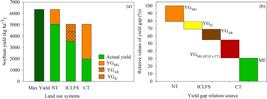
Maximum soybean yield (max yield; stronger green; obtained from the crop model considering soil properties from the no-tillage system - NT), actual yield, yield gap (YG) by agricultural management (MG) for no-tillage (NT) compared to maximum yield, and YG by MG due to the reduction in the area for tree growth (AR) and intercropping competition (IC) under integrated crop-forest (ICF) and conventional tillage (CT) systems compared to NT (a); and relative YG for the land-use system under NT to lower agricultural management efficiency (ME) under CT (b), based on the mean difference between growing seasons.
The yield gap was decomposed by ranking the land-use systems from best to worst performance, from NT to CT. NT was limited by a yield gap by management of 21 %, based on the crop model reference yield (Figure 3b), which was near the maximum acceptable value of 20 % (Lobell et al. 2009). ICF showed a yield gap of 24 %, when compared to NT, 10 % of which were due to interspecific competition and 14 % due to land loss by trees. Behling et al. (2023) observed a yield reduction between 14 and 26 % in soybean, when it was grown with eucalyptus, at 7 years after planting. CT had a yield gap of 24 %, if compared to ICF, resulting in a final agricultural management efficiency of 31 % (Figure 3b), which was lower than the national agricultural management efficiency of 56 % (Marin et al. 2022). Under ICF, the agricultural management efficiency was 55 %, when considering a yield gap of 10 % for intercrop competition, of which 14 % were due to the area lost for tree growth and 21 % due to agricultural management. This was still comparable to the national average yield gap of 44 % for soybean (Marin et al. 2022).
The agricultural management efficiency is in line with the soil properties measured in the land systems, in which the bulk density was significantly higher in CT (1.7275 Mg m-3), in comparison to ICF (1.5895 Mg m-3) and NT (1.5740 Mg m-3), in the 2021/2022 growing season, indicating a greater soil compaction (Table 4). In contrast, the porosity in the soil macropore domain was higher under ICF (0.02750 m3 m-3) and NT (0.02685 m3 m-3), when compared to CT (0.01895 m3 m-3). Likewise, both the soil water storage capacity and soil air storage capacity were higher in ICF (0.7905 and 0.2125 m3 m-3, respectively) and NT (0.7750 and 0.1970 m3 m-3, respectively) than in CT (0.5985 and 0.4405 m3 m-3, respectively).
Soil bulk density, porosity in the soil macropore domain, soil water storage capacity, and soil air storage capacity under integrated crop-forest (ICF), no-tillage (NT), and conventional tillage (CT) systems, in the 2021/2022 and 2022/2023 growing seasons.
The soil properties showed similar trends in the 2022/2023 growing season. The bulk density remained highest under CT (1.7267 Mg m-3), whereas porosity in the soil macropore domain, soil water storage capacity, and soil air storage capacity were consistently higher under ICF (0.0285, 0.8005, and 0.2135 m3 m-3, respectively) and NT (0.0278, 0.7850, and 0.1980 m3 m-3, respectively), when compared to CT (0.0192, 0.5892, and 0.4390 m3 m-3, respectively). These results show that ICF and NT created a favorable environment for root growth and water infiltration due to soil structure improvement (Moraes et al. 2020). The comparison between NT and CT reinforces the superiority and benefits of NT, in terms of soil conservation and moisture retention, critical aspects in sandy soils (Licker et al. 2010).
The determination of nutrient concentrations in soybean leaves revealed differences in nutrient uptake (Table 5). In both growing seasons, the N, Ca, and Mg concentrations were consistently higher under ICF and NT, if compared to CT. In the 2021/2022 season, N concentrations were 57.2 and 57.6 g kg-1 under ICF and NT, respectively, whereas CT exhibited a significantly lower concentration of 49.7 g kg-1. Similar trends were observed for Ca and Mg, with ICF and NT showing higher concentrations (Ca: 8.36 and 8.45 g kg-1; Mg: 3.93 and 4.43 g kg-1, respectively), in comparison to CT (Ca: 5.72 g kg-1; Mg: 2.19 g kg-1). This pattern persisted in the 2022/2023 season, as the N, Ca, and Mg concentrations in the ICF and NT systems remained superior to CT. Inacio et al. (2025) reported an increased soil organic matter content, N content, and enzymatic activity in sandy tropical soil under NT and ICF, improving soybean photosynthetic parameters, when compared to CT.
Nitrogen (N), phosphorus (P), potassium (K), calcium (Ca), magnesium (Mg), and sulfur (S) contents in soybean leaves in integrated crop-forest (ICF), no-tillage (NT), and conventional tillage (CT) systems, in the 2021/22 and 2022/23 growing seasons.
Therefore, implementing the ICF system is justified, as it maintains soybean production levels and provides additional tree production, offsetting the soybean yield difference. These findings are consistent with recent literature, which points to the need for an integrated approach to closing the yield gap and increasing crop resilience in the face of climate change (Gil et al. 2015, Sanz et al. 2020, Garcia et al. 2022, Inacio et al. 2025), considering ICF in areas less favorable to annual crops for improving system resilience.
CONCLUSIONS
-
No-tillage was the most efficient land-use system, showing superior agronomic performance and smaller yield gaps due to better soil physical conditions, greater water availability, and enhanced nutrient uptake, when compared to conventional tillage;
-
The integrated crop-forestry system demonstrated an intermediate performance, with yield reductions associated with interspecific competition and land area allocated to trees. It improved the soil structure and nutrient status, if compared to conventional tillage, indicating a greater potential for system resilience, particularly under water-limited conditions;
-
Water availability was the main driver of yield variability between the evaluated growing seasons, reinforcing the importance of soil management strategies that enhance water retention in sandy soils.
Data Availability Statement:
Research data are only made available by authors upon request.
ACKNOWLEDGMENTS
We are thankful to the Instituto Federal de Mato Grosso do Sul for the financial research (Edital nº 032/2022), Conselho Nacional de Desenvolvimento Científico e Tecnológico for a research fellowship (Grant: 712310494/2022-2 and 302834/2022-2), and Fundação de Amparo à Pesquisa do Estado de Goiás (Grant: 202310267000208). This research was developed within the framework of the Sustainable Rural Project - Cerrado, the partnership between the Inter-American Development Bank (IDB), the Government of the United Kingdom, the Ministry of Agriculture, Livestock and Supply (MAPA), the Brazilian Institute for Development and Sustainability (IABS), Embrapa, and the ICLF Network Association.
REFERENCES
-
AGRITEMPO: sistema de monitoramento agrometeorológico. 2024. Available at: https://www.agritempo.gov.br/ Access on: Feb. 18, 2025.
» https://www.agritempo.gov.br/ - ALVARES, C. A.; STAPE, J. L.; SENTELHAS, P. C.; GONÇALVES, J. L. M.; SPAROVEK, G. Köppen’s climate classification map for Brazil. Meteorologische Zeitschrift, v. 22, n. 6, p. 711-728, 2013.
- ALVAREZ, V. H.; ALVAREZ, G. A. M. Reflexões sobre a utilização de estatística para pesquisas em ciência do solo. Boletim Informativo da Sociedade Brasileira de Ciência do Solo, v. 38, n. 3, p. 28-35, 2013.
- ASSIS, P. C. R.; STONE, L. F.; MEDEIROS, J. C.; MADARI, B. E.; OLIVEIRA, J. M.; WRUCK, F. J. Atributos físicos do solo em sistemas de integração lavoura-pecuária-floresta. Revista Brasileira de Engenharia Agrícola e Ambiental, v. 19, n. 4, p. 309-316, 2015.
- BARRETTO, V. C. M.; BONINI NETO, A. Long-term integrated crop-livestock-forestry systems recover the structural quality of Ultisol soil. Agronomy, v. 12, n. 12, e2961, 2022.
- BATTISTI, R.; SENTELHAS, P. C.; PASCOALINO, J. A. L.; SAKO, H.; DANTAS, J. P. S.; MORAES, M. F. Soybean yield gap in the areas of yield contest in Brazil. International Journal of Plant Production, v. 12, n. 1, p. 159-168, 2018.
- BATTISTI, R.; SENTELHAS, P. C. New agroclimatic approach for soybean sowing dates recommendation: a case study. Revista Brasileira de Engenharia Agrícola e Ambiental, v. 18, n. 11, p. 1149-1156, 2014.
- BATTISTI, R.; SENTELHAS, P. C.; BOOTE, K. J. Inter-comparison of performance of soybean crop simulation models and their ensemble in southern Brazil. Field Crops Research, v. 200, n. 1, p. 28-37, 2017b.
- BATTISTI, R.; SENTELHAS, P. C.; BOOTE, K. J. Sensitivity and requirement of improvements of four soybean crop simulation models for climate change studies in southern Brazil. International Journal of Biometeorology, v. 62, n. 5, p. 823-832, 2017a.
- BATTISTI, R.; SILVA, O. C. C.; KNAPP, F. M.; ALVES JÚNIOR, J.; MESQUITA, M.; MONTEIRO, L. A. Assessment of the reliability to use NASA POWER gridded weather applied to irrigation planning and management in Brazil. Theoretical and Applied Climatology, v. 155, n. 8, p. 8287-8297, 2024.
- BEHLING, M.; SOUZA, A. L.; LANGE, A.; CAMARGO, D.; FALLGATTER, J.; BARRETO, G. U. Effect of thinning eucalyptus trees on soybean productivity in integrated crop-forestry systems. Ciência Rural, v. 53, n. 9, e20220202, 2023.
- DIAMANTIS, V.; VARGAS, L. K.; GRANADA, C. E. Challenges for sustainable production in sandy soils: a review. Environment, Development and Sustainability, v. 22, n. 5, p. 4547-4563, 2020.
- DONAGEMMA, G. K.; FREITAS, P. L.; BALIEIRO, F. C.; FONTANA, A.; SPERA, S. T.; LUMBRERAS, J. F.; VIANA, J. H. M.; ARAÚJO FILHO, J. C.; SANTOS, F. C.; ALBUQUERQUE, M. R.; MACEDO, M. C. M.; TEIXEIRA, P. C.; AMARAL, A. J.; BORTOLON, E.; BORTOLON, L. Characterization, agricultural potential, and perspectives for the management of light soils in Brazil. Pesquisa Agropecuária Brasileira, v. 51, n. 9, p. 1003-1020, 2016.
- ELLI, E. F.; SENTELHAS, P. C.; FREITAS, C. H.; CARNEIRO, R. L.; ALVARES, C. A. Assessing the growth gaps of eucalyptus plantations in Brazil: magnitudes, causes and possible mitigation strategies. Forest Ecology and Management, v. 451, e117464, 2019.
- FEHR, W. R.; CAVINESS, C. E. Stages of soybean development Ames: Iowa State University, 1977.
- FERREIRA, D. F. ExpDes.pt: experimental designs package in R. Lavras: UFLa, 2014.
- GARCIA, R. A.; VARGAS, R.; CORTI, G.; DAZZI, C.; MONTANARELLA, L.; MONTELEONE, A.; CAON, L.; PIAZZA, M. G.; CALZOLARI, C.; MUNAFÒ, M.; BENEDETTI, A. Improving soil and water management in crop-forestry systems. Agronomy Journal, v. 114, n. 2, p. 383-398, 2022.
- GIL, J.; SIEBOLD, M.; BERGER, T. Adoption and development of integrated crop-forestry systems in Mato Grosso, Brazil. Agriculture, Ecosystems and Environment, v. 199, n. 1, p. 394-406, 2015.
- GONDEK, M.; WEINDORF, D. C.; THIEL, C.; KLEINHEINZ, G. Soluble salts in compost and their effects on soil and plants: a review. Compost Science & Utilization, v. 28, n. 2, p. 59-75, 2020.
- GROSSMAN, R. B.; REINSCH, T. G. Bulk density and linear extensibility. In: DANE, J. H.; TOPP, G. C. (ed.). Methods of soil analysis: part 4: physical methods. Madison: Soil Science Society of America, 2002. p. 201-228.
- HATFIELD, J. L.; DOLD, C. Agroclimatology and crop production: coping with climate change. Frontiers in Plant Science, v. 9, e224, 2018.
- HENDERSON, B.; GODDE, C.; MEDINA-HIDALGO, D.; VAN WIJK, M.; SILVESTRI, S.; DOUXCHAMPS, S.; STEPHENSON, E.; POWER, B.; RIGOLOL, C.; CACHO, O.; HERRERO, M. Closing system-wide yield gaps to increase food production and mitigate GHGs among mixed crop-livestock smallholders in sub-Saharan Africa. Agricultural Systems, v. 143, n. 3, p. 106-113, 2016.
- INACIO, K. A. M.; FONSECA, A. H. H.; TROVATO, G. H. C. M.; OLIVEIRA, A. A.; QUEIROZ, R. P.; SANTOS, M. L.; MAUAD, M.; SANTOS, E. F. Soil organic matter and enzyme activity in tropical sandy soils under integrated and conventional land uses. Soil Science Society of America Journal, v. 89, e70151, 2025.
- LEMOS-JUNIOR, J. M.; SILVA NETO, C. M.; SOUZA, K. R.; GUIMARÃES, L. E.; OLIVEIRA, F. D.; GONÇALVES, R. A.; MONTEIRO, M. M.; LIMA, N. L.; VENTUROLI, F.; CALIL, F. N. Volumetric models for Eucalyptus grandis × urophylla in a crop-forest integration (CLFI) system in the Brazilian Cerrado. African Journal of Agricultural Research, v. 11, n. 15, p. 1336-1343, 2016.
- LICKER, R.; JOHNSTON, M.; FOLEY, J. A.; BARFORD, C.; KUCHARIK, C. J.; MONFREDA, C.; RAMANKUTTY, N. Mind the gap: how do climate and agricultural management explain the ‘yield gap’ of croplands around the world? Global Ecology and Biogeography, v. 19, n. 6, p. 769-782, 2010.
- LOBELL, D. B.; CASSMAN, K. G.; FIELD, C. B. Crop yield gaps: their importance, magnitudes, and causes. Annual Review of Environment and Resources, v. 34, n. 1, p. 179-204, 2009.
- MARIN, F. R.; ZANON, A. J.; MONZON, J. P.; ANDRADE, J. F.; SILVA, E. H. F. M.; RICHER, G. L.; ANTOLIN, L. A. S.; RIBEIRO, B. S. M. R.; RIBAS, G. G.; BATTISTI, R.; HEINEMANN, A. B.; GRASSINI, P. Protecting the Amazon forest and reducing global warming via agricultural intensification. Nature Sustainability, v. 5, n. 10, p. 1018-1026, 2022.
- MEDRADO, E.; LIMA, J. E. F. W. Development of pedotransfer functions for estimating water retention curve for tropical soils of the Brazilian Savanna. Geoderma Regional, v. 1, n. 1, p. 59-66, 2014.
- MESQUITA, M.; BATTISTI, R.; ARAÚJO, D. S.; MORAES, D. H. M.; ALMEIDA, R. A.; FLORES, R. A.; ESTRELLA, P. F. J.; SALVADOR, P. R. I. Bamboo species, size, and soil water define the dynamics of available photosynthetic active solar radiation for intercrops in the Brazilian Savanna biome. Advances in Bamboo Science, v. 3, e100025, 2023.
- MORAES, M. T.; DEBIASI, H.; FRAANCHINI, J. C.; MASTROBERTI, A. A.; LEVIEN, R.; LEITNER, D.; SCHNEPF, A. Soil compaction impacts soybean root growth in an Oxisol from subtropical Brazil. Soil and Tillage Research, v. 200, e104611, 2020.
- MULAZZANI, R. P.; BOENO, D.; RIBEIRO, B. S. M. R.; ALVES, A. F.; ZANON, A. J.; GUBIANI, P. I. Chemical constraints are the major limiting factor of root deepening in southern Brazil soils. Geoderma Regional, v. 38, e00825, 2024.
- ONG, C. K.; WILSON, J.; DEANS, J. D.; MULAYTA, J.; RAUSSEN, T.; WAJJA-MUSUKWE, N. Tree-crop interactions: manipulation of water use and root function. Agricultural Water Management, v. 53, n. 1-3, p. 171-186, 2002.
- PEZZOPANE, J. R. M.; NICODEMO, M. L. F.; BOSI, C.; GARCIA, A. R.; LULU, J. Animal thermal comfort indexes in silvopastoral systems with different tree arrangements. Journal of Thermal Biology, v. 79, n. 1, p. 103-111, 2019.
- REYNOLDS, W. D.; DRURY, C. F.; TAN, C. S.; FOX, C. A.; YANG, X. M. Use of indicators and pore volume-function characteristics to quantify soil physical quality. Geoderma, v. 152, n. 3-4, p. 252-263, 2009.
- SALTON, J.; MERCANTE, F. M.; TOMAZI, M.; ZANATTA, J. A.; CONCENÇO, G.; SILVA, W. M.; RETORE, M. Integrated crop-livestock system in tropical Brazil: toward a sustainable production system. Agriculture, Ecosystems & Environment, v. 190, n. 1, p. 70-79, 2014.
- SAMPAIO, L. S.; BATTISTI, R.; LANA, M. A.; BOOTE, K. J. Assessment of sowing dates and plant densities using CSM-CROPGRO-soybean for soybean maturity groups in low latitude. Journal of Agricultural Science, v. 158, n. 10, p. 819-832, 2020.
- SANTOS, E. F.; MACEDO, F. G.; ZANCHIM, B. J.; LIMA, G. P. P.; LAVRES, J. Prognosis of physiological disorders in physic nut to N, P, and K deficiency during initial growth. Plant Physiology and Biochemistry, v. 115, n. 4, p. 249-258, 2017.
- SANTOS, E.; MARCANTE, N.; MURAOKA, T.; CAMACHO, M. Phosphorus use efficiency in pima cotton (Gossypium barbadense L.) genotypes. Chilean Journal of Agricultural Research, v. 75, n. 2, p. 210-215, 2015.
- SANTOS, T. G.; BATTISTI, R.; CASAROLI, D.; ALVES JÚNIOR, J.; EVANGELISTA, A. W. P. Assessment of agricultural efficiency and yield gap for soybean in the Brazilian central Cerrado biome. Bragantia, v. 80, e1821, 2021.
- SANZ, M. J.; OLIVEIRA, R. S. de; VÁZQUEZ, A. B.; CASTRO, T. Carbon sequestration in agroforestry systems: opportunities and challenges. Global Change Biology, v. 26, n. 4, p. 2037-2051, 2020.
- SEIXAS, C. D. S.; NEUMAIER, N.; BALBINOT JUNIOR, A. A.; KRZYZANOWSKI, F. C.; LEITE, R. M. V. B. C. Tecnologias de produção de soja Londrina: Embrapa Soja, 2020.
-
STACKHOUSE, P. W. The POWER project: NASA prediction of worldwide energy resources. 2024. Available at: https://power.larc.nasa.gov/ Access on: June 12, 2024.
» https://power.larc.nasa.gov/ - UNITED STATES DEPARTMENT OF AGRICULTURE (USDA). Soil Survey Staff. Keys to soil taxonomy 13. ed. Washington, DC: USDA, 2022.
- VAN DER LINDEN, A.; OOSTING, S. J.; VAN DER VEN, G. W. J.; VEYSSET, P.; BOER, I. J. M.; VAN ITTERSUM, M. K. Yield gap analysis of feed-crop livestock systems: the case of grass-based beef production in France. Agricultural Systems, v. 159, n. 1, p. 21-31, 2018.
- VAN RAIJ, B.; CANTARELLA, H.; QUAGGIO, J. A.; FURLANI, A. M. C. (ed.). Recomendações de adubação e calagem para o estado de São Paulo 2. ed. rev. e atual. Campinas: Instituto Agronômico, 1997. (Boletim técnico, 100).
-
Editor:
Luis Carlos Cunha Junior