Taxonomy of Aburria Reichenbach, 1853 (Aves, Galliformes, Cracidae) based on morphological characters
Abstract
Within the South American Cracidae, the genus Aburria Reichenbach, 1853 is considered monotypic, while the closely related Pipile Bonaparte, 1856 contains up to five species accepted by some authors. That classification stands even though genetic and morphological studies have demonstrated that Pipile is rendered paraphyletic by Aburria. We provide an assessment of the status of those two genera and their species and subspecies based on morphological (plumage and morphometrics) and zoogeographical evidence. Pipile is a junior synonym of Aburria, and, based on the analysis of 305 specimens deposited in museums worldwide, 2,388 photos from citizen science databases, and 250 additional field records, we found consistent and unambiguous diagnostic characters for recognizing seven species of Aburria: A. aburri (Lesson, 1828), A. cujubi (Pelzeln, 1858), A. cumanensis (Jacquin, 1784), A. grayi (Pelzeln, 1870), A. jacutinga (Spix, 1825), A. nattereri (Reichenbach, 1862), and A. pipile (Jacquin, 1784).
Keywords:
Neotropics; Pipile; Piping guans; South America; Wattled guan.
INTRODUCTION
Guans, along with chachalacas and curassows, are members of the galliform family Cracidae, the most endangered group of birds in the Americas, with about half its species threatened by extinction (IUCN, 2025). The name “guan” is commonly applied to species from six genera: Oreophasis, Penelopina, Chamaepetes, Penelope, Aburria, and Pipile. The systematics of the latter two genera have recently attracted attention, leading to conflicting views. Some consider the genus AburriaReichenbach, 1853 as monotypic and containing only the Wattled Guan Aburria aburri (Lesson, 1828). The piping guans of the genus PipileBonaparte, 1856 currently comprise five accepted species: the Trinidad Piping-Guan P. pipile (Jacquin, 1784), the Red-throated Piping-Guan P. cujubi Pelzeln, 1858, the Blue-throated Piping-Guan P. cumanensis (Jacquin, 1784), the White-throated Piping-Guan P. grayi Pelzeln, 1870, and the Black-fronted Piping-Guan P. jacutinga (Spix, 1825). Furthermore, Natterer’s Piping-Guan P. nattereri (Reichenbach, 1862) has been alternately recognized as a subspecies of either P. cujubi (current) or P. cumanensis.
Aburria and Pipile form a monophyletic clade with little genetic distance between them (Grau et al., 2005; Chen et al., 2021). The phylogenetic study of Grau et al. (2005) recovered Pipile as paraphyletic, pending the inclusion of Aburria, which led them to consider the former a junior synonym of the latter. That result was also supported by a phylogenetic analysis using a complete sampling of the species and genetics, external morphology, and osteology data by Frank-Hoeflich et al. (2007). Chen et al. (2021) recovered Aburria as the sister taxon to Pipile, although those authors had only two species of Pipile in their study. The synonymy has some precedent and support in the literature based on external morphology and osteology (e.g.,Delacour & Amadon, 1973, 2004; Haverschmidt & Mees, 1994; Silveira, 2003), but some checklists retain the two genera as distinct (e.g.,del Hoyo & Collar, 2014), notably the IOC World Bird List (Gill et al., 2023) and the South American Classification Committee (Remsen Jr. et al., 2023), while Pacheco et al. (2021) follow the results published by Grau et al. (2005) and Frank-Hoeflich et al. (2007), which had much broader taxonomic coverage.
In the past four decades, no attempts have been made to revise the group’s taxonomy and consolidate the knowledge of the morphological features and geographic distribution of the species and subspecies involved. Mostly, species and subspecies have been relocated or combined, with their classification varying from one checklist to another (e.g.,del Hoyo, 1994; del Hoyo & Collar, 2014). Here, we provide an assessment of the status of Aburria and Pipile and their species and subspecies based on morphological (plumage and morphometrics) and zoogeographical evidence.
MATERIAL AND METHODS
We analyzed 306 specimens (skins) in natural history collections worldwide, of which 182 were directly analyzed and 124 studied via high-quality photographs (including type specimens when available). A list of the analyzed material is presented in Appendix 1, and the specimens are housed in the following collections: AMNH, American Museum of Natural History (New York, USA); COP, Colección Ornitológica Phelps (Caracas, Venezuela); EBRG, Estación Biológica de Rancho Grande (Carabobo, Venezuela); FMNH, Field Museum of Natural History (Chicago, USA); IAvH, Instituto Alexander von Humboldt (Villa de Leiva, Colombia); ICN, Colección del Instituto de Ciencias Naturales (Bogotá, Colombia); MHNT, Museu de História Natural de Taubaté Doutor Herculano Alvarenga (Taubaté, Brazil); MNHN, Muséum National d’Histoire Naturelle (Paris, France); MNRJ, Museu Nacional (Rio de Janeiro, Brazil); MPEG, Museu Paraense Emílio Goeldi (Belém, Brazil); MZUSP, Museu de Zoologia da Universidade de São Paulo (São Paulo, Brazil); NHMUK, Natural History Museum (Tring, UK); NMPC, National Museum Natural History (Prague, Czechia); NMW, Naturhistorisches Museum Wien (Vienna, Austria); RMNH, Naturalis Biodiversity Center (Leiden, The Netherlands); USNM, Smithsonian National Museum of Natural History (Washington, D.C., USA); ZMB, Museum für Naturkunde (Berlin, Germany); ZSM, Zoologische Staatssammlung München (Munich, Germany).
For morphological analysis, the previous identifications of museum specimens and photographs were ignored due to the long history of contradictory identifications and classifications. Each specimen was clustered into consistent morphological groupings, compared to type specimens and original descriptions, and assigned to a species (General Lineage Concept of Species sensude Queiroz, 2007).
After a preliminary assessment of the specimens, a series of external morphological characters (15 qualitative and seven quantitative; Baldwin et al., 1931; Baumel et al., 1993) was defined that could be used for comparison among all specimens and that reflected the variation present. Measurements were taken using a Vernier caliper (precision 0.1 mm) or, for larger structures, with a metal ruler (precision 1 mm).
We selected the following qualitative characters: C1:Naked facial area: (1) large; (2) restricted to eye-ring; (3) absent (i.e., covered by feathers). C2:Crest feather tips shape: (1) lanceolate; (2) rounded. C3:Crest feather rachis color: (1) corneous; (2) brown; (3) black. C4:Black area on crest feathers: (1) entire vexilla; (2) more than half vexilla; (3) only bordering rachis; (4) absent. C5:White feathers to the sides of the crest (towards the neck): (1) absent; (2) present. C6:Dewlap shape: (1) rounded; (2) triangular; (3) narrow/pendular. C7:Dewlap color: (1) blue to purple; (2) blue anterior and red posterior; (3) yellow to red. C8:Dewlap feathers: (1) complete feathers present; (2) only shafts present. C9:Alular feathers color: (1) black with a white strip in at least one of the feathers; (2) entirely black. C10:Lesser coverts color: (1) presence of white on edge and center of vexilla; (2) presence of white only on the edge of vexilla; (3) no white on vexilla. C11:Median coverts color: (1) white color present on a larger part of vexilla, only with tips black; (2) white color present only on the edge of vexilla; (3) no white on vexilla. C12:Greater coverts color: (1) white color present on both vexilla; (2) white color present on the entire external vexillum; (3) white color present only on edge of external vexillum; (4) no white on vexilla. C13:Breast and ventral feathers may present a white border on their vexillum, giving the bird a streaked appearance: (1) white streaks present, restricted to neck area; (2) white streaks present until anterior portion of ventral area; (3) white streaks present in entire ventral area; (4) white streaks absent. C14:Dorsal feathers streaks: (1) present; (2) absent. C15:Dorsal and caudal feathers iridescence: (1) greenish black; (2) bluish black; (3) purplish black.
Quantitative characters: C16:Bill length (from exposed culmen to tip). C17:Bill width (measured on the terminal region of the nostrils). C18:Bill height (or depth; measured on the terminal region of nostrils). C19:Wing length (from the most proximal portion of the wing to the tip of the longest remige). C20:Tail length (from the insertion of rectrices on the rump to the tip of the longest feather of the central pair). C21:Tarsometatarsus length (from the articulation of tarsus to the base of digit III). C22:Number of modified primaries (primary remiges with a tapered distal extremity).
To create the distribution maps, we included museum specimens, photographs from the online community science platform WikiAves (https://www.wikiaves.com.br; 2,388 in total), and field observations made by the senior author (LFS; about 250 records of all Brazilian taxa, made from 1998 to 2024). Specimens with uncertain provenance and photographs in which the species could not be determined with certainty were excluded. Literature records that were not tied to voucher specimens were excluded, as their identification cannot be confirmed.
Appendix 2 contains the localities and geographic coordinates of each analyzed specimen, WikiAves photographs, and new observations. The names were corrected and updated to current usage and spelling, with the aid of Gazetteers whenever necessary. When not present in the data, Coordinates were derived using Google Earth. The distribution map was generated using QGIS software (https://qgis.org) using the map from Natural Earth (https://www.naturalearthdata.com).
A detailed history of the taxonomy of Aburria and Pipile is provided, including all species-level taxa. The results are presented below, followed by the Systematics section, in which we provide an updated classification based on our analysis. The Systematics section also includes an updated diagnosis and distribution for each taxon, as well as the synonymy and an abridged chresonymy referencing the main taxonomic studies (i.e., works relevant to the clade’s taxonomy, excluding publications such as general catalogs, checklists and field guides).
Taxonomic History
Jacquin (1784) described the first two species of this clade, classifying them as Crax cumanensis and Crax pipile. His descriptions were based on birds held at the Imperial Menagerie (Zoological Garden) in Vienna that were brought on a ship from South America through Martinique, which has led to some confusion regarding the type localities of the species (Vaurie, 1967a; see below). With access to specimens housed in a zoo, Jacquin’s (1874) descriptions could include illustrations based on living animals, which was not usual for many Neotropical birds at the time. Both species were then transferred to the genus Penelope by Gmelin (1789).
Similarly, Merrem (1786) described Penelope leucolophos based on a live specimen kept by Mr. Ickens in Bremen, Germany. Merrem identified his species with Jacquin’s Crax cumanensis and “I’Yacou” of Bajon (1777). Thus, this was not the third species described in this clade, as it is synonymous with P. cumanensis (Hellmayr & Conover, 1942; Vaurie, 1968).
Wied (1820) listed a Penelope leucoptera in his work; however, no accompanying information is provided and it represents, therefore, a nomen nudum. Penelope jacutinga was the actual third species in this clade, described by Spix (1825) from the Atlantic Forest and consisting of the same species listed by Wied. Lesson (1828) used the notes of Mr. Goudot to describe Penelope aburri from New Granada (present-day Colombia). Wied (1833) finally presented a valid description for his P. leucoptera, but by then, Spix’s (1825) P. jacutinga had precedence.
Wagler (1830) was the first author to provide a taxonomic revision of these taxa, reassessing the genus Penelope as it was then defined. That author recognized Penelope pipile and P. cumanensis as valid, but synonymized P. jacutinga with P. pipile; no mention was made of P. aburri (likely due to the time frame). Wagler’s (1830) classification was followed by Gray (1844), although the latter author included P. aburri in the genus.
Reichenbach (1853) introduced the genus Aburria to contain his Aburria carunculata (later shown to be a synonym of Lesson’s Penelope aburri). A few years later, Bonaparte (1856) introduced the genus Pipile, containing P. leucolophosMerrem, 1786 (a junior synonym of Jacquin’s P. pipile), P. cumanensis, and P. nigrifrons “Temminck” (understood as P. jacutinga;Hellmayr & Conover, 1942), as well as P. argyrotis Bonaparte, 1856 (which presently belongs to the genus Penelope).
Pelzeln (1858) then described a new species, Penelope cujubi, retaining the usage of the genus Penelope instead of the newly coined Pipile.Reichenbach (1862) started using the genus Pipile and described P. nattereri based on Pelzeln’s (1858) description of some specimens that he identified as P. cumanensis. Reichenbach also proposed the name Pipile jacquini for Jacquin’s Crax pipile and described Pipile jacou (a synonym of P. cumanensis) from Cayenne, French Guiana. Gray (1867) then described the last species in this clade: Penelope (Pipile) jacquinii. However, the name was already pre-occupied by Pipile jacquini Reichenbach, 1862, which led Pelzeln (1870) to coin the new name Penelope grayi.
Sclater & Salvin (1870) provided a synopsis of all Cracidae, accepting only P. cumanensis, P. cujubi, and P. jacutinga as valid species, along with Aburria carunculata (=A. aburri). Ogilvie-Grant (1897) reinstated A. aburri as having precedence over A. carunculata and followed Sclater & Salvin (1870) in accepting only those three valid species in Pipile.Coues (1900) argued that the name Pipile was already preoccupied by Pipilo Vieillot, 1816 (Passeriformes), and therefore proposed the new name Cumana. However, that assessment was incorrect, and Pipile is valid. The name Cumana was thus correctly disregarded by most authors, although a few adopted it (e.g.,Ihering, 1905; Ihering & Ihering, 1907; Bertoni, 1914). Notably, Ihering & Ihering (1907) disagreed with contemporaneous authors and considered Cumana nattereri as a valid species.
Hellmayr (1908) was the first to adopt trinomials in this group, recognizing the subspecies P. cumanensis cumanensis, P. cumanensis grayi, and P. cumanensis nattereri. While that decision was not immediately adopted (e.g., the revision of Pipile by Salvadori, 1914, which maintains them as separate species), the subspecies later became ingrained in the literature of the group, though very inconsistently: virtually all combinations of species and subspecies have been proposed at some point. The validity of some subspecies was questioned by Naumburg (1930) based on overlaps in distribution and intermediate character states observed in some specimens. This, notably the synonymy of P. c. grayi and P. c. nattereri, was a contentious issue in Pipile taxonomy until very recently (see below). Todd (1932) described a new subspecies, P. cumanensis naumburgae, based on Naumburg’s observations. That subspecies, however, was widely regarded as a synonym of P. cumanensis nattereri, with a few exceptions (e.g.,Peters, 1934).
The subsequent works were mostly catalogs and checklists, and the previous classifications (including the trinomials) were adopted to different degrees. Sometimes, the authors of such works based their decisions on additional data (e.g.,Hellmayr & Conover, 1942, when considering P. cumanensis grayi a synonym of P. c. nattereri), but arbitrary decisions were also made (e.g.,Peters, 1934: P. p. pipile and P. p. cujubi). The next authoritative study was that of Vaurie (1968), who revised the status of all Cracidae taxa and proposed the following valid species and subspecies of Pipile (Aburria aburri remained separated): P. pipile pipile, P. pipile cumanensis, P. pipile grayi, P. cujubi cujubi, P. cujubi nattereri, and P. jacutinga. In their book Curassows and Related Birds,Delacour & Amadon (1973) recognized the same taxa as Vaurie (1968) but treated Pipile as a synonym of Aburria. Most subsequent studies did not accept the latter, keeping Pipile as a distinct genus. Notably, del Hoyo (1994), in the Handbook of the Birds of the World, recognized the following taxa: P. pipile, P. cumanensis cumanensis, P. cumanensis grayi, P. cujubi cujubi, P. cujubi nattereri, and P. jacutinga.Delacour & Amadon (2004), in the revised edition of their book, used different generic allocations in the text (Aburria) and in the figures (Pipile). Finally, del Hoyo & Collar (2014) recognized P. grayi as a distinct species from P. cumanensis.
Phylogenetic studies demonstrated that Pipile was a paraphyletic assemblage and, thus, should be regarded as a junior synonym of Aburria (Grau et al., 2005; Frank-Hoeflich et al., 2007). While most South American researchers have followed that assessment (e.g.,Pacheco et al., 2021), it was not adopted by “global” (i.e., Global North-led) committees and checklists (Gill et al., 2023; Remsen Jr. et al., 2023), although consistent evidence from different datasets was presented and phylogenetically analyzed.
RESULTS AND DISCUSSION
The specimens were grouped in morphologically cohesive populations according to the character states described above. Qualitative characters were very informative in clustering populations, with some states allowing for a quick and unambiguous diagnosis. Quantitative characters presented some differences among taxa, but those are minimal (Table 1) and, thus, of little taxonomic value. Sexual dimorphism in size was observed in all characters, with males being larger than females (Table 1). That allowed the identification of seven distinct and diagnosable species based on a unique combination of plumage and naked parts. As such characters have been historically employed for species recognition by previous authors (e.g.,Vaurie, 1968; Delacour & Amadon, 1973, 2004), the species recovered here represent taxa already described in the literature, although some reformulation and reinterpretation were necessary.
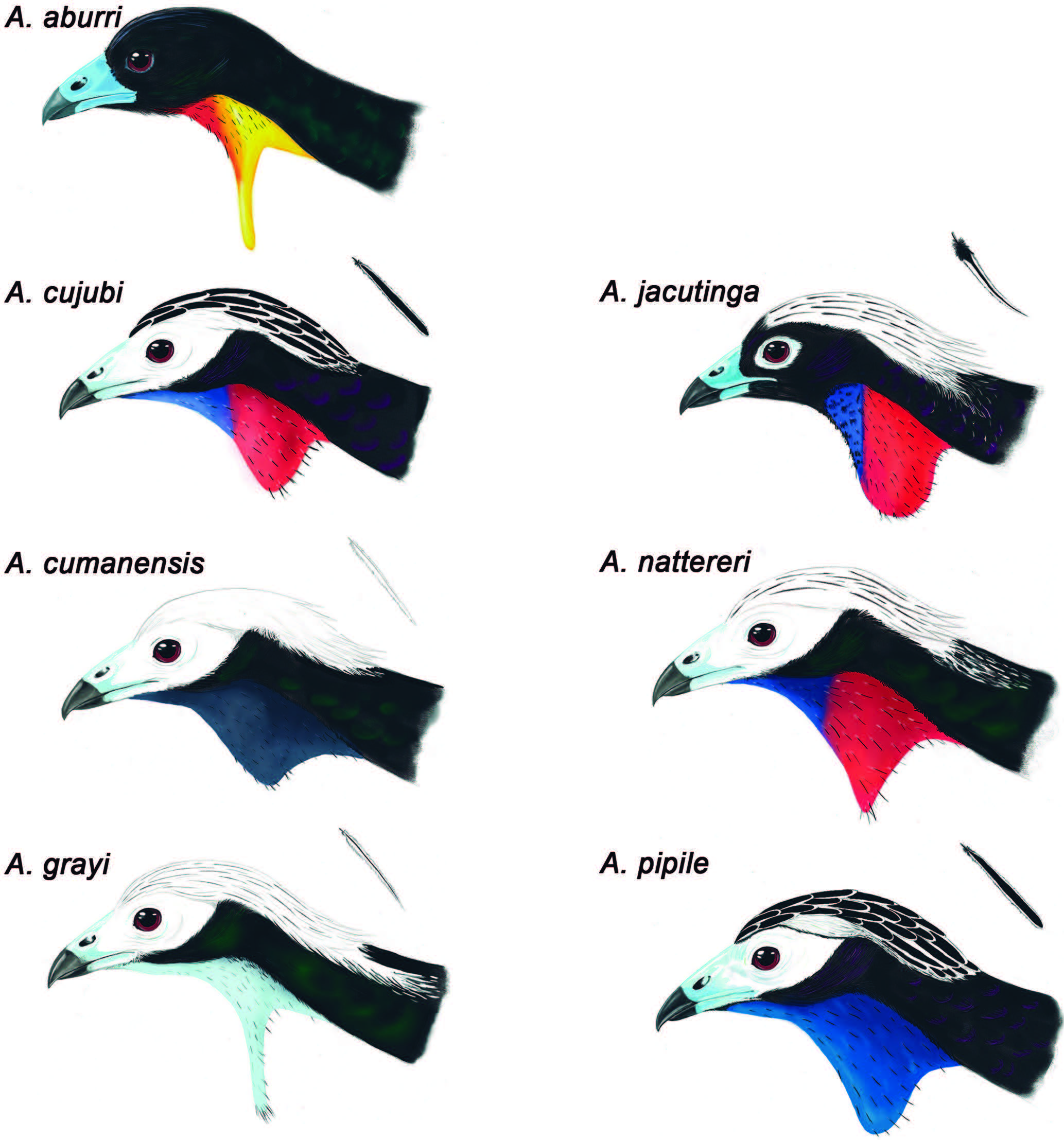
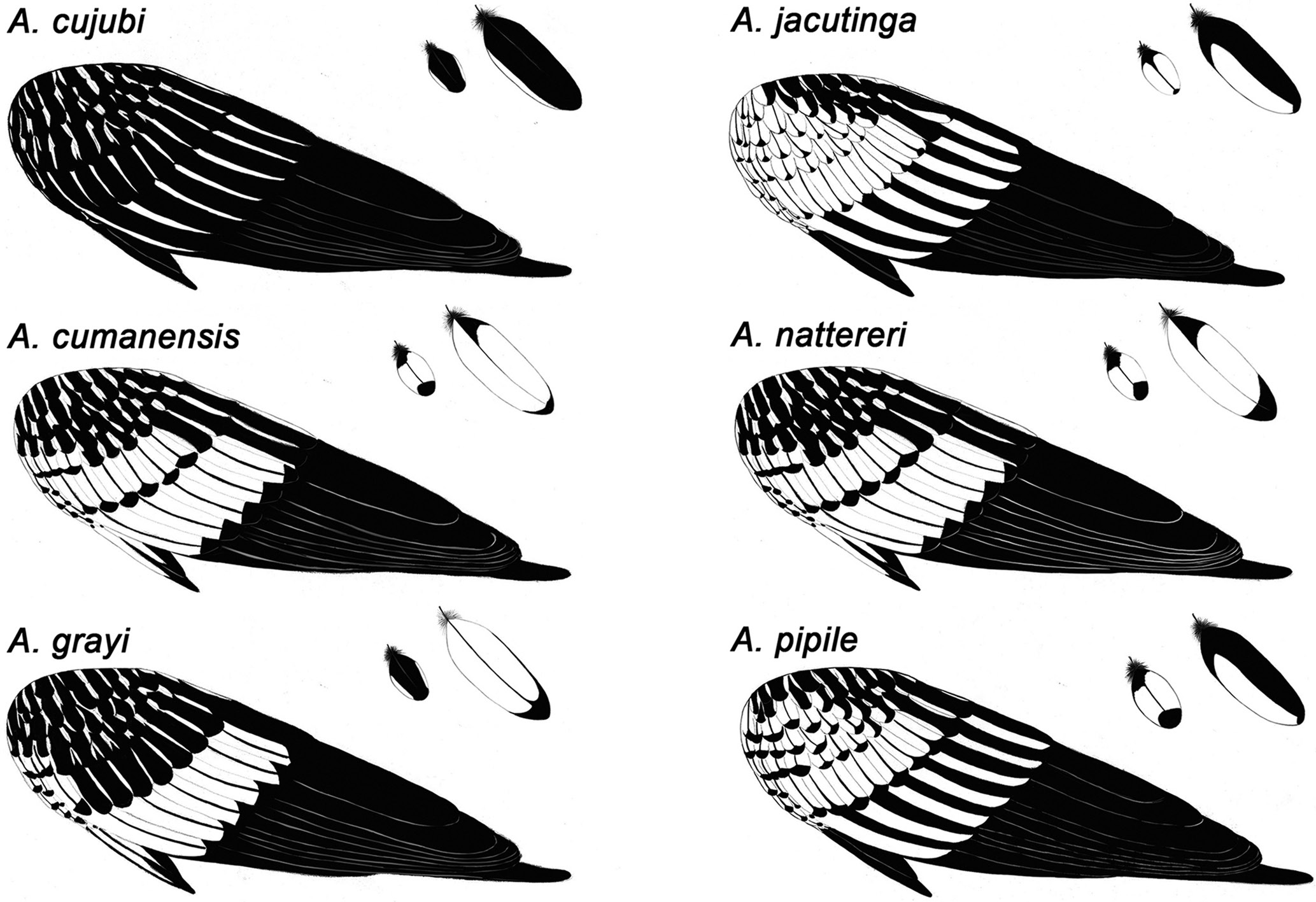
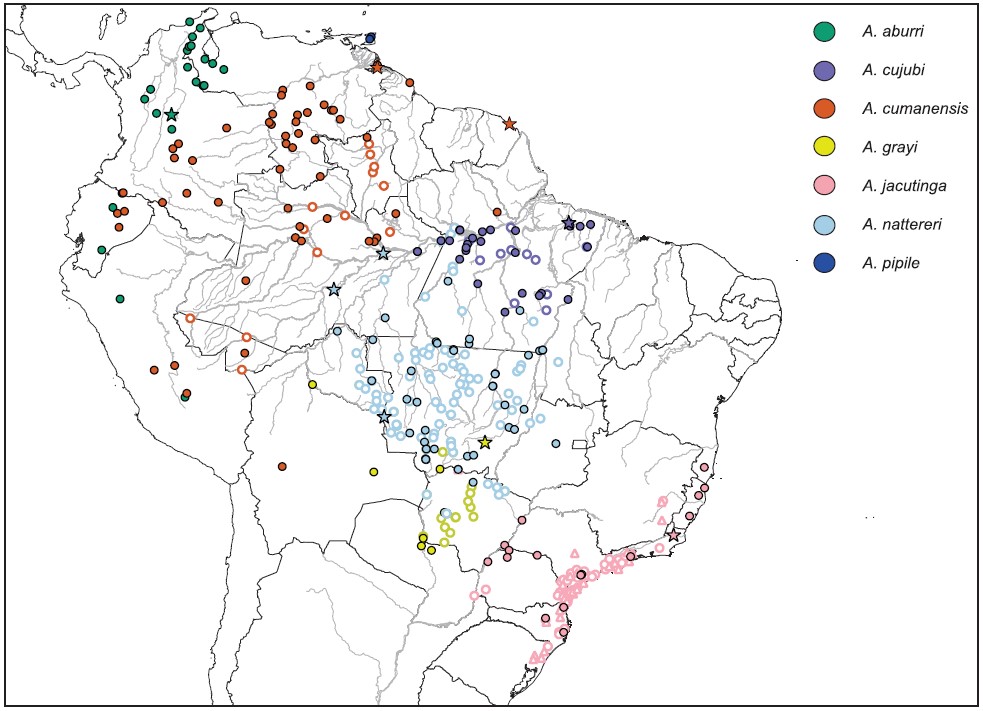
The seven species recognized here are: Aburria aburri (Lesson, 1828), Aburria cujubi (Pelzeln, 1858), Aburria cumanensis (Jacquin, 1784), Aburria grayi (Pelzeln, 1870), Aburria jacutinga (Spix, 1825), Aburria nattereri (Reichenbach, 1862), and Aburria pipile (Jacquin, 1784). The Systematics section further below provides a full taxonomic treatment of each taxon and a discussion of characters. Figures 1 and 2 present the diagnostic characters for each species, while Figure 3 shows the geographic distribution of each recognized taxon.
Morphologically, there is no definitive set of characters to justify a genus-level diagnosis of Aburria aburri in relation to Pipilespp. All character states observed in the former can be observed in groups of two or more species of Pipile. For instance, the thin dewlap is present in both A. aburri and P. grayi, while the blue cere can be seen in both A. aburri and P. jacutinga (Fig. 1). The only singular features of A. aburri are the absence of a distinct crest, the yellow color of the dewlap, and the overall black plumage. Those differences consist in a solid species-level diagnosis, but it is inadequate to distinguish an entirely separate genus. Still, the unique vocalization of A. aburri has been brought up as a possible reason for keeping it in a separate genus (del Hoyo & Collar, 2014, citing unpublished data), but no comparative analysis of the vocal repertoire was presented to justify this supposition.
Furthermore, an osteological study of the Cracidae (Silveira, 2003) concluded that osteological characters were not enough to distinguish species-level taxa, although it has proven useful at genus level. Due to their close similarity, Silveira (2003) suggested that Pipile should be considered a synonym of Aburria. The osteological analysis of Frank-Hoeflich et al. (2007) reached the same conclusion.
Grau et al. (2005) and Frank-Hoeflich et al. (2007) recovered Pipile as paraphyletic, pending the inclusion of Aburria. A similar result was obtained by Eo et al. (2009; although the position of P. jacutinga on the tree was uncertain), but it was not obtained by Chen et al. (2021), though the latter authors included only two species of Pipile. The exact relationship between the species should be reassessed in the future, by improving both specimen sampling and genetic coverage. Nevertheless, these studies agree on one front: there is little genetic distance between Aburria and Pipile (Grau et al., 2005; Chen et al., 2021). Such distance is similar to those observed in other galliform genera, such as Crax and Gallus, and smaller than in genera such as Coturnix and Polyplectron (Chen et al., 2021). Finally, the divergence time between Aburria aburri and Pipile jacutinga is estimated to be during the Early Pliocene (Pereira et al., 2002). This is, thus, a very young clade, which weakens the argument of keeping the
When all the above is considered together, the evidence makes a strong argument in favor of the synonymy of the two genera. Furthermore, as an added benefit, this decision avoids yet another monotypic genus, a type of taxon that adds very little value and information to a classification scheme if no significant differences can be observed.
Therefore, we follow Delacour & Amadon (1973, 2004), Grau et al. (2005), and Frank-Hoeflich et al. (2007), considering Pipile Bonaparte, 1856 synonymous with AburriaReichenbach, 1853. Consequently, all taxa classified in Pipile are transferred to Aburria: Aburria cujubi (Pelzeln, 1858), Aburria cumanensis (Jacquin, 1784), Aburria grayi (Pelzeln, 1870), Aburria jacutinga (Spix, 1825), Aburria nattereri (Reichenbach, 1862) (see below), and Aburria pipile (Jacquin, 1784).
Measurements of quantitate characters for all Aburria spp. Number of specimens analyzed, average value, minimum and maximum for males and females. The data for A. aburri and A. pipile was obtained from Vaurie (1967a, b).
Our analysis has shown seven well-circumscribed and diagnosable taxa within the genus, namely: Aburria aburri, A. cujubi, A. cumanensis, A. grayi, A. jacutinga, A. nattereri, and A. pipile. Our results align with almost all taxa described in the literature (the exception being the subspecies naumburgae; see below), including the decision of del Hoyo & Collar (2014) to elevate A. grayi to species level. The latter is easily diagnosable from the closely related A. cumanensis by its pendular light blue dewlap and white crest feathers with dark raquis, with a crest that extends to the sides of the neck (Fig. 1), in addition to differences in wing coverts (Fig. 2). These two species have little overlap of morphological characters. However, the dewlap, crest, and coverts might be challenging to observe in older museum specimens and some photographs, rendering the identification difficult in such cases. There is also no known overlap in their distribution (Fig. 3).
Notably, our results support the return of A. nattereri to the level of species based on the following morphological characters: a triangular dewlap, white crest feathers with varying amount of black, and a crest that extends to the sides of the neck (Fig. 1). There is a marked white panel on the wings formed by the coverts, which is a very useful diagnostic character for distinguishing this species from the closely related A. cujubi alongside the
Diagnostic features on the head of each species: crest, crest feathers (detail), face, and dewlap.
color of the coverts (Fig. 2). As for the pair A. cumanensis and A. grayi, diagnosis can be complicated by poor pres- ervation of some museum specimens and poor angle or lighting in photographs. This species has not always been identified as a separate taxon, and we believe this might be due to the wide array of morphological variation ob- served in it, particularly on the crest feathers, wing co- verts, and the overall iridescence of the black body feath- ers. Nevertheless, A. nattereri has a well-circumscribed geographic distribution, with only small stretches of sympatry with A. grayi and A. cujubi along the borders of its range (Fig. 3). The subspecies naumburgae cannot be distinguished from nominate nattereri. It was described from the extreme northwest of A. nattereri’s range (Todd, 1932; Fig. 3) and can be confidently diagnosed as be- longing to the latter.
Individuals with supposed intermediate character states (typically of crest and wing coloration) between some species pairs (A. nattereri and A. cujubi, A. nattereri and A. grayi, A. cumanensis and A. grayi, A. cumanensis and A. cujubi) have been reported in the literature and of- ten considered hybrids (e.g.,Hellmayr, 1908; Naumburg, 1930; Vaurie, 1967a, 1968; Delacour & Amadon, 2004; del Hoyo & Collar, 2014). Most of the supposed interme- diates or hybrids did not stand a closer investigation; using the unique diagnostic features delineated in this study, it was possible to assign them to a species confi- dently. A few specimens remained, however, that are dif-
ficult to classify and could either represent a morpholog- ical extreme or a hybrid. Nevertheless, apart from some observations of supposed mixed pairs and notes on hy- bridization in captivity (with Penelope spp.; del Hoyo et al., 2014), no genetic data exists to support hybrid- ization in most species’ pairs. Nevertheless, one pair of species seems to hybridize, A. cujubi and A. nattereri; the specimens supporting these claims are discussed in the entry of A. nattereri in the Systematics section.
Another aspect that often confounds species distri- butions using photographic evidence is that people tend to notice and photograph outliers and “rare” animals more frequently for such online platforms (Rosa et al., 2022). Thus, some records might represent birds with un- usual morphology (as mentioned above) or even occa- sional vagrants. Therefore, photographic records close to the boundaries of species’ distributions must be tak- en with extra care.
In summary, the seven taxa studied here can be con- sidered as distinct species. They present a consistent set of morphological diagnostic features that allow pre- cise identification; they are distributed geographically in distinct regions, with very little overlap in their rang- es (Fig. 3); there are a handful of records of mixed pairs, but with poor evidence of continuing hybridization. Thus, there is good evidence to fulfill the requirements of different species concepts: phylogenetic (diagnosabil- ity) and biological/evolutionary/genetic (isolation and
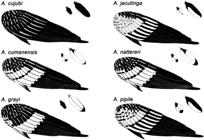
Diagnostic features on the wings of each species: wing panel, lesser and median coverts (detail, left), and greater coverts (detail, right).
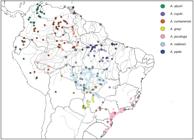
Geographic distribution of Aburria spp. Closed circles = museum specimens; open circles = photographic records (from citizen science sites); triangles = new observational records (by LFS); stars = type localities, including those of synonymized taxa (see Systematics section and the final table of Appendix 2).
little to no hybridization) (Cracraft, 1997; Ghiselin, 1997; Wheeler & Platnick, 2000; Baker & Bradley, 2006; Zachos, 2016).
Systematics
Order Galliformes
Family Cracidae
Genus Aburria Reichenbach, 1853
AburriaReichenbach, 1853: 26.
PipileBonaparte, 1856: 877.
OpetioptilaSundevall, 1873: 118 [new name for AburriaReichenbach, 1853 on unclear reason].
CumanaCoues, 1900: 65 [new name for Pipile Bonaparte, 1856 due to perceived preoccupation by Pipilo Vieillot, 1816 (Passeriformes)].
Type species: Aburria carunculata “Temminck” Reichenbach, 1853 [=Penelope aburri Lesson, 1828], by original designation.
Included species: Aburria aburri (Lesson, 1828), Aburria cujubi (Pelzeln, 1858), Aburria cumanensis (Jacquin, 1784), Aburria grayi (Pelzeln, 1870), Aburria jacutinga (Spix, 1825), Aburria nattereri (Reichenbach, 1862), Aburria pipile (Jacquin, 1784).
Diagnosis: Members of this genus can be distinguished from other cracids (and in particular from the closely related genus Penelope) by their developed dewlap, colored (bluish) cere, tail feathers lacking markings, and short tarsometatarsi.
Aburria aburri (Lesson, 1828) (Figs. 1 , 2 )
Penelope aburri Lesson, 1828: 215; Gray, 1844: unpaginated.
Penelope (Penelope) aburri:Lesson, 1831: 482.
Aburria carunculataReichenbach, 1853: 26; Reichenbach, 1862: 141; Sclater & Salvin, 1870: 530.
Aburria aburri:Ogilvie-Grant, 1897: 254; Peters, 1934: 23; Hellmayr & Conover, 1942: 195; Vaurie, 1967b: 1; Vaurie, 1968: 247; Delacour & Amadon, 1973: 156, fig. 31, pl. 16; del Hoyo, 1994: 354, pl. 32, fig. 32; Pereira et al., 2002: table 1; Delacour & Amadon, 2004: 145, fig. 29, pls. 3, 21; Grau et al., 2005: 642; Frank-Hoeflich et al., 2007: 252; del Hoyo & Collar, 2014: 72, fig. 24; Aguilar & Aguilar, 2012: 54, figs. 1-2; Chen et al., 2021: fig. 1.
Type material: Uncertain.
Type locality: Mountains of New Granada, restricted to Muzo in Boyacá Province, Colombia, by Vaurie (1968).
Analyzed material: n = 27 (see Appendix 1 for details).
Diagnosis: Body and head covered by entirely black feathers with greenish iridescent hue. Cere blue. Crest absent. Dewlap is narrow and pendular, bright yellow with a reddish base. Legs yellow.
Geographic distribution: Colombia, western Venezuela, eastern Ecuador, Peru. From 450 m to 3,000 m altitude.
Remarks: This is the most easily recognizable species in the genus due to its completely back plumage and yellow dewlap. The feathers on the top of the head of A. aburri are short and do not constitute a proper crest, in sharp contrast to the other species, which are all crested. The legs are yellow, which is also in contrast to all other species, which have reddish legs.
It has been alluded that this species could contain unrecognized subspecies based on differences in size (larger individuals in Venezuela and Colombia) and on the iridescence of the feathers (greenish hue in Venezuela and Colombia, bluish in Ecuador and Peru; e.g.,Chubb, 1919; Chapman, 1926; Hellmayr & Conover, 1942; Vaurie, 1967b, 1968; Delacour & Amadon, 2004). However, the size differences do not seem to hold, and the different shades of bluish hue vary widely from southern Colombia to Ecuador and Peru (Vaurie, 1967b). Our analysis agrees with Vaurie (1967b, 1968) in that no subspecies-level taxa can be recognized within A. aburri.
This species is distributed along the eastern Andes, from northwestern Venezuela (Cerro del Cedro, specimen COP 9089) to southern Peru (near Cuzco, specimen USNM 273024). Altitudinally, it can occur higher than previously reported (e.g.,del Hoyo, 1994), up to 3,000 m in Colombia (specimen USNM 368532). It can occur in areas close to the distribution of A. cumanensis in Colombia, Ecuador, and Peru. These species occupy different altitudinal ranges and niches (cf.Delacour & Amadon, 2004); no hybrid morphology specimens have been encountered so far.
Aburria cujubi (Pelzeln, 1858) (Figs. 1 , 2 )
Penelope cujubiPelzeln, 1858: 328; Pelzeln, 1870: 284.
Pipile cujubi:Reichenbach, 1862: 153.
Pipile cujubi:Sclater & Salvin, 1870: 530; Ogilvie-Grant, 1897: 253; Salvadori, 1914: 55; Snethlage, 1914: 58; Hellmayr & Conover, 1942: 189.
Cumana cujubi:Coues, 1900: 65; Ihering & Ihering, 1907: 17.
Pipile pipile cujubi:Peters, 1934: 22.
Pipile cujubi cujubi:Vaurie, 1967a: 4, fig. 2; Vaurie, 1968: 247, fig. 20; del Hoyo, 1994: 354, pl. 32, fig. 30; Delacour & Amadon, 2004: pls. 3, 20; del Hoyo & Collar, 2014: 72, fig. 22.
Aburria pipile cujubi:Delacour & Amadon, 1973: 148, pl. 3; Delacour & Amadon, 2004: 141.
Aburria cujubi:Grau et al., 2005: 642; Frank-Hoeflich et al., 2007: 252.
Aburria cujubi cujubi:Pacheco et al., 2021: suppl.
Type material: NMW 22309 (holotype).
Type locality: Brazil, Pará state; restricted to the city of Belém (Pinto, 1964; Vaurie, 1967a).
Analyzed material: n = 43 (see Appendix 1 for details).
Diagnosis: Crest feathers with rounded tips, black with white borders. Dewlap round, anterior portion blue, posterior portion red, sparsely covered by black feather shafts. Lesser, median, and greater coverts with white borders. Black alula. Body plumage black, purplish iridescent. Ventral feathers streaked white.
Geographic distribution: Brazil, in easternmost Amazonas state and Pará state (south of the Amazon River).
Remarks: This species is most similar to P. nattereri, from which it can be distinguished by its darker crest and wing, lack of crest feathers extending to the side of the neck, and the purplish hue of its body plumage. It can be distinguished from A. cumanensis by its blue and red dewlap, darker crest and wing, and purplish iridescence. The amount of back on the crest feathers and amount of white on the wing coverts of A. cujubi display some variation, even between individuals from the same locality. It is presently unknown whether this is solely intraspecific morphological variation or if it is related to the age of the individual.
The geographic distribution of this species reported in the literature is ambiguous in some cases (e.g.,Hellmayr & Conover, 1942; del Hoyo, 1994; Delacour & Amadon, 2004), due to the difficulty and confusion of diagnosing A. cujubi from A. nattereri. Aburria cujubi is restricted to the western Amazonas state and Pará state in Brazil, always south of the Amazon River (Fig. 3). In some areas, its distribution borders that of A. cumanensis, which is restricted to the north of the Amazon River. It has some overlap with A. nattereri and a few specimens suggesting hybridization were found, being discussed below in the entry for A. nattereri.
Aburria cumanensis ( Jacquin, 1784 ) (Figs. 1 , 2 )
I’Yacou: Bajon, 1777: 398, pl. 5.
Crax (cumanensis) Jacquin, 1784: 25, pl. 10.
Penelope leucolophosMerrem, 1786: 43, pl. 12.
Penelope cumanensis:Gmelin, 1789: 734; Wagler, 1830: 1109; Gray, 1844: unpaginated; Pelzeln, 1858: 330.
Pipile cumanensis:Bonaparte, 1856: 877; Reichenbach, 1862: 154.
Pipile leucolophos Bonaparte, 1856: 877; Reichenbach, 1862: 152.
Pipile JacouReichenbach, 1862: p. 154, pl. 271c, fig. 5056.
Pipile cumanensis:Sclater & Salvin, 1870: 529; Ogilvie-Grant, 1897: 250; Salvadori, 1914: 50; Snethlage, 1914: 57; Delacour & Amadon, 2004: pl. 17; del Hoyo & Collar, 2014: 72, fig. 20; Chen et al., 2021: fig. 1.
Cumana cumanensis:Coues, 1900: 65; Ihering & Ihering, 1907: 16.
Pipile cumanensis cumanensis:Hellmayr, 1908: 97; Peters, 1934: 23; Hellmayr & Conover, 1942: 191; del Hoyo, 1994: 354, pl. 32, fig. 29; Delacour & Amadon, 2004: pls. 3, 20.
Pipile pipile cumanensis:Vaurie, 1967a: 4, fig. 2; Vaurie, 1968: 246, fig. 20.
Aburria pipile cumanensis:Delacour & Amadon, 1973: 148, pls. 3, 15; Delacour & Amadon, 2004: 141.
Aburria cumanensis:Grau et al., 2005: 642; Frank-Hoeflich et al., 2007: 252.
Aburria cumanensis cumanensis:Pacheco et al., 2021: suppl.
Type material: Unknown.
Type locality: Venezuela, Orinoco River, near Cumana. Vaurie (1967a) argued that this type locality is probably mistaken, based on a captive bird from the Imperial Menagerie in Vienna. The delta of the Orinoco was suggested as the correct type locality by Phelps & Phelps (1958).
Analyzed material: n = 82 (see Appendix 1 for details).
Diagnosis: Crest feathers lanceolate, white to dirty white; raquis light yellowish brown to light brown. Dewlap triangular, purplish blue, sparsely covered by black feather shafts. Most lesser coverts with white borders (more pronounced on anterior feathers). Six to ten median coverts are white with black tips. Greater coverts white with black tips. Body plumage black, greenish iridescent. Ventral feathers streaked white.
Geographic distribution: Central and southern Venezuela (along Orinoco River), Guyana, Suriname, French Guiana, northern Brazil (Amapá, Roraima, Acre, northern Pará, northern Amazonas), Colombia, Ecuador, central and southeastern Peru.
Remarks: This species is similar to A. grayi, from which it can be distinguished by a whiter and shorter crest (it does not extend to the sides of the neck), a purplish-blue dewlap, and the whitish wing coverts and wing panel (Fig. 2). The crest feathers are considerably variable in A. cumanensis, and the rachis can have a corneous or sometimes brownish color. Nevertheless, the overall white or “dirty white” crest is still useful in diagnosing this species. Many authors have also considered the iridescent green hue of the black body plumage of A. cumanensis a diagnostic character (e.g.,Sclater & Salvin, 1870; Hellmayr, 1908; Naumburg, 1930), but this character is sometimes not observable.
Aburria cumanensis is also reminiscent of A. pipile due to the blue color of the dewlap, although it is purplish-blue in the former and cobalt blue in the latter (Fig. 1). The latter can also be distinguished by its blacker crest and its body plumage bearing a purplish iridescent hue.
This species has a wide distribution in northern and western South America, coming in close contact with A. aburri in some parts of the Andes (Fig. 3). In Brazil, A. cumanensis is restricted to northern (north of the Amazon River) and western Amazon, while A. cujubi occurs in the eastern Amazon and A. nattereri in the southern Amazon (both latter species are restricted to the south of the Amazon River) (Fig. 3). The species might come in close contact in some regions (Fig. 3), but there is no overlap in distribution. Finally, the purported overlap in the distribution of A. cumanensis with A. grayi reported in the literature is mistaken (see entry of A. grayi below).
Aburria grayi ( Pelzeln, 1870 ) (Figs. 1 , 2 )
Penelope (Pipile) JacquiniiGray, 1867: 8.
Penelope GrayiPelzeln, 1870: 284 [new name for Penelope jacquinii Gray, 1867, which was pre-occupied by Pipile jacquiniReichenbach, 1862 (=Pipile pipileJacquin, 1784)].
Pipile cumanensis grayi:Hellmayr, 1908: 98; Peters, 1934: 23; del Hoyo, 1994: 354, pl. 32, fig. 29; Delacour & Amadon, 2004: pls. 3, 20.
Pipile grayi:Salvadori, 1914: 52; del Hoyo & Collar, 2014: 72, fig. 21.
Pipile pipile grayi:Vaurie, 1967a: 4, fig. 2; Vaurie, 1968: 247, fig. 20.
Aburria pipile grayi:Delacour & Amadon, 1973: 148, pl. 3; Delacour & Amadon, 2004: 141.
Aburria cumanensis grayi:Pacheco et al., 2021: suppl.
Type material: NHMUK 1858.6.25.11 (holotype).
Type locality: Peru (Gray, 1867), emended to Paraguay by Laubmann (1939). As the holotype’s origin was not known, Vaurie (1967a) suggested the origin of Pelzeln’s specimens (Pelzeln, 1870) as an emended type locality: Sangrador, in Mato Grosso state, Brazil (referring to what is known today as Rio Sangradouro Grande).
Analyzed material: n = 30 (see Appendix 1 for details).
Diagnosis: Crest feathers thin, pure white with black rachis. Dewlap thin, pendular, cerulean, sparsely covered by black feather shafts. White feathers on the side of the crest towards the neck. Lesser coverts with white borders, occasionally entirely black. Four to five median coverts are white with black tips. Greater coverts white. Alula with white band on the external vane. Body plumage black, greenish to bluish iridescent. Ventral feathers streaked white.
Geographic distribution: Bolivia, western Brazil (Rondônia, Mato Grosso, and Mato Grosso do Sul states), Paraguay (Concepción department).
Remarks: This species is most similar to A. cumanensis, which has been widely regarded as conspecific until rather recently (del Hoyo & Collar, 2014). Our analysis supports its status as a distinct species, diagnosed by its pendular grayish blue dewlap, white crest feathers with black shaft, crest extending to the sides of the neck, and mostly black lesser and median wing coverts (Fig. 2). The white crest feathers extending to the side of the neck (Fig. 1) are a remarkably good diagnostic feature, and one that has been pointed out by only a few authors (Pelzeln, 1858; Sclater & Salvin, 1870; del Hoyo & Collar, 2014).
The distribution of A. grayi is considered to overlap with that of A. cumanensis in southeastern Peru and northern Bolivia (Vaurie, 1967a, 1968; del Hoyo & Collar, 2014), but this overlap was not observed in the available specimens and photographs studied here. All SE Peruvian specimens (Appendix 1) previously assigned to A. grayi were misidentified and belong instead to A. cumanensis. All Bolivian specimens, on the other hand, belong to A. grayi. The distributions of the two species, therefore, do not seem to overlap (Fig. 3), and no intermediate specimens (or potential hybrids) were observed.
Aburria grayi, however, meets A. nattereri in a narrow area in midwestern Brazil stretching from Rondônia to Mato Grosso do Sul state (Fig. 3). Some hybrid specimens between A. grayi and A. nattereri have been mentioned in the literature (e.g.,Hellmayr, 1908; Vaurie, 1968; Delacour & Amadon, 2004) and several photographs taken at Poconé, Mato Grosso (e.g., WA1916807, WA5606786, WA5559901, WA4603235), including mixed pairs (e.g., WA5655937, WA5124959) confirm the presence of this hybrid zone. However, whether these F1 hybrids can reproduce beyond F2 generations is unclear. Poconé is a well-known collecting locality, and hybrids were not observed in older museum specimens. Human-landscape modifications through time may provide the conditions for the recent contact of both species at this site, and this hybrid zone needs further research and monitoring.
Finally, it has been argued that in the past, the range of A. grayi had some overlap with A. jacutinga in Concepción and Amambay departments in Paraguay, with no interbreeding (Vaurie, 1967a; del Hoyo & Collar, 2014), but that could not be confirmed with the available specimens and photographs.
Aburria jacutinga ( Spix, 1825 ) (Figs. 1 , 2 )
Penelope leucopteraWied, 1820: 260 [nomen nudum].
Penelope JacutingaSpix, 1825: 53, pl. 70; Pelzeln, 1870: 283.
Penelope nigrifrons (“Temminck”) Lesson, 1831: 482.
Penelope leucopteraWied, 1833: 544.
Pipile leucolophos:Reichenbach, 1862: 152 [non Merrem].
Pipile nigrifrons:Reichenbach, 1862: 154.
Pipile jacutinga:Sclater & Salvin, 1870: 530; Ogilvie-Grant, 1897: 251; Hellmayr, 1906: 689; Salvadori, 1914: 53; Peters, 1934: 23; Hellmayr & Conover, 1942: 190; Vaurie, 1967a: 5, fig. 2; Vaurie, 1968: 247, fig. 20; del Hoyo, 1994: 354, pl. 32, fig. 31; Pereira et al., 2002: table 1; Delacour & Amadon, 2004: pls. 3, 19, 20, 45; del Hoyo & Collar, 2014: 72, fig. 23; Chen et al., 2021: fig. 1.
Cumana jacutinga:Coues, 1900: 65.
Cumana jacutinga:Ihering & Ihering, 1907: 17.
Aburria jacutinga:Delacour & Amadon, 1973: 150, fig. 30, pl. 3; Delacour & Amadon, 2004: 143, fig. 28; Grau et al., 2005: 642; Frank-Hoeflich et al., 2007: 252; Pacheco et al., 2021: suppl.
Type material: ZSM-ORN00000195 (holotype).
Type locality: Brazil, between Bahia and Rio de Janeiro states.
Analyzed material: n = 23 (see Appendix 1 for details).
Diagnosis: Almost no bare skin on the head; featherless eye ring whitish blue. Crest feathers lanceolate to rounded, white with black base gradually becoming white towards the tip, black rachis. Dewlap rounded, anterior portion blue, posterior bright red; covered by black feathers on the base. Lesser coverts and 15 to 20 median coverts white with black tips. Greater coverts with white external vane. Body plumage black, purplish iridescent. A large number of ventral feathers streaked white.
Geographic distribution: Eastern to southernmost Brazil (from Bahia to Rio Grande do Sul states), southeastern Paraguay, and northeastern Argentina (Misiones province).
Remarks: This species is easily diagnosable by its black face with white eye ring and the stark blue cere. Previous mentions of sexual dimorphism in plumage (crest feathers size and dorsal feather colors; Wied, 1833) were not substantiated by our analysis. Aburria jacutinga is the largest bird in the genus in overall body size, together with A. pipile (Table 1; cf.Vaurie, 1968).
Due to the color of the dewlap, A. jacutinga might seem similar in appearance to A. cujubi and A. nattereri, although its black face with white eye-ring is unmistakable (Fig. 1). The white wing panel of A. jacutinga and the purplish iridescent hue of its body feathers are similar to what is observed in A. pipile (Fig. 2).
A few variable characters could be observed in A. jacutinga. The amount of black in the crest feathers is variable among individuals, as well as the shape of those feathers, which are usually lanceolate but can also have a more rounded tip. The number of white “streaks” observed on the side of the neck (extending from the crest) and on the ventral region of the animal is also variable. Even though the latter character is not diagnostic, overall, A. jacutinga seems to display more white streaks on the ventral region.
In the phylogenetic analysis of Grau et al. (2005), A. jacutinga was recovered as the sister taxon to a clade formed by all other Aburriaspp. In the following node, A. aburri branched out (Grau et al., 2005). Thus, it is possible that some features shared by these species (face covered by black feathers and the blue cere) are ancestral character states in the genus. Nevertheless, a new phylogenetic study containing all species and additional genetic markers is necessary to test such hypotheses.
Aburria jacutinga is distributed from southern Bahia state to southern Brazil and west to southeastern Paraguay and Misiones province in Argentina (Fig. 3). Even though it is distributed over a wide geographic area, it is rarely found outside protected areas such as national parks and other nature reserves (Brooks, 2006; Silveira et al., 2008).
In the past, it was considered that the range of A. jacutinga had some overlap with that of A. grayi in Concepción and Amambay departments in Paraguay, without interbreeding (Vaurie, 1967a; del Hoyo & Collar, 2014). We could not confirm that assertion based on the specimens and photographs available. In any event, A. jacutinga is presently not known from those departments (del Hoyo & Collar, 2014).
Aburria nattereri ( Reichenbach, 1862 ) (Figs. 1 , 2 )
Penelope cumanensis: Pelzeln, 1858: 330 [in part, nonJacquin, 1784].
Pipile NattereriReichenbach, 1862: 154, pl. 271c, fig. 5060.
Penelope Nattereri:Pelzeln, 1870: 283.
Cumana nattereri:Ihering & Ihering, 1907: 17.
Pipile cumanensis nattereri:Hellmayr, 1908: 96; Naumburg, 1930: 64; Peters, 1934: 23; Hellmayr & Conover, 1942: 193.
Pipile nattereri:Salvadori, 1914: 51.
Pipile cumanensis naumburgaeTodd, 1932: 213; Peters, 1934: 23.
Pipile cujubi nattereri:Vaurie, 1967a: 4, fig. 2; Vaurie, 1968: 247, fig. 20; del Hoyo, 1994: 354, pl. 32, fig. 30; Delacour & Amadon, 2004: pls. 3, 20; del Hoyo & Collar, 2014: 72, fig. 22.
Aburria pipile nattereri:Delacour & Amadon, 1973: 148, pl. 3; Delacour & Amadon, 2004: 141.
Aburria cujubi nattereri:Pacheco et al., 2021: suppl.
Type material: NMW 22285 and 22286 (syntypes).
Type locality: The type locality of this species is often considered to be Rio das Flexas in Mato Grosso state, Brazil. However, that assumption is erroneous. As explained by Schifter et al. (2007), Reichenbach’s (1862) description was based on Pelzeln (1858), who only had the two specimens listed above for his study (identified by him as A. cumanensis). Hence, those specimens are syntypes, and the correct type localities are: Ilha do Carvalho on Rio Guaporé (Mato Grosso state) and Lago de Manaqueri on Rio Solimões (Amazonas state). Pelzeln (1858) also lists the following other localities (rivers) for A. cumanensis (including what would later be described as A. nattereri): Rio das Flexas, Rio Madeira, Rio Negro, and Rio Branco. However, the type localities of A. nattereri should remain only Ilha do Carvalho and Lago de Manaqueri.
While the latter is a rather precise locality, the former (Ilha do Carvalho) was largely uncertain, even to Vanzolini (1993), who researched the itineraries of Johann Natterer in Brazil. However, Da Fonseca (1880) reported that Ilha do Carvalho is around 4 km in length, located where the Rio Verde joins the Rio Guaporé to the north of the Vila Bela municipality. Da Fonseca (1880) also provided a map with the locality noted. With the kind help of André C. De Luca, we could pinpoint the locality on Google Earth at the coordinates 13°59′49.9″S, 60°23′41.6″W, close to the border with Bolivia (De Luca, pers. comm., 2023).
Analyzed material: n = 76 (see Appendix 1 for details).
Diagnosis: Crest feathers lanceolate to round, white to yellowish white, with varying amounts of black; rachis black to light yellowish brown. Dewlap’s anterior portion is blue, and the posterior portion is bright red, sparsely covered by black feather shafts. Lesser coverts with white borders. Six to seven median coverts are white with center and tip black. External vane of the alula with a white band. Body plumage is black, greenish to bluish iridescent; variation in the same individual is possible. Ventral feathers streaked white.
Geographic distribution: Brazil, in the states of Amazonas (south of the Amazon River), Rondônia, Pará, Mato Grosso, Tocantins, Goiás, and northern Mato Grosso do Sul.
Remarks: This taxon is herein elevated from a subspecies of A. cujubi to a full species based on a consistent set of diagnostic features and a geographic distribution restricted to southern Amazon and the Cerrado. The subspecies naumburgae described by Todd (1932) is its synonym.
Throughout the taxonomic history of the genus, many authors have proposed that nattereri represented a distinct entity (e.g.,Reichenbach, 1862; Hellmayr, 1908; Naumburg, 1930; Hellmayr & Conover, 1942; Delacour & Amadon, 2004), although it has proven difficult to diagnose it. According to our analysis, that confusion might be due to the intrinsic variability seen in some plumage characters. The crest feathers vary from lanceolate to round, white to yellowish white with varying amounts of black, with a rachis that can vary from black to light yellowish brown; sometimes, this variation may be present in a single individual. The crest can extend to varying degrees to the sides of the neck (a feature also observed in A. grayi and A. jacutinga). The body plumage can have a greenish to bluish iridescence, and this can also vary in the same individual.
Even though the nattereri taxon was for quite a while considered a subspecies of A. cumanensis, it is simple to diagnose both based on the shape and color of the dewlap in A. nattereri (Fig. 1), as well as by the body plumage having a mixture of green and blue iridescence. Later, A. nattereri was considered a subspecies of A. cujubi (e.g.,Vaurie, 1967a, 1968; del Hoyo, 1994; del Hoyo & Collar, 2014), with which it shares a closer morphological similarity as well as an overlapping distribution. Overall, A. nattereri can be diagnosed from A. cujubi by its whiter crest feathers (Fig. 1) and the presence of a white panel on the wings resulting from a larger amount of white on its coverts, most notably the median and greater coverts (Fig. 2).
The geographic distribution of A. nattereri is much larger than previously recognized in the literature (e.g.,del Hoyo, 1994; Delacour & Amadon, 2004); it inhabits a large area in central and northern Brazil (Fig. 3). It has a narrow overlap zone with A. grayi to the east, and it occurs in sympatry with A. cujubi over a wide area (Fig. 3). It does not have an overlap with A. jacutinga (contraVaurie, 1968).
Naumburg (1930) mentioned birds with intermediate features between A. nattereri and A. grayi (notably near the Roosevelt River), but the present study does not support that: all specimens from that area could be easily diagnosed as A. nattereri. Further specimens from the overlap area can be diagnosed as either one or the other species, and no real intermediate (or potential hybrid) between A. nattereri and A. grayi could be found.
However, a few potential hybrid specimens of A. nattereri and A. cujubi were found. In eastern Amazonas state, all specimens from Lago Batista area display intermediate states for crest characters (feather shape and color) and wing panel (color of coverts and alular feathers). Specimens MNRJ 20572 and 20616, and MZUSP 22031 and 22053, are intermediate in all characters, while specimens MNRJ 20546 and 20547 are intermediate only in crest characters (wing characters are typical of one or the other species). Further potential hybrid specimens showed intermediate crest and wing character states in Pará state (rivers Jamauchim and Iriri; MPEG 6558 and 10604, respectively).
Aburria pipile ( Jacquin, 1784 ) (Figs. 1 , 2 )
Crax (Pipile) Jacquin, 1784: 26, pl. 11.
Penelope Pipile:Gmelin, 1789: 734; Pelzeln, 1858: 329.
Penelope (Penelope) pipile:Lesson, 1831: 482.
Penelope pipile:Wagler, 1830: 1109; Gray, 1844: unpaginated, pl. unnumbered, fig. 2.
“Penelope” pipile:Reichenbach, 1853: 26.
Pipile JacquiniReichenbach, 1862: 154 [new name for Crax pipile Jacquin, 1784].
Pipile pipile:Salvadori, 1914: 56; Hellmayr & Conover, 1942: 188; del Hoyo, 1994: 354, pl. 32, fig. 28; Delacour & Amadon, 2004: pls. 3, 18, 20; del Hoyo & Collar, 2014: 72, fig. 19.
Cumana pipile:Coues, 1900: 65.
Pipile pipile pipile:Peters, 1934: 22; Vaurie, 1967a: 3, fig. 2; Vaurie, 1968: 246, fig. 20.
Aburria pipile pipile:Delacour & Amadon, 1973: 148, pl. 3; Delacour & Amadon, 2004: 141.
Aburria pipile:Grau et al., 2005: 642; Frank-Hoeflich et al., 2007: 252.
Type material: Unknown.
Type locality: Venezuela, Orinoco River, near Cumana. Vaurie (1967a) argued that this type locality is probably mistaken, based on a captive bird from the Imperial Menagerie in Vienna, and suggested Trinidad as type locality, considering that the species is restricted to that island.
Analyzed material: n = 3 (see Appendix 1 for details).
Diagnosis: Crest feathers rounded, black with white borders. Dewlap round, cobalt blue, sparsely covered by black feather shafts. 15 to 20 lesser and median coverts on average are white with black tips. Greater coverts white with black tip. Alula black. Body plumage black, purplish iridescent. Ventral feathers streaked white.
Geographic distribution: Trinidad.
Remarks: This species is endemic to Trinidad and is easily diagnosable from the others by the cobalt blue dewlap (Fig. 1) and the purplish iridescent hue of its body plumage. Aburria pipile has sometimes been considered a congener of or even synonymous with A. cujubi and A. cumanensis (e.g.,Sclater & Salvin, 1870). With the former, A. pipile shares the rounded and mostly black crest feathers, and with the latter it shares a blue dewlap (though it is cobalt blue in A. pipile and purplish blue in A. cumanensis).
On the other hand, Hellmayr & Conover (1942) considered A. pipile closer to A. jacutinga rather than to A. cujubi or A. cumanensis. Indeed, the wing panel and wing coverts of A. pipile are very similar to that of A. jacutinga (Fig. 2), and so is the purplish hue of the body plumage. However, the phylogenetic study of Grau et al. (2005) suggests that A. pipile is the sister taxa of A. cumanensis, with A. cujubi being the sister to both. Aburria jacutinga is the sister to all other Aburriaspp. (Grau et al., 2005).
Due to its restricted geographic distribution in the forests of Trinidad (Fig. 3), this species is critically endangered, the only species in the genus to have such status (Brooks, 2006).
CONCLUSION
PipileBonaparte, 1856 is considered a junior synonym of AburriaReichenbach, 1853, which includes seven species:
Aburria aburri (Lesson, 1828);
Aburria cujubi (Pelzeln, 1858);
Aburria cumanensis (Jacquin, 1784);
Aburria grayi (Pelzeln, 1870);
Aburria jacutinga (Spix, 1825);
Aburria nattereri (Reichenbach, 1862);
Aburria pipile (Jacquin, 1784).
Acknowledgments:
We are very grateful to all museum staff who facilitated visits to the collections and/or provided information and photographs of specimens. We are also grateful to André C. De Luca for helping locate Ilha do Carvalho. We thank Murilo Sharp (Agropecuária Morro Branco), Wilson Lemos de Morais Neto (Fazenda Fartura), and the staff of the following protected areas: Intervales and Carlos Botelho State Parks, Itatiaia, Serra das Lontras, Iguaçu, and Pantanal National Parks; Fazenda Descalvados; Boraceia Biological Station; and Serra Bonita Reserve. We dedicate this paper to Moacyr de Carvalho Dias (Xixo, deceased), Pedro Mario Nardelli (deceased), and to Roberto Motta de Avelar Azeredo, the most prominent bird breeders in Brazil, who contributed significantly to advancing knowledge of Cracids in Brazil, and with whom we had the privilege of discussing several aspects of the taxonomy and distribution of Aburria.
Data Availability:
All the data presented in this article.
REFERENCES
- Aguilar, H.F. & Aguilar, R.F.H. 2012. Redescripción del gualí, Aburria aburri (Lesson, 1828) (Craciformes: Cracidae), con notas sobre el nido y el huevo. Revista de Ecología Latinoamericana, 17: 53-61.
-
Bajon, B. 1777. Memoires pour servir a l’histoire de Cayenne et de la Guiane Françoise, dans lesquels on fait connoître la nature du climat de cette contrée, les maladies qui attaquent les Européens nouvellement arrivés, & celles qui régnent sur les blancs & les noirs; des observations sur l’histoire naturelle du pays, & sur la culture des terres . Vol.1. Paris, Grangé. 469p. https://doi.org/10.5962/bhl.title.156462.
» https://doi.org/10.5962/bhl.title.156462 -
Baker, R.J. & Bradley, R.D. 2006. Speciation in mammals and the genetic species concept. Journal of Mammalogy, 87(4): 643-662. https://doi.org/10.1644/06-MAMM-F-038R2.1.
» https://doi.org/10.1644/06-MAMM-F-038R2.1 -
Baldwin, S.P.; Oberholser, H.C. & Worley, L.G. 1931. Measurements of birds Cleveland. 165p. (Scientific Publications of the Cleveland Museum of Natural History, 2). https://doi.org/10.5962/bhl.title.60247.
» https://doi.org/10.5962/bhl.title.60247 - Baumel, J.J.; King, A.S.; Breazile, J.E.; Evans, H.E. & Berge, J.C.V. 1993. Handbook of Avian Anatomy, Nomina Anatomica Avium 2. ed. Cambridge, Nuttal Ornithological Club. 779p.
- Bertoni, A.W. 1914. Fauna Paraguaya: Catálogos sistemáticos de los vertebrados del Paraguay: peces, batracios, reptiles, aves, y mamíferos conocidos hasta 1913 Asunción, M. Brossa. 86p.
- Bonaparte, S.A. 1856. Tableaux paralléliques de l’ordre des Gallinacés. Comptes Rendus Hebdomadaires des Séances de l’Académie des Sciences, 42: 874-884.
- Brooks, D.M. 2006. Conserving cracids: the most threatened family of birds in the Americas. Miscellaneous Publications of The Houston Museum of Natural Science, 6: 1-169.
- Chapman, F.M. 1926. The distribution of bird-life in Ecuador: a contribution to a study of the origin of Andean bird-life. Bulletin of the American Museum of Natural History, 55: 1-784.
-
Chen, D.; Hosner, P.A.; Dittmann, D.L.; O’Neill, J.P.; Birks, S.M.; Braun, E.L. & Kimball, R.T. 2021. Divergence time estimation of Galliformes based on the best gene shopping scheme of ultraconserved elements. BMC Ecology and Evolution, 21: 209. https://doi.org/10.1186/s12862-021-01935-1.
» https://doi.org/10.1186/s12862-021-01935-1 -
Chubb, C. 1919. I. Notes on Collections of Birds in the British Museum, from Ecuador, Peru, Bolivia, and Argentina. Ibis, 61: 1-55. https://doi.org/10.1111/j.1474-919X.1919.tb02871.x.
» https://doi.org/10.1111/j.1474-919X.1919.tb02871.x -
Coues, E. 1900. Pipile vs. Pipilo The Auk, 17: 65. https://doi.org/10.2307/4069079.
» https://doi.org/10.2307/406907 - Cracraft, J. 1997. Species concepts in systematics and conservation biology - an ornithological viewpoint. In: Claridge, M.F.; Dawah, H.A. & Wilson, M.R. (Eds.). Species: the units of biodiversity London, Chapman & Hall. p. 325-339.
-
Da Fonseca, J.S. 1880. Viagem ao redor do Brasil 1875-1878 . Vol.1. Rio de Janeiro, Pinheiro & C. 403p. https://doi.org/10.5962/bhl.title.109361.
» https://doi.org/10.5962/bhl.title.109361 -
de Queiroz, K. 2007. Species concepts and species delimitation. Systematic Biology, 56(6): 879-886. https://doi.org/10.1080/10635150701701083.
» https://doi.org/10.1080/10635150701701083 - del Hoyo, J. 1994. Family Cracidae (Chachalacas, Guans and Curassows). In: del Hoyo, J.; Elliot, A. & Sargatal, J. (Eds.). Handbook of the birds of the World. Volume 2.New World Vultures to Guineafowl. Barcelona, Lynx. p. 310-363.
- del Hoyo, J. & Collar, N.J. 2014. Illustrated Checklist of the Birds of the World. Vol. 1. Non-passerines Barcelona, Lynx . 903p.
- Delacour, J.T. & Amadon, D. 1973. Curassows and Related Birds New York, American Museum Natural History. 247p.
- Delacour, J.T. & Amadon, D. 2004. Curassows and related birds Barcelona, Lynx . 476p.
-
Eo, S.H.; Bininda-Emonds, O.R.P. & Carroll, J.P. 2009. A phylogenetic supertree of the fowls (Galloanserae, Aves). Zoologica Scripta, 38(5): 465-481. https://doi.org/10.1111/j.1463-6409.2008.00382.x.
» https://doi.org/10.1111/j.1463-6409.2008.00382.x -
Frank-Hoeflich, K.; Silveira, L.F.; Estudillo-López, J.; García-Koch, A.M.; Ongay-Larios, L. & Piñero, D. 2007. Increased taxon and character sampling reveals novel intergeneric relationships in the Cracidae (Aves: Galliformes). Journal of Zoological Systematics and Evolutionary Research, 45(3): 242-254. https://doi.org/10.1111/j.1439-0469.2007.00396.x.
» https://doi.org/10.1111/j.1439-0469.2007.00396.x - Ghiselin, M.T. 1997. Metaphysics and the Origin of Species Albany, State University of New York Press.
-
Gill, F.; Donsker, D. & Rasmussen, P. 2023. IOC World Bird List (v.13.1 ). Available: https://doi.org/10.14344/IOC.ML.13.0. Access: 04/01/2024.
» https://doi.org/10.14344/IOC.ML.13.0 - Gmelin, J.F. 1789. Systema Naturae per Regna Tria Naturae: secundum classes, ordines, genera, species, cum characteribus, differentiis, synonymis, locis Tomus I. Pars II Lipsiae, G.E. Beer. 1032p.
-
Grau, E.T.; Pereira, S.L.; Silveira, L.F.; Höfling, E. & Wajntal, A. 2005. Molecular phylogenetics and biogeography of Neotropical piping guans (Aves: Galliformes): Pipile Bonaparte, 1856 is synonym of Aburria Reichenbach, 1853. Molecular Phylogenetics and Evolution, 35(3): 637-645. https://doi.org/10.1016/j.ympev.2004.12.004.
» https://doi.org/10.1016/j.ympev.2004.12.004 -
Gray, G.R. 1844. The Genera of Birds: Comprising their generic characters, a notice of the habits of each genus, and an extensive list of species referred to their several genera . Vol.3. London, Longman, Brown, Green, and Longmans. 117p. https://doi.org/10.5962/bhl.title.126497.
» https://doi.org/10.5962/bhl.title.126497 - Gray, G.R. 1867. List of the Specimens of Birds in the Collection of the British Museum, Part 5: Gallinae London, Order of the Trustees. 120p.
- Haverschmidt, F. & Mees, G.F. 1994. Birds of Suriname Paramaribo, Vaco. 584p.
-
Hellmayr, C.E. 1906. Revision der Spix’schen Typen brasilianischer Vögel. Abhandlungen der Mathematisch-Physikalischen Klasse der Königlich Bayerischen Akademie der Wissenschaften, 22: 563-726. https://www.biodiversitylibrary.org/item/110344#page/673/mode/1up
» https://www.biodiversitylibrary.org/item/110344#page/673/mode/1up - Hellmayr, C.E. 1908. An account of the birds collected by Mons. G.A. Baer in the State of Goyaz, Brazil. Novitates Zoologicae, 15: 13-102.
- Hellmayr, C.E. & Conover, B. 1942. Catalogue of birds of the Americas and adjacent islands. Publications. Field Museum of Natural History, Ornithological Series, 13: 1-636.
- Ihering, H von. 1905. Aves do Rio Juruá. Revista do Museu Paulista, 6: 430-452.
-
Ihering, H von. & Ihering, R von. 1907. Catalogos da Fauna Brazileira. Vol. 1. As Aves do Brazil São Paulo, Museu Paulista. 485p. https://doi.org/10.5962/bhl.title.50211.
» https://doi.org/10.5962/bhl.title.50211 -
International Union for Conservation of Nature and Natural Resources (IUCN). 2026. The IUCN Red List of Threatened Species. Version 2025-2 https://www.iucnredlist.org
» https://www.iucnredlist.org -
Jacquin, J.F.E. von. 1784. Beyträge zur Geschichte der Vögel Vienna, C.F. Wappler. 45p. https://doi.org/10.5962/bhl.title.49548.
» https://doi.org/10.5962/bhl.title.49548 - Laubmann, A. 1939. Die Vögel von Paraguay . Vol.1. Stuttgart, Strecker und Schroder. 245p.
-
Lesson, R.P. 1828. Manuel d’Ornithologie, ou Description des genres et des principales espèces d’oiseaux .. Paris, Roret, Paris. v. 2, 448p. https://doi.org/10.5962/bhl.title.111597.
» https://doi.org/10.5962/bhl.title.111597 -
Lesson, R.P. 1831. Traité d’ornithologie, ou, Tableau méthodique des ordres, sous-ordres, familles, tribus, genres, sous-genres et races d’oiseaux: ouvrage entièrement neuf, formant le catalogue le plus complet des espèces réunies dans les collections publiques de la France Paris, F.G. Levrault. 659p. https://doi.org/10.5962/bhl.title.51958.
» https://doi.org/10.5962/bhl.title.51958 -
Merrem, B. 1786. Avium rariorum et minus cognitarum: icones et descriptiones collectae et e germanicis latinae factae Leipzig, Müller. 44p. https://doi.org/10.5962/bhl.title.98278.
» https://doi.org/10.5962/bhl.title.98278 - Naumburg, E.M.B. 1930. The birds of Matto Grosso, Brazil. A Report on the birds secured by the Roosevelt-Rondon Expedition. Bulletin American Museum of Natural History, 60: 1-432.
-
Ogilvie-Grant, W.R. 1897. A Hand-book to the Game-birds. Vol. 2. Pheasants (continued), megapodes, curassows, hoatzins, bastard-quails London, E. Lloyd. 316p. https://doi.org/10.5962/bhl.title.15232.
» https://doi.org/10.5962/bhl.title.15232 -
Pacheco, J.F.; Silveira, L.F.; Aleixo, A.; Agne, C.E.; Bencke, G.A.; Bravo, G.A.; Brito, G.R.R.; Cohn-Haft, M.; Maurício, G.N.; Naka, L.N.; Olmos, F.; Posso, S.R.; Lees, A.C.; Figueiredo, L.F.A.; Carrano, E.; Guedes, R.C.; Cesari, E.; Franz, I.; Schunck, F. & Piacentini, V.Q. 2021. Annotated checklist of the birds of Brazil by the Brazilian Ornithological Records Committee - second edition. Ornithology Research, 29(2): 94-105. https://doi.org/10.1007/s43388-021-00058-x.
» https://doi.org/10.1007/s43388-021-00058-x - Pelzeln, A. von. 1858. Neue und weniger gekannte Arten von Vogeln aus der Sammlung des k.k. zoologischen Hof-Cabinetes. Sitzungsberichte der Kaiserlichen Akademie der Wissenschaften, Mathematisch-Naturwissenschaftliche Classe, 31: 319-331.
-
Pelzeln, A. von. 1870. Zur Ornithologie Brasiliens. Resultate von Johann Natterers Reisen in den Jahren 1817 bis 1335. Abtheilung III Vienna, Pichler’s Witwe & Sohn. 390p. https://doi.org/10.5962/bhl.title.3654.
» https://doi.org/10.5962/bhl.title.3654 -
Pereira, S.L.; Baker, A.J. & Wajntal, A. 2002. Combined nuclear and mitochondrial DNA sequences resolve generic relationships within the Cracidae (Galliformes, Aves). Systematic Biology , 51(6): 946-958. https://doi.org/10.1080/10635150215873.
» https://doi.org/10.1080/10635150215873 - Peters, J.L. 1934. Check-list of Birds of the World . Vol.2. Cambridge, Harvard University Press.
- Phelps, W.H. & Phelps, W.W. 1958. Lista de las aves de Venezuela con su distribución. Tomo 2, Pt. 1. Boletín de la Sociedad Venezolana de Ciencias Naturales, 19(90): 1-317.
- Pinto, O.M.O. 1964. Ornitologia Brasiliense . Vol.1. São Paulo, Secretaria da Agricultura do Brasil.
- Reichenbach, H.G.L. 1853. Avium Systema Naturale. Das natürliche System der Vögel, Dresden & Leipzig. 36 + 31p. (Expedition der Vollständigsten Naturgeschichte)
- Reichenbach, H.G.L. 1862. Die vollständigste Naturgeschichte der Tauben und taubenartigen Vögel: Wallnister, Erdtauben, Baumtauben, Hocco’s. Columbariae Megapodinae, Peristerinae, Columbinae, Alectorinae. Neu entdeckte Taubenvögel und Nachträge zu den bereits abgebildeten und beschriebenen Arten, nach deren Numerirung geordnet Dresden, Unknown publisher.
-
Remsen Jr.; J.V.; Areta, J.I.; Bonaccorso, E.; Claramunt, S.; Del-Rio, G.; Jaramillo, A.; Lane, D.F.; Robbins, M.B.; Stiles, F.G. & Zimmer, K.J. 2023. A classification of the bird species of South America American Ornithological Society. Available: Available: https://www.museum.lsu.edu/~Remsen/SACCBaseline.htm Access: 04/01/2024.
» https://www.museum.lsu.edu/~Remsen/SACCBaseline.htm -
Rosa, R.M.; Cavallari, D.C. & Salvador, R.B. 2022. iNaturalist as a tool in the study of tropical molluscs. PLOS ONE, 17: e0268048. https://doi.org/10.1371/journal.pone.0268048.
» https://doi.org/10.1371/journal.pone.0268048 - Salvadori, T. 1914. Le specie del genere “Pipile”. Rivista Italiana di Ornitologia, 3: 48-58.
- Schifter, H.; Bauernfeind, E. & Schifter, T. 2007. Die Typen der Vogelsammlung des Naturhistorischen Museums Wien. Teil I. Nonpasseres. Kataloge der wissenschaftlichen Sammlungen des Naturhistorischen Museums in Wien 20, Aves, Heft 1 Vienna, Naturhistorisches Museum Wien. 376p.
- Sclater, P.L. & Salvin, O. 1870. Synopsis of the Cracidae. Proceedings of the Zoological Society of London, 1870: 504-544.
- Silveira, L.F. 2003. Filogenia dos Cracidae (Aves: Galliformes) com base em caracteres osteológicos (Doctoral thesis). Universidade de São Paulo, São Paulo.
- Silveira, L.F.; Soares, E.S. & Bianchi, C.A. 2008. Plano de Ação Nacional para a conservação dos Galliformes ameaçados de extinção (aracuãs, jacus, jacutingas, mutuns e urus) Brasília, Instituto Chico Mendes de Conservação da Biodiversidade.
- Snethlage, E. 1914. Catalogo das aves Amazonicas. Boletim do Museu Goeldi, 8: 1-533.
-
Spix, J.B. 1825. Avium species novae quas in itinere per Brasiliam Tomus II Hübschmann, Munich. 85p. https://doi.org/10.5962/bhl.title.63182.
» https://doi.org/10.5962/bhl.title.63182 - Sundevall, C.J. 1873. Methodi naturalis avium disponendarum tentamen Stockholm, Samson and Wallin. 187 + 12p.
- Todd, W.E.C. 1932. Critical notes on the Cracidae. Proceedings of Biological Society of Washington, 45: 209-214.
-
Vanzolini, P.E. 1993. As viagens de Johan Natterer no Brasil, 1817-1835. Papéis Avulsos de Zoologia, 38: 17-60. https://doi.org/10.11606/0031-1049.1992.38.p17-60.
» https://doi.org/10.11606/0031-1049.1992.38.p17-60 - Vaurie, C. 1967a. Systematic notes on the bird family Cracidae. No. 7. The genus Pipile American Museum Novitates, 2296: 1-16.
- Vaurie, C. 1967b. Systematic notes on the bird family Cracidae. No. 8. The genera Aburria, Chamaepetes, and Penelopina American Museum Novitates, 2299: 1-12.
- Vaurie, C. 1968. Taxonomy of the Cracidae (Aves). Bulletin of the American Museum of Natural History, 138: 131-260.
- Wagler, J.G. 1830. Revisio generis Penelope Isis von Oken, 23: 1109-1112.
- Wheeler, Q.D. & Platnick, N.I. 2000. The phylogenetic species concept (sensu Wheeler and Platnick). In: Wheeler, Q.D. & Meier, R. (Eds.). Species concepts and phylogenetic theory - A Debate New York, Columbia University Press. p. 55-69.
- Wied, M. von. 1820. Reise nach Brasilien in den Jahren 1815 bis 1817. Erster Band. Frankfurt a. M, H.L. Brönner, 376p. https://doi.org/10.5962/bhl.title.85967.
- Wied, M. von. 1833. Beiträge zur Naturgeschichte von Brasilien. IV. Band. Esrte Abtheilung Weimar, Landes-Industrie-Comptoirs. 946p.
- Zachos, F.E. 2016. Species concepts in biology. Historical development, theoretical foundations and practical relevance Switzerland, Springer. 220p.
-
Ethics Statement:
All authors thank IBAMA and Instituto Chico Mendes para a Conservação da Biodiversidade (ICMBio) for collecting permits and the Ethical Committee on Animal Use of the Instituto de Biociências da Universidade de São Paulo.
-
AI Use:
The authors did not use any artificial intelligence tools in the design and production of this article.
-
Funding:
PL received support from Coordenação de Aperfeiçoamento de Pessoal de Nível Superior (CAPES) and Conselho Nacional de Desenvolvimento Científico e Tecnológico (CNPq), Brazil. LFS thanks the Fundação de Amparo à Pesquisa do Estado de São Paulo (FAPESP, grant 2017/23548-2) and the Conselho Nacional de Desenvolvimento Científico e Tecnológico (CNPq, grant 308337/2019-0). LFS received grants (processes 457444/2012-6 and 441166/2023-7) from PPBio Cerrado.
SUPPLEMENTARY MATERIAL
Appendix 1: List of analyzed specimens, including their registration number and collection data.
Appendix 2: Tables with the geographic coordinates of analyzed specimens, WikiAves photographs, new observations, and type localities used to build the distribution map (Fig. 3).
APPENDIX 1: SPECIMENS ANALYZED
Below are listed all specimens analyzed for the present study, with their accompanying collection data, arranged by country and then by province/state. Specimens for which the sex is known are indicated accordingly by ♀ or ♂; if no sym bol is present, the sex is unknow.
Aburria aburri (Lesson, 1828)
COLOMBIA: unknown (NHMUK 1889.6.1.255). Antioquia: Antioquia (NHMUK 1889.6.1.258), Valdivia; Antioquia (NHMUK 98.10.6.2). Cundinamarca: Santa Fé de Bogotá (NHMUK 1889.6.1.259). Huila: PNN Cueva de los Guácharos (IAvH 247 ♂). La Guajira: Los Gorros, Old Trail Fonseca, Riohacha (USNM 383377 ♀); Tierra Nueva, Sierra Negra (USNM 368532 ♀). Meta: Ridge Camp, SW of Entrada, Macarena (NHMUK 1950.64.59 ♂). Nariño: Basin of Rumiyaco and Ranchería rivers (IAvH 10451).
ECUADOR: Morona-Santiago: Chigüinda, Villa Gomez (NHMUK 1889.6.1.256, NHMUK 1889.6.1.257). Napo: Baeza (NHMUK 1925.12.24.653 ♂).
PERU: Amazonas: Santa Rosa de Huayabamba (NHMUK 1899.6.30.764 ♀). Cuzco: Río San Miguel (USNM 273024 ♀).
VENEZUELA: Barinas: Calderas, Barinas (COP 81090). Mérida: Limones (NHMUK 1914.11.26.11 ♀, NHMUK 1914.11.26.12 ♀); Mérida: Santa Elena, Río Perdido, Mérida (COP 62905 ♀, COP 62906). Táchira: Cumbre, Cerro El Teteo, Burgua (COP 60527 ♂); El Salao, Burgua (COP 60773 ♂). Zuila: Cerro Alto del Cedro (COP 9089 ♀); Cerro Pejochaina, Perijá-Zulia (COP 54438 ♂, COP 54457 ♂); La Sabana, Rio Negro, Perijá (COP 5997 ♂, COP 5998 ♀, COP 5999 ♂).
Aburria cujubi (Pelzeln, 1858)
BRAZIL: Amazonas: Lago do Batista, Rio Amazonas (MNRJ 20546 ♂), Villa Bela, Imperatriz, Lago Andira, Rio Amazonas, S bank (AMNH 217463 ♂). Goiás: Rio Araguaia, Posto Indígena dos Xambioá (MPEG 34763). Pará: Belém (MZUSP 43879 ♂, NMW 22309 holotype); Caxiricatuba, Rio Tapajós (MNRJ 20548 ♀, MNRJ 20570 ♀, MZUSP 20832 ♂); Curuatinga, tributary of Curuá Una, Prainha municipality (MNRJ 25233 ♂, MNRJ 25234 ♀, MNRJ 25235 ♀, MNRJ 25236 ♂, MNRJ 25237 ♀, MNRJ 25238 ♂, MNRJ 25239 ♀); Fordlândia, Rio Tapajós (MZUSP 46451 ♀); Igarapé Fortaleza, right margin of Rio Xingu (MPEG 28037 ♀); Juruti, Capiranga, Igarapé Mutum (MPEG 58242 ♂); Lago Cuipeua, Rio Amazonas (MZUSP 15958 ♂); Lower Amazon (NHMUK 1889.6.1.252 ♀, NHMUK 1889.6.1.253 ♀, NHMUK 1889.6.1.254); Obidos, lower Tapajós (MZUSP 10598 ♂); Ourém, Sítio Fé em Deus, km 24, Igarapé Pedral (MPEG 31994 ♂, MPEG 31995 ♀, MPEG 31996 ♀); Paragominas, mata 35 km, between Pimental and upper Rio Gurupi (MPEG 28442 ♂ juvenile); Piquiatuba, Rio Tapajós (MZUSP 20912 ♂, MZUSP 21931 ♂, MZUSP 21947 ♀, MZUSP 21948 ♀); Portal Pará (Rodovia Transamazônica, close to Rio Aratás (MHNT 6971 ♂); Portel, Flona de Caxiuanã, plot PP BIO (MPEG 61650 ♀); Rio Acará (MPEG 1695 ♂); Rio Cussary (MNRJ 2938 ♂); Rio Tapajós (MHNT 6563); Rio Xingu, Altamira, Ilha da Taboca, UHE Belo Monte (MPEG 55322); Serra dos Carajás, right mar- gin of Rio Azul (MPEG 34897 ♂); Serra dos Carajás, Serra Norte N1 (MPEG 43801); Serra dos Carajás, Serra Norte N2 (MPEG 35333 ♀, MPEG 35334 ♂, MPEG 36718 ♂); Urucurituba, Rio Tapajós (MZUSP 46452 ♀).
Aburria cumanensis (Jacquin, 1784)
BRAZIL: Acre: Rio Macauã (MZUSP 76359, MZUSP 76360, MZUSP 76361). Amapá: Rio Mapari e Inipacu. Aldeia Uai-Uai (MPEG 31646). Amapá/Pará: Rio Jarí (ZMB 51181 ♂). Amazonas: Balaio, km 107, estrada S.G. Cachoeira (MNRJ 38056 ♂); Jacaré, próximo a Fonte Boa (MZUSP 69822 ♀); Maraã, Lago Cumapi (MPEG 62382 ♀); Raudal Uayanari, Rio Padauari (COP 34796); Rio Juruá (MZUSP 2264 ♂); Rio Pitinga, Igarapé Água Branca (MPEG 43698 ♂); RPS. Cujubim, ca. 390 km SW Jutaí (MPEG 60084 ♀, MPEG 60085 ♀). Roraima: Alto Mucajaí, perto da boca do Rio Apiaú (MZUSP 55752 ♂, MZUSP 55753 ♀); Rio Mucajaí, Sul de Boa Vista (MPEG 28039 ♂); Vila da Colônia do Apiau, Igarapé Serrinha (MPEG 40647 ♂, MPEG 40648 ♀).
COLOMBIA: Caquetá: Río Cuemani, 30 km from mouth (IAvH 1495 ♂); Tres Troncos, La Tagua, Río Caquetá (ICN-UNAL 15893 ♂, ICN-UNAL 15894 ♀). Guaviare: Río Guaviare, mout of Río Ariari (IAvH 4055 ♂). Meta: Hacienda La Colorada, Vereda Dano Grande (ICN-UNAL 1510 ♀); La Macarena (ICN-UNAL 1511 ♂, ICN-UNAL 1512 ♂, ICN-UNAL 1513 ♂, ICN-UNAL 1514 ♀, ICNUNAL 1515 ♀, ICN-UNAL 1516 ♂, ICN-UNAL ICN-UNAL 1517 ♀, ICN-UNAL 1518 ♂, ICN-UNAL 1519 ♂, ICN-UNAL 13699 ♂, ICN-UNAL 13700 ♂, ICN-UNAL 16783 ♀, ICN-UNAL 16784 ♀, ICNUNAL 16785 ♂, ICN-UNAL 16786 ♂); Río Cafre (IAvH 1642 ♀). Nariño: Basin of Rumiyaco and Ranchería rivers (IAvH 10450). Vaupés: Soratama (ICN-UNAL 1520 ♂). Vichada: Alto Río Tomo, N of Hato Canaima (IAvH 4059 ♂).
ECUADOR: Napo: Cordillera de Galeras (NHMUK 1953.68.44 ♂). Oriente: Rio Suno, Oriente (NHMUK 1940.12.5.43 ♂). Pastaza: Sarayacu (NHMUK 1889.6.1.244, NHMUK 1889.6.1.245).
GUYANA: uncertain (ZMB 11873). Demerara-Essequibo Coast: Pomeroon River (NHMUK 1922.3.5.185 ♂).
PERU: Cuzco: Cosñipata (NHMUK 1889.6.1.248); Río Comberciato (AMNH 166490 ♂, USNM 273022 ♀, USNM 273023 ♂); Río Comberciato, Urubamba tributary (AMNH 166489 ♂). Junín: Perene (NHMUK 1902.3.13.1852 ♂). Ucayali: Lagarto, up- per Ucayali (AMNH 238778 ♂, AMNH 238781).
VENEZUELA: Amazonas: Brazo Casiquiare (USNM 326573 ♀, USNM 326574 ♂); Caño Cataniapo, Atures (COP 20612 ♀); Caño Cuao, Caño, Piedra (COP 33347 ♂); Caño Cuao, Río Sipapo (COP 22359 ♂, 22360 ♂); Cerro Yavi (COP 37570); Las Carmelitas (COP 38204 ♀); Nacientes do Río Siapa (COP 34795); Puerto Yapacana (COP 38902 ♀); Río Asisa (COP 47049 ♂); Río Puruname, 40 km from Río Orinoco (EBRG 9600 ♀); Río Puruname, 50 km from Río Orinoco (EBRG 9601 ♀); San Juan de Manapiare (COP 52266, COP 52267 ♂); Serrania de Maigualida (EBRG 11102 ♂). Bolívar: Comején Camp, Cerro Guaiquinima (COP 29165 ♂); El Cambur, lower Río Caura (COP 24980 ♂); La Urbana (EBRG 6339 ♂); Raudal Apure, Caño Antabari (COP 29166 ♂); Río Suapure (EBRG 8288 ♀); Salto Guaiquinima, Río Paragua (COP 29164 ♀); Salto Pará, Alto Caura, Bolívar (COP 24979 ♂); Sierra Pacaraima, Cerro Urutaní (COP 73498 ♂). Delta Amacuro: Rio Jobure, Delta Amacuro (COP 49523 ♀, COP 49524).
Aburria grayi (Pelzeln, 1868)
BOLIVIA: El Beni: Río Itenez (ZMB 39827 ♀, ZMB 39828 ♀). La Paz: Charuplaya (NHMUK 1902.3.18.1853 ♀). Santa Cruz: Santa Cruz de la Sierra, Curr. de San Ramon (ZSM 27.979).
BRAZIL: Mato Grosso: Rio Piquiri (MNRJ 21515 ♂, MZUSP 12352 ♂, MZUSP 13039 ♀); Rio Piquiri, Fazenda São José do Piquiri (MNRJ 44235 ♀). Mato Grosso do Sul: Fazenda Miranda-Estância, Miranda (MNRJ 44236 ♂); Miranda (MNRJ 28270 ♀); Porto Quebracho (MNRJ 23477); Salobra (MNRJ 20118 ♀, MNRJ 20119 ♂ juvenile, MNRJ 20820 ♂, MNRJ 20821 ♀, MNRJ 20822 ♀, MNRJ 20823 ♀, MNRJ 22877, MNRJ 22878 ♀, MZUSP 18239 ♀, MZUSP 18240 ♂, MZUSP 18241 ♀, MZUSP 26463 ♀, MZUSP 27631 ♂, MZUSP 27634 ♀).
PARAGUAY: Concepción: Concurrência, upper Paraguai (NHMUK 1910.7.9.107 ♂); NW Paraguay, Río Apa, mounts (ZSM 32.53, ZSM 32.54, ZSM 32.55).
UNCERTAIN: Paraguay? (NHMUK 1858.6.25.11 holotype).
Aburria jacutinga (Spix, 1825)
BRAZIL: between Bahia and Rio de Janeiro (ZSM-ORN00000195 holotype); uncertain (ZMB 11871, 11872). Bahia: Cachoeira Grande, Rio Jucurucu (MZUSP 14025 ♀). Espirito Santo: Córrego Braço do Sul, Colatina (MNRJ 39528 ♂); Cupido (MNRJ 26741 ♀); Fazenda Boa Esperança, C. da Barra (MNRJ 44242 ♀). Paraná: Porto Camargo, Rio Paraná (MZUSP 36713 ♀); Rio Cinza (MZUSP 11366 ♂). Rio de Janeiro: Mambucaba (MNRJ 7590 ♂, MNRJ 7591 ♂, MNRJ 20004 ♀, MNRJ 20005 ♂). São Paulo: Iporanga (MZUSP 49387 ♂); Itapura (MZUSP 5066 ♀); Porto Cabral, Rio Paraná (MZUSP 27484 ♂, MZUSP 27485 ♀, MZUSP 27486 ♀); Rio Paranapanema, Ilha da Serra do Diabo (MZUSP 31223 ♀, MZUSP 31224 ♀); Rocha (MZUSP 49385 ♂, MZUSP 49386 ♂). Santa Catarina: Joinville (MZUSP 4864); Parque Estadual da Serra do Tabuleiro, São Bonifácio (MZUSP 78436).
Aburria nattereri (Reichenbach, 1862)
BRAZIL: Amazonas: Lago de Manaqueri, Rio Solimões (NMW 22286 ♂ syntype); Lago do Batista, Rio Amazonas (MNRJ 20547 ♀). Goiás: Fazenda Thome Pinto, Rio das Almas (MZUSP 14703 ♂). Mato Grosso: unknown (NMW 22284 ♀); 32 km NE Alta Floresta, Ilha do Ludovico (MPEG 54591 ♀); 6 km from mouth of Rio São Benedito (MPEG 54565 ♀); up- per Rio Xingu, Posto Jacaré (MPEG 28040 ♀); upper São Lourenço, Poxoréu (MNRJ 44238 ♂, MNRJ 44239 ♀); Cabeçeiras do Ribeirão Pindaíba (MZUSP 32254 ♂); Cáceres (MZUSP 10123 ♂, RMNH 363 ♀); Chavantina (MZUSP 32250 ♂, MZUSP 32251 ♀, MZUSP 32252 ♀, MZUSP 32253 ♂); Colônia dos Índios Barbados (MNRJ 21762 ♀, MNRJ 21763 ♂); Descalvados (AMNH 149329); Diauarum, upper Xingu (MNRJ 31541 ♀, MNRJ 31542 ♂); Fazenda Descalvados, camp. 1, Cáceres (MZUSP 79222, MZUSP 79223 ♂); Fazenda Descalvados, camp. 2, Cáceres (MZUSP 79221 ♂, MZUSP 79224 ♂, MZUSP 79225); Fazenda Ipê, Vila Rica (MZUSP 78125 ♀); Garapú, upper Culuene (MNRJ 31540 ♀); Ilha do Carvalho, Rio Guaporé (NMW 22285 ♂ syntype); Jacaré, lower Rio Culuene, upper Xingu (MNRJ 31538 ♀, MNRJ 31539 ♂, MNRJ 31544 ♂, MNRJ 33493 ♂, MNRJ 33495 ♀, MNRJ 33496 ♀, MNRJ 33497 ♂, MNRJ 33498 ♂, MNRJ 33494 ♂); Juruena (MNRJ 18878 ♂); Ribeirão Pindaíba, Rio das Mortes (MZUSP 34964 ♀); Rio do Sangue (MNRJ 18874); Rio Piquiri (MNRJ 21512 ♀, MNRJ 21513 ♂, MNRJ 21514 ♀); Rio Piquiri, Fazenda São José do Piquiri (MNRJ 44237 ♀); Rio Roosevelt (AMNH 127234 ♂); Rio Suiá-Missu, tributary of Rio Xingu (MHNT 2717); Rio Teles Pires, Alta Floresta, Rio Cristalino (MPEG 51277 ♀); Rondonópolis (MZUSP 17028 ♂); Sangradouro (NMW 22283 ♂); São Domingos, Rio das Mortes (MZUSP 34963 ♀); Tapirapuã (MNRJ 18880 ♀); Teles Pires, left margin, Paranaíta (MNRJ MNA4355 ♀, MNRJ MNA4356 ♀, MNRJ MNA4357 ♀, MNRJ MNA4358 ♂); Utiariti, Rio Papagaio (MNRJ 18873 ♂, MNRJ 18879 ♀, MNRJ 18881 ♀, MNRJ 18883 ♀). Mato Grosso do Sul: Fazenda Recreio, Coxim (MZUSP 17027 ♀, MZUSP 17029 ♂). Pará: Base Aeronáutica do Cachimbo (MPEG 57297, MPEG 57298 ♂); Cachimbo (MZUSP 38309 ♂); Fazenda Barra das Princesas, S of Araguaia (MPEG 48494 ♂); Fazenda Fartura, S of Araguaia (MZUSP 81977, MZUSP 81978, MPEG 48491 ♂); Fazenda Fartura, S of Araguaia, Rio Santana (MZUSP 81979); Riosinho, tributary of Rio Fresco, Rio Xingu (MPEG 28041 ♂); Rondônia: Pimenta Bueno (MNRJ 33439 ♂); Rio Jamari (MNRJ 18870, MNRJ 18871, MNRJ 18872, MNRJ 18875).
Aburria pipile (Jacquin, 1784)
TRINIDAD AND TOBAGO: uncertain (NMPC P6V-27037 ♂); Arima: Aripo (ZSM 12.2008 ♂). Caroni: Caparo (AMNH 471557 ♂). Princess Town: Princess Town (AMNH 59510 ♂).
APPENDIX 2
Edited by
-
Edited by:
Carlos José Einicker Lamas