The correct holotype of Aegla rosanae Campos Jr., 1998 (Crustacea: Anomura: Aeglidae)
Abstract
Persistent uncertainty about the holotype of A. rosanae threatens both the correct use of the species name and the nomenclatural stability of its junior synonyms. Here, the holotype is definitively identified as the male MZUSP 11162, ensuring proper usage of the name. The holotype is redescribed and illustrated, its COX2 gene sequenced, and the geographic coordinates, altitude, and photographs of the type locality are provided. The female specimen, previously mistaken for the holotype, is reassigned to the new register number MZUSP 47998.
Keywords:
Taxonomy; Nomenclature; Decapoda; DNA barcoding; Cytochrome C Oxidase 2
INTRODUCTION
In 1992, Oswaldo Campos Junior and collaborators collected one male and one female of the freshwater anomuran genus Aegla Leach, 1821, in the headwaters of the Benfica stream, a small tributary of the Paraíba do Sul River, the principal river of the basin bearing the same name. A few years later, Campos Jr. (1998) described Aegla rosanae as a new species based solely on the male specimen, without mentioning the existence of the female. Both specimens were deposited in the collections of the Museum of Zoology, University of São Paulo (MZUSP) in the same vial under the same register number, MZUSP 11162. The male was not clearly labeled as the holotype at the time, an oversight that later contributed to confusion regarding its correct recognition as the holotype of Aegla rosanae.
Bond-Buckup & Buckup (2000) subsequently synonymized A. rosanae with A. paulensis Schmitt, 1942, after examining the type material of both species, without reference to the female of A. rosanae. They argued that the differences between A. rosanae and A. paulensis were due to misrepresentation of morphology, notably the rostrum shape, which is upturned in lateral view rather than deflexed downward and, the epigastric prominences are distinctly evident and tuberculate, as depicted by Campos Jr. (1998: fig. 4). They also criticized the poor quality of the original illustrations (Campos Jr., 1998: 139, figs. 2-4).
At some point, the male and female of A. rosanae were separated into different vials but inadvertently retained the same register number, MZUSP 11162, with the female labeled as the holotype. The MZUSP type specimen catalog, based on information from the original description, lists the holotype as a male under this number (Melo et al., 2003), whereas in the collection the female continued to bear the holotype label. This discrepancy likely led Moraes et al. (2016) to accept the female as the holotype and to assert that Campos Jr. (1998) and Bond-Buckup & Buckup (2000) were incorrect in citing the male.
Moraes et al. (2016: 18, figs. 14A-D) published photographs of the purported female holotype and used a male topotype (MZUSP 34369) to redescribe the species (Moraes et al., 2016, figs. 12-13, 24C-D, 25B, 26B, 27B, 28B, 29B), offering several characters to differentiate A. rosanae from A. paulensis and resurrecting A. rosanae as a valid taxon, while the male holotype, unknown to them, remained overlooked and inadequately described and illustrated.
The taxonomy of Aegla has been the focus of recent studies, with several closely related new species described and more anticipated (Moraes et al., 2016; Bueno et al., 2024; 2025; Arantes et al., 2025). Persistent uncertainty about the holotype of A. rosanae threatens both the correct use of the species name and nomenclatural stability for junior synonyms. Herein, the holotype is definitively identified as the male MZUSP 11162, ensuring proper usage of the name. The holotype is redescribed and illustrated, and DNA barcoding data, geographic coordinates, altitude, and a photograph of the type locality are provided. The female specimen, previously mistaken for the holotype, is reassigned to the new register number MZUSP 47998.
The acronyms MZUSP and CCDB refer to the carcinological collections of the Museum of Zoology, University of São Paulo and Biology Department of the Faculty of Philosophy, Sciences and Letters of the University of São Paulo, Ribeirao Preto, SP.
MATERIAL AND METHODS
Morphological description essentially follows Schmitt (1942), Martin & Abele (1988), Bond-Buckup & Buckup (1994), and Moraes et al. (2016). The triangular shape of the rostrum, the rectangular carapace areola, the trapezoidal cardiac area, and the high, short palm are self-evident and preclude the morphometric calculations proposed by Moraes et al. (2016).
DNA extraction and similarity analysis
Total genomic DNA was extracted from muscle tissue from pleon or pereiopods using the DNeasy Blood and Tissue Kits, Qiagen (Cat. No. ID: 69506). Partial sequences of the 16S rRNA and barcode regions of COI and COII subunits were amplified. The following primers/protocols were used: for 16S rRNA: 16Saeglid-f/16Saeglid-r (annealing temperature: 58℃) (Pérez-Losada et al., 2002); for COI: LCOI-f / COIA2-r (annealing temperature: 46℃) (Xu et al., 2009); for COII: COIIaeglid-f / COIIaeglid-r (annealing temperature: 44℃) (Pérez-Losada et al., 2002). DNA extraction and PCR amplification were conducted at the Laboratory of Molecular Biology at MZUSP. PCR were performed in 20 µL reactions with reagent volumes and concentrations as follows: 0.3 µL of each primer (10 µM), 1.5 µL of Taq buffer (10X), 1.2 µL of MgCl2 (50 mM), 1.2 µL dNTPs (10 mM) and 0.2 µL Taq (PlatinumR Taq DNA Polymerase) (5 U/µL), 1 µL of genomic DNA (diluted in elution buffer: 10x diluted). Total volume was completed with ultrapure water. The PCR reactions were supplemented with 0.15 µL of 100% DMSO for COI amplification, with either 2 µL of 5% BSA for COII and 3 µL of 1 M Betaine for 16S amplification. The PCR cycles were run at 94℃ for 2 min (first step); 35 cycles of 94℃ for 30 s (denaturation), annealing temperature varying according to primers (see above) for 30 s, and 72℃ for 60 s (extension); 72℃ for 5 min (final step). The resulting products were visualized through electrophoresis using a 1.4% agarose gel. Sequencing reactions were purified using SureClean Plus kit (Bioline Reagents, UK) and ExoSAP-IT™ (Thermo Fisher Scientific Inc.) and were sent to be sequenced at Human Genome and Stem Cell Research Center (HUG-CELL) of University of São Paulo. Sequencing reactions were carried out using 1 µL of purified PCR product and 5 µL primer (0.5 pmol/µL) in a 15 µL reaction, performed on an ABI 3730 DNA Analyser, Life Technologies-Applied Biosystems. The sequencing reactions were conducted using BigDye Terminator v3.1 Cycle Sequencing Kit (cod. 4337456). Sequences were assembled, primers were trimmed, and the final sequence were checked for quality using Geneious 8.0.5 (Biomatters Ltd, Auckland, New Zealand). Sequences generated for this study have been deposited into GenBank and combined with sequences already deposited at this repository.
Sequences were aligned using the MUSCLE algorithm implemented in MEGA 11 (Tamura et al., 2021). Pairwise similarity between sequences was assessed by calculating evolutionary distances using the p-distance model and calculated the percent of similarity (1 - pairwise distance) × 100.
RESULTS
Family Aeglidae
Genus Aegla Leach, 1821
Aegla rosanae Campos Jr., 1998
(Fig. 1A-I)
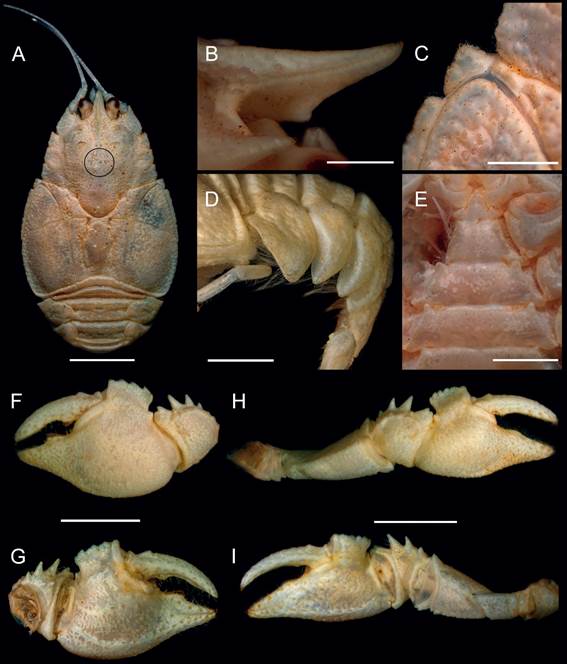
(A-I) Aegla rosanae Campos Junior, 1998, male holotype (MZUSP 11162). (A) Habitus, color of ethanol preserved specimen. (B) Detail of the subrostral process, lateral view. (C) Detail of the left epibranchial tooth, dorsal view. (D) Lateral view of pleonal epimera 2-4. (E) Thoracic sternites 3-7. (F, G) Left cheliped (major), lateral and mesial views, respectively. (H, I) Right cheliped, lateral and mesial views, respectively. Note in A the distinctive markings (circled in black), which closely match those in the photograph of the holotype published by Campos Jr. (1998: 138, fig. 1). Scales: A, F-I, 5 mm; B, C 1 mm; D, E 2 mm.
-
Aegla rosanaeCampos Jr., 1998: 138-139, figs. 1-4 [male holotype].
-
Aegla rosanae - Melo et al., 2003: 427 [type catalogue]; Moraes et al., 2016: 15, figs. 1, 12, 13, 24C-D, 25B, 26B, 27B, 28B, 30 [description, illustrations]; Bartholomei-Santos et al., 2020: 10, 15 [list]; Bueno et al., 2021: 353 [list]; Santos et al., 2017: 7 [list]; 2020: 62 [diagnosis and distribution]; Boos et al., 2020: 239 [extinction risk]; Rogers et al., 2020: 927 [key]; Bueno et al., 2024: 8; 2025 [GenBank accession number PP768652], 22 [phylogenetic relationships].
-
Aegla paulensis - Bond-Buckup & Buckup, 2000 pro parte: 386 [not Aegla paulensis Schmitt, 1942].
Type material: Male holotype (MZUSP 11162), Brazil, São Paulo, city of Piquete, Benfica stream headwater, R.S. Lima, O. Takeshi and O. Campos Jr. coll., 26.vi.1992. Genbank access PX516873.
Topotypical material: 1 female (MZUSP 47998), same data as holotype, Genbank access: COX1 PX447583, COX2 PX516874, 16S PX447735. 1 male (MZUSP 34370), same data as type locality, J.C.B. Moraes and S.L.S. Bueno coll., 28.ix.2012. 11 males, ibidem, J.C.B. Moraes and S.L.S. Bueno coll., 07.xii.2012 (MZUSP 34369), Genbank access KU948373.
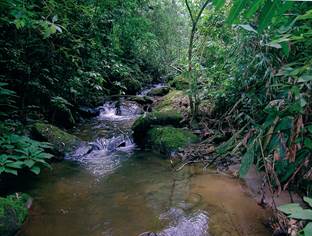
Type-locality: Brazil, São Paulo, city of Piquete, Benfica stream headwater, 22°35′43.8″S, 45°13′35.1″W, altitude 630 m.
In December 2012, J.C. Moraes and S. Bueno organized an expedition to the type locality to collect topotypic specimens. During this expedition, geographical coordinates, altitude information, and photographs of the type locality were also obtained (Fig. 2).
The type locality of Aegla rosanae Campos Junior, 1998: Benfica stream headwater, 22°35′43.8″S, 45°13′35.1″W, altitude 630 m.
Geographical distribution: Known so far from the type locality.
Redescription of the male holotype: Carapace depressed sightly convex, granulated. Rostrum triangular, curved upward distally, extending beyond distal apex of compound eyes, small corneous scales and setae on lateral margins and tip (Fig. 1A). Rostral carina beginning at level of protogastric lobes, extending until apex. Subrostral process well developed on proximal half, tip rounded and slightly curved anteriorly (Fig. 1B).
Eyestalk and cornea well developed. Orbital sinus U-shaped, plumose setae subventrally. Only left orbital spines present, well developed, acute, minute corneous tip. Extraorbital sinus of left side narrow, right side absent. Anterolateral spines straight upward, longer than orbital spines, reaching base of cornea, with sparsely simple setae, ending in terminal corneous scale (Fig. 1A). Epigastric prominences and protogastric lobes pronounced, without corneous scales. Two conspicuous circular pits mesially between protogastric lobes. Gastric area slightly inflated, gastric pits small, smooth. Limit between hepatic lobes well defined. Lateral margins of hepatic lobes with small corneous scales and small setae (Fig. 1A).
Transverse dorsal linea (TDL) sinuous throughout its extension, not merged with cervical groove mesially. Areola rectangular. Cardiac area trapezoidal (Fig. 1A). Epibranchial tooth slightly elongated, triangular shaped, anterolateral angle blunt with a small corneous scale, lateral margin with row of small corneous scales and scattered small setae (Fig. 1C). Third thoracic sternite more depressed than fourth, anteromesial region ending in abrupt tip, with sparsely simple setae. Fourth thoracic sternite with anterolateral angles strongly produced upward, with scattered setae (Fig. 2E).
Chelipeds unequal in size (Figs. 1F, G). Major cheliped. Coxa missing. Basi-ischium partially fused, suture present. Ischium with distal spine on dorsal margin, four spines on ventromesial margin; ventrolateral margin smooth.
Merus antero-dorsolateral margin with one well developed spine followed by row of tubercles decreasing in size proximally; ventromesial margin with five spines, three small similar in size proximally, distal two larger; ventrolateral margin with two tubercles distally followed by small tubercles decreasing in size proximally.
Carpus dorsal margin with three strong spines increasing in size distally, one well developed spine on subdistal lobe; mesial surface with two spines similar in size with long seta apically; carpal ridge high and formed by well-defined tubercles. Propodus granulate; palm high and short; mesial surface with two low ridges, first below palmar crest, with tubercles with tufts of long simple setae apically; second ridge subparallel to lower margin of propodus with with low, poorly distinguishable prominences each with tufts of long simple setae apically; palmar crest rectangular, margin lobulate, lateral surface excavated; mesial surface of fixed finger gently excavated; cutting margin with corneous lobular basal tooth, followed by row of juxtaposed flat surface corneous teeth ending in strong incisive corneous tooth distally. Dactylus inner surface smooth; proximal lobe on dorsal margin blunt; cutting margin with well-developed lobular basal tooth with flattened corneous scales, followed by row of juxtaposed corneous teeth ending in strong incisive corneous tooth; row of tufts of long simple setae next to cutting margins.
Minor cheliped similar to major cheliped, except as noted. Coxa smooth. Basischium with one ventrolateral strong tubercle. Merus ventrolateral margin with two tubercles distally. Carpus with one strong spiniform tubercle on mesial surface, dorsal margin with two spines similar in size, one subdistal prominent tubercle, carpal ridgelower. Propodus slenderer, lateral surfaceof palmar crest well excavated; cutting edge of both fixed finger and dactylus with lobular basal tooth low remaining cutting border formed by row of narrow incisive-teeth like corneous scales.
Pereiopods 2-4 broken. Dactyli with several rows of setal tufts on general surface, ending in acute corneous scale. Propodi with small corneous scales on dorsal margins, scattered setae mainly along dorsal and ventral margins. Carpi with small corneous scale on distal portion of dorsal margin, scattered setae. Meri and ischia with scattered setae mainly along dorsal margin.
Fifth pereiopods reduced and chelate. Sexual tube long, narrow.
Pleonal epimera: anterolateral margin of second epimeron with low angle provided with small corneus scale; third epimeron ventral angle with one spiny corneous scale; ventral angle of fourth pleonal epimeron unarmed.
Pleopods absent.
Telson anterolateral and posterolateral margins straight medially; junction of anterolateral and posterolateral margins indistinct.
Pairwise similarity
Mitochondrial genes COX1, COX2, and 16S rRNA have been widely used in species delimitation and have been instrumental in resolving species complexes within Aegla (Moraes et al., 2016; Marçal et al., 2020; Mollmann et al., 2024). Sequencing type specimens provide valuable corroboration for morphology-based primary species hypotheses and strengthens confidence in subsequent taxonomic and phylogenetic analysis, as demonstrated in other decapod groups (Puillandre et al., 2011).
Sequences for COX1 (GenBank: PX447583), COX2 (GenBank: PX516874), and 16S (GenBank: PX447735) were successfully obtained from the topotype specimen MZUSP 47998 of Aegla rosanae. In contrast, amplification of COX1 and 16S from the holotype of A. rosanae (MZUSP 11162) was unsuccessful. However, the COX2 gene was successfully sequenced (GenBank: PX516873) and showed 99% similarity to the COX2 sequence of the topotype MZUSP 47998.
The COX1 and 16S sequences from MZUSP 47998 were compared with sequences from other topotypical specimens previously published by Moraes et al. (2016), Bueno et al. (2024), and Colavite et al. (2024). The COX1 sequence from MZUSP 47998 (GenBank: PX447583) was identical (100% similarity) to the sequences of both MZUSP 34369 (GenBank: PQ635416) and CCDB 6396 (GenBank: PP768652). The 16S sequence from MZUSP 47998 (GenBank: PX447735) showed 96.57% similarity to that of MZUSP 34369 (GenBank: KU948373).
CONCLUSIONS
The male holotype of Aegla rosanae was originally poorly described, illustrated, and inaccurately measured (22 mm “length”, 14 mm “width”). These measurements do not correspond to either of the specimens collected by Campos Jr. and collaborators, whose carapace length including the rostrum (CL) and carapace maximum width (CW) are as follows: male holotype, CL 15.0 mm, CW 12.3 mm; female, CL 9.5 mm, CW 8.2 mm. The original width measurement (14 mm) and scale bars (7 mm) match the carapace width in the published illustrations (Campos Jr., 1998: 139, figs. 1, 2) but not the actual specimens. For the reported length of 22 mm to be accurate, the measurement must have been taken from the tip of the rostrum to the posterior margin of the fourth pleonal somite in dorsal view, corresponding to the perspective in the holotype’s dorsal illustration (Campos Jr., 1998: 139, figs. 1, 2).
Apart from the statement “Holótipo macho” [holotype male], nothing in the original description or illustrations alone permits a definitive determination of the holotype’s sex. However, distinctive markings on the dorsal carapace in the published photograph of the holotype (Campos Jr., 1998: 138, fig. 1) closely match those of male MZUSP 11162, providing conclusive evidence that this specimen is the holotype of A. rosanae (Fig. 1A). The female of A. rosanae (now MZUSP 47998), collected alongside the male holotype, is markedly smaller and lacks the distinctive carapace markings visible in the holotype photograph.
Moraes et al. (2016: 19) proposed several characters to distinguish between A. rosanae and A. paulensis based on 13 topotypical specimens; all of these features are also present in the male holotype of A. rosanae.
DATA AVAILABILITY:
All nucleotide sequence data were submitted to GenBank under the accession number: PX447583, PX447735.
Acknowledgments:
We thank J.C. Moraes and S. Bueno (Institute of Biology, University of São Paulo) for making available the photograph of the type-locality of Aegla rosanae and to SB for his helpful comments on this manuscript. Joana d’Arc de Jesus Pinto (MZUSP) registered most of the Aegla material used in this study. MT and JC thanks CNPQ (PQ 309488/2020-6) and FAPESP (PD 2022/11142-0), respectively, for supporting studies on the systematics of decapod crustaceans.
REFERENCES
-
Arantes, T.; Oliveira-Rogeri, L.; Bochini, G.L.; Frazato, P.S.; Souza-Shibatta, L.; Mantelatto, F.L. & Teixeira, G.M. 2025. First record of Aegla Leach, 1821 (Decapoda: Anomura) in drainages flowing into Iguaçu National Park with description of two new species. Zoologischer Anzeiger 318: 53-64. https://doi.org/10.1016/j.jcz.2025.07.005.
» https://doi.org/10.1016/j.jcz.2025.07.005 - Bartholomei-Santos, M.L.; Santos, S.; Zimmermann, B.L.; Pérez-Losada, M. & Crandall, K.A. 2019. Evolutionary history and phylogenetic relationships of Aeglidae. In: Santos, S. & Bueno, S.L.S. (Eds.). Aeglidae: Life history and conservation status of unique freshwater Anomuran decapods., CRC Press. p. 1-27.
-
Bond-Buckup, G. & Buckup, L. 1994. A família Aeglidae (Crustacea, Decapoda, Anomura). Arquivos de Zoologia, 32(4): 159-346. https://doi.org/10.11606/issn.2176-7793.v32i4p159-346.
» https://doi.org/10.11606/issn.2176-7793.v32i4p159-346 -
Bond-Buckup, G. & Buckup, L. 2000. Aegla rosanae Campos Jr., um novo sinônimo de Aegla paulensis Schmitt (Crustacea, Aeglidae). Revista Brasileira de Zoologia, 17(2): 385-386. https://doi.org/10.1590/S0101-81752000000200008.
» https://doi.org/10.1590/S0101-81752000000200008 -
Boos, H.; Salge, P.G. & Pinheiro, A.A. 2020. Conservation status and threats of Aeglidae: Beyond the assessment. In: Santos, S. & Bueno, S.L.S. (Eds.). Aeglidae: Life history and conservation status of unique freshwater Anomuran decapods CRC Press. p. 233-251. (Advances in Crustacean Reseach, 21). https://doi.org/10.1201/b22343-9.
» https://doi.org/10.1201/b22343-9 -
Bueno, S.; Camargo, A.L.; Santos, A.L.H.; Vera-Silva, A.L.; Tavares, M. & Mantelatto, F.L. 2024. An integrative taxonomy study of cave-dwelling aeglids (Decapoda: Anomura: Aeglidae) from Natural Protected Areas in south-eastern Brazil, with description of three new species. Invertebrate Systematics, 38(9): IS24023. https://doi.org/10.1071/IS24023.
» https://doi.org/10.1071/IS24023 -
Bueno, S.; Colavite, J.; Igual, E.; Martins, L.S.; Teles, J.N.; Tavares, M. & Mantelatto, F. 2025. Diversity of Aegla (Decapoda: Anomura) from the Tietê River watershed in the Atlantic Rainforest, southeastern Brazil, with description of two new species. Zoological Studies, 64: 1-165. https://doi.org/10.6620/ZS.2025.64-45.
» https://doi.org/10.6620/ZS.2025.64-45 -
Bueno, S.L.S.; Wolf, M.R. & Shimizu, R.M. 2021. Reassessing the Current Conservation Status of the Freshwater Aeglid, Aegla jaragua Moraes, Tavares and Bueno, 2016 (Decapoda: Anomura: Aeglidae) as Critically Endangered. A Ten-Year Case Study. In: Kawai, T. & Rogers, D.C. (Eds.). Recent advances in freshwater crustacean biodiversity and conservation CRC Press. p. 347-380. (Advances in Crustacean Research, 22) https://doi.org/10.1201/9781003139560-11.
» https://doi.org/10.1201/9781003139560-11 - Campos Jr., O.C. 1998. Nova espécie do gênero Aegla da Bacia do Rio Paraíba, Brasil (Anomura, Aeglidae). Iheringia, 85: 137-140.
-
Colavite, J.; Bueno, S.L.S.; da Silva, A.R. & Tavares, M. 2024. A new species of Aegla (Decapoda, Anomura, Aeglidae) from the Paranapanema watershed, southeastern Brazil. Crustaceana, 97: 659-675. https://doi.org/10.1163/15685403-bja10387.
» https://doi.org/10.1163/15685403-bja10387 - Leach, W.E. 1821. Galatéadées, Galateadæ. (Crust.). In: Cuvier, F. Dictionnaire des Sciences Naturelles… Strasbourg et Paris, F.G. Levrault et Le Normant. v. 18, p. 49-56.
-
Marçal, I.C.; Páez, F.P.; Souza-Shibatta, L.; Sofia, S.H. & Teixeira, G.M. 2020. Taxonomic revision of Aegla lata Bond-Buckup & Buckup, 1994 (Decapoda: Anomura: Aeglidae), with the description of a new species of Aegla leach, 1820 from the upper Paraná ecoregion, Brazil. Journal of Crustacean Biology, 40(4): 425-434. https://doi.org/10.1093/jcbiol/ruaa024.
» https://doi.org/10.1093/jcbiol/ruaa024 -
Martin, J.W. & Abele, L.G. 1988. External morphology of the genus Aegla (Crustacea: Anomura: Aeglidae). Smithsonian Contributions to Zoology, 453: 1-46. https://doi.org/10.5479/si.00810282.453.
» https://doi.org/10.5479/si.00810282.453 - Melo, G.A.S.; Vezzani, R.M. & Campos Junior, O. 2003. Type catalogue of the Crustacea Decapoda in the collections of the Museu de Zoologia da Universidade de São Paulo, Brazil. Proceedings of the Biological Society of Washington, 116(2): 423-437.
-
Mollmann, V.H.S.; Bartholomei-Santos, M.L.; Fernandes, G.; Puli, G.; Mossolin, E.C.; Dalosto, M.M. & Santos, S. 2024. Hidden diversity of Aegla (Decapoda, Anomura) in a priority area for conservation. Zoologica Scripta, 53(6): 850-866. https://doi.org/10.1111/zsc.12686.
» https://doi.org/10.1111/zsc.12686 -
Moraes, J.C.B.; Terossi, M.; Buranelli, R.C.; Tavares, M.; Mantelatto, F.L. & Bueno, S.L.S. 2016. Morphological and molecular data reveal the cryptic diversity among populations of Aegla paulensis (Decapoda, Anomura, Aeglidae), with descriptions of four new species and comments on dispersal routes and conservation status. Zootaxa, 4193(1): 1-48. https://doi.org/10.11646/zootaxa.4193.1.1.
» https://doi.org/10.11646/zootaxa.4193.1.1 -
Pérez-Losada, M.; Jara, C.G.; Bond-Buckup, G. & Crandall, KA. 2002. Phylogenetic relationships among the species of Aegla (Anomura: Aeglidae) freshwater crabs from Chile. Journal of Crustacean Biology, 22(2): 304-313. https://doi.org/10.1163/20021975-99990237.
» https://doi.org/10.1163/20021975-99990237 -
Puillandre, N.; Macpherson, E.; Lambourdière, J.; Cruaud, C.; Boisselier-Dubayle, M.C. & Samadi, S. 2011. Barcoding type specimens helps to identify synonyms and an unnamed new species in Eumunida Smith, 1883 (Decapoda: Eumunididae). Invertebrate Systematics, 25(4): 322-333. https://doi.org/10.1071/IS11022.
» https://doi.org/10.1071/IS11022 -
Rogers, D.C.; Magalhães, C.; Peralta, M.; Ribeiro, F.B.; Bond-Buckup, G.; Price, W.W.; Guerrero-Kommritz, J.; Mantelatto, F.L.; Bueno, A.; Camacho, A.I.; González, E.R.; Jara, C.G.; Pedraza, M.; Pedraza-Lara, C.; Rudolph Latorre, E. & Santos, S. 2020. Chapter 23 Phylum Arthropoda: Crustacea: Malacostraca. In: Damborenea, C.; Rogers, D.C. & Thorp, J. (Eds.). Thorp and Covich’s Freshwater Invertebrates. Vol. 5. Keys to Neotropical and Antarctic Fauna 4.ed. California, Academic Press. p. 809-986. https://doi.org/10.1016/B978-0-12-804225-0.00023-X.
» https://doi.org/10.1016/B978-0-12-804225-0.00023-X - Santos, S.; Bond-Buckup, G.; Buckup, L. & Jara, C.G. 2020. Morphology, taxonomy, and diversity of extant Aeglidae. In: Santos, S. & Bueno, S.L.S. (Eds.). Aeglidae: Life history and conservation status of unique freshwater Anomuran decapods CRC Press. p. 1-27.
-
Santos, S.; Bond-Buckup, G.; Gonçalves, A.S.; Bartholomei-Santos, M.L.; Buckup, L. & Jara, C.G. 2017. Diversity and conservation status of Aegla spp. (Anomura, Aeglidae): an update. Nauplius, 25: 1-14, e2017011. https://doi.org/10.1590/2358-2936e2017011.
» https://doi.org/10.1590/2358-2936e2017011 -
Schmitt, W.L. 1942. The species of Aegla, endemic South-American fresh-water crustaceans. Proceedings of the United States National Museum, 91(3132): 431-520. https://doi.org/10.5479/si.00963801.91-3132.431.
» https://doi.org/10.5479/si.00963801.91-3132.431 -
Tamura, K.; Stecher, G. & Kumar, S. 2021. MEGA11: Molecular evolutionary genetics analysis version 11. Molecular Biology and Evolution, 38(7): 3022-3027. https://doi.org/10.1093/molbev/msab120.
» https://doi.org/10.1093/molbev/msab120 -
Xu, J.; Pérez-Losada, M.; Jara, C.G. & Crandall, K.A. 2009. Pleistocene glaciation leaves deep signature on the freshwater crab Aegla alacalufi in Chilean Patagonia. Molecular Ecology, 18(5): 904-918. https://doi.org/10.1111/j.1365-294X.2008.04070.x.
» https://doi.org/10.1111/j.1365-294X.2008.04070.x