 PlayTeeth Tool Development: An Innovative Dental Care Tool for Individuals with Autism Spectrum Disorder
ABSTRACT
Objective: To associate the Treatment and Education of Autistic and Communication Handicapped Children (TEACCH) and Applied Behavior Analysis (ABA) validated techniques with technology in dentistry by developing software to mediate and facilitate dental care.
Material and Methods: A literature review was performed to retrieve information about those techniques. The software for tablets and smartphones was developed based on the data extracted. The results were considered to determine which characteristics the tool should present, such as settings, colors, and gameplay patterns.
Results: The main characteristics are illustrations with vibrant colors and background music and two characters to be chosen. The application has three interactive environments: kitchen, bathroom, and dental office, so the patient goes through all of them interacting with health promotion content.
Conclusion: An application is presented that aims to facilitate such care in a practical, accessible, and free manner, improving the interaction between dentists and patients.
Keywords:
Autism Spectrum Disorder; Software; Health Promotion.
Introduction
Autism spectrum disorder (ASD) is a developmental disorder that can present different support level needs [1,2]. The prevalence is 1:36 in children at age 8, presenting a 3.8 prevalence ratio comparing males to females [3]. These individuals exhibit deficits in communication and social interaction, as well as restricted and repetitive behaviors and interests [2,4].
In ASD individuals, atypical sensory processing is present due to alterations in cerebellum structure, resulting in an atypical activation during the execution of simple or complex functions [5]. These limitations make dental treatment challenging for professionals, caregivers, and patients, as excessive sensory stimuli can cause hyperstimulation, limiting and causing difficulties in care [6].
Non-pharmacological intervention methodologies can be adopted to facilitate dental care for ASD patients, such as the "tell-show-do" technique, voice control, positive reinforcement, and psychological techniques of conditioning and desensitization [7]. The introduction of technology as an adjunct in care has also proven quite effective, especially as a facilitator of learning [8]. However, the use of validated psychological techniques such as TEACCH (Treatment and Education of Autistic and Communication Handicapped Children) and ABA (Applied Behavior Analysis) are already well-established as mediators for school learning and in some areas of health therapy (e.g., physiotherapy and occupational therapy) [9].
The TEACCH technique was developed in 1966 by Dr. Eric Schopler's team, a physician in the psychiatry department at the University of North Carolina, United States [10]. Its goal is to provide individualized environment organization through sensory stimuli to familiarize patients with ASD with the learning environment (10). ABA is a widely explored and scientifically studied intervention with proven effectiveness in treating and controlling the behavior of patients with ASD [11]. This methodology involves repetitions, with a behavior reinforcement system established for the satisfactory execution of requested commands, significantly reducing aggressive behaviors and self-injury [11].
TEACCH and ABA techniques are still relatively underexplored in dentistry [9]. Therefore, we aimed to combine management techniques with technology to create a tool that aids the oral health promotion of individuals with ASD by mediating and facilitating dental care.
Material and Methods
Search Strategy
A bibliographic survey was conducted to gather sufficient data to develop an application that could facilitate dental care for ASD patients. The search strategy was built by combining the terms “dentistry,” “ASD,” “behavior therapy,” “conditioning therapy,” “cognitive behavioral therapy,” and “behavior modification.” These search terms were chosen to identify the characteristics of therapeutic and educational methodologies used in treating ASD individuals. The results were considered to determine which characteristics the tool should present, such as settings, colors, and gameplay patterns. The application would be practical for oral health promotion based on these settings.
Software Development
A specialized company was hired to lay out and code the software. The Unity Engine 3D platform (Unity Technologies, San Francisco, CA, USA), a cross-platform software used for game development - was used to produce the application. After completion, it was hosted on app stores for Android and iOS. This software was registered with the Brazilian National Institute of Industrial Property (INPI) under BR 51 2023 003292-1.
Results
The application was designed to entertain ASD patients, help condition, and facilitate dental care. The behavioral therapies TEACCH and ABA were used as a basis for the development of three interactive environments. Each environment offers illustrations with vibrant colors and background music. Interaction with the characters is done through touches on the screen. Before starting interaction in the environments, you can choose the character you want to play with - a boy or a girl. After the choice, you are directed to the first environment.
1. Kitchen: Nutritional Education
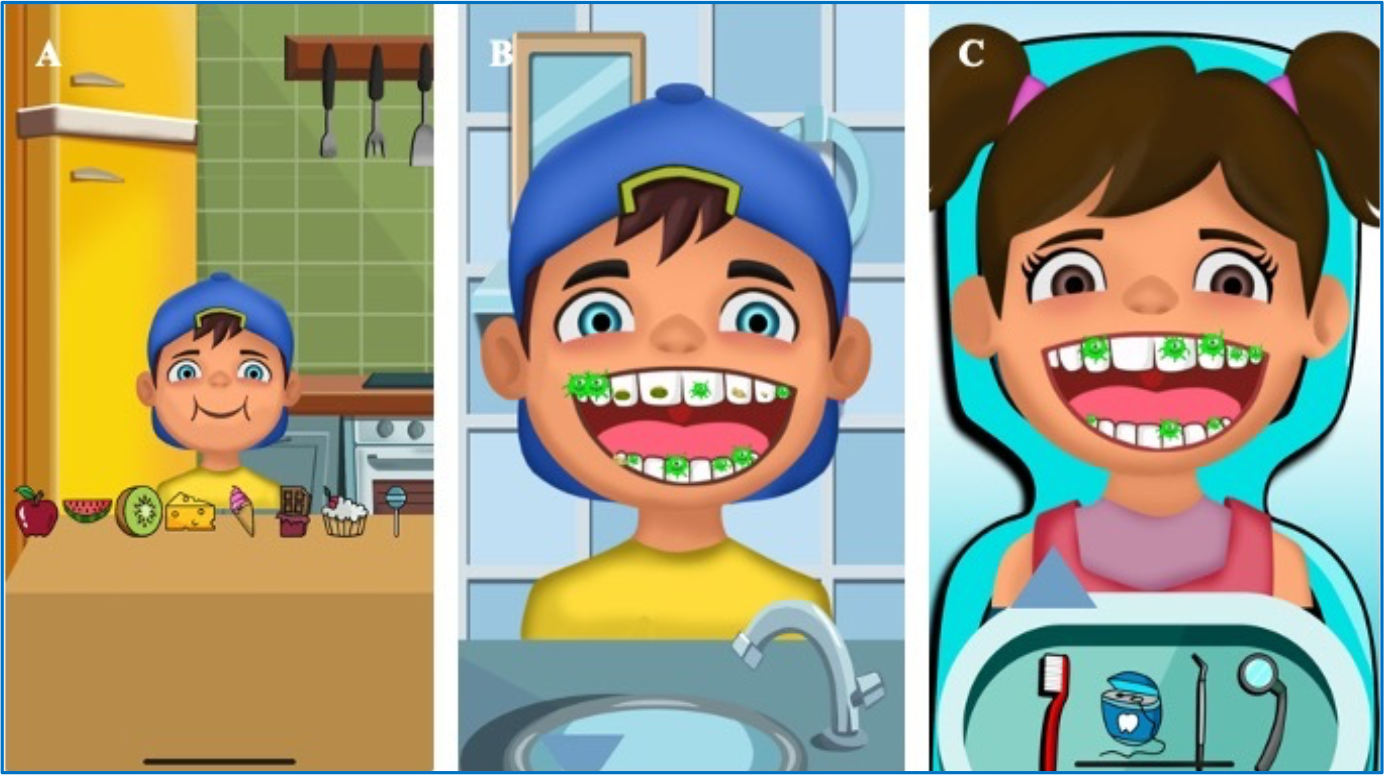
The illustration simulates a kitchen offering different types of healthy and processed foods. The patient interacts by feeding the character their choice, which provides an opportunity to promote nutritional education. After being fed, a suggestive animation of odor emanating from the mouth appears, signaling that it's time for the next step, and the game moves to another environment (Figure 1A).
Application environments. A) Kitchen: individuals choose which food they want, taking it to the character’s mouth; B) Bathroom: the actions of flossing and toothbrushing are requested by the app; C) Dental office: in addition to flossing and toothbrushing, a probe and a mirror are showed and used for cleaning and checking the mouth.
2. Bathroom: Home Toothbrushing
In this environment, there is a simulation of a common bathroom, with a toothbrush and dental floss provided for hygiene. In the patient's mouth, green figures simulate dirt on the teeth. The patient interacts with the character through repetitive movements and performs oral hygiene. When the patient brushes and flosses the character's teeth, the amount of "dirt" decreases. Once the interaction is initiated, each item has a 10-second time limit for each step. If the patient does not move the object towards the teeth or releases the accessory, the time is paused until the action is completed (Figure 1B).
3. Dental Office
In this stage, the character is exposed to four objects that simulate those used in a dental office (dental mirror, explorer probe, toothbrush, and dental floss). The remaining "dirt" is removed through professional cleaning. Interaction also occurs through repetitive movements, and each object has a usage time of about 5 seconds. This environment was designed to familiarize the patient with the instruments they will see when visiting the dentist and to associate those visits with maintaining oral health (Figure 1C).
Discussion
The use of technology in aiding the cognitive and social development of autistic children has shown positive results, particularly in their independence and social inclusion [12]. The literature has identified no references to software developed methodically to encourage oral hygiene and help familiarize the patient with dental appointments. The creation of Play Teeth aims to put dentistry in this dynamic and serve as a didactic therapeutic intervention to be used either at home or at the dental office.
Individuals with ASD are known to learn more easily through visualization and repetition. As a result, they tend to respond more effectively to visual stimuli, facilitating communication and reducing challenging behaviors [13]. The application becomes a way to promote oral health through the patient's interaction with educationally appropriate content. Additionally, it can be easily used in the public health system since there is no associated cost, and most of the population can access a smartphone.
The first application’s environment shows foods that atypical children often reject due to selective eating. Dietary restrictions that can lead to imbalances in the body and illness are a common concern of caregivers and health professionals involved in the care of these patients [14]. Therefore, the "kitchen" environment, which includes a variety of foods from different food groups, aims to implicitly influence the acceptance of new foods and promote nutritional education.
ASD patients have higher rates of dental caries and periodontal disease compared to typical children, mainly due to behavioral and sensory alterations, as well as selective eating [15]. A randomized clinical study using visual pedagogy to teach and improve dental brushing in patients with ASD showed positive results in improving oral hygiene and periodontal health conditions after three months of intervention [16]. Considering such data, the application becomes a way to promote oral health, prevent oral diseases, and address the need for interventions. Therefore, it might influence public health policies for oral health in individuals with ASD. The PlayTeeth tool will be used in upcoming clinical trials to assess its performance and to gather user feedback.
Conclusion
The increasing rates of individuals diagnosed with ASD reflect a growing demand for professionals capable of providing specialized care to these patients. An application is presented that aims to facilitate such care in a practical, accessible, and free manner aimed to improve the interaction between dentists and patients while providing access to health promotion content for individuals with developmental disorders.
-
Financial Support
This study was financed in part by the Coordenação de Aperfeiçoamento de Pessoal de Nível Superior - Brazil (CAPES) - Finance Code 001. We are also thankful for the support of Conselho Nacional de Desenvolvimento Científico e Tecnológico - Brazil (CNPq) - INCT Saúde Oral e Odontologia - Grant n. 406840/2022-9, and of Fundação de Amparo à Pesquisa do Estado de Minas Gerais - Brazil (FAPEMIG).
Data Availability
The data used to support the findings of this study can be made available upon request to the corresponding author.
References
-
[1] Guillén VM, Verdugo MÁ, Jiménez P, Aguayo V, Amor AM. Support needs of children with autism spectrum disorders: Implications for their assessment. Behav Sci 2023; 13(10):793. https://doi.org/10.3390/bs13100793
» https://doi.org/10.3390/bs13100793 -
[2] Hodges H, Fealko C, Soares N. Autism spectrum disorder: Definition, epidemiology, causes, and clinical evaluation. Transl Pediatr 2020; 9(Suppl 1):S55-S65. https://doi.org/10.21037/tp.2019.09.09
» https://doi.org/10.21037/tp.2019.09.09 -
[3] Maenner MJ, Warren Z, Williams AR, Amoakohene E, Bakian AV, Bilder DA, et al. Prevalence and characteristics of autism spectrum disorder among children aged 8 years - Autism and developmental disabilities monitoring network, 11 sites, United States, 2020. MMWR Surveill Summ 2023; 72(2):1-14. https://doi.org/10.15585/mmwr.ss6513a1
» https://doi.org/10.15585/mmwr.ss6513a1 -
[4] Hirota T, King BH. Autism spectrum disorder: A review. JAMA 2023; 329(2):157-168. https://doi.org/10.1001/jama.2022.23661
» https://doi.org/10.1001/jama.2022.23661 -
[5] Cakar ME, Okada NJ, Cummings KK, Jung J, Bookheimer SY, Dapretto M, G et al. Functional connectivity of the sensorimotor cerebellum in autism: Associations with sensory over-responsivity. Front Psychiatry 2024; 15:1337921. https://doi.org/10.3389/fpsyt.2024.1337921
» https://doi.org/10.3389/fpsyt.2024.1337921 -
[6] Stein Duker LI, Martinez M, Lane CJ, Polido JC, Cermak SA. Association between oral care challenges and sensory over-responsivity in children with Down syndrome. Int J Paediatr Dent 2022; 32(4):546-557. https://doi.org/10.1111/ipd.12933
» https://doi.org/10.1111/ipd.12933 - [7] Dailey JC, Brooks JK. Autism spectrum disorder: Techniques for dental radiographic examinations. J Dent Hyg 2019; 93(6):35-41.
-
[8] Krishnan L, Iyer K, Kumar PDM. Effectiveness of two sensory-based health education methods on oral hygiene of adolescent with autism spectrum disorders: An interventional study. Spec Care Dentist 2021; 41(5):626-633. https://doi.org/10.1111/scd.12606
» https://doi.org/10.1111/scd.12606 -
[9] Mazza M, Pino MC, Vagnetti R, Filocamo A, Attanasio M, Calvarese A, et al. Intensive intervention for adolescents with autism spectrum disorder: Comparison of three rehabilitation treatments. Int J Psychiatry Clin Pract 2021; 25(1):28-36. https://doi.org/10.1080/13651501.2020.1800042
» https://doi.org/10.1080/13651501.2020.1800042 -
[10] Schopler E, Mesibov G, Baker A. Evaluation of treatment for autistic children and their parents. J Am Acad Child Psychiatry 1982; 21(3):262-267. https://doi.org/10.1016/s0002-7138(09)60881-5
» https://doi.org/10.1016/s0002-7138(09)60881-5 -
[11] Morris EK, Todd JT, Midgley BD, Schneider SM, Johnson LM. The history of behavior analysis: Some historiography and a bibliography. Behav Anal 1990; 13(2):131-158. https://doi.org/10.1007/BF03392530
» https://doi.org/10.1007/BF03392530 -
[12] Valencia K, Rusu C, Quiñones D, Jamet E. The impact of technology on people with autism spectrum disorder: A systematic literature review. Sensors 2019; 19(20):4485. https://doi.org/10.3390/s19204485
» https://doi.org/10.3390/s19204485 -
[13] Meharwade P, Nookala H, Kajjari S, Malavalli P, Hugar SM, Uppin C. Bridging the communication gap in autistic children, one picture at a time. J Oral Biol Craniofac Res 2021; 11(4):507-510. https://doi.org/10.1016/j.jobcr.2021.07.005
» https://doi.org/10.1016/j.jobcr.2021.07.005 -
[14] Esposito M, Mirizzi P, Fadda R, Pirollo C, Ricciardi O, Mazza M, et al. Food selectivity in children with autism: Guidelines for assessment and clinical interventions. Int J Environ Res Public Health 2023; 20(6):5092. https://doi.org/10.3390/ijerph20065092
» https://doi.org/10.3390/ijerph20065092 -
[15] Uliana JC, Del' Agnese CC, Antoniazzi RP, Kantorski KZ. Autistic individuals have worse oral status than neurotypical controls: A systematic review and meta-analysis of observational studies. Clin Oral Investig 2024; 28(2):137. https://doi.org/10.1007/s00784-024-05500-0
» https://doi.org/10.1007/s00784-024-05500-0 -
[16] Du RY, Lam PPY, Yiu CKY, McGrath CP. Evaluation of visual pedagogy in improving plaque control and gingival inflammation among preschool children with autism spectrum disorder: An interventional study. Int J Paediatr Dent 2021; 31(1):89-105. https://doi.org/10.1111/ipd.12688
» https://doi.org/10.1111/ipd.12688
Edited by
-
Academic Editor:
Alidianne Fábia Cabral Cavalcanti