 Insights into Staphylococcus aureus pathogenesis and genetic diversity in bovine mastitis
ABSTRACT:
Bovine mastitis is the most common infectious disease in dairy herds and causes important economic losses. Various pathogens can cause the disease, with Staphylococcus aureus being one of the most significant. S. aureus can cause clinical, subclinical, and chronic forms of the disease due to a variety of virulence factors, including protein A, coagulase, toxins, and adhesins. The presence of methicillin-resistant S. aureus strains complicates treatment protocols and raises concerns about antimicrobial resistance. The genetic characterization of these strains, utilizing techniques such as molecular typing by pulsed-field gel electrophoresis (PFGE), reveals the existence of different genetic and virulence profiles, as well as the geographical variations in the distribution of these genotypes. The role of next-generation sequencing (NGS) technologies, functional genomics, and multi-omics approaches in the genetic research of bovine mastitis are highlighted, providing a complete understanding of its genetic basis and opening opportunities for targeted interventions and improved disease control strategies in the dairy industry. This review highlights the importance of understanding the genetic diversity and pathogenic mechanisms of S. aureus in bovine mastitis to develop effective disease management strategies and reduce economic losses in the dairy sector globally.
INDEX TERMS:
Infectious disease; dairy herds; genetic characterization; Staphylococcus aureus
RESUMO:
A mastite bovina é a doença infecciosa mais comum em rebanhos leiteiros e causa importantes perdas econômicas. Diversos patógenos podem causar a doença, sendo Staphylococcus aureus um dos mais significativos. S. aureus pode causar formas clínicas, subclínicas e crônicas da doença devido a uma variedade de fatores de virulência, incluindo proteína A, coagulase, toxinas e adesinas. A presença de cepas de S. aureus resistentes à meticilina complica os protocolos de tratamento e levanta preocupações sobre a resistência antimicrobiana. A caracterização genética dessas cepas, utilizando técnicas como a tipagem molecular por eletroforese em gel de campo pulsado (PFGE), revela a existência de diferentes perfis genéticos e de virulência, bem como as variações geográficas na distribuição desses genótipos. Destaca-se o papel das tecnologias de sequenciamento de nova geração (NGS), da genômica funcional e das abordagens multi-ômicas na pesquisa genética da mastite bovina, proporcionando uma compreensão mais completa de sua base genética e abrindo oportunidades para intervenções direcionadas e melhores estratégias de controle da doença na indústria de laticínios. Esta revisão destaca a importância de compreender a diversidade genética e os mecanismos patogênicos de S. aureus na mastite bovina para desenvolver estratégias eficazes de manejo da doença e reduzir as perdas econômicas no setor de laticínios globalmente.
TERMOS DE INDEXAÇÃO:
Doença infecciosa; rebanhos leiteiros; caracterização genética; Staphylococcus aureus
Introduction
Bovine mastitis remains a major challenge in the dairy industry and causes considerable economic losses worldwide. Different pathogens can cause the disease, and Staphylococcus aureus is the most prevalent contagious pathogen in dairy herds around the world. S. aureus is a Gram-positive bacteria that can be found on the skin and mucous membranes of animals and humans.
When S. aureus penetrates the cow’s udder, usually during the milking process, it can cause an infection that triggers an inflammatory response in the mammary tissue. This leads to several characteristic symptoms, such as swelling, redness, warmth, and tenderness in the affected mammary gland. The milk produced by the infected cow may contain pus, resulting in changes in its appearance, such as a yellowish or greenish color, and may have an unpleasant odor.
Mastitis due to S. aureus can occur in acute or chronic form. In acute mastitis, symptoms are generally more severe and may include fever in the affected cow. In chronic cases, the infection can persist for long periods, with less obvious symptoms but with reduced milk production and lower quality.
Treatment of S. aureus mastitis usually involves the use of specific antibiotics. However, S. aureus can be resistant to certain antibiotics, making it difficult to treat. Additionally, this bacterium can form biofilms on the udder, which can protect it from antibiotics and make eradication difficult.
Prevention of S. aureus mastitis is essential and may include proper management practices such as hygiene during milking, maintaining clean and dry facilities, and using appropriate milking systems to prevent contamination. Control of S. aureus mastitis is important for both the health and well-being of cows and the production of quality milk in the dairy industry. A comprehensive understanding of the genetic diversity and pathogenic mechanisms of S. aureus is imperative to design effective disease control strategies. In this context, the present review attempts to provide insights into the pathogenesis and genetic diversity of S. aureus in bovine mastitis. A systematic exploration of the literature was conducted to outline the current state of knowledge in this domain. The methodologies covered the analysis of all the articles considered and the synthesis of pertinent information. Inclusion criteria were established to select relevant original articles and reviews, which included the following: articles published between 1990 and 2023, original research articles, review papers, and clinical studies, studies focusing on the pathogenesis, genetic diversity, and alternative treatments of S. aureus in bovine mastitis, articles published in English and Spanish, and peer-reviewed articles with robust methodologies and clear findings. Through this review, we aim to highlight the importance of understanding the mechanisms of genetic diversity and pathogenic mechanisms of S. aureus in bovine mastitis, with a view to formulating targeted interventions and strengthening disease control measures within the dairy industry.
Bovine Mastitis
Mastitis is the most common infectious disease in dairy herds around the world and is considered the disease that causes the greatest economic losses to the producer and the dairy industry (Hogeveen et al. 2011, Hadrich et al. 2018). Losses occur because of a significant decline in milk production, the need to discard milk due to treatment, and the excessive costs associated with antibiotics and veterinary services. Additionally, these factors contribute to a decrease in the overall quality and value of the milk.
The term “mastitis” originates from the Greek word “mastos,” meaning mammary gland, and the suffix “itis,” denoting inflammation. It refers to an inflammatory condition of the mammary gland tissues triggered by the invasion of microorganisms. Mastitis is characterized by damage to the glandular epithelium, leading to clinical or subclinical inflammation. The extent of pathological changes can vary, ranging from localized to generalized, depending on the severity of the damage (Garcia 2004).
The main causes of mastitis in cattle are bacteria. The occurrence and intensity of a case of mastitis depends on factors that are associated with the infected animal, the pathogenic bacterium, and the environment. The environment is determined by the handling conditions used in the dairy. Factors such as teat skin lesions, inadequate udder disinfection, and improper use of milking machines, among others, facilitate the entry of pathogens into the udder, leading to intramammary infection. It is important to consider the source and ways of transmission of the disease. Mastitis-causing microorganisms can be found in various environments, such as fecal matter, bedding, and skin. Ensuring the overall cleanliness of cows and their housing and implementing proper handling procedures (particularly during milking) are effective measures for controlling the spread of mastitis (Cheng & Han 2020).
Bovine mastitis can be classified into clinical and subclinical depending on the presence of signs of disease. Subclinical mastitis is not easily visible and cannot be detected without specialized tests. Although almost all affected quarters may appear normal, Garcia (2004) note a decrease in milk production and an increase in the number of somatic cells. Therefore, its detection is achieved by isolating the pathogenic agent and determining a high number of somatic cells, which may include macrophages, neutrophils, epithelial cells, and other cell types. Subclinical mastitis is considered the most important for several reasons, it is 15 to 40 times more common than clinical mastitis and usually precedes the clinical form, therefore, to control the clinical form, one must start by controlling the subclinical one, which is long-lasting and difficult to detect. The bacteria associated with this type of mastitis are Staphylococcus aureus, non-aureus Staphylococcus (NAS), Streptococcus agalactiae and Streptococcus uberis.
Clinical mastitis is a visible condition, and it is characterized by noticeable abnormalities in the milk. The affected quarter may exhibit heat, inflammation, and sensitivity (Kibebew 2017). Systemic symptoms often accompany clinical mastitis, including fever and loss of appetite, and in severe cases, it can lead to the death of the animal, known as hyperacute clinical mastitis. In addition, milk production decreases, and the milk may appear like blood serum. This type of mastitis is frequently caused by one of the major pathogens, staphylococci, streptococci, and coliforms.
Mastitis pathogens
Many microbial agents can come in contact with the udder and can enter the mammary gland through the teat canal. New infections can occur at any stage, either during lactation or during the dry period. However, early lactating cows are susceptible to new infections due to stress conditions and immune suppression associated with the postpartum period (Petersson-Wolfe & Currin 2012).
More than eighty causative agents of mastitis have been identified, including species of bacteria, fungi, mycoplasmas, and algae (Cobirka et al. 2020). However, bacteria cause most of the infections (Fig.1). These mastitis-causing organisms have been classified based on bacterial origin into contagious, environmental and opportunistic pathogens and pathogens that cause mastitis less frequently (Langoni et al. 2011).
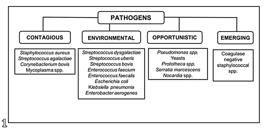
Contagious microorganisms are present on the udder or teat surface of cows. They are transmitted from infected quarters to uninfected quarters and from animal to animal during the milking process. The main contagious microorganisms are Staphylococcus aureus, Streptococcus agalactiae, Corynebacterium bovis and Mycoplasma species, being S. aureus the most frequently isolated contagious species (Barkema et al. 2009).
Environmental pathogens are those whose primary reservoir is the environment surrounding the animals. These organisms represent a heterogeneous group of bacterial genera and species, such as Streptococcus dysgalactiae, Streptococcus uberis, Streptococcus bovis, Enterococcus faecium, Enterococcus faecalis, and coliform bacteria (Escherichia coli, Klebsiella pneumoniae and Enterobacter aerogenes) (Schroeder 2012). Among environmental bacteria, streptococci and enterococci are important causative agents of intramammary infection. They are the main pathogens responsible for high somatic cell counts in bulk milk tanks in properly managed herd dairies (Carrillo-Casas & Miranda-Morales 2012, Reinoso 2017). Mastitis caused by environmental organisms is opportunistic in nature and occurs when the host’s immune system is depressed or when proper sanitation and hygiene are not practiced during or after milking (Schukken et al. 2003).
Opportunistic pathogens responsible for bovine mastitis include Pseudomonas spp., yeasts, Prototheca spp., Serratia marcescens, and Nocardia spp. These pathogens originate from the cow’s environment, and their main mode of transmission is improper handling practices. Examples of such practices include wet litter, unsanitary grounds, udders wet with milk, inadequate udder and teat preparation before milking, housing systems that facilitate teat lesions, and exposing uninfected quarters to pathogens. These environmental conditions can arise at any point during a cow’s lifespan. Infections caused by opportunistic pathogens typically occur sporadically, but outbreaks can arise within herds or entire regions, often due to hygiene or treatment issues.
In addition, coagulase-negative staphylococcal species (CoNS) have become the most commonly isolated bacteria from cows with mastitis and are recognized as emerging pathogens in mastitis cases.
S. aureus is one of dairy cattle’s most prevalent major mastitis pathogens, causing significant economic losses globally. Although hygienic milking practices and effective dairy management systems have reduced its incidence, intramammary infections by this pathogen remain a major challenge for dairy farms, with a high prevalence (Vaughn et al. 2020).
S. aureus is a Gram-positive, catalase- and coagulase-positive, non-spore-forming, oxidase-negative, non-motile, cluster-forming, facultative anaerobe bacterium belonging to the family Micrococcaceae (Vaughn et al. 2020).
Moreover, S. aureus is not only a pathogen of animals but also a human pathogen. The identification of S. aureus as a human pathogen was reported by Ogston in 1881, after the discovery of the microorganisms by Robert Koch in 1878. In the following decades, it was considered the most important agent in nosocomial infections since it can produce from a simple abscess to fatal sepsis (Kim et al. 2014).
This highly contagious pathogen is frequently isolated in bovine intramammary infections worldwide, causing clinical, subclinical, and chronic mastitis and resulting in significant economic losses in dairy farms (Castañeda Vazquez et al. 2014, Reinoso 2017). The primary reservoir for this pathogen is the infected quarter, with transmission occurring frequently during the milking process.
Furthermore, S. aureus is part of the normal flora found on mammals and birds’ skin and mucous membranes. It commonly colonizes the human colon, with the nose being the main site of colonization. Humans serve as a natural reservoir of S. aureus, and asymptomatic colonization is more prevalent than infection. The pathogenicity of S. aureus is attributed to the expression of virulence factors, which can be either surface-associated or secreted into the surrounding medium (Camussone & Calvinho 2013).
The S. aureus genome consists of a single circular chromosome of approximately 2.8 million base pairs (bp), with a GC percentage of 32-33% (Sivakumar et al. 2023). The first S. aureus genomes were sequenced in 2001 (Kuroda et al. 2001). The core genes, which comprise approximately 75% of the genome, contain necessary genes for cell survival and genes involved in bacterial metabolism, DNA and RNA synthesis, and replication (Stefani et al. 2012). These core genes are highly conserved, with a similarity of over 97%. Another piece of the S. aureus genome consists of variable core genes, which include more than 700 different genes. These genes encode surface or structural proteins that interact with the host. They are distributed throughout the genome and comprise 10-12%. The third component of the S. aureus genome is the mobile genetic elements (MGEs), which are genes introduced by horizontal gene transfer, as phage genes, antimicrobial resistance, and different virulence genes. This component constitutes approximately 10-20% of its genome. It is characterized by DNA fragments that can replicate independently or have specific mechanisms to insert themselves into chromosomes or plasmids that replicate (Malachowa & DeLeo 2010). The main transfer system for mobile genetic elements (MGEs) in S. aureus is transduction, followed by conjugation; transformation is much less common. Most MGEs can only be transferred to their genetic line or a restricted number of lines (Stefani et al. 2012, Lindsay et al. 2014). Accessory genes play an important role in the pathogenesis of S. aureus intramammary infections (Magro et al. 2017).
Virulence factors of Staphylococcus aureus
Different virulence factors have been described in S. aureus (Cheung et al. 2021). It is reported that these factors include 20 immune evasion molecules (such as protein A, coagulase, hemolysins and leucocidins, factors related to suppressing innate immunity), 15 microbial surface components recognizing adhesive matrix molecules associated with tissue adhesion (such as clumping factor A clfA, intercellular adhesion genesicaAandicaD), and 25 different toxins (such as enterotoxins SEA to SEQ, toxic shock syndrome toxin-1 TSST-1, exfoliative toxins Eta, Etb) among others. Table 1 summarizes the main virulence factors of S. aureus, detailing their functions and associated genes, providing a clear and concise overview of how each factor contributes to the pathogenesis of bovine mastitis.
Protein A is encoded by the spa gene, which has a conserved and a variable region. The X polymorphic region consists of a variable number of 24 base pair repeats and is located upstream of the coding region from the C-terminus of the cell wall. The region’s diversity originated from spontaneous deletion and duplication of the repeat units and point mutations. The protein A domain, encoded by the X region, serves to extend the N-terminal immunoglobulin IgG-binding portion through the cell wall, preventing phagocytosis and complement fixation. The 24-bp repeats vary in number among different S. aureus strains and are commonly used as a molecular tool to study genetic variability (El-Sayed et al. 2006, Bhati et al. 2016).
Coagulase protein is another important virulence factor in S. aureus. The enzyme is a prothrombin activator, offering protection against phagocytosis. Like the spaA gene, the coa gene has a repeat polymorphic region that can be used to differentiate strains. The coa gene variable region comprises short 81 base pair repeat sequences that are variable in number and sequence (Chmagh & Al-Abbas 2019).
S. aureus strains can produce capsular polysaccharides in vivo or under defined culture conditions. The capsule is a virulence factor that has been demonstrated in different animal models since it inhibits phagocytosis. It is reported in the literature that capsule types 5 and 8 are the most common. However, a high percentage of S. aureus is encapsulated (Kuipers et al. 2016). A variable prevalence of the capsule type has been found in bovine isolates from different geographic regions of the world (Salimena et al. 2016).
Adhesins are considered the most important virulence factors in the early phases of infection since they facilitate the adhesion to different host cell types. Among them, fibronectin, laminin, elastin, osteoporin, sialoproteins and collagen stand out. Adhesins are called microbial surface-recognizing components of adhesive molecules on the host cell (termed MSCRAMMs), which are cell-wall attached proteins with structural traits like an N-terminal folded domain associated with ligand binding and a wall-spanning region followed by a sorting signal placed at the C-terminal that anchor the protein to the cell wall (Foster et al. 2014). Each of these MSCRAMMs is characterized as having a specificity for a single host protein. For example, the ability of S. aureus to bind fibrinogen and fibrin is due to the presence of the clfA gene that codes for the fibrinogen receptor. On the other hand, the cna gene encodes an adhesin that binds to collagen in the host cell. In addition to its role in adhesion, it also participates in immune evasion during human infection (Campos et al. 2022).
S. aureus is also an important pathogen due, in part, to the production of exotoxins, which are considered superantigens capable of eliciting an increased immunological response in the host by activating host T cells (Hu et al. 2021). Various exotoxins can contribute to the development of bovine mastitis (Campos et al. 2022). These exotoxins include alpha-toxin (α-toxin), beta-toxin (β-toxin), gamma-toxin (γ-toxin), and delta-toxin (δ-toxin). Alpha-toxin is known for its cytotoxic effects, damaging host cell membranes and contributing to tissue damage. These exotoxins can exacerbate inflammation and tissue injury in the udder during mastitis infections.
Furthermore, staphylococcal enterotoxins produced by S. aureus can also cause bovine mastitis. Enterotoxins are heat stable and not destroyed during pasteurization, so they are a potential biohazard (Hennekinne et al. 2012). While their primary role is in causing food poisoning in humans, in the context of bovine mastitis, they can contribute to the inflammatory response in the udder and exacerbate the severity of mastitis infections. Enterotoxin-encoding genes are in mobile genetic elements, such as pathogenicity islands, phages, and plasmids (Otto 2014). Overall, the production of exotoxins and enterotoxins by S. aureus can contribute to the pathogenesis of bovine mastitis by promoting inflammation and tissue damage and exacerbating the host immune response.
In addition, the expression of extracellular proteins is subject to the coordinated regulation of several loci. The first to be discovered and most characterized is the agr regulator, which involves five genes (agrA, agrB, agrC, agrD, and hld). The agr system acts as a positive regulator of secretory proteins such as α, β and δ hemolysins, protease, DNAse, staphylokinase and toxic shock syndrome toxin. In contrast, it represses the transcription of protein A and coagulase genes and other wall-associated proteins (Wang & Muir 2016). The sar locus is required for agr expression, providing an additional level of regulation of the virulence factor in response to different signals.
Biofilm is considered a virulence factor in S. aureus, and its formation begins with the action of adhesive molecules, which help the union of S. aureus to the epithelial cells of the mammary gland. Then, the attached S. aureus strains multiply and accumulate by the involvement of the bacterial extracellular matrix, the polysaccharide intercellular adhesion molecule produced by icaADBC operon, which is considered the most virulent factor associated with biofilm production (Boonyayatra et al. 2014). Cytolytic toxins have also been reported as necessary in biofilm development (Huseby et al. 2010). Alpha-toxin is involved in cell communications, and biofilm-associated protein (Bap), associated with biofilm formation, has a role in perseverance intracellular and antibacterial resistance (Valle et al. 2012). Furthermore, regulation of agr is also involved in biofilm development. These traits that are involved in biofilm formation are closely related to persistence in the host.
Methicillin-resistant Staphylococcus aureus strains
The use of antibiotics in veterinary medicine is often employed for preventive measures, enhanced feed efficiency, and growth promotion, especially in developing countries. This extensive use of antimicrobials has led to the emergence of antimicrobial-resistant pathogens (Caneschi et al. 2023). The rise and dissemination of multidrug-resistant zoonotic pathogens have sparked growing concerns within both public and scientific communities regarding the widespread application of antimicrobial agents.
Antibiotic-resistant bacteria pose a significant challenge as they do not respond to conventional antibiotic treatments, thereby complicating the course of disease management. In the context of S. aureus strains, antibiotic resistance further complicates treatment protocols for infections. The resistance of S. aureus to antimicrobial agents, notably penicillin, became apparent shortly after the introduction of penicillin around 1945. Most S. aureus populations developed resistance by producing β-lactamase, an enzyme that hydrolyzes penicillin, encoded by the blaZ gene.
In response to the rise in penicillin resistance, methicillin, an antibiotic impervious to β-lactamase hydrolysis, was introduced into human medicine in the late 1950s. However, methicillin-resistant S. aureus (MRSA) strains were reported shortly after its introduction. MRSA is mediated by the mecA gene, which encodes another penicillin-binding protein, PBP2A, with low affinity for β-lactam antibiotics and is part of a large mobile genetic element known as the staphylococcal cassette chromosome mec (SCCmec). MRSA strains are typically resistant to multiple drugs (Algammal et al. 2020).
S. aureus strains can acquire the staphylococcal cassette chromosome (SCCmec), generating MRSA strains. The SCCmec can be transferred horizontally, carrying the resistance gene mecA that codes for penicillin-binding protein (PBP2a) with low affinity for β-lactam antibiotics, providing resistance to β-lactams commonly used for mastitis treatment (Markey & Leonard 2023). MRSA arose in the community during the 1960s. Subsequently, MRSA was reported as a pathogenic agent causing bovine mastitis in dairy cattle in Europe. Since then, livestock-associated MRSA (LA-MRSA) strains have been described (Kadlec et al. 2019). Most LA-MRSA isolates are reported as multi-resistant to antibiotics and lack toxins such as PVL and enterotoxins (Khanal et al. 2022).
Notably, MRSA has emerged as a concerning issue in veterinary medicine, representing a new dimension of zoonotic diseases. Initially described as a hospital-based cause of infection, MRSA has garnered attention as a significant concern in the broader veterinary context (Vanderhaeghen et al. 2012). The implications of MRSA in veterinary settings highlight the complex interplay between antibiotic usage, resistance development, and the potential for zoonotic transmission, underscoring the need for comprehensive strategies to address this evolving challenge.
Otherwise, previous studies (Mendonça et al. 2012, Soares et al. 2012, 2021, Silva et al. 2013, Melo et al. 2014) have reported several phenotypic methicillin-resistant Staphylococcus spp. isolates that are not correlated with the presence of the mecA gene. Further investigation allowed Melo et al. (2020) to report the discovery of a mecA gene variant in bovine samples containing mutations in the annealing region that prevent detection of the gene with the primers described so far. A two-set study was conducted to confirm this hypothesis. Firstly, original primers based on the nucleotide sequences of the S. aureus mecA gene (HE681097) were tested in bovine, human and equine strains. Those primers failed to amplify the whole mecA gene segment in bovine strains. The impairment of mecA gene detection in bovine strains sheds light on the specificity of bovine samples. Next, a second-step primer set was based on a sequence of Staphylococcus sciuri mecA gene (AY820253) and only yielded mecA gene segments for bovine strains. The multiple alignments of mecA gene sequences from bovine, human, and equine origins revealed that bovine ones presented punctual but significant differences leading to the observed impairment of mecA gene detection in bovine strains, probably due to some selective pressure in the dairy environment (Melo et al. 2014). The increase in selection pressure can indeed promote the spread of resistance genes and the emergence of specific mutations, making it challenging to accurately analyze resistance in dairy production environments. It is important to note that many intramammary pharmaceuticals containing cloxacillin are ineffective against methicillin-resistant strains, which is often overlooked as a selection criterion (Fischer-Tenhagen et al. 2023). Considering the impact of MRSA on human health, it is crucial to assess the risks of using this class of antimicrobials in animal production without precise indication.
Molecular typing of Staphylococcus aureus strains
Molecular typing is essential to understanding the evolution of pathogens and their genetic relationships; thus, a greater understanding is achieved during epidemiological investigations (El-Sayed et al. 2017, Vázquez et al. 2018, García et al. 2018).
A variety of molecular techniques, with different degrees of discrimination, are used to type S. aureus, including A-surface protein typing (spa typing), multiple locus sequence typing (MLST), plasmid profile analysis, restriction fragment length polymorphism (RFLP) analysis (MLVA), whole genome DNA sequence analysis and pulsed-field electrophoresis (PFGE) (Sabat et al. 2013, Dendani et al. 2022). Among the techniques, PFGE is considered the gold standard for having a high discriminatory power, with the capacity to produce different profiles, easy to interpret and reproduce (Zadoks & Schukken 2006, Reinoso 2020). The analysis of S. aureus isolates using PFGE is an essential tool to establish the clonal origin of bacterial isolates, helping to establish epidemiological relationships between strains of the same species isolated from one or different herds. Knowledge of a certain genetic profile makes it possible to understand the distribution of strains with infective capacity, allowing the identification of virulence factors associated with mastitis infection and helping develop more effective treatments (Ote et al. 2011).
Table 2 compares various techniques for the genetic characterization of S. aureus, outlining their principles, advantages, limitations, and applications. Each technique provides unique insights into the genetic diversity and epidemiology of S. aureus, contributing to a comprehensive understanding of its pathogenesis and aiding in the development of effective control measures.
A significant development in DNA technology occurred in the early 1990s when Williams et al. (1990) and Welsh & McClelland (1990) simultaneously developed a strategy based on polymerase chain reaction (PCR) by using profiles of DNA fragments amplified using a given primer (Reinoso 2020).
A first advance in molecular typing was the analysis of variable tandem repeat (VNTR) sequences at different virulence loci. The number of repeat units at the same locus always varies from strain to strain and can be detected by PCR. Amplification of repeated regions of different genes, such as coagulase (coa), protein A (spaA), fibrinogen receptor (cflA) and collagen adhesion (cna), have been used for reliable and accurate typing. spaA gene typing is especially important for the rapid typing of MRSA isolates, as it offers higher resolution than coa gene typing (Shopsin et al. 1999).
spatyping is a fast and cheap method widely used for characterizing MRSA. spa typing emerges as a cost-effective and accessible technique and allows its use in geographically distant laboratories, taking advantage of the various types of spa that prevail in various regions (Krawczyk & Kur 2018).
Although typing methods are not 100% resolving, it should be noted that bacterial strains will undergo mutation events as they propagate in different environments. So, it is important to recognize that there is no typing technique that allows definitive differentiation (an exception to whole genome sequencing) because strains could be continually mutating. However, it is of fundamental importance to establish the criteria for the use of these methods so that the results obtained are reproducible and precise.
Genetic variation of Staphylococcus aureus
Virulence factors of S. aureus strains that cause bovine mastitis are well-known, although the reasons why different genotypes with variable virulence factors can cause infection remain unclear. Molecular typing techniques have been used in epidemiological investigations worldwide, and the results have shown that disseminated identical or related clones are responsible for intramammary infections within and among cattle in specific geographical areas. Table 3 summarizes studies on the genetic variation of S. aureus in bovine mastitis. Marques et al. (2013), when analyzing strains using PFGE, did not detect a predominant profile. Likewise, the presence or absence of virulence genes could not be associated with the PFGE profiles, confirming the marked diversity of circulating clones in the evaluated dairy herds.
Castañeda-Vázquez et al. (2020) analyzed 335 cows from 27 stables in 10 municipalities in the state of Jalisco, observing a genetic variation of 14.9%. The analyzed strains were grouped into profiles with 95% or more genetic similarity, resulting in 12 PFGE profiles.
In a study conducted by Dieser et al. (2017) in Argentina, genetic profiles of 43 S. aureus strains were determined using PFGE. Chromosomal DNA digestion resulted in eight to 15 macrorestriction fragments ranging from 48.5 to 436.5 Kb. Two distinct PFGE profiles (A and B) were identified, with Profile A representing 76.7% (33/43) of the S. aureus strains and only one identified as subtype Aa. Profile B was found in 23.2% (10/43) of the S. aureus strains, and among the seven analyzed strains, four subtypes (Ba, Bb, Bc, and Bd) were distinguished. Profile A was recovered from 80% of the analyzed farms. Furthermore, the study revealed a high number of virulence profiles, indicating that strains with different virulence profiles may be capable of causing mastitis without a predominant profile being detected.
PFGE results obtained by Vaughn et al. (2020) showed the presence of 16 PFGE types throughout the farms, of which three types were the most frequently isolated. This study did not find an association between type, genotypic, and phenotypic virulence factors.
Recent advances in understanding S. aureus genetic variation have focused on studying clonal complexes. It has been reported that S. aureus clones causing bovine mastitis belong to complexes CC151, CC97, CC133, CC479, and CC771 (Zadoks et al. 2011, Schlotter et al. 2012). Hoekstra et al. (2020) showed that CC479 was strongly associated with clinical mastitis. A limited number of S. aureus complexes were responsible for bovine mastitis, and the complex type influences the clinical outcome of the disease. Additionally, the study identified specific genes associated with clinical mastitis.
Monistero et al. (2018) evaluated the genetic lineages of 120 S. aureus isolates from eight countries using RS-PCR and examined 26 virulence factors. Novel genotypes associated with South African strains were detected, while new variants of existing genotypes were identified in other countries. Specific genotypic patterns were found for each country, demonstrating a wide variety of genotypes and confirming the genetic diversity associated with the geographical origin of the isolates.
Leijon et al. (2021) compared the sequence types of S. aureus collected from cases of bovine clinical mastitis in Sweden from 2002 to 2003 with sequence types of a set of strains isolated from 2013 to 2018 using core genome multi-locus sequence typing (cgMLST). The study showed that the frequent sequence types recovered from 2002 to 2003 belonged to the clonal complexes CC97, CC133, and CC151. Furthermore, these clonal complexes were also detected among the isolates from 2013 to 2018. However, there was a population change from one complex to another (CC133 to CC97). Additionally, CC151 was detected over time.
Furthermore, S. aureus exhibits some host-specific features, suggesting that the bacterium displays distinct characteristics or adaptations depending on the host species it infects. Genomic and epidemiological evidence indicates that S. aureus has undergone multiple interspecies transfers throughout its evolutionary timeline (Matuszewska et al. 2020). This implies that S. aureus may have evolved specific mechanisms or traits to successfully colonize and interact with different hosts. These host-specific features could include variations in virulence factors, immune evasion strategies, or even changes in genetic or phenotypic traits that enable S. aureus to thrive within specific host environments (Howden et al. 2023). Different studies have shown that certain clonal lineages of S. aureus are exclusively or more frequently associated with a certain host species (Richardson et al. 2018, Howden et al. 2023, Lima et al. 2023).
Emerging trends in genetic research on bovine mastitis
In recent years, significant progress has been made in genetic research related to bovine mastitis, providing novel perspectives and tools for comprehending and addressing this widespread ailment in dairy herds. These emerging trends contribute to a more nuanced understanding of the genetic foundations of mastitis, opening avenues for innovative disease control and prevention strategies.
Next-generation sequencing (NGS) technologies. One of the most impactful advancements is the widespread adoption of NGS technologies. These methodologies enable the rapid and cost-effective sequencing of entire bacterial genomes, allowing for a detailed exploration of S. aureus strains associated with bovine mastitis. NGS facilitates a comprehensive analysis of the genetic landscape, revealing subtle variations and enabling a more precise classification of strains (Wilkes 2023).
Functional genomics studies. Advancements in functional genomics have deepened our understanding of the specific genes and pathways contributing to S. aureus virulence in the context of bovine mastitis. Researchers now employ techniques such as CRISPR-Cas9 technology to manipulate bacterial genomes, allowing for targeted investigations into the role of individual genes in the pathogenicity of S. aureus (Liu et al. 2017).
Integration of multi-omics approaches. The integration of multi-omics approaches, combining genomics with transcriptomics, proteomics, and metabolomics, provides a holistic view of host-pathogen interactions during bovine mastitis. This systems biology approach offers insights into dynamic changes in gene expression, protein production, and metabolite profiles, unraveling the complex molecular mechanisms underlying the disease (Naserkheil et al. 2022).
Machine learning and bioinformatics. Bioinformatics and machine learning algorithms are increasingly vital in managing the vast datasets generated by genomic studies. These tools assist in identifying patterns, predicting virulence factors, and assessing antimicrobial resistance profiles. Integrating machine learning into genetic research enhances our ability to predict and mitigate the impact of specific S. aureus strains on bovine mastitis outcomes (Esener et al. 2021).
Global collaborative genomic studies. With the advent of global collaborative initiatives, researchers can now pool large datasets from diverse geographic regions. This facilitates a more comprehensive analysis of the global genetic diversity of S. aureus associated with bovine mastitis, considering regional variations, and allowing for the identification of commonalities and unique characteristics.
Conclusions
Bovine mastitis remains a significant challenge for the global dairy industry. Controlling mastitis involves implementing measures to ensure overall cleanliness in cows and their housing, emphasizing proper handling procedures during milking, and addressing factors like teat skin lesions and udder disinfection. Staphylococcus aureus, a Gram-positive bacterium, is a prevalent mastitis pathogen with significant economic implications. It possesses various virulence factors, including protein A, coagulase, toxins, and adhesins, contributing to its ability to cause clinical, subclinical, and chronic mastitis. The emergence of methicillin-resistant S. aureus (MRSA) strains adds complexity to treatment protocols and raises concerns about antimicrobial resistance.
Various molecular typing techniques, such as pulsed-field electrophoresis (PFGE), have been employed to characterize the genetic profiles of S. aureus strains. Studies from different regions have identified multiple PFGE profiles, indicating the presence of distinct genetic clusters within S. aureus populations associated with bovine mastitis. Furthermore, these studies have demonstrated the presence of different virulence profiles among S. aureus strains causing mastitis, suggesting the existence of multiple pathogenic mechanisms involved in the development of the disease. The absence of a predominant virulence profile emphasizes the complexity of the pathogenesis and highlights the ability of different strains with diverse virulence factors to cause mastitis in cows. Moreover, geographic variations in genotypes have been observed, indicating the influence of geographical factors on the genetic diversity of S. aureus strains causing mastitis. Different countries and regions exhibit specific genotypic patterns, suggesting the presence of local strains and highlighting the impact of geographical origin on the genetic makeup of these strains.
Genetic research on bovine mastitis has witnessed notable advancements, with next-generation sequencing (NGS) technologies, functional genomics, multi-omics approaches, machine learning, and global collaborative studies playing crucial roles. These trends contribute to a more comprehensive understanding of the genetic basis of mastitis, paving the way for targeted interventions and improved disease control strategies in the dairy industry.
As the genetic basis of this disease’s complexities continues to unravel, the dairy industry will benefit from targeted interventions, ultimately reducing economic losses and improving dairy herds’ overall health.
Acknowledgments
This study was financially supported by grants from “Consejo Nacional de Ciencia y Tecnología” (CONICET). Mic. MF Cerioli is a fellow doctoral at CONICET. Dr. MV Moliva and Dr. EB Reinoso are members of the research career of CONICET.
References
-
Algammal AM, Hetta HF, Elkelish A, Alkhalifah DHH, Hozzein WN, El-Saber Batiha G, El Nahhas N, Mabrok MA. Methicillin resistant Staphylococcus aureus (MRSA): one health perspective approach to the bacterium epidemiology, virulence factors, antibiotic resistance, and zoonotic impact. Infect Drug Resist 2020; https://doi.org/10.2147/IDR.S272733, PMid:33061472
» https://doi.org/10.2147/IDR.S272733 -
Barkema HW, Green MJ, Bradley AJ, Zadoks RN. Invited review: the role of contagious disease in udder health. J Dairy Sci 2009; https://doi.org/10.3168/jds.2009-2347, PMid:19762787
» https://doi.org/10.3168/jds.2009-2347 -
Bhati T, Nathawat P, Sharma SK, Yadav R, Bishnoi J, Kataria AK. Polymorphism in spa gene of Staphylococcus aureus from bovine subclinical mastitis. Vet World 2016; https://doi.org/10.14202/vetworld.2016.421-424, PMid:27182140
» https://doi.org/10.14202/vetworld.2016.421-424 -
Boonyayatra S, Rin-ut S, Punyapornwithaya V. Association of intramammary infection caused by biofilm producing pathogens with chronic mastitis in dairy cows. Int J Dairy Sci 2014; https://doi.org/10.3923/ijds.2014.89.95
» https://doi.org/10.3923/ijds.2014.89.95 -
Campos B, Pickering AC, Rocha LS, Aguilar AP, Fabres-Klein MH, Oliveira Mendes TA, Fitzgerald JR, Oliveira Barros Ribon A. Diversity and pathogenesis of Staphylococcus aureus from bovine mastitis: current understanding and future perspectives. BMC Vet Res 2022; https://doi.org/10.1186/s12917-022-03197-5, PMid:35331225
» https://doi.org/10.1186/s12917-022-03197-5 -
Camussone CM, Calvinho LF. Factores de virulencia de Staphylococcus aureus asociados con infecciones mamarias en bovinos: relevancia y rol como agentes inmunógenos. Rev Argent Microbiol 2013; https://doi.org/10.1016/s0325-7541(13)70011-7, PMid:23876275
» https://doi.org/10.1016/s0325-7541(13)70011-7 -
Caneschi A, Bardhi A, Barbarossa A, Zaghini A. The use of antibiotics and antimicrobial resistance in veterinary medicine, a complex phenomenon: a narrative review. Antibiotics, Basel 2023; https://doi.org/10.3390/antibiotics12030487, PMid:36978354
» https://doi.org/10.3390/antibiotics12030487 -
Carrillo-Casas EM, Miranda-Morales RE. Bovine mastitis pathogens: prevalence and effects on somatic cell count. In: Chaiyabutr N. Milk Production: an Up-to-date overview of animal nutrition, management and health. 2012; https://doi.org/10.5772/51032
» https://doi.org/10.5772/51032 - Castañeda Vazquez H, Castañeda Vazquez MA, Padilla Ramirez J, Carbajal Mariscal O, Alvarez Moya C. Jalisco en el mundo contemporáneo. Aportaciones para una Enciclopedia de la época, p.79-102. In: Vazquez HC, Wolter W, Vazquez MAC. La Mastitis Bovina. Vol.3. 2014.
-
Castañeda-Vázquez H, Padilla-Ramírez FJ, Castañeda-Vázquez M, Camacho-Palafox J, Salas-Castañeda E. Variación genética de Staphylococcus aureus causante de mastitis en vacas lecheras en Jalisco. Abanico Veterinario 2020; https://doi.org/10.21929/abavet2020.21
» https://doi.org/10.21929/abavet2020.21 -
Cheng WN, Han SG. Bovine mastitis: risk factors, therapeutic strategies, and alternative treatments - a review. Asian-Australas J Anim Sci 2020; https://doi.org/10.5713/ajas.20.0156, PMid:32777908
» https://doi.org/10.5713/ajas.20.0156 -
Cheung GYC, Bae JS, Otto M. Pathogenicity and virulence of Staphylococcus aureus Virulence 2021; https://doi.org/10.1080/21505594.2021.1878688, PMid:33522395
» https://doi.org/10.1080/21505594.2021.1878688 -
Chmagh AA, Al-Abbas MJA. Comparison between the coagulase (coa and vwb) genes in Staphylococcus aureus and other staphylococci. Gene Reports 2019; https://doi.org/10.1016/j.genrep.2019.100410
» https://doi.org/10.1016/j.genrep.2019.100410 -
Cobirka M, Tancin V, Slama P. Epidemiology and Classification of Mastitis. Animals, Basel 2020; https://doi.org/10.3390/ani10122212, PMid:33255907
» https://doi.org/10.3390/ani10122212 -
Dendani CZ, Dib L, Zeroual F, Benakhla A. Usefulness of molecular typing methods for epidemiological and evolutionary studies of Staphylococcus aureusisolated from bovine intramammary infections. Saudi J Biol Sci 2022; https://doi.org/10.1016/j.sjbs.2022.103338, PMid:35813112
» https://doi.org/10.1016/j.sjbs.2022.103338 -
Dieser SA, Fessia AS, Ferrari MP, Raspanti CG, Odierno LM. Streptococcus uberis: In vitro biofilm production in response to carbohydrates and skim milk. Rev Arg Microbiol 2017; https://doi.org/10.1016/j.ram.2017.04.007, PMid:28774481
» https://doi.org/10.1016/j.ram.2017.04.007 -
El-Sayed A, Alber J, Lämmler C, Abdulmawjood A, Zschöck M, Hugo Castañeda V. Comparative sequence analysis of spa gene of Staphylococcus aureus isolated from bovine mastitis characterization of an unusual spa gene variant. J Dairy Res 2006; https://doi.org/10.1017/S002202990600183X, PMid:16569278
» https://doi.org/10.1017/S002202990600183X -
El-Sayed A, Awad W, Abdou N-E, Castañeda Vázquez H. Molecular biological tools applied for identification of mastitis causing pathogens. Int J Vet Sci Med 2017; https://doi.org/10.1016/j.ijvsm.2017.08.002, PMid:30255056
» https://doi.org/10.1016/j.ijvsm.2017.08.002 -
Esener N, Maciel-Guerra A, Giebel K, Lea D, Green MJ, Bradley AJ, Dottorini T. Mass spectrometry and machine learning for the accurate diagnosis of benzylpenicillin and multidrug resistance ofStaphylococcus aureusin bovine mastitis. PLoS Comput Biol 2021; https://doi.org/10.1371/journal.pcbi.1009108, PMid:34115749
» https://doi.org/10.1371/journal.pcbi.1009108 -
Fischer-Tenhagen C, Bohm D, Finnah A, Arlt S, Schlesinger S, Borchardt S, Sutter F, Tippenhauer CM, Heuwieser W, Venjako PL. Residue concentrations of cloxacillin in milk after intramammary dry cow treatment considering dry period length. Animals 2023; https://doi.org/10.3390/ani13162558, PMid:37627348
» https://doi.org/10.3390/ani13162558 -
Foster TJ, Geoghegan JA, Ganesh VK, Höök M. Adhesion, invasion and evasion: the many functions of the surface proteins of Staphylococcus aureus Nat Rev Microbiol 2014; https://doi.org/10.1038/nrmicro3161, PMid:24336184
» https://doi.org/10.1038/nrmicro3161 -
Garcia A. Contagious vs. environmental mastitis. Extension Extra. Paper 126. 2004. Accessed on February 5, 2024. http://openprairie.sdstate.edu/extension_extra/126
» http://openprairie.sdstate.edu/extension_extra/126 - García GM, Montoya GN, López VM, Aguilar MSW, Salvador Lagunas BS, Valladares CB, Vázquez ChJC, Castañeda H, Velázquez OV. Caracterización de los ecotipos de Staphylococcus aureus en hatos lecheros de producción familiar en el Valle de Toluca, México. In: Siclán S, Carbajal MLV, Castillo A G, Demetrio A del CG, González WL, Arriaga FJ, Enrique J. Temas Selectos en la Innovación de las Ciencias Agropecuarias. México: Alfaomega Grupo, Universidad del Estado de México; 2018.
-
Hadrich JC, Wolf CA, Lombard J, Dolak TM. Estimating milk yield and value losses from increased somatic cell count on US dairy farms. J Dairy Sci 2018; https://doi.org/10.3168/jds.2017-13840, PMid:29398029
» https://doi.org/10.3168/jds.2017-13840 -
Hennekinne J-A, De Buyser M-L, Dragacci S. Staphylococcus aureus and its food poisoning toxins: characterization and outbreak investigation. FEMS Microbiol Rev 2012; https://doi.org/10.1111/j.1574-6976.2011.00311.x, PMid:22091892
» https://doi.org/10.1111/j.1574-6976.2011.00311.x -
Hoekstra J, Zomer AL, Rutten VPMG, Benedictus L, Stegeman A, Spaninks MP, Bennedsgaard TW, Biggs A, De Vliegher S, Mateo DH, Huber-Schlenstedt R, Katholm J, Kovács P, Krömker V, Lequeux G, Moroni P, Pinho L, Smulski S, Supré K, Swinkels JM, Holmes MA, Lam TJGM, Koop G. Genomic analysis of European bovineStaphylococcus aureusfrom clinical versus subclinical mastitis. Sci Rep 2020; https://doi.org/10.1038/s41598-020-75179-2, PMid:33097797
» https://doi.org/10.1038/s41598-020-75179-2 -
Hogeveen H, Huijps K, Lam TJGM. Economic aspects of mastitis: New developments. N Z Vet J 2011; https://doi.org/10.1080/00480169.2011.547165, PMid:21328153
» https://doi.org/10.1080/00480169.2011.547165 -
Howden BP, Giulieri SG, Wong Fok Lung T, Baines SL, Sharkey LK, Lee JYH, Hachani A, Monk IR, Stinear TP. Staphylococcus aureus host interactions and adaptation. Nat Rev Microbiol 2023; https://doi.org/10.1038/s41579-023-00852-y, PMid:36707725
» https://doi.org/10.1038/s41579-023-00852-y -
Hu D-L, Li S, Fang R, Ono HK. Update on molecular diversity and multipathogenicity of staphylococcal superantigen toxins. Anim Dis 2021; https://doi.org/10.1186/s44149-021-00007-7
» https://doi.org/10.1186/s44149-021-00007-7 -
Huseby MJ, Kruse AC, Digre J, Kohler PL, Vocke JA, Mann EE, Bayles KW, Bohach GA, Schlievert PM, Ohlendorf DH, Earhart CA. Beta toxin catalyzes formation of nucleoprotein matrix in staphylococcal biofilms. Proc Natl Acad Sci 2010; https://doi.org/10.1073/pnas.0911032107, PMid:20660751
» https://doi.org/10.1073/pnas.0911032107 -
Kadlec K, Entorf M, Peters T. Occurrence and characteristics of livestock-associated methicillin-resistant Staphylococcus aureus in quarter milk samples from dairy cows in Germany. Front Microbiol 2019; https://doi.org/10.3389/fmicb.2019.01295, PMid:31244807
» https://doi.org/10.3389/fmicb.2019.01295 -
Khanal S, Boonyayatra S, Awaiwanont N. Prevalence of methicillin-resistant Staphylococcus aureus in dairy farms: a systematic review and meta-analysis. Front Vet Sci 2022; https://doi.org/10.3389/fvets.2022.947154, PMid:36561392
» https://doi.org/10.3389/fvets.2022.947154 - Kibebew K. Bovine mastitis: a review of causes and epidemiological point of view. J Biol Agric Health 2017;7(2):1-14.
-
Kim HK, Missiakas D, Schneewind O. Mouse models for infectious diseases caused by Staphylococcus aureus J Immunol Methods 2014; https://doi.org/10.1016/j.jim.2014.04.007, PMid:24769066
» https://doi.org/10.1016/j.jim.2014.04.007 -
Krawczyk B, Kur J. Molecular identification and genotyping of staphylococci: genus, species, strains, clones, lineages, and interspecies exchanges. In: Savini V. Pet-To-Man Travelling Staphylococci. 2018; https://doi.org/10.1016/B978-0-12-813547-1.00016-9
» https://doi.org/10.1016/B978-0-12-813547-1.00016-9 -
Kuipers A, Stapels DAC, Weerwind LT, Ko Y-P, Ruyken M, Lee JC, van Kessel KPM, Rooijakkers SHM. The Staphylococcus aureus polysaccharide capsule and Efb-dependent fibrinogen shield act in concert to protect against phagocytosis. Microbiology 2016; https://doi.org/10.1099/mic.0.000293, PMid:27112346
» https://doi.org/10.1099/mic.0.000293 -
Kuroda M, Ohta T, Uchiyama I, Baba T, Yuzawa H, Kobayashi I, Cui L, Oguchi A, Aoki K, Nagai Y, Lian J, Ito T, Kanamori M, Matsumaru H, Maruyama A, Murakami H, Hosoyama A, MizutaniUi Y, Takahashi NK, Sawano T, Inoue R, Kaito C, Sekimizu K, Hirakawa H, Kuhara S, Goto S, Yabuzaki J, Kanehisa M, Yamashita A, Oshima K, Furuya K, Yoshino C, Shiba T, Hattori M, Ogasawara N, Hayashi H, Hiramatsu K. Whole genome sequencing of methicillin-resistant Staphylococcus aureus Lancet 2001; https://doi.org/10.1016/S0140-6736(00)04403-2, PMid:11418146
» https://doi.org/10.1016/S0140-6736(00)04403-2 -
Langoni H, Penachio DS., Citadella JCC, Laurino F, Faccioli-Martins PY, Lucheis SB, Menozzi BD, Silva AV. Aspectos microbiológicos e de qualidade do leite bovino. Pesq Vet Bras 2011; https://doi.org/10.1590/S0100-736X2011001200004
» https://doi.org/10.1590/S0100-736X2011001200004 -
Leijon M, Atkins E, Persson Waller K, Artursson K. Longitudinal study of Staphylococcus aureus genotypes isolated from bovine clinical mastitis. J Dairy Sci 2021; https://doi.org/10.3168/jds.2021-20562, PMid:34454758
» https://doi.org/10.3168/jds.2021-20562 -
Lima A, Caetano ACB, Castillo RH, Santos RG, Rodrigues DLN, Sousa TJ, Kato RB, Viana MVC, Gomide ACP, Aburjaile FF, Tiwari S, Jaiswal A, Gala-García A, Seyffert N, Castro TLP, Brenig B, Costa MM, Dorneles EMS, Le Loir Y, Azevedo V. Comparative genomic analysis of ovine and other host associated isolates of Staphylococcus aureus exhibit the important role of mobile genetic elements and virulence factors in host adaptation. Gene 2023; https://doi.org/10.1016/j.gene.2022.147131, PMid:36539044
» https://doi.org/10.1016/j.gene.2022.147131 -
Lindsay JA. Staphylococcus aureus genomics and the impact of horizontal gene transfer. Int J Med Microbiol 2014; https://doi.org/10.1016/j.ijmm.2013.11.010, PMid:24439196
» https://doi.org/10.1016/j.ijmm.2013.11.010 -
Liu Q, Jiang Y, Shao L, Yang P, Sun B, Yang S, Chen D. CRISPR/Cas9-based efficient genome editing in Staphylococcus aureus Acta Biochim Biophys Sin, Shanghai 2017; https://doi.org/10.1093/abbs/gmx074, PMid:28910979
» https://doi.org/10.1093/abbs/gmx074 -
Magro G, Biffani S, Minozzi G, Ehricht R, Monecke S, Luini M, Piccinini R. Virulence genes of S. aureus from dairy cow mastitis and contagiousness risk. Toxins, Basel 2017; https://doi.org/10.3390/toxins9060195, PMid:28635647
» https://doi.org/10.3390/toxins9060195 -
Malachowa N, DeLeo FR. Mobile genetic elements of Staphylococcus aureus Cell Mol Life Sci 2010; https://doi.org/10.1007/s00018-010-0389-4, PMid:20668911
» https://doi.org/10.1007/s00018-010-0389-4 -
Markey BK, Leonard FC. Special issue - Resistant staphylococci in animals. Vet Sci 2023; https://doi.org/10.3390/vetsci10040240, PMid:37104395
» https://doi.org/10.3390/vetsci10040240 -
Marques VF, Souza MMS, Mendonça ECL, Alencar TA, Pribul BR, Coelho SMO, Lasagno M, Reinoso EB. Análise fenotípica e genotípica da virulência de Staphylococcus spp. e de sua dispersão clonal como contribuição ao estudo da mastite bovina. Pesq Vet Bras 2013; https://doi.org/10.1590/S0100-736X2013000200005
» https://doi.org/10.1590/S0100-736X2013000200005 -
Matuszewska M, Murray GGR, Harrison EM, Holmes MA, Weinert LA. The evolutionary genomics of host specificity in Staphylococcus aureus Trends Microbiol 2020; https://doi.org/10.1016/j.tim.2019.12.007, PMid:31948727
» https://doi.org/10.1016/j.tim.2019.12.007 -
Melo DA, Coelho IS, Motta CC, Rojas ACCM, Dubenczuk FC, Coelho SMO, Souza MMS. Impairments of mecA gene detection in bovine Staphylococcus spp. Braz. J Microbiol 2014; https://doi.org/10.1590/S1517-83822014000300041, PMid:25477945
» https://doi.org/10.1590/S1517-83822014000300041 -
Melo DA, Soares BS, Motta CC, Dubenczuck FC, Barbieri NL, Logue CM, Coelho SO, Coelho IS, Souza MMS. Accuracy of PCR universal primer for methicillin-resistant Staphylococcus and comparison of different phenotypic screening assays. Braz J Microbiol 2020; https://doi.org/10.1007/s42770-019-00171-6, PMid:31664699
» https://doi.org/10.1007/s42770-019-00171-6 -
Mendonça ECL, Marques VF, Melo DA, Alencar TA, Coelho IS, Coelho SMO, Souza MMS. Caracterização fenogenotípica da resistência antimicrobiana em Staphylococcus spp. isolados de mastite bovina. Pesq Vet Bras 2012; https://doi.org/10.1590/S0100-736X2012000900008
» https://doi.org/10.1590/S0100-736X2012000900008 -
Monistero V, Graber HU, Pollera C, Cremonesi P, Castiglioni B, Bottini E, Ceballos-Marquez A, Lasso-Rojas L, Kroemker V, Wente N, Petzer I-M, Santisteban C, Runyan J, Veiga Dos Santos M, Alves BG, Piccinini R, Bronzo V, Abbassi MS, Said MB, Moroni P. Staphylococcus aureusisolates from bovine mastitis in eight countries: genotypes, detection of genes encoding different toxins and other virulence genes. Toxins, Basel 2018; https://doi.org/10.3390/toxins10060247, PMid:29914197
» https://doi.org/10.3390/toxins10060247 -
Naserkheil M, Ghafouri F, Zakizadeh S, Pirany N, Manzari Z, Ghorbani S, Banabazi MH, Bakhtiarizadeh MR, Huq MA, Park MN, Barkema HW, Lee D, Min K-S. Multi-omics integration and network analysis reveal potential hub genes and genetic mechanisms regulating bovine mastitis. Curr Issues Mol Biol 2022; https://doi.org/10.3390/cimb44010023, PMid:35723402
» https://doi.org/10.3390/cimb44010023 -
Ote I, Taminiau B, Duprez J-N, Dizier I, Mainil JG. Genotypic characterization by polymerase chain reaction of Staphylococcus aureus isolates associated with bovine mastitis. Vet Microbiol 2011; https://doi.org/10.1016/j.vetmic.2011.05.042, PMid:21708435
» https://doi.org/10.1016/j.vetmic.2011.05.042 -
Otto M. Staphylococcus aureus toxins. Curr Opin Microbiol 2014; https://doi.org/10.1016/j.mib.2013.11.004, PMid:24581690
» https://doi.org/10.1016/j.mib.2013.11.004 - Petersson-Wolfe CS, Currin J. Streptococcus dysgalactiae: a practical summary for controlling mastitis. Publication DASC5P. Virginia: Virginia Cooperative Extension; 2012.
-
Reinoso EB. Bovine mastitis caused by Streptococcus uberis: virulence factors and biofilm. J Microb Biochem Technol 2017; https://doi.org/10.4172/1948-5948.1000371
» https://doi.org/10.4172/1948-5948.1000371 - Reinoso EB. Molecular epidemiology in microbiology, p.171. In: Berhardt LV. Advances in Medicine and Biology. Vol. 61. New York: Nova Science Publishers; 2020.
-
Richardson EJ, Bacigalupe R, Harrison EM, Weinert LA, Lycett S, Vrieling M, Robb K, Hoskisson PA, Holden MTG, Feil EJ, Paterson GK, Tong SYC, Shittu A, van Wamel W, Aanensen DM, Parkhill J, Peacock SJ, Corander J, Holmes M, Fitzgerald JR. Gene exchange drives the ecological success of a multi host bacterial pathogen. Nat Ecol Evol 2018; https://doi.org/10.1038/s41559-018-0617-0, PMid:30038246
» https://doi.org/10.1038/s41559-018-0617-0 -
Sabat AJ, Budimir A, Nashev D, Sá-Leão R, van Dijl JM, Laurent F, Grundmann H, Friedrich AW, ESCMID Study Group of Epidemiological Markers (ESGEM). Overview of molecular typing methods for outbreak detection and epidemiological surveillance. Euro Surveill 2013; https://doi.org/10.2807/ese.18.04.20380-en, PMid:23369389
» https://doi.org/10.2807/ese.18.04.20380-en -
Salimena APS, Lange CC, Camussone C, Signorini M, Calvinho LF, Brito MAVP, Borges CAV, Guimarães AS, Ribeiro JB, Mendonça LC, Piccoli RH. Genotypic and phenotypic detection of capsular polysaccharide and biofilm formation in Staphylococcus aureus isolated from bovine milk collected from Brazilian dairy farms. Vet Res Commun 2016; https://doi.org/10.1007/s11259-016-9658-5, PMid:27255108
» https://doi.org/10.1007/s11259-016-9658-5 -
Schlotter K, Ehricht R, Hotzel H, Monecke S, Pfeffer M, Donat K. Leukocidin genes lukFP83 and lukM are associated with Staphylococcus aureus clonal complexes 151, 479 and 133 isolated from bovine udder infections in Thuringia, Germany. Vet Res 2012; https://doi.org/10.1186/1297-9716-43-42, PMid:22587484
» https://doi.org/10.1186/1297-9716-43-42 -
Schroeder J. Bovine Mastitis and Milking Management. North Dakota State University; 2012. Accessed on January 26, 2024. https://library.ndsu.edu/ir/bitstream/handle/10365/5362/as1129.pdf?sequence=1
» https://library.ndsu.edu/ir/bitstream/handle/10365/5362/as1129.pdf?sequence=1 -
Schukken YH, Wilson DJ, Welcome F, Garrison-Tikofsky L, Gonzalez RN. Monitoring udder health and milk quality using somatic cell counts. Vet Res 2003; https://doi.org/10.1051/vetres:2003028, PMid:14556696
» https://doi.org/10.1051/vetres:2003028 -
Shopsin B, Gomez M, Montgomery SO, Smith DH, Waddington M, Dodge DE, Bost DA, Riehman M, Naidich S, Kreiswirth BN. Evaluation of protein A gene polymorphic region DNA sequencing for typing of Staphylococcus aureus strains. J Clin Microbiol 1999; https://doi.org/10.1128/jcm.37.11.3556-3563.1999, PMid:10523551
» https://doi.org/10.1128/jcm.37.11.3556-3563.1999 -
Silva NCC, Guimaraes FF, Manzi MP, Budri PE, Gómez-Sanz E, Benito D, Langoni H, Rall VLM, Torres C. Molecular characterization and clonal diversity of methicillin-susceptible Staphylococcus aureus in milk of cows with mastitis in Brazil. J Dairy Sci 2013; https://doi.org/10.3168/jds.2013-6719, PMid:24054305
» https://doi.org/10.3168/jds.2013-6719 -
Sivakumar R, Pranav PS, Annamanedi M, Chandrapriya S, Isloor S, Rajendhran J, Hegde NR. Genome sequencing and comparative genomic analysis of bovine mastitis associated Staphylococcus aureus strains from India. BMC Genomics 2023; https://doi.org/10.1186/s12864-022-09090-7, PMid:36698060
» https://doi.org/10.1186/s12864-022-09090-7 -
Soares BS, Motta CC, Barbieri NL, Melo DA, Gomez MA, Alencar TA, Coelho IS, Coelho SMO, Logue CM, Souza MMS. Molecular characterization and genetic diversity of Staphylococcus aureus isolates of dairy production farms in Rio de Janeiro, Brazil. Braz J Vet Med 2021; https://doi.org/10.29374/2527-2179.bjvm001120
» https://doi.org/10.29374/2527-2179.bjvm001120 -
Soares LC, Pereira IA, Pribul BR, Oliva MS, Coelho SMO, Souza MMS. Antimicrobial resistance and detection of mecA and blaZ genes in coagulase negative Staphylococcus isolated from bovine mastitis. Pesq Vet Bras 2012; https://doi.org/10.1590/S0100-736X2012000800002
» https://doi.org/10.1590/S0100-736X2012000800002 -
Stefani S, Chung DR, Lindsay JA, Friedrich AW, Kearns AM, Westh H, Mackenzie FM. Meticillin resistant Staphylococcus aureus (MRSA): global epidemiology and harmonization of typing methods. Int J Antimicrob Agents 2012; https://doi.org/10.1016/j.ijantimicag.2011.09.030, PMid:22230333
» https://doi.org/10.1016/j.ijantimicag.2011.09.030 -
Valle J, Latasa C, Gil C, Toledo-Arana A, Solano C, Penadés JR, Lasa I. Bap, a biofilm matrix protein of Staphylococcus aureus prevents cellular internalization through binding to GP96 host receptor. PLoS Pathogens 2012; https://doi.org/10.1371/journal.ppat.1002843, PMid:22876182
» https://doi.org/10.1371/journal.ppat.1002843 -
Vanderhaeghen W, Van de Velde E, Crombé F, Polis I, Hermans K, Haesebrouck F, Butaye P. Screening for methicillin-resistant staphylococci in dogs admitted to a veterinary teaching hospital. Res Vet Sci 2012; https://doi.org/10.1016/j.rvsc.2011.06.017, PMid:21726884
» https://doi.org/10.1016/j.rvsc.2011.06.017 -
Vaughn JM, Abdi RD, Gillespie BE, Kerro Dego O. Genetic diversity and virulence characteristics of Staphylococcus aureus isolates from cases of bovine mastitis. Microb Pathog 2020; https://doi.org/10.1016/j.micpath.2020.104171, PMid:32224210
» https://doi.org/10.1016/j.micpath.2020.104171 -
Vázquez HC, Wolter W, Serratos AJC, Castañeda VMA, Salas Castañeda EP, Moya CA. Avances en las investigaciones de Staphylococcus aureus como agente patógeno causante de mastitis bovina, mediante biología molecular, p.108-121. In: Van Eerdenburg FJCM. Bienestar Animal en la Práctica, en Producciones Lecheras, desde la Perspectiva Europea. 2018; https://www.dropbox.com/s/q9jdztauo43io26/Bienestar%20animal%20en%20la%20practica.pdf?dl=0
» https://www.dropbox.com/s/q9jdztauo43io26/Bienestar%20animal%20en%20la%20practica.pdf?dl=0 -
Wang B, Muir TW. Regulation of virulence in Staphylococcus aureus: molecular mechanisms and remaining puzzles. Cell Chem Biol 2016; https://doi.org/10.1016/j.chembiol.2016.01.004, PMid:26971873
» https://doi.org/10.1016/j.chembiol.2016.01.004 -
Welsh J, McClelland M. Fingerprinting genomes using PCR with arbitrary primers. Nucleic Acids Res 1990; https://doi.org/10.1093/nar/18.24.7213, PMid:2259619
» https://doi.org/10.1093/nar/18.24.7213 -
Wilkes RP. Next generation diagnostics for pathogens. Vet Clin N Am Food Anim Pract 2023; https://doi.org/10.1016/j.cvfa.2022.09.003, PMid:36731996
» https://doi.org/10.1016/j.cvfa.2022.09.003 -
Williams JGK, Kubelik AR, Livak KJ, Rafalski JA, Tingey SV. DNA polymorphisms amplified by arbitrary primers are useful as genetic markers. Nucleic Acids Res 1990; https://doi.org/10.1093/nar/18.22.6531, PMid:1979162
» https://doi.org/10.1093/nar/18.22.6531 -
Zadoks RN, Middleton JR, McDougall S, Katholm J, Schukken YH. Molecular epidemiology of mastitis pathogens of dairy cattle and comparative relevance to humans. J Mammary Gland Biol Neoplasia 2011; https://doi.org/10.1007/s10911-011-9236-y, PMid:21968538
» https://doi.org/10.1007/s10911-011-9236-y -
Zadoks RN, Schukken YH. Use of molecular epidemiology in veterinary practice. Vet Clin N Am Food Anim Pract 2006; https://doi.org/10.1016/j.cvfa.2005.11.005, PMid:16517304
» https://doi.org/10.1016/j.cvfa.2005.11.005
-
1
Ethical statement.- No approval of research ethics committees was required to accomplish the goals of this study since no animal experiments were performed.
-
Data availability statement
Data availability statement. The datasets analyzed during this study are available from the corresponding author upon reasonable request.
Data availability statement. The datasets analyzed during this study are available from the corresponding author upon reasonable request.