 CHEMICAL PROFILE OF PEEL, PULP AND SEED OF Eugenia dysenterica USING PAPER SPRAY MASS SPECTROMETRY
Abstract
“Cagaita” is the fruit of the “cagaiteira” (Eugenia dysenterica), a native fruit tree of the Myrtaceae family, found in the Brazilian “Cerrado”. This fruit is a rich source in nutrients and bioactive compounds and it presents high potential for marketing products, such as jellies, ice cream, and beverages. The objective of this work was to evaluate the chemical profile of chemical compounds in the pulp, peel, and seed of E. dysenterica. The chemical profile of the fixed compounds in the “cagaita” was evaluated, using the paper-spray ionization method coupled with mass spectrometry (PS-MS) in positive and negative ionization modes. In the positive mode, forty different compounds might be proposed as chemical constituents, nine of which are from different chemical classes including flavonoids, sugars, coumarins, fatty acids, and tannins, three of which are exclusive to the peel and two to the seed. In the negative mode, 31 compounds were identified, including organic acids, flavonoids, tannins, sugars, phenylpropanoids, hydroxybenzoic acids, and fatty acids. The PS-MS analysis has once again proven itself to be a simple, fast, and efficient technique in obtaining the fingerprints of the constituents of the “cagaita” enabling easily the identification of several compounds.
Keywords:
analysis; bioactive compounds; Brazilian Savanna; “cagaita”; fingerprints.
INTRODUCTION
“Cerrado”, or Brazilian Savanna, occupies around 200 million hectares with a precious high biodiversity of fauna and flora comprising more than 11 thousand native species that must be studied and preserved to achieve sustainable development, since this biome has still been poorly studied to evaluate the efficacy and therapeutic effects of the natural products that can be found in the crude extracts or as isolated compounds.1-8
In fact, due to the expansion and form of conventional agricultural exploitation, this precious biome and its high resource potential of its flora have been neglected3-9 such as, for example, the fruit of the “Cerrado”, that present high nutritional values, unique pungent aromas and flavors and maybe with irreplaceable biological activities, especially those ones of Eugenia genera (Myrtaceae).3,4,10,11
Among these native “Cerrado” plants, “cagaiteira” or “cagaita tree” (Eugenia dysenterica) is a remarkable arboreal species belonging to the Myrtaceae Family,12 reaching from four to ten meters in height, with a tortuous trunk and branches, with thick bark and fissures.5,13 Its fruiting occurs between October and December, generating globose, yellowish, slightly acidic fruits with membranous epicarp, 3 to 4 cm long, 3 to 5 cm in diameter, weighing 14 to 20 g, and containing one to three seeds on average.4,11,14 This well-known, tasty and aromatic fruit is called “cagaita”, a product with high consumption by local residents due to its popular laxative property15 and with great economic potential for gastronomy in a broader and more elaborate way.1-3,5,12 The fruit “cagaita” is generally consumed fresh, but it can be also frozen for longer shelf life, or even be processed into several interesting food derivatives, such as ice cream, jellies, sweets, liqueurs, and juices,10,16 which optimize its consumption and add financial value to the final product.1-3 It is a valuable fruit that confers benefits to human health, since it is rich in some nutrients, for instance, vitamin C, β-carotene, and phenolic compounds, specially flavonoids14,15 that have antioxidant and antimutagenic bioactive properties, as well as other benefits for the proper functioning of our physiology that must be chemically investigated in order to reveal the chemical composition and to obtain a better comprehension of the biological activity of these plants.5,10,12
There are just a few scientific works about phytochemical and pharmacological investigations of “cagaiteira”: in 2008, Genovese et al.16 reported that “cagaita” and other exotic fruits are good sources of many bioactive compounds with antioxidant properties such as vitamin C, flavonoids, and ellagic acid and in another work (2010)17 they also related the antidiabetic activity; also in 2010, Lima et al.18 discovered that a 7 kDa peptide might be the molecule responsible for the previous reported15 laxative properties of “cagaita”. In 2011, the physical characterization and report of occurrence of vitamin C, carotenoids (α-carotene, β-carotene, β-cryptoxanthin, and lycopene), vitamin E, and folates was described.19 In 2012, it was reported20 that Eugenia dysenterica extracts presented potent in vitro tyrosinase inhibition and their isolated constituents are promising agents for skin-whitening or antimelanogenesis formulations; Prado et al.21 investigated the gastroprotective effects of leaf aqueous extract by possible role of condensed tannins; Donado-Pestana et al.,22 in 2015, reported an investigation indicating that phenolics from “cagaita” may play an important role in the prevention of obesity and its associated abnormalities; in 2017, there are two investigations by Gasca et al., one of them about the hexane extract of the leaves that led to the identification of five pentacyclic triterpenos23 and another one in which it is reported the investigation of the aqueous leaf extract, rich in polyphenols that was tested in the human neuroblastoma cell line SH-SY5Y.24
Therefore, to enable an easy, fast and practical methodologies to the investigation of the chemical composition of natural products, several methods have been developed and among many of them the electrospray ionization (ESI) is one of the most important techniques that can be highlighted.25 From this basic method, others - such as desorption electrospray ionization mass spectrometry (DESI-MS) and electrospray-assisted laser desorption ionization (ELDI) - can also be cited.26,27 More recently, paper spray ionization has grown to become one of the most successful ambient ionization methods within the past decade. The paper spray-mass spectrometry (PS-MS) method is given by a high voltage applied to the sample contained on the tip of a chromatographic paper cut in the triangular format, which is spread by capillary effect, in order to generate an electric field, thus inducing the formation of an electrolytic spray at the tip of the paper, in Taylor cone shape. PS-MS has been becoming the simplest, most efficient and successful ambient ionization methodology to analyze chemical compounds present in complex mixtures ensuring quality and safety in the results for a wide number of science fields.28-30 Recently, for example, PS-MS method was used for obtain fingerprints of “cagaita” pulp from different regions and this study shows that this is a very simple and ultrafast technique with minimum sample preparation.31 Other investigations corroborate this precious advantages of PS-MS analytical technique32,33 and, since there is a general consensus among scientific researchers and entrepreneurs34 that more efficient and faster analytical techniques for chemical composition and biological activity investigations must be rapidly developed, the PS-MS technique therefore might be one of the most promising methodologies.28-34
In this sense, considering the importance of the “cagaiteira” as a strategic forest and food resource, the aim of this work was to analyze the chemical profile of the fixed compounds of the pulp, peel, and seeds of the “cagaita” fruits from the “Cerrado”, through the simple, efficient, and fast PS-MS analysis.
EXPERIMENTAL
Plant material
Ripe fruits of “cagaita” were collected in Sete Lagoas, Minas Gerais, Brazil (19°28’35.8” S and 44°11’42.4” W) in November 2022. The fruits were washed in running water, selected, sanitized for 15 min with sodium hypochlorite (200 mg L-1), and rinsed in running water, following the manual process of pulping, separation of peels and seeds. SisGen registration number: AF5A90C.
Sample treatment
The extracts were obtained from the parts of the freshly harvested fruits. The pulps and peels were crushed and homogenized with a blender (L99-FR, Mondial, Barueri, Brazil) and the seeds were crushed in an analytical batch mill (IKA A 11 basic, Staufen, Germany). The samples, previously homogenized, were weighed (1.0 g) and 8 mL of high-performance liquid chromatography (HPLC) grade methanol (LICHROSOLV MERCK, Germany) were added for each extraction. Then, they were shaken for 30 s and kept at rest for 1 h at room temperature (25 °C). The extracts were stored at freezing temperature until the analysis by PS-MS.
Chemical profile
The chemical constituents of “cagaita” were evaluated using mass spectrometry with paper spray ionization (LCQ Fleet mass spectrometer, Thermo Scientific, San Jose, CA, USA), as described in Silva et al.31 The following experimental conditions were employed to full scan experiment: mass range from 100 to 1000 m/z; voltage applied to the paper, +4.5 kV (positive ionization mode) and -3.5 kV (negative ionization mode); capillary voltage of 40 V; capillary temperature, 275 °C; and tube lens voltage, 120 V. Aliquots with 2 µL of “cagaita” pulp, peel, and seed extracts were placed on the tip of a triangular-shaped chromatographic paper, positioned in front of the mass spectrometer entrance, and connected to a high voltage source of the spectrometer. After, HPLC grade methanol (40 μL) was applied to the base of the triangular paper and the voltage source was switched on to obtain the mass spectra. A subsequent fragmentation was carried out to obtain the fragmentation profile of the ions for a subsequent attempt to identify the metabolites. Ion fragmentation was performed using collision energy from 15 to 45 units. The Xcalibur software35 was used for data acquisition and the compounds were identified according to their m/z and by comparison with literature data.3,31,36
RESULTS AND DISCUSSION
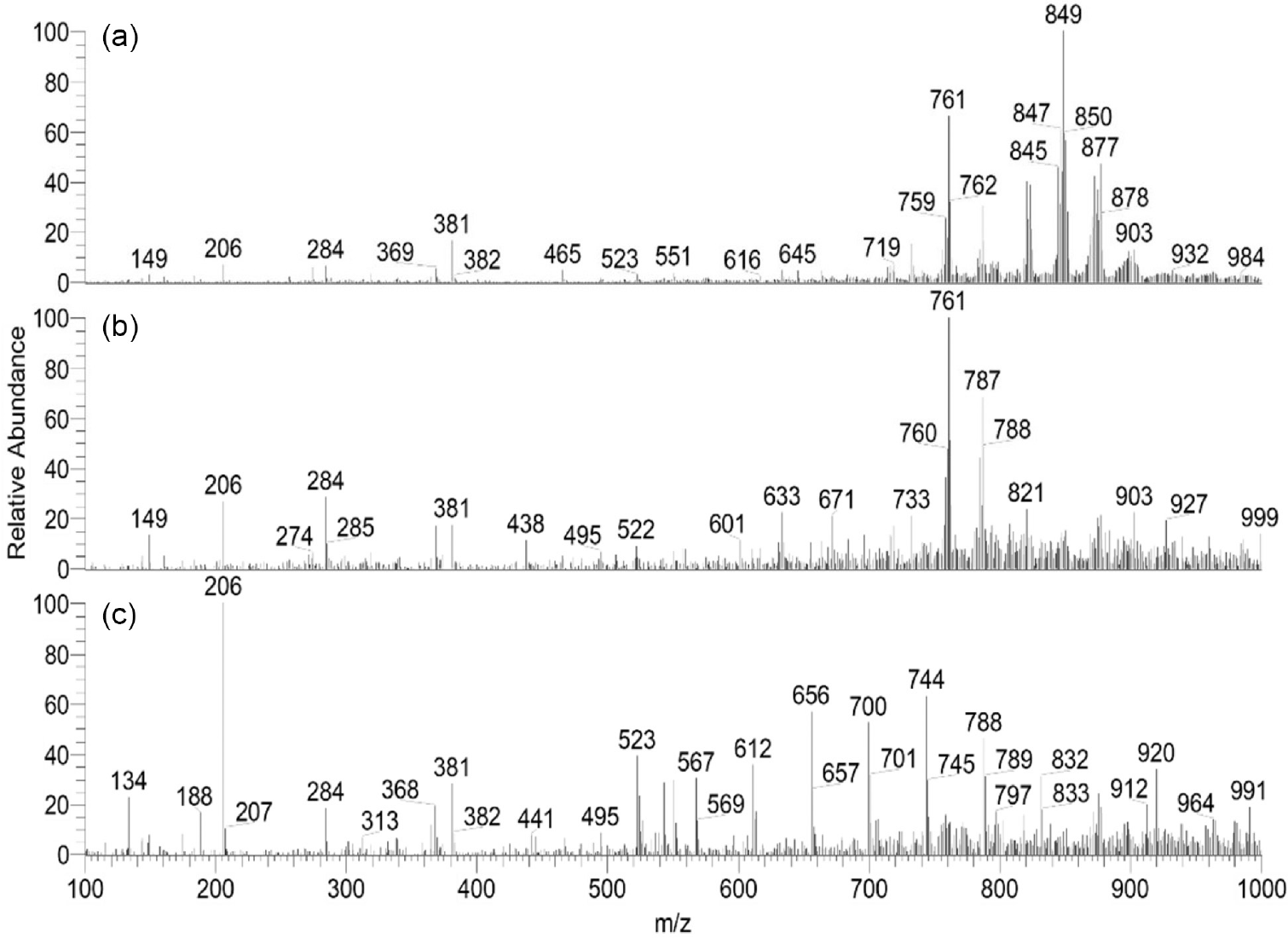
Examples of spectra of PS-MS analysis in the positive mode (PS(+)-MS) of “cagaita” pulp, peel, and seed are illustrated in Figure 1. Examples of product ion mass spectrum are shown in Figures 1S 3S (Supplementary Material).
In general, it was possible to identify ions referring to sugars, flavonoids, and organic acids, which represented 22.2% each of the chemical classes found in the positive mode. Coumarins, fatty acids, and tannins represented 11.1% each among the chemical classes. In the peel, seven compounds were tentatively identified, in the pulp, four compounds, and in the seed, two compounds, as can be seen in Table 1.
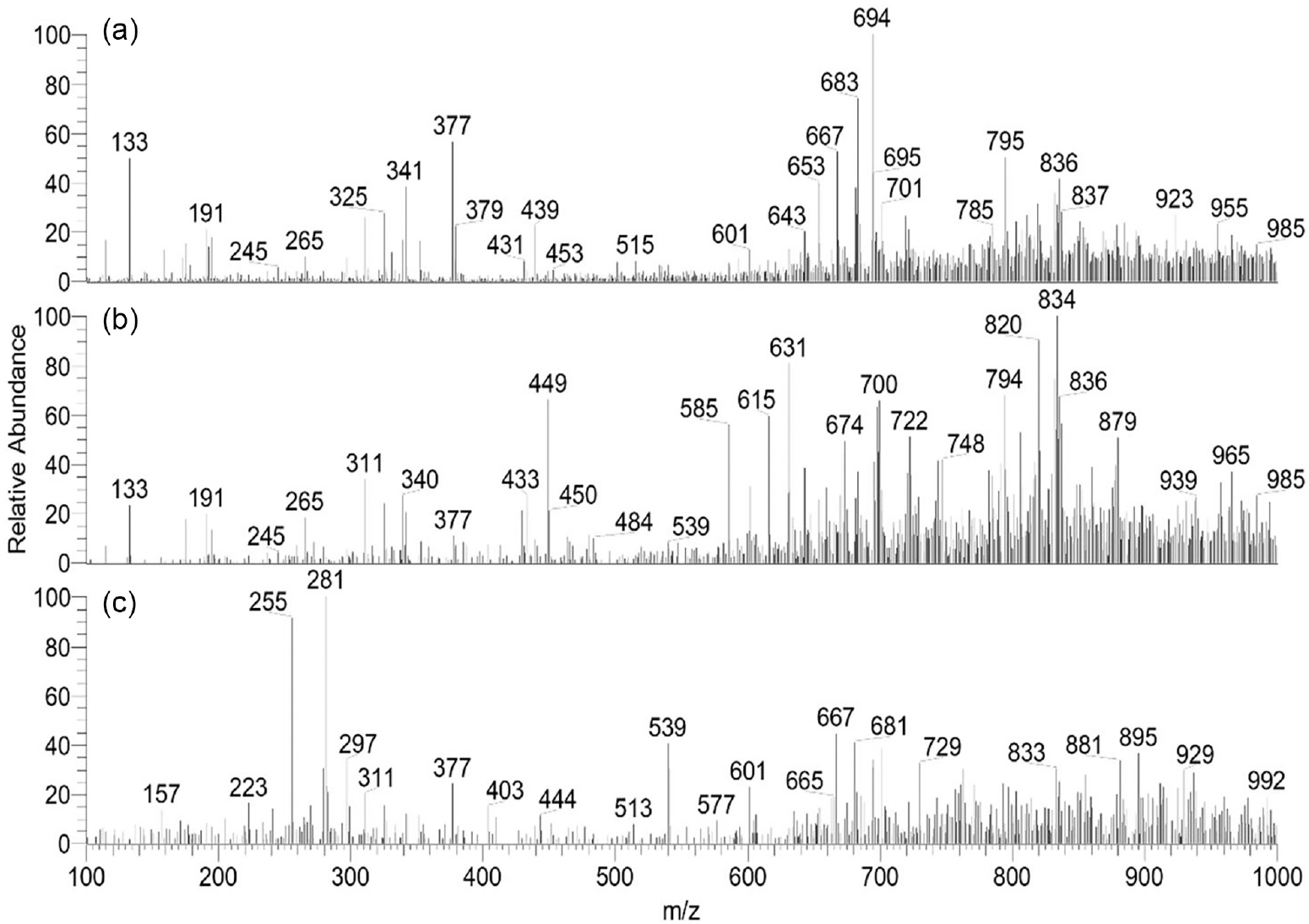
Examples of spectra of PS-MS analysis in the negative mode (PS(-)-MS) of “cagaita” pulp and peel, and seed are illustrated in Figure 2. Examples of product ion mass spectrum are shown in Figures 4S-10S (Supplementary Material).
A total of 31 compounds were identified in the negative mode in the “cagaita”, being 21 compounds present in the pulp, 17 compounds in the peel, and seven in the seed samples. In general, they were classified into phenylpropanoids, presenting 25.8% of the total compounds, flavonoids with 22.6%, organic acids 16.1%, sugars and tannins 9.7% each, fatty acids 6.5%, and phenolic acids, hydrobenzoic acids, and others with 3.2% each. All possible compounds are presented in Table 2.
The ion with m/z 206 can be recognized as citroptene, a coumarin that was identified based on its MS/MS transition 206 → 121; this compound was also found by Silva et al.2 and Rodrigues et al.3 in studies evaluating “cagaita”. Coumarin is an important class of secondary metabolites, widely present in the plant kingdom, being present in plants, from the roots to the fruits, being important enzymatic inhibitors and antioxidants acting in the physiology of plants.44
The compound m/z 207 was identified as vanillic acid, also found by Farias et al.,37,38 who evaluated the chemical profile of uvaia (Eugenia pyriformis) seeds. Vanillic acid is cited as an intermediate compound between ferulic acid and vanillin, the latter is highly explored in the herbicide, pharmaceutical and food industries.45,46 Vanillic acid is described as having anti-inflammatory, antioxidant, and immunostimulatory activities.45-47
The signal with m/z 381 can be identified as sucrose [Suc + K]+ or hexose [2Hex + K - H2O]+. Silva et al.31 found this same signal by analyzing the pulp of “cagaita”, and in our study, this compound was found in both the pulp and the peel. Another sugar found was the ion at m/z 365, this compound, like the previous one, was found in the pulp and peel. Ramos et al.39 found this ion in the pulp of “grumixama” (Eugenia brasiliensis), in positive and negative mode, using the same technique of the present study. The “grumixama” is a fruit belonging to the same genus as the “cagaita”, however, native to the Atlantic Forest, and has several compounds, common to the genus Eugenia, such as flavonoids, phenylpropanoids, vitamins, sugars, and other polyphenols.45,48
Gomphrenin (m/z 551) is an indolyl-carboxylic acid also identified in the pulp of “grumixama” by Ramos et al.39 The cyanidin 3-galactoside (m/z 449) is an anthocyanin, a compound belonging to the flavonoid group, found in several fruits, especially those of darker and red colors, such as apples, blueberries, strawberries and cherries49 with important antioxidant properties, which was also described by Ramos et al.39 in the pulp of “grumixama”. Another flavonoid, quercetin 3-O-glucuronide (m/z 479), also has important biological functions such as the previous flavonoid, as they sequester free radicals, in addition to chelate metal ions, thus protecting tissues from free radicals and lipid peroxidation.50 It is noteworthy that these two compounds were identified only in the peel, and a possible justification for this fact would be its protective function under the rest of the fruit, since the peel provides physical protection against mechanical impacts and solar rays, the latter of which have the ability to promote oxidative stress and, consequently, the release of free radicals. In this sense, it is necessary that the cells of the shell produce more flavonoids,49 because these compounds have antioxidant functions. Thus, it is clear the importance of consuming the peel of this fruit, even in natura, for greater nutritional gain, in addition to avoiding food waste.
The signal at m/z 785 has been suggested as a digalloyl HHDP-glucose (HHDP: hexahydroxydiphenoyl). This compound was identified in Eugenia leitonii by Lazarini et al.41 Classified as an ellagitannin, it belongs to a diverse class of hydrolyzable tannins and is present in some fruits, nuts and seeds, such as strawberry, raspberry, pomegranate, walnuts, and almonds. Elagitannins have an important nutritional role and several bioactive properties, such as antioxidant, anticancer, anti-atherosclerotic, antibacterial, anti-inflammatory, anti-hepatotoxic, and anti-HIV (human immunodeficiency virus) replication.51
In the positive mode, more compounds were identified in the peel than in the pulp, and two flavonoids and one fatty acid were not observed in the pulp. A probable justification for such a difference would be the protective function of the peel under the rest of the fruit. In the seed, only two compounds were identified in the positive mode (vanillic acid and digalloyl-HHDP-glucose).
Among the organic acids, two compounds at m/z 115 and 133 presented the same fragment, m/z 71 [C3H3O2]-, thus being defined as malic acid, however, the ion with signal at m/z 133 was present in the pulp and peel samples, while the same compound with m/z 115 was exclusive of the pulp. This fact is due to the differences in ionization, because while one compound was ionized presenting a water molecule in its structure, the other was ionized without this molecule, thus differing its mass-charge ratio, influencing its detections. These two ions were observed in similar studies with the pulp of “cagaita”2 and the Cerrado pear (Eugenia klotzschiana Berg),40 belonging to the same genus of “cagaita” (Eugenia). The pimelic (m/z 159) and shikimic acids (m/z 173) were also identified in “cagaita” pulp in the study by Silva et al.2
The ion m/z 191 was identified in the peel and pulp, being suggested as citric acid based on the post-fragmentation ions obtained (m/z 85, 111, and 173).2,3,39 This compound was frequently found in the literature in similar works with “cagaita” and other fruits of the genus Eugenia.2,3,10,45,48 Kaempferol, a flavonoid commonly found in fruits and vegetables such as broccoli, grapes, strawberries, tomatoes, and others,52 was identified by the ion m/z 285. This compound had not yet been found in studies evaluating “cagaita”, however it was identified in the pulp of the “grumixama” evaluated by Ramos et al.,39 using the same technique described in the present study.
The flavonoids identified as gallocatechin (m/z 305) and epigallocatechin gallate (m/z 457) in the “cagaita” seed were described for the first time in the present study in this sample. They are polyphenols, of the flavonol class, of the catechin group, being very present in green teas (Camellia sinensis). These compounds have antioxidant activity, acting in the sequestration of free radicals, and help in the reduction of corporal fat.53,54 These two compounds were previously found in the seeds of Eugenia calycina Cambess, a typical fruit species of the Cerrado, popularly known as red pitanga.42
The ion m/z 311 was identified as caftaric acid, present in the pulp and peel; this compound was often found in previous work with “cagaita”.2,3,31 Another compound present in the pulp and peel was the ion with m/z 325, a hydroxycinnamic acid conjugated to a hexose called p-coumaric acid hexoside and its identification was given by the mass spectrum MS/MS with m/z 119 and 145. In the literature,2-4,31 dealing with the chemical evaluation of “cagaita”, its identification was frequent. Coumarin is an important class of secondary metabolites, widely present in the plant kingdom, from roots to fruits, being an important enzymatic inhibitor and antioxidant in plant physiology. In addition, coumarins are of great interest in the medicinal environment, due to their ability to exert non-covalent interactions with protein structures, possessing a wide spectrum of biological activities. An example is warfarin, a drug used since the 50’s and registered by FDA (Food and Drug Administration) as an anticoagulant agent for the treatment and prevention of thromboembolic diseases.55
Among the fatty acids, palmitic acid (m/z 255) was found only in the pulp of “cagaita”, as it was also found by Silva et al.2 and in the pulp of “grumixama”.39 The compound with m/z 327 was identified as an isomer of oxo-dihydroxyoctadecenoic acid, another fatty acid, however, this ion was not found in previous studies evaluating the fixed compounds of “cagaita”, but Mariano et al.,40 analyzing the Cerrado pear, also found such a compound. The ion with m/z 339 was designated as caffeic acid in the form conjugated to a hexose (caffeoyl-D-glucose). Its fragment (m/z 159) resulted from the loss of caffeic acid (-170 amu). This compound present in the pulp and peel samples was commonly found by other authors2,3,31 evaluating the pulp of “cagaita”.
The sign m/z 355, chebulic acid, was identified in the seeds of “cagaita”, as well as by Araújo et al.42 in the seeds of red pitanga, being a phenolic compound of the class of ellagitannins. This compound was originally isolated from the fruits of Terminalia chebula (Combretaceae family), a medicinal plant widely used in India, with a wide spectrum of biological activities, such as antibacterial, anticancer, antihypertensive, and antioxidant, due to the various bioactive compounds in its constitution.56
The ion with m/z 633 has also been found in the pulp and peel, and can be attributed to a tannin conjugated to a sugar, HHDP-galloyl-glucose. This compound had not been reported before by studies evaluating “cagaita”, however, Mariano et al.,40 analyzing the pulp of the Cerrado pear, observed this same ion. Tannins are polymeric phenols, which have the ability to complexe and precipitate proteins from aqueous solutions, being responsible for the reddish pigment of some plants and fruits, and for the astringent taste of some foods. Tannins have been used throughout history to transform the skin of animals into leather (tanning), because these compounds are able to interact with macromolecules, like proteins, creating collagen fibers in the skin, acquiring resistance to heat, water and abrasives.57,58
The compounds isoenothein C (m/z 783) and galloyl-HHDP-glucose (m/z 785), found in the samples of “cagaita” seeds, were identified as hydrolyzable tannins. These compounds were identified by Omar et al.,43 who evaluated the chemical profile of jamelon (Eugenia jambolana) seeds, a species originating in India, and much explored in the traditional medicine of the country, being present today in several tropical and sub-tropical countries; and by Larazini et al.,41 evaluating the fruit Eugenia leitonii. These compounds are described as having high enzymatic inhibition, especially of alpha-glucosidase, such characteristic is considered beneficial for people who seek blood sugar regulation, such as diabetics, and people with obesity problems43,59,60 and, in addition, have other various benefits to human health due to their antioxidant activity.60-62
The ions at m/z 643 and 667, di-hydromyricetin diglucoside and quercetin acetyl hexoside, respectively, are attributed as flavonoids, both present in the peel and pulp of “cagaita”, which have bioactive properties.49,50 It is observed that the di-hydromyricetin diglucoside had not been identified until then in previous studies evaluating the fixed compounds of “cagaita”, however, this same ion was found by Ramos et al.39 in the pulp of “grumixama”.
The signs with m/z 681, 683, and 685 were attributed as phenylpropanoids, present in the peel and pulp, and were reported in previous studies2,3,31 evaluating the pulp of the “cagaita”. The ions with m/z 377 (hexose or sucrose) and m/z 719 ([tetraose + Cl]-) were attributed as sugar in the peel and pulp of “cagaita”, and were also reported by Silva et al.2 in the pulp of “cagaita” and in the ice cream of “cagaita”.
CONCLUSIONS
It is concluded that the pulp presented more compounds, such as organic acids, phenylpropanoids, fatty acids, flavonoids and others. The seeds presented a higher amount of compounds in the negative mode as well as the rest of the parts of the fruit compared to the positive mode. Among them stand out the hydrolyzable tannins and some flavonoids. Some compounds that have been identified here corroborate the previous literature evaluating the pulp of the “cagaita”. The evaluation of the chemical compounds in the peel and seeds of the “cagaita” was a differential in this study, since this approach is still incipient in the literature. Thus, the use of these parts considered waste is an excellent option from a nutritional as well as environmental point of view, avoiding waste generation.
Therefore, the analysis by PS-MS proved to be a simple, fast, and efficient technique in obtaining the fingerprints of the constituents of the “cagaita”, allowing the identification of several compounds present in the peel, seed, and pulp of this fruit.
SUPPLEMENTARY MATERIAL
Some figures of the PS-MS spectra are available in http://quimicanova.sbq.org.br, in the form of a PDF file, with free access.
Supplementary PDF
ACKNOWLEDGMENTS
The authors would like to thank the Universidade Federal de São João del-Rei (UFSJ, PROPE), Universidade Federal de Minas Gerais (UFMG), FAPEMIG, CAPES (finance code 001), CNPq (research productivity grant 132217/2023-6, 307787/2022-2 and 404432/2024-7), and the Teaching, Research and Extension Group in Chemistry and Pharmacognosy (GEPEQF). This study was financed in part by FAPEMIG (Finance Code APQ-04336-23, APQ-05883-24, PPE-00094-23 and 5.308/15).
DATA AVAILABILITY STATEMENT
The data used and generated in the research are available in the text.
REFERENCES
-
1 Takahashi, J. A.; Melo, J. O. F.; de Araújo, R. L. B.; Pimenta, L. P. S.; Mazzinghy, A. C. C.; Ramos, A. L. C. C.; Silva, V. D. M.; Food Res. Int. 2024, 197, 115223. [Crossref]
» Crossref -
2 Silva, M. R.; Freitas, L. G.; Mendonça, H. O. P.; Souza, A. G.; Pereira, H. V.; Augusti, R.; Lacerda, I. C. A.; Melo, J. O. F.; de Araújo, R. L. B.; Quim. Nova 2021, 44, 129. [Crossref]
» Crossref -
3 Rodrigues, D. B.; Mendonça, H. O. P.; Nogueira, L. A.; de Paula, A. C. C. F. F.; de Melo, A. C.; Reina, L. D. C. B.; Silva, M. R.; de Araújo, R. L. B.; Augusti, R.; Melo, J. O. F.; Research, Society and Development 2021, 10, e25610111735. [Crossref]
» Crossref -
4 dos Santos, M. N. G.: Avaliação de Polpa de “Cagaita” (Eugenia dysenterica DC.) Submetida ao Congelamento e Atomização; MSc Dissertation, Federal University of Goiás, Goiânia, Brazil, 2015. [Link] accessed in March 2026
» Link -
5 Bueno, G. H.; Guedes, M. N. S.; de Souza, A. G.; Madeira, A. P. C.; Garcia, E. M.; Taroco, H. A.; Melo, J. O. F.; Brazilian Journal of Biometrics 2017, 35, 515. [Link] accessed in March 2026
» Link -
6 Myers, N.; Mittermeier, R. A.; Mittermeier, C. G.; da Fonseca, G. A. B.; Kent, J.; Nature 2000, 403, 853. [Link] accessed in March 2026
» Link -
7 Sano, E. E.; Rosa, R.; Brito, J. L. S.; Ferreira, L. G.; Environ. Monit. Assess. 2010, 166, 113. [Crossref]
» Crossref -
8 Bailão, E. F. L. C.; Devilla, I. A.; da Conceição, E. C.; Borges, L. L.; Int. J. Mol. Sci. 2015, 16, 23760. [Crossref]
» Crossref -
9 Oliveira, K. B.; Garcia, E. M.; Reis, G. D.; Taroco, H. A.; Melo, J. O. F.; Souza, A. G.; Scientific Electronic Archives 2017, 10, 58. [Link] accessed in March 2026
» Link -
10 de Araújo, F. F.; Neri-Numa, I. A.; Farias, D. P.; da Cunha, G. R. M. C.; Pastore, G. M.; Food Res. Int. 2019, 121, 57. [Crossref]
» Crossref -
11 Rodrigues, D. B.; Costa, L. T.; Lopes, T. S.; Souza, A. G.; Garcia, E. M.; Melo, C. P. O. F.; Taroco, H. A.; Melo, J. O. F.; Scientific Electronic Archives 2017, 10, 40. [Link] accessed in March 2026
» Link -
12 de Sousa, E. R. B.; Camilo, Y. M. V.; Vera, R. In Exotic Fruits; Rodrigues, S.; Silva, E. O.; de Brito, E. S., eds; Academic Press: Cambridge, USA, 2018, p. 77-83. [Crossref]
» Crossref -
13 Silva, R. S. M.; Chaves, L. J.; Naves, R. V.; Rev. Bras. Frutic. 2001, 23, 330. [Crossref]
» Crossref -
14 Guedes, M. N. S.; Rufini, J. C. M.; Marques, T. R.; Melo, J. O. F.; Ramos, M. C. P.; Viol, R. E.; Rev. Bras. Frutic. 2017, 39, e-360. [Crossref]
» Crossref -
15 Silva, S. M. M.; Silva, C. A. G.; Fonseca-Bazzo, Y. M.; Magalhães, P. O.; Silveira, D.; Infarma - Ciências Farmacêuticas 2015, 27, 49. [Crossref]
» Crossref -
16 Genovese, M. I.; Pinto, M. S.; Gonçalves, A. E. S. S.; Lajolo, F. M.; Food Sci. Technol. Int. 2008, 14, 207. [Crossref]
» Crossref -
17 Gonçalves, A. E. S. S.; Lajolo, F. M.; Genovese, M. I.; J. Agric. Food Chem. 2010, 58, 4666. [Crossref]
» Crossref -
18 Lima, T. B.; Silva, O. N.; Oliveira, J. T. A.; Vasconcelos, I. M.; Scalabrin, F. B.; Rocha, T. L.; Grossi-de-Sá, M. F.; Silva, L. P.; Guadagnin, R. V.; Quirino, B. F.; Castro, C. F. S.; Leonardecz, E.; Franco, O. L.; Peptides 2010, 31, 1426. [Crossref]
» Crossref -
19 Cardoso, L. M.; Martino, H. S. D.; Moreira, A. V. B.; Ribeiro, S. M. R.; Pinheiro-Sant’Ana, H. M.; Food Res. Int. 2011, 44, 2151. [Crossref]
» Crossref -
20 Souza, P. M.; Elias, S. T.; Simeoni, L. A.; de Paula, J. E.; Gomes, S. M.; Guerra, E. N. S.; Fonseca, Y. M.; Silva, E. C.; Silveira, D.; Magalhães, P. O.; PLoS One 2012, 7, e48589. [Crossref]
» Crossref -
21 Prado, L. C. S.; Silva, D. B.; de Oliveira-Silva, G. L.; Hiraki, K. R. N.; Canabrava, H. A. N.; Bispo-da-Silva, L. B.; Biol. Pharm. Bull. 2014, 37, 722. [Crossref]
» Crossref -
22 Donado-Pestana, C. M.; Belchior, T.; Genovese, M. I.; Food Res. Int. 2015, 77, 177. [Crossref]
» Crossref -
23 Gasca, C. A.; Castillo, W. O.; Takahashi, C. S.; Fagg, C. W.; Magalhães, P. O.; Fonseca- Bazzo, Y. M.; Silveira, D.; Food Chem. Toxicol. 2017, 109, 996. [Crossref]
» Crossref -
24 Gasca, C. A.; Chaves, M.; Fagg, C. W.; Magalhães, P. O.; Fonseca Bazzo, Y. M.; Silveira, D.; J. Appl. Pharm. Sci. 2017, 7, 51. [Crossref]
» Crossref -
25 Prabhu, G. R. D.; Williams, E. R.; Wilm, M.; Urban P. L.; Nat. Rev. Methods Primers 2023, 3, 23. [Crossref]
» Crossref -
26 Takáts, Z.; Wiseman, J. M.; Cooks, R. G.; J. Mass Spectrom. 2005, 40, 1261. [Crossref]
» Crossref -
27 Feider, C. L.; Krieger, A.; DeHoog, R. J.; Eberlin, L. S.; Anal. Chem. 2019, 91, 4266. [Crossref]
» Crossref -
28 Wang, H.; Liu, J.; Cooks, R. G.; Ouyang, Z.; Angew. Chem., Int. Ed. 2010, 49, 877. [Crossref]
» Crossref -
29 Liu, J.; Wang, H.; Manicke, N. E.; Lin, J.-M.; Cooks, R. G.; Ouyang, Z.; Anal. Chem. 2010, 82, 2463. [Crossref]
» Crossref -
30 McBride, E. M.; Mach, P. M.; Dhummakupt, E. S.; Dowling, S.; Carmany, D. O.; Demond, P. S.; Rizzo, G.; Manicke, N. E.; Glaros, T.; TrAC, Trends Anal. Chem. 2019, 118, 722. [Crossref]
» Crossref -
31 Silva, M. R.; Freitas, L. G.; Souza, A. G.; Araújo, R. L. B.; Lacerda, I. C. A.; Pereira, H. V.; Augusti, R.; Melo, J. O. F.; J. Braz. Chem. Soc. 2019, 30, 1034. [Crossref]
» Crossref -
32 Ramos, A. L. C. C.; Minighin, E. C.; Soares, I. I. C.; Ferreira, R. M. S. B.; de Sousa, I. M. N.; Augusti, R.; Labanca, R. A.; de Araújo, R. L. B.; Melo, J. O. F.; Food Res. Int. 2023, 165, 112514. [Crossref]
» Crossref -
33 Correia, V. T. V.; D’Angelis, D. F.; Queiroz, V. A. V.; Ramos, A. L. C. C.; Macedo, M. C. C.; Augusti, R.; Melo, J. O. F.; Ferreira, A. A.; Lacerda, I. C. A.; Fante, C. A.; J. Braz. Chem. Soc. 2023, 34, 182. [Crossref]
» Crossref -
34 Ramos, A. L. C. C.; García, Y. M.; de Oliveira, A. F.; de Paula, A. C. C. F. F.; de Lemos, E. E. P.; Reina, L. D. C. B.; Silva, M. R.; Augusti, R.; de Araújo, R. L. B.; Melo, J. O. F. In Ciências Agrárias: O Avanço da Ciência no Brasil; Melo, J. O. F., ed.; Editora Científica Digital: Guarujá, Brazil, 2021, ch. 15. [Crossref]
» Crossref - 35 Xcalibur, version 2.1; Thermo Scientific; San Jose, CA, USA, 2011.
-
36 García, Y. M.; Ramos, A. L.C. C.; de Oliveira Júnior, A. H.; de Paula, A. C. C. F. F.; de Melo, A. C.; Andrino, M. A.; Silva, M. R.; Augusti, R.; de Araújo, R. L. B.; de Lemos, E. E. P.; Melo, J. O. F.; Molecules 2021, 26, 7206. [Crossref]
» Crossref -
37 Farias, D. P.; de Araújo, F. F.; Neri-Numa, I. A.; Dias-Audibert, F. L.; Delafiori, J.; Catharino, R. R.; Pastore, G. M.; Food Res. Int. 2020, 137, 109522. [Crossref]
» Crossref -
38 Farias, D. P.; de Araújo, F. F.; Neri-Numa, I. A.; Dias-Audibert, F. L.; Delafiori, J.; Catharino, R. R.; Pastore, G. M.; Food Res. Int. 2021, 150, 110767. [Crossref]
» Crossref -
39 Ramos, A. L. C. C.; Mendes, D. D.; Silva, M. R.; Augusti, R.; Melo, J. O. F.; de Araújo, R. L. B.; Lacerda, I. C. A.; Research, Society and Development 2020, 9, e318974008. [Link] accessed in March 2026
» Link -
40 Mariano, A. P. X.; Ramos, A. L. C. C.; Augusti, R.; Araújo, R. L. B.; Melo, J. O. F.; Research, Society and Development 2020, 9, e949998219. [Link] accessed in March 2026
» Link -
41 Lazarini, J. G.; Franchin, M.; Infante, J.; Paschoal, J. A. R.; Freires, I. A.; de Alencar, S. M.; Rosalen, P. L.; J. Funct. Foods 2016, 26, 249. [Crossref]
» Crossref -
42 Araújo, N. M. P.; Arruda, H. S.; dos Santos, F. N.; de Morais, D. R.; Pereira, G. A.; Pastore, G. M.; Food Res. Int. 2020, 137, 109556. [Crossref]
» Crossref -
43 Omar, R.; Li, L.; Yuan, T.; Seeram, N. P.; J. Nat. Prod. 2012, 75, 1505. [Crossref]
» Crossref -
44 Franco, D. P.; Pereira, T. M.; Vitorio, F.; Nadur, N. F.; Lacerda, R. B.; Kümmerle, A. E.; Quim. Nova 2021, 44, 180. [Crossref]
» Crossref -
45 Libardi, S. H.: Atividade Antioxidante da Vanilina e do Ácido Vanílico e o Efeito da Complexação por Proteínas do Soro do Leite na Desativação de Radicais e Ferrilmioglobina em Condições Simulando o Trato Gastrointestinal; MSc Dissertation, University of São Paulo, São Carlos, Brazil, 2010. [Crossref] accessed in March 2026
» Crossref -
46 Oliveira, A. J. M. S.: Amidas Derivadas do Ácido Vanílico: Reações de Acoplamento e Bioatividade; MSc Dissertation, Federal University of Paraíba, João Pessoa, Brazil, 2018. [Link] accessed in March 2026
» Link -
47 Jung, Y.; Park, J.; Kim, H.-L.; Sim, J.-E.; Youn, D.-H.; Kang, J.; Lim, S.; Jeong, M.-Y.; Yang, W. M.; Lee, S.-G., Ahn, K. S.; Um, J.-Y.; FASEB J. 2018, 32, 1388. [Crossref]
» Crossref -
48 Nogueira, L. A.; Figueiredo, Y. G.; Ramos, A. L. C. C.; Correia, V. T. V.; Nunes, B. V.; Ribeiro, L. V.; Franco, A. O.; Ferreira, R. B.; Sousa, I.; Mota, J.; Batista-Santos, P.; de Araújo, R. L. B.; Melo, J. O. F.; Frontiers in Food Science and Technology 2022, 2, 899492. [Crossref]
» Crossref -
49 Liang, Z.; Liang, H.; Guo, Y.; Yang, D.; Int. J. Mol. Sci. 2021, 22, 2261. [Crossref]
» Crossref -
50 Behling, E. B.; Sendão, M. C.; Francescato, H. D. C.; Antunes, L. M. G.; Bianchi, M. L. P.; Aliment. Nutr. 2004, 15, 285. [Link] accessed in March 2026
» Link -
51 Landete, J. M.; Food Res. Int. 2011, 44, 1150. [Crossref]
» Crossref -
52 Rajendran, P.; Rengarajan, T.; Nandakumar, N.; Palaniswami, R.; Nishigaki, Y.; Nishigaki, I.; Eur. J. Med. Chem. 2014, 86, 103. [Crossref]
» Crossref -
53 Lamarão, R. C.; Fialho, E.; Rev. Nutr. 2009, 22, 257. [Crossref]
» Crossref -
54 Zielinski, A. A. F.: Avaliação dos Compostos Fenólicos e Atividade Antioxidante in vitro de Chás: Classificação, Modelagem e Otimização por Técnicas Quimiométricas; PhD Thesis, Federal University of Paraná, Curitiba, Brazil, 2015. [Link] accessed in March 2026
» Link -
55 Colet, C. F.; Amador, T. A.; Heineck, I.; International Journal of Cardiovascular Sciences 2019, 32, 110. [Crossref]
» Crossref -
56 Dhingra, A. K.; Chopra, B.; Grewal, A. S.; Guarve, K.; Pharmacological Research - Modern Chinese Medicine 2022, 5, 100163. [Crossref]
» Crossref -
57 Silva, M. R.; da Silva, M. A. A. P.; Rev. Nutr. 1999, 12, 21. [Crossref]
» Crossref -
58 Barbosa, N. C.: Uma Revisão Bibliográfica dos Fatores Antinutricionais: Taninos, Inibidores de Proteases e Lectinas; Final Paper, Federal Institute of Education, Science and Technology of Goiás, Anápolis, Brazil, 2015. [Link] accessed in March 2026
» Link -
59 Bezerra, M. F.: Polpa de Jambolão (Eugenia jambolana Lam.) Fresca e Desidratada: Características Físico-Químicas, Bioativas e Funcionais, Efeitos Biológicos em Caenorhabditis elegans e Uso para Produção de Frozen Yogurt Caprino Probiótico; PhD Thesis, Federal University of Rio Grande do Norte, Natal, Brazil, 2015. [Link] accessed in March 2026
» Link -
60 Wu, S.-B.; Wu, J.; Yin, Z.; Zhang, J.; Long, C.; Kennelly, E. J.; Zheng, S.; J. Agric. Food Chem. 2013, 61, 4035. [Crossref]
» Crossref -
61 Pinheiro, A. J. M. C. R.; Mendes, A. R. S.; Neves, M. D. F. J.; Prado, C. M.; Bittencourt-Mernak, M. I.; Santana, F. P. R.; Lago, J. H. G.; de Sá, J. C.; da Rocha, C. Q.; de Sousa, E. M.; Fontes, V. C.; Grisoto, M. A. G.; Falcai, A.; Lima-Neto, L. G.; Front. Immunol. 2019, 10, 2727. [Crossref]
» Crossref -
62 He, H.-F.; Front. Nutr. 2022, 9, 888892. [Crossref]
» Crossref
Edited by
-
Associate Editor handled this article:
Fernando F. Sodré