 ENHANCING 2,4-DICHLOROPHENOXYACETIC ACID DEGRADATION VIA FENTON OXIDATION PROCESS (H2O2/Fe2+) USING FACTORIAL PLANNING
Abstract
This study explores the degradation of 2,4-dichlorophenoxyacetic acid (2,4-D), a common herbicide, using the Fenton oxidation process under varying conditions. A factorial design approach was applied to evaluate the impact of pH (2.50, 2.75, 3.00), FeSO4∙7H2O concentrations (0.3, 0.5, and 0.7 mmol L-1), and H2O2 concentrations (3.0, 5.0, and 7.0 mmol L-1), with a fixed 2,4-D concentration of 100 mg L-1. A total of 27 experiments were conducted to assess removal efficiency and post-treatment ecotoxicity. Optimal degradation was observed at pH 2.75, FeSO4∙7H2O = 0.3 mmol L-1, and H2O2 = 7.0 mmol L-1, achieving a 69.66% reduction in 2,4-D concentration after 120 min of treatment. The results indicate that the Fenton process is a viable pretreatment option for agrochemical wastewater, offering effective partial degradation and a reduction in toxicity. These findings support the potential of Fenton oxidation as an environmentally friendly approach for mitigating the impacts of herbicide-contaminated wastewater.
Keywords:
Fenton oxidation; degradation efficiency; advanced oxidation processes; factorial design; 2,4-D degradation.
INTRODUCTION
Agriculture, an ancient practice indispensable to humanity,1 commonly employs pesticides to control weeds, pests, fungi, and aid in the development of agricultural crops.2 2,4-Dichlorophenoxyacetic acid (2,4-D) is widely used as herbicide in agriculture, making it the most commonly used herbicide for broadleaf weed control in both crops and non-crop areas.3-5 Despite its agricultural benefits, 2,4-D is known to negatively affect biological systems, raising concerns about adverse health effects in animals and humans. These effects include the disruption of immunological responses and deoxyribonucleic acid (DNA) repair,6,7 alteration in antioxidant enzyme activities8,9 and negative effect in embryo development in zebrafish (Danio rerio).10 Toxicity (median effective concentration (EC50) value of 21.1 mg L-1 from Microtox test and 213 mg L-1 from activated sludge respiration inhibition test) and low biodegradability (less than 25% of total organic carbon (TOC) reduction after 28 days) indicate that traditional biological treatments are not effective for 2,4-D removal.11,12
The utilization of advanced oxidative processes (AOPs) has emerged as an excellent option for degrading 2,4-D in water and treating agrochemical-containing wastewaters.13-15 Various AOPs, including gamma irradiation with H2O2,16 ozonation, catalytic ozonation,17,18 ultrasonic and electrochemical oxidation,19 monometallic Pb catalysis,20 UV-H2O2 process,21 and the Fenton reaction,22 have been explored.
The Fenton reaction has been extensively studied and employed for removing pesticides in contaminated water, owing to its faster rate of pollutant elimination.13 In the Fenton process, iron salts are added as catalysts to a hydrogen peroxide solution, generating hydroxyl radicals (HO•), making it relatively simple to be implemented.23 These processes are renowned for efficiently producing potent non-selective hydroxyl radicals, which effectively dismantle the target contaminant.13 The effectiveness of Fenton oxidation as pretreatment when combined with a biological treatment process (sequencing batch reactors) achieves 90% reduction in organic matter.22
Despite being a well-established process for decades and there are other AOPs such as photo-Fenton and electro-Fenton, the Fenton process continues to be in demand, mainly due to its simplicity and when the implementation of an electrolysis system or ultraviolet (UV) source is not feasible.24 In this context, it is relevant to study the optimization of the operational conditions of the Fenton process, aiming for the best cost-benefit ratio to minimize the reagents consumption while maintaining efficiency in 2,4-D degradation. In this regard, factorial design25 emerges as a powerful statistical approach for identifying the optimal experimental parameters to maximize the degradation response.
This research aims to optimize the operational conditions of the Fenton oxidation process using factorial design. By systematically varying key factors such as the concentration of hydrogen peroxide, dosage of iron catalyst, and pH, the study seeks to identify the optimal combination of these parameters to achieve the highest efficiency in degrading 2,4-D herbicide.
EXPERIMENTAL
Chemicals and reagents
Technical grade 2,4-D (97% purity, Sigma-Aldrich®) was used to obtain the calibration curve (initial stock solution of 1,000 mg L-1 diluted in acetonitrile). Commercial 2,4-D herbicide (DMA® 806 BR, DOW) was used to perform the degradation tests using Fenton oxidation (initial stock solution of 1000 mg L-1 diluted in distilled water).
Ferrous sulfate heptahydrate (FeSO4∙7H2O, Synth®) was used as a catalyst, hydrogen peroxide (H2O2 30%, Sigma-Aldrich®) was used as a source of hydroxyl radicals, sulfuric acid (H2SO4, Química Moderna®) and sodium hydroxide (NaOH, Química Moderna®) were used to pH control in the reaction solution.
Fenton oxidation process
For the evaluation of different operational conditions, a complete 33 factorial design was used (Statistica 8.0, StatSoft, Tulsa, OK, USA, 2007). Selected operational conditions included: FeSO4∙7H2O concentration of 0.3, 0.5 and 0.7 mmol L-1; H2O2 concentration of 3, 5 and 7 mmol L-1; pH of 2.5, 2.75 and 3.0, resulting in 27 tests. The experiments were performed at 21 ± 1 °C, and the initial concentration of commercial 2,4-D was fixed in 100 mg L-1 for all the tests. The experimental planning matrix is presented in Table 1. It was selected pH 2.5-3.0 to center the tests around the well-established optimum for homogeneous Fenton chemistry (ca. 2.8-3.0), avoiding FeIII precipitation at higher pH and •OH/proton scavenging at lower pH.26 The FeSO4∙7H2O (0.3-0.7 mM Fe2+) and H2O2 (3-7 mM) windows place the system in the typical millimolar regime used in bench-scale Fenton studies, spanning subto supra-optimal oxidant/catalyst doses while keeping Fe loads moderate; this bracket is intended to capture the known curvature with respect to the H2O2/Fe2+ ratio and to avoid efficiency losses from excess H2O2 via radical/self-quenching side reactions.27 Finally, an initial 2,4-D concentration of 100 mg L-1 provides an analytically robust challenge concentration that is widely adopted in AOP/Fenton optimization for chlorinated aromatics, facilitating comparison with prior literature and kinetic modeling.
Experimental design for evaluating the 2,4-D degradation with variations in FeSO4∙7H2O, H2O2 and pH
Fenton reaction system was composed by a glass reactor (net volume of 500 mL) and a magnetic stirrer. It was used a pH meter (mPA 210P, Tecnopon®) for measuring pH and temperature. For each test were used 100 mL of sample contain commercial 2,4-D, 100 mL of H2O2 and 100 mL of FeSO4∙7H2O, whose dilutions were prepared immediately before testing began. Monitoring was carried out manually and 5 mL of sample was collected with a volumetric pipette at the beginning of the test and after 2, 5, 10, 15, 20, 30, 60 and 120 min. The 2,4-D degradation efficiency was calculated considering the measurements after 120 min of reaction time.
Aiming a fast and simple way to monitor the 2,4-D degradation, measurements was carried out using a UV-Vis spectrophotometer (Specord 50 Plus, Analytik Jena®) with a quartz cuvette. The reactants (FeSO4∙7H2O, and technical grade 2,4-D) and two commonly by-products (2,4-dichlorophenol and phenol) were scanned between 200-900 nm, in order to check their respective absorption maxima and identify interferences in the spectrophotometer measurements. Two main wavelengths to monitor 2,4-D were 235 and 290 nm, being 235 nm preferred due to minor observed interference with products. Calibration curve was carried out using the technical grade 2,4-D at the concentrations of 1, 2, 5, 10, 20 and 100 mg L-1. The limits of detection (LOD) and quantification (LOQ) was determined by ten blank measurements and calculated according to the equations , and LOQ = 3 × LOD, resulting in values of 0.95 and 2.85 mg L-1, respectively.
Ecotoxicological tests
Ecotoxicological tests were carried out based on the Organization for Economic Co-operation and Development (OECD) guideline for the testing of chemicals 208.28 The bioindicator plant selected was lettuce (Lactuca sativa L.).
For each test, 10 seeds and 2 mL of sample were placed in 10 cm petri dish with membrane. The dishes were closed, sealed with aluminum foil and incubated at 25 ± 2 °C. Germination percentage was evaluated after five days for determination of the median effect concentration (EC50) using the Spearman-Karber method.29
RESULTS AND DISCUSSION
Optimization of reaction parameters
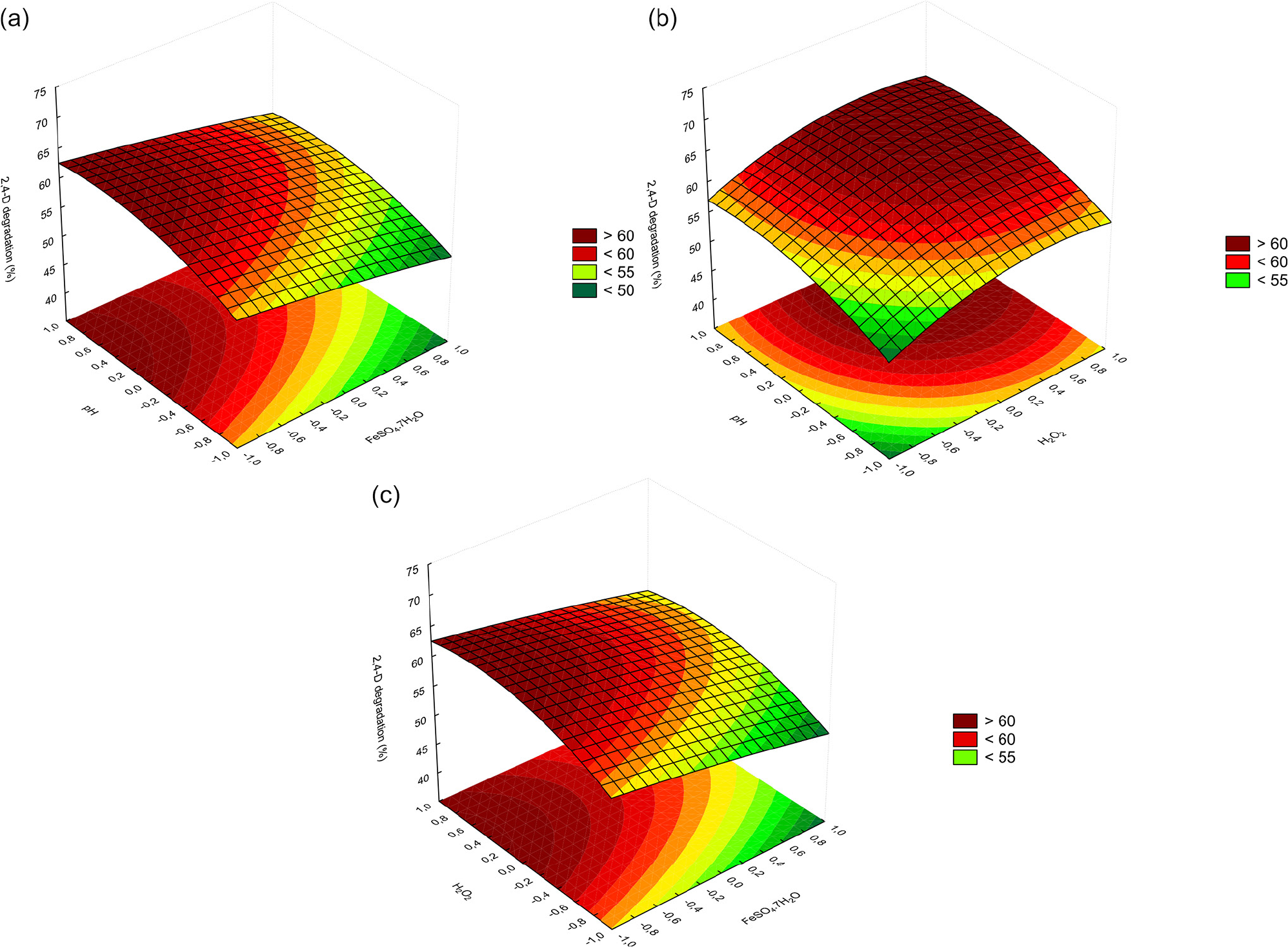
The analysis of factorial design shows significant effect of all three variables ([FeSO4∙7H2O], [H2O2], and pH) on the efficiency of 2,4-D degradation by Fenton process. The Figure 1 present the response surfaces obtained from the factorial design for degradation monitoring at 235 nm (monitoring at 290 nm are shown in Figure 1S, Supplementary Material). Table 2 shows the degradation efficiency of 2,4-D determined from measurements at 235 nm. The corresponding results obtained at 290 nm are provided in the Supplementary Material (Table 1S).
2,4-D degradation for each experimental condition, after 120 min, based on the UV-Vis measurements at 235 nm
Surfaces of response for degradation efficiency of 2,4-D (measurements at 235 nm). Evaluating: (a) pH and FeSO4∙7H2O effect with fixed H2O2; (b) pH and H2O2 effect with fixed FeSO4∙7H2O; (c) H2O2 and FeSO4∙7H2O effect with fixed pH. All fixations were set at level 0
According to the Pareto charts (Figure 2S), only the FeSO4 concentration and pH variation showed a significant effect on 2,4-D degradation (p < 0.05). However, we still evaluated the behavior of the assays under the variation in H2O2 concentration and compared the results with the effects reported in the literature.24 From results of the experimental design, the calculated critical values (point of maximum) for 2,4-D degradation (%) were -4.59 for FeSO4, 0.46 for pH, and 0.60 for H2O2, where these values are relative to the coefficients used in the test (-1, 0, 1), resulting in a predicted degradation of 68.43%, according to the equation: 68.43% = 0.46pH + 0.60H2O2 - 4.59FeSO4. Note that the predicted value for FeSO4 is below the lower tested value, and therefore it lacks precision.
Effects of pH
The degradation of 2,4-D at 235 nm is notably higher in environments with pH 2.75 and 3.00. Degradation of 2,4-D conducted at pH 2.75 achieves 69.7 and 69.0% in trials 8 and 14, respectively. The trial exhibiting the highest degradation rate involved a lower concentration of FeSO4∙7H2O and a higher concentration of H2O2. These results align with the observations of Al Momani et al.,30 who, operating at pH 3.00 using the photo-Fenton reaction, achieved a maximum degradation of 66.9% for 2,4-D. Acidic conditions are favorable for the degradation of 2,4-D.31 Other studies also support the preference for pH 3.0 in the Fenton reaction, as evidenced by Li et al.,32 who observed a maximum degradation of 87.54% at pH 3.0, while alternative pH values (1, 4, and 5) resulted in values below 20% after 180 min of reaction,33 obtained satisfactory results of 99.2% with a pH of 3.0 in a concentration of 2.4-D at 2.6 mg L-1.
The Fenton process is typically carried out in the pH range of 2.5-3.0.34,35 This condition is constrained, as at very low pH, there is the formation of H+ ions that consume and decrease the HO• radicals, according to the reaction: HO• + H+ + e- → H2O. At pH levels above 3.0, there is also a decrease in efficiency due to increased production of Fe3+ and a reduction in the production of HO•,34 and at elevated pH levels, occurs the precipitation of Fe(OH)3, resulting in a decrease in the concentration of the catalyst in the solution.36
Effects of FeSO4∙7H2O concentration
For FeSO4∙7H2O it was found that the lowest Fe2+ concentration (0.3 mmol L-1) resulted in the highest degradation efficiency, corresponding to an H2O2/Fe2+ molar ratio of approximately 23:1. A study37 on the effect of Fe2+ ligand and H2O2/Fe2+ ratio on the hydroxyl radical yield reported that for Fe2+ sulfate 25:1 ratio presents high HO• yield compared to 50:1 and 10:1 ratio, in addition sulfate decreases HO• yield.
Effects of H2O2 concentration
The importance of H2O2 is related to its influence on the generation of hydroxyl radicals.15,37 In this work, the maximum degradation of 2,4-D was achieved when applying concentrations of 7 mmol L-1 of H2O2. Li et al.32 found optimal values for Fenton oxidation of 2,4-dichlorophenol when using 10 mmol L-1 (86.22%) after 180 min of reaction. A 99.2% degradation of 2,4-D was achieved with H2O2 concentration of 470 μL L-1.33
Despite its desirable effectiveness, the required dose of the Fenton reagent is an important factor to consider as it can determine the economic viability of the process. In our study, the doses needed to treat the herbicide 2,4-D at a concentration of 100 mg L-1 are not excessively high, suggesting that the Fenton process can be considered as either a treatment or a pre-treatment for wastewater containing 2,4-D.
Predicted optimized conditions
The complete factorial design allows to estimate the ideal conditions to maximize the desired response (2,4-D degradation). Those critical values are calculated as [H2O2] 5.92 mmol L-1, and pH 2.90 (experimental design codes [H2O2] 0.461, and pH 0.597). For the experimental range chosen for variable [FeSO4∙7H2O] in this work, an efficiency maximum was not reached, preventing the determination of a critical (optimum) value, allowing only the observation of the consistent increasing efficiency at lower levels, indicating that a further reduction in Fe2+ concentration can perform better performance, however, a new scan with lower concentrations is needed to confirm this hypothesis. For instance, the better proposed conditions for 2,4-D degradation by Fenton reaction in terms of [FeSO4∙7H2O], [H2O2], and pH are 0.3 mmol L-1, 5.92 mmol L-1, and 2.90, respectively.
A 2.4-D degradation of 31.13% was reported38 using 0.18 mmol L-1 of Fe2+ and 2.94 mmol L-1 of H2O2, and the degradation drop to 28.65% when reducing [Fe2+] to 0.09 mol L-1. Optimization studies39 reported a lower degradation of 60.93% with 17.68 mmol L-1 of H2O2 and 0.39 mmol L-1 of Fe2+, and a maximum degradation of 88.02% with 5.44 mmol L-1 of H2O2 and 0.12 mmol L-1 of Fe2+.
Ecotoxicological tests
Ecotoxicity of the synthetic wastewater containing commercial 2,4-D, treated with Fenton oxidation, was evaluated under the condition of maximum 2,4-D degradation (0.3 mmol L-1 FeSO4∙7H2O, 7 mmol L-1 H2O2, pH 3.0). Samples were collected at 0 (initial), 15, and 120 min of reaction time. Additionally, synthetic wastewater containing technical-grade 2,4-D was tested at concentrations ranging from 0.5 to 20 mg L-1 for comparison. The 5-day EC50 for the germination of Lactuca sativa L. was determined (Table 3).
Results of Spearman-Karber EC50 for technical grade and commercial 2,4-dichlorophenoxyacetic (2,4-D) herbicide using Lactuca sativa L. as bioindicator
The EC50 for technical-grade 2,4-D was 3.5 mg L-1, indicating high toxicity, with mortality rates ranging from 40 to 90%. In contrast, the commercial formulation of 2,4-D subjected to Fenton oxidation exhibited a marked reduction in toxicity over time. Initially, at the start of the Fenton process (0 min), 100% mortality was observed, indicating severe toxicity. However, as the reaction progressed, mortality dropped significantly, with only 10% observed after 120 min. The EC50 value for the Fenton-treated commercial 2,4-D increased to 39.3 mg L-1, demonstrating a marked reduction in toxicity after just 15 min of reaction.
These results demonstrate that the Fenton process is effective in reducing the ecotoxicity of commercial 2,4-D by breaking down toxic compounds into less harmful by-products. This reduction in toxicity is likely due to the increased biodegradability of the partially degraded 2,4-D molecules. This aligns with previous findings by Sanchis et al.,22 where a combination of Fenton oxidation and biological treatment achieved effective 2,4-D removal even at high concentrations. The Fenton process, therefore, shows promise as a pretreatment for agrochemical-containing wastewater.
CONCLUSIONS
The complete factorial design utilized in this study proved effective in estimating the ideal conditions for maximizing the degradation of 2,4-D herbicide. Optimum values for [H2O2] and pH were achieved, demonstrating the effectiveness of the Fenton oxidation process under these conditions. Additionally, the experiments suggest that further reductions in the [FeSO4∙7H2O] concentration may lead to even greater efficiency in degrading 2,4-D. This finding highlights the potential for optimizing the Fenton oxidation process to achieve higher levels of contaminant degradation in aqueous solutions.
-
ACKNOWLEDGMENTS
This study was financed in part by CAPES - Finance Code 001 and by CNPq.
SUPPLEMENTARY MATERIAL
SUPPLEMENTARY MATERIAL
The results of 2,4-D degradation measured at the complementary monitoring wavelength (290 nm) can be verified in the Supplementary Material available at https://quimicanova.sbq.org.br/ as a PDF file.
DATA AVAILABILITY STATEMENT
Data should be requested from the corresponding author.
REFERENCES
-
1 Mahapatra, D. M.; Satapathy, K. C.; Panda, B.; Sci. Total Environ. 2022, 803, 149990. [Crossref]
» Crossref -
2 Rojas, S.; Rodríguez-Diéguez, A.; Horcajada, P.; ACS Appl. Mater. Interfaces 2022, 14, 16983. [Crossref]
» Crossref -
3 Islam, F.; Wang, J.; Farooq, M. A.; Khan, M. S. S.; Xu, L.; Zhu, J.; Zhao, M.; Muños, S.; Li, Q. X.; Zhou, W.; Environ. Int. 2018, 111, 332. [Crossref]
» Crossref -
4 Zuanazzi, N. R.; Ghisi, N. C.; Oliveira, E. C.; Chemosphere 2020, 241, 125016. [Crossref]
» Crossref -
5 Ritcharoon, B.; Sallabhan, R.; Toewiwat, N.; Mongkolsuk, S.; Loprasert, S.; J. Microbiol. Methods 2020, 175, 105997. [Crossref]
» Crossref -
6 Alengebawy, A.; Abdelkhalek, S. T.; Qureshi, S. R.; Wang, M.-Q.; Toxics 2021, 9, 42. [Crossref]
» Crossref -
7 Bharadwaj, L.; Dhami, K.; Schneberger, D.; Stevens, M.; Renaud, C.; Ali, A.; Toxicol. In Vitro 2005, 19, 603. [Crossref]
» Crossref -
8 Bukowska, B.; Comp. Biochem. Physiol., Part C: Toxicol. Pharmacol. 2003, 135, 435. [Crossref]
» Crossref -
9 Amel, N.; Wafa, T.; Samia, D.; Yousra, B.; Issam, C.; Cheraif, I.; Attia, N.; Mohamed, H.; J. Food Sci. Technol. 2016, 53, 1454. [Crossref]
» Crossref -
10 Gaaied, S.; Oliveira, M.; Domingues, I.; Banni, M.; Environ. Sci. Pollut. Res. 2020, 27, 3686. [Crossref]
» Crossref -
11 Tobajas, M.; Polo, A. M.; Monsalvo, V. M.; Mohedano, A. F.; Rodriguez, J. J.; Environ. Eng. Manage. J. 2014, 13, 2955. [Crossref]
» Crossref -
12 Polo, A. M.; Tobajas, M.; Sanchis, S.; Mohedano, A. F.; Rodríguez, J. J.; Biodegradation 2011, 22, 751. [Crossref]
» Crossref -
13 Girón-Navarro, R.; Linares-Hernández, I.; Teutli-Sequeira, E. A.; Martínez-Miranda, V.; Santoyo-Tepole, F.; Environ. Sci. Pollut. Res. 2021, 28, 26325. [Crossref]
» Crossref -
14 Li, X.; Jin, X.; Zhao, N.; Angelidaki, I.; Zhang, Y.; Bioresour. Technol. 2017, 228, 322. [Crossref]
» Crossref -
15 Falconi, I. B. A.; Baltazar, M. P. G.; Espinosa, D. C. R.; Tenório, J. A. S.; Can. J. Chem. Eng. 2020, 98, 1069. [Crossref]
» Crossref -
16 Şolpan, D.; Torun, M.; J. Radioanal. Nucl. Chem. 2012, 293, 21. [Crossref]
» Crossref -
17 Aziz, K. H. H.; Miessner, H.; Mueller, S.; Mahyar, A.; Kalass, D.; Moeller, D.; Khorshid, I.; Rashid, M. A. M.; J. Hazard. Mater. 2018, 343, 107. [Crossref]
» Crossref -
18 Ikehata, K.; El-Din, M. G.; Ozone: Sci. Eng. 2005, 27, 83. [Crossref]
» Crossref -
19 Fontmorin, J.-M.; Fourcade, F.; Geneste, F.; Soutrel, I.; Floner, D.; Amrane, A.; C. R. Chim. 2015, 18, 32. [Crossref]
» Crossref -
20 Zhou, X.; Luo, H.; Chen, Q.; Cao, X.; Shen, C.; Zhou, J.; Chem. Eng. J. 2020, 402, 126175. [Crossref]
» Crossref -
21 Adak, A.; Das, I.; Mondal, B.; Koner, S.; Datta, P.; Blaney, L.; Emerging Contam. 2019, 5, 53. [Crossref]
» Crossref -
22 Sanchis, S.; Polo, A. M.; Tobajas, M.; Rodriguez, J. J.; Mohedano, A. F.; Chemosphere 2013, 93, 115. [Crossref]
» Crossref -
23 Ribeiro, A. R.; Nunes, O. C.; Pereira, M. F. R.; Silva, A. M. T.; Environ. Int. 2015, 75, 33. [Crossref]
» Crossref -
24 Reis, P. M.; Rodrigues, J. R.; Gando-Ferreira, L. M.; Quinta-Ferreira, R. M.; J. Ind. Eng. Chem. 2024, 129, 365. [Crossref]
» Crossref -
25 Durakovic, B.; Periodicals of Engineering and Natural Sciences (PEN) 2017, 5, 421. [Link] accessed in January 2026
» Link -
26 Walling, S. A.; Um, W.; Corkhill, C. L.; Hyatt, N. C.; npj Mater. Degrad. 2021, 5, 50. [Crossref]
» Crossref -
27 Minz, S.; Garg, S.; Gupta, R.; Iran. J. Chem. Chem. Eng. 2021, 40, 539. [Crossref]
» Crossref - 28 OECD; Test No. 208: Terrestrial Plant Test: Seedling Emergence and Seedling Growth Test, 1st ed.; OECD Publishing: Paris, 2006.
-
29 Hamilton, M. A.; Russo, R. C.; Thurston, R. V.; Environ. Sci. Technol. 1977, 11, 714. [Crossref]
» Crossref -
30 Al Momani, F.; Sans, C.; Esplugas, S.; J. Hazard. Mater. 2004, 107, 123. [Crossref]
» Crossref -
31 Cai, J.; Zhou, M.; Pan, Y.; Lu, X.; Sep. Purif. Technol. 2020, 230, 115867. [Crossref]
» Crossref -
32 Li, R.; Gao, Y.; Jin, X.; Chen, Z.; Megharaj, M.; Naidu, R.; J. Colloid Interface Sci. 2015, 438, 87. [Crossref]
» Crossref -
33 Dolatabadi, M.; Ghaneian, M. T.; Wang, C.; Ahmadzadeh, S.; J. Mol. Liq. 2021, 334, 116116. [Crossref]
» Crossref -
34 Hsueh, C. L.; Huang, Y. H.; Wang, C. C.; Chen, C. Y.; Chemosphere 2005, 58, 1409. [Crossref]
» Crossref -
35 Jain, B.; Singh, A. K.; Kim, H.; Lichtfouse, E.; Sharma, V. K.; Environ. Chem. Lett. 2018, 16, 947. [Crossref]
» Crossref -
36 Nadais, H.; Li, X.; Alves, N.; Couras, C.; Andersen, H. R.; Angelidaki, I.; Zhang, Y.; Chem. Eng. J. 2018, 338, 401. [Crossref]
» Crossref -
37 Fischbacher, A.; von Sonntag, C.; Schmidt, T. C.; Chemosphere 2017, 182, 738. [Crossref]
» Crossref -
38 Forti, J. C.; Loretti, G. H.; Tadayozzi, Y. S.; de Andrade, A. R.; J. Environ. Manage. 2020, 266, 110588. [Crossref]
» Crossref -
39 Sangami, S.; Manu, B.; Water Sci. Technol. 2017, 75, 451. [Crossref]
» Crossref
Edited by
-
Editor-in-Chief handled this article:
Cassiana C. Montagner