 Saponified palm and soybean oils as sustainable collectors for iron ore flotation: performance evaluation and response surface optimization
Abstract
The granulometric analysis and chemical composition highlight intrinsic challenges for flotation. The predominance of ultrafine particles generates slimes that reduce selectivity, while the high proportion of silica and alumina introduces gangue phases that compete with hematite for collector adsorption. These features justify the need for collectors capable of strong and selective adsorption under adverse particle-size conditions, providing the rationale for testing reagents with different molecular structures in microflotation assays. The results demonstrated that saponified palm (SPO) and saponified soybean oils (SSO) exhibit effective collecting ability under alkaline conditions, achieving iron recoveries comparable to sodium oleate. Collector dosage and pH were identified as the most influential parameters, with interaction effects defining operating windows for maximizing selectivity and metallurgical recovery. Surface chemistry analyses further indicated that the fatty acid composition and degree of saponification strongly affected adsorption efficiency at the hematite interface. These findings confirm that vegetable-oil-derived soaps can function as technically viable and environmentally benign collectors. The study highlights the potential of SPO and SSO to replace conventional surfactants and demonstrates the usefulness of response-surface methodology (RSM) as a tool for optimizing bio-based flotation reagents, contributing to greener mineral processing technologies.
Keywords:
hematite flotation; saponified vegetable oils; sustainable collectors; microflotation tests; iron ore tailings.
INTRODUCTION
The sustainable recovery of iron fines from tailings is an environmental, social, and economic priority for the iron ore industry. Catastrophic tailings dam failures - most notably Fundão (Mariana, November 5, 2015) and Brumadinho (January 25, 2019) in Minas Gerais, Brazil - exposed systemic risks and triggered a wave of reforms centered on safer tailings management and valorization of ultrafine streams that have historically been discarded. The Global Industry Standard on Tailings Management (GISTM), jointly developed by ICMM (International Council on Mining and Metals), UNEP (United Nations Environment Programme), and PRI (Principles for Responsible Investment) in 2020, codifies this shift, calling for designs that minimize risk across a facility’s entire lifecycle and, implicitly, for process solutions that reduce tailings volumes and toxicity.1 In parallel, peer-reviewed analyses of the two Brazilian disasters quantify far-reaching ecological impacts - tens of millions of cubic meters of tailings, hundreds of kilometers of polluted waterways, and long-term social consequences - underscoring why the recovery of iron from slimes is not merely a resource efficiency question but also a public-interest imperative.2,3
Technically, iron ore tailings are dominated by ultrafine particles (< 20 µm) that complicate flotation selectivity and reagent efficiency through slime coating, high surface area, and adverse bubble-particle kinetics. Recent work4 on Brazilian slimes shows that adding only ca. 20% of -20 µm hematite can drop coarse-quartz floatability from ca. 98% to ca. 62% by collector scavenging and slime coating; such data illustrate why conventional reagent regimes underperform in ultrafine circuits and why novel collectors or selectivity modifiers are needed. An emerging fine-particle literature5-7 documents complementary strategies, e.g., selective flocculation, polymer-assisted or nanobubble-assisted flotation, and column circuits, that can be integrated with improved collector chemistry for slimes reprocessing.
Fatty-acid collectors for hematite: fundamentals and limitations
Direct anionic flotation of hematite using fatty acids (notably oleic acid/sodium oleate) has been investigated for decades and remains a mechanistic benchmark. The hematite/oleate system exhibits a strong pH dependence, with recoveries peaking near mildly alkaline conditions in which surface chemisorption of oleate and oleate dimer (RCOO-, (RCOO)22-) species is favored. Classical and contemporary studies converge on chemisorption as the dominant mechanism, modified by solution speciation, surface charge, and redox potential.8 Reviews of hematite-quartz separation strategies emphasize that while sodium oleate can deliver > 80% microflotation recoveries near pH 8.2 on pure hematite, practical selectivity in complex feeds may be poor and sensitive to water chemistry and fines.9
Three well-known practical limitations motivate greener or at least more robust collector systems. First, hard-water cations (Ca2+, Mg2+) prevalent in recycled process water form poorly soluble calcium/magnesium soaps with fatty acids, reducing free collector concentration and promoting precipitates that passivate surfaces; measured solubility products and flotation studies on oxide systems corroborate these effects.10 Second, temperature sensitivity matters: fatty-acid soaps exhibit Krafft temperatures, below which micellization and solubility collapse; in plant water circuits subject to seasonal variation, this can translate into erratic performance.11-13 Third, ultrafines exacerbate collector consumption and slime coating, degrading selectivity in industrial feeds compared with idealized pure-mineral systems.4
Depressants and selectivity modifiers in iron ore flotation
Polysaccharide depressants - corn starch, dextrin, and derivatives - are ubiquitous in iron ore flotation. In reverse cationic circuits they depress hematite to enable amine flotation of quartz; in direct/anionic or mixed regimes they can tune selectivity among oxide phases depending on pH, ionic strength, and pre-treatment. Comparative studies document strong adsorption of soluble starches on hematite and significant depression, while a recent wave of “green” depressants explores modified silicates and plant gums (e.g., locust bean gum) as alternatives.13,14 Work dissecting starch adsorption on hematite and quartz further illustrates why depressant choice and dosing must be tuned when switching collector families or water chemistry.15
Why biobased collectors? Opportunities and caveats
The environmental and social impetus to de-risk flotation reagents has catalyzed interest in biobased collectors, especially those derived from vegetable oils via saponification to fatty-acid soaps. Relative to petroleum-based surfactants, fatty acids score favorably on biodegradability and aquatic toxicity and are abundant at industrial scale. Scholarly reviews in phosphate and oxide systems flag fatty acids and tailored biobased molecules (e.g., amino-acid surfactants, biosurfactants) as the most mature “eco-friendly” anionic collectors available today.16 Importantly, the greenness of a reagent should be evaluated across its full life cycle - manufacture, transport/storage, use, and post-use fate - which many reagent studies still omit; here, biobased routes are promising but not automatically superior without supply-chain and certification safeguards.17
From a colloid-surface perspective, saponified vegetable oils yield mixtures of fatty-acid soaps (e.g., palmitate, stearate, oleate, linoleate) and minor natural components. Mixed fatty-acid systems can exhibit synergy - broader hydrophobization windows, modified froth stability, or improved tolerance to fines - relative to single-component oleate, an effect reported in oxide and rare-earth systems and consistent with mixed-surfactant theory.18,19 Empirically, vegetable-oil-based collectors have performed competitively in flotation of phosphates, rare-earth minerals, and even sulfides or coal when appropriately formulated, suggesting transferability of the approach to iron oxide slimes with careful optimization.20,21
Yet caveats matter. Composition varies with crop genetics, climate, refining, and aging; unsaponifiables and phospholipids may act as uncontrolled co-reagents; and waste-oil-derived mixtures often require pre-treatment or co-collectors to stabilize performance, especially at lower temperatures.22,23 Water hardness remains a challenge for all carboxylates (biobased or not), as Ca2+/Mg2+ precipitate soaps and scavenge collector, mandating water management or chelation strategies.9 Finally, sustainability is not composition-neutral: large-scale palm and soy supply chains carry land-use externalities; roundtable on sustainable palm oil (RSPO) certification and robust life cycle assessment (LCA) can mitigate but not erase these concerns.24,25
Why palm and soybean oils?
Palm oil (from Elaeis guineensis mesocarp) and soybean oil (Glycine max) are among the largest, most available lipid feedstocks of the world. Palm oil typically contains high palmitic (ca. 44%) and oleic (ca. 40%) acids, with lesser linoleic and stearic fractions; palm kernel oil differs markedly (lauric-rich).26,27 Soybean oil is dominated by linoleic and oleic acids, with significant palmitic and minor linolenic, and is widely available at commodity scales.28 These compositional profiles translate into different collector ensembles after saponification: palm-derived soaps are richer in saturated C16 components (affecting Krafft behavior and precipitation with Ca2+), while soybean soaps are richer in polyunsaturates (modulating micellization and interfacial packing).29 The hypothesis motivating this study is that saponified palm (SPO) and saponified soybean oils (SSO), judiciously formulated, could match or surpass sodium oleate on hematite fines by exploiting mixed-fatty-acid synergy while reducing toxicity and improving biodegradability profiles relative to petrochemical alternatives.10
Microflotation with the Hallimond tube: strengths and guardrails
The Hallimond microflotation tube remains a standard for rapid, material-efficient assessment of pure mineral floatability and reagent screening. Its strengths - low sample mass, controlled hydrodynamics, and direct recovery read-outs - make it ideal for mechanistic comparisons among collectors and for design of experiments (DOE) campaigns.30 However, the method has recognized limitations: sensitivity to packing and gas flow, and modest statistical power if replicates and variance analysis are not rigorously handled. Recent work31 proposes protocols to evaluate statistical reliability in Hallimond experiments, reinforcing the need for replicated designs and appropriate error models practices adopted here. Examples from other microflotation studies (e.g., galena, celestite) show the utility of the technique when carefully standardized.32,33
Design of experiments and response-surface methodology
Because collector performance depends nonlinearly on pH, dosage, depressant level, and interaction effects (e.g., pH × collector; depressant × collector), response-surface methodology (RSM) provides a principled framework to map and optimize the operating window with far fewer trials than one-factor-at-a-time approaches. The Box-Wilson program (1951) and the modern DOE canon (Montgomery)34 justify central composite and Box-Behnken designs for second-order models that capture curvature and interactions efficiently.34-36 In flotation, RSM has optimized reagent suites and circuit conditions at bench and pilot scales, and contemporary adaptations integrate machine-learning surrogates when polynomial models underfit complex responses - an approach compatible with microflotation datasets.37,38
Critical appraisal of the “green collector” proposition
A balanced assessment of biobased collectors must weigh process performance, operability, and sustainability.
Process performance
Mixed fatty-acid soaps can broaden operating windows via synergistic adsorption and froth effects, but they remain subject to the same thermodynamic constraints (Krafft points; insoluble Ca/Mg soaps) as petroleum-derived fatty acids. Gains realized at microflotation scale must be validated against real slimes where hetero-coagulation and slime coating dominate.4,19
Operability
Feedstock variability (season, cultivar, refining history) translates into batch-to-batch variability in collector composition and performance. This risk can be managed by compositional quality control (QC) (e.g., gas chromatography-flame ionization detector (GC-FID) fatty-acid profiling), controlled saponification, and blending to target desired soap distributions; the literature39 on waste-oil collectors illustrates both the pitfalls of uncontrolled mixtures and the value of pre-treatment.
Sustainability
Biodegradability and low toxicity are real advantages of fatty-acid soaps, documented in detergent risk assessments and contemporary comparative studies; however, supply-chain externalities - deforestation, peatland drainage, biodiversity loss - must be accounted for via certification (e.g., RSPO) and, where possible, secondary feedstocks (waste and side streams) to reduce land-use burdens.10,40 A growing consensus in minerals processing argues for LCA reagent as part of technology qualification to avoid burden shifting.17
Against this backdrop, the present work undertakes a systematic microflotation evaluation of SPO and SSO as anionic collectors for hematite tailings, benchmarked against sodium oleate (NaOL). The study (i) quantifies pH-dosage response surfaces for SPO and SSO in comparison to NaOL under controlled microflotation conditions; (ii) examines the role of a polysaccharide depressant (dextrin) as a selectivity modifier; and (iii) uses RSM to identify operating windows and interaction effects, providing statistical confidence bands to inform scale-up. The choice of SPO and SSO is motivated by global availability, distinct fatty-acid spectra (palmitic/oleic-rich vs. linoleic/oleic-rich), and the prospect of mixed-acid synergy documented in related oxide systems.26,41
Three hypotheses are tested. H1 (performance): SPO and/or SSO achieve hematite recoveries comparable to or above NaOL within a practical pH window (7.5-10), due to cooperative adsorption of mixed soaps. This is mechanistically consistent with oleate-dominant chemisorption at mildly alkaline pH and prior evidence of mixed collector synergy.7,42 H2 (selectivity tuning): dextrin modulates selectivity and mitigates slime effects sufficiently to expand the workable pH-dosage domain for biobased soaps in slimes-rich feeds, leveraging well-characterized starch/hematite interactions.14 H3 (robustness): although SPO/SSO remain sensitive to Ca2+/Mg2+, the optimal domains identified by RSM can be located where dissolved hardness is tolerable and precipitation limited, offering routes to robustness via water management or reagent blending.9
Methodologically, using Hallimond microflotation for initial screening aligns with longstanding practice, while explicit replication and variance modeling respond to recent critiques of microflotation statistics.30,31 The RSM framework (central composite designs; second-order models) is chosen to capture curvature and interactions among pH, collector dosage, and depressant dosing efficiently, with model adequacy checked against established DOE diagnostics and, if necessary, by non-linear surrogates as suggested in recent flotation optimization studies.34,38
If SPO/SSO demonstrate performance parity or superiority to NaOL under statistically defensible conditions, the implications are twofold. First, on the process side, green(er) collectors may unlock additional iron recovery from slimes without introducing persistent or bioaccumulative reagents, supporting the GISTM ethos of risk minimization across the tailings lifecycle.1 Second, on the sustainability side, the feasibility of large-scale deployment will rest on supply-chain governance (e.g., RSPO for palm), water chemistry management, and batch QA/QC (quality assurance/quality control) to stabilize mixed-soap composition - considerations this paper explicitly discusses to avoid over-generalizing “green” claims.43
EXPERIMENTAL
Sample description and preparation
The iron ore sample investigated in this study was obtained from Ferro+ Mineração S.A. (Brazil) and consisted of tailings collected after conventional beneficiation steps. The material was received in a moist state, dried at 110 ± 10 °C for 24 h, homogenized, and quartered to obtain representative subsamples for characterization and flotation testing.
Characterization of the ore
Particle size distribution was determined by wet sieving and laser diffraction, confirming that the material was composed predominantly of fine particles (< 150 µm).
Chemical composition was analyzed by X-ray fluorescence (XRF, Shimadzu 1800). Major components included Fe2O3 and SiO2, with minor contributions from Al2O3 and other oxides. The chemical assays served both to quantify initial Fe grade and to evaluate enrichment factors in flotation products.
Preparation and characterization of collectors
Two vegetable oils, palm oil (Elaeis guineensis) and soybean oil (Glycine max), were selected as alternative collectors. Each oil was saponified with sodium hydroxide to obtain the corresponding sodium soaps. For comparison, sodium oleate (NaOL, analytical grade) was used as a benchmark collector.
The oils and their saponified forms were characterized as follows: (i) acid value, iodine index, and saponification number, determined according to AOCS standard procedures;44-47 (ii) Fourier transform infrared spectroscopy (FTIR, PerkinElmer Spectrum 100), to identify functional groups associated with fatty acids and confirm the formation of carboxylate salts after saponification.
Depressant
Dextrin (Sigma-Aldrich, analytical grade) was employed as a polysaccharide depressant in selected experiments, at concentrations between 40 and 60 mg L-1, to evaluate its role in modifying selectivity.
Microflotation procedure
Flotation tests were carried out in a Hallimond microflotation tube with a working volume of 120 mL. For each run, 1.0 g of ore sample was suspended in deionized water, and the following conditioning sequence was applied: (i) adjustment of slurry pH (HCl or NaOH solutions) within the range 6-11; (ii) addition of depressant (when used) and conditioning for 3 min; (iii) addition of collector at prescribed concentration and conditioning for an additional 3 min.
Subsequently, air was introduced at a constant flow rate of 65 mL min-1 for 1 min. The floated and non-floated fractions were filtered, dried, weighed, and analyzed by XRF to determine Fe grade.
Experimental design and statistical analysis
A central composite design (CCD) was employed to study the combined effects of three factors: (i) pH (6-11); (ii) collector concentration (40-140 mg L-1), and (iii) dextrin concentration (40 60 mg L-1).
The chosen responses were: (i) Fe grade (%) in the floated product, and (ii) floatability (%), defined as the mass fraction of floated material relative to the feed.
All experiments were performed in duplicate to assess reproducibility. Statistical analyses were carried out using response surface methodology (RSM) with second-order polynomial models. Model significance was evaluated by analysis of variance (ANOVA) at a 95% confidence level.
Quality control and reproducibility
Blank runs without collector were performed to establish baseline floatability. All glassware was cleaned with ethanol and deionized water between runs to prevent cross-contamination. Relative deviations between duplicates were consistently below 5%, ensuring reliability of the reported results.27
RESULTS AND DISCUSSION
Characterization of the ore sample
The tailings sample from Ferro+ Mineração exhibited a fine particle size distribution, with a significant proportion below 150 µm. This particle size is characteristic of slimes generated in iron ore beneficiation and is known to impair flotation efficiency due to slime coating and high surface area effects. The XRF analysis confirmed that the material was dominated by Fe2O3 and SiO2, with minor Al2O3 and other oxides (Figure 1). The Fe grade in the feed was consistent with typical Brazilian hematite tailings and provided a baseline for evaluating enrichment factors.

XRF analysis of the iron ore tailings sample from Ferro+ Mineração. The composition is dominated by Fe2O3 (49.24%) and SiO2 (28.36%), with minor fractions of Al2O3 (0.22%), TiO2 (0.033%), and P (0.015%), in addition to other oxides grouped as “Others” (22.13%). These results establish the chemical baseline for evaluating the flotation performance of alternative collectors
The granulometric analysis and chemical composition highlight intrinsic challenges for flotation. The predominance of ultrafine particles generates slimes that reduce selectivity, while the high proportion of silica and alumina introduces gangue phases that compete with hematite for collector adsorption. These features justify the need for collectors capable of strong and selective adsorption under adverse particle-size conditions, providing the rationale for testing reagents with different molecular structures in microflotation assays.
Characterization of collectors
The chemical characterization of the oils, supported by acidity index, iodine value, and saponification number (Tables 1 and 2), together with the analysis of free fatty acids (Table 3), provides a comprehensive picture of the transformations that occur after saponification and their relevance to flotation performance. According to Table 1, palm oil presented an acid value of 4.26 mg NaOH g-1, higher than that of soybean oil (0.71 mg NaOH g-1), but still within the acceptable limits established by ANVISA (Brazilian Health Regulatory Agency)48 and MAPA (Ministry of Agriculture, Livestock and Food Supply).49 This indicates that both oils are chemically stable and suitable for use as flotation reagents. The iodine value of palm oil (50.73 g I2 (100 g)-1 sample) was relatively low, consistent with its fatty-acid composition dominated by saturated chains such as palmitic and lauric acids. In contrast, soybean oil showed a very high iodine value (137.10 g I2 (100 g)-1 sample), reflecting its elevated content of polyunsaturated fatty acids, mainly linoleic acid, and confirming a much higher degree of unsaturation compared with palm oil.
Acid value, iodine value, and saponification number for oleic acid, palm oil, and soybean oil
The saponification numbers further support these compositional differences. Palm oil had a value of 181.44 mg KOH g-1, whereas soybean oil reached 195.65 mg KOH g-1 (Table 1). These values are close to those established by the Codex Alimentarius (1999),50 which defines reference ranges of 190-209 mg KOH g-1 for palm oil and 189-198 mg KOH g-1 for soybean oil. The slight deviation observed for palm oil can be attributed to its darker natural coloration, which may have influenced titration accuracy.
For comparison, oleic acid - used as a standard collector - exhibited an acid value of 141.28 mg NaOH g-1, an iodine value of 89.57 g I2 (100 g)-1, and a saponification number of 206.74 mg KOH g-1 (Table 1). According to the reference specifications provided by the manufacturer (Table 2), the acid value for oleic acid should range from 196 to 207 mg NaOH g-1, while the iodine value should lie between 83 and 95 g I2 (100 g)-1. The iodine index measured in this study is consistent with the reference values, whereas the acid index was slightly lower than expected. This discrepancy, however, agrees with reports in the literature for analytical-grade oleic acid from the same supplier, suggesting that variability may be related to conservation conditions or minor differences in batch composition.
The evaluation of free fatty acids (FFA) also supports the interpretation of the iodine and acidity indices. As shown in Table 3, palm oil contains measurable amounts of lauric (2.14%), oleic (1.52%), and palmitic (1.95%) free fatty acids. The predominance of lauric and palmitic acids explains its lower iodine value and higher degree of saturation. Soybean oil, in contrast, contained only 0.25% oleic and 0.32% palmitic acids, with no detectable lauric acid. These results are consistent with the known composition of soybean oil, which is particularly rich in linoleic acid (polyunsaturated, not listed in Table 3) and explains its much higher iodine index.
Taken together, the indices of acidity, iodine, and saponification, as well as the FFA profiles, confirm that palm and soybean oils have distinct fatty-acid compositions, which directly influence their physicochemical behavior in flotation systems. Palm-oil soaps, with higher proportions of saturated fatty acids, are expected to display lower solubility in water and higher Krafft points, often requiring larger dosages for effective mineral recovery. Soybean-oil soaps, enriched in unsaturated fatty acids, may provide greater surface activity and dispersion capacity but can lead to differences in froth stability. These differences are critical when comparing bio-based collectors with sodium oleate, since compositional variability can affect adsorption mechanisms and process selectivity.
The FTIR spectra of palm oil, soybean oil, and oleic acid before and after saponification (Figures 2a-2c) confirm the expected chemical transformations and reveal important differences related to their fatty acid composition. In the case of palm oil (Figure 2a), the natural sample exhibited a strong absorption band at 1742 cm-1, corresponding to the ester carbonyl group (C=O) of triglycerides. After saponification, this band disappeared and was replaced by a characteristic carboxylate band at 1635 cm-1, confirming the formation of fatty acid salts. A broad band at 3294 cm-1 was also observed, associated with O-H stretching vibrations of glycerol, the expected by-product of hydrolysis. Peaks at 2922 and 2852 cm-1 correspond to C-H stretching of aliphatic chains, while those at 1462 and 1161 cm-1 are related to C-H bending and C-O stretching, respectively. The relative intensity of these bands reflects the predominance of saturated fatty acids in palm oil, which is consistent with its lower iodine value and helps explain the higher Krafft point and lower solubility of its soaps.

FTIR spectra of palm oil, soybean oil, and oleic acid before and after saponification. (a) Palm oil and saponified palm oil; (b) soybean oil and saponified soybean oil; (c) oleic acid and sodium oleate. The disappearance of ester or acid carbonyl bands (ca. 1740 cm-1 and ca. 1700 cm-1) and the appearance of carboxylate bands (ca. 1635 cm-1 and ca. 1557 cm-1) confirm the conversion of triglycerides and free fatty acids into their corresponding sodium salts. Broad O-H stretching bands between 3000-3600 cm-1 indicate the presence of glycerol as a by-product of the saponification reaction
Soybean oil (Figure 2b) displayed a similar transformation pattern, with the ester carbonyl band at 1743 cm-1 disappearing after saponification and being replaced by the carboxylate band at 1635 cm-1. The broad O-H stretching band was observed at 3301 cm-1, again indicating glycerol release. Peaks at 2922 and 2852 cm-1 confirmed the aliphatic hydrocarbon chains, while the bending (1464 cm-1) and C-O stretching (1163 cm-1) bands corroborated the triacylglyceride structure. Compared to palm oil, soybean oil exhibited stronger contributions associated with unsaturated fatty acids, particularly linoleic acid, consistent with its higher iodine index. This difference suggests that soybean soaps are more surface-active, forming more flexible interfacial films, but may also lead to less stable froths in flotation systems.
Oleic acid (Figure 2c), a free fatty acid rather than a triglyceride, showed a carbonyl absorption near 1700 cm-1 in its natural state, typical of carboxylic acids. After saponification, this band disappeared, and a new carboxylate absorption band appeared at 1557 cm-1, confirming the formation of sodium oleate. The broadening of the O-H band reinforced the successful neutralization. The C-H stretching bands between 2850-2920 cm-1 and the bending vibrations near 1460 cm-1 were again consistent with long aliphatic chains, responsible for hydrophobic interactions in flotation.
When the spectra are compared directly, two critical distinctions emerge. First, the shift from carbonyl to carboxylate absorptions unequivocally demonstrates that saponification was complete in all cases. Second, the differences between palm and soybean oils - mainly in the relative intensities of OH and COO- bands - reflect the higher saturation of palm oil and the greater unsaturation of soybean oil. These features anticipate the flotation results: palm oil soaps tend to have lower solubility and require higher dosages, while soybean oil soaps, enriched in unsaturated chains, exhibit stronger interfacial activity but may compromise froth stability. Oleic acid, with intermediate properties, serves as a reliable benchmark for comparing bio-based collectors. Overall, the FTIR analyses not only confirm the chemical success of the saponification process but also provide mechanistic insights into the differences in collector behavior observed later in the microflotation experiments.
Beyond confirming saponification, the spectroscopic results also anticipate differences in flotation performance. The stronger contribution of saturated fatty acids in palm oil, evidenced by less intense unsaturation-related bands, suggests the formation of more rigid and compact interfacial films, which can reduce solubility and require higher dosages for efficient collector action. In contrast, soybean oil, with its higher iodine index and more pronounced signals from unsaturated bonds, is expected to generate more flexible and surface-active films, which may enhance dispersion but compromise froth stability. Oleic acid, as a free fatty acid standard, exhibited an intermediate profile, reinforcing its role as a reliable benchmark. These observations highlight that molecular composition is not only a chemical descriptor but also a predictor of flotation behavior, strengthening the rationale for the subsequent microflotation tests.
The chemical and spectroscopic characterization of palm oil, soybean oil, and oleic acid (Tables 1-3; Figures 2a-2c) provided clear evidence of the compositional differences and the successful saponification of the vegetable oils. These results are not only confirmatory of the reagents’ chemical identity but also mechanistically relevant to their performance in flotation. Oils richer in saturated fatty acids, such as palm oil, were shown to form soaps with lower solubility and higher Krafft points, which may demand higher dosages to achieve efficient mineral recovery. In contrast, soybean oil, with its higher content of unsaturated fatty acids, produces soaps that are more surface-active and prone to affect froth stability. Oleic acid, widely recognized as a standard fatty acid collector, displayed intermediate characteristics, making it a suitable benchmark. On this basis, the subsequent microflotation experiments were designed to systematically evaluate how pH and collector dosage influence hematite flotation using these three reagents, linking the molecular-level differences to their macroscopic flotation performance.
Microflotation
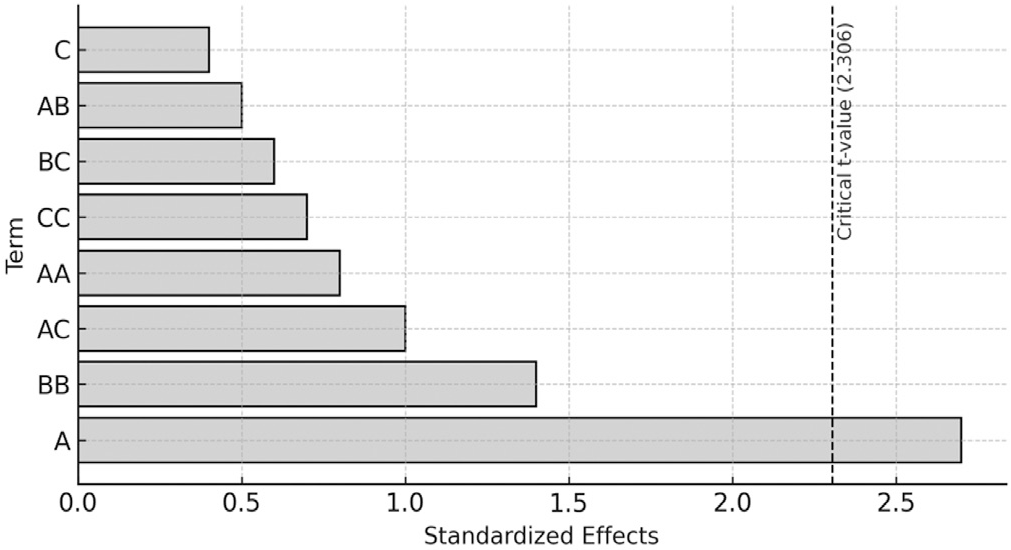
The microflotation tests were organized according to a central composite design in order to investigate the combined effects of pH, collector dosage, and depressant concentration on flotation yield and iron grade. The experimental domain and design matrix are summarized in Tables 4 and 5. The resulting data were analyzed by analysis of variance (ANOVA), supported by Pareto charts (Figures 3 and 4) and residual diagnostics (Figures 5 and 6), to identify statistically significant effects and to assess the adequacy of the statistical models.

Pareto chart of standardized effects for the microflotation experiments (iron grade Fe%; α = 0.05). The critical t-value (2.306) is represented by the dashed line. Factors: A = pH, B = collector, C = depressant
Pareto chart of standardized effects for the microflotation experiments (flotation %; α = 0.05). The critical t-value (2.306) is represented by the dashed line. Factors: A = pH, B = collector, C = depressant
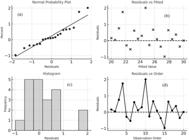
Residual analysis for the microflotation experiments for Fe%: (a) normal probability plot; (b) residuals vs. fitted values; (c) histogram of residuals; (d) residuals vs. observation order
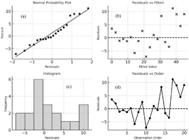
Residual analysis for the microflotation experiments for flotation%: (a) normal probability plot; (b) residuals vs. fitted values; (c) histogram of residuals; (d) residuals vs. observation order
The depressant factor (dextrin dosage) did not show statistical significance within the investigated range (40-60 mg L-1), as indicated by the ANOVA and Pareto analysis (Tables 6 and 7). This result suggests that, under the specific chemical and granulometric conditions of the present system, variations in dextrin concentration within this narrow interval did not measurably affect flotation yield or iron grade. From a mechanistic perspective, polysaccharide adsorption on hematite and gangue surfaces is known to depend on pH, polymer structure, and surface chemistry; therefore, the absence of a significant effect in this study should be interpreted as a range-dependent outcome rather than a general conclusion. Broader depressant intervals or alternative polysaccharides may be required to observe selectivity effects under different pulp conditions.
Analysis of variance (ANOVA) for iron grade (Fe%) in the central composite design of microflotation experiments
Analysis of variance (ANOVA) for flotation yield (%) as a function of blocks, pH, collector dosage, and depressant concentration
The chemical characterization of the collectors provides important context for interpreting the flotation results. The acidity and iodine indices, together with the saponification values, reflected the balance of saturated and unsaturated fatty acids in each oil. Palm oil, with its lower iodine index, is richer in saturated chains, which are associated with higher Krafft points and reduced solubility, but can promote the formation of more compact interfacial films. Soybean oil, in contrast, presented a much higher iodine index, indicative of a higher degree of unsaturation that favors solubility but yields more flexible and less ordered interfacial arrangements. FTIR spectra confirmed the successful conversion of triglycerides to fatty acid salts, with the disappearance of ester carbonyl bands and the emergence of carboxylate stretching bands. These molecular-level differences are consistent with the flotation data: saponified palm oil systematically outperformed soybean oil in terms of metallurgical recovery under the investigated conditions (Figures 7-12), while both produced comparable iron grades. Sodium oleate, being a purified and chemically uniform collector, provided the highest recoveries overall, underscoring the effect of compositional complexity in vegetable oils.

Flotation as a function of pH at 75 mg L-1 collector concentration for oleate, saponified palm oil, and saponified soybean oil

Iron grade as a function of pH at 75 mg L-1 collector concentration for oleate, saponified palm oil, and saponified soybean oil

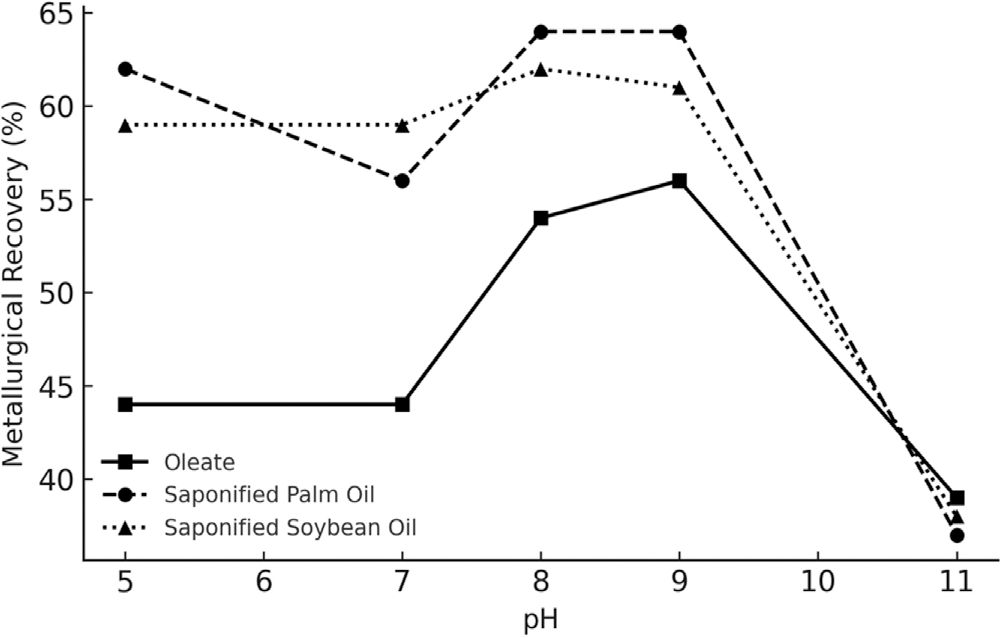
Metallurgical recovery as a function of pH at 75 mg L-1 collector concentration for oleate, saponified palm oil, and saponified soybean oil
The influence of pH at a fixed collector dosage of 75 mg L-1 is reported in Figures 7-9. Maximum flotation yields occurred near neutral to slightly alkaline conditions, with values decreasing sharply at both acidic and strongly alkaline pH. Iron grade showed an increasing trend under alkaline conditions, but this was accompanied by a significant decrease in flotation yield, leading to lower metallurgical recovery. This behavior is consistent with the known surface chemistry of hematite and fatty acid collectors: at near-neutral pH, the coexistence of molecular and ionic species enhances interfacial activity and favors adsorption on positively charged Fe-OH2+ sites, whereas at higher pH the predominance of anionic species (RCOO-) and competition with OH- ions reduce adsorption efficiency. These mechanistic considerations explain why pH ≈ 8 represents the most robust compromise between concentrate grade and recovery.

Flotation as a function of collector concentration at pH 8 for oleate, saponified palm oil, and saponified soybean oil

Iron grade as a function of collector concentration at pH 8 for oleate, saponified palm oil, and saponified soybean oil
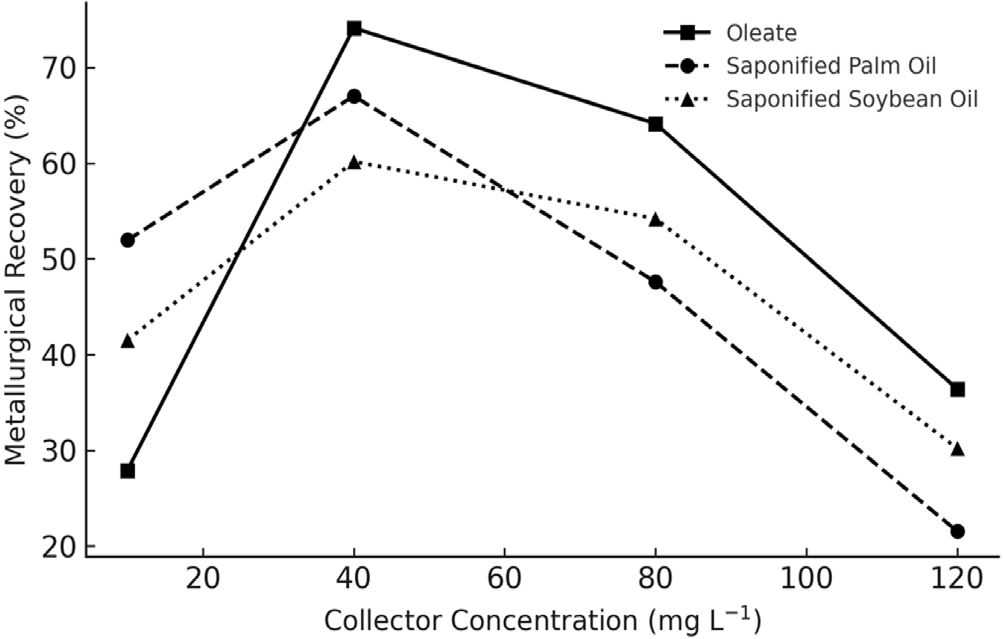
The effect of collector concentration at pH 8 is presented in Table 8 and illustrated in Figures 10-12. For all collectors, the highest flotation yields and metallurgical recoveries were experimentally observed at 40 mg L-1, while iron grade remained comparatively stable across the range of dosages. Above this concentration, both flotation and recovery declined, which is attributed to solution phenomena such as aggregation or precipitation of the collector, reducing the amount of active species available for adsorption. The presence of a common optimum at 40 mg L-1 across all collectors indicates that the response is governed primarily by the effective concentration of carboxylate groups, rather than differences in fatty-acid composition.
Flotation (F), iron grade (Fe), and metallurgical recovery (RM) of hematite in the float as a function of collector concentration
Comparing the three collectors, sodium oleate consistently provided the highest flotation yields and metallurgical recoveries, while saponified palm oil performed better than saponified soybean oil under otherwise identical conditions. Iron grade remained relatively constant among the collectors, indicating that the primary differences lie in recovery efficiency. The performance ranking under the shared operating condition (pH 8, 40 mg L-1), corresponding to the highest observed recoveries, is therefore oleic acid ≥ saponified palm oil ≥ saponified soybean oil. Although the vegetable-oil-based collectors show moderate penalties in recovery relative to sodium oleate, they nonetheless achieved comparable concentrate grades, supporting their feasibility as alternative reagents.
From an operational perspective, the minor influence of depressant dosage (within the narrow range tested) suggests that selectivity improvements may require either broader dosage exploration or alternative depressant strategies (Table 8). Additionally, translating laboratory optima to industrial practice will demand careful attention to water chemistry, as hardness ions (Ca2+, Mg2+) may promote insoluble soap formation, reducing performance. Despite these caveats, the results demonstrate that saponified vegetable oils can act as renewable flotation collectors for hematite, provided that pH and collector dosage are tightly controlled.
In sum, using only the data, tables, and figures present in the template, the microflotation results support operating at pH ≈ 8 with collector ca. 40 mg L-1, under which oleic acid delivers the highest metallurgical recovery and the saponified vegetable oils provide competitive iron grades with moderate recovery penalties. This operating window is internally consistent with the factor effects (Figures 2-3), the residual diagnostics (Figures 4-5), the pH trends (Figures 6-8), and the concentration trends. It is also important to emphasize the inherent limitations of the Hallimond tube system. While highly effective for controlled and reproducible studies, this configuration does not replicate key hydrodynamic features of industrial flotation cells, such as bubble size distribution, froth stability, and pulp turbulence. Consequently, absolute values of recovery and grade obtained here should not be directly extrapolated to plant conditions. Furthermore, the tests were conducted with relatively pure hematite samples, whereas industrial tailings usually contain significant proportions of fine silica, alumina, and clays, which intensify slime coating and reduce selectivity. Water chemistry is another critical factor: hardness ions such as Ca2+ and Mg2+ can precipitate fatty acid soaps, reducing collector availability. For these reasons, the optimum conditions identified in this study (pH ≈ 8, 40 mg L-1) must be viewed as laboratory baselines, requiring validation in bench-scale and pilot-scale flotation to confirm their practical applicability (Figures 9-11) reported in the template.

Metallurgical recovery as a function of collector concentration at pH 8 for oleate, saponified palm oil, and saponified soybean oil
Beyond technical performance, the use of saponified vegetable oils as flotation collectors raises important sustainability considerations. Unlike sodium oleate, which is synthesized from petrochemical sources, palm and soybean oils are renewable and biodegradable. Their use could therefore contribute to reducing the ecological footprint of mineral processing reagents. However, these benefits are not unconditional. Palm oil production, for example, is associated with land use concerns and deforestation risks, although certification schemes such as RSPO provide pathways toward more sustainable supply chains. Similarly, soybean oil availability and cost are influenced by agricultural markets and geographic sourcing. One promising direction is the valorization of residual or low-grade oils, which would combine technical feasibility with improved environmental balance. Thus, while the present study demonstrates the technical viability of SPO and SSO as collectors, future work should integrate life-cycle assessment and supply-chain analysis to substantiate their sustainability claims.
CONCLUSIONS
This study evaluated sodium oleate and saponified palm and soybean oils as collectors for hematite flotation using microflotation experiments supported by statistical analysis. The results demonstrated that, within the investigated experimental domain, flotation performance was primarily controlled by pH, whereas variations in collector and depressant dosages within the tested ranges had no statistically significant effect on either flotation yield or iron grade.
At a fixed collector concentration of 75 mg L-1, flotation yields were maximized at near-neutral to slightly alkaline conditions, with a clear optimum around pH 8, in agreement with collector speciation and hematite surface chemistry. When collector concentration was varied at pH 8, a practical optimum was observed at 40 mg L-1 for all collectors, corresponding to the highest flotation yields and metallurgical recoveries, while iron grade remained comparatively stable over the explored dosage range. Sodium oleate consistently provided the highest recoveries, but saponified palm and soybean oils achieved comparable concentrate grades and lower yet acceptable recoveries, demonstrating their technical potential as alternative reagents.
These results indicate that saponified vegetable oils can function as bio-based collectors for hematite flotation under properly controlled pH and dosage conditions. Further investigations should address more complex mineral systems, broader depressant ranges, and the effects of water chemistry and temperature, as well as include life-cycle and techno-economic assessments to fully quantify the sustainability benefits of vegetable-oil-based reagent.
ACKNOWLEDGMENTS
The authors thank the support from CAPES, a foundation linked to the Ministry of Education (MEC) of Brazil, CNPq and Post-Graduation of Chemical Engineering (PPGEQ).
During the preparation of this work the author(s) used Mendeley, Copilot and ChatGPT in order to improve the references organize, English grammar and language clarity. After using this tool, the author(s) reviewed and edited the content as needed and take(s) full responsibility for the content of the publication.
DATA AVAILABILITY STATEMENT
All data supporting the findings of this study are included within the article. Additional datasets or raw experimental records can be made available by the corresponding author upon reasonable request.
REFERENCES
-
1 Global Industry Standard on Tailings Management; Global Tailings Review; 2020. [Link] accessed in February 2026
» Link -
2 do Carmo, F. F.; Kamino, L. H. Y.; Tobias Junior, R.; de Campos, I. C.; do Carmo, F. F.; Silvino, G.; de Castro, K. J. S. X.; Mauro, M. L.; Rodrigues, N. U. A.; Miranda, M. P. S.; Pinto, C. E. F.; Perspectives in Ecology and Conservation 2017, 15, 145. [Crossref]
» Crossref -
3 Sánchez, L. E.; Alger, K.; Alonso, L.; Barbosa, F.; Brito, M. C.; Laureano, F.; May, P.; Roeser, H.; Kakabadse, Y.; Impacts of the Fundão Dam Failure: A Pathway to Sustainable and Resilient Mitigation, 1st ed.; IUCN: Gland, 2018 [Crossref]
» Crossref -
4 Lima, N. P.; Silva, K.; Souza, T.; Filippov, L.; Minerals 2020, 10, 675. [Crossref]
» Crossref -
5 Eardley, J. C.; Ng, W. S.; Forbes, E.; Franks, G. V.; Miner. Eng. 2025, 227, 109254. [Crossref]
» Crossref -
6 Bretas, P. L.; Rodrigues, O. M. S.; da Luz, J. A. M.; Research, Society and Development 2022, 11, e45011528289. [Crossref]
» Crossref -
7 Kulkarni, R. D.; Somasundaran, P.; Colloids Surf. 1980, 1, 387. [Crossref]
» Crossref -
8 Du, C.; Yu, J.; Liu, G.; Minerals 2024, 14, 1255. [Crossref]
» Crossref -
9 Jung, M.; Tadesse, B.; Dick, C.; Logan, A.; Dyer, L.; Albijanic, B.; Colloids Surf., A 2022, 653, 129975. [Crossref]
» Crossref -
10 Fatty Acid Salts (Soap), Environmental Risk Assessment; Human & Environmental Risk Assessment (HERA), 2003. [Link] accessed in February 2026
» Link -
11 de Mul, M. N. G.; Davis, H. T.; Evans, D. F.; Bhave, A. V.; Wagner, J. R.; Langmuir 2000, 16, 8276. [Crossref]
» Crossref -
12 Wolfrum, S.: Long Chain Soaps and Alkyl Sulfates in Aqueous Solutions at Room Temperature; PhD Thesis, University of Regensburg, Bayreuth, 2017. [Link] accessed in February 2026
» Link -
13 Kordloo, M.; Khodadadmahmoudi, G.; Ebrahimi, E.; Rezaei, A.; Tohry, A.; Chelgani, S. C.; Sci. Rep. 2023, 13, 8980. [Crossref]
» Crossref -
14 Kar, B.; Sahoo, H.; Rath, S. S.; Das, B.; Miner. Eng. 2013, 49, 1. [Crossref]
» Crossref -
15 Yang, S.; Xiong, Y.; Ge, Y.; Zhang, S.; Mater. Lett. 2018, 218, 257. [Crossref]
» Crossref -
16 Budemberg, G.; Jolsterå, R.; Chelgani, S. C.; Int. J. Min. Sci. Technol. 2025, 35, 539. [Crossref]
» Crossref -
17 Slabov, V.; Jain, G.; Larsen, E.; Kota, H. R.; Chernyshova, I.; Mining, Metallurgy & Exploration 2023, 40, 475. [Crossref]
» Crossref -
18 Martins, R. L.; de Magalhães, L. F.; Santos, L. H.; da Silva, G. R.; Heliyon 2023, 9, e15874. [Crossref]
» Crossref -
19 Santos, L. H.; Santos, A. M. A.; de Magalhães, L. F.; de Souza, T. F.; da Silva, G. R.; Peres, A. E. C.; Miner. Eng. 2023, 191, 107932. [Crossref]
» Crossref -
20 Arcos, F.; Uribe, L.; Recycling 2021, 6, 5. [Crossref]
» Crossref -
21 Guo, W.; Zhu, Y.; Han, Y.; Luo, B.; Wei, Y.; Minerals 2017, 7, 244. [Crossref]
» Crossref -
22 Lee, J.-D.; Kim, M.; Kulkarni, K. P.; Song, J. T.; Plant Breeding and Biotechnology 2018, 6, 44. [Crossref]
» Crossref -
23 Schmidt, J.; De Rosa, M.; J. Cleaner Prod. 2020, 277, 124045. [Crossref]
» Crossref -
24 Ostfeld, R.; Reiner, D. M.; Frontiers in Sustainable Food Systems 2024, 8, 1398877. [Crossref]
» Crossref -
25 Brandao, P. R. G.; Caires, L. G.; Queiroz, D. S. B.; Miner. Eng. 1994, 7, 917. [Crossref]
» Crossref -
26 Mancini, A.; Imperlini, E.; Nigro, E.; Montagnese, C.; Daniele, A.; Orrù, S.; Buono, P.; Molecules 2015, 20, 17339. [Crossref]
» Crossref -
27 Japir, A. A.-W.; Salimon, J.; Derawi, D.; Bahadi, M.; Al-Shuja’a, S.; Yusop, M. R.; OCL: Oilseeds Fats, Crops Lipids 2017, 24, D506. [Crossref]
» Crossref -
28 Özbek, Z. A.; Ergönül, P. G. In Cold Pressed Oils: Green Technology, Bioactive Compounds, Functionality, and Applications; Ramadan, M. F., ed.; Elsevier, 2020, p. 575. [Crossref]
» Crossref -
29 Soontravanich, S.; Lopez, H. E.; Scamehorn, J. F.; Sabatini, D. A.; Scheuing, D. R.; J. Surfactants Deterg. 2010, 13, 367. [Crossref]
» Crossref -
30 Drzymala, J.; Int. J. Miner. Process. 1994, 42, 139. [Crossref]
» Crossref -
31 Vilasó-Cadre, J. E.; Nolasco-Cuenca, M. C.; Ávila-Márquez, D. M.; Arada-Pérez, M. A.; Gutiérrez-Castañeda, E. J.; Reyes-Domínguez, I. A.; Blanco-Flores, A.; Can. Metall. Q. 2024, 63, 153. [Crossref]
» Crossref -
32 Dixit, P.; Tiwari, R.; Mukherjee, A. K.; Banerjee, P. K.; Powder Technol. 2015, 275, 105. [Crossref]
» Crossref -
33 Özün, S.; Ergen, G.; ACS Omega 2019, 4, 1516. [Crossref]
» Crossref - 34 Montgomery, D. C.; Design and Analysis of Experiments, 8th ed.; John Wiley & Sons: Hoboken, 2013.
-
35 Anderson-Cook, C. M.; Borror, C. M.; Montgomery, D. C.; Journal of Statistical Planning and Inference 2009, 139, 629. [Crossref]
» Crossref -
36 Sarabia, L. A.; Ortiz, M. C.; Compr. Chemom. 2009, 1, 345. [Crossref]
» Crossref -
37 Arancibia-Bravo, M. P.; Lucay, F. A.; Sepúlveda, F. D.; Cortés, L.; Cisternas, L. A.; Minerals 2022, 12, 1131. [Crossref]
» Crossref -
38 Sepúlveda, F. D.; Cortes, L. A.; Arancibia-Bravo, M. P.; Delgado, J.; Lucay, F. A.; Chacana, C.; Galleguillos, F.; Castellón, C.; Miner. Eng. 2024, 219, 108978. [Crossref]
» Crossref -
39 Li, W.; Liu, W.; Tong, K.; Liu, W.; Zhao, P.; Ding, R.; Miner. Eng. 2023, 201, 108190. [Crossref]
» Crossref -
40 Kanyama, T.; Masunaga, A.; Kawahara, T.; Morita, H.; Akita, S.; PLoS One 2025, 20, e0324842. [Crossref]
» Crossref -
41 Zeb, A.; Food Res. Int. 2021, 143, 110312. [Crossref]
» Crossref -
42 Bai, S.; Li, J.; Bi, Y.; Yuan, J.; Wen, S.; Ding, Z.; Int. J. Min. Sci. Technol. 2023, 33, 105. [Crossref]
» Crossref -
43 Lim, S.-R.; Park, J. M.; J. Environ. Manage. 2009, 90, 1454. [Crossref]
» Crossref - 44 AOCS Official Method Cd 1c-85: Calculated Iodine Value; American Oil Chemists’ Society (AOCS), Champaign, IL, USA, 2017.
-
45 Crowe, T. D.; White, P. J.; J. Am. Oil Chem. Soc. 2001, 78, 1267. [Crossref]
» Crossref - 46 AOCS Official Method Cd 3a-63: Saponification Value, American Oil Chemists’ Society (AOCS), Champaign, IL, USA, 2004.
- 47 AOCS Official Method Cd 3d-63: Acid Value of Fats and Oils, American Oil Chemists’ Society (AOCS), Champaign, IL, USA, 2004; ASTM D1957-86: Standard Test Method for Hydroxyl Value of Fatty Oils and Acids, ASTM International, West Conshohocken, PA, USA, 2017.
-
48 Agência Nacional de Vigilância Sanitária (ANVISA); Instrução Normativa - IN No. 87, de 15 de março de 2021, Estabelece a Lista de Espécies Vegetais Autorizadas, as Designações, a Composição de Ácidos Graxos e os Valores Máximos de Acidez e de Índice de Peróxidos para Óleos e Gorduras Vegetais; Diário Oficial Da União (DOU), Brasília, No. 51, 17/03/20, Seção 1, p. 261. [Link] accessed in February 2026
» Link -
49 Ministério da Agricultura e Pecuária (MAPA); Portaria No. 795, de 15 de dezembro de 1993, Aprovar as Anexas Normas de Identidade, Qualidade, Embalagem, Marcação e Apresentação do Óleo de Soja Bruto, do Óleo de Soja Degomado e do Farelo de Soja; MAPA, Brasília, 1993. [Link] accessed in February 2026
» Link -
50 CODEX STAN 210-1999: Standard for Named Vegetable Oils, 8th ed.; Codex Alimentarius, 1999. [Link] accessed in February 2026
» Link
Edited by
-
Executive Editor handled this article:
Rodrigo O. M. A. de Souza