 Nutritional contribution and bioaccessibility of essential elements in edible nuts
Abstract
Brazil nuts (Bertholletia excelsa) and cashew nuts (Anacardium occidentale) are important dietary sources of essential minerals. However, the total concentration of an element does not necessarily reflect the fraction absorbed by the human body, making it crucial to evaluate the amount of nutrients that becomes available upon ingestion. This study quantified the total and bioaccessible concentrations of Cu, Mg, Mn, and Zn in these nuts using an in vitro gastrointestinal digestion model followed by detection via inductively coupled plasma optical emission spectrometry (ICP OES). The results revealed high total concentrations of these minerals in all samples. However, when assessing bioaccessibility, only Cu and Mg were released after the in vitro assay, while Mn and Zn were below the limit of detection. The nutritional contributions per serving were significant: a 30 g portion of cashew nuts provided 38.0% (Cu) and 9.9-12.8% (Mg) of the recommended daily intakes (RDI), while a 15 g portion of Brazil nuts provided 18.0% (Cu) and 4.8-6.1% (Mg). The contrast between total contents and bioaccessible fractions highlights the influence of antinutritional factors in limiting mineral utilization. These findings imply that: (i) nutritional labeling should consider bioaccessibility data, and (ii) processing methods that reduce antinutrient content may enhance mineral bioavailability.
Keywords:
bioaccessibility; gastrointestinal digestion; ICP OES; cashew nut; Brazil nut.
INTRODUCTION
Foods play a crucial role in sustaining life by providing essential nutrients that support growth, tissue repair, and the energy required for physiological functions.1-3 A balanced diet requires the intake of macronutrients and micronutrients essential for developmental and metabolic processes.4-8 To achieve adequate nutrient supply and optimal physiological function, dietary diversity must include vegetables, meats, grains, fruits and nuts.9-11
Edible nuts are particularly rich in bioactive compounds such as antioxidants, essential fatty acids (omega-3 and omega-6), vitamins, and minerals. These constituents contribute to their high nutritional value and are widely recognized for promoting health and well-being.12-17 Brazil currently produces four major oilseeds (cashew nut, Brazil nut, macadamia, and pecan nut), classified among the eight most consumed nuts worldwide, which also include hazelnut, almond, peanut, pistachio, macadamia, chestnuts, and walnut.18
Among these species, native Brazil nuts (Bertholletia excelsa H.B.K.) and cashew nut (Anacardium occidentale L.) stand out and were selected as the focus of this study. In 2023, Brazil produced 116,829 tons of cashew nuts, according to the Brazilian Institute of Geography and Statistics (IBGE)19 and the National Supply Company (Conab),20 ranking eleventh in global production according to the Food and Agriculture Organization Statistical Database (FAOSTAT).21 In the same year, Brazil nut production reached 35,351 tons, positioning Brazil as the largest producer of this commodity in the world.21,22
The minerals present in nuts contribute to the human health in different ways. Copper, for example, is an essential trace element involved in energy synthesis, neurotransmission, and redox process.23,24 It is also a cofactor for enzymes such as cytochrome c oxidase (CCO), which converts oxygen to water, and ceruloplasmin (Cp), which oxidizes Fe2+ to Fe3+, thereby facilitating iron transport in plasma.25-27 Magnesium acts as a cofactor in more than 300 enzymatic reactions and is indispensable for neuromuscular function, immune regulation, and cardiovascular system.8,27,28 Manganese participates in enzymatic activation and is a structural component of metalloenzymes including arginases, pyruvate carboxylase, and manganese superoxide dismutase (MnSOD or SOD2). In plasma, it is predominantly found as Mn2+, Mn3+ or Mn4+.29-31 Zinc plays a regulatory role in more than 100 enzymes and is essential for immune function, bone development, wound healing, and hormone regulation.8,27,28,32,33
Despite the nutritional relevance of these minerals, the total concentration of an element in food does not necessarily reflect the amount absorbed by the human body. Thus, it is necessary to evaluate nutrient bioaccessibility and bioavailability when assessing nutritional quality. Bioaccessibility refers to the fraction of a nutrient released from the food matrix into the gastrointestinal tract potentially available for absorption, while bioavailability is the fraction of the ingested nutrient that reaches the systemic circulation and is effectively used by the body, including process of absorption, distribution, metabolism, and excretion.34-37
Nutrient bioaccessibility and bioavailability are evaluated through in vivo and in vitro assays, respectively. In vivo studies involve administering controlled doses of nutrients to humans or animals to assess absorption and metabolism. Although animal models with physiological similarities to human are often used, these studies are costly, ethically controversial, and limited in the amount of data generated.38-40 Alternatively, in vitro digestion models applied to estimate nutrient bioaccessibility are low-cost, reproducible, and rapid.38,41 These assays simulate human gastrointestinal conditions by reproducing factors such as temperature, agitation, pH, and enzymatic composition. Foods are subjected to solutions that simulate oral, gastric and intestinal digestion, and the resulting extracts are analyzed to estimate the bioaccessible fraction of the target elements relative to their total concentration.34-36,39,42
Bioaccessibility studies therefore provide a more accurate assessment of the nutritional value of foods, as they account for interactions between the food matrix and gastrointestinal digestion. Then, the present study aims to evaluate, using in vitro methods, the total concentrations and bioaccessible fractions of the essential elements Cu, Mg, Mn, Zn in Brazil nuts (Bertholletia excelsa) and cashew nuts (Anacardium occidentale).
EXPERIMENTAL
Instrumentation
All glassware, laboratory utensils, and equipment accessories were decontaminated with 10% (v/v) nitric acid and subsequently rinsed with high-purity water (18 MΩ cm-1) obtained from a Milli-Q purification system (model ICW 3000, Millipore, Bedford, MA, USA) previously to experimental procedures.
The nuts were ground using a food processor (Britânia, Paraná, Brazil) and weighed on an analytical balance with a precision of four decimal digits (Ohaus Adventures, Metter Toledo, São Paulo, Brazil). Standard reference material (SRM), Brazil nuts, and cashew nuts were subjected to acid digestion in a closed-vessel microwave oven (ETHOS UP, Milestone, Italy) equipped with pressure and temperature sensors.
For the in vitro assay, a thermostatic water bath (model Q226 M, Quimis, Brazil) with constant agitation and a centrifuge (model Q222 T, Quimis, Brazil) were used to separate the supernatant from the remaining solid residue.
Elemental quantification of Cu, Mg, Mn, and Zn was performed by inductively coupled plasma optical emission spectrometer (ICP OES, iCAP 7400 Duo, Thermo Scientific, USA) equipped with a solid-state detector and a high-performance charge injection device (CID). Calibration was performed using a multi-element solution (10 mg L-1) prepared from analytical-grade stock solutions at a concentration of 1000 mg L-1 (Merck, Darmstadt, Germany).
Plasma robustness was verified through the analysis of the 10 mg L-1 solution and by evaluating the intensity ratio between Mg(II) and Mg(I) using the emission lines at 280 nm (Mg II) and 285 nm (Mg I). Instrumental conditions were optimized to achieve a Mg(II)/Mg(I) ratio greater than 8, as recommended in the literature.43,44 The operating parameters are detailed in Table 1.
Sample preparation
Brazil nut and cashew nut samples were purchased from a local market (Mercado Municipal, São Paulo, Brazil). The selection was based on their nutritional relevance, owing to their high mineral content, and their commercial importance as native Brazilian species. Samples were stored in a freezer at -14 °C and ground separately for 5 min in a food processor to obtain a powder. The processing was conducted in a pulsed regimen with interruptions to prevent excessive heating of the processor blades and the subsequent formation of a nut paste. Ground samples were then weighed on an analytical balance and subjected to the processes described in the following sections.
Microwave-assisted acid digestion
Approximately 0.25 g of the sample was weighed into PFA (perfluoroalkoxy) tubes, followed by the addition of 2 mL of HNO3 (65%, Merck, Germany), 1 mL of H2O2 (30%, Merck, Germany), and 7 mL of deionized water. Samples were digested using the heating program shown in Table 2.
The procedure was performed in triplicate (n = 3) for the samples, blanks, and the certified reference material (NIST, Apple Leaves 1515, USA). Final solutions were diluted to 15 mL with deionized water and analyzed by ICP OES.
Bioaccessibility of Mg, Cu, Mn and Zn
In vitro gastrointestinal digestion was performed according to the method described by Kamioka et al.45 and Fioroto et al.46 Simulated digestion fluids were prepared as follows:
(i) Gastric fluid: 0.2 g of NaCl (Merck, Darmstadt, Germany), 0.32 g of pepsin (Sigma-Aldrich, Saint Louis, USA), and 7 mL of 0.12 mol L-1 HCl (Merck, Darmstadt, Germany) in 100 mL solution.
(ii) Inhibitory solution: 2.5 g of NaHCO3 (Synth, Diadema, Brazil) in 50 mL ultrapure water.
(iii) Intestinal fluid: 0.68 g of K2HPO4 (Synth, Diadema, Brazil), 1 g of pancreatin (Sigma-Aldrich, Saint Louis, USA), 1.25 g of bile salts (Sigma-Aldrich, Saint Louis, USA), and 7.7 mL of 0.2 mol L-1 NaOH (Merck, Darmstadt, Germany) in 100 mL solution. The in vitro assay was performed following the steps illustrated in Figure 1.
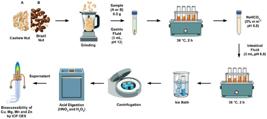
Simulated gastrointestinal digestion for the evaluation of the bioaccessibility of Cu, Mg, Mn and Zn in Brazil nut and cashew nut
For digestion, 0.5 g of sample was weighed into a Falcon tube with 3 mL of gastric fluid and incubated in a thermostatic bath (36 °C, 90 rpm) for 2 h. The pH was adjusted to 6.8 using 0.2 mL inhibitory solution, followed by the addition of 3 mL intestinal fluid. The mixture was incubated under the same conditions for an additional 2 h. Enzymatic activity was terminated by cooling in an ice bath, and the mixture was centrifuged (6500 rpm, 10 min). The supernatant was transferred to a PFA container and digested as described in “Microwave-assisted acid digestion” sub-section before ICP OES analysis. Bioaccessible fractions of each element were calculated relative to their total concentrations.
Quantification of Cu, Mg, Mn and Zn
Calibration curves were prepared from multielement standard solutions of Cu, Mg, Mn, and Zn, obtained by appropriate dilutions of analytical-grade stock solutions (Merck, Darmstadt, Germany). Stock solution concentrations were 10 mg L-1 for Cu, 1000 mg L-1 for Mg, and 100 mg L-1 for Mn and Zn. Calibration solutions were prepared in an acidic medium by adding 1 mL of concentrated analytical-grade HNO3 and diluting to 50 mL with deionized water in previously acid-cleaned polypropylene tubes.
Method performance was evaluated by determining: limit of detection (LOD), limit of quantification (LOQ), linearity of the calibration curve, and accuracy using SRM.
The LOD values were calculated using the background equivalent concentration (BEC), signal-to-background ratio (SBR), and relative standard deviation of the blank (RSDblank), according to the International Union of Pure and Applied Chemistry (IUPAC) recommendations:47
The RSDblank was calculated from ten replicate measurements of acid-digested procedural blanks, reflecting the precision of the method under matrix-matched conditions.
The SBR was determined from the net analyte signal, calculated as the difference between the sample signal intensity (Irs) and the blank signal intensity (Iblank), normalized to the blank signal (Iblank’).
where Irs and Iblank correspond to the emission intensities of the multielement reference solution (10 mg L-1) and the blank solution, respectively.
The BEC represents the analyte concentration required to produce a signal equal to the background noise level. It was calculated as the ratio of the reference standard concentration (Crs) to the SBR, providing a direct measure of the sensitivity of the method to background interference.
The LOQ were calculated as:43
Statistical analysis
All analyses were performed in triplicate to ensure reproducibility. Statistical significance was assessed using a paired t-test (α = 0.05). Accuracy was evaluated by comparing experimental results with certified reference values using t-test (95% confidence level). Data processing and statistical analyses were performed using Microsoft Excel (Microsoft Corporation, USA, 2019), OriginPro 8.5 (OriginLab Corporation, UK, 2010) and jamovi (jamovi, Australia, 2024).
RESULTS AND DISCUSSION
Method optimization and validation
The analytical conditions of the plasma were evaluated using the ratio of the intensity of Mg II (ionic) / Mg I (atomic), based on the spectral lines at 280 nm for Mg II and 285 nm for Mg I.43 This parameter used to assess plasma robustness, as it reflects the efficiency of energy transfer to the analytes. The nebulizing gas pressure was adjusted to maintain adequate sample residence time. Ratios above 8 indicate robust plasma conditions, whereas ratios below 4 suggest greater susceptibility to matrix interferences.43,48
In this study, Mg II / Mg I ratios between 8.5 to 10 were observed, confirming the robustness of the method. This indicates that the analytical conditions employed were capable of tolerating variations in the sample matrix, minimizing standard deviations, and enhancing accuracy without compromising analytical responses.46
The method performance for quantifying Cu, Mg, Mn, and Zn by ICP OES was evaluated based on the figures of merit (Table S1, Supplementary Material). The calibration curves demonstrated linearity over the range of 0.004-100 mg L-1, with correlation coefficients (r2) exceeding 0.999, confirming a consistent linear relationship between signal intensity and analyte concentration.
The LOD and LOQ were calculated based on the background equivalent concentration (BEC). For total elemental determination, LOD values were 1 μg g-1 for Cu; 26 μg g-1 for Mg; 0.5 μg g-1 for Mn; and 0.9 μg g-1 for Zn, with LOQs of 3.3; 86; 1.65; 3 μg g-1, respectively. In the in vitro assay, higher LOD values were obtained: 0.8 μg g-1 for Cu; 32 μg g-1 for Mg; 0.2 μg g-1 for Mn; and 2 μg L-1 for Zn, with corresponding LOQs of 3; 106; 0.7; and 7 μg L-1.
Specifically for magnesium, the higher LODs observed in the in vitro assay are attributed to the composition of the blanks, which contained gastrointestinal fluids composed of enzymes and salts. These components increased the SBR and raised the detection limits.49 Nonetheless, the values obtained remained adequate for quantification of trace elements in nut samples.
Additionally, the accuracy of the method was evaluated using an SRM. The agreement between certified and measured values was assessed using the Student’s t-test. In all cases, the calculated t values (tCalculated) were lower than the critical t value (tCritical) at the 95% confidence level, and no statistically significant differences were observed (p > 0.05). Recovery rates ranged from 85 to 98.9%, with fall within the commonly accepted range of 100 ± 20% for food matrix analyses.50 These results validate the method as statistically reliable for the quantification of Cu, Mg, Mn, and Zn in Brazil nuts and cashew nuts.
Determination of the total elemental concentration in the nuts
The validated method was applied to determine the total concentration of Cu, Mg, Mn, and Zn in Brazil nuts and cashew nuts. The results were compared with values reported in the Brazilian Food Composition Table (TACO)51 and the United States Department of Agriculture (USDA) databases (Table 3).52,53
The concentrations obtained in this study were consistent with those reported in the literature,16,17,54 including values reported in the TACO and USDA food composition databases, as well as in compositional studies of similar nuts determined by spectroscopic analytical techniques. However, for Brazil nuts, the contents of Cu, Mg, and Zn were higher than the reference values. These differences may be attributed to soil composition, as mineral uptake by Brazil nut trees is strongly influenced by the origin of the samples. This suggests that the Brazil nut trees may have been grown in soils rich in Mg, Cu, and Zn, resulting in greater absorption of these minerals by the plant.55,56
Determination of the bioaccessibility of Cu, Mg, Mn, and Zn in Brazil nuts and cashew nuts
Although the total element content provides an estimate of nutrient abundance, it does not necessarily represent the fraction available for absorption. In such cases, the bioaccessibility studies are needed to quantify this important information for nutritional purposes. Thus, the bioaccessibility of Cu, Mg, Mn, and Zn was evaluated using an in vitro gastrointestinal digestion model, and the results are presented in Table 4.
In cashew nuts, the bioaccessibility fraction corresponded to 56% of Cu and 52% of Mg, while Mn and Zn were below the limits of detection. Similarly, in Brazil nuts, 50% of Cu, and 28% of Mg were bioaccessible, whereas Mn an Zn again remained undetectable after gastrointestinal digestion. When comparing these bioaccessibility values with those reported in published studies, the results obtained for Cu and Mg were consistent with and comparable to those reported in compositional analyses of nuts using spectrometric methods, although slightly higher.17,57 This can be attributed to the different gastrointestinal digestion models, enzymatic composition, and experimental procedures employed.
The explanation for the null Mn bioaccessibility may be related to the presence of antinutritional compounds, such as polyphenols, oxalates, phytic acid, and dietary fibers, which form stable complexes with cations, thereby reducing solubility.55,58,59 Zinc bioaccessibility is particularly affected by phytates, which are known to inhibit Zn absorption.60,61 Similar findings have been reported in previous studies,62 which attribute low bioaccessibility of Mn and Zn in nuts to antinutritional compounds and the neutral pH of the intestinal environment.
Furthermore, nuts are fat-rich matrices in which minerals may be physically retained within lipid bodies or associated with lipid-protein complexes.63 Under physiological conditions, gastric lipase triggers the initial hydrolysis of triglycerides, promoting matrix disruption and enhancing mineral liberation.64 Consequently, the absence of gastric lipase in the applied protocol may impair lipid degradation during the gastric phase, resulting in a potential underestimation of mineral bioaccessibility.
In summary, these findings confirm that in vitro gastrointestinal assay provide more realistic estimations of nutrient availability than total concentration analyses, offering a more accurate reflection of the amounts of minerals that can be absorbed by the human body.
Nutritional contribution based on recommended dietary allowances (RDA)
To evaluate the nutritional relevance of the bioaccessibility mineral fractions, the results were compared with the recommended dietary allowance (RDA) established by the National Institutes of Health.65 A daily intake of 28-30 g of nuts is recommended, although consumption of Brazil nuts should not exceed 15 g due to their high selenium content, which can be higher than RDA recommendations and pose toxicity risks.66,67
As presented in Table 5, a 30 g serving of cashew nuts provides 38.0% of the RDA for Cu and 9.9-12.8% of the RDA for Mg, while a 15 g serving of Brazil nuts contributes 18.0% of the RDA for Cu and 4.8-6.1% for Mg. However, Mn and Zn showed negligible bioaccessibility and therefore did not contribute to the RDAs.
Content of Cu, Mg, Mn, and Zn in cashew nuts and Brazil nuts based on the recommended dietary allowances (RDA) for a daily serving
Overall, cashew nuts provide slightly higher contributions of Cu and Mg compared to Brazil nuts. Among the evaluated minerals, Cu contributed most significantly to daily intake, followed by Mg. However, Mn and Zn demonstrated null bioaccessibility, probably due to the presence of antinutritional factors.
Relative bioaccessibility (RB)
Relative bioaccessibility (RB) is a parameter used to compare the nutritional relevance of one food with another. This calculation allows the identification of food sources that provide higher amounts of minerals potentially absorbed by the human body. RB is determined as the ratio of the bioaccessibility of a nutrient in one food relative to another, according to the following expression:
The results obtained are presented in Table 6. The data indicate that the bioaccessibility of Cu and Mg in cashew nut corresponds to 94.1 and 95.8%, respectively, of the values observed in Brazil nuts. This similarity indicates that both nuts can serve as relevant dietary sources of these minerals, offering equivalent nutritional benefits with respect to bioaccessibility.
In contrast, it was not possible to estimate RB for Mn and Zn, as the concentration were below the limit of detection. This outcome suggests that, despite the high total contents of these elements in nuts, their actual contribution to mineral intake may be limited by low solubility or the interactions with antinutritional compounds.
The results highlight the importance of assessing not only total elemental composition but also bioaccessible fractions when evaluating the nutritional values of foods.
CONCLUSIONS
The methodologies applied in this study effectively stabilized the diluted oxidizing solution used to determine essential elements in nut samples. Microwave-assisted acid decomposition with diluted nitric acid offered a reliable and sustainable approach, reducing both reagents consumption and waste generation.
Elemental analysis using the ICP OES provided a robust, fast, and precise method for quantifying total and bioaccessible concentrations of Cu, Mg, Mn and Zn in cashew nuts and Brazil nuts. The developed method demonstrated good linearity, precision, and reproducibility. Bioaccessibility assays indicated that only Cu and Mg were released under gastrointestinal digestion, whereas Mn and Zn remained below the limit of detection, probably due to interactions with antinutritional compounds.
Nutritionally, both nuts contributed to the recommended daily intake of Cu, and Mg, with cashew nuts providing a slightly higher level. However, the lack of bioaccessibility of Mn and Zn suggests that the intake of these minerals from these sources may be limited. Therefore, while nuts are valuable sources of certain minerals, their contribution to the diet should be complemented with other food sources to meet the daily requirements of all essential nutrients. Future investigations, particularly those involving chemical speciation, effect of toxic elements, and interactions with antinutritional factors, are recommended to better understand the bioavailability of these elements in complex food matrices.
SUPPLEMENTARY MATERIAL
Supplementary material for this work is available at http://quimicanova.sbq.org.br/, as a PDF file, with free access.
Supplementary PDF
ACKNOWLEDGMENTS
We are grateful to FAPESP (process No. 2016/02603-2; 2018/04957-1; 2022/ 03647-4), as well as FINEP (process No. 0413007800) for financial support. This study was also supported by the CAPES.
DATA AVAILABILITY STATEMENT
All the necessary data were provided by the authors, they are available in the text and supplementary material.
REFERENCES
-
1 Cena, H.; Calder, P. C.; Nutrients 2020, 12, 334. [Crossref]
» Crossref - 2 Morris, A. L.; Mohiuddin, S. S.; Biochemistry, Nutrients; StatPearls Publishing: Treasure Island, FL, 2023.
-
3 Fernandes, T. H.; Bell, V.; J. Food Sci. 2024, 89, 51. [Crossref]
» Crossref -
4 Kiani, A. K.; Dhuli, K.; Donato, K.; Aquilanti, B.; Velluti, V.; Matera, G.; Iaconelli, A.; Connelly, S. T.; Bellinato, F.; Gisondi, P.; Bertelli, M.; Journal of Preventive Medicine and Hygiene 2022, 63, E93. [Crossref]
» Crossref -
5 Gupta, U. C.; Gupta, S. C.; Pedosphere 2014, 24, 13. [Crossref]
» Crossref -
6 Savarino, G.; Corsello, A.; Corsello, G.; Ital. J. Pediatr. 2021, 47, 109. [Crossref]
» Crossref -
7 Metsu, D.; Caspar-Bauguil, S.; Galinier, A.; Nutr. Clin. Metab. 2023, 37, 130. [Crossref]
» Crossref -
8 Lukaski, H. C.; Nutrition 2004, 20, 632. [Crossref]
» Crossref -
9 Liu, R. H.; Adv. Nutr. 2013, 4, 384S. [Crossref]
» Crossref -
10 Murphy, S. P.; Allen, L. H.; J. Nutr. 2003, 133, 3932S. [Crossref]
» Crossref -
11 Ros, E.; Nutrients 2010, 2, 652. [Crossref]
» Crossref -
12 Dreher, M. L.; Maher, C. V.; Kearney, P.; Nutr. Rev. 1996, 54, 241. [Crossref]
» Crossref - 13 Ferreira, I. C. F. R.; Morales, P.; Barros, L.; Wild Plants, Mushrooms and Nuts: Functional Food Properties and Applications; Wiley Blackwell: Chichester, 2017.
-
14 Moshfegh, A.; Goldman, J.; Ahuja, J.; Rhodes, D.; Lacomb, R.; What We Eat in America, NHANES 2005-2006, Usual Nutrient Intakes from Food and Water Compared to 1997 Dietary Reference Intakes for Vitamin D, Calcium, Phosphorus, and Magnesium; U.S. Department of Agriculture, Agricultural Research Service, 2009. [Link] accessed in March 2026
» Link -
15 Sabaté, J.; Ros, E.; Salas-Salvadó, J.; Br. J. Nutr. 2006, 96, S1. [Crossref]
» Crossref -
16 Wojdyło, A.; Turkiewicz, I. P.; Tkacz, K.; Nowicka, P.; Bobak, Ł.; Food Chem.: X 2022, 15, 100418. [Crossref]
» Crossref -
17 Moreda-Piñeiro, J.; Herbello-Hermelo, P.; Domínguez-González, R.; Bermejo-Barrera, P.; Moreda-Piñeiro, A.; Food Chem. 2016, 205, 146. [Crossref]
» Crossref -
18 Dniz, F.; Setor Produtivo de Nozes e Castanhas Busca Apoio da Embrapa para Alavancar Mercado no Brasil; Embrapa, 2019. [Link] accessed in March 2026
» Link -
19 Instituto Brasileiro de Geografia e Estatística (IBGE); Levantamento Sistemático da Produção Agrícola, Estatística da Produção Agrícola - Janeiro 2024; IBGE, 2024. [Link] accessed in March 2026
» Link -
20 Fagundes, M. H.; Castanha de Caju: Análise Mensal - Novembro de 2024; Companhia Nacional de Abastecimento (Conab), Brasília, 2024. [Link] accessed in March 2026
» Link -
21 Food and Agriculture Organization of the United Nations (FAO); FAOSTAT: Countries by Commodity - Cashew Nuts, in Shell (2023); FAO, Rome, 2023. [Link] accessed in March 2026
» Link -
22 Food and Agriculture Organization of the United Nations (FAO); FAOSTAT: Countries by Commodity - Brazil Nuts, in Shell (2023); FAO, Rome, 2023. [Link] accessed in March 2026
» Link -
23 Lutsenko, S.; Curr. Opin. Chem. Biol. 2010, 14, 211. [Crossref]
» Crossref -
24 Lutsenko, S.; Petris, M. J.; J. Membr. Biol. 2003, 191, 1. [Crossref]
» Crossref -
25 Gromadzka, G.; Tarnacka, B.; Flaga, A.; Adamczyk, A.; Int. J. Mol. Sci. 2020, 21, 9259. [Crossref]
» Crossref -
26 Desai, V.; Kaler, S. G.; Am. J. Clin. Nutr. 2008, 88, 855S. [Crossref]
» Crossref -
27 Huskisson, E.; Maggini, S.; Ruf, M.; J. Int. Med. Res. 2007, 35, 277. [Crossref]
» Crossref -
28 Bielik, V.; Kolisek, M.; Int. J. Mol. Sci. 2021, 22, 6803. [Crossref]
» Crossref -
29 Schwarz, G.; Belaidi, A. A. In Metal Ions in Life Sciences, vol. 13; Sigel, A.; Sigel, H.; Sigel, R., eds.; Springer: Dordrecht, 2013, p. 415. [Crossref]
» Crossref -
30 Martins, A. C.; Krum, B. N.; Queirós, L.; Tinkov, A. A.; Skalny, A. V.; Bowman, A. B.; Aschner, M.; J. Agric. Food Chem. 2020, 68, 12893. [Crossref]
» Crossref -
31 Balachandran, R. C.; Mukhopadhyay, S.; McBride, D.; Veevers, J.; Harrison, F. E.; Aschner, M.; Haynes, E. N.; Bowman, A. B.; J. Biol. Chem. 2020, 295, 6312. [Crossref]
» Crossref -
32 Höller, U.; Bakker, S. J. L.; Düsterloh, A.; Frei, B.; Köhrle, J.; Konz, T.; Lietz, G.; McCann, A.; Michels, A. J.; Molloy, A. M.; Murakami, H.; Rein, D.; Saris, W. H. M.; Schmidt, K.; Shimbo, K.; Schumacher, S.; Vermeer, C.; Kaput, J.; Weber, P.; Eggersdorfer, M.; Rezzi, S.; TrAC, Trends Anal. Chem. 2018, 102, 110. [Crossref]
» Crossref -
33 Dubey, P.; Thakur, V.; Chattopadhyay, M.; Nutrients 2020, 12, 1864. [Crossref]
» Crossref -
34 Ribas-Agustí, A.; Martín-Belloso, O.; Soliva-Fortuny, R.; Elez-Martínez, P.; Crit. Rev. Food Sci. Nutr. 2018, 58, 2531. [Crossref]
» Crossref -
35 Fernández-García, E.; Carvajal-Lérida, I.; Pérez-Gálvez, A.; Nutr. Res. 2009, 29, 751. [Crossref]
» Crossref -
36 Carbonell-Capella, J. M.; Buniowska, M.; Barba, F. J.; Esteve, M. J.; Frígola, A.; Compr. Rev. Food Sci. Food Saf. 2014, 13, 155. [Crossref]
» Crossref -
37 Huey, S. L.; Mehta, N. H.; Konieczynski, E. M.; Bhargava, A.; Friesen, V. M.; Krisher, J. T.; Mbuya, M. N. N.; Monterrosa, E.; Nyangaresi, A. M.; Boy, E.; Mehta, S.; Crit. Rev. Food Sci. Nutr. 2024, 64, 4500. [Crossref]
» Crossref -
38 Moreda-Piñeiro, J.; Moreda-Piñeiro, A.; Romarís-Hortas, V.; Moscoso-Pérez, C.; López-Mahía, P.; Muniategui-Lorenzo, S.; Bermejo-Barrera, P.; Prada-Rodríguez, D.; TrAC, Trends Anal. Chem. 2011, 30, 324. [Crossref]
» Crossref -
39 Mingroni, T. T.; Hamada, J.; Xavier, A. D. S.; Cavalcante, C.; do Nascimento, A. N.; J. Braz. Chem. Soc. 2019, 30, 108. [Crossref]
» Crossref -
40 Dias, D. M.; Costa, N. M. B.; Nutti, M. R.; Tako, E.; Martino, H. S. D.; Crit. Rev. Food Sci. Nutr. 2018, 58, 2136. [Crossref]
» Crossref -
41 Etcheverry, P.; Grusak, M. A.; Fleige, L. E.; Front. Physiol. 2012, 3, 317. [Crossref]
» Crossref -
42 Xavier, A. D. S.; Furtado, D. Z. S.; Assunção, N. A.; Nascimento, A. N.; J. Food Compos. Anal. 2019, 83, 103259. [Crossref]
» Crossref -
43 Mermet, J.-M.; Poussel, E.; Appl. Spectrosc. 1995, 49, 12A. [Crossref]
» Crossref -
44 Nomura, C. S.; Silvestre, D. M.; Naozuka, J.; Nascimento, A. N.; Leme, F. O.; Spectroscopy 2015, 30, 36. [Link] accessed in March 2026
» Link -
45 Kamioka, T. L.; Xavier, A. D. S.; Coelho, A. C. B.; Nogueira, A.; Quim. Nova 2024, 47, e-20230112. [Crossref]
» Crossref -
46 Fioroto, A. M.; Nascimento, A. N.; Oliveira, P. V.; J. Agric. Food Chem. 2015, 63, 6331. [Crossref]
» Crossref -
47 IUPAC; Spectrochim. Acta, Part B 1978, 33, 241. [Crossref]
» Crossref -
48 Guimarães-Silva, A. K.; de Lena, J. C.; Froes, R. E. S.; Costa, L. M.; Nascentes, C. C.; J. Braz. Chem. Soc. 2012, 23, 753. [Crossref]
» Crossref -
49 Campos, W. E. O.; Rosas, L. B.; Neto, A. P.; Mello, R. A.; Vasconcelos, A. A.; J. Food Compos. Anal. 2017, 60, 90. [Crossref]
» Crossref -
50 Gray, P. J.; Mindak, W. R.; Cheng, J.; Inductively Coupled Plasma-Mass Spectrometric Determination of Arsenic, Cadmium, Chromium, Lead, Mercury, and Other Elements in Food Using Microwave Assisted Digestion Current; 2020. [Link] accessed in March 2026
» Link -
51 Núcleo de Estudos e Pesquisas em Alimentação (NEPA); Tabela Brasileira de Composição de Alimentos - TACO, 4th ed.; UNICAMP: Campinas, 2011. [Link] accessed in March 2026
» Link -
52 FoodData Central; Brazil Nuts; U.S. Department of Agriculture, Agricultural Research Service, 2024. [Link] accessed in March 2026
» Link -
53 FoodData Central; Cashews, Unsalted; U.S. Department of Agriculture, Agricultural Research Service, 2024. [Link] accessed in March 2026
» Link -
54 Moreda-Piñeiro, J.; Sánchez-Piñero, J.; Alonso-Rodríguez, E.; Turnes-Carou, I.; López-Mahía, P.; Muniategui-Lorenzo, S.; Journal of Food Measurement and Characterization 2020, 14, 1314. [Crossref]
» Crossref -
55 Suliburska, J.; Krejpcio, Z.; J. Food Sci. Technol. 2014, 51, 589. [Crossref]
» Crossref -
56 Hornick, S. B.; American Journal of Alternative Agriculture 1992, 7, 63. [Crossref]
» Crossref -
57 Nascimento, A. N.; Naozuka, J.; Oliveira, P. V.; Microchem. J. 2010, 96, 58. [Crossref]
» Crossref -
58 Oatway, L.; Vasanthan, T.; Helm, J. H.; Food Rev. Int. 2001, 17, 419. [Crossref]
» Crossref -
59 Ou, K.; Cheng, Y.; Xing, Y.; Lin, L.; Nout, R.; Liang, J.; J. Food Sci. Technol. 2011, 48, 598. [Crossref]
» Crossref -
60 Gonçalves, T. O.; Filbido, G. S.; Pinheiro, A. P. O.; Piereti, P. D. P.; Dalla Villa, R.; de Oliveira, A. P.; J. Food Compos. Anal. 2020, 86, 103356. [Crossref]
» Crossref -
61 Ovca, A.; van Elteren, J. T.; Falnoga, I.; Šelih, V. S.; Food Chem. 2011, 128, 839. [Crossref]
» Crossref -
62 Arpadjan, S.; Momchilova, S.; Venelinov, T.; Blagoeva, E.; Nikolova, M.; J. Agric. Food Chem. 2013, 61, 6086. [Crossref]
» Crossref -
63 Jardim, T.; Domingues, M. R. M.; Alves, E.; Crit. Rev. Food Sci. Nutr. 2024, 64, 9132. [Crossref]
» Crossref -
64 Miled, N.; Canaan, S.; Dupuis, L.; Roussel, A.; Rivière, M.; Carrière, F.; de Caro, A.; Cambillau, C.; Verger, R.; Biochimie 2000, 82, 973. [Crossref]
» Crossref - 65 Stallings, V. A.; Harrison, M.; Oria, M.; Dietary Reference Intakes for Sodium and Potassium; A Consensus Study Report of 2019.
-
66 Łoźna, K.; Styczyńska, M.; Hyla, J.; Bienkiewicz, M.; Figurska-Ciura, D.; Biernat, J.; Bronkowska, M.; Journal of Elementology 2020, 25, 745. [Crossref]
» Crossref -
67 Brown, R.; Gray, A. R.; Chua, M. G.; Ware, L.; Chisholm, A.; Tey, S. L.; Int. J. Environ. Res. Public Health 2021, 18, 7812. [Crossref]
» Crossref - 68 Institute of Medicine (US) Panel on Dietary Antioxidants and Related Compounds; Dietary Reference Intakes for Vitamin C, Vitamin E, Selenium, and Carotenoids; National Academies Press: Washington, D.C., 2000.
-
69 Shenkin, A.; Journal of Human Nutrition and Dietetics 2003, 16, 199. [Crossref]
» Crossref
Edited by
-
Executive Editor handled this article:
Clarice D. B. do Amaral