 RESOURCES IN ACTION: THE DYNAMICS OF RESOURCING IN AN EDUCATIONAL ORGANIZATION
ABSTRACT
This study explores the concept of resourcing, focusing on the transformation of resources by organizational actors in their daily practices, going beyond an economic approach of strategy. Through a single case study with an ethnographic approach conducted over six months in a distance education unit of a private university, we investigated how resourcing unfolds in response to unexpected changes that impose resource constraints on teaching practices. The research involved 42 interviews with managers, online lecturers, and staff, as well as document analysis and observations. Grounded in an ontology of practices and processes, the analysis identified three dynamics of resourcing - responsive, configurational, and occupational - which describe how actors mobilize resources to cope with time, space, and professional role constraints. This study contributes to the understanding of the interactions between strategy and resourcing, offering practical implications for educational organizations in rapidly changing and uncertain contexts.
Keywords:
organizational change; resources; resourcing; practices; process.
RESUMO
Este estudo explora o conceito de resourcing (recursos em uso), com foco na transformação de recursos por atores organizacionais em suas práticas cotidianas, indo para além de uma abordagem econômica da estratégia. Por meio de um estudo de caso único, com abordagem etnográfica ao longo de seis meses em uma unidade de ensino a distância de uma universidade privada, investigamos como o resourcing ocorre diante de mudanças inesperadas que restringem recursos nas práticas de ensino. A pesquisa incluiu 42 entrevistas com gestores, professores, funcionários, análise de documentos e observações. Fundamentada em uma ontologia de práticas e processos, a análise identificou três dinâmicas de resourcing - responsivo, configuracional e ocupacional - que descrevem como os atores mobilizam recursos para lidar com restrições de tempo, espaço e papéis profissionais. A pesquisa contribui para a compreensão das interações entre estratégia e resourcing, oferecendo implicações práticas para organizações educacionais em contextos de rápida mudança e incerteza.
Palavras-chave:
mudança organizacional; recursos; resourcing; práticas; processos.
RESUMEN
Este estudio explora el concepto de resourcing (recursos en uso), centrándose en la transformación de recursos por actores organizacionales en sus prácticas cotidianas, yendo más allá de un enfoque económico de la estrategia. A través de un estudio de caso único, con un enfoque etnográfico realizado durante seis meses en una unidad de educación a distancia de una universidad privada, investigamos cómo el resourcing ocurre frente a cambios inesperados que restringen los recursos en las prácticas de enseñanza. La investigación incluyó 42 entrevistas con gestores, profesores, empleados, análisis de documentos y observaciones. Basado en una ontología de prácticas y procesos, el análisis identificó tres dinámicas de resourcing -responsiva, configuracional y ocupacional- que describen cómo los actores movilizan recursos para afrontar restricciones de tiempo, espacio y roles profesionales. La investigación contribuye a la comprensión de las interacciones entre estrategia y resourcing, ofreciendo implicaciones prácticas para organizaciones educativas en contextos de cambio rápido e incertidumbre.
Palabras clave:
cambio organizacional; recursos; resourcing; prácticas; procesos.
INTRODUCTION
Resources encompass elements in daily activities, such as objects, information, and people. They are intrinsic to all forms of organizational life, facilitating daily work and achieving goals and intentions (Feldman & Worline, 2016). The concept of resources has been central to various management perspectives, including resource dependence theory (Pfeffer & Salancik, 1978), the resource-based view (Helfat et al., 2023), and dynamic capabilities (Teece et al., 1997).
While many studies have investigated organizational change from these perspectives, further research is needed to understand how the meanings shared by various organizational actors influence resource use (Feldman & Orlikowski, 2011; Feldman & Worline, 2016; Sutter et al., 2023). Traditionally, strategy research has examined organizations and their resources separately from the environments in which they operate (Feldman, 2004). In this context, the resourcing perspective emerges, highlighting the dynamic practices and processes involved in mobilizing, using, and transforming resources within organizations. This contrasts with classical strategic approaches, which treat resources as static assets (Sonenshein, 2014; Feldman & Worline, 2016).
Grounded in a processual and praxeological ontology, the resourcing perspective enables the analysis of the dynamics of daily activities and strategic action in organizational change processes (Feldman & Orlikowski, 2011). It frames organizational processes as dynamic, emergent, and in constant flow, highlighting how resources are continuously mobilized and reconfigured (Deken et al., 2018; Feldman & Worline, 2011; Sutter et al., 2023; Wiedner et al., 2017). The perspective underscores that the value of resources is not intrinsic but emerges from how organizational actors mobilize them in specific contexts, emphasizing the strategic importance of resource use.
The resourcing process has been explored in various contexts (Schneider et al., 2021; Sonenshein, 2014; Sutter et al., 2023). More recently, a limited number of empirical studies have advanced our understanding of how resourcing unfolds in strategic practices (Deken et al., 2018; Kannan-Narasimhan & Lawrence, 2018; Wiedner et al., 2017), revealing the mechanisms through which resource combinations enable strategic change and innovation. However, while early resourcing research focused on how resources are mobilized at operational levels - particularly in Feldman’s (2004) pioneering work - the relationship between strategic changes and their implications at the operational level remains insufficiently explored (Feldman et al., 2016; Schneider et al., 2022).
A central question in the resourcing process is how actors redesign resources and activities to enhance their daily tasks (Feldman, 2004; Schneider et al., 2022). This study examines how resourcing unfolds in a scenario of unexpected strategic change characterized by resource constraints in educational practices at the operational level. Specifically, the study addresses the research question: How do actors mobilize resources in their daily activities to respond to constraints imposed by an unexpected strategic change?
The internal environment and context of distance learning (DL) practices at UAlpha’s distance learning unit (DLU) provide a unique opportunity to examine the dynamics of change and resourcing. Following the implementation of a new strategy, DLU experienced an unexpected surge in enrollments, leading to unexpected resource constraints. Thus, we investigate how resource mobilization unfolded across interdependent teaching practices and organizational areas. This study broadens the understanding of resourcing by identifying three processes - responsive, configurational, and occupational - demonstrating how interdependence among activities shapes resource allocation and use, offering a more integrated and dynamic perspective.
THE RESOURCING PERSPECTIVE IN ORGANIZATIONS
The concept of resources is central to organizational analysis, particularly in strategy and organizational studies. However, understanding how resources gain value requires new approaches (Deken et al., 2018). Traditional literature emphasizes the static nature and intrinsic qualities of resources, prioritizing the strategic content of change (Helfat et al., 2023; Pfeffer & Salancik, 1978; Teece et al., 1997). In contrast, practice and process perspectives explore how organizational actors mobilize resources in everyday life (Schneider et al., 2022; Sonenshein, 2014; Wiedner et al., 2017). In this context, the resourcing approach stands out for moving beyond the traditional view that resources ensure competitive advantage or sustain organizational change solely due to their intrinsic qualities (Feldman & Orlikowski, 2011; Feldman & Worline, 2016).
The resourcing perspective provides a valuable framework for analyzing and understanding the use of resources (Feldman & Orlikowski, 2011; Feldman & Worline, 2016). It emphasizes that value emerges as resources are used and interpreted by individuals within their specific contexts of action (Sutter et al., 2023; Kannan-Narasimhan & Lawrence, 2018). Actors define value by transforming resources into use, a process where actions, resources, and schemes combine to create new meanings and organizational possibilities (Feldman, 2004).
Rooted in a processual and praxeological perspective, the resourcing approach views organizational reality as a constantly evolving phenomenon shaped by actors’ actions and interpretations (Feldman & Orlikowski, 2011). This perspective highlights organizations as dynamic processes that emerge from everyday practices and interactions, focusing on how actors produce and reproduce actions in a continuous flow of processes (Langley & Tsoukas, 2017). There is a growing interest in studies that adopt a more dynamic approach, emphasizing the emergent and fluid nature of organizational practices and processes (Langley & Tsoukas, 2017; Nicolini et al., 2023).
Practices, including in the organizational context, are composed of different interdependent elements through routine behaviors, which consist of “forms of bodily activities, forms of mental activities, ‘things’ and their use, a background knowledge in the form of understanding, know-how, states of emotion and motivational knowledge,” as well as the way actors interpret and perform their daily activities (Reckwitz, 2002, p. 249).Schatzki (2005) expands on this view, arguing that practices integrate social and material arrangements, shaping “organized human activities” (p. 471) in fields such as politics, education, management, work, and design. Identifying the actors, resources, locations, and processes that drive change is essential for situating action in transformation contexts (Feldman, 2004). In this sense, resourcing refers to “the creation in practice of assets such as people, time, money, knowledge, or skill; and qualities of relationships such as trust, authority, or complementarity such that they enable actors to enact schemas” (Feldman, 2004, p. 296).
According to Wiedner et al. (2017), it is crucial to distinguish between potential resources - such as objects, artifacts, people, or information - and the resourcing process, which involves the actual mobilization of these resources within the time and space of organizational dynamics. Potential resources can be mobilized in different ways, leading to varying outcomes, whether facilitating change or maintaining organizational stability. The authors argue that analyzing resource use alone is insufficient, as potential resources also shape behaviors and relationships. Thus, a comprehensive understanding of organizational change requires considering both. Feldman (2004) categorizes potential resources as assets, including people, time, money, and skills, or as relational qualities, such as trust, authority, and complementarity.
The resourcing perspective highlights the contextual nature of potential and resources-in-use within organizations. By focusing on processes and practices, this approach reveals the emergent nature of organizational reality, providing a more nuanced understanding of phenomena and events as they unfold, mediated by actors’ activities. In its conceptual and methodological application, researchers must remain attentive to the emergent aspects of the process, the diversity of resources involved, and the dynamics of action and interaction among actors in organizational practices.
METHODOLOGICAL PROCEDURES
The methodological procedures adopted in this research rely on widely recognized data collection and analysis techniques found in qualitative studies inspired by ethnography within organizational research. These techniques are commonly employed to investigate practices and processes by examining the meanings and actions of organizational actors (Feldman, 2004; Feldman et al., 2016). This study employs a qualitative and abductive approach (Sætre & Van de Ven, 2021) to monitor and understand the phenomenon and the actors involved in a specific organizational process. It includes a reflexive dynamic, wherein the researcher consistently interacts with theories and data throughout the coding and analysis process.
The research explores the higher education sector in Brazil, currently undergoing profound transformations driven by economic, regulatory, and market factors (Bertolin, 2021; Carvalho & Lima, 2024; Giolo, 2018). The 2014 economic and political crisis led to cuts in public education funding and fewer grants from the Brazilian Student Financing Fund (FIES), which has historically supported in-person higher education. Consequently, in-person enrollments stagnated while distance learning witnessed substantial growth (Giolo, 2018). This shift was primarily driven by cost factors and further encouraged by the regulatory flexibility introduced by Decree 9,057/2017. This eliminated the need for prior site visits by authorities to approve new distance learning units (DLUs). Institutions with strong evaluations from the Brazilian Ministry of Education (MEC) were thus permitted to open hundreds of units each year, leading to rapid expansion, intense competition, and a “price war” (Carvalho & Lima, 2024). This study focuses on a Brazilian private university (UAlpha), which faces pressure to adapt to these rapid institutional changes. The deregulation of DLUs directly impacted UAlpha’s corporate and commercial strategies, leading to the massive expansion of new units and a competitive pricing strategy. The research examines the unexpected shifts in the commercial strategy of UAlpha’s DLU and the organizational consequences of these changes in teaching practices through the lens of the resourcing perspective.
Following recent research procedures, a diverse set of data sources was used to ensure triangulation (Günther et al., 2022; Schneider et al., 2022). The primary data collection methods included non-participant observation, semi-structured interviews, and the analysis of secondary sources, such as documents and artifact records.
The first author conducted 51 field visits, totaling roughly 300 hours over six months. During this time, the DLU’s daily operations and activities were observed. The non-participant observation involved: a) monitoring the performance of actors; b) observing 29 meetings in various areas; c) engaging in informal discussions within and outside the DLU; d) attending social events such as lunches, dinners, and institutional gatherings; and e) accessing the online learning environment as a student in multiple courses. Field notes were taken during significant observations and meetings to document the participants involved, the actions taken, the resources used, and the first author’s reflections on the research questions (Emerson et al., 2011).
In addition, 42 semi-structured interviews were conducted with actors from different areas within the DLU. The interviews focused on three core elements: a) how actors perform their activities and use resources; b) the interdependencies between activities and resources within and beyond the DLU; and c) perceptions of changes in the work context, including external and internal factors affecting activities, resources, and interactions.
Further data on distance education were collected through secondary sources, including scientific and non-scientific materials related to Brazil’s distance education landscape. Internal documents from DLU actors - such as norms, resolutions, standard operating procedures, and institutional calendars from DLU and the UAlpha.
Data analysis followed an open coding approach (Strauss & Corbin, 2008) combined with live coding, aligning with the logic of discovery and validation (Locke et al., 2015). Open coding involved a detailed micro-analysis of all collected documents, supported by Atlas.TI software. Live coding facilitated an emergent analytical process, generating initial codes through reflective engagement with observed events, such as “change in DLU strategy,” “impacts on DLU,” “time constraints,” and “customization.” Analytical units were determined based on sentences or paragraphs necessary for contextualizing these events. The validation process, conducted concurrently with discovery, incorporated established organizational studies concepts such as “practices,” “activities,” “resources,” “resources-in-use,” and “potential resources.” This iterative coding approach enabled an abductive analysis of the investigated phenomena, fostering an organic process “in which coding, codes, and data shape each other; they are interdependent and inseparable” (Locke et al., 2015, p. 373).
Subsequently, temporal analysis was reconstructed using first-order and second-order categories, as well as aggregated dimensions, following the method proposed by Gioia et al. (2013). The process involved: 1) identifying organizational practices based on actor-activity-resource interactions; 2) mapping teaching practices most affected by institutional changes; 3) identifying key activities and resources linked to teaching practices; 4) contextualizing and analyzing changes within the DLU; 5) examining the transformation of teaching practices and their interdependent activities in the new scenario, with a focus on the resource use; and 6) constructing the case narrative, detailing the temporal dynamics of resource use and its implications for teaching practices and disruptions. Finally, complementary narratives were developed to refine first-order categories and support the abductive emergence of second-order categories and aggregated dimensions.
DESCRIPTION OF RESULTS
The case of the UAlpha distance learning unit
At the beginning of a new academic cycle, the UAlpha DLU team - comprising managers, online lecturers, and staff - was preparing to resume classes and welcome new students to distance learning courses. The unit began the cycle with clear growth objectives, outlined in a strategic map that guided projects and actions to enhance its activities. The expectation was a 15% to 20% increase in student enrollment for the new cycle:
If I’m not mistaken, we started in September or October of last year to do the strategic planning up to 2022. We already had our strategic map, and we thought about where we wanted to go. Based on this planning, the projects for this year [2018] emerged. (Coordinator)
At the start of the cycle, commercial area managers identified opportunities in the distance learning market, driven by regulatory flexibility and growing demand for courses. This led to the adoption of a new commercial strategy aimed at competing with major players, expanding market share, opening new units, and offering a 90% discount to new students. However, most other sectors were unaware of the strategy, leading to unexpected consequences, including a 200% increase in enrollments: “So the number of students each professor was responsible for increased considerably compared to our previous parameters. This had a significant impact on the preparation of activities [...]” (Online Lecturer 11).
This surge in enrollments caused disruptions in information systems, changes in activity schedules, and a threefold increase in service demand, all without a corresponding increase in staff or support processes. The primary concern became maintaining the quality of teaching amid this rapid growth and the scarcity of resources required to address the challenges imposed by the new strategy:
The academic sector is deeply concerned with maintaining academic quality, whereas the commercial and operations sectors concentrate on growth [...]. There’s no point in expanding so significantly if we do not have the capacity to retain, absorb, and uphold quality. (Analyst 1)
At this stage, the resources and activities related to teaching practices at UAlpha’s DLU experienced a rupture, as different actors - particularly those in the commercial area and other sectors - grappled with differing understandings of the emerging changes.
Reflections of the strategy in teaching practices
The unexpected changes had a significant impact on the availability and use of resources by online lecturers in their teaching practices. With the number of students per professor tripling, several core activities performed by online lecturers were directly affected.
During this transition period, a notable change emerged in how online lecturers managed their activities, particularly regarding time constraints for grading exercises. This task requires online lecturers to analyze and interpret students’ responses within the Blackboard system, the online learning environment DLU uses, providing individualized feedback and assigning grades. With the student load tripling on average, the volume of exercises to be graded also increased threefold: “I believe we are beginning to adjust to a different system. With more students coming in, you start reorganizing accordingly.” (Online Lecturer 10)
Additionally, the influx of new students - many of whom faced technological difficulties and challenges with writing and comprehension - led to a significant rise in student inquiries, particularly regarding administrative matters: “They have more questions about how to access tools. It’s something they get a little lost about too, they ask a lot about deadlines and scheduling” (Online Lecturer 1). This increase in student inquiries further reduced the time for online lecturers to focus on teaching activities, as they were required to respond to all student concerns.
Challenges related to limitations in physical space also emerged. The unit had nearly reached full capacity, and with the ongoing growth in student enrollment, further faculty expansion was expected. As a result, the need for additional hires became apparent: “And now one of these models is to go back to working from home, especially because with all these new hires already happening, the space will not be able to accommodate them even with the renovation” (Online Lecturer 4).
Confronted with these constraints, online lecturers began to reassess their professional roles under the new conditions imposed by UAlpha. The increased workload for essential tasks, like grading exercises, along with responsibilities outside their traditional teaching roles - such as answering administrative queries - resulted in rising dissatisfaction:
I believe, you see, that there are a lot of students per professor. The moment when learning would really be strengthened - through dialogue between the Online Lecturer and the student, in providing feedback and reviewing mistakes and successes - is in the grading process. But we cannot offer individualized, learning-focused feedback when we have to correct 150 activities in a day. I think this is a crucial issue because the workforce we have here is highly specialized - many hold master’s and doctoral degrees and have the ability to inspire student learning. Yet, the very moment when this would be most valuable is being neglected. (Professor 16)
An examination of this evolving process revealed that the new strategy redefined how resources were mobilized to address challenges related to time constraints, space limitations, and the evolving role of online lecturers. In response to these limitations, actors actively adapted and reinterpreted available resources within their specific teaching contexts to navigate the shifting landscape.
Standardization and customization of activities through resourcing
To address the time constraints caused by the increase in student numbers, lecturersonline lecturers developed new ways to organize their work by customizing and standardizing activities using available resources. During this time of emerging change, discussions occurred among managers and lecturers online lecturers regarding how to manage the increased marking workload. The marking process involves online lecturers providing qualitative feedback to students through the forum, promoting interaction, or evaluating weekly exercises according to the course syllabus. To streamline this process, participants decided to implement a marking spreadsheet in the software Excel, a tool rarely used in some courses, to decrease grading time.
Since the spreadsheet was designed as a generic resource applicable across all courses, online lecturers were expected to modify it based on the specific content of their exercises, transforming it from a potential resource into a resource-in-use. Customizing the spreadsheet involved creating a structured rubric with objective assessment criteria to determine whether a student’s response “meets,” “partially meets,” or “does not meet” the expected answer. This standardized tool, referred to by online lecturers as an “activity rubric,” helped optimize the grading process: “We created rubrics to help. They serve as a guideline for assessing students, making marking easier and faster.” (Online Lecturer 3)
By adapting Excel to standardize grading, online lecturers moved away from subjective assessments and began objectively verifying whether students’ answers met predefined criteria. As a result, the new system became a central tool for marking, significantly improving efficiency and reducing time constraints for submitting grades within the deadlines established by the course calendar.
However, prioritizing marking deadlines and responding to student inquiries affected other activities due to time limitations. Online lecturers had to reduce the customization of certain tasks to optimize time management. Two key changes emerged: first, to handle the high demand, online lecturers minimized the personalization of messages in the online announcement area - a learning environment where course-related content was shared. Second, they spent less time reading, studying, or searching for supplementary materials: “Apart from that, I try to be very objective, something I didn’t do before. Previously, I would spend a lot of time thinking about how to phrase what I needed to say, but now I realize that’s not feasible” (Online Lecturer 7). In this context, time resources became a resource-in-use, allowing online lecturers to allocate more time to priority tasks.
Throughout the learning process, students frequently had questions - both administrative and academic - using various communication channels such as the Q&A Forum or private messages within the online learning environment. While students were instructed to direct administrative questions (e.g., system navigation, applications) to the institution’s call center or consult the student handbook and academic calendar, they often preferred to contact online lecturers first due to easier access within the online environment. The students’ academic questions were related to course content, exercises, or feedback on assessments.
Similar to marking, the increase in student numbers also led to a rise in inquiries, requiring online lecturers to dedicate more time to answering questions. However, they noted that a significant portion of their time was spent addressing administrative concerns rather than academic ones: “The tutor, who should be providing more pedagogical and didactic support related to the course content, ends up spending much of their time answering operational questions.” (Online Lecturer 11)
Due to the high volume of questions - particularly concerning system usage - many online lecturers recorded explanatory videos on Blackboard and made them accessible to students. These videos, created as an immediate solution, compiled frequently asked questions into standardized answers. Online lecturers posted them in the online announcement area, ensuring that all students could access them, which reduced the need for personalized responses: “I had to make a video in the first week of class, explaining the online learning environment step by step” (Online Lecturer 17). “The online lecturers create tutorials on how to find the answer key, for example... If a question is asked often, they send a tutorial” (Online Lecturer 2).
In summary, the transformation of potential resources into resources-in-use addressed key challenges and redefined the work standards of online lecturers by promoting adaptive and improvised solutions. The strategic adaptation of technological and time resources enabled online lecturers to meet the increasing demands of their roles, considering both the growing student population and time constraints. This ongoing process of adaptation and redefinition illustrates how strategic changes can shape new teaching practices, aligning them more effectively with the evolving needs of DLU.
New configurations and roles in teaching practices from resourcing
At DLU, there was a consensus that answering administrative questions should not fall under the online lecturers’ responsibilities but should instead be assigned to support professionals or an artificial intelligence (AI) system. To address this, the support team established an online learning environment dedicated to frequently asked questions (FAQs) related to administrative issues. Support analysts identified the most common student inquiries and created an FAQ to integrate into the online learning environment:
We are developing these training courses; there is the FAQ, and we try to provide an online environment for the students. So, with this data collection, we try to provide that. And the rest is more period-specific. [...] The professor should not be answering, “Where can I access my grades?” or resolving problems like “Oh, my course is not online.”(Analyst 1)
Based on the use of the Blackboard system and students’ administrative inquiries, the FAQ was implemented as a resource to support online lecturers’ in their teaching practices. However, actors believed that the FAQ alone would not sufficiently reduce the number of administrative questions. Consequently, a second project was proposed to automate communication with students through an AI-powered chat system. If needed, students would be directed to a technician, allowing online lecturers to remain uninvolved in the process. Nonetheless, the AI system required further development by the support team, which delayed its implementation and positioned it as a potential resource for future use.
DLU also faced space limitations in the UAlpha building, exacerbated by a 200% increase in student enrollment. With the university’s new strategy, it became clear that available space for online lecturers and staff needed to be rethought. Although remote work had been planned for future years, managers prioritized its immediate implementation to accommodate the expanding team:
Let’s focus on working from home because we need to have indicators, so we created the working-from-home project. [...] We took all the teaching indicators, prioritized those related to remote work, and created a specific project for this, pushing it to the front of the queue. Then we continued with the rest of the deliverables. (Coordinator).
To facilitate remote work, managers and the indicators team explored how the Blackboard software could be used to create performance indicators for monitoring remote teaching activities. As Blackboard was the primary platform for educational activities, collaboration between the indicators team and other departments allowed for the development of relevant monitoring metrics. The next step involved assessing whether these indicators could be effectively captured within the available systems:
We already have all the data and can start analyzing it. For instance, a valuable indicator for remote work is tracking whether the online lecturer is actually logging in. Someone working from home may not spend precisely 40 hours on the online platform, but it should be a considerable amount of time (Analyst 2).
By the end of the semester, the coordination team partially implemented the remote work project. The development of new indicators using Blackboard became a valuable resource, allowing for the monitoring of approximately ten online lecturers selected for the pilot phase. This initiative facilitated the reconfiguration of teaching practices by connecting educational activities with performance indicators.
The responsibility of answering administrative queries was perceived as an operational task misaligned with the professional role of online lecturers. However, the pressure to meet deadlines and respond to students’ needs - particularly to avoid negative evaluations - led many online lecturers to take on this responsibility. This resulted in increased workload, uncertainty regarding their professional roles, and emotional strain, ultimately affecting their perception of job quality. The transition to the new teaching strategy significantly altered the routines of online lecturers and their understanding of their professional responsibilities.
As the adaptation process progressed, online lecturers began to reinterpret their roles, recognizing the necessity of modifying their practices to align with the new strategic direction. The gradual acceptance that distance learning required a more scalable, mass-oriented approach led online lecturers to adjust their expectations and teaching methods. Additionally, adaptation efforts - such as the development of FAQs and the exploration of AI solutions for automating administrative responses - offered a positive outlook for the future. These potential resources, once implemented, were expected to minimize online lecturers’ operational workload, allowing them to focus more on pedagogical content.
The managers understand, based on our discussions, that the way we operate today is a differential: maintaining direct contact with students, engaging with them, and being there, taking care of the group. They recognize that this is a key factor in our pedagogical quality and course excellence. So, the tendency is that this will not change. (Online Lecturer 9)
In short, collaboration between managers and supervisors was crucial in helping online lecturers adjust to the new working conditions. UAlpha’s leadership demonstrated a commitment to maintaining pedagogical quality while acknowledging the importance of direct interaction between online lecturers and students. At the same time, efforts were made to implement solutions that could alleviate workload challenges. This organizational support helped online lecturers perceive the transition as a temporary phase, with expectations for future improvements in resource utilization and teaching quality - ensuring alignment with the evolving demands of distance learning.
DISCUSSION
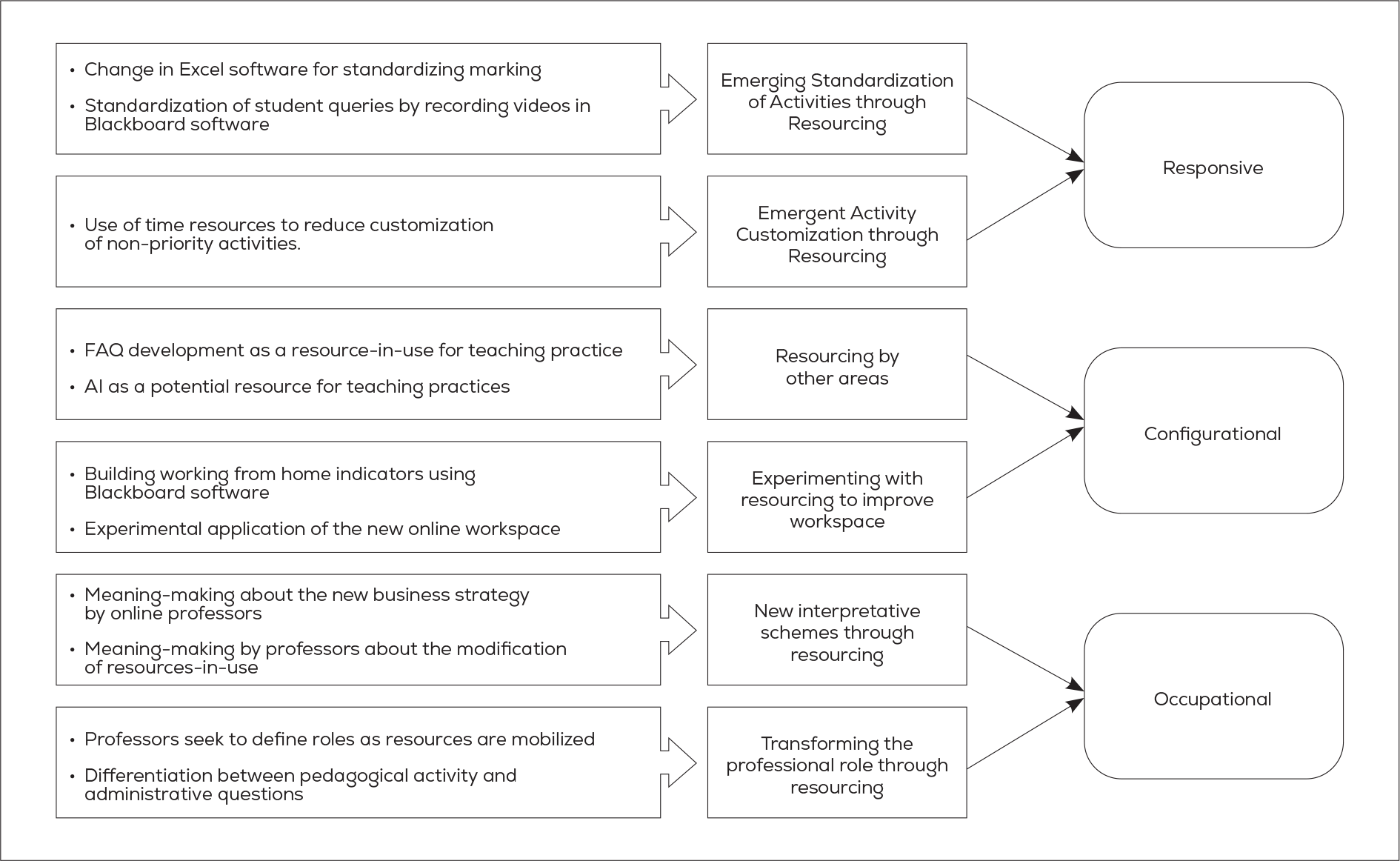
The case of UAlpha illustrates that strategic changes in dynamic environments necessarily involve significant shifts in internal interactions between an organization’s operational areas. This study highlights the role of teaching practices and organizational activities as key drivers of change, adaptation, and improvisation in strategic transformations (Feldman, 2004; Sonenshein, 2014). Using the method proposed by Gioia et al. (2013) and analyzing narratives constructed from the description of results, we identified the main first-order and second-order categories, as well as the aggregate dimensions that shape the resourcing process within and across educational practices at UAlpha’s DLU, as shown in Figure 1. Three central dimensions of resourcing emerge, occurring simultaneously and interdependently in the process of organizational change within and between organizational activities: responsive, configurational, and occupational. Below, we describe the key characteristics of each identified process.
Responsive resourcing: It occurs when actors within teaching practices transform potential resources into resources-in-use to address efficiency challenges arising from strategic change within a short timeframe. Faced with unexpected work demands and time constraints, these actors collaborate to resolve urgent issues, adapting their daily activities based on available resources. In this process, they may standardize or customize their activities to manage time constraints effectively. Responsive resourcing typically involves immediate (short-term) and internally driven solutions, without requiring the involvement of other interdependent areas.
Configurational resourcing: It entails collaboration between interdependent areas to solve problems and enhance the efficiency of teaching practices. When internal changes impact these practices, non-teaching areas must develop resources that enable adaptation to the new strategic conditions. Addressing different constraints requires specific solutions, such as the mobilization of potential and in-use resources by support and indicator areas to improve teaching activities. Unlike responsive resourcing, this process unfolds over a longer period, requiring more time to modify resources and teaching practices while fostering a shared understanding of the change process among organizational actors. Configurational resourcing aims to bring structural modifications to teaching practices, as seen in the transfer of administrative queries to the support area, which enhances resource flexibility in an uncertain environment.
Occupational resourcing: It is a dynamic and emergent process through which organizational actors reconstruct their interpretative frameworks of professional roles by transforming resources. Although interdependent activities did not immediately alter the structure of teaching practices, the resources developed by the indicator and support areas shaped actors’ expectations about future changes. Online lecturers began perceiving the current situation as temporary, believing that other areas would ultimately resolve existing challenges. Meanwhile, managers reinforced the pursuit of teaching quality during the transition, mitigating concerns about its impact. These actions helped online lecturers adapt to new dynamics and redefine their professional roles more effectively. The transformation of potential resources into resources in use by online lecturers involved both interpretative shifts and practical adjustments to professional practices to navigate uncertainties during the transition.
Considering the three resourcing processes identified, Table 1 provides a summary of the main research findings.
The three types of resourcing - responsive, configurational, and occupational - complement each other by addressing different constraints on organizational resources. Each type is triggered by specific demands: responsive resourcing emerges in situations of high urgency, configurational resourcing occurs in planned structural change processes, and occupational resourcing manifests in the continuous adaptation to new professional roles. Responsive resourcing functions as an emergent response not anticipated in configurational and occupational processes, enabling rapid problem-solving and providing time for broader and more structured solutions to be implemented through configurational resourcing. In both cases, technologies played a central role as mediators, shaping the mobilization of resources in achieving organizational transformations. Occupational resourcing permeates the other two, allowing individuals to continually reinterpret their roles and adapt to the changes generated by responsive and configurational processes. Thus, it serves as a mediating dimension that facilitates the transition between rapid and structural changes, promotes the redefinition of experiences, and helps actors navigate uncertainties. Therefore, the scope of organizational transformations depends on the interdependence of these three resourcing types, which are essential for addressing new organizational realities.
Strategy research has advanced in understanding the resourcing process across different strategic contexts (Deken et al., 2018; Kannan-Narasimhan & Lawrence, 2018; Wiedner et al., 2017). Resourcing broadens the view of strategy as an emergent, situated, and collective process, emphasizing how the daily actions and interactions of organizational actors influence the construction and adaptation of strategy over time. The first contribution of this research is its connection between the strategic context and the micro-level dynamics of organizational action, represented by the interdependent interactions between the organization’s operational activities (Feldman, 2004; Feldman et al., 2016; Schneider et al., 2022). The study demonstrates how the strategic changes legitimized by UAlpha’s senior executives in relation to the DLU triggered a series of transformations in the unit’s teaching practices and activities, highlighting how organizational actors mobilized resources in an emergent manner.
A second contribution of this study is its expansion of the understanding of strategic change by emphasizing the active role of organizational actors in contexts of uncertainty and resource scarcity - an aspect that has received limited attention in the resourcing literature (Sonenshein, 2014). The findings indicate that time, space, and professional roles are fundamental resources for organizational action. These elements are directly impacted by strategic decisions, shaping the performativity of activities that mobilize resources, sometimes reinforcing and sometimes challenging the changes. The study also reinforces the idea that the strategic value of resources is not intrinsic but emerges through practical use and contextual application, underscoring the importance of organizational daily practices in understanding change processes (Deken et al., 2018; Feldman & Worline, 2011; Sutter et al., 2023; Wiedner et al., 2017). Thus, UAlpha’s transformation involved a dynamic interplay between potential resources and resources-in-use, revealing the meanings embedded in resource changes and how actors resignify their professional roles and activities.
Additionally, identifying the three resourcing processes - responsive, configurational, and occupational - provides new insights into how resources are utilized in practice. This study significantly contributes to the resourcing literature by emphasizing the central role of scarcity-related factors such as time, space, and professional roles in this process. This perspective expands upon previous research, which has mainly concentrated on aspects like data use (Günther et al., 2021), tension resolution (Schneider et al., 2021), negotiation (Kannan-Narasimhan & Lawrence, 2018), collaborative processes (Deken et al., 2018), and power relations (Wiedner et al., 2017). Moving beyond these dimensions, this study examines how scarcity elements shape organizational practices and affect resource mobilization in a context-specific and dynamic way.
Finally, responsive resourcing is characterized by immediate and localized responses, whereas configurational resourcing involves more sustained adaptations that impact different areas of the organization. Occupational resourcing, in turn, refers to the reconstruction of professional roles by organizational actors. From this perspective, there is no predetermined expectation; rather, it is assumed that these three forms of resourcing - responsive, configurational, and occupational - emerge in all types of strategic change due to their situational nature, focusing on specific actions and micro-processes (Feldman & Worline, 2011). However, the presence and predominance of each form may vary depending on the nature of the change and the organizational context. Thus, the dynamics between responsive, configurational, and occupational resourcing are closely linked to the nature, urgency, and situational context of strategic change, reflecting the continuous transformation of resources in use based on the practices and interpretations of organizational actors (Feldman & Orlikowski, 2011).
By analyzing resource dynamics from a processual and praxeological perspective, this study also contributes to the critique of the rapid expansion of distance education in higher education, highlighting relevant implications for the quality of distance learning in Brazil (Bertolin, 2021; Carvalho & Lima, 2024; Giolo, 2018). The rapid expansion of distance learning in undergraduate programs has raised significant concerns about the quality of professional training, potentially compromising the depth of learning, the effectiveness of pedagogical activities, and the ability of coordinators and online lecturers to properly manage and execute these activities (Bertolin, 2021). This often unregulated expansion, driven by competition among large private education groups, has led to abrupt transformations in teaching practices, increasing job insecurity for online lecturers and distorting the meaning attributed to their professional roles (Casagrande et al., 2022).
Short-term changes arising from improvised and creative practices often provide only temporary relief within the context of precarious academic labor, acting as stopgap solutions to the pressures of work overload and increasing student-to-professor ratios (Veloso & Mill, 2018). Structural and technological changes, such as integrating artificial intelligence and remote work, may present advantages; however, without proper planning, they risk compromising the quality of teaching practices (Waltermann et al., 2022). Moreover, the escalating demand for new roles and the expansion of online lecturers’ responsibilities lead to a heightened sense of job insecurity and ongoing concerns about the quality of their work (Veloso & Mill, 2018).
In this context, resourcing processes must be integrated to enhance teaching practices, considering the evolving nature of academic work, particularly for online lecturers. This calls for a critical reflection on the market and educational logic that shape these practices, ensuring a balance between expanding access to education and maintaining instructional quality. While the expansion of distance learning has improved access to higher education, it must be accompanied by measures that safeguard both the quality of teaching and the working conditions of online lecturers.
FINAL CONSIDERATIONS
The primary objective of this research was to understand how actors, in their daily activities, mobilize resources to navigate the constraints imposed by an unexpected strategic change. The study highlights the significance of the resourcing process in the context of rapid transformations and resource scarcity within the teaching practices of a distance learning unit. Its main contributions include the identification of three key resourcing processes - responsive, configurational, and occupational - which emphasize the complexity and interdependence involved in adapting resources within constantly evolving educational environments. Additionally, the research emphasizes the dynamic nature of resources, which acquire meaning and value through practice, offering deeper insights into the strategies employed by organizational actors in carrying out teaching activities and interdependent tasks.
The practiceand process-based approach adopted in this study enabled a more nuanced analysis of the interactions between resources, daily activities, and the organizational context, moving beyond a purely economic perspective on strategy. This approach revealed new empirical pathways for understanding the interplay between macroand micro-level changes in organizational transformation. By conceptualizing resources not as static entities but as dynamic elements whose meaning and value emerge through situated action, the study demonstrated how actors mobilize and reinterpret these resources to overcome organizational challenges and achieve their goals. Furthermore, this article contributes to the critical discourse on distance learning, highlighting how the rapid expansion of distance education in higher education can undermine online lecturers’ working conditions. The findings suggest that while resourcing processes can offer temporary and structural solutions, the absence of long-term planning and the pressure for rapid adaptation may negatively impact online lecturers’ daily experiences and the perceived meaning of their work.
The main limitations of this research include its short observation period, limited to six months, which allowed for the analysis of emerging changes at DLU but did not enable an evaluation of the long-term strategic outcomes of the resourcing process. Therefore, we suggest that future studies adopt long-term approaches to investigate how change processes are consolidated over time and how they influence broader strategic outcomes. Additionally, we recommend expanding research on resourcing processes across diverse educational contexts to explore the different forms of transformation that shape organizational change dynamics.
-
The Peer Review Report is available at this link
-
Evaluated through a double-anonymized peer review.
ACKNOWLEDGMENT
We would like to thank the Coordination for the Improvement of Higher Education Personnel (CAPES) for the scholarship granted during the period in which this research was carried out.
-
FUNDING
This work was carried out with the support of the Brazilian agency Coordination for the Improvement of Higher Education Personnel (CAPES) - Financing Code 001
References
-
Bertolin, J. C. G. (2021). Existe diferença de qualidade entre as modalidades presencial e a distância? Cadernos de Pesquisa, 51, e06958. https://doi.org/10.1590/198053146958
» https://doi.org/10.1590/198053146958 -
Carvalho, C. H. A. D., & Lima, R. D. S. (2024). Estratégias e movimentos dos grandes grupos privados de ensino superior de capital aberto entre 2007 e 2021. Revista Brasileira de Educação, 29, e290091. https://doi.org/10.1590/S1413-24782024290091
» https://doi.org/10.1590/S1413-24782024290091 -
Casagrande, A. L., Maieski, A., & Alonso, K. M. (2022). As contingências e condições objetivas da “EADIZAÇÃO” do ensino superior presencial. Educação & Sociedade, 43, e261767. https://doi.org/10.1590/ES.261767
» https://doi.org/10.1590/ES.261767 -
Deken, F., Berends, H., Gemser, G., & Lauche, K. (2018). Strategizing and the initiation of interorganizational collaboration through prospective resourcing. Academy of Management Journal, 61(5), 1920-1950. https://doi.org/10.5465/amj.2016.0687
» https://doi.org/10.5465/amj.2016.0687 - Emerson, R. M., Fretz, R. I., & Shaw, L. L. (2011). Writing ethnographic fieldnotes. University of Chicago Press.
-
Feldman, M., & Worline, M. (2016). The practicality of practice theory. Academy of Management Learning & Education, 15(2), 304-324. https://doi.org/10.5465/amle.2014.0356
» https://doi.org/10.5465/amle.2014.0356 -
Feldman, M. S. (2004). Resources in emerging structures and processes of change. Organization Science, 15(3), 295-309. https://doi.org/10.1287/orsc.1040.0073
» https://doi.org/10.1287/orsc.1040.0073 -
Feldman, M. S., & Orlikowski, W. J. (2011). Theorizing practice and practicing theory. Organization Science, 22(5), 1240-1253. https://doi.org/10.1287/orsc.1100.0612
» https://doi.org/10.1287/orsc.1100.0612 -
Feldman, M. S., Pentland, B. T., D’Adderio, L., & Lazaric, N. (2016). Beyond routines as things: Introduction to the special issue on routine dynamics. Organization Science, 27(3), 505-513. https://doi.org/10.1287/orsc.2016.1070
» https://doi.org/10.1287/orsc.2016.1070 - Feldman, M. S., & Worline, M. C. (2011). Resources, resourcing, and ampliative cycles in organizations. In G. M. Spreitzer & K. S. Cameron (Eds.), The Oxford handbook of positive organizational scholarship (pp. 629-641). Oxford Library of Psychology.
-
Gioia, D. A., Corley, K. G., & Hamilton, A. L. (2013). Seeking qualitative rigor in inductive research: Notes on the Gioia methodology. Organizational Research Methods, 16(1), 15-31. https://doi.org/10.1177/1094428112452151
» https://doi.org/10.1177/1094428112452151 -
Giolo, J. (2018). Educação a distância no Brasil: A expansão vertiginosa. Revista Brasileira de Política e Administração da Educação, 34(1), 73-97. https://doi.org/10.21573/vol34n12018.82465
» https://doi.org/10.21573/vol34n12018.82465 -
Günther, W. A., Mehrizi, M. H. R., Huysman, M., Deken, F., & Feldberg, F. (2022). Resourcing with data: Unpacking the process of creating data-driven value propositions. The Journal of Strategic Information Systems, 31(4), 101744. https://doi.org/10.1016/j.jsis.2022.101744
» https://doi.org/10.1016/j.jsis.2022.101744 -
Helfat, C. E., Kaul, A., Ketchen, D. J., Jr, Barney, J. B., Chatain, O., & Singh, H. (2023). Renewing the resource-based view: New contexts, new concepts, and new methods. Strategic Management Journal, 44(6), 1357-1390. https://doi.org/10.1002/smj.3500
» https://doi.org/10.1002/smj.3500 -
Kannan-Narasimhan, R., & Lawrence, B. S. (2018). How innovators reframe resources in the strategy-making process to gain innovation adoption. Strategic Management Journal, 39(3), 720-758. https://doi.org/10.1002/smj.2748
» https://doi.org/10.1002/smj.2748 - Langley, A., & Tsoukas, H. (2017). Introduction: Process thinking, process theorizing and process researching. In A. Langley & H. Tsoukas (Eds.), The SAGE handbook of process organization studies (pp. 1-25). Sage Publishing.
- Locke, K., Feldman, M. S., & Golden-Biddle, K. (2015). Discovery, validation, and live coding. In K. D. Elsbach & R. M. Kramer (Eds.), Handbook of qualitative organizational research (pp. 371-380). Routledge.
- Nicolini, D., Seidl, D., & Splitter, V. (2023). Schatzki’s practice theory and strategy as practice. In D. Golsorkhi, L. Rouleau, D. Seidl, E. Vaara (Eds.), Cambridge handbook of strategy as practice (3a ed.). Cambridge University Press.
- Pfeffer, J., & Salancik, G. R. (1978). The external control of organizations: A resource dependence perspective Harper & Row.
-
Reckwitz, A. (2002). Toward a theory of social practices: A development in culturalist theorizing. European Journal of Social Theory, 5(2), 243-263.https://doi.org/10.1177/13684310222225432
» https://doi.org/10.1177/13684310222225432 -
Sætre, A. S., & Van de Ven, A. (2021). Generating theory by abduction. Academy of Management Review, 46(4), 684-701. https://doi.org/10.5465/amr.2019.0233
» https://doi.org/10.5465/amr.2019.0233 -
Schatzki, T. R. (2005). Peripheral vision: The sites of organizations. Organization Studies, 26(3), 465-484. https://doi.org/10.1177/0170840605050876
» https://doi.org/10.1177/0170840605050876 -
Schneider, A., Bullinger, B., & Brandl, J. (2021). Resourcing under tensions: How frontline employees create resources to balance paradoxical tensions. Organization Studies, 42(8), 1291-1317. https://doi.org/10.1177/0170840620926825
» https://doi.org/10.1177/0170840620926825 -
Schneider, A., Subramanian, D., Suquet, J. B., & Ughetto, P. (2022). Situating service work in action: A review and a pragmatist agenda for analysing interactive service work. International Journal of Management Reviews, 24(1), 25-50. https://doi.org/10.1111/ijmr.12259
» https://doi.org/10.1111/ijmr.12259 -
Sonenshein, S. (2014). How organizations foster the creative use of resources. Academy of Management Journal, 57(3), 814-848. https://doi.org/10.1111/ijmr.12259
» https://doi.org/10.1111/ijmr.12259 - Strauss, A. L., & Corbin, J. (2008). Pesquisa qualitativa: Técnicas e procedimentos para o desenvolvimento de teoria fundamentada Artmed.
-
Sutter, C., Bhatt, B., & Qureshi, I. (2023). What makes resource provision an effective means of poverty alleviation? A resourcing perspective. Organization Science, 34(1), 223-245. https://doi.org/10.1287/orsc.2021.1570
» https://doi.org/10.1287/orsc.2021.1570 -
Teece, D. J., Pisano, G., & Shuen, A. (1997). Dynamic capabilities and strategic management. Strategic Management Journal, 18(7), 509-533. https://doi.org/10.1002/(SICI)1097-0266(199708)18:7%3C509::AID-SMJ882%3E3.0.CO;2-Z
» https://doi.org/10.1002/(SICI)1097-0266(199708)18:7%3C509::AID-SMJ882%3E3.0.CO;2-Z -
Veloso, B. G., & Mill, D. (2018). Precarização do trabalho docente na educação a distância: Elementos para pensar a valorização da docência virtual. Educação Em Foco, 23(1), 111-132 https://doi.org/10.34019/2447-5246.2018.v23.20005
» https://doi.org/10.34019/2447-5246.2018.v23.20005 -
Waltermann, M. E., Martins, M. I. M., & Gedrat, D. C. (2022). Trabalho em home office, felicidade e saúde do professor universitário. ECOS-Estudos Contemporâneos da Subjetividade,12(2), 184-196. https://periodicoshumanas.uff.br/ecos/article/view/3120/1765
» https://periodicoshumanas.uff.br/ecos/article/view/3120/1765 -
Wiedner, R., Barrett, M., & Oborn, E. (2017). The emergence of change in unexpected places: Resourcing across organizational practices in strategic change. Academy of Management Journal, 60(3), 823-854. https://doi.org/10.5465/amj.2014.0474
» https://doi.org/10.5465/amj.2014.0474
Edited by
-
Associate Editor:
Diego M. Coraiola