 Innovation governance: Method applicable to large Brazilian companies
Abstract
Objective: Propose an innovation governance methodology applicable to large Brazilian companies, addressing the knowledge gap that exists on this subject in both the academic and business spheres.
Originality/value: This study addresses the gap in traditional corporate governance, which neglects leadership and strategy for innovation, compromising companies’ vitality. Although innovation governance is crucial for achieving organizational ambidexterity, Brazil lacks a methodology applicable to large companies, considering its economic and political context. Thus, the presented result proposes a new approach to the topic.
Methodology: Design Science Research was adopted, which follows a qualitative approach and aims to design artifacts to solve complex problems, assess what has been designed or is functioning, and communicate the results obtained. For this study, five stages were followed in order to ensure scientific rigor: identification of the problem to be addressed, proposal of the artifact, development of the artifact, evaluation of the results obtained, and, finally, communication of the results.
Findings: A functional artifact, validated by experts, that provides a solution to the challenge of innovation governance in large Brazilian companies. Grounded in organizational philosophy and business heterogeneity, the method is divided into five stages: decision on the modus operandi of innovation, strategic definition, structuring of people architecture, design of innovation processes, and formalization.
Contribution/implications: The applications of this method allow large Brazilian companies to incorporate innovation as a strategic element, optimizing their processes and structures for organizational ambidexterity. The main theoretical contribution lies in proposing an innovation governance model contextualized for the Brazilian scenario, which can serve as a basis for future research that seek to explore this theme.
Keywords:
innovation governance; corporate governance; innovation; organizational ambidexterity; multi-dexterity
Resumo
Objetivo: Prever uma metodologia de governança da inovação aplicável às grandes empresas brasileiras, preenchendo a lacuna de conhecimento que existe acerca desse assunto, tanto na esfera acadêmica quanto na empresarial.
Originalidade/valor: Aborda a lacuna existente na governança corporativa, que negligencia a liderança e estratégia para inovação, comprometendo a vitalidade das empresas. Embora a governança da inovação seja crucial para alcançar a ambidestria organizacional, o Brasil carece de uma metodologia aplicável a grandes empresas, considerando seu contexto econômico e político.
Metodologia: Fora adotada a Design Science Research, qual possui uma abordagem qualitativa e tem como objetivo projetar artefatos para resolver problemas complexos, avaliar o que foi projetado ou o que está funcionando e comunicar os resultados obtidos. Para o estudo em questão, foram seguidas cinco etapas de maneira a cumprir com o rigor científico: identificação do problema a ser resolvido, sugestão do artefato, desenvolvimento do artefato, avaliação dos resultados obtidos e, por fim, a comunicação dos resultados.
Resultados: Um artefato funcional e validado por especialistas, que oferece uma solução para o desafio da governança da inovação em grandes empresas brasileiras. Baseado na filosofia organizacional e na heterogeneidade dos negócios, o método é dividido em cinco etapas: decisão sobre o modus operandi da inovação, definição estratégica, estruturação da arquitetura de pessoas, desenho dos processos de inovação e formalização.
Contribuição/implicações: As aplicações desse método permitem que grandes empresas brasileiras incorporem a inovação como um elemento estratégico, otimizando seus processos e estruturas para a ambidestria organizacional. A principal contribuição teórica reside na proposição de um modelo de governança da inovação contextualizado para o cenário brasileiro, que pode servir como base para futuras pesquisas que busquem explorar essa temática.
Palavras-chave:
governança da inovação; governança corporativa; inovação; ambidestria organizacional; multidestria
INTRODUTION
The increasingly frequent volatile, uncertain, complex, and ambiguous (VUCA) environment is marked by technological transformations and significant changes in consumer behavior. Decision-making in this context involves not only mitigating present risks but also defining future strategies. In this scenario, companies increasingly seek to ground themselves in innovation.
Among the various definitions of innovation, it can be understood as the development or implementation of new products or services, processes, organizational structures, or business models aimed at creating value for customers and generating returns for the company (Organization for Economic Cooperation and Development [OCDE], 2018).
However, innovation must be a continuous activity within the organization, as the development of an isolated innovation may provide competitive advantages for a certain period, but these will likely be temporary. If a company seeks long-term sustainability, innovation must occur in increasingly shorter cycles, and for this to happen, its governance system must be aligned with the theme of innovation (Almeida e de Brito, 2020).
Since its inception, corporate governance has been a structure designed to move companies toward the future. To do this, it must be essentially grounded in accountability, to ensure transparency, and in innovation, to secure a forward-looking vision. However, various corporate governance codes around the world emphasize investment and integrity, yet overlook leadership and innovation strategy, leading large companies to lose vitality in this regard (Clarke, 2018). Therefore, a new model becomes necessary, one that positions innovation as a strategic priority. Thus emerges innovation governance (Carreira, 2021).
Innovation governance can be understood as a strategic approach to guiding, promoting, and sustaining innovation. By reorganizing principles of corporate governance, innovation governance describes how a company allocates resources and responsibilities in a way that fosters innovation internally (Deschamps, 2020).
At the same time, Brazil has shown significant contrasts in its approach to innovation: on one hand, there is a set of innovative companies with a long history of competitiveness at both national and international levels; on the other hand, the vast majority of national organizations do not foster innovation. According to IBGE data from PINTEC – a survey that evaluates the innovation efforts of Brazilian companies – only 33.6% of companies could be considered innovative in 2020. Innovation governance, or the lack thereof, has been identified as one of the reasons why companies operating under the same cultural and economic context exhibit such differences in innovation development (Carreira, 2021).
Despite numerous academic studies, Brazilian companies still lack an innovation governance methodology aligned with the national context, economy, and politics: a method that allows the company, while ensuring operational efficiency, to also prepare for the future. Accordingly, this study seeks to address the following research question: what is the most suitable innovation governance method for large Brazilian companies?
INNOVATION GOVERNANCE
Innovation governance consists of integrating a new priority into the organization’s objectives: innovation. In order for this new objective to receive due attention, a dedicated governance structure is required, which assumes responsibility, defines its scope, and designs the mechanisms for its implementation (Carreira, 2021).
The first author to refer to the concept of innovation governance was the professor, scientist and consultant Gina O’Connor (1999), suggesting that companies guided by traditional governance models tend to have bureaucratic decision-making rules that create obstacles to innovation. To overcome these obstacles, it is necessary to introduce a new structure with autonomy, access to financial resources, and the ability to mediate decision-making between the board of directors and innovation execution. This structure was initially proposed to be called an innovation governance council, which later became known as an innovation committee (Robeson & O’Connor, 2013).
O’Connor’s (1999) theory evolved, and the term innovation governance was popularized by the work of Jean-Philippe Deschamps and Beebe Nelson, who, between 2013 and 2014, conducted a study with 133 large innovative companies in the United States, Europe and Asia, aiming to identify the innovation governance models most commonly used by these companies. This research resulted in eight different functional models: an innovation committee composed of senior management, a mixed committee, the CEO responsible for innovation, the unit director responsible for innovation, the innovation manager, an innovation duo, the director of research, development, and innovation (RD&I), and innovation squads (Deschamps & Nelson, 2014).
The models proposed by Deschamps and Nelson (2014), whether used individually or in combination, have been adopted worldwide as inspiration for companies seeking to create a more agile and fluid system to manage innovation, aiming to enable not only incremental innovations but also investments in adjacent and transformational solutions.
However, when structuring an innovation governance system, the model should not be chosen directly. Instead, the company must consider two fundamental premises: business heterogeneity and management philosophy (Deschamps & Nelson, 2014).
Business heterogeneity refers to how many markets a company operates and how they differ from one another, as well as the number of units the company has to serve them. Companies operating solely within the same market niche tend to adopt more centralized innovation governance structures. In contrast, those operating across multiple market niches require more decentralized structures, adapted to each niche.
Management philosophy assumes that organizations with more hierarchical decision-making processes will require innovation governance structures that are similarly hierarchical, such as an innovation manager or a committee composed of senior management. Conversely, companies with a culture of decentralized decision-making tend to opt for structures such as innovation squads or mixed committees (Deschamps & Nelson, 2014).
Furthermore, these premises need to be encompassed within four dimensions: innovation strategy, innovation architecture, processes and formalization (Água & Correia, 2020; Deschamps & Nelson, 2014; Robeson & O’Connor, 2013).
Innovation strategy
Tushman and O’Reilly (1996) proposed that companies seeking to achieve longevity need to become ambidextrous, that is, to work on exploitation, which refers to leveraging existing knowledge through lower-risk processes and projects focused on efficiency, alongside exploration, which involves pursuing new opportunities that requires experimentation, research, and discovery.
To achieve this, it is necessary to address potential tensions that may arise, such as the uncertainty of innovation versus the predictability inherent in the traditional business, continuous improvement practices versus those required for transformational innovations, traditional product and solution development methodologies versus methodologies primarily based on open innovation, and maintaining the current portfolio versus a portfolio that includes different investments in several types of innovation (Carlomagno, 2018).
According to Deschamps and Nelson (2014), a well-developed innovation strategy must encompass investments in innovations across the three portfolio matrices: core, adjacent, and transformational. Using an analogy to personal investments, companies need to ensure an ‘emergency reserve’ by investing in incremental innovations to keep their core business competitive, while also allocating resources to higher-risk areas, such as adjacent and transformational innovations. The greater the risk taken, the higher the potential for exponential gains.
To determine an effective innovation strategy and appropriate investments in its portfolio, a company must also be attentive to its market and the movements of its competitors. More traditional markets, such as textiles, financial services and medicine, tend to invest more in core-related innovations than in transformational ones. Conversely, more innovative markets, such as aerospace, biotechnology and digital services, tend to pursue more transformational innovations (Levón, 2018).
Thus, an innovation strategy aimed at breaking the organization’s current paradigms must be able to identify and address trends impacting the company’s business, the cultural transformation it seeks to achieve, the desired outcomes, portfolio balancing, and alignment with the ecosystem in which it operates (Menkhoff & Geok Chwee, 2018).
Innovation architecture
Just as there are different strategies for innovation, leadership and the organizational structuring of people for this purpose also vary according to the maturity and ambition pursued by the company (Andersson, 2013).
According to Menkhoff and Chwee (2018), in addition to a managerial structure for innovation, there must be direct engagement with the board of directors, who are the true decision-makers regarding the organization’s future. If the board is not considering the next generation of the company, the efforts promoted by executives will be in vain. Therefore, the authors suggest that at least one member of the board should possess the mindset and knowledge required for innovation.
Thus, the innovation architecture can be understood as the structure of power through which the theme of innovation will permeate the organization, acting as a facilitator for this purpose. This structure must possess its own autonomy, while in some way remaining linked to the corporate governance framework, taking into account the premise of management philosophy (Água & Correia, 2020).
The eight models proposed by Deschamps and Nelson (2014) are widely used worldwide and primarily focus on structuring a system of personnel capable of deciding, coordinating and executing innovation within large companies. However, these models still lack a broader perspective oriented toward the board of directors, which is considered the main agent within a governance structure. According to Deschamps (2020), boards of directors were formed merely as a legal requirement for many years; over time, they gained robustness and strategic value for the organization. However, in the VUCA economy, these boards still need to develop more visionary approach in order to guide companies toward investments in radical and disruptive innovations.
In this context, innovation architecture must be able to encompass four functional structures: one responsible for strategic guidance, one responsible for decision-making, one responsible for coordination and one responsible for execution.
The structure responsible for strategic guidance must necessarily be the board of directors, either through a single member or the collective of all members. Its duties include guiding the innovative behavior of the CEO and the executive board, promoting and approving innovative projects, demonstrating patience regarding financial results—particularly those from radical innovation projects—and granting decision-making autonomy to those assuming the other roles within the innovation architecture (Robeson & O’Connor, 2013).
The structure responsible for decision-making consists of people who determine which projects will be invested in, as well as establish innovation tactics, define targets, and set the indicators that will measure their achievement. These individuals also motivate the rest of the organization to engage in innovation projects. Due to these responsibilities and the need for broad decision-making authority, the group assuming this role within the innovation architecture must occupy higher hierarchical levels within the company’s management structure (Andrade, 2021; Robeson & O’Connor, 2013).
Those responsible for coordination have as their main role to organize the company’s innovation programs and projects, maintaining relationships with the innovation ecosystem, engaging employees to foster a culture of innovation and ensuring compliance with the previously designed innovation strategy (Deschamps & Nelson, 2014).
Finally, the group responsible for execution consists of the individuals directly involved in developing innovation projects, enabling organizational ambidexterity or multidexterity. According to Tushman and O’Reilly (1996), for this execution to be effective, companies can adopt three approaches: structural, sequential, and contextual ambidexterity. The structural model is based on separating exploitation and exploration activities into distinct organizational units, such as hubs, centers or innovation laboratories. The sequential model relies on temporal separation, with cyclical focus on each activity, for example, companies like Google or 3M encourage employees to dedicate 20% of their work time to innovation projects. The contextual model assumes that such separation is unnecessary, and all individuals within the organization should allocate time to both types of activities.
Regardless of the model adopted, these structures must be formally documented and processually organized, which is the focus of the next section (Tushman & O’Reilly, 1996).
Innovation processes
Once the innovation strategy and the organizational and leadership structure have been determined, the next dimension is to establish the processes through which innovation will flow during its trajectory within the company. Innovation processes must include routines for testing and experimentation, information sharing, and specific criteria and metrics for decision-making regarding whether to continue or finishing a project. As innovation involves greater uncertainty during development, the process must ensure that ideas are not discarded prematurely, while also preventing undue delays in finishing projects that are unlikely to deliver the expected results. To achieve this, the methodology commonly used is known as the innovation pipeline (Água & Correia, 2020; Menkhoff & Geok Chwee, 2018).
Innovation pipeline follows a funnel logic, where multiple ideas or projects enter at the top, and as testing and experimentation occur: those that perform best advance to subsequent stages, while those that fail to meet the established metrics are discarded. The funnel also incorporates an inverse investment logic: ideas at the top of the funnel, where uncertainty is highest, receive limited investment. Those at the bottom of the funnel, where uncertainty is lower, receive greater investment to ensure they become truly scalable (Viki et al., 2017).
In addition to ensuring the proper development of internal projects, the innovation process must include moments in which the company engages in open innovation vehicles, particularly through connections with emerging businesses or startups, which in the new economy are considered sources of acceleration and technological development for solving complex problems.
However, for this connection to be effective, the company must incorporate less rigid compliance rules and a less bureaucratic hiring or partnership process: this simplification is referred to as a fast track (Viki et al., 2017). The fast track involves mapping activities that are critical and could influence the continuation of the projects, and creating actions or mechanisms to unblock these activities, allowing greater agility and fluidity when working with emerging businesses and startups (Bagherzadeh et al., 2022).
Necessary formalization
Finally, after the entire innovation governance structure has been systematized, it is necessary to establish ways to formalize it. According to Água & Correia (2020), the most effective way to achieve this is through an innovation policy.
The innovation policy is a document approved by the board of directors that outlines the company’s long-term strategy for innovation, the innovation architecture, and the incentive systems for employees involved in innovative projects to Água & Correia (2020)??. Processes are not included in the innovation policy because they need to remain flexible according to the vehicles adopted by the company and must be able to be modified with minimal bureaucracy when they no longer provide the required agility (Água & Correia, 2020).
This policy should be developed with the purpose of regulating the extraction and creation of value necessary for innovation and, therefore, must include elements in three essential areas. The first legitimizes the authority, autonomy and capacity of the people architecture to manage innovation investments promoting a long-term vision within the organization. The second aims to engage employees in a process of continuous and cumulative learning, recognizing the importance of individuals in the innovation process and seeking to develop, acknowledge and reward them. Finally, the third ensures the availability of financial resources to sustain the innovation process, maintaining reserves to continue innovative activities even during economically challenging periods (Andrade, 2021).
Thus, the formalization of the innovation governance structure completes the necessary dimensions for the proper functioning of this system. Together with the fundamental premises, it provides the company with the essential elements to govern innovation in a results-oriented manner.
METHOD
Given the objective of the present study—to develop a method for innovation governance applicable to large Brazilian companies— the chosen research method was Design Science Research (DSR).
DSR adopts a qualitative approach and aims to design artifacts to address complex problems, evaluate what has been designed and communicate the obtained results. Its purpose is to investigate the artificial and its behavior, both from an academic standpoint and from an organizational perspective (Lacerda et al., 2013).
The term ‘artificial’ refers to something produced or invented by humans, subject to their interventions. Therefore, machines, organizations, and the economy itself can be classified as instances of the artificial (Baskerville, 2008). The sciences of the artificial, unlike the natural sciences, concern themselves with how things ought to be in order to function and achieve specific goals. Thus, the primary mission of this type of science is to develop knowledge that can be applied to the conception and development of artifacts (Simon, 1996).
Whereas natural and social sciences focus on understanding, explaining, and investigating how phenomena occur, the sciences of the artificial aim to produce knowledge through the process of designing, conceiving, and building artifacts. In this sense, Design Science Research employs design as the means of constructing an artifact that simultaneously serves as the objective of scientific inquiry (Pimentel & Filippo, 2020).
In order to ensure scientific rigor during the construction of the artifact, a systematic process composed of five stages was followed, as proposed by Lacerda et al. (2013): problem identification, artifact suggestion, artifact development, evaluation of the results, and communication of findings.
The problem identification stage consists of formulating the research question to be addressed, establishing its boundaries and mapping the existing knowledge on the subject. These elements were developed and described in the present document within the introduction and theoretical framework, respectively.
The following stage, artifact suggestion, involves the design of one or more models that could potentially solve the problem stated. The outcome of this stage is a set of possible artifacts and the prioritization of one to be further developed (Freitas Júnior et al., 2015).
To carry out this stage, inputs were drawn both from the theoretical framework and from semi-structured interviews conducted with innovation directors and managers from leading Brazilian companies recognized for their innovative practices.
For the selection of these companies, researchers relied on the Prêmio Inovação Brasil ranking of 2023, developed by the strategic consulting firm Strategy& in partnership with the newspaper Valor Econômico. This ranking highlights the 150 largest companies operating in Brazil, across different economic sectors, that stand out in innovation. Evaluation is based on five criteria: innovation intent, efforts undertaken to innovate, achieved results, market perception, and knowledge generation. Eligible companies must have at least 5% private capital and a net revenue exceeding R$500 million in the last two fiscal years.
For the present study, the 20 top-ranked companies were contacted and invited to participate in virtual interviews. Eight companies accepted the invitation, listed in alphabetical order in Table 1.
It is worth noting that the semi-structured interviews were conducted with the aim of understanding how companies currently govern innovation and whether they employ any pre-established model, considering the premises of business heterogeneity and management philosophy, as well as the dimensions of innovation strategy, innovation architecture, processes, and formalization, as outlined in the theoretical framework.
Once the interview phase was completed, the data analysis method proposed by Creswell (2010) was applied. This method combines the analysis of the collected data with the existing bibliographic references, enabling data triangulation. The process consists of grouping the information gathered into themes and correlating them with their respective descriptions in order to identify patterns, repetitions, and discrepancies among the participating companies and the existing theoretical references.
Continuing with the five-stage DSR process, the third stage concerns the development of the artifact. The artifact may take the form of computational algorithms, graphical representations, prototypes, mock-ups, and so forth. The main outcome of this stage is to obtain a functional artifact, so that it can be tested and validated (Baskerville et al., 2018).
According to Lacerda et al. (2013), the artifact can take different forms, such as a construct, a model, a method, or an instantiation. Table 2 presents the distinctions between these types of artifacts.
Thus, for the research in question, the method artifact was employed, in which, in addition to the creation of the graphical representation, a step-by-step guide is also prescribed for the use of this model, in order to direct how an organization may address its innovation governance problem.
After the construction of the artifact, the process advanced to the fourth stage: the evaluation of the results obtained. For the present study, the type of evaluation adopted was that conceptualized by Lacerda et al. (2013) as informed argument, which leverages existing bases of knowledge to build a convincing argument regarding the artifact’s utility. Accordingly, the researchers presented the constructed artifact to three specialists in the fields of innovation, governance, and innovation governance, each possessing distinct knowledge, educational backgrounds and professional experiences. Their perceptions were collected regarding the artifact’s use as a new method applicable to the business environment of large Brazilian companies. A result would only be considered satisfactory if an absolute majority of the consulted specialists affirmed that the proposed method fulfills its intended objective.
The evaluation process involved the researchers presenting the artifact individually to each of the specialists. Following the presentation, the specialists were invited to share their perspectives based on the following questions: a) applicability: Is the artifact suitable for large Brazilian companies? b) foundation: Are the arguments presented solid and well-supported? c) representation: Is the graphical model intuitive and easily understandable? d) improvements: Are there any necessary changes to be implemented in the artifact?
The feedback and suggestions provided by the specialists were then categorized according to the stages established in the artifact. After a thorough analysis, the researchers made the appropriate modifications so that, in its final version, the artifact would be usable by large Brazilian companies.
Finally, the last stage of Design Science Research consists of communicating the results, which, as the name suggests, entails reporting on the outcomes of the artifact. This communication comprises several instances: writing and defending the dissertation originating from the study, publishing in specialized journals and creating an executive version of the artifact that was sent to the interviewees who participated in the present research.
PROPOSED ARTIFACT
As explained throughout this document, the objective of this research was to develop an innovation governance method applicable to large Brazilian companies, which was made possible by combining elements from the literature review, semi-structured interviews, and validation conducted with innovation and governance experts.
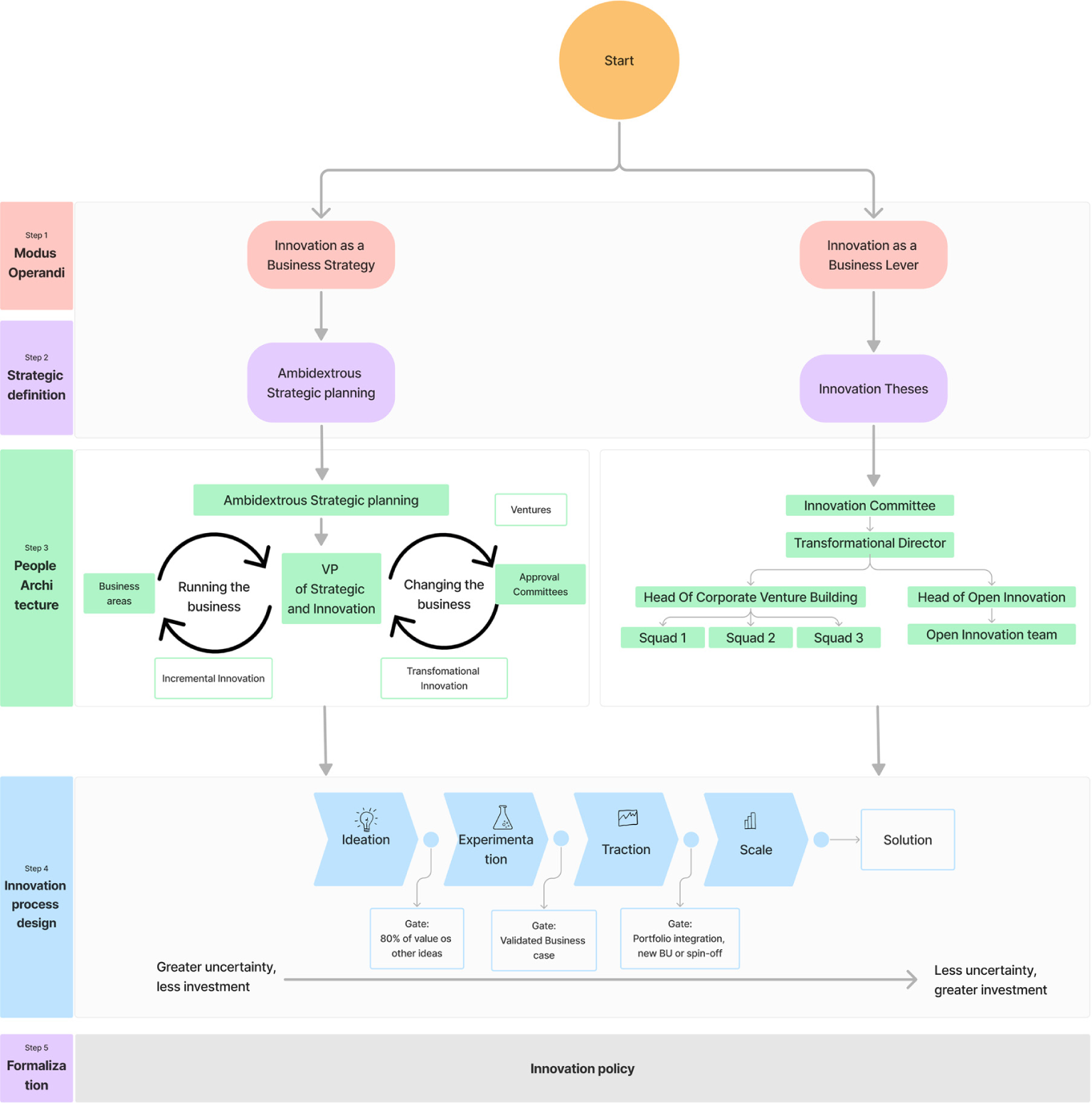
The proposed methodology is divided into five main stages: decision on the modus operandi of innovation, strategic definition, structuring of people architecture, process design and formalization.
Decision on the modus operandi of innovation
When structuring an innovation governance system, the company must consider two fundamental premises: the heterogeneity of the business and the management philosophy (Deschamps & Nelson, 2014). Taking these two premises into account, the first stage of the proposed methodology is precisely to analyze how innovation can occur within the organization, considering its own culture, market, and decision-making structure.
Thus, considering the input gathered during the interview phase, innovation can be addressed in two main ways: as a business strategy and as a business lever.
Despite the subtle difference between the two, defining modus operandi is crucial for advancing to the subsequent stages. Innovation as a business strategy treats innovation as something intrinsic to the business and the corporation’s overall strategy. In contrast, innovation as a business lever treats the topic as distinct from corporate strategy, using it to boost the company’s strategic objectives.
Therefore, innovation as a strategy is a transversal theme within the organization, where each department sets its own objectives and targets related to innovation. Additionally, the company’s strategic planning already considers innovation as an integral part of its overall plan.
On the other side, innovation as a lever addresses innovation as a specific area or department within the organization, which requires its own strategy to stimulate the company’s core business.
The decision as to whether innovation will serve as a business lever or a business strategy involves two main analyses: the heterogeneity of the business and the organization’s management philosophy, as presented in Table 3.
When the corporation’s decision-making philosophy is centralized and its businesses are homogeneous, employing innovation as a business strategy tends to be the most assertive choice. Integrating the theme of innovation into its corporate strategy and working with it transversally across the company can facilitate more agile execution, effectively making the organization ambidextrous.
Conversely, when the decision-making philosophy is decentralized but the businesses are homogeneous, treating innovation as a lever will be the most effective approach. In this scenario, having an area or department with a specific strategy will serve as support for other departments in executing innovative projects.
On the other hand, when a company has heterogeneous businesses, in other words, it operates in several distinct markets, and maintains a more centralized decision-making process, having a dedicated team and innovation strategy as support will enhance its corporate strategies. In this case, a Board of Innovation will allow the innovation theme to be addressed across the various businesses with fewer obstacles.
However, when a heterogeneous company adopts a more decentralized decision-making philosophy, incorporating innovation into its strategic plan and distributing responsibility for the theme among all departments will enable the pursuit of ambidexterity. This approach grants each business unit the autonomy to manage innovation in ways that are most efficient and strategic for its own market.
Strategic definition
Innovation strategy defines the organization’s objectives regarding innovation, the balance it intends to maintain in its portfolio, its goals, and the investments to be made over the stipulated period (Clarke, 2018).
In the proposed method, the innovation strategy directly depends on the company’s modus operandi: innovation as a business strategy or innovation as a business lever.
When innovation is treated as a business strategy, its planning is conducted alongside the organization’s strategic planning, making innovation an intrinsic part of the company’s operations and routines. Strategic objectives already consider innovation as a foundational pillar. In this way, the company is able to balance investments aimed at improving efficiency while simultaneously planning actions to build for the future, thus creating an ambidextrous strategic plan.
Conversely, when innovation is defined strategically as a lever, it is guided by innovation theses—that is, a document that outlines a hypothesized solution in which the company will invest resources, whether financial or otherwise. These theses will guide the company’s efforts and search for innovative projects. The theses must highlight the stimulus this hypothesis can provide to the core business, even if it is executed without direct connection to it.
Despite the differences between the strategic definitions of the two models, both must analyze the market and the trends impacting the company’s niche, so that investment decisions are made with the aim of remaining competitive in relation to competitors.
Structuring of people architecture
The architecture for innovation is essentially the power structure through which the theme of innovation will permeate the organization. In other words, it defines how people are organized to work with this topic by establishing roles and responsibilities at three levels: decision-making, coordination and execution (Água & Correia, 2020).
Just like strategic definition, the structuring of people architecture directly depends on the modus operandi of innovation.
Innovation as a business strategy
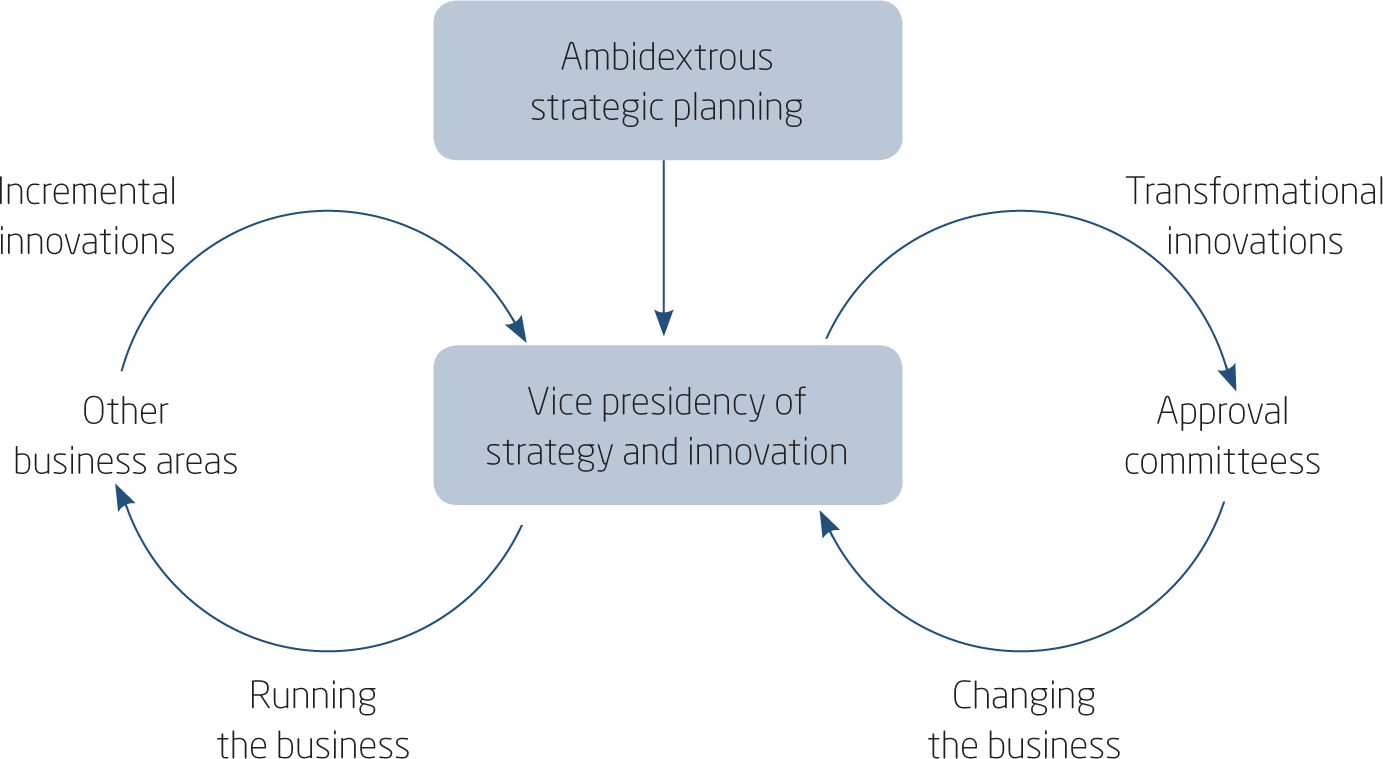
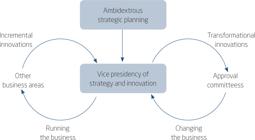
Considering innovation in this modus operandi, it is treated as an intrinsic part of the business strategy, the topic becomes similar to any other area within the organization. Thus, a Vice Presidency or Directorate of Strategy and Innovation is established, which becomes responsible for overseeing innovation initiatives.
The person occupying the position of Vice President is responsible for making decisions regarding innovation within the organization, while coordination and execution are subdivided into two categories: running the business and changing the business.
The structure named running the business is responsible for monitoring incremental and adjacent innovation projects, which aim to develop competitive advantages for the company’s existing businesses. These innovations are developed by the various areas or departments of the organization and are intrinsic to their daily operations. Therefore, running the business’ structure team only monitors and provides support through agile methodologies, ensuring alignment of the innovation portfolio. In this structure, innovation is coordinated by running the business’ team, but execution is carried out by the requesting area itself.
The structure named changing the business, in turn, is responsible for transformational innovations, that create new businesses and prepare the organization for the future. This structure may adopt different mechanisms to accelerate innovation, such as the creation of a venture capital fund to invest in startups or emerging businesses. Changing the business has its own project monitoring routines and may have distinct decision-making and coordination structures depending on the type of project being developed. Thus, decision-making is typically carried out by an approval committee.
This committee is composed of the organization’s top leadership and, as needed, and members of the Board of Directors may also participate. The committees should be thematic, according to the company’s strategic bets, and may be modified as changes occur in its ambidextrous strategic planning.
The roles of innovation coordination are carried out by the team responsible for changing the business itself, and execution is conducted by teams specifically assigned to the strategic bet or innovation vehicle chosen.
Figure 1 illustrates how both areas—running the business and changing the business—are organized within the same Vice Presidency of Strategy and Innovation.
Innovation as a business lever
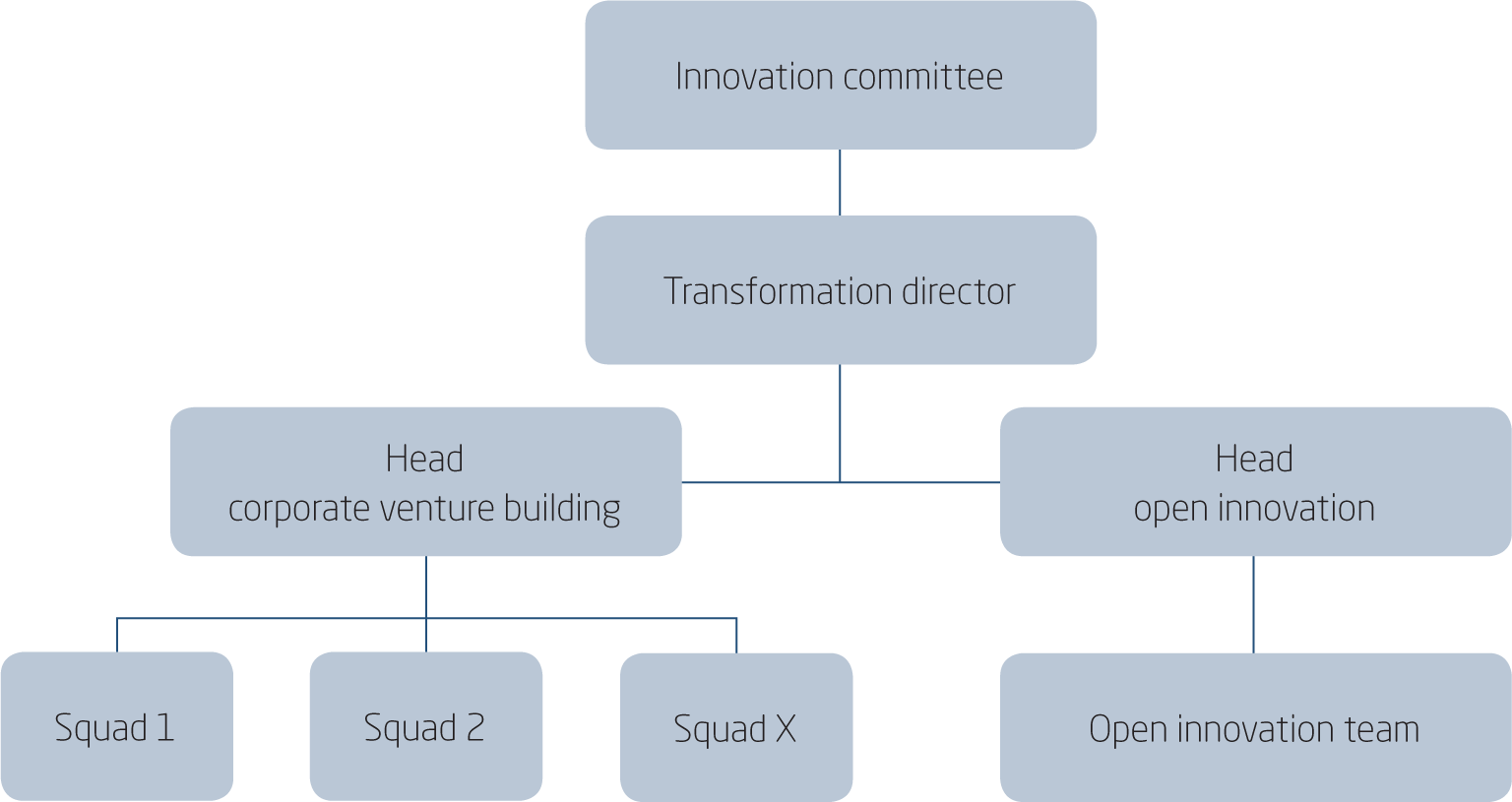
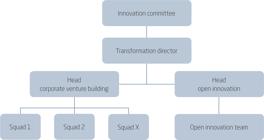
On the other hand, the architecture for the modus operandi of innovation as a business lever assumes that the company has a specific structure dedicated to innovation, such as an innovation center, innovation lab or even a specialized area, which is not necessarily tied to the company’s compliance function. Utilizing this type of structure allows the topic to be addressed with greater agility and autonomy.
This innovation center—or lab or area—will be responsible for centralizing the organization’s innovation portfolio, primarily focusing on adjacent and transformational innovation projects. This structure is divided into two parts based on the innovation vehicle to be used: corporate venture building (CVB) or open innovation.
Each structure has a leader whose role is to orchestrate innovation. Execution within CVB is carried out by a mixed team consisting of members from both the innovation unit and the requesting area, forming a dedicated work squad. In open innovation, a dedicated innovation team manages the entire connection process, whether with startups or universities.
The decision-making role within this structure is fulfilled by an Innovation Committee comprised of the company’s senior management, whose main responsibilities are to foster a culture of innovation and ensure that the projects developed serve as levers for the company’s business.
For accountability purposes or to establish an organizational link, the innovation center should be connected to a Directorate or Vice Presidency that is most aligned with the innovation agenda, such as Marketing or Transformation. Figure 2 illustrates how this structure is organized.
Innovation process design
The innovation process represents the pathway through which ideas are handled and evaluated within the organization until they become solutions that generate new revenues or promote greater internal efficiency (Corso et al., 2020).
Unlike the previous stages, the innovation process is independent of the modus operandi, since the logic brought by the innovation pipeline methodology is capable of meeting the demands of both types of structures.
Thus, the innovation process must include the stages of ideation, experimentation, traction and scaling. The ideation phase represents the moment when ideas originate that may become future solutions. This origination can occur in various ways, such as idea programs, intrapreneurship programs, hackathons, external events or even from the organization’s daily operations. Companies with R&D departments may utilize research as a source of idea origination for innovative practices. Before moving to the next phase, these ideas must go through a pre-established filter set by the company, ensuring alignment with the strategy and the innovation focus areas. These filters are commonly referred like stage-gates.
A best practice identified during the interviews conducted for this study indicates that ideas advancing to the next phase should demonstrate approximately 80% of the value gain—whether economic or financial—of all the others combined. Although this is not a rule, it can serve as a benchmark for companies wishing to adopt this method.
The experimentation phase is when the prioritized ideas are actually built and tested with their target audience. This is the stage where the MVP—minimum viable product—practice should be applied; that is, developing a solution capable of delivering the initially conceived value proposition, but with optimized time and financial investment. At the end of this stage, the idea goes through the second gate, and only those that present a concise, validated, and financially viable business case will proceed to the next stage.
The third stage is called traction. This is when the solution is fully developed and the organization should invest in its development. At this point, the level of uncertainty has already been reduced by previous validations, and the organization can understand the potential gains and the risks that may still arise during implementation. Output of this stage is solutions that can be integrated into the company’s product or service portfolio, lead to the creation of a new business unit, or even result in the formation of a spin-off.
Finally, the last stage of the innovation pipeline is scaling, which is when the solution is ready to gain market share and grow exponentially. At this point, the innovation is already embedded within the organization, treated as another element in its portfolio, thus making room for new ideas to begin the innovation process in a cyclical and systematic manner.
Formalization
The final proposed stage is formalization, which consists of documenting all the steps developed up to this point. At this moment, it is also necessary to establish the frameworks that will support the implementation of innovation within the organization, such as corporate ventures or sandboxes, which were highlighted as best practices during the interviews.
Creating a corporate venture capital vehicle enables the company to make risk investments, especially in transformational innovations. This type of structure has a specific legal nature, which facilitates management and reduces the organization’s own risks should these investments not yield the expected results.
The sandbox is also a structure with its own legal nature; however, its management is typically outsourced to a consulting firm specialized in innovation. This firm uses the sandbox to hire startups or emerging players that can be connected to the organization to accelerate an internal process or, in partnership, develop a new market solution. Given its legal autonomy, these connections do not need to follow the company’s strict compliance rules, thereby reducing bureaucracy.
Finally, after establishing the support structures, the company must formalize its innovation governance system through an innovation policy, regardless of the defined modus operandi. The innovation policy must be designed to regulate the extraction and creation of value necessary for innovation and, therefore, should address three essential aspects: legitimizing people architecture, establishing a systematic recognition mechanism for innovators, and ensuring financial resources for innovation.
The first aspect legitimizes the authority, autonomy, and capability of people architecture to manage innovation investments and encourage a long-term vision within the organization. The second aims to engage employees in a process of continuous and cumulative learning, recognizing the importance of people in the innovation process, and seeks to develop, acknowledge, and reward employees. Finally, the third aspect seeks to secure the availability of financial resources to sustain the innovation process, ensuring reserves for the maintenance of innovative activities even during economically unfavorable periods (Andrade, 2021).
It is also recommended that the innovation policy specify the role of the Board of Directors, indicate whether there will be members focused on innovation topics, clarify whether the official agenda will include this subject and describe how important decisions involving innovation will be voted on, especially those related to transformational horizons, where the level of uncertainty is high.
This innovation policy must be approved by the Board of Directors and should be reviewed whenever there are changes in the organization’s innovation governance structure.
Graphical representation
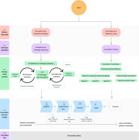
Given the foregoing and the unification of the stages created by the researchers, the graphical representation of the proposed method is shown in Figure 3.
The proposed innovation governance method presents an innovative character by systemically integrating mechanisms of strategic alignment with agile practices of experimentation and portfolio management, thereby fostering the continuous generation of value in dynamic organizational environments. Its practical implementation requires coordination across different decision-making levels, from top leadership to operational teams, ensuring clarity of priorities, monitoring metrics and resource allocation criteria. However, the process is not without barriers, chief among them being cultural resistance to change, the challenge of balancing short-term initiatives with investments in more uncertain horizons, and the limitation of internal competencies to deal with ambiguity and risk. Overcoming these challenges requires not only formal structures but also the development of an organizational mindset focused on continuous learning and adaptation in the face of complex scenarios.
CONCLUSIONS
The present study aimed to develop an innovation governance method applicable to large Brazilian companies, following the predefined stages of Design Science Research. The expected outcome was to deliver a functional artifact, validated and feasible for implementation by such companies, thereby assisting in organizing innovation and sustaining the subject to foster organizational ambidexterity.
The method presented by the researchers adheres to scientific rigor while also incorporating empirical market best practices identified during the interviews. In this way, by introducing an innovative method, the study bridges academia and the market, ensuring that its contribution has a positive impact on both.
As suggestions for future research, authors encourage the model to be tested in a large Brazilian company, conducting a case study to assess its effectiveness and applicability. Such a study could reveal gaps not addressed in this article, such as the average time required for implementation and potential obstacles during deployment. Applying the method to companies founded in Brazil as well as multinational corporations operating in the country and comparing their similarities and differences is also recommended as a direction for subsequent research.
The limitations of this study are primarily related to the still nascent theoretical framework on the topic of innovation governance, where certain concepts could not be explored in depth due to the limited availability of references, especially regarding the distinction between innovation management and innovation governance. There is also a limitation concerning the DSR method, which, being relatively new to the field of Administration, posed challenges for both the theoretical foundation and practical applicability.
Finally, the phenomenon of innovation remains a subject that will require not only internal business adaptations and transformations but also the anticipation of changes to enable organizations to take a leading role. Corporate governance, therefore, must incorporate innovation governance to sustain an active innovation culture and practices that facilitate the systematic treatment of this subject internally. The proposed method offers a pathway for achieving this integration.
-
RAM does not have information about open data regarding this manuscript.
-
RAM does not have permission from the authors or evaluators to publish this article’s review.
Open Data:
the contents underlying the research text are contained in the manuscript
REFERENCES
-
Água, P. B., & Correia, A. (2020). Innovation governance in practice: A business policy approach. Corporate Board Role Duties and Composition, 16(2), 54–64. https://doi.org/10.22495/cbv16i2art5
» https://doi.org/10.22495/cbv16i2art5 -
Almeida, S., & de Brito, X. (2020). Inovação: A perspectiva do Conselho de Administração Dissertação de mestrado, FGV, URI: https://hdl.handle.net/10438/29046
» https://hdl.handle.net/10438/29046 - Andersson, T. (2013). Innovation governance and innovation leadership in different contexts. 27th Australian and New Zealand Academy of Management Conference: Managing on The Edge, 1–19.
-
Andrade, P. R. S. de. (2021). Governança da inovação e criação de valor Dissertação de mestrado, Universidade Vale do Rio dos Sinos, URI: http://www.repositorio.jesuita.org.br/handle/UNISINOS/9876
» http://www.repositorio.jesuita.org.br/handle/UNISINOS/9876 -
Bagherzadeh, M., Gurca, A., & Brunswicker, S. (2022). Problem types and open innovation governance modes: A project-level empirical exploration. IEEE Transactions on Engineering Management, 69(2), 287–301. https://doi.org/10.1109/TEM.2019.2942132
» https://doi.org/10.1109/TEM.2019.2942132 -
Baskerville, R. (2008). What design science is not. European Journal of Information Systems, 17(5), 441–443. https://doi.org/10.1057/ejis.2008.45
» https://doi.org/10.1057/ejis.2008.45 -
Baskerville, R., Baiyere, A., Gergor, S., Hevner, A., & Rossi, M. (2018). Design science research contributions: Finding a balance between artifact and theory. Journal of the Association for Information Systems, 19(5), 358–376. https://doi.org/10.17705/1jais.00495
» https://doi.org/10.17705/1jais.00495 - Carlomagno, M. S. (2018). Disrupção, governança e corporate venture em empresas estabelecidas: Qual o papel do Conselho de Administração na governança da inovação? In C. E. L. Brandão, J. R. Fontes Filho, & S. N. Muritiba (Eds.), Governança corporativa e inovação: Tendências e reflexões (p. 129–140). Instituto Brasileiro de Governança Corporativa.
- Carreira, A. A. S. (2021). Um modelo de governo da inovação Escola Naval.
- Clarke, T. (2018). Corporate governance: Leadership, strategy and innovation. In C. E. L. Brandão, J. R. Fontes Filho, & S. N. Muritiba (Eds.), Governança corporativa e inovação: Tendências e reflexões (pp. 19–31). Instituto Brasileiro de Governança Corporativa.
-
Corso, R. L., Eckert, A., & Pompermayer, R. (2020). A relação entre governança corporativa e empreendedorismo corporativo: Uma análise bibliométrica https://revistaseletronicas.fmu.br/index.php/RMGC/index
» https://revistaseletronicas.fmu.br/index.php/RMGC/index - Creswell, J. W. (2010). Projeto de Pesquisa Artmed.
-
Deschamps, J.-P. (2020). Do you have the right profiles in your C-Suite for an effective transformation? In New leadership in strategy and communication (p. 37–45). Springer International Publishing. https://doi.org/10.1007/978-3-030-19681-3_4
» https://doi.org/10.1007/978-3-030-19681-3_4 - Deschamps, J.-P., & Nelson, B. (2014). Innovation governance: how top management organizes and mobilizes for innovation Jossey-Bass.
-
Freitas Júnior, J. C. S., Klein, A. Z., & Fargundes, P. M. (2015). Uma proposta de instrumento quanti-qualitativo para autoavaliação de competências de liderança. Revista de Administração Da Unimep, 13(3), 1–27. https://doi.org/10.15600/1679-5350/rau.v13n3p1-27
» https://doi.org/10.15600/1679-5350/rau.v13n3p1-27 -
Lacerda, D. P., Dresch, A., Proença, A., & Antunes Júnior, J. A. V. (2013). Design science research: Método de pesquisa para a engenharia de produção. Gestão & Produção, 20(4), 741–761. https://doi.org/10.1590/S0104-530X2013005000014
» https://doi.org/10.1590/S0104-530X2013005000014 -
Levón, I. (2018). Innovation Governance in project-based organizations Dissertação de mestrado, Tampere University, URI: https://trepo.tuni.fi/bitstream/handle/123456789/26856/Levon.pdf;jsessionid=C39C4C0582921BE4F146A76004EF68FC?sequence=4
» https://trepo.tuni.fi/bitstream/handle/123456789/26856/Levon.pdf;jsessionid=C39C4C0582921BE4F146A76004EF68FC?sequence=4 -
Menkhoff, T., & Geok Chwee, O. (2018). Innovation governance in Chinese family business: A case study. Proceedings of the 15th International Joint Conference on E-Business and Telecommunications, 158–165. https://doi.org/10.5220/0006851501580165
» https://doi.org/10.5220/0006851501580165 - Organization for Economic Cooperation and Development. (2018). Manual de OSLO (D. Malkin, G. Sirilli, & D. Deffays, Eds.; 4th ed.). Organization for Economic Cooperation and Development.
-
Pimentel, M., & Filippo, D. (2020). Design science research: Pesquisa científica atrelada ao design de artefatos. RE@D – Revista de Educação a Distância e Elearning, 37–61. https://doi.org/10.34627/vol3iss1pp37-61
» https://doi.org/10.34627/vol3iss1pp37-61 -
Robeson, D., & O’Connor, G. C. (2013). Boards of directors, innovation, and performance: An exploration at multiple levels. Journal of Product Innovation Management, 30(4), 608–625. https://doi.org/10.1111/jpim.12018
» https://doi.org/10.1111/jpim.12018 - Simon, H. A. (1996). The Sciences of the Artificial (3rd ed.). The MIT Press.
-
Tushman, M. L., & O’Reilly, C. A. (1996). Ambidextrous organizations: Managing evolutionary and revolutionary change. California Management Review, 38(4), 8–29. https://doi.org/10.2307/41165852
» https://doi.org/10.2307/41165852 - Viki, T., Toma, D., & Gons, E. (2017). The corporate startup Vakmedianet.
Edited by
-
EDITORIAL BOARD
Editor-in-chiefAlmir Martins VieiraAssociated editorGustavo Hermínio Salati Marcondes de MoraesTechnical supportVitória Batista Santos Silva
-
EDITORIAL PRODUCTION
Publishing coordinationAndreia Ferreira CominettiLanguage editorDaniel LeãoLayout designerEmapGraphic designerEmap