 Association of autonomic regulation with pain and disability in patients with chronic neck pain: a systematic review
BACKGROUND
Globally, the prevalence rate of chronic neck pain (CNP) is 37%, with a higher occurrence observed among females of all age groups, higher-income countries, and sedentary office-based workers, compared to males of all age groups, lower-income countries, and physically active populations, respectively1. It is ranked fourth in terms of years lived with a disability and impaired quality of life2. It is a multifactorial condition with a sparsely known etiology and pathophysiology. Multiple population-based studies have identified psychosocial and psychophysiological factors as predictors of CNP3,4, indicating their significance in the development and maintenance of chronic pain conditions5. Among psychophysiological factors, autonomic nervous system (ANS) dysregulation is recognized as an important phenomenon in the development and maintenance of chronic musculoskeletal pain5. Therefore, assessment and knowledge of autonomic modulation are important when dealing with CNP.
Recent research has shown that CNP is linked to altered basal autonomic modulation along with altered autonomic reactivity to physical and mental stressors6,7. Furthermore, this altered regulation can cause a decrease in blood flow to the muscles and reduce oxygenation levels, potentially affecting physical functioning, contributing to increased disability levels, and hindering participation in physical activities. Thus, it exacerbates pain, deteriorates both physical and mental health, and impairs the overall quality of life8. However, conflicting findings have also been reported, with no discernible difference in basal autonomic regulation and reactivity to laboratory stressors5,9,10. Therefore, it is imperative to assess ANS dysregulation in patients with CNP and ascertain its association with pain intensity and the perceived level of disability. Consequently, this systematic review was conducted to investigate the existing literature on the association between ANS regulation and pain and disability in patients with CNP.
METHODS
Search strategy and information sources
The systematic review was comprehensively registered in PROSPERO in December 2023 (CRD42023490989). Preferred Reporting Items for Systematic Reviews and Meta-analyses (PRISMA) guidelines for reporting systematic reviews were stringently pursued11. For this purpose, an extensive search of five electronic databases, namely Medline, Web of Science, Scopus, ScienceDirect, and CENTRAL, and a reference list of the selected articles were performed. No restrictions on the start date were applied in the literature search. Only the full-text English reports of observational studies completed before November 2023 were included.
Study selection
The following inclusion criteria were defined: (1) observational studies, (2) male and female ≥18 years, (3) CNP ≥3 months and assessing ANS regulation, and (4) pain and disability as outcomes.
Other types of studies, such as experimental design, reviews, pilot studies, and letters to the editor, that did not meet the inclusion criteria were excluded.
The articles retrieved by the search were imported into Zotero software for identification and duplicate exclusion. Subsequently, all the studies were individually screened for eligibility by two authors (AA and II), and any potential discrepancies were settled by the consensus of all authors.
Data extraction
The data collected included methodological characteristics (study design, pain chronicity, sample characteristics, and related outcome variables), and the main findings are described in Table 1.
Quality assessment
The Newcastle–Ottawa Scale (NOS) was used to assess the methodological quality of the included studies12. The included studies were assessed in three domains (selection, comparability, and outcomes), with a maximum score of 9. A score of 7 or above was regarded as high quality, scores ranging from 3 to 6 were considered moderate quality, and a score of 2 or below was categorized as low quality13. Two authors independently assessed the study quality (AA and II), and any disagreements were resolved by discussion among all authors.
RESULTS
Study selection
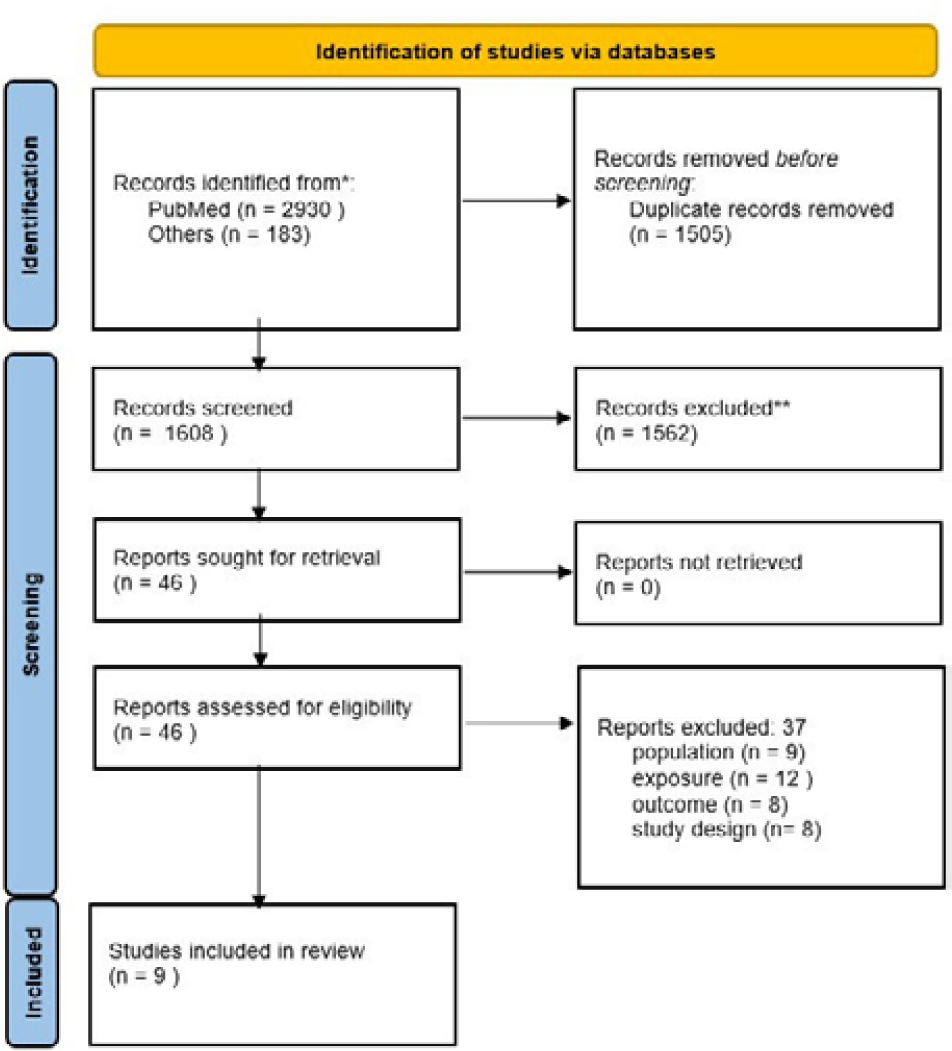
A search of five databases revealed a total of 3,113 relevant articles (PubMed, 2,930; other databases, 183). After removing duplicates, 1,608 studies were processed by reviewing the titles and abstracts, and 46 studies were selected for full-text analysis. Of these, only eight met the selection criteria for inclusion in this review. The detailed PRISMA flowchart is shown in Figure 1.
Preferred reporting items for systematic reviews and meta-analyses flowchart study selection.
Study characteristics
Of the eight studies included, six were cross-sectional studies, while the other two studies did not explicitly mention the study design. The total population size was 440, of which 353 were female and 87 were male. All the included studies were published between 2011 and 2023.
In total, 12 autonomic tests were performed in all included studies. Heart rate variability (HRV) was used in four studies. In one study using HRV, three alternate ANS tests (electromyography, muscle blood flow, blood pressure, and heart rate fluctuation at rest and in response to handgrip test, cold pressor test, and deep breathing test) were also reported. Skin temperature alone was used in one study and with electrical impedance in another study14,15. Fingertip skin temperature and evaporation were measured together in one study16, and finally, autonomic reactivity to mental stressors was used in one study9.
Results of quality assessment
The results for the methodological quality of the eligible studies are shown in Table 2. The overall score of each study ranged from five to nine out of the total nine scores. After reviewing all the studies included, four of them were considered high quality7,10,14,17, and four of them were of moderate quality6,9,15,16.
Main findings
Association between autonomic nervous system and pain intensity
When reviewing studies assessing ANS regulation using HRV, one moderate-quality study revealed a negative correlation between resting pain intensity and basal autonomic dysregulation (particularly parasympathetic activity)6, whereas such a correlation at rest was not reported by two high-quality studies7,10. Additionally, the correlation between pain intensity and autonomic regulation has not been studied in a high-quality study17.
One high-quality study assessing ANS regulation using skin temperature showed no correlation between resting pain intensity and autonomic dysregulation14, while one moderate-quality study revealed a moderate positive correlation when symptoms were unilateral16. However, another moderate-quality study provided no information on its correlation with skin temperature15.
Furthermore, a moderate-quality study that utilized cardiovascular reflexes in response to mental stressors to assess ANS regulation reported no significant association between resting pain intensity and autonomic dysregulation9.
Association between autonomic nervous system and disability
While taking disability into account, three high-quality studies and one moderate-quality study performed HRV analysis for assessing ANS regulation, revealing a notably negative correlation of disability with reduced basal parasympathetic activity and overall autonomic dysregulation6,7,10,17. Conversely, two moderate-quality and one high-quality study that performed alternate ANS assessment techniques found no association with disability14,15,16. However, one moderate-quality study did not report a correlation between ANS regulation and disability9.
DISCUSSION
This review aimed to systematically analyze the results of all available original articles that evaluated the association between ANS regulation and pain and disability in patients with CNP. After analysis, it was found that only two of the eight studies showed a significant correlation between pain intensity at rest and autonomic dysregulation6,16, while five of them showed no correlation7,10,14,15 and one did not report about correlation findings17. Despite the lack of correlation with pain intensity at rest, two high-quality studies have reported a correlation between pain intensity during movement and ANS dysregulation. These variations in results might be due to the heterogeneity in the duration of symptoms and ANS assessment techniques.
Zaproudina et al. reported a moderately positive correlation between fingertip skin temperature and resting pain intensity in individuals with unilateral symptoms, suggesting more of a vascular disorder than an autonomic disorder16. The study further investigated skin evaporation but found no significant relationship between ANS regulation and pain intensity. Interestingly, patients experiencing unilateral pain had notably higher evaporation values than controls. These variations in the skin temperature and evaporation values may be due to psychophysiological characteristics or emotional reactions, which could restrict the applicability of these instruments as diagnostic tools16.
Santos-de-Araújo et al. and Pontes-Silva et al. reported a noteworthy result: while pain intensity during movement showed a moderate negative correlation with parasympathetic activity, no correlation was seen during rest. This remark was made using HRV as an assessment technique7,10. Certain authors in their study proposed a pathophysiological explanation for this observation6,14: Patients with CNP tend to have higher muscular activity at rest following any neck movement. Consequently, increased muscular activity has been proposed to serve as a mediator between central or psychological consequences and the development or maintenance of muscle pain. Hence, it may be plausible that elevated muscular activity during movement is associated with autonomic dysregulation6.
This study revealed a stronger correlation between CNP and the parasympathetic system, possibly due to its close anatomical proximity to the cervical region and the sympathetic system’s association with the lumbar area7,10. In addition, pain duration plays an important role. Chronic pain initially inhibits parasympathetic activity, resulting in autonomic dysregulation. Later, it facilitated an inadequate sympathetic response to physical and mental stressors6,9. Consistent with this, few researchers have reported a blunted BP response to exercise in patients with CNP18. Similar trends have been observed in patients with whiplash-associated disorder19 and low back pain20.
When considering mental stressors, Shahidi et al. found no significant correlation between pain intensity and autonomic reactivity but observed an inverse relationship between pain chronicity and blood pressure in response to psychological stress, but not heart rate, in response to the psychological stressor9. This discrepancy might be due to the belief that adaptation within the ANS occurs gradually over time because of decreased baroreceptor sensitivity to chronic pain21. The lack of association with pain intensity might be explained by the variation in the timing of cardiovascular response measurements. However, it appears more likely that adaptations in physiological stress responses are more strongly related to the duration of symptoms than the degree of neck pain, which varies greatly from day to day22.
Hallman et al. demonstrated a negative correlation between disability and reduced basal parasympathetic activity and sympathetic response to physical stressors, consistent with the findings of Kang et al.17. Similar trends have been observed in chronic low back pain23. This might be due to the higher levels of mood disorders, pain severity, and sleep problems, as displayed by patients with greater levels of disability.
An important point to consider is that the majority of the population is female, and it is not surprising to comment that females are more prone to developing CNP1. In addition, the response to autonomic regulation can be influenced by age, measurement, time of day, humidity, temperature, sleep patterns, physical activity, and the use of medication, alcohol, and caffeine. Unfortunately, it is difficult to determine whether the results were caused by pain and disability or whether ANS dysregulation was influenced by one or more of these factors because the majority of the included studies did not indicate whether these factors were controlled.
Our study is the first systematic review to analyze the association between autonomic dysregulation and pain and disability in patients with CNP. However, some limitations were encountered during this review. First, the design of the included studies was cross-sectional; thus, the causal relationship could not be explained. Additionally, we detected large methodological heterogeneity between the studies regarding the severity of symptoms, duration of pain symptoms, assessment techniques, and control of confounding factors, compromising the findings.
CONCLUSION
The results suggest that the higher the pain intensity and perceived disability in patients with CNP, the greater the autonomic dysregulation. Additionally, it appears that, as the duration of pain symptoms increases, the ANS becomes more provoked and becomes increasingly dysregulated. Considering the impact of this condition, further research employing larger cohorts, standardized methodologies, and more comprehensive assessments of both autonomic regulation and related clinical outcomes is required to increase the quality of evidence and guide clinical practice.
REFERENCES
-
1. Fandim JV, Nitzsche R, Michaleff ZA, Pena Costa LO, Saragiotto B. The contemporary management of neck pain in adults. Pain Manag. 2021;11(1):75-87. https://doi.org/10.2217/pmt-2020-0046
» https://doi.org/10.2217/pmt-2020-0046 -
2. GBD 2017 Disease and Injury Incidence and Prevalence Collaborators. Global, regional, and national incidence, prevalence, and years lived with disability for 354 diseases and injuries for 195 countries and territories, 1990-2017: a systematic analysis for the Global Burden of Disease Study 2017. Lancet. 2018;392(10159):1789-858. https://doi.org/10.1016/S0140-6736(18)32279-7
» https://doi.org/10.1016/S0140-6736(18)32279-7 -
3. Genebra CVDS, Maciel NM, Bento TPF, Simeão SFAP, Vitta A. Prevalence and factors associated with neck pain: a population-based study. Braz J Phys Ther. 2017;21(4):274-80. https://doi.org/10.1016/j.bjpt.2017.05.005
» https://doi.org/10.1016/j.bjpt.2017.05.005 -
4. Jahre H, Grotle M, Smedbråten K, Dunn KM, Øiestad BE. Risk factors for non-specific neck pain in young adults. A systematic review. BMC Musculoskelet Disord. 2020;21(1):366. https://doi.org/10.1186/s12891-020-03379-y
» https://doi.org/10.1186/s12891-020-03379-y -
5. Sjörs A, Larsson B, Dahlman J, Falkmer T, Gerdle B. Physiological responses to low-force work and psychosocial stress in women with chronic trapezius myalgia. BMC Musculoskelet Disord. 2009;10:63. https://doi.org/10.1186/1471-2474-10-63
» https://doi.org/10.1186/1471-2474-10-63 -
6. Hallman DM, Lindberg LG, Arnetz BB, Lyskov E. Effects of static contraction and cold stimulation on cardiovascular autonomic indices, trapezius blood flow and muscle activity in chronic neck-shoulder pain. Eur J Appl Physiol. 2011;111(8):1725-35. https://doi.org/10.1007/s00421-010-1813-z
» https://doi.org/10.1007/s00421-010-1813-z -
7. Pontes-Silva A, Bassi-Dibai D, Fidelis-de-Paula-Gomes CA, Souza CDS, Pires FO, Mostarda CT, et al. Comparison of the autonomic nervous system dysfunction between different chronic spine disorders: neck pain versus low back pain. Rev Assoc Med Bras (1992). 2022;68(9):1288-96. https://doi.org/10.1590/1806-9282.20220406
» https://doi.org/10.1590/1806-9282.20220406 -
8. Sterling M. Differential development of sensory hypersensitivity and a measure of spinal cord hyperexcitability following whiplash injury. Pain. 2010;150(3):501-6. https://doi.org/10.1016/j.pain.2010.06.003
» https://doi.org/10.1016/j.pain.2010.06.003 -
9. Shahidi B, Sannes T, Laudenslager M, Maluf KS. Cardiovascular responses to an acute psychological stressor are associated with the cortisol awakening response in individuals with chronic neck pain. Physiol Behav. 2015;150:93-8. https://doi.org/10.1016/j.physbeh.2015.02.010
» https://doi.org/10.1016/j.physbeh.2015.02.010 -
10. Santos-de-Araújo AD, Dibai-Filho AV, Santos SN, Alcântara EV, Souza CDS, Gomes CAFP, et al. Correlation between chronic neck pain and heart rate variability indices at rest: a cross-sectional study. J Manipulative Physiol Ther. 2019;42(4):219-26. https://doi.org/10.1016/j.jmpt.2018.11.010
» https://doi.org/10.1016/j.jmpt.2018.11.010 -
11. Page MJ, McKenzie JE, Bossuyt PM, Boutron I, Hoffmann TC, Mulrow CD, et al. The PRISMA 2020 statement: an updated guideline for reporting systematic reviews. BMJ. 2021;372:n71. https://doi.org/10.1136/bmj.n71
» https://doi.org/10.1136/bmj.n71 - 12. Higgins JP, Green S, editors. Cochrane Handbook for Systematic Reviews of Interventions. Hoboken, NJ: Wiley; 2011.
-
13. Stang A. Critical evaluation of the Newcastle-Ottawa scale for the assessment of the quality of nonrandomized studies in meta-analyses. Eur J Epidemiol. 2010;25(9):603-5. https://doi.org/10.1007/s10654-010-9491-z
» https://doi.org/10.1007/s10654-010-9491-z -
14. Girasol CE, Dibai-Filho AV, Oliveira AK, Jesus Guirro RR. Correlation between skin temperature over myofascial trigger points in the upper trapezius muscle and range of motion, electromyographic activity, and pain in chronic neck pain patients. J Manipulative Physiol Ther. 2018;41(4):350-7. https://doi.org/10.1016/j.jmpt.2017.10.009
» https://doi.org/10.1016/j.jmpt.2017.10.009 -
15. Dibai-Filho AV, Barros MA, Oliveira AK, Jesus Guirro RR. Electrical impedance of the torso is associated with the pressure pain threshold on myofascial trigger points in patients with chronic neck pain: a cross-sectional study. J Back Musculoskelet Rehabil. 2018;31(2):275-84. https://doi.org/10.3233/BMR-169671
» https://doi.org/10.3233/BMR-169671 -
16. Zaproudina N, Ming Z, Närhi M. Sensory and sympathetic disorders in chronic non-specific neck pain. Funct Neurol. 2015;30(3):165-71. https://doi.org/10.11138/fneur/2015.30.3.165
» https://doi.org/10.11138/fneur/2015.30.3.165 -
17. Kang JH, Chen HS, Chen SC, Jaw FS. Disability in patients with chronic neck pain: heart rate variability analysis and cluster analysis. Clin J Pain. 2012;28(9):797-803. https://doi.org/10.1097/AJP.0b013e3182442afd
» https://doi.org/10.1097/AJP.0b013e3182442afd -
18. Gockel M, Lindholm H, Alaranta H, Viljanen A, Lindquist A, Lindholm T. Cardiovascular functional disorder and stress among patients having neck-shoulder symptoms. Ann Rheum Dis. 1995;54(6):494-7. https://doi.org/10.1136/ard.54.6.494
» https://doi.org/10.1136/ard.54.6.494 -
19. Kalezic N, Noborisaka Y, Nakata M, Crenshaw AG, Karlsson S, Lyskov E, et al. Cardiovascular and muscle activity during chewing in whiplash-associated disorders (WAD). Arch Oral Biol. 2010;55(6):447-53. https://doi.org/10.1016/j.archoralbio.2010.03.015
» https://doi.org/10.1016/j.archoralbio.2010.03.015 - 20. Kalezic N, Åsell M, Kerschbaumer H, Lyskov E. Physiological reactivity to functional tests in patients with chronic low back pain. J Musculoskeletal Pain. 2007;15(1):29-40.
-
21. Maixner W, Fillingim R, Kincaid S, Sigurdsson A, Harris MB. Relationship between pain sensitivity and resting arterial blood pressure in patients with painful temporomandibular disorders. Psychosom Med. 1997;59(5):503-11. https://doi.org/10.1097/00006842-199709000-00007
» https://doi.org/10.1097/00006842-199709000-00007 -
22. Balter JE, Molner JL, Kohrt WM, Maluf KS. Mechanical pain sensitivity and the severity of chronic neck pain and disability are not modulated across the menstrual cycle. J Pain. 2013;14(11):1450-9. https://doi.org/10.1016/j.jpain.2013.07.008
» https://doi.org/10.1016/j.jpain.2013.07.008 -
23. Gockel M, Lindholm H, Niemistö L, Hurri H. Perceived disability but not pain is connected with autonomic nervous function among patients with chronic low back pain. J Rehabil Med. 2008;40(5):355-8. https://doi.org/10.2340/16501977-0172
» https://doi.org/10.2340/16501977-0172