 Is national governance important for economic growth?
Abstract
There is a growing emphasis on the role of institutions in explaining countries’ economic growth. According to institutional theory, governance guidelines directly influence economic growth. This study examines the impact of national governance on the economic growth of countries that are members of Mercosur, the North American Free Trade Agreement (NAFTA), and the European Union. The sample comprises 39 countries and analyzes the period 2007-2021. The results indicate that, among governance indicators, the rule of law is the most significant factor in explaining GDP per capita growtr. The European Union is associated with higher levels of governance and medium to high levels of GDP per capita, whereas Mercosur is associated with intermediate governance levels and lower GDP per capita. In general, results show that national governance is important for economic growth; however, governance quality alone may not be sufficient. In addition to governance, fixed capital formation, inflation, and trade openness have significant effects on the economic growth of the countries analyzed.
Keywords:
institutional theory; national governance; economic growth
Resumo
Há uma ênfase crescente no papel das instituições na explicação do crescimento econômico das nações. Conforme a Teoria Institucional, sustenta-se que instituições de excelência estabelecem diretrizes de governança, exercendo uma influência direta sobre o crescimento econômico. Este estudo examina o impacto da governança nacional sobre o crescimento econômico dos países do Mercosul, do Acordo de Livre Comércio da América do Norte (NAFTA, na sigla em inglês) e da União Europeia. A pesquisa reúne uma amostra de 39 países e analisa o período de 2007 a 2021. De forma pontual, os resultados indicam que, entre os indicadores de governança, o Estado de direito é o fator mais significativo para explicar o crescimento do Produto Interno Bruto (PIB) per capita. Além disso, constatou-se que a União Europeia está associada ao nível alto de governança e ao PIB per capita alto e médio e que o Mercosul está associado a nível médio de governança e PIB per capita baixo. Em geral, os resultados confirmam que a governança nacional é importante para o crescimento econômico, porém, vale ressaltar que por si só a qualidade da governança pode não ser suficiente. Aliadas à governança, o estudo revela que a formação de capital fixo, a inflação e a abertura comercial têm efeitos significativos no crescimento econômico dos países analisados.
Palavras-chave:
teoria institucional; governança nacional; crescimento econômico
Resumen
Hay un énfasis creciente en el papel de las instituciones a la hora de explicar el crecimiento económico de las naciones. Según la teoría institucional, se sostiene que algunas instituciones de excelencia establecen parámetros de gobernanza, lo que influencia directamente el crecimiento económico. Este estudio examina el impacto de la gobernanza nacional sobre el crecimiento económico de los países del Mercosur, Tratado de Libre Comercio de América del Norte (NAFTA) y Unión Europea. La investigación recopila una muestra de 39 países y analiza el periodo de 2007 a 2021. En concreto, los resultados indican que entre los indicadores de gobernanza, el Estado de derecho es el factor más significativo para explicar el crecimiento del Producto Interno Bruto (PIB) per cápita. Además, se encontró que la Unión Europea está asociada con un alto nivel de gobernanza y un PIB per cápita alto y medio y que el Mercosur está asociado con un nivel medio de gobernanza y un PIB per cápita bajo. En general, los resultados confirman que la gobernanza nacional es importante para el crecimiento económico; sin embargo, vale la pena destacar que la calidad de la gobernanza por sí sola puede no ser suficiente. Junto con la gobernanza, el estudio revela que la formación de capital fijo, la inflación y la apertura comercial tienen efectos significativos en el crecimiento económico de los países analizados.
Palabras clave:
teoría institucional; gobernanza nacional; crecimiento económico
1. INTRODUCTION
The role of institutions in the economic growth of countries has been one of the most dynamic areas of inquiry in economics. According to North (1981), institutions can be described as a set of rules, compliance procedures, and moral and ethical norms of behavior intended to guide individual actions toward the maximization of the principals’ wealth or utility. The author argued that institutional change plays a central role in shaping the long-term trajectory of societies and, consequently, in determining the direction of economic performance.
According to DiMaggio and Powell (1983), institutionalism encompasses multiple subjects, such as economics, political science, and sociology, with particular emphasis on governance, regimes, isomorphism, and legitimacy. Meyer and Rowan (1977) define institutionalization as the process through which social processes, obligations, or events acquire rule-like status in social thought and action.
Institutional Theory sustains that high-quality institutions establish governance guidelines, which in turn exert a direct influence on economic growth by fostering sustainable processes and development (Aoki, 1996; Glass & Newig, 2019; Ramzan et al., 2023). Therefore, the economic progress of societies is intrinsically linked to their institutional governance structures. Governments play a crucial role by embracing the principles of good governance in the formulation and implementation of appropriate policies (Quibria, 2006), given that countries with strong governance systems tend to be more prosperous, happier, and to face fewer socio-environmental challenges (Kyriacou, 2019).
This study investigates the relationship between national governance and economic growth, drawing on the assumption of Institutional Theory that the quality of institutional structures shapes economic incentives and influences the performance of national economies. The main argument posits that different governance arrangements generate distinct effects on economic growth, particularly when considering countries with varying levels of development and degrees of international insertion.
Studies such as those by Acemoglu and Robinson (2012) and Rodrik et al. (2004) reinforce the idea that political and economic institutions shape social incentives, thereby determining whether countries prosper or fail. In this context, national governance is understood as the set of institutional, political, and administrative mechanisms that ensure the exercise of state authority and the government’s capacity to formulate and implement effective public policies (Kaufmann et al., 1999; Programa das Nações Unidas para o Desenvolvimento [PNUD], 2022). This definition is distinguished from related concepts such as “institutional quality” - which is broader and more diffuse - and “political institutions” or “economic institutions”, by emphasizing the systemic role of governance in coordinating interactions among state, society, and economy.
National governance includes systems and processes designed to ensure accountability, transparency, responsiveness, the rule of law, stability, justice, inclusion, empowerment, and broad participation - thus, it is one of the main factors explaining disparities in economic performance across countries (Kyriacou, 2019).
In this regard, it is supposed that the quality of national governance demonstrates its effectiveness across several areas, including the attraction of foreign direct investment (Bailey, 2018); the promotion of entrepreneurship (Aparicio et al., 2016); the advancement of corporate social responsibility (Ochi et al., 2023); and the stimulation of economic growth (Edeme & Mumuni, 2023; Gani, 2011; Kraipornsak, 2020; Law et al., 2013; Mehanna et al., 2010; Ramzan et al., 2023), with the latter being the primary focus of the present study. Additionally, strong institutions can contribute to meeting citizens’ social needs and fostering social progress (Uddin et al., 2023).
Considering the scope of this research, prior literature largely points to a positive relationship between national governance and economic growth. However, institutions do not exert the same influence on economic growth across different countries (Uddin et al., 2023). Therefore, it is important to carry out an analysis that takes into account countries from different economic blocs in order to obtain better results.
In pursuit of stronger competitive positioning within the global economic order, states seek to form economic blocs in which they mutually grant advantages and defend common interests (Hassan, 2001). Given that countries integrate regionally to address global challenges, this study analyzes three major and distinct economic blocs: Mercosur (Southern Common Market), NAFTA (North American Free Trade Agreement), and the European Union.
Therefore, the importance of examining the relationship between countries’ governance indicators and economic growth lies in providing governments with the ability to undertake a more comprehensive assessment of their policies. This, in turn, enhances the prospects for improving national economic growth, given that strong administrative intervention is required to promote a country’s economic development (Sturm, 2013; Uddin et al., 2023).
The general objective of this study is to examine the impact of national governance on the economic growth of countries belonging to Mercosur, NAFTA, and the European Union. The study assesses the effect of governance indicators on economic growth using data from 39 countries, across 3 economic blocs, over a 15-year period (2007-2021), thus contributing to the literature in several ways, particularly due to the breadth of the sample being analysed.
In line with the assumptions of Institutional Theory, patterns of causality between institutions and growth may vary considerably across nations with different levels of economic development (Glass & Newig, 2019). In this context, the countries analyzed are members of three distinct blocs - NAFTA (currently USMCA, composed of the same member countries, renamed primarily for political reasons and to reflect the modernization of the trade agreement), Mercosur, and the European Union - thus enabling a comparative analysis of the proposed relationship between national governance and economic growth across both developed and emerging countries.
With regard to the variables employed, existing studies often focus on a single dimension of governance indicators. In contrast, this study proposes to examine all six World Bank national governance indicators, both individually and jointly, through a composite index (gov), as proposed by Ouedraogo et al. (2022).
In summary, this study advances the work of Uddin and Rahman (2023), which analyzed the impact of three of the six national governance indicators, as well as that of Epaphra and Kombe (2017), which focused on African countries. Furthermore, when compared to Marino et al. (2016), this article extends the analysis by examining countries from different economic blocs, employing a broader set of indicators, and covering a longer time period. It also advances beyond Gani (2011), which focused on low and middle-income developing countries. Radulović (2020), in its turn, analyzed ten European countries, but did not employ a composite governance index nor include additional control variables in the econometric model. Therefore, this study contributes to filling gaps identified in the existing literature.
2. THEORETICAL BACKGROUND AND HYPOTHESES DEVELOPMENT
2.1. National governance
In Institutional Theory, social practices are guided by institutions, which shape and assign specific probabilities of action. This does not imply uniform predetermination, but rather that social actors operate within an institutionalized reality where norms guide behavior and exert configurational pressure. Nevertheless, it is not presumed that subjects are passive: even under similar institutional pressures individuals in different contexts may exhibit varying levels of compliance (Jacometti et al., 2016).
The quality of national governance plays a central role in human development, as effective governments are more likely to implement robust and efficient policies that foster socioeconomic progress (Yang, 2010). According to Gaygisiz (2013), recent economic literature emphasizes that institutions significantly influence not only economic growth, but also broader development outcomes. The author argues that governance is critical for explaining disparities in socioeconomic development across countries, given that variations in governance shape economic, health, and education policies, as well as the quality of these services (Gaygisiz, 2013).
The United Nations Development Programme (UNDP, 2022) defines governance as the exercise of economic, political, and administrative authority for managing a country’s affairs at all levels. Governance encompasses the mechanisms, processes, and institutions that allow citizens and groups to articulate their interests, exercise legal rights, fulfill obligations, and resolve differences.
Kaufmann et al. (1999), for their part, describe governance as the traditions and institutions that regulate the exercise of authority for the common good. This definition includes the selection, monitoring, and replacement of leaders, as well as the government’s capacity to manage resources effectively and implement sound policies.
Since 1996, the World Bank has published the Worldwide Governance Indicators (WGI), which assess six dimensions of governance: voice and accountability, political stability, government effectiveness, regulatory quality, rule of law, and control of corruption. According to Kaufmann et al. (1999), the purpose of these indicators is to measure subjective perceptions regarding the quality of governance across countries. These dimensions reflect the perspectives of a broad spectrum of businesses, citizens, and experts on governance quality in both developed and developing countries (Gaygisiz, 2013; Kaufmann et al., 2009).
In this study, national governance is understood as the quality and effectiveness of institutional and administrative arrangements that ensure accountability, transparency, government effectiveness, political stability, the rule of law, regulatory quality, and control of corruption - dimensions operationalized by the WGI. This concept is therefore distinct from “institutional quality”, which encompasses broader aspects of political and social organization, and from “economic institutions”, which pertain to specific rules regarding property, contracts, and market incentives (Rodrik et al., 2004). The relationship between governance indicators and economic growth has been the subject of several recent studies (Dossou et al., 2023; Ochi et al., 2023; Ouedraogo et al., 2022).
Among related studies, diverse findings have emerged regarding the relationship between national governance and economic and social development. For instance, studies have found an association between good governance and poverty reduction (Aracil et al., 2022; Jindra & Vaz, 2019; Nguyen et al., 2019), evidence that better governance and public administration improve income distribution (Nguyen et al., 2019), and proof that democratic institutions exert influence on gender equality (Glass & Newig, 2019; Jamil et al., 2022). Furthermore, studies indicate that the quality of governance plays a significant role in promoting a country’s economic and financial growth (Law et al., 2013; Ramzan et al., 2023; Uddin et al., 2023).
Given this context, the quality of governmental institutions plays a central role in economic growth, as effective governments tend to implement robust and efficient policies that foster human progress (Yang, 2010). Moreover, it is necessary to distinguish between economic growth and economic development. Growth refers to the quantitative increase in production, usually measured by Gross Domestic Product (GDP) or GDP per capita, whereas development encompasses broader qualitative dimensions, such as income distribution, health, education, and social well-being (Stiglitz et al., 2009). Since the dependent variable used in this study is GDP per capita, the analysis is limited to economic growth rather than economic development, thereby avoiding conceptual ambiguities.
2.1. Economic growth
According to Acemoglu and Robinson (2010), institutions play a crucial role as determinants of economic growth, as they shape the incentives present in society and can either stimulate or hinder economic activity. To Murphy et al. (2004), lower-quality institutions have the potential to slow economic activity by directing economic agents toward redistributive policies with lower economic returns, rather than toward activities that effectively promote growth.
From this perspective, numerous studies have examined the role of governance in economic growth, with the prevailing conclusion being that institutions exert a fundamental role as positive and significant determinants of economic growth (Law et al., 2013). One of the most widely used measures for assessing a country’s economic growth is GDP per capita (van Stel et al., 2005).
Using GDP per capita as a proxy for economic growth, Abubakar (2020) demonstrates that good governance has a positive effect on economic growth. Similarly, Epaphra and Kombe (2017) found that institutions play a pivotal role in economic growth, with political stability appearing to be the most significant factor in explaining the real GDP per capita growth in African countries. Nguyen et al. (2019) examined the effect of good governance and public administration on GDP per capita, income inequality, and poverty, reporting a positive relationship between governance, public administration, and GDP per capita. Thus, these findings demonstrate that better governance promotes economic growth.
Other studies have also identified a positive association between national governance indicators and economic growth, suggesting that higher institutional quality can contribute to a country’s economic growth (Edeme & Mumuni, 2023; Gani, 2011; Kraipornsak, 2020; Law et al., 2013; Mehanna et al., 2010; Radulović, 2020; Ramzan et al., 2023).
Thus, based on the assumptions of Institutional Theory and the recommendations of prior literature, it is proposed that national governance exerts a positive influence on the economic growth of countries. However, it is recognized that this relationship may not be unidirectional, as suggested by Acemoglu and Robinson (2012) and Rodrik et al. (2004), since economic growth itself may reinforce institutional quality and governance mechanisms, either through the enhancement of state capacity or through greater societal demand for transparency and accountability.
Consequently, although this study formulates directional hypotheses, the results should be interpreted with caution due to potential simultaneity between governance and growth. It must be emphasized that the following hypotheses are formulated in terms of positive association, but they should not be interpreted as strictly causal relationships, given the methodological limitations of the model.
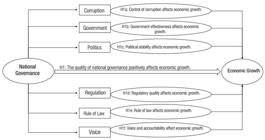
General Hypothesis (H1): The quality of national governance positively affects economic growth.
Hypothesis H1a: Control of corruption affects economic growth.
Hypothesis H1b: Government effectiveness affects economic growth.
Hypothesis H1c: Political stability affects economic growth.
Hypothesis H1d: Regulatory quality affects economic growth.
Hypothesis H1e: Rule of law affects economic growth.
Hypothesis H1f: Voice and accountability affect economic growth.
3. METHOD
This study examines the relationship between national governance indicators and economic growth in the countries that constitute Mercosur, NAFTA (now USMCA), and the European Union. To this end, data were collected in February 2024 from the websites of international institutions - the World Bank, the World Intellectual Property Organization (WIPO), and the International Monetary Fund (IMF) - covering the period from 2007 to 2021.
Regarding the economic blocs, the European Union emerged in the 1950s and is characterized as an economic and political partnership and considered a supranational alliance. It operates through a system of independent institutions and makes decisions negotiated among its member states, resulting in the creation of its own legal framework. Mercosur, in turn, was established in 1991 by South American countries, with the primary objective of promoting political, economic, and social integration among its members. Finally, NAFTA was established in 1994 and comprises the United States, Canada, and Mexico.
Given these contexts, the sample of the present study consists of all member and associate countries of the three economic blocs for which data were available. Accordingly, four associate countries of Mercosur were excluded: Venezuela, due to the suspension of its rights; Bolivia, due to its process of accession still being undercurrent; and Guyana and Suriname, due to the lack of available data. Table 1 presents a breakdown of the number of member and associate countries in each economic bloc. It should be noted that the United Kingdom is included in the European Union sample, given that its withdrawal was officially finalized in 2020.
Tables 2 and 3 summarize the independent, dependent, and control variables used in the study, presenting their respective data sources, theoretical descriptions, and the references that support their use.
2.1. Data analysis and empirical models
2.1.1. Composite governance index
To address the issue of causality, Mehanna et al. (2010) employed the simple average of the six World Bank governance indicators in order to construct a new index. While some researchers use percentile rankings to index governance variables on a scale from 0 to 1 - in which higher values indicate better governance quality (Morrissey & Udomkerdmongkol, 2012) - others develop a classification system ranging from 0 to 10 by applying a weighted average of the six indicators (Abbas et al., 2021).
Aiming to analyze the overall performance of national governance in the 39 countries in the sample, a composite governance index must be constructed based on a factor analysis using Principal Components Analysis (PCA), conducted using the six indicators shown in Figure 2 (Kline, 2014).
2.1.2. Statistical tests
Initially, the data were described in order to present a profile of the 39 countries in the sample regarding governance indicators and economic growth over time. Subsequently, the technique of Multiple Correspondence Analysis (MCA) was employed to, through a perceptual map, examine associations among the economic blocs, national governance indicators, and economic growth (Whitlark & Smith, 2001).
To test the hypotheses, this study proposes the estimation of seven econometric models, as described below:
In which:
pibperit represents the GDP per capita of country i in period t;
pibperit-1 represents the GDP per capita of country i in period t-1;
govit represents the composite governance index of country i in period t;
corrupit represents the corruption indicator of country i in period t;
governmit represents the government indicator of country i in period t;
politicit represents the political stability indicator of country i in period t;
regulit represents the regulation indicator of country i in period t;
ruleit represents the rule of law indicator of country i in period t;
voiceit represents the voice and accountability indicator of country i in period t;
divpubit represents the public debt indicator of country i in period t;
giiit represents the innovation indicator of country i in period 𝑡;
capfixoit represents the fixed capital indicator of country i in period t;
abertit represents the trade openness indicator of country i in period t;
inflait represents the inflation indicator of country i in period t; and
educait represents the education indicator of country i in period t.
Although seven equations are presented above, it is important to emphasize that they should not be analyzed in isolation. The first equation aims to verify whether national governance influences the economic growth of countries in the three analyzed blocs, which constitutes the central objective of this paper. The remaining equations are intended only to examine whether this influence operates through the individual indicators that compose the governance index. Thus, depending on the estimation results, the last six equations may provide insights into how governance affects economic growth.
It is known that the relationship between national governance and economic growth is characterized by endogeneity, given the mutual interaction between these variables, as indicated by previous studies applied in different institutional contexts using specific proxies (Liberato & Ribeiro, 2020; Nogueira & Arraes, 2023; Sobral et al., 2014). On one hand, strong institutions and good governance practices are considered fundamental for sustained growth; on the other hand, economic growth itself generates conditions and pressures for improved governance. That is to say that this bidirectional relationship creates an endogeneity problem, which, if not addressed, will produce biased estimates.
As noted by Bond et al. (2001), growth models are typically estimated using dynamic panel data (DPD) techniques, including the System Generalized Method of Moments (SYS-GMM) (Arellano & Bover, 1995; Blundell & Bond, 1998). To address the endogeneity problem in the model, this study employs the SYS-GMM estimation method, which uses a system that combines level equations, as specified above, with first-difference equations, as described below:
It is worth noting that the method uses lagged first-difference variables and lagged level variables as instruments for the level and first-difference equations, respectively. In addition, to test for residual autocorrelation, the Arellano and Bond (1991) test is applied for first- and second-order autocorrelation, in which the null hypothesis of no first-order autocorrelation should be rejected, while the null hypothesis of no second-order autocorrelation should not be rejected.
To assess the validity of the instruments, the Hansen (1982) test is employed, in which the null hypothesis of instrument validity should not be rejected. It should also be noted that the data were processed using Microsoft Excel, in addition to the software programs Stata 14 and SPSS 21.
3. RESULTS
3.1. Composite governance index
Initially, Table 4 presents the correlation matrix of the six indicators that constitute national governance.
It can be observed that the correlations are high, which could result in severe multicollinearity in the regression model if at least two of these variables were included simultaneously in the same model (equation). Therefore, to assess which public governance indicators influence economic growth, a separate model will be estimated for each of these variables, so that the high correlations observed among them will not lead to multicollinearity.
High correlations, however, reinforce the convergent interpretation of the indicators, as they represent complementary aspects of the same institutional structure. In this context, each individual model captures the specific contribution of each indicator within this integrated set, without compromising the statistical consistency of the coefficients.
Subsequently, this study employs Principal Components Analysis (PCA) to construct a composite governance index (gov) from its six components. The Kaiser-Meyer-Olkin (KMO) statistic, used to assess the suitability of the data for factor analysis, yielded a value of 0.906, and Bartlett’s test resulted in a significant 5%, indicating the adequacy of the sample. The Kaiser criterion identified a single factor, which accounted for 88% of the total variance.
3.2. Descriptive analysis
Table 5 presents the descriptive statistics for GDP per capita, the composite governance index (gov), and the governance indicators for each economic bloc. It should be noted that GDP per capita values are expressed in U.S. dollars (US$); the governance indicators have been standardized, ranging from 0 to 1; and the composite index is the result of the PCA generated from the variables shown in Figure 2.
Initially, it can be observed that the mean GDP per capita (pib_per_capita) for the NAFTA and European Union blocs are relatively similar and, on average, approximately four times higher than the GDP per capita of Mercosur.
Regarding governance, the highest indicator values were observed in the countries of NAFTA and the European Union; however, only the European Union achieved the maximum level. In Mercosur, the best-performing indicator was voice and accountability, with a mean of 0.59 and a maximum of 0.937, whereas the corruption indicator had a minimum value of 0.077.
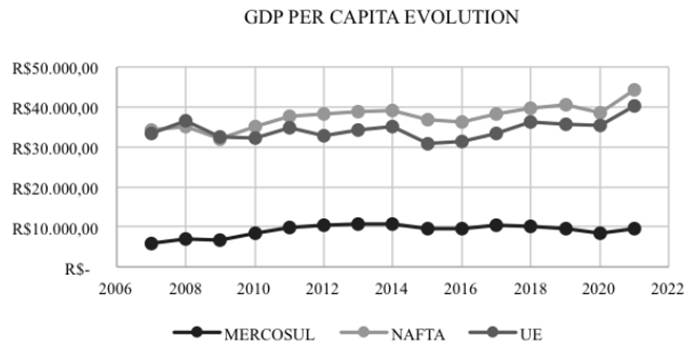
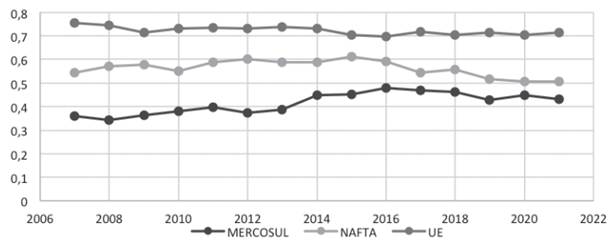
Given the data span (2007-2021), it was decided that the trajectories of these variables should be presented. Figure 2 shows the evolution of GDP per capita across the three economic blocs.
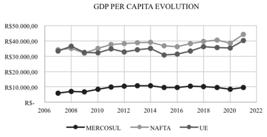
It can be observed that GDP per capita in the three economic blocs followed upward trajectories without significant fluctuations. In Mercosur, GDP per capita amounted to US$ 5,906.54 in 2007 and reached US$ 9,655.88 in 2021, representing a growth of 63%. NAFTA and the European Union recorded GDP per capita levels of US$ 34,143.34 and US$ 33,349.27, respectively, in 2007. However, in 2010, NAFTA experienced stronger growth, diverging somewhat from the European Union - a gap that remained largely unchanged over time. As a result, in 2021, NAFTA and the European Union reached GDP per capita levels of US$ 44,207.93 (a 29% increase relative to 2007) and US$ 40,328.66 (a 20% increase relative to 2007), respectively. These results may reflect distinct economic and political dynamics across the blocs, highlighting the importance of considering regional contexts when interpreting economic data (Hassan, 2001).
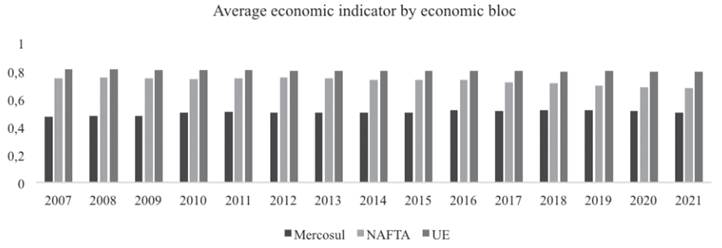
With respect to the average evolution of the governance indicator, a pattern similar to that observed for GDP per capita emerges, with the European Union and NAFTA exhibiting the highest average values (Figure 3).
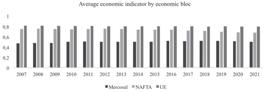
Overall, the findings can be explained through the lens of Institutional Theory. The European Union, as the most stable bloc across all indicators, may exhibit more robust and efficient institutions compared to Mercosur and NAFTA, thereby contributing to higher governance indicators. In this context, beyond institutional strength, differences in legal, regulatory, and cultural systems also influence the observed outcomes.
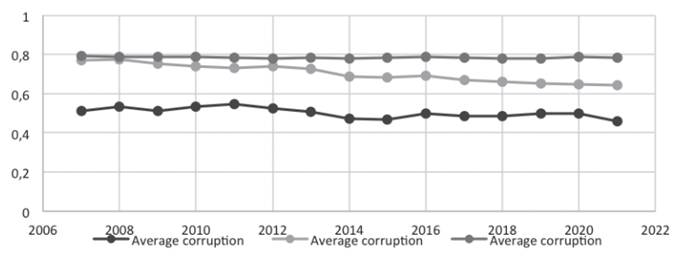
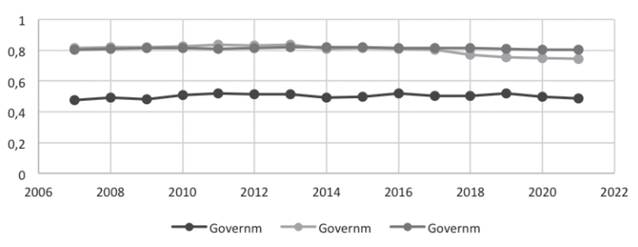
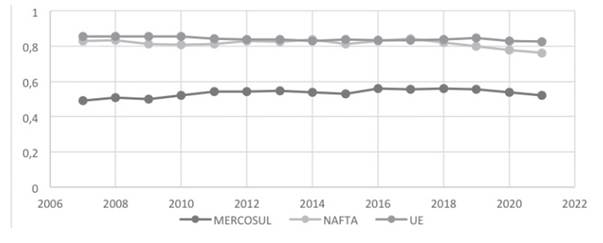
Figures 4 through 9 illustrate the behavior of each component of the governance indicator over the 2007-2021 period for each economic bloc. Overall, Mercosur displays the lowest average values across all indicators throughout the period. In contrast, the European Union and NAFTA exhibit similar averages, except for the political stability indicator, for which the European Union’s average is substantially higher than that of NAFTA - particularly from 2016 onward, when NAFTA’s average for this indicator follows a declining trajectory, approaching that of Mercosur. Moreover, the European Union’s averages show a relatively stable trajectory over the period, largely concentrated around the 0.8 level.
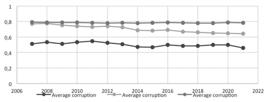
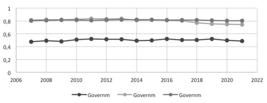

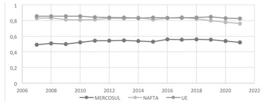


Considering the above, the European Union stands out as the bloc with the highest GDP per capita and governance levels, both in aggregate and across each component, while Mercosur exhibits the lowest averages. Accordingly, the results appear to indicate a positive relationship between governance and economic growth, as measured here by GDP per capita.
3.3. Multiple correspondence analysis
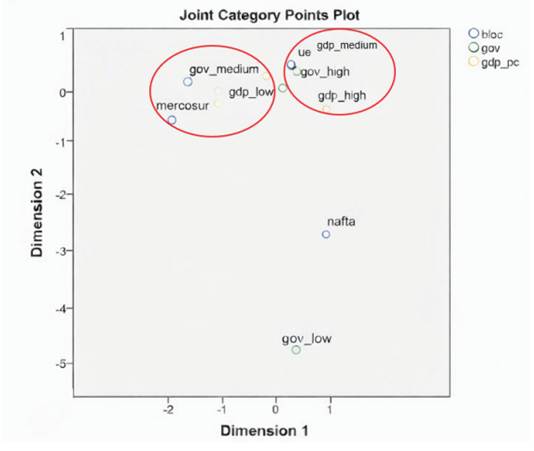
Figure 10 presents a visual representation of the relationships between the categories of the economic bloc, governance indicators, and economic growth variables.

First, it is observed that the European Union is associated with high levels of governance and high and medium GDP per capita. It is also noted that Mercosur is associated with intermediate levels of governance and with low GDP per capita, whereas the NAFTA bloc is not associated with any specific level of governance or GDP per capita.
Next, Table 6 presents the results of the estimations of the seven models proposed earlier to test this paper’s hypotheses. The Arellano-Bond test fails to reject the null hypothesis of no second-order autocorrelation (AR 2), but rejects the null of no first-order autocorrelation (AR 1). In addition, the Hansen test does not reject the null hypothesis that the instruments are valid. Therefore, as discussed in the previous section, the estimations can be considered efficient.
To facilitate comparison of the estimated effects across the different models, Table 7 summarizes the coefficients associated with the governance indicators.
Based on Table 6, national governance is shown to have a positive relationship with GDP per capita (Model 1). This finding suggests that national governance can be interpreted as an institutional factor that influences economic growth, as higher levels of governance are, on average, associated with higher GDP per capita.
In addition, six further models (Models 2 to 7) were estimated in order to identify which specific components of public governance influence economic growth. The results indicate that four governance components exhibit a positive and statistically significant relationship with GDP per capita, namely: political stability - consistent with the findings of Epaphra and Kombe (2017), Gani (2011), Radulović (2020), and Ramzan et al. (2023); government effectiveness - corroborating earlier studies by Gani (2011), Kraipornsak (2020), Mehanna et al. (2010), Radulović (2020), and Uddin and Rahman (2023); voice and accountability - as reported by Kraipornsak (2020), Radulović (2020), and Ramzan et al. (2023); and control of corruption - reinforcing previous evidence highlighting the crucial role of corruption control in fostering economic growth (Kraipornsak, 2020; Mehanna et al., 2010; Ramzan et al., 2023; Uddin & Rahman, 2023).
Despite the theoretical relevance of regulatory quality and the rule of law, these indicators were not statistically significant (Aoki, 1996; Kaufmann et al., 1999). One possible explanation lies in institutional heterogeneity across blocs: in the European Union, these indicators already display high and stable levels, which may reduce their marginal impact on growth; in Mercosur, by contrast, greater institutional fragility combined with limited variation may prevent their effects from translating into measurable growth effects.
An alternative explanation is the presence of nonlinear effects, as the literature suggests that regulation and the rule of law stimulate growth only after a certain threshold of institutional quality is reached (Kraipornsak, 2020; Ochi et al., 2023). Consequently, in countries that have not yet attained this threshold, their effects may not be captured by linear models, such as the one employed in this study.
Based on what has been presented, the results provide evidence that good governance practices are essential for promoting economic growth. Thus, good governance emerges as a key mechanism for fostering national development, reducing poverty, mitigating income inequality, and sustaining higher economic growth. These findings are consistent with the assumptions of Institutional Theory and with the widely accepted understanding that stronger institutions are necessary to stimulate economic growth.
Regarding the control variables, the results indicate that fixed capital formation, trade openness, and inflation are statistically significant and exert positive effects on economic growth, as expected. Regarding innovation, the study by Paula et al. (2021), conducted in the Brazilian context, similarly found that R&D expenditures were not significant in explaining the country’s economic growth.
Finally, fixed capital formation exhibits relatively large and stable coefficients across all models (ranging from 0.19 to 0.30). This may partially mask the effects of governance, suggesting that economic growth in the sample is strongly driven by investment in physical capital.
3.4. Synthesis of results
Table 8 reports the main results from the analysis of the impact of national governance on economic growth.
Based on Table 8, with the exception of the hypotheses involving regulatory quality and the rule of law, all other hypotheses were confirmed and are supported by the assumptions of Institutional Theory. This finding can be partly explained by the observation of Stewart et al. (2021), who note that while regulatory quality may reduce the availability of credit in a country, this does not necessarily translate into an effect on GDP.
Similarly, the rule of law - which reflects the quality of a country’s legal institutions, the effectiveness of its rules and regulations, and the commitment of both government and citizens to abide by established norms - was not statistically significant in influencing economic growth, as measured by GDP per capita (Aoki, 1996; Dam, 2006). This result does not fully align with the theoretical prediction that high-quality institutions provide governance guidelines that exert a direct influence on economic growth, given the observed statistical insignificance of these variables.
4. CONCLUSIONS
Good governance is one of the United Nations Sustainable Development Goals (SDGs). This study examined the impact of national governance on economic growth in Mercosur, NAFTA, and the European Union. Specifically, the study assessed economic growth, described the national governance indicators of the analyzed blocs, and comparatively analyzed these governance indicators across blocs. Thus, the analysis investigated the effects of the six World Bank governance indicators, as well as the composite governance index (gov), on economic growth by using a panel data approach for the period 2007-2021.
Regarding economic growth, different economic and political dynamics were observed across the blocs, highlighting the importance of considering regional contexts when interpreting economic data. Additionally, the results indicate a trajectory of stability in national governance indicators, with similarities between NAFTA and the European Union, the latter displaying the highest overall performance.
In general, NAFTA and the European Union stood out for exhibiting notable economic growth compared to Mercosur. These regions also present the highest levels of governance indicators, underscoring the substantial importance of effective governance systems as a determinant of national economic progress. The European Union, as a bloc with greater stability across all governance indicators, possesses more robust and efficient institutions than Mercosur and NAFTA, contributing to higher governance outcomes.
According to the results of the Multiple Correspondence Analysis (MCA), the European Union is associated with high levels of governance and high and medium GDP per capita throughout its countries. Mercosur is associated with medium levels of governance and low GDP per capita, while NAFTA is not associated with any specific level of governance or GDP per capita.
The results of the econometric models indicate that, with the exception of regulatory quality and the rule of law, national governance indicators and the composite governance index positively and significantly affect economic growth. In other words, government effectiveness, control of corruption, voice and accountability, and political stability are necessary to promote economic growth in the countries analyzed. Therefore, well-governed countries have the potential to formulate and implement policies that stimulate growth.
Additionally, the study provides evidence that fixed capital formation, inflation, and trade openness are positively significant for economic growth. In contrast, there is no empirical evidence that innovation, education, or public debt significantly influence the economic growth of countries in Mercosur, NAFTA, and the European Union.
Consequently, it is imperative that governments in Mercosur adopt improved governance practices to reshape economic growth in South American economies. Furthermore, investing in fixed capital formation and trade openness, as well as controlling inflation, can help revitalize growth in these countries.
The findings of this study suggest that the dynamics of the modern global economy make it necessary for developing countries to act proactively within their own borders to enhance the dimensions of national governance and establish governance practices that are internally relevant and internationally comparable and consistent.
Given the crucial role of institutional governance quality in relation to economic growth, these results are highly significant. They serve as a warning to policymakers and public administrators, emphasizing the importance of adopting good governance practices. This is essential both in policy formulation and in the effective management of public resources.
Moreover, the analysis of the World Bank governance indicators used in this study revealed notable differences between countries across the different economic blocs. This finding aligns with previous literature, which highlights the need to account for country-specific characteristics in governance studies. It is important to note, however, that this research did not analyze these country-specific characteristics individually.
Regarding limitations of this research, it should be first noticed that the characteristics of each economic bloc constrained the analysis, as it was not possible to empirically examine variable relationships separately by bloc. Another limitation is the focus on economic growth measured exclusively by GDP per capita, which does not account for social development indicators. For future research, it is recommended that the results be analyzed separately for each economic bloc. It is also advisable to incorporate social development indicators into the analysis.
References
-
Abbas, Q., Junqing, L., Ramzan, M., & Fatima, S. (2021). Role of governance in debt-growth relationship: Evidence from panel data estimations. Sustainability, 13(11), 5954. https://doi.org/10.3390/su13115954
» https://doi.org/10.3390/su13115954 -
Abubakar, S. (2020). Institutional quality and economic growth: Evidence from Nigeria. African Journal of Economic Review, 8(1), 48-64. https://ideas.repec.org/a/ags/afjecr/301050.html
» https://ideas.repec.org/a/ags/afjecr/301050.html -
Acemoglu, D., & Robinson, J. (2010). The role of institutions in growth and development. Review of Economics and Institutions, 1(2), 1-33. https://rei.unipg.it/rei/article/view/14
» https://rei.unipg.it/rei/article/view/14 - Acemoglu, D., & Robinson, J. A. (2012). Why nations fail: The origins of power, prosperity, and poverty Crown Business.
-
Aoki, M. (1996). Towards a comparative institutional analysis: Motivations and some tentative theorizing. The Japanese Economic Review, 47(1), 1-19. https://doi.org/10.1111/j.1468-5876.1996.tb00031.x
» https://doi.org/10.1111/j.1468-5876.1996.tb00031.x -
Aparicio, S., Urbano, D., & Audretsch, D. (2016). Institutional factors, opportunity entrepreneurship and economic growth: Panel data evidence. Technological Forecasting and Social Change, 102, 45-61. https://doi.org/10.1016/j.techfore.2015.04.006
» https://doi.org/10.1016/j.techfore.2015.04.006 -
Aracil, E., Gómez-Bengoechea, G., & Moreno-de-Tejada, O. (2022). Institutional quality and the financial inclusion-poverty alleviation link: Empirical evidence across countries. Borsa Istanbul Review, 22(1), 179-188. https://doi.org/10.1016/j.bir.2021.03.006
» https://doi.org/10.1016/j.bir.2021.03.006 -
Arellano, M., & Bond, S. (1991). Some tests of specification for panel data: Monte Carlo evidence and an application to employment equations. Review of Economic Studies, 58(2), 277-297. https://doi.org/10.2307/2297968
» https://doi.org/10.2307/2297968 -
Arellano, M., & Bover, O. (1995). Another look at the instrumental-variable estimation of error-components model. Journal of Econometrics, 68(1), 29-51. https://doi.org/10.1016/0304-4076(94)01642-D
» https://doi.org/10.1016/0304-4076(94)01642-D -
Bailey, N. (2018). Exploring the relationship between institutional factors and FDI attractiveness: A meta-analytic review. International Business Review, 27(1), 139-148. https://doi.org/10.1016/j.ibusrev.2017.05.012
» https://doi.org/10.1016/j.ibusrev.2017.05.012 -
Blundell, R., & Bond, S. (1998). Initial conditions and moment restrictions in dynamic panel data models. Journal of Econometrics, 87(1), 115-143. https://doi.org/10.1016/S0304-4076(98)00009-8
» https://doi.org/10.1016/S0304-4076(98)00009-8 -
Bond, S. R., Hoeffler, A., & Temple, J. (2001). GMM estimation of empirical growth models (CEPR Discussion Paper No. 3048). Centre for Economic Policy Research. http://papers.ssrn.com/abstract=290522
» http://papers.ssrn.com/abstract=290522 -
Dam, K. W. (2006). The judiciary and economic development(Working Paper No. 287). University of Chicago Law & Economics. https://doi.org/10.2139/ssrn.892030
» https://doi.org/10.2139/ssrn.892030 -
DiMaggio, P. J., & Powell, W. W. (1983). The iron cage revisited: Institutional isomorphism and collective rationality in organizational fields. American Sociological Review, 48(2), 147-160. https://doi.org/10.2307/2095101
» https://doi.org/10.2307/2095101 -
Dossou, T. A. M., Kambaye, E. N., Berhe, M. W., & Alinsato, A. S. (2023). Toward efforts to lessen income inequality in Asia: Exploring synergies between tourism and governance quality. Tourism Management Perspectives, 46, 101086. https://doi.org/10.1016/j.tmp.2023.101086
» https://doi.org/10.1016/j.tmp.2023.101086 -
Edeme, R. K., & Mumuni, S. (2023). Terms of trade, governance and household income in selected African countries. Sustainable Futures, 5, 100115. https://doi.org/10.1016/j.sftr.2023.100115
» https://doi.org/10.1016/j.sftr.2023.100115 -
Epaphra, M., & Kombe, A. H. (2017). Institutions and economic growth in Africa: Evidence from panel estimation. Business and Economic Horizons, 13(5), 570-590. https://ideas.repec.org/a/ags/pdcbeh/285110.html
» https://ideas.repec.org/a/ags/pdcbeh/285110.html -
Gani, A. (2011). Governance and growth in developing countries. Journal of Economic Issues, 45(1), 19-40. https://doi.org/10.2753/JEI0021-3624450102
» https://doi.org/10.2753/JEI0021-3624450102 -
Gaygısız, E. (2013). How are cultural dimensions and governance quality related to socioeconomic development? The Journal of Socio-Economics, 47, 170-179. https://doi.org/10.1016/j.socec.2013.02.012
» https://doi.org/10.1016/j.socec.2013.02.012 -
Glass, L.-M., & Newig, J. (2019). Governance for achieving the sustainable development goals: How important are participation, policy coherence, reflexivity, adaptation and democratic institutions? Earth System Governance, 2, 100031. https://doi.org/10.1016/j.esg.2019.100031
» https://doi.org/10.1016/j.esg.2019.100031 - Gokal, V., & Hanif, S. (2004). Relationship between inflation and economic growth (Economics Department Working Paper). Reserve Bank of Fiji.
-
Hansen, L. (1982). Large sample properties of generalized method of moments estimators. Econometrica, 50(4), 1029-1054. https://doi.org/10.2307/1912775
» https://doi.org/10.2307/1912775 -
Hassan, M. K. (2001). Is SAARC a viable economic block? Evidence from gravity model. Journal of Asian Economics, 12(2), 263-290. https://doi.org/10.1016/S1049-0078(01)00086-0
» https://doi.org/10.1016/S1049-0078(01)00086-0 -
Jacometti, M., Castro, M., Gonçalves, S. A., & Costa, M. C. (2016). Análise de efetividade das políticas públicas de arranjo produtivo local para o desenvolvimento local a partir da teoria institucional. Revista de Administração Pública, 50(3), 425-454. https://doi.org/10.1590/0034-7612142712
» https://doi.org/10.1590/0034-7612142712 -
Jamil, B., Yaping, S., Ud Din, N., & Nazneen, S. (2022). Do effective public governance and gender (in)equality matter for poverty? Economic Research-Ekonomska Istraživanja, 35(1), 1-17. https://doi.org/10.1080/1331677X.2021.1889391
» https://doi.org/10.1080/1331677X.2021.1889391 -
Jindra, C., & Vaz, A. (2019). Good governance and multidimensional poverty: A comparative analysis of 71 countries. Governance, 32(4), 657-675. https://doi.org/10.1111/gove.12394
» https://doi.org/10.1111/gove.12394 -
Kaftan, V., Kandalov, W., Molodtsov, I., Sherstobitova, A., & Strielkowski, W. (2023). Socio-economic stability and sustainable development in the post-COVID era: Lessons for the business and economic leaders. Sustainability, 15(4), 2876. https://doi.org/10.3390/su15042876
» https://doi.org/10.3390/su15042876 -
Kaufmann, D., Kraay, A., & Mastruzzi, M. (2009). Governance matters VIII: Aggregate and individual governance indicators 1996-2008 (Policy Research Working Paper No. 4978). World Bank Group. https://doi.org/10.1596/1813-9450-4978
» https://doi.org/10.1596/1813-9450-4978 -
Kaufmann, D., Kraay, A., & Zoido-Lobatón, P. (1999). Governance matters(Policy Research Working Paper No. 2196). World Bank Group. http://documents.worldbank.org/curated/en/665731468739470954
» http://documents.worldbank.org/curated/en/665731468739470954 - Kline, P. (2014). An easy guide to factor analysis Routledge.
-
Konga, Q., Peng, D., Ni, Y., Jiang, X., & Wang, Z. (2020). Trade openness and economic growth quality of China: Empirical analysis using ARDL model. Finance Research Letters, 38, 101488. https://doi.org/10.1016/j.frl.2020.101488
» https://doi.org/10.1016/j.frl.2020.101488 -
Kraipornsak, P. (2020). Good governance dimensions and growth in Asia and the Pacific countries. International Journal of Innovation, Management and Technology, 11(2), 63-68. https://doi.org/10.18178/ijimt.2020.11.2.877
» https://doi.org/10.18178/ijimt.2020.11.2.877 -
Kyriacou, A. P. (2019). Inequality and governance Routledge. https://doi.org/10.4324/9781315536910
» https://doi.org/10.4324/9781315536910 -
Law, S. H., Lim, T. C., & Ismail, N. W. (2013). Institutions and economic development: A Granger causality analysis of panel data evidence. Economic Systems, 37(4), 610-624. https://doi.org/10.1016/j.ecosys.2013.05.005
» https://doi.org/10.1016/j.ecosys.2013.05.005 -
Liberato, D. D. P., & Ribeiro, H. M. D. (2020). Governança e pobreza: Uma análise para países. Planejamento e Políticas Públicas, 55, 147-166. https://doi.org/10.38116/ppp55art5
» https://doi.org/10.38116/ppp55art5 -
Lin, M. (2019). Challenges and opportunities for technical and vocational education and training in the local communities: Education and labour market for young people. International Journal of Social Science Studies, 7(3), 1-15. https://doi.org/10.11114/ijsss.v7i3.4136
» https://doi.org/10.11114/ijsss.v7i3.4136 -
Ma, D., & Zhu, Q. (2022). Innovation in emerging economies: Research on the digital economy driving high-quality green development. Journal of Business Research, 145, 801-813. https://doi.org/10.1016/j.jbusres.2022.03.041
» https://doi.org/10.1016/j.jbusres.2022.03.041 -
Marino, P. B. L. P., Soares, R. A., Luca, M. M. M. D., & Vasconcelos, A. C. (2016). Indicadores de governança mundial e sua relação com os indicadores socioeconômicos dos países do BRICS. Revista de Administração Pública,50(5), 721-744. https://doi.org/10.1590/0034-7612144359
» https://doi.org/10.1590/0034-7612144359 -
Mehanna, R.-A., Yazbeck, Y., & Sarieddine, L. (2010). Governance and economic development in MENA countries: Does oil affect the presence of a virtuous circle? Journal of Transnational Management, 15(2), 117-150. https://doi.org/10.1080/15475778.2010.481250
» https://doi.org/10.1080/15475778.2010.481250 -
Meyer, J. W., & Rowan, B. (1977). Institutionalized organizations: Formal structure as myth and ceremony. American Journal of Sociology, 83(2), 340-363. https://doi.org/10.1086/226550
» https://doi.org/10.1086/226550 -
Morrissey, O., & Udomkerdmongkol, M. (2012). Governance, private investment and foreign direct investment in developing countries. World Development, 40(3), 437-445. https://doi.org/10.1016/j.worlddev.2011.07.004
» https://doi.org/10.1016/j.worlddev.2011.07.004 -
Murphy, K. M., Shleifer, A., & Vishny, R. W. (2004). Why is rent-seeking so costly to growth?American Economic Review Papers and Proceedings, 83(2), 213-218. https://shleifer.scholars.harvard.edu/publications/why-rent-seeking-so-costly-growth
» https://shleifer.scholars.harvard.edu/publications/why-rent-seeking-so-costly-growth -
Nguyen, C. V., Giang, L. T., Tran, A. N., & Do, H. T. (2019). Do good governance and public administration improve economic growth and poverty reduction? The case of Vietnam. International Public Management Journal, 24(1), 1-27. https://doi.org/10.1080/10967494.2019.1592793
» https://doi.org/10.1080/10967494.2019.1592793 -
Nogueira, L. V., & Arraes, R. A. (2023). Qualidade das finanças públicas e crescimento econômico brasileiro em uma modelagem multidimensional. Análise Econômica, 41(84), 1-44. https://doi.org/10.22456/2176-5456.102942
» https://doi.org/10.22456/2176-5456.102942 - North, D. C. (1981). Structure and change in economic history W. W. Norton & Company.
-
Ochi, A., Saidi, Y., & Labidi, M. A. (2023). Nonlinear threshold effect of governance quality on poverty reduction in South Asia and Sub-Saharan Africa: A dynamic panel threshold specification. Journal of the Knowledge Economy, 15, 4239-4264. https://doi.org/10.1007/s13132-023-01271-3
» https://doi.org/10.1007/s13132-023-01271-3 -
Ouedraogo, I., Tabi, H. N., Ondoa, H. A., & Jiya, A. N. (2022). Institutional quality and human capital development in Africa. Economic Systems, 46(1), 100937. https://doi.org/10.1016/j.ecosys.2021.100937
» https://doi.org/10.1016/j.ecosys.2021.100937 -
Paula, S. R., Ferreira, M. F., Uhr, D. A. P., & Uhr, J. G. Z. (2021). Inovação e crescimento econômico: Uma análise em painel dinâmico para o Brasil. Revista de Economia Mackenzie, 18(2), 109-134. http://editorarevistas.mackenzie.br/index.php/rem/article/view/14324
» http://editorarevistas.mackenzie.br/index.php/rem/article/view/14324 -
Programa das Nações Unidas para o Desenvolvimento. (2022). Desenvolvimento humano relatório 2021/2022 - Tempos incertos, vidas instáveis: A construir o nosso futuro num mundo em transformação https://hdr.undp.org/system/files/documents/global-report-document/hdr2021-22pt.pdf
» https://hdr.undp.org/system/files/documents/global-report-document/hdr2021-22pt.pdf -
Quibria, M. G. (2006). Does governance matter? Yes, no or maybe: Some evidence from developing Asia. Kyklos, 59(1), 99-114. https://doi.org/10.1111/j.1467-6435.2006.00322.x
» https://doi.org/10.1111/j.1467-6435.2006.00322.x -
Radmehr, R., Ali, E. B., Shayanmehr, S., Saghaian, S., Darbandi, E., Agbozo, E., & Sarkodie, S. A. (2022). Assessing the global drivers of sustained economic development: The role of trade openness, financial development and FDI. Sustainability, 14(21), 14023. https://doi.org/10.3390/su142114023
» https://doi.org/10.3390/su142114023 -
Radulović, M. (2020). The impact of institutional quality on economic growth: A comparative analysis of the EU and non-EU countries of Southeast Europe. Economic Annals, 65(225), 163-181. https://doi.org/10.2298/EKA2025163R
» https://doi.org/10.2298/EKA2025163R -
Ramzan, M., Yao, H., Abbas, Q., Fatima, S., & Hussain, H. (2023). Role of institutional quality in debt-growth relationship in Pakistan: An econometric inquiry. Heliyon, 9(8), e18574. https://doi.org/10.1016/j.heliyon.2023.e18574
» https://doi.org/10.1016/j.heliyon.2023.e18574 -
Rodrik, D., Subramanian, A., & Trebbi, F. (2004). Institutions rule: The primacy of institutions over geography and integration in economic development. Journal of Economic Growth, 9, 131-165. https://doi.org/10.1023/B:JOEG.0000031425.72248.85
» https://doi.org/10.1023/B:JOEG.0000031425.72248.85 -
Sobral, E. F. M., Ferreira, M. D. O., & Besarria, C. D. N. (2014). Corrupção e os seus efeitos sobre a dinâmica do crescimento econômico regional: Uma análise do caso brasileiro. In Anais do 43º Encontro Nacional de Economia (ANPEC), Florianópolis, SC, Brasil. https://www.anpec.org.br/encontro/2015/submissao/files_I/i6-491dee12742cac2c962bafbecf2d12aa.pdf
» https://www.anpec.org.br/encontro/2015/submissao/files_I/i6-491dee12742cac2c962bafbecf2d12aa.pdf -
Stewart, R., Chowdhury, M., & Arjoon, V. (2021). Interdependencies between regulatory capital, credit extension and economic growth. Journal of Economics and Business, 117, 106010. https://doi.org/10.1016/j.jeconbus.2021.106010
» https://doi.org/10.1016/j.jeconbus.2021.106010 -
Stiglitz, J. E., Sen, A., & Fitoussi, J.-P. (2009). Report by the Commission on the Measurement of Economic Performance and Social Progress European Union. https://ec.europa.eu/eurostat/documents/8131721/8131772/Stiglitz-Sen-Fitoussi-Commission-report.pdf
» https://ec.europa.eu/eurostat/documents/8131721/8131772/Stiglitz-Sen-Fitoussi-Commission-report.pdf -
Sturm, P. (2013). Public sector governance and development performance: An international comparison with special focus on Vietnam(Working Paper No. 152). Development and Policies Research Center (DEPOCEN). https://ideas.repec.org/p/dpc/wpaper/0213.html
» https://ideas.repec.org/p/dpc/wpaper/0213.html -
Tarek, B. A., & Ahmed, Z. (2017). Governance and public debt accumulation: Quantitative analysis in MENA countries. Economic Analysis and Policy, 56, 1-13. https://doi.org/10.1016/j.eap.2017.06.004
» https://doi.org/10.1016/j.eap.2017.06.004 -
Uddin, I., Ahmad, M., Ismailov, D., Eid Balbaa, M., Akhmedov, A., Khasanov, S., & Ul Haq, M. (2023). Enhancing institutional quality to boost economic development in developing nations: New insights from CS-ARDL approach. Research in Globalization, 7, 100137. https://doi.org/10.1016/j.resglo.2023.100137
» https://doi.org/10.1016/j.resglo.2023.100137 -
Uddin, I ., & Rahman, K. U. (2023). Impact of corruption, unemployment and inflation on economic growth: Evidence from developing countries. Quality & Quantity, 57, 2759-2779. https://doi.org/10.1007/s11135-022-01481-y
» https://doi.org/10.1007/s11135-022-01481-y -
van Stel, A., Carree, M., & Thurik, R. (2005). The effect of entrepreneurial activity on national economic growth. Small Business Economics, 24, 311-321. https://doi.org/10.1007/s11187-005-1996-6
» https://doi.org/10.1007/s11187-005-1996-6 -
Whitlark, D. B., & Smith, S. M. (2001). Using correspondence analysis to map relationships. Marketing Research, 13(3), 22-27. https://www.proquest.com/scholarly-journals/using-correspondence-analysis-map-relationships/docview/202679656/se-2
» https://www.proquest.com/scholarly-journals/using-correspondence-analysis-map-relationships/docview/202679656/se-2 -
Yang, K.-H. (2010). Human development and government effectiveness (Master’s thesis, Georgetown University). Georgetown University Institutional Repository. http://hdl.handle.net/10822/553626
» http://hdl.handle.net/10822/553626
-
DATA AVAILABILITY
All data supporting the findings of this study are available within the article
-
FUNDING
This research was supported by CAPES (Coordination for the Improvement of Higher Education Personnel) through a master’s scholarship granted to the author Thamara Marcos dos Santos.
-
14
[Translated version] Note: All English quotes were translated by this article’s translator.
-
Reviewers:
Francisco José Silva Tabosa (Universidade Federal do Ceará, Fortaleza / CE - Brazil)
-
18
Eva Yamila da Silva Catela (Universidade Federal de Santa Catarina, Florianópolis / SC - Brazil)
-
Peer review report:
The peer review report is available at this link https://periodicos.fgv.br/rap/article/view/97069/90457
All data supporting the findings of this study are available within the article

 Source: Elaborated by the authors.
 Source: Research Data.
 Source: Research Data.
 Source: Research Data.
 Source: Research Data.
 Source: Research Data.
 Source: Research Data.
 Source: Research Data.
 Source: Research Data.
 Source: Research Data.