
 Use of public spaces for physical activity: An exploratory study in Oeiras, Portugal
ABSTRACT
Introduction: Previous systematic reviews indicate that easy access to places for walking and exercise favors the practice of physical activity (PA). However, despite the effort and investment in improving structures for PA practice in the municipality of Oeiras, Portugal, no study has been dedicated to identifying the profile of its occupants, health indicators, and their relation with these spaces.
Objective: This exploratory-descriptive study aimed to characterize the users of public parks, describing their PA and sedentary behavior (SB) levels, perception of health, life satisfaction, and the relationship with the spaces used for PA practice.
Method: Through a convenience sample, 403 interviews were carried out by questionnaire applied face-to-face in public areas in 9 infrastructures for PA practice, and descriptive analyses were employed.
Results:
Results indicated that the PA levels of public park users are above those described by other national studies (153 ± 291 min/week of vigorous-intensity PA and 417 ± 657 min/week of moderate-intensity PA). In addition, the participants reported spend-ing an average of 314 ± 164 minutes/day (5.2 hours/day) in SB and had a high life satisfaction (mean = 7.6 - on a scale of 0 to 10). Besides that, they reported that the main reasons for choosing that place were proximity to home (45.7%) and being in contact with nature (22.1%).
Conclusion: Our descriptive study demonstrates that people who attend public parks dedicated to PA practice tend to be more physically active, spend less time in SB, which contributes to reducing physical inactivity.
Keywords:
Physical activity; Sedentary behavior; Public parks; Public health.
RESUMO
Introdução: Revisões sistemáticas anteriores indicam que o acesso fácil a locais para prática de caminhadas e exercícios físicos favorece a prática de atividade física (AF). No entanto, apesar do esforço e investimento em melhorar as estruturas para a prática de AF no município de Oeiras, Portugal, nenhum estudo tem se dedicado a identificar o perfil dos seus usuários, indicadores de saúde e suas relações com estes espaços.
Objetivo: Este estudo exploratório-descritivo teve como objetivo caracterizar os usuários destes parques públicos, descrevendo seus níveis de AF, comportamento sedentário (CS), percepção de saúde, satisfação com a vida e a relação com os espaços utilizados para AF.
Método: Através de uma amostra de conveniência, 403 entrevistas foram realizadas por meio de questionário aplicado face a face em 9 estruturas para a prática de AF e então, foram empregadas análises descritivas.
Resultados: Os resultados indicaram que os níveis de AF dos usuários de parques públicos estão acima dos descritos por outros estudos nacionais (153 ± 291 min/ sem de AF de intensidade vigorosa e 417 ± 657 min/sem de AF de intensidade moderada). Além disso, os participantes relataram gastar em média 314 ± 164 minutos/dia (5,2 horas/dia) em CS e tiveram uma alta satisfação com a vida (média = 7,6 - em uma escala de 0 a 10). Além disso, relataram que os principais motivos para a escolha do local foram a proximidade de casa (45,7%) e o contato com a natureza (22,1%).
Conclusão: Nosso estudo descritivo demonstra que as pessoas que frequentam parques públicos dedicados à prática de AF tendem a ser mais ativas fisicamente, passam menos tempo em CS, o que contribui para a redução da inatividade física. Foram identificadas barreiras e oportunidades auxiliares no planejamento de políticas públicas e intervenções para o futuro.
Palavras-chave
Atividade física; Comportamento sedentário; Parques públicos; Saúde pública.
Introduction
The World Health Organization (WHO) recommends the practice of 150-300 min of moderate inten-sity physical activity (PA) or 75-150 min of vigorous intensity per week, or an equivalent combination1, for benefits in health. The benefits include a lower risk of cardiovascular disease, hypertension, obesity, diabetes, and breast and colon cancer2 and improved quality of life and well-being3. Besides that, the WHO also rec-ommends the reduction of sedentary behavior (SB), which is defined as any activity while awake, with ≤1.5 metabolic equivalents, in a seated or reclining pos-ture4. Excessive SB accumulation is associated with all-cause mortality, cardiovascular disease, type II di-abetes, abdominal obesity, some types of cancer, and depression5-7. In addition, SB is negatively associated with PA8, which can reduce the chance of meeting the recommendations.
Despite these recommendations, data from the Eu-robarometer9 with 28 countries of the European Union indicate that Portugal has one of the highest preva-lences of physical inactivity, defined as noncompliance with the recommended amount of PA4, with just 4% of the population performing regularly and 72% never performing physical exercise. In addition, in the same report, 20% of the people interviewed reported spend-ing between 5 h 31 min/day and 8 h 30 min/day in SB, and 9% reported spending more than 8 h 31 min/ day in the same behavior. These values are considered troubling, given that the data of the prospective studies indicate that for each sitting hour, the risk of all-cause mortality increases by 2%, and this risk can rise up to 5% in the case of more than 7 hours of sitting per day, independent of PA levels10.
Previous systematic reviews indicate that the built environment, the quality of urban infrastructures, and the installation of fitness equipment or spaces for walking or bicycle use favor the practice of PA11. For example, a study12 based on the International Physi-cal Activity and Environment Network, where the participants were sampled from fourteen cities in ten countries on five continents, into neighborhoods with varied levels of walkability and socioeconomic sta-tus, indicated that net residential density, intersection density, public transport density, and number of parks were significantly, positively, and linearly related to PA practice. However, returning to being a friendly city to the environment (i.e., with more walkability or cyclable pathways), is a challenge after decades of urbanization intended for vehicle use around the world13,14.
Oeiras is a Portuguese city, in the metropolitan area of Lisbon, with an area of 45.88 km2 and with 177.866 inhabitants15. Oeiras is one of the cities with the high-est gross income per person in the country (18,456 €), more than the national median (12,568 €)16. Further-more, Oeiras has 26 gardens17 and green spaces dedi-cated to meetings, sports, and recreation for the prac-tice of PA (or physical exercise), such as green parks, outdoor fitness equipment, and walking/running paths with distinct contexts (e.g., close to the ocean, in an ur-ban setting). The current public policies of the Munici-pality of Oeiras incentivize the practice of PA through the Municipal Plan for Development and Innovation in Sports and Physical Activity (2021-2030). This plan aims to promote PA for all, from conceptualization as a social activity in school and leisure contexts to the practice of competition and high performance.
However, despite the effort and investment in im-proving the structures for the practice of PA in the municipality of Oeiras, no study has been dedicated to identifying the profile of its occupants, their levels of PA and SB, as well as other health indicators, and their satisfaction with these spaces. Furthermore, it is important to identify which barriers and facilities can promote better use of these spaces to inform planning and public policy interventions to include those least covered by these infrastructures. Thus, this is an ex-ploratory-descriptive study that aims to characterize the users of public parks in the municipality of Oeiras, Portugal, identifying their levels of PA, SB, health per-ception, life satisfaction, and the relationship with the spaces used for the practice of PA and social spaces.
Method
This investigation was conducted according to the STROBE guidelines18.
Study design, setting, and ethics considerations
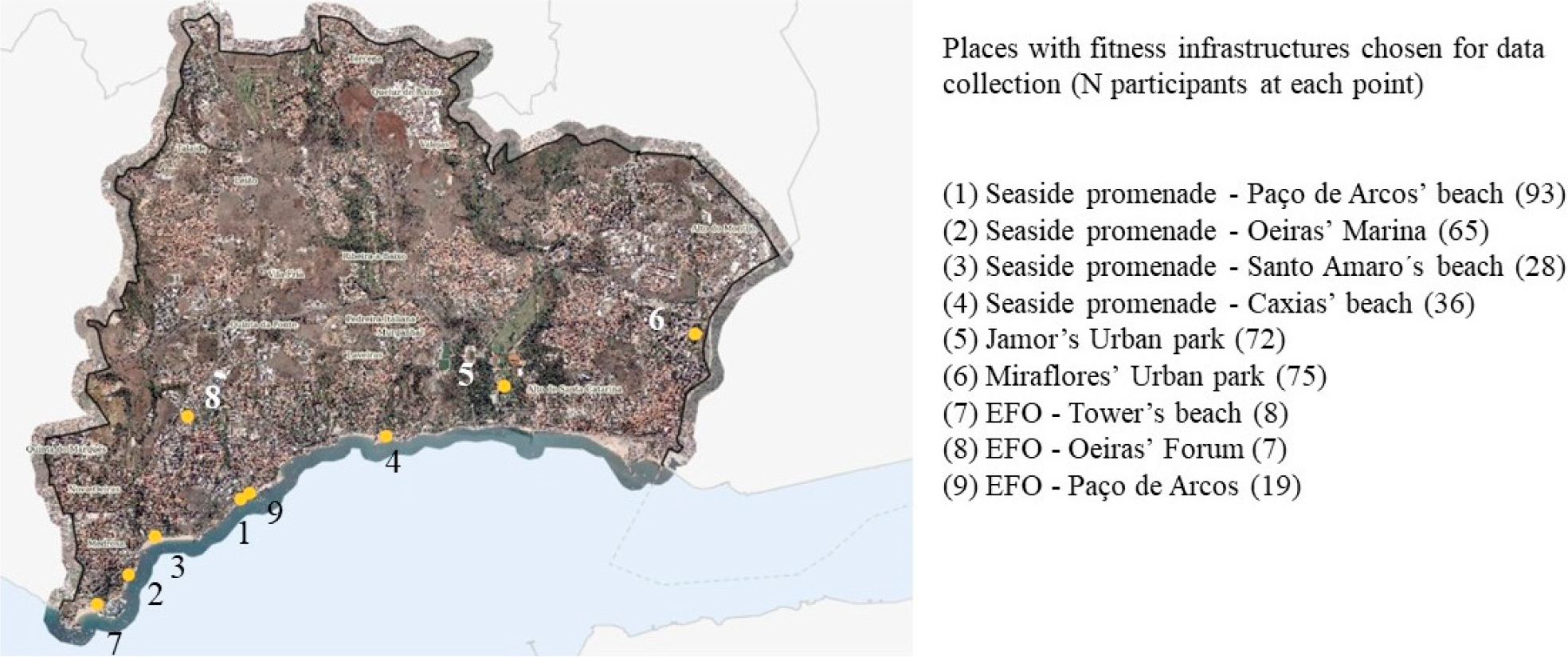
This is a cross-sectional investigation carried out through a questionnaire applied by face-to-face in-terviews in public areas of the municipality of Oei-ras, Portugal, regardless of where they lived. The data collection visits took place between March and April 2022, in 9 infrastructures for PA practice provided by the city council (Figure 1). Besides that, during the two weeks of data collection (last week of March and first week of April), the research teams remained at each collection point for a period of 4 hours, alternating be-tween the morning (from 8:00 am to 12:00 pm) and the afternoon (from 3:00 pm to 7:00 pm), and between weekdays and weekends.

Places with fitness infrastructures chosen for data collection Abbreviation: EFO: Equipment fitness outdoor.
The interviews were performed by well-trained interviewers recruited and instructed for the purpose of this study. First, they explained the goal of the investiga-tion to potential participants and that their participation would be voluntary, meaning that they could give up at any time and that no identifiable data would be collect-ed, only their answers. Besides that, a convenience sampling design was chosen, with the inclusion of the largest number of accessible cases, to maximize the robustness of the analyses within the feasible research conditions. The study was conducted following the Declaration of Helsinki and approved by the ethics committee of Uni-versidade Lusófona de Lisboa under the number J1822, on January 18, 2022, and the participants gave their in-formed consent prior to participation in the study.
Participants
A convenience sample of 403 participants was recruit-ed, and the approach was carried out by people who were using outdoor public infrastructures and were in-vited to participate in the survey. The main inclusion criteria were being an adult (> 18 years old) and being available to answer the questions for a few minutes. The only exclusion criteria were those < 18 years old.
Variables
Age, gender and body weight were self-reported, and then the body mass index was calculated as weight/ height2 . The sleep hours were based on the questions “What time do you go to bed” and “What time do you wake up in the morning on most days”?, and sleep quality was assessed in a binary manner (i.e., sleeping continuously? yes/no). We also assessed their subjec-tive well-being through one item from “the scale of life satisfaction”19. The question was “Overall, how satisfied are you with life these days? Nothing was “0” satisfied and “10” extremely satisfied. The level of life satisfaction of people who usually use the public parks in the Mu-nicipality of Oeiras was also evaluated, and the measure used in our questionnaire is the same used by the Orga-nization for Economic Cooperation and Development, which measures the well-being of populations.
Prevalence of disease (“Do you have a disease di-agnosis from a doctor? yes/no”), the level of education completed (“What is your highest completed educa-tional level?” *less than high school, high school, and graduated* [classified as bachelor or more]), if lived alone or accompanied (alone/accompanied), housing area (living in the Oeiras municipality - yes/no) were self-reported. Furthermore, the following questions were also made: the most common way to commute (i.e., by car/motorcycle, by public transportation, by walking or by bicycle), perception of financial status (i.e., very difficult, difficult, enough to pay the bills, comfortable, very comfortable) were also self-reported.
PA was assessed with the short version of the Inter-national Physical Activity Questionnaire (IPAQ). The short version has been demonstrated to have acceptable test-retest reliability (rho = 0.8) and criterion-related validity compared with accelerometers (rho = 0.3) in a 12-country evaluation study that included Portugal20. The IPAQ assesses total PA by asking the frequency (the number of days per week) and duration (the aver-age time in minutes per day) that a person performed vigorous and moderate intensity PA, and walking. The responses were then categorized into “active” i.e., meet-ing PA recommendations” (≥150 min/week of moder-ate or ≥ 75 min/week of vigorous PA) or “inactive”, i.e, not meeting the overall recommendations, according to the WHO guidelines.
SB was also assessed using the IPAQ by asking about the duration (the average time in hours per day) that the person spends sitting during weekdays and weekends. The answers were weighted by day (min/ day) through the weighted arithmetic media of the re-sponses of the time in SB on weekdays and weekend days and then also transformed into a categorical vari-able: low (≤ 180 min/day), medium (181 - 419 min/ day), and high SB (≥ 420 min/day), according to previ-ous cut points10,21.
Only the equipment fitness outdoors users (who were nearby or using them) were asked if there were physical exercise instructors to help them with the cor-rect use of the equipment free of charge, and if this would make them use them more (with two options: yes, I would use more times/no, I do not use more be-cause of that). Finally, recognizing that some people face barriers to the practice of PA22, the interviewers asked all participants, about their relationship with the places where they were interviewed through open-end-ed questions: What are the main goals of going to this place? What are the main reasons for not using this place anymore? What would make them attend their places more often, and what are the main reasons that make you choose this place? Finally, we asked: Do you believe that anything in this place should be changed?
Statistical analysis
Descriptive analyses were performed with the soft-ware Jamovi Project, version 2.2. All participants who agreed to participate in the research fully responded to the questionnaire administered in person, and no missing data were identified in the variables analyzed. However, as it was not possible to record the number of people who refused to participate in the interview, it is not possible to estimate the non-response rate.
Results
The sample consisted of 403 participants (n = 231 women [57.3%]), with an average age of 48.5 ± 17.1 years, ranging from 18 to 87 years, and 20.6% were old-er adults (≥ 65 years) (n = 83). The body mass index of the participants was on average 24.5 ± 3.69 kg/m2, and 58.1% had graduated (bachelor’s, master’s, or Ph.D. degrees), 30.5% had at least a high school education, and 11.4% had less than a high school education. More demographic information on Table 1.
Health indicators
Regarding health indicators, respondents reported sleeping an average of 8 ± 1 hours of nighttime sleep per day, and 57.7% of them said they sleep continu-ously, an indicator of sleep quality. When asked if they had any disease diagnosed by a doctor, 69.7% of the total reported that they did not, while 30.3% reported having a disease diagnosed.
Our results indicate that 83% of respondents had values ≥ than 7, with 11.7% of them assigning a maxi-mum value of 10, resulting in an average of 7.6.
Physical activity and sedentary behavior
Based on the IPAQ, users of public places reported performing 153 ± 291 min/week of vigorous-intensi-ty PA and 417 ± 657 min/week of moderate-intensity PA. According to the WHO recommendations, 75.2% (n = 303) of respondents complied with the minimum recommended weekly amount of total PA, while 24.8% (n = 100) did not achieve these values (Figure 2). In our stratified analysis, the values separated by age groups indicated that older adults accumulate on average 339 ± 407 min/week of moderate and 98 ± 210 min/week of vigorous PA. More information in Figure 2.
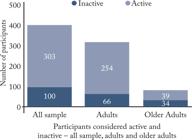
Distribution of participants who meet/do not meet current World Health Organization physical activity recommen-dantions.
Regarding SB, participants accumulated on average 315 ± 165 min/day (5.23 hours/day), 29.5% of them amounted to less than 3 hours/day, 41.7% accumulat-ed between 3 and 6 hours and 59 min/day, and 28.8% added values above 7 hours/day. Once again, when sep-arated by age groups, the older adults seem to spend less time sitting, with an average of 236 ± 129 min/ day, while adults remain seated on average 335 ± 167 min/day.
Respondents reported that the most common way to travel on their day-to-day commutes is mainly by car or motorcycle (63.0%), on foot (22.8%), by public transport (12.9%), and only 1.2% of respondents re-ported choosing to travel by bicycle.
Visitors’ relationship with public parks
The main objectives reported when attending pub-lic parks were practicing PA (72.7%), feeling greater well-being, to relax or for leisure (9.4%), to be outdoors and in contact with nature (6.7%), to bring or play with children/grandchildren (5.5%), and other reasons (5.7%).
Although a considerable proportion of people re-ported already using the places sufficiently (34%), the remaining interviewees said they would use it more often if: 1) it was closer to their home (21.3%); 2) if they had more time (20.6%); 3) other personal reasons* (10.9%); 4) if there were more physical exercise instruc-tors (5.2%) and 5) if they had more energy (3.5%). Fi-nally, any other miscellaneous responses that were not related to City Council services or that did not fit into the other categories were indicated as “Other reasons (4.5%)” (Figure 3).

The main reasons that made people choose the place where they were for their use were mainly the proximity to home (45.7%), the fact that it was close to the sea or felt that they were “in contact with nature” (22.1%), because they liked the place or thought it was beautiful/pleasant (12.9%) and because they believed it was suitable for the practice of PA (10.9%).
When asked “Do you believe that anything in this place should be changed?” and 39.7% of respondents said they were satisfied with the services/structure of the infrastructures, answering that “nothing” should be changed. However, the main suggestions pointed out by the other 60.3% were: 1) that there should be a separate space for cyclists, or that they should use the spaces at the determined times (12.2%). This happened mainly in places where cyclists and pedestrians use the same space, such as on the Oeiras promenade; 2) They pointed out that there should be more toilets (6.5%); 3) that there should be more equipment fitness outdoors’s (4%); 4) that the places needed more maintenance (3.7%); 5) that there should be more cafes/terraces (3.7%), among other suggestions, as seen in Table 2.
Frequency of suggestion based on the question: “Do you believe that anything in this place should be changed?
Only the users of the equipment fitness outdoors (who were nearby or using) were asked if there were physical exercise instructors to help them with the correct use of the equipment free of charge, and if this would make them use them more. The answers indi-cate that 57.2% of respondents (n = 40 [20 men and 20 women]) support the idea of having an instructor and that they would use them more if it were so. On the other hand, 42.8% (n = 30 [21 men and 9 women]) would no longer use the equipment due to the presence of an instructor, even though it was made available free of charge by the municipality.
Discussion
The current public policies of the Municipality of Oeiras incentivize the practice of PA through the Munic-ipal Plan for Development and Innovation in Sports and Physical Activity; however, no study has been ded-icated to identifying the profile of its occupants, their levels of PA and SB, as well as other health indicators and their satisfaction, barriers and facilities of use in these spaces.
According to our descriptive investigation, people who attend public parks seem to be more physically ac-tive than the general average of the country and accu-mulate less SB. Besides that, we identified that in these places there is a frequency of 20.6% of older people, a value very close to the proportion of older adults in the current Portuguese population, which has about 24% of people over 65 years old23.
Based on the IPAQ, 75.2% of respondents were considered physically active according to WHO rec-ommendations, while 24.8% (n = 100) did not achieve these values. It is important to note that although 1/4 of the interviewees do not comply with the minimum amount of PA, the average for PA in this study is high-er than other research at the national level and reveals encouraging numbers for the reduction of physical inactivity in users of public parks. In the National Food, Nutrition and Physical Activity Survey (IAN-AF, 2015-2016)24 72.9% of the Portuguese population did not comply with PA recommendations. Another research carried out during the COVID-19 pandemic confinement period25 (REACT-COVID 2.0 - 2021) demonstrated that about 45.7% of the population was considered inactive, according to the same criteria.
The fact that the older adults are possibly retired and do not have the requirement of spending so much time sitting at work context may explain the differ-ences in SB levels found and should alert different companies and workplaces to this reality. Besides that, since older people spend less time in moderate and vigorous PA intensities, we can hypothesize that they spend more time in light PA with daily tasks, which, although important, can have less impact on cardiometabolic results26,27. Besides that, according to the answers about commuting in their daily lives, we believe that the population’s transport option should be monitored in future research, aiming to increase ac-tive transport, corroborating Sustainable Development Goal -12 (sustainable management and efficient use of natural resources and reduction of pollutants), due to a large percentage still travel by motor.
The results also reveal high life satisfaction among Oeiras park goers, with an average of 7.6 (and 83% giving a score ≥ 7, with 11.7% having a maximum val-ue of 10), contrasting with the national average of life satisfaction in Portugal, situated between 5.2 and 5.8 according Better Life Index of the Organization for Economic Cooperation and Development28. This pos-itive deviation reinforces the idea that the municipality of Oeiras, known for its high economic, educational, and innovation indicators, provides an urban context that enhances the subjective well-being of its residents and visitors.
Based on the results, we can also identify that the perceived aesthetics of the practice places, the proxim-ity to the house, the spaces being wooded and being in contact with nature (e.g. near the sea), are important factors for the PA practice. This is corroborated by pre-vious studies29,30 and demonstrates that public policies to improve the urban quality, beyond encouraging the population to be more active by themselves, are nec-essary. This perception that the environment must be more inviting for frequent use is in line with evidence that natural environments, such as parks and urban green areas, promote greater motivation and adherence to PA, in addition to providing additional psychologi-cal and physiological benefits, such as stress reduction and mood improvement31.
Although most respondents expressed satisfaction with the infrastructure, the suggestions reported (such as separating cyclists and pedestrians, increasing toilets and equipment fitness outdoors, and improving main-tenance) highlight practical needs. Addressing these aspects may enhance safety, comfort, and adherence to PA, reinforcing the role of public spaces as health-pro-moting environments. Furthermore, according to our research, these places would benefit from having an exercise instructor at specific times (for example, a few hours in the morning or afternoon), since over half of the respondents expressed that they would use equip-ment fitness outdoors more frequently if professional instructors were available.
Regarding the implications for the future, this study provides relevant contributions at the scientific, practi-cal, and policy levels. Scientifically, it helps fill a gap in the characterization of public park users and their PA and SB levels, highlighting the health potential of these environments. Practically, it reinforces the need for strategies such as professional guidance, and age-friend-ly infrastructure to enhance use and engagement, es-pecially among older adults. From a policy perspective, the findings support continued investment in green and recreational spaces as part of broader health promotion and sustainable urban development strategies.
Regarding limitations, although our research offers new insights into public park users, it is limited by questionnaire-based data prone to recall, social desir-ability, and misperception of PA intensity, which may overestimate PA or underestimate SB. The sample was drawn from places likely to attract more active individ-uals (public and social spaces), limiting generalizability. Additionally, refusal rates were not recorded, prevent-ing non-response rate estimation and suggesting po-tential self-selection bias. Data were also collected in a single municipality and during the spring, which may affect seasonal or regional applicability.
On the other hand, the study aligns with global and national agendas, including the WHO Global Action Plan and the Sustainable Development Goals, partic-ularly regarding health, sustainable cities, and climate action. By assessing PA, life satisfaction, and space-use barriers, it presents a multidimensional perspective valuable for urban health strategies.
In conclusion, our descriptive study demonstrates that people who attend public parks dedicated to PA practice and social spaces tend to be more physically active, spend less time in SB and present more life sat-isfaction than their peers in other national studies. This corroborates the importance of public policies to promote PA practice through changing city environments to be more inviting to be physically active and mitigate the effects of climate change. Beyond these findings, the study advances scientific evidence on the role of urban green spaces, informs practical strategies such as age-friendly infrastructure and guided activities, and supports policies that integrate health promotion with sustainable urban development.
-
Funding
This work was supported by Oeiras City Council, through the Technical and Scientific Cooperation Program (2020/22).
Declaration regarding the use of artificial intelligence tools in the article writing process
The authors did not use artificial intelligence tools for preparation of the manuscript.
Acknowledgments
The authors thank the collaborators involved in the research: Rui Helder Vasconcelos Martins, Erica Melissa da Silva Fernandes, Catarina de Oliveira Reis, Beatriz Portugal Santos, Diana Filipa Simões da Fonseca, Emi Noelia Ferreira Araújo, Emílio de Nasci-mento Saringo Matanga, Pedro Miguel Rosa Vicente (later count-ed), Jorge Miguel M. Ambrósio (recruited later). Besides that, the authors appreciate the support of the Oeiras Municipality.
Availability of research data and other materials
Anonymized data will be available for non-commercial research purposes only upon request to the authors
References
-
1 Bull FC, Al-Ansari SS, Biddle S, et al. World Health Organization 2020 guidelines on physical activity and sedentary behaviour. Br J Sports Med. 2020;54(24):1451-62. doi: https://doi.org/10.1136/bjsports-2020-102955
» https://doi.org/10.1136/bjsports-2020-102955 -
2 Pedersen BK, Saltin B. Exercise as medicine - evidence for prescribing exercise as therapy in 26 different chronic dis-eases. Scand J Med Sci Sports. 2015;25:1-72. doi: 10.1111/sms.12581
» https://doi.org/10.1111/sms.12581 -
3 Marquez DX, Aguiñaga S, Vásquez PM, Conroy DE, Erickson KI, Hillman C, et al. A systematic review of physical activ-ity and quality of life and well-being. Transl Behav Med. 2020;10(5):1098-109. doi: https://doi.org/10.1093/tbm/ibz198
» https://doi.org/10.1093/tbm/ibz198 -
4 Thivel D, Tremblay A, Genin PM, Panahi S, Rivière D, Duclos M. Physical Activity, Inactivity, and Sedentary Behaviors: Definitions and Implications in Occupational Health. Front Public Health. 2018;6:288. doi: https://doi.org/10.3389/fpubh.2018.00288
» https://doi.org/10.3389/fpubh.2018.00288 -
5 Júdice PB, Silva AM, Santos DA, Baptista F, Sardinha LB. Associations of breaks in sedentary time with abdominal obesity in Portuguese older adults. Age (Dordr). 2015;37(2):23. doi: https://doi.org/10.1007/s11357-015-9760-6
» https://doi.org/10.1007/s11357-015-9760-6 -
6 Patterson R, McNamara E, Tainio M, de Sá TH, Smith AD, Sharp SJ, et al. Sedentary behaviour and risk of all-cause, cardiovascular and cancer mortality, and incident type 2 diabetes: a systematic review and dose response meta-analysis. Eur J Epidemiol. 2018;33(9):811-29. doi: https://doi.org/10.1007/s10654-018-0380-1
» https://doi.org/10.1007/s10654-018-0380-1 -
7 Wang X, Li Y, Fan H. The associations between screen time-based sedentary behavior and depression: a systematic review and meta-analysis. BMC Public Health. 2019;19(1):1524. doi: https://doi.org/10.1186/s12889-019-7904-9
» https://doi.org/10.1186/s12889-019-7904-9 -
8 Mansoubi M, Pearson N, Biddle SJ, Clemes S.The relationship between sedentary behaviour and physical activity in adults: A systematic review. Prev Med. 2014;69:28-35. doi: https://doi.org/10.1016/j.ypmed.2014.08.028
» https://doi.org/10.1016/j.ypmed.2014.08.028 -
9 Europen Comission. Desporto e Atividade Física - Setembro 2022 - Inquérito Eurobarómetro. 2022. Available from: <https://europa.eu/eurobarometer/surveys/detail/2668> [2022 September].
» https://europa.eu/eurobarometer/surveys/detail/2668 -
10 Chau JY, Grunseit AC, Chey T, Stamatakis E, Brown WJ, Matthews CE, et al. Daily Sitting Time and All-Cause Mortality: A Meta-Analysis.PLOS ONE 2013;8(11):e80000. doi: https://doi.org/10.1371/journal.pone.0080000
» https://doi.org/10.1371/journal.pone.0080000 -
11 S Smith M, Hosking J, Woodward A, Witten K, MacMillan A, Field A, et al. Systematic literature review of built envi-ronment effects on physical activity and active transport - an update and new findings on health equity. Int J Behav Nutr Phys Act. 2017;14(1):158. doi: https://doi.org/10.1186/s12966-017-0613-9
» https://doi.org/10.1186/s12966-017-0613-9 -
12 Sallis JF, Cerin E, Conway TL, Adams MA, Frank LD, Pratt M, et al. Physical activity in relation to urban environments in 14 cities worldwide: a cross-sectional study. Lancet. 2016;387(10034):2207-17. doi: https://doi.org/10.1016/S0140-6736(15)01284-2
» https://doi.org/10.1016/S0140-6736(15)01284-2 -
13 Derdouri A, Murayama Y, Morimoto T, Wang R, Aghasi NHM. Urban green space in transition: A cross-continental perspective from eight Global North and South cities. Landsc Urban Plann. 2025;253:105220. doi: https://doi.org/10.1016/j.landurbplan.2024.105220
» https://doi.org/10.1016/j.landurbplan.2024.105220 -
14 Radha RA, Mohammed-Amin RK, Ali AF. Assessing Walkability in Sulaimani City Center. KJAR. 2020;5(1):175-99. doi: https://doi.org/10.24017/science.2020.1.13
» https://doi.org/10.24017/science.2020.1.13 -
15 Fundação Francisco Manuel dos Santos. Pordata. Retatros dos Municípios. População - Oeiras. n.d. Available from: <https://retratos.pordata.pt/populacao/oeiras> [2025 November].
» https://retratos.pordata.pt/populacao/oeiras -
16 Instituto Nacional de Estatísticas. Estatísticas do Rendimento ao Nível Local - 2020. Available from https://www.ine.pt/documentos/municipios/rnlocal/ano2022/1110.pdf> [2022 September].
» https://www.ine.pt/documentos/municipios/rnlocal/ano2022/1110.pdf -
17 Oeiras Valley. Município de Oeiras. Espaço Verdes. 2023. Available from: <https://www.oeiras.pt/espa%C3%A7o-verdes?p_l_back_url=%2Fpesquisa%3Fq%3Despa%25C3%25A7os%2Bverdes> [2023 May].
» https://www.oeiras.pt/espa%C3%A7o-verdes?p_l_back_url=%2Fpesquisa%3Fq%3Despa%25C3%25A7os%2Bverdes -
18 von Elm E, Altman DG, Egger M, Pocock SJ, Gøtzsche PC, Vandenbroucke JP. Strengthening the reporting of observa-tional studies in epidemiology (STROBE) statement: guidelines for reporting observational studies. BMJ. 2007;335(7624):806-8. doi: https://doi.org/10.1136/bmj.39335.541782.AD
» https://doi.org/10.1136/bmj.39335.541782.AD -
19 Diener E, Emmons RA, Larsen RJ, Griffin S. The Satisfaction With Life Scale. J Pers Assess. 1985;49(1):71-5. doi: https://doi.org/10.1207/s15327752jpa4901_13
» https://doi.org/10.1207/s15327752jpa4901_13 -
20 Craig CL, Marshall AL, Sjöström M, Bauman AE, Booth ML, Ainsworth BE, et al. International physical activity ques-tionnaire: 12-country reliability and validity. Med Sci Sports Exerc. 2003;35(8):1381-95. doi: https://doi.org/10.1249/01.MSS.0000078924.61453.FB
» https://doi.org/10.1249/01.MSS.0000078924.61453.FB -
21 Rezende LFM, Sá TH, Mielke GI, Viscondi JYK, Rey-López JP, Garcia LMT. All-Cause Mortality Attributable to Sitting Time: Analysis of 54 Countries Worldwide. Am J Prev Med. 2016;51(2):253-63. doi: https://doi.org/10.1016/j.amepre.2016.01.022
» https://doi.org/10.1016/j.amepre.2016.01.022 -
22 Spiteri K, Broom D, Bekhet AH, et al. Barriers and Motivators of Physical Activity Participation in Middle-aged and Older-adults - A Systematic Review. J Aging Phys Act. 2019;27(4):929-944. doi: https://doi.org/10.1123/japa.2018-0343
» https://doi.org/10.1123/japa.2018-0343 -
23 Fundação Francisco Manuel dos Santos. Pordata. População Residente Segundo Os Censos: Total e Por Grandes Grupos Etários. n.d. Available from: <https://www.pordata.pt/Portugal/Popula%C3%A7%C3%A3o+residente+segundo+os+Censos+total+e+por+grandes+grupos+et%C3%A1rios-512-2541> [2022 May].
» https://www.pordata.pt/Portugal/Popula%C3%A7%C3%A3o+residente+segundo+os+Censos+total+e+por+grandes+grupos+et%C3%A1rios-512-2541 -
24 Teixeira PJ, Marques A, Lopes C, Sardinha LB, Mota JA. Prevalence and Preferences of Self-Reported Physical Activity and Nonsedentary Behaviors in Portuguese Adults. J Phys Act Health. 2019;16(4):251-8. doi: https://doi.org/10.1123/jpah.2018-0340
» https://doi.org/10.1123/jpah.2018-0340 -
25 República Portuguesa. Serviço Nacional de Saúde. Direção-Geral da Saúde. REACT-COVID 2.0 Inquérito Sobre Ali-mentação e Atividade Física em Contexto da Pandemia COVID-19. Available from: <https://alimentacaosaudavel.dgs.pt/wp-content/uploads/2022/07/REACT_COVID_20_Out2021.pdf> [2022 September]
» https://alimentacaosaudavel.dgs.pt/wp-content/uploads/2022/07/REACT_COVID_20_Out2021.pdf -
26 Aerts N, Le Goff D, Odorico M, Le Reste JY, Van Bogaert P, Peremans L, et al. Systematic review of international clinical guidelines for the promotion of physical activity for the primary prevention of cardiovascular diseases. BMC Fam Pract. 2021;22(1):97. doi: https://doi.org/10.1186/s12875-021-01409-9
» https://doi.org/10.1186/s12875-021-01409-9 -
27 Zheng C, Gill JMR, Sun FH, Huang WY, Sheridan S, Chen XK, et al. Effects of increasing light versus moderate-to-vigorous physical activity on cardiometabolic health in Chinese adults with obesity. J Sports Sci. 2023;41(16):1547-57. doi: https://doi.org/10.1080/02640414.2023.2282278
» https://doi.org/10.1080/02640414.2023.2282278 -
28 Organization for Economic Cooperation and Development (OECD). OECD Better Life Index. 2021. Available from: <https://www.oecdbetterlifeindex.org/pt/sobre/> [2021 September].
» https://www.oecdbetterlifeindex.org/pt/sobre/ -
29 Humpel N, Owen N, Leslie E. Environmental factors associated with adults’ participation in physical activity: A review. Am J Prev Med. 2002;22(3):188-99. doi: https://doi.org/10.1016/S0749-3797(01)00426-3
» https://doi.org/10.1016/S0749-3797(01)00426-3 -
30 Moran M, Van Cauwenberg J, Hercky-Linnewiel R, Cerin E, Deforche B, Plaut P. Understanding the relationships be-tween the physical environment and physical activity in older adults: a systematic review of qualitative studies. Int J Behav Nutr Phys Act. 2014;11:79. doi: https://doi.org/10.1186/1479-5868-11-79
» https://doi.org/10.1186/1479-5868-11-79 -
31 Pretty J, Peacock J, Sellens M, Griffin M. The mental and physical health outcomes of green exercise. Int J Environ Health Res. 2005;15(5):319-37. doi: https://doi.org/10.1080/09603120500155963
» https://doi.org/10.1080/09603120500155963
Edited by
-
Editor in Chief
Átila Alexandre Trapé https://orcid.org/0000-0001-6487-8160University of São Paulo, Ribeirão Preto, São Paulo, Brazil.
-
Section editor
Debora Bernardo https://orcid.org/0000-0003-4351-8929Brazilian Center for Analysis and Planning, São Paulo, São Paulo, Brazil.
Reviewers’ assessment
The reviews of this article were originally conducted in Portuguese. This version has been translated using ChatGPT and subsequently reviewed by the Chief Editors.About the reviewerReviewer A
Anonymous
-
Did not authorize publication of the review.
- peer review recommendation:
Reviewers’ assessment
The reviews of this article were originally conducted in Portuguese. This version has been translated using ChatGPT and subsequently reviewed by the Chief Editors.About the reviewerReviewer B
Anonymous
-
Use of public spaces for physical activity: An ex-ploratory study in the municipality of Oeiras - Por-tugal - The title has a total of 105 characters (in-cluding spaces), which exceeds the limit indicated by the journal.
-
The manuscript presents margins that differ from those specified in the Instructions to Authors. I re-quest that the margins be adjusted according to the journal’s template in the next version.
-
I recommend aligning the introduction of the abstract with the focus of the manuscript. In the current version, by emphasizing infrastructure/ equipment, the text gives the impression that the condition of park equipment will be evaluated. I suggest that the contextualization clearly state that the interest lies in who uses the parks, how they use them (PA/SB), and why, positioning the study within this scope-and not in the evaluation of equipment conditions.
-
Although the Introduction situates the relevance of PA/SB and the role of parks, the disproportionate emphasis on infrastructure/equipment leads to a reading focused on park condition assessment. The assumptions underlying the gap the study intends to fill are not made explicit. I recommend condensing the review on equipment, anticipating the formula-tion of the gap centered on user characteristics, user perceptions, and user motivations, and suppressing extensive statistical details and examples from pre-vious studies that do not directly dialogue with the objectives and results of the manuscript.
-
The methodological procedures are, in general terms, appropriate to the research problem, but some points require greater clarity. Convenience recruitment was described, but details on data col-lection times, prevention of re-interviews, and ex-clusion criteria are lacking. The use of the IPAQ was well justified, but other variables (such as sleep, life satisfaction, and financial perception) were as-sessed through single items, without reference to validated instruments. The analysis plan is poor-ly detailed, mentioning only descriptive statistics, even though the results include comparisons not previously described. The ethics section is adequate, but it is suggested to adjust the wording to indi-cate that no identifiable data were collected, rather than stating that “no personal data” were recorded. Improving the Methods section in these aspects is recommended to ensure greater transparency and reproducibility.
-
The results are presented clearly, with appropriate use of tables and figures, which facilitates reading and understanding. However, there is redundancy between the text and the tables/figures, which could be more complementary, with the text focusing on the most relevant findings rather than repeating values already shown. Sample characteristics are well described, but refusals or participant losses were not reported, which should be included for greater transparency. The number of illustrations seems sufficient, although it is important to con-firm compliance with the journal’s guidelines. It is recommended to revise the section to reduce repe-tition and emphasize interpretations.
-
The discussion presents the main findings clearly and relates them to the international literature, in addition to acknowledging methodological limita-tions and highlighting strengths of the study. How-ever, it is recommended to strengthen the critical analysis by making clearer how the limitations affect the interpretation of the results (e.g., sample bias, seasonality, and absence of a non-response rate). In addition, it would be useful to organize the study’s contributions more systematically, differentiating scientific, practical, and public policy implications. This would give the section greater consistency and increase the relevance of the findings for the scien-tific community and for local policymakers.
-
The conclusion is clear and coherent with the objectives and highlights the importance of public spaces in promoting PA and improving well-being, reinforcing the relevance of urban policies aimed at these environments. However, it could be strength-ened in terms of originality by explicitly stating how the findings contribute to filling the identified gap in the Portuguese context and which practical implications differentiate this study from evidence already consolidated in other countries. A more an-alytical formulation, highlighting specific contribu-tions to science, public policies, and urban planning, would add strength to the section.
-
Final comments: The study presents relevant results by demonstrating that users of public parks tend to be more physically active, less sedentary, and more satisfied with life, highlighting the importance of public policies aimed at promoting physical activity. However, some issues need to be improved before publication. The introduction could be reformulat-ed to more clearly explicate the scientific gap and the positioning of the work in relation to the exist-ing literature. The methodology also requires addi-tional detail, especially regarding sample selection criteria, control of potential biases, and limitations inherent to the data collection process, which is es-sential to ensure transparency and replicability. In the discussion, it is recommended to reinforce the originality of the contribution and promote a more critical dialogue with previous studies. Finally, the conclusion could be more assertive, clearly high-lighting the advancement provided by this study and its implications for practice and public policies.
Editor comments
-
The manuscript presents consistent and relevant results for the field, especially by evidencing the relationship between the use of public parks, high-er levels of physical activity, reduced sedentary be-havior, and greater life satisfaction. These findings reinforce the importance of the topic for both pub-lic health and urban planning, justifying interest in its publication. However, I believe the text still requires adjustments to improve clarity and read-er understanding. The introduction needs clear-er contextualization, situating the contribution of the study within the current scientific debate. The methodology, although generally adequate, requires greater detail to ensure rigor and transparency. In addition, I suggest revising the discussion in order to strengthen its connection with the existing liter-ature and to more critically highlight the innovative nature of the research. With these improvements, the manuscript will have the potential to offer a more robust and clear contribution to studies on physical activity, urban environments, and health.
In addition to the comments sent by the reviewers, I suggest that:
-
Only the term gender be used in Table 1.
-
The word “concelho” be corrected to “municipality” in the Portuguese title.
-
The number of illustrations be adjusted, as the jour-nal guidelines allow up to 5 illustrations and the submitted text contains 6. Also, better organization of the presentations is suggested. For example, Fig-ures 3 and 4 are presented together; one suggestion is to present them as Figures 3a and 3b.
-
Update the references used in the text. Of the 29 cited, 18 were published more than five years ago; it is recommended to update some of them with more recent publications.
Final Decision
-
Substantial revisions required
- peer review recommendation: minor-revision


 *We fit into the category “other personal reasons” those that had personal characteristics, or of a transitory order, or that do not fit into any public responsibility, for example: “my leg is injured” or “is the first time that I came here”.