
 Effects of a physical exercise program in children with Autism Spectrum Disorder
ABSTRACT
Objective: The study investigate study was to investigate the effects of a physical exercise program on the motor skills and physical activity levels of children with Autism Spectrum Disorder (ASD).
Methods: Forty-nine children, aged 8 to 10 years, were randomly assigned to an exercise group (EG; n = 29) and a control group (CG; n = 20). The EG participated in a 16-week program, with three weekly sessions of 50 minutes each, consisting of both aerobic and strength exercises. Motor skills were measured by the Test of Gross Motor Development-2. Physical activity was assessed by accelerometry before the intervention, after 8 weeks, and after 16 weeks. Data analysis was conducted using Generalized Estimating Equations and Bonferroni post-hoc tests (α = 0.05).
Results: 39 children completed the intervention. The results showed that the EG had higher scores related to motor skills compared to the CG after the intervention. Additionally, significant improvements in motor skills were observed in the EG from week 0 to week 8 and from week 8 to week 16, with no changes over time in the CG. The CG reduced physical activity levels from week 0 to week 8, and the EG remained stable.
Conclusion: Children with ASD benefited from the physical exercise program, showing improvements in motor skills and maintenance of physical activity levels. Exercise programs should be used to promote inclusion in physical exercise promotion, mitigating disparities in access to physical activity and its associated benefits.
Keywords:
Autism Spectrum Disorder; Test of Gross Motor Development-2; Accelerometry; Cir-cuit-based exercise; Equity; Inclusion.
RESUMO
Objetivo: O estudo investigou os efeitos de um programa de exercícios físicos nas habilidades motoras e nos níveis de atividade física de crianças com Transtorno do Espectro Autista (TEA).
Métodos: Quarenta e nove crianças, com idades entre 8 e 10 anos, foram aleatoriamente distribuídas em um grupo de exercícios (GE; n = 29) e um grupo controle (GC; n = 20). O GE participou de um programa de 16 semanas, com três sessões semanais de 50 minutos, incluindo exercícios aeróbicos e de força. As habilidades motoras foram avaliadas pelo Teste de Desenvolvimento Motor Grosso-2, e a atividade física por acelerometria, antes da intervenção, após 8 e 16 semanas. Os dados foram analisados por Equações de Estimativa Generalizadas e testes post-hoc de Bonferroni (α = 0,05).
Resultados: Completaram a intervenção 39 crianças. Os resultados mostraram que o GE obteve escores mais altos em relação às habilidades motoras em comparação com o GC após a inter-venção. Além disso, melhorias significativas nas habilidades motoras foram observadas no GE da semana 0 para a semana 8 e da semana 8 para a semana 16, sem alterações ao longo do tempo no GC. O GC apresentou redução nos níveis de atividade física da semana 0 para a semana 8, enquanto o GE manteve-se ativo.
Conclusão: Crianças com TEA se beneficiaram do programa de exercícios físicos, apresentando melhorias nas habilidades motoras e manutenção dos níveis de atividade física. Programas de exercícios devem ser utiliza-dos para promover a inclusão, reduzindo disparidades no acesso à atividade física e seus benefícios associados.
Palavras-chave:
Transtorno do Espectro Autista; Test of Gross Motor Development-2; Acelerometria; Exercício baseado em circuito; Equidade; Inclusão
Introduction
Autism Spectrum Disorder (ASD) is a neurodevelopmental disorder characterized by difficulties in com-munication, social interaction, and the presence of re-strictive and repetitive behaviors1. Children with ASD often exhibit deficits in basic motor skills, such as gross and fine motor coordination, postural control, and balance2. These impairments can affect the performance of daily living activities, such as personal hygiene, eating, and dressing, as well as limit their participation in play and physical activities3.
Physical exercise for children with ASD has been identified as a key intervention for improving motor coordination4,5. Structured physical activity programs have demonstrated moderate to large effects on the development of manipulative and locomotor skills, physical fitness, and social functions6. Previous studies have demonstrated positive effects on the motor skills of children with ASD following programs involving sports and recreational physical exercises4,7-9.
Studies indicate that most youth with ASD do not meet the minimum recommendations for moderate to vigorous physical activity (MVPA) per week10-12. Additionally, it has been found that gender, family in-come, and family structure are associated with physical activity scores. Furthermore, lack of opportunity and financial burden are highlighted as the main barriers to engaging in physical activity12. Despite the benefits reported in intervention studies with children with ASD, these studies have generally had small sample sizes5,9,13 and are scarce in the Brazilian context. Bhat14, in a study with 13887 children with ASD aged 5 to 15 years, from the United States of America, described that 87% of the sample had motor impairments. Simi-larly, as supported by the literature, children with ASD engage less and for shorter durations in MVPA15. Giv-en the challenges, it is crucial to explore inclusive phys-ical exercise interventions for people with ASD.
Despite the well-documented benefits of physical exercise for children with ASD internationally, there is still a lack of national studies on physical exercise interventions in children with ASD, especially those focusing on motor skills and physical activity levels. The present study aimed to investigate the effects of a 16-week physical exercise program on motor skills and physical activity levels in children with ASD aged 8 to 10 years.
Methods
Experimental design
This study is characterized as a randomized controlled trial, which assessed the effects of a 16-week combined physical exercise program, conducted three times a week, compared to a control group of children with ASD. The control group was instructed not to modify their physical activity habits during the study period. Motor skills and physical activity levels were measured at the start of the intervention, after eight weeks, and after 16 weeks of the physical exercise program. The study was carried out in 2019 at the conducted between at the School of Physical Education and Physiotherapy of the Federal University of Pelotas (Brazil).
Participants
The sample was intentionally selected in a non-prob-abilistic manner, aiming to include as many children as possible. A total of fifty-four c hildren w ith A SD, aged 8 to 10 years, were invited to participate in the study, with five declining, resulting in a fi nal sample of forty-nine children. All participants were attending one of the institutions that support children with ASD in Pelotas, Brazil. The invitation was also extended through media resources, including city websites, tele-vision, and radio.
A total of 49 children were included in the study. Ten children were unable to commit to the exercise protocol and were therefore allocated to the CG. The remaining 39 children were distributed between the exercise group (EG) and the control group (CG) based on age, gender, and severity of ASD. To account for the possibility of higher dropout rates in the EG, ten additional children were allocated to this group. As a result, the participants were divided into two groups: EG: n = 29 and CG: n = 20.
Ethics statement
The study was conducted following all ethical princi-ples and was submitted and approved by the Research Ethics Committee of the School of Physical Education and Physiotherapy, Federal University of Pelotas (pro-tocol no. 70687417.3.0000.5313). The Informed Con-sent Form was signed by the parents or legal guardians of the participating children. Due to the participants’ characteristics with ASD, the signing of the Informed Assent Form was not required, and this procedure was duly justified and approved by the Ethics Committee.
Assessments
Motor skills and physical activity levels were measured at three distinct time points: 1) before the interven-tion (week 0); 2) before the 24th session (week 8); and 3) before the 48th session (week 16). At each of these times, participants from both groups (EG and CG) completed the Test of Gross Motor Development-2 (TGMD-2) and used an accelerometer for seven con-secutive days. Parents and guardians of the children completed instruments related to the determination of ASD severity and lifestyle for sample characterization, while the tests were conducted at baseline.
Autism Spectrum Disorder support level
The support level of ASD for all participants was measured using the Childhood Autism Rating Scale16. This instrument, comprising a 15-item scale, evaluates im-pairments in social interaction, communication, and repetitive behaviors. Fourteen items assess general be-havior across various domains, including personal rela-tionships, imitation, emotional response, use of the body, use of objects, responses to changes, visual responses, auditory responses, responses to taste, smell, and touch, fear and anxiety, verbal communication, non-verbal communication, activity level, and the consistency of intellectual responses. The final item provides an overall impression based on observation of the child.
Each item is rated on a scale from 1 (within normal limits) to 4 (severe symptoms). After assessing the child and reviewing the parents’ responses, the re-searcher rates each item on a 7-point scale with val-ues ranging from 1 to 4, including intermediate values (1-1.5, 2-2.5, 3-3.5, 4). The total score ranges from 15 to 60, allowing for classification of ASD severity as follows: a) < 30 points: no ASD; b) 30 to 36 points: mild to moderate symptoms; and c) > 37 points: severe symptoms17.
Motor skills
The TGMD-2 was used to assess gross motor devel-opment in locomotion and object control skills. The TGMD-2, which has been utilized in research with children with ASD18, consists of 12 items-six relat-ed to locomotion skills (running, galloping, hopping, jumping on one foot, jumping with both feet, lateral running, and sliding) and six related to object control skills (catching, bouncing, receiving, kicking, overhead throwing, and rolling a ball). The TGMD-2 allows for separate evaluations of each item (locomotion and ob-ject control).
The test protocol suggests using a video camera to analyze motor performance after the test is adminis-tered. Each sub-item has different performance criteria based on video analysis. The child receives 1 point if they meet the criterion correctly and zero if they do not. The points obtained in each sub-item are imme-diately summed to generate raw scores. The raw score ranges from zero to 48 for locomotion skills and from zero to 48 for object control skills. All tests were ana-lyzed by two assessors, and in case of disagreement, a third assessor was consulted to make the final decision.
Physical activity levels
Physical activity levels were objectively measured using the Actigraph GT3X accelerometer. This accelerome-ter measures 4.6 cm × 3.3 cm × 1.5 cm and weighs 19 grams. It records acceleration, energy expenditure, physical activity intensity, and body position. All chil-dren were asked to wear the device on their right hip secured with elastic straps for seven consecutive days at each assessment point (week 0, week 8, and week 16) and during classes to measure their intensity. Ad-ditionally, parents or guardians were given a diary to record periods when the accelerometer was not used.
After collecting the accelerometer data, the data were analyzed using the manufacturer’s software. The data recording frequency was 60 Hz. A valid day for analysis required at least 480 minutes of recorded data19. Non-use was validated by 60 minutes of con-secutive zeros, with a peak tolerance of 2 minutes to determine if the device was likely removed. Moreover, 60 minutes of zero data were interpreted as non-use periods. Physical activity was collected continuously in minutes but later categorized dichotomously (<300 min/week - insufficiently active; ≥300 min/week - ac-tive)20. Physical activity levels were assessed based on time spent in sedentary, light, moderate, vigorous, and very vigorous activities, as well as by counts per min-ute (cpm). The cut-off points proposed by Evenson et al.21 were used to categorize activities into different in-tensities: light (101-2295 cpm), moderate (2296-4011 cpm), and vigorous (4012-∞ cpm).
Physical exercise program
The physical exercise program lasted 16 weeks, with a frequency of three 50-minute sessions per week. The classes were taught by four physical education teachers with prior experience working with the studied popu-lation. The number of students per class ranged from four to five children. Each session was composed of four parts: 1)Initial Circle: Upon entering the room, students were positioned in a circle for an explanation of the class by the instructors; 2)Warm-up: The warm-up involved games aimed at promoting social interac-tion and stimulating contact between peers (e.g., tag, music activities, playful exercises, among others); 3) Main Part: Aerobic Circuit - This included four aer-obic activities (e.g., agility ladder, zig-zag cones, step jumping, among others) that needed to be repeated around four to five times; Strength Circuit- Exercises (e.g., squats, push-ups, TRX suspension training rows, medicine ball throws, planks, among others) targeting the lower limbs, upper limbs, trunk, and abdomen, or multi-joint exercises; 4) Final Circle: The students were positioned again in a circle and a short stretching session was performed with breathing exercises and a discussion about how the class had been. This class structure was used throughout the program, as the importance of routine during classes was recognized due to the characteristics of ASD, to promote more effective adaptation. The materials used were: balls of different sizes and 2 kg medicine balls, hoops, agility ladders, steps, large and small cones, TRX suspension bands, benches, and ropes of different sizes.
Statistical analysis
Results were presented as mean ± standard deviation and frequencies. The Chi-Square test was used to com-pare the variables between groups at the beginning of the intervention. Generalized Estimating Equations and Bonferroni post-hoc tests were employed to com-pare between time points (week 0, week 8, and week 16) and between groups (EG and CG). The effect size (Cohen’s d) was calculated from the mean values be-tween EG and CG at weeks 8 and 16 and classified as small (between 0.2 and 0.5), moderate (between 0.5 and 0.8), or large (0.8 or more)22. To analyze the inten-sity of the EG classes across time points (class 3, class 24, and class 42), repeated measures ANOVA was used after testing for data normality with the Shapiro-Wilk test. Analyses were conducted using SPSS 20.0 soft-ware, and the significance level was set at α = 0.05.
Results
Participants
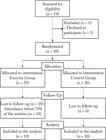
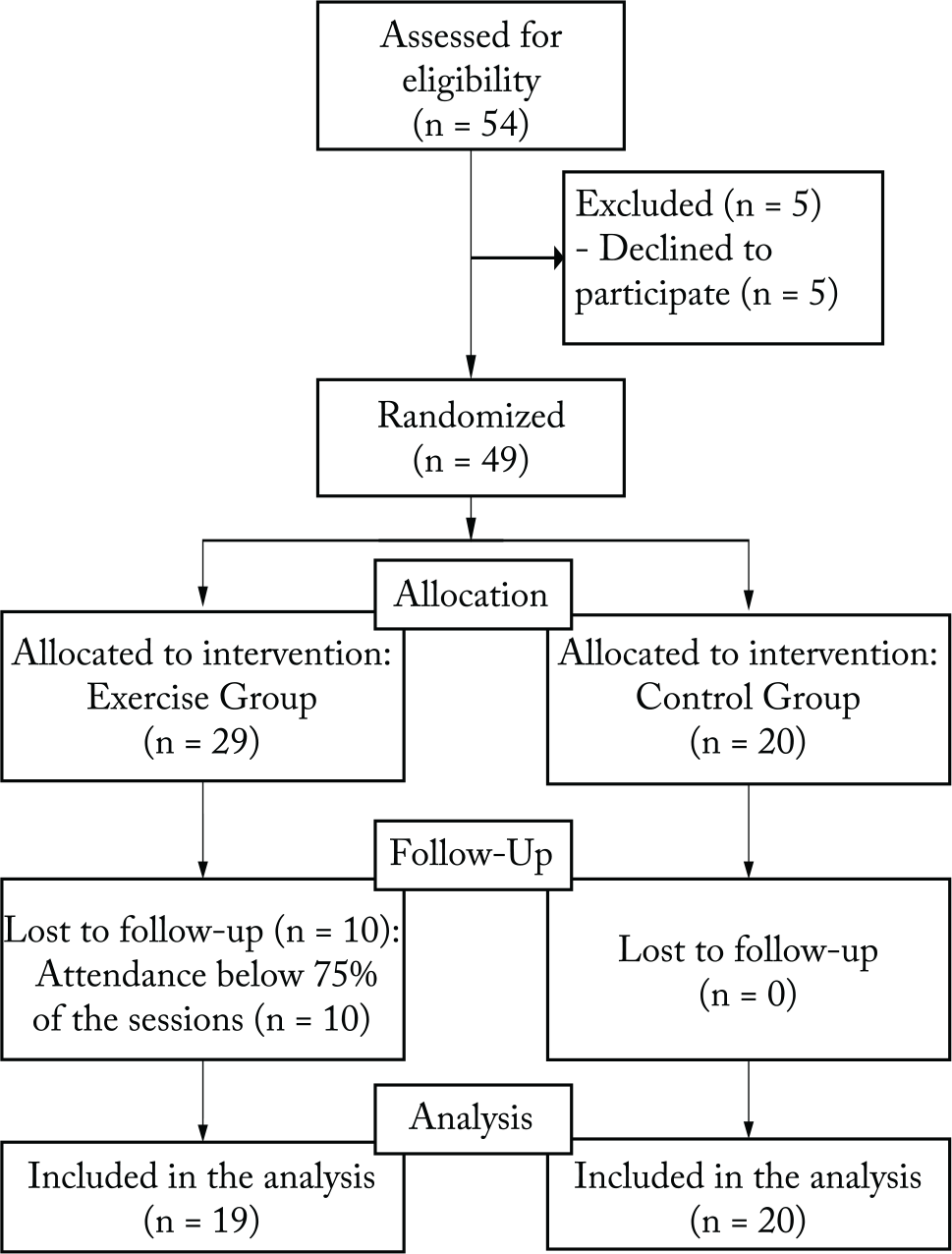
The flow of participants through the study is presented in Figure 1. Of the 54 children who were contacted for participation, 49 were randomized (EG: n = 29; CG: n = 20) and 39 (EG: n = 19; CG: n = 20) completed the intervention and were included in the analysis. Ten participants dropped out during the intervention peri-od due to problems not related to the study. In addi-tion, it was not possible to obtain the physical activity data of six participants (1 from EG and 5 from CG), because the children did not accept the use of the ac-celerometer. Baseline characterization of participants is presented in Table 1.
Most of the children were male, 10 years old, and diagnosed with ASD by the age of three. Three children (7.8%) had siblings with disabilities: one with ASD, one with schizophrenia, and one with an intellectual disability. Eleven children (28.2%) had some health issue, including five with bronchitis (12.8%), three with rhinitis (7.8%), two with sinusitis (5.1%), and one with epilepsy (2.0%). Among the 32 children who were tak-ing medication (82.1%), 21 were on more than one medication (53.8%). Most were using antidepressants combined with anxiolytics. The most frequently men-tioned medication was risperidone (51.3%).
The results related to motor skills are presented in Table 2. A significant interaction was observed be-tween group vs. time for variables related to locomotion skills (p < 0.001), object control (p < 0.001), and total TGMD-2 score (p < 0.001). The Bonferroni post-hoc test indicated that scores obtained by EG and CG were similar at week 0 (locomotion: p = 0.391; object control: p = 0.474; total score: p = 0.407), as well as at week 8 (locomotion: p = 0.261; object control: p = 0.158; total score: p = 0.202). At week 16, scores obtained by EG were higher compared to CG (locomotion: p = 0.042; object control: p = 0.017; total score: p = 0.023). Ad-ditionally, for EG, a significant improvement was ob-served in locomotion skills, object control, and the total TGMD-2 score from week 0 to week 8 (p < 0.001) and from week 8 to week 16 (p < 0.001). No changes were observed between time points for the CG.
Results of Test of Gross Motor Development-2 before training and after 8 and 16 weeks of training: exercise group and control group
The effect size analysis between the EG and CG results in the week 8 showed a small magnitude of effect for score total of TGMD-2 (0.40; 95% confi-dence interval [CI]: -0.23 to 1.04), locomotor (0.36; 95% CI: - 0.28 to 0.99) and object control (0.45; 95% CI: -0.19 to 1.09). Furthermore, the effect size analysis between the EG and CG data in the week 16 demon-strated a moderate magnitude of effect for score total of TGMD-2 (0.72; 95% CI: 0.07 to 1.37), locomotor (0.64; 95% CI: 0.00 to 1.28) and object control (0.76; 95% CI: 0.11 to 1.41).
The results related to physical activity level are presented in Figure 2. A significant interaction was ob-served between group vs. time (p = 0.003). The Bonfer-roni post-hoc test indicated that the groups had similar values at week 0 (p = 0.560) and week 8 (p = 0.148). However, at week 16, the CG had lower values com-pared to EG (p = 0.05). The CG reduced its physical activity level from week 0 to week 8 (p = 0.003) and from week 8 to week 16 (p < 0.001), with no difference between weeks 8 and 16 (p = 0.999). The physical ac-tivity level of EG remained unchanged. The effect size analysis between EG and CG results showed a small effect magnitude for physical activity level at week 8 (0.49; 95% CI: -0.21 to 1.18) and a moderate effect magnitude at week 16 (0.66; 95% CI: -0.04 to 1.37).
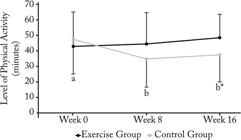
Results of Level of Physical Activity before training and after 8 and 16 weeks of training: exercise group (n = 18) and control group (n = 15).
Figure 3 shows the time spent in MVPA during the 3rd, 24th, and 42nd classes. The results indicated a difference in time spent in MVPA between the classes (p = 0.006). The Bonferroni post-hoc test revealed that the 42nd class had a significantly greater time spent in MVPA compared to the 3rd class (p = 0.016). The 24th class did not show a significant difference from the other two classes.
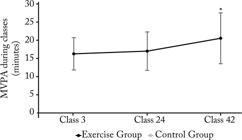
Results of time in moderate to vigorous physical activ-ities measured by the accelerometer during classes 3, 24, and 42 in the exercise group.
Discussion
The main findings of this study showed that 16 weeks of a combined physical exercise program positively im-pacted the locomotion and object control motor skills of children with ASD. However, although the program had effects on motor skills, this type of intervention did not change the participants’ levels of physical activity.
The results showed increases of 72% in locomotion skills, 100% in object control skills, and 84% in the to-tal TGMD-2 score. These findings are consistent with studies showing improvements in motor skills in chil-dren with ASD through exercise. Ketcheson et al.5, in an eight-week study using recreational activities with 11 children with ASD aged 4 to 6 years, demonstrated increases of 94% in locomotion skills, 100% in object control skills, and 100% in the total score using the TGMD-2. In the study by Lourenço et al.9, involving 17 children with ASD aged 4 to 10, where the exer-cise group participated in a weekly trampoline training session lasting 45 minutes, motor skills were assessed using the Bruininks-Oseretsky test battery, showing a 65% increase for the exercise group. Improvements in these motor skills are crucial for this population, as such characteristics have been reported as barriers to physical activity23,24. Many of these motor limitations are exacerbated by social misunderstandings of these children. Therefore, developing body awareness in different contexts during childhood, along with interact-ing with their environment, contributes to improving basic motor skills25,26. Consequently, children with ASD who exhibit better motor skills perform their daily activities with greater proficiency and indepen-dence27, enhancing their social, physical, and cognitive development.
Despite some of the aforementioned studies pre-senting evidence of improvements in motor skills, a re-cent meta-analysis28 indicated that children with ASD who participated in exercise programs did not show significantly better motor coordination compared to control children. One point of discussion was the va-riety in the type and implementation of practices (e.g., school physical education, Tai Chi, sports education, and table tennis). Therefore, it is highlighted that the characteristics of the exercise program in this study (structure, type of exercises, duration) may have con-tributed to positive outcomes in motor skills.
Physical activity at moderate-to-vigorous levels during the week showed a significant decrease in the CG. Numerous studies describe physical activity lev-els, noting that most children do not meet the World Health Organization’s recommendation of 60 minutes of daily physical activity6,12,29. Pan et al.8 conducted a study with youth aged 12 to 17 years with mild ASD, reporting that 13 of the 22 participants met the World Health Organization recommendations. In Stanish et al.12, which included 30 adolescents aged 13 to 21 years, the average of MVPA was 29.1 minutes per day. Similarly, in the present study, only 20% (five from the EG and three from the CG) met the recommenda-tions. Current research indicates that individuals with ASD benefit from physical activity, such as improve-ments in social skills30, sleep quality31, and reduced ste-reotypies32. However, research still shows that children and youth with ASD engage minimally in physical activity during leisure time33 and, compared to their peers without disabilities, are 60% less likely to engage in regular physical activity and 74% less likely to par-ticipate in organized sports34.
Despite the concerningly low levels of physical activity in children with ASD35, the exercise program in this study was not able to improve participants’ daily levels of MVPA, even with significant improvements in motor skills. This suggests that gains in motor skills alone were not sufficient to increase MVPA levels in children with ASD. However, it is important to note that the study lasted 16 weeks, raising the hypothesis that such motor improvements may foster greater engagement in physical activity over the long term. Moreover, behavior change is known to be a complex process influenced by various factors beyond motor competence, such as motivation, social inclusion, envi-ronmental opportunities, and, especially in individuals with ASD, family support, which is essential to pro-moting meaningful and lasting change.
Regarding participation in the classes, a significant increase in the time spent in MVPA was observed from class three (16 minutes) to class 42 (21 min-utes). This suggests that the increased participation of students over time contributed to the intensity of the classes, which may be related to the level of participa-tion in them. This improvement can be explained by the significant enhancement in motor skills observed during the activities, as children with better skills and a higher sense of competence interact more efficiently, boosting their self-esteem and feeling more integrated into the group27. Zhao and Chen30 observed in their in-tervention that a structured 12-week physical activity program, with two sessions per week, led to significant improvements in social interaction and communica-tion for children with ASD.
However, this study presents some limitations, such as the use of a non-probabilistic sampling method, which may compromise the generalizability of the find-ings, and the absence of evaluator blinding. In addition, there was a loss of ten children from the intervention group. This dropout occurred because some participants had difficulty attending the proposed three weekly ses-sions or did not adapt well to the group-based meth-odology. Moreover, ten children were directly allocated to the CG, as their families had previously informed, prior to randomization, that they would not be willing to adhere to the required number of weekly sessions in the program. Since most studies in this field have small sample sizes, we decided to retain these children in the study. The absence of prospective registration of the clinical trial also represents an important lim-itation. Nevertheless, the study was conducted under the supervision of experienced researchers and in full compliance with ethical guidelines. All methodological details and data analyses were thoroughly reported to ensure transparency.
It is worth highlighting the use of validated assessment instruments, including the motor skills assess-ment and the accelerometry. Additionally, the observed improvements in locomotor and object control motor skills were achieved through a simple physical exercise program that required minimal equipment and was adapted to children with different levels of ASD sup-port. This reinforces its applicability in different school and community settings, where resources are often limited.
Based on the results obtained, it can be concluded that a 16-week physical exercise program, consisting of three 50-minute sessions per week, is effective in im-proving motor skills and maintaining physical activity levels in children with ASD. A progressive increase in participation was also observed throughout the inter-vention, resulting in a gradual rise in the intensity of the classes. Given these findings, structured and periodized physical exercise programs prove to be an effective in-tervention for the motor development of children with ASD. Furthermore, the implementation of adapted programs can promote inclusion and engagement in physical activities, helping to reduce disparities in ac-cess and ensuring that vulnerable populations can ben-efit from the health advantages associated with regular physical activity. It is recommended that future research explore the long-term impact of these interventions, as well as strategies that integrate motivational aspects, family support, and environmental opportunities to promote sustainable behavioral changes.
Declaration regarding the use of artificial intelligence tools in the article writing process
The authors did not use artificial intelligence tools for preparation of the manuscript.
Acknowledgments
The authors would like to thank the children and their families who participated in the study, as well as the instructors of the Carinho Project at the Federal University of Pelotas. Special thanks are given to Professor Dr. Alexandre Carriconde Marques, affectionately known as “Sapinho” (in memoriam), who super-vised this work and, despite his premature passing, left a lasting legacy in the field of physical activity and inclusion.
Availability of research data and other materials
After publication the data will be available on demand to authors.
References
- 1 American Psychiatric Association. Diagnostic and statistical manual of mental disorders (DSM-5). 5th ed. Arlington: APA; 2013.
-
2 Fulceri F, Grossi E, Contaldo A, Narzisi A, Apicella F, Parrini I, et al. Motor skills as moderators of core symptoms in autism spectrum disorders: Preliminary data from an exploratory analysis with artificial neural networks. Front Psychol. 2019;9:1-12. doi: https://doi.org/10.3389/fpsyg.2018.02683
» https://doi.org/10.3389/fpsyg.2018.02683 -
3 Krüger GR, Garcias LM, Hax GP, Marques AC. O efeito de um programa de atividades rítmicas na interação social e na coordenação motora em crianças com transtorno do espectro autista. Rev Bras Ativ Fís Saúde. 2019;23:1-5. doi: https://doi.org/10.12820/rbafs.23e0046
» https://doi.org/10.12820/rbafs.23e0046 -
4 Xing Y, Wu X. Effects of Motor Skills and Physical Activity Interventions on Motor Development in Children with Autism Spectrum Disorder: A Systematic Review. Healthcare (Basel, Switzerland). 2025;13(5):489. doi: https://doi.org/10.3390/healthcare13050489
» https://doi.org/10.3390/healthcare13050489 -
5 Ketcheson L, Hauck J, Ulrich D. The effects of an early motor skill intervention on motor skills, levels of physical activity, and socialization in young children with autism spectrum disorder: A pilot study. Autism. 2016;26. doi: https://doi.org/10.1177/1362361316650611
» https://doi.org/10.1177/1362361316650611 -
6 Healy S, Haegele JA, Grenier M, Garcia JM. Physical activity, screen-time behavior, and obesity among 13-year-olds in Ireland with and without autism spectrum disorder. J Autism Dev Disord. 2017;47(1):49-57. doi: https://doi.org/10.1007/s10803-016-2920-4
» https://doi.org/10.1007/s10803-016-2920-4 -
7 Najafabadi MG, Sheikh M, Poushaneh K, Hemayattalab R, Bakhtiar S, Ghorbani MH. The effect of SPARK on social and motor skills of children with autism. Pediatr Neonatol. 2018;59(5):481-7. doi: https://doi.org/10.1002/aur.2659
» https://doi.org/10.1002/aur.2659 -
8 Pan CY, Tsai CL, Hsieh KW, Chu CH, Li YL, Huang ST. Objectively measured physical activity and health-related physical fitness in secondary school-aged male students with autism spectrum disorders. Phys Ther. 2016;96(4):511-20. doi: https://doi.org/10.2522/ptj.20140353
» https://doi.org/10.2522/ptj.20140353 -
9 Lourenço CCV, Vilas-Boas AA, Boemer MR. A eficácia de um programa de treino de trampolins na proficiência motora de crianças com transtorno do espectro do autismo. Rev Bras Educ Espec. 2016;22(1):39-48. doi: https://doi.org/10.1590/S1413-65382216000100004
» https://doi.org/10.1590/S1413-65382216000100004 -
10 Li R, Liang X, Zhou Y, Ren Z. A Systematic Review and Meta-Analysis of Moderate-to-Vigorous Physical Activity Levels in Children and Adolescents With and Without ASD in Inclusive Schools. Front Pediatr. 2021;9:726942. doi: https://doi.org/10.3389/fped.2021.726942
» https://doi.org/10.3389/fped.2021.726942 -
11 Memari AH, Ziaee V, ShayestehFar M, Ghanouni P, Mansournia MA, AkbarFahimi N. Children with autism spectrum disorder and patterns of participation in daily physical and play activities.Neurol Res Int.2015;2015:531906. doi: https://doi.org/10.1155/2015/531906
» https://doi.org/10.1155/2015/531906 -
12 Stanish HI, Curtin C, Must A, Phillips S, Maslin M, Bandini LG. Physical activity levels, frequency, and type among adolescents with and without autism spectrum disorder. J Autism Dev Disord. 2017;47(3):785-94. doi: https://doi.org/10.1007/s10803-016-3001-4
» https://doi.org/10.1007/s10803-016-3001-4 -
13 Bremer E, Balogh R, Lloyd M. Effectiveness of a fundamental motor skill intervention for 4-year-old children with autism spectrum disorder: A pilot study. Autism. 2015;19(8):980-91. doi: https://doi.org/10.1177/1362361314557548
» https://doi.org/10.1177/1362361314557548 -
14 Bhat AN. Motor Impairment Increases in Children With Autism Spectrum Disorder as a Function of Social Communication, Cognitive and Functional Impairment, Repetitive Behavior Severity, and Comorbid Diagnoses: A SPARK Study Report. Autism research: official journal of the International Society for Autism Research. 2021;14(1):202-19. doi: https://doi.org/10.1002/aur.2453
» https://doi.org/10.1002/aur.2453 -
15 Abadi MRH, Zheng Y, Wharton T, Dell CA, Vatanparast H, Johnston J. Children with Autism Spectrum Disorder Spent 30 Min Less Daily Time in Moderate-to-Vigorous Physical Activity than Typically Developing Peers: a Meta-Analysis of Cross-sectional Data. Rev J Autism Dev Disord. 2023;10:144-57. doi: https://doi.org/10.1007/s40489-021-00262-x
» https://doi.org/10.1007/s40489-021-00262-x - 16 Schopler E, Reichler RJ, Renner BR. The childhood autism rating scale (CARS). Los Angeles: Western Psychological Services; 1988.
-
17 Pereira A, Riesgo RS, Wagner MB. Childhood autism: translation and validation of the Childhood Autism Rating Scale for use in Brazil. J Pediatr (Rio J). 2008;84(6):487-94. doi: https://doi.org/10.2223/JPED.1828
» https://doi.org/10.2223/JPED.1828 -
18 Ruggeri A, Dancel A, Johnson R, Sargent B. The effect of motor and physical activity intervention on motor outcomes of children with autism spectrum disorder: A systematic review. Autism. 2020;24(3):544-68. doi: https://doi.org/10.1177/1362361319885215
» https://doi.org/10.1177/1362361319885215 -
19 Cain KL, Sallis JF, Conway TL, Van Dyck D, Calhoon L. Use of accelerometers in youth physical activity studies: a review of methods. J Phys Act Health. 2013;10(3):437-50. doi: https://doi.org/10.1123/jpah.10.3.437
» https://doi.org/10.1123/jpah.10.3.437 -
20 World Health Organization. WHO guidelines on physical activity and sedentary behaviour. Geneva: WHO; 2020 Available from: <https://www.who.int/publications/i/item/9789240015128> [2025 July].
» https://www.who.int/publications/i/item/9789240015128 -
21 Evenson KR, Catellier DJ, Gill K, Ondrak KS, McMurray RG. Calibration of two objective measures of physical activity for children. J Sports Sci. 2008;26(14):1557-65. doi: https://doi.org/10.1080/02640410802334196
» https://doi.org/10.1080/02640410802334196 - 22 Cohen J. Statistical power analysis for the behavioral sciences. 2nd ed. Hillsdale, NJ: Lawrence Erlbaum Associates; 1988.
- 23 Krüger GR. Atividade física e barreiras em crianças com autismo de Pelotas [dissertação de mestrado]. Pelotas: Universidade Federal de Pelotas; 2015.
-
24 Must A, Phillips SM, Curtin C, Bandini LG. Motor intervention and assessment instruments in autism spectrum disorders. J Phys Act Health. 2015;12(4):52934. doi: https://doi.org/10.1590/1980-0037.2019v21e60515
» https://doi.org/10.1590/1980-0037.2019v21e60515 -
25 Ferreira JP, Toscano CVA, Rodrigues AM, Furtado GE, Barros MG, Wanderley RS, et al. Effects of a physical exercise program (PEP-Aut) on autistic children’s stereotyped behavior, metabolic and physical activity profiles, physical fitness, and health-related quality of life: A study protocol. Front Public Health. 2018;6:47. doi: https://doi.org/10.3389/fpubh.2018.00047
» https://doi.org/10.3389/fpubh.2018.00047 -
26 Soares AM, Neto JLC. Evaluation of motor behavior in children with autism spectrum disorder: A systematic review. Rev Bras Educ Espec. 2015;21:445-58. doi: https://doi.org/10.1590/S1413-65382115000300010
» https://doi.org/10.1590/S1413-65382115000300010 -
27 Kruger G, Silveira JR, Marques AC. Habilidades motoras de crianças com transtorno do espectro autista. Rev Bras Cineantropom Desempenho Hum. 2019;21:e60515. doi: https://doi.org/10.1590/1980-0037.2019v21e60515
» https://doi.org/10.1590/1980-0037.2019v21e60515 -
28 Monteiro CE, Da Silva E, Sodré R, Costa F, Trindade AS, Bunn P, et al. The effect of physical activity on motor skills of children with autism spectrum disorder: A meta-analysis. Int J Environ Res Public Health. 2022;19(21):14081. doi: https://doi.org/10.3390/ijerph192114081
» https://doi.org/10.3390/ijerph192114081 -
29 Benson S, Piper BJ, Krueger L, Helms K, Waterbury H, Lynch J. Differences in sleep patterns, sleepiness, and physical activity levels between young adults with autism spectrum disorder and typically developing controls. Dev Neurorehabil. 2019;22(3):164-73. doi: https://doi.org/10.1080/17518423.2018.1501777
» https://doi.org/10.1080/17518423.2018.1501777 -
30 Zhao M, Chen S. The effects of structured physical activity program on social interaction and communication for children with autism. Biomed Res Int. 2018;2018:1-13. doi: https://doi.org/10.1155/2018/1825046
» https://doi.org/10.1155/2018/1825046 -
31 Wachob D, Lorenzi DG. Brief report: Influence of physical activity on sleep quality in children with autism. J Autism Dev Disord. 2015;45(8):2641-6. doi: https://doi.org/10.1007/s10803-015-2424-7
» https://doi.org/10.1007/s10803-015-2424-7 -
32 Bahrami F, Movahedi A, Marandi SM, Abedi A. Kata techniques training consistently decreases stereotypy in children with autism spectrum disorder. Res Dev Disabil. 2012;33(4):1183-93. doi: https://doi.org/10.1016/j.ridd.2012.01.018
» https://doi.org/10.1016/j.ridd.2012.01.018 -
33 Tyler K, MacDonald M. Physical activity and physical fitness of school-aged children and youth with autism spectrum disorders. J Autism Dev Disord. 2014;44(12):3121-6. doi: https://doi.org/10.1155/2014/312163
» https://doi.org/10.1155/2014/312163 -
34 McCoy SM, Jakicic JM, Gibbs BB. Comparison of obesity, physical activity, and sedentary behaviors among adolescents with and without autism spectrum disorder. J Autism Dev Disord. 2016;46(7):2317-26. doi: https://doi.org/10.1007/s10803-016-2762-0
» https://doi.org/10.1007/s10803-016-2762-0 -
35 Jones RA, Downing K, Rinehart NJ, Barnett LM, May T, McGillivray JA, et al. Physical activity, sedentary behavior and their correlates in children with autism spectrum disorder: A systematic review. PLoS One. 2017;12(2):e0172482. doi: https://doi.org/10.1371/journal.pone.0172482
» https://doi.org/10.1371/journal.pone.0172482
Edited by
-
Editor in Chief
Átila Alexandre Trapé University of São Paulo, São Paulo, São Paulo, Brazil.
-
Section editor
Sueyla Ferreira da Silva dos Santos São Paulo State University, Presidente Prudente, São Paulo, Brazil
Reviewers’ assessment
The reviews of this article were originally conducted in Portuguese. This version has been translated using ChatGPT and subsequently reviewed by the Chief Editors.About the reviewerReviewer A
Format
-
Does the article comply with the manuscript prepa-ration guidelines for submission to the Revista Bra-sileira de Atividade Física e Saúde?
Partially
-
Regarding formal aspects, is the manuscript well structured, containing the sections: introduction, methods, results, and discussion (with the conclu-sion as part of the discussion)?
Yes
-
Is the language appropriate? Is the text clear, pre-cise, and objective?
Yes
-
Was any indication of plagiarism observed in the manuscript?
-
Yes
Suggestions/comments:
-
The article partially complies with the manuscript preparation guidelines for submission to the Revis-ta Brasileira de Atividade Física e Saúde. It is nec-essary to review the number of references, especially references 9 and 13, and remove the DOI from the references.
-
Regarding formal aspects, the manuscript is well structured, containing the sections introduction, methods, results, and discussion (with the conclu-sion as part of the discussion), highlighting im-portant aspects in each section, which are entirely appropriate.
-
The text is well written, employing scientific lan-guage with objectivity. No grammatical agreement errors or typographical errors were found.
-
Regarding plagiarism detection, Justdone was used on the English version of the text, revealing a high level of plagiarism (86% average plagiarism; 34% with minor changes and 17% identical). The Por-tuguese-translated version also showed a high level of plagiarism (70% average plagiarism; 44% with minor changes and 13% identical).
-
Suggestion: This must be corrected by rewriting the plagiarized text.
Abstract
-
Are the abstract and abstract (Portuguese and En-glish) appropriate (including: objective, participant information, variables studied, main results, and con-clusion) and do they reflect the manuscript content?
Partially
Suggestions/comments:
-
Although the abstract contains the important as-pects, it does not mention that the level of support for Autism Spectrum Disorder was measured using the Childhood Autism Rating Scale, as described in the Methods section.
-
Another necessary correction concerns the num-ber of children in the two groups. It states that 49 children were randomly allocated, with an exercise group (EG: n=29) and a control group (CG: n=20). However, the text indicates that 39 children (EG: n=19; CG: n=20) completed the intervention and were included in the analysis. Therefore, the abstract should report only the children who completed all study stages in both EG and CG.
Introduction
-
Was the research problem clearly stated and delim-ited?
Partially
-
Is the research problem adequately contextualized in relation to existing knowledge, moving from general to specific?
Partially
-
Are the reasons justifying the study (including the authors’ assumptions about the problem) well es-tablished?
Partially
-
Are the references used to support the presentation of the research problem current and relevant?
Partially
-
Was the objective clearly presented?
Yes
Suggestions/comments:
-
The research problem is partially stated and delim-ited, but not explicitly mentioned. However, the general objective clarifies the object investigated.
-
Suggestion: Add a clear statement of the research problem before the general objective.
-
Include similar studies in the Introduction and compare their findings in the Discussion, especially regarding 16-week exercise effects on motor skills and physical activity levels in children with ASD aged 8-10 years. There is no mention in the Intro-duction of studies addressing physical activity levels.
-
The justification needs strengthening based on sim-ilar previous studies.
-
References are partially current and relevant (years ranging from 2004 to 2019).
-
Suggestion: Include more recent studies (last 5 years).
-
The general objective is clearly presented.
Methods
-
Are the methodological procedures generally ade-quate?
Yes
-
Are they sufficiently detailed?
Partially
-
Was the participant selection/recruitment proce-dure adequate and clearly described?
Partially
-
Were instruments described, including psychomet-ric qualities and operational definitions?
Partially
-
Is the data analysis plan adequate and well de-scribed?
Yes
-
Were inclusion/exclusion criteria described and ap-propriate?
-
No
-
Were ethical procedures clarified?
Yes
Suggestions/comments:
-
Methods are generally adequate and well described; however, the routine of the control group was not reported (e.g., whether they continued usual exer-cise).
-
Clarify how 10 additional children were allocated to the exercise group due to anticipated dropout.
-
Provide more details on the institution and ASD support levels.
-
Include psychometric properties of instruments.
-
Inclusion/exclusion criteria were not described. Clarify discrepancies in group numbers.
-
Ethical procedures were described, including ethics approval and consent/assent forms.
-
Suggestion: Explain how children with ASD (in-cluding level 3) understood and signed the assent form, and whether adaptations were made.
Results
-
Is the use of tables/figures appropriate?
Yes
-
Are participant flow and losses described?
Yes
-
Are participant characteristics sufficient?
-
No
-
Are results adequately presented without repeti-tion?
Yes
Suggestions/comments:
-
Tables and figures are appropriate (3 figures, 2 ta-bles).
-
49 children randomized; 39 completed (EG:19; CG:20). Reasons for dropout were explained.
-
Participant characteristics are partially described. Missing comments on ASD levels (medical and CARS), school attendance, PE participation, and leisure-time physical activity.
-
Suggestion: Justify the use of CARS and clarify DSM-5/CID-11 considerations.
Discussion
-
Are main findings presented?
Yes
-
Are limitations and strengths discussed?
Partially
-
Are results discussed considering limitations and existing knowledge?
Yes
-
Are potential contributions discussed?
-
No
Suggestions/comments:
-
Main findings clearly presented (motor skill im-provements but no increase in physical activity lev-els).
-
Limitations include dropout and lack of clinical trial registration. Strengths not clearly highlighted.
-
Include more similar studies for comparison.
-
Discuss potential contributions to scientific ad-vancement and practical intervention.
Conclusion
-
Is it appropriate and coherent?
Yes
-
Is it original?
-
No
Suggestions/comments:
-
Conclusion aligns with objective and findings.
-
Not considered original, as similar evidence exists. Reference Monteiro et al. (2022) noting differing results.
References
-
Are they updated and sufficient?
Partially
-
Do they follow journal guidelines?
Partially
-
Are citations appropriate?
Yes
Suggestions/comments:
-
Include more recent studies.
-
Reduce references from 34 to recommended 30.
-
Adjust formatting (especially references 9 and 13).
-
Remove DOIs.
Comments to the author
-
The article addresses a highly relevant and current scientific topic, particularly for Physical Education. Corrections were suggested for resubmission to im-prove quality.
Final decision
-
Reject
- peer review recommendation: reject
Reviewer B
About the reviewerSCIMAGO INSTITUTIONS RANKINGSReviewer B
Format
-
Does the article comply with submission guide-lines?
Yes
-
Is it well structured?
Yes
-
Is the language adequate?
Partially
-
Was plagiarism observed?
Yes
Suggestions/comments:
-
Some English sections require grammatical and fluency revision by a fluent/native speaker.
Abstract
-
Is it appropriate and reflective of the manuscript?
Yes
-
Suggestion:
-
Restructure after manuscript revisions.
Introduction
-
Research problem clearly stated?
Partially
-
Contextualized adequately?
Yes
-
Justification well established?
Yes
-
References current?
Partially
Suggestions/comments:
-
Well grounded but lengthy.
-
Synthesize descriptive sections about ASD.
-
Emphasize scientific gap more clearly.
-
Some references are outdated or lack Brazilian con-text.
Methods
-
Methodological procedures adequate and detailed?
Yes
-
Selection/recruitment adequate?
Yes
-
Instruments and psychometrics described?
Yes
-
Data analysis plan adequate?
Yes
-
Inclusion/exclusion criteria described?
Yes
-
Ethical procedures clarified?
-
No
Suggestions/comments:
-
Clarify randomization after excluding non-adher-ent participants.
-
Include dropout reasons in flowchart and clarify in-tention-to-treat vs per-protocol analysis.
-
Better justify accelerometer criteria.
-
Add an “Ethical aspects” section with committee approval and CAAE number.
Results
-
Use of tables/figures appropriate?
Yes
-
Participant flow adequately described?
Partially
-
Participant characteristics sufficient?
Yes
-
Results adequately presented?
Yes
Suggestions/comments:
-
Only 20% reached recommended activity levels; this deserves deeper discussion.
Discussion
-
Main findings presented?
Yes
-
Limitations and strengths discussed?
Partially
-
Results contextualized?
Yes
-
Potential contributions discussed?
Partially
Suggestions/comments:
-
Expand discussion on null effect for physical activ-ity levels.
-
Discuss whether motor gains may improve future engagement.
-
Highlight applicability in schools/community.
-
Include sampling limitation (non-probabilistic), lack of trial registration, potential bias from losses, and lack of assessor blinding.
Conclusion
-
Appropriate and coherent?
Partially
-
Original?
Yes
Suggestion:
-
Expand practical implications and future research recommendations.
References
-
Updated and sufficient?
Partially
-
Mostly original articles?
Yes
-
Follow journal guidelines?
Partially
-
Citations appropriate?
Yes
Suggestion:
-
Add more recent references.
Comments to the author
-
The study evaluates the effects of a combined (aero-bic and strength) exercise program in children with ASD, focusing on motor skills and physical activity levels. Positive effects were observed in motor skills but not in overall physical activity levels.
Strengths:
-
Relevant topic with practical applicability.
-
Well-structured and replicable intervention protocol.
-
Objective physical activity assessment (accelerom-etry).
-
Validated instrument for motor skills (TGMD-2).
-
Well-structured exercise sessions respecting ASD characteristics.
Final decision
-
Major revisions required
- peer review recommendation: major-revision

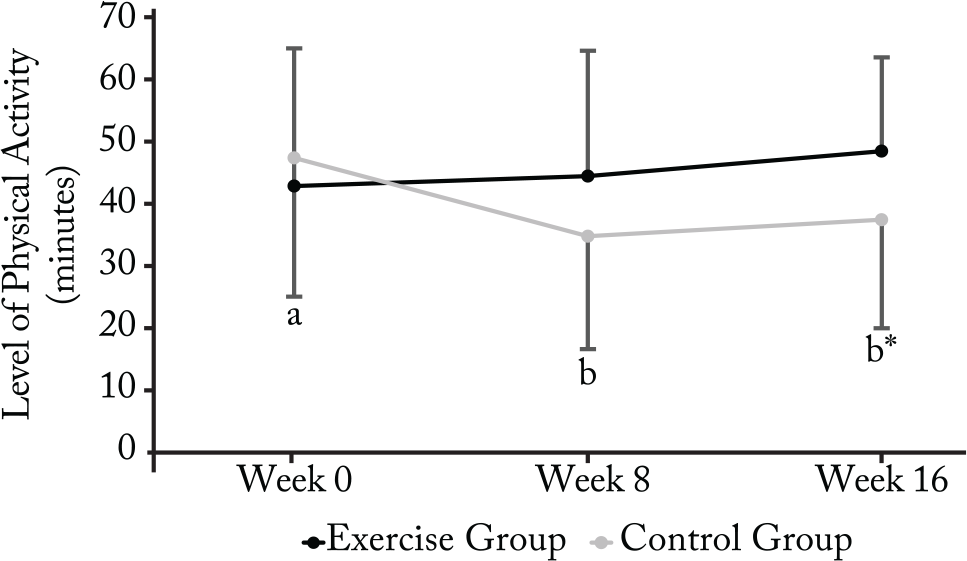 *indicates significant difference between groups. Different letters indi-cate a significant difference between moments for the control group.
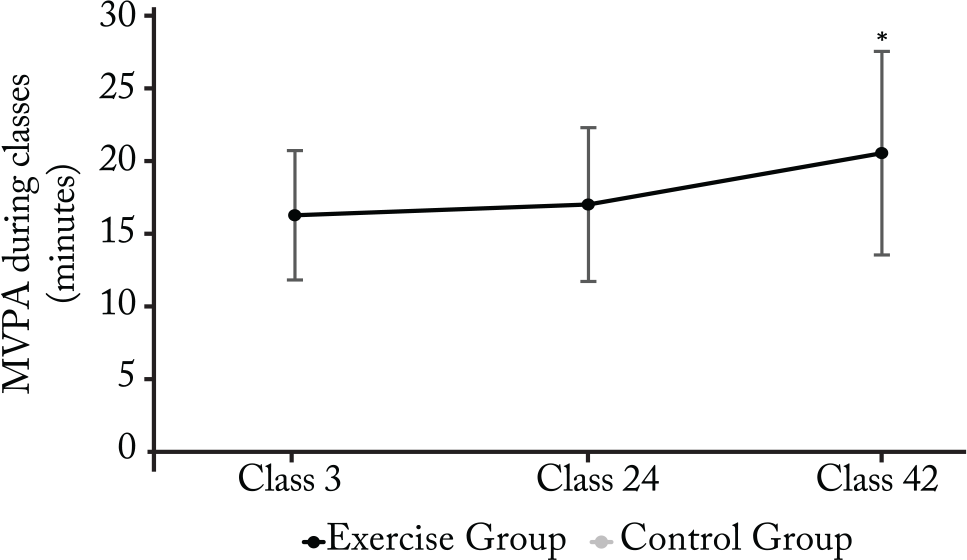 * indicates a significant difference between classes 3 and 42.