 Effect of Varying Protein Levels and Amino Acids on Growth Performance, Gas Emission, Organ Weight, and Body Condition Score in Laying Chicks
ABSTRACT
There is increasing interest among nutritionists in formulating reduced crude protein (CP) diets for poultry. Nearly a century of research has offered biochemical insights into the effects of reduced CP diets in broilers but practical implementation of such diets for laying hens remains limited. Therefore, this study aims to investigate the effect of varying crude protein (CP) and amino acids (AA) levels on growth performance, gas emission, organ weight, and body condition score in laying chicks. n=480, 1d old chicks were allocated into six treatment groups with 5 replicates of 16 birds/pen. The dietary treatments for Phase 1 (0-6 weeks) were as follows: CON - 18.5% CP with 100% digestible AA; TRT1 - 18.5% CP with 100% digestible AA; TRT2 - 18.5% CP with 105% digestible AA; TRT3 - 18.0% CP with 100% digestible AA; TRT4 - 18.0% CP with 100% digestible AA; and TRT5 - 18.0% CP with 105% digestible AA. In Phase 2 (6-16 weeks), the CP level was reduced by 2% in the CON, TRT4, and TRT5 diets, and by 2.5% in TRT1, TRT2, and TRT3 diets, while the AA levels remained consistent in all treatments. Our study demonstrates that slight variations in protein levels and AA have no impact on growth performance, gas emission, organ weight, and body condition score in laying chicks. In summary, we infer that poultry diet can be flexible and potentially reduce protein levels if ensuring sufficient AA, thus optimizing performance without negatively affecting the growth.
Keywords:
Laying chicks; growth performance; digestible amino acid; crude protein
INTRODUCTION
Protein and amino acids (AA) play important roles in the formulation of poultry diets to maximize production, ensure bird welfare, and minimize environmental pollution. Accordingly, there is growing interest among nutritionists in feeding reduced protein diets to broiler chickens. Nearly a century of research attempts has been done to decrease the crude protein (CP) content in broiler diets. Though the ideal protein concept has been successful to a certain degree (Aispuro et al., 2022), the information concerning the use of AA in low CP diets for laying hens remains scarce. Incorporating low-CP diets in poultry production offers several benefits, particularly in terms of environmental impact and animal welfare (Zhang et al., 2021). Firstly, it reduces the nitrogen (N) intake of broilers while maintaining N retention. This strategy supports increased N retention and reduced N excretion (Belloir et al., 2017). Secondly, excessive levels of CP in the diets of broiler chickens usually rely on the inclusion of soybean meal (SBM), often linked to land use change and therefore global warming potential (Castanheira & Freire, 2013). Research by Méda et al. (2019) demonstrated that broiler fed low CP diets showed decreased volatilization of nitrogen from litter into gaseous emissions, such as ammonia (NH3) and nitrous oxide (N2O). Similarly, Kebreab et al. (2016) noted that reducing dietary CP reduced the global warming potential of chicken meat production. In 2019, Van Harn et al. demonstrated that broilers fed diets supplemented with 20.8 % to 17.8 % of CP in grower (11-28d) and 19.8 % to 16.8 % of CP in finisher (28-35d) had no negative effect on growth performance. Furthermore, Torki et al. (2015) reported that layers fed 16.5 to 12.0% low CP diet supplemented with the essential amino acids maintained acceptable production performance under a high ambient temperature. From this literature, we hypothesize that feeding low-CP diets to poultry is not only an effective way to decrease ammonia emissions but also serves to reduce feed costs. The modern livestock industry uses corn-soybean-based diets, and the emission of nitrogen in the excreta of chicks is an important issue in the poultry industry. Considering both the rising cost of feed proteins and their environmental implications, the current research aims to evaluate the effects of low-CP levels supplemented with amino acids in laying chicks’ diets. Specifically, this study assesses the impact of reduced CP levels combined with amino acids on laying chicks’ growth performance, gas emissions, organ weight, and body condition score during each developmental phase.
MATERIALS AND METHODS
Ethical approval
The research protocol (DK-1-2417) of the present study was approved by the Animal Care and Use Committee of Dankook University (South Korea).
Animals, Housing, Experimental design and diets
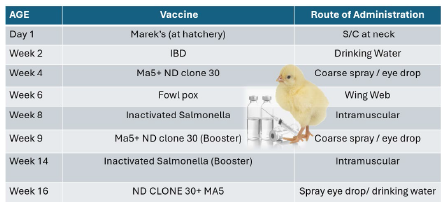
A total of 480, Hy-line brown laying chicks (1-d old) were kept in multiple type cages with an evaporative cooling house system with 60% relative humidity, and 16-h of fluorescent light cycle. A temperature regimen starting at 33°C was applied and was gradually reduced by 3°C each week until reaching 24°C by the end of week 16. This experiment was conducted for a period of 16 weeks (Phase 1, 0- 6 weeks and Phase 2, 6 -16 weeks) in a completely randomized design, and all chicks were assigned to one of 6 dietary treatments. The test diets were provided in two phases: Phase 1 (0-6 weeks) and Phase 2 (6-16 weeks). The dietary treatments for Phase 1 were as follows: CON - 18.5% CP with 100% digestible AA; TRT1 - 18.5% CP with 100% digestible AA; TRT2 - 18.5% CP with 105% digestible AA; TRT3 - 18.0% CP with 100% digestible AA; TRT4 - 18.0% CP with 100% digestible AA; and TRT5 - 18.0% CP with 105% digestible AA. In Phase 2, the CP level was reduced by 2% in the CON, TRT4, and TRT5 diets, and by 2.5% in TRT1, TRT2, and TRT3 diets, while the AA levels remained consistent in all treatments. The above-mentioned diets were prepared in the laboratory of feed science and technology according to NRC (1994) guidelines and were examined for protein and AA prior to the trial. The analysis of AA was performed with an amino acid analyzer. The ingredients and nutrient composition of the experimental diets for phases 1 and 2 are presented in Table 1 and Figure 1.
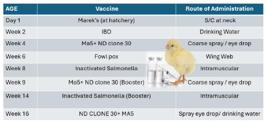
Each treatment has 5 replicates of 16 laying chicks per cage. All chicks were provided with ad libitum access to fresh water, and feed was introduced to each cage at 07:00 A.M and 16:00 P.M. The vaccination was provided at different time points and included in Figure 1. No mortality was found until the end of the 16th week.
Sampling and laboratory analysis
Growth performance
Growth performance parameters such as body weight [(BW) weighed individually and averaged by pen] and feed intake [(FI) weighed on a pen basis] were calculated on phase basis [phase 1 (week 0-7) phase 2 (week 7-16), and overall experimental period], to determine BW gain (BWG) and feed conversion ratio (FCR). Simultaneously, all birds were inspected twice a day for general health and mortality rates.
Noxious Gas emission
At the end of phases 1 and 2, fresh excreta samples (approximately 300 g) were collected from 2 cages/treatment around 17:00 (pm), pooled thoroughly, stored in an airtight container (2.6 L) with a slight hole on one side, fastened tightly with adhesive tape, and fermented at 25oC for 7 days. On the 8th day, a 100 ml sample was taken from the headspace (2cm) for air circulation, and the box was re-sealed. The sample container was manually shaken for about 30 seconds to determine the crust formation on the surface. Finally, NH3, H2S, Acetic acid, Propionic acid, Butyric acid, Iso butyric acid, Valeric acid, and Isovaleric acid were measured using a Multi-RAE Lite gas detection probe (model PGM-6208, RAE Systems, San Jose, CA, USA).
Organ Weight
At the end of phases 1 and 2, two birds/pen were picked randomly from each replication for carcass evaluation. The birds were slaughtered after starving for about 12 hours and weighed. Then the birds were de-feathered completely and eviscerated. The breast muscle, liver, spleen, abdominal fat, cloacal bursa, and gizzard were collected, weighed, and their percentages were determined in relation to live weight.
Body Lesion score
At the end of the trial, live birds were held individually with both legs in one hand and the head downwards. The palm of the other hand was used for palpating and grading the protuberance of the keel, the development of the breast muscles immediately alongside the ventral ridge of the keel, and the convexity or concavity of the breast muscle contour. Finally, the body condition score was assessed following the Gregory and Robins (1998) scoring system. In brief: score 0 corresponded to protruding keel bone and depressed contour to breast muscle; score 1 to prominent keel bone with poorly developed breast muscle; score 2 to a less prominent keel bone and moderate breast muscle development; and score 3 to plump breast muscle which provide a smooth contour with the keel.
RESULTS AND DISCUSSION
To optimize production costs, hens’ diets must contain adequate quantities of nutrients, particularly protein. It is generally known that providing high dietary protein to animals causes a low efficiency of protein utilization and high heat production, while limiting protein consumption and adding synthetic dl-methionine and l-lysine can improve the protein utilization and production performance of the hens (Bunchasak & Silapasorn, 2005). Thus, this study intends to examine the effect of varying protein levels and AA in the diets of laying chicks. The present study demonstrates that varying protein levels and AA in the diets of laying chicks did not significantly affect their growth performance during both Phase 1 and Phase 2 (Table 2). Particularly during phase 1, no differences in growth performance were observed between the control group (CON) and TRT1 chicks, both fed 18.5% crude protein (CP) with 100% AA, as well as between TRT2 chicks fed 18.5% CP with 105% AA. This suggests that increasing AA levels in conjunction with the fixed protein level did not impact the chicks’ growth. Similarly, no performance differences were observed between the TRT3 and TRT4 chicks, which were fed 5% reduced CP with similar AA levels, and the TRT5 chicks that received the same reduced CP but with a 5% increase in AA. These results were aligned with Cabel & Waldroup (1990), who found similar results in broilers fed diets containing 23% and 19% CP. However, Pesti & Fletcher (1984) observed improved FCR with high CP level. During phase 2, the CON and TRT1 chicks fed 16.5% CP with 100% AA also showed no difference in growth compared to the TRT2 chicks fed 16.0% CP with 105% AA. Moreover, no growth performance differences were observed between TRT3 and TRT4 chicks fed 16.0% CP with 100% AA, and TRT5 chicks fed 16.0% CP with 105% AA.
This result is in line with Humphrey and Klasing (2004), who reported that poultry fed protein- and methionine-deficient diets had no impact in their feed intake. We supposed that slight reductions in protein levels could be compensated by increased AA with no significant impacts on the growth performance of chicks. Protein and AA requirements are generally considered to decrease with increasing age (Cabel & Waldroup. 1990). We supposed that different properties in AA might intact proteins to decline growth rate in laying chicks.
Ammonia is a primary noxious gas produced in poultry houses, and it is typically influenced by factors such as dietary protein levels, the balance of amino acids, and overall nitrogen metabolism in birds (Wang et al., 2021). Odor emissions can be controlled by proper management and dietary intervention (Park & Kim. 2020). Previously, Nahm (2007) demonstrated that reducing CP levels in diets lowered ammonia gas, VFA, and other odors in poultry manure. Similarly, Park & Kim. (2019) reported that hydrogen sulfide was decreased with low CP diets. However, in this study, there were no noticeable changes in laying chicks’ gas emission performance by reducing protein and/or increasing AA in their diet (Table 3).
This suggests that the changes in protein content and AA supplementation did not have a substantial impact on the birds’ nitrogen metabolism in the short term, which is consistent with some previous studies indicating that small adjustments in protein and AA levels may not always lead to changes in gas emissions (Roberts et al., 2007). At this stage, this result is unclear and requires further research.
Organ weight in poultry is an important indicator of overall health and metabolic function (Wang et al., 2021), and it can be influenced by various factors such as diet composition, nutrient intake, and AA requirements (Plavnik & Hurwitz. 1983). Protein and amino acids play a key role in tissue growth and repair, and any alterations in dietary protein levels or AA balance can affect organ development. However, in this study, the lack of significant differences in organ weight across treatments implies that the protein and AA levels tested were within the range that adequately supported organ growth and function in the laying chicks (Table 4). Previously, Nastain et al. (2021) reported that broilers fed slight variations in the protein and AA in their diets showed no difference in their organ weight. Similarly, Badawi et al. (2009) found no considerable difference in dressing percentage and visceral organ weight in broilers fed diets containing reduced CP. However, Kobayashi et al. (27) reported that broilers fed low CP diets have little difference in their breast muscle, with no substantial difference in the AA diet. The inconsistencies among findings could be due to the adjustments made in this study, such as the reduction in protein or increase in AA. In fact, many studies have demonstrated that the essential amino acids provided in sufficient quantities along with lowering CP does not negatively affect organ weight or overall health (Shao et al., 2018). As long as the AA profile of the diet is balanced and sufficient to meet the birds’ metabolic needs, small changes in protein levels may not result in noticeable differences in organ weight. However, the exact cause for the lack of this outcome is currently unknown, and thus further research is needed. Previously, Gregory & Robins (1998) addressed that birds with the lowest condition score were skinny and were distinguished by a low breast muscle: bone ratio and a low breast muscle: leg muscle ratio. However, in this study, since the dietary treatments did not result in significant differences in body lesion scores (Table 5), it is likely that the protein and AA levels used could support the chicks’ health and well-being. To our knowledge no study analyzing the effect of protein and AA diet in the body score of laying chicks exists, and thus sufficient comparisons could not be made.
CONCLUSION
This study demonstrates that slight variations in protein levels and amino acids do not significantly affect the growth performance of laying chicks, provided that the AA balance is maintained. Based on these findings, we propose that poultry nutrition strategies can be flexible, allowing for reduced protein levels while ensuring sufficient amino acid supplementation, without negatively affecting growth.
ACKNOWLEDGEMENTS
The Department of Animal biotechnology was supported through the Research-Focused Department Promotion & Interdisciplinary Convergence Research Project as a part of the Support Program for University Development for Dankook University in 2024.
REFERENCES
-
ME, Ali AH, El-Razik WM, et al. Influence of low crude protein diets on broiler chickens performance. Advances in Animal and Veterinary Sciences 2019;7(s2):26-33. https://doi.org/10.17582/journal.aavs/2019/7.s2.26.33
» https://doi.org/10.17582/journal.aavs/2019/7.s2.26.33 -
Belloir P, Lessire M, Lambert W, et al. Changes in body composition and meat quality in response to dietary amino acid provision in finishing broilers. Animal 2019;13(5):1094-102. https://doi.org/10.1017/S1751731118002306
» https://doi.org/10.1017/S1751731118002306 -
Bunchasak C, Silapasorn T. Effects of adding methionine in low-protein diet on production performance, reproductive organs and chemical liver composition of laying hens under tropical conditions. International Journal of Poultry Science 2005;4(5):301-8. https://doi.org/10.3923/ijps.2005.301.308
» https://doi.org/10.3923/ijps.2005.301.308 -
Cabel MC, Waldroup PW. Effect of dietary protein level and length of feeding on performance and abdominal fat content of broiler chickens. Poultry Science 1991;70(7):1550-8. https://doi.org/10.3382/ps.0701550
» https://doi.org/10.3382/ps.0701550 -
Castanheira ÉG, Freire F. Greenhouse gas assessment of soybean production: implications of land use change and different cultivation systems. Journal of Cleaner Production. 2013;54:49-60. https://doi.org/10.1016/j.jclepro.2013.05.026
» https://doi.org/10.1016/j.jclepro.2013.05.026 -
Gregory NG, Robins JK. A body condition scoring system for layer hens. New Zealand Journal of Agricultural Research 1998;41(4):555-9. https://doi.org/10.1080/00288233.1998.9513338
» https://doi.org/10.1080/00288233.1998.9513338 -
Humphrey BD, Klasing KC. Modulation of nutrient metabolism and homeostasis by the immune system. World's Poultry Science Journal 2004;60(1):90-100. https://doi.org/10.1079/WPS20037
» https://doi.org/10.1079/WPS20037 -
Kebreab E, Liedke A, Caro D, et al. Environmental impact of using specialty feed ingredients in swine and poultry production: A life cycle assessment. Journal of Animal Science 2016;94(6):2664-81. https://doi.org/10.2527/jas.2015-9036
» https://doi.org/10.2527/jas.2015-9036 -
Kobayashi H, Nakashima K, Ishida A, et al. Effects of low protein diet and low protein diet supplemented with synthetic essential amino acids on meat quality of broiler chickens. Animal Science Journal 2013;84(6):489-95. https://doi.org/10.1111/asj.12021
» https://doi.org/10.1111/asj.12021 -
Martínez-Aispuro JA, Figueroa-Velasco JL, Sánchez-Torres MT, et al. Practical application of the ideal protein concept in pigs. Agro Productividad 2022;15(3). https://doi.org/10.32854/agrop.v15i3.2098
» https://doi.org/10.32854/agrop.v15i3.2098 - Méda B, Tesseraud S, Lambert W, et al. Effet de la substitution totale du soja dans un aliment à bas taux protéique chez le poulet de chair en finition. Proceedings of the 13rd Journées de la Recherche Avicole et Palmipèdes à Foie Grãs; 2019 Mar; Tours, France; 2019.
-
Nahm KH. Feed formulations to reduce N excretion and ammonia emission from poultry manure. Bioresource Technology 2007;98(12):2282-300. https://doi.org/10.1016/j.biortech.2006.07.039
» https://doi.org/10.1016/j.biortech.2006.07.039 - Nastain FS, Mahardhika BP, Ridla M, et al. Visceral organ weight of broiler chicken fed different level protein and protease enzyme supplementation diet. Proceedings of the 3rd International Conference of Animal Science and Technology; 2020 Nov 3-4; Makassar, Indonesia; 2020.v.788.
- NRC - National Research Council. Nutrients requirements of poultry. 9th ed. Washington; 1994.
-
Park JH, Kim IH. Effects of dietary Achyranthes japonica extract supplementation on the growth performance, total tract digestibility, cecal microflora, excreta noxious gas emission, and meat quality of broiler chickens. Poultry Science 2020;99(1):463-70. https://doi.org/10.3382/ps/pez533
» https://doi.org/10.3382/ps/pez533 -
Park JH, Kim IH. The effects of betaine supplementation in diets containing different levels of crude protein and methionine on the growth performance, blood components, total tract nutrient digestibility, excreta noxious gas emission, and meat quality of the broiler chickens. Poultry Science 2019;98(12):6808-15. https://doi.org/10.3382/ps/pez412
» https://doi.org/10.3382/ps/pez412 -
Pesti GM, Fletcher DL. The response of male broiler chickens to diets with various protein contents during the grower and finisher phases. British Poultry Science 1984;25(3):415-23. https://doi.org/10.1080/00071668408454882
» https://doi.org/10.1080/00071668408454882 -
Plavnik I, Hurwitz S. Organ weights and body composition in chickens as related to the energy and amino acid requirements: effects of strain, sex, and age. Poultry Science 1983;62(1):152-63. https://doi.org/10.3382/ps.0620152
» https://doi.org/10.3382/ps.0620152 -
Roberts SA, Xin H, Kerr BJ, et al. Effects of dietary fiber and reduced crude protein on nitrogen balance and egg production in laying hens. Poultry Science 2007;86(8):1716-25. https://doi.org/10.1093/ps/86.8.1716
» https://doi.org/10.1093/ps/86.8.1716 -
Shao D, Shen Y, Zhao X, et al. Low-protein diets with balanced amino acids reduce nitrogen excretion and foot pad dermatitis without affecting the growth performance and meat quality of free-range yellow broilers. Italian Journal of Animal Science 2018;17(3):698-705. https://doi.org/10.1080/1828051X.2017.1400414
» https://doi.org/10.1080/1828051X.2017.1400414 -
Torki M, Mohebbifar A, Ghasemi HA, et al. Response of laying hens to feeding low-protein amino acid-supplemented diets under high ambient temperature: performance, egg quality, leukocyte profile, blood lipids, and excreta pH. International Journal of Biometeorology 2015;59:575-84. https://doi.org/10.1007/s00484-014-0870-0
» https://doi.org/10.1007/s00484-014-0870-0 -
Van Harn J, Dijkslag MA, Van Krimpen MM. Effect of low protein diets supplemented with free amino acids on growth performance, slaughter yield, litter quality, and footpad lesions of male broilers. Poultry Science 2019; 98(10):4868-77. https://doi.org/10.3382/ps/pez229
» https://doi.org/10.3382/ps/pez229 -
Wang YC, Han MF, Jia TP, et al. Emissions, measurement, and control of odor in livestock farms: a review. Science of The Total Environment 2021;776:145735. https://doi.org/10.1016/j.scitotenv.2021.145735
» https://doi.org/10.1016/j.scitotenv.2021.145735 -
Zhang YN, Wang S, Deng YZ, et al. The application of reduced dietary crude protein levels supplemented with additional amino acids in laying ducks. Poultry Science 2021;100(4):100983. https://doi.org/10.1016/j.psj.2021.01.006
» https://doi.org/10.1016/j.psj.2021.01.006
-
FUNDING
None.
-
DATA AVAILABILITY STATEMENT
Data sets will be available from the correspondence upon reasonable request.
-
DISCLAIMER/PUBLISHER’S NOTE
The published papers’ statements, opinions, and data are those of the individual author(s) and contributor(s). The editor(s) disclaim responsibility for any injury to people or property resulting from any ideas, methods, instructions, or products referred to in the content.
Data sets will be available from the correspondence upon reasonable request.