 Incidental Gallbladder Cancer: Statistical Overview in a Tertiary Hospital in Fortaleza, CE, Brazil
ABSTRACT
Introduction: Gallbladder adenocarcinoma is the most common malignant tumor of the bile ducts and is sometimes discovered incidentally after cholecystectomy for benign gallbladder disease.
Objective: To determine the prevalence and describe epidemiological aspects observed in patients diagnosed with incidental gallbladder cancer (IBC) in cholecystectomies performed between 2015 and 2022 at the "Hospital Universitário Walter Cantídio".
Method: Descriptive cross-sectional study, with retrospective data where all medical records of patients undergoing elective and non-elective cholecystectomy in a high-complexity public hospital in Fortaleza, between January 2015 and December 2022 were included. The exclusion criteria were all patients who underwent cholecystectomy and had an established or presumed diagnosis of gallbladder neoplasia.
Results: During the study period, 1,707 patients who underwent cholecystectomy with a diagnosis of cholelithiasis or cholecystitis have been found, 382 anatomopathological reports were lost and six patients with a previous diagnosis of gallbladder neoplasia were excluded, totaling 1,319 patients. Of these, nine (0.7%) were incidentally diagnosed with gallbladder adenocarcinoma after anatomopathological study.
Conclusion: Corroborating the global literature, the prevalence of IBC in the present study was low and occurred more frequently in older female patients than those affected by benign bile duct disease.
Key words:
Gallbladder Diseases/epidemiology; Gallbladder Neoplasms/epidemiology; Cholecystolithiasis/surgery; Cholecystectomy
RESUMO
Introdução: O adenocarcinoma da vesícula biliar é o tumor maligno mais comum das vias biliares, sendo descoberto às vezes incidentalmente após colecistectomia para doenças benignas da vesícula biliar.
Objetivo: Determinar a prevalência e descrever aspectos epidemiológicos observados nos pacientes com diagnóstico de câncer incidental de vesícula biliar (CIVB) em colecistectomias realizadas entre 2015 e 2022 no Hospital Universitário Walter Cantídio.
Método: Estudo do tipo transversal descritivo, com coleta retrospectiva de dados, em que foram incluídos todos os prontuários de pacientes submetidos à colecistectomia eletivas e não eletivas em um hospital público de alta complexidade em Fortaleza, entre janeiro de 2015 e dezembro de 2022. Os critérios de exclusão foram todos os pacientes que realizaram colecistectomia que apresentavam diagnóstico estabelecido ou presumido de neoplasia da vesícula biliar.
Resultados: Durante o período do estudo, foram encontrados 1.707 pacientes submetidos à colecistectomia com diagnóstico de colelitíase ou colecistite. Nesse período, houve uma perda de 382 laudos anatomopatológicos, foram excluídos seis pacientes com diagnóstico prévio de neoplasia de vesícula biliar totalizando neste estudo 1.319 pacientes. Destes, nove (0,7%) foram incidentalmente diagnosticados como tendo adenocarcinoma de vesícula biliar após estudo anatomopatológico.
Conclusão: Corroborando a literatura mundial, a prevalência de CIVB neste estudo foi baixa e ocorreu mais frequentemente em pacientes do sexo feminino com mais idade do que aquelas acometidas pela doença benigna da via biliar.
Palavras-chave:
Doenças da Vesícula Biliar/epidemiologia; Neoplasias da Vesícula Biliar/epidemiologia; Colecistolitíase/cirurgia; Colecistectomia
RESUMEN
RESUMEN
Introducción: El adenocarcinoma de vesícula biliar es el tumor maligno más común de los conductos biliares y a veces se descubre de manera incidental después de una colecistectomía por enfermedad benigna de la vesícula biliar.
Objetivo: Determinar el predominio y describir los aspectos epidemiológicos observados en pacientes diagnosticados de cáncer incidental de vesícula biliar (CIVB) en colecistectomías realizadas entre 2015 y 2022 en el Hospital Universitario Walter Cantídio.
Método: Estudio descriptivo, transversal, con recolección de datos retrospectivo, en el que se incluyeron todas las historias clínicas de pacientes sometidos a colecistectomía electiva y no electiva en un hospital público de alta complejidad de Fortaleza, entre enero de 2015 y diciembre de 2022. Los criterios fueron todos los pacientes sometidos a colecistectomía y que tuvieran un diagnóstico establecido o presunto de neoplasia de vesícula biliar.
Resultados: Durante el período de estudio, hubo 1707 pacientes a los que se les realizó colecistectomía con diagnóstico de colelitiasis o colecistitis. Durante este período hubo pérdida de 382 informes anatomopatológicos, se excluyeron seis pacientes con diagnóstico previo de neoplasia de vesícula biliar, totalizando 1319 pacientes en este estudio. De ellos, a nueve (0,7%) pacientes se les diagnosticó incidentalmente adenocarcinoma de vesícula biliar tras el estudio anatomopatológico.
Conclusión: Corroborando la literatura global, el predominio de CIVB de este estudio fue bajo y ocurrió con más frecuencia en pacientes mujeres mayores que en aquellas afectadas por una enfermedad benigna de las vías biliares.
Palabras clave:
Enfermedades de la vesícula biliar/epidemiología; Neoplasias de la vesícula biliar/epidemiología; Colecistolitiasis/cirugía; Colecistectomía
INTRODUCTION
Gallbladder cancer is relatively rare and is the fifth most common of the gastrointestinal tract and the most frequent of the biliary system. Its high prevalence occurs in Japan and in some regions of India, South America and East Europe and relatively rare in Norther Europe and North America, revealing its non-homogeneous geographical distribution1,2.
This pathology is a diagnostic and clinic challenge due to unspecific presentation, but it progresses fast with high mortality after it onsets, incidentally found at post cholecystectomy histopathology, being known as incidental gallbladder carcinoma (IGBC). A prevalence of approximately 0.2.-3% of the cholecystectomies performed was found in the literature. Few are the studies in Brazil about this indicator, only regional studies exist1,4.
Biliary lithiasis is the main risk factor for gallbladder cancer together with other less common risk factors as adenomatous polyp, obesity, estrogen, choledochal cyst and carcinogenic. The golden standard for definitive treatment of symptomatic biliary lithiasis is laparoscopic surgery, all the samples of cholecystectomy are sent for histopathology to increase the rate of detection of undetected IGBC at initial stage in benign diseases of the biliary gallbladder1,5.
IGBC has good prognosis depending on the pathological staging. At initial stages, survival is prolonged and potentially curable, but if remote, the prognosis is dismal with high lethality and fast progression1,6.
The objective of this article is to determine the prevalence and describe epidemiological aspects of incidental gallbladder cancer in cholecystectomies performed between 2015 and 2022 at "Hospital Universitário Walter Cantídio (HUWC)" of "Universidade Federal do Ceará", Fortaleza, Brazil.
METHOD
Descriptive, retrospective cross-sectional study with non-probabilistic sample by convenience where all charts of patients submitted to elective and non-elective cholecystectomy at a reference high complexity hospital in Fortaleza, Ceará, Brazil between January 2015 and December 2022 have been included.
At the hospital, all the patients who would be submitted to cholecystectomy were evaluated preoperatively with abdomen ultrasound. Abdomen CAT scan, magnetic resonance cholangiopancreatography (MRCP) and/ or endoscopic ultrasound are performed when the morphology of gallbladder is abnormal in order to rule out the presence of gallbladder stones in the regular pathway or in case of diagnostic uncertainty. Surgery is conducted by laparoscopy in most of the cases with a four trocar standard technique and the sample is shipped for histopathological testing in all the cases.
Post-surgical outpatient follow-up lasts five years at least according to the hospital protocol, in addition, the data of global survival were collected from the date of the surgery and the date when the data were collected in July 2023. Outcomes were searched at the Mortality Information System (SIM) to find whether the patients were alive.
Exclusion criteria were all the patients submitted to cholecystectomy with confirmed or presumed diagnosis of gallbladder neoplasm. The standardized data collected according to the flowchart were migrated to Microsoft Excel's descriptive statistics tool to calculate the frequency and percentage presented as charts.
The Institutional Review Board approved the study, report number 6,126,977 (CAAE (submission for ethical review): 69756823.1.0000.5045) in compliance with Ordinance 466/127 of the National Health Council.
RESULTS
In the study period (2015-2022), 1,707 patients were submitted to cholecystectomy by laparoscopy or conventional surgery with clinical impression of cholelithiasis or cholecystitis. Six patients with previous diagnosis of gallbladder cancer were excluded; in addition, 382 anatomopathological reports were lost, totaling 1,319 patients who met the inclusion criteria. Of these, (0.7%) were incidentally diagnosed with gallbladder adenocarcinoma after anatomopathology of the surgical procedure.
1,105 women, 214 men, with the ratio women/men 5.1:1, were investigated, with mean age of 52.2 years. Elective procedures were the majority of the types of surgery (95%). The histopathology revealed that the chronic cholecystitis (CC) was the most common finding (95.4%) followed by acute cholecystitis (3.4%), dysplasia (3.4%) while adenocarcinoma was found in nine cases (0.7%).
Of the nine patients with incidental finding of gallbladder adenocarcinoma, eight were women and one man. In addition, these patients were older than those with benign disease – 65.4 vs. 52.2 years (Table 1). Surgical indication for most of the cases was surgery due to biliary cholic + biliary lithiasis (Table 2). Pre-operative abdomen CAT scan and magnetic resonance cholangiopancreatography (MRCP) were performed in the acute scenario in three patients – cholestasis (patient 1), choledocholithiasis (patient 2) and bulky polyp (patient 3).
The imaging findings revealed some risk factors for IGBC: patients 2, 3 and 9 presented polyps larger than 1 cm, and patients 2, 5 and, stones larger than 2 cm. Two patients presented choledocholithiasis and liver cyst associated with biliary lithiasis, respectively (Table 2).
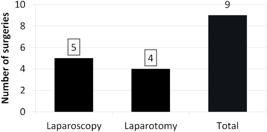
Laparoscopic cholecystectomy was performed in five patients (Graph 1). In four, conventional technique was applied due to the COVID-19 pandemic when surgery was indicated.
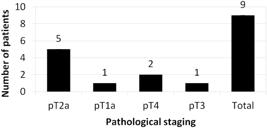
Stage pT2a in approximately 55% of the population (Graph 2) was found after anatomopathology staging of the patients (Graph 2). In addition, the histopathology of all the patients was adenocarcinoma.
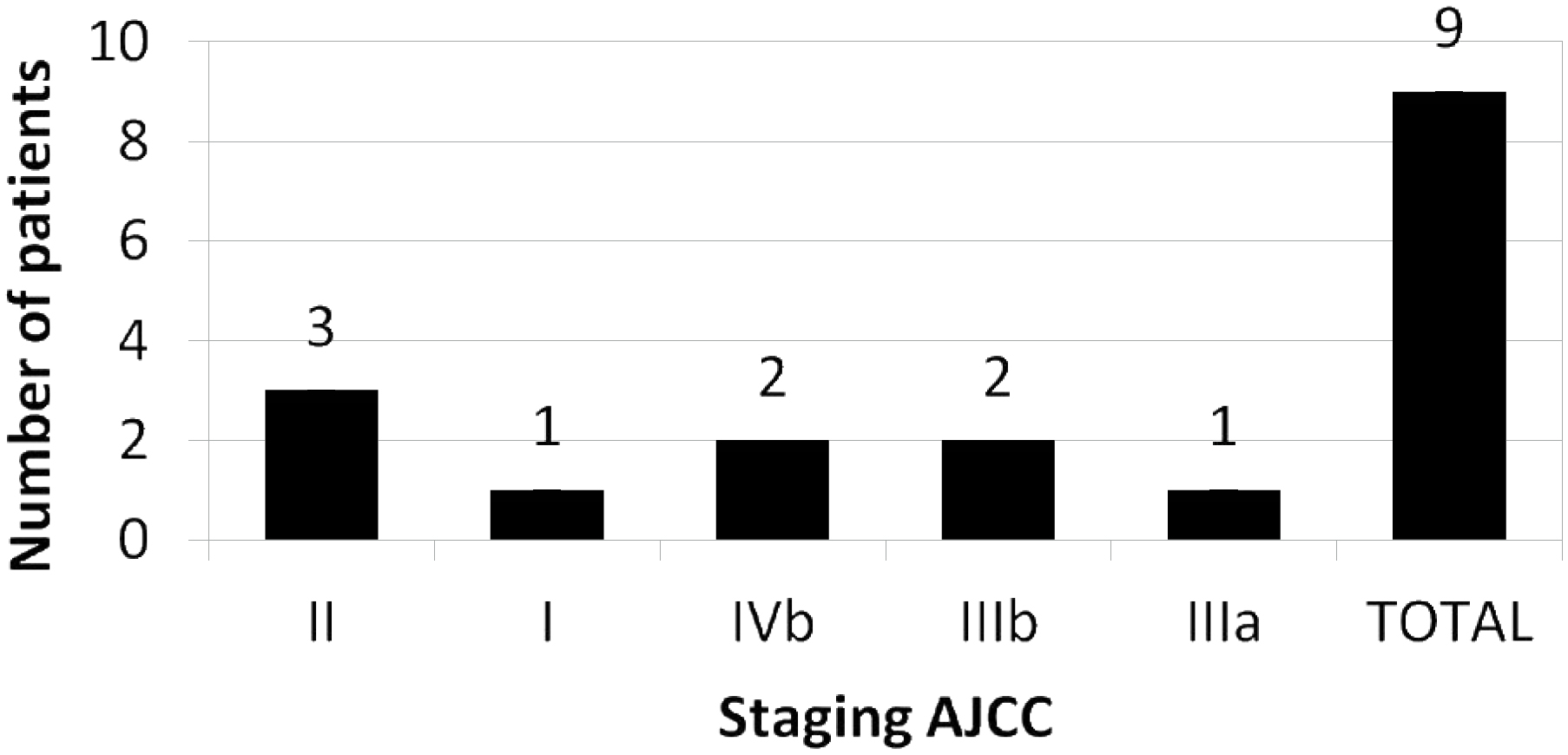
After surgical procedure, all the patients were followed up at the hospital's outpatient, two patients died (2 and 8) due to surgical postoperative complications. Except patient 3, all the others were staged to define which treatment would be selected with predominance of advanced stages (Graph 3).
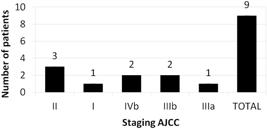
Stage I patient 3 was submitted to cholecystectomy by videolaparoscopy without relapse until data collection. Stage II patients 1, 2 and 6 were submitted to partial hepatectomy with excision of liver segments IVB-V and lymphadenectomy of liver pedicle, but for patient 6, the disease progressed with peritoneal carcinomatosis as observed at the reapproach which made surgical procedure impossible.
Stage III patients were submitted to partial hepatectomy and lymphadenectomy of the liver pedicle associated with adjuvant chemotherapy treatment, respectively, patient 7 evolved to palliative care as outcome, patient 9 died and patient 5 lost outpatient follow-up but without death registered at SIM.
The mean global survival for this population was 24.3 months, standing out stage I patient with 70 months of survival and another stage IVB patient with 48 months of survival.
DISCUSSION
Females predominated in the study sample at the proportion of 8:1 with mean age of 65.4 years. In addition, the incidence of IGBC was 0.7% within the incidence range according to the Brazilian Consensus of 0.2-3%1.
Due to Brazil's great extension and substantial discrepancy of access to health system, an important variation of prevalence exists in the studies. In a study conducted in Piauí9, the frequency was approximately 6.53%, but in Paraíba3 and Pernambuco10, the prevalence was similar to the present study.
Worldwide, a geographic variation of incidence of IGBC exists associated with biliary lithiasis. High rates of IGBC were found in Latin America, specifically Chile, Bolivia and Ecuador and in some areas of Northern India, Pakistan, Japan, Korea and Poland8,10-12. It is believed that both genetic factors and socioeconomic questions that delay or block the access to cholecystectomy for gallbladder stones contribute to this5,6.
As counterpart, IGBC presents similar prevalence in international studies. Studies in India (1.26%), United Kingdom (0.1%), Spain (1.1%), Iran (0.37%) and Turkey (0.14%) presented frequencies similar to the present study, corroborating the international consensus2,4,7,9,11.
For IGBC staging of patients at early-disease stage, the surgery itself could be curative, unfortunately less than 10% of the symptomatic patients and only 20% of the patients diagnosed incidentally with cholecystectomy present early-stage gallbladder cancer10,12. In this casuistic, of the nine patients, only one (11%) was diagnosed at early-stage; in addition, patients 4 and 8, at the moment of the first surgery presented findings of advanced disease with presence of peritoneal implants.
The prognosis of the patient with IGBC depends on the disease stage because the extension of the tumor to the gallbladder wall correlates with the risk of peritoneal metastasis, with 100% 1-year survival reported for T1, 75% for T2, 40% for T3, 0% for T4, respectively5,6.
For postoperative staging, stages I and II occurred in more than 60% of the patients in some studies8,12. Approximately 44% of these staging occurred in the present study population.
Gallbladder cancer is the most common gastrointestinal malignancy associated with dismal prognosis due to its indolent nature when most of the patients will be metastatic when diagnosed1,5,6. Early diagnosis is paramount although no screening tests are described in the literature.
There are discussions in the literature about not performing routine anatomopathology of elective cholecystectomy without suspicion of IGBC4,7,9. At the hospital where the study was carried out, this is a routine test, but despite its low incidence, early diagnosis is essential for the patient survival as revealed in the present sample.
CONCLUSION
The prevalence of IGBC in the study sample was low, corroborating the literature and occurred more frequently in older women than those affected by the benign disease, consistent with regional and international studies.
IGBC is potentially curable as any other neoplasm, but an accurate staging is essential for proper treatment and is directly associated with the global survival of these patients. Currently, the best way to determine the staging is cholecystectomy with anatomopathological review in elective surgeries to detect cases still in initial stages.
References
-
1 Torres OJM, Alikhanov R, Agarwal A, et al. Consenso brasileiro de carcinoma incidental de vesícula biliar. ABCD. Arq Bras Cir Dig. 2020;33(1):e1496. doi:https://doi.org/10.1590/0102-672020190001e1496
» https://doi.org/10.1590/0102-672020190001e1496 -
2 Geramizadeh B, Kashkooe A. Incidental gall bladder adenocarcinoma in cholecystectomy specimens; a single center experience and review of the literature. Middle East J Dig Dis. 2018;10(4):249-53. doi:https://doi.org/10.15171/mejdd.2018.118
» https://doi.org/10.15171/mejdd.2018.118 -
3 Silva DAG, Veloso OLL, Valadares MSP, et al. Câncer incidental de vesícula biliar: qual a prevalência e como operamos a colecistectomia por doença presumidamente benigna? Rev Col Bras Cir. 2022;49:e20223417. doi:https://doi.org/10.1590/0100-6991e-20223417
» https://doi.org/10.1590/0100-6991e-20223417 -
4 Kanlioz M, Ekici U, Ayva Y. Analysis of incidental gallbladder cancer in cholecystectomies. Cureus. 2019;11(9):e5710. doi:https://doi.org/10.7759/cureus.5710
» https://doi.org/10.7759/cureus.5710 -
5 Mehrotra B. Gallbladder cancer: epidemiology, risk factors, clinical features, and diagnosis. UpTodate [Internet]. 2022[acesso 2023 set 1];1:1. Disponível em:https://www.uptodate.com/contents/gallbladder-cancer-epidemiology-risk-factors-clinical-features-and-diagnosis/print?search=cancer%20de%20vesicula&source=search_result&selectedTitle=1~62&usage_type=default&display_rank=1
» https://www.uptodate.com/contents/gallbladder-cancer-epidemiology-risk-factors-clinical-features-and-diagnosis/print?search=cancer%20de%20vesicula&source=search_result&selectedTitle=1~62&usage_type=default&display_rank=1 -
6 House MG, Mehrotra B. Surgical management of gallbladder cancer. UpTodate [Internet]. 2021;1:1. [acesso 2023 set 3]. Disponível em:https://www.uptodate.com/contents/surgical-management-of-gallbladder-cancer?search=cancer%20de%20vesicula&source=search_result&selectedTitle=2~62&usage_type=default&display_rank=2
» https://www.uptodate.com/contents/surgical-management-of-gallbladder-cancer?search=cancer%20de%20vesicula&source=search_result&selectedTitle=2~62&usage_type=default&display_rank=2 - 7 Conselho Nacional de Saúde (BR). Resolução n° 466, de 12 de dezembro de 2012. Aprova as diretrizes e normas regulamentadoras de pesquisas envolvendo seres humanos. Diário Oficial da União, Brasília, DF. 2013 jun 13; Seção I:59.
-
8 Figueiredo WR, Santos RR, Paula MMDRC. Comparative incidence of incidental gallbladder cancer in emergency cholecystectomies versus in elective cholecystectomies. Incidência comparativa de câncer incidental de vesícula biliar em colecistectomias de urgência versus colecistectomias eletivas. Rev Col Bras Cir. 2019;46(6):e20192366. doi:https://doi.org/10.1590/0100-6991e-20192366
» https://doi.org/10.1590/0100-6991e-20192366 -
9 Martins-Filho ED, Batista TP, Kreimer F, et al. Prevalence of incidental gallbladder cancer in a tertiary-care hospital from Pernambuco, Brazil. Arq Gastroenterol. 2015;52(3):247-9. doi:https://doi.org/10.1590/S0004-28032015000300017
» https://doi.org/10.1590/S0004-28032015000300017 -
10 Di Mauro D, Orabi A, Myintmo A, et al. Routine examination of gallbladder specimens after cholecystectomy: a single-centre analysis of the incidence, clinical and histopathological aspects of incidental gallbladder carcinoma. Discov Oncol. 2021;12(4):1-7. doi https://doi.org/10.1007/s12672-021-00399-5
» https://doi.org/10.1007/s12672-021-00399-5 -
11 Apodaca-Rueda M, Cazzo E, De-Carvalho RB, et al. PREVALENCE of gallbladder cancer in patients submitted to cholecystectomy: experience of the university hospital, faculty of medical sciences, State University of Campinas – UNICAMP. Rev Col Bras Cir. 2017;44(3):252-6. doi:https://doi.org/10.1590/0100-69912017003005
» https://doi.org/10.1590/0100-69912017003005 -
12 Ocón FJM, Vicente JB, Orts FR, et al. Cáncer de vesícula biliar en un hospital comarcal. Cirug Esp. 2009;86(4):219-23. doi:https://doi.org/10.1016/j.ciresp.2009.02.021
» https://doi.org/10.1016/j.ciresp.2009.02.021 -
13 Yadav R, Sagar M, Kumar S, et al. Incidental gallbladder carcinoma in north Indian population: importance of routine histopathological examination of all benign gallbladder specimens. Cureus. 2021;13(7):e16156. doi:https://doi.org/10.7759/cureus.16156
» https://doi.org/10.7759/cureus.16156