 Cancer Incidence and Mortality in Young Adults in Two Regions of São Paulo State
ABSTRACT
Introduction: Cancer in young adults is uncommon and tends to be more aggressive. There is evidence of an increase in incidence and mortality for some types of cancer.
Objective: To assess the incidence (2002-2018) and mortality (2000-2020) of the main cancers in young adults (20-39 years old) residing in two areas of the State of São Paulo: the municipality of São Paulo and the Barretos region.
Method: Incidence data were obtained from the Population-Based Cancer Registries of São Paulo and Barretos. Deaths and population data were obtained from the Department of Informatics of the National Health System (DATASUS). To contextualize cancer, an analysis of the leading causes of death in young adults was performed. Subsequently, crude incidence and mortality rates for cancer were calculated, along with their trends through annual percentage change (APC).
Results: The distribution of causes of cancer-related deaths was similar for both regions. In males, the most frequent types were leukemia, nervous system cancers, and colorectal cancer, while in females, the most common were breast cancer, cervical cancer, and colorectal cancer.
Conclusion: There is a trend of increasing rates for some types of cancer in young adults, particularly breast cancer, cervical cancer, and colorectal cancer.
Key words:
Young Adult; Adult; Incidence; Mortality/trends; Neoplasms/mortality
RESUMO
Introdução: O câncer em adultos jovens é incomum e tem comportamento mais agressivo. Há evidências de aumento da incidência e mortalidade por algumas topografias.
Objetivo: Avaliar a incidência (2002 a 2018) e a mortalidade (2000 a 2020) das principais neoplasias em adultos jovens (20 a 39 anos) residentes em duas localidades do Estado de São Paulo: município de São Paulo e Região de Barretos.
Método: Os dados de incidência foram obtidos nos Registros de Câncer de Base Populacional de São Paulo e Barretos. Os óbitos e os dados de população foram obtidos no Departamento de Informática do Sistema Único de Saúde (DATASUS). Para fins de contextualização do câncer, foi realizada a análise das principais causas de morte em adultos jovens. Sequencialmente, foram calculados os coeficientes brutos de incidência e mortalidade por câncer e sua tendência pela variação percentual anual (APC).
Resultados: A distribuição por causa de morte por câncer foi semelhante para as duas localidades, sendo, para o sexo masculino, os tipos mais frequentes, as leucemias, sistema nervoso e colorretal, enquanto, no sexo feminino, o câncer de mama, colo do útero e colorretal.
Conclusão: Há uma tendência de aumento de alguns tipos de câncer em adultos jovens, com destaque para câncer de mama, colo do útero e colorretal.
Palavras-chave:
Adulto Jovem; Adulto; Incidência; Mortalidade/tendências; Neoplasias/mortalidade
RESUMEN
Introducción: El cáncer en adultos jóvenes es poco común y presenta un comportamiento más agresivo. Existen evidencias de un aumento en la incidencia y mortalidad de algunas localizaciones tumorales.
Objetivo: Evaluar la incidencia (2002 a 2018) y la mortalidad (2000 a 2020) de los principales tipos de neoplasias en adultos jóvenes (20 a 39 años) residentes en dos localidades del estado de São Paulo: el municipio de São Paulo y la región de Barretos.
Método: Los datos de incidencia se obtuvieron de los Registros de Cáncer de Base Poblacional de São Paulo y Barretos. Los datos de defunciones y población fueron obtenidos del Departamento de Informática del Sistema Único de Salud (DATASUS). Para contextualizar el cáncer, se realizó un análisis de las principales causas de muerte en adultos jóvenes. Posteriormente, se calcularon las tasas brutas de incidencia y mortalidad por cáncer y su tendencia mediante la variación porcentual anual (APC).
Resultados: La distribución por causa de muerte por cáncer fue similar en ambas localidades. En el sexo masculino, los tipos más frecuentes fueron las leucemias, los tumores del sistema nervioso y colorrectales; mientras que en el sexo femenino fueron el cáncer de mama, cuello uterino y colorrectal.
Conclusión: Existe una tendencia creciente en algunos tipos de cáncer en adultos jóvenes, destacándose el cáncer de mama, cuello uterino y colorrectal.
Palabras clave:
Adulto Joven; Adulto; Incidencia; Mortalidad/tendencias; Neoplasias/mortalidad
INTRODUCTION
Cancer is among the four main causes of early death (before 70 years of age) in most countries1. The incidence and mortality by neoplasms have been expanding worldwide, due to aging and demographic growth, as well as due to changes in the arrangement and prevalence of cancer risk factors, mainly those related to socioeconomic issues and lifestyle. A shift in the main types of cancer has been observed in developing countries, with a reduction of neoplasms related to infections and an increase of those associated with improved socioeconomic conditions and inclusion of habits and behaviors related to urbanization, for instance, sedentary lifestyle, eating ultra-processed food, and lack of physical activity2. Therefore, with the decrease in the impact of transmissible infections, cardiovascular diseases and cancer became the most common mortality causes worldwide. In 2022, the number of new cancer cases and deaths was estimated at 20 million and 9.7 million, respectively, while, in the same year, the number of new cancer cases in young adults worldwide was estimated at approximately 1.2 million3.
However, cancer in adults has increasingly targeted individuals in the 20-39 age group. The literature has no clear definition for the age group of patients encompassing the young adult category. "Young adult" is a term used to refer to people over 20 years old4. Upon analyzing 6,425 patients in 55 publications, O’Connell et al.5 discovered 37 manuscripts that considered people aged 40 or under as young, while 14 (25%) and 4 (7%) established those under 30 or 35 years as young, respectively. The justification for this age segmentation was based on the biological and physiological maturity of patients under 40 years old. However, we must proceed with caution, since any predefined age group for young adults is arbitrary and serves only for the purpose of consensus, simplicity, and data comparison3.
The causes of neoplasms in young adults are the result of interaction between hereditary or constitutional predisposition to cancer, mutational processes of endogenous progression, and exposure to regulating factors, including environmental mutagenic factors (ultraviolet radiation, X-rays, chemical substances, pollutant agents) and oncogenic pathogens. Although original studies of predisposition to hereditary cancer have identified such mutations in individuals with a known family history, germinative mutations in individuals with no family history of cancer were also identified, accelerated by the recent advancements in genome sequencing. Currently, up to 10% of apparently sporadic cancers in adults are estimated to involve an underlying hereditary or constitutional predisposing genetic mutation6,7. However, this is not the only explanation since this group is not seen as a priority and consequently has worse chances of receiving a timely diagnosis and treatment, according to a study by the National Cancer Institute8. In its 58th Assembly, the World Health Organization (WHO) convoked its member-states to include more prevention and early detection measures, as well as to improve treatment and palliative care in oncology9,10.
In this context, this study aimed at assessing cancer incidence and mortality in young adults, their trends throughout time, in two distinct Regions of the State of São Paulo: the municipality of São Paulo (MSP), and the Barretos Region.
METHOD
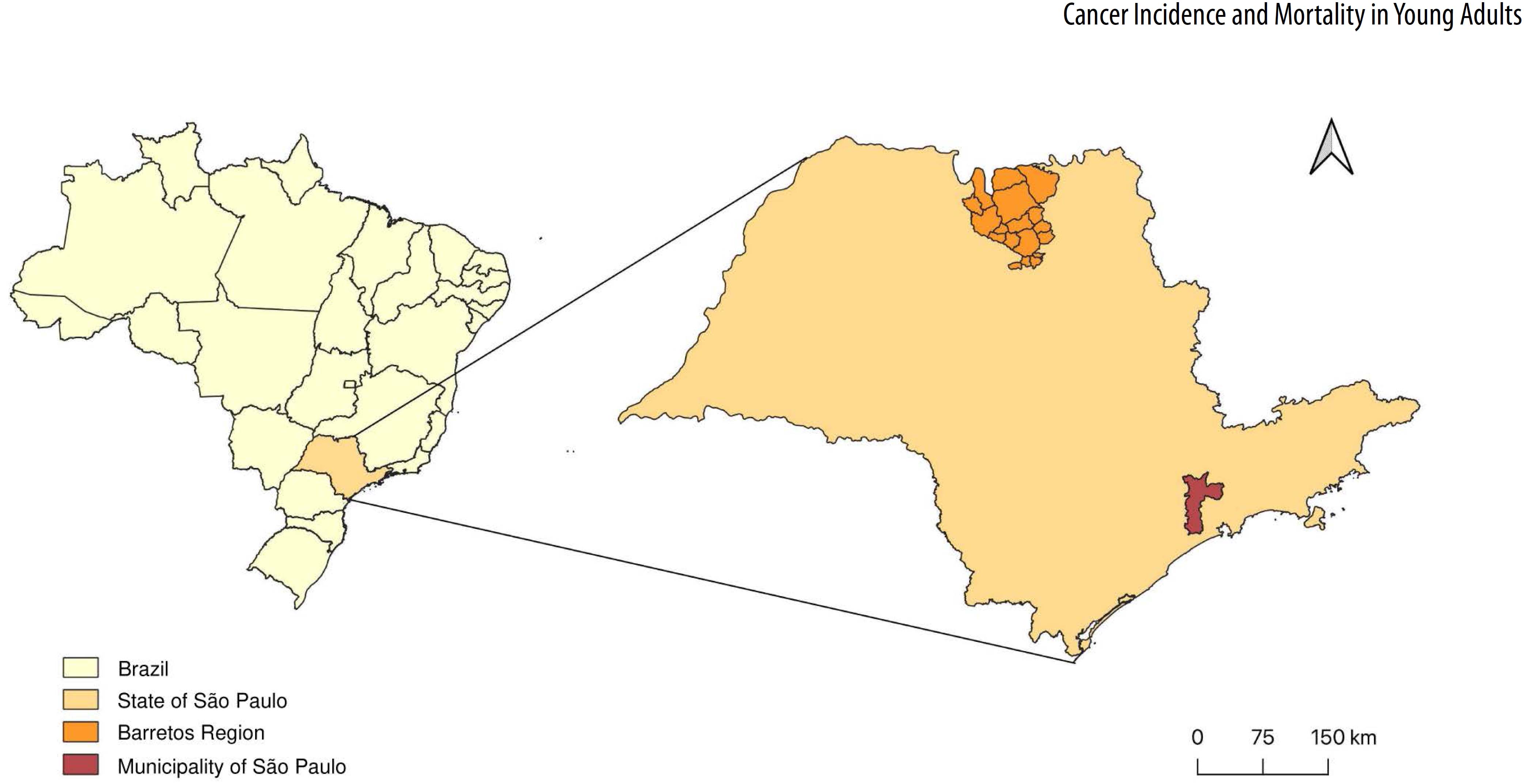
This is an ecological time series analysis that assessed two Regions with diverse characteristics (Figure 1). One refers to the MSP, State capital, with a total area of 1,521.202 km², presenting high population density with 12,396,372 inhabitants estimated in 2021, great socioeconomic diversity, and an economy aimed at the services sector11. The other is the Barretos Region, officially called the Regional Health Department of Barretos. This Region comprises 18 municipalities (Altair, Barretos, Bebedouro, Cajobi, Colina, Colômbia, Guaíra, Guaraci, Jaborandi, Monte Azul Paulista, Olímpia, Severínia, Taiaçu, Taiúva, Taquaral, Terra Roxa, Viradouro, and Vista Alegre do Alto), with an estimated population of 123,546 inhabitants in 2021 and a total area of 1,566.161 km212. Agriculture, commerce, and service provision are the foundation of this Region's economy.
Population data for the mid-year and the calculation of coefficients were obtained from the Department of Informatics of the National Health System (DATASUS), which provides census and intercensal estimation data from the Brazilian Institute of Geography and Statistics (IBGE)13. Cancer cases in young adults (20-39 years old) within the 2002-2018 period were obtained from the São Paulo14 and Barretos15 Population-Based Cancer Registry (RCBP) databases. Regarding the Barretos RCBP, as a standard procedure, all the incidence base undergoes a verification process to check the origin of cases, excluding those confirmed as non-residing within the 18 municipalities that comprise its scope area. A similar procedure is adopted by the São Paulo RCBP, whose base integrates data from a greater variety of notifying sources – including clinics, laboratories, private, state, and federal hospitals –, directly or indirectly collected. Deaths in young adults (aged 20-39 years), within the 2000-2020 period, in MSP and Barretos Region residents, were obtained from DATASUS’ Mortality Information System (SIM)16.
First, the main young adult mortality causes in both localities were investigated, using the 10th Review of the International Classification of Diseases and Related Health Problems (ICD-10) as reference17. The categorization of cancer cases in young adults also followed the ICD-10, a standard adopted by the official incidence and mortality databases in Brazil. This option ensures comparability with national and international statistics and maintains consistency between the utilized data sources, although other classifications, such as the International Classification of Cancer in Adolescents and Young Adults (CAYA), may offer more morphological detailing and specific analysis per age group. Next, Crude Incidence Coefficients and Crude Mortality Coefficients were calculated, dividing the number of new cancer cases or the number of deaths by the respective population on July 1st, multiplying this quotient by 100 thousand. In the analysis of coefficient trends, scatter plots were constructed between the incidence and mortality coefficients and the years of the study, to visualize the function expressed between them. From this observation, the annual percentage variation was calculated using the Joinpoint18 software. In this analysis, the software decomposes the Y trajectory (in this study, the incidence or mortality coefficients) into straight lines, and for each one, the increment is calculated based on the Poisson distribution. It is possible to work with the estimations for each straight and/or with the trends’ weighted average. In this work, we chose to describe each one of the trends, without the weighted average calculation, showing the annual percentage variation (%aa). For the Barretos Region, the mortality trend analysis was made only for breast cancer due to the other topographies’ low number of deaths.
This is an ecological study, whose information comes from secondary databases, with no individual identification, no interviews, questionnaires, or any other kind of relationship with human beings. Therefore, this research is exempt from submission to a Research Ethics Committee19,20.
RESULTS
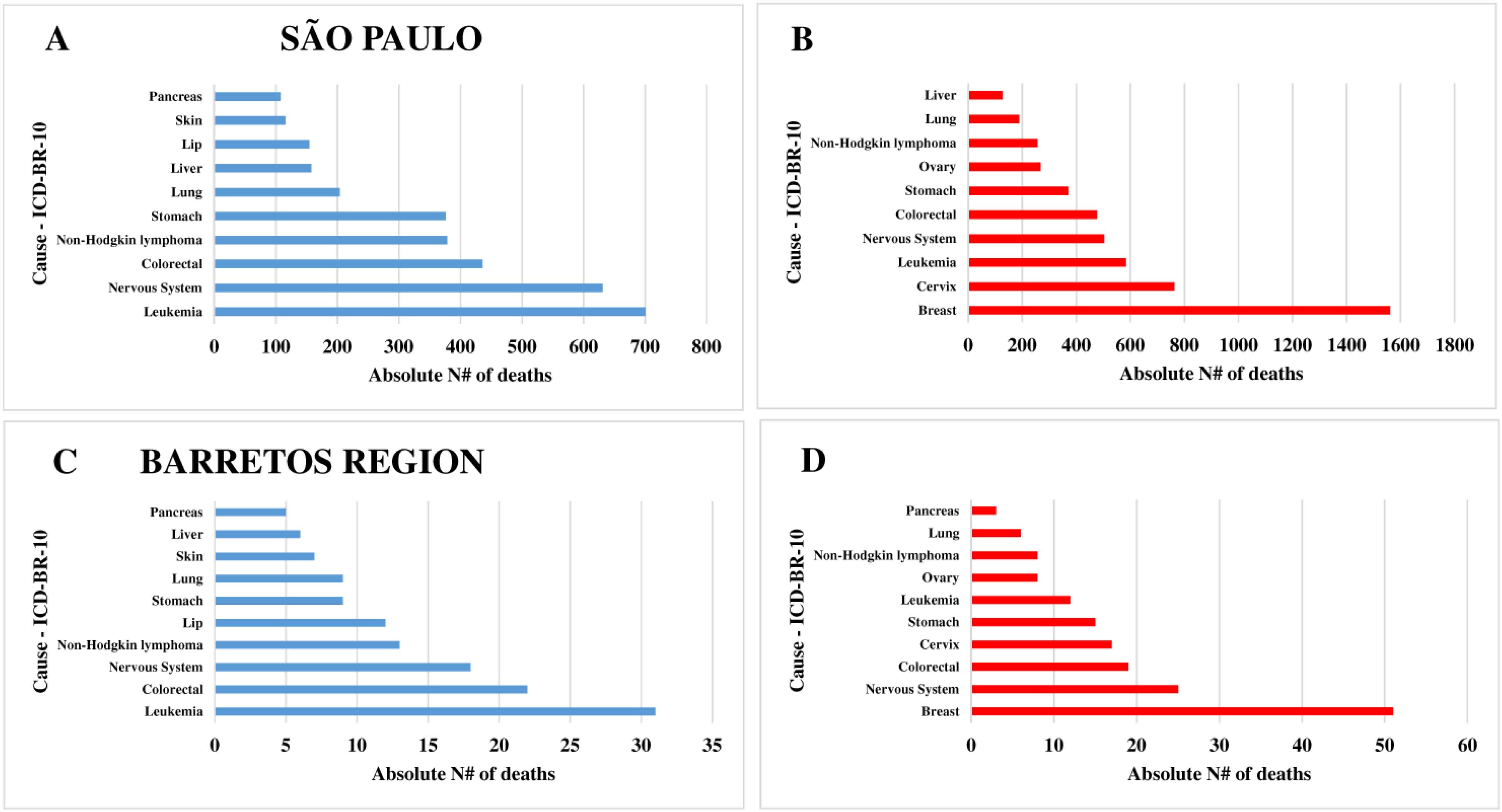
Figure 2 shows the deaths by ICD-10 neoplasms in young adults from the MSP (A-men; B-women) and the Barretos Region (C-men; D-women), from 2000-2020 in absolute numbers. In both Regions, the first place is occupied by breast cancer for women and leukemia for men. In the MSP, cervical cancer and leukemia rank second and third place for women, and nervous system and colorectal cancer rank second and third for men, respectively. In the Barretos Region, nervous system and colorectal cancer show up in second and third place among women, switching positions among men.
Deaths by neoplasms in young adults in the municipality of São Paulo (A-men; B-women) and in the Barretos Region (C-men; D-women), 2000-2020
Table 116 has the description of death causes (ICD-10 chapter) for the MSP and Barretos Region. It is observed that, in the period from 2000 to 2020, external causes were responsible for 60,926 (47.3%) deaths in São Paulo, followed by diseases of the circulatory system (14,236 deaths – 11.1%) and neoplasms (11,862 deaths – 9.2%). In the male sex, 56.9% of deaths are due to external causes, with neoplasms ranking 4th (5.3%). These external causes are mainly aggression (homicides) and transportation accidents. While for the female sex, neoplasms are the number 1 death cause (20.7%), followed by external causes (19,1%).
Number and percentage of deaths, according to sex and ICD-10 chapter, among people aged 20-39 years in the municipality of São Paulo and the Barretos Region, 2000-2020
The Barretos Region, as well as the MSP, presented a rather expressive number of deaths due to external causes: 1,822 deaths – 41.3%. In the analysis by sex, the standard is quite similar for the male sex, whose main causes of death are external (49.4%), followed by infectious and parasitic diseases (11.7%), diseases of the circulatory system (7.7%), and neoplasms (5.8%), ranking 4th. However, the main external causes in this Region are transportation accidents (48.5%), followed by aggressions (25.9%). The Barretos Region has a different standard for the female sex, whose main cause of death is external causes (20.9%), followed by neoplasms (17.4%). External causes also hold high percentages of transportation accidents (55.9%), followed by aggression (19.8%) and self-inflicted injuries (18.6%).
Table 215 shows the cancer incidence analysis throughout the 2000-2018 period. In the MSP, for the male sex, the most frequent are non-melanoma skin cancer with 1,478 cases (37.7%), colorectal cancer with 1,066 cases (27.2%), and stomach cancer with 660 cases (16.8%), while for women it is cervical cancer with 9,019 cases (39.5%) and breast cancer with 8,459 cases (37.1%). In the Barretos Region, for men, the most frequent cancers are colorectal with 44 cases (31.0%), leukemias with 39 cases (27.5%), and nervous system with 18 cases (12.7%). As for women, the standard is similar to that of the MSP, given that cervical cancer with 680 new cases (67.1%) is the most frequent, followed by breast cancer with 209 cases (20.6%) and colorectal cancer with 39 cases (3.8%). The analyses of incidence trends for the male sex in the MSP indicate a reduction for nervous system cancer (APC=-6.26; p=0.035) and lung (-5.09; p=0.002). For the female sex, there was an increase in breast cancer (APC=0.5; p<0.001), colorectal (APC=2.3; p=0.034), non-melanoma skin (APC=3.9; p=0.020), and pancreas (APC=5.2; p=0.030), corresponding to the three main locations among new cases. There was a decrease in nervous system cancer (APC=-11.1; p<0.001). In the Barretos Region, the cancers that presented a significant/expressive increase in women were cervical cancer (APC=8.96; p=0.002) and breast cancer (APC=5.91; p=0.004), while colorectal cancer declined (APC=-4.43; p=0.011). When analyzing men, there is a significant increasing trend for colorectal cancer incidence (APC=5.75, p=0.030).
Number of new cases, frequency, and annual percentage change for 14 types of cancer, among people aged 20-39 years in the municipality of São Paulo and the Barretos Region, 2000-2018
For the MSP, in the 2000-2020 period, it is possible to observe in Table 3 that there are more deaths by neoplasms in the female sex (5,126) than in the male sex (3,264). The main causes of death by cancer in the male sex are leukemias (21.5%), followed by tumors of the nervous system (19.3%) and colorectal cancer (13.4%), while for the female sex, the main causes are breast cancer (30.5%), cervical cancer (14.9%), and leukemias (11.4%). Leukemias presented a statistically significant drop for men (APC=-2.3%aa, p=0.003) and women (APC=-2.6%aa e p=0.005). The other neoplasms remained stable for the male and female sexes, except for cervical cancer, which had a significant increase (APC=1.7%aa; p=0.002) (Table 3).
Number of deaths, frequency, and annual percentage change for 14 types of cancer, among people aged 20-39 years in the municipality of São Paulo and the Barretos Region, 2000-2020
The results in the Barretos Region, for the 2000-2020 period, were similar to those obtained for São Paulo, where women present a higher number of deaths by cancer (181 in women and 148 in men). There is a similarity in the topography distribution, given that, in the male sex, the main locations were leukemias (20.9%), nervous system (16.9%), and colorectal cancer (14.9%). While in the female sex, the main cancers were breast (28.2%), nervous system (13.8%), and colorectal (10.5%), with cervical cancer ranking fourth in mortality (9.4%). There was a growing trend in breast cancer mortality (APC=13.41%aa; p=0.027). For the other topographies, it was not possible to calculate APC due to the low number of deaths in the period.
DISCUSSION
Based on the results presented, it became evident how significant cancer currently is among young adults. In the MSP, from 2000-2020, in absolute numbers of deaths, the neoplasm ranked first for the female sex, and second in the Barretos Region. The incidence trends show similarities between the sexes in different locations, with an increase in colorectal cancer in males, both in the MSP and in the Barretos Region, with this increase being significant in Barretos. Regarding female tumors, an expressive increase in breast cancer and cervical cancer incidence in the Barretos Region must be underlined, with a slight increase in the incidence of breast cancer in the MSP. Moreover, another expressive point is the women's deaths in the Barretos and MSP Regions, who have died more of cancer than men. This is possibly due to breast cancer having a greater impact on mortality, followed by cervical cancer and colorectal cancer.
Deaths by external causes in Brazil, since the 1980s, corresponded to the second cause of death, overcome only by diseases of the circulatory system21. Forty years later (1980-2020), this panorama has shifted, with external causes in the first position, followed by diseases of the circulatory system. This study identified that the main causes of death were external causes that overcame other death causes, like infectious and parasitic diseases and circulatory system diseases, except for women in São Paulo, where deaths by neoplasms ranked first. Studies suggest that this vulnerability due to external causes in people aged 20-35 years is related to certain risk behaviors, like the search for thrill, pleasure in experimenting with risky situations, impulsiveness, and abuse of psychoactive substances22. This study sought to highlight external causes, specifically in this age group (20-39 years), since it predominantly affects them, especially a young, economically active male population, resulting in millions of deaths annually, thousands of hospitalizations, and a burden on health services23. External factors do not affect the population uniformly. Several studies have demonstrated that there are more predisposed population groups, which can be perceived by the unequal distribution of deaths due to external causes24. Moreover, the high number of deaths and sequelae/incapabilities from external causes constitutes an important demand for health and safety public policies to be structured, implemented, and followed in Brazil25.
The global burden of cancer in young adults aged 20-39 years is different from that observed in younger or more advanced ages, and varies significantly according to sex, development level, and geographic area. Compared to other countries, the results from the present study show similarity. According to Fidler et al.26, considering the global burden of cancer in young adults, there have been changes according to the Human Development Index (HDI) – a composite indicator of socioeconomic development that encompasses life expectancy, education, and gross national income. Although the absolute number of new cases has been higher among high-HDI countries, the incidence was higher in the very-high-HDI countries, followed by the low-HDI. Thyroid cancer and testicle cancer have been appointed as the most consistent neoplasms in Regions with very-high-HDI, while cancers associated with an infection were more frequent in countries with low HDI; in fact, one every three neoplasms (33.2%) were connected to important infectious agents, including human papillomavirus (HPV), human virus herpes-8 (HHV-8), hepatitis B virus (HBV), hepatitis C virus (HCV), and Helicobacter pylori, in countries of low-HDI, in relation of one at each nine (11.3%) in settings of very high HDI. In this population-based study conducted by Fidler et al.26, the focus was to quantify the load of neoplasms in young adults worldwide, showing that there is a mixed pattern, since both cervical cancer and breast cancer have been demonstrated to be the most common among women. Whereas for men, the most incident cancers are not related to viruses26. Although the increase in cervical cancer incidence is generally associated with populations with low socioeconomic development, an increase in cases was identified in the Barretos Region, where municipalities present, on average, a higher socioeconomic status. This pattern probably reflects the impact of the organized cervical cancer screening program maintained by a High-Complexity Oncology Center (Cacon) that encompasses all the municipalities that make up the Barretos RCBP. Greater access to screening tests and early diagnosis may have contributed to the incidence increase observed in this study.
Fidler et al.26 highlight the attention that must be dispensed to this population age group, mainly in low-income countries. In addition to the obvious lack of access to organized health systems, delayed diagnosis, and administration of treatments that are not optimized for these age groups, the impact of cancer on the quantity and quality of life of these young people can be devastating. The authors identified that, despite high-income countries presenting higher incidences of tumors in people aged 15-39 years, their mortality rates are inferior to those of low-income countries. This is because they have high-tech, organized healthcare systems, and people are diagnosed at the initial stages of the disease, while low-income countries do not possess such facilitated access to diagnosis. Thus, when the individual discovers the disease, it is already in an advanced stage26. In Brazil, among patients who reached the hospital without a diagnosis, 66.3% of young adults aged 20-39 years had tumor treatment initiated within 60 days of diagnosis, as determined by Law 12,732/201227. But when compared to the 15-29 years age group, they took double the average time between consultation and diagnosis (12 days versus 6 days) and between consultation and treatment initiation (20 days versus 11 days)9.
The average annual percentage change in cancer incidence among young adults was assessed in 41 countries in the 1998-2012 period, contributing with a total of 1,846,588 new cancer cases and 3.1 billion people-years among the 15-39 years age group. There was variation in the incidence of cervical cancer, which decreased among young adult women in Brazil, Colombia, the United States, India, the Philippines, South Korea, Thailand, Austria, Bulgaria, the Czech Republic, France, Poland, Slovenia, Spain, and New Zealand, contrasting with increases in incidence among young adults in China, Japan, Türkiye, Belarus, Ireland, Norway, and the United Kingdom. There was an indication that cervical cancer incidence began to increase, but more recently, among young women in the Netherlands. Substantial decreases in lung cancer incidence were observed, for both sexes, in Canada, the United States, Bahrain, China, Israel, the Republic of Korea, Türkiye, Bulgaria, Croatia, the Czech Republic, and Spain. This decrease was widely restricted to male young adults28.
According to Li and Kuang3, the main change over the last decades is the worldwide popularization of Western lifestyles. Therefore, the increase in cancer incidence in young adults is more significant in developed countries and in cancers related to obesity, such as breast cancer, thyroid cancer, colorectal cancer, pancreatic cancer, kidney cancer, ovarian cancer, and multiple myeloma. However, the incidence of several cancers in young adults decreased over the last decade, including Kaposi sarcoma and cervical, liver, and gastric cancer, all related to infections. This decrease in incidence was due to the widespread application of vaccines and Helicobacter pylori "screening and eradication" strategies.
This study saw an increase in breast cancer and colorectal cancer in both localities (MSP and Barretos Region). In this age group, several factors may be associated with an increase in the risk of developing breast cancer, such as: age, endocrine factors/reproductive history (history of early menarche (first menstruation before 12 years-old)), first pregnancy after 30 years-old, nulliparity, use of oral contraceptives (estrogen-progesterone)29-31, behavioral/environmental factors (alcohol intake, overweight and obesity, physical inactivity, and exposure to ionizing radiation) and genetic/hereditary factors32. Global statistics of cancer in young adults with data from the Globocan 20223 show female predominance as the most striking characteristic, where almost two-thirds of new cases and over half the deaths related to cancer occurred in women. The female predominance of cancer in young adults, as seen in this study, indicates that sexual hormones may play key roles in this type of cancer. For instance, hormonal and reproductive factors are established risk factors for breast cancer in pre-menopause and thyroid cancer.
According to the Brazilian Society of Mastology, the recommended age to undergo a mammogram test is 40 years old, which is the age at which the disease incidence curve starts increasing among women. While the Ministry of Health and the National Cancer Institute recommend starting at age 50. The guidelines for breast cancer screening have been recently updated, and the Ministry of Health started to recommend mammograms starting at age 40, with on-demand screening (conducted following clinical indication or shared decision by women and health professionals) for the 40-49 years age group. From 50-74 years, screening is done at a population level, with tests conducted biannually.
Regarding colorectal cancer, risk factors include obesity, physical inactivity, and frequent intake of industrialized and fiber-poor food, such as fast foods, widely consumed by young people. However, the increase in right colon cancer incidence has been strongly related to the increase in obesity rather than any other dietary factors33. Some studies suggest that low intake of fruits and vegetables and high intake of red meat are associated with an increased risk of distal, but not proximal, colon cancer34-37. These patterns indicate that risk factors can vary according to the tumor sub-location, which can explain the different magnitudes of variations observed between colon cancer and rectum or rectosigmoid cancer. Moreover, recent evidence suggests that the excess of body fat in early life may be associated with a greater risk of colorectal cancer in women — including for rectal cancer — regardless of obesity in adult age38,39.
Age-period-cohort analyses reveal that variations by birth cohort predominate over period effects in the variation of incidence and mortality of several cancers, suggesting that early or cumulative exposure, such as obesity, smoking, HPV, and HCV, strongly influences risk in young adults. The differences between cohorts reflect both changes in the prevalence of risk factors as well as variations in screening and diagnosis practices throughout time. These results reinforce the importance of integrated analyses of age-period-cohort models and descriptive data, as well as the need for prevention and screening policies adapted to different generations and socioeconomic contexts40.
It is noteworthy that, even with a lower frequency of cancer occurrence in young adults (a key demographic group in which cancer screening or prevention efforts are not recommended) than in older age groups, its effects remain considerable because these individuals have a large proportion of life expectancy, contribute substantially to the economy, and play an important role in caring for their families. Early diagnosis minimizes the damages of a more aggressive treatment26, but there is a need that health professionals be trained to recognize signs and symptoms in this age group, and that the population is aware of the risks associated with lifestyle, behavioral, environmental, and genetic factors, or to integrated action of different factors, which are responsible for the increasing trends in cancer occurrence at the population level. Additionally, cancer vigilance and prospective cohort studies need to be intensified to explore etiologies of early-onset cancers. Each country must adjust its prevention strategies41.
This study highlights the use of comprehensive incidence data from RCBP and mortality information from a national database covering more than 20 consecutive years for the MSP and the Barretos Region. As a limitation, the use of secondary data may be subject to under-recording, inconsistencies, and variations in the quality of information throughout time and between regions. Moreover, the absence of more detailed clinical and behavioral variables restricts the possibility of exploring other individual determinants associated with incidence and mortality. Such limitations are inherent to ecological studies and must be considered in the interpretation of results.
CONCLUSION
Cancer was the fourth most frequent cause of death among male young adults and the first among women. The distribution of cancer-related deaths showed little variation between the MSP and the Barretos Region, with breast cancer, leukemia, nervous system cancer, and colorectal cancer being the most frequent causes. There is a growing trend of certain types of cancer in young adults, particularly breast, cervical, and colorectal cancer.
An analysis of cancer in young adults, in areas with such distinct characteristics, may contribute to the formulation/reformulation of specific public policies for this age group. The results presented herein suggest the need for additional research that deepens the investigation of health determinants in this younger population, in addition to a review of procedures that make early detection feasible, given the consequent increase in cancer incidence in this population group.
DATA AVAILABILITY STATEMENT
All the contents associated with the article are included in the manuscript.
References
-
1 Sung H, Ferlay J, Siegel RL, et al. Global Cancer Statistics 2020: GLOBOCAN estimates of incidence and mortality worldwide for 36 Cancers in 185 Countries. CA Cancer J Clin. 2021;71(3):209-49. doi: https://doi.org/10.3322/caac.21660
» https://doi.org/10.3322/caac.21660 -
2 Bray F, Laversanne M, Sung H, et al. Global cancer statistics 2022: GLOBOCAN estimates of incidence and mortality worldwide for 36 cancers in 185 countries. CA Cancer J Clin. 2024;74(3):229-63. doi: https://doi.org/10.3322/CAAC.21834
» https://doi.org/10.3322/CAAC.21834 -
3 Li J, Kuang X. Global cancer statistics of young adults and its changes in the past decade: incidence and mortality from GLOBOCAN 2022. Public Health. 2024;237;336-43. doi: https://doi.org/10.1016/j.puhe.2024.10.033
» https://doi.org/10.1016/j.puhe.2024.10.033 -
4 Bleyer A, Viny A, Barr R. Cancer in 15- to 29-year-olds by primary site. Oncologist. 2006;11(6):590-601. doi: https://doi.org/10.1634/theoncologist.11-6-590
» https://doi.org/10.1634/theoncologist.11-6-590 -
5 O’Connell JB, Maggard MA, Liu JH, et al. Do young colon cancer patients have worse outcomes? World J Surg. 2004;28(6):558-62. doi: https://doi.org/10.1007/s00268-004-7306-7
» https://doi.org/10.1007/s00268-004-7306-7 -
6 Kentsis A. Why do young people get cancer? Pediatr Blood Cancer. 2020;67(7):e28335. doi: https://doi.org/10.1002/pbc.28335
» https://doi.org/10.1002/pbc.28335 -
7 Zhang J, Walsh MF, Wu G, et al. Germline mutations in predisposition genes in pediatric cancer. N Engl J Med. 2015;373(24):2336-46. doi: https://doi.org/10.1056/NEJMoa1508054
» https://doi.org/10.1056/NEJMoa1508054 -
8 Instituto Nacional de Câncer José Alencar Gomes da Silva, Coordenação de Prevenção e Vigilância. Incidência, mortalidade e morbidade hospitalar por câncer em crianças, adolescentes e adultos jovens no Brasil: informações dos registros de câncer e do sistema de mortalidade [Internet]. Rio de Janeiro: INCA; 2016 [acesso 2024 nov 11]. Disponível em: https://www.inca.gov.br/publicacoes/livros/incidencia-mortalidade-e-morbidade-hospitalar-por-cancer-em-criancas-adolescentes
» https://www.inca.gov.br/publicacoes/livros/incidencia-mortalidade-e-morbidade-hospitalar-por-cancer-em-criancas-adolescentes - 9 Arregi M. Câncer em adultos jovens (20-39 anos) em Fortaleza: tendências em incidência, mortalidade e sobrevida, 1997-2006 [dissertação]. [Fortaleza]: Fundação Antônio Prudente; 2011. 293p.
-
10 Wild CP, Weiderpass E, Stewart BW. World cancer report: cancer research for cancer prevention [Internet]. Lyon: World Health Organization; 2020 [acesso 2024 nov 11]. Disponível em: https://www.ncbi.nlm.nih.gov/books/NBK606505/
» https://www.ncbi.nlm.nih.gov/books/NBK606505/ -
11 Programa Cidades Sustentáveis [Internet]. São Paulo: Instituto Cidades Sustentáveis; [sem data] - [acesso 2024 nov 11]. Disponível em: https://www.cidadessustentaveis.org.br/painel-cidade/detalhes/3830
» https://www.cidadessustentaveis.org.br/painel-cidade/detalhes/3830 -
12 Cidades [Internet]. Versão 4.6.110. Cidade Barretos. Rio de Janeiro: Instituto Brasileiro de Geografia e Estatística; ©2023 [acesso 2024 nov 9]. Disponível em: https://cidades.ibge.gov.br/brasil/sp/barretos/panorama
» https://cidades.ibge.gov.br/brasil/sp/barretos/panorama -
13 População Residente [Internet]. Versão 1. Brasília, DF: DATASUS; [sem data] – [acesso 2024 nov 9]. Disponível em: https://datasus.saude.gov.br/populacao-residente/
» https://datasus.saude.gov.br/populacao-residente/ -
14 RCBP: Registro de Câncer de Base Populacional [Internet]. São Paulo: USP; ©2025 [acesso 2024 nov 9]. Disponível em: https://www.fsp.usp.br/rgcsp/
» https://www.fsp.usp.br/rgcsp/ -
15 RCBP: Registro de Câncer de Base Populacional [Internet]. Barretos: Instituto de Ensino e Pesquisa (IEP) do Hospital de Amor; [sem data] - [acesso 2024 nov 9]. Disponível em: https://iep.hospitaldeamor.com.br/quem-somos/
» https://iep.hospitaldeamor.com.br/quem-somos/ -
16 SIM: Sistema de Informação sobre Mortalidade [Internet]. Versão 3.2.1.2. Brasília (DF): DATASUS. [data desconhecida] - [acesso 2024 nov 9]. Disponível em: http://sim.saude.gov.br/default.asp
» http://sim.saude.gov.br/default.asp - 17 Organização Mundial da Saúde. CID-10: Classificação Estatística Internacional de Doenças e problemas relacionados à saúde. São Paulo: Edusp; 2008.
-
18 Joinpoint Trend Analysis [Internet]. Version 4.8.0.1. Bethesda (MD): National Cancer Institute. 2020 [acesso 2024 nov 9]. Disponível em: https://surveillance.cancer.gov/joinpoint/
» https://surveillance.cancer.gov/joinpoint/ - 19 Conselho Nacional de Saúde (BR). Resolução n° 466, de 12 de dezembro de 2012. Aprova as diretrizes e normas regulamentadoras de pesquisas envolvendo seres humanos. Diário Oficial da União, Brasília, DF. 2013 jun 13; Seção I:59.
-
20 Conselho Nacional de Saúde (BR). Resolução n° 510, de 7 de abril de 2016. Dispõe sobre as normas aplicáveis a pesquisas em Ciências Humanas e Sociais cujos procedimentos metodológicos envolvam a utilização de dados diretamente obtidos com os participantes ou de informações identificáveis ou que possam acarretar riscos maiores do que os existentes na vida cotidiana, na forma definida nesta Resolução [Internet]. Diário Oficial da União, Brasília, DF. 2016 maio 24 [acesso 2024 abr 7]; Seção 1:44. Disponível em: http://bvsms.saude.gov.br/bvs/saudelegis/cns/2016/res0510_07_04_2016.html
» http://bvsms.saude.gov.br/bvs/saudelegis/cns/2016/res0510_07_04_2016.html -
21 Gonsaga R, Rimoli C, Pires E, et al. Evaluation of the mortality due to external causes. Rev Col Bras. 2012;39(4):263-7. doi: https://doi.org/10.1590/S0100-69912012000400004
» https://doi.org/10.1590/S0100-69912012000400004 -
22 Souza MFM, Malta DC, Souza CGM, et al. Análise descritiva e de tendência de acidentes de transporte terrestre para políticas sociais no Brasil. Epidemiol e Serviços Saúde. 2007;16(1):33-44. doi: http://dx.doi.org/10.5123/S1679-49742007000100004
» http://dx.doi.org/10.5123/S1679-49742007000100004 -
23 Orru H, Åström DO. Increases in external cause mortality due to high and low temperatures: evidence from Northeastern Europe. Int J Biometeorol. 2017;61(5):963-6. doi: https://doi.org/10.1007/s00484-016-1270-4
» https://doi.org/10.1007/s00484-016-1270-4 -
24 Nogueira CAS, Brandão FB. Mortalidade de adultos jovens por causas externas no município de Imperatriz-MA, no biênio (2017-2018). Rev Científica Multidiscip Núcleo do Conhecimento. 2020;31-58. doi: https://doi.org/10.32749/nucleodoconhecimento.com.br/saude/mortalidade-de-adultos
» https://doi.org/10.32749/nucleodoconhecimento.com.br/saude/mortalidade-de-adultos -
25 Batista J, Barreto MS, Merino MFGL, et al. Perfil epidemiológico da mortalidade por causas externas entre beneficiários de planos de saúde no Brasil. Rev Enferm do Centro-Oeste Min. 2018;8:8-1870. doi: https://doi.org/10.19175/recom.v8i0.1870
» https://doi.org/10.19175/recom.v8i0.1870 -
26 Fidler M, Gupta S, Soerjomataram I, et al. Cancer incidence and mortality among young adults aged 20–39 years worldwide in 2012: a population-based study. Lancet Oncol. 2017;18(12):1579-89. doi: https://doi.org/10.1016/s1470-2045(17)30677-0
» https://doi.org/10.1016/s1470-2045(17)30677-0 -
27 Presidência da República (BR). Lei n° 12.732, de 22 de novembro de 2012. Dispõe sobre o primeiro tratamento de paciente com neoplasia maligna comprovada e estabelece prazo para seu início [Internet]. Diário Oficial da União, Brasília, DF. 2012 nov 23 [acesso 2025 ago 25]; Seção 1:1. Disponível em: https://www.planalto.gov.br/ccivil_03/_ato2011-2014/2012/lei/l12732.htm
» https://www.planalto.gov.br/ccivil_03/_ato2011-2014/2012/lei/l12732.htm -
28 Gupta S, Harper A, Ruan Y, et al. International trends in the incidence of cancer among adolescents and young adults. J Natl Cancer Inst. 2020;112(11):1105-17. doi: https://doi.org/10.1093/jnci/djaa007
» https://doi.org/10.1093/jnci/djaa007 -
29 Tirona MT, Sehgal R, Ballester O. Prevention of breast cancer (part i): epidemiology, risk factors, and risk assessment tools. Cancer Invest. 2010;28(7):743-50. doi: https://doi.org/10.3109/07357907.2010.494321
» https://doi.org/10.3109/07357907.2010.494321 -
30 Adami H, Hunter D, Trichopoulos D. Textbook of cancer epidemiology 2º edn. New York: Oxford Academic; 2008. 748p. doi: https://doi.org/10.1093/acprof:oso/9780195311174.001.0001
» https://doi.org/10.1093/acprof:oso/9780195311174.001.0001 -
31 Silva MM, Silva VH. Envelhecimento: importante fator de risco para o câncer. Arq méd ABC [Internet]. 2005 [acesso 2024 nov 7]; 30(1):11-8. Disponível em: http://www.fmabc.br/admin/files/revistas/30amabc011.pdf
» http://www.fmabc.br/admin/files/revistas/30amabc011.pdf - 32 Almeida A. Conhecimento, atitude e prática acerca da detecção precoce do câncer de mama no âmbito da estratégia de saúde da família [dissertação]. [Fortaleza]: Universidade Federal do Ceará; 2016. 111p.
-
33 Chauvenet M, Cottet V, Lepage C, et al. Trends in colorectal cancer incidence: a period and birth-cohort analysis in a well-defined french population. BMC Cancer. 2011;11:282. doi: https://doi.org/10.1186/1471-2407-11-282
» https://doi.org/10.1186/1471-2407-11-282 -
34 Bingham SA, Day NE, Luben R, et al. Dietary fibre in food and protection against colorectal cancer in the European Prospective Investigation into Cancer and Nutrition (EPIC): an observational study. Lancet. 2003;361(9368):1496-501. doi: https://doi.org/10.1016/s0140-6736(03)13174-1
» https://doi.org/10.1016/s0140-6736(03)13174-1 -
35 Ferro A, Costa AR, Morais S, et al. Fruits and vegetables intake and gastric cancer risk: a pooled analysis within the stomach cancer pooling project. Int J Cancer. 2020;147(11):3090-101. doi: https://doi.org/10.1002/ijc.33134
» https://doi.org/10.1002/ijc.33134 -
36 Koushik A, Hunter DJ, Spiegelman D, et al. Fruits, vegetables, and colon cancer risk in a pooled analysis of 14 cohort studies. J Natl Cancer Inst. 2007;99(19):1471-83. doi: https://doi.org/10.1093/jnci/djm155
» https://doi.org/10.1093/jnci/djm155 -
37 Larsson SC, Wolk A. Meat Consumption and risk of colorectal cancer: a meta-analysis of prospective studies. Int J Cancer. 2006;119(11):2657-64. doi: https://doi.org/10.1002/ijc.22170
» https://doi.org/10.1002/ijc.22170 -
38 Friedenreich C, Norat T, Steindorf K, et al. Physical activity and risk of colon and rectal cancers: the european prospective investigation into cancer and nutrition. Cancer Epidemiol Biomarkers Prev. 2006;15(12):2398-407. doi: https://doi.org/10.1158/1055-9965.epi-06-0595
» https://doi.org/10.1158/1055-9965.epi-06-0595 -
39 Zhang X, Wu K, Giovannucci EL, et al. Early life body fatness and risk of colorectal cancer in u.s. womenand men-results from two large cohort studies. Cancer Epidemiol Biomarkers Prev. 2015;24(4):690-7. doi: https://doi.org/10.1158/1055-9965.epi-14-0909-t
» https://doi.org/10.1158/1055-9965.epi-14-0909-t -
40 Murphy CC, Yang YC. Use of age-period-cohort analysis in cancer epidemiology research. Curr Epidemiol Rep. 2018;5(4):418-31. doi: https://doi.org/10.1007/s40471-018-0174-8
» https://doi.org/10.1007/s40471-018-0174-8 -
41 Hamilton AC, Coleman HG. Shifting tides: the rising tide of early-onset cancers demands attention. BMJ Oncol. 2023;2(1):e000106. doi: https://doi.org/10.1136/bmjonc-2023-000106
» https://doi.org/10.1136/bmjonc-2023-000106
Edited by
-
Associate editor:
Jeane Tomazelli. Orcid iD: https://orcid.org/0000-0002-2472-3444
-
Scientific-editor:
Anke Bergmann. Orcid iD: https://orcid.org/0000-0002-1972-8777