 Mortality due to Colon and Rectal Cancer in Brazil and its Regions between 2006 and 2020
ABSTRACT
Introduction: In Brazil, 704 thousand new cases of cancer were estimated for each year of the triennium 2023-2025, and colon and rectal cancer (CRC) is the type of neoplasm responsible for the third highest mortality rate for both sexes in the country.
Objective: To analyze the temporal trend of premature mortality by CRC from 2006 to 2020, for both sexes, in Brazil and its five macroregions, and to evaluate whether the goal proposed by the Strategic Action Plan for Tackling Chronic non Communicable Diseases in Brazil 2011-2022 of the Ministry of Health (MH) in relation to CCR has been met.
Method: Time series study of standardized premature mortality rates by CRC (ICD-10: C18-21); the study population is Brazil's population obtained from DATASUS’ Mortality Information System from 2006 to 2020.
Results: Premature mortality rates by CRC in Brazil and in all five macroregions increased linearly over the period investigated, but with important regional differences. The target proposed by the MH's Plan for CRC was not met.
Conclusion: There was an increase in premature mortality rates by CRC in Brazil, a trend expected for developing countries. As it is a type of cancer that involves modifiable risk factors, continuous actions to manage these factors are important, such as national health promotion policies. Furthermore, studies are needed to support preventive policies for screening and early diagnosis programs.
Key words:
Epidemiology/statistics & numerical data; Colorectal Neoplasms; Time Series Studies; Brazil
RESUMO
Introdução: No Brasil, estima-se a ocorrência de 704 mil casos novos de câncer para cada ano do triênio 2023-2025, sendo o câncer de cólon e reto (CCR) o tipo de neoplasia responsável pela terceira maior taxa de mortalidade para ambos os sexos.
Objetivo: Analisar a tendência temporal de mortalidade prematura por CCR de 2006 a 2020, em ambos os sexos, no Brasil e em suas cinco Macrorregiões, e avaliar o alcance da meta proposta pelo Plano de Ações Estratégicas para o Enfrentamento das Doenças Crônicas não Transmissíveis no Brasil 2011-2022 do Ministério da Saúde (MS) em relação ao CCR.
Método: Estudo de séries temporais das taxas de mortalidade prematura e padronizada de CCR (CID-10: C18-21) tendo como população de estudo a do Brasil, com dados obtidos a partir do Sistema de Informação sobre Mortalidade do DATASUS de 2006 a 2020.
Resultados: As taxas de mortalidade prematura por CCR apresentaram aumento linear ao longo do período observado, porém com importantes diferenças regionais. Em relação ao CCR, a meta proposta pelo plano do MS não foi alcançada.
Conclusão: Houve um aumento das taxas de mortalidade prematura por CCR no Brasil, tendência esperada em países em desenvolvimento. Por ser um câncer que envolve fatores de risco modificáveis, são importantes ações contínuas voltadas para o manejo desses fatores, tais como políticas nacionais de promoção de saúde. Além disso, são necessários estudos que subsidiem políticas preventivas de programas de rastreamento e diagnóstico precoce.
Palavras-chave:
Epidemiologia/estatística dados numéricos; Neoplasias Colorretais; Estudos de Séries Temporais; Brasil
RESUMEN
Introducción: En el Brasil, se estimó la aparición de 704 000 nuevos casos de cáncer para cada año del período 2023-2025, siendo el cáncer de colorrectal (CCR) el tipo de neoplasia responsable de la tercera mayor tasa de mortalidad para ambos sexos en el país.
Objetivo: Analizar la tendencia en el tiempo de la mortalidad prematura por CCR en el período de 2006 a 2020, en ambos sexos, en el Brasil y sus 5 macrorregiones, y evaluar si fue alcanzada la meta propuesta por el Plan de Acción Estratégica para el Enfrentamiento de las Enfermedades Crónicas no Transmisibles en el Brasil 2011-2022 del Ministerio de Salud (MS) con relación al CCR.
Método: Estudio de series temporales de tasas de mortalidad prematura estandarizadas por CCR (CIE-10: C18-21) utilizando como población de estudio toda la población del Brasil, con datos obtenidos del Sistema de Información sobre Mortalidad del DATASUS de 2006 a 2020.
Resultados: Las tasas de mortalidad prematura por CCR en el Brasil y en las cinco regiones mostraron un aumento lineal durante el período observado, pero con importantes diferencias regionales. Con relación al CCR, la meta propuesta por el Plan del MS no fue alcanzada.
Conclusión: Hubo un aumento de las tasas de mortalidad prematura por CCR en el Brasil, tendencia esperada en países en desarrollo. Al tratarse de un tipo de cáncer que involucra factores de riesgo modificables, son importantes las acciones continuas encaminadas a gestionar estos factores, como las políticas nacionales de promoción de la salud del CCR. Además, se necesitan estudios que respalden las políticas preventivas para los programas de detección y diagnóstico temprano.
Palabras clave:
Epidemiología/estadística & datos numéricos; Neoplasias Colorrectales; Estudios de Series Temporales; Brasil
INTRODUCTION
Cancer is one of the main public health problems worldwide and one of the four major causes of premature death in most of the countries. The World Health Organization – WHO estimates that in 2020, 19,292,789 cases occurred predominantly in males, responsible for 9,958 deaths in the world1. In Brazil, neoplasms are the second main cause of general and premature mortality, behind only cardiovascular diseases2,3. Due to the processes of demographic and epidemiologic transition which, combined, contribute to the population ageing and change of the epidemiologic profile, the incidence and mortality by cancer and other non-communicable diseases is increasing worldwide, becoming one of the main causes of death2,4. The occurrence of 704 thousand new cases of cancer are estimated for each year of the triennium 20232025 in the country5.
According to data of the National Cancer Institute (INCA), except non-melanoma skin cancer, colorectal cancer (CRC) is the second most incident neoplasm for both sexes with 6.4% for men, behind only prostate cancer and 6.5% for women, behind only breast cancer5. In 2021, the male mortality rate by CRC, in relation to other neoplasms, was 8.8% and for females, 9.6%, the third neoplasm with high mortality for both sexes6.
CRC encompasses tumors located in the large intestine, rectum and anus. The most frequently associated symptoms are: blood in feces, change of bowel habits (alternating diarrhea and constipation), frequent abdominal pain, weakness, anemia, weight loss with no apparent cause and abdominal tumor.
The etiology of this neoplasm is complex and multifactorial involving hereditary, behavioral factors and age. Among the modifiable risk factors are: obesity, few physical activity/sedentarism, smoking, high intake of ultra-processed food, red meat, excessive use of alcohol and low intake of vegetal fibers7. These tumors usually exhibit precursor lesion known as adenomatous polyp detected by colonoscopy – gold-standard method for early diagnosis of CRC. Studies have demonstrated that endoscopic polypectomy, early diagnosis and timely treatment reduce the incidence of and mortality by CRC since there is no difference in treatment's results according to the diseases’ staging8,9.
The data of the study Global Cancer Statistics 20202 indicate that globally, CRC accounts for 10% of all the diagnoses of cancer and for 9.4% of the total mortality by cancer, behind only breast cancer (11.7%) and lung (11.4%) in terms of incidence and lung cancer (18%) for mortality.
Different trend patterns of mortality rates by CRC have been detected in the world since 2012, increasing in developing countries – Eastern Europe, Latin America and Asia – and declining in developed countries – United States, Australia, New Zealand and some countries of Western Europe2,9. In addition, all five BRICS countries have witnessed a rise of their mortality rates by CRC since 20109,10. A Brazilian study on the progression of premature mortality for 2030 highlights CRC as the type of cancer with the highest predicted increase for both sexes for all Brazilian regions, except the Southeast region11
Strategies to reduce the incidence of these diseases have been implemented in recent years globally and nationally. In 2011, Brazil launched the Strategic Action Plan for Tackling Chronic Non-Communicable Diseases (NCD)12, reaching goals and actions to reduce the premature mortality rates by these diseases in 2% yearly between 2011 and 2022. In 2013, WHO implemented the NCD Global Action Plan determining a reduction of 25% of premature mortality by chronic NCD for country-members between 2013 and 202013.
Due to the impact of this disease on public health, it is essential the monitoring of mortality rates by CRC to stimulate debates and studies to further public policies in relation to their several levels of prevention.
The objective of this study is to analyze the time trend of premature mortality by CRC from 2006 to 2020 for both sexes in Brazil and its five macroregions and evaluate whether Brazil has met the goal proposed by the Strategic Actions Plan for Tackling Chronic Non-Communicable Diseases (NCD) to reduce premature mortality by CRC.
METHOD
Time-series ecologic study of premature mortality rate by CRC (ICD-10: C18-21); the sample is the Brazilian population and its five macroregions.
The Mortality Information System (SIM)14 of the Computer Department of the National Health System (DATASUS) of the Ministry of Health (MS) was the source of the data from 2006 to 2020. The direct method of standardization of the premature mortality rate was utilized15. The standard population was the Brazilian population from the Census 2010 according to the data of the Demographic and Socioeconomic Information System which utilizes projections of "Instituto Brasileiro de Geografia e Estatística (IBGE)"16.
The premature mortality rate is a health indicator to follow-up the goals of reduction of chronic NCD in Brazil12. Premature deaths of individuals by CRC in the age-range between 30 and 69 years old were included15.
The number of deaths of the population of a certain year and place in the age-range of 30-69 years and the resident population between 30-69 years of a certain year and place were considered for the calculation of the annual premature mortality rate (PMR) by CRC in Brazil's five regions from 2006 to 2020. The measure unit is expressed in number of deaths per 100 thousand inhabitants15.
The number of deaths by CRC was corrected according to the methodology of Mathers et al.17 and adaptation proposed by Girianelli, Gamarra and Azevedo-Silva18, which consists in redistributing proportionally 50% of the deaths classified as ill-defined (ICD-10: R00-R99). The adaptation was deemed necessary because cancer is the least found among ill-defined deaths than well-defined19. Therefore, the correction factors were calculated for each age-range (30-39, 40-49, 50-59, 60-69), calendar-year, sex and macroregion of residence (North, Northeast, Midwest, South and Southeast).
Upon the correction, the direct standardization method was applied to annual mortality rates per 100 thousand inhabitants referred to the Brazilian population of 2010, stratified by sex15. The corresponding values to "age ignored" and "sex ignored" were excluded in the calculation of the rates, representing < 0.001% of the sample in the period investigated.
The difference between the standardized annual premature mortality rate by CRC and the goal of 2% of reduction of chronic NCD was calculated since 2011, the year when the Tackling Plan of Chronic NCD of the MS initiated and applying the reduction of 2%/year with the formula of txi = taxa2011*(1-0,02)t where: txi is the rate after the reduction of 2%/year for the year i (for instance, 2012 would be t = 1, i = 1 and so on). While listing the expected series of reductions and comparing with the series of the taxa (txobservada - txi), the differences of the format of the table of each year were detailed, the negative values were those whose txobservada were lower than the expected rate of reduction.
Test t was utilized for independent samples to compare the means of the standardized rates of premature mortality by CRC for the Brazilian regions from 2006 to 2020 stratified by sex. The normality hypotheses of the values and homogeneity of variances were tested with Shapiro-Wilk tests for factors levels and by the Levene test, respectively.
Considering the time dependence of the annual rates of the period investigated, the autoregressive integrated moving means model – Arima was utilized, allowing the standardized mortality rate to be explained by values lagged in time and also to analyze the intervention20. In the case, a binary variable that would assume value 0 for the period 2006-2011 was utilized, being 2011 the year when the goal of the Strategic Plan For Tackling Chronic NCD in Brazil was agreed upon for 2011-2022 and assuming value 1 for the post-implementation period from 2012 to 2020. Assuming the normality of the standardized rates, a time series stochastic process for a model Arima (2,1,1), the biggest possible model for these data will be given as:
Where the first difference Δzt= zt-zt-1
φ1 e 2 represents the autoregressive parameter
θ1 represents the parameter of moving mean
zt standardized rate for instant t
at ∼N(0,1) represents the random error of the model
The choice of the autoregressive integrated moving mean between (2,1,1) and (1,1,0) will be given through the comparison of their criteria AIC (Akaike information criterion) and BIC (Bayesian information criterion), keeping the one with lower values20. The development of the series occurs by its time relation, with the year when the data was extracted as the time unit and the estimation of the model was made by the function of likelihood21. The characteristics of the model, the significance of the parameters estimated, and the mean absolute error of the predictions were evaluated by the test Box-Pierce-Ljung20 within the sample (Mean Absolute Percentage Error – MAPE)22. The software utilized in the analysis was R23, version 4.1.0, adopting the packages Forecast and lmtest.
To estimate the linear trend, the autoregressive distributed lag model was utilized. Considering the lagging of the dependent variable and lagging of the explanatory variables (confounders) considering its chronological successions.
The general form with one lag:
The model utilized was:
Where:
yt is the standardized rate and Δzt is the difference of the rate with its successor in t-1
β1xt is the parameter of the lagged explanatory variable utilized for the linear trend and explanatory variables were not utilized in this model, being the time as explanatory variable in form 1 for the first year, 2006 and 15 for 2020. ϵt ∼N(0,σt) normal variance constant in t
Considering the dynamic balance and the utilization of only one exogenous variable to diagnose the model, only the test of Box-Pierce-Ljung was utilized, being the white noise the expected residue20. In the context of the language R for this model, it is possible to adjust Arima (1,1,0) utilizing the estimated drift by maximum likelihood. As example, the package forecast and the order Arima C (data, order = c(1,1,0), include.drift = T) were adopted.
The Institutional Review Board waived the review and approval of the study because only deidentified and public data were utilized according to Directive 510/201624 of the National Health Council (CNS).
RESULTS
The rates of premature mortality rate by CRC in Brazil and its five regions have risen linearly in the period investigated but important regional differences exist. In 2020, general mortality rates per 100,000 inhabitants were higher in the South (11.23), Southeast (10.89) and Midwest (10.26) regions and lower in the Northeast (6.34) and North (5.95) regions (Table 1).
When general and premature mortality rates by sex are compared, an even higher rate for males in all regions was found in 2020: 12.39 (South), 11.71 (Southeast), 11.00 (Midwest), 6.49 (Northeast) and 6.21 (North). Also in the same year, the highest rates of premature death for females were detected for the South (10.18) and Southeast (10.15) regions, followed by Midwest (9.22), Northeast (6.20) and North (5.69).
Despite higher mortality rates for males in all regions for 2020 have been found, the North region presented higher mortality rates for females in this same period and male mortality exceeded females rates only in 2007, 2013, 2019 and 2020 after analyzing the mean rates of the period investigated. However, the North and Northeast regions were the only ones which did not present statistically significant mortality rates by CRC according to the test t of difference in means (Table 2).
Standardized mean of the rates of premature death by CRC stratified by sex, Brazilian regions, 2006-2020
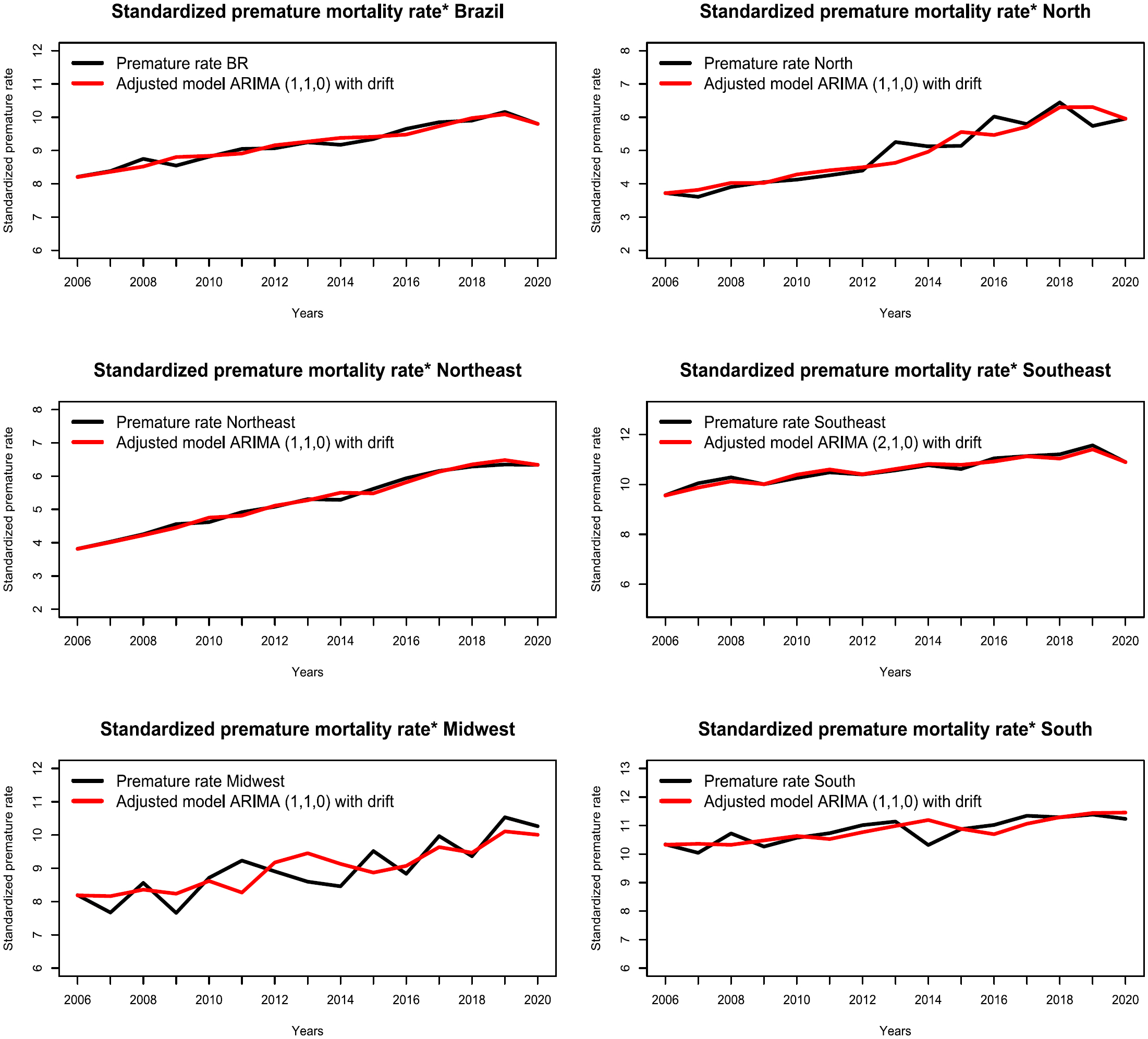
The charts of the standardized rate with the adjusted model show goodness-of-fit. The Southeast region had the highest time-dependence with one model Arima (2,1,0) with drift, for the other regions the model Arima (1,1,0) was utilized. All the models presented goodness-of-fit, even in the Midwest and North regions, with 4.62% and 4.21%, respectively. The values MAPE for the other regions and the national values fluctuated between 1.2 and 1.4%. All the regions presented rising trend of the standardized mortality rates by CRC from 2006 to 2020 (Graph 1).

The South and Southeast regions presented the highest standardized rates of premature death for the general population in 2020, 11.23% and 10.89% respectively, with lower growth trends (0.079% and 0.106%), but the trend for the South region was not statistically significant. North, Northeast and Midwest regions had increasing trend above the national mean of 0.124% (Table 3).
The South region was the only Brazilian region which met the goal of reduction of mortality of at least 2% between 2012 and 2014. In 2020, all the regions exceeded at least two points above the goal of premature standardized mortality rate, the results show that premature mortality by CRC kept an increasing trend even after the implementation of the strategic plan (Table 4).
Difference between the annual premature standardized mortality rate by CRC and goal of 2% of reduction of NCD
DISCUSSION
The increasing time trend of premature mortality rate by CRC in Brazil was observed for both sexes across all the country's regions during the years investigated. From 2011 to 2020, the goal of reduction of CRC determined by the Strategic Plan for Tackling Chronic NCDs (2%/ year) was not met.
As the South and Southeast regions are the most economically developed regions and the Northeast and North are the less developed, some findings deserve attention: a) the highest mortality rates were found at the most economically developed and declining trend in time and b) the lowest mortality rates were found on the least developed regions and rising trend in time. The model for the Midwest region with the highest trend among the regions varied significantly, with consistent growth curve and wider amplitude of the confidence interval, which can explain its rising trend compared to other regions (Table 3).
Socioeconomic level and CRC is a well-established relation in the literature. Studies show the rising time trend by CRC in Brazil, a developing country and positive association between the rates and level of local development4,11,25. The premature mortality rate by CRC was higher in the South, Southeast and Midwest regions, the most economic developed. Globally, there is a rising trend of the morality rate by CRC in less developed countries, mainly in Eastern Europe, Latin America and Asia, while in the Western European countries, a declining trend was noticed2. Although in USA the rate declines continuously, deaths by CRC in individuals younger than 55 years have increased nearly 1% annually26.
The rising trend of the mortality in Brazil reflects the heterogeneity across the Brazilian regions, similar to what other national studies have concluded4,11,27. Although lower rates of premature mortality have been found in the North and Northeast regions, there is an increasing trend compared with the South and Southeast regions for both sexes, similar to other studies which estimated significant rise of the mortality rate for the least developed regions until 2030 due to late diagnosis that could have been diagnosed earlier contrary to the most developed regions28-30.
Many studies have shown highest premature mortality rates in men than in women4,28,31,32. However, other Brazilian studies concluded otherwise33. These results can be explained by poor search of men for health services, higher alcohol intake and cultural issues, in addition to few health units for males only34. On the other hand, a possible protective effect of female hormones against colorectal tumors with the use of oral contraceptives and hormone replacement therapy35 has been described.
Higher premature mortality rates were found for Brazilian men in every region, except the North region, however, no statistically significant difference was detected among premature mortality rates for men and women in the North and Northeast regions.
The study by Barbosa30 emphasizes the differences among sexes with relative stable female mortality rates until 2030 and reduction of male mortality. Souza et al29, in their study, show increase of male mortality rates nationally and by geographical regions, except for the South region (a drop is anticipated) until 2025. Rising rates are expected for women in the whole country, increasing in the North, Northeast and Midwest regions and declining in the South and Southeast regions, but other factors may affect the heterogeneity of the mortality by CRC in the regions.
Heterogeneous food profiles of each region may impact the distribution of mortality rates by CRC27. The Family Budget Research of 2017-2018 investigated the Brazilian food diet by comparing the macroregions: fruits and vegetable per capita intake (kg) in the North region is well below other regions. The intake of meats is higher in the South region, followed by the Midwest, Southeast, North and Northeast. Beverages in general has risen from 9.7% in 2008-2009 to 10.6% in 2017-2018 with the same behavior of annual intake of meats per capita in the regions, higher in the South region, followed by Midwest, Southeast, North and Northeast regions36,37. The analyzes of regions’ intake rates should include dietary standards in addition to family income because it can impact the consumption of food with protective effect against CRC4.
The time since diagnosis and treatment of CRC varies in States and Regions. The waiting time to start treatment can reflect deficiencies of access to treatment and negatively impact the prognosis of CRC. Lima and Villela38 showed the long waiting time in Brazil and differences among macroregions and found that the mean time to start the treatment is less than 60 days, but in some states, the time exceeded 60 days as in the North Region (Pará and Amazonas), Northeast (Sergipe and Bahia), Midwest (Goiás and Federal District) and Southeast (Rio de Janeiro).
The goal of the Strategic Action Plan for Tackling Chronic NCD for CRC is challenging for the government. Screening and detection are the main strategies to reduce the mortality. The etiology of CRC favors screening because the time of onset of the adenoma, growth and transformation in tumor exceeds ten years, quite long to allow the identification, resection and prevention39,40.
The WHO recommends early diagnosis and screening for men and women older than 50 years (the incidence below 50 years is 10%) in countries with structure to confirm the diagnosis and treatment. In Brazil, screening is indicated for the age-range of 50-75 years with test of occult blood in feces, colonoscopy or sigmoidoscopy and endoscopy polypectomy which reduce the incidence and mortality10,39,40. Whether evidences of cost-effectiveness and sustainability are not available, the priority is early and patient-centered diagnosis for high-risk situations. Although clinical trials address the benefits of screening, the implementation of national CRC screening programs in Brazil depends on cost-effectiveness and feasibility in addition to health systems context39,40.
It is strongly recommended that early diagnosis strategy is implemented in its integrality: ample disclosure to the population and health professionals of signs, immediate access to diagnosis of suspected cases (increased offer of digestive endoscopy and others) and access to correct and timely treatment39,40.
As CRC is a modifiable type of cancer, national preventive policies are important. Healthy life measures and reduction of chronic NCD were included in public policies as promotion of better feeding, high intake of fruits and vegetables, less salt, public venues for physical activity, anti-smoking campaigns and banning alcohol adds11,41. The successful fulfillment of the goal hinges on: ensure the access to health unit, especially for most vulnerable groups, health professionals training, renovation of health units with better equipment, investment in access to high and intermediate complex technologies if applicable.
Notwithstanding what has been achieved in the last decades, some limitations related to the quality of death certificates which feed the database of SIM42,43 have been found. This reality can interfere in the calculation of rates that differ across the regions with potential subnotification, mainly in the North and Northeast regions undergoing demographic and epidemiologic transition with less coverage, less economically developed and portraying more deaths than notified with clear consequences in the formulation of public policies.
CONCLUSION
The trend of premature mortality by CRC has risen across every Brazilian region for both sexes similar to developing countries, but this result failed to reach the reduction of the goal of premature death proposed by the Ministry of Health, an important public health problem. The definition of priority populations and Brazilian regions for early intervention that increase survival and reduce mortality depends on rates trends.
Regardless of genetic factors and population ageing – risk factors not addressed in this study – the patterns and trends of incidence and premature mortality by CRC are related to levels of human and local development which, if modified, can reflect in healthier lifestyles. Targeted resources-dependent governmental interventions including primary health promotion with early detection to reduce the number of patients with CRC in the upcoming years is required.
Full care to patients with CRC, even if these measures have been implemented, should address the access to health units which offer high-and-middle complex technologies. Cost-effective governmental evaluations to facilitate the access of vulnerable populations to tests of occult blood in feces and colonoscopy, increasing CRC screening since prognosis and reducing premature death because prognosis is quite often better whether detected in symptomatic stage.
References
-
1 GCO: Global Cancer Observatory [Internet]. Lyon: IARC; c1965-2022. Estimated number of new cases in 2020, worldwide, both sexes, all ages. [acesso 2021 mar 8]. Disponível em: https://gco.iarc.fr/today/online-analysis-table
» https://gco.iarc.fr/today/online-analysis-table -
2 Sung H, Ferlay J, Siegel RL, et al. Global Cancer Statistics 2020: GLOBOCAN Estimates of Incidence and Mortality Worldwide for 36 Cancers in 185 Countries. CA A Cancer J Clin. 2021;71(3):209-49. doi: https://doi.org/10.3322/caac.21660
» https://doi.org/10.3322/caac.21660 -
3 Malta DC, Duncan BB, Schmidt MI, et al. Trends in mortality due to non-communicable diseases in the Brazilian adult population: national and subnational estimates and projections for 2030. Popul health metrics. 2020;18(sup1):1-4. doi: https://doi.org/10.1186/s12963-020-00216-1
» https://doi.org/10.1186/s12963-020-00216-1 -
4 Dutra VG, Parreira VA, Guimarães RM. Evolution of mortality for colorectal cancer in Brazil and regions, by sex, 1996-2015. Arq Gastroenterol. 2018;55(1):61-5. doi: https://doi.org/10.1590/S0004-2803.201800000-12
» https://doi.org/10.1590/S0004-2803.201800000-12 -
5 Instituto Nacional de Câncer. Estimativa 2023: incidência de câncer no Brasil. Rio de Janeiro: INCA; 2022. [acesso 2023 ago 1]. Disponível em: https://www.inca.gov.br/sites/ufu.sti.inca.local/files/media/document/estimativa-2023.pdf
» https://www.inca.gov.br/sites/ufu.sti.inca.local/files/media/document/estimativa-2023.pdf -
6 Instituto Nacional de Câncer [Internet]. Rio de Janeiro: INCA; 2022. Estatísticas de cancer: Ações de Vigilância do Câncer, componente estratégico para o planejamento eficiente e efetivo dos programas de prevenção e controle de câncer no país; 2023 jun 23 [atualizado 2023 jul 18; acesso 2023 set 14]. Disponível em: https://www.gov.br/inca/pt-br/assuntos/cancer/numeros
» https://www.gov.br/inca/pt-br/assuntos/cancer/numeros -
7 Center MM, Jemal A, Smith RA, et al. Worldwide variations in colorectal cancer. CA: Cancer J Clin. 2009;59(6):366-78. doi: https://doi.org/10.3322/caac.20038
» https://doi.org/10.3322/caac.20038 -
8 Instituto Nacional de Câncer José Alencar Gomes da Silva, American Institute for Cancer Research, World Cancer Research Fund. Dieta, nutrição, atividade física e câncer: uma perspectiva global – um resumo do terceiro relatório de especialistas com uma perspectiva brasileira. Rio de Janeiro: INCA; 2020. [acesso 2023 jul 1]. Disponível em: https://www.inca.gov.br/sites/ufu.sti.inca.local/files/media/document/dieta_nutricao_atividade_fisica_e_cancer_resumo_do_terceiro_relatorio_de_especialistas_com_uma_perspectiva_brasileira.pdf
» https://www.inca.gov.br/sites/ufu.sti.inca.local/files/media/document/dieta_nutricao_atividade_fisica_e_cancer_resumo_do_terceiro_relatorio_de_especialistas_com_uma_perspectiva_brasileira.pdf -
9 Habr-Gama A. Câncer coloretal: a importância de sua prevenção. Arq. Gastroenterol. 2005;42(1):2-3. doi: https://doi.org/10.1590/S0004-28032005000100002
» https://doi.org/10.1590/S0004-28032005000100002 -
10 Arnold M, Sierra MS, Laversanne M, et al. Global patterns and trends in colorectal cancer incidence and mortality. Gut. 2016:66(4):683-91. doi: https://doi.org/10.1136/gutjnl-2015-310912
» https://doi.org/10.1136/gutjnl-2015-310912 -
11 Camargo Cancela M, Bezerra de Souza DL, Leite Martins LF, et al. Can the sustainable development goals for cancer be met in Brazil? A population-based study. Front Oncol. 2023;12:1060608. doi: https://doi.org/10.3389/fonc.2022.1060608
» https://doi.org/10.3389/fonc.2022.1060608 - 12 Ministério da Saúde (BR). Secretaria de Vigilância em Saúde. Departamento de Análise de Situação de Saúde. Plano de ações estratégicas para o enfrentamento das doenças crônicas não transmissíveis (DCNT) no Brasil 2011-2022. Brasília, DF: MS; 2011.
-
13 World Health Organization. WHO Global action plan for the prevention and control of noncommunicable disease 2013-2020 [Internet]. Geneva: WHO; 2013. [2021 jul 1]. Disponível em: https://www.who.int/publications/i/item/9789241506236
» https://www.who.int/publications/i/item/9789241506236 -
14 SIM: Sistema de Informação sobre Mortalidade [Internet]. Versão 3.2.1.2. Brasília (DF): DATASUS. [data desconhecida] - [acesso 2023 ago 1]. Disponível em: http://sim.saude.gov.br/default.asp
» http://sim.saude.gov.br/default.asp - 15 Costa AJL, Kale PC, Vermelho LL. Indicadores de saúde. In: Medronho RA, Bloch KV, Luiz RR, et al. Epidemiologia. São Paulo: Atheneu; 2008. p. 38.
-
16 Departamento de Informática do Sistema Único de Saúde [Internet]. Brasília, DF:MS; 2023. Demográficas e Socioeconômicas; [sem data]. [acesso 2023 ago 1]. Disponível em: https://datasus.saude.gov.br/demograficas-e-socioeconomicas/
» https://datasus.saude.gov.br/demograficas-e-socioeconomicas/ -
17 Mathers CD, Bernard C, Iburg KM, et al. Global burden of disease in 2002: data sources, methods and results [Internet]. Geneva: World Health Organization; 2003. [acesso 2023 ago 1]. Disponível em: https://citeseerx.ist.psu.edu/document?repid=rep1&type=pdf&doi=b1570a1c4ea8d47e1a81b7c012b054439870cc15
» https://citeseerx.ist.psu.edu/document?repid=rep1&type=pdf&doi=b1570a1c4ea8d47e1a81b7c012b054439870cc15 - 18 Girianelli VR, Gamarra CJ, Azevedo e Silva G. Os grandes contrastes na mortalidade por câncer do colo uterino e de mama no Brasil. Rev Saúde Publica. 2014;48(3):459-67.
- 19 França E, Teixeira R, Ishitani L, et al. Ill-defined causes of death in Brazil: a redistribution method based on the investigation of such causes. Rev Saúde Pública. 2014;48:671-81.
- 20 Morettin PA, Toloi CM. Análise de séries temporais: modelos lineares univariados. São Paulo: Editora Blucher; 2018.
- 21 Johnston J, Dinardo J. Métodos econométricos [A3]. 4 ed. Singapura: McGraw-Hill; 2004.
-
22 Oliveira MS, Montovani EH, Santana MD, et al. Mortalidade por doença respiratória crônica no Brasil: tendência temporal e projeções. Rev Saúde Pública. 2022;56:52. doi: https://doi.org/10.11606/s1518-8787.2022056003672
» https://doi.org/10.11606/s1518-8787.2022056003672 -
23 R: The R Project for Statistical Computing [Internet]. Version 4.1.0 [Desconhecido]: The R foundation. 2021 Nov 2 - [acesso 2023 ago 1]. Disponível em: https://www.r-project.org/
» https://www.r-project.org/ - 24 Conselho Nacional de Saúde (BR). Resolução n° 510, de 7 de abril de 2016. Dispõe sobre as normas aplicáveis a pesquisas em Ciências Humanas e Sociais cujos procedimentos metodológicos envolvam a utilização de dados diretamente obtidos com os participantes ou de informações identificáveis ou que possam acarretar riscos maiores do que os existentes na vida cotidiana, na forma definida nesta Resolução. Diário Oficial da União, Brasília, DF. 2016 maio 24; Seção I:44.
-
25 Dutra VG, Guimarães RM. Desenvolvimento social e mortalidade por câncer de cólon e reto no Brasil, 1996-2013. Rev Bras Cancerol. 2016;62(4):345. doi: https://doi.org/10.32635/2176-9745.RBC.2016v62n4.216
» https://doi.org/10.32635/2176-9745.RBC.2016v62n4.216 -
26 American Cancer Society.. Atlanta: American Cancer Society; 2020. Key Statistics for Colorectal Cancer; 2023 ago 1. [atualizado 2024 jan 29; acesso 2023 ago 14]. Disponível em: https://www.cancer.org/cancer/colon-rectal-cancer/about/key-statistics.html
» https://www.cancer.org/cancer/colon-rectal-cancer/about/key-statistics.html - 27 Neves FJ, Mattos IE, Koifman RJ. Mortalidade por câncer de cólon e reto nas capitais brasileiras no período 1980-1997. Arq Gastroenterol. 2005;42(1):63-70.
-
28 Kuiava VA, Grisolia ET, Fornari F, et al. Reported mortality for colorectal cancer in Brazil in the first 16 years of the 21st century. Clin Biomed Res. 2019;39(3):186-92. doi: https://doi.org/10.22491/2357-9730.93465
» https://doi.org/10.22491/2357-9730.93465 - 29 Souza DL, Jerez-Roig J, Cabral FJ, et al. Colorectal cancer mortality in Brazil: predictions until the year 2025 and cancer control implications. Diseases of the colon & rectum. 2014;57(9):1082-9.
-
30 Barbosa IR, Souza DL, Bernal MM, et al. Cancer mortality in Brazil: temporal trends and predictions for the year 2030. Medicine. 2015;94(16):e746. https://doi.org/10.1097/md.0000000000000746
» https://doi.org/10.1097/md.0000000000000746 -
31 Jardim BC, Ferreira VD, Junger WL, et al. Cancer mortality in the capitals and in the interior of Brazil: a four-decade analysis. Rev Saúde Pública. 2020;54:126. doi: https://doi.org/10.11606/s1518-8787.2020054002255
» https://doi.org/10.11606/s1518-8787.2020054002255 -
32 Martin FL, Morais CL, Sakita JY, et al. Age-related and gender-related increases in colorectal cancer mortality rates in Brazil between 1979 and 2015: projections for continuing rises in disease. J Gastrointest. Canc. 2021;52:280-8. doi: https://doi.org/10.1007/s12029-020-00399-8
» https://doi.org/10.1007/s12029-020-00399-8 -
33 Moura AR, Marques AD, Dantas MS, et al. Trends in the incidence and mortality of colorectal cancer in a brazilian city. BMC Research Notes. 2020;13(560):1-6. doi: https://doi.org/10.1186/s13104-020-05411-9
» https://doi.org/10.1186/s13104-020-05411-9 -
34 Gomes R, Nascimento EF, Araújo FC. Por que os homens buscam menos os serviços de saúde do que as mulheres? As explicações de homens com baixa escolaridade e homens com ensino superior. Cad Saúde Pública. 2007;23(3):565-74. doi: https://doi.org/10.1590/S0102-311X2007000300015
» https://doi.org/10.1590/S0102-311X2007000300015 -
35 Majek O, Gondos A, Jansen L, et al. Sex differences in colorectal cancer survival: population-based analysis of 164,996 colorectal cancer patients in Germany. PloS one. 2013;8(7):e68077. doi: https://doi.org/10.1371/journal.pone.0068077
» https://doi.org/10.1371/journal.pone.0068077 - 36 Instituto Brasileiro de Geografia e Estatística. Pesquisa de orçamentos familiares 2017-2018: despesas, rendimentos e condições de vida. Rio de Janeiro: IBGE; 2019.
-
37 Rodrigues RM, Souza AD, Bezerra IN, et al. Evolução dos alimentos mais consumidos no Brasil entre 2008-2009 e 2017-2018. Rev Saúde Pública. 2021;55(Supl1):1-10s. doi: https://doi.org/10.11606/s1518-8787.2021055003406
» https://doi.org/10.11606/s1518-8787.2021055003406 -
38 Lima MA, Villela DA. Fatores sociodemográficos e clínicos associados ao tempo para o início do tratamento de câncer de cólon e reto no Brasil, 2006-2015. Cad Saúde Pública. 2021;37(5):e00214919. doi: https://doi.org/10.1590/0102-311X00214919
» https://doi.org/10.1590/0102-311X00214919 - 39 Ministério da Saúde (BR). Secretaria de Atenção à Saúde. Departamento de Atenção Básica. Rastreamento. Brasília, DF: MS; 2010.
-
40 Instituto Nacional de Câncer José Alencar Gomes da Silva. Detecção Precoce do câncer. Rio de Janeiro: INCA; 2021. [acesso 2023 set 1]. Disponível em: https://www.inca.gov.br/sites/ufu.sti.inca.local/files/media/document/deteccao-precoce-do-cancer.pdf
» https://www.inca.gov.br/sites/ufu.sti.inca.local/files/media/document/deteccao-precoce-do-cancer.pdf -
41 Malta DC, Andrade SS, Oliveira TP, et al. Probabilidade de morte prematura por doenças crônicas não transmissíveis, Brasil e regiões, projeções para 2025. Rev Bras Epidemiol. 2019;22:e190030. https://doi.org/10.1590/1980-549720190030
» https://doi.org/10.1590/1980-549720190030 -
42 Instituto Brasileiro de Geografia e Estatística. IBGE divulga estimativas de sub-registro e subnotificação de nascimentos e óbitos em 2021. Agência IBGE Notícias. 2023 dez. 14 [acesso 2023 dez 14]. Disponível: https://agenciadenoticias.ibge.gov.br/agencia-sala-de-imprensa/2013-agencia-de-noticias/releases/38664-ibge-divulga-estimativas-de-sub-registro-e-subnotificacao-de-nascimentos-e-obitos-em-2021#:∼:text=O%20total%20estimado%20de%20%C3%B3bitos,2015%20(2%2C32%25)
» https://agenciadenoticias.ibge.gov.br/agencia-sala-de-imprensa/2013-agencia-de-noticias/releases/38664-ibge-divulga-estimativas-de-sub-registro-e-subnotificacao-de-nascimentos-e-obitos-em-2021#:∼:text=O%20total%20estimado%20de%20%C3%B3bitos,2015%20(2%2C32%25) - 43 Ministério (BR). Secretaria de Vigilância em Saúde. Departamento de Vigilância de Doenças e Agravos Não Transmissíveis e Promoção da Saúde. A qualidade das Informações. Saúde Brasil 2014. Brasília, DF: Ministério da Saúde; 2014.
Edited by
-
Associate-editor:
Jeane Tomazelli. Orcid iD: https://orcid.org/0000-0002-2472-3444
-
Scientific-editor:
Anke Bergmann. Orcid iD: https://orcid.org/0000-0002-1972-8777