 Muscle endurance of Brazilian children and adolescents: a systematic review update of published studies from 2020 to 2024
Abstract
Abstract Muscle endurance is an important indicator of health-related fitness in childhood and adolescence. The present study aimed to identify and summarize the evidence on the prevalence of adequate muscle endurance among Brazilian children and adolescents (6 to 18 years) to update the evidence of previously published by the Report Card Brazil project. A systematic search of studies published from 2020 to 2024 was performed in five databases (LILACS, SciELO, Medline/PubMed, Web of Science, Scopus). We identified 20,202 articles; 16 met the eligibility criteria and were included in this review for data extraction and risk-of-bias assessment. Among the 4,613 children and adolescents participating in the studies was estimated at 55.9% (range 29.1% to 76.7%), had adequate abdominal muscle endurance. Different test batteries were reported, the most used were PROESP/BR® and FITNESSGRAM®. Most studies were carried out in the South (62.5%) and Southeast (25.0%) regions of Brazil. We conclude that more than half of Brazilian children and adolescents of both genders have an abdominal muscle endurance adequate for health, with similar values among boys and girls.
Key words:
Adolescent; Child; Physical fitness
Resumo
Resumo A resistência muscular é um importante indicador de aptidão física relacionada à saúde na infância e na adolescência. O presente estudo teve como objetivo identificar e sumarizar as evidências sobre a prevalência de resistência muscular adequada entre crianças e adolescentes brasileiros (6 a 18 anos) para atualizar as evidências publicadas anteriormente pelo projeto Report Card Brasil. Uma busca sistemática de estudos publicados de 2020 a 2024 foi realizada em cinco bases de dados (LILACS, SciELO, Medline/PubMed, Web of Science, Scopus). Identificamos 20.202 artigos, dos quais 16 atenderam aos critérios de elegibilidade e foram incluídos nesta revisão para extração de dados e avaliação do risco de viés. Entre as 4.613 crianças e adolescentes participantes dos estudos, estimou-se que 55,9% (variação de 29,1% a 76,7%) apresentavam resistência muscular abdominal adequada. Diferentes baterias de testes foram reportadas, sendo as mais utilizadas o PROESP/BR® e o FITNESSGRAM®. A maioria dos estudos foi realizada nas regiões Sul (62,5%) e Sudeste (25,0%) do Brasil. Concluímos que mais da metade das crianças e adolescentes brasileiros de ambos os sexos possuem resistência muscular abdominal adequada para a saúde, com valores semelhantes entre meninos e meninas.
Palavras-chave:
Adolescente; Criança; Aptidão física
INTRODUCTION
Physical fitness is considered essential for health, and high levels during childhood and adolescence tend to have positive repercussions in adulthood, reducing the risk of future comorbidities and expanding opportunities for engagement in physical activity1. Within this context, muscular fitness stands out as an important component, being related to motor performance but also to mental, bone, and metabolic health2.
As an integral part of this construct, muscle endurance is defined as the ability to sustain repeated contractions over time3. Although it has historically been associated with athletic performance, muscle endurance is now recognized as an essential component for functional capacity, enabling individuals to perform activities of daily living more effectively and with less fatigue3.
The importance of monitoring this attribute lies in its robust long-term association with health outcomes4. Evidence suggests an inverse relationship between muscle endurance and cardiovascular risk factors, such as adiposity, insulin resistance, and systemic inflammation5,6. Additionally, the tracking phenomenon has been observed, in which the muscle endurance profile observed in the pediatric phase tends to persist into adulthood4. Consequently, low muscle endurance in youth increases the risk of all-cause morbidity and mortality as well as the development of chronic diseases in the future7. Conversely, maintaining adequate levels from an early age may provide lasting protection against these conditions4.
Despite the health benefits, a concerning trend is observed in Brazil, where more than half of children and adolescents exhibit inadequate levels of abdominal muscle endurance2. This situation is further aggravated by the increase in sedentary behavior, especially screen time, physical inactivity, and excess body fat8. To mitigate this cycle, global guidelines from the World Health Organization9 and the Physical Activity Guidelines for the Brazilian Population10 recommend, in addition to 60 minutes of daily activity, the specific inclusion of muscle- and bone-strengthening exercises on at least three days of the week.
Updating this evidence base is important both to identify new findings and to support the continuous surveillance of this relevant health-related indicator. This study aimed to identify and summarize the evidence on the prevalence of adequate muscle endurance among Brazilian children and adolescents (6 to 18 years) to update the evidence previously published by the Report Card Brazil project.
METHODS
This systematic review is part of the Global Matrix 5.0 initiative of the Active Healthy Kids Global Alliance11 based on the “Report Card Brazil: Health Indicators for Children and Adolescents” (4rd edition) project, which updates previous systematic reviews12,13 by expanding the number of bibliographic databases, the search strategy, and the temporal window of published articles. The systematic reviews of the health indicators covered by the “Report Card Brazil” protocol were registered on the OSF platform14, which provides further details about the project.
Eligibility criteria
The inclusion criteria were original studies involving Brazilian children and adolescents (6 to 19 years) that measured muscle endurance in the trunk region (abdominal) using flexion tests and upper limbs using curl-up, push-up, or modified pull-up tests– most used in previous research2 if they reported the interpretation of the adequacy of this physical fitness component, and the prevalence of participants who met the muscle endurance criteria. Studies of any design (observational or intervention) published in Portuguese, English, or Spanish.
Studies were excluded if: 1) issue was outside the scope of this review; 2) participants were younger (< 6 years) or older (> 19 years); 3) they involved participants of nationalities other than Brazilian; 4) children and adolescents had chronic conditions (HIV infection, congenital heart disease, cancer or chromosomal abnormalities) or were athletes. The Rayyan Platform (QCRI, Qatar) was utilized to identify and exclude duplicate studies across various bibliographic databases. Narrative and systematic reviews, case reports, monographs, dissertations, and theses were also excluded.
Sources
Five bibliographic databases were searched for studies published between January 2020 and December 2024: Latin American and Caribbean Literature in Health Sciences (LILACS) through the Bireme platform, Scientific Electronic Library Online (SciELO), SCOPUS, and Medical Literature Analysis and Retrieval System Online (MEDLINE) through PubMed and the Web of Science.
Search strategy
Procedures such as search, selection, inclusion, and exclusion of original studies were carried out by two pairs of independent researchers (MRA and FAG; MA and KS). All conflicts and disagreements were discussed in a consensus meeting, and a third reviewer resolved them with a casting vote (ECM). The research in the bibliographic databases utilized descriptors related to the outcome and the population of interest, organized into separate blocks, as presented in the Supplementary Table 1. Boolean operators “AND” for addition and “OR” for substitution were used. All searches were conducted on July 14, 2025, using English-language descriptors.
Study selection
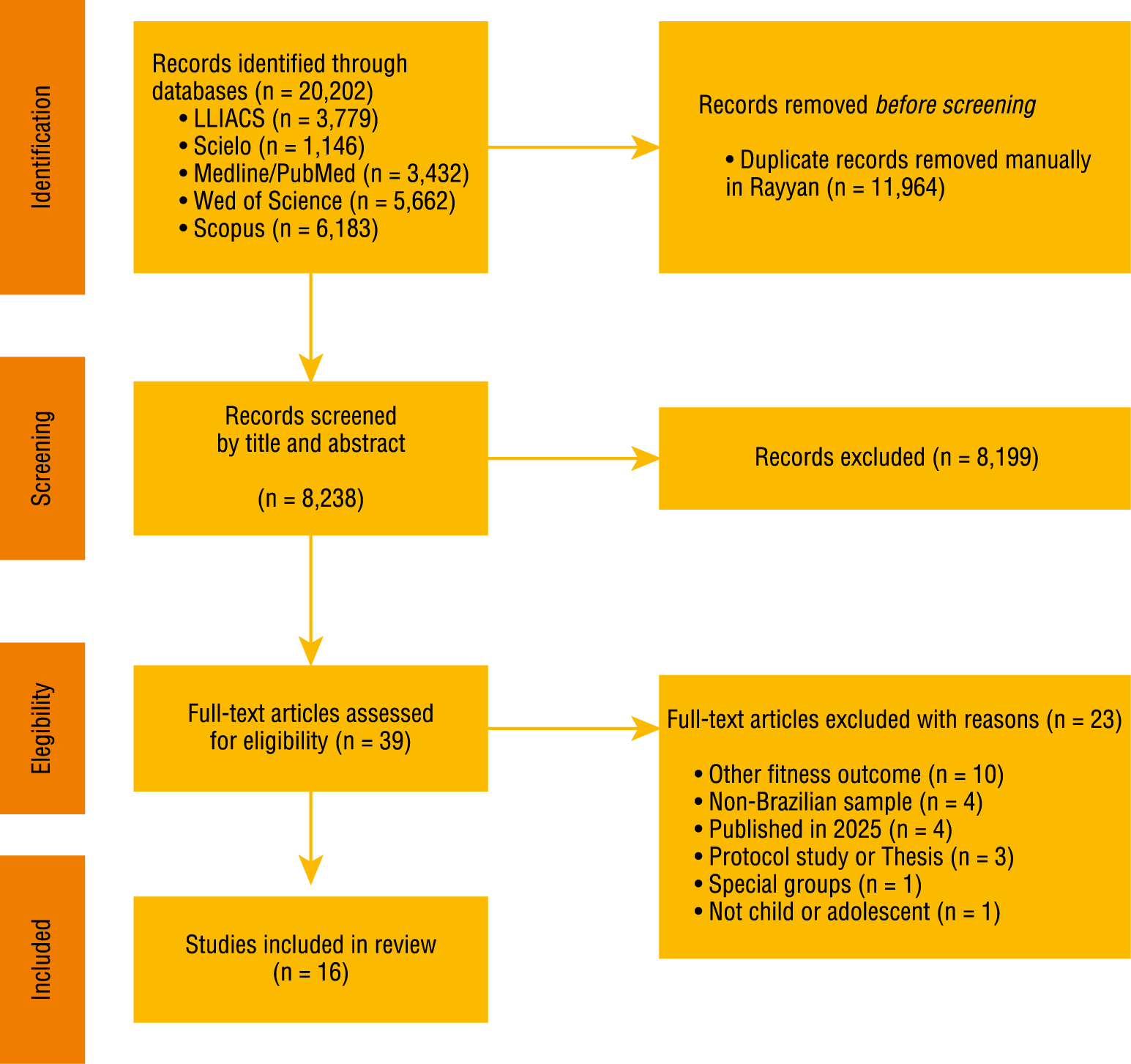
The studies identified in the databases were downloaded and analyzed using the Rayyan® platform to exclude duplicates. Two pairs of researchers (MRA and FAG; MA and KS) independently read titles and abstracts to screen studies for eligibility using the Rayyan platform. The full texts of the remaining studies were read, considering the eligibility criteria (Figure 1). Eligible studies had their reference list checked to find potential studies that the initial search strategy had not identified. If these studies met the eligibility criteria, they were included in this review.
Data collection process
Information about authorship, year of publication, study site, sample size, and percentage of participants by sex and age group was extracted from eligible studies (Table 1). In addition, information was extracted on muscle endurance tests used, cutoff points, and the total prevalence of participants who met the muscle endurance criteria, stratified by sex and their classifications, if available (Table 2). For studies that did not present prevalence data, mean and standard deviation information were extracted from muscle endurance tests (Table 3). All data extraction procedures were performed independently by pairs of researchers (MRA and FAG; MA and KS) and subsequently validated by another independent researcher (LRAL).
Characteristics of the included studies (n=16) about muscular endurance with Brazilian children and adolescents, Brazil, 2025.
Protocol, Fitness Battery, and Prevalence of adequate muscle endurance in Brazilian children and adolescents, Brazil, 2024.
Protocol, Fitness Battery, and mean value of muscle endurance in Brazilian children and adolescents, Brazil, 2024.
Risk of bias assessment
The risk of bias was analyzed using the National Heart, Lung, and Blood Institute Quality Assessment Tool for Observational Cohort and Cross-Sectional Studies31. This instrument contains 14 questions regarding the internal validity of the study, 10 of which refer to cross-sectional observational studies. The analysis process was conducted by one researcher (ECM) and validated by another independent researcher (PFRB), with conflicts being resolved by a third researcher (LRAL). A score of 0 (no) and 1 (yes) was assigned to each item evaluated, and the arithmetic mean of the valid questions was obtained to calculate the final score of the instrument, excluding the questions that could not be answered by the information available in the study and/or did not apply to it. The final score was classified as low (score ≥ 0.70), moderate (≥ 0.50-0.69), or high (< 0.50) risk of bias.
Summary of results
When summarizing the results, the prevalence of children and adolescents who met the recommended health criteria for muscle endurance was based on the cutoff points and classifications used in the eligible studies. As a summary indicator, the mean prevalence of adequate muscle endurance was calculated from the available data from the included studies.
RESULTS
Based on the search strategy, 20,202 studies were identified in the databases. From these, 11,964 duplicate studies were manually removed using Rayyan®. The remaining 8,238 studies were assessed for eligibility, and 8,199 were excluded based on title and abstract review. Furthermore, 39 studies were reviewed in full-text assessment for eligibility, resulting in 16 studies included in the present review. Figure 1 summarizes the analysis steps and shows the reasons for exclusion.
The characteristics of the 16 studies included in the review are shown in Table 1. Ten studies (62.5%) were conducted in the South region, five in the state of Parana16,23,24,28,30, three in Rio Grande do Sul15,25,26, and two in Santa Catarina19,29. Four studies (25.0%) were carried out in the Southeast region, two in the state of Rio de Janeiro18,22, one in Minas Gerais21, and one in Sao Paulo20. Two studies (12.5%) were conducted in the Northeast region (Pernambuco17 and Ceará27). No studies have been conducted in the northern and central-western regions of the country. Most studies investigated both sexes (n = 15)15,16,18-30, the age group 6-19 years, and, together, included a total of 4,613 Brazilian children and adolescents (Table 1).
Different tests were used to assess abdominal muscle endurance in Brazilian children and adolescents, but, in general, most studies used the curl-ups maximum in 60 seconds (n = 13)15,17,18,20,21,23-30. There are different cutoff points in the literature for assessing muscle endurance using curl-ups. The following physical fitness batteries were used: PROESP-BR (n = 06)15,18,20,25-27, FITNESSGRAM (n = 07)16,17,22-24,28,30, and others (n = 05)16,17,19,21,29. From included studies, only six (n = 06) reported data on the overall prevalence of adequate muscle endurance15,16,19,25-27.
The overall prevalence of children and adolescents with adequate abdominal muscle endurance was estimated at 55.9% (range 29.1%27 to 76.7%19) according to the health criteria defined by the physical fitness batteries. The overall prevalence of adequate muscle endurance for health was 56.0% (range: 21.2%27 to 87,7%19) for males and 56.0% (range: 32.4%25 to 74.3%15) for females (Table 2). Additionally, for studies without prevalence values, we calculated average values and observed that, in general, the average number of repetitions (per minute or total repetitions, depending on the test protocol) across the studies was 25.11, ranging from 14.530 to 35.8620 (Table 3).
The studies showed a moderate risk of bias (n = 10; 62.5%)15,17,18,21,24-27,29,30 and low risk of bias (n = 6; 37.5%)16,19,20,22,23,28. Details of the studies regarding the risk of bias are presented in Table 4.
Risk of bias assessment in the studies included in the systematic review on muscle endurance in Brazilian children and adolescents, Brazil, 2025.
DISCUSSION
This systematic review aimed to identify and synthesize the most recent evidence on the prevalence of adequate muscle endurance among Brazilian children and adolescents, covering studies published between 2020 and 2024. Sixteen original studies were included, with a total of 4,613 children and adolescents aged 6 to 19 years. We found a geographical disparity of the included studies, since ahigh number in the South (n = 11)15-17,19,23-26,28-30 and Southeast (n = 4)18,20-22 regions, with low representation from the Northeast (n = 2)17,27 and an absence of studies from the North and Midwest regions. Regarding the analyzed construct, the main findings revealed that most studies assessed the abdominal region, predominantly evaluated by abdominal curl-up tests, indicating that approximately 55.9% of the evaluated youth reached the recommended health levels, with values ranging from 29.1%27 to 76.7%19. Moving forward from previous review, this incorporated four studies that assessed upper-limb muscular endurance using push-ups. In this body segment, the muscular endurance profile was substantially lower, with a prevalence of 32.1%, varying between 13.5%16 and 62.9%16.
In the most recent overall Report Card Brazil 2022, the global physical fitness indicator was graded as D+, indicating that fewer than half of Brazilian children and adolescents met the established health criteria13. Compared to the last national survey2, conducted in 2021, an increase in the adequacy of abdominal muscular endurance was observed (57.0% vs. 43.5%). However, the Brazilian prevalence remains lower than international scores32,33. This comparison becomes even more relevant, as in recent decades a global trend of continuous decline in muscular fitness among youth has been observed, especially affecting abdominal and upper limb muscular endurance1.
These findings should be interpreted considering the broader epidemiological context. Most studies included in this review collected their data before the COVID-19 pandemic. Therefore, the higher prevalence of adequate muscular endurance observed in the present review may partly reflect the pre-pandemic period rather than the current national scenario. This interpretation is consistent with Eberhardt et al.34, who reported that the previous downward trend in muscular endurance had stabilized and that improvements were already being observed before the pandemic. The same study also suggested that the onset of the pandemic interrupted this favorable trajectory. Such an interpretation is plausible, given that pandemic-related restrictions were associated with increased physical inactivity and sedentary behavior, contributing to greater adiposity. In turn, excess adiposity may impair performance in tests that require supporting or repeatedly moving one’s own body mass and penalize obese and overweight individuals35. In addition, muscular endurance has been shown to be inversely associated with obesity indicators in young populations5.
Differences in abdominal and upper-limb muscular endurance may be partly explained by the distinct functional roles and movement demands associated with these muscle groups. Trunk musculature is primarily involved in postural control and locomotion and is more consistently during everyday activities36. In contrast, the development of upper limb endurance depends on neuromuscular stimuli and specific overload, which occur mainly during active play that involves supporting and pulling one's own body weight37. From this perspective, reduced engagement in such activities may disproportionately affect upper-limb muscular endurance, highlighting the importance of promoting movement experiences that specifically challenge this body segment throughout childhood and adolescence. In the Brazilian context, schools may represent a particularly strategic setting for this purpose. The School indicator was among the highest-rated components in Report Card Brazil 2022, receiving a grade of B, largely due to the mandatory inclusion of physical education in the school curriculum13. Accordingly, school-based strategies may play a central role in aligning practice with the recommendations of the World Health Organization9 and the Brazilian Physical Activity Guidelines10, both of which emphasize the regular inclusion of muscle-strengthening activities.
When analyzing muscular endurance by gender, the findings revealed differences across body segments. In upper limb tests, a superiority of the male gender was observed. This superiority in this specific region stems from both the biological sexual dimorphism of puberty and sociocultural barriers, which historically direct boys more toward practices requiring greater strength. In contrast, when observing abdominal endurance, the scenario appears more balanced, suggesting an equilibrium in the muscle group responsible for stabilization, where biological and cultural differences are attenuated.
Continuous monitoring of muscular endurance is necessary because adequate levels of muscular endurance and a lower risk of cardiometabolic diseases during childhood and adolescence5. However, the present systematic review presents limitations: 1) the strong concentration of studies in the South and Southeast regions, with an absence of data from the North and Midwest, limiting generalizability to the national scenario; 2) the heterogeneity of protocols and cut-off points, making direct comparisons between studies difficult; and 3) the predominance of data collected in the pre-pandemic period, which prevents observing the acute impact of COVID-19 isolation on current prevalence.
CONCLUSION
This systematic review updates the study by Silva et al.2 and shows that more than half (57.0%) of Brazilian children and adolescents met the health criteria for abdominal muscular endurance. In contrast, the inclusion of upper-limb muscular endurance revealed substantially lower prevalence estimates (32.1%), highlighting an imbalance across body segments and, more importantly, the need for targeted activities to improve upper-limb fitness. In addition, the scientific evidence on this topic remains concentrated in the South and Southeast regions and is characterized by heterogeneous assessment protocols, which limit both cross-study comparability and the national representativeness of the findings. Therefore, future studies that include all regions of the country and adopt more standardized procedures are needed to strengthen the monitoring of this indicator in the Brazilian context. From a practical perspective, the findings of this review may support the development of interventions and public policies, especially in the school setting, to promote muscular fitness and reduce health inequalities among children and adolescents.
SUPPLEMENTARY MATERIAL
Supplementary material accompanies this paper.
Supplementary File 1
This material is available as part of the online article from https://doi.org/10.1590/1980-0037.2026v28e112040
Data Availability Statement
The data that support the findings of this study are available from the corresponding author, upon reasonable request.
-
How to cite this article
Silva Junior MCP, Menezes EC, Silva MRA, Alencar MA, Albuquerque FGT, Silva KC, Bandeira PFR, Lima LRA. Muscle endurance of Brazilian children and adolescents: a systematic review update of published studies from 2020 to 2024. Rev Bras Cineantropom Desempenho Hum 2026, 28:e112040. DOI: https://doi.org/10.1590/1980-0037.2026v28e112040
-
Funding
This research did not receive any specific grant from funding agencies in the public, commercial, or not-for-profit sectors. This study was funded by the authors.
-
Ethical approval
This research is in accordance with the standards set by the Declaration of Helsinki.
REFERENCES
-
1 Masanovic B, Gardasevic J, Marques A, Peralta M, Demetriou Y, Sturm DJ, et al. Trends in physical fitness among school-aged children and adolescents: a systematic review. Front Pediatr. 2020;8:627529. https://doi.org/10.3389/fped.2020.627529 PMid:33363072.
» https://doi.org/10.3389/fped.2020.627529 -
2 Silva MCP Jr, Menezes EC, Mendonça G, Lima LRA. Muscle endurance of Brazilian children and adolescents: a systematic review of the literature. Rev Bras Cineantropom Desempenho Hum. 2022;24:e84728. https://doi.org/10.1590/1980-0037.2022v24e84728
» https://doi.org/10.1590/1980-0037.2022v24e84728 -
3 Song JS, Yamada Y, Kataoka R, Hammert WB, Kang A, Loenneke JP. Cross-education of muscular endurance: a scoping review. Sports Med. 2024;54(7):1771-83. https://doi.org/10.1007/s40279-024-02042-z PMid:38758463.
» https://doi.org/10.1007/s40279-024-02042-z -
4 García-Hermoso A, Izquierdo M, Ramírez-Vélez R. Tracking of physical fitness levels from childhood and adolescence to adulthood: a systematic review and meta-analysis. Transl Pediatr. 2022;11(4):474-86. https://doi.org/10.21037/tp-21-507 PMid:35558968.
» https://doi.org/10.21037/tp-21-507 -
5 Lima TR, Martins PC, Moreno YMF, Chaput JP, Tremblay MS, Sui X, et al. Muscular fitness and cardiometabolic variables in children and adolescents: a systematic review. Sports Med. 2022;52(7):1555-75. https://doi.org/10.1007/s40279-021-01631-6 PMid:35020179.
» https://doi.org/10.1007/s40279-021-01631-6 -
6 Smith JJ, Eather N, Weaver RG, Riley N, Beets MW, Lubans DR. Behavioral correlates of muscular fitness in children and adolescents: a systematic review. Sports Med. 2019;49(6):887-904. https://doi.org/10.1007/s40279-019-01089-7 PMid:30864143.
» https://doi.org/10.1007/s40279-019-01089-7 -
7 Kaster T, Dooley FL, Fitzgerald JS, Walch TJ, Annandale M, Ferrar K, et al. Temporal trends in the sit-ups performance of 9,939,289 children and adolescents between 1964 and 2017. J Sports Sci. 2020;38(16):1913-23. https://doi.org/10.1080/02640414.2020.1763764 PMid:32567491.
» https://doi.org/10.1080/02640414.2020.1763764 -
8 De Marco JCP, Bim MA, Souza FUD, Martins R, Pinto ADA, Felden EPG, et al. Association of abdominal endurance with body adiposity, physical activity and sitting time in adolescents. J Sport Health Res. 2025;17(1):23-30. https://doi.org/10.58727/jshr.102584
» https://doi.org/10.58727/jshr.102584 -
9 Bull FC, Al-Ansari SS, Biddle S, Borodulin K, Buman MP, Cardon G, et al. World Health Organization 2020 guidelines on physical activity and sedentary behaviour. Br J Sports Med. 2020;54(24):1451-62. https://doi.org/10.1136/bjsports-2020-102955 PMid:33239350.
» https://doi.org/10.1136/bjsports-2020-102955 -
10 Brasil. Ministério da Saúde. Guia de atividade física para a população brasileira [Internet]. Brasília: Ministério da Saúde; 2021 [cited 2026 Mar 27]. Available from: https://bvsms.saude.gov.br/bvs/publicacoes/guia_atividade_fisica_populacao_brasileira.pdf
» https://bvsms.saude.gov.br/bvs/publicacoes/guia_atividade_fisica_populacao_brasileira.pdf -
11 Active Healthy Kids Global Alliance [Internet]. 2026 [cited 2026 Mar 27]. Available from: https://www.activehealthykids.org/
» https://www.activehealthykids.org/ -
12 Davoli GBDQ, Lima LRA, Silva DAS. Abdominal muscular endurance in Brazilian children and adolescents: systematic review of cross-sectional studies. Rev Bras Cineantropom Desempenho Hum. 2018;20(4):483-96. https://doi.org/10.5007/1980-0037.2018v20n4p483
» https://doi.org/10.5007/1980-0037.2018v20n4p483 -
13 Silva DAS, Pelegrini A, Christofaro DGD, Ferrari EP, Ferrari G, Silva KS, et al. Results from Brazil’s 2022 Report Card on physical activity for children and adolescents. Int J Environ Res Public Health. 2022;19(16):10256. https://doi.org/10.3390/ijerph191610256 PMid:36011891.
» https://doi.org/10.3390/ijerph191610256 -
14 Silva DAS, Pelegrini A, Pinto AA, Christofaro DGD, Ferrari GLM, Nunes HEG, et al. Report Card Brazil: health indicators for children and adolescents [Internet]. OSF; 2026 [cited 2026 Mar 27]. Available from: https://osf.io/y2q8z
» https://osf.io/y2q8z - 15 Aimi GA, Hein AP, Gaya AR. Estado nutricional, nível de atividade física e aptidão física relacionada à saúde de estudantes do ensino fundamental de uma escola particular de Porto Alegre. Rev Destaques Acad. 2021;14(85):121-35.
-
16 Arruda GAD, Coledam DHC, Cantieri FP, Oliveira ARD. Agreement between Physical Best and FitnessGram criterion-referenced standards for muscular strength and endurance. Rev Paul Pediatr. 2021;39:e2020018. https://doi.org/10.1590/1984-0462/2021/39/2020018 PMid:33729322.
» https://doi.org/10.1590/1984-0462/2021/39/2020018 -
17 Almeida MB, Leandro CG, Queiroz DDR, José-da-Silva M, Pessôa Dos Prazeres TM, Pereira GM, et al. Plyometric training increases gross motor coordination and associated components of physical fitness in children. Eur J Sport Sci. 2021;21(9):1263-72. https://doi.org/10.1080/17461391.2020.1838620 PMid:33108985.
» https://doi.org/10.1080/17461391.2020.1838620 -
18 Chagas DDV, Barnett LM. Adolescents’ flexibility can affect motor competence: the pathway from health related physical fitness to motor competence. Percept Mot Skills. 2023;130(1):94-111. https://doi.org/10.1177/00315125221128638 PMid:36192839.
» https://doi.org/10.1177/00315125221128638 -
19 De Marco JCP, Alves AD, Gonzaga I, Bim MA, Carminatti LJ, Pinto ADA, et al. Associação entre aptidão física relacionada à saúde, atividades físicas extracurriculares e adiposidade corporal em uma amostra representativa de adolescentes de Florianópolis, Brasil. Retos. 2023;49:1-8. https://doi.org/10.47197/retos.v49.97245
» https://doi.org/10.47197/retos.v49.97245 -
20 Ferreira GOC, Ferrari G, Langer RD, Cossio-Bolaños M, Gomez-Campos R, Lázari E, et al. Phase angle and its determinants among adolescents: influence of body composition and physical fitness level. Sci Rep. 2024;14(1):13697. https://doi.org/10.1038/s41598-024-62546-6 PMid:38871752.
» https://doi.org/10.1038/s41598-024-62546-6 - 21 Freitas AS, Góes AVS, Mendes JCL, Deusdará FF, Barros PEG, Durães GM, et al. Obesidade na adolescência: IMC, circunferência abdominal e aptidão física em escolares do norte de Minas. Rev Eletron Acervo Saude. 2020;14(84):37-45.
-
22 Legey S, Sá AS Fo, Yadollahpour A, Garcia-Garcia F, Imperatori C, Murillo-Rodriguez E, et al. Health-related fitness as a predictor of anxiety levels among school adolescents: an observational cross-sectional study. Clin Pract Epidemiol Ment Health. 2022;18(1):e174501792208151. https://doi.org/10.2174/17450179-v18-e2208151 PMid:37274858.
» https://doi.org/10.2174/17450179-v18-e2208151 -
23 Mendonça FR, Ferreira de Faria W, Marcio da Silva J, Massuto RB, Castilho dos Santos G, Correa RC, et al. Effects of aerobic exercise combined with resistance training on health-related physical fitness in adolescents: a randomized controlled trial. J Exerc Sci Fit. 2022;20(2):182-9. https://doi.org/10.1016/j.jesf.2022.03.002 PMid:35401769.
» https://doi.org/10.1016/j.jesf.2022.03.002 -
24 Moraes FBD Jr, Tadiotto MC, Lenardt B, Mota J, Matos OD, Leite N. Importance of return to usual and school activities after social isolation in recovering vitamin D concentrations, physical fitness, and motor performance in adolescents. Int J Environ Res Public Health. 2024;21(11):1494. https://doi.org/10.3390/ijerph21111494 PMid:39595761.
» https://doi.org/10.3390/ijerph21111494 -
25 Pedretti A, Mello JHP, Mello JB, Gaya AR, Gaya ACA. Efeitos de dois programas de educação física na aptidão física relacionada à saúde de crianças de acordo com sexo. J Phys Educ. 2022;33(1). https://doi.org/10.4025/jphyseduc.v33i1.3343
» https://doi.org/10.4025/jphyseduc.v33i1.3343 -
26 Reis LN, Reuter CP, Burns RD, Martins CMDL, Mota J, Gaya ACA, et al. Effects of a physical education intervention on children’s physical activity and fitness: the PROFIT pilot study. BMC Pediatr. 2024;24(1):78. https://doi.org/10.1186/s12887-024-04544-1 PMid:38267928.
» https://doi.org/10.1186/s12887-024-04544-1 - 27 Silva MAFM, Moura ARLI, Gomes JLB, Carvalho FO, Moraes JFVN. Associação entre funções executivas, antropometria e aptidão física de escolares. Rev Bras Obes Nutr Emagrecimento. 2021;26(2):233-43.
-
28 Silva PR, Castilho dos Santos G, Silva JM, Ferreira de Faria W, Gonçalves de Oliveira R, Stabelini A No. Health-related physical fitness indicators and clustered cardiometabolic risk factors in adolescents: a longitudinal study. J Exerc Sci Fit. 2020;18(3):162-7. https://doi.org/10.1016/j.jesf.2020.06.002 PMid:32636893.
» https://doi.org/10.1016/j.jesf.2020.06.002 -
29 Sordi RM, Trevisan A, Fermino RC, Quadros GDD, Rocha RERD. Efeito de um programa multicomponente sobre a aptidão física relacionada à saúde em escolares. Saude Pesqui. 2021;14(1):e8863. https://doi.org/10.17765/2176-9206.2021v14n1.e8863
» https://doi.org/10.17765/2176-9206.2021v14n1.e8863 -
30 Tadiotto MC, Duncan M, Mota J, Moraes-Junior FB, Corazza PRP, Czoczuk M, et al. Excess adiposity and low physical fitness hamper Supine-to-Stand test performance among sedentary adolescents. J Pediatr. 2021;97(6):658-64. https://doi.org/10.1016/j.jped.2021.01.007 PMid:33716011.
» https://doi.org/10.1016/j.jped.2021.01.007 -
31 NIH: National Institutes of Health. Study quality assessment tools [Internet]. 2021 [cited 2026 Mar 27]. Available from: https://www.nhlbi.nih.gov/health-topics/study-quality-assessment-tools
» https://www.nhlbi.nih.gov/health-topics/study-quality-assessment-tools -
32 Day S, Nguyen C, Argenio K, Konty K, Dougan SS, D’Agostino E, et al. Trends in 4th-12th grade students’ aerobic capacity and muscular strength and endurance: New York City public school students, 2006-2019. Front Public Health. 2026;14:1682913. https://doi.org/10.3389/fpubh.2026.1682913 PMid:41788529.
» https://doi.org/10.3389/fpubh.2026.1682913 -
33 Marques A, Demetriou Y, Popovic S, Gardasevic J, Masanovic B, Martins J, et al. Healthy fitness zone prevalence and age-specific fitness profile of young people in seven European countries in 2022: the EUFITMOS project. Am J Hum Biol. 2024;36(2):e23989. https://doi.org/10.1002/ajhb.23989 PMid:37732555.
» https://doi.org/10.1002/ajhb.23989 -
34 Eberhardt T, Bös K, Woll A, Kliegl R, Niessner C. Secular trends of children’s physical fitness and the impact of the COVID-pandemic for years 2012 to 2023. Sports Med Open. 2025;11(1):80. https://doi.org/10.1186/s40798-025-00881-2 PMid:40555921.
» https://doi.org/10.1186/s40798-025-00881-2 -
35 Thivel D, Ring-Dimitriou S, Weghuber D, Frelut ML, O’Malley G. Muscle strength and fitness in pediatric obesity: a systematic review from the European Childhood Obesity Group. Obes Facts. 2016;9(1):52-63. https://doi.org/10.1159/000443687 PMid:26901423.
» https://doi.org/10.1159/000443687 -
36 Malina RM, Bouchard C, Bar-Or O. Growth, maturation, and physical activity. 2nd ed. Champaign: Human Kinetics; 2004. doi:https://doi.org/10.5040/9781492596837
» https://doi.org/10.5040/9781492596837 -
37 Faigenbaum AD, Kraemer WJ, Blimkie CJR, Jeffreys I, Micheli LJ, Nitka M, et al. Youth resistance training: updated position statement paper from the National Strength and Conditioning Association. J Strength Cond Res. 2009;23(5, Suppl 5):S60-79. https://doi.org/10.1519/JSC.0b013e31819df407 PMid:19620931.
» https://doi.org/10.1519/JSC.0b013e31819df407
Edited by
-
Scientific Editor:
Diego Augusto Santos Silva