 Effects of High-Intensity Interval Training on running biomechanics: a cohort study uncontrolled design
ABSTRACT
This study aimed to evaluate the effects of a 4-week HIIT protocol on treadmill training and its impact on running performance. Eleven experienced runners underwent a treadmill test to determine Maximum Aerobic Speed (MAS) for establishing training intensities. Performance was assessed by total time reduction in a 2400-meter track test, and stride variables (frequency and length) were measured using Kinovea. Data were analyzed using Shapiro-Wilk, One-Way ANOVA with Tukey's post hoc, and T-test with Wilcoxon post-test. Significance was set at p < 0.05. Results showed increased stride length and reduced test time post-HIIT, with no change in stride frequency. The HIIT protocol proved effective in improving track test performance.
Keywords:
Biomechanics; Track test; Treadmill; High intensity interval training
RESUMO
Este estudo teve como objetivo avaliar os efeitos de um protocolo de Treinamento Intervalado de Alta Intensidade (HIIT) de 4 semanas realizado em esteira e seu impacto no desempenho de corrida. Onze corredores experientes realizaram um teste em esteira para determinar a Velocidade Aeróbia Máxima (VAM), utilizada para estabelecer as intensidades de treinamento. O desempenho foi avaliado pela redução do tempo total em um teste de 2400 metros em pista, e as variáveis de passada (frequência e comprimento) foram mensuradas por meio do software Kinovea. Os dados foram analisados pelos testes de Shapiro-Wilk, ANOVA One-Way com pós-teste de Tukey e teste t, com pós-teste de Wilcoxon. A significância foi estabelecida em p < 0,05. Os resultados indicaram aumento do comprimento de passada e redução do tempo no teste após o HIIT, sem alteração da frequência de passada. O protocolo de HIIT mostrou-se eficaz para melhorar o desempenho no teste em pista.
Palavras-chave:
Biomecânica; Teste em pista; Esteira; Treinamento intervalado de alta intensidade
RESUMEN
Este estudio tuvo como objetivo evaluar los efectos de un protocolo de Entrenamiento Interválico de Alta Intensidad (HIIT) de 4 semanas realizado en cinta y su impacto en el rendimiento de carrera. Once corredores experimentados realizaron una prueba en cinta para determinar la Velocidad Aeróbica Máxima (VAM), utilizada para establecer las intensidades de entrenamiento. El rendimiento se evaluó mediante la reducción del tiempo total en una prueba de 2400 metros en pista, y las variables de zancada (frecuencia y longitud) se midieron utilizando el software Kinovea. Los datos se analizaron con la prueba de Shapiro–Wilk, ANOVA de una vía con post hoc de Tukey y prueba t, con post hoc de Wilcoxon. La significación se estableció en p < 0,05. Los resultados mostraron un aumento de la longitud de zancada y una reducción del tiempo de la prueba tras el HIIT, sin cambios en la frecuencia de zancada. El protocolo HIIT demostró ser eficaz para mejorar el rendimiento en la prueba de pista.
Palabras clave:
Biomecánica; Prueba en pista; Cinta de correr; Entrenamiento interválico de alta intensidad
INTRODUCTION
Biomechanics of running is a factor influencing runners' performance, directly affecting energy expenditure, fatigue processes, susceptibility to injuries, among other factors (Zatsiorsky, 2000). Biomechanical variables related to runners' performance, assessed through kinematics, include Stride Frequency (SF) – the number of steps taken during a specific period, and Stride Length (SL) – the distance covered by the athlete in each complete step, both crucial for running speed (McGinnis, 2015).
Running economy (RE) has been a central topic of research in biomechanics due to its importance for athletic performance (Joyner and Coyle, 2008). RE refers to the amount of energy an athlete consumes to maintain a given running speed and is often assessed through the oxygen cost (VO2) per unit of distance (Barnes and Kilding, 2015a, b). The study of RE in biomechanics is relevant because it is not directly related to VO2 max, suggesting that other factors influence running efficiency (Joyner & Coyle, 2008).
Thus, biomechanical analysis provides a unique opportunity to understand how athletes can improve their RE by optimizing body movements and the forces applied during running. Among the biomechanical variables associated with running economy and performance, we can highlight step frequency, stride length, and the ground reaction force (Barnes and Kilding, 2015a).
As part of running training, especially for high-intensity interval training (HIIT), the use of treadmills allows greater control over variables involved in training sessions, such as volume, intensity, incline, and rest intervals. It also enables the use of cameras for biomechanical analyses, equipment for monitoring and clinical diagnoses, evaluations, injury rehabilitation, and other purposes related to the physiology and biomechanics of running. Additionally, it provides better control over external environmental variables, such as weather conditions, allowing training to be maintained in adverse conditions (Miller et al., 2019; Morin and Sève, 2011; Van Hooren et al., 2020).
However, numerous studies have been conducted to examine the differences between treadmill and track running, resulting in conflicting findings. Nevertheless, there is agreement regarding the existence of differences between the two modes (Van Hooren et al., 2020; Miller et al., 2019). One significant difference lies in the values of maximum oxygen volume (VO2max), which are generally higher in ground running than on the treadmill, possibly due to the lack of air resistance during treadmill workouts (Cappa et al., 2014). A strategy employed to simulate air resistance is to incline the treadmill by 1%, commonly used in training, performance tests, and research (Jones and Doust, 1996). Studies indicate that there may be significant differences in running biomechanics due to the differing resistance imposed by the ground, as the treadmill has a cushioning system not found on the track (Van Hooren et al., 2020; Nigg et al., 1995; Zatsiorsky, 2000).
The primary objective of this study was to analyze the effects of 4 weeks of HIIT performed on a treadmill on the biomechanics and performance of runners during a 2400m track running test. Additionally, the study aimed to evaluate the kinematic characteristics of running during HIIT sessions. The authors hypothesized that HIIT sessions, particularly when conducted at intensities equal to or greater than 100% of Maximum Aerobic Speed (MAS), may alter stride frequency and/or length during the 2400m test when compared before and after HIIT. This effect is potentially attributed to neuromuscular and metabolic adaptations.
MATERIALS AND METHODS
This is a cohort study uncontrolled, approved by the Research Ethics Committee of the Federal University of XXXXXXX, under opinion number 3.397.582 (CAE: 13624419.2.0000.5152). The study included 11 runner athletes, with an average age of 31.09±5.78 years, average body mass of 65.2±9.2 kg, average height of 1.755±0.06 meters, and average Body Mass Index (BMI) of 21.1±2.2 kg/m2. The average running experience was 10.23 ± 6.11 years, and as an inclusion criterion for the study, participants had to achieve a race time of under 17 minutes in 5 km races.
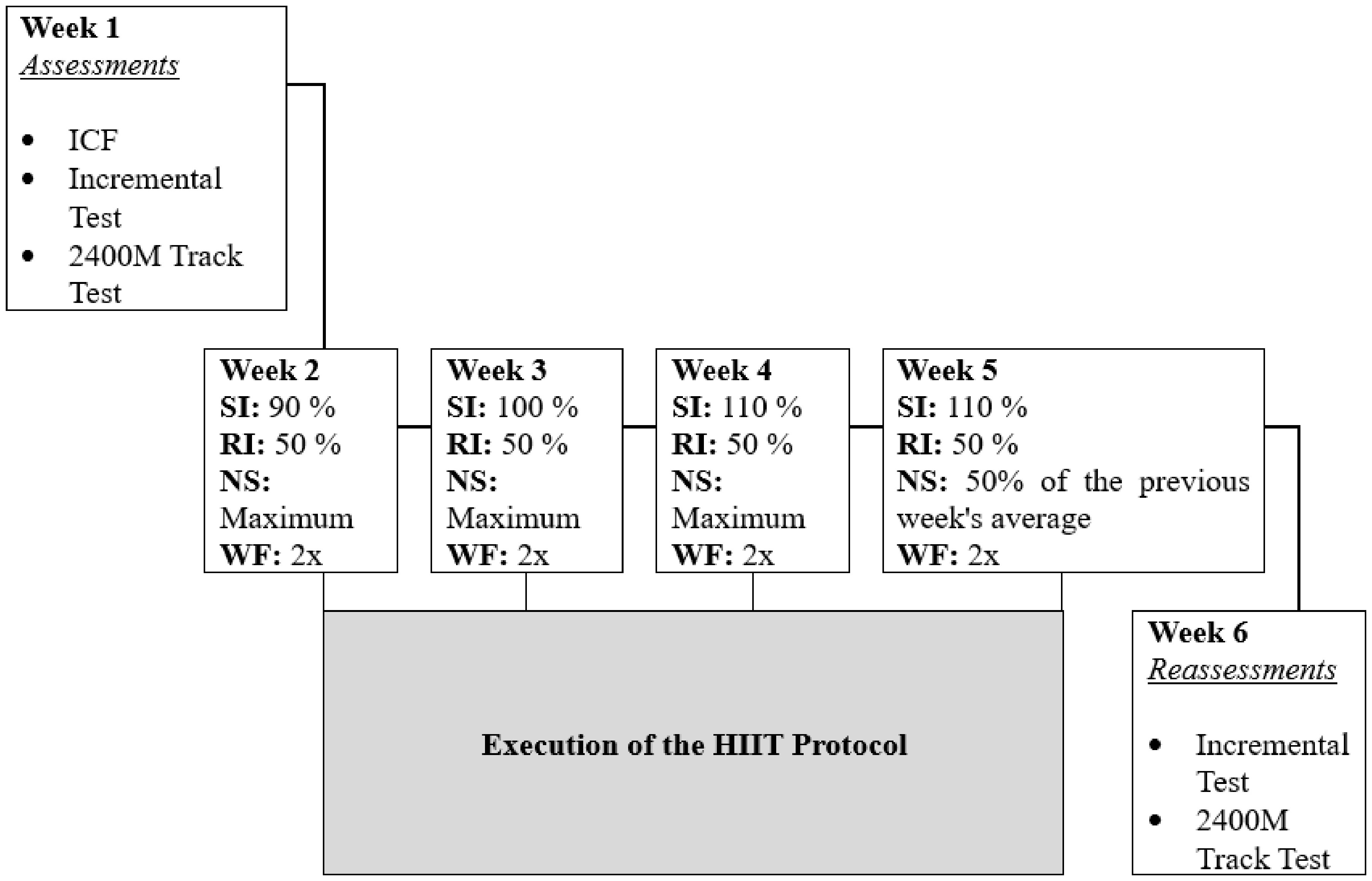
The experimental activities of the research were carried out over six weeks, the treadmill and track tests were performed in that order, in weeks 1 and 6, with a 72-hour interval between them, as described in Figure 1.
Study Design. ICF: Informed Consent Form; Incremental Test: Maximum Incremental Treadmill Test; 2400m Track Test: Maximum Test Conducted on Asphalt Tracks; SI: Stimulus Intensity (%MAS); RI: Recovery Intensity (%MAS), NS: Number of Stimuli; WF: Weekly Frequency.
Treadmill incremental test
A treadmill incremental test was conducted using a Movement brand ergometric treadmill, model E.740, in order to evaluate the (VO2max) and the maximum aerobic speed (MAS). The test started at a speed of 10 km/h, with an increase of 1 km/h every 2 minutes, without breaks between stages, until voluntary exhaustion. The incline was maintained at 1% throughout the test (Chang et al., 2020; Jones and Doust, 1996).
in which corresponds to the speed of the last completed stage, t is the time in seconds sustained by the athlete in the incomplete stage, T is the total time in seconds established for the complete stage (120 sec.), and Speed Increment is the increment in speed at each stage (1 km/h) (Arantes et al., 2017; Glass and Dwyer, 2007; Kuipers et al., 2003).
Maximum performance test on the track
The test was conducted on a 200-meter asphalt track, covering a total distance of 2,400 meters, to evaluate performance based on test time, as well as stride length and frequency. To capture the images, a Sony HDR-CX160 camera with a resolution of 1080 pixels and 60 FPS was used, positioned 75 cm above the ground and 11.5 meters from the center of the track, sufficient to capture images of two complete strides. For the analysis, the first and last laps completed by the participants were discarded.
The images were analyzed using Kinovea® software, before carrying out the test, a measurement was made using a rotating tape measure of the length of the track lane. For calibration, the “line” tool was used, transforming the pixels into meters. To obtain stride length values, measuring the distance between the heel of one foot and the heel of the contralateral foot, and stride frequency, measuring the time spent between the start of the first stride and the end of the last one, determining the number of steps per minute (Alton et al., 1998; Puig-Diví et al., 2019).
With the objective of analyzing changes in maximum indirect oxygen consumption (VO2max), the adapted formula was used:
Where: D corresponds to the distance (m), fixed at 2400m (Cooper, 1968; Santos, 2012).
Treadmill running kinematics
With the objective of analyzing changes in stride length and frequency at each HIIT intensity, treadmill images were captured using a Motorola smartphone, Moto G6 Plus, equipped with a 12-megapixel camera in FULL HD, with a resolution of 1080 pixels and 60 FPS. The smartphone was mounted on a tripod positioned 60 cm above the ground and 3 meters from the center of the treadmill. Complete one-minute stages were recorded at each intensity level during the HIIT. The videos were analyzed using the Kinovea® software to extract data on stride length and frequency (Alton et al., 1998).
Training protocol
The training was designed following the principles of High-Intensity Interval Training (HIIT) (Billat, 2001; Gillen and Gibala, 2014). The sessions took place on a treadmill, with a frequency of two sessions per week and a minimum interval of 72 hours between them, spanning four weeks for a total of eight training sessions. Participants performed one-minute stimuli followed by one minute of active recovery at an intensity of 50% of MAS. Stimulus intensities were progressive over the first three weeks, 90%, 100% and 110% of MAS in the third. In the fourth week, the intensity remained at 110% of the MAS, and the volume was set at 50% of the number of stimuli performed in the third week. Velocities were calculated using the equation
In the first three weeks, the stimuli were maximum until voluntary exhaustion, or the limit of 45 stimuli.
Statistical analysis
Data normality was determined using the Shapiro-Wilk test. One-Way ANOVA was used to analyze biomechanical variables on the treadmill with post hoc Tukey's test in the comparisons among the intensities of 50%, 90%, 100% e 110% of MAS in the HIIT sessions. The T test, with Wilcoxon post-test, was used to analyze biomechanical variables during the 2,400m test before and after the HIIT protocol. Significance was considered for p values < 0.05. Analyzes were performed using GraphPad Prism 7 software (GraphPad Prism Inc., San Diego, CA, USA). The effect size was calculated using Cohen's formula based on the following criteria (Rhea, 2004): < 0.35 trivial; 0.35 - 0.80 small; 0.80 - 1.50 moderate; and > 1.5 large effect.
RESULTS
Track running analysis
The comparisons between the means of the variable values during the 2400-meter track test, before and after HIIT, are presented in Table 1. Comparing the pre and post-HIIT moments, significant differences (p < 0.05) were demonstrated in the variables stride length, VO2max, and total time of the track test. Before HIIT, the time was 8 minutes and 26 seconds (± 0:50), while after HIIT, it was 8 minutes and 12 seconds (± 0:42). For the variables average stride frequency and average speed, no significant differences (p > 0.05) were observed between the pre and post HIIT situations.
Treadmill running analysis
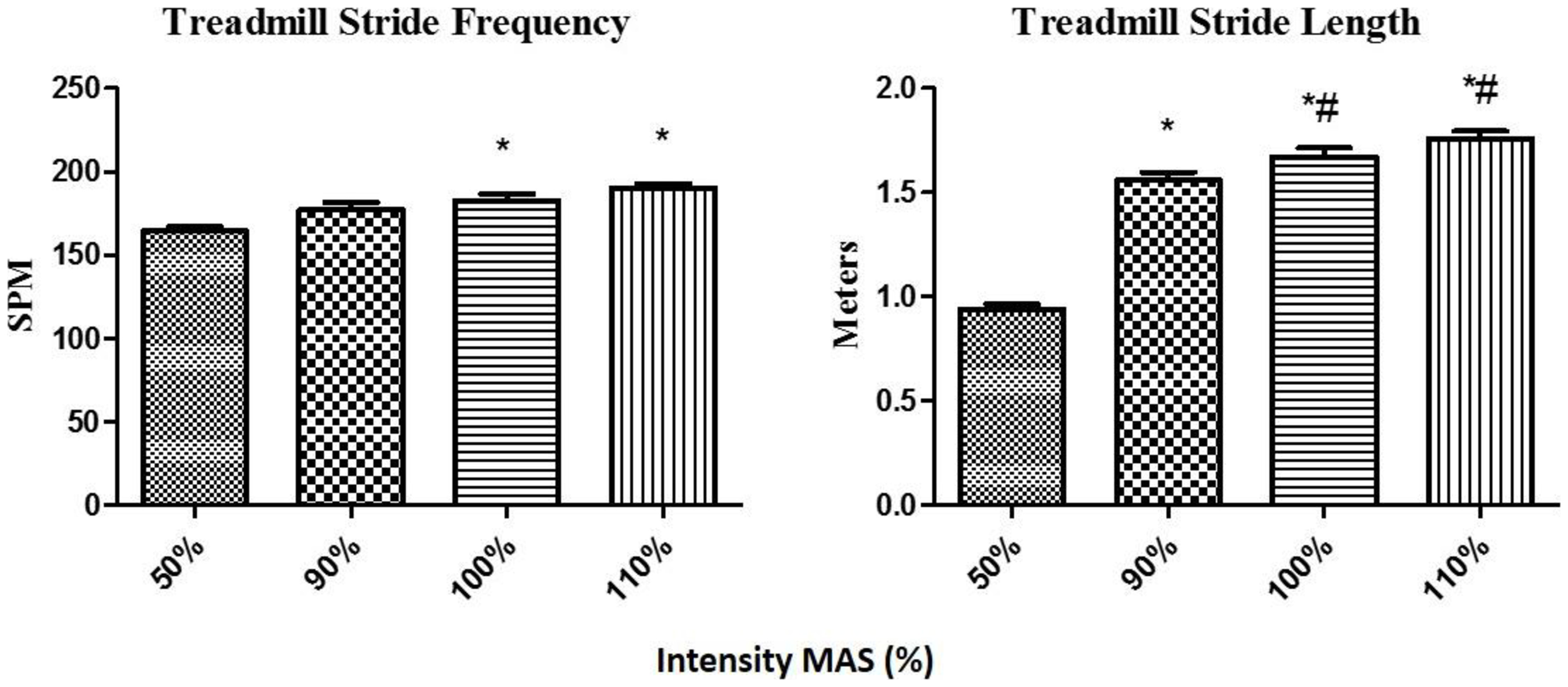
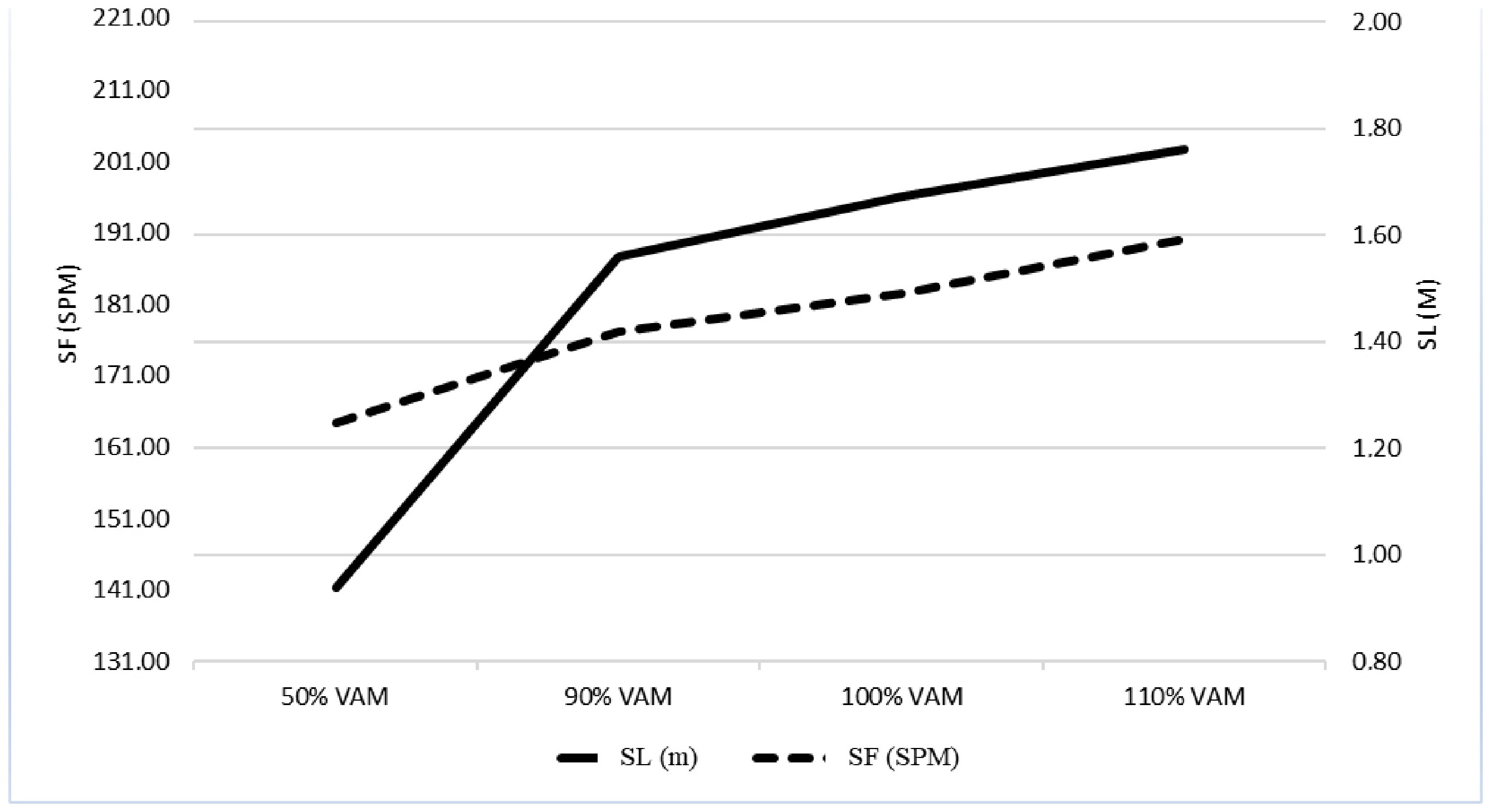
For data related to frequency and length during the execution of HIIT on the treadmill, comparing different training intensities. The results indicated significant differences in stride frequency only in the comparisons between the intensities of 50% of MAS with 100% and 110% of MAS, as shown in Figures 2 and 3.
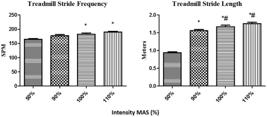
Treadmill Stride Frequency and Length. Illustration of significant differences between stride length and frequency during incremental treadmill test. *Significant P value <0.05 for comparisons with 50% intensity. #Significant P value <0.05 for comparisons with 90% intensity.
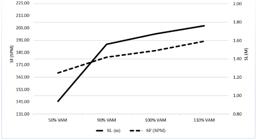
Relationship Between Stride Frequency and Length on the Tread. Behavior of variables: Stride Length, in meters (M) and Stride Frequency, in strides per minute (SPM) in relation to Intensities in percentage of Maximum Aerobic Speed (MAS). Y axis: Stride Length (m) and Stride Frequency (SPM). X Axis: Intensities (% of MAS).
For stride length, significant differences were observed in the comparisons between the intensities of 50% of MAS with 90%, 100%, and 110% of MAS, as well as significant differences in the comparisons between 90% of MAS with 100% and 110% of MAS, as shown in Table 2 and Figures 2 and 3.
DISCUSSION
A relevant finding of the present study was the significant improvement in the performance of runners in the 2400m track test when compared before and after the HIIT training conducted on the treadmill. This suggests the effectiveness of the proposed treadmill HIIT training. The increase in stride length on the track can be attributed, in part, to the characteristics of HIIT, which exposed participants to intensities exceeding 100% of their maximal aerobic speed (MAS) in one-minute stimuli. According to Bailey et al. (2020), Goodall et al. (2015) and Perrey et al. (2010) the exercise intensity proposed significantly influences neuromuscular system responses and biomechanical aspects of running.
Loads greater than 100% of MAS favor positive adaptations in running performance, suggesting an increase in ground reaction force as evidenced by the stride length increase observed in the present study. The importance of stride frequency and length variables in relation to performance aligns with the findings of various previous studies (Goodall et al., 2015; Jamkrajang et al., 2023).
Hunter et al. (2004) found a positive association between propulsive impulse and running economy in highly trained runners. Adjustments to past parameters suggest the development of more economical movement patterns. Williams and Cavanagh (1987) found that changes in stride length influenced oxygen cost, and other studies, such as Anderson (1996), found that improving stride frequency and ground contact time is also critical to improving running economy.
In agreement with the present study, García-Pinillos et al. (2017) observed that including 2 to 3 weekly sessions of treadmill-based HIIT, performed at or above MAS, with a volume exceeding 10 minutes, involving short work periods with a stimulus-to-recovery ratio of 1:1 to 1:2, is effective in enhancing runners' performance.
Silva et al. (2017) analyzed the effect of twice-weekly HIIT for four weeks on a 5 km running race. While they did not find changes in race pace or overall performance, improvements were observed in running economy, VO2max, and MAS, aligning with the findings of the present study.
In previous studies, it was observed that at higher speeds, stride length tends to stabilize, while stride frequency increases compared to frequencies at lower speeds, aligning with the findings of the present study Dillman (1975) and Mero and Komi (1986). This suggests that from 90% of MAS onwards, biomechanical adjustments to increase speed are more represented by greater stride frequency.
The competitive context is significantly shaped by various elements, including the presence of other runners and strategies adopted during the race. These factors can significantly influence movement patterns during competitions, thus exerting a direct impact on overall performance. Consequently, it is crucial to approach with caution the extent of the contribution of biomechanical factors to the outcome of competitions, given the difficulty of establishing a direct relationship between identified biomechanical parameters in experimental tests and their translation into real competitive situations.
STUDY LIMITATIONS
Guidelines related to the volume and intensity of total weekly stimuli were provided; however, there was no monitoring of stimuli on days when HIIT was not performed.
The present study did not have a control group due to limitations imposed by the inclusion criteria, as well as restrictions imposed by the COVID-19 pandemic during the data collection period.
CONCLUSIONS
The obtained results indicate that high-intensity interval training (HIIT) on a treadmill over a four-week period for runners proved to be effective, showing improvements in performance during the 2400-meter track test. These findings suggest that the implementation of HIIT can be an effective strategy for enhancing runner performance.
Additionally, we observed that the increase in running speed is more strongly associated with an increase in stride length for lower intensities, up to 90% of the maximum aerobic speed (MAS). However, between 90% and 110% of MAS, the improvement in running speed is equally related to increases in both stride length and stride frequency. This understanding can practically guide the design of specific training programs tailored to the individual needs of runners to optimize performance across different intensity ranges.
-
FUNDING
The author(s) reported there is no funding associated with the work featured in this article.
DATA AVAILABILITY
The dataset includes video records and potentially identifiable information; public sharing is not covered by the consent/ethics approval. Data may be provided upon justified request under a data-use agreement.
REFERENCES
-
Alton F, Baldey L, Caplan S, Morrissey MC. A kinematic comparison of overground and treadmill walking. Clin Biomech. 1998;13(6):434-40. https://doi.org/10.1016/S0268-0033(98)00012-6 PMid:11415818.
» https://doi.org/10.1016/S0268-0033(98)00012-6 -
Anderson T. Biomecânica e economia de corrida. Sports Med. 1996;22(2):76-89. https://doi.org/10.2165/00007256-199622020-00003 PMid:8857704.
» https://doi.org/10.2165/00007256-199622020-00003 -
Arantes FJ, Vieira PF, Borges DL, Pereira AA. Pode o consumo máximo de oxigênio e a frequência cardíaca máxima medidos em teste laboratorial serem preditos por equações em corredores amadores? Revista Brasileira de Prescrição e Fisiologia do Exercício [Internet]. 2017 [cited 2024 Jul 29];11(66):343-52. Available from: https://www.rbpfex.com.br/index.php/rbpfex/article/view/1146
» https://www.rbpfex.com.br/index.php/rbpfex/article/view/1146 -
Bailey JP, Dufek JS, Freedman Silvernail J, Navalta J, Mercer J. Understanding the influence of perceived fatigue on coordination during endurance running. Sports Biomech. 2020;19(5):618-32. https://doi.org/10.1080/14763141.2018.1508489 PMid:30325255.
» https://doi.org/10.1080/14763141.2018.1508489 -
Barnes KR, Kilding AE. Running economy: measurement, norms, and determining factors. Sports Med Open. 2015a;1(1):8. https://doi.org/10.1186/s40798-015-0007-y PMid:27747844.
» https://doi.org/10.1186/s40798-015-0007-y -
Barnes KR, Kilding AE. Strategies to improve running economy. Sports Med. 2015b;45(1):37-56. https://doi.org/10.1007/s40279-014-0246-y PMid:25164465.
» https://doi.org/10.1007/s40279-014-0246-y -
Billat LV. Interval Training for Performance: A Scientific and Empirical Practice. Sports Med. 2001;31(1):13-31. https://doi.org/10.2165/00007256-200131010-00002 PMid:11219499.
» https://doi.org/10.2165/00007256-200131010-00002 - Cappa DF, García GC, Secchi JD, Maddigan ME. The relationship between an athlete’s maximal aerobic speed determined in a laboratory and their final speed reached during a field test (UNCa Test). J Sports Med Phys Fitness. 2014;54(4):424-31. PMid:25034546.
-
Chang SC, Adami A, Lin HC, Lin YC, Chen CPC, Fu TC, et al. Relationship between maximal incremental and high-intensity interval exercise performance in elite athletes. PLoS One. 2020;15(5):e0226313. https://doi.org/10.1371/journal.pone.0226313 PMid:32396576.
» https://doi.org/10.1371/journal.pone.0226313 -
Cooper KH. A Means of Assessing Maximal Oxygen Intake. JAMA. 1968;203(3):201-4. https://doi.org/10.1001/jama.1968.03140030033008 PMid:5694044.
» https://doi.org/10.1001/jama.1968.03140030033008 -
Dillman CJ. Kinematic analyses of running. Exerc Sport Sci Rev. 1975;3(1):193-218. https://doi.org/10.1249/00003677-197500030-00010 PMid:1175666.
» https://doi.org/10.1249/00003677-197500030-00010 -
García-Pinillos F, Soto-Hermoso VM, Latorre-Román PA. How does high-intensity intermittent training affect recreational endurance runners? Acute and chronic adaptations: A systematic review. J Sport Health Sci. 2017;6(1):54-67. https://doi.org/10.1016/j.jshs.2016.08.010 PMid:30356547.
» https://doi.org/10.1016/j.jshs.2016.08.010 -
Gillen JB, Gibala MJ. Is high-intensity interval training a time-efficient exercise strategy to improve health and fitness? Appl Physiol Nutr Metab. 2014;39(3):409-12. https://doi.org/10.1139/apnm-2013-0187 PMid:24552392.
» https://doi.org/10.1139/apnm-2013-0187 - Glass S, Dwyer GB. ACSM’s metabolic calculations handbook. Philadelphia: Lippincott Williams & Wilkins; 2007.
-
Goodall S, Charlton K, Howatson G, Thomas K. Neuromuscular fatigability during repeated-sprint exercise in male athletes. Med Sci Sports Exerc. 2015;47(3):528-36. https://doi.org/10.1249/MSS.0000000000000443 PMid:25010404.
» https://doi.org/10.1249/MSS.0000000000000443 -
Joyner MJ, Coyle EF. Endurance exercise performance: the physiology of champions. J Physiol. 2008;586(1):35-44. https://doi.org/10.1113/jphysiol.2007.143834 PMid:17901124.
» https://doi.org/10.1113/jphysiol.2007.143834 -
Van Hooren B, Fuller JT, Buckley JD, Miller JR, Sewell K, Rao G, et al. Is motorized treadmill running biomechanically comparable to overground running? A systematic review and meta-analysis of cross-over studies. Sports Med. 2020;50(4):785-813. https://doi.org/10.1007/s40279-019-01237-z PMid:31802395.
» https://doi.org/10.1007/s40279-019-01237-z -
Hunter JP, Marshall RN, McNair PJ. Interaction of step length and step rate during sprint running. Med Sci Sports Exerc. 2004;36(2):261-71. https://doi.org/10.1249/01.MSS.0000113664.15777.53 PMid:14767249.
» https://doi.org/10.1249/01.MSS.0000113664.15777.53 -
Jamkrajang P, Suwanmana S, Limroongreungrat W, Verheul J. Spatiotemporal and kinematic adjustments in master runners may be associated with the relative physiological effort during running. Front Sports Act Living. 2023;5:1271502. https://doi.org/10.3389/fspor.2023.1271502 PMid:37886221.
» https://doi.org/10.3389/fspor.2023.1271502 -
Jones AM, Doust JHA. 1% treadmill grade most accurately reflects the energetic cost of outdoor running. J Sports Sci. 1996;14(4):321-7. https://doi.org/10.1080/02640419608727717 PMid:8887211.
» https://doi.org/10.1080/02640419608727717 -
Kuipers H, Rietjens GJWM, Verstappen F, Schoenmakers H, Hofman G. Effects of stage duration in incremental running tests on physiological variables. Int J Sports Med. 2003;24(7):486-91. https://doi.org/10.1055/s-2003-42020 PMid:12968205.
» https://doi.org/10.1055/s-2003-42020 - McGinnis MP. Biomecânica do esporte e do exercício. Tradução Débora Cantergi. 3rd ed. Porto Alegre: Artmed; 2015.
-
Mero A, Komi PV. Force-, EMG-, and elasticity-velocity relationships at submaximal, maximal and supramaximal running speeds in sprinters. Eur J Appl Physiol Occup Physiol. 1986;55(5):553-61. https://doi.org/10.1007/BF00421652 PMid:3769912.
» https://doi.org/10.1007/BF00421652 -
Miller JR, Van Hooren B, Bishop C, Buckley JD, Willy RW, Fuller JT. A Systematic Review and Meta-Analysis of Crossover Studies Comparing Physiological, Perceptual and Performance Measures Between Treadmill and Overground Running. Sports Med. 2019;49(5):763-82. https://doi.org/10.1007/s40279-019-01087-9 PMid:30847825.
» https://doi.org/10.1007/s40279-019-01087-9 -
Morin J-B, Sève P. Sprint running performance: comparison between treadmill and field conditions. Eur J Appl Physiol. 2011;111(8):1695-703. https://doi.org/10.1007/s00421-010-1804-0 PMid:21210279.
» https://doi.org/10.1007/s00421-010-1804-0 -
Nigg BM, De Boer RW, Fisher V. A kinematic comparison of overground and treadmill running. Med Sci Sports Exerc. 1995;27(1):98-105. https://doi.org/10.1249/00005768-199501000-00018 PMid:7898346.
» https://doi.org/10.1249/00005768-199501000-00018 -
Perrey S, Racinais S, Saimouaa K, Girard O. Neural and muscular adjustments following repeated running sprints. Eur J Appl Physiol. 2010;109(6):1027-36. https://doi.org/10.1007/s00421-010-1445-3 PMid:20358218.
» https://doi.org/10.1007/s00421-010-1445-3 -
Puig-Diví A, Escalona-Marfil C, Padullés-Riu JM, Busquets A, Padullés-Chando X, Marcos-Ruiz D. Validity and reliability of the Kinovea program in obtaining angles and distances using coordinates in 4 perspectives. PLoS One. 2019;14(6):e0216448. https://doi.org/10.1371/journal.pone.0216448 PMid:31166989.
» https://doi.org/10.1371/journal.pone.0216448 - Rhea MR. Determining the magnitude of treatment effects in strength training research through the use of the effect size. J Strength Cond Res. 2004;18(4):918-20.
-
Santos AS. Estimar a capacidade aeróbica através do teste de 2400 metros e velocidade crítica após oito semanas de treinamento aeróbico em militares da polícia militar de minas gerais. Revista Brasileira de Prescrição e Fisiologia do Exercício [Internet]. 2012 [cited 2024 Jul 29];6(34):410-7. Available from: https://www.rbpfex.com.br/index.php/rbpfex/article/view/445
» https://www.rbpfex.com.br/index.php/rbpfex/article/view/445 -
Silva R, Damasceno M, Cruz R, Silva-Cavalcante MD, Lima-Silva AE, Bishop DJ, et al. Effects of a 4-week high-intensity interval training on pacing during 5-km running trial. Braz J Med Biol Res. 2017;50(12):e6335. https://doi.org/10.1590/1414-431x20176335 PMid:29069224.
» https://doi.org/10.1590/1414-431x20176335 -
Williams KR, Cavanagh PR. Relationship between distance running mechanics, running economy, and performance. J Appl Physiol. 1987;63(3):1236-45. https://doi.org/10.1152/jappl.1987.63.3.1236 PMid:3654469.
» https://doi.org/10.1152/jappl.1987.63.3.1236 - Zatsiorsky VM. Biomecânica no esporte: performance do desempenho e prevenção de lesão. Rio de Janeiro: Guanabara Koogan; 2000. https://doi.org/978-85-277-0886-9.
Edited by
-
Executive Editor:
Pedro Otavio Pimpim Bezerra
-
Associate Editor:
Leonardo Peyré Tartaruga
-
Assistant Editors:
André Ivaniski Mello
-
Editor Chief:
Ari Lazzarotti Filho