
 Constructing a research design in political science: notes for undergraduate and graduate students
Abstract:
This article seeks to provide guidance for developing research designs in political science, primarily for undergraduate and graduate students. Recognizing the inherent multicausal complexity of political phenomena and their theoretical-conceptual particularities, we emphasize the importance of well-defined research procedures without neglecting the need for flexibility given the diversity of research objects. The article is organized around two main sections: (i) conceptualizations of research design and (ii) constitutive elements for its construction, followed by operational guidelines for its development, with emphasis on the articulation between theory and empirical evidence. The approach assumes a commitment to critical and reflective methodological training, avoiding excessively normative prescriptions while preserving analytical rigor. In the concluding remarks, we reiterate that command of research design construction constitutes a fundamental methodological skill, regardless of the theoretical or technical preferences prevailing in different Brazilian academic institutions.
Keywords:
research design; methodology; method; political science
Resumo:
Este artigo busca oferecer orientações para a elaboração de desenhos de pesquisa em Ciência Política, destinando-se prioritariamente a discentes de graduação e pós-graduação. Reconhecendo a complexidade multicausal inerente aos fenômenos políticos e suas particularidades teórico-conceituais, destacamos a importância de procedimentos de pesquisa bem definidos sem, com isso, negligenciar a necessidade de flexibilidade diante da diversidade dos objetos de estudo. A estrutura do artigo se organiza em dois eixos expositivos: (i) conceituações sobre o desenho de pesquisa e (ii) elementos constitutivos para sua construção, seguidos de algumas diretrizes operacionais para sua elaboração, com ênfase na articulação entre teoria e empiria. A abordagem assume compromisso com uma formação metodológica crítica e reflexiva, evitando prescrições excessivamente normativas, mas preservando o rigor analítico. Nas considerações finais, reitera-se que o domínio da construção de desenhos de pesquisa configura-se como competência metodológica fundamental, independentemente das preferências teóricas ou técnicas vigentes nas distintas instituições acadêmicas brasileiras.
Palavras-chave:
desenho de pesquisa; metodologia; método; ciência política
Introduction
Every researcher faces challenges related to the knowledge production process throughout their academic trajectory, regardless of approach, research object, or techniques employed. Among the most recurring concerns are the delimitation of the research problem, coherence between the theoretical framework and methodological strategies, and the translation of complex objects into viable analytical procedures (Gschwend; Schimmelfennig, 2007; Perissinotto; Nunes, 2023; Rezende, 2023). These obstacles can be mitigated through systematic planning of the investigative stages, in which the development of the research design assumes a central role, functioning as an articulating element between theory and empirical evidence (King; Keohane; Verba, 1994; Montenegro, 2016; Mesquita, 2017; Leite; Rocha, 2019).
In general terms, the construction of Political Science’s identity as an autonomous field of knowledge has been largely associated with the development of methods that confer scientific status, ensuring tools capable of generating more precise conceptualizations, significant relevance, and interpretable inferences Brady; Collier, Seawright, 2010). In the article “Science in Brazilian Political Science” (Leite; Feres Júnior, 2021, translated by the authors), we find a reflection on methodological parameters through the refinement of a meta-discussion about the scientific character of the Brazilian academic production. The recent multiplication of national publications in this field underscores a revitalization of the debate marked by growing concern with the analytical standards of studies, both from qualitative and quantitative perspectives (Figueiredo Filho, 2019; Figueiredo Filho et al., 2021; Perissinotto et al., 2022; Perissinotto; Nunes, 2023; Rezende, 2023).
Mesquita and Montenegro, in the articles “Research design, inference and causality in political science and international relations: a didactic introduction5” (Mesquita, 2017) and “Research design, inference and causality in political science6” (Montenegro, 2016), offer reflections on this process through discussion of three guiding concepts: (a) research design; (b) inference; and (c) causality. Both authors also seek to examine the pivotal influence of King, Keohane and Verba’s (1994) work for reflection on the development of methods in political science. The present text seeks to explore other equally relevant aspects in the process of developing research designs and thereby contribute to a more complete framework of methodological reflections in this important field of the social sciences.
First, the conceptual distinction among methodology, method, and technique is fundamental for structuring scientific investigation. Methodology refers to the set of theoretical-epistemological principles that guide research, defining its general plan and the criteria that govern the approach to the object of study - from hypothesis formulation to result interpretation (Borsotti, 2007). Method, in turn, is a more specific criterion within methodology that details the essential steps for collecting, processing, and interpreting the object according to the chosen approach (Marsh; Stoker, 1997). Each method can be selected based on its adequacy to specific questions and the nature of available data (Reis, 1991). Research techniques, meanwhile, consist of the operational instruments and tools used to apply one or more methods in the conduct of research (Silva, E.; Silva, J., 2016).
In political science, the construction of research design assumes a central role given the complex and multifaceted character of its objects of study. Topics such as electoral behavior, institutional dynamics, public policy, democratic theory, and others require methodological approaches that coherently articulate at least three interdependent dimensions: theoretical-epistemological foundations (that is, the methodology); methodological strategies (the methods); and investigative tools (the techniques). The choice and combination of these elements vary according to the theoretical perspective employed, reflecting the analytical plurality that characterizes the field.
Such diversity is a strength of the discipline, but it also poses challenges to the formulation of a research design that is simultaneously consistent, viable, and aligned with the investigation’s objectives. Given this, the design fulfills the function of structuring, in a logical and consistent manner, the main components of the investigative process, from theoretical foundations to empirical strategies, including the definition of the problem, objectives, and analytical categories (Lichbach; Zuckerman, 2009; Marsh; Stoker, 1997).
Flávio Rezende (2017, 2023) proposes the concept of inferential pluralism to analyze the different ways of establishing causal relations in Brazilian political science. This approach reveals how researchers combine diverse theoretical and methodological perspectives, incorporating new paradigms that guide knowledge production in the field. According to the author, the field is undergoing a significant transformation. In this sense, “Political science is moving rapidly toward the credibility revolution, in which credible causal inferences are sought from experimental and observational research designs endowed with greater methodological awareness” (Rezende, 2023, p. 341, author’s emphasis, translated by the authors).
As Goertz and Mahoney (2006) argue, the predominant methodological approaches in the social sciences - qualitative and quantitative - constitute distinct investigative cultures, each characterized by its own norms, practices, and tools, articulated in an internally coherent manner. These approaches do not advocate mutually exclusive choices, however. On the contrary, they prove potentially complementary, especially in studies employing mixed methods (Creswell, 1994. In the field of comparative politics, for example, the strategic combination of mixed methods (qualitative-quantitative) has proven particularly fruitful.
Within the qualitative approach, techniques such as comparative historical analysis, Qualitative Comparative Analysis (QCA), and Process Tracing (Perissinotto; Nunes, 2023) enable the investigation of contextual causalities and complex political processes. Similarly, the quantitative approach presents a scenario of inferential pluralism, offering support for statistical generalizations and systematic analyses of empirical patterns - such as surveys, public opinion research, public policy impact evaluations and analyses based on metadata, including, for example, reports produced by international organizations such as the UN, and global democracy indices such as Freedom in the World (Freedom House), the Democracy Index (The Economist), and the Democracy Report (V-Dem), among others (Leite; Feres Júnior, 2021; Rezende, 2017, 2023).
However, the ambiguity of methodological diversity expresses the coexistence of theoretical approaches, sometimes antagonistic, that can generate what Marsh and Stoker (1997) admit to be a veritable epistemological “cacophony” evidenced in various theoretical approaches, each with different assumptions, methods and objectives, which can complicate the integration or choice of an analytical approach. Moreover, this methodological diversity is not only about methods or techniques but involves different visions about what constitutes valid knowledge and about the role of science in society. Thus, the integration of different perspectives requires critical awareness of one’s assumptions, be they normative values, institutional structures, behavioral patterns, narrative constructions, or others, recognizing that a given research choice reflects not only what is studied but how one sees the world.
In the classic work Designing Social Inquiry, Gary King, Robert Keohane, and Sidney Verba (1994) - widely known by the acronym KKV - postulate the importance of the researcher developing a consistent research design. The authors present guidance on how to adequately formulate the research problem, make the theoretical framework explicit, carefully select cases and observations, improve data quality, and test both descriptive and causal arguments. It is precisely these methodological foundations that guide the present article.
Considering the framework presented above, we propose a pedagogical and situated review of the main guidelines for developing research designs in Brazilian political science, grounded in two observations: (i) the persistent gap in methodological training, especially in institutions peripheral to major academic centers (Figueiredo Filho et al., 2021; Neiva, 2015; Soares, 2005); and (ii) the need for a set of practical guidelines that consider diverse regional contexts and limited resources, that is, the material reality of many undergraduate and graduate students in Brazil. Our motivation arose from the challenges faced in our own training, which involved active and systematic searches and readings on the topic. The ultimate goal is to offer a methodological itinerary that articulates classic and contemporary contributions, including those we have experienced ourselves.
The structure of the article is organized in two articulated and complementary sections. The first presents the conceptualization of research design, its different types, and its importance for contemporary political science. The second elucidates the constitutive elements of a research design, with emphasis on the articulation between theory and method, including practical recommendations for the creative integration of approaches. Finally, the concluding remarks synthesize the arguments and point toward paths for future research.
Research design in political science: basic definitions
What differentiates scientific investigation from other types of intellectual production is the commitment to methodological rigor and theoretical grounding, characteristics that allow not only for verification but also for replication of results by other researchers (King; Keohane; Verba, 1994). In this context, research design emerges as a central element in the strategic plan of investigative processes. But how exactly does it contribute to the production of scientific knowledge in the discipline? This is the question we sought to answer.
Originally associated with graphic and schematic representations, the term research design has expanded to encompass systematic planning that ensures scientific validity and reliability (Cano, 2012). In the social sciences, this evolution reflects the need to approach complex phenomena with flexible yet structured methods. In political science particularly, research design involves: (a) formulation of well-defined research questions; (b) selection of appropriate methods for data collection and analysis; and (c) interpretation of results based on a consistent theoretical framework. These steps ensure analytical precision, especially in studies on sensitive topics and those subject to bias (Gschwend; Schimmelfennig, 2007).
Among various definitions, research design can be understood as a step-by-step process that organizes the main dimensions of the investigative process: methodological procedures (methods), which guide research execution; collection and analysis strategies (techniques), which determine data selection and processing; and inference mechanisms (interpretation), which articulate theory and empirical evidence (Leite; Rocha, 2019). This construct performs a dual function of ensuring transparency in the knowledge production process and providing the necessary structure to validate the credibility of obtained results.
The literature offers several contributions to developing sound research designs. Studies such as those by Kim, Zhu and Chen (2016) demonstrate how quantitative methods can be systematically applied to review bibliographies, monitoring how works function in a given field and identifying connections, influences and gaps among studies. They allow highlighting which theories are most debated, which authors are most recognized and cited (referenced), as well as the most prominent research agendas. The authors offer a step-by-step approach for comparative application between information visualization (InfoVis) and data visualization (DataVis), using scientometric techniques7 to identify conceptual, thematic, and application differences.
Here, data visualization refers to the graphic representation of raw information, facilitating preliminary exploration and identification of initial patterns, as in the case of scatter plots and histograms. In contrast, information visualization involves the graphic presentation of processed and already analyzed datasets, such as infographics and dashboards, with the objective of synthesizing and communicating results, causal relationships, or conclusions derived from methodological processing (Kim; Zhu; Chen, 2016).
Although data visualization is elementary for the exploratory phase of analysis that enables initial screening and hypothesis formulation, it is information visualization that assumes a strategic role in disseminating produced knowledge, translating complexity into accessible formats for final interpretation. Both modalities, when articulated, constitute complementary analytical resources for ensuring methodological rigor in bibliographic review, with greater transparency in interpretation and effectiveness in theoretical research.
Building on this approach, Župič and Čater (2015) developed a specific research planning model for this type of investigation, called the scientometric methodological flowchart, composed of five distinct phases. As the first of these phases, research design is central because it defines the parameters that impact all subsequent stages. Within it, the premises that respond to three foundational questions are elaborated:
-
Specific objectives: What does the research intend to achieve?
-
Specific problems: What gaps or questions does the research aim to address?
-
Selected methods: What techniques and procedures will be used for data collection and analysis?
As a proposal for data collection and analysis, this systematic planning enables the identification of emerging trends, the tracking of theoretical changes over time and the attainment of a more precise view of the conceptual evolution of political trends. Its approach facilitates understanding of the dynamics inherent to bibliographic research, enabling the identification of areas that present gaps and demand greater investigative depth, as detailed in Table 1.
The framework proposed by Župič and Čater (2015) organizes five sequential and complementary phases. The first phase establishes the foundations of the investigation through the definition of problems, objectives and methods, ensuring alignment between research questions and methodological approach. The second phase describes collection procedures, including sources (such as databases and document types), spatial, temporal and thematic criteria, as well as selection protocols (filters and inclusion/exclusion criteria). The third phase involves the application of processing and analysis techniques, such as network analysis and text mining with linguistic normalization, for systematic data treatment. The fourth phase consists of graphic representation of identified patterns, with emphasis on distribution (frequency) and relationships (concentration/proportion) among terms or concepts. Finally, the fifth phase reveals how complementary qualitative analysis will be conducted through content analysis, contextualizing and validating the identified quantitative patterns.
The main characteristics of this approach include logical sequencing of phases, methodological integration between quantitative and qualitative techniques, traceability of explicit construction criteria and multidimensionality in considering temporal, spatial, and thematic aspects. This structure ultimately constitutes a complete framework, ensuring methodological rigor and flexibility for adaptation to different objects of study (Župič; Čater, 2015).
Alternatively, feminist methodology revolutionizes research designs by transforming them from technical tools into political-epistemological instruments. While traditional models privilege replicability and generalization, this approach starts from situated experience (Haraway, 1988), taking marginalized lived experiences as a starting point (such as studies on domestic work presented from the workers’ perspective); assumes positionality, rejecting neutrality as fiction and requiring researchers to make explicit their social location (race, gender, class) in the methodological design (Harding, 1987, 2004, 2015); and incorporates intersectionality, capturing the simultaneity of oppressions, in contrast to the isolated variable approaches of conventional models (Collins, 2019; Crenshaw, 1991).
For the feminist approach, the rigidity of traditional research designs in political science neglects perspectives by not incorporating these postulates, keeping veiled the asymmetries they study. In Brazil, dominant paradigms and quantitative data fail to capture the complexity of subaltern groups, especially the experiences of racialized women, distorting realities and reinforcing inequalities by rendering intersectional dimensions invisible. Feminist methodology is not, therefore, an “addition” but rather an ethical reconstruction of research foundations, arguing that research designs in the field must commit to social inclusion and advance agendas that combine methodological rigor with epistemic justice for subalternized groups (Martinez, 2023; Perez, 2022).
Given this, although social reality is composed of particular and mutable cases (conditioned by historical and cultural contexts), it falls to the political scientist to balance analytical simplification and respect for empirical complexity, avoiding reductionism (Adcock; Collier, 2001). This requires an effort of simplification: identifying essential characteristics of the object, conferring greater systematicity and scope on research without losing specificity and focus (Adcock; Collier, 2001; Seawright; Gerring, 2008). This systematic abstraction enables the production of broad and socially relevant knowledge (King; Keohane; Verba, 1994), with research design serving as the integrating element that organizes these methodological processes. To this end, the ideal design should be flexible to incorporate critical reflections, specific in defining methods, and transparent in its epistemological choices.
A well-developed research design represents a parameter for replication of studies, guided by two main objectives: describing and explaining political phenomena (Figueiredo Filho et al., 2021). To achieve these objectives, the researcher investigates observable facts aiming to unveil unknown aspects and thus produce knowledge applicable to other contexts, potentially generalizable through holistic interpretations (Cano, 2012; Gerring, 2017).
Below, we present a table with types of research designs in political science, highlighting how each can be operationalized through different methodologies, not as exclusive models but as structures adaptable to the researcher’s instruments.
The types of research designs presented are based on the classic taxonomy by King, Keohane and Verba (1994) for hierarchizing strategies by their inferential potential, starting from the experimental as the causal gold standard (Shadish; Cook; Campbell, 2002), moving through the quasi-experimental for policy evaluation, to the cross-sectional. Comparative logic is based on systematic contraposition of cases (MSS), as proposed by Przeworski and Teune (1970). On the other hand, case study research deepens mechanisms through process tracing, following the approaches of George and Bennett (2005) and Van Evera (1997). The temporal dimension (longitudinal) is crucial for establishing causal sequence. This approach allows for adapting general principles to specific empirical scenarios, but requires attention to possible selection and generalization biases. Each type of research design aligns with specific research questions and different empirical possibilities. The final decision about which design to implement depends on the level of control the researcher seeks over the object of study, the time available and the access to data.
Moreover, it is also important to distinguish research design from methodological approach, even though both are closely related. While the research design structures the course of investigation, the methodological approach determines how that course will be followed, based on criteria of rigor, theoretical coherence, and adequacy to the study’s objectives. Thus, the methodological approach is a component of research design but does not exhaust it. In the next section, we examine in detail the essential elements for research designs in political science.
Essential elements for research designs in political science: notes for planning
In this section, we explore the essential elements for developing research designs in political science, presenting their main constitutive elements and emphasizing practical strategies to support investigative planning.
Essential elements
Regarding research design, we can define at least four characteristics that guide investigation toward scientific validation: a) the objective is inference; b) procedures are public; c) conclusions are uncertain; and d) the content is method (King; Keohane; Verba, 1994). But what does this mean? We comment on each of these below:
a) The objective is inference
The researcher’s intention should be to extract relevant information from the social world through the formation of descriptive or causal inferences. Descriptive inference is the process of understanding an unobserved phenomenon based on a set of observations from an observed reality. We can formulate hypotheses or theorize about a universe of cases from a sample. We also make inferences about concepts from observations. In the social sciences, many of the terms we work with are subjective, and what we do are approximations, representations of concepts based on facts from real life (Collier; Seawright; Munck, 2010). For instance, we do not see machismo (or sexism) in a concrete, tangible way in our daily lives, but violence against women is something visible, low rates of female representation in political offices are real, and from these real-world data, we infer machismo.
Causal inference, on the other hand, establishes a cause-and-effect relationship between two facts from a reality we know to one that is unknown. That is, through causal inference, we formulate our study hypotheses. A hypothesis has as its characteristic (1) establishing a relationship (positive or negative) between a (2) dependent variable and an (3) independent variable (Figueiredo Filho et al., 2021).
Despite these differences, the researcher needs to explain in their research project whether their objective is to better understand how a phenomenon occurs or to test causal relationships that would explain the occurrence of that phenomenon. Making inferences, that is, generalizing about other individuals, groups, or situations based on the reality under investigation, is what makes our production essentially scientific. Without this, we would be using essayistic language, as in literature, rather than the language of social science (Cano, 2012).
b) Procedures are public
To do science, one of the essential tasks is to explicitly inform the concepts that guided the research, the foundational literature, the choice of research area, how data were collected and analyzed, making all these processes transparent to readers and the scientific community. Since its founding and establishment as an autonomous academic field, political science has prioritized the effort to affirm its scientific status through the development of research methods and techniques, which includes the replicability and publicity of the data and techniques used. This methodological concern resonates to the present day. Making data public ensures the replicability of research, evaluation of results, verification of validity, comparison with findings from other studies and allows other researchers to learn from the methods employed (Leite; Rocha, 2019).
c) Conclusions are uncertain, therefore not absolute
Inference is, by definition, an imperfect process, as we make statements from a reality we know to another we do not know. Uncertainty is therefore a constant and present aspect in all scientific investigation. The results we find and the theories we develop are, in essence, falsifiable and provisional (De Vaus, 2001); otherwise, they would be dogmatic rather than scientific. In other words, just as in law everyone is considered innocent until proven guilty, in science, a theory is considered valid until disproven.
d) The content is the method
The essential content of science does not concern the phenomenon of study itself but rather the methods, rules, and techniques at our disposal. As mentioned previously, the findings of our research are always uncertain and subject to revision, and it is through them that our results are judged. Therefore, it is the methods and techniques employed that distinguish scientific knowledge from other forms of knowledge, such as common sense or religious knowledge, for example (Collier; Seawright; Munck, 2010; Figueiredo Filho et al., 2021).
Having examined the nature and essential characteristics of a research design, we now turn to recommendations for developing sound research designs based on the reviewed literature.
Steps in research design
To develop a research design, we can follow certain “steps”, that is, logical stages of a research project,8 each with distinct specificities: a) formulation of the research question; b) theoretical assumptions and theoretical framework; c) selection of cases/data; d) causal strategy or analytical approach; e) triangulation and interpretation; and f) ethics and reliability. Below, we detail each of these stages.
Formulation of the research question
What is the research object to be investigated? Is the question clearly defined?
A well-crafted research question functions as a lighthouse, illuminating the methodological path. When investigating a specific topic, one defines where to seek data, how to analyze them, and what contribution will be made to a particular field of knowledge. This certainty prevents us from getting lost in scattered sources or confused questions. Remember: questions that are too ambitious generate superficial research, while questions that are too narrow limit discoveries. The balance lies in specificity with theoretical significance.
However, how does one choose a topic and define a question? First, ideally the researcher should select a topic that interests them personally. We know that the research process is challenging, solitary and exhausting. Investigating a topic that intrigues us makes the journey less draining. As Barakso, Sabet and Schaffner (2014) warn, a poorly formulated question may generate methodological ambiguities and compromise the validity of results.
Specificity allows for identifying measurable variables and avoiding unfounded generalizations (Figueiredo Filho et al., 2021). Finally, according to Creswell (1994, p. 71), when elaborating a research question, the researcher should consider: mapping theoretical frameworks from foundational disciplines; examining previous studies to identify gaps; making causal mechanisms between variables explicit; and reflecting on empirical feasibility.
Thus, instead of approaching a topic generically (such as “Is corruption bad?”), we transform this question into a defined and researchable problem (“Why do some anti-corruption systems fail in Brazilian municipalities?”). This question directs focus toward specific causes and measurable contexts, avoiding traps such as vague generalizations or moral judgments.
Additionally, to justify your research problem academically, engage in dialogue with existing literature. Suppose that previous studies on corruption in Brazil, such as Power’s (2000), have already mapped federal mechanisms but neglected local realities. This is the opportunity to show how your research fills that gap, using theories, such as North’s (1990) institutionalism, to explain why municipal arrangements may fail. This theoretical dialogue is not decorative literature review; it is what transforms personal curiosity into a relevant scientific problem.
It is also necessary to reflect on practical feasibility, which requires: access to data (available online?); interviews (feasible in six months or a year?); and knowledge of institutional analysis (do you master it?). When identifying insurmountable obstacles, adjust the scope of the study (for example, conducting research in three comparable cities may be more feasible than studying all municipalities in a state).
Suppose one wants to study gender inequality in politics. We should begin by refuting commonplaces. A weak research problem would be: “Do women have less space in politics?” as this is a widely documented question and therefore not very innovative. A more structured problem could be formulated as follows: “How do informal rules in conservative parties render the ascension of Black women to executive power positions unfeasible?” This problem can be tested with, for instance: the theoretical filter, which links it to debates about intersectionality (Collins, 2019) and informal institutions (Helmke; Levitsky, 2004); the methodological filter, which requires a case study, such as analysis of trajectories within a specific party combined with document analysis (statutes, minutes, regulations); or the ethical filter, which seeks to give voice to marginalized groups, not merely study them as objects. If it passes these tests, you will have a viable, original, and academically consistent research problem. A good research problem is one whose answer, even if negative, forces the discipline to rethink its assumptions (King; Keohane; Verba, 1994).
Beyond scientific relevance, research should, insofar as possible, offer a social contribution. The knowledge generated can be useful for understanding political institutions, evaluating government efficiency, or supporting public policies (Gschwend; Schimmelfennig, 2007). It is important to notice that this utility is not limited to the direct application of results by decision-makers. In a broad perspective, even problematizing neglected topics, such as understudied social relations, constitutes per se a valid contribution, conferring social validity on the analytical effort.
Another crucial factor, as discussed in the example about corruption in municipalities, is the operational feasibility of the research, since some questions can be answered in a semester while others require years of investigation; and while certain data are publicly accessible, others demand complex negotiations. Key questions for this moment are: Where will your data come from? Are they sufficient and reliable? In summary, an academically consistent question must combine clarity, specificity, solid and factual empirical basis (aligned with resources, skills and deadlines), and theoretical anchoring with potential for contribution in its area of knowledge (Barakso; Sabet; Schaffner, 2014).
b) Assumptions and theoretical framework
What are the “theoretical lenses” through which the research object is viewed?
Theory operates as the backbone of research design, organically integrating from question formulation to result interpretation. Its main function is to provide the logic that articulates objectives, methods and analysis, guaranteeing internal coherence to the project. In Brazilian political science, this articulation requires heightened attention to concept operationalization, since categories such as social participation or democratic quality, for example, assume specific conceptual meanings in our institutional context (Przeworski et al., 2000). Theoretical choice is not merely illustrative; it defines the explanatory reach of research and validates methodological options (Adcock; Collier, 2001), reinforcing local studies or offering global interpretations.
In research with a deductive orientation, theory establishes prior hypotheses and guides the selection of variables and quantitative techniques (Creswell, 1994). In inductive orientation, more frequent in qualitative studies, theory emerges progressively during data collection and analysis, requiring flexibility in initial planning. This dynamic is exemplified by research on Latin American political institutions, where research design incorporates interactive adjustments to capture local complexities (Mahoney; Rueschemeyer, 2003).
Thus, the term “theory” encompasses two complementary aspects: consolidated theories, which serve as a starting point; and theoretical innovation, which revises and surpasses previously accepted paradigms, proposing unprecedented mechanisms of interpretation. In the first case, the central challenge resides in conceptual translation. Consolidated theories, originated in other contexts, need to be adapted to local realities without losing analytical rigor. Democratization theory, for instance, when applied to Brazilian federalism, demands rethinking indicators of institutional stability, as Abrucio (2022) and Arretche (2012) demonstrate in comparative studies. This adaptation is not only empirical but requires methodological refinement, from the definition of observation units to data collection techniques sensitive to regional asymmetries.
In the second case, when research aims for theoretical innovation, research design must incorporate more consistent validation mechanisms. Brazilian studies on digital activism (Ribeiro; Borba; Hansen, 2019) or media exposure (Biroli; Miguel, 2013), for example, illustrate how triangulation of methods, stratified sampling, and control of contextual biases become indispensable elements. In these cases, theory not only guides but remodels itself through empirical discoveries, requiring transparency in collection and analysis choices.
Moreover, falsifiability (Popper, 1959) assumes practical meanings in research design through strategies that incorporate the search for contradictory evidence. In the Brazilian context, process tracing can track causal mechanisms in public policies (Perissinotto; Nunes, 2023), while warning about traps in operationalizing polysemic concepts like “citizenship” and “civil society” (Lavalle; Swako 2015). In this case, analytical transparency ensures measurement feasibility and indicator construction in case studies.
In sum, the theoretical framework is the integrating nucleus that confers consistency on research design. Its function goes beyond conceptual grounding, as it guarantees that each methodological choice, from sample delimitation to analytical techniques, is theoretically and contextually justified. This process critically connects already established knowledge (past and contemporary references) to research results, ensuring they are comparable, verifiable and integrated into scientific debate, while avoiding unfounded speculation and guaranteeing result validation. Therefore, research should seek to construct or test theories by orienting itself through pertinent literature and reflecting on interpretations that range from global frameworks to local realities, which generates distinctive analytical innovations.
c) Selection of cases/data
Why choose these cases and not others? Do they help answer the research question?
To develop or test a theory, we need cases and data. That is, to achieve the desired outcome, it will be necessary to collect, mine, process, and systematize cases and data that can be analyzed and tested in order to answer our questions. The case and data selection stage should also be guided by the literature.9 Theory is necessary here because, as previously noted, it is from theory that we define the concepts to be addressed in answering the research question. These are the theoretical concepts that will be operationalized and measured. Only after these definitions do we choose the cases and observations to be analyzed (Gschwend; Schimmelfennig, 2007). Theories and data, therefore, interrelate, and the latter also need to be theoretically oriented.
A central question at this moment is: will the database be constructed or will work proceed with an already existing database? When collecting one’s own data, it is essential to select adequate measurement instruments. This choice should be directly associated with the research topic and data collection context, not with the researcher’s personal preferences. Not all techniques are appropriate for all questions. For this reason, it is critical to know several research tools and techniques, understanding their advantages and limitations (Cano, 2012).
On the other hand, there are numerous consolidated databases available, such as Brazilian platforms (IBGE, IpeaData, and others) and international ones (in addition to specialized UN agencies), as we mentioned earlier. However, when using pre-existing databases, it is essential to problematize or describe in detail the methodological parameters of the original database construction (sources, collection methods, sample sizes, and so forth), making explicit the construction of indices and conceptual categories (such as GDP, HDI, censuses, etc.), and not simply accept the final evidence, since it is indispensable to understand the processes underlying the results (sources, dimensions, variables, intervals). In other words, all prerequisites of academic rigor apply here, including transparency, verification and replicability.
The choice among methods, in turn, depends on the research objectives. Qualitative data (interviews, historical documents, participant observation, etc.) allow analytical depth and contextualization, as in case studies on constitutional reforms (Yin, 1984). Quantitative data (surveys, indices, statistical databases, etc.) privilege generalization and pattern identification, as in analyses of GDP impact on elections (King; Keohane; Verba, 1994). Mixed methods, meanwhile, combine both approaches to compensate for limitations, as in triangulation between surveys and focus groups to study corruption (Creswell; Plano Clark, 2017). Thus, methodological selection reflects the nature of the studied phenomenon as well as the search for analytical complementarity.
d) Causal strategy or analytical approach
How does one test whether “A” causes “B”?
This guiding question requires the development of a transparent analytical strategy. For this reason, in this phase one plans how to make descriptive inferences and test causal inferences from obtained data or selected observations. As in other phases, theory is fundamental, since interpretation and the search for meaning in data depend on the researcher who performs them in light of the theories employed (Gil, 2008; King; Keohane; Verba, 1994; Paranhos et al., 2012).
After data collection, the first stage of analysis is to organize, mine and systematize data. In quantitative research, programs are commonly used to perform statistical operations, elaborate descriptive analyses, demonstrate correlations between variables and show possible causal relationships. This allows the researcher, based on theory, to analyze data, test hypotheses and draw relevant conclusions (Kellstedt; Whitten, 2015; Leite; Rocha, 2019).
In qualitative research, the researcher must simplify and organize data to enable systematic analysis, observe differences and connections among them, identify regularities, tendencies and explanations, and identify or develop meanings. Currently, various software programs specialized in qualitative analysis assist in these processes of organization, identification and meaning construction. However, final attribution of meaning to data remains the exclusive responsibility of the researcher (Gil, 2008).
Given these considerations, during data collection, the researcher should seek to minimize biases by collecting information about the largest possible number of observable consequences and facts, in order to guarantee data validity and reliability and to control for alternative explanations (Collier; Seawright; Munck, 2010; King; Keohane; Verba, 1994). A set of questions then arises: Which biases should be avoided? How should data control be implemented? What do validity and reliability mean? These questions are detailed below.
e) Triangulation and interpretation
How does one cross-reference different sources and methods to verify result reliability?
Triangulation, in its essence, is a validation strategy that confronts multiple perspectives on the same phenomenon. It involves convergence of at least three dimensions: data sources (documents, interviews, statistics), methods (qualitative, quantitative, comparative) and theories (competing explanatory paradigms) (Denzin, 1978).
In practice, when investigating, for example, public policy implementation, a researcher can cross-reference official data on government expenditures, interviews with managers and media discourse analysis. If these independent elements point toward the same conclusion, interpretive consistency increases significantly. However, triangulation does not seek to establish forced consensus. Its value resides precisely in the capacity to identify contradictions, revealing nuances that isolated methods would conceal. It is in this dialectical space between convergences and divergences that interpretation gains depth, transforming raw data into grounded scientific contributions (Flick, 2006).
During the data collection and analysis process, one must also remain attentive to two possible errors: systematic and random. The first occurs when there is inadequate correspondence between observed cases, indicators, and concepts we plan to measure, generating a serious validity problem. That is, in the case of systematic error, we measure something different from what we actually want to assess. For example, a researcher intends to measure the degree of “democratic liberalism” in different countries but adopts the “existence of regular elections” as the sole indicator. This indicator ignores other crucial aspects such as press freedom, judicial independence and civil rights. In this way, the researcher may classify as “liberal” countries that hold elections but where the rule of law is not fully established, therefore measuring something different (and more restricted) than the original concept. This is a systematic bias.
Random error, meanwhile, occurs when inconsistent results arise, that is, when variables show a value quite divergent compared to the average of values. An illustrative example in political science would be attempting to measure the level of vertical accountability in a municipality through interviews with local citizens. If, due to casual factors such as recent corruption events widely reported in the news during the research week, weather conditions on the day of questionnaire application, or even the interviewers’ approach, responses oscillate in an atypical way without a defined direction, collected data will reflect this variation. This case, in turn, does not involve the variable measurement itself but impacts investigation reliability. This unpredictability characterizes random error (Adcock; Collier, 2001).
Similarly, an important aspect of inference is separating systematic and random components related to the phenomenon under study. Systematic factors are persistent conditions whose consequences tend to repeat in certain contexts, with effects reproducible in similar contexts (for example, political system, stable institutions, historical inequalities). Their identification allows isolating stable causal relationships. Random or non-systematic factors, meanwhile, possess a transitory character and correspond to unpredictable events (for example, sudden economic crises, political scandals, natural disasters) that introduce non-standardized variation. These, although transitory, can mask or distort underlying patterns.
Operationally, this distinction requires statistical control in quantitative cases and data, with inclusion of variables or fixed effects to capture systemic influences. In qualitative cases and data, contextual triangulation should be performed by tracking how the phenomenon occurs in stable versus disruptive environments. In sum, analytical capacity should test whether results remain after exclusion of outliers (extreme random events). Neglecting this duality compromises research external validity, confusing findings with essential mechanisms or merely circumstantial noise (Adcock; Collier, 2001).
f) Ethics and reliability
How can the research affect the people studied? Have you reflected on your own biases?
Beyond methodological aspects, the ethical dimension requires special attention. In the social sciences and in political science, the researcher must exercise caution and avoid producing biases, especially in the phase of choosing and collecting cases and data to be evaluated. It is fundamental that there be variation in observed cases (the variable must, after all, ‘vary’) and that elements with potential for explanatory influence on the researched phenomenon not be omitted. One of the most common biases is selection bias, which occurs when there is no variation in the cases being studied, reducing the number of observable consequences and realities capable of being analyzed (Machado, 2021).
Simultaneously, when conducting hypothesis testing, the need to control for alternative explanations is crucial to avoid omitted variable bias. By doing this, one eliminates the possibility of finding spurious relationships or hidden causes of observed results (Brady; Collier, 2010). Once these prerequisites are met, we have a good path toward producing valid results. These precautions regarding biases and alternative explanations are intrinsically linked to the search for validation and reliability. Research validation is an extremely important issue and is connected to concepts, applied processes, and obtained results, influencing the potential of a new study to bring new perspectives (Jannuzzi, 2001).
When related to concepts, validity concerns the connection between the concept (abstract) and the measures extracted from reality (data). Validity is achieved when what one proposes to measure is in fact measured. Regarding processes and results, validity ensures that methodological procedures are coherent with objectives and that findings are consistent and true (De Vaus, 2001; Ollaik; Ziller, 2012). Thus, research planning that guarantees validity is a primary task in research designs (De Vaus, 2001).
Alongside validity, reliability, both of measurement and of research, should be a central objective. Measurement reliability refers to the guarantee that repeated application of the same measures will result in the same interpretation (De Vaus, 2001). Research reliability, in turn, is ensured when the application of the same procedures under the same conditions produces identical results. This replicability is essential so that the study can be tested and validated by other researchers, contributing to scientific progress (King; Keohane; Verba, 1994).
Up to this point, we have synthesized the concept of research design, its essential components and main methodological guidelines, based on reference authors in political science. In the next section, we discuss final guidelines that aim to facilitate the project elaboration process for beginning researchers.
Concluding remarks
As we have presented throughout this article, research design is fundamental for guaranteeing the validity of results. We have maintained that rigor in systematization is crucial for scientific progress and that we, as social scientists, must pay constant attention to these aspects in our intellectual production. The elaboration of inferences, whether descriptive or causal, is what distinguishes our work from other forms of knowledge. For this reason, we defend methodological transparency to ensure the replicability and trustworthiness of obtained results, without forgetting that scientific conclusions are always provisional and that method is, ultimately, the core of our practice as researchers.
The choice of research techniques should always be guided by the research question, not by personal preferences or familiarity with specific methods. We understand that, depending on the object of study, the combination of qualitative and quantitative approaches can enrich analysis, allowing us to leverage the strengths of each tradition. However, far from a neutral instrumental perspective, we argue that this combination, when conscious of its own biases, can construct more consistent interpretations. A well-structured research design confers greater depth and scope on empirical work.
Theory, in turn, plays a central role in research problem formulation and throughout the entire investigative process, demanding constant articulation with empirical data. Study quality is also linked to judicious case selection, systematic observation, precise variable definition, and comparison across multiple contexts, in order to identify both patterns and singularities.
It is equally important to conduct investigation with critical sensitivity toward notions such as simplification and objectivity. As we mentioned, feminist contributions, among other critical traditions, warn that the pretension of neutrality may be an unattainable ideal that conceals biases and reinforces hegemonic perspectives. Given this, it becomes indispensable that researchers be conscious of their own positions of privilege and possible preconceptions, and that they adopt a reflexive approach to the intersectionalities involved. This produces truly inclusive analyses that respect the diversity of experiences and do not perpetuate structural inequalities.
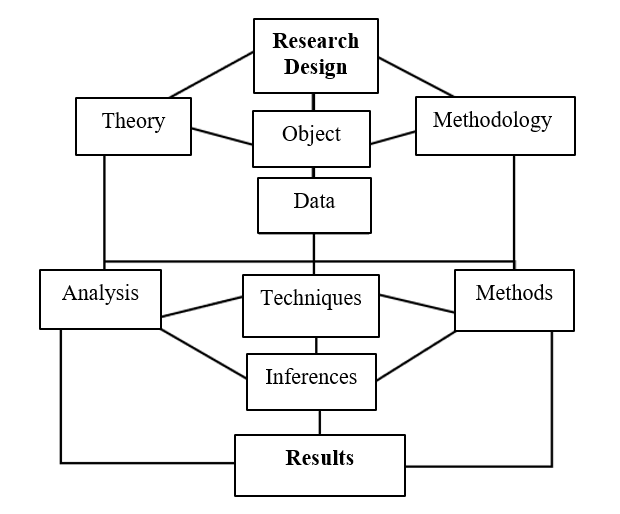
To support the understanding and application of these principles, we have developed a pedagogical flowchart, which follows, with the objective of guiding researchers through each constitutive phase of research design, facilitating the practical translation of the reflections systematized here.
In sum, despite individual preferences or methodological approaches valued by each institution, competence in research project development constitutes a fundamental skill in training new social scientists. More than applying techniques, it involves developing structured methodological thinking capable of translating research problems into innovative and creative investigative designs.
It is in this spirit that we offer these compiled reflections as a set of conceptual tools forged by researchers for researchers. We recognize the inherent challenges of social scientific inquiry, but we equally reaffirm its transformative potential, particularly relevant in Latin American countries, where openness to the analytical possibilities that emerge from plural contexts becomes not only methodologically but epistemologically necessary.
References
-
ABRUCIO, Fernando Luiz. Federalismo brasileiro e projeto nacional: os desafios da democracia e da desigualdade. Revista USP, São Paulo, n. 134, p. 127-142, 2022. Disponível em: Disponível em: https://revistas.usp.br/revusp/article/view/202382 Acesso em: 21 abr. 2026.
» https://revistas.usp.br/revusp/article/view/202382 -
ADCOCK, Robert; COLLIER, David. Measurement validity: a shared standard for qualitative and quantitative research. American Political Science Review, v. 95, n. 3, p. 529-546, set. 2001. Disponível em: https://doi.org/10.1017/S0003055401003100. Acesso em: 27 jun. 2025.
» https://doi.org/10.1017/S0003055401003100 -
ARRETCHE, Marta. Democracia, federalismo e centralização no Brasil. Rio de Janeiro: Editora FIOCRUZ, 2012. 232p. Disponível em: Disponível em: https://books.scielo.org/id/bx899 Acesso em: 21 abr. 2026.
» https://books.scielo.org/id/bx899 - BARAKSO, Maryann; SABET, Daniel M.; SCHAFFNER, Brian. The research question. In: BARAKSO, Maryann; SABET, Daniel M.; SCHAFFNER, Brian. Understanding political science research methods: the challenge of inference. New York: Routledge, 2014. p. 36-55. [chapter 2].
-
BIROLI, Flávia. MIGUEL; Luis Felipe. Meios de comunicação, voto e conflito político no Brasil. Revista Brasileira de Ciências Sociais, São Paulo, v. 28, n. 81, 2013. Disponível em: https://doi.org/10.1590/S0102-69092013000100006 Acesso em: 1 maio 2026.
» https://doi.org/10.1590/S0102-69092013000100006 - BRADY, Henry E.; COLLIER, David (orgs.). Rethinking social inquiry: diverse tools, shared standards. 2. ed. Lanham: Rowman & Littlefield Publishers, 2010.
- BORSOTTI, Carlos A. Temas de metodología de la investigación en ciencias sociales empíricas. 1. ed. Buenos Aires: Miño y Dávila, 2007.
-
CANO, Ignacio. Nas trincheiras do método: o ensino da metodologia das ciências sociais no Brasil. Sociologias, Porto Alegre, v. 14, n. 31, p. 94-119, 2012. Disponível em: Disponível em: https://www.scielo.br/j/soc/a/QC6rphm93gZgXmt6FSqWJys/ Acesso em: 27 jun. 2025.
» https://www.scielo.br/j/soc/a/QC6rphm93gZgXmt6FSqWJys/ - COLLIER, David; SEAWRIGHT, Jason; MUNCK, Gerardo L. The quest for standards: King, Keohane, and Verba’s designing social inquiry. In: BRADY, Henry E.; COLLIER, David (orgs.). Rethinking social inquiry: diverse tools, shared standards. 2. ed. Lanham: Rowman & Littlefield Publishers, 2010. p. 33-63. [chapter 2].
- COLLINS, Patricia Hill. On intellectual activism. Philadelphia: Temple University Press, 2019.
-
CRENSHAW, Kimberle. Mapping the margins: intersectionality, identity politics, and violence against women of color. Stanford Law Review, v. 43, n. 6, p. 1241-1299, 1991. Disponível em: Disponível em: https://www.jstor.org/stable/1229039 Acesso em:10 jan. 2025.
» https://www.jstor.org/stable/1229039 - CRESWELL, John W. Research design: qualitative and quantitative approaches. Thousand Oaks: Sage Publications, 1994.
- CRESWELL, John W.; PLANO CLARK, Vicki L. Designing and conducting mixed methods research. 3rd. ed. Los Angeles: SAGE, 2017.
- DENZIN, Norman K. The research act: A theoretical introduction to sociological methods. 2. ed. New York: McGraw-Hill, 1978.
- DE VAUS, David. Causation and the logic of research design. In: DE VAUS, David (ed.). Research design in social research. Thousand Oaks, CA: Sage, 2001. p. 34-52.
- FIGUEIREDO FILHO, Dalson. Métodos quantitativos em ciência política. Curitiba: InterSaberes, 2019.
-
FIGUEIREDO, Dalson; FERNANDES, Antônio; BORBA, Lucas; AGUIAR, Thaís Helena. Metodologias de pesquisa em ciência política: uma breve introdução. Revista Brasileira de Informação Bibliográfica em Ciências Sociais (BIB), São Paulo, n. 94, p. 1-34, 2021. Disponível em: Disponível em: https://bibanpocs.emnuvens.com.br/revista/article/view/175 Acesso em: 27 jun. 2025.
» https://bibanpocs.emnuvens.com.br/revista/article/view/175 - FLICK, Uwe. An introduction to qualitative research. 3rd ed. London: Sage Publications, 2006.
- GEORGE, Alexander L.; BENNETT, Andrew. Case studies and theory development in the social sciences. Cambridge, MA: MIT Press, 2005.
-
GERRING, John. Case study research: principles and practices. 2. ed. Cambridge: Cambridge University Press, 2016. Disponível em: https://doi.org/10.1017/9781316848593. Acesso em: 21 abr. 2026.
» https://doi.org/10.1017/9781316848593 - GIL, Antônio Carlos. Métodos e técnicas de pesquisa social. 6. ed. São Paulo: Atlas, 2008.
- GIL, Antônio Carlos. Como elaborar projetos de pesquisa. 6. ed. São Paulo: Atlas, 2017.
-
GSCHWEND, Thomas; SCHIMMELFENNIG, Frank. Introduction: designing research in political science - a dialogue between theory and data. In: GSCHWEND, Thomas; SCHIMMELFENNIG, Frank (eds). Research design in political science: how to practice what we preach?. Basingstoke: Palgrave Macmillan, 2007. p. 1-18. [chapter 1]. Disponível em: Disponível em: https://link.springer.com/chapter/10.1057/9780230598881_1 Acesso em:27 jun. 2025.
» https://link.springer.com/chapter/10.1057/9780230598881_1 -
HARAWAY, Donna. Situated knowledges: the science question in feminism and the privilege of partial perspective. Feminist Studies, v. 14, n. 3, p. 575-599, 1988. Disponível em: Disponível em: https://philpapers.org/archive/harskt.pdf Acesso em: 27 jun. 2025.
» https://philpapers.org/archive/harskt.pdf - HARDING, Sandra (ed.). Feminism and methodology: social science issues. Bloomington: Indiana University Press, 1987.
- HARDING, Sandra (ed.). The feminist standpoint theory reader: intellectual and political controversies. New York: Routledge, 2004.
- HARDING, Sandra. Objectivity and diversity: another logic of scientific research. Chicago: University of Chicago Press, 2015.
-
HELMKE, Gretchen; LEVITSKY, Steven. Informal institutions and comparative politics: a research agenda. Perspectives on Politics, v. 2, n. 4, p. 725-740, dez. 2004. Disponível em: Disponível em: https://www.cambridge.org/core/journals/perspectives-on-politics/article/abs/informal-institutions-and-comparative-politics-a-research-agenda/11A6AA9DCAF579F5B72DA250728AA513 Acesso em: 27 jun. 2025.
» https://www.cambridge.org/core/journals/perspectives-on-politics/article/abs/informal-institutions-and-comparative-politics-a-research-agenda/11A6AA9DCAF579F5B72DA250728AA513 - JANNUZZI, Paulo de Martino. Conceitos básicos. In: JANNUZZI, Paulo de Martino. Indicadores sociais no Brasil. Campinas: Alínea, 2001. p. 13-36. [chapter 1].
- KELLSTEDT, Paul M.; WHITTEN, Guy D. Fundamentos da pesquisa em ciência política. São Paulo: Blucher, 2015.
-
KIM, Meen Chul; ZHU, Yongjun; CHEN, Chaomei. How are they different? A quantitative domain comparison of information visualization and data visualization (2000-2014). Scientometrics, v. 107, n. 1, p. 123-165, 2016. Disponível em: https://doi.org/10.1007/s11192-015-1830-0. Acesso em: 21 abr. 2026.
» https://doi.org/10.1007/s11192-015-1830-0 - KING, Gary; KEOHANE, Robert O.; VERBA, Sidney. Designing social inquiry: scientific inference in qualitative research. Princeton, N.J.: Princeton University Press, 1994.
-
LAVALLE, Adrian Gurza; SZWAKO, José. Sociedade civil, Estado e autonomia: argumentos, contra-argumentos e avanços no debate. Opinião Pública, Campinas, v. 21, n. 1, p. 157-187, abril, 2015. Disponível em: https://doi.org/10.1590/1807-0191211157. Acesso em: 1 maio 2026.
» https://doi.org/10.1590/1807-0191211157 -
LEITE, Fernando; FERES JÚNIOR, João. A ciência na ciência política brasileira. Revista Brasileira de Ciência Política, Brasília, n. 34, p. 1-53, 2021. Disponível em: Disponível em: https://www.scielo.br/j/rbcpol/a/V3K9y7DW8Svjvk885nDwkVB/?format=pdf⟨=pt Acesso em: 27 jun. 2025.
» https://www.scielo.br/j/rbcpol/a/V3K9y7DW8Svjvk885nDwkVB/?format=pdf⟨=pt -
LEITE, Rodrigo; ROCHA, Gustavo de Andrade. Desenho de pesquisa, inferência e causalidade: caminhos entre a abordagem qualitativa e quantitativa. Revista Eletrônica de Ciência Política, Curitiba, v. 10, n. 1, p. 1-28, 18 mar. 2019. Disponível em: Disponível em: https://revistas.ufpr.br/politica/article/view/61004/0 Acesso em: 27 jun. 2025.
» https://revistas.ufpr.br/politica/article/view/61004/0 - LICHBACH, Mark I.; ZUCKERMAN, Alan S. Comparative politics: rationality, culture, and structure. Cambridge: Cambridge University Press, 2009.
-
MACHADO, Daniel Baldin. Sete elementos do processo de seleção de casos: contribuições para um maior rigor e transparência nas Ciências Sociais. Revista Brasileira de Ciência Política, Brasília, n. 36, p. 1-32, 2021. Disponível em: https://doi.org/10.1590/0103-3352.2021.36.243087. Acesso em: 27 jun. 2025.
» https://doi.org/10.1590/0103-3352.2021.36.243087 -
MAHONEY, James; GOERTZ, Gary. A tale of two cultures. Political Analysis, v. 14, n. 3, p. 227-249, 2006. Disponível em: Disponível em: https://www.jstor.org/stable/25791851 Acesso em: 27 jun. 2025.
» https://www.jstor.org/stable/25791851 -
MAHONEY, James; RUESCHEMEYER, Dietrich (orgs.). Comparative historical analysis in the social sciences. Cambridge: Cambridge University Press, 2003. Disponível em: Disponível em: https://www.cambridge.org/core/books/comparative-historical-analysis-in-the-social-sciences/0654B5F390778FCD909E4A06318BFAFF Acesso em:10 maio 2026.
» https://www.cambridge.org/core/books/comparative-historical-analysis-in-the-social-sciences/0654B5F390778FCD909E4A06318BFAFF -
MARTINEZ, Iris Nabolotnyj. De quem é esse lugar?: uma análise do feminismo acadêmico brasileiro a partir do Web of Science (1998-2021). 2023. Tese (Doutorado em Ciência Política) - Programa de Pós-Graduação em Ciência Política, Universidade Federal do Rio Grande do Sul, Porto Alegre, 2023. Disponível em: Disponível em: https://lume.ufrgs.br/handle/10183/271708 Acesso em: 10 jan. 2025.
» https://lume.ufrgs.br/handle/10183/271708 - MARSH, David; STOKER, Gerry (orgs.). Teoría y métodos de la ciencia política. Tradução de Jesús Cuéllar Menezo. Madrid: Alianza Editorial, 1997. [publicado originalmente em 1995].
-
MESQUITA, Rafael. Desenho de pesquisa, inferência e causalidade em Ciência Política e Relações Internacionais: uma introdução didática. Revista Política Hoje, Recife, v. 26, n. 2, p. 188-229, 2017. Disponível em: https://doi.org/10.51359/1808-8708.2017.234402. Acesso em: 27 jun. 2025.
» https://doi.org/10.51359/1808-8708.2017.234402 -
MONTENEGRO, Renan Holanda. Desenho de pesquisa, inferência e causalidade em Ciência Política. Revista Agenda Política, Brasília, v. 4, n. 2, p. 276-301, maio/ago. 2016. Disponível em: Disponível em: https://www.agendapolitica.ufscar.br/index.php/agendapolitica/article/view/10 4. Acesso em: 27 jun. 2025.
» https://www.agendapolitica.ufscar.br/index.php/agendapolitica/article/view/10 -
NEIVA, Pedro. Revisitando o calcanhar de Aquiles metodológico das ciências sociais no Brasil. Sociologia, Problemas e Práticas, Lisboa, n. 79, p. 65-83, 2015. Disponível em: Disponível em: http://scielo.pt/pdf/spp/n79/n79a04.pdf Acesso em: 27 jun. 2025.
» http://scielo.pt/pdf/spp/n79/n79a04.pdf -
NICOLAU, Jairo. Breve roteiro para a redação de um projeto de pesquisa. Revista Estudos Políticos, Niterói, n. 6, p. 345-353, 2013. Disponível em: Disponível em: https://periodicos.uff.br/revista_estudos_politicos/article/view/38673/22176 Acesso em: 27 jun. 2025.
» https://periodicos.uff.br/revista_estudos_politicos/article/view/38673/22176 - NORTH, Douglass C. Institutions, institutional change and economic performance. Cambridge: Cambridge University Press, 1990.
-
OLLAIK, Leila Giandoni; ZILLER, Henrique Moraes. Concepções de validade em pesquisas qualitativas. Educação e Pesquisa, São Paulo, v. 38, n. 1, p. 229-242, 2012. Disponível em: Disponível em: https://www.scielo.br/j/ep/a/HmMrcZjwBH5GtqHd8YpXT8m/abstract/?lang=pt Acesso em: 27 jun. 2025.
» https://www.scielo.br/j/ep/a/HmMrcZjwBH5GtqHd8YpXT8m/abstract/?lang=pt -
PARANHOS, Ranulfo; FIGUEIREDO, Dalson; ROCHA, Enivaldo Carvalho da; SILVA JÚNIOR, José Alexandre da; SANTOS, Manoel Leonardo Wanderley Duarte. Levando Gary King a sério: desenhos de pesquisa em Ciência Política. Revista Eletrônica de Ciência Política, Curitiba, v. 3, n. 1-2, p. 86-117, 2012. Disponível em: Disponível em: https://www.researchgate.net/publication/273170876_Levando_Gary_King_a_serio_desenhos_de_pesquisa_em_Ciencia_Politica/link/5695007f08ae820ff074918e/download Acesso em: 27 jun. 2025.
» https://www.researchgate.net/publication/273170876_Levando_Gary_King_a_serio_desenhos_de_pesquisa_em_Ciencia_Politica/link/5695007f08ae820ff074918e/download - PEREZ, Caroline Criado. Mulheres invisíveis: o viés dos dados em um mundo projetado para homens. Tradução de Renata Guerra. 1. ed. Rio de Janeiro: Intrínseca, 2022.
- PERISSINOTTO, Renato; NUNES, Wellington. Introdução aos métodos qualitativos: Comparação Histórica, QCA e Process Tracing. São Paulo: Edusp, 2023.
- PERISSINOTTO, Renato; BOTELHO, João Carlos Amoroso; BOLOGNESI, Bruno; BATISTA, Mariana; SANTOS, Manoel Leonardo. Política comparada: teoria e método. Rio de Janeiro: EdUERJ, 2022.
- POPPER, Karl R. The logic of scientific discovery. New York: Basic Books, 1959.
- POWER, Timothy J. The political right in postauthoritarian Brazil: elites, institutions, and democratization. University Park, PA: Pennsylvania State University Press, 2000.
- PRZEWORSKI, Adam; ALVAREZ, Michael E.; CHEIBUB, José Antonio; LIMONGI, Fernando. Democracy and development: political institutions and material well-being in the world, 1950-1990. Cambridge: Cambridge University Press, 2000.
- PRZEWORSKI, Adam; TEUNE, Henry. The logic of comparative social inquiry. New York: John Wiley and Sons, Inc., 1970.
-
REIS, Fábio Wanderley. O tabelão e a lupa: teoria, método generalizante e idiografia no contexto brasileiro. Revista Brasileira de Ciências Sociais, São Paulo, v. 6, n. 16, jul. 1991. Disponível em: Disponível em: https://anpocs.org.br/1991/06/30/vol-6-no-16-rio-de-janeiro-1991/ Acesso em: 27 jun. 2025.
» https://anpocs.org.br/1991/06/30/vol-6-no-16-rio-de-janeiro-1991/ - REZENDE, Flávio da Cunha. O pluralismo inferencial na ciência política: teoria e evidências. Curitiba: Appris, 2023.
-
REZENDE, Flávio da Cunha. O Pluralismo inferencial na ciência política pós-KKV (2005-2015): argumento e evidências. Revista Política Hoje, Recife, v. 26, n. 1, p. 241-277, 2017. Disponível em: Disponível em: https://periodicos.ufpe.br/revistas/index.php/politicahoje/article/view/12839/16120 Acesso em:27 jun. 2025.
» https://periodicos.ufpe.br/revistas/index.php/politicahoje/article/view/12839/16120 -
RIBEIRO, E. A., BORBA, J., HANSEN, J. R. Internet e ativismo político na América Latina e Caribe: recursos individuais e oportunidades de acesso. Civitas: Revista de Ciências Sociais, v. 19, n.1, p. 261-280, 2019. Disponível: https://doi.org/10.15448/1984-7289.2019.1.30332. Acesso em: 1 maio 2026.
» https://doi.org/10.15448/1984-7289.2019.1.30332 -
SEAWRIGHT, Jason; GERRING, John. Case selection techniques in case study research: a menu of qualitative and quantitative options. Political Research Quarterly, v. 61, n. 2, p. 294-308, jun. 2008. Disponível em: https://doi.org/10.1177/1065912907313077. Acesso em: 1 maio 2026.
» https://doi.org/10.1177/1065912907313077 - SHADISH, William R.; COOK, Thomas D.; CAMPBELL, Donald T. Experimental and quasi-experimental designs for generalized causal inference. Boston: Houghton Mifflin, 2002.
-
SILVA, Elaine Aparecida da; SILVA, José Maria da. Ofício, engenho e arte: inspiração e técnica na análise de dados qualitativos. Revista Latino-americana de Geografia e Gênero, Ponta Grossa, v. 7, n. 1, p. 132-154, jan./jul. 2016. Disponível em: Disponível em: https://revistas.uepg.br/index.php/rlagg/article/view/8041 Acesso em: 27 jun. 2025.
» https://revistas.uepg.br/index.php/rlagg/article/view/8041 -
SOARES, Gláucio Ary Dillon. O calcanhar metodológico da ciência política no Brasil. Sociologia, Problemas e Práticas, Lisboa, n. 48, p. 27-52, 2005. Disponível em: Disponível em: https://sociologiapp.iscte-iul.pt/fichaartigo.jsp?pkid=512 Acesso em: 27 jun. 2025.
» https://sociologiapp.iscte-iul.pt/fichaartigo.jsp?pkid=512 - VAN EVERA, Stephen. Guide to methods for students of political science. Ithaca, NY: Cornell University Press, 1997.
- YIN, Robert K. Case study research: design and methods. 1st ed. Newbury Park: SAGE, 1984.
-
ŽUPIČ, Ivan; ČATER, Tomaž. Bibliometric methods in management and organization. Organizational Research Methods, Slovenia, v. 18, n. 3, p. 429-472, 2015. Disponível em: Disponível em: https://www.researchgate.net/publication/254970530_Bibliometric_methods_in_management_and_organization Acesso em: 27 jun. 2025.
» https://www.researchgate.net/publication/254970530_Bibliometric_methods_in_management_and_organization
-
5
The title of this article was translated by the authors.
-
6
The title of this article was translated by the authors.
-
7
Scientometrics analyzes scientific production through quantitative data. It maps academic activity through publications, examining production volume, citations, author impact, and collaboration networks among researchers, revealing not only what is produced but what actually influences the field and opens new pathways for science. Its evidence provides more solid support for developing effective science policies.
-
8
Jairo Nicolau offers a concise and pedagogical proposal on how to develop a research project in Political Science (Nicolau, 2013). We also recommend reading the recommendations of Gil (2017).
-
9
For a reflection on how to proceed rigorously in selecting cases to be studied in order to avoid biased choices, we recommend reading Daniel Machado’s article (Machado, 2021).
-
Data Availability
The entire dataset from this study was published in the article.
-
Statement on the Use of Generative Artificial Intelligence
The authors declare that they did not use generative artificial intelligence tools in the preparation of this manuscript and assume full responsibility for its content.
-
Editors
Debora Rezende de AlmeidaRebecca Neaera Abers
The entire dataset from this study was published in the article.

 Source: Authors’ elaboration (2025)