 Effectiveness of zeolite, biochar, and dicyandiamide in reducing nitrogen losses (N2O emissions and NH3 volatilizations) from farming dairy effluent under drought
ABSTRACT
The combination of farming dairy effluent (FDE) with mitigating agents’ nitrogen (N) losses to the environment, such as zeolites, dicyandiamide (DCD), and biochar, may reduce losses and improve N availability to plants. A field experiment was conducted in an Argiudol of the Pampa region, Argentina, to evaluate N use efficiency and associated losses following FDE application. On a natural grassland with a predominance of ryegrass (Lolium multiflorum) and the presence in smaller quantities of fescue (Festuca sp.), alfalfa (Medicago sativa), and white clover (Trifolium repens). The treatments included application of FDE, FDE plus zeolite (Zeo), FDE plus dicyandiamide (DCD), FDE plus biochar (BC), and a control untreated soil (C), each with three replicates. A uniform application of 11 L m-2 of effluent (eq to 250 kg of N ha-1) was performed, and nitrous oxide (N₂O) emissions, ammonia (NH₃) volatilization, soil and atmospheric temperature, and water-filled pore space were monitored up to three months. Overall, N₂O emissions were low across all treatments, reaching a maximum of 18.4 µg m2 h-1 of N-N2O. Zeo and BC significantly reduced N₂O emissions by 63.1 and 63.8 %, respectively, compared with FDE alone. Furthermore, BC reduced NH₃ volatilization by 55.5 % relative to FDE, highlighting its strong potential to mitigate total N losses. Regarding pasture performance, the highest greenness index was observed in the BC treatment, followed by intermediate values in FDE, DCD, and Zeo, and the lowest in the control. Under our study conditions, with particularly low rainfall and high temperatures, the mitigating effects of DCD and Zeo appeared to be limited. In contrast, the combination of FDE and BC emerged as the most effective strategy to reduce N losses and enhance pasture quality. Furthermore, environmental conditions play a key role in determining the efficacy of mitigation strategies to curb N losses.
Keywords
nutrient management; mitigating agents; organic fertilizer
INTRODUCTION
Nitrogen (N) fertilization is an effective way to enhance productivity and improve pasture quality, which in turn can lead to better milk production (Beukes et al., 2020). However, the increase in dairy waste poses an environmental challenge (Milani et al., 2011). One potential solution is to utilize farm dairy effluent (FDE) as an organic fertilizer (Iocoli et al., 2021; Cosentino et al., 2024). The efficiency of FDE can be further improved by incorporating nitrification inhibitors (NI) or materials like zeolites or biochar, which help to increase nitrogen use efficiency (NUE) by releasing N gradually (He et al., 2025). Ammonia volatilization is a main pathway of nitrogen loss, and in the case of organic fertilizers, it can account for up to 64 % of the total nitrogen applied, depending on the type of material, application method, and environmental conditions (Wester-Larsen et al., 2022).
On the other hand, nitrous oxide (N2O) has a global warming potential 273 times higher than carbon dioxide (CO2) and is one of the leading greenhouse gases (GHG) emitted by the agricultural sector (Forster et al., 2021). In this sense, delivering nutrients from mineral or organic fertilizers out of sync with crop uptake causes inefficiencies with the risk of environmental contamination due to NH3 volatilization, N2O emissions, or nitrate leaching (NO3-) (Chin et al., 2018). Consequently, reducing N losses in agricultural systems is a major challenge for modern agriculture. The recovery of FDE and its use as a source of N for crops and pastures, maximizing NUE, is undoubtedly a sustainable alternative, providing a solution to waste disposal and contributing to reducing the use of synthetic fertilizers (Cosentino et al., 2024).
Nitrification inhibitors (NIs) are chemical compounds that suppress the first step of nitrification by inhibiting a broad range of ammonia-oxidizing organisms, including Nitrosomonas spp. (McCarty, 1999; Lei et al., 2022). Their use promotes nitrogen retention in the form of ammonium (NH₄⁺), which is less mobile in the soil solution, while reducing nitrate (NO₃-) concentrations and thus the substrate available for denitrification and N₂O production (Di et al., 2014; Gonzatto et al., 2016). Among them, dicyandiamide (DCD) stands out as a widely used NI due to its low cost, water solubility, low volatility, and effectiveness when applied with nitrogen fertilizers (Di et al., 2011). Several studies have demonstrated that NIs, including DCD, can significantly reduce N₂O emissions from soils (Di et al., 2012; Gonzatto et al., 2016). However, limited information is available regarding their effectiveness when applied with organic waste, particularly farm dairy effluent (FDE). Evaluating the impact of DCD on N₂O emissions and NH₃ volatilization from FDE-treated soils is essential for identifying management strategies that enhance productivity while reducing environmental losses.
Application of FDE with zeolite represents an interesting strategy, as zeolites are low-cost minerals with a microporous structure and high cation exchange capacity (Park et al., 2024). These properties allow zeolite to retain nutrients and reduce the mobility of potentially toxic elements (PTEs) by adsorbing them onto its surface (Wang and Peng, 2010; Mohsin et al., 2023). Zeolites can also modulate nutrient release and regulate soil moisture content (Eroglu et al., 2017), which may help reduce N losses, particularly N₂O emissions, when co-applied with organic amendments such as FDE.
Another product with GHG mitigation potential is biochar (Doyeni et al., 2023), a porous carbonaceous material created through the pyrolysis of organic matter in low-oxygen conditions. This material features a microporous structure, which gives a high cation exchange capacity and a diverse range of physical and chemical properties, influenced by factors such as the type of raw material used, the conditions of pyrolysis, and the nutrient content in the biochar (Niraula et al., 2021). Like zeolite, biochar can retain and diminish the bioavailability of PTE, while also gradually adsorbing and releasing nutrients through the mineralization of FDE (Peng et al., 2020; Zhang et al., 2023). Additionally, biochar has significant potential for sustainable agriculture by helping to reduce GHG emissions (Zhang et al., 2012). Nonetheless, the effectiveness of biochar application in agricultural settings is greatly influenced by factors such as soil type, the biochar-to-soil ratio, and climatic conditions. Consequently, further research is necessary to optimize biochar use in agriculture.
The evaluation of FDE management strategies amended to the soil is critical to reduce nitrogen losses to the environment, improve pasture performance and quality, enhancing soil and air health. It was hypothesized that (i) the combination of FDE with these amendments reduces nitrogen losses as N₂O and NH₃ compared with FDE alone, and (ii) these combinations improve pasture performance. This study aimed to evaluate different management strategies to mitigate atmospheric nitrogen losses by applying FDE combined with a nitrification inhibitor (DCD), zeolite, and biochar under drought conditions.
MATERIALS AND METHODS
Field experiment
The field experiment was carried out on a natural grassland without animal, with predominance of ryegrass (Lolium multiflorum) and presence in smaller quantities of fescue (Festuca sp.), alfalfa (Medicago sativa), white clover (Trifolium repens) located in Castelar, Buenos Aires province, Argentina (34°37’21.13” S - 58° 40’12.44” W), from October 12, 2022, to January 13, 2023. The soil in the area is classified as Vertic Argiudol (Soil Survey Staff, 2022) with a silty loam texture (sand 165 g kg-1, silt 585 g kg-1, and clay 250 g kg-1). Soil had a value of 6.3; electrical conductivity of the saturated paste extract was 0.2 dS m-1; percentage of organic carbon of 1.8; percentage of N of 0.2; and bulk density of 1.20 Mg m-3 in the first 0.20 m of soil.
Treatments included application onto soil of farm dairy effluent alone (FDE), FDE plus zeolite (Zeo), FDE plus dicyandiamide (DCD), FDE plus biochar (BC), and the control untreated (C). A completely randomized design was used, with three replicates. The FDE was collected fresh two days before applying it to the soil from a stabilization lagoon of a milk farm in the town of Lobos, Buenos Aires province. The FDE was stored in a cool, shady place, in 100-liter plastic drums. The characterization of the FDE is presented in table 1. Total carbon and nitrogen, and carbon-to-nitrogen ratio (C/N) of each treatment material were determined before field application and are shown in table 2. These values provide additional information on the biochemical characteristics of the amendments, which could influence nitrogen dynamics.
Characterization of the FDE for the treatments farm dairy effluent (FDE), farm dairy effluent plus zeolite (Zeo), farm dairy effluent plus Dicyandiamide (DCD) and farm dairy effluent plus biochar (BC)
Total N and C contents, and the C/N ratio of the pasture, for the treatments farm dairy effluent (FDE), farm dairy effluent plus zeolite (Zeo), farm dairy effluent plus Dicyandiamide (DCD), farm dairy effluent plus biochar (BC), and control (C)
The biochar was produced through a pyrolysis process (100 min at 600 °C) using a species of bamboo cane called Tacuaruzú (Guadua chacoensis) as an input. It was ground by hand and sieved through two mesh screens, size 20 and 4 (corresponding to a particle size between 0.84 and 4.75 mm). The zeolites used belong to the clinoptilolite-heulandite series and were obtained in the province of La Rioja, Argentina. They were supplied and characterized by the Argentine Geological and Mining Service (SEGEMAR) and processed by grinding and sieving through a 200 ASTM mesh screen, resulting in particles with a size of 0.074 mm or less.
In all treatments involving effluent, a volume equivalent to 11 L effluent m-2 (corresponding to 250 kg ha-1 of N) was applied superficially and uniformly across each experimental plot 12 m2 (3 × 4 m). The amount of effluent was carefully adjusted according to the area of each measurement device (N2O chambers and NH3 towers) and applied manually to ensure accurate dosing in these critical measurement zones.
We applied zeolite at 100 g L-1 FDE (~11 Mg ha-1), biochar at 15 g L-1 of FDE (≈ 1.66 Mg ha-1), and dicyandiamide (DCD) at 10 kg ha-1. Zeolite and biochar were pre-mixed into the effluent 24 h before soil application, while DCD was co-applied directly with the FDE at the time of application. These rates were selected based on prior studies showing agronomic and nitrogen-related benefits at comparable doses: 10–15 Mg ha-1 zeolite improved N retention and use efficiency across crops (GirijaVeni et al., 2021; Hazrati et al., 2022); ≤ 3 Mg ha-1 biochar proved effective as a low dose in temperate field conditions (Jiang et al., 2023), and 0.5–4.0 % was effective in pot trials (Qiu et al., 2022); and 10 kg ha-¹ DCD was supported by field trials in the Pampas under cool, moist conditions (Cosentino et al., 2024), as well as mechanistic evidence indicating this dose can significantly reduce nitrification (Guo et al., 2014). All rates were later refined and validated through unpublished trials under our local environmental conditions.
The grass was cut to a height of 0.05 m above the ground, five days before the experiment began, to homogenize initial conditions, and was only cut to assess pasture yield. During the experimental period, the average soil temperature was 16.3 °C, the air temperature averaged 29.3 °C, and accumulated precipitation totalled 142.2 mm.
N2O emission
The static chamber method was used for sampling N2O during the 92 days after application (DAA). Each static chamber consisted of a metal base covering a surface area of 0.13 m2 and a non-vented plastic top with a height of 0.125 m. The metal base was inserted into the soil to a depth of 0.05 m soon after cutting the ryegrass to avoid possible gas leakage or contamination by lateral diffusion (Clough et al., 2020). Sampling was carried out in the morning (between 09:00 am and 12:00 pm), as described by Cosentino et al. (2012). Gas samples were taken from the chamber headspace at 0, 15, and 30-min after closing the chambers. Gases were extracted directly from inside the chamber (volume 16.7 dm3) using a vacuum pump and injected into previously evacuated 10 cm3 vials sealed with rubber stoppers fixed to the vial with an aluminum flange (Alves et al., 2012; Cosentino et al., 2012), we followed this procedure on each sampling date and for each of the 3 chambers within each plot. Within seven days of sampling, N2O was measured in the laboratory with a GC 6890 Agilent Technologies Network gas chromatograph, fitted with a 63Ni electron capture detector (Agilent Network GC System, A´ ECD, Santa Clara, CA, USA) and a 30 m × 530 μm × 25 μm Molsieve HP-Plot column. The oven, injector and detector temperatures were 150, 100 and 300 °C, respectively. The carrier gas was N2, and the injection volume was 0.5 cm3. The N2O fluxes (f) were calculated using equation 1.
in which: ΔC/Δt is the change in N2O concentration in the chamber during the deployment time Δt; V is the volume of the chamber (16.7 dm3); A is the soil area (0.13 m2) covered by the chamber; m is the molecular mass of N2O; and Vm is molar volume of N2O. The N2O emission fluxes were calculated by the linear regression method, taking the accumulation time (t0, t15, t30 min) as the independent variable and the N2O concentration in each of those as the dependent variable times (Ct0, Ct15, Ct30).
NH3 volatilization
The static semi-open-cylinder absorption system proposed by Nômmik (1973) and modified by Videla (1994) was used to measure NH3 volatilization during the 22 DAA. This system featured a cylindrical collection tower with polyethylene walls, measuring 0.24 m in diameter and 0.80 m in height. Within the tower, two metal rods supported two plates of expanded polyurethane, each 1.5 cm thick, saturated with a 0.25 mol L-1 H2SO4 solution. The lower plate, positioned 0.15 m above the soil, captured NH3 volatilization from the soil, while the upper plate acted as a barrier to prevent contamination from atmospheric NH3. Additionally, each tower was outfitted with a zinc roof to prevent rainwater from entering. Ammonia determinations over time were carried out until no significant differences (p<0.05) were observed between the treatments and the control (Videla, 1994). This gas was sampled daily for the first nine days after applying the treatments, then once a week for two weeks. In each sampling, the polyurethane plate of the lower grid was rinsed with distilled water, and the NH4+ content in the sponge-washing solution was determined by the micro distillation method and subsequent titration (Bremner and Keeney, 1965). From the N-NH₄⁺ value, the concentration of N-NH₃ volatilized over the surface covered by the NH₃ collection chamber was obtained as nitrogen capture (Nc), according to equation 2.
in which: Va is the volume of sulfuric acid used for the sample (cm3); Vb is the volume of sulfuric acid used for the blank (cm3); Nac is the normality of the sulfuric acid (meq cm-3); Vm is the volume of the sample (cm3); and m is the weight of the meq of N.
Nitrogen lost due to volatilization of N-NH₃⁺ per hectare (Nv) was calculated according to the equation 3.
in which: Nc is the N from NH₃ captured by the cylinder; 10000 is the area of one hectare in (m2); and CS is the cylinder's coverage area in (m2).
To understand potential differences among treatments in N-NH3 volatilization across all nine samplings, cumulative N-NH3 was calculated for each treatment.
Total N emitted
Cumulative N loss from different treatments was calculated as N lost through N2O emission and NH3 volatilization. This was determined by linearly interpolating between sampling points, multiplying the mean N2O emission and NH3 volatilization for two successive sampling dates by the period between sampling, and adding that amount to the previous cumulative total (Dorich et al., 2020). The fraction of N emitted (N2O emission and NH3 volatilization) was obtained from the cumulative emission for each treatment. Nitrogen fraction (NF) was calculated using equation 4.
in which: NF is the N fraction emitted (N emitted as % of N applied); MT is the total N emitted (N2O emission and NH3 volatilization) per treatment; MC is the total N emitted from the control treatment; and Total N applied is the N applied as FDE (150 kg ha-1).
Soil and plant parameters
Soil temperature was measured at 0.10 m depth. Soil composite samples (0.00–0.20 m layer) were taken to determine NO3- content (Cataldo et al., 1975) and gravimetric water content (GWC) by drying the soil samples at 105 °C for 48 h or until constant weight was reached. Each soil composite sample was composed of three sub-samples. Soil samples were collected adjacent to the gas‑flux chamber within the sampling area. Soil cylinders (100 cm³ volume and 0.05 m in diameter) were also collected to determine soil bulk density (Blake, 1965).
Water-filled pore space (WFPS) was calculated using equation 5.
in which: θg (g/g) is the gravimetric water content; BD (g/cm3) is the soil bulk density; and PD is the soil particle density, generally given as 2.65 Mg m-3.
On day 30 DAA, the greenness index was measured (with SPAD 502 millivolt) as an average between four subsamples randomly chosen within each plot. Pasture aboveground was cut at 33 DAA in all plots. The greenness index was used as a non-destructive proxy for plant health and nitrogen status, providing insight into the effectiveness of each treatment in promoting pasture quality under drought conditions. The samples collected were dried in an oven at 40 °C and weighed to obtain dry weight. Total N content (Modified Kjeldahl method, IRAM-SAGyP standard 29572:2018), the total C content (Modified Walkley & Black method, IRAM-SAGyP Standard 29571:2016), and the C/N ratio of the pasture were also determined and are shown in table 2.
Statistical analysis
Linear regression was used to estimate daily emission rates of N₂O based on three discrete flux measurements per gas, as previously described. These rates were then used to calculate cumulative emissions over time. To evaluate statistical differences between treatments in cumulative N₂O emissions, NH₃ volatilization, total N losses (N₂O + NH₃), pasture yield, and greenness index, data were subjected to analysis of variance (ANOVA) using the InfoStat software (Di Rienzo et al., 2020). Before ANOVA, assumptions of normality (Shapiro–Wilk test) and homoscedasticity (Levene’s test) were verified. Differences among means were tested using Tukey’s HSD test at a significance level of 0.05.
RESULTS
Emissions of N2O were low throughout the experiment across all treatments, with a maximum of 18.40 µg m2 h-1 of N-N2O. The highest emissions were observed within the first DAA, with significant differences between the FDE and the rest of the treatments only on five sampling dates between days 4 and 12 DAA (Figure 1a). Soil temperature ranged from 17 to 27 °C, with an average of 20.5 °C (data not shown). The WFPS (water-filled pore space) ranged from 25 to 56 %, with an average of 42 % across the season, and did not differ among treatments. Values are therefore presented as the site‑level mean in figure 1b. The seasonal mean WFPS was low (≈ 42 %), consistent with the drought conditions recorded. In all treatments with FDE application, the NO3- content was higher at the beginning of the experiment and decreased over time. Treatment with Zeo presented the highest NO3- values over time (Figure 1c).
Evolution of N2O emission (a), water-filled pore space (WFPS, -○-) and rainfall (b), and NO3- content (c) across treatments. Bars indicate standard errors. Asterisks (*) denote statistically significant differences between treatments for a given day (p<0.05, ANOVA followed by Tukey’s HSD test).
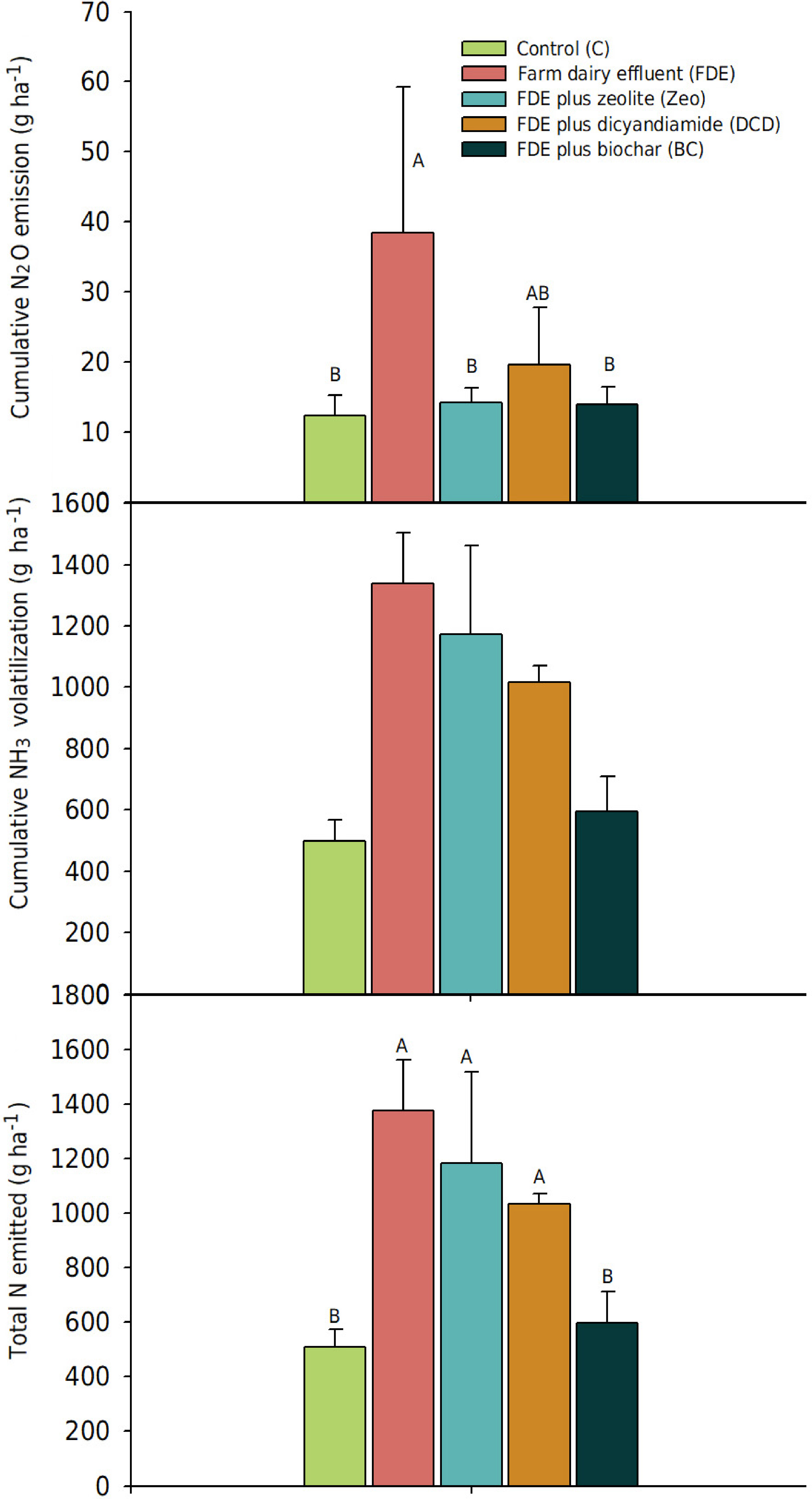
Zeo or BC addition significantly reduced N2O emissions by 63.1 and 63.8 %, respectively, compared with the FDE treatment. In contrast, the DCD addition did not present significant differences with the FDE treatment (Figure 2a). Regarding NH3 volatilization, the BC treatment significantly reduced (p<0.05) NH3 volatilization by 55.5 % compared with the FDE treatment. The BC treatment showed NH3 volatilization values close to those of the C treatment. In contrast, the Zeo and DCD treatments did not reduce NH3 volatilization (Figure 2b). The BC treatment showed the highest inferred mitigation potential based on total N loss (the sum of N emitted as N2O and NH3) (Figure 2c).
Cumulative N2O emission (a), cumulative NH3 volatilization (b), and total N lost to the atmosphere (c) from the control soil. Bars indicate standard errors. Different letters indicate statistically significant differences among treatments (p<0.05, ANOVA followed by Tukey’s HSD test).
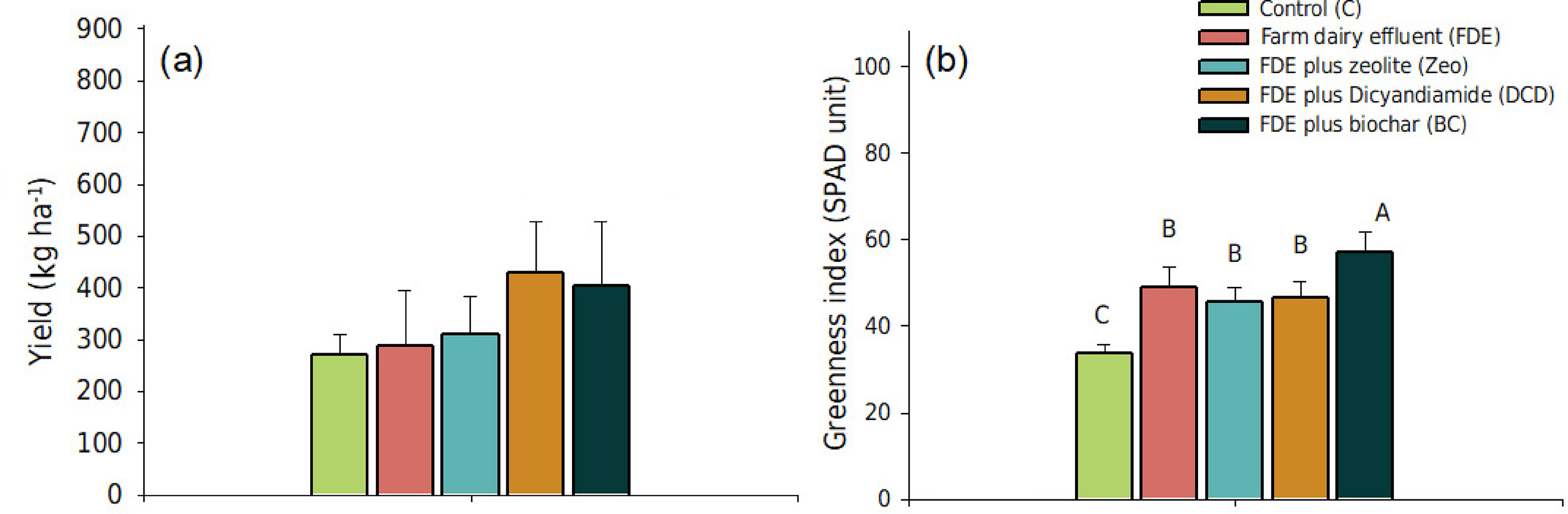
Pasture yield was very low (close to 400 kg ha-1), and there were no significant differences between treatments (Figure 3a). However, there were significant (p>0.05) treatment effects on greenness index with the following trend: BC (169.6 %) > FDE (145.3 %) ≈ DCD (138.4 %) ≈ Zeo (135.8 %) > C (100 %) treatment (Figure 3b).
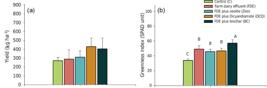
Pasture yield (a) and greenness index (b) from the control soil. Bars indicate standard errors. Different letters indicate statistically significant differences among treatments (p<0.05, ANOVA followed by Tukey HSD test).
DISCUSSION
Emissions of N₂O during the experiment were generally low, although short-lived peaks were observed shortly after the application of the treatments. These initial peaks were likely associated with the rapid increase in soil mineral nitrogen, particularly NO₃-, following FDE application in all treatments (Figure 1c). Similar transient increases in N₂O emissions after the addition of organic amendments have been reported in previous studies (Roig et al., 2012; Masaka et al., 2014). For example, Li et al. (2015) found that N₂O fluxes consistently peaked within the first 24 h after FDE application across three consecutive seasons. Li et al. (2014) also observed this trend during winter. Comparable results were reported for other types of organic effluents, with sharp but short-lived increases in N₂O emissions after application (Sharpe and Harper, 2002; Luo et al., 2008).
The low cumulative N₂O emissions observed throughout the experiment can be largely attributed to the environmental conditions, particularly low soil moisture. Throughout the study period, WFPS did not exceed 60 % in any treatment, likely due to below-average rainfall. Under such conditions, the relative importance of denitrification as a source of N₂O diminishes, while nitrification becomes the dominant process (Linn and Doran, 1984). Since nitrification generally produces less N₂O than denitrification (Smith et al., 2003; Bateman and Baggs, 2005), this shift in dominant pathways likely contributed to the overall low emissions.
Nevertheless, it is possible that the water added through FDE application temporarily created anaerobic microsites, promoting short-term denitrification and explaining the initial emission peaks (Siddique et al., 2012). Moreover, the average soil temperature during the study was 20.5 °C, which may have enhanced microbial activity. High temperatures can promote rapid oxygen consumption through microbial respiration, leading to the formation of anaerobic micropores and favoring denitrification (Li et al., 2000; Smith et al., 2003; Farquharson and Baldock, 2008). The combination of effluent-derived moisture and increased microbial activity could explain the brief spike in N₂O emissions observed immediately after application (Dalal et al., 2010). Importantly, in the medium and long term, a negative relationship was observed between soil temperature and WFPS, as elevated temperatures accelerated soil drying and reduced the formation of anaerobic zones. Consequently, the denitrification process induced by effluent application was likely short-lived.
No significant differences in cumulative N2O emissions were observed between DCD and FDE treatment (Figure 2a). These results differ from those reported by many authors. Li et al. (2015) conducted a field experiment during spring, applying different organic fertilizers to the soil (Li et al., 2000). They observed that DCD reduced N2O emissions by 24-69 %. Di et al. (2021) co-applied 10 kg of DCD ha-1 with cow urine and observed a 65 % decrease in N2O emission. Merino et al. (2002) also found that applying cattle manure plus 25 kg of DCD ha-1 to the soil inhibited nitrification and reduced N2O emissions by up to 60 %. A recent meta-analysis of 149 scientific publications found that DCD reduces N2O emissions by 47 % without significantly affecting NH3 volatilization (Tufail et al., 2022). Furthermore, Cosentino et al. (2024) observed a decrease of 50 % in N2O emissions and an increase in crop yield when applying DCD together with FDE in an autumn-winter field experiment.
Under the conditions of the present study, with very dry soil and extremely hot weather (an average air temperature of 29 °C and 42 % WFPS), the DCD may have lost or reduced its efficiency and, therefore, its role as a mitigator. Soil moisture content strongly affects the effectiveness of DCD (Di and Cameron, 2006). Guo et al. (2022) investigated the effectiveness of four NIs (including DCD) in reducing N2O emissions from N-fertilized soil. They concluded that this efficiency increased with increasing soil moisture. The effectiveness of DCD to mitigate N2O emissions also depends on soil temperature. Below 15 °C, DCD has been reported to inhibit nitrification for up to 6 months, while above 15 °C, the efficacy decreases substantially (Kelliher et al., 2014). Furthermore, the DCD has low stability at high temperatures, which rapidly decreases its half-life (Kelliher et al., 2014).
Significant differences in cumulative N2O emissions were observed between FDE and BC (Figure 2a). Pan et al. (2020) conducted a leachate test and observed that the considerable amount of surface functional groups and the large surface area of biochar effectively adsorbed and removed a significant amount of organic matter, facilitating the completion of the nitrification and denitrification reactions and resulting in lower N2O emissions. Zhang et al. (2023) conducted a meta-analysis to analyze N2O emissions from soil after biochar application. They found that, on average, adding biochar reduced N2O emissions from soil by 16.2 %. Rittl et al. (2021) also applied different doses of biochar in soils under various temperature conditions and observed that higher biochar rates were needed to mitigate N₂O emissions as soil temperature increased. For example, a dose of 2.5 Mg ha-1 was effective in reducing emissions in soils exposed to temperatures up to 40 °C. These findings are consistent with our study, in which soil temperature averaged 20.5 °C and biochar was applied at a lower rate (1.67 Mg ha-1), yet still mitigated N₂O emissions.
Zeolite addition reduced N₂O emissions by 63.1 % (Figure 2a). This mitigation is consistent with zeolite high cation-exchange capacity and microporosity, which transiently retain NH₄⁺ from the applied effluent/manure and modulate N release, damping short-lived mineral-N pulses that typically drive coupled nitrification–denitrification immediately after application. Consistent with this mechanism, multiple field and incubation studies report lower N₂O emissions with zeolite across N fertilizer sources (Zaman and Nguyen, 2010; Jumadi et al., 2020; Ali et al., 2022). When applied with pig slurry, zeolite decreased cumulative N₂O by 16.3 % and increased forage and cob yield in maize (Choi et al., 2020) and reduced cumulative N₂O by 15.6 and 31.5 % during king‑grass and corn seasons, respectively, while improving NUE and N availability (Park et al., 2024). Under the dry, warm conditions of our study —low rainfall and prevailing drought— denitrification was likely constrained by limited anaerobic microsites (Dobbie and Smith, 2003), so the transient reduction in substrate availability and improved near‑surface aeration associated with zeolite would further limit N₂O formation. The BC was the only treatment that reduced NH3 volatilization (Figure 2b), reaching levels similar to those of the C treatment. Meiirkhanuly et al. (2020) applied biochar to pig manure in storage and observed a reduction in NH3 volatilization from 19 to 39 %. In contrast, the treatments with Zeo and DCD showed NH3 volatilization values that were similar to those of FDE. The DCD is a NI, so it is not expected to reduce NH3 losses from volatilization. In a meta-analysis conducted by Di et al. (2021) involving 89 studies worldwide, the authors concluded that, in most cases, the addition of NI increased NH3 volatilization by 35.7 % compared with a fertilizer without NI, even under different soil conditions. Choi et al. (2020) observed that adding zeolite to pig manure reduced NH3 volatilization by 20.1 %, while Park et al. (2024) found that zeolite application reduced cumulative NH3 volatilization from swine manure by 16.7 and 24.4 % in the king-grass and corn growing seasons, respectively. Our results differ from those reported by these authors because we did not observe a decrease in NH3 volatilization (Figure 2a). The balance between NH3 and NH4+ in zeolites is influenced by water content; as water content decreases, NH4+ tends to convert to NH3. Lower water levels can lead to NH4+ being released as NH3 rather than adsorbed by zeolite, thereby increasing NH3 volatilization (Chen et al., 2018).
Pasture yield was low, and no significant difference between treatments was observed. However, the greenness index presented significant differences between treatments. The maximum value was observed in the BC treatment, intermediate values in the FDE, DCD, and Zeo treatments, and the lowest value in the C treatment. While the SPAD value is strongly related to plant N content, it is important to remember that it can also be affected by other factors that influence chlorophyll, such as Mg and S availability, plant diseases, and drought. Other researchers who have studied zeolite, biochar, and DCD applied to different agricultural residues reported nutritional improvements and pasture performance. Rehakova et al. (2004) reported that applying zeolite to soil modifies the rhizosphere and increases plant biomass. Niraula et al. (2021) observed that applying biochar saturated with dairy effluent to the soil improved the nutritional quality and growth of the pasture. Finally, Cosentino et al. (2024) observed increases in pasture yield after co-application of FDE plus DCD. In this experiment, the lack of rainfall may have affected pasture yield, interfering with the evaluation of the Zeo, BC, and DCD effects on yield.
Additionally, the application of zeolite generated a surface crust that delayed pasture growth. This crust may also have affected the pasture yield. This finding highlights the importance of avoiding doses that lead to crust formation on the soil surface.
CONCLUSIONS
In this study, during an exceptionally dry season, farm diary effluent (FDE) application with biochar (BC) was the most efficient mitigating strategy, showing the lowest loss of N to the environment and promoting higher quality in the pasture. In line with our hypothesis, the FDE + BC treatment reduced both N₂O and NH₃ losses and improved canopy greenness; by contrast, the hypothesis was not supported for zeolite, and no yield gains were detected.
Zeolite showed intermediate performance, mainly through reductions in N₂O, but it did not lessen NH₃ losses. The very low rainfall likely promoted surface crusting and limited the expression of zeolite’s usual benefits; indeed, its high water‑holding capacity can be counterproductive during extreme drought. The dicyandiamide (DCD) was ineffective at mitigating N losses (both N₂O and NH₃) under these conditions. Further multi-season studies under different environmental conditions are needed to expand recommendations on these mitigation substances.
ACKNOWLEDGEMENTS
The authors thank Jorge Vallejos, Mauro Gonzales, and Beatríz Zumalave Rey for providing the biochar; Cañada del Toro SRL for providing the Farming Diary Effluent; and SEGEMAR (Argentine Geological and Mining Service) for providing the zeolites.
-
How to cite:
Cosentino VRN, Estrada EO, Romaniuk RI, Contreras MCS, Shumba A, Beltrán MJ, Pérez MG, Costantini AO, Silvia Imhoff S. Effectiveness of zeolite, biochar, and dicyandiamide in reducing nitrogen losses (N2O emissions and NH3 volatilizations) from farming dairy effluent under drought. Rev Bras Cienc Solo. 2026;50:e0250094. https://doi.org/10.36783/18069657rbcs20250094
-
FUNDING
This research was partially supported by PD I122 Project “Gestión de las biomasas del SAB y estrategias tecnológicas para su transformación en bioproductos de valor agregado”, PD I097 Project “Emisiones de gases de efecto invernadero y captura de carbono en sistemas agropecuarios y forestales”, and Proyecto Fontagro ATN/RF-20641-RG ATN/RF-20642-RG “Optimizando el uso de nitrógeno, mayor producción y menor impacto (N4R)”.
DATA AVAILABILITY
After publication, the data will be available on demand to authors.
REFERENCES
-
Ali A, Ali MF, Javed T, Abidi SH, Syed Q, Zulfiqar U, Wolny P. Mitigating ammonia and greenhouse gaseous emission from arable land by co-application of zeolite and biochar. Front Plant Sci. 2022;13:950944. https://doi.org/10.3389/fpls.2022.950944
» https://doi.org/10.3389/fpls.2022.950944 -
Alves BJR, Smith KA, Flores RA, Cardoso AS, Oliveira WRD, Jantalia CP, Urquiaga S, Boddey RM. Selection of the most suitable sampling time for static chambers for the estimation of daily mean N2O flux from soils. Soil Biol Bioc. 2012;46:129-35. https://doi.org/10.1016/j.soilbio.2011.11.022
» https://doi.org/10.1016/j.soilbio.2011.11.022 -
Bateman EJ, Baggs EM. Contributions of nitrification and denitrification to N2O emissions from soils at different water-filled pore space. Biol Fertil Soils. 2005;41:379-88. https://doi.org/10.1007/s00374-005-0858-3
» https://doi.org/10.1007/s00374-005-0858-3 -
Beukes P, Gregorini P, Cameron K, Attwood G. Farm-scale carbon and nitrogen fluxes in pastoral dairy production systems using different nitrogen fertilizer regimes. Nutr Cycl Agroecosyst. 2020;117:1-12. https://doi.org/10.1007/s10705-020-10052-2
» https://doi.org/10.1007/s10705-020-10052-2 -
Blake G. Bulk density. In: Black CA, editor. Methods of soil analysis: Part 1 Physical and mineralogical properties, including statistics of measurement and sampling. Madison: American Society Agronomy; 1965. p. 374-90. https://doi.org/10.2134/agronmonogr9.1.c30
» https://doi.org/10.2134/agronmonogr9.1.c30 -
Bremner JM, Keeney DR. Steam distillation methods for determination of ammonium, nitrate, and nitrite. Anal Chim Acta. 1965;32:485-95. https://doi.org/10.1016/S0003-2670(00)88973-4
» https://doi.org/10.1016/S0003-2670(00)88973-4 -
Cataldo DA, Haroon MH, Schrader LE, Youngs VL. Rapid colorimetric determination of nitrate in plant tissue by nitration of salicylic acid. Commun Soil Sci Plant Anal. 1975;6:71-80. https://doi.org/10.1080/00103627509366547
» https://doi.org/10.1080/00103627509366547 -
Chen HF, Lin YJ, Chen BH, Yoshiyuki I, Liou SYH, Huang RT. A further investigation of NH4+ removal mechanisms by using natural and synthetic zeolites in different concentrations and temperatures. Minerals. 2018;8:499. https://doi.org/10.3390/min8110499
» https://doi.org/10.3390/min8110499 -
Chin A, Schmidt S, Buckley S, Pirie R, Redding M, Laycock B, Luckman P, Batstone DJ, Robinson N, Brackin R. Sorbents can tailor nitrogen release from organic wastes to match the uptake capacity of crops. Sci Total Environ. 2018;645:1474-83. https://doi.org/10.1016/j.scitotenv.2018.07.135
» https://doi.org/10.1016/j.scitotenv.2018.07.135 -
Choi AR, Park SH, Kim TH. The effects of zeolite on ammonia, nitrous oxide emission, and forage yield from pig slurry applied to the forage corn cropping. J Kor Grassl Forage Sci. 2020;40:274-8. https://doi.org/10.5333/kgfs.2020.40.4.274
» https://doi.org/10.5333/kgfs.2020.40.4.274 -
Clough TJ, Rochette P, Thomas SM, Pihlatie M, Christiansen JR, Thorman RE. Global Research Alliance N2O chamber methodology guidelines: Design considerations. J Environ Qual. 2020;49:1081-91. https://doi.org/10.1002/jeq2.20117
» https://doi.org/10.1002/jeq2.20117 -
Cosentino VRN, Fernandez PL, Figueiro AS, Taboada MA. N2O emissions from a cultivated mollisol: Optimal time of day for sampling and the role of soil. Rev Bras Cienc Solo. 2012;36:1814-9. https://doi.org/10.1590/S0100-06832012000600015
» https://doi.org/10.1590/S0100-06832012000600015 -
Cosentino VRN, Romaniuk RI, Mórtola NA, Estrada Otero E, Martinek N, Beltran MJ, Costantini AO, Imohff S, Taboada MA. Nitrification inhibitor addition to farm dairy effluent to reduce nitrous oxide emissions. Rev Bras Cienc Solo. 2024;48:e0230039. https://doi.org/10.36783/18069657rbcs20230039
» https://doi.org/10.36783/18069657rbcs20230039 -
Dalal RC, Gibson I, Allen DE, Menzies NW. Green waste compost reduces nitrous oxide emissions from feedlot manure applied to soil. Agric Ecosyst Environ. 2010;136:273-81. https://doi.org/10.1016/j.agee.2009.06.010
» https://doi.org/10.1016/j.agee.2009.06.010 -
Di HJ, Cameron KC, Podolyan A, Robinson A. Effect of soil moisture status and a nitrification inhibitor, dicyandiamide, on ammonia oxidizer and denitrifier growth and nitrous oxide emissions in grassland soil. Soil Biol Bioc. 2014;73:59-68. https://doi.org/10.1016/j.soilbio.2014.02.011
» https://doi.org/10.1016/j.soilbio.2014.02.011 -
Di HJ, Cameron KC, Shen JP, Winefield CS, O’Callaghan M, Bowatte S, He JZ. Methanotroph abundance not affected by applications of animal urine and a nitrification inhibitor, dicyandiamide, in six grazed grassland soils. J Soils Sediments. 2011;11:1032-9. https://doi.org/10.1007/s11368-010-0318-z
» https://doi.org/10.1007/s11368-010-0318-z -
Di HJ, Cameron KC. How does the application of different nitrification inhibitors affect nitrous oxide emissions and nitrate leaching from cow urine in grazed pastures? Soil Use Manage. 2012;28:54-61. https://doi.org/10.1111/j.1475-2743.2011.00373.x
» https://doi.org/10.1111/j.1475-2743.2011.00373.x -
Di HJ, Cameron KC. Nitrous oxide emissions from two dairy pasture soils by different rates of a fine particle suspension nitrification inhibitor, dicyandiamide. Biol Fertil Soils. 2006;42:472-80. https://doi.org/10.1007/s00374-005-0038-5
» https://doi.org/10.1007/s00374-005-0038-5 - Di Rienzo JA, Casanoves F, Balzarini MG, Gonzalez L, Tablada M, Robledo CK. InfoStat versión. Córdoba, Argentina: Grupo InfoStat, Universidad Nacional de Córdoba; 2020.
-
Di W, Zhang Y, Dong G, Du Z, Wu Z, Chadwick D, Bol R. The importance of ammonia volatilization in estimating the efficacy of nitrification inhibitors to reduce N2O emissions: A global meta-analysis. Environ Pollut. 2021;271:116365. https://doi.org/10.1016/j.envpol.2020.116365
» https://doi.org/10.1016/j.envpol.2020.116365 -
Dobbie KE, Smith KA. Nitrous oxide emission factors for agricultural soils in Great Britain: The impact of soil water-filled pore space and other controlling variables. Glob Change Biol. 2003;9: 204-18. https://doi.org/10.1046/j.1365-2486.2003.00563.x
» https://doi.org/10.1046/j.1365-2486.2003.00563.x -
Dorich CD, Conant R, Grace P. Global Research Alliance N2O chamber methodology guidelines: Guidance for gap-filling missing measurements. J Environ Qual. 2020;9:1186-202. https://doi.org/10.1002/jeq2.20138
» https://doi.org/10.1002/jeq2.20138 -
Doyeni MO, Barcauskaite K, Buneviciene K, Venslauskas K, Navickas K, Rubezius M, Baksinskaite A, Suproniene S, Tilvikiene V. Nitrogen flow in livestock waste system towards an efficient circular economy in agriculture. Waste Manag Res. 2023;41:701-12. https://doi.org/10.1177/0734242X221123484
» https://doi.org/10.1177/0734242X221123484 -
Eroglu N, Emekci M, Athanassiou CG. Applications of natural zeolites on agriculture and food production. J Sci Food Agric. 2017;97:3487-99. https://doi.org/10.1002/jsfa.8312
» https://doi.org/10.1002/jsfa.8312 -
Farquharson R, Baldock J. Concepts in modelling N2O emissions from land use. Plant Soil. 2008;309:147-67. https://doi.org/10.1007/s11104-007-9485-0
» https://doi.org/10.1007/s11104-007-9485-0 - Forster P, Storelvmo T, Armour K, Collins W, Dufresne J-L, Frame D, Lunt D, Mauritsen T, Palmer M, Watanabe M, Wild M, Zhang H. The Earth’s energy budget, climate feedbacks, and climate sensitivity. In Climate Change; 2021: The Physical Science Basis, Contribution of Working Group I to the Sixth Assessment Report of the Intergovernmental Panel on Climate Change. New Orleans, LA: AGU Fall Meeting; 2021. p. 923-1054.
- GirijaVeni V, Reddy KS, Sharma KL, Shankar KS, Rohit J. Role of zeolites in improving nutrient and water storage capacity of soil and their impact on overall soil quality and crop performance. In: Rakshit A, Singh S, Abhilash P, Biswas A, editors. Soil science: Fundamentals to recent advances. Singapore: Springer; 2021. p. 449–67.
-
Gonzatto R, Stüker F, Aita C, Giacomini SJ, Lüdtke RC, Dessbesell A, Giacomini DA, Pujol SB. Dicyandiamide as nitrification inhibitor of pig slurry ammonium nitrogen in soil. Cienc Rural. 2016;46:802-8. https://doi.org/10.1590/0103-8478cr20141664
» https://doi.org/10.1590/0103-8478cr20141664 -
Guo Y, Naeem A, Becker-Fazekas S, Pitann B, Mühling K. Efficacy of four nitrification inhibitors for the mitigation of nitrous oxide emissions under different soil temperature and moisture. J Plant Nutr Soil Sci. 2022;185:60-8. https://doi.org/10.1002/jpln.202000367
» https://doi.org/10.1002/jpln.202000367 -
Guo YJ, Di HJ, Cameron KC, Winefield CS, He JZ. Effect of application rate of a nitrification inhibitor, dicyandiamide (DCD), on nitrification rate, and ammonia-oxidizing bacteria and archaea growth in a grazed pasture soil: An incubation study. J Soils Sediments. 2014;14:897-903. https://doi.org/10.1007/s11368-013-0843-7
» https://doi.org/10.1007/s11368-013-0843-7 -
Hazrati S, Khurizadeh S, Sadeghi AR. Application of zeolite improves water and nitrogen use efficiency while increasing essential oil yield and quality of Salvia officinalis under water-deficit stress. Saudi J Biol Sci. 2022;29:1707-16. https://doi.org/10.1016/j.sjbs.2021.10.059
» https://doi.org/10.1016/j.sjbs.2021.10.059 -
He Z, Lü H, Wang Y, Yuan H, Liu Y, Li N, He L. Effects of biochar combined with nitrification inhibitors on NH3 and N2O emission under different water conditions from vegetable soils. Front Microbiol. 2025;16:1547979. https://doi.org/10.3389/fmicb.2025.1547979
» https://doi.org/10.3389/fmicb.2025.1547979 -
Iocoli G, Orden L, López F, Gómez M, Villamil M, Zabaloy M. Towards sustainable dairy production in Argentina: Evaluating nutrient and CO₂ release from raw and processed farm waste. Agronomy. 2021;11:2595. https://doi.org/10.3390/agronomy11122595
» https://doi.org/10.3390/agronomy11122595 - IRAM-SAGyP. 29571-3:2016 Calidad ambiental - Calidad del suelo. Determinación de materia orgánica en suelos. Parte 3 - Determinación de carbono orgánico oxidable por mezcla oxidante fuerte, microescala. Argentina: Ministerio de Economía; 2016.
- IRAM-SAGyP. 29572:2018 Calidad ambiental - Calidad del suelo. Determinación de nitrógeno en suelo por el método Kjeldahl modificado. Argentina: Ministerio de Economía; 2018.
-
Jiang RW, Mechler MA, Oelbermann M. Exploring the effects of one-time biochar application with low dosage on soil health in temperate climates. Soil Secur. 2023;12:100101. https://doi.org/10.1016/j.soisec.2023.100101
» https://doi.org/10.1016/j.soisec.2023.100101 -
Jumadi O, Hala Y, Iriany RN, Makkulawu AT, Baba J, Hartono H, Inubushi K. Combined effects of nitrification inhibitor and zeolite on greenhouse gas fluxes and corn growth. Envi Sci Pollut Res. 2020;27:2087-95. https://doi.org/10.1007/s11356-019-06776-6
» https://doi.org/10.1007/s11356-019-06776-6 -
Kelliher FM, Van Koten C, Kear MJ, Sprosen MS, Ledgard SF, Klein CAM, Letica SA, Luo J, Rys G. Effect of temperature on dicyandiamide (DCD) longevity in pastoral soils under field conditions. Agric Ecosyst Environ. 2014;186:201-4. https://doi.org/10.1016/j.agee.2014.01.026
» https://doi.org/10.1016/j.agee.2014.01.026 -
Lei J, Fan Q, Yu J, Yin J, Liu R. A meta-analysis to examine whether nitrification inhibitors work through selectively inhibiting ammonia-oxidizing bacteria. Front Microbiol. 2022;13:962146. https://doi.org/10.3389/fmicb.2022.962146
» https://doi.org/10.3389/fmicb.2022.962146 -
Li C, Aber J, Stange F, Butterbach-Bahl K, Papen H. A process-oriented model of N2O and NO emissions from forest soils: 1. Model development. J Geop Res. 2000;105:4369-84. https://doi.org/10.1029/1999JD900949
» https://doi.org/10.1029/1999JD900949 -
Li J, Luo J, Shi Y, Lindsey S, Houlbrooke D, Ledgard S. Nitrous oxide emissions from dairy farm effluent applied to a New Zealand pasture soil. Soil Use Manage. 2015;31:279-89. https://doi.org/10.1111/sum.12187
» https://doi.org/10.1111/sum.12187 -
Li J, Shi Y, Luo J, Zaman M, Houlbrooke D, Ding W, Ledgard S, Ghani A. Use of nitrogen process inhibitors for reducing gaseous nitrogen losses from land-applied farm effluents. Biol Fertil Soils. 2014;50:133-45. https://doi.org/10.1007/s00374-013-0842-2
» https://doi.org/10.1007/s00374-013-0842-2 -
Linn DM, Doran JW. Effect of water-filled pore space on carbon dioxide and nitrous oxide production in tilled and nontilled soils. Soil Sci Soc Am J. 1984;48:1267-72. https://doi.org/10.2136/sssaj1984.03615995004800060013x
» https://doi.org/10.2136/sssaj1984.03615995004800060013x -
Luo J, Gar S, Bhandar R, Bolan N, Ledgard S, Lindsey S, Sun W. Effects of irrigating dairy-grazed grassland with farm dairy effluent on nitrous oxide emissions. Plant Soil. 2008;309:119-30. https://doi.org/10.1007/s11104-008-9550-3
» https://doi.org/10.1007/s11104-008-9550-3 -
Masaka J, Nyamangara J, Wuta M. Nitrous oxide emissions from wetland soil amended with inorganic and organic fertilizers. Arch Agron Soil Sci. 2014;60:1363-87. https://doi.org/10.1080/03650340.2014.890707
» https://doi.org/10.1080/03650340.2014.890707 -
McCarty G. Modes of action of nitrification inhibitors. Biol Fertil Soils. 1999;29:1-9. https://doi.org/10.1007/s003740050518
» https://doi.org/10.1007/s003740050518 -
Meiirkhanuly Z, Koziel JA, Chen B, Białowiec A, Lee M, Wi J, Banik C, Brown R, Bakshi S. Mitigation of gaseous emissions from swine manure with the surficial application of biochars. Atmosphere. 2020;11:1179. https://doi.org/10.3390/atmos11111179
» https://doi.org/10.3390/atmos11111179 -
Merino P, Estavillo JM, Graciolli LA, Pinto M, Lacuesta M, Munoz-Rueda A, Gonzalez-Murua C. Mitigation of N2O emissions from grassland by nitrification inhibitor and Actilith F2 applied with fertilizer and cattle slurry. Soil Use Manage. 2002;18:135-41. https://doi.org/10.1111/j.1475-2743.2002.tb00231.x
» https://doi.org/10.1111/j.1475-2743.2002.tb00231.x -
Milani F, Nutter D, Thoma G. Invited review: Environmental impacts of dairy processing and products: A review. J Dairy Sci. 2011;94:4243-54. https://doi.org/10.3168/jds.2010-3955
» https://doi.org/10.3168/jds.2010-3955 -
Mohsin MZ, Huang J, Hussain MH, Zaman WQ, Liu Z, Salim-ur-Rehman, Zhuang Y, Guo M, Mohsin A. Revolutionizing bioremediation: Advances in zeolite-based nanocomposites. Coord Chem Rev. 2023;491:215253. https://doi.org/10.1016/j.ccr.2023.215253
» https://doi.org/10.1016/j.ccr.2023.215253 -
Niraula S, Choi Y-K, Payne K, Muir JP, Kan E, Chang W-S. Dairy effluent-saturated biochar alters microbial communities and enhances Bermudagrass growth and soil fertility. Agronomy. 2021;11:1794. https://doi.org/10.3390/agronomy11091794
» https://doi.org/10.3390/agronomy11091794 -
Nômmik H. Assessment of volatilization loss of ammonia from surface-applied urea on forest soil by N15 recovery. Plant Soil. 1973;38:589-603. https://doi.org/10.1007/BF00010699
» https://doi.org/10.1007/BF00010699 -
Pan X, Chen M, Wang F, Li Q. Effect of biochar addition on the removal of organic and nitrogen pollutants from leachate treated with a semi-aerobic aged refuse biofilter. Waste Manag Res. 2020;38:1176-84. https://doi.org/10.1177/0734242X20957411
» https://doi.org/10.1177/0734242X20957411 -
Park SH, Choi AR, Tae-Hwan K, Bok-Rye L. Zeolite application mitigates NH3 and N2O emissions from pig slurry-applied field and improves nitrogen use efficiency in Italian ryegrass−maize crop rotation system for forage production. J Environ Manag. 2024;357:120775. https://doi.org/10.1016/j.jenvman.2024.120775
» https://doi.org/10.1016/j.jenvman.2024.120775 -
Peng X, Deng Y, Liu L, Tian X, Gang S, Wei Z, Yue K. The addition of biochar as a fertilizer supplement for the attenuation of potentially toxic elements in phosphogypsum-amended soil. J Clean Prod. 2020;277:124052. https://doi.org/10.1016/j.jclepro.2020.124052
» https://doi.org/10.1016/j.jclepro.2020.124052 -
Qiu M, Liu L, Ling Q, Cai Y, Yu S, Wang S, Wang X. Biochar for the removal of contaminants from soil and water: A review. Biochar. 2022;4:19. https://doi.org/10.1007/s42773-022-00146-1
» https://doi.org/10.1007/s42773-022-00146-1 -
Rehakova M, Čuvanová S, Dzivak M, Rimár J, Gaval’Ová Z. Agricultural and agrochemical uses of natural zeolite of the clinoptilolite type. Curr Opin Solid State Mater Sci. 2004;8:397-404. https://doi.org/10.1016/j.cossms.2005.04.004
» https://doi.org/10.1016/j.cossms.2005.04.004 -
Rittl TF, Oliveira DM, Canisares LP, Sagrilo E, Butterbach-Bahl K, Dannenmann M, Cerri CE. High application rates of biochar to mitigate N2O emissions from a N-fertilized tropical soil under warming conditions. Front Environ Sci. 2021;8:611873. https://doi.org/10.3389/fenvs.2020.611873
» https://doi.org/10.3389/fenvs.2020.611873 -
Roig N, Sierra J, Martí E, Nadal M, Schuhmacher M, Domingo JL. Long-term amendment of Spanish soils with sewage sludge: Effects on soil functioning. Agric Ecosyst Environ. 2012;158:41-8. https://doi.org/10.1016/j.agee.2012.05.016
» https://doi.org/10.1016/j.agee.2012.05.016 -
Sharpe RR, Harper LA. Nitrous oxide and ammonia fluxes in a soybean field irrigated with swine effluent. J Environ Qual. 2002;31:524-32. https://doi.org/10.2134/jeq2002.5240
» https://doi.org/10.2134/jeq2002.5240 -
Siddique KM, Johansen C, Turner N, Jeuffroy M-H, Hashem A, Sakar D, Gan Y, Alghamdi S. Innovations in agronomy for food legumes. A review. Agron Sust Dev. 2012;32:45-64. https://doi.org/10.1007/s13593-011-0021-5
» https://doi.org/10.1007/s13593-011-0021-5 -
Smith KA, Ball T, Conen F, Dobbie KE, Massheder J, Rey A. Exchange of greenhouse gases between soil and atmosphere: interactions of soil physical factors and biological processes. Eur J Soil Sci. 2003;54:779-91. https://doi.org/10.1046/j.1351-0754.2003.0567.x
» https://doi.org/10.1046/j.1351-0754.2003.0567.x - Soil Survey Staff. Keys to soil taxonomy. 13th ed. Washington, DC: United States Department of Agriculture, Natural Resources Conservation Service; 2022.
-
Tufail MA, Naeem A, Arif MS, Farooq TH, Shahzad SM, Dar AA, Shakoor A. Unraveling the efficacy of nitrification inhibitors (DCD and DMPP) in reducing nitrogen gases emissions across agroecosystems: A three-decade global data synthesis (1993–2021). Fuel. 2022;324:124725. https://doi.org/10.1016/j.fuel.2022.124725
» https://doi.org/10.1016/j.fuel.2022.124725 - Videla CC. La volatilización de amoníaco: Una vía de pérdida de nitrógeno en sistemas agropecuarios. Argentina: Instituto Nacional de Tecnología Agropecuaria, Estación Experimental Agropecuaria Balcarce; 1994. (Boletim técnico, 131).
-
Wang S, Peng Y. Natural zeolites as effective adsorbents in water and wastewater treatment. Chem Eng J. 2010;156:11-24. https://doi.org/10.1016/j.cej.2009.10.029
» https://doi.org/10.1016/j.cej.2009.10.029 -
Wester-Larsen L, Müller-Stöver D, Salo T, Jensen L. Potential ammonia volatilization from 39 different novel biobased fertilizers on the European market: A laboratory study using five European soils. J Envi Manag. 2022;323:116249. https://doi.org/10.1016/j.jenvman.2022.116249
» https://doi.org/10.1016/j.jenvman.2022.116249 -
Zaman M, Nguyen ML. Effect of lime or zeolite on N2O and N2 emissions from a pastoral soil treated with urine or nitrate-N fertilizer under field conditions. Agric Ecosyst Environ. 2010;136:254-61. https://doi.org/10.1016/j.agee.2009.12.002
» https://doi.org/10.1016/j.agee.2009.12.002 -
Zhang A, Bian R, Pan G, Cui L, Hussain Q, Li L, Zheng J, Zheng X, Han X, Yu X. Effects of biochar amendment on soil quality, crop yield and greenhouse gas emission in a Chinese rice paddy: A field study of 2 consecutive rice growing cycles. Field Crops Res. 2012;127:153-60. https://doi.org/10.1016/j.fcr.2011.11.020
» https://doi.org/10.1016/j.fcr.2011.11.020 -
Zhang X, Zou G, Chu H, Shen Z, Zhang Y, Abbas MHH, Albogami BZ, Zhou L, Abdelhafez AA. Biochar applications for treating potentially toxic elements (PTEs) contaminated soils and water: a review. Front Bioeng Biot. 2023;11:1258483. https://doi.org/10.3389/fbioe.2023.1258483
» https://doi.org/10.3389/fbioe.2023.1258483
Edited by
-
Editor:
José Miguel Reichert https://orcid.org/0000-0001-9943-2898 and Jeferson Dieckow https://orcid.org/0000-0002-3025-4402