
 Microorganism co-inoculation associated with potassium silicate doses on nutrition, production components, and yield of soybean
ABSTRACT
Soybean is a crop of significant economic importance, with its grains serving various purposes. In a scenario of increasing demand for food and environmental challenges, bioinputs emerge as effective alternatives to achieve sustainability. Thus, this study aimed to evaluate the co-inoculation of Bradyrhizobium japonicum and Bacillus aryabhattai, associated with potassium silicate doses in soybean cultivation. The experiment was conducted under field conditions using a randomized block design arranged in a 2 × 5 factorial scheme with four replications. The first factor consisted of microorganism inoculation (Bradyrhizobium japonicum and B. japonicum + Bacillus aryabhattai), and the second factor comprised foliar potassium silicate doses (0, 1.50, 2.50, 3.50, and 4.50 L ha⁻¹), applied in two growth stages (R2 and R3). A total of ten treatments were evaluated. The experimental plots consisted of eight rows, each five meters long, with a distance of 0.5 m between rows. The observational area of the plot comprised the four central rows, excluding one meter from the ends of the rows. Co-inoculation of B. japonicum and B. aryabhattai resulted in increased plant height but decreased the number of reproductive nodes compared to inoculation with B. japonicum alone. Inoculation with B. japonicum significantly increased the number of pods per plant and 100-grain weight. Co-inoculation with B. japonicum and B. aryabhattai and foliar application of potassium silicate doses did not influence K and Si contents in straw and grains and soybean grain yield.
Key words:
Bradyrhizobium japonicum; Bacillus aryabhattai; Glycine max L.; silicon; foliar fertilization
HIGHLIGHTS:
Under fertile soil and adequate rain, co-inoculation and foliar potassium silicate do not affect soybean yield.
Isolated inoculation of Bradyrhizobium japonicum increases the number of pods per plant.
Co-inoculation influences soybean plant height but does not result in increased grain yield.
RESUMO
A soja é uma cultura de grande relevância econômica, cujos grãos podem ter diversas finalidades. Em um cenário de aumento da demanda por alimentos e desafios ambientais, os bioinsumos surgem como alternativas eficazes para alcançar a sustentabilidade. Assim, este estudo teve como objetivo avaliar a coinoculação de Bradyrhizobium japonicum e Bacillus aryabhattai, associados a doses de silicato de potássio aplicadas, no cultivo de soja. O experimento foi realizado em campo, e o delineamento experimental adotado foi blocos casualizados, em um esquema fatorial 2 × 5, sendo respectivamente, fator microrganismo (B. japonicum; B. japonicum + B. aryabhattai), e doses de silicato de potássio foliar (0; 1,50; 2,50; 3,50; 4,50 L ha-1) divididas em duas aplicações (R2 e R3), totalizando dez tratamentos, com quatro repetições. As parcelas experimentais foram constituídas por oito linhas, cada uma com cinco metros de comprimento, com espaçamento de 0,5 m entre linhas. A área útil da parcela compreendeu as quatro fileiras centrais, excluindo um metro das extremidades das fileiras. A co-inoculação de B. japonicum e B. aryabhattai resultou em aumento da altura da planta, mas diminuiu o número de nós reprodutivos em comparação à inoculação com B. japonicum. A inoculação com B. japonicum resultou em aumento significativo no número de vagens por planta e na massa de cem grãos de soja. A co-inoculação com B. japonicum e B. aryabhattai, bem como as doses foliares de silicato de potássio, não influenciaram as concentrações de K e Si na palha e nos grãos, e o rendimento de grãos de soja.
Palavras-chave:
Bradyrhizobium japonicum; Bacillus aryabhattai; Glycine max L.; silício; adubação foliar
Introduction
Soybean, a versatile crop of significant economic importance, faces climatic challenges that threaten its yield and profitability, including changes in global temperature and the increase in extreme weather events such as droughts (Silva et al., 2021). In this context, sustainable agricultural strategies become indispensable to optimize production, with bioinputs being an increasingly adopted option (Meyer, 2022).
In Brazil, the use of beneficial microorganisms, such as bacteria from the genera Bradyrhizobium and Bacillus, is becoming increasingly common among soybean producers, aiming to increase the yield and sustainability of the production system (Cargnelutti et al., 2021). In addition to promoting biological nitrogen fixation, these microorganisms are associated with the reduction of CO2 emissions and improvement in grain quality (Meyer, 2022; Telles et al., 2023).
Another promising strategy is the use of silicon, which is known to strengthen plant resistance to various stresses and promote plant growth by increasing nutrient absorption (Islam et al., 2020; Huang et al., 2021; Nogueira et al., 2021). Foliar application of potassium silicate may offer an effective approach to address adverse conditions such as drought and soil salinity, potentially improving the efficiency and resistance of soybean cultivation.
Therefore, the objective of this study was to evaluate the co-inoculation of Bradyrhizobium japonicum and Bacillus aryabhattai in association with doses of potassium silicate on soybean plant growth and grain yield.
Material and Methods
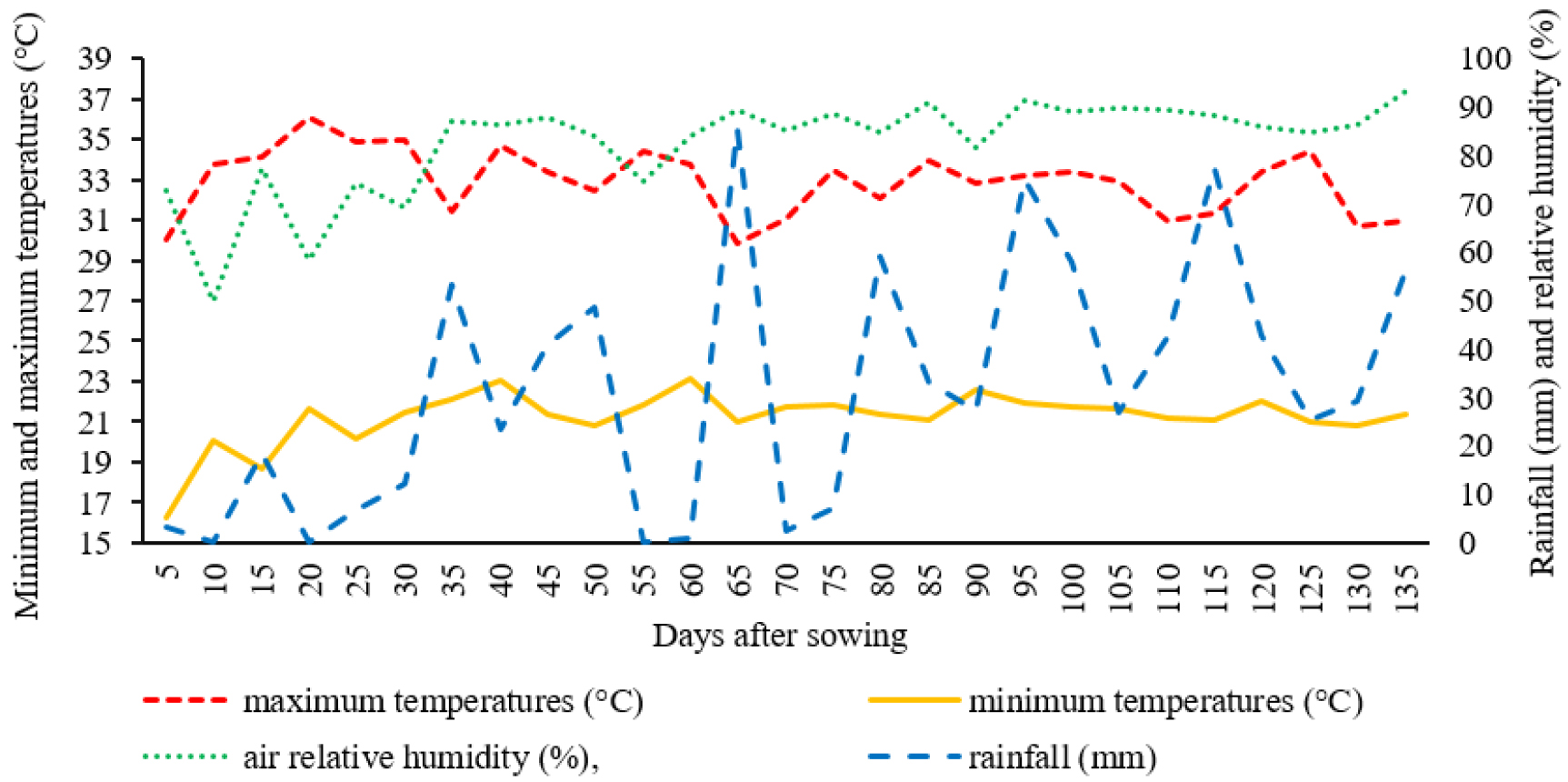
The experiment was conducted from November 2022 to March 2023 at the Teaching, Research, and Extension Farm (FEPE) of the Ilha Solteira School of Engineering (FEIS-Unesp). FEPE is located in Selvíria, Mato Grosso do Sul, Brazil (20° 20′ 50″ S, 51° 24′ 08″ W; altitude: 335 m). The soil is classified as Latossolo Vermelho distrófico (Santos et al., 2018), corresponding to Oxisols (Soil Survey Staff, 2022). The region has a humid tropical climate, characterized by summer rainfall and a dry winter, classified as Aw according to the Köppen system (Alvares et al., 2013). Meteorological data for the experimental period were obtained from Canal CLIMA for Ilha Solteira, the nearest city with a meteorological station (Figure 1).

Five-day averages of rainfall (mm), relative humidity (%), and minimum and maximum temperatures (°C) in the municipality of Ilha Solteira (SP) from November 2022 to March 2023. Source: Canal CLIMA - FEIS
Before the experiment establishing, soil samples were collected from the 0-0.20 m layer for chemical analysis. The chemical attributes, determined according to the methods of van Raij et al. (2001), were as follows: P (resin) = 43.8 mg dm⁻³; organic matter (OM) = 22.3 g dm⁻³; pH (CaCl₂) = 5.6; K⁺ = 2.7 mmolc dm⁻³; Ca²⁺ = 27 mmolc dm⁻³; Mg²⁺ = 25.3 mmolc dm⁻³; H⁺ + Al³⁺ = 20.5 mmolc dm⁻³; Al³⁺ = 0 mmolc dm⁻³; S-SO₄²⁻ = 3.3 mg dm⁻³; B = 0.3 mg dm⁻³; Cu = 2.9 mg dm⁻³; Fe = 18.8 mg dm⁻³; Mn = 27.7 mg dm⁻³; Zn = 1.5 mg dm⁻³; sum of bases (SB) = 55.0 mmolc dm⁻³; cation exchange capacity (CEC) = 75.5 mmolc dm⁻³; and base saturation (V) = 72.8%.
A randomized complete block design was adopted in a 2 × 5 factorial scheme with four replications. The first factor consisted of inoculant composition (Bradyrhizobium japonicum and Bacillus aryabhattai + B. japonicum), and the second factor comprised potassium silicate doses (0, 1.50, 2.50, 3.50, and 4.50 L ha⁻¹), applied in two equal foliar applications. A total of ten treatments were evaluated. The choice of doses was based on the recommendation prescribed in the technical data sheet of the product used. The experimental plots consisted of eight rows, each five meters long, with a distance of 0.5 m between rows. The observational area of the plot comprised the four central rows, excluding one meter from the ends of the rows.
The chosen area for the experiment has a five-year history of no-till system. In the two years preceding the experiment, maize and sorghum were cultivated in succession. Before the experiment was established, the area was previously desiccated with Carfentrazone-ethyl (400 g L-1), Glyphosate acid equivalent (720 g kg-1), and glyphosate (792.5 g kg-1).
For the experiment establishing, commercial products were used to apply microorganisms. For the inoculation of B. japonicum, strains SEMIA 5079 and 5080 (5×10⁹ CFU mL-1) were used, and for the application of B. aryabhattai, strain CMAA 1363 (1×10⁸ CFU mL-1) was used. The application was carried out via seed treatment, following the doses recommended by the manufacturer, which were 2.5 mL for B. japonicum and 2.0 mL for B. aryabhattai for each 1 kg of seed. The soybean cultivar used was of indeterminate growth type and had a maturity group of 6.7, with a medium to late maturation cycle ranging from 125 to 145 days. The seeds were chemically treated with Pyraclostrobin (25 g L-1), Thiophanate-methyl (225 g L-1), and Fipronil (250 g L-1), applying 2 mL of the commercial product per kilogram of seeds. Sowing was done mechanically with 13 seeds per meter. Simultaneously, 330 kg ha⁻¹ of the 02-20-20 fertilizer formulation was applied in the sowing furrow, corresponding to 6.6, 66.0, and 66.0 kg ha⁻¹ of N, P₂O₅, and K₂O, respectively. Fertilization was carried out based on the technical recommendations of Boletim 100 (Quaggio et al., 2022).
Silicon was used as potassium silicate, presenting the following characteristics: silicon content of 12%, K2O content of 15%, density of 1.40 g cm-3, and pH of 10.96. Foliar applications were carried out in two distinct soybean growth stages, with half of the dose applied at R2 and the remaining half at R3. A spray volume of 100 L of solution per hectare was used for the application, and a battery-powered backpack sprayer was employed, allowing constant pressure and flow rate. It is essential to highlight that the weather conditions during the applications were monitored. Both applications were performed in the morning, without wind or rain, with mean temperatures of 26 and 27 °C for the first and second applications, respectively.
Chemical management of the area consisted of three applications. At 30 days after sowing, herbicides (Chlorimuron-ethyl: 250 g kg⁻¹, Glyphosate acid equivalent: 720 g kg⁻¹, glyphosate: 792.5 g kg⁻¹, and Haloxyfop-P-methyl acid equivalent: 520 g L⁻¹), fungicides (Trifloxystrobin: 100 g L⁻¹ and Tebuconazole: 200 g L⁻¹), insecticides (Acetamiprid: 250 g kg⁻¹ and Bifenthrin (250: g kg⁻¹), and mineral oil. At 63 days after sowing, fungicides (Trifloxystrobin at 100 g L⁻¹ and tebuconazole at 200 g L⁻¹) and insecticides (Acephate at 970 g kg⁻¹ and Spinetoram at 120 g L⁻¹) were applied. At 74 days after sowing, fungicides (Trifloxystrobin at 150 g L⁻¹ and Prothioconazole at 175 g L⁻¹) and insecticides (Acetamiprid and Bifenthrin at 250 g kg⁻¹ each, and spinetoram at 120 g L⁻¹) were applied.
During soybean harvest, five representative plants per plot were separated for the following assessments: Plant height (cm); First pod insertion height (cm), measured from the stem base to the node where the first pod is attached; number of pods per plant; number of grains per pod; number of reproductive nodes; 100-grain weight (g); moisture content (%), using a G650 portable grain moisture meter. After the analysis, the vegetative part of the plants was placed in properly labeled paper bags and taken to an oven at 65 °C for 72 hours to determine the shoot dry mass of five plants, which was extrapolated to kg ha-1, considering a population of 200 thousand plants per hectare. Grain yield was determined by collecting plants from the two central observational rows of each plot. After mechanical threshing, the grains were weighed, data were extrapolated to kg ha-1, and corrected to 13% moisture content. After weighing, straw and dried grains were ground and sent to the plant nutrition laboratory for analysis to determine potassium concentrations, following the methodology of Malavolta et al. (1997), and silicon concentrations, following the methodology of EMBRAPA (2009).
Data analysis was performed using R software version 4.2.1 (Team, 2020). The normality hypothesis was tested using the Shapiro-Wilk test, and analysis of variance (ANOVA) with F-test at a 5% significance level was conducted to detect differences among factors and interactions. When there was a significant effect, multiple linear and quadratic regression analysis was performed at 0.01 and 0.05 probability to detect the effect of potassium silicate doses.
Results and Discussion
Regarding nutrient concentrations and straw mass (Table 1), the results indicate that potassium silicate doses and inoculants did not significantly impact potassium concentration in soybean straw and grains. Similarly, silicon concentration in both straw and grains showed no significant differences among the tested treatments, indicating the possible stability of these variables under the studied conditions.
Analysis of variance for straw dry mass yield (SDMY), potassium (K) and silicon (Si) concentration in straw and grains, and silicon (Si) concentration in straw and grains according to the inoculation and co-inoculation with Bradyrhizobium japonicum and Bacillus aryabhattai, in association with foliar potassium silicate doses applied to soybean
Potassium plays a crucial role in plants, affecting various enzymes involved in vital processes such as energy utilization, starch synthesis, nitrogen metabolism, and respiration, and is recognized for its beneficial effects on plant health (Johnson et al., 2022). However, despite the observed variations in potassium concentrations, it was impossible to identify a consistent relationship pattern between these concentrations and the tested potassium silicate doses.
Furthermore, the lack of observed relationship suggests that additional potassium doses above those necessary do not confer additional benefits to the plant. This may indicate that the amount of potassium in the soil adequately meets the plant’s needs, not justifying supplementary doses to promote further improvements.
Despite the highly weathered soils of the Brazilian Cerrado presenting a potassium deficit (Silva et al., 2008), the area’s history played a crucial role in maintaining high fertility. With a consolidated no-till system for at least five years and regular fertilization practices at each new crop cycle, soil fertility is maintained. Notably, fertilizations play a significant role in preserving fertility, especially considering the need for soil restitution after nutrient export by grains (Lopes, 2005), emphasizing the importance of this process in each crop cycle.
Thus, the combination of adequate K presence in the soil, rooted in sustainable management practices of the studied area, and ideal moisture conditions result in optimized water efficiency and the maximization of plant physiological performance. Potassium (K) increases water efficiency by reducing the amount of water required for dry mass production and plays a crucial role in the proper functioning of stomata (Kumar et al., 2020). This aspect is fundamental for essential processes such as photosynthesis, water and nutrient transport, and thermal regulation, which can be compromised under K deficiency conditions (Sardans & Peñuelas, 2021).
Regarding plant development and yield components of soybeans (Table 2), the results revealed that the co-inoculation influenced all variables (PP, MGH, PH, FPI, and RN) except GP and GY. Plant height was influenced (p < 0.05) by co-inoculation (B. japonicum + B. aryabhattai), presenting a significantly greater mean height than B. japonicum isolated. Additionally, it was observed that co-inoculation promoted (p < 0.05) a lower number of reproductive nodes compared to exclusive inoculation of B. japonicum (Table 2).
Analysis of variance for pods per plant (PP), grains per pod (GP), 100-grain weight (100W), plant height (PH), first pod insertion height (FPI), reproductive nodes (RN), and grain yield (GY) according to the inoculation and co-inoculation with Bradyrhizobium japonicum and Bacillus aryabhattai, in association with foliar potassium silicate doses applied to soybean
Contrary to expectations, the increased plant height did not positively influence (p > 0.05) the number of reproductive nodes, suggesting that taller plants may produce fewer reproductive nodes, which raises concerns because, besides having fewer nodes, it may lead to lower yield; taller plants are subject to a higher risk of lodging, which could result in harvest losses.
The number of pods per plant differed statistically concerning the type of inoculant, with isolated inoculation (B. japonicum) demonstrating a higher quantity of pods per plant. This corroborates the observation that a higher number of reproductive nodes is associated with greater production of pods per plant. Additionally, 100-grain weight, a crucial metric for evaluating grain production, also showed a higher average when inoculated with isolated B. japonicum.
Although there are significant differences in the number of pods per plant and the 100-grain weight, it is important to note that the number of grains per pod and grain yield did not reveal significant differences (p > 0.05). Notably, although we did not find statistical differences (p > 0.05) in soybean grain yield, there was an average difference of 290 kg, or about 5 bags (each 60 kg) per hectare, between the inoculation treatments. This leads us to consider the possibility of antagonistic effects between bacteria when applied together since individual inoculation resulted in superior productivity. Previous studies have already stated the production of natural antibiotics by growth-promoting microorganisms (Ranpariya & Tarpara, 2023); such competitiveness is influenced by various factors related to the genotypes of bacteria, the host plant, and environmental factors (Streeter, 1994).
Bacillus genus bacteria are generally considered PGPR (Plant Growth-Promoting Rhizobacteria) due to their ability to colonize the rhizosphere and stimulate plant growth (Kundan et al., 2015). However, the little response observed in co-inoculation with B. aryabhattai may be attributed to the high rainfall index during the experimental period. It is worth noting that the bacterium B. aryabhattai originates from the Caatinga biome, where some microbial communities undergo significant changes during the dry and rainy seasons (Lacerda-Júnior et al., 2019). These seasonal changes may have contributed to the decrease in the presence of this bacterium at the experimental site, thus explaining the less expressive response in soybean co-inoculation.
A similar pattern was observed for silicon doses, as soybean grain yield was not affected by the foliar application of potassium silicate. However, previous studies have reported yield increases, with an average gain of 1,140 kg ha⁻¹ in plants that received three foliar applications of potassium silicate (15% K₂O and 10% Si) under rainfed conditions, with an average precipitation of 75.2 mm during the vegetative stage and 98.77 mm during the reproductive stage (Moreira et al., 2010). Additionally, in soybeans grown under water stress, potassium silicate showed greater agronomic efficiency than potassium chloride applied to the soil before sowing at a rate of 40 kg ha⁻¹ of K₂O (Barbosa et al., 2025). Therefore, in the present study, the amount and regime of rainfall explain why there was no significant effect for foliar application of potassium silicate doses in soybeans.
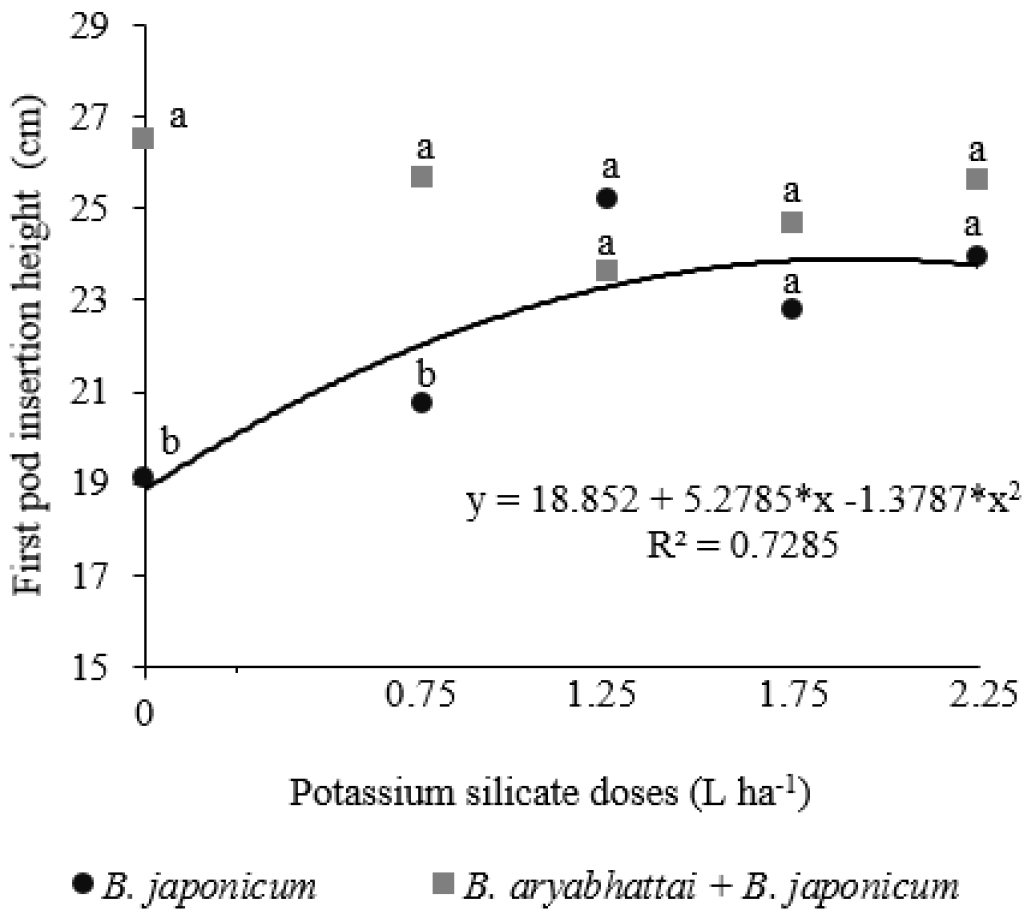
Regarding the first pod insertion height, there was a significant effect (p < 0.05) of the interaction between potassium silicate doses and inoculants, with a quadratic regression observed only in the treatment with isolated B. japonicum (Figure 2). The first pod insertion height is an important characteristic of soybean plant architecture. Higher insertion heights can make mechanical harvesting more efficient (Cartter & Hartwig, 1962). However, for cultivars with plant height equal to or greater than 65 cm and a first pod insertion point equal to or greater than 10 cm, it is sufficient for mechanical harvesting (Bonetti, 1983).
Soybean first pod insertion height according to the inoculation and co-inoculation with Bradyrhizobium japonicum and Bacillus aryabhattai, in association with foliar potassium silicate doses
The regression curve analysis shows a gradual increase in the first pod insertion height as the potassium silicate dose increases. Remarkably, the treatment that did not receive potassium silicate application showed an average height of 19.0 cm for the first pod insertion height (Figure 2). In contrast, the highest mean insertion height, about 22.1 cm, was recorded with a dose of 1.9 L ha-1, as calculated by the regression equation. It is important to note that after this peak point, the regression curve shows a constant in the first pod insertion height with higher potassium silicate doses. This trend suggests an optimized response at moderate doses influenced by the interaction between the two factors.
Throughout this study, the absence of responses in various analyzed variables (straw dry mass yield, K concentration in straw and grains, Si concentration in straw and grains, and grain yield) of soybean can be attributed to favorable environmental conditions during the soybean cultivation cycle. It is crucial to emphasize that silicon is widely recognized for its ability to improve plant resistance to stressful situations such as water deficit and the potential positive impact of B. aryabhattai. However, the present experiment’s weather conditions were conducive, characterized by adequate water availability and appropriate temperatures. Furthermore, adequate soil fertility and nutrient supply may explain why treatments did not affect soybean productivity. The combination of high soil fertility and appropriate water regime may also have masked the effects of the treatments used in this research.
It is important to highlight that these results are pertinent to the specific cultivation conditions observed. However, repeating the experiment in different growing seasons or locations-especially under conditions prone to dry spells or drought-may provide further insights into how weather variability influences soybean responses to silicon application and co-inoculation with Bacillus aryabhattai.
Conclusions
-
Co-inoculation of Bradyrhizobium japonicum and Bacillus aryabhattai resulted in increased plant height but decreased number of reproductive nodes compared to inoculation with only B. japonicum.
-
Inoculation with B. japonicum resulted in a significant increase in the number of pods per plant and the 100-grain weight of soybean.
-
Co-inoculation with B. japonicum and B. aryabhattai and foliar application of potassium silicate did not influence K and Si concentrations in straw and grains and soybean grain yield.
Acknowledgments
To the Graduate Program in Agronomy, to the Ilha Solteira School of Engineering - UNESP/FEIS, to the Applied Statistics and Plant Nutrition Laboratories.
Literature Cited
-
Alvares, C. A.; Stape, J. L.; Sentelhas, P. C.; Gonçalves, J. L. M; Sparovek, G. Köppen’s climate classification map for Brazil. Meteorologische Zeitschrift, v.22, p.711-713, 2013. https://doi.org/10.1127/0941-2948/2013/0507
» https://doi.org/10.1127/0941-2948/2013/0507 -
Barbosa, M. C.; Fernandes, G. C.; Lima, B. H.; Rosa, L. G. P.; Ito, W. C. N.; Souza, L. F. R.; Jalal, A.; Nogueira, T. A. R.; Oliveira, C. E. da S.; Ghaley, B. B.; Teixeira Filho, M. C. M. The effects of potassium dose, timing, and source in soybean crops in Brazilian Savannah Oxisol. Sustainability, v.17, e.934, 2025. https://doi.org/10.3390/su17030934
» https://doi.org/10.3390/su17030934 - Bonetti, L. P. Cultivares e seu melhoramento genético. In: Vernetti, F. J. (Coord.). Soja: genética e melhoramento. Campinas: Fundação Cargill, 1983. p.741-794.
- Cargnelutti, D.; Bampi, E.; Melo Santiago, G.; Luz, V. C.; Garbin, E.; Castamann, A.; Mossi, A. J. Soluções tecnológicas emergentes para uma agricultura sustentável: microrganismos eficientes. In: García, L. M. H. Agroecologia: princípios e fundamentos ecológicos aplicados na busca de uma produção sustentável. Cap.2, 2021. p.31-62.
-
Cartter, J. L.; Hartwig, E. E. The management of soybeans. Advances in Agronomy, v.14, p.359-412, 1962. https://doi.org/10.1016/S0065-2113(08)60442-3
» https://doi.org/10.1016/S0065-2113(08)60442-3 - EMBRAPA - Empresa Brasileira de Pesquisa Agropecuária. Manual de análises químicas de solos, plantas e fertilizantes. 2.ed. Brasília: Embrapa Informação Tecnológica, 2009. 216-217p.
-
Huang, H.; Li, M.; Rizwan, M.; Dai, Z.; Yuan, Y.; Hossain, M. M.; Cao, M.; Xiong, S.; Tu, S. Synergistic effect of silicon and selenium on the alleviation of cadmium toxicity in rice plants. Journal of Hazardous Materials, v.401, e123393, 2021. https://doi.org/10.1016/j.jhazmat.2020.123393
» https://doi.org/10.1016/j.jhazmat.2020.123393 -
Islam, W.; Tayyab, M.; Khalil, F.; Hua, Z.; Huang, Z.; Chen, H. Y. Silicon-mediated plant defense against pathogens and insect pests. Pesticide Biochemistry and Physiology, v.168, e104641, 2020. https://doi.org/10.1016/j.pestbp.2020.104641
» https://doi.org/10.1016/j.pestbp.2020.104641 -
Johnson, R.; Vishwakarma, K., Hossen, M. S.; Kumar, V.; Shackira, A. M.; Puthur, J. T.; Abdi, G.; Sarraf, M.; Hasanuzzaman, M. Potassium in plants: Growth regulation, signaling, and environmental stress tolerance. Plant Physiology and Biochemistry, v.172, p.56-69, 2022. https://doi.org/10.1016/j.plaphy.2022.01.001
» https://doi.org/10.1016/j.plaphy.2022.01.001 -
Kumar, P.; Kumar, T.; Singh, S.; Tuteja, N.; Prasad, R.; Singh, J. Potassium: A key modulator for cell homeostasis. Journal of Biotechnology, v.324, p.198-210, 2020. https://doi.org/10.1016/j.jbiotec.2020.10.018
» https://doi.org/10.1016/j.jbiotec.2020.10.018 -
Kundan, R.; Pant, G.; Jadon, N.; Agrawal, P. Plant growth promoting rhizobacteria: Mechanism and current prospective. Journal of Fertilizers & Pesticides, v.6, e155, 2015. https://doi.org/10.4172/2471-2728.1000155
» https://doi.org/10.4172/2471-2728.1000155 -
Lacerda-Júnior, G. V.; Noronha, M. F.; Cabral, L.; Delforno, T. P.; Sousa, S. T. P.; Fernandes Júnior, P. I.; Melo, I. S.; Oliveira, V. M. Land use and seasonal effects on the soil microbiome of a brazilian dry forest. Frontiers in Microbiology, v.10, e648, 2019. https://doi.org/10.3389/fmicb.2019.00648
» https://doi.org/10.3389/fmicb.2019.00648 - Lopes, A. S. Reservas de minerais potássicos e produção de fertilizantes potássicos no Brasil. In: Yamada, T. R. Potássio na agricultura brasileira. Cap.2, 2005. p.21-32.
- Malavolta, E.; Vitti, G. C.; Oliveira, S. A. Avaliação do estado nutricional das plantas: princípios e aplicações. 1.ed. Piracicaba: Potafos, 1989. 154p.
- Meyer, M. C.; Mazaro, S. M.; Silva, J. C. Bioinsumos na cultura da soja. 1.ed. Brasília: Embrapa, 2022. 550p.
- Moreira, A. D. R.; Fagan, E. B.; Martins, K. V.; Souza, C. H. E. Resposta da cultura de soja a aplicação de silício foliar. Bioscience Journal, v.26, p.413-423, 2010.
-
Nogueira, T. A. R.; Miranda, B. G.; Jalal, A.; Lessa, L. G. F.; Teixeira Filho, M. C. M.; Marcante, N. C.; Abreu-Junior, C. H.; Jani, A. D.; Capra, G. F.; Moreira, A.; Martins, É. S. Nepheline syenite and phonolite as alternative potassium sources for maize. Agronomy, v.11, e1385, 2021. https://doi.org/10.3390/agronomy11071385
» https://doi.org/10.3390/agronomy11071385 - Quaggio, J. A.; Cantarella, H.; Rosolem, C. A.; Crusciol, C. A. C. Soja (Glycine max). In: Cantarella, H; Quaggio, J. A.; Mattos Junior, D.; Boaretto, R. M.; van Raij, B. (Org.). Recomendações de adubação e calagem para o estado de São Paulo - B100. 3ed. Campinas: Instituto Agronômico de Campinas. 2022. p.209-212.
-
R Core Team. R: A language and environment for statistical computing. Vienna: R Foundation for Statistical Computing, 2020. Available on: < Available on: https://www.r-project.org/ >. Accessed on: Oct. 2023.
» https://www.r-project.org/ - Ranpariya, V.; Tarpara, N. The ability of microorganisms to produce antibiotics - A Review. World Journal of Current Medical and Pharmaceutical Research, v.6, p.41-46, 2023.
- Santos, H. dos; Jacomine, P. K. T.; Anjos, L. dos; Oliveira, V. de; Lumbreras, J. F.; Coelho, M. R.; Almeida, J. de; Araujo Filho, J. C.; Oliveira, J. de; Cunha, T. J. F. Sistema de classificação de solos. Brasília: Embrapa Solos, 2018. 356p.
-
Sardans, J.; Peñuelas, J. Potassium control of plant functions: Ecological and agricultural implications. Plants, v.10, e419, 2021. https://doi.org/10.3390/plants10020419
» https://doi.org/10.3390/plants10020419 -
Silva, E. H. F. M.; Antolin, L. A. S.; Alencar, J. Z.; Souza, H. A.; Carvalho, K. S.; Vieira Júnior, N. A.; Marin, F. R. Impact assessment of soybean yield and water productivity in Brazil due to climate change. European Journal of Agronomy, v.129, e126329, 2021. https://doi.org/10.1016/j.eja.2021.126329
» https://doi.org/10.1016/j.eja.2021.126329 -
Silva, V. A.; Marchi, G.; Guilherme, L. R. G.; Lima, J. M.; Nogueira, F. D.; Guimarães, P. T. G. Kinetics of K release from soils of Brazilian coffee regions: Effect of organic acids. Revista Brasileira de Ciência do Solo, v.32, p.533-540, 2008. https://doi.org/10.1590/S0100-06832008000200008
» https://doi.org/10.1590/S0100-06832008000200008 - Soil Survey Staff. Keys to soil taxonomy. 13.ed. Lincoln: USDA - Natural Resources Conservation Service, 2022. 401p.
-
Streeter, J. G. Failure of inoculant rhizobia to overcome the dominance of indigenous strains for nodule formation. Canadian Journal of Microbiology, v.40, p.513-522, 1994. https://doi.org/10.1139/m94-084
» https://doi.org/10.1139/m94-084 -
Telles, T. S.; Nogueira, M. A.; Hungria, M. Economic value of biological nitrogen fixation in soybean crops in Brazil. Environmental Technology & Innovation, v.31, e103158, 2023. https://doi.org/10.1016/j.eti.2023.103158
» https://doi.org/10.1016/j.eti.2023.103158 - van Raij, B.; Quaggio, J. A.; Cantarella, H.; Abreu, C. A. Os métodos de análise química do sistema IAC de análise de solo no contexto nacional. In: Andrade, J. C. de; Cantarella, H.; Quaggio, J. A. Análise química para avaliação da fertilidade de solos tropicais. Cap.1, 2001. p.5-39.
Financing statement
-
This research was partially supported by a productivity research grant from the Conselho Nacional de Desenvolvimento Científico e Tecnológico (CNPq), awarded to the corresponding author (Grant No. 311308/2020-1). Additional support was provided by the Coordenação de Aperfeiçoamento de Pessoal de Nível Superior (CAPES), Brazil - Financing Code 001.
There are no supplementary sources for data availability.

 * Significant at p ≤ 0.05