 Thermal index, fruit yield and physiological responses of melon under different irrigation depths1
ABSTRACT
Melon cultivation in northeastern Brazil faces water challenges due to low rainfall. Technologies such as infrared imaging show promise for monitoring water demand and heat stress. The objective of this study was to evaluate the vegetative, physiological, and yield responses of melon plants subjected to different irrigation depths, as well as monitoring the thermal index as a water stress indicator. The study was conducted using a randomized block design, with four treatments related to irrigation depth (50, 75, 100, and 125% of crop evapotranspiration) and five replicates. Drip irrigation and the class A pan method were used to determine evapotranspiration. Stem diameter showed the highest value at 75% ETc at the beginning of the cycle, and the length of the main branch increased linearly with irrigation depth. At 62 days after transplanting (DAT), transpiration and stomatal conductance showed quadratic behavior, with peaks close to the 100% ETc irrigation depth, while the photosynthetic rate and thermal index showed significant linear regression, positive and negative, respectively, with the applied irrigation depth. Fruit mass, circumference, and diameter increased linearly with the irrigation depth, but total soluble solids decreased and pH showed no significant difference. Yield increased with the increase in irrigation depth, while water use efficiency was reduced. As the thermal index showed a negative significant linear regression, it can be inferred that the greater the volume of water available to the plant, the lower the thermal index, which can be used as an indicator of water stress from 62 DAT onwards.
Key words:
Cucumis melo L.; infrared; thermography; fruit quality; gas exchange
HIGHLIGHTS:
From 62 days after transplanting, the water stress of melon plants is demonstrated by the thermal index.
Lower irrigation depths increase the total soluble solids of melon fruits.
Higher irrigation depths reduce water use efficiency.
RESUMO
A cultura do melão no Nordeste brasileiro enfrenta desafios hídricos devido à escassez de chuvas. Tecnologias, como imagens infravermelhas, são promissoras para monitorar a demanda hídrica e o estresse térmico. Objetivou-se avaliar as respostas vegetativas, fisiológicas e produtivas da cultura do meloeiro submetida a lâminas de irrigação, além de monitorar o índice térmico como indicador de estresse hídrico. O estudo foi conduzido utilizando delineamento em blocos casualizados, com quatro tratamentos referentes a lâmina de irrigação (50, 75, 100 e 125% da evapotranspiração da cultura) e cinco repetições. A irrigação por gotejamento e o método do tanque classe A para determinar a evapotranspiração. O diâmetro do caule foi otimizado com 75% da ETc no início do ciclo, e o comprimento do ramo principal aumentou linearmente com a lâmina de irrigação. Aos 62 dias após o transplante (DAT) a transpiração e condutância estomática, apresentaram comportamento quadrático, com picos próximos à lâmina de 100% da ETc, enquanto a taxa fotossintética e o índice térmico mostraram regressões lineares significativas, positiva e negativa, respectivamente, com a lâmina aplicada. A massa, circunferência e diâmetro dos frutos aumentaram linearmente com a lâmina, porém, os sólidos solúveis totais diminuíram e o pH não mostrou diferença significativa, A produtividade aumentou com o incremento da lâmina, enquanto a eficiência do uso da água foi reduzida. Como o índice térmico apresentou regressão linear significativa, pode-se inferir que, quanto maior o volume de água disponível para a planta menor o índice térmico, com isso, pode-se utilizá-lo como indicador do estresse hídrico a partir dos 62 DAT.
Palavras-chave:
Cucumis melo L.; infravermelho; termografia; qualidade dos frutos; trocas gasosas
INTRODUCTION
The Northeast region of Brazil has favorable climatic conditions for fruit production, due to its geographical location and distribution of sunshine hours throughout the year. The region’s photoperiod is characterized by long days with good light (Borém & Nick, 2019). These characteristics, combined with the presence of a nearby port network, such as the ports of Suape, Salvador, and Pecém, located in Pernambuco, Bahia, and Ceará, respectively, boost exports of agricultural products to countries in Europe and North America (Coêlho, 2023).
In this context, crop evapotranspiration is an important parameter for determining the water requirements of melon. The correct water supply ensures the proper development of the aerial part (Yang et al., 2023), physiological processes (Lima et al., 2020), as well as fruit yield and quality (Lins et al., 2024), an aspect that determines which market it will be sold to (EMBRAPA, 1994).
Several technologies are available to assess water stress in a non-destructive manner and with an accurate response. Among the main techniques for monitoring this problem is the use of remote sensing with images (El Hachimi et al., 2022).
Among remote sensing techniques, thermography stands out for its ability to monitor leaf surface temperature variations. This technique is based on the principle that water stress induces stomatal closure to reduce water loss through transpiration, which decreases evaporative cooling and, consequently, raises the canopy temperature (Gerhards et al., 2016).
To quantify this thermal stress, a thermal index can be used, which increases as the plant reduces its thermal regulation capacity, with water stress being one of the primary causes. One of the main advantages of the thermal index is that its calculation is based on canopy and air temperatures. However, for normalized results across different conditions, indices such as the crop water stress index (CWSI) can be used. These indices allow differentiating thermal variations caused by the environment from those resulting from plant water deficit, serving as a precise indicator of water status and aiding in efficient irrigation management (Jackson et al., 1981)
The objective of this study was to evaluate the vegetative, physiological, and yield responses of melon plants subjected to different irrigation depths, as well as monitoring the thermal index as a water stress indicator.
MATERIAL AND METHODS
The experiment was conducted in an experimental area belonging to the Hydraulics and Irrigation Laboratory of the Department of Agricultural Engineering at Universidade Federal do Ceará, Fortaleza-CE, Brazil, which was carried out from September to November of 2024. The coordinates are 3° 45’ S and 38° 33’ W, at altitude of 19 m. The climate classification according to Köppen is Aw’, tropical rainy, with the rainy season concentrated in summer and autumn.
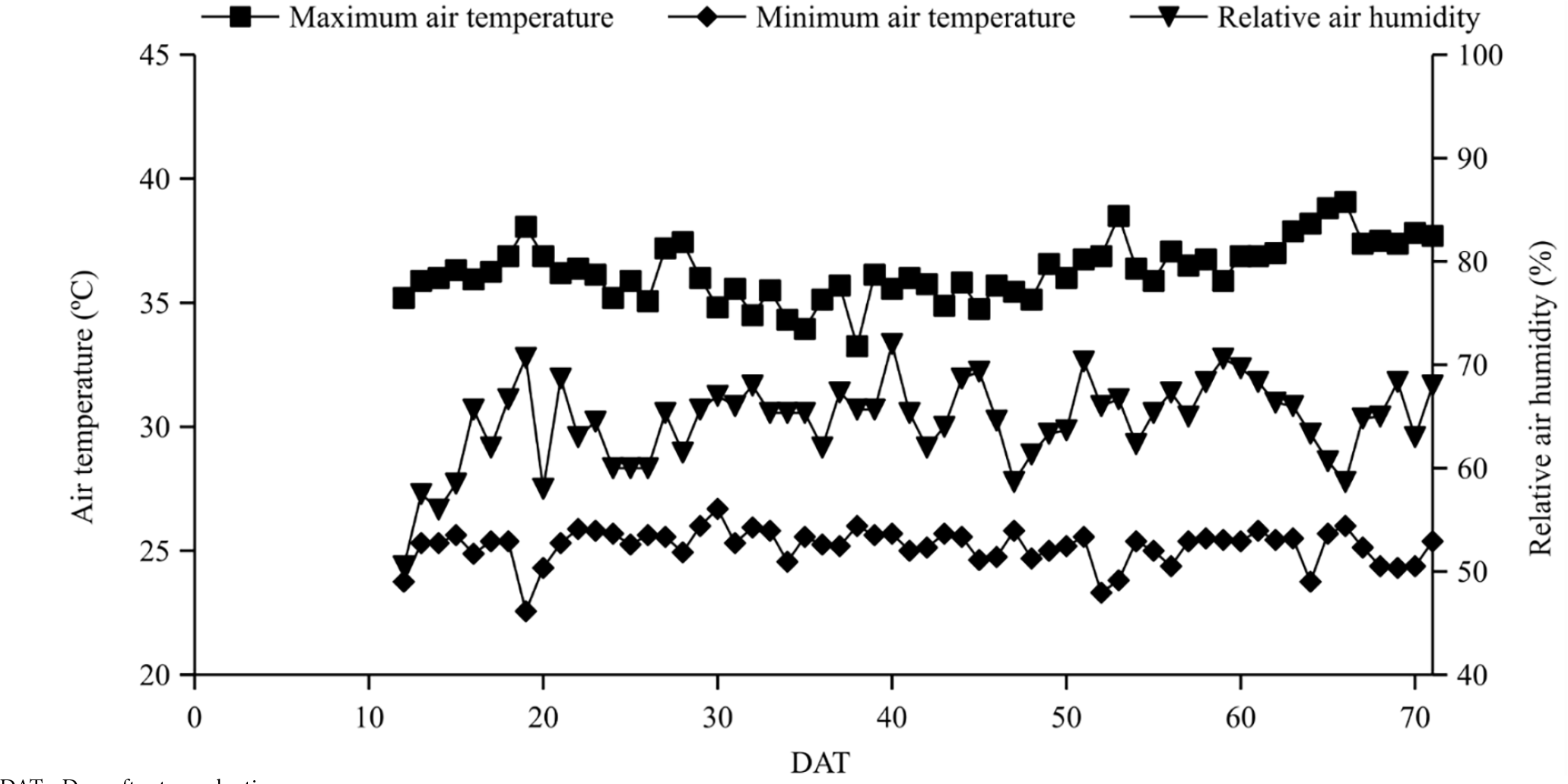
The minimum and maximum temperatures and relative humidity were collected throughout the experiment and are shown in Figure 1.
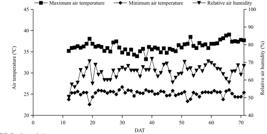
Minimum air temperature, maximum air temperature, and relative air humidity recorded during the experiment
Soil preparation involved the use of a plow for clod breaking, followed by a bed former to create seven experimental beds, which were 16 m long, 1.0 m wide, and 30 cm high. The soil was classified as Argissolo Vermelho-Amarelo (Ultisol) with a sandy clay loam texture (Soil Survey Staff, 2022). For chemical characterization, soil samples were collected from all beds at a depth of 0-20 cm, homogenized, and sent to the laboratory for analysis (Table 1).
Drip irrigation was used, with Netafim™ brand drip tape with a flow rate of 1.6 L h-1. A 0.5 cv (≈0.37 kW) motor pump was used for each treatment. Each pumping system used a disc filter, a pressure gauge to measure the operating pressure, and a water meter to record the volume of water used.
For each treatment, the water used for irrigation was stored in a 310-liter water tank, which originated from a deep well and was sent to the laboratory for analysis, being classified as C3S1 (Richards, 1954), i.e., high salinity, limited use in low-drainage soils and in crops intolerant to salinity and low sodium content (Table 2).
Data for temperature, relative humidity, wind speed, and Class A pan evaporation were obtained from the agrometeorological station at the Pici campus, located 100 meters away from the experimental area. The pan coefficient (Kp) was determined according to Eq. 1, using the equation proposed by Cuenca (1989). Reference evapotranspiration (ETo) was calculated following Eq. 2 (Bernardo et al., 2019), while crop evapotranspiration (ETc) was determined using the Class A pan method (Eq. 3), as described by Allen et al. (1998). The crop coefficients (Kc) adopted were: 0.21, 0.21 to 1.21, 1.21, and 0.98 for the initial, growth, middle, and late stages, respectively (EMBRAPA, 2001).
Where:
ETc - crop evapotranspiration;
ETo - reference evapotranspiration;
Kc - crop coefficient;
Kp - class A pan coefficient;
Epan - class A pan evaporation (mm per day);
U - average wind speed at 2 m above the soil surface (km per d);
Rh - average air relative humidity (%); and,
F - side distance of green crop (m).
After installing the irrigation system, the beds were covered with black and white polyethylene plastic mulch, with thickness of 20 μm, and placed with the white side facing up, which was perforated at 50 cm intervals for planting the seedlings.
The cultivar used was Goldex F1 (TopSeed), which was sown in 162-cell plastic trays, using BioAdubo™ organic compost as substrate. The compost is classified as a Class A mixed organic fertilizer, with the following minimum guarantees: 138 g kg⁻1 of total organic carbon, 11 g kg⁻1 of total nitrogen, a C/N ratio of 16, pH of 6.5 and CEC of 30 mmolc kg⁻1. Seedlings were transplanted to the beds 15 days after sowing.
The experimental design used was randomized blocks, with four treatments referring to irrigation depth [50, 75, 100, and 125% of crop evapotranspiration (ETc)] and five replicates. Each experimental unit consisted of eight plants spaced 0.50 m apart, totaling 4.0 m in length per plot. A total of seven beds were used, five for the experimental units and two as borders.
Fertilizers were applied via fertigation, with doses calculated according to the nutritional requirements of the crop. The management followed the crop nutrient uptake curve (EMBRAPA, 2011), totaling the application of 0.625 t ha-1 of urea, 1.875 t ha-1 of potassium nitrate, 2.6 t ha-1 of calcium nitrate, 0.3 t ha-1 of monoammonium phosphate (MAP), and 0.21 t ha-1 of magnesium sulfate throughout the cycle.
Growth assessments were performed at 25, 40, and 60 days after transplanting (DAT), corresponding to the phenological stages of vegetative growth, fruit set, and fruit ripening, respectively (EMBRAPA, 2001). Stem diameter (St), main branch length (Mbl), number of secondary branches (Nb), and number of leaves (Nl) were assessed following the methodology described by EMBRAPA (2017).
Thermal index and gas exchange assessments were performed simultaneously, with the first conducted at 35 DAT (09:00 AM) under a vapor pressure deficit (VPD) of 1.32 kPa, 29.6 °C of average air temperature, and the second at 62 DAT (09:30 AM) with a VPD of 2.092 kPa, 34.7 °C of average air temperature. Both assessments were carried out on the sixth leaf of the main branch, using three plants per experimental unit. Gas exchange was measured using an infrared gas analyzer (IRGA), model LCi (ADC, Hoddesdon, UK), with a reference CO2 concentration of 380 ppm and an artificial light source of 900 µmol m-2 s-1 of photosynthetically active photons. The variables collected were: transpiration (E), stomatal conductance (gs), photosynthetic rate (A), and internal CO2 concentration (Ci).
Thermal images were obtained at 0.5 m from the target, perpendicular to the ground, using a FLIR One Pro camera with 160 × 120 pixels resolution, 70 mK thermal sensitivity, and 55º x 43° field of view. The images were analyzed using FLIR Tools software, with emissivity adjusted to 0.98 (López et al., 2012). Air temperature was recorded by a Bluetooth sensor at 10-minute intervals, and linear interpolation was applied to determine the value for each minute. The thermal index (Ti), consisting of the difference between canopy and air temperatures at the time of image capture, was obtained using the average leaf temperature and the interpolated air temperature (Sousa et al., 2022).
Fruit harvest was carried out at 71 DAT, when most fruits across the four treatments reached physiological maturity. The harvest point was determined by the predominantly yellow rind color and the presence of superficial cracking (netting) near the peduncle. The maturity criterion for starting the harvest was based on random fruit sampling from each treatment until soluble solids (SS) exceeded 10 °Brix.
Two fruits per experimental unit were collected and used for quality assessments. The following variables were assessed for fruit quality: fruit mass (Fm), using a digital scale; longitudinal circumference (Fc), using a measuring tape, and fruit diameter (Fd), using a graduated ruler. Total soluble solids (Tss) were measured in the central region of the pulp using an analog refractometer (model RHB0-90), and the pulp pH was determined using a portable pH meter.
To calculate fruit yield, the mass of all marketable fruits harvested at 71 DAT was measured, along with the area occupied by each treatment (Eq. 4); subsequently, the yield was extrapolated to t ha-1. Based on the obtained yield and the volume of water used in each treatment, the water use efficiency (WUE) was calculated (Eq. 5).
Where:
Yield - Crop yield (kg m-2);
Production - Fruit mass produced per treatment (kg);
Area - Area corresponding to each treatment (m2);
WUE - Water use efficiency (kg m-3); and,
W - Amount of water used per treatment (m3).
Statistical analyses were performed independently for each evaluation period. Initially, the data were subjected to analysis of variance with F-test. Upon verifying the influence of the irrigation depth at p < 0.05 by the F-test, linear and quadratic regression models were fitted, based on significant effect by F-test at p < 0.05.
RESULTS AND DISCUSSION
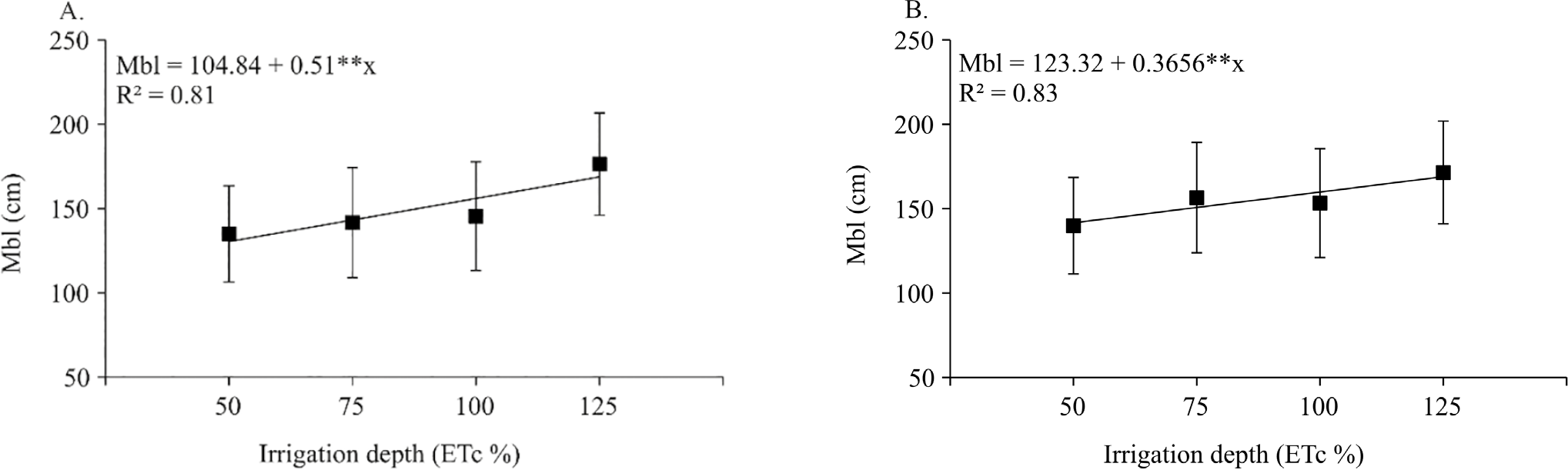
For main branch length (Mbl), no significant difference was observed in the evaluation at 25 DAT. However, for the evaluations performed at 45 and 60 DAT, the variable showed significant positive linear relationships with the irrigation depths. At 45 DAT, there was a 30% increase in the variable when comparing the extreme irrigation depths (50 and 125% ETc) (Figure 2A). However, in the evaluation at 60 DAT, this increase dropped to 20% (Figure 2B).
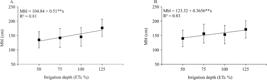
Main branch length of melon plants at 45 (A) and 60 (B) days after transplanting as a function of irrigation depth (% of ETc - crop evapotranspiration)
The stem diameter variable (St) showed a significant difference at 25 DAT, with the highest value observed in the 75% ETc treatment, showing an increase of 18% when compared to the 50% ETc treatment. No significant difference was observed in the evaluations performed at 45 and 60 DAT for stem diameter (St).
For the growth variables, number of leaves (Nl) and number of branches (Nb), there was no significant difference between treatments in any of the evaluations performed.
The vegetative development of the melon plants responded positively to increased water availability, particularly regarding main branch length (Mbl). This trend aligns with the findings of Irineu et al. (2018) and Kamer et al. (2022), who also reported linear growth of this variable as a function of irrigation depth. However, these results differ from those of Miceli et al. (2023), who observed an effect on Mbl only in the early stages (20 DAT), whereas in the present study, the response became significant from 45 DAT onwards.
Regarding number of branches and leaves, the results were contrasting. While Kamer et al. (2022) observed a reduction in the number of branches (Nb) under severe water deficit, the number of branches was not influenced by the applied water volume in this research. Similarly, leaf number showed a distinct pattern from that reported by Irineu et al. (2018), who identified a significant quadratic relationship for this variable, contrasting with no significant regression observed in this study.
Increasing the volume of water applied to melon plants favors plant growth in a linear fashion due to direct effects on photosynthesis, cell turgor, and stomatal opening, favoring vegetative growth (Taiz et al., 2017), especially during the period of intense growth up to 45 DAT (Yang et al., 2023). After this period, the gain in main branch length remains until the end of the crop cycle (Figures 2A and B).
This growth is present as long as this water supply does not cause hypoxia in the root system by filling the macropores with water (Yu et al., 2024).
Stem diameter and number of branches were characteristics that were either not affected or not linearly affected by the volume of water applied. This is probably because these variables are determined by the plant’s genotype, reaching their maximum potential even under adverse conditions (Vasileva & Chipilski, 2022).
The variables related to gas exchange: transpiration (E), stomatal conductance (gs), photosynthetic rate (A), and internal CO2 in the leaf (Ci) showed no statistical difference in the evaluation performed at 35 DAT. The same was observed for the thermal index (Ti) variable.
Probably the availability of water in the soil at 35 days after transplanting (DAT) was sufficient to meet the crop’s water demand at the time of evaluation, as it is also a time when there is a weak correlation between the water content in the plant and the thermal index (Ti) (García-Tejero et al., 2018), which may have limited the expression of physiological differences between treatments.
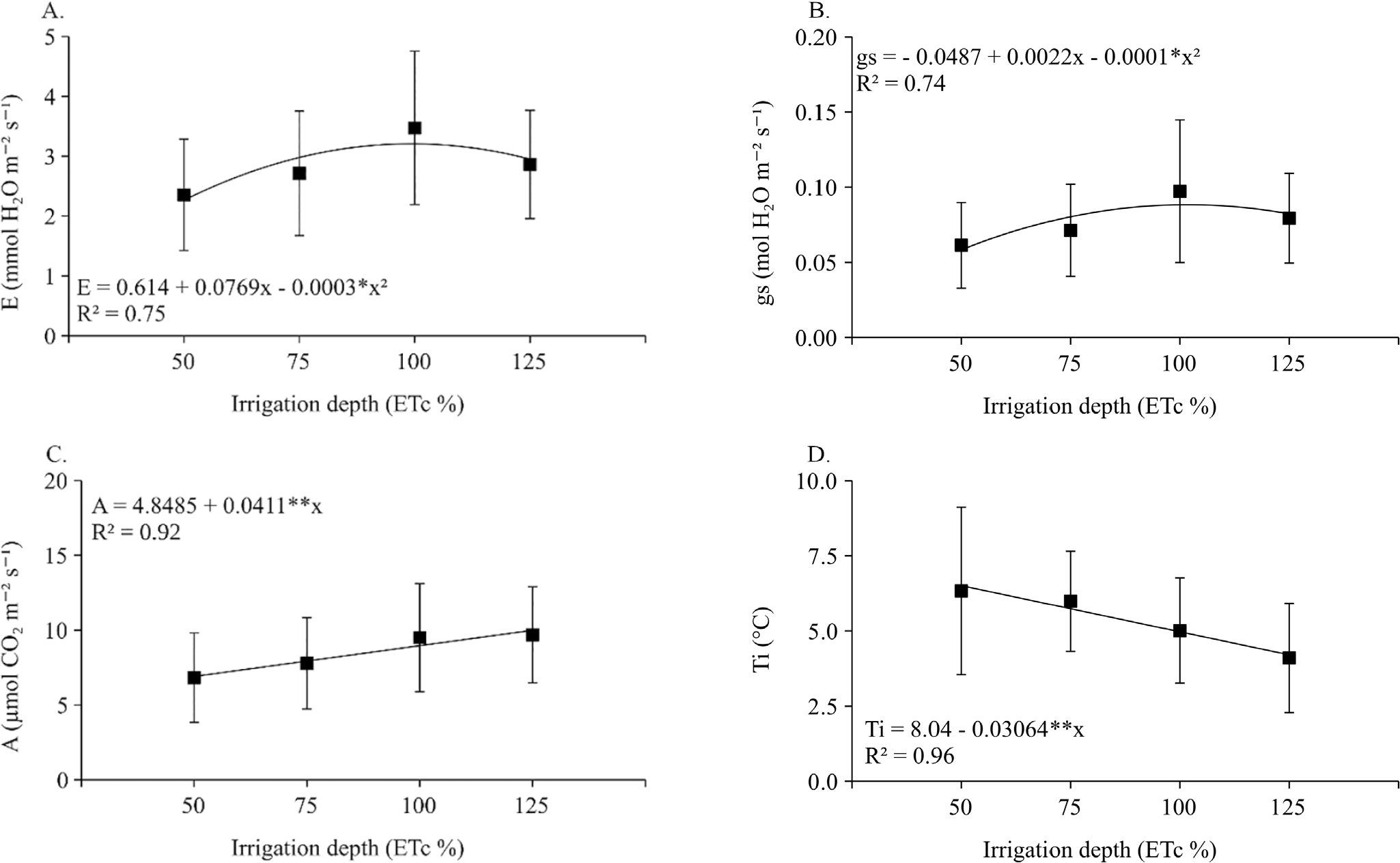
However, at 62 DAT, with more developed plants, transpiration (E) showed significant quadratic polynomial behavior, with the maximum estimated value at ~99% ETc irrigation depth (Figure 3A), occurring similarly with stomatal conductance (gs), which also showed quadratic behavior, with a maximum estimated value at ~101% ETc irrigation depth (Figure 3B).
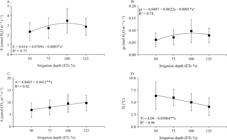
Leaf transpiration (A), stomatal conductance (B), photosynthetic rate (C) and thermal index (D) of melon plants at 62 days after transplanting as a function of irrigation depth (% of ETc - crop evapotranspiration)
A positive linear regression was observed for the photosynthetic rate (A) with the irrigation depth, with an increase of 44% when comparing the treatments referring to 50 and 125% ETc (Figure 3C).
For the thermal index (Ti) variable, a negative linear regression was found with a 54% reduction in the variable, which decreased at 125% ETc compared with 50% ETc (Figure 3D).
The physiological responses of the melon plants varied according to the evaluation period and the intensity of the water deficit. In stages earlier than fruit maturity, the results for transpiration (E) and internal CO2 concentration (Ci) are similar to those of Vieira et al. (2024), who found no significant influence of irrigation depths (40 to 100% ETc) on these variables during early assessments.
However, under more severe water stress or in stages later than fruit maturity, a positive linear regression between water supply and gas exchange was observed. This behavior aligns with the findings of Lima et al. (2020) and Wang et al. (2022), who reported reductions in transpiration and stomatal conductance (gs) in plants subjected to water deficits (depths below 90 and 60% ETc, respectively). Notably, Lima et al. (2020) also observed that increased water availability favors the photosynthetic rate, although the internal CO2 concentration tends to be less sensitive to irrigation depth variations compared to other physiological parameters.
Silva et al. (2025), when evaluating the impact of controlled water deficit on tomato plants, found that reduced water supply significantly increased thermal index values, aligning with the current study. However, unlike our findings, those authors reported that these values were not influenced by the crop’s developmental stage.
When evaluating melon plants, Aragão et al. (2023) observed a negative linear regression between the thermal index and irrigation depths (40 to 120% ETc) at 15, 30, 45 and 60 DAT. These results partially corroborate the present study, which identified this influence only at 60 DAT. This discrepancy may be attributed to the experimental conditions. While Aragão et al. (2023) and Silva et al. (2025) conducted their study in pots, where a limited and known soil volume leads to rapid depletion of available water under lower irrigation depths, the present study was field-based. In the field, roots explore a larger soil volume, which can delay or mitigate the onset of water deficit symptoms.
The volume of water available in the root absorption region and the stage of plant development are determining factors in the physiological behavior of the plant. The greater the water potential, the easier it will be for the plant to perform its physiological processes measured in this study, such as photosynthetic rate and transpiration (Taiz et al., 2017).
These characteristics are evident in the physiological stages of greatest water demand, as observed in the evaluation carried out at 62 DAT. The treatments that received less water than necessary had reduced stomatal conductivity, photosynthesis, and transpiration.
Directly related to the water issue, at 62 DAT, the thermal index could be used as an indicator of water stress. This fact correlates lower irrigation depth with limitations in plant gas exchange, as water flow through the plant affects the thermal index: the greater the flow, the more heat the plant will tend to lose to the atmosphere through transpiration, and since water is also part of photosynthetic processes, lower thermal index values are related to higher photosynthetic rates.
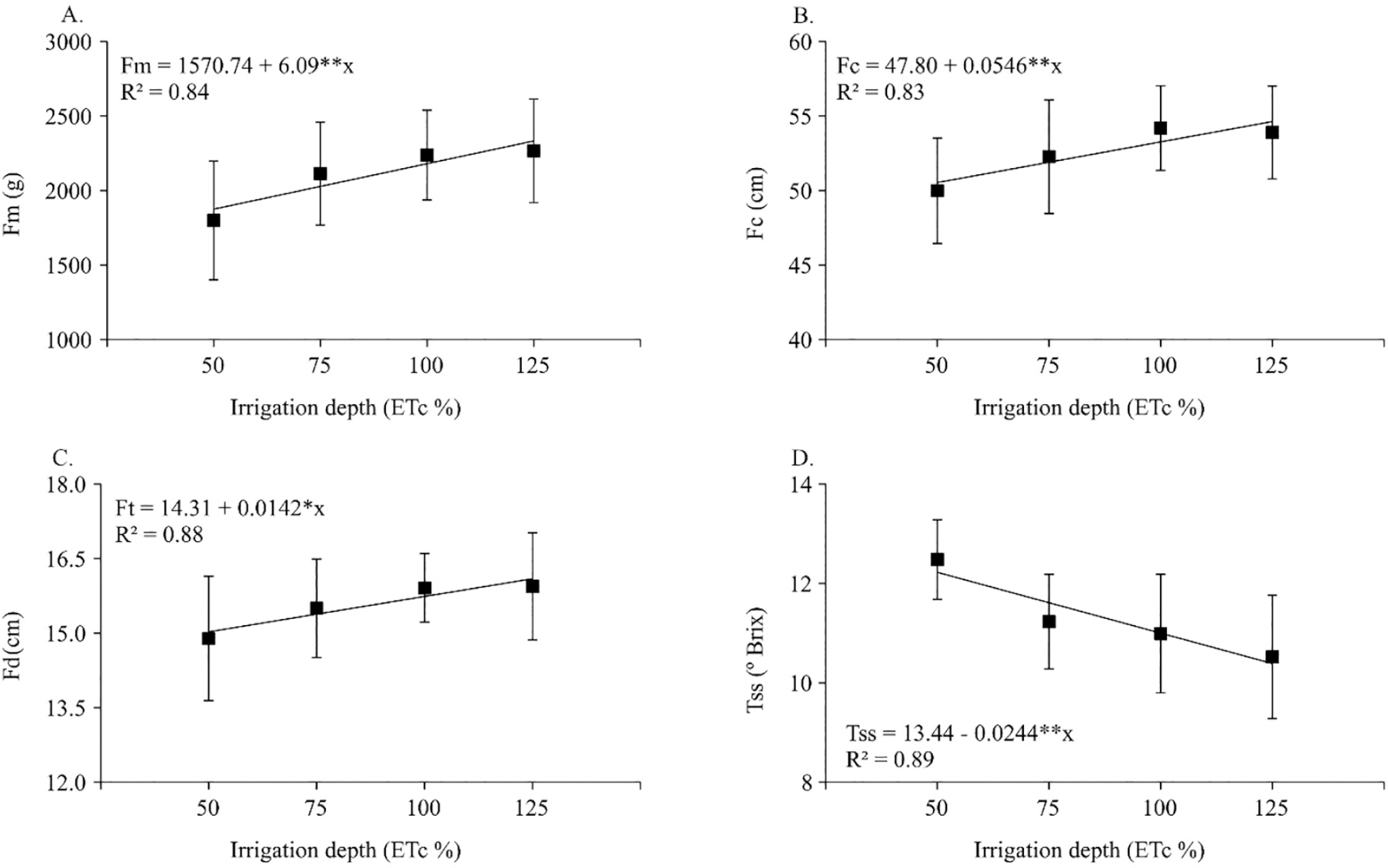
The fruit mass variable (Fm) showed a positive linear relationship with the irrigation depth, with a 20% increase when comparing the results obtained with the 50 and 125% depth, respectively (Figure 4A). Similar behavior was observed in fruit circumference, with a 7% increase (Figure 4B), while fruit diameter showed an increase of 6% for the 50 and 125% ETc depths, respectively (Figure 4C).
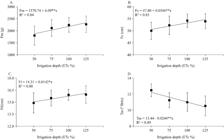
Fruit mass (A), fruit circumference (B), fruit diameter (C) and total soluble solids (D) of melon plants at 71 days after transplanting as a function of irrigation depth (% of ETc - crop evapotranspiration)
For total soluble solids, an inverse linear regression was observed with the increase in the applied depth, with a 15% reduction in °Brix between the highest and lowest irrigation depth (Figure 4D), unlike what was observed for pulp pH, which was not significantly influenced by the irrigation depth applied.
Diverse water responses regarding melon quality and yield are reported in the literature. Contrary to the present study, Yavuz (2021) and Lins et al. (2024) found no significant influence of irrigation depths on total soluble solids (Tss) and pH. However, both studies reported a positive relationship between fruit mass and applied water volume, corroborating our results and the findings of Valnir Júnior et al. (2022).
Ren et al. (2021) observed peak °Brix content under ideal irrigation, with reductions under both water deficit and excess. This pattern differs from the decreasing linear behavior observed in this study, where the lowest Tss values occurred at the highest water depths. Additionally, Azevedo et al. (2016) identified quadratic behavior for Tss and fruit diameter; this discrepancy may be related to the range of irrigation depths, as their study tested up to 150% of ETc, while the present study was limited to 125%.
These differences may be related to fertilization, as the aforementioned authors did not emphasize calcium nutritional supply. This nutrient is essential for cell division and elongation, as well as cell wall stability, which may explain the high average fruit mass observed. The reduction in Tss content with increasing irrigation depth may result from the dilution effect, a physiological principle where solute concentration decreases due to a disproportionate increase in water content within the tissues (Chen et al., 2020).
Total soluble solids are the primary quality parameter for export. Ideal values are considered to be above 10 °Brix (UNECE, 2023), while according to EMBRAPA (1994), values from 9 to 12 °Brix are suitable for marketing, and above 12 °Brix are classified as “extra melon”. The 50% ETc treatment was the only one to achieve the soluble solids content required for the highest classification; however, according to European parameters, all treatments reached the minimum recommended value. Regarding fruit mass, the 125, 100, and 75% ETc treatments showed average masses exceeding 2 kg per fruit, surpassing the upper commercial limit, while the lowest irrigation depth resulted in values within the accepted marketing range (EMBRAPA, 1994).
The increase in soil nutrient concentration, especially potassium and nitrogen, has been associated with higher soluble solids content in fruits. Wang et al. (2022) demonstrated that optimized applications of N and K significantly increased the soluble solids content in melons due to improved photosynthesis and sugar transport to the fruit.
In sandy soils, as observed in the present study, high irrigation volumes can intensify nutrient leaching, reducing nutrient availability to roots and leading to greater leaching of nitrate, potassium, and calcium (Zapata-García et al., 2023). This scenario compromises the positive effects of fertilization because, despite the high initial concentration in the soil, excessive loss through percolation decreases nutritional effectiveness, reducing the accumulation of soluble solids and lowering the pH in the fruit.
As for fruit mass, water volume proved to be the determining factor for this variable. Even under different growing conditions and different cultivars, a positive linear regression between the volume of water applied and fruit mass was observed.
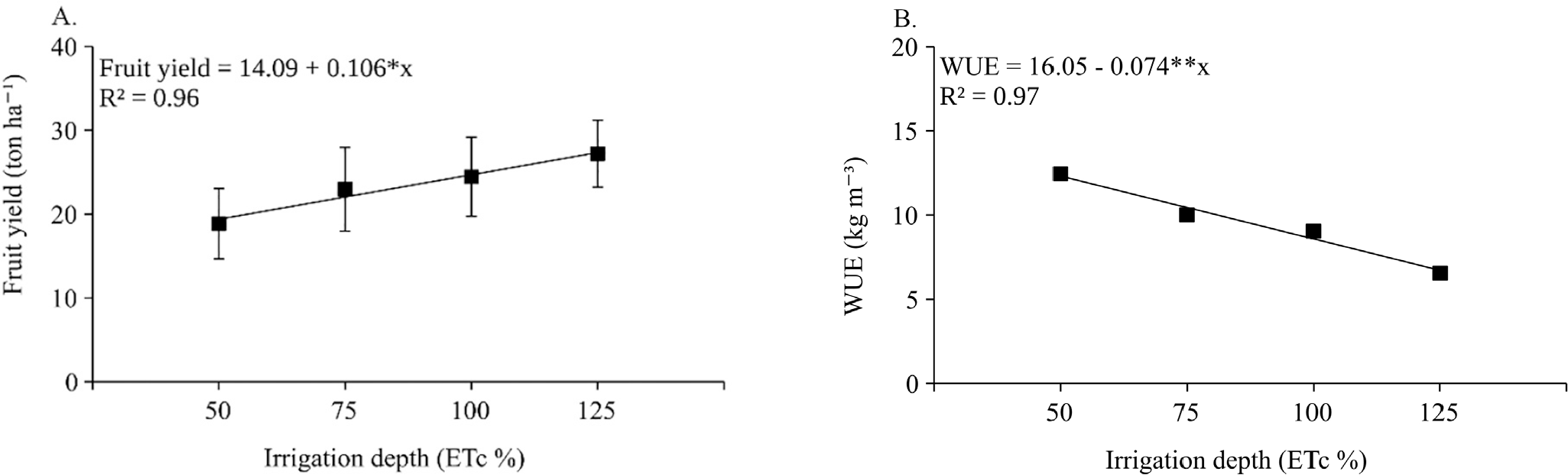
For fruit yield, a positive linear regression was observed with the increase in the irrigation depth, with a 29% increase in yield when comparing the depth for the 50 and 125% ETc treatments (Figure 5A).
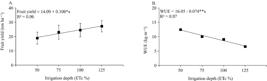
Fruit yield (A) and water use efficiency (WUE) (B) as a function of irrigation depth (% of ETc - crop evapotranspiration)
Water use efficiency showed a negative linear relationship with the increase in water depth, with an 81% reduction in efficiency for the 50 and 125% ETc treatments, respectively, as a result of the low influence of irrigation depth on fruit yield (Figure 5B).
Azevedo et al. (2016) evaluated fruit yield and water use efficiency in yellow melon plants subjected to irrigation depths ranging from 25 to 150% ETc and observed quadratic behavior with a maximum value close to 100% ETc for fruit yield as a function of the volume of water applied, which corroborates in part the present study, in which we observed a linear regression. Water use efficiency showed similar behavior in both studies, considering the same irrigation depths.
He et al. (2022), when evaluating irrigation water use efficiency in the production of watermelon and muskmelon subjected to irrigation depths between 80 and 100% ETc, found that for both crops there was no statistical difference, which contradicts the results obtained in the present study. In contrast, Wang et al. (2023) analyzed water use efficiency in watermelon cultivation and concluded that reducing the irrigation depth contributed to increased efficiency, a result consistent with the pattern observed in this study.
The linear behavior of fruit yield in relation to the applied depth is explained by the increase in fruit mass, also linear with the increase in depth. Despite this increase in yield, water use efficiency had a negative relationship with the irrigation depth. This result can be explained by the fact that it was necessary to apply more than double the volume of water to achieve a 30% increase in yield. This higher water consumption is also related to lower energy efficiency and, thus, a lower financial return for producers (Moradi et al., 2015).
CONCLUSIONS
-
1. Under the conditions tested, the thermal index (Ti) indicated water stress at 62 days after transplanting (DAT), with lower Ti values under higher irrigation depths.
-
2. At 62 DAT, irrigation depth significantly affected leaf transpiration (E), stomatal conductance (gs), and photosynthetic rate (A).
-
3. Increasing irrigation depth (50-125% ETc) increased fruit mass and yield in melon plants.
-
4. Higher irrigation depths reduced total soluble solids and decreased water use efficiency, indicating a trade-off between yield, fruit sweetness, and efficiency.
Acknowledgements:
Thanks to Coordenação de Aperfeiçoamento de Pessoal de Nível Superior (CAPES) for granting a scholarship to the first author.
Data availability statement:
The authors declare that there are no data underlying the text.
LITERATURE CITED
- Allen, R. G. et al. Crop evapotranspiration: Guidelines for computing crop water requirements. Rome: FAO, 1998. 300p. (FAO. Irrigation and Drainage Paper, 56).
-
Aragão, M. F. et al. Evaluation of crop water status of melon plants in tropical semi-arid climate using thermal imaging. Revista Brasileira de Engenharia Agrícola e Ambiental, v.27, p.447-456, 2023. http://dx.doi.org/10.1590/1807-1929/agriambi.v27n6p447-456
» http://dx.doi.org/10.1590/1807-1929/agriambi.v27n6p447-456 -
Azevedo, B. M. D. et al. Irrigation depths and yield response factor in the productive phase of yellow melon. Revista Brasileira de Fruticultura, v.38, e802, 2016. https://doi.org/10.1590/0100-29452016802
» https://doi.org/10.1590/0100-29452016802 - Bernardo, S. et al. Manual de irrigação. 9.ed. Viçosa: Ed. UFV, 2019, 545p.
- Borém, A.; Nick, C. Melão: do plantio à colheita. 1.ed. Viçosa, MG: Editora UFV, 2019. 246p.
-
Chen, J. et al. Fruit water content as an indication of sugar metabolism improves simulation of carbohydrate accumulation in tomato. Journal of Experimental Botany, v.71, p.5010-5026, 2020, https://doi.org/10.1093/jxb/eraa225
» https://doi.org/10.1093/jxb/eraa225 - Coêlho, J. D. Milho: produção e mercados. Fortaleza: Banco do Nordeste, 2023. 10p. (Caderno Setorial ETENE, ano 8, n.291, jul. 2023).
- Cuenca, R. H. Irrigation System Design: An Engineering Approach. 1. ed. Englewood Cliffs: Prentice Hall, 1989. 552 p.
-
El Hachimi, J. et al. Combination of Sentinel-2 Satellite Images and Meteorological Data for Crop Water Requirements Estimation in Intensive Agriculture. Agriculture, v.12, 1168, 2022. https://doi.org/10.3390/agriculture12081168
» https://doi.org/10.3390/agriculture12081168 -
EMBRAPA - Empresa Brasileira de Pesquisa Agropecuária. Melão para exportação: procedimentos de colheita e pós-colheita. 1994. Infoteca-e: repositório de informação tecnológica da Embrapa. Available on: https://www.infoteca.cnptia.embrapa.br/infoteca/handle/doc/425896 Accessed on: Jan. 2026.
» https://www.infoteca.cnptia.embrapa.br/infoteca/handle/doc/425896 -
EMBRAPA - Empresa Brasileira de Pesquisa Agropecuária. Evapotranspiração e coeficientes de cultivo e de irrigação para a cultura do melão (Cucumis melo L.) na Região Litorânea do Ceará. 2001. Infoteca-e: repositório de informação tecnológica da Embrapa. Available on: https://www.infoteca.cnptia.embrapa.br/infoteca/bitstream/doc/425896/1/Bd002.pdf Accessed on: Jan. 2026.
» https://www.infoteca.cnptia.embrapa.br/infoteca/bitstream/doc/425896/1/Bd002.pdf -
EMBRAPA - Empresa Brasileira de Pesquisa Agropecuária. Irrigação e fertirrigação na cultura do melão. 2011. Infoteca-e: repositório de informação tecnológica da Embrapa. Available on: https://www.infoteca.cnptia.embrapa.br/infoteca/handle/doc/921606 Accessed on: Jan. 2026.
» https://www.infoteca.cnptia.embrapa.br/infoteca/handle/doc/921606 -
EMBRAPA - Empresa Brasileira de Pesquisa Agropecuária. A cultura do melão. 2017. Infoteca-e: repositório de informação tecnológica da Embrapa. Available on: https://www.infoteca.cnptia.embrapa.br/infoteca/bitstream/doc/1069567/1/PLANTARMelaoed032017.pdf Accessed on: Jan. 2026.
» https://www.infoteca.cnptia.embrapa.br/infoteca/bitstream/doc/1069567/1/PLANTARMelaoed032017.pdf -
García-Tejero, I. F. et al. Thermal imaging at plant level to assess the crop-water status in almond trees (cv. Guara) under deficit irrigation strategies. Agricultural Water Management, v.208, p.176-186, 2018. https://doi.org/10.1016/j.agwat.2018.06.002
» https://doi.org/10.1016/j.agwat.2018.06.002 -
Gerhards, M. et al. Water stress detection in potato plants using leaf temperature, emissivity, and reflectance. International Journal of Applied Earth Observation and Geoinformation, v.53, p.27-39, 2016. https://doi.org/10.1016/j.jag.2016.08.004 .
» https://doi.org/10.1016/j.jag.2016.08.004 -
He, J. et al. Effects of nanobubble in subsurface drip irrigation on the yield, quality, irrigation water use efficiency and nitrogen partial productivity of watermelon and muskmelon. International Agrophysics, v.36, p.163-171, 2022. https://doi.org/10.31545/intagr/150413
» https://doi.org/10.31545/intagr/150413 -
Irineu, T. H. da S. et al. Agronomic efficiency of ‘Cantaloupe’ melon under different water blades and organic fertilization. Comunicata Scientiae, v.9, p.421-429, 2018. https://doi.org/10.14295/cs.v9i3.1389
» https://doi.org/10.14295/cs.v9i3.1389 -
Jackson, R. D et al. Canopy temperature as a crop water stress indicator. Water Resource Research, v.17, p.1133-1138, 1981. http://dx.doi.org/10.1029/WR017i004p01133
» http://dx.doi.org/10.1029/WR017i004p01133 -
Kamer, A. M. E. et al. Yield and quality performance of some new sweet melon lines under water stress conditions. Journal of the Advances in Agricultural Researches, v.27, p.149-160, 2022. https://doi.org/10.21608/JALEXU.2022.114554.1036
» https://doi.org/10.21608/JALEXU.2022.114554.1036 -
Lima, D. S. R. et al. ‘Pele de sapo’ melon grown under different irrigation depths and bioestimulant rates in the Semiarid region of Brazil. Comunicata Scientiae, v.11, e3303, 2020. https://doi.org/10.14295/cs.v11i.3303
» https://doi.org/10.14295/cs.v11i.3303 -
Lins, G. R. et al. Hydrogel polymer in yellow melon plants cultivated under different irrigation depths. Revista Brasileira de Engenharia Agrícola e Ambiental, v.28, e280282, 2024. https://www.scielo.br/j/rbeaa/a/mTk7MVY99Xb9cXSdTPfKKpR
» https://www.scielo.br/j/rbeaa/a/mTk7MVY99Xb9cXSdTPfKKpR -
López, A. et al. Determining the emissivity of the leaves of nine horticultural crops by means of infrared thermography. Scientia Horticulturae, v.137, p.49-58, 2012. https://doi.org/10.1016/j.scienta.2012.01.022
» https://doi.org/10.1016/j.scienta.2012.01.022 -
Miceli, A. et al. Effect of mycorrhizal inoculation on melon plants under deficit irrigation regimes. Agronomy, v.13, 440, 2023. https://doi.org/10.3390/agronomy13020440
» https://doi.org/10.3390/agronomy13020440 -
Moradi, R. et al. Energy use and economical analysis of seedy watermelon production for different irrigation systems in Iran. Energy Reports, v.1, p.36-42, 2015. https://doi.org/10.1016/j.egyr.2014.10.002
» https://doi.org/10.1016/j.egyr.2014.10.002 -
Ren, R. et al. Irrigation based on daily weighted evapotranspiration affects yield and quality of oriental melon. Scientia Horticulturae, v.275, 109714, 2021. https://doi.org/10.1016/j.scienta.2020.109714
» https://doi.org/10.1016/j.scienta.2020.109714 - Richards, L. A. Diagnosis and Improvement of Saline Alkali Soils. Washington DC: US Department of Agriculture, 1954. 160p. (Agriculture Handbook, 60).
-
Silva, D. A. da. et al. Irrigation strategies and soil conditioning on thermal index and yield of cherry tomato. Revista Brasileira de Engenharia Agrícola e Ambiental, v.29, e280430, 2025. https://doi.org/10.1590/1807-1929/agriambi.v29n6e280430
» https://doi.org/10.1590/1807-1929/agriambi.v29n6e280430 -
Soil Survey Staff. Keys to Soil Taxonomy. 13.ed. USDA - Natural Resources Conservation Service, 2022. 401p. Available at: https://www.nrcs.usda.gov/resources/guides-and-instructions/keys-to-soil-taxonomy Accessed on: Jan 14, 2025.
» https://www.nrcs.usda.gov/resources/guides-and-instructions/keys-to-soil-taxonomy -
Sousa, N. I. G. de. Hydrogel as mitigator of salt stress during the establishment of Tagetes patula L. seedlings. Revista Brasileira de Engenharia Agrícola e Ambiental, v.26, p.807-814, 2022. https://doi.org/10.1590/1807-1929/agriambi.v26n11p807-814
» https://doi.org/10.1590/1807-1929/agriambi.v26n11p807-814 - Taiz, L. et al. Fisiologia e desenvolvimento vegetal. 6.ed. Porto Alegre: Artmed, 2017. 858p.
-
UNECE - United Nations Economic Commission for Europe. UNECE Standard FFV-23 concerning the marketing and commercial quality control of Melons. 2023. UNECE Standards and agricultural quality. Available on: https://unece.org/sites/default/files/2024-03/FFV-23_Melons_2023_e.pdf Accessed on: Dec. 2025.
» https://unece.org/sites/default/files/2024-03/FFV-23_Melons_2023_e.pdf -
Valnir Júnior, M. et al. Qualidade e vida útil pós-colheita dos frutos de melão submetidos a diferentes lâminas de irrigação. Research. Society and Development, v.11, e1211225091, 2022. https://doi.org/10.33448/rsd-v11i2.25091
» https://doi.org/10.33448/rsd-v11i2.25091 - Vasileva, E.; Chipilski, R. Identification and characterization of drought tolerant local populations of Cucurbitaceae. Bulgarian Journal of Agricultural Science, v.28, p.417-424, 2022.
-
Vieira, N. Q. B. et al. Cultivation of yellow melon subjected to different irrigation levels and application of arbolina® biostimulant. Revista Caatinga, v.37, e12452, 2024. https://doi.org/10.1590/1983-21252024v3712452rc
» https://doi.org/10.1590/1983-21252024v3712452rc -
Wang, X-C. et al. Effects of water and NPK fertigation on watermelon yield, quality, irrigation-water, and nutrient use efficiency under alternate partial root-zone drip irrigation. Agricultural Water Management, v.271, 107785, 2022. https://doi.org/10.1016/j.agwat.2022.107785
» https://doi.org/10.1016/j.agwat.2022.107785 -
Wang, Z. et al. Deficit mulched drip irrigation improves yield, quality, and water use efficiency of watermelon in a desert oasis region. Agricultural Water Management, v.277, 108132, 2023. https://doi.org/10.1016/j.agwat.2022.108132
» https://doi.org/10.1016/j.agwat.2022.108132 -
Yang, Z. et al. Appropriate water and fertilizer supply can increase yield by promoting growth while ensuring the soil ecological environment in melon production. Agricultural Water Management, v.289, 108561, 2023. https://doi.org/10.1016/j.agwat.2023.108561
» https://doi.org/10.1016/j.agwat.2023.108561 -
Yavuz, N. Can grafting affect yield and water use efficiency of melon under different irrigation depths in a semi-arid zone?. Arabian Journal of Geosciences, v.14, e1118, 2021. https://doi.org/10.1007/s12517-021-07498-1
» https://doi.org/10.1007/s12517-021-07498-1 -
Yu, Z. Z. et al. The effect of aeration and irrigation on the improvement of soil environment and yield in dryland maize. Frontiers in Plant Science, v.15, e1464624, 2024. https://doi.org/10.3389/fpls.2024.1464624
» https://doi.org/10.3389/fpls.2024.1464624 -
Zapata-García, S. et al. Using soil water status sensors to optimize water and nutrient use in melon under semi-arid conditions. Agronomy, v.13, 2652, 2023. https://doi.org/10.3390/agronomy13102652
» https://doi.org/10.3390/agronomy13102652
Edited by
-
Editors:
Ítalo Herbet Lucena Cavalcante & Walter Esfrain Pereira

 DAT - Days after transplanting
 Vertical lines represent the standard error of the mean (n = 15); ** - Significant at p ≤ 0.01 by F-test. Mbl - Main branch length
 Vertical lines represent the standard error of the mean (n = 15); ** and * - Significant at p ≤ 0.01 and p ≤ 0.05, respectively, by F-test; A - Photosynthetic rate; gs - Stomatal conductance, E - Leaf transpiration; and Ti - Thermal index
 Vertical lines represent the standard error of the mean (n = 10); ** and * - Significant at p ≤ 0.01 and p ≤ 0.05, respectively, by F-test. Fm - Fruit mass, Fc - Fruit circumference, Fd - Fruit diameter, Tss - Total soluble solids
 Vertical lines represent the standard error of the mean; ** and * - Significant at p ≤ 0.01 and p ≤ 0.05, respectively, by F-test. WUE - Water use efficiency