
 Scientific interclass debate: an experience in a public school from Pelotas, South of Brazil
ABSTRACT
With easy access to information, new generations quickly become discouraged with classical teaching methods and are more likely to abandon their studies, increasing dropout rates. The present work challenged high school students to a scientific debate as a way to promote learning in genetics. Research, argumentation, and oratory were discussed in class. After, students faced each other in an afternoon of debates. Pre-debate questionnaire revealed that 96% of the students were quite apprehensive, but the post-debate survey showed that more than 80% approved of the methodology as an exciting way to learn. Students need to be constantly challenged so that their interest in the school space and in their own academic progress is constantly nurtured and dropping out becomes an unthinkable alternative.
Keywords:
Science Education; Argumentation; Biology Teaching; Debate
RESUMO
Com o fácil acesso à informação, as novas gerações rapidamente se desestimulam com os métodos clássicos de ensino e apresentam maior propensão ao abandono dos estudos, aumentando as taxas de evasão escolar. O presente trabalho desafiou estudantes do ensino médio a participarem de um debate científico como forma de promover a aprendizagem em genética. Pesquisa, argumentação e oratória foram discutidas em sala de aula. Posteriormente, os estudantes se confrontaram em uma tarde de debates. O questionário pré-debate revelou que 96% dos alunos estavam bastante apreensivos, mas a pesquisa pós-debate demonstrou que mais de 80% aprovaram a metodologia como uma forma estimulante de aprender. Estudantes precisam ser constantemente desafiados para que seu interesse pelo espaço escolar e por seu próprio progresso acadêmico seja continuamente nutrido, tornando a evasão uma alternativa impensável.
Palavras-chave:
Educação Científica; Argumentação; Ensino de Biologia; Debate
RESUMEN
Las nuevas generaciones se desalientan rápidamente con los métodos clásicos de enseñanza y es más probable que abandonen la escuela, lo que aumenta las tasas de deserción. El presente trabajo desafió a estudiantes de secundaria a un debate científico, como una forma de promover el aprendizaje en genética. La investigación, la argumentación y la oratoria fueron discutidas. Luego, grupos de estudiantes se enfrentaron en una tarde de debates. El cuestionario previo reveló que el 96% de los estudiantes estaban aprensivos, pero la encuesta posterior mostró más del 80% de aprobación. Los estudiantes necesitan ser desafiados constantemente en el espacio escolar para que su interés por la escuela y por su propio progreso académico se nutra constantemente y la deserción se convierta en una alternativa impensable.
Palabras clave:
Enseñanza de las Ciencias; Argumentación; Enseñanza de la Biología; Debate
INTRODUCTION
Basic education in Brazil, which includes pre-school, elementary (years 1-5), middle (years 6-9), and high school (10-13) levels, has been looking for innovative strategies that may help teachers to better prepare students for their future careers and to fully exercise their citizenship. It’s acknowledged that critical and logical thinking and the development of argumentative capacity are essential features for any pro-active citizen, as well as for all competent professionals. However, building up the capacity for critical analysis, the global view to understand the world around, and the recognition of the importance of scientific thinking in the technological, socioeconomic, cultural, and human development of society are not easy tasks.
The question is that, facing the great easiness of access to scientific information, new generations of students rapidly become demotivated with classic teaching methods and become more likely to give up precociously on pursuing a more qualified academic education. Considering especially the teaching of biology, the vast majority of professors use methodologies that are now considered not outdated, but classic and recurring in the teaching of biological sciences. Therefore, it is crucial that professors carefully guide and challenge the young minds to explore their high intellectual potential, or we face the risk of having a generation of completely demotivated students, who may turn into poorly prepared professionals.
The science education (or scientific literacy for some authors) aims to instrumentalize students to use scientific knowledge, and its developments, as a way to understand issues or solve problems in all kinds of areas in their lives. Some Brazilian authors use the expression “Scientific Enculturation,” in order to express that science teaching should offer some learnings that the students may carry out through life. Among them are included notions, concepts, and scientific ideas to allow them to become part of the discussions concerning their very own culture, and in so doing, participate actively in society’s evolution (Sasseron and Carvalho, 2011).
School is usually the first and main center of scientific knowledge disclosure for the young. In Brazil, the nature sciences curriculum is usually organized in one discipline named Science for middle school children. It contains a general, but broad look at biology and a very restricted study of physics and chemistry. In high school level, this area of knowledge suffers a separation into three disciplines: biology, physics and chemistry. This organization is still very common in public and private schools, but some educational establishments are changing this organization in order to achieve a more interdisciplinary approach to knowledge.
The curricular components of science - biology, physics and chemistry - are still the expected spaces for helping the students in the development of the capacity for critical analyses and a global understanding of science. Nevertheless, science is a product of the human mind, desires, necessities, curiosity, and actions. It is strongly influenced by different human aspects and knowledge. In this sense, most researchers in science education agree that the adoption of educational methodologies focused on the integration of knowledge from different areas may result in more contextualized and interdisciplinary science teaching, leading to a significant overall improvement in science education (Lapa, Bejarano and Penido, 2011).
Historically, science teaching suffers multiple influences and pressures from educational laws, governmental curricular instructions, textbooks, and even economy and culture (Nascimento, Fernandes and Mendonça, 2010; Duschl and Grandy, 2013). As if the stress were not enough, in emerging countries like Brazil, it is possible to add a few more difficulties. First, overcrowding classrooms (an expressive number of Brazilian teachers deal with a high number of students per class). Second, professional devaluation forces teachers to have a weekly load of 40 h (some reach 60 h), often distributed in more than one school, to be able to perceive a minimal wage to survive and support their families. Third, a significantly lagging physical structure in education institutions, which are still widely distributed in public schools (Alves and Pinto, 2011). Furthermore, interdisciplinary in science education represents a strong challenge because most teachers do not feel (and are not technically) prepared in the universities to work with subjects that differ from what they teach, generating discomfort and insecurity when demanded to work with other matters (Augusto and Caldera, 2005).
Considering all that, it is not surprising that a significant number of teachers choose to employ classical methodologies such as the use of didactic models in their teaching practice (Della Justina and Ferla, 2006; Temp, Carpilovsky and Guerra, 2011) or lab classes with very restricted guidelines and well-known and expected results (Lima and Garcia, 2011). That is true, especially when the time most professors have to prepare classes and update themselves on new scientific discoveries and teaching methodologies is scarce (Nuñes and Ramalho, 2013).
Data obtained from interviews made by Pedrancini et al. (2007) reveal that, while students have studied the basic concepts regarding the structure and physiology of living beings in their various levels of organization in school, they have spontaneous ideas that are expressed whenever they are questioned about specific topics of science. It seems that faced with a challenge, students forget the issues studied in the school environment and automatically access the consolidated empirical knowledge in their memories, which was constructed by massive exposure to the media, internet, and∕or popular knowledge. The same research identified many alternative ideas, often mistaken, in relation to living things. The views expressed during their investigation with regard to transgenic showed that there were intuitive concepts greatly influenced by the media, but for the most part, devoid of scientific knowledge (Pedrancini et al., 2007). Citizen opinions should come from knowledge constructed by life experiences and by teacher-student, student-student, and student-knowledge interactions in the school environment. It is possible that public school, as it is structured nowadays, contributes little to students building up an understanding that differs from the one acquired in non-school situations.
Currently in Brazil, despite the fact that scientific and technological innovations are part of the public school curriculum, most students do not contextualize the biology topics, especially the genetic content (Moura et al., 2013). What is noticeable in science and biology education, as well as in projects that seek to work in an interdisciplinary or multidisciplinary way, is the high incidence of studies with themes such as environmental education and ecology. Obviously, those themes are significant and develop the student’s view of the community that surrounds them (Borges and Lima, 2007), but are far from being the only subjects that allow teachers to work in an interdisciplinary manner, helping students to develop various skills.
Nevertheless, there is a limitation and almost oblivion of other issues with an interdisciplinary connotation or a transversal theme characteristic. For example, working with interdisciplinary projects for genetics and biotechnology is not usual in Brazilian public schools. In addition, the methods to develop the theory that is the basis of these themes are usually classical: oral explanation associated or not with lab classes, campaigns in the community, and construction of models (Borges and Lima, 2007). Besides being fundamental to reconsidering the themes to be highlighted in the lessons, strategies to address these topics must include diverse and interesting situations in a way that significantly favors student learning.
In a research published by Fialho (2013), students highlighted that, even though the biology topics are interesting and curious, the teaching methodologies and the expectations of the teachers are always the classic and intense “memorization.” Adolescents are willing and recognize that they need to dedicate themselves more, but they require in return that the teachers seek new ways to explain, and offer more interesting classes (filled with dynamic diversity in activities and classroom control).
Activities that require commitment, search, and effort to discover ways to solve questions challenge the student and at the same time encourage them to move forward, to deepen within a subject, and, more importantly, to appreciate their own effort and the achievement done on their own merits (even if under the guidance of a teacher). In this sense, this study sought to investigate the response of teenagers before a simple reinvented methodology that, in developed countries, is well known, but in Brazil is not widely used, perhaps because of the lack of preparation of teachers who still focus too much on theoretical-expository methods or plastered laboratory practices.
Arguing and debating are very common human practices that can take place as individual or as social activities. People use verbal or written arguments in all parts of their lives, whether for personal interests (such as to persuade friends or family members to do or to comply with something) or professional purposes (e.g., convincing an employer to give one a salary raise). The Interclass Debate was a project structured to show students that scientific knowledge is all around them and may affect directly or indirectly their future. It was meant to evoke in them a sense of responsibility, since only well-informed people can make conscious decisions and position themselves in society, whether in support or protest of the directions of science, politics, economy, and overall development of human society. It was also designed to verify how students would respond to a teaching methodology they have never experienced in their academic lives.
METHODOLOGY
The project occurred during 3 years in the classes assigned to the author, always beginning in the first week of the second term, when the proposition for the debate was presented to the students. In Year 1, classes numbered 304, 305, 307, and 309 (n = 69 students) participated. In the second (n = 41 students) and third years (n = 38 students), only classes number 305, 306, and 307 were assigned to the author. The decrease in the number of students was due to retention and not dropout. Each classroom was divided into two or more groups. The themes for the first year of the debate were assigned by the teacher and included: cloning, transgenic, embryonic stem cells, and human genetic improvement. In the second year, the selection of themes for the debate was changed, and students were able to select it themselves from a list or suggest a new topic by accessing an online form in Google Docs space. The most voted themes were Genetic Discrimination - use of genetic parameters to select individuals, cloning, genetic improvement - manipulation of genes to “perfect” species, and biological weapons. In the last year, the themes selected were human cloning, genetic improvement, and genetic discrimination.
In the 3 years of the project, students could answer a questionnaire about their expectations and feelings about participating in the debate weeks before the event, during the preparation time. In addition, students answered a questionnaire after attending the debate so that the impressions that the methodology caused in them could be verified.
The topics to be discussed in the main debate and the views to be defended (pros and cons) were randomly assigned among the classes. The draw of topics occurred so that discussions of pros versus cons always occurred between groups belonging to different classes. All groups were instructed to research generalities on the theme to better understand the basic concepts of it, and then look for scientific arguments to defend the pros or cons of developing and using the biotechnology they had drawn.
In the following weeks, in each encounter, different biotechnologies (and other related topics) were discussed, and at the end of each lesson, students watched 10-15 min documentaries where renowned scientists presented different views and arguments on the subject. After that, a small debate between classmates was organized as preparation for the major event. One group was randomly selected to start the debate defending the pros or cons of the biotechnology studied in the class. They had 90 s to launch the first argument, and the other group had the same 90 s to evaluate the argument and launch a counterargument. This dynamic continued until the end of the class, with frequent teacher intervention to help students build up their arguments. The teacher guided students on how to construct an argument based on scientific elements, highlighting the basic elements of a good argument based on Toulmin’s model (2003) (basic knowledge, data, modal qualifications, justification, and refutation).
During the term, the students were supervised in their research, and questions were answered. Under constant orientation, they prepared a written work with the scientific arguments to defend the point of view assigned to them by drawing and were allowed to consult it during the interclass debate. The event occurred in the last week of the term. To evaluate the debate, three professors from different areas were invited: a doctor in genetics, a master in human sciences and a master in biochemistry. They received an evaluation form that contained the following criteria: knowledge of the topic, scientific nature of the arguments, oral expression, coherence in argumentation, and conduct during the debate. On each criterion, the group received grades from 6 to 10. The timing for the debate was the same as that used in classes, but here a maximum of 30 min per issue was established, meaning that the two groups engaged in the debate would have a total time of 30 min to present their arguments and counterarguments.
After the debate, students responded to a questionnaire to evaluate the whole process. They could score from one to five on all different aspects of the debate. Scores were identified as follows:
-
• 1: no; bad; unsuitable; uninteresting; nothing worthwhile;
-
• 2: more or less; regular; somewhat suitable; somewhat interesting; somewhat worthwhile;
-
• 3: kind of yes; good with improvements; partially suitable; partially interesting; partially worthwhile;
-
• 4: yes; good; suitable; interesting; worthwhile;
-
• 5: certainly; excellent; totally suitable; very interesting; very worthwhile.
The students evaluated the event on different aspects, such as the adequacy of the chosen themes, duration, value of the methodology, and general evaluation of the process.
RESULTS
Figure 1 shows the results from the first question of the pre-debate questionnaire of the Interclass Debate: “Have you ever participated in a structured debate competition?” It is possible to notice that most students (81%) have never participated in a structured debate. The few who answered “yes” (19%) later explained that they referred to a classroom debate in the Human Sciences, where the structure of the debate was an open discussion with their teacher and classmates based only on their personal opinions, legislation, and values rather than a scientifically based argumentation.
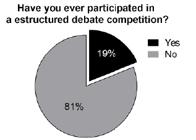
Percentage of students’ answer to the question: “Have you ever participated in a structured debate competition?” in the Interclass Debate.
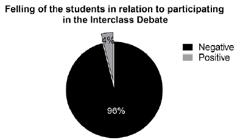
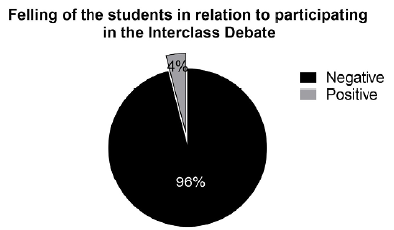
The first reaction of the great majority of students when presented with the proposal was to protest and complain. Negative feelings like anxiety (48%), nervousness (28%), or both (16%), and insecurity or shyness (8%) were mentioned by 96% of the students prior to the event (Figure 2). Only a small percentage (4%) reported being happy and motivated. It was possible to see a decrease in the anxiety after the explanation of the process that would precede the actual event, but overall, students were very apprehensive with the new challenge.
The last question of the pre-debate questionnaire was: “Do you believe that the debate is an interesting methodology to learn about biology topics?” In this question, students probably based their answer on their feelings about the pre-debates in the classroom, which were received very well by all classes. The results may be seen in Chart 1.
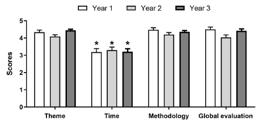
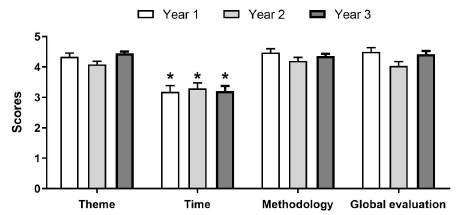
After the event, students were able to attribute scores for four general aspects of the Interclass Debate (results are presented in Figure 3):
-
1. Theme - issues addressed in the debates (considering that in the first year, the themes were selected by the teacher, and in the following years, students were responsible for the selection);
-
2. Time - the overall time, time for presenting the arguments, and time for counterargument;
-
3. Methodology - the use of science debate as a teaching methodology and global evaluation, concerning the event and the overall view of students.
Scores given by the students to the general variables of the event. Results are presented as mean ± SEM in each year. Scores are distributed as: 1-bad; 2-regular; 3-good with improvements; 4-good; 5-excellent. Data were analyzed by one-way analysis of variance and the Newman-Keuls multiple comparison test (GraphPad Prism® 5.0).
No significant difference (p = 0.34) was found between score values when comparing results of each aspect among the years, but it is possible to see that time was an aspect with a significantly lower level of approval in all years (p < 0.0001; F = 46.83, R-squared = 0.2785). Even though time was an issue since the first edition, no change was possible because of the school calendar and activities, so the negative result was kind of expected in subsequent years.
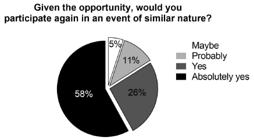
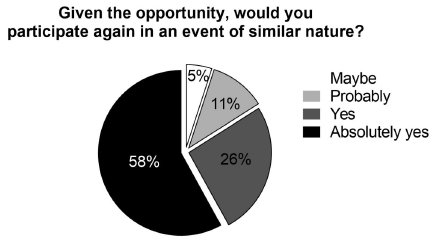
The percentage of students that, given an opportunity, would participate again in such a project exceeded 80%, as shown in Figure 4.
Students’ answer to the question: “Given the opportunity, would you participate again in an event of a similar nature?” The results reflect a 3-year opinion assessment.
To have a more specific idea of which aspects within each variable were and were not approved by the participants, more detailed topics were inserted in the post-debate questionnaire. Chart 2 shows the evaluation of the students regarding these specific topics within the general aspects of the event.
Scores attributed by the students for specific topics within general variables related to the event. Results are presented as mean ± standard error of the mean in each year. Scores are distributed as mentioned in the methodology item. Data were analyzed by one-way analysis of variance and the Newman-Keuls multiple comparison test (GraphPad Prism® 5.0).
Students were also encouraged to highlight the main positive and negative aspects of the methodology and their suggestions in a free manner. The most common comments are transcribed below.
Positive aspects:
“The most important thing is that the student learns not to memorize but to debate and talk with the group.”
“First, the acquired knowledge in a spontaneous and enjoyable way, then the meeting and also the approximation of classes.”
“It was a very good experience. At first, it did not seem like a good idea. But then it was very good and helpful.”
“In four years in this school, it was one of the coolest, most fun works I’ve had.”
Negative aspects:
“The time for argumentation could be longer.”
“I do not see many. Maybe if some group felt insecure about exposing ideas in front of colleagues, but it was not my case.”
“Little time to organize the group during the event.”
“The time available for each group was too short.”
Suggestions:
“All the themes should remain, but more controversial issues, such as abortion, for example, could be included.”
“All terms should have activities like this.”
Transcriptions and results in Chart 2 reflect a significant positive result from the use of the debate methodology with high school students (seen as the enthusiasm translated from students’ scores and comments). It is also possible to see that the main issue in the evaluation of the project was the time assigned to each part of the debate, which the students found too short.
DISCUSSION AND FINAL CONSIDERATIONS
The scientific knowledge in school is a result of a complex process of transposition of the products of scientific research, conducted in higher education and/or special institutions, to the basic educational context. During this process, there is a certain distortion, or rather an adaptation of the scientific knowledge, resulting in a non-precise correspondence between these educational levels (Villani and Nascimento, 2003).
In Brazil, there is still a significant gap between the teaching of science and the student’s daily life. This is common in important areas such as genetics. A quick research in the Scientific Electronic Library Online (SciELO), an electronic library covering a selected collection of South American scientific journals, brings less than 100 publications in Scientific Argumentation topic in the last 10 years. Upon observing these publications, it becomes clear that only a couple dozen of them actually focus on working with scientific argumentation with students rather than promoting a theoretical study of the methodology. This problem may be mainly due to factors like the precariousness in many teacher training courses, excessive working hours, lack of structure in public schools, and a difficulty in the understanding of what interdisciplinary and contextualized activities really are and/or how to work in that manner (Augusto and Caldera, 2005; Alves and Pinto, 2011; Moura et al., 2013).
In an attempt to modernize their classes and approximate students for the “real world,” teachers are trying to increase the number of laboratory activities in biology classes. A research by Lima and Garcia (2011), with high school students from the south of Brazil, reported an interesting difference in the view of what a lab class is. Most of the interviewed students who do not have lab classes described biology practical lessons as the ones that use animals and plants (1st and 2nd most cited). The use of microscopes (3rd most quoted) was also mentioned. Among the students who have lab classes, biology practical lessons were described as the ones with the use of DNA extraction techniques and the microscope, respectively. In this study, students also mentioned that lab classes help them to understand the topics studied, complement the theory, and approximate the school to the real world (Lima and Garcia, 2011).
Nevertheless, it is important to consider just how much the way these classes are introduced or conducted actually contribute in achieving these goals. After all, how many students have in their “real world” or everyday life contact with microscopy (one of the most used practices in Science and Biology classes)? In no way does this observation aim to classify the lab classes as outdated or useless tools. Nevertheless, it is essential to seek different ways of using teaching methods to approximate more effectively the schoolwork to the students’ daily lives. The fact is that the practical lessons can significantly alter the performance of students (Lima and Garcia, 2011), although they are not the only reason for improvement in the academic results.
It is important for students in any kind of science to acquire skills such as the ability to interpret data, write reports, and critically analyze research articles. According to Norris and Phillips (2003), the reading and writing of scientific texts need more emphasis in science education. Reading and arguing in science education involves complex abilities, such as elaborated interpretation processes and analyses and criticism of scientific texts - activities that are central to all sciences (Van Lacum, Ossevoort and Goedhart, 2014).
The science education, as a process that includes scientific enculturation and scientific literacy, is expected to promote students’ insertion into science culture, providing students with a new vision of the world, of natural phenomena, and of human activities. It should prepare young minds to intervene in the world, to modify it and modify themselves, through an aware practice based on scientific knowledge and abilities associated with the scientific practice (Sasseron and Carvalho, 2011).
However, in order to achieve student scientific inclusion, it is important that science education embraces activities that are instigating, such as exploration of natural phenomena, a topic that, by itself, stimulates students’ curiosity. The drawback in this case may be the necessity of some equipment or a minimal laboratory structure to explore some phenomena. Nevertheless, there are some activities, such as discussions and debates that do not depend on a specialized space or equipment and are also instigating. So many scientific issues are addressed in the news and on the internet daily that the amount of material to foment interesting discussions among students is abundant. In this matter, developing activities in the classroom that allow students to investigate scientific sources and establish hypotheses and arguments on scientific matters with property could be another alternative to stimulate high school students (Sasseron and Carvalho, 2011).
Authors usually agree that a proper science education should stimulate argumentation, which requires students to construct and evaluate scientific sources of information and to reason scientifically (Norris and Phillips, 2003; Osborne, 2010; Sasseron and Carvalho, 2011; Van Lacum, Ossevoort and Goedhart, 2014). Research on the students’ skills in scientific argumentation is still in search of instruments to access students’ competency. However, what is in little doubt is that the ability to critically evaluate science issues and to build well-based argumentation is an essential skill in constructing the future of human society. Research to date has shown that mere contact with science does not develop such attributes. It has also demonstrated that teaching/stimulating students to reason, to argue, and to think critically could enhance students’ conceptual learning, especially in scientific matters (Osborne, 2010).
It is becoming very common to see science teachers, especially biology ones, introducing scientific news or texts in their classes. Nevertheless, this kind of material is usually previously selected by the teacher and not researched in different sources by the students. Most teachers do not challenge their high school students to investigate science journals in search of scientific material to explain everyday phenomena.
It is not common to find biology teachers that use debate as a methodology of teaching, so it is not surprising that in the present work, students have manifested an important negative expectation toward the debate. Some interesting comments said: “I feel nervous because I am insecure about debating with other people;” “I feel nervous because I have never done something like that;” “I am a little shy and anxious.” It is clear in the statement that the student felt afraid since, in their minds, debating with people they do not relate to daily and “fail/lose” could cause some embarrassment for them. Some adolescents tend to be very sensitive to situations they are not used to and that have the potential to expose them before their friends or colleagues. Nevertheless, new challenges also significantly stimulate young minds and push them to outgrow their expectations about themselves, especially in the academic area. This kind of stimulus creates excitement and is likely to foment an important change of view toward the school environment, deconstructing the idea that school is a monotonous place where the knowledge constructed (or acquired) is devoid of significance in the world they live in (Freeman et al., 2014).
Among the students who did not believe that the debate was a good choice of methodology, two answers stood out: “I believe not for biology, but maybe to evaluate ethical questions related to biotechnologies” and “I do not think that the debate is necessary. I believe that group work with presentation would be more interesting.” The first student seems to have a compartmentalized idea of knowledge. The answer given indicates that the student does not see the connection between ethics and all topics in biological sciences (except biotechnologies), which shows a necessity of stimulating multidisciplinary and interdisciplinary work so a more holistic view of knowledge can be constructed.
The students, who believed debate was a good methodology, expressed some understanding of what the debate intended to evoke in them. That can be seen in: “Yes, there is no way to participate in a debate if you are completely unaware of the topic in discussion. It also improves our resourcefulness and oratory;” “Yes, certainly. It is a way of learning biology because we have to study to debate, deepening our knowledge;” and “Yes. A lot. Different ways to learn motivate the students much more.” Even though the debate, as structured in this project, was a novelty for the majority of the students, it was possible to help them understand the motivations of the challenge. After an explanation and the preparatory debates phase, students seemed to have a better comprehension of the process and were dedicating themselves to the project.
Even though the main focus of the present work was not to analyze students’ discourse and ability to interpret scientific articles, it was possible to see during the debates that the subjects had problems finding in the articles they used to build their arguments all the evidence that could be used to justify a certain conclusion. It is only possible to speculate that one reason for that observation may be that students do not realize which supports are important as evidence for a conclusion and do not realize that more supports are usually needed as evidence in order to justify a claim or argument. The same was observed by Van Lacum, Ossevoort and Goedhart (2014), who also found an increase in students’ confidence during the execution of argumentation activities. Even though the present work had a different proposal, it was also possible to see students’ confidence increasing after each argument and counterargument exposed during both the pre-debates and the final event.
It is important to clarify that self-assessments are limited in what they can actually tell about students’ improvement. Nevertheless, the present work has shown that students tend to respond well to new challenges and that sometimes, other methodologies, rather than classical ones such as laboratory classes, may have a positive impact in stimulating students to see the school space as more than a place to memorize things to pass exams.
A study with high school students (Fialho, 2013) pointed out that cytology and genetics were themes in which they presented greater difficulty of comprehension because they had trouble “memorizing” scientific names, among other difficulties. These students also indicate main causes of their problems in these areas: “failures in education, explanation, and constant teacher exchanges.” When evaluating the content itself, they identify it as “full of complicated names that are difficult to memorize.” However, in the same study, students recognize their “lack of home study, reading, and execution of homework.” These difficulties often make students give up on deepening their studies and seeking more information on the subjects. Since the same students say they like the biology and can recognize that this science has a significant relation with their daily life, this demotivation constitutes a serious problem.
The present work involved students in complex work that demanded organization and writing of arguments and counterarguments, creating an opportunity for them to work in an interdisciplinary manner because it went beyond biology, connecting students with language and social sciences knowledge. It also demanded the use of many abilities and encouraged the development of competences that are the main goal of basic education. Reading and interpretation skills, associating scientific knowledge of all areas (natural sciences, mathematics, sociology, etc.) for the solution of everyday problems, and understanding of the world around and how every human action affects the whole planet and society’s very existence were some of the abilities demanded by this project.
Arguing is not an exceptional activity since people do it very often in their ordinary lives. Nevertheless, when scientific argumentation is addressed in the classroom, the focus becomes persuading students to seek logical reasoning associated with scientific evidence and reasons for ideas and actions. In this context, interpreting texts, considering evidences, proofs and alternatives, integrating values, and evaluating the potential viability of claims are important steps in constructing scientific arguments, but most important, in taking responsible decisions in everyday life since it is through processes of appreciation, reassessment, and criticism that progress in science is made (Driver, Newton and Osborne, 2000; Sasseron and Carvalho, 2011).
Based on the response from students after the interclass debate, it is possible to perceive that the pedagogical approach used was mostly appreciated and considered as very stimulating. The results also indicate that adolescents respond very well and may actually change the way they look at the school environment, starting to like school (which could help them to stay longer there), if they are sufficiently challenged by their teachers. It was also possible to notice an increase in students’ self-confidence during the development of activities related to the debate and the emergence of a perception that the opinion of an individual, if well grounded, has value and can be considered important by their peers. This empowerment of young students may increase their interest in knowledge and the schoolwork and contribute to their holistic training as active citizens in society.
REFERENCES
-
ALVES, Thiago; PINTO, José Marcelino de Rezende. Payment and characteristics of the teaching work in Brazil: a contribution of data from school census and PNAD. Cadernos de Pesquisa, São Paulo, v. 41, n. 143, p. 606-639, 2011. https://doi.org/10.1590/S0100-15742011000200014
» https://doi.org/https://doi.org/10.1590/S0100-15742011000200014 -
AUGUSTO, Thaís Gimenez da Silva; CALDEIRA, Ana Maria de Andrade. Interdisciplinaridade no ensino de ciências da natureza: dificuldades de professores de educação básica, da rede pública Brasileira, para a implantação dessas práticas. Enseñanza de las Ciencias, n. esp., p. 1-5, 2005. Available at: https://ddd.uab.cat/record/76201/ Accessed on: May 10, 2020.
» https://ddd.uab.cat/record/76201/ - BORGES, Regina Maria Rabello; LIMA, Valderez Marina do Rosário. Tendências contemporâneas do ensino de Biologia no Brasil. Revista Electrónica de Enseñanza de las Ciencias, v. 6, n. 1, p. 165-175, 2007.
-
DELLA JUSTINA, Lourdes Aparecida; FERLA, Marcio Ricardo. A utilização de modelos didáticos no ensino de genética-exemplo de representação de compactação do DNA eucarioto. Arquivos do Museu Dinâmico Interdisciplinar, v. 10, n. 2, p. 35-40, 2006. https://doi.org/10.4025/arqmudi.v11i1.19993
» https://doi.org/https://doi.org/10.4025/arqmudi.v11i1.19993 -
DRIVER, Rosalind; NEWTON, Paul; OSBORNE, Jonathan. Establishing the norms of scientific argumentation in classrooms. Science Education, v. 84, n. 3, p. 287-312, 2000. https://doi.org/10.1002/(SICI)1098-237X(200005)84:3%3C287::AID-SCE1%3E3.0.CO;2-A
» https://doi.org/https://doi.org/10.1002/(SICI)1098-237X(200005)84:3%3C287::AID-SCE1%3E3.0.CO;2-A -
DUSCHL, Richard A.; GRANDY, Richard. Two views about explicitly teaching nature of science. Science & Education, v. 22, n. 9, p. 2109-2139, 2013. https://doi.org/10.1007/s11191-012-9539-4
» https://doi.org/https://doi.org/10.1007/s11191-012-9539-4 -
FIALHO, Wanessa Cristiane Gonçalves. As dificuldades de aprendizagem encontradas por alunos no ensino de biologia. Praxia-Revista on line de Educação Física da UEG, v. 1, n. 1, p. 53-70, 2013. Available at: https://www.revista.ueg.br/index.php/praxia/article/view/943 Accessed on: April 12, 2022.
» https://www.revista.ueg.br/index.php/praxia/article/view/943 -
FREEMAN, Scott; EDDY, Sarah L.; MCDONOUGH, Miles; SMITH, Michelle K.; OKOROAFOR, Nnadozie; JORDT, Hannah; WENDEROTH, Mary Pat. Active learning increases student performance in science, engineering, and mathematics. Proceedings of the National Academy of Sciences, v. 111, n. 23, p. 8410-8415, 2014. https://doi.org/10.1073/pnas.1319030111
» https://doi.org/https://doi.org/10.1073/pnas.1319030111 - LAPA, Jancarlos Menezes; BEJARANO, Nelson Rui; PENIDO, Maria Cristina Martins. Interdisciplinaridade e o ensino de ciências: uma análise da produção recente. In: ENCONTRO NACIONAL DE PESQUISA E ENSINO DE CIÊNCIAS, 8., 2011, Campinas. Anais [...]. Campinas: Universidade Estadual de Campinas, 2011.
-
LIMA, Daniela Bonzanini de; GARCIA, Rosane Nunes. Uma investigação sobre a importância das aulas práticas de Biologia no Ensino Médio. Cadernos do Aplicação, Porto Alegre, v. 24, n. 1, p. 201-224, 2011. https://doi.org/10.22456/2595-4377.22262
» https://doi.org/https://doi.org/10.22456/2595-4377.22262 -
MOURA, Joseane; MEIRELES DE DEUS, Maria do Socorro; GONÇALVES, Nilda Masciel Neiva; PERON, Ana Paula. Biology/Genetics: The teaching of biology with a focus on genetics, public schools in Brazil: brief report and reflection. Semina: Ciências Biológicas e da Saúde, Londrina, v. 34, n. 2, p. 167-174, 2013. https://doi.org/10.5433/1679-0367.2013v34n2p167
» https://doi.org/https://doi.org/10.5433/1679-0367.2013v34n2p167 -
NASCIMENTO, Fabrício do; FERNANDES, Hylio Laganá; MENDONÇA, Viviane Melo de. O ensino de ciências no Brasil: história, formação de professores e desafios atuais. Revista HISTEDBR On-line, Campinas, v. 10, n. 39, p. 225-249, 2010. https://doi.org/10.20396/rho.v10i39.8639728
» https://doi.org/https://doi.org/10.20396/rho.v10i39.8639728 -
NORRIS, Stephen P.; PHILLIPS, Linda M. How literacy in its fundamental sense is central to scientific literacy. Science Education, v. 87, n. 2, p. 224-240, 2003. https://doi.org/10.1002/sce.10066
» https://doi.org/https://doi.org/10.1002/sce.10066 -
NUÑES, Isauro Beltrán; RAMALHO, Betania Leite. O tempo como dimensão do profissionalismo docente: o caso de professores de química, física, biologia e matemática do ensino médio. Ensino em Re-Vista, v. 19, n. 1, p. 35-50, 2012. Available at: https://seer.ufu.br/index.php/emrevista/article/view/14900 Accessed on: June 23, 2016
» https://seer.ufu.br/index.php/emrevista/article/view/14900 -
OSBORNE, Jonathan. Arguing to learn in science: the role of collaborative, critical discourse. Science, v. 328, n. 5977, p. 463-466, 2010. https://doi.org/10.1126/science.1183944
» https://doi.org/https://doi.org/10.1126/science.1183944 -
PEDRANCINI, Vanessa Daiana; CORAZZA-NUNES, Maria Júlia; GALUCH, Maria Terezinha Bellanda; MOREIRA, Ana Lúcia Olivo Rosas; RIBEIRO, Alessandra Claudia. Ensino e aprendizagem de Biologia no ensino médio e a apropriação do saber científico e biotecnológico. Revista Electrónica de Enseñanza de las Ciencias, Vigo, v. 6, n. 2, p. 299-309, 2007. Available at: https://reec.uvigo.es/volumenes/volumen06/ART5_Vol6_N2.pdf Accessed on: April 12, 2022.
» https://reec.uvigo.es/volumenes/volumen06/ART5_Vol6_N2.pdf - SASSERON, Lúcia Helena; CARVALHO, Anna Maria Pessoa de. Scientific Literacy: a bibliographical review. Investigações em Ensino de Ciências, v. 16, n. 1, p. 59-77, 2011.
-
TEMP, Daiana Sonego; CARPILOVSKY, Cristiane Kohler; GUERRA, Leonan. Cromossomo, gene e DNA: utilização de modelo didático. Genética na Escola, v. 6, n. 1, p. 9-11, 2011. https://doi.org/10.55838/1980-3540.ge.2011.110
» https://doi.org/https://doi.org/10.55838/1980-3540.ge.2011.110 - TOULMIN, Stephen. The uses of argument. New York: Cambridge University Press, 2003.
-
VAN LACUM, Edwin B.; OSSEVOORT, Miriam A.; GOEDHART, Martin J. A teaching strategy with a focus on argumentation to improve undergraduate students’ ability to read research articles. CBE Life Sciences Education, v. 13, n. 2, p. 253-264, 2014. https://doi.org/10.1187/cbe.13-06-0110
» https://doi.org/https://doi.org/10.1187/cbe.13-06-0110 - VILLANI, Carlos Eduardo Porto; NASCIMENTO, Silvania Sousa do. Argumentation and science teaching: an experimental activity in the physics didactical laboratory at high school level. Investigações em Ensino de Ciências, v. 8, n. 3, p. 187-209, 2003.
-
How to cite this article:
AGUIAR, Rosiane Borba de. Scientific interclass debate: an experience in a public school from Pelotas, South of Brazil. Revista Brasileira de Educação, v. 31, e310024, 2026. https://doi.org/10.1590/S1413-24782026310024
-
Funding:
The study didn’t receive funding.
-
Data availability statement:
Research data is available upon request.
-
Responsible Editor:
Fabiane Maia Garcia https://orcid.org/0000-0003-0121-0416
Research data is available upon request.

 Source: prepared by the authors (2025).
 Source: prepared by the authors (2025).
 Source: prepared by the authors (2025).
 Source: prepared by the authors (2025).