
 Students as gamers and digital artists: a prisma review on the use and design of video games for enhancing learning engagement
ABSTRACT
Educational video games have been increasingly studied, given their alignment with students’ interests and engaging learning experiences. This systematic review follows the Preferred Reporting Items for Systematic Reviews and Meta-Analyses (PRISMA) method and identifies popular interventions, areas needing further study and methods used to assess learning engagement generated by educational video games. Findings suggest that the most effective practices are related to gamification, the use of serious video games and serious video game design, in health and sciences subjects, while the most recurrent methodological practices are of a quantitative nature. As a contribution, our study highlights technocratic thinking, while urging more rigorous investigation into digital immersive practices, particularly serious video game design by secondary education students in humanities and arts.
Keywords:
Digital Game-Based Learning; Collaborative Design; Educational Video Games; Engagement; Systematic Review
RESUMO
Os videojogos educativos têm sido cada vez mais estudados, dado seu alinhamento com os interesses dos alunos e experiências de aprendizado envolventes. Esta revisão sistemática segue o método Preferred Reporting Items for Systematic Reviews and Meta-Analyses (PRISMA) e identifica intervenções populares, áreas que precisam de mais estudo e métodos usados para avaliar o envolvimento na aprendizagem gerado por videojogos educativos. As nossas descobertas sugerem que as práticas mais eficazes estão relacionadas com a gamificação, o uso de videojogos sérios e o design de videojogos sérios, nas áreas da saúde e ciências, enquanto as práticas metodológicas mais recorrentes são de natureza quantitativa. Como contribuição, o nosso estudo destaca o pensamento tecnocrático, enquanto incentiva uma investigação mais rigorosa sobre práticas digitais imersivas, particularmente o design de videojogos sérios por estudantes do ensino secundário nas humanidades e artes.
Palavras-chave:
Aprendizagem Baseada em Jogos Digitais; Design Colaborativo; Videojogos Educativos; Envolvimento; Revisão Sistemática
RESUMEN
Los videojuegos educativos han sido cada vez más estudiados, dado su alineación con los intereses de los alumnos y experiencias de aprendizaje envolventes. Esta revisión sistemática sigue el método "Principales Ítems para Reportar Revisiones Sistemáticas y Metaanálisis" (PRISMA) e identifica intervenciones populares, áreas que necesitan más estudio y métodos utilizados para evaluar el involucramiento en el aprendizaje generado por videojuegos educativos. Nuestros hallazgos sugieren que las prácticas más efectivas están relacionadas con la gamificación, el uso de videojuegos serios y el diseño de videojuegos serios, en las áreas de Salud y Ciencias, mientras que las prácticas metodológicas más recurrentes son de naturaleza cuantitativa. Como contribución, nuestro estudio destaca el pensamiento tecnocrático, al tiempo que insta a una investigación más rigurosa sobre prácticas digitales inmersivas, particularmente el diseño de videojuegos serios por estudiantes de Educación Secundaria en Humanidades y Artes.
Palabras clave:
Aprendizaje Basado en Juegos Digitales; Diseño Colaborativo; Videojuegos Educativos; Involucramiento; Revisión Sistemática
INTRODUCTION
The world of education has been experiencing a paradigm shift, motivated by the fast technological advances transforming our society and the need to incorporate them into the classroom (Coelho et al., 2020; Acosta-Medina et al., 2021). As the demand for digital skills related to the use of Information and Communication Technologies (ICTs) becomes increasingly higher, it is important for teachers to gain familiarity with them and their pedagogical potentialities (Seemiller and Grace, 2017). By passing that knowledge into their pupils, teachers can help them thrive in technology-oriented environments (Brown, 2014).
Digital Game-Based Learning (DGBL), coined by Prensky (2001), is a good example of an approach that recognizes the ability of technology to provide students of the new generation, the so-called Generation Z, with fun and pleasurable learning experiences. As technology tends to be highly valued and used by secondary education students, with video games being a common source of entertainment for them, using these resources in a pedagogical context can help bridge the gap between school and students’ interests (Mohr and Mohr, 2017). Indeed, video games and gamified digital platforms, as sources of motivation, curiosity and willingness to learn, exhibit essential elements for student engagement in meaningful learning (Manzano-León et al., 2021). This construct is identified in several studies as an essential factor for the success of pedagogical interventions (Dimitra et al., 2020; Adipat et al., 2021; Höyng, 2022).
It is our goal to systematize, according to the PRISMA method (Page et al., 2021), the main thematic trends in recent research, conducted in the last five years, in terms of the relationship between pedagogical practices revolving around video games, or aspects of them, and student engagement. After presenting our study's theoretical framework, in which we define video games, based on the concept of engagement or flow introduced by Csikszentmihalyi (1990), we relate it to pedagogical actions such as the pedagogy of flow (Glessner and Olufemi, 2019) and production pedagogy (Thumlert, Castell and Jenson, 2018). Subsequently, we describe the methods applied in our systematic review, followed by the presentation and discussion of the obtained results.
THEORETICAL FRAMEWORK
It is common to equate games with entertainment; however, one should not reduce them to that definition (Huizinga, 2016). In truth, they correspond to unique activities, hardly classifiable, which respond to our desire for distraction. Transcending material reality, the act of playing games contains a metaphysical element, as "the very existence of play continually confirms the supra-logical nature of the human nature […]. We play and know that we play, so we must be more than merely rational beings, for play is irrational" (Huizinga, 2016, p. 3).
In terms of their characteristics, games constitute playful actions subjected to rules and goals, capable of sparking fun among other pleasurable effects (Studart, 2022). These resources present interactivity and include representations of imaginary or real worlds. They can display a plot or narrative features, which contribute to their captivating character. The higher the level of tension and suspension it provides, the more engaged the player will feel (Breien and Wasson, 2020). Conflicts and challenges contribute to that, insomuch as they lead to a sense of uncertainty about the outcome of the gamer's actions (Coelho et al., 2020).
Amongst game types we can find digital games or video games, which can be defined as entertainment experiences mediated by electronic devices (Harvey and Pence, 2021). As Brown (2014) points out, these resources are characterized by an artistic dimension, which harmonizes human and technological elements: "Video games are the first widely disseminated art form, emerging from the synthesis of human and artificial intelligence" (Brown, 2014, p. xii).
When we use video games in a pedagogical context, we are promoting DGBL. This can be defined as an intervention that seeks to "merge the content of learning and the motivation of game" (Prensky, 2001, p. 2). Serious or educational video games are, thus, distinguishable from commonly marketed video games, due to their ability to entertain while serving a pedagogical purpose (Höyng, 2022).
VIDEO GAMES AND THE CONCEPT OF FLOW OR ENGAGEMENT
The concept of engagement or flow was introduced by Csikszentmihalyi (1990), who argues that effective learning is connected with positive feelings, achievable through students’ immersion in activities that can erase their awareness of themselves and their surroundings. The desire to participate and remain active in the learning process, even when it becomes difficult, emerges as one of the main advantages of ensuring conditions that favour flow in the classroom (Glessner and Olufemi, 2019).
According to Magana et al. (2022), flow is key to meaningful learning, since it helps students integrate new information into their pre-existing schemas. By deriving satisfaction from an experience they acknowledge as useful or beneficial for their self-improvement, students perceive learning as rewarding and, therefore, worthy of their time and attention (Michailidis, Balaguer-Ballester and He, 2018).
Admittedly, experiences that trigger flow can lead to pleasure and enjoyment, the first corresponding to the feeling of satisfaction we experience when the expectations informed by our biology or social conditionings are met, and the latter to a sense of novelty or conquest. There are seven components related to enjoyment: tasks with an appropriate degree of challenge, clear objectives, immediate feedback, temporary break from any concerns, control over our actions, lack of self-awareness, and changes in the concept of time (Csikszentmihalyi, 1990).
Concerning the world of video games, we use the term game flow to describe players’ intrinsic motivation, in other words, "playing for the sake of playing, and learning for the sake of learning" (Shabalina et al., 2014, p. 2). It is important to note, in this respect, that the creativity of the game and the player plays an important role in their perception of their gaming experience, as this strength allows them to appreciate a well-done activity, even if success is not achieved.
Another aspect to consider relates to the game interface, its gameplay and mechanics. The interface pertains to the introduction of data by the player in the game, along with obtaining feedback on the results of their actions (Camingue, Melcer and Carstensdottir, 2020). In turn, mechanics are the rules that define how the player interacts with the game and fulfills the requests they are given. The gameplay concerns the configuration of the game and the experience it gives the player, based on its content, challenges and media elements (Øygardslia, Weitze and Shin, 2020).
Studies focusing on the impact of educational video games on affective constructs, such as engagement, have been growing considerably, taking account of games’ interactivity, which is present in the game's use of multisensory configurations. Combining the narrative with appropriate visuals, sound effects and soundtrack allows players to give meaning to their gaming experiences (Zhao et al., 2022). With this in mind, researchers of serious video game design highlight the importance of the plot, which must be appealing from the student's point of view, characters’ avatars, preferably customizable, the game's realism, its degree of challenge and, finally, the exploratory component, which awakens in the student a sense of control (Laine and Lindberg, 2020).
Another thrilling opportunity for students to learn through video games, besides playing them, is designing and customizing them (Nash and Brady, 2022). When designing their own games, students can actively participate in creating authentic materials, shaping them in the light of their interests and personal traits. Emotional design is the process underlying this, as it presupposes "both a cognitive and an affective component — cognitive to assign meaning, affective to assign value" (Norman, 2004, p. 25). Getting to decide, even if limited by the need to include in the game content from their subjects’ curricula, which aesthetic, narrative and linguistic elements will end up in their creations helps students attribute a meaning to their game-making experience (Silva and Miguéis, 2023).
It is important for students to include a narrative in their customized games, as it is a means towards improving multiliteracies — literary literacy — associated with building and decoding meaning in a text, through a process of exegesis (Marlatt, Pando and Harvey, 2020), cultural literacy — understanding the cultural references in the game, establishing bridges between them and the students’ own culture (Zaky, 2022) — and digital literacy, present in the manipulation and creation of digital resources (Thumlert, Castell and Jenson, 2018).
In short, to promote engagement or flow in an effective manner, one can resort to educational video games. They allow for immersion, given its versatility, ability to create meaning, and customizable aspect, triggering a prolonged sense of satisfaction and acknowledgement of value in learning tasks. The narrative element can be a source of multiliteracies while the customizable one is an opportunity for students to express beliefs, interests and perceptions of what is relevant.
PEDAGOGIES RELATED TO ENGAGEMENT OR FLOW
Production pedagogy assigns the student the role of a cultural designer, without limiting the goals of the products they create to the classroom or the need to cover content (Thumlert, Castell and Jenson, 2018). The resulting products have a digital nature and multidisciplinary uses. Ultimately, they constitute artistic works, serving the intentions of not only the teacher, but also the student.
As stated by Thumlert, Castell and Jenson (2018), learning through making digital artefacts "is premised on the view that people learn best […], through making things that address learners’ present purposes and self-defined concerns: real-world objects and technology artefacts that have immediate sociocultural worth to the makers" (Thumlert, Castell and Jenson, 2018, p. 708). Affectively speaking, this pedagogy aims to transform learning into a customizable adventure, open to digital improvisation, the stimulation of imagination and representations of real-life situations (Prensky, 2007).
In turn, pedagogy of flow establishes that learning activities need to provide immersive experiences in which a student can widen their knowledge and master skills. This process is conducive to a sense of fulfillment (Glessner and Olufemi, 2019). To assess whether their flow-based practices are successful, teachers should think about issues such as:
What do I know about these students? What are they interested in? What sort of activities do they enjoy doing? What conditions are usually present in those moments in which they are in a state of flow?" And finally, "How can I facilitate a flow experience for all my students? (Glessner and Olufemi, 2019, p. 3).
A key element in pedagogy of flow is authenticity, for it is necessary to give the activities a practical, experimental nature, in order to enhance students’ understanding of how to operate effectively in real-world contexts. Two powerful learning forces, negotiation and co-construction of meaning, arise from creating digital art collaboratively. To contribute to their development, teachers should promote collaborative work and activities that rely on students’ agency and spirit of initiative (Nash and Brady, 2022).
It is worth noting that, in both production pedagogy and pedagogy of flow, the teacher performs the role of facilitator, contributing to the success of the student through a process of scaffolding (Faber et al., 2023). By limiting their interventions to what is merely necessary —helping overcome creative blocks while clarifying and systematizing certain contents — teachers can empower students, fostering their engagement and enhancing their protagonism in the classroom.
METHODOLOGY
Systematic reviews involve describing and reflecting on information selected from articles that share themes and approaches, in a way that allows for production and dissemination of knowledge (Zawacki-Richter et al., 2019). They elucidate the process undertaken by the researcher, so that future adaptations or replications of their work can be done (Okoli, 2015). A further advantage is the identification of scientific gaps and guidelines related to good practices. The methods we have employed comply with PRISMA recommendations insofar as they focus on the thorough assessment of the findings described in the collected studies, addressing their degree of bias (Page et al., 2021).
RESEARCH QUESTIONS
Research on serious video games and DGBL, due to its growing popularity, is broad and dispersed. As such, it benefits from efforts to synthesize and discuss the information that currently exists on the subject (Manzano-León et al., 2021). Since research in technological areas is constantly evolving, our study focuses on the last five years of scientific findings, pertaining to educational video games and engagement, in an attempt to provide a concise updated overview on this thematic. As such, we aim to answer the following questions:
P1: What practices related to video games and DGBL environments, relevant for secondary education contexts, are the most popular in recent research? Which areas need to be further investigated?
P2: What methods are being used to measure engagement generated by practices focused on serious video games? How rigorously?
PROTOCOL AND REGISTER
The protocol used for this systematic analysis has not been previously registered.
ELIGIBILITY CRITERIA
We considered, in the selection of studies, the following factors: typology, meaningfulness and target population. Given this, the criteria that led to our corpus were: publication date between 2019 and 2023; area that fits formal education; inclusion of an empirical dimension; association between practices focused on video games and engagement or constructs alike (motivation, for example); and, finally, study relevant for secondary education contexts. Texts behind a paywall were not excluded. The type of text we chose was the article.
DATABASES AND DESCRIPTORS
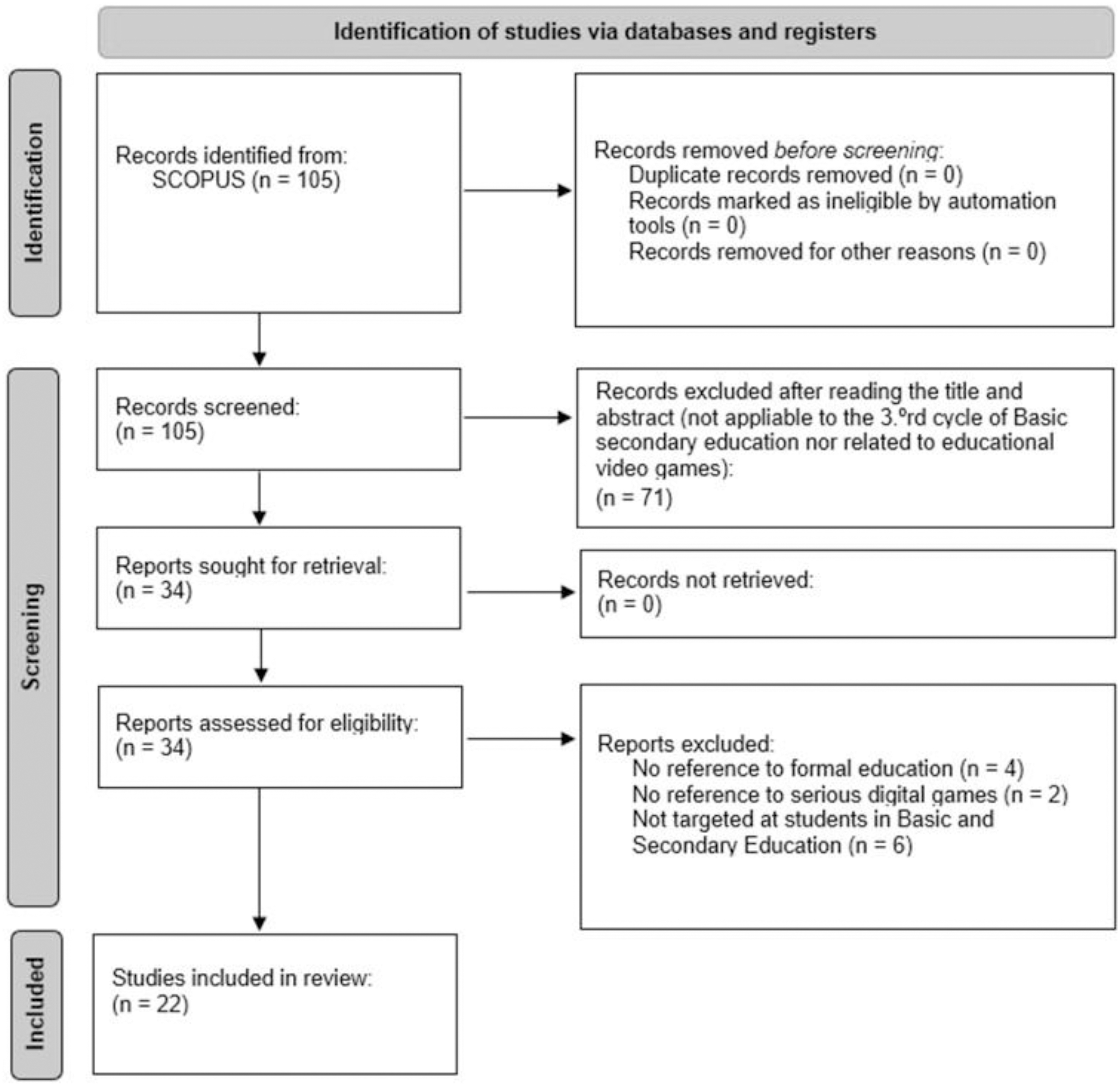
Our search was conducted in December 2023, in the Scopus database. The descriptors included in the search field were: ("video game" OR "game design" OR DGBL) AND (engagement OR flow). The number of articles we initially obtained corresponded to 105. The selected filters refer to the years targeted (2019–2023) and text type ("journal article"). We read the titles and abstracts of the texts to determine their relevance to our study. This process resulted in 34 articles, whose contents were further analyzed, so we could ascertain their alignment with the levels attended by students in secondary education and the themes: formal education, video games, DGBL and engagement. Ultimately, 22 articles were included in our study. We considered articles which, notwithstanding the absence of a clear target audience, present empirical findings on practices applicable to teenage students. In Figure 1, it is possible to confirm the total number of obtained, excluded and used articles.
Preferred Reporting Items for Systematic Reviews and Meta-Analyses (PRISMA) 2020 flow diagram for new systematic reviews.
RESULTS
POPULAR PRACTICES RELATED TO VIDEO GAMES AND DIGITAL GAME-BASED LEARNING ENVIRONMENTS, RELEVANT FOR SECONDARY EDUCATION CONTEXTS
The most popular approaches identified in the studies constituting our corpus1 include gamification, Aprendizagem Baseada em Games (ABG), comparable to DGBL, classroom gamification based on video game design, and the use of mobile games. We analyzed seven articles exclusively related to the use of gamification, in other words, the incorporation into a classroom of "different game design elements (badge, time constraint, clear goals, challenge, playtesting) on varying levels of abstraction" (Franco, 2022, p. 2). In Franco (2022), we see how an English course book can be digitally transformed into a gamified experience. In turn, Studart (2022) describes an instructional design model for video game-centered pedagogical practices.
As for Zhao et al. (2022), they propose an innovative conceptual model, NEWTON-enhanced gamification model (N-EGM), for the integration of digital games in Science, Technology, Engineering and Mathematics (STEM) subjects. On a more general note, Vrcelj, Hoić-Božić and Dlab (2023) present a systematic review reporting the use of a wide variety of digital tools — video games and platforms with video game elements included — in primary and secondary education, designed and implemented in line with the selected subject's content and curricula goals. Likewise, Manzano-León et al. (2021) resort to a systematic review to explore the impact of educational gamification on student motivation and their school performance.
In a study undertaken by Gallego-Durán et al. (2019), the authors describe a rubric that holds potential to effectively create an engaging and effective game design, by analyzing its strengths and weaknesses, while highlighting areas for improvement. Although its target audience corresponds to teachers who wish to acquire initial experience in gamification, with no reference of students’ age or school years, the study highlights the need for gamified experiences to provoke affective responses such as emotional entailment, engagement, and playfulness enabled, a characteristic of sandbox and open-world games, where "players have complete autonomy for developing their own creativity in vast open decision spaces" (Gallego-Durán et al., 2019, p. 10).
Rodrigues, Oliveira and Rodrigues (2019) also explore the connection between gamification and engagement, emphasizing how understanding video games and social games’ popularity and immersiveness allows for a broader definition of gamification. They advocate that the digital and social aspect, transposed into non-game applications, are as important as the game elements themselves.
Concerning serious games and practices which fall into DGBL, we found 15 articles, seven of which related to health education (Themistokleous, Avraamidou and Vrasidas, 2020; Haruna et al., 2021; Nicholas et al., 2022, 2023; Andrew et al., 2023; Guo et al., 2023; Wang et al., 2023). These present goals which range from conveying information about the dangers of drug use, smoking and unhealthy sexual endeavors by adolescents to promoting actions in general leading to a healthy lifestyle. Themistokleous, Avraamidou and Vrasidas (2020) stress the advantages of using mobile games rather than computer games, due to young people's easy access to these devices. On the subject of wellness in the digital world, Wang et al. (2023) seek to tackle the issue of Internet addiction by designing and implementing a digital serious game-course in a middle school. The study foci extend to the effects exerted by DGBL on students’ cyber wellness literacy, motivation and engagement.
In terms of engagement in specific domains of knowledge, Morawski and Wolff-Seidel (2023) present the results from a research project titled "Gaming & Geography", in an attempt to legitimize assigning video games the role of a medium in the didactic discourse of geography. A model for critically analyzing digital space and action in video games emerged from this research project, with an aim to improve rigor in video game use, in the context of geographic education. In turn, aiming to identify effective game-based elements to customize an engaging learning courseware, Harikrishnan et al. (2019) reflect critically on the existing empirical studies on immersive educational technology in the domain of mathematics.
Regarding the four articles focused on video game design we identified, it is worth referring Breien and Wasson (2022), who, following a multidisciplinary approach, propose a model for designing serious video games, in a way that motivates educators to collaborate with programmers in the multidisciplinary design of DGBL narrative environments. Beça et al.'s study (2022) stands out, insomuch as they employ a production-based pedagogy, by assigning youngsters with no experience in game making the task of creating narrative video games, using an original resource, the Gamers4Nature Toolkit. Mohd Tuah, Mohd Nizam and Haslinda Sani (2021), in turn, present a new model of player association to an avatar, based on student engagement and the attention they devote to the experience of playing serious video games. As for Laine and Lindberg (2020), they carry out a systematic review with the goal of creating a taxonomy containing elements of games that favor motivation. Finally, two studies, similarly to Beça et al. (2022), delve into the topic of educational video games and climate change (Ouariachi et al., 2019; Neset et al., 2020), describing engagement as a concept which is easier to understand if broken down into three dimensions — cognitive, emotional and behavioral.
METHODS USED TO MEASURE ENGAGEMENT GENERATED BY DIGITAL GAME-BASED LEANING ENVIRONMENTS
In our corpus there are seven studies which do not employ methods for assessing engagement generated by gamification, with the possibility of including digital elements, or DGBL environments (Harikrishnan et al., 2019; Laine and Lindberg, 2020; Manzano-León et al., 2021; Breien and Wasson, 2022; Franco, 2022; Nicholas et al., 2022; Studart, 2022). Indeed, they either present or reflect on immersive game-based educational technology with no mention of rigorous methods specifically designed to measure its ability to promote learning engagement.
Concerning the studies which include such variable, we have attested the exclusive use or description of a quantitative approach in six out of the 22 articles analyzed. Neset et al. (2020), Haruna et al. (2021), Beça et al. (2022), Wang et al. (2023), administered questionnaires to assess students’ views on the impact of their proposed serious video games and game-making toolkit. Engagement is measured indirectly in the parameters chosen by the authors. For instance, when discussing the results, Beça et al. (2022, p. 139) conclude that "upper-secondary students considered that the toolkit […] provided a good experience when designing the game)."
Gallego-Durán et al. (2019) and Guo et al. (2023) resort to Likert scales to measure the efficiency of gamification and serious video games, as well as their ability to engage students. Whereas Guo et al. (2023) assess engagement explicitly by including items in their scale related to its three components — cognitive, behavioral and emotional engagement — Gallego-Durán et al. (2019) measure engagement implicitly in all of the items of their scale, except for challenge, where the theory of the channel of flow is referred, and emotional entailment, where the connection with learning engagement or flow is more evident. This is due to the common association of engagement to positive emotions triggered by immersive learning experiences.
The number of studies which followed a qualitative approach corresponds to two. Ouariachi et al. (2019) and Themistokleous, Avraamidou and Vrasidas (2020) conducted interviews, targeted at students, teachers or other experts, aimed at gathering data needed for assessing the efficiency of serious video games or proposing a framework that works as a facilitator of serious video game-making (Ouariachi et al., 2019). Student engagement is discussed directly in the first study, unlike in Ouariachi et al. (2019), where it is implied in parameters such as the ability of the game to generate fun, meaningful and experiential-driven learning.
The remaining seven studies either describe or follow a mixed methods approach. Besides Zhao et al. (2022), Morawski and Wolff-Seidel (2023), and Nicholas et al. (2023) administered questionnaires — from students to teachers and vice-versa in Morawski and Wolff-Seidel's (2023) case — complemented by interviews or classroom observation. In turn, Rodrigues, Oliveira and Rodrigues (2019) use a systematic review tool — Leximancer — aimed at ascertaining the relative attractiveness of gamification features, by resorting to longitudinal studies, focus groups, surveys, and user test experiences.
DISCUSSION
On the subject of gamification, with the possibility of including DGBL aspects, the conclusions of the selected authors converge on the idea that there are "several benefits of the use of gamified learning in students such as an improvement in their motivation, engagement, and academic achievement" (Manzano-León et al., 2021, p. 12). This makes it a helpful tool for content learning and formatively assessing students. Notwithstanding, gamification can have a negative result on students who perform poorer, due to competition and an excessive focus on extrinsic motivation (Vrcelj, Hoić-Božić and Dlab, 2023). Teachers’ lack of knowledge about the use of gamification and access to good examples and the lack of physical or verbal interaction among students also constitute obstacles to efficient gamification-based activities. Modern methods, such as collaborative learning and the inverted classroom help ameliorate such difficulty.
As an example of good gamification practices, we stress Studart's proposal (2022), since the author suggests an innovating way of combining analogical with digital elements (video games or aspects of them). To follow this approach, the teacher must transform the classroom into an environment similar to the ones found in Massively Multiplayer Online Role Playing Games (MMORPG), where students are grouped into teams and represented by avatars. They are expected to fulfill missions and challenges, among other tasks (both digital and physical). Their success is rewarded with experience points and stems not only from their performance, but also from their team's.
About the articles discussing serious games and practices which fall into DGBL, it is worth noting that engagement is always mentioned as an essential driving force for learning. This is due to the possibility of associating it with other skills indispensable not only for good school performance, but also for inducing behavioral change. To ensure engagement, practitioners should be mindful of the outcome element — a game-based indicator of significant and essential apprenticeships learners should have acquired at the end of a given course —, as it motivates learners to distinguish and achieve learning goals more easily. As pointed out by Harikrishnan et al. (2019), other important contributors to engagement and performance are opportunities for problem-solving (in correlation with interaction, play, fun and interaction), behavioral-related elements, clear instructions and graphical animations, as well as the representation element (especially when it can be experienced multiple times through replaying a serious video game) and, finally, challenge and conflict.
With regard to the contents informing serious video games, we found that there is a tendency for them to be used in subjects such as health and sciences, as opposed to humanities. As such, we deem it necessary, in future investigations, for teachers and researchers to devote more attention to the use and design of video games dedicated to those subjects’ content. On a positive note, social causes — centered on health, environmental issues, and inclusivity — are increasingly being incorporated into investigations and in-classroom practices related to serious video games. About inclusivity as an educational video game theme, as Andrew et al. (2023) point out, considering the marginalized groups in the design of serious video games, and incorporating in them positive messages, defiant of self-fulfillment prophecies, favors engagement and behavioral modification.
In turn, concerning the articles related to educational video game design, they advocate that educators and researchers should endorse rigorous design practices, concerned with the quality of elements such as gamified items, narrative and thematic relevance, characters, avatars and scenarios, freedom of exploration, autonomy, and control over the game, interactivity and, finally, challenge and feedback. We build on these ideas by stressing that efforts should be invested into analyzing the obstacles inherent to the use of gamification and serious video games, from a critical perspective that steers clear from a technocratic mindset.
On the topic of materials, although supplementing teachers and students with training, tools or extra materials is a recurrent concern and recommendation among authors, we stress that more studies should more comprehensively reflect on many schools’ lack of access to proper equipment, as well as the need for workshops that cultivate good attitudes towards teaching and learning through video games, so as to propose plans to integrate elements of DGBL and digital gamification in settings less favorable to the use of immersive technology.
In terms of target population, we have observed that there are few studies specifically related to the use of gamification and serious video games by secondary education students in formal settings. In this respect, Vrcelj, Hoić-Božić and Dlab (2023, p. 24) recommend that more "research related to the implementation of gamification to provide a broader pedagogical-technological framework for the implementation of gamification in primary and secondary schools" should be conducted, as it prepares students for the increasingly digitally dominated world to which they belong.
Given this, regarding the areas that need to be further investigated, we can infer that it is important to develop more studies on the use and design of serious video games, as well as their ability to meet different subjects’ goals. There is a prevalence of studies that focus on the student as a gamer, rather than a designer, demonstrating that pedagogical actions aimed at creating video games, in an effort to combine production pedagogy and pedagogy of flow, should be implemented more often.
As for the methods employed to measure DGBL engagement and constructs alike, it is possible to understand that many studies, when measuring engagement generated by gamified activities or serious video games, opt for a mainly qualitative or quantitative type of analysis rather than the combination of both. Few studies directly address the impact of serious video games or aspects of them on students’ engagement.
It should be noted, nonetheless, that Nicholas et al. (2022), despite not addressing methods for assessing engagement in the video game they describe, elaborate on the considerations they had made in a previous study (Nicholas et al., 2023), in which the efficacy of the serious video game they described was evaluated by using mixed methods. The focus group interviews targeted at students, which constitutes an attempt to remedy the lack of research based on user preferences, draw on "game design preferences [which] included incorporating social elements and decision-making opportunities" (Nicholas et al., 2023, p. 4). The interviews were combined with user test scales, with engagement being mentioned in some of its parameters.
This is aligned with a recommendation we found in the systematic reviews conducted by Andrew et al. (2023) and Vrcelj, Hoić-Božić and Dlab (2023), in other words, the need to avoid using mainly quantitative or qualitative approaches when researching gamification and serious video games. As Vrcelj, Hoić-Božić and Dlab (2023, p. 24) points out,
mixed methods approach using qualitative and quantitative methods is needed. One possible recommendation for research approach in this area is the Design Based Research (DBR) methodology (Wang & Hannafin, 2005), which emphasizes collaboration between researchers and teachers during iterative analysis, design, development, and implementation.
Similarly, Mohd Tuah, Mohd Nizam and Haslinda Sani (2021) emphasize that mixed methods should be used rather than the single use of questionnaires in order to properly measure learning engagement generated by serious video games. Indeed, preferring mixed methods to other approaches allows for a more accurate vision on both teachers and students’ representations and feelings towards immersive educational technology, while contributing to the ongoing improvement of materials and practices integrated in that domain. Triangulating evidence from difference sources results in a more comprehensive analysis, which is susceptible to generalization. Moreover, mixed methods favor a formative type of assessment, more concerned with providing results that serve as continuous feedback and progress, ensured by the possibility of practitioners solving problems in real time, other than outcomes specific to a certain time and context.
We concede, notwithstanding, that not all studies analyzed here present engagement as its main theme, so we cannot evaluate its risk of bias by verifying whether they describe scientific methods focused on measuring this variable. Still, despite the presence of qualitative and quantitative research in our corpus, which we cannot fail to recognize, the rigorous assessment of educational video games-related engagement could benefit of a more direct use of mixed methods aimed at determining students’ feelings and opinions regarding the quality of serious video games. As such, we conclude that there are studies, with regard to their assertions on engagement, which may present a risk of bias. Nevertheless, they are still scientifically sound, as they were peer-reviewed and based on the works of well-established authors (e.g., Prensky, 2001; Deterding et al., 2011).
FINAL REMARKS
In conclusion, it is worth noting that studies on practices related to gamification and DGBL have been significantly growing, mirroring practitioners and researchers’ concern with ensuring that learning environments are digitally prepared to attend to Gen-Z students’ educational needs. By answering the questions "What practices related to video games and DGBL environments, relevant for secondary education contexts, are the most popular in recent research? Which areas need to be further investigated?", we have concluded that the gamification of didactic resources, the use of serious video games, and their collaborative design correspond to the most common themes in research, especially in STEM fields. When addressing their potential, authors agree that serious video games, especially when they result from rigorous multidisciplinary design practices, are useful pedagogical resources, fostering student engagement due to their immersive properties, which are ultimately favorable to the development of different literacies.
There still prevails, however, the need for more investigation regarding the design of serious video games by students in areas such as arts and humanities. It is also evident that studies tend to highlight the advantages of immersive DGBL environments, without comprehensively reflecting on the difficulties underlying its implementation. Avoiding technocratic thinking by understanding that the efficiency of immersive technology depends on schools’ access to quality equipment, students and teachers’ knowledge and receptivity towards learning about DGBL, as well as the latter's ability to properly frame DGBL into activities aligned with subjects’ curricula and students’ learning goals, is one of our main recommendations.
In terms of our second question, "What methods are being used to measure engagement generated by practices focused on serious video games? How rigorously," we have observed that a mixed-methods approach, although attestable, should be employed more often, with an aim to efficiently and directly measure affective variables related to serious video games or aspects of them. In line with the studies analyzed, we recommend that they place the emphasis on teachers and students’ feelings and opinions regarding its elements’ quality.
Finally, as a limitation, our analysis includes articles which draw on engagement generated by gamification and serious video games, without having chosen it as its main theme. As a result, it is possible that the weaknesses we have identified in them may not be fully representative of literature specifically devoted to exploring such concepts. Subsequent research should narrow the articles’ content to serious video game engagement or flow in order to provide for a broader understanding of this topic.
-
1
A table presenting the information in which we based our analysis can be found in Appendix 1.
-
Funding:
Fundação para a Ciência e a Tecnologia, I.P., under the CIDTFF R&D Unit, with the reference UID/00194/2025, https://doi.org/10.54499/UID/00194/2025, and the grant no. 2024.03157.BD.
Data availability statement:
The research data is available at https://shorturl.at/zvw2i.
REFERENCES
-
ACOSTA-MEDINA, Julieth Katherin; TORRES-BARRETO, Martha Liliana; CÁRDENAS-PARGA, Andrés Felipe. Students’ preference for the use of gamification in virtual learning environments. Australasian Journal of Educational Technology, Australia, v. 37, n. 4, p. 145-158, 2021. https://doi.org/10.14742/ajet.6512
» https://doi.org/10.14742/ajet.6512 -
ADIPAT, Surattana; LAKSANA, Kittisak; BUSAYANON, Kanrawee; AUSAWASOWAN, Alongkorn; ADIPAT, Boonlit. Engaging students in the learning process with game-based learning: the fundamental concepts. International Journal of Technology in Education, Germany, v. 4, n. 3, p. 542-552, 2021. https://doi.org/10.46328/ijte.169
» https://doi.org/10.46328/ijte.169 -
ANDREW, Lesley; BARWOOD, Donna; BOSTON, Julie; MASEK, Martin; BLOOMFIELD, Lauren; DEVINE, Amanda. Serious games for health promotion in adolescents – a systematic scoping review. Education and Information Technologies, Netherlands, v. 28, p. 5519-5550, 2023. https://doi.org/10.1007/s10639-022-11414-9
» https://doi.org/10.1007/s10639-022-11414-9 -
BEÇA, Pedro; ARESTA, Mónica; SANTOS, Rita; VELOSO, Ana Isabel; GOMES, Gonçalo. Students as game creators: easing the game construction process by using a toolkit to game design. Interaction Design and Architecture(s) Journal, Italy, v. 53, p. 128-143, 2022. https://doi.org/10.55612/s-5002-053-006
» https://doi.org/10.55612/s-5002-053-006 -
BREIEN, Fredrik S.; WASSON, Barbara. Narrative categorization in digital game-based learning: Engagement motivation and learning. British Journal of Educational Technology, United Kingdom, v. 52, n. 1, p. 91-111, 2020. https://doi.org/10.1111/bjet.13004
» https://doi.org/10.1111/bjet.13004 -
BREIEN, Fredrik S.; WASSON, Barbara. eLuna: a co-design framework for narrative digital game-based learning that support STEAM. Frontiers in Education, Switzerland, v. 6, 775746, 2022. https://doi.org/10.3389/feduc.2021.775746
» https://doi.org/10.3389/feduc.2021.775746 - BROWN, Harry J. Videogames and education London: Routledge, 2014.
- CAMINGUE, Janelynn; MELCER, Edward; CARSTENSDOTTIR, Elin. A (visual) novel route to learning: a taxonomy of teaching strategies in visual novels. In: INTERNATIONAL CONFERENCE ON THE FOUNDATIONS OF DIGITAL GAMES, 20., 2020, Malta. Proceedings […] Malta: ACM, 2020. p. 1-15.
-
COELHO, Fernando Pereira; FONSECA, Jaiany Da Silva Gomes; ALENCAR, Fernanda Cavalcante de; VIEIRA, Maria do Socorro Tavares Cavalcante. Criação de visual novels com contexto educacional. Revista Semiárido De Visu, Sertão Pernambucano, v. 8, n. 2, p. 300-309, 2020. https://doi.org/10.31416/rsdv.v8i2.61
» https://doi.org/10.31416/rsdv.v8i2.61 -
CSIKSZENTMIHALYI, Mihaly. Flow: the psychology of optimal experience. 1990. Available at: https://www.researchgate.net/publication/224927532 Accessed in: Jan. 2024.
» https://www.researchgate.net/publication/224927532 -
DETERDING, Sebastian; DIXON, Dan; KHALED, Rilla; NACKE, Lennart. From game design elements to gamefulness: Defining "gamification". In: INTERNATIONAL ACADEMIC MINDTREK CONFERENCE: ENVISIONING FUTURE MEDIA ENVIRONMENTS, 15., 2011. Proceedings […]. Finland: ACM, 2011. p. 9-15. https://doi.org/10.1145/2181037.2181040
» https://doi.org/10.1145/2181037.2181040 -
DIMITRA, Kirstavridou; KONSTANTINOS, Kousaris; CHRISTINA, Zafeiriou; KATERINA, Tzafilkou. Types of game-based learning in education: a brief state of the art and the implementation in Greece. The European Educational Researcher, United Kingdom, v. 3, n. 2, p. 87-100, 2020. https://doi.org/10.31757/euer.324
» https://doi.org/10.31757/euer.324 -
FABER, Tjitske J. E.; DANKBAAR, Mary E. W.; KICKERT, Rob; VAN DEN BROEK, Walter W.; VAN MERRIËNBOER, Jeroen J. G. Identifying indicators to guide adaptive scaffolding in games. Learning and Instruction, Belgium, v. 83, p. 101666, 2023. https://doi.org/10.1016/j.learninstruc.2022.101666
» https://doi.org/10.1016/j.learninstruc.2022.101666 -
FRANCO, Claudio de Paiva. Gamification in a textbook for Brazilian learners of English. Brazilian English Language Teaching Journal, Canada, v. 13, n. 1, e41062, 2022. https://doi.org/10.15448/2178-3640.2022.1.41062
» https://doi.org/10.15448/2178-3640.2022.1.41062 -
GALLEGO-DURÁN, Francisco J.; VILLAGRÁ-ARNEDO, Carlos J.; SATORRE-CUERDA, Rosana; COMPAÑ-ROSIQUE, Patricia; MOLINA-CARMONA, Rafael; LLORENS-LARGO, Faraón. A guide for game-design-based gamification. Informatics, Switzerland, v. 6, n. 4, p. 49, 2019. https://doi.org/10.3390/informatics6040049
» https://doi.org/10.3390/informatics6040049 -
GLESSNER, Marci; OLUFEMI, Daniel. Pedagogy of flow. In: PETERS, M. (ed.). Encyclopedia of teacher education Singapore: Springer, 2019. p. 1-3. https://doi.org/10.1007/978-981-13-1179-6_295-1
» https://doi.org/10.1007/978-981-13-1179-6_295-1 -
GUO, Jong-Long; HSU, Hsiao-Pei; LIN, Mei-Hsun; LIN, Cheng-Yu; HUANG, Chiu-Mieh. Testing the usability of digital educational games for encouraging smoking cessation. International Journal of Environmental Research and Public Health Article, Switzerland, v. 17, n. 8, p. 2695, 2023. https://doi.org/10.3390/ijerph17082695
» https://doi.org/10.3390/ijerph17082695 -
HARIKRISHNAN, Hemanathan; HALIM, Noor D. Abd; HARUN, Jamalludin; ARJUNAN, Shalini. Exploring the digital game-based elements in mathematics education: A meta-analysis review. Universal Journal of Educational Research, United States of America, v. 7, A9, p. 106-116, 2019. https://doi.org/10.13189/ujer.2019.071613
» https://doi.org/10.13189/ujer.2019.071613 -
HARUNA, Hussein; HU, Xiao; CHU, Samuel K. W.; MELLECKER, Robin R. Initial validation of the MAKE framework: a comprehensive instrument for evaluating the efficacy of game-based learning and gamification in adolescent sexual health literacy. Annals of Global Health, California, 2021. Available at: https://annalsofglobalhealth.org/articles/10.5334/aogh.1110 Accessed in: Jan. 2024.
» https://annalsofglobalhealth.org/articles/10.5334/aogh.1110 - HARVEY, Miles Madison; PENCE, Lucretia E. P. Creating a classroom affinity space with video games and virtual reality as literature. In: DALLACQUA, Ashley K.; RICE, Mary F. (ed.). Luminous literacies United Kingdom: Emerald, 2021.
-
HÖYNG, Mona. Encouraging gameful experience in digital game-based learning: A double-mediation model of perceived instructional support, group engagement, and flow. Computers and Education, United Kingdom, v. 179, 104408, 2022. https://doi.org/10.1016/j.compedu.2021.104408
» https://doi.org/10.1016/j.compedu.2021.104408 - HUIZINGA, Johan. Homo Ludens: a study of the play-element in culture. Brooklyn: Angelico Press, 2016.
-
LAINE, Teemu H.; LINDBERG, Renny S. N. Designing engaging games for education: a systematic literature review on game motivators and design principles. IEEE Transactions on Learning Technologies, New York, v. 13, n. 4, p. 804-821, 2020. https://doi.org/10.1109/TLT.2020.3018503
» https://doi.org/10.1109/TLT.2020.3018503 -
MAGANA, Alejandra J.; HWANG, Jisoo; FENG, Shi; REBELLO, Sanjay; ZU, Tianlong; KAO, Dominic. Emotional and cognitive effects of learning with computer simulations and computer videogames. Journal of Computer Assisted Learning, New York, v. 38, n. 3, p. 875-891, 2022. https://doi.org/10.1111/jcal.12654
» https://doi.org/10.1111/jcal.12654 -
MANZANO-LEÓN, Ana; CAMACHO-LAZARRAGA, Pablo; GUERRERO, Miguel A.; GUERRERO-PUERTA, Laura; AGUILAR-PARRA, José M.; TRIGUEROS, Rubén; ALIAS, Antonio. Between level up and game over: A systematic literature review of gamification in education. Sustainability, Switzerland, v. 13, n. 4, p. 2247, 2021. https://doi.org/10.3390/su13042247
» https://doi.org/10.3390/su13042247 -
MARLATT, Rick; PANDO, Magdalena; HARVEY, Miles M. This is next level: combining video games with literature to promote literacy. In: MORAN, Clarice (ed.). Affordances and constraints of mobile phone use in English language arts classrooms Pennsylvania: IGI Global, 2020. p. 1-21. https://doi.org/10.4018/978-1-7998-5805-8.ch001
» https://doi.org/10.4018/978-1-7998-5805-8.ch001 -
MICHAILIDIS, Lazaros; BALAGUER-BALLESTER, Emili; HE, Xun. Flow and immersion in video games: the aftermath of a conceptual challenge. Frontiers in Psychology, v. 9, n. SEP, p. 1682, 2018. https://doi.org/10.3389/fpsyg.2018.01682
» https://doi.org/10.3389/fpsyg.2018.01682 -
MOHD TUAH, Nooralisa; MOHD NIZAM, Nina; HASLINDA SANI, Zaidatol A. Modelling the player and avatar attachment based on student's engagement and attention in educational games. International Journal of Advanced Computer Science and Applications, United Kingdom, v. 12, n. 7, 2021. https://doi.org/10.14569/IJACSA.2021.0120740
» https://doi.org/10.14569/IJACSA.2021.0120740 -
MOHR, Kathleen A. J.; MOHR, Eric S. Understanding generation Z students to promote a contemporary learning environment. Journal on Empowering Teaching Excellence, Utah, v. 1, n. 1, article 9, 2017. https://doi.org/10.15142/T3M05T
» https://doi.org/10.15142/T3M05T -
MORAWSKI, Michael; WOLFF-SEIDEL, Sebastian. Gaming & geography (education): a model of reflexive analysis of space & action in video games. European Journal of Geography, Brussels, v. 14, n. 3, p. 1-19, 2023. https://doi.org/10.48088/ejg.m.mor.14.3.001.019
» https://doi.org/10.48088/ejg.m.mor.14.3.001.019 -
NASH, Brady L.; BRADY, Randi Beth. Video games in the secondary English language arts classroom: a state-of-the-art review of the literature. Reading Research Quarterly, New Jersey, v. 57, n. 3, p. 957-981, 2022. https://doi.org/10.1002/rrq.454
» https://doi.org/10.1002/rrq.454 -
NESET, Tina-Simone; ANDERSSON, Lotta; UHRQVIST, Ola; NAVARRA, Carlo. Serious gaming for climate adaptation—assessing the potential and challenges of a digital serious game for urban climate adaptation. Sustainability, Switzerland, v. 12, n. 5, p. 1789, 2020. https://doi.org/10.3390/su12051789
» https://doi.org/10.3390/su12051789 -
NICHOLAS, Joanna; MILLS, Brennen; HANSEN, Sara; BRIGHT, Stephen J.; BOYD, Heather; BROOK, Luke; WATSON, Jess; HOPPER, Luke. Developing an alcohol and other drug serious game for adolescents: considerations for improving student engagement. Australian and New Zealand Journal of Public Health, New Zealand, v. 46, n. 5, p. 682-688, 2022. https://doi.org/10.1111/1753-6405.13287
» https://doi.org/10.1111/1753-6405.13287 -
NICHOLAS, Joanna; MILLS, Brennen; HANSEN, Sara; BRIGHT, Stephen J.; SCOTT, Joseph; RIDOUT, Imogen; WATSON, Jess; BOYD, Heather; BROOK, Luke; HOPPER, Luke. Sideffect GamePlan: Development of an alcohol and other drug serious game for high school students using a systematic and iterative user-centred game development framework. Computers in Human Behavior, Amsterdam, v. 145, 107774, 2023. https://doi.org/10.1016/j.chb.2023.107774
» https://doi.org/10.1016/j.chb.2023.107774 - NORMAN, Donald. Emotional design: why we love (or hate) everyday things. New York: Basic Books, 2004.
-
OKOLI, Chitu. A Guide to Conducting a standalone systematic literature review. Communications of the Association for Information Systems, United States of America, v. 37, 2015. https://doi.org/10.17705/1CAIS.03743
» https://doi.org/10.17705/1CAIS.03743 -
OUARIACHI, Tania; OLVERA-LOBO, María Dolores; GUTIÉRREZ-PÉREZ, José; MAIBACH, Edward. A framework for climate change engagement through video games. Environmental Education Research, London, v. 25, n. 5, p. 701-716, 2019. https://doi.org/10.1080/13504622.2018.1545156
» https://doi.org/10.1080/13504622.2018.1545156 -
ØYGARDSLIA, Kristine; WEITZE, Charlotte L.; SHIN, Jh. The educational potential of visual novel games: principles for design investigating the potential of gameful design for enhancing student engagement and motivation in the collaborative writing process using Google Docs. In: REPLAYING JAPAN. 2020. v. 2. Available in: https://www.researchgate.net/publication/341380379 Accessed in: Jan. 2024.
» https://www.researchgate.net/publication/341380379 -
PAGE, Matthew J.; MCKENZIE, Joanne E.; BOSSUYT, Patrick M.; BOUTRON, Isabelle; HOFFMANN, Tammy C.; MULROW, Cynthia D.; MOHER, David. The PRISMA 2020 statement: an updated guideline for reporting systematic reviews. BMJ, United Kingdom, v. 71, p. 372, 2021. https://doi.org/10.1136/bmj.n71
» https://doi.org/10.1136/bmj.n71 - PRENSKY, Marc. Digital game-based learning the games generations: how learners have changed. New York: McGraw-Hill, 2001.
-
PRENSKY, Marc. Students as designers and creators of educational computer games who else? British Journal of Educational Technology, United Kingdom, v. 39, n. 6, p. 1004-1019, 2007. https://doi.org/10.1111/j.1467-8535.2008.00823_2.x
» https://doi.org/10.1111/j.1467-8535.2008.00823_2.x -
RODRIGUES, Luís Filipe; OLIVEIRA, Abílio; RODRIGUES, Helena. Main gamification concepts: A systematic mapping study. Heliyon, United States of Amerca, v. 5, n. 7, e01993, 2019. https://doi.org/10.1016/j.heliyon.2019.e01993
» https://doi.org/10.1016/j.heliyon.2019.e01993 -
SEEMILLER, Corey; GRACE, Meghan. Generation Z: educating and engaging the next generation of students. About Campus: Enriching the Student Learning Experience, United States of America, v. 22, n. 3, p. 21-26, 2017. https://doi.org/10.1002/abc.21293
» https://doi.org/10.1002/abc.21293 - SHABALINA, Olga; MOZELIUS, Peter; MALLIARAKIS, Christos; TOMOS, Florica. Combining game-flow and learning objectives in educational games. In: EUROPEAN CONFERENCE ON GAMES BASED LEARNING, 8., 2014, Berlin. Proceedings […]. Berlin: ECGBL, 2014. v. 2. p. 529-537.
-
SILVA, Cláudia Eugénia; MIGUÉIS, Marlene da Rocha. Revisão da literatura PRISMA sobre o impacto do uso e design de videojogos educativos no envolvimento do aluno na aprendizagem. Indagatio Didactica, Aveiro, v. 15, n. 3, p. 89-108, 2023. https://doi.org/10.34624/id.v15i3.31412
» https://doi.org/10.34624/id.v15i3.31412 -
STUDART, Nelson. Gamification as a design instructional. Revista Brasileira de Ensino de Física, Brasil, v. 44, e20210362, 2022. https://doi.org/10.1590/1806-9126-RBEF-2021-0362
» https://doi.org/10.1590/1806-9126-RBEF-2021-0362 -
THEMISTOKLEOUS, Sotiris; AVRAAMIDOU, Lucy; VRASIDAS, Charalambos. Mobile games for negotiated-play and decision-making in health literacy. Eurasia Journal of Mathematics, Science and Technology Education, United Kingdom, v. 16, n. 9, em1873, 2020. https://doi.org/10.29333/EJMSTE/8352
» https://doi.org/10.29333/EJMSTE/8352 -
THUMLERT, Kurt; CASTELL, Suzanne; JENSON, Jennifer. Learning through game design: a production pedagogy. In: EUROPEAN CONFERENCE ON GAME-BASED LEARNING, 12., 2018. Proceedings […]. Berlin: ACPI, 2018. Available at: https://www.researchgate.net/publication/329842518 Accessed in: Jan. 2024.
» https://www.researchgate.net/publication/329842518 -
VRCELJ, Ana; HOIĆ-BOŽIĆ, Natasa; DLAB, Martina H. Use of gamification in primary and secondary education: a systematic literature review. International Journal of Educational Methodology, United Kingdom, v. 9, n. 1, p. 13-27, 2023. https://doi.org/10.12973/ijem.9.1.13
» https://doi.org/10.12973/ijem.9.1.13 -
WANG, Ke; LIU, Panpan; ZHANG, Junyi; ZHONG, Jinping; LUO, Xianfei; HUANG, Jingxiu; ZHENG, Yunxiang. Effects of digital game-based learning on students’ cyber wellness literacy, learning motivations, and engagement. Sustainability, Switzerland, v. 15, n. 7, p. 5716, 2023. https://doi.org/10.3390/su15075716
» https://doi.org/10.3390/su15075716 - ZAKY, Hany. Digital literacy for adult education beyond borders: developing learners’ intercultural sensitivity using game-based learning. In: SHAPING ONLINE SPACES THROUGH ONLINE HUMANITIES CURRICULA. Pennsylvania: IGI Global, 2022. p. 115-149.
-
ZAWACKI-RICHTER, Olaf; KERRES, Michael; BEDENLIER, Svenja; BOND, Melissa; BUNTINS, Katja. Systematic reviews in educational research Wiesbaden: Springer VS, 2019. https://doi.org/10.1007/978-3-658-27602-7
» https://doi.org/10.1007/978-3-658-27602-7 -
ZHAO, Dan; PLAYFOOT, Jim; NICOLA, Carmine de; GUARINO, Giuseppe; BRATU, Marilena; SALVADORE, Fabio di. An innovative multi-layer gamification framework for improved STEM learning experience. IEEE Accessed, United States of America, v. 10, p. 3879-3889, 2022. https://doi.org/10.1109/ACCESSED.2021.3139729
» https://doi.org/10.1109/ACCESSED.2021.3139729
Edited by
-
Responsible Editor:
Décio Gatti Júnior https://orcid.org/0000-0002-5876-6733

 Source: