| EC (Doudin and Curchod-Ruedi, 2010) |
(Fiorilli et al., 2017) (PR)
|
Social support -[burnout]-> SEC in teachers: less SEC, more dissatisfaction with social support in face of higher levels of burnout.
https://doi.org/10.1080/00313831.2015.1119722
|
| SEC (Bisquerra Alzina and Péres-Escoda, 2007) |
(Morente et al., 2017) (A)
|
SEC predicts self-esteem, performance, social climate in the classroom and anxiety. Self-esteem predicts performance.
https://doi.org/10.5944/reop.vol.28.num.1.2017.19355
|
| (Sánchez Calleja, Rodríguez Gómez and García Jiménez, 2018) * (A)
|
SEC (>) in the post-training observations, supported by the interviews. Effective training for SEC.
https://doi.org/10.5209/RCED.54402
|
| (Rodríguez-Ledo et al., 2018) * (PR) (A)
|
SEC without differences; EI (>), empathy (>), social adjustment (>) post-intervention in EG. Effective training for EI and preventive effect regarding SEC decline.
https://doi.org/10.25115/ejrep.v16i46.2241
|
| (Márquez-Cervantes and Gaeta-González, 2018) (PR) (A) (PA)
|
SEC (+) decision-making. Parents work more on: emotional awareness, collaborative work with school, emotional regulation and control. Teachers: awareness, decision-making, communication and discipline.
https://doi.org/10.15359/ree.22-1.9
|
| (Fernández-García and Fernández-Río, 2019) (A) (t)
|
The WonderWall project aims to develop emotional awareness followed by emotional regulation. It consists of a wall for students to identify their emotions or ask questions.
https://doi.org/10.47197/retos.v0i35.63259
|
| SEC (SEL) |
(Lee, Yang and Zuilkowski, 2019) (PR)
|
Adaptation with similar distribution of items in 3 factors on social emotional learning (SEL).
https://doi.org/10.1111/bjep.12247
|
| (Portnow, Downer and Brown, 2018) * (PR) (A)
|
SEC and an emotionally supportive environment predicted significant reductions in aggression and behavior problems.
https://doi.org/10.1016/j.jsp.2017.12.004
|
| SS (Social Competence) |
(Morrow, Hubbard and Sharp, 2019) (PR) (A)
|
Victimization predicts significant reductions in social skills. Victimization -[aggressiveness]-> social competence.
https://doi.org/10.1080/15374416.2017.1416618
|
| SS (Del Prette and Del Prette, 2005) |
(Cintra and Del Prette, 2019) * (PR)
|
Post-intervention SS (>) and knowledge about SS (>). Teacher characteristics (+) outcome and process variables. Effective training for SS.
https://doi.org/10.1590/1413-82712019240409
|
| (Da Silva et al., 2018) * (A)
|
Bullying (<) in the EG and CG, SS (>) in EG post-intervention and follow-up. Effective training for SS.
https://doi.org/10.1590/0034-7167-2017-0151
|
| (Jovarini et al., 2018) (A)
|
SS (+) academic results (grades). SS (-) stress. The variability in academic results could be explained by the triad of stress, the student role, and SS.
https://doi.org/10.1590/1982-4327e2819
|
| SS (Elliott and Gresham, 2007) |
(Wollersheim Shervey et al., 2017) * ** (PR)
|
The program showed social validity, teachers considered it relevant and easy to apply, but those in the 1st year reduced this perception over the course of the study, while those in the second year increased it.
https://doi.org/10.1037/spq0000203
|
| SS (Gutiérrez-Marín et al., 2017) |
(Gil-Madrona et al., 2019) * (A)
|
Post-intervention SS and behaviors related to physical activity (>). SS gender and age: (↑) girls and younger students. Effective training for SS.
https://doi.org/10.3389/fpsyg.2019.01998
|
| (Navarro-Patón et al., 2019) * (A)
|
Post-intervention SS (>), girls (+) SS. Effective intervention for SS.
https://doi.org/10.6018/sportk.401081
|
| SS (Gutman and Schoon, 2013) |
(Siddiqui and Ventista, 2018) (A)(t)
|
Ten training programs were found in the articles reviewed. The inclusion of parents and CG was associated with higher quality and more reliable results. "Sense of community" and "feelings" were the most common SS.
https://doi.org/10.1016/j.ijer.2018.06.003
|
| SS (Ladd, Herald-Brown, and Andrews, 2009) |
(Miller et al., 2017) * (PR) (A)
|
Post-intervention connection with school and performance (grades) (>). No significant effect on social behaviors. Effective training.
https://doi.org/10.1016/j.jsp.2017.01.002
|
| SS (Monjas, 2012) |
(Cañabate et al., 2018) * (A)
|
Post-intervention positive emotions (>). Smaller groups (+) positive emotions. No significant differences for SS. Training not effective for SS.
https://doi.org/10.3390/su10051585
|
| SS (unidentified) |
(Nelson et al., 2018) * (PR) (A)
|
Post-intervention appropriate classroom behavior (>), praise from the teacher (>), reprimands (<). Effective training for SS.
https://doi.org/10.1177/1098300718762744
|
| (Prino et al., 2018) (PR) (A)
|
Six clusters established based on popularity and pro-social behavior. All (+) conflicts in the teacher-student relationship. Clusters predictive of some pro-social behaviors.
https://doi.org/10.3389/fpsyg.2018.01421
|
| (Tillman and Prazak, 2019) * (PR) (A) (PA)
|
Post-intervention SS (>). More SS and positive emotions reported, fewer negative reactions to post-intervention social situations. Effective training for SS.
https://doi.org/10.1002/capr.12213
|
| EI (skills) |
(Valenzuela-Santoyo and Portillo-Peñuelas, 2018) (A)
|
EI -(+)-> students’ academic performance
https://doi.org/10.15359/ree.22-3.11
|
| (Postigo-Zegarra et al., 2019) * (A)
|
Report of more SEC, pro-social, cooperation, awareness of influencers of decision-making post-training. SEC (>), positive affect (>), aggression (<) post-training. Effective training to develop SEC.
https://doi.org/10.1080/02103702.2019.1578925
|
| EI (Multiple Intelligences) |
(Rebollo Goñi, 2017) * (A)
|
EI (-) errors made in the tasks (executive functions). EI gender (↑) girls. Executive functions gender (↑) boys.
https://doi.org/10.30827/Digibug.44253
|
| EI (traits) |
(Alharbi, 2018) (A)
|
EI predictors: student's age, living with both parents, parents’ educational level, mother working, father's working conditions (+), frequency of school failures and physical health problems (-).
https://doi.org/10.15537/smj.2018.6.22141
|
| (Cejudo, 2017) * (A)
|
EI, adaptive skills, academic performance and positive affect (>), behavioral symptoms (<) in the EG post-intervention. Effective training for IE.
https://doi.org/10.1080/02103702.2017.1341099
|
| (Luna, Guerrero and Cejudo, 2019) * (A)
|
Negative affect (<) and EI (>) in the EG post-intervention. Effective training for IE.
https://doi.org/10.3390/ijerph16101821
|
| (Susanto, Asmi Rozali and Agustina, 2019) (PR)
|
EI is part of the proposed model of pedagogical competence and correlates positively with it.
https://doi.org/10.13189/ujer.2019.071010
|
| (Amado-Alonso et al., 2019) (A)
|
EI (>) in those who play sports, girls and younger students.
https://doi.org/10.3390/su11061615
|
| (Alonso Ferres et al., 2018) (A)
|
EI (+) family income, number of books in the house, not as family climate.
https://doi.org/10.6018/rie.36.1.281441
|
| (García et al., 2018) * ** (A)
|
Post-intervention EI, academic performance (grade), communication (>), disrespect toward peers and teachers (<). Effective training for IE.
https://dialnet.unirioja.es/servlet/articulo?codigo=7146581
|

 Social and emotional competencies in elementary school: a systematic review
 Thumbnail
 Thumbnail
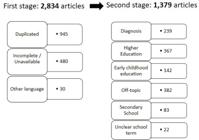
 Source: research data (2021).
 Source: research data (2021).