 Assessment of digital health literacy among undergraduate health students using the eHEALS-Br
ABSTRACT
Introduction: Digital health literacy has become an essential competency in health professional education due to the rapid digitalization of health information, increased use of technology in clinical practice, and growing exposure to online misinformation. Despite this context, national studies assessing digital health literacy among undergraduate health students and associated factors remain limited.
Objective: To assess the level of digital health literacy among undergraduate health students using the Brazilian version of the eHealth Literacy Scale (eHEALS-Br) and to investigate associated sociodemographic factors.
Methods: A cross-sectional, observational study with a quantitative approach was conducted with 91 undergraduate students from Biomedicine, Nursing, Pharmacy, Medicine, and Psychology programs at a private higher education institution in southern Brazil. Data were collected through an online questionnaire including sociodemographic variables and the eHEALS-Br. Descriptive statistics, univariate analyses, multiple linear regression, and Principal Component Analysis (PCA) were performed.
Results: Participants had a mean age of 22 ± 4 years, with a predominance of females (83.5%). The mean overall eHEALS-Br score was 32.66 ± 4.54. According to national cutoff points, 52.7% of students presented a high level of digital health literacy, 42.9% a moderate level, and 4.4% a low level. Multiple linear regression identified proficiency in a second language (β = 2.17; p = 0.043) and receipt of a scholarship (β = 1.81; p = 0.061) as independent predictors of the score. PCA revealed two main dimensions while preserving the scale’s unidimensional structure. The lowest mean scores were observed for confidence in using online health information for decision-making.
Conclusion: Students perceive themselves as having high digital health literacy, particularly in accessing and evaluating online information; however, uncertainty remains regarding its practical application. Second-language proficiency and institutional financial support appear to facilitate digital health competencies, suggesting that curricular internationalization and equity-oriented educational policies may enhance digital health literacy in undergraduate health education.
Keywords:
Health literacy; Computer Literacy; Health education
RESUMO
Introdução: O letramento digital em saúde tornou-se uma competência essencial na formação de profissionais da saúde, diante da crescente digitalização do acesso à informação, da incorporação de tecnologias na prática clínica e do aumento da exposição à desinformação on-line. Apesar desse cenário, ainda são escassos os estudos nacionais que avaliam o nível dessa competência entre estudantes de graduação da área da saúde e os fatores associados.
Objetivo: Este estudo teve como objetivos avaliar o nível de letramento digital em saúde de estudantes de graduação da área da saúde utilizando a versão brasileira da eHealth Literacy Scale (eHEALS-Br) e investigar a associação com variáveis sociodemográficas.
Método: Trata-se de um estudo observacional, transversal, de abordagem quantitativa, realizado com 91 estudantes dos cursos de Biomedicina, Enfermagem, Farmácia, Medicina e Psicologia de uma instituição privada do Sul do Brasil. Os dados foram coletados por meio de questionário on-line contendo informações sociodemográficas e a eHEALS-Br. Realizaram-se análises estatísticas descritivas, testes univariados, regressão linear múltipla e análise de componentes principais (PCA).
Resultado: A amostra apresentou idade média de 22 ± 4 anos, com predominância do sexo feminino (83,5%). O escore médio global da eHEALS-Br foi de 32,66 ± 4,54 pontos. De acordo com pontos de corte nacionais, 52,7% dos estudantes apresentaram nível alto de letramento digital em saúde; 42,9%, moderado; e 4,4%, baixo. A regressão linear múltipla identificou o domínio de uma segunda língua (β = 2,17; p = 0,043) e o recebimento de bolsa de estudos (β = 1,81; p = 0,061) como preditores independentes do escore. A PCA revelou duas dimensões principais, preservando a estrutura unidimensional do instrumento. O item relacionado à confiança para uso das informações on-line na tomada de decisão apresentou a menor média.
Conclusão: Os estudantes demonstram elevado letramento digital em saúde para localizar e avaliar informações on-line, porém persistem incertezas quanto à aplicação prática dessas informações. O domínio de outra língua e o apoio institucional emergem como fatores facilitadores, indicando que estratégias de internacionalização curricular e políticas de equidade podem fortalecer competências digitais em saúde na graduação.
Palavras-chave:
Letramento em Saúde; Alfabetização Digital; Educação em Saúde
INTRODUCTION
In recent years, access to health information has rapidly shifted to digital platforms, driven by the widespread use of the internet and new communication technologies. This change has expanded the range of resources available to patients and healthcare professionals, but it has also highlighted the need for these users to be able to locate, interpret and critically evaluate online content - a skill known as eHealth literacy. The World Health Organisation points out that inadequate levels of this competency can compromise clinical decision-making and adherence to treatment, particularly among individuals with lower levels of education, income or technological literacy.
Various tools have been developed to measure this construct; among them, the eHealth Literacy Scale (eHEALS)1 has established itself as the most widely used internationally, the scale assesses people’s perceptions of their ability to seek and use health information online and has already been adapted and validated for the Brazilian context (eHEALS-Br)2. Despite the increasing digitalisation of health education, few studies have investigated the level of digital health literacy among undergraduate students in Brazil and the associated sociodemographic factors. This gap makes it difficult to align curriculum guidelines with teaching practice. This article therefore seeks to answer the question: “What is the level of eHealth literacy among undergraduate students in the health sector, and which sociodemographic factors influence this competency?”
METHOD
Type of study
A quantitative, observational, cross-sectional and descriptive-analytical study.
Purpose
To assess the level of digital health literacy among students on healthcare courses at a higher education institution in the state of Paraná, Brazil.
Study participants
The study involved 91 student volunteers from the Biomedicine, Nursing, Pharmacy, Medicine and Psychology programmes, all of whom were currently enrolled at a private university. The inclusion criteria were age 18 or over, active enrolment in any term of the courses mentioned, and access to the internet. There were no exclusions based on preconceived criteria.
Study Location
The study was conducted at a private higher education institution located in the state of Paraná, which does not formally offer compulsory courses in computer science or digital literacy as part of its curriculum. The data was collected online between November 2024 and April 2025 via an electronic questionnaire.
Regarding the ‘scholarship’ variable, it is worth noting that the institution offers a range of support options. In addition to the University for All Programme (ProUni)3, the institution offers institutional scholarships based on academic merit, teaching assistantships, family ties, staff and faculty development, partnerships, talent development programmes and specific policies such as the Entrance Exam Scholarship, Experience Scholarship (for students over 50), the Transfer Scholarship and the Graduate Scholarship. Therefore, the group of scholarship recipients in the sample is not homogeneous, representing different mechanisms of social inclusion and academic support.
Research Tool
The main tool used in this study was the eHEALS, developed by Norman and Skinner1 in 2006 with the aim of measuring individuals’ perceptions of their ability to find, evaluate and apply health information available on the internet. The scale was developed based on the theoretical guidelines known as the Lily Model, which defines digital health literacy as a skill comprising six fundamental literacies: traditional, information, health, scientific, media and computational.
The eHEALS is a self-administered questionnaire consisting of eight items, as shown in Table 1, answered on a five-point Likert scale ranging from 1 (“strongly disagree”) to 5 (“strongly agree”), with a total score ranging from 8 to 40 points. Higher scores indicate a greater perception of eHealth literacy. The items assess skills relating to finding health information online, distinguishing between high-quality and low-quality information, applying that information to one’s own health, and making decisions based on that information.
Although it measures subjective perceptions of Web 1.0 and does not directly test skills, eHEALS has proven to be a practical tool that is easy to apply and adaptable to different population contexts, as suggested by subsequent studies involving adults, the elderly, students and populations with chronic conditions4, as well as being the most widely used questionnaire internationally, allowing for comparison across more than two dozen countries5. In Brazil, the scale was translated, adapted and validated by Maschio and Silva6 in 2019 and by Barros et al.2 in 2022, maintaining good internal consistency and a unifactorial structure. For this study, we opted for the version adapted and validated by Barros et al., published in a peer-reviewed scientific journal, as it provides more robust psychometric evidence and adheres methodologically to international guidelines for instrument validation.
It is worth noting that the previous version of the scale, translated and administered by Maschio and Silva6, involved a slightly larger sample (n = 514). However, this is a final coursework, which has not been published in a scientific journal and is limited in its presentation of the stages of cross-cultural adaptation; it does not include essential methodological elements such as confirmatory factor analysis, content validity coefficient (CVC), or the use of a multidisciplinary expert panel - criteria required by good psychometric practice in accordance with COSMIN (Consensus-based Standards for the Selection of Health Measurement Instruments). The version validated by Barros et al., on the other hand, followed rigorous cross-cultural adaptation protocols, including translation, back-translation, review by a panel of 10 experts, assessment of the CVC (0.86), and administration to 431 participants, with exploratory and confirmatory factor analyses, verification of internal consistency (Cronbach’s alpha = 0.90) and of convergent, concurrent and structural validity. These procedures lend greater reliability to this Brazilian version of the scale. Therefore, the choice of this version is based not only on its technical rigour and statistical robustness, but also on its recognised validity in scientific publications, which ensures greater reliability of the data produced in this study and comparability with the international literature.
In addition, a second structured questionnaire was administered to collect sociodemographic data, covering the following variables: degree programme and semester of study, age, gender, proficiency in a second language, receipt of a scholarship, and average daily time spent on the internet. These variables made it possible to examine potential associations with the scores obtained on the eHEALS, as recommended in international studies that link eHealth literacy to various sociodemographic factors.
Data analysis
Power analysis
The GPower7 software was used and found that the sample of 91 individuals achieved a statistical power of 0.804, assuming an F-distribution for linear models with 7 predictor variables, with a Type I error of 0.05 and an average effect size of 0.15.
Univariate analysis, multivariate analysis and principal component analysis (PCA)
Univariate analyses were conducted to investigate the association between the total score on the instrument (dependent variable) and each of the study variables individually. With the aim of developing a more comprehensive explanatory model, multivariate analysis using multiple linear regression was conducted, initially including all the independent variables mentioned. It was therefore possible to assess the combined effect of the independent variables on the outcome. The normality of the data was assessed using the Shapiro-Wilk test. The non-significant variables were then eliminated through backwards stepwise progression, fitting the reduced models, in order to assess the statistical behaviour and the quality of the subsequent fits.
To explore the underlying patterns in the responses to the eight questions in the questionnaire, a principal component analysis (PCA) was performed, with the variables standardised, using the PCA function from the “FactoMineR” package. The suitability of the data matrix for factor analysis was assessed using the Kaiser-Meyer-Olkin (KMO) test, implemented using the “psych” package.
PCA was applied using two separate approaches: The first variable classified participants according to whether they spoke a second language (‘Yes’ or ‘No’); the second variable classified participants according to whether they were scholarship recipients (‘Yes’ or ‘No’). The individuals’ scores on the first two principal dimensions (Dim1 and Dim2) were used for comparative analyses between the groups.
Visualisation and supplementary statistical tests
Biplots with confidence ellipses (95% confidence level) were generated using the fviz_pca_biplot function (from the “factoextra” package), showing the distribution of individuals according to the clusters. To assess differences in the factor loadings extracted from each group across the principal dimensions of the PCA, means and standard errors were calculated (using the “Rmisc” package). Subsequently, comparisons between the groups were performed using Student’s t-tests (two-tailed or one-tailed, depending on the hypothesis), following verification of normality (Shapiro-Wilk test) and homogeneity of variances (F-test). The graphical visualisations were created using the “ggplot2” package.
All analyses were performed using the R software8, with a significance level of 0.05 applied across all analyses.
Ethical Aspects
The research was approved by the Research Ethics Committee of Faculdade Pequeno Príncipe under approval number 7.204.171 on November 4 in 2024 (CAAE: 83103224.5.0000.5580), in accordance with the principles of the National Health Council, as set out in Resolution No. 466/20129. Participants were informed about the aims and procedures of the study and only proceeded after signing the Informed Consent Form (ICF), which was provided in digital format. The data collected was anonymised and stored securely, in accordance with the provisions of the LGPD10 (General Data Protection Law - Law No. 13.709/2018).
RESULTS
Characterisation of the sample
The sample consisted predominantly of female university students (83.5%) studying Medicine (54.9%) and Nursing (29.7%), with the majority in the early semesters of their degree programmes, as shown in Table 2.
Participants perceived internet use for accessing health information
The results show that participants reported high levels of perceived competence regarding the use of the internet for health-related purposes (mean = 32.66; SD = 4.54), as shown in Table 3, indicating a high perception particularly regarding the ability to use the internet to access and apply health information, with the exception of the dimension related to confidence in decision-making, where the lowest mean was observed.
Univariate analyses
None of the variables showed a statistically significant effect (p < 0.05), although two showed a trend towards significance:
-
Undergraduate Course: F(4.85)=1.26, p=0.294
-
Semester of study: F(1.88)=1.42, p=0.237
-
Gender: F(1.88)=2.00, p=0.161
-
Proficiency in a second language: F(1.87)=2.89, p=0.093
-
Scholarship recipient: F(1.88)=2.82, p=0.097
-
Age: F(1.88)=1.85, p=0.177
-
Daily internet usage time: F(1.86)=0.085, p=0.771
Multivariate model
Since the individual predictor variables showed no statistical significance, we decided to construct multivariate models to assess the combined effect of these sociodemographic variables.
The initial multiple linear regression model, which included all explanatory variables, failed to yield a significant fit: F(10.76)=1.01, p=0.443, with R²=0.117.
Subsequent reduced models were tested by progressively excluding non-significant variables. The model that performed best was the one that retained only two variables: proficiency in a second language and receipt of a scholarship, showing a significant effect or trend for both:
-
Proficiency in a second language: β=2.17, p=0.043
-
Scholarship recipient: β=1.81, p=0.061
This final model yielded F(2.86)=3.28, p=0.042, with R²=0.071, and a normal distribution of the residuals (p=0.153). Accordingly, these two predictive variables were then used to examine the association with the results of all the items in the questionnaire.
Principal component analysis (PCA)
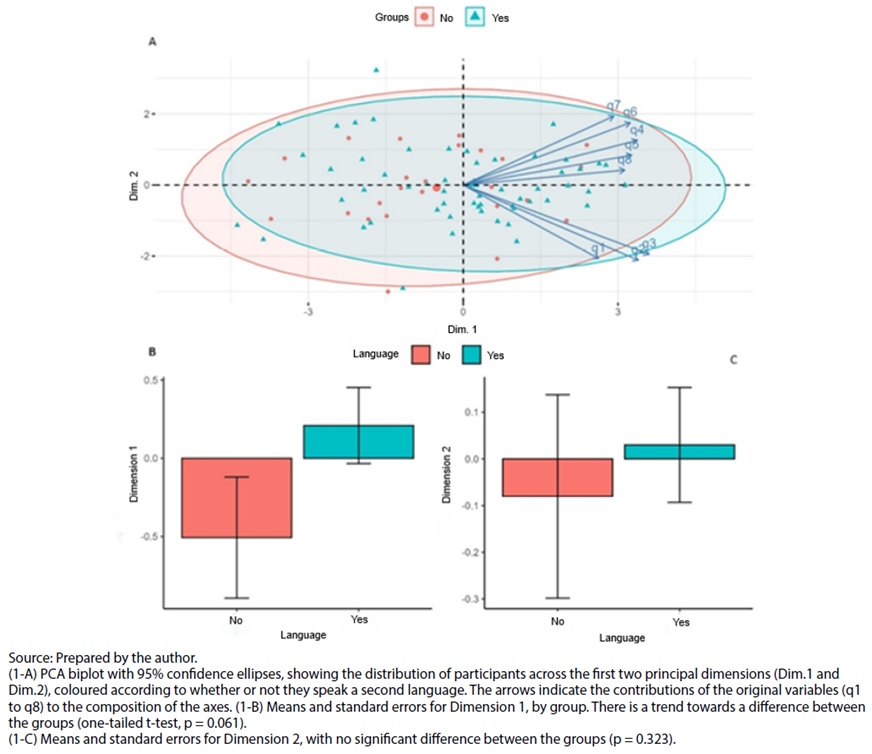
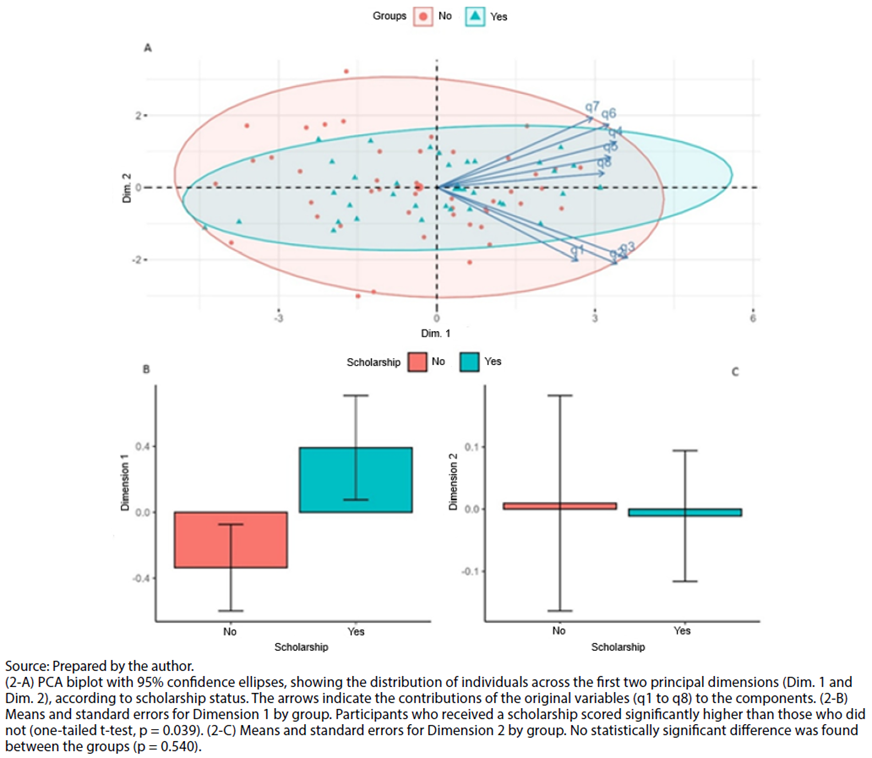
PCA was carried out using the scores from eight questions relating to digital health literacy. The KMO index was adequate (MSA = 0.81), indicating that PCA was suitable for application (graphic 1A and graphic 2A). The first two dimensions accounted for the largest proportion of the total variance, consisting mainly of the following variables:
-
Dimension 1 (46.9%): the largest contribution came from q4, q5 and q8, relating to the use of the internet for health-related activities;
-
Dimension 2 (12.5%): the highest contribution comes from q2, q1, q3, q7 and q6, relating to the Recognition and Understanding of Digital Health Resources.
Principal component analysis (PCA) of responses to questions on eHealth literacy, according to second-language proficiency.
Principal Component Analysis (PCA) of responses to questions on eHealth literacy, by scholarship recipient status.
Comparison by second language domain
The data relating to the PCA factor loadings showed a partial separation between the “Yes” and “No” groups. The average score for Dimension 1 was higher in the group that reported proficiency in a second language ( = 0.21 ± 0.24) compared to the group without a second language ( = -0.51 ± 0.39), with a trend towards significance in the one-tailed t-test (t=−1.56, p=0.061). This result suggests that students who reported proficiency in a second language demonstrate higher levels of eHealth literacy than those who did not report such proficiency (graphic 1B). In Dimension 2, there was no statistically significant difference between the groups (p=0.323; graphic 1C).
Comparison by scholarship receipt
For Dimension 1, scholarship recipients had higher mean scores ( = 0.39 ± 0.32) compared to non-recipients ( = -0.34 ± 0.26), with statistical significance (t=−1.78, p=0.039). This finding suggests that students who reported receiving scholarships have higher levels of eHealth literacy than those who reported not receiving them (Figure 2B).
No significant differences were observed in Dimension 2 between the groups (p=0.540; graphic 2C).
DISCUSSION
Interpretative summary of the results
The results of this study show that the participating healthcare students generally had a high level of confidence in their ability to find, understand and apply health information available on the internet. This pattern is consistent with other studies conducted in Brazil11),(12 and in countries such as Iran, Canada and Sweden13)-(15, which have also shown high scores among health students, particularly about the recognition of and access to information sources.
However, an item-by-item analysis of the eHEALS-Br revealed a significant asymmetry: whilst items such as ‘finding’ and ‘using’ the content scored the highest means, item 8: “I feel confident using information from the internet to make decisions about my health” had the lowest average score. This discrepancy suggests that, although students appear familiar with navigating and consuming digital health content, there is uncertainty regarding the practical application and decision-making based on this content, which may be related to doubts about the reliability of sources, a lack of clinical validation, or a fear of liability. This trend is a recurring theme in the literature and reflects an often-overlooked aspect of eHealth literacy: the critical assessment of information quality16),(17.
Statistical analysis indicated that, taken individually, none of the sociodemographic variables showed a statistically significant association with the total eHEALS score. However, when considering the combined effect of multiple factors, the multiple linear regression model identified two significant predictors: proficiency in a second language and receipt of a scholarship. These findings were corroborated by Principal Component Analysis (PCA), in which both groups scored higher on Dimension 1, which included items relating to the use of the internet to find and apply health information. The difference was statistically significant for scholarship students (p = 0.039) and showed a trend towards second-language proficiency (p = 0.061).
The positive impact of proficiency in a second language is likely linked to greater access to relevant sources of information that are not available in Portuguese, such as databases, international journals, and educational content in video or text format, most of which is provided in English. Although there are as yet no international studies that directly compare eHealth literacy among bilingual groups, there is evidence from studies in the United States indicating that immigrants with limited English proficiency have significantly lower levels of eHealth literacy18),(19. Thus, Archanjo, in revealing that bilingualism - a rare trait among the Brazilian population20) - is associated with better eHealth literacy, this dissertation, as well as the curriculum guidelines for health courses21)-(23 , reinforces the need for institutional strategies that combine digital literacy and language teaching, particularly English.
The positive correlation between receiving a scholarship and having greater eHealth literacy, however, deserves particular attention. At first glance, the result seems paradoxical, as Brazilian2),(12 and international24),(25 studies show that low income has a negative correlation with eHealth literacy. However, this finding can be understood in the following context: Approximately 25% of the students who enrolled at the institution in 2024 were recipients of the University for All Programme (ProUni)3 100%, according to data provided by the institution, demonstrating an active policy of social inclusion. This programme, established in 2005, awards scholarships to students who must meet income criteria and undergo a selection process based on academic merit, which entails greater commitment and responsibility. Free access to the university’s physical and digital facilities - such as high-speed internet, a virtual library and educational platforms - can compensate for any limitations in technological resources at home, increasing exposure to digital health tools and encouraging more frequent use of the internet for problem-solving. Therefore, scholarship status, far from being a marker of disadvantage, appears in this context to serve as an indicator of engagement, academic resilience and positive institutional support.
It is important to note that the literature on the ‘scholarship recipient’ variable is still limited. None of the national surveys on eHealth literacy stratified their results according to this variable. As such, this study is one of the first to highlight student finance as a powerful driver of digital literacy.
International comparisons and the Brazilian context
This sample achieved an overall mean score of 32.66 ± 4.54 on the eHEALS-Br. Applying the national cut-off points for university students (low ≤ 24; moderate 25-32; high 33-40) proposed by Mialhe et al.26, 52.7% of our participants fall into the ‘high’ category, 42.9% into the ‘moderate’ category and 4.4% into the ‘low’ category. Using the Swedish dichotomisation (limited ≤ 26; sufficient ≥ 27) by Wångdahl et al.27, the proportion rises to 92.3% at the “sufficient” level and 7.7% at the “limited” level. This sample therefore ranks higher than most international studies and those previously described in Brazil that used a similar methodology, as shown in Table 4:
We therefore found that the students scored up to 7.5 points higher than other Brazilian adults and up to 3.6 points higher than comparable foreign populations, suggesting a favourable institutional ecosystem (unlimited internet access, virtual libraries, digital tutoring practices). However, an item-by-item analysis reveals weaknesses consistent with the international literature: a lower mean score on item 8 of the eHEALS questionnaire (3.58 ± 0.99), which represents the assessment and application of evidence, as identified by Park and Min14 in Canadian students (mean of 3.5) and by Puspita et al.30 among pharmacy students in Indonesia (mean of 3.7). This confirms that the challenge today no longer lies in the practical aspects of information retrieval, but rather in filtering and applying that information - a shortcoming that persists even in technological environments and across healthcare courses, calling for curricula that emphasise scientific reasoning, source verification and digital ethics.
In the case of Brazil, it is noteworthy that this analysis must also take into account the country’s vast size and the profound regional inequalities in digital infrastructure and access to healthcare services. Unlike other smaller countries with more uniform health systems, Brazil faces the challenge of integrating digital health strategies across a vast territory characterised by great geographical distances and a concentration of resources in urban centres. Against this backdrop, telemedicine and other digital tools are not merely complementary resources, but strategic tools for expanding the coverage of the SUS (Unified Health System) and reducing inequalities in access. Therefore, when making international comparisons, it is essential to recognise that Brazil’s results reflect the complexity of a country of continental dimensions, which calls for specific and scalable solutions.
Educational implications
We have identified a need to rethink teaching practices in higher education in the health sector, particularly about the development of eHealth health. The existence of inequalities linked to factors such as income, academic background and proficiency in a foreign language points to gaps in students’ training when it comes to meeting the demands of an increasingly digitalised clinical practice.
The National Curriculum Guidelines (DCNs) for Medicine from 201422 and Nursing from 201821 already recognised the importance of incorporating technologies into the teaching. However, the 2025 update to the Medicine DCNs23 further reinforces this approach, stipulating that courses must include, structurally, content on digital health, artificial intelligence and data security, in line with the needs of a clinical practice increasingly mediated by technology. However, studies such as that by Pantaleão et al.32 show that the majority of students still do not feel prepared to use digital tools in clinical practice. They have underscored the urgent need to structurally incorporate topics such as the search for and critical evaluation of online evidence, ethics in digital information, infodemics, data security and the use of artificial intelligence in health.
Recent evidence shows that structured interventions, such as face-to-face workshops, online courses and supervised practical activities, are effective in improving eHealth literacy scores. A meta-analysis of 11 experimental studies33 identified average increases of 5.8 points on the eHEALS scale following the interventions, with more lasting gains when the strategies included theoretical exposure, practical activities and individualised feedback. These findings highlight the educational value of integrated, evidence-based approaches.
Promising educational strategies therefore involve the creation of specific courses or cross-disciplinary modules on digital skills, the incorporation of problem-based learning using international databases (such as PubMed and UpToDate), and the provision of practical English language activities focused on the critical reading of scientific articles. These strategies can reduce inequalities and increase autonomy. Furthermore, self-assessment tools such as eHEALS can provide ongoing support for diagnosis and educational planning.
Thus, integrating digital health education in a systematic and critical manner can not only strengthen students’ technical skills, but also foster the development of professionals who are more confident, ethical and capable of guiding their patients in the safe and critical use of digital tools.
Implications for public policy and digital equity
Digital literacy in health has been gaining prominence in international strategies, such as the World Health Organisation’s Global Strategy on Digital Health 2020-2025 from the World Health Organisation34, which aims to empower individuals to access and use digital information safely and independently. However, the findings of this dissertation confirm that there are factors that still limit the effective use of digital technologies, even among health students.
A key finding was the positive association between receiving a scholarship and higher eHealth literacy scores, suggesting that policies promoting access to higher education may act as a protective factor against digital inequalities. This finding reinforces the idea that digital equity depends not only on technical access to the internet, but also on structural measures that promote the meaningful use of health information.
Accordingly, public policies should provide for the inclusion of digital skills in the curriculum at all levels of education, as well as expanding access to devices, high-quality connectivity, and reliable and accessible digital content. Programmes such as PROUNI and social and racial quotas, when combined with digital literacy initiatives, can broaden the information literacy of students in vulnerable situations.
It is recommended that eHealth literacy indicators be incorporated into educational and health monitoring systems, thereby enabling the identification of inequalities and guiding targeted interventions. The digital transformation of healthcare could therefore be guided by principles of social justice, ensuring that technological innovation reduces, rather than exacerbates, existing inequalities28),(35),(36.
In the Brazilian context, investment in digital skills within undergraduate health programmes can also have a direct impact on the quality of services provided by the SUS, improving the effectiveness of primary care, enhancing telehealth programmes and strengthening health education initiatives, in other words, educational policies that promote eHealth literacy translate into policies that strengthen the SUS.
Strengths and limitations of the study
One of its key strengths is the use of an internationally validated instrument (eHEALS-Br), which has already been adapted to the Brazilian context; this ensures methodological rigour and allows for comparisons with studies conducted both in Brazil and abroad. Furthermore, the research was conducted using a sample of students from various courses in the field of health, thereby providing a broader perspective on the situation.
Multivariate analysis enabled us to explore associations between eHealth literacy and sociodemographic variables, revealing significant patterns of information inequality. The proposal to use specific cut-off points also broadens the applicability of the results by allowing for a more objective interpretation.
On the other hand, some limitations should be considered. The main concern relates to the cross-sectional nature of the study and the fact that the tool is based on self-perception, which may lead to an overestimation of digital skills. The variable relating to bilingualism was also self-reported, with no proficiency tests or identification of the predominant language.
Another important limitation relates to the composition of the sample, which was drawn from a single institution; although students from different health-related degree programmes were included, there was low representation from the Pharmacy and Psychology courses, preventing specific inferences about these groups and hindering generalisation to other institutions or regions.
Furthermore, although eHEALS is widely used, it may not fully capture the latest developments in the digital health environment, such as interaction on social media, the use of mobile apps and artificial intelligence in health.
Outlook and recommendations for future research
Future studies should prioritise longitudinal designs, mixed-methods approaches and more diverse samples, with greater regional and socio-cultural representativeness. It is also important to explore alternatives to eHEALS and to evaluate educational interventions aimed at developing eHealth literacy at undergraduate level.
FINAL CONSIDERATIONS
This study used the eHEALS-Br tool to assess the eHealth literacy of health students. The results showed a generally high perception of competence, particularly about searching for and evaluating information online, but less confidence in applying this information to decision-making. Furthermore, proficiency in a second language and receiving a scholarship were found to be factors associated with better outcomes. Despite the limitations of the cross-sectional design, the single-institution sample and the use of self-reported data, the findings underscore the need to strengthen eHealth literacy at undergraduate level.
References
-
1 Norman CD, Skinner HA. eHEALS: The eHealth Literacy Scale. J Med Internet Res. 2006;8(4):e27. doi: https://doi.org/10.2196/jmir.8.4.e27.
» https://doi.org/https://doi.org/10.2196/jmir.8.4.e27 -
2 Barros JK, Oliveira LP, Souza RC, Yamaguchi MU. Adaptação transcultural e evidências da validade da eHealth Literacy Scale para uso no Brasil. Rev Enferm Ref. 2022;6(1):e21066. doi: https://doi.org/10.12707/RV21066.
» https://doi.org/https://doi.org/10.12707/RV21066 -
3 Brasil. Lei nº 11.096, de 13 de janeiro de 2005. Institui o Programa Universidade para Todos (Prouni). Diário Oficial da União; 14 jan 2005. Seção 1. Acesso em: 12 mar. 2025. Disponível em: Disponível em: https://www2.camara.leg.br/legin/fed/lei/2005/lei-11096-13-janeiro-2005-535381-publicacaooriginal-23558-pl.html
» https://www2.camara.leg.br/legin/fed/lei/2005/lei-11096-13-janeiro-2005-535381-publicacaooriginal-23558-pl.html - 4 Souza NFL. eHealth literacy entre jovens: estudo exploratório sobre o papel das condições socioeconômicas no uso da informação sobre saúde na Internet [dissertação]. Rio de Janeiro: Instituto de Comunicação e Informação Científica e Tecnológica em Saúde, Fundação Oswaldo Cruz; 2020. 195 p.
-
5 Lee J, Lee E, Chae D. eHealth literacy instruments: systematic review of measurement properties. J Med Internet Res . 2021;23(11):e30644. doi: https://doi.org/10.2196/30644.
» https://doi.org/https://doi.org/10.2196/30644 - 6 Maschio KF, Silva KK. “The eHealth Literacy Scale” (eHEALS): tradução e validação da versão brasileira de uma escala de alfabetização em saúde eletrônica [monografia]. Chapecó: Universidade Federal da Fronteira Sul; 2019.
-
7 Erdfelder E, Faul F, Buchner A. GPOWER: a general power analysis program. Behavior Research Methods, Instruments, & Computers. 1996;28:1-11. doi: https://doi.org/10.3758/BF03203630.
» https://doi.org/https://doi.org/10.3758/BF03203630 -
8 R Core Team. R: a language and environment for statistical computing. Vienna: R Foundation for Statistical Computing; 2024. Acesso em: 12 mar. 2025. Disponível em: Disponível em: https://www.R-project.org/
» https://www.R-project.org/ - 9 Brasil. Resolução nº 466, de 12 de dezembro de 2012. Dispõe sobre diretrizes e normas regulamentadoras de pesquisas envolvendo seres humanos. Diário Oficial da União ; 13 dez 2012. Seção 1.
-
10 Brasil. Lei nº 13.709, de 14 de agosto de 2018 (Lei Geral de Proteção de Dados Pessoais - LGPD). Dispõe sobre a proteção de dados pessoais e altera a Lei nº 12.965, de 23 de abril de 2014. Diário Oficial da União ; 15 ago 2018. Seção 1. Acesso em: 12 mar. 2025. Disponível em: Disponível em: https://www.planalto.gov.br/ccivil_03/_ato2015-2018/2018/lei/L13709.htm
» https://www.planalto.gov.br/ccivil_03/_ato2015-2018/2018/lei/L13709.htm -
11 Mialhe FL, Moraes KL, Sampaio HAC, Brasil VV, Vila VSC, Soares GH, et al. Avaliação das propriedades psicométricas do instrumento eHealth Literacy Scale em adultos brasileiros. Rev Bras Enferm. 2022;75(1):e20201320. doi: https://doi.org/10.1590/0034-7167-2020-1320.
» https://doi.org/https://doi.org/10.1590/0034-7167-2020-1320 -
12 Macedo BSP, Yamaguchi MU, Santos ER, Dias KM, Aprile DCB, Lopes CT. Letramento digital em saúde de estudantes de enfermagem ou medicina: fatores relacionados. Acta Paul Enferm. 2022;35:eAPE02647. doi: https://doi.org/10.37689/acta-ape/2022AO02647.
» https://doi.org/https://doi.org/10.37689/acta-ape/2022AO02647 -
13 Dashti S, Peyman N, Tajfard M, Esmaeeli H. E-health literacy of medical and health sciences university students in Mashhad, Iran in 2016: a pilot study. Electron Physician. 2017;9(3):3966-73. doi: https://doi.org/10.19082/3966.
» https://doi.org/https://doi.org/10.19082/3966 -
14 Park JY, Min J. Exploring Canadian pharmacy students’ e-health literacy: a mixed method study. Pharm Pract (Granada). 2020;18(1):1747. doi: https://doi.org/10.18549/PharmPract.2020.1.1747.
» https://doi.org/https://doi.org/10.18549/PharmPract.2020.1.1747 -
15 Wångdahl J, Jaensson M, Dahlberg K, Nilsson U. The Swedish version of the Electronic Health Literacy Scale: prospective psychometric evaluation study including thresholds levels. JMIR Mhealth Uhealth. 2020;8(2):e16316. doi: https://doi.org/10.2196/16316.
» https://doi.org/https://doi.org/10.2196/16316 -
16 Griebel L, Enwald H, Gilstad H, Pohl AL, Moreland J, Sedlmayr M. eHealth literacy research- quo vadis? Inform Health Soc Care. 2018 Dec;43(4):427-442. doi: https://doi.org/10.1080/17538157.2017.1364247.
» https://doi.org/https://doi.org/10.1080/17538157.2017.1364247 -
17 Norman C. eHealth literacy 2.0: problems and opportunities with an evolving concept. J Med Internet Res . 2011;13(4):e125. doi: https://doi.org/10.2196/jmir.2035.
» https://doi.org/https://doi.org/10.2196/jmir.2035 -
18 Nagori A, Keshvani N; Patel L; Dhruve R; Sumarsono A. Electronic health literacy gaps among adults with diabetes in the United States: role of socioeconomic and demographic factors. Prev Med Rep. 2024;47:102895. doi: https://doi.org/10.1016/j.pmedr.2024.102895.
» https://doi.org/https://doi.org/10.1016/j.pmedr.2024.102895 -
19 Valdovinos C, Perez-Aguilar G, Huerta RG, Barrios C, Gutierrez G, Mendez C, et al. Electronic health literacy among linguistically diverse patients in the Los Angeles County Safety Net Health System. Ethn Dis. 2022;32(1):21-30. doi: https://ethndis.org/archive/files/ethndis-32-21.pdf
» https://ethndis.org/archive/files/ethndis-32-21.pdf -
20 Archanjo R. Globalização e multilingualismo no Brasil: competência linguística e o Programa Ciência sem Fronteiras. Rev Bras Linguist Apl. 2015;15(3):621-56. doi: https://doi.org/10.1590/1984-639820156309.
» https://doi.org/https://doi.org/10.1590/1984-639820156309 -
21 Brasil. Diretrizes Curriculares Nacionais do Curso de Graduação em Enfermagem. Resolução CNE/CES nº 573/2018. Brasília: Ministério da Educação; 2018. Acesso em: 12 mar. 2025. Disponível em: Disponível em: https://conselho.saude.gov.br/resolucoes/2018/Reso573.pdf
» https://conselho.saude.gov.br/resolucoes/2018/Reso573.pdf -
22 Brasil. Diretrizes Curriculares Nacionais do Curso de Graduação em Medicina. Brasília: Ministério da Educação ; 2014. Acesso em: 12 mar. 2025. Disponível em: Disponível em: https://toledo.ufpr.br/wp-content/uploads/2017/07/DCN-2014.pdf
» https://toledo.ufpr.br/wp-content/uploads/2017/07/DCN-2014.pdf - 23 Brasil. Resolução CNE/CES nº 5, de 14 de agosto de 2025. Institui as Diretrizes Curriculares Nacionais do Curso de Graduação em Medicina. Brasília: Ministério da Educação ; 2025.
-
24 Guo Z, Zhao SZ, Guo N, Wu Y, Weng X, Wong JY, et al. Socioeconomic disparities in eHealth literacy and preventive behaviors during the COVID-19 pandemic in Hong Kong: cross-sectional study. J Med Internet Res . 2021;23(4):e24577. doi: https://doi.org/10.2196/24577.
» https://doi.org/https://doi.org/10.2196/24577 -
25 Shiferaw KB, Tilahun BC, Endehabtu BF, Gullslett MK, Mengiste SA. E-health literacy and associated factors among chronic patients in a low-income country: a cross-sectional survey. BMC Med Inform Decis Mak. 2020;20:181. doi: https://doi.org/10.1186/s12911-020-01202-1.
» https://doi.org/https://doi.org/10.1186/s12911-020-01202-1 -
26 Mialhe FL, Moraes KL, Sampaio HAC, Brasil VV, Rebustini F. Normatização dos escores da escala eHealth Literacy Scale para avaliação do letramento digital em saúde. Rev Enferm UERJ. 2023;31:e74812. doi: https://doi.org/10.12957/reuerj.2023.74812.
» https://doi.org/https://doi.org/10.12957/reuerj.2023.74812 -
27 Wångdahl J, Dahlberg K, Jaensson M, Nilsson U. Arabic version of the Electronic Health Literacy Scale in Arabic-speaking individuals in Sweden: prospective psychometric evaluation study. J Med Internet Res . 2021;23(3):e24466. doi: https://doi.org/10.2196/24466.
» https://doi.org/https://doi.org/10.2196/24466 -
28 Barbosa MCF, Baldiotti ALP, Resende JL, Perazzo MF, Firmino RT, Granville-Garcia AF, et al. Assessment of the psychometric properties of the eHealth Literacy Scale for Brazilian adolescents. PLoS One. 2024;19(11):e0314099. doi: https://doi.org/10.1371/journal.pone.0314099.
» https://doi.org/https://doi.org/10.1371/journal.pone.0314099 -
29 Del Giudice P, Bravo G, Poletto M, De Odorico A, Conte A, Brunelli L, et al. Correlation between eHealth literacy and health literacy using the eHealth Literacy Scale and real-life experiences in the health sector as a proxy measure of functional health literacy: cross-sectional web-based survey. J Med Internet Res . 2018;20(10):e281. doi: https://doi.org/10.2196/jmir.9401.
» https://doi.org/https://doi.org/10.2196/jmir.9401 -
30 Puspita N, Kurniawan AH, Tias CAN. Exploring the relationship between e-health literacy and online health information-seeking behaviour among pharmacy students in Indonesia. Pharm Educ. 2024;24(1):304-10. doi: https://doi.org/10.46542/pe.2024.241.304310.
» https://doi.org/https://doi.org/10.46542/pe.2024.241.304310 -
31 Tubaishat A, Habiballah L. eHealth literacy among undergraduate nursing students. Nurse Educ Today. 2016; 42:47-52. doi: https://doi.org/10.1016/j.nedt.2016.04.003.
» https://doi.org/https://doi.org/10.1016/j.nedt.2016.04.003 -
32 Pantaleão AN, Mennitti AL, Brunheroto FB, Stavis V, Ricoboni LT, Castro VAF, et al. Fostering digital health in universities: an experience of the first Junior Scientific Committee of the Brazilian Congress of Health Informatics. Healthc Inform Res. 2024;30(1):83-9. doi: https://doi.org/10.4258/hir.2024.30.1.83.
» https://doi.org/https://doi.org/10.4258/hir.2024.30.1.83 -
33 Barbati C, Maranesi E, Giammarchi C, Lenge M, Bonciani M, Barbi E, et al. Effectiveness of eHealth literacy interventions: a systematic review and meta-analysis of experimental studies. BMC Public Health. 2025;25(1):288. doi: https://doi.org/10.1186/s12889-025-21354-x.
» https://doi.org/https://doi.org/10.1186/s12889-025-21354-x -
34 World Health Organization. Global strategy on digital health 2020-2025. Geneva: World Health Organization; 2021. Acessoe em 12 mar. 2025. Disponível em: Disponível em: https://www.who.int/publications/i/item/9789240020924
» https://www.who.int/publications/i/item/9789240020924 -
35 Hua Z, Sun Y, Liu Q, Chen H. Factors influencing eHealth literacy worldwide: systematic review and meta-analysis. J Med Internet Res . 2025;27:e50313. doi: https://doi.org/10.2196/50313.
» https://doi.org/https://doi.org/10.2196/50313 -
36 Jongebloed H, Anderson K, Winter N, Nguyen L, Huggins CE, Savira F, et al. The digital divide in rural and regional communities: a survey on the use of digital health technology and implications for supporting technology use. BMC Res Notes. 2024;17:90. doi: https://doi.org/10.1186/s13104-024-06687-x.
» https://doi.org/https://doi.org/10.1186/s13104-024-06687-x
Research data is available in the body of the document.