 Remote Objective Structured Clinical Examination (OSCE) to evaluate bad news communication in a university project
ABSTRACT
Introduction: Historically, medical education institutions have failed to encourage the development of their students’ communication skills, especially in terms of communicating bad news. The ‘’Dying: a Human Thing’’ project, carried out at the Federal University of Rio Grande do Norte (UFRN), complements the teaching of difficult news communication skills with active teaching and assessment methodologies through virtual simulations.
Objective: This study aimed to evaluate the performance of students participating in the ‘’Dying: a Human Thing’’ project in the remote OSCE, as well as to characterize the students’ perception of their performance in virtual simulations.
Method: This is a quantitative, qualitative, descriptive and exploratory study. Students participating in the “Dying: a Human Thing” project in the 2021.2 edition were included in the quantitative stage, and their performance in communicating bad news was evaluated by the same checklist, in two different online OSCEs, separated by training on the SPIKES protocol, in order to establish comparative analysis between the simulations. The checklist was completed by teachers trained on the topic. Those students who responded to a semi-structured script to analyze their experience in the simulations were included in the qualitative stage to their discretion. Quantitative analysis was conducted in a non-parametric way, and, for the qualitative content, the students’ descriptions were organized by thematic categories according to Minayo’s method.
Results: There was an improvement in the students’ scores after virtual training in breaking bad news, with the remote OSCE being an adequate tool to measure the participants’ performance in this project. The main feelings aroused in this context were fear and anguish in the face of this communicative context.
Conclusion: Communicating bad news is still a challenge in medical practice and had to be carried out by virtual means during the SARS-CoV-2 pandemic. Thus, combining the development of communication skills with familiarization with the remote model is essential for the education of future physicians.
Keywords:
Medical education; Communication; Professional-Patient Relations; Telemedicine; Clinical Competence
RESUMO
Introdução: As instituições de educação médica, historicamente, possuem falhas no incentivo ao desenvolvimento de competências em comunicação dos seus discentes, sobretudo dentro da comunicação de más notícias. O projeto “Dying: a human thing’’, realizado na Universidade Federal do Rio Grande do Norte (UFRN), complementa o ensino das habilidades de comunicação de notícias difíceis com metodologias ativas de ensino e avaliação por meio de simulações virtuais.
Objetivo: Este estudo teve como objetivos avaliar o desempenho dos discentes participantes do projeto “Dying: a human thing’’ no OSCE remoto e caracterizar a percepção dos estudantes sobre o próprio desempenho nas simulações virtuais.
Método: Trata-se de um estudo com metodologia mista, quantiqualitativa, de caráter descritivo e exploratório. Foram incluídos na etapa quantitativa os estudantes participantes do projeto “Dying: a human thing” na edição 2021.2, que tiveram seu desempenho em comunicação de más notícias avaliado por um mesmo checklist, em dois OSCE online diferentes, separados por uma capacitação acerca do protocolo SPIKES, a fim de estabelecer uma análise comparativa entre as simulações. O checklist foi preenchido por professores capacitados sobre esse tema. Incluíram-se na etapa qualitativa, por conveniência, aqueles alunos que responderam a um roteiro semiestruturado para a análise de sua experiência nas simulações. A análise quantitativa ocorreu de forma não paramétrica, e, para o conteúdo qualitativo, as descrições dos discentes foram organizadas por categorias temáticas de acordo com o método de Minayo.
Resultado: Observou-se melhora nas pontuações dos discentes após a capacitação virtual em comunicação de más notícias, sendo o OSCE remoto uma ferramenta adequada para mensurar o desempenho dos participantes desse projeto de extensão. Os principais sentimentos despertados nesse contexto foram medo e angústia diante desse contexto comunicativo.
Conclusão: A comunicação de más notícias ainda é um desafio na prática médica e precisou ser realizada por meios virtuais durante a pandemia causada pelo Sars-CoV-2. Desse modo, aliar o desenvolvimento de habilidades comunicativas à familiarização com o modelo remoto é fundamental para a educação dos futuros médicos.
Palavras-chave:
Educação Médica; Acolhimento; Humanização da Assistência; Telemedicina; Competência Clínica
INTRODUCTION
Despite the obvious importance of communication in health practice, few medical schools offer training aimed at developing the communication skills and competences of their future professionals. Thus, in delicate situations, such as those involving the communication of bad news, the suffering generated is not limited to those who receive the painful information; it also affects those who break such news, given the difficulty imposed by this dialogue. Furthermore, this experience can strongly influence the doctor-patient relationship1.
In this context, it is also worth highlighting the outlook generated by the Covid-19 pandemic: the severe restrictions on hospital visits by family members meant that many difficult conversations had to take place remotely. This revealed new difficulties and reinforced the lack of training in the communication skills needed for this kind of contact2),(3.
Since 2013, the Federal University of Rio Grande do Norte (UFRN) has developed the “Dying: A Human Thing” project, linked to the International Federation of Medical Students’ Association (IFMSA) Brazil, to complement teaching about communication skills, especially bad news. At the beginning of 2020, due to the social distancing scenario, it was adapted to the virtual format and also set out to address the recent questions imposed by the pandemic within communicative competences.
The project includes round tables on the subject of breaking difficult news and two simulations using the “Objective Structured Clinical Examination” (OSCE) model, interspersed with training on the SPIKES4 protocol. The first simulation is designed to assess students in a practical situation of communicating bad news, based on their experiences prior to the project; and the second is aimed at consolidating learning and analysing the development of communication skills.
Based on these propositions, although the OSCE has been recognised as a valuable assessment method by scientific literature in medical schools, there is no data or publications that demonstrate its impact on the development of remote communication skills, especially in the way promoted by the initiative in question. In view of the above, this article sought to evaluate the development of communication skills through the application of remote OSCE, within the “Dying: a Human Thing” project at UFRN, as well as to understand the students’ perception of their performance in the virtual simulations.
METHODOLOGY
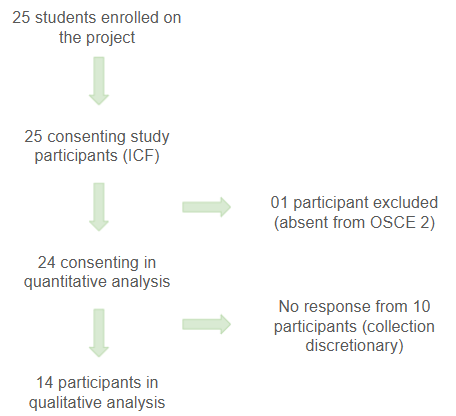
This descriptive and exploratory study used a mixed, quantitative and qualitative, methodological approach. The inclusion criteria for the research were: being a medical student at UFRN participating in the 2021.2 edition of the “Dying: A human thing” project. Anyone who did not take part in any of the research stages was excluded. Thus, the quantitative perspective involved the participation of 24 students, while the qualitative perspective comprised 14 participants.With regard to the quantitative approach, data was collected in two stages: during the first simulation, which preceded the participants’ training on the SPIKES protocol, and during the second simulation.
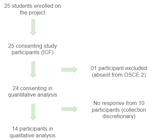
With regard to the quantitative approach, data was collected in two stages: during the first simulation, which preceded the participants’ training on the SPIKES protocol, and during the second simulation.
Between the two simulations, training was provided in order to offer theoretical support for the subsequent simulation and comparative analysis. The students’ training consisted of a 2-hour online lecture, which covered each stage of the SPIKES protocol in detail by discussing clinical cases. The class was given by a doctor who specialises in communicating bad news, giving students the opportunity to share experiences and clarify doubts.
The remote simulation was structured as follows: each participant was invited individually to a virtual room on the digital platform used, where they were welcomed by an organiser, a member of the student coordination of the project, a professor from the UFRN medical course involved with the project and an actor. In the room, they received, via virtual chat, a fictitious clinical case - adapted for video call dialogue - and the conduct, which consisted of difficult news to be told to the actor, who was playing the role of either the patient or their family member.
Before the simulations, the actors took part in individual meetings with members of the project to receive detailed instructions on the clinical cases. During these meetings, the scenarios that would be simulated were presented, as well as the possible emotional reactions and dialogues to be used. This preparation ensured consistent expressions in each simulation, although they still had the freedom to act. In the first OSCE, the case of a 68-year-old patient was discussed; he required orotracheal intubation due to respiratory failure caused by COVID-19. The objectives of the simulation included communicating the procedure, clarifying doubts and offering support to the patient’s son or daughter. The second OSCE dealt with a 66-year-old patient who died after cardiopulmonary resuscitation, also as a result of COVID-19. The main objective was to inform the patient’s son of his father’s death by video call. In both simulations, the student acted as the doctor in charge of the patients.
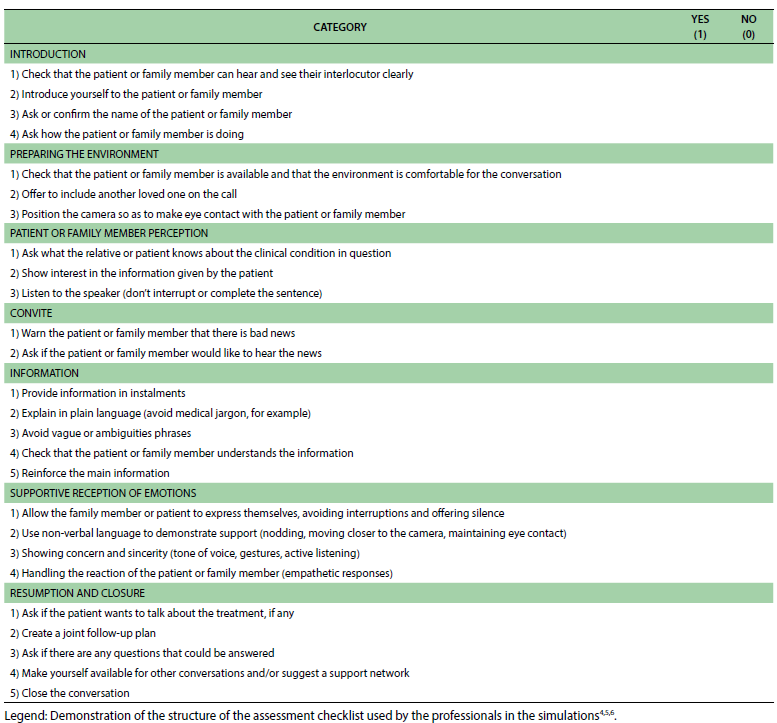
The case was read out in 1 minute and immediately afterwards the conversation with the actor began, lasting 5 minutes. At the same time, the assessing teacher filled in the structured script via Google Forms. This script was developed in an unprecedented way, with no prior validation, since it was part of a new communication reality: the demand for social distancing and the use of digital platforms to break difficult news. However, it was based on questions relating to the assessment of bad news communication proposed by the SPIKES protocol, associated with global communication guidelines and updates on communicating difficult news virtually (Table 1).
The score posted on the checklist could vary from 0 to 26 points, with no decimal variation (each skill, if performed, counted as 1 point; if not, 0 points). The total points obtained by the student in the first and second simulation were taken into account for the comparative analysis. Each student’s performance was analysed by the same teacher assessor in both simulations.
The qualitative stage of the data collection took place after both simulations, using a script with open-ended questions. The script was made available via Google Forms (Chart 1) after the second OSCE had been finalised and remained available for a fortnight. All the participants were invited to complete the questionnaire to their own discretion, and adherence to this stage was completely voluntary.
Data analysis
The data analysis was split between the research perspectives. In the quantitative approach, the data was analysed using IBM SPSS Statistics v24 software, and the normality analysis was performed using the Shapiro-Wilk test. This showed a distribution characteristic of a parametric variable for the data from the first OSCE, and a non-parametric variable for the data from the subsequent OSCE. Thus, the set of variables was described as non-parametric based on the median, minimum and maximum values. Comparisons were analysed using the Wilcoxon test. The evolution of each student’s performance, quantified as a grade according to the number of correct answers, constituted the independent variable, while the scores in each skill made up the dependent variables in this study.
In the qualitative field, the answers given in the subjective questionnaire were organised and coded with a view to grouping the reports that showed similarities between opinions and perceptions, so that they could be analysed using thematic clusters, as proposed by Minayo7. The students’ words are quoted, and they are identified as “student” (A), together with an arbitrarily assigned number, for example: student 1 will be identified as A1.
RESULTS
Characterisation of the sample:
The study participants were mainly enrolled in the first five terms of the medical course, with 79.17% of the sample in the 1st to 3rd period, 16.67% in the 4th period and 4.17 in the 5th period. There was a significant predominance of females among the participants - 62.5% of the sample, with 37.5% males. Their average age was 20.7 years, with a standard deviation of 1.6 years.
Quantitative analysis:
The median total score for students in the second OSCE was higher than in the first (p<0.001), as were the medians by domain (Table 2). Although the median remained the same for some domains, statistical significance also takes into account the overall increase in scores in the category. Therefore, even if the aforementioned value remained constant there may be a differential improvement in the group, represented by the p-value. The only domains that did not evolve with statistical significance (established by a p-value of <0.05) were the invitation and the supportive reception of emotions. It should be noted that the p-value is calculated from the ratio between the medians of OSCE 2 and OSCE 1.
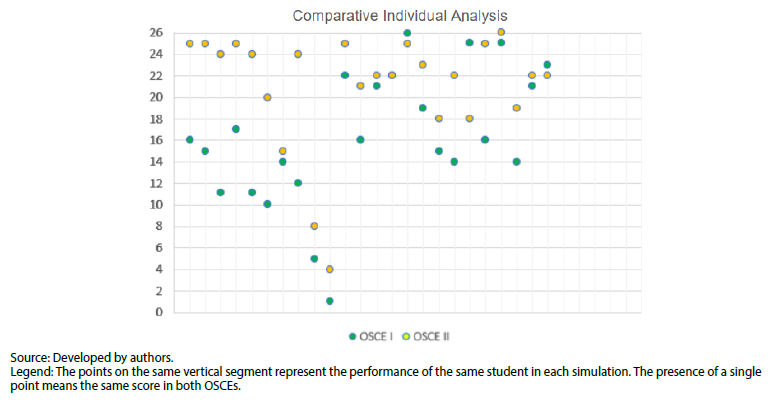
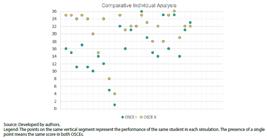
There was an explicit increase in the individual students’ total score between the simulations (Graph 1). It can be seen that only 4 students (16.7%) failed to perform better in the second OSCE, with 1 of them scoring the same in both simulations.
By stratifying the scores of each student by skill (Table 3), we can see significant variations in the success rates - with up to 220% improvement when comparing the indices between the first and second simulations. There were only 3 skills which did not see an increase in the aforementioned index, of which 2 showed a negative percentage and one a neutral percentage.
Qualitative analysis:
Three thematic clusters emerged from the analysis of the results: participants’ experience of the remote OSCE; learning from the OSCE, focusing on the assessment methods discussed; and finally, remote simulations: advantages and disadvantages.
Participants’ experience of the remote OSCE
Feelings such as nervousness and insecurity about the experience of the first OSCE were reported, as can be seen in the following statements:
“In the first simulation, I was very nervous and didn’t know how to react to the countless script possibilities.” (A7)
“I felt extremely anxious and insecure, because I had never taken part in an OSCE and I didn’t know how to act in front of the patient, even more so in the face of bad news, but I went through this experience and I’m glad I was exposed to it.” (A8)
The students also noted an improvement in self-confidence and a reduction in anxiety in the second OSCE, based on the experience of the first, as well as greater theoretical and practical knowledge:
“At that point I still felt anxious and nervous, but definitely more prepared for the osce. I still made mistakes, but I came out of it happy because I knew I’d made progress.” (A8)
“My second Dying simulation went very smoothly and I had the confidence to convey the bad news in a complete and empathetic way.” (A9)
“I was already able to structure a certain ‘script’ with the steps I should follow to break the bad news in the best possible way.” (A12)
In addition, the participants mentioned the benefit of the experiences of the project in the process of developing their skills in communicating bad news:
“They’ve certainly developed a lot, since the round table discussions make learning much more attractive, because with all the different experiences exchanged we get a broader idea of what works and what doesn’t when it comes to communicating bad news.” (A11)
“Although I still find (communicating bad news) a challenge, this project manages to put us in that context with preparation and amplifying empathy and understanding of the signals given by the person we are talking to, which are crucial factors at the time of breaking the news.” (A14).
Learning from the remote OSCE
During the simulations, the participants reported an improvement in their understanding of the SPIKES protocol, both in terms of its usefulness and how to apply it. At the same time, they noted the need to adapt the protocol itself and the association between this technical instrument and empathy:
“I realised that communicating bad news goes beyond an algorithm.” (A5)
“I realised that the art of breaking bad news is much more about the human aspect of supporting the other than the merely technical aspect.” (A8)
“Here, I was able to (learn), above all, about humanity - in the sense of sharpening the sensitivity of speaking and being able to embrace the pain that is not only mine. I think that because we’re on a health course, dealing directly with lives, the desire to embrace the pain of others should already be a requirement... But we’ve been able to learn and evolve the technique of this welcome as students and future professionals.” (A7)
The improvement cited was even more prominent when associated with training on the SPIKES protocol during the project:
“The lesson on the SPIKES protocol given after the first simulation was highly transformative, as it brought a series of clarifications and new perspectives to the approach to communicating bad news.” (A9)
“Now the protocol makes a lot more sense to me, so I think I’ll be able to break bad news the right way.” (A3)
The students also emphasised the relevance of the OSCE as a practical assessment tool for their teaching-learning process, as seen in:
“I believe that the OSCE was fundamental, since communication skills are a very important part of practical learning and without opportunities like this it’s unlikely that I would have been able to consolidate my knowledge, see what I had really learnt and also get feedback on what to improve.” (A13)
Within the simulation, they report on the importance of feedback:
“In the second (simulation) you already have the feedback from the first, it gives you an idea of how to improve this communication.” (A14)
Finally, the OSCE was considered a means of assessment that places the student as the protagonist of their process, above all because of its practical nature, as stated in:
“The OSCE puts us in an active position, testing us and giving us experience at an early stage in the course. It’s an essential tool for our learning, which gives us a head start in real-life situations.” (A12)
“The OSCE was fundamental to the evolution of learning, because theory is important, but without practice it becomes useless.” (A8)
“I feel that, like any skill, the more we practise and the more we experience different situations, learning how best to adapt and perform that skill in various situations, the more capable and skilful we become. In this way, I believe that Dying has helped a lot in improving, learning and perfecting the art of breaking bad news.” (A13)
“I think I developed a skill that perhaps I would only have developed over time if it wasn’t for the Dying project, as well as making several mistakes until I got it right.” (A2)
Remote simulations: advantages and disadvantages
One of the advantages of remote communication identified by the participants was the possibility of interacting from a convenient location and of experiencing telemedicine:
“The practice of online communication has proved to be practical and accessible, as it allows us to connect without the difficulty of travelling, making it possible to make better use of our time.” (A9)
“The online OSCE also offers advantages, such as enabling training in telemedicine, which is a reality that is increasingly being imposed on doctors.” (A3)
On the other hand, disadvantages were pointed out, such as the possible instability of the internet network and interference from the physical environment that hosts this interaction:
“I believe that an inherent difficulty in online OSCE is related to possible network instabilities and other challenges of distance learning, such as the need to manage interruptions caused by students being at home.” (A3)
“The connection can be unstable and hinder communication between doctor and patient due to possible delays.” (A12)
“The online OSCE ends up limiting the full experience of communication, such as looking the patient in the eye, shaking their hand or putting your hand on the shoulder after an expression of sadness.” (A5)
The experience of emotions was mentioned in some statements as an advantage and in others as a disadvantage, as illustrated in:
“The analysis of body posture and facial expression is less rigorous, due to the limitations of the camera, the online osce can allow for a lack of personal connection.” (A4)
“The remote format brings a certain protection in the sense of disguising the nervousness a little.” (A5)
“An online osce fulfils the role of communicating bad news, but I still feel that it fails in the exercise of dealing with the patient and conveying and absorbing their emotions, elements that would be much more visible in person.” (A1)
This duality in relation to this issue led to anguish, which was summarised in the following account:
“I’m afraid that, in the future, the online OSCE might make it difficult for me to interact in person, because online communication, in a way, allows the healthcare professional to shield themselves emotionally, making the communication process ‘easier’ and more practical. This can jeopardise our ability to deal with the emotional side of communicating bad news in a physically complete way. I’m afraid that in the future I’ll fi]nd it difficult to deal with the OSCE ‘eye to eye’.” (A9)
DISCUSSION
Communication between doctor and patient, which is essential for building the care relationship, often leads to emotionally difficult dialogues involving information that can alter the patient’s life and future prospects1. In this context of bad news, the transmission of information also generates suffering in those who does the informing8.
Despite current outreach projects in this direction, the institutional effort to prepare its future professionals has historically been deficient within the compulsory curricular structure9. This is even recognised by active professionals and has serious consequences: students do not learn to reflect on their emotions, nor on the perception of patients and their families, which leads to a practice that is not focused on the quality of interpersonal relationships10. Teaching technical skills seems to be prioritised over teaching communication skills11, although these can be taught and learnt, especially through active teaching and assessment methodologies that involve student engagement12.
Among these methodologies and the context in which they were devised, this study highlights the OSCE, which consists of a structured clinical examination, carried out to test knowledge and provide feedback on student performance13. Due to the health context, it had to be carried out remotely. The medical students’ experience was considered within this panorama of communicating difficult news, through virtual simulations, to contribute to reflection on the best teaching and assessment strategies aligned with the objective of optimising the professional outlook within humanised medicine.
Within this proposal, the objective analysis of the students’ progress, using the structured questionnaire, was divided into domains, which represented the order of the steps proposed by the SPIKES protocol, and subdivided into skills, which should be part of the qualified communication of bad news. With regard to the categories, there was no statistically significant difference in the scores for the “invitation” and “supportive reception of of emotions”, while there was a significant improvement for “introduction”, “preparation of the environment”, “perception of the patient or family member”, “information” and “resumption and closure”.
From a more detailed point of view, the skills with the most significant improvement, as seen in Table 2, were “introducing oneself to the patient or family member”, “offering to include a loved one on the call”, “asking what the patient or family member knows about the clinical condition in question”, “warning that there is bad news”, “reinforcing the main information” and “creating a joint follow-up plan”. The feedback given after the simulations has a significant influence on the alignment of these behaviours; and, given these competences, it is possible to see that improvement is essential in order to offer greater autonomy to the patient/family member. Offering the ability to choose whether or not to include someone on the call, whether or not to create a treatment plan, for example, are ways of placing the patient as the protagonist of their health process, so as to facilitate their adherence to therapeutic processes14),(15.
No difference was found in the skill “handling the patient’s or family member’s reaction”, but it should be emphasised that its success rate remained high (91.6%). In this same domain of supportive reception of emotions, there are two skills that showed a reduced success rate between the OSCEs (“use non-verbal language to demonstrate support” and “show concern and sincerity”). We should therefore consider whether theoretical training on protocols is in fact effective in developing students’ understanding of the importance of emotional availability during such a difficult time. In fact, it should be noted that practical teaching and assessment methodologies can elicit more realistically the competences needed by these students, as previously stated by the research participants.
With regard to the total score, the students’ overall performance improved statistically significantly after the theoretical training, with an increase in the median from 16 points in the first OSCE to 22 points in the second (p < 0.001). This is also associated with a significant improvement in the students’ individual scores, as shown in Graph 1. There was also a change in the distribution characteristics of the variables analysed: the parametric variables in the first OSCE and non-parametric variables in the second OSCE, with the scores tending upwards.
This reinforces the students’ ability to develop their communicative competences as part of their learning process12 and demonstrates the relevance of this study in reinforcing this possibility, including through virtual training and simulations, for practically all the skills assessed, although those related to emotional competences proved to be more difficult.
The qualitative aspect of this study, meanwhile, shed light on the students’ perception of the simulated experience of breaking bad news caused by the project in question, following the thematic clusters “experience”, “learning” and “advantages and disadvantages of the online format”. It was observed that this experience provoked anguish and fear as the main feelings. This corroborates the analyses in the current literature, insofar as doctors are known to consider the moment of breaking bad news to be prone to insecurity and the loss of a balanced and professional posture16. This was exacerbated by the fact that most of the participants were in the early stages of their undergraduate studies and consequently had little preparation for this type of behaviour, both in theoretical and practical terms.
Within this context of education based on practical moments, the students repeatedly pointed out how the simulation was relevant to placing them as actors in their training; and, in fact, this should be the basic axis of medical education. This is because, as one practices more, knowledge is structured through applied theory, which makes it possible to question, doubt and, above all, problematise the differences between what should be done and what can actually be done continuously17. An example of this is that, through this application, there was a significant improvement in understanding of the SPIKES protocol, as reported by the participants, even after theoretical training.
Among the greatest difficulties encountered during the simulations were intrinsic aspects of the virtual environment in which they were conducted, such as the instability of the internet and difficulties with the audio and camera. These issues were seen as limiting and capable of directly interfering with the quality of communication. However, the research team’s skills with the platform used and willingness to answer questions were used to overcome these problems.
With regard to the OSCE, students found it especially difficult to respond to emotions in virtual dialogue, since physical distance limits the possibilities for expressions of support and empathy18. Eye contact, posture in front of the camera and tone of voice were very important aspects for getting round this problem, but they required skills that were not widely developed by these undergraduate students. This was shown both by the students’ perceptions and by the fact that this issue did not show a statistically significant variation in improvement in the second simulation compared to the first.
The literature corroborates this view as it emphasises the need to compensate for social distancing through verbal communication, facial expressions and maintaining body language, even when behind the camera19. This is why targeted training with practical exposure is essential, as demonstrated in this study. Furthermore, regardless of the continuing demands of social distancing over the course of the COVID-19 pandemic, telemedicine has gained a foothold in the medical labour market, and students must also be trained to enter this environment19. Therefore, studying how to improve medical education with the tools available today is imperative.
Based on all the information presented, it can be seen that the various advantages and disadvantages of the virtual format do not have a substantial impact on most of the aspects involved in communicating bad news. This type of training therefore becomes a viable and useful teaching method for this subject matter13),(20. Making students more confident and empathetic when communicating bad news, whether virtually or in person, is a way of developing trust within the relationship between doctor and patient, as this is one of the pillars of communication - especially in a profession where the outcomes are multiple, as are the impacts on the life of the person being given care14.
For this reason, the study emphasises that the training of these students can also be conducted in a virtual environment, given the needs imposed by the pandemic and the new medical market, but above all by the patient in both settings. It is a congruent and reproducible means of teaching and assessment, capable of allowing students to analyse their own performance and consolidate their learning, although there is still a gap in the postural and emotional preparation of these students, which can be improved with the use of this methodology.
In analysing these results, it is worth emphasising that this study has limitations. Accordingly, we should highlight the limited number of participants, and having electronic devices and their own internet access as determining factors for participation in the project, due to the social context of the COVID-19 pandemic. Additionally, we should underline the lack of prior validation of the adapted checklist, given the unprecedented context of social distancing. Furthermore, the written modality was used for data collection in the qualitative phase of the research as regards possible interference of adapting the speech to be transmitted in words and summarising the participants’ impressions in characters. These facts suggest that further research is needed into training medical students to communicate bad news online.
CONCLUSION
Difficulties in communicating bad news have traditionally been neglected by medical schools, and the arrival of the SARS-CoV-2 pandemic has demonstrated even more significant gaps, including professional unpreparedness for communication in a virtual environment. These adversities have led to the creation of heterogeneous behaviours without a full scientific basis, which have often had traumatic impacts, both for the professional who communicated the difficult news and for the patient or family member who received it. It is therefore necessary to intervene in the process of educating future doctors to improve the quality of doctor-patient relationships and qualify them to deal with the suffering that is often inherent in the care process.
In this study, the intervention was carried out and led to improved student performance, emphasising that, in addition to having an empathetic attitude - so central from the perspective of offering a supportive reception and strengthening the doctor-patient relationship - communication skills can be trained and improved, even virtually. This highlights the need to combine face-to-face and remote teaching in the wider provision of training in the area of communicating bad news by medical education institutions. With these changes, it will be possible to increase the training of future professionals, albeit in an online format.
References
- 1 Camargo N, Lima MG de, Brietzke E, Mucci S, Góis AFT de. Teaching how to deliver bad news: a systematic review. Rev Bioét. 2019;27(2):326-40.
- 2 Collini A, Parker H, Oliver A. Training for difficult conversations and breaking bad news over the phone in the emergency department. Emerg Med J. 2020;38(2):151-4.
- 3 Back A, Tulsky JA, Arnold RM. Communication skills in the age of covid-19. Ann Intern Med. 2020;172(11):759-760.
- 4 Baile WF, Buckman R, Lenzi R, Glober G, Beale EA, Kudelka AP. SPIKES - a six-step protocol for delivering bad news: application to the patient with cancer. Oncologist. 2000;5(4):302-11.
- 5 Stamer T, Essers G, Steinhäuser J, Flägel K. From summative MAAS Global to formative MAAS 2.0 - a workshop report. GMS J Med Educ. 2023;40(1):9.
- 6 Vitto C, Del Buono B, Daniel L, Rivet E, Cholyway R, Santen SA. teaching toolbox: breaking bad news with virtual technology in the time of covid. J Cancer Educ. 2022;37(5):1429-1432.
- 7 Minayo MCS, Deslandes SF, Gomes R. Pesquisa social: teoria, método e criatividade. A análise de dados em pesquisa qualitativa. Petrópolis: Vozes; 2010.
- 8 Monteiro DT, Quintana AM. A comunicação de más notícias na UTI: perspectiva dos médicos. Psicologia: Teoria e Pesquisa. 2016;(4)32.
- 9 Lino CA, Augusto KL, Oliveira RAS de, Feitosa LB, Caprara A. Uso do protocolo Spikes no ensino de habilidades em transmissão de más notícias. Rev Bras Educ Med. 2011;35(1):52-7.
- 10 Borges MS, Freitas GF, Gurgel WG. A comunicação da má notícia na visão dos profissionais de saúde. Tempus. 2012;6(3):113-26.
- 11 Lamba S, Tyrie LS, Bryczkowski S, Nagurka R. Teaching surgery residents the skills to communicate difficult news to patient and family members: a literature review. J Palliat Med. 2016;19(1):101-7.
- 12 Kaplonyi J, Bowles KA, Nestel D, Kiegaldie D, Maloney S, Haines T, et al. Understanding the impact of simulated patients on health care learners’ communication skills: a systematic review. Med Educ. 2017;18;51(12):1209-19.
- 13 Harden RM, Stevenson M, Downie WW, Wilson GM. Assessment of clinical competence using objective structured examination. Br Med J. 1975;22;1(5955):447-51.
- 14 Pimentel, LCMA. Comunicação de notícias difíceis na formação médica: desenvolvendo competências relacionais. 2019. Dissertação (Mestrado Profissional em Ensino na Saúde) - Centro de Ciências da Saúde, Universidade Federal do Rio Grande do Norte, Natal, 2019.
- 15 Casalvara VJ, Scorsolini-Comin F, Corsi CAC. A comunicação de más notícias em saúde: aproximações com a abordagem centrada na pessoa. Rev. Abordagem Gestál. 2019;25(1):92-102.
- 16 Prado AJF do, Silva EA, Almeida VA de, Fráguas Júnior R. Ambiente médico: o impacto da má notícia em pacientes e médicos - em direção a um modelo de comunicação mais efetivo. Rev Med. 2013;20;92(1):13.
- 17 Puccini RF, Sampaio LO, Batista NA. A formação médica na Unifesp: excelência e compromisso social. Editora Fap-Unifesp; 2008(1)101-115.
- 18 Hauk H, Bernhard J, McConnell M, Wohlfarth B. Breaking bad news to cancer patients in times of covid-19. Support Care Cancer. 2021;29(8):4195-4198.
- 19 Miao JH. Adapting medical education initiatives through team-based e-learning, telemedicine objective structured clinical exams, and student-led community outreach during the covid-19 pandemic. JMIR Med Educ . 2021;7(2):e26797.
- 20 Cömert M, Zill JM, Christalle E, Dirmaier J, Härter M, Scholl I. Assessing communication skills of medical students in Objective Structured Clinical Examinations (OSCE) - a systematic review of rating scales. PLoS One. 2016;11(3):e0152717.
Research data is available in the body of the document

 Source: Developed by authors.