
 Training on pediatric and adolescent gynecology in the practice of gynecology and obstetric residents
ABSTRACT
Introduction: The presence of children and adolescents has been an increasingly frequent situation in gynecologists’ offices and it is noteworthy that the care for these age groups is very different from the care for adult women. Therefore, professionals need to be prepared for this type of situation, not only with specific technical knowledge, but they must also know the laws that regulate the assistance of minors and the ethical particularities of providing care to this population. However, this training often does not occur in medical school or medical residency.
Objective: To analyze training in Pediatric and Adolescent Gynecology (PAG) during the Gynecology and Obstetrics medical residency in Bahia, Brazil.
Method: Cross-sectional observational study, using a convenience sample consisting of 51 Gynecology and Obstetrics residents from eight institutions in the state of Bahia, using an online questionnaire that assessed the following aspects: technical-theoretical and ethical knowledge about Pediatric and Adolescent Gynecology, self-perception of comfort, confidence, and competence in caring for children and adolescents and access to theoretical and practical content related to PAG at the medical residency institution.
Results: The majority has already treated children and adolescents at residency (78,4%), but there was no specific outpatient clinic (86,3%) or annual exposure to PAG (86,3%) in most institutions. Most importantly, PAG was discussed at residency less than 5 times (70,6%), followed by never (23,5%). Regarding PAG, most of them considered the allocated time insufficient (90,2%), would like more training (96,1%), and to be included in practice as a specialty (66,7%). Finally, concerning self-perceived preparedness, comfort, and confidence, in most questions about children, the level was between 2 and 3, while for adolescents the level was 4 in the Likert scale. Furthermore, the majority chose the right answers to specific knowledge questions.
Conclusion: Although most of them have demonstrated theoretical and ethical knowledge in PAG, most of the residents have little theoretical-practical training in Pediatric and Adolescent Gynecology, and they often feel unprepared, uncomfortable, and not very confident in dealing especially with children. Therefore, most of them would like more training in PAG and should receive it.
Keywords:
gynecology; pediatric; adolescent; residents; residency
RESUMO
Introdução: A presença de crianças e adolescentes tem sido uma situação cada vez mais frequente nos consultórios dos médicos ginecologistas, e destaca-se que o atendimento dessas faixas etárias é muito diferente do atendimento de mulheres adultas. Assim, os profissionais precisam estar preparados para esse tipo de situação não só com conhecimento técnico específico, como também devem conhecer as leis que regulamentam a assistência a menores e as particularidades éticas do atendimento a essa população. Contudo, muitas vezes essa capacitação não ocorre na faculdade de Medicina nem na residência médica.
Objetivo: Este estudo teve como objetivo analisar o treinamento em ginecologia pediátrica e adolescente (PAG) durante a residência médica em ginecologia e obstetrícia em um estado do Nordeste brasileiro.
Método: Trata-se de um estudo observacional transversal, do qual participaram 51 residentes em ginecologia e obstetrícia de oito instituições do estado da Bahia, por meio de aplicação de questionário online que avaliou os seguintes aspectos: conhecimento técnico-teórico e ético sobre PAG, autopercepção sobre conforto, confiança e competência no cuidado de crianças e adolescentes e acesso a conteúdo teórico e prático relacionado à PAG na instituição da residência médica.
Resultado: A maior parcela já atendeu crianças e adolescentes na residência (78,4%), mas não havia ambulatório específico (86,3%), nem exposição anual em PAG na maioria das instituições (86,3%). Para a maior parte, a PAG foi assunto na residência menos de cinco vezes (70,6%), seguido por nunca (23,5%). Sobre a PAG, majoritariamente, consideraram o tempo destinado insuficiente (90,2%), gostariam de mais treinamento (96,1%) e afirmaram que desejam incluir na prática como especialista (66,7%). Por fim, em relação ao preparo, ao conforto e à confiança autopercebidos, o nível referido, na maioria das questões sobre crianças, foi entre 2 e 3, já sobre adolescentes o nível foi 4, em escala de Likert. A maioria acertou as questões de conhecimento específico.
Conclusão: Embora grande parte tenha demonstrado conhecimento teórico e ético em PAG, os residentes em sua maioria têm pouco treinamento teórico-prático em PAG, sentem-se muitas vezes despreparados, desconfortáveis e pouco confiantes para lidar especialmente com crianças, assim gostariam de mais treinamento em PAG em seus locais de especialização.
Palavras-chave:
Ginecologia; Pediátrica; Adolescente; Residentes; Residência
INTRODUCTION
Gynecology is a medical specialty that aims to promote health, prevent, diagnose and treat conditions related to women in their different cycles of life, from childhood to old age1. Thus, Pediatric and Adolescent Gynecology (PAG) is a sub-area that deals more specifically with children and adolescents, with situations related to the menstrual cycle, primary amenorrhea, pelvic pain, uterovaginal malformations, vulvovaginitis, pubertal development, contraceptive methods and sexual abuse2),(3.
Regarding the historical aspects of Pediatric and Adolescent Gynecology, it is noteworthy that the International Federation of Child and Adolescent Gynecology (FIGIJ) was founded on February 6, 1971, and that in September 1971, the Pediatric and Pubertal Gynecology Sector began operating in Brazil at Hospital das Clínicas, Faculty of Medicine, Universidade de São Paulo to care for girls aged 0 to 16 years, being the first organized service in this area in the country. Currently, the outpatient clinic still operates, caring for children and adolescents of the Brazilian Unified Health System (SUS, Sistema Único de Saúde), with an average of 240 consultations and three surgeries per month. Since then, several specific centers in this area have been founded throughout Brazil. In addition, it is worth noting the creation of SOGIA-BR (Brazilian Association of Childhood and Adolescence Obstetrics and Gynecology) on October 3, 1995, with the purpose of bringing together all professionals who care for the health and reproductive future of Brazilian children and adolescents4.
The presence of children and adolescents, especially those brought by their mothers, has been an increasingly frequent situation in the gynecologists’ offices and this space has been their reference, since the motivations for seeking medical help occur not only due to gynecological disorders, contraception and unplanned pregnancy, but also due to questions about sexuality, counseling and clarification of doubts about physiological development5. Regarding raw data on gynecological outpatient care for children and adolescents in Brazil, a total of 1,053,933 consultations were recorded in the Department of Information Technology of the Unified Health System (DATASUS) between 2008 and 2020. There is a concentration of the population under one year of age and the youth population between 15 and 19 years old6.
It is clear that the care provided to children and adolescents is very different from the care provided to adult women, both because they are individuals in full biopsychosocial development who require a different approach and form of communication, and because of specific gynecological disorders in children and adolescents, in addition to the diagnostic and therapeutic peculiarities of diseases that can also affect menacme and old age4),(7. Therefore, gynecologists need not only specific technical knowledge, but they must also be familiar with the laws that regulate the care provided to minors, as well as the ethical particularities of providing care to this population8.
Therefore, it is important to emphasize that the Medical Residency Program in Gynecology and Obstetrics is a training period in which doctors must have the opportunity to learn and develop their knowledge in their specialty areas, acquiring both theoretical-technical and ethical and legal experience. In this sense, it is worth highlighting that the competence matrix of the Medical Residency in Gynecology and Obstetrics includes aspects that are part of the topics covered by Pediatric and Adolescent Gynecology, such as: mastering the physiology of the normal menstrual cycle, normal and abnormal pubertal development; demonstrating knowledge about amenorrhea, vaginal agenesis and urogenital sinus malformations; formulating a differential diagnosis of abnormal uterine bleeding in different age groups; planning treatment for each age group; demonstrating knowledge about aspects involving assistance to victims of sexual abuse: Ministry of Health standards, treatment and prophylaxis of infections, medical-legal aspects, legal measures to protect underage victims and abortion provided for by law, in addition to mastering the planning of care and guidance to women and/or their legal guardians in cases of sexual violence9.
Therefore, the professionals must be prepared for various types of situations, including the most sensitive ones, such as sexual violence against minors. However, gynecologists are not always able to treat this type of patient, who often require training that is not acquired during undergraduate medical school5. Therefore, aiming to provide qualified care to this population, resident doctors must be exposed to this specialized care and undergo effective training during their medical residency10.
In view of the above, it is necessary to seek information on the scenario of Medical Residency Courses in Gynecology and Obstetrics in the country in relation to the topic in question, identifying the existing services and gaps for better planning of the pedagogical project of Medical Residency Programs and for the implementation of academic assistance activities for the development of the necessary skills.
Thus, this study aims to analyze the training in Pediatric and Adolescent Gynecology during the medical residency in Gynecology and Obstetrics in the state of Bahia, Brazil, evaluating the technical-theoretical and ethical knowledge on the subject, the residents’ self-perception of comfort, confidence and competence in caring for children and adolescents, as well as access to theoretical and practical content related to PAG in the medical residency institution.
METHOD
This is a cross-sectional observational study, carried out from July to September 2023, involving Resident Physicians in Gynecology and Obstetrics from the state of Bahia, Brazil, attending the three years of medical residency, who signed the Free and Informed Consent Form. Data collection was carried out through the online application of an anonymous questionnaire, developed based on a literature review4),(5),(8),(11, using the Google Forms® platform. This questionnaire contained forty-one questions covering sociodemographic data, training in Pediatric and Adolescent Gynecology during the residency, general theoretical-technical and ethical knowledge on the subject, as well as the self-perceived level of comfort, preparedness and confidence to deal with this population in clinical practice. Regarding the strategy for including participants in the study, the “snowball” technique was applied, through which a convenience sampling is carried out using reference chains from the researchers’ personal network12. In this sense, the form was sent to a starting group, consisting of gynecologists, medical students and residents of Gynecology and Obstetrics from the authors’ personal network, as well as residents whose names were found on the lists of approved candidates for the SUS-BA medical residency selection process, who were approached through the following social media platforms: WhatsApp and Instagram. They were then asked to forward the form to residents of Gynecology and Obstetrics in Bahia that they knew.
The data collected from the online form were extracted directly from the Google Forms® platform into Microsoft Excel® and analyzed using the Statistical Package for the Social Sciences (SPSS) software, version 21.0. Thus, the descriptive analysis of the assessed variables was performed using means, standard deviation (SD), frequencies and percentages. Categorical variables were submitted to bivariate analysis using Pearson’s Chi-Square test or Fisher’s Exact Test, considering p<0.05 as statistically significant. Data regarding self-perceived levels of comfort, preparedness and confidence were presented using a Likert scale. Regarding ethical aspects, the research was submitted for evaluation by the Research Ethics Committee of Universidade Estadual da Bahia, through Plataforma Brasil, and was approved according to Opinion number 6,155,562.
RESULTS
The study included 51 resident physicians in Gynecology and Obstetrics who were completing their residency in the state of Bahia. Regarding the sociodemographic characteristics of this sample (Table 1), it is worth noting that the mean age was 28.45 years, with a predominance of females (92.2%), the majority of which were brown (52.9%), but with a significant number of whites (43.1%). Moreover, the majority of the participants were single (88.2%), had completed their undergraduate studies mainly in 2020 (41.2%) and had mostly graduated from public institutions (84.3%).
The majority of the residents completed their undergraduate studies in the state of Bahia (88.2%), with a predominance of participants attending the second year of residency (41.18%), but with a significant number of third-year residents (37.25%). Finally, the study included the participation of residents from eight institutions in the state of Bahia, with Hospital Geral Roberto Santos, Hospital da Mulher (30% in both), followed by Professor José Maria de Magalhães Netto Reference Maternity Hospital and Obras Socias Irmã Dulce (28% in both) being the services with the highest number of responses.
Regarding the training of residents in Pediatric and Adolescent Gynecology (Table 2), it is clear that most of them have already treated children and adolescents (78.4%), most of the medical residency institutions in Gynecology and Obstetrics do not have a specific outpatient clinic or annual exposure to PAG (86.3%) and only residents at Hospital Universitário Professor Edgard Santos reported the existence of this service.
Moreover, 90.2% of the residents considered that the time allocated to Pediatric and Adolescent Gynecology is not enough in their institutions and 96.1% would like more training in PAG. It is noteworthy that most participants would like to include PAG in their future clinical practice as specialists (66.7%) and that Pediatric and Adolescent Gynecology was a topic in the residency less than five times for the majority (70.6%), drawing attention to the fact that it was never a topic in the residency of 23.5% of the participants.
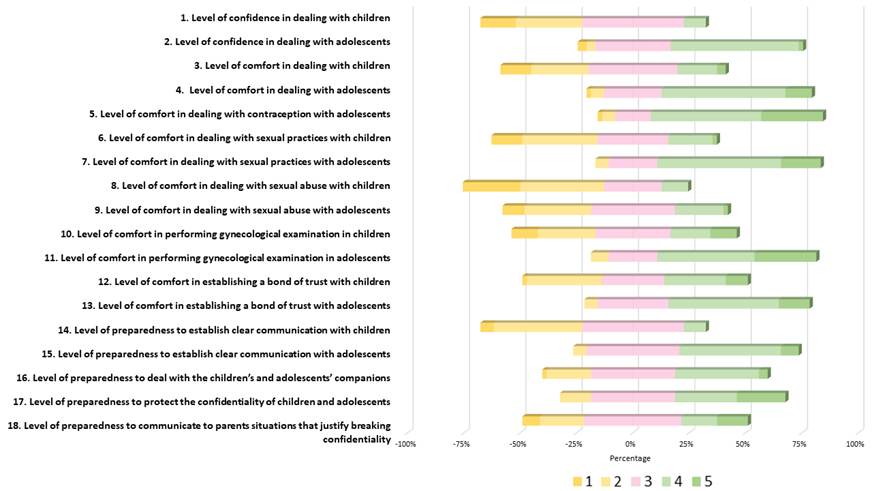
Figure 1 represents the responses to questions about residents’ self-perception regarding care for children and adolescents, assessed using a Likert scale in which 1 refers to the lowest level and 5 to the highest level of confidence/comfort/preparedness, depending on the question. There were eighteen questions on this topic in the questionnaire, so each line in the figure refers to one question. The first and second questions were respectively about the residents’ self-perceived level of confidence in dealing with children and adolescents; the majority answered 3 (45.1%) for children and 4 (56.9%) for adolescents. The third and fourth questions addressed respectively the residents’ self-perceived level of comfort in dealing with children and adolescents; the majority answered 3 (39.2%) for children and 4 (54.9%) for adolescents.
The fifth question assessed the level of comfort in dealing with the topic of contraception with adolescents; the majority answered 4 (49%). The sixth and seventh questions were respectively about the level of comfort in dealing with the topic of sexual practices with children and adolescents, with the majority answering between 2 and 3 (33.3% and 31.4%) for children and 4 (54.9%) for adolescents. The eighth and ninth questions respectively dealt with the level of preparedness in dealing with the topic of sexual abuse with children and adolescents, with the majority answering 2 (37.3%), with a concentration of answers between 1 and 3 for children and 3 (37.3%) with a concentration of answers between 2 and 4 for adolescents. The tenth and eleventh questions addressed, respectively, the level of comfort in performing gynecological examinations on children and adolescents, with the majority answering 3 (33.3%) for children and 4 (43.1%) for adolescents.
The twelfth and thirteenth questions assessed, respectively, the level of comfort in establishing a bond of trust with children and adolescents, with the majority answering 2 (33.3%) for children and 4 (49%) for adolescents. Regarding questions fourteen and fifteen, they dealt respectively with the level of self-perceived preparedness to establish clear communication with children and adolescents, with the majority of responses being between 2 (39.2%) and 3 (45.1%) for children and between 3 (41.2%) and 4 (45.1%) for adolescents.
To conclude the description of figure 1, the majority of responses were between 3 (37.3%) and 4 (37.3%) for question sixteen, which assessed the level of self-perceived preparedness to deal with children’s and adolescents’ companions. In question seventeen, about self-perceived preparedness to defend children’s and adolescents’ confidentiality, if necessary, during gynecological consultations, the majority answered 3 (37.3%). The last question in this section dealt with the level of self-perceived preparedness to communicate to parents/guardians situations that justify breaking confidentiality and the majority of answers were 3 (43.1%).
Table 3, which shows the correct answers to six questions that assessed theoretical knowledge of Pediatric and Adolescent Gynecology, shows that all questions, except the second, had more than 50% correct answers, and the second question was answered correctly by 45.1% of the residents. The first three questions dealt with ethical knowledge, in which hypothetical cases were presented and the residents were asked to choose the most ethically correct option.
The case of the first question was “during a gynecological consultation, you see a 14-year-old girl who has an active sex life and wants your guidance and prescription for the use of contraceptive methods, but she says that her mother is against it”. The second case was “during a gynecological consultation, you see a 16-year-old girl who has an active sex life and wants to have an intrauterine device (IUD) implant, has the clinical indications for this implant, but reports that her mother does not want to authorize it because she thinks it will be too invasive”. The third case was “during a gynecological consultation, you see a 13-year-old girl who, after creating a bond of trust, reveals that she started dating, started her sexual life because she felt forced to do it, and that her boyfriend does not use condoms nor does he want her to use any contraceptive method, since for him it is “nonsense”. But she begs you not to tell her parents”. On the other hand, the last three questions concerned theoretical and technical knowledge, being, in that order, Tanner staging, causes of prepubertal vaginal bleeding and common gynecological causes of secondary dysmenorrhea in an adolescent patient.
DISCUSSION
This study highlighted the fact that the training in Pediatric and Adolescent Gynecology received by most residents in Gynecology and Obstetrics in the state of Bahia was considered insufficient by them, and that they would like more training on the subject. It was observed that in most institutions there is no outpatient clinic or annual exposure to PAG and in most cases, the number of times the subject was discussed in the residency was less than 5 or never. Thus, the same findings were verified in a British study13, where the majority of the residents (93.24%) did not believe they had received adequate exposure to PAG during their training and reported that many hospitals did not have a PAG-dedicated clinic and residents in Gynecology and Obstetrics still have very little experience or exposure to PAG during their training in the assessed institutions.
Two other American studies demonstrated similar findings, with the first14 showing that 63% of the residency programs did not have any formal, dedicated pediatric and adolescent gynecology clinics, while 83% did not have outpatient PAG rotations. The second10 study found that most respondents reported not having PAG clinics or rotations and recalled limited didactic sessions with only 0-2 classes. Moreover, 98% of the university residents and 94% of community residents requested more PAG training.
The present study found that most residents who participated in the study were female, brown, single, attending their second year of residency, with an average age of 28.45 years. American studies also described sociodemographic data. In one of them15, the majority of the residents were aged between 30 and 34 years, slightly older than the average found in this study. However, unlike this study, they were concentrated in the first and fourth years of residency. In another study10, the race reported by the majority was Caucasian and there was a majority of women in both studies, as in the present one.
Regarding the residents’ self-perceived levels of preparedness, comfort and confidence to care for children and adolescents, three American studies corroborate the findings of the present study, since in the first study16, 58% did not feel comfortable evaluating pediatric gynecology patients and 42% did not feel prepared or competent to care for pediatric and adolescent patients. In the second study, it was found that after the introduction of the curriculum, there was an improvement in the resident physicians’ level of comfort and knowledge related to PAG, since comfort increased in examining the genitals of a pediatric gynecology patient (median difference 5.1, 5; p 5.003) and in obtaining history, physical examination skills and management (median difference 5.1; p 5.002) compared to before the introduction of the curriculum17.
Wagner et al. evaluated comfort levels regarding PAG issues on a 5-point scale (1 = low; 5 = high comfort), as did the present study, comparing residents from university and community institutions. It was demonstrated that university residents scored 3.7 with pediatric patients and 4.4 with adolescents. and community residents scored 4.0 in the pediatric age group and 4.3 in the adolescent age group10, showing slightly higher levels of comfort in relation to children and similar levels in relation to adolescents when compared to this study.
As for the residents’ specific theoretical-technical knowledge about Pediatric and Adolescent Gynecology, it is evident in this study that all questions, except the second, had more than 50% of correct answers. Other studies that evaluated such knowledge can be mentioned, with the first analyzing specific knowledge before and after the inclusion of the PAG curriculum and there was no significant difference in the overall score of the questionnaire, so that the score was high in both, with at least 65% of correct answers17. In the second study, the residents answered the knowledge-based questions with familiarity 61% of the time, representing the majority, as in the present study10.
Hirai et al. similarly identified that, in their study, an average score of correct answers was greater than 50% in specific theoretical and technical questions. In more details, the study described that the average scores of the exams before the curriculum was modified were 57% and 87% after the curricular change (p = 0.003), remaining significantly higher after 1-2 years, with average scores of 71% (p = 0.025). It was identified that a formal Pediatric and Adolescent Gynecology curriculum increased exam performance16.
In the study by Huguelet et al, unlike this one, less than 50% of the residents reported adequate knowledge in questions covering Pediatric and Adolescent Gynecology topics. However, after completing the curriculum containing PAG, self-reported knowledge improved in 8 of the 10 learning objectives15.
It is observed that none of the studies found analyzed the knowledge of ethical aspects of Gynecology and Obstetrics residents when dealing with minors during gynecological care. In this sense, the need for new studies that explore this aspect is highlighted, since knowledge of ethical issues, which are often specific, is crucial for the care of this population.
Regarding the study limitations, it is clear that the methodology is observational and cross-sectional, with a convenience sample, which, despite reaching all institutions with residencies in the state, is not necessarily representative of the entire population of Gynecology and Obstetrics residents in the state. However, it is a clear indicator of the lack of effective training in PAG, as well as most residents’ dissatisfaction with this situation. Therefore, it points to a gap that can be reviewed and corrected over time with the implementation of better planning of the pedagogical project of the analyzed residencies, aiming to improve the training of these professionals and, consequently, the gynecological care of children and adolescents.
Finally, it is worth noting that, to the best of our knowledge, this is the first study to evaluate training in Pediatric and Adolescent Gynecology in medical residency programs in Brazil. Thus, it can be used as a reference for conducting studies on the subject in other Brazilian states and regions.
CONCLUSION
Pediatric and Adolescent Gynecology is a very relevant and necessary topic for the training of obstetricians-gynecologists. However, most residents do not undergo adequate training in PAG during their medical specialization years, with little or no theoretical contact with the topic. This study showed that most residents demonstrate theoretical and ethical knowledge of PAG and treat children and adolescents in their clinical practice.
Despite this, residents often feel unprepared, uncomfortable and lack confidence in dealing with this population group, especially children, and would like more training in Pediatric and Adolescent Gynecology in their Medical Residency services.
Finally, it was observed that most of the resident physicians participating in the study do not have specific practice for the development of the interpersonal, behavioral and technical skills necessary to treat minors.
References
-
1 Brasil. Residência médica em obstetrícia e ginecologia [acesso em 26/10/2023]. Disponível em: Disponível em: https://www.gov.br/mec/pt-br/residencia-medica/pdf/matriz-ginecologia-e-obstetricia.pdf/view
» https://www.gov.br/mec/pt-br/residencia-medica/pdf/matriz-ginecologia-e-obstetricia.pdf/view - 2 Stankovic ZB, Tridenti G, Liassides M, Wood PL, Roos EJ. The future of paediatric and adolescent gynaecology in Europe. Eur J Obstet Gynecol Reprod Biol. 2019;235:121-4.
- 3 Adams Hillard PJ. Pediatric and adolescent gynecology: what the generalist ob/gyn needs to know. Clin Obstet Gynecol. 2020;63(3):vii-ix.
- 4 Almeida JAM, Monteiro DLM. Ginecologia e obstetrícia na infância e na adolescência: recomendações da Sogia-BR. Rio de Janeiro: Thieme Revinter Publicações; 2022.
- 5 Federação Brasileira das Associações de Ginecologia e Obstetrícia. Atendendo a adolescente no consultório. São Paulo: Febrasgo; 2017.
- 6 Machado PHR de O, Leite PM, Ferro LD, Carvalho RA, Almeida JP, Terra MC, et al. Ginecologia da criança do adolescente: cenário brasileiro. Braz J Hea Rev. 2021;4(3):11571-7.
- 7 Adams Hillard PJ. Pediatric and adolescent gynecology in practice and residency training. Curr Opin Obstet Gynecol. 2004;16(5):363-5.
- 8 Federação Brasileira das Associações de Ginecologia e Obstetrícia. Necessidades específicas para o atendimento de pacientes adolescentes. São Paulo: Febrasgo ; 2018.
- 9 Brasil. Resolução nº 3, de 8 de abril de 2019. Diário Oficial da União; 11 abr 2019.
- 10 Wagner EA, Schroeder B, Kowalczyk C. Pediatric and adolescent gynecology experience in academic and community OB/GYN residency programs in Michigan. J Pediatr Adolesc Gynecol. 1999;12(4):215-8.
- 11 Rheme MFB, Cabral ZAF, Monteiro DLM, Herter LD, Araújo ESP, Cunha A, et al. 2º Fórum sobre Aspectos Éticos e Legais no Atendimento de Adolescentes. Femina. 2020;48(2):70-81.
- 12 Vinuto JA. A amostragem em bola de neve na pesquisa qualitativa: um debate em aberto. Temáticas. 2014;22(44):203-20.
- 13 Ritchie JK, Sahu B, Wood PL. Obstetric and gynaecology trainees’ knowledge of paediatric and adolescent gynaecology services in the UK: a national qualitative thematic analysis. Eur J Obstet Gynecol Reprod Biol . 2019;235:30-5.
- 14 Solomon ER, Muffly TM, Hood C, Attaran M. Residency training in pediatric and adolescent gynecology across obstetrics and gynecology residency programs: a cross-sectional study. J Pediatr Adolesc Gynecol . 2013;26(3):180-5.
- 15 Huguelet PS, Browner-Elhanan KJ, Fleming N, Karjane NW, Loveless M, Sheeder J, et al. Does the North American Society for Pediatric and Adolescent Gynecology short curriculum increase resident knowledge in pediatric and adolescent gynecology? J Pediatr Adolesc Gynecol . 2016;29(6):623-7.
- 16 Hirai CAM, Chern IY, Kumura NDS, Hiraoka M. Perceptions regarding pediatric and adolescent gynecology training among obstetrics and gynecology residents in Hawai‘i. Soc Welfare. 2021;80(8):1-5.
- 17 Palaszewski DM, Miladinovic B, Caselnova PM, Holmström SW. Impact of a pediatric and adolescent gynecology curriculum on an obstetrics and gynecology residency. J Pediatr Adolesc Gynecol . 2016;29(6):668-72.

 Source: prepared by the authors, 2023.