 Three new species of Lopesia Rübsaamen (Insecta, Diptera, Cecidomyiidae) from Brazil
ABSTRACT
Lopesia rondoniensis Proença & Maia sp.nov., Lopesia tonteleae Proença & Maia sp.nov., and Lopesia matogrossensis Proença & Maia sp.nov., three new species of Cecidomyiidae (Insecta: Diptera) that induce fusiform galls on leaves of Swartzia sp. (Fabaceae), conical galls on leaves of Tontelea sp. (Celastraceae), and lenticular galls on Protium sp. (Burseraceae), respectively, are described and illustrated based on material from Rondônia and Mato Grosso states, Brazil.
Keywords:
Galling insect; gall midge; Amazonian rainforest; Cerrado; taxonomy
Introduction
The genus Lopesia Rübsaamen, 1908 (Diptera, Cecidomyiidae, Lopesiini) has indistinct limits and comprises species with four-segmented palpi or less; male antennae with binodal or gynecoid flagellomeres, and three separated circumfila or interconnected circumfila (as in female); R5 joining C beyond the wing apex; Rs closer to the end of R1 than to the arculus; tarsal claws bowed near the basal third, generally toothed; ovipositor short, barely protrusible and female cerci separate (Rodrigues and Maia, 2010).
This genus is known from 33 species distributed in Nearctic, Neotropical, Afrotropical and Australasia regions. All of them are gall inducer, except Lopesia davillae Maia, 2017. Most of the species are related to Fabaceae, Clusiaceae and Burseraceae (Gagné and Jaschhof, 2025). The 28 species of Lopesia recorded in Brazil are distributed across all biomes, and only the states of Acre (AC), Ceará (CE), Piauí (PI), and Rio Grande do Sul (RS) lack records of the genus (Maia, 2026).
This study aims to describe three new Neotropical species of Lopesia based on morphological characters of males, females, pupae and/or pupal exuvia and larvae of third instar.
Materials and Methods
This work is part of the project “Diptera dos Estados do Mato Grosso, Mato Grosso do Sul e Rondônia: diversidade, sistemática e limites distribucionais” with the aim of inventoring the diversity of dipteran specimens from northern and midwestern Brazil (Lamas et al., 2023).
The fieldwork was conducted for 15 days each, in 10 trails in Chapada dos Guimarães and Cuiabá municipalities, in Mato Grosso state, and in seven trails in three municipalities in the state of Rondônia, in Monte Negro, Campo Novo de Rondônia, and Cacaulândia municipalities. Mato Grosso and Rondônia are two Brazilian states located in areas of Cerrado (savannah) and Amazon rainforest, respectively. In Rondônia, fieldwork was conducted in October 2011 and May 2012, and in Mato Grosso, fieldwork was conducted in September 2011; January 2012; July 2012 and January 2013.
All host plant organs were searched for insect galls, except for the subterranean roots. The galls obtained were photographed using a digital camera, and then individually plastic bags containing a label with information about the locality and date of collection, and also the number of the respective host plant. The host plants received the same label as their corresponding galls and were mounted as exsiccates for later identification. All plants were identified by Dr. Gracialda Ferreira (Dendrologia -UFRA-ICA) and by biologist Manuel Cordeiro, both from the Instituto de Ciências Agrárias do Pará, Universidade Federal Rural da Amazônia (UFRA). The exsiccates were deposited in the herbarium Felisberto Camargo located at UFRA. The galls were characterized according to their shape, color, presence or absence of trichomes, and the number of inner chambers.
The collected material was transferred to the Laboratório de Diptera (Museu Nacional - Rio de Janeiro) where the galls and host plants were processed. A part of the galls was placed in plastic pots and left at room temperature to await the emergence of the gall-inducing adults, and another part of the galls was dissected to collect immature stages of the inducer. Larvae, pupae and adults were prepared and mounted on slides following the methods outlined by Gagné (1994).
The gall midge genus was identified using the key to Neotropical genera provided by Gagné (1994) and the species were determined to be new after morphological comparison based on the literature (original descriptions and illustrations of all described species of Lopesia) (Gagné and Hibbard, 1996; Maia, 2001, 2004; Maia et al., 2002, 2010; Madeira et al., 2002; Narahara et al., 2004; Urso-Guimarães et al., 2015; Maia and Monteiro, 2017), as well as comparison with specimens from the Entomological collection of the Museu Nacional (MNRJ) (Proença and Maia, 2021). The diagnostic characters were illustrated in ink with the aid of a microscope. All images were scanned, vectorized using Sketchbook® and then processed in Photoshop CS6®. For each new species, a male was designated as the holotype and males, females, pupae and/or pupal exuvia, and larvae were designated as paratypes. The material, including the types, was deposited in the Entomological Collection of Museu Nacional, Rio de Janeiro (MNRJ). Morphological terminology follows Gagné (1994).
Results
We obtained material for the description of three new species of Lopesia, two collected in Rondônia, and one in Mato Grosso, Brazil. Lopesia rondoniensis Proença & Maia sp.nov. was collected at Campo Novo in Rondônia municipality (Rondônia), inducing fusiform, green and glabrous gall on leaves of Swartzia sp. (Fabaceae) (Fig. 1a). Lopesia tonteleae Proença & Maia sp.nov. was collected at Cacaulândia municipality (Rondônia state) inducing conical, green and glabrous galls on leaves of Tontelea sp. Miers (Celastraceae) (Fig. 1b). In Brazil, this plant genus is found in Amazonian rainforest, Caatinga, Cerrado and Atlantic forest biomes (JBRJ, 2025). Swartzia can be found as shrubs, trees, or lianas. In Brazil, it occurs in Amazon rainforest, Caatinga, Cerrado, Atlantic forest and Pantanal (JBRJ, 2025). Lopesia matogrossensis Proença & Maia sp.nov. was collected in the Chapada dos Guimarães National Park (Mato Grosso state), inducing lenticular, green and glabrous galls on leaves of Protium sp. (Burseraceae) (Fig. 1c). Species of Protium can be found in Amazon rainforest, Caatinga, Cerrado and Atlantic forest areas (JBRJ, 2025).
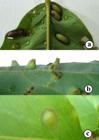
a) Fusiform, green and glabrous gall induced by Lopesia rondoniensis Proença & Maia, sp. nov. on leaves of Swartzia sp. (Fabaceae); b) Conical, green and glabrous galls induced by Lopesia tonteleae Proença & Maia, sp. nov. on leaves of Tontelea sp. Miers (Celastraceae); c) Leaf gall, lenticular, green and glabrous induced by Lopesia matogrossensis Proença & Maia, sp nov. on leaves of Protium sp. (Burseraceae).
Lopesia rondoniensis Proença & Maia sp. nov. (Figs. 2 -4)
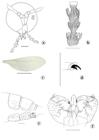
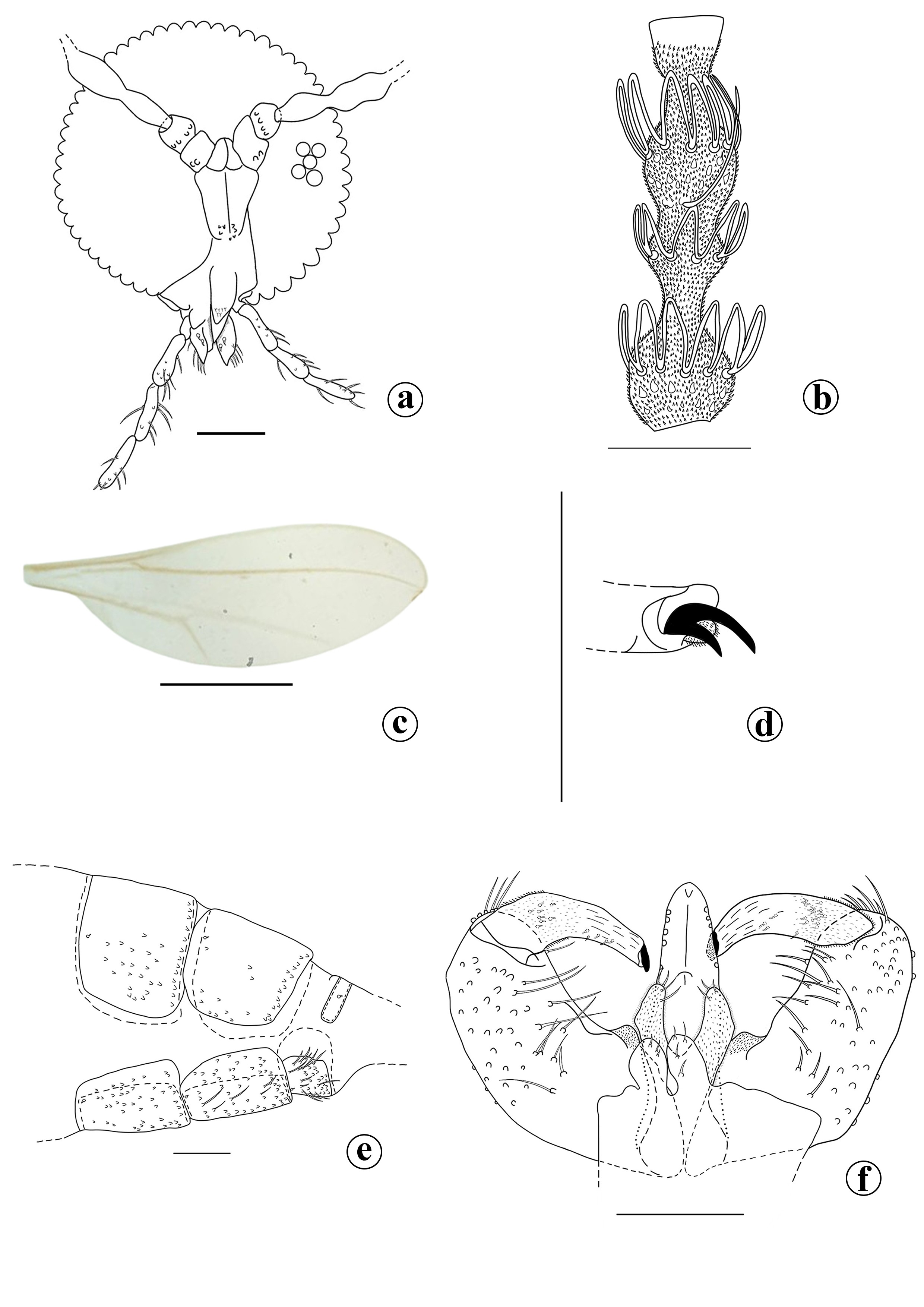
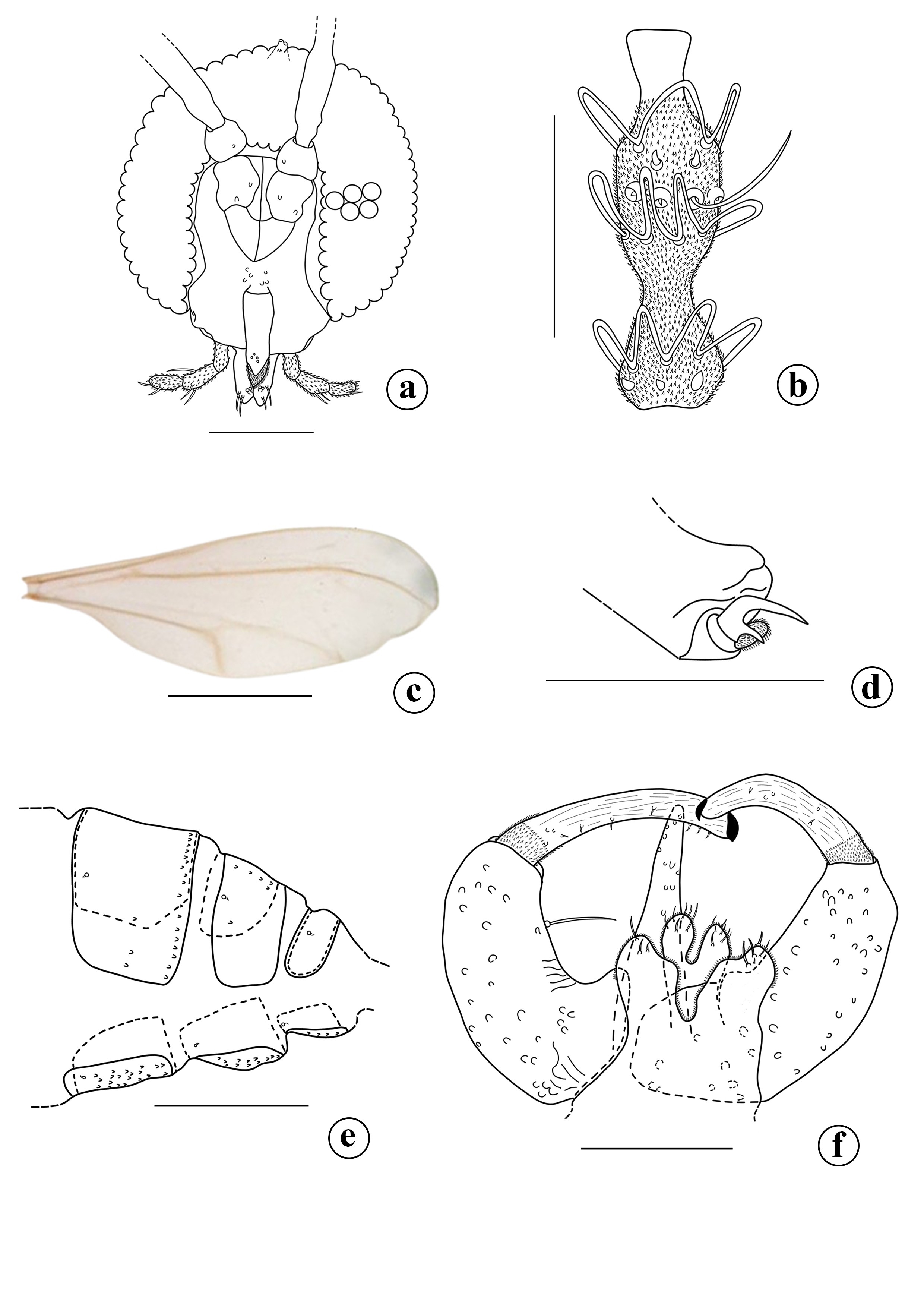
Lopesia rondoniensis Proença & Maia, sp. nov. Male features. (a) head (frontal view); (b) flagellomere V; (c) male wing; (d) tarsal claws and empodium (foreleg, lateral view); (e) abdomen, segments 6-8 (lateral view); (f) terminalia (dorsal view). All scales represent 0.1mm, except the wing, with 0.90 mm.
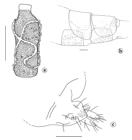
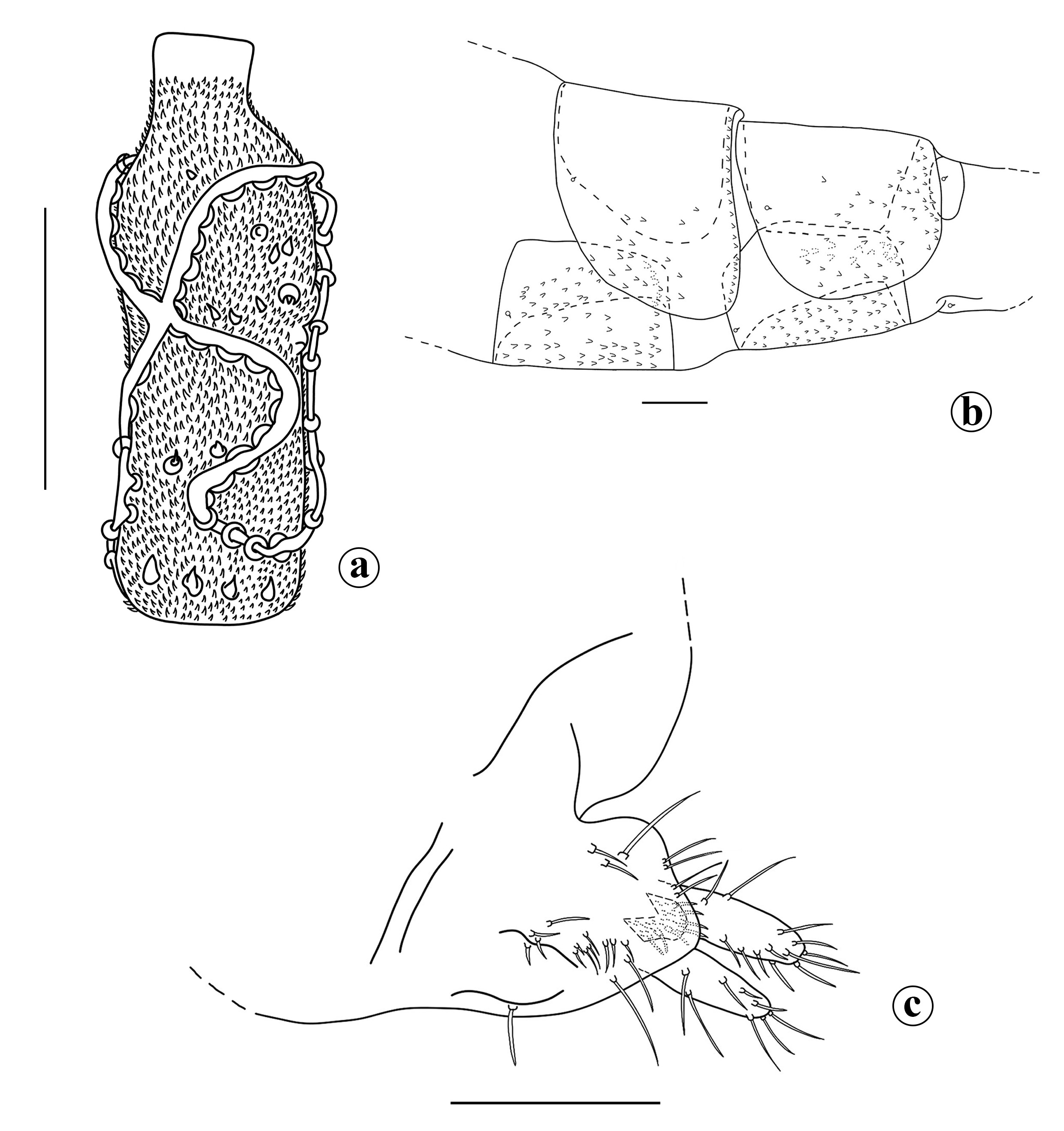
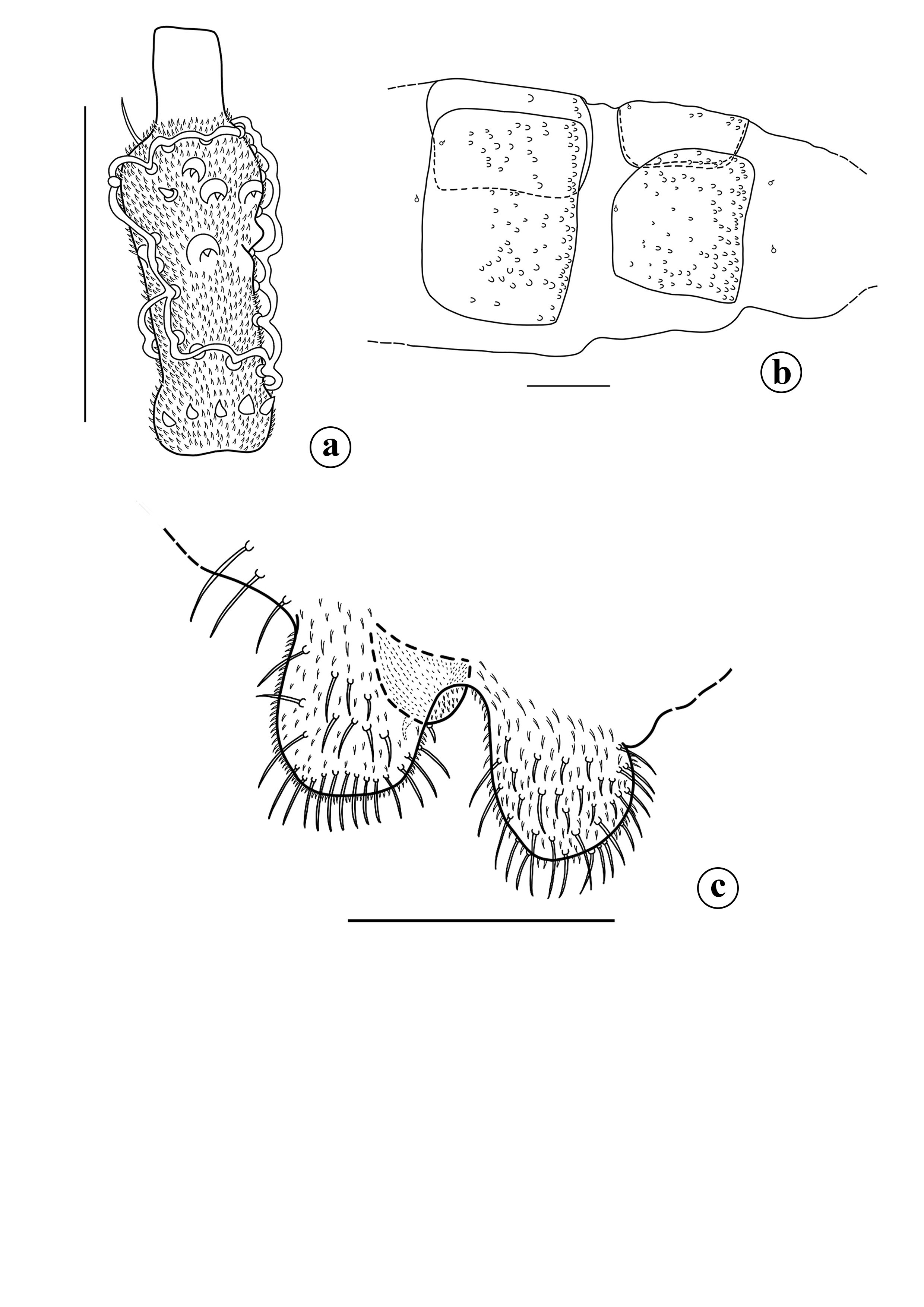
Lopesia rondoniensis Proença & Maia, sp. nov. Female features. (a) flagellomere V; (b) abdomen, segments 6-8 (lateral view); (c) ovipositor (dorsal view). All scales represent 0.1 mm.
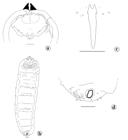
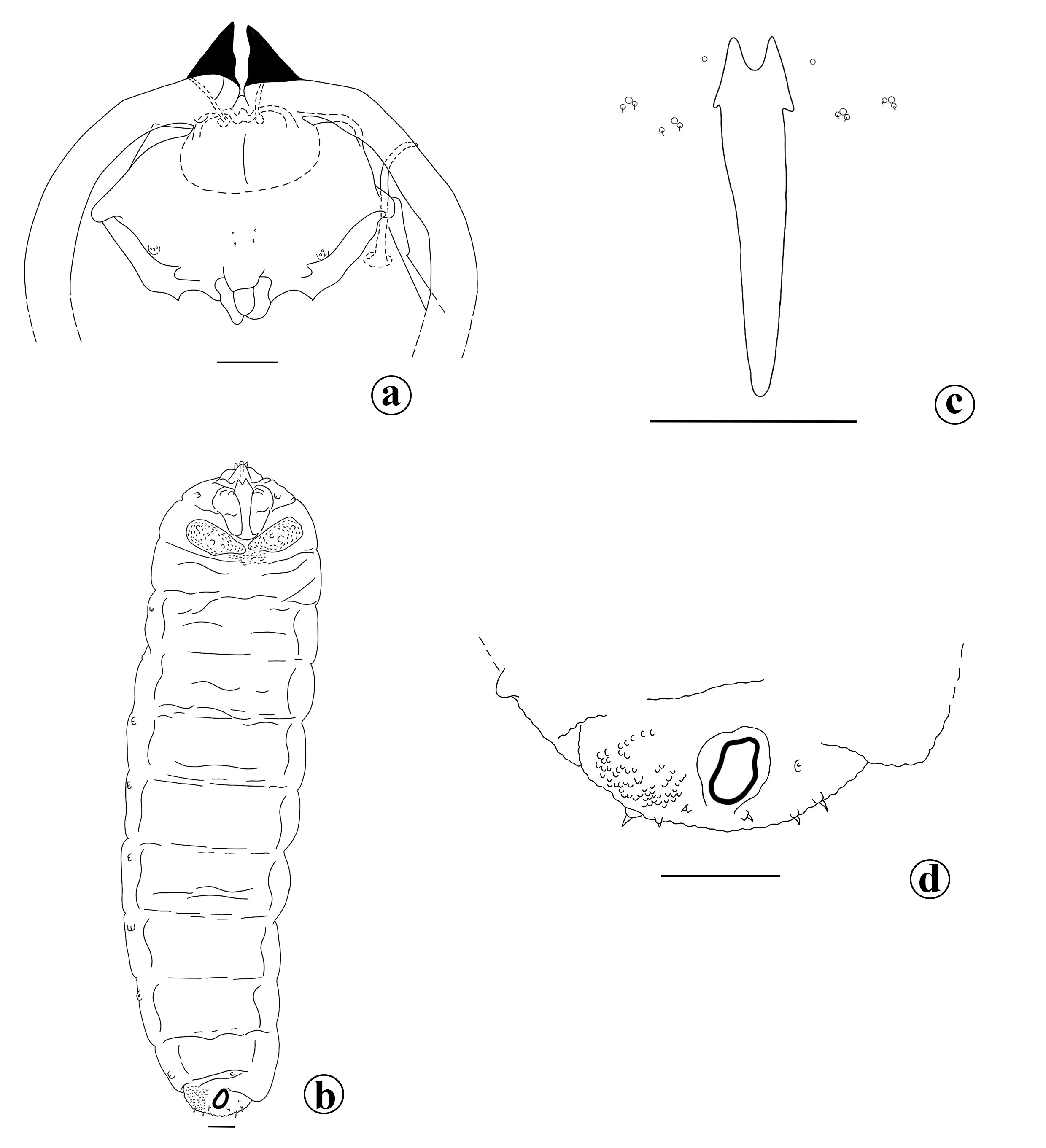
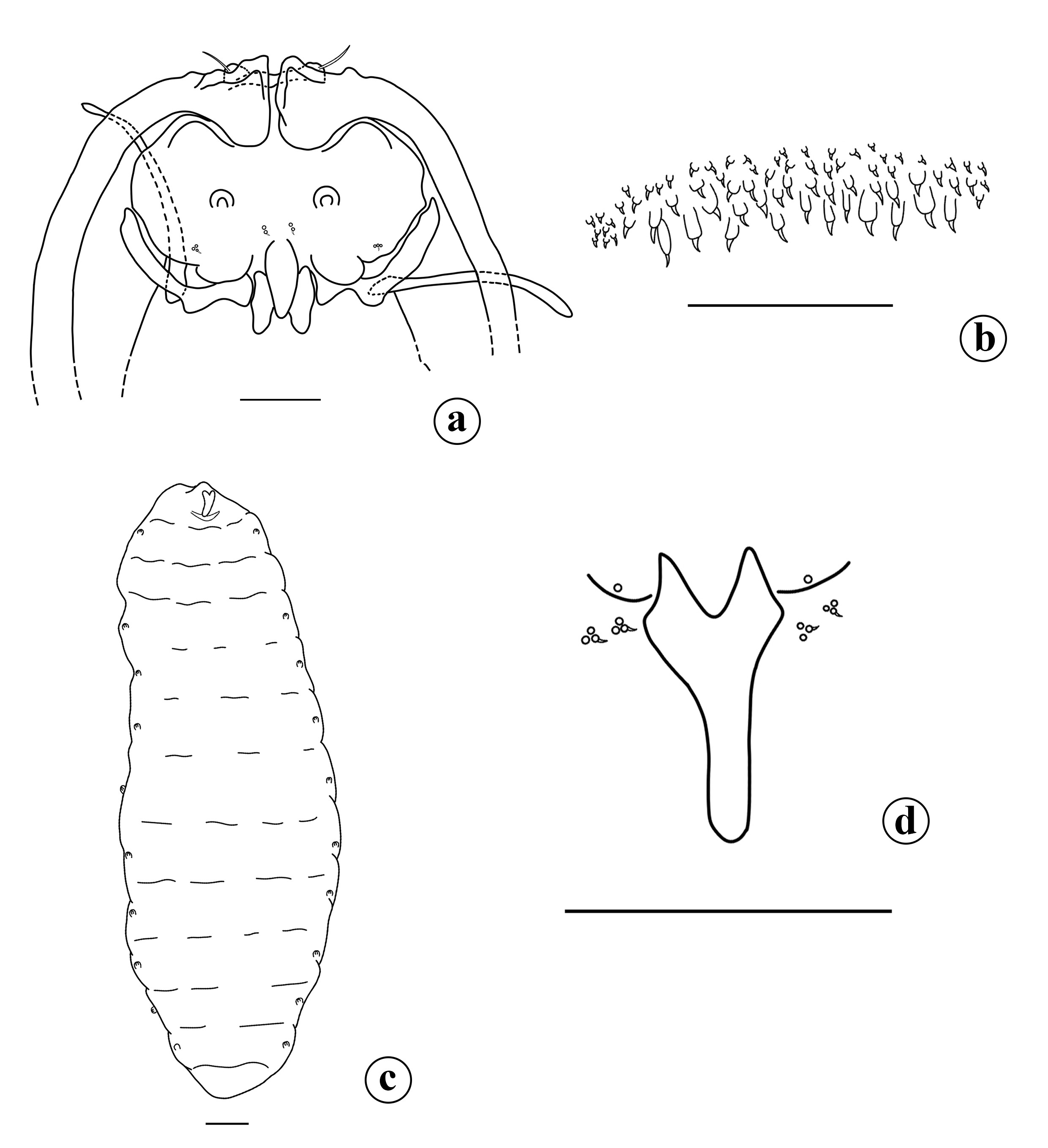
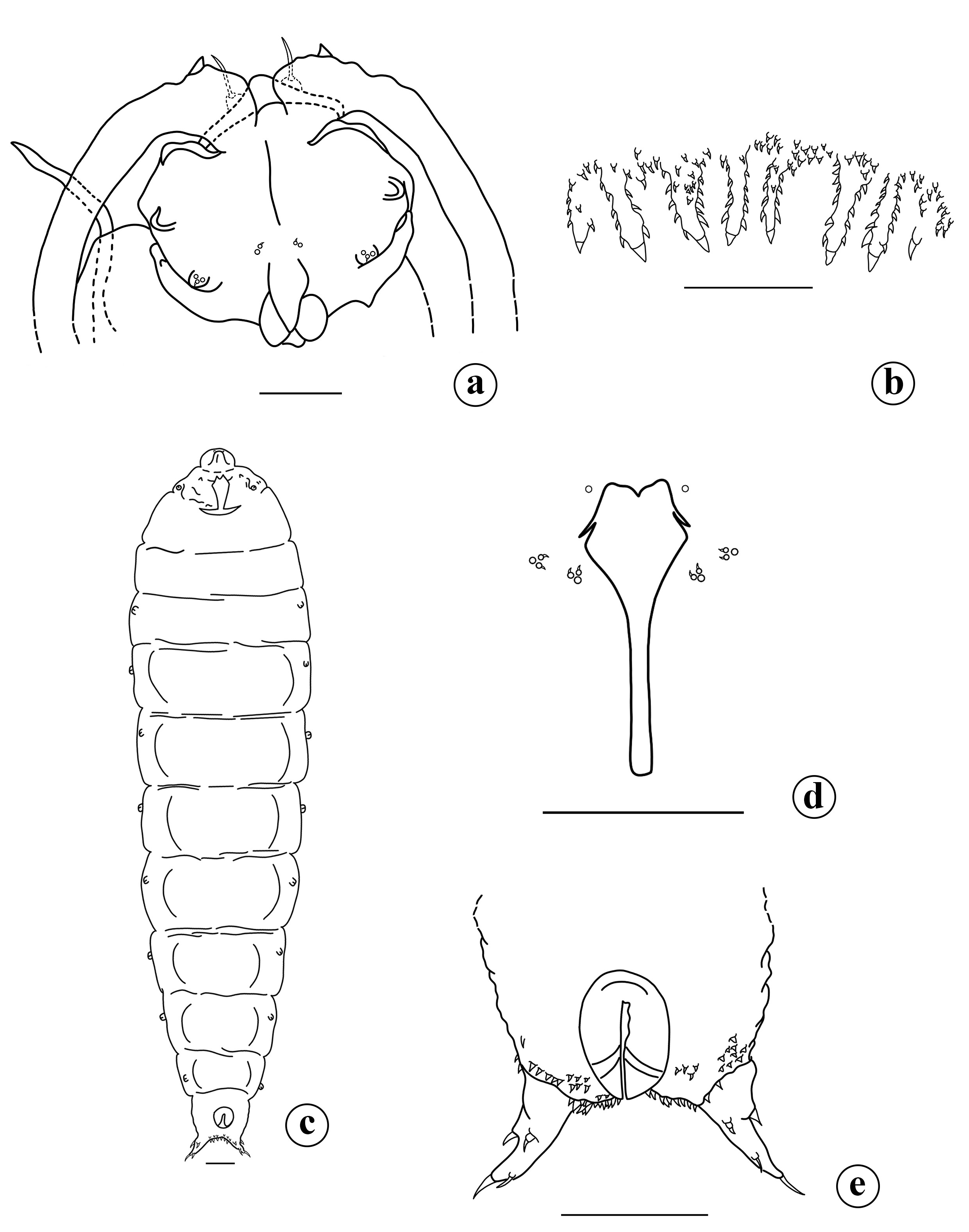
Lopesia rondoniensis Proença & Maia, sp. nov. Immatures. Pupa: (a) head; Larva: (b) general aspect (ventral view); (c) spatula and lateral papillae (ventral view); (d) terminal segment (ventral view). All scales represent 0.1 mm.
urn:lsid:zoobank.org:act:454425B2-00F4-4701-871F-9B5650985245
Diagnosis. Adult: Eyes facets circular, male flagellomeres binodal, both sexes with basal half of the antennal flagellomere necks setulose; male mid-circumfila reduced; female circumfila slightly sinuose; palpi four-segmented; tarsal claws simple, bend at the basal third, empodia reaching the bend in claws; male tergite 8 narrow, band-like, with only anterior pair of trichoid sensilla; gonocoxites wider at the base; gonostylus claviform; cerci rounded; hypoproct bilobate; aedeagus long, slightly glossiform. Female 8th tergite not sclerotized, female cerci elongated, hypoproct pentagonal. Pupae: antennal horns triangular, as long as the apical setae; prothoracic spiracle long, bent; abdominal segments without spines. Larvae: spatula well sclerotized, with two triangular apical teeth; four pairs of corniform papillae; the external one longer than the rest.
Male. Body 2.1 – 3.6 mm long (n=4). Head (Fig. 2a): Occipital process absent; eyes facets circular, all closely approximated, contiguous at vertex. Antenna: scape obconical with 2 setae at the basal margin (n=5); pedicel globoid with 4 setae at the basal margin (n=4). Male antennal flagellomeres binodal, distal node constricted between the two circumfila, and tricircumfilar (one circumfila on basal node, two on distal node), nodes and internodes setulose; setulose basal half of the neck; flagellomeres 1 and 2 connate (n=2). Circumfila loops in different sizes: distal loops slightly longer than the others and middle loop shorter than the others (Fig. 2b). Frontoclypeus with 4-6 setae (n=4); labrum long-attenuate, with sharp apex, with 6 setae (n=3); hypopharynx apically setulose, slightly longer than labrum (n=3); labellae with sharp apex, with 5 pairs of setae and two pairs of short mesal sensory setae (n=4). Palpus four-segmented, setulose, the first shorter (0.04 mm) and the second longer than the others (0.09 mm); segments three and four with the same length (0.08 mm) (n=5). Thorax: wings 2.2-2.4 mm long (n=5) (Fig. 2c). Anepimeron with two irregular rows of setae. Anepisternum with two setae at the posterior margin. Other pleura bare. Scutum with lateral and dorsal setae at the posterior; anterior portion with dorsal setae, forming a single row until the posterior portion. Scutellum with few setae at the posterior portion. Posterior portion of scutellum with few setae. Tarsal claws simple, bend at the basal third, empodia reaching the bend in claws (Fig. 2d). Abdomen (Fig. 2e): Tergites rectangular, more sclerotized and with more setae than the sternites. Both tergites and sternites with scales elsewhere; 1st-6th tergites with posterior row of setae, sparse lateral and median setae, and anterior pair of trichoid sensilla; 7th tergite with posterior row of setae, lateral setae and few mesal setae; 8th tergite narrow, band-like with only anterior pair of trichoid sensilla at the median position; 2nd-7th sternites weakly sclerotized, rectangular, posterior row of setae, scattered setae in the rest of the sternites except nearby the anterior margin and anterior pair of trichoid sensilla; 8th sternite rectangular, narrow, with the same chaetotaxy as the other sternites. Terminalia (Fig. 2f): Gonocoxites elongated, wider at the base, well developed, with obtuse mesobasal lobes, slightly pronounced, setulose. Gonostylus claviform, setulose at basal 1/2; striated at distal 1/2; some sensilla. Cercus setulose, with rounded margins, medially wider than basally, incision U-shaped, shorter than hypoproct, with setae at the apex. Hypoproct setulose, with several apical setae, rounded at the apex, strongly bilobated, lobes widely spaced apart. Aedeagus elongated, rounded at the apex, with asetose lateral papillae.
Female: Body 3.7 – 4.1 mm long (n=4). Flagellomeres cylindrical with circumfila slightly sinuous (Fig. 3a). Wing 2.2-2.9 mm long (n=5). Tergites with anterior pair of trichoid sensilla; 1st-7th tergites rectangular, more sclerotized than sternites, with posterior row of setae, some lateral setae, scattered mesal setae, scales elsewhere; 8th tergite not sclerotized. Sternites with one anterior pair of trichoid sensilla; 2nd-7th sternites sclerotized, rectangular, with posterior row of setae, some lateral setae, scattered mesal setae, scales elsewhere; 8th sternite not sclerotized, with long posterior setae (Fig. 3b). Ovipositor (Fig. 3c): Short, slightly protrusible, with the half of the length of the 7th sternite. Cerci elliptical, with long posterior setae at the dorsal portion; hypoproct with a mesal reentrance at basal margin and rounded at distal margin, with apical setae. Other characters as in male.
Pupa (Fig. 4a): Body 4.0-4.10 mm long (n=5). Integument of antennal horns, apical plate, prothorax, and prothoracic spiracle more sclerotized than the rest of the body. Head: Apical seta 0.07-0.08 mm long (n=5), slightly longer than the antenna’s width. Antennal horns triangular, 0.07-0.08 mm long, as long as the apical setae (n=5). Two pairs of lower facial papillae, one setose and one asetose; two pairs of three lateral facial papillae: one pair setose and two asetose. Thorax: prothoracic spiracle setiform, bent long, 0.28-0.30 mm long (n=5), 3.7 – 4.0 times longer than the apical setae. Wings sheath reaching approximately the distal margin of 3th segment; foreleg sheath reaching the distal 1/3 of 8th segment; mid leg the basal 1/3 of 7th segment; hindleg the distal margin of 5th segment. Abdomen: all segments with spiny integument. Dorsal spines absent.
Third instar larva: Body 2.25-2.30 mm long (n=3), cylindrical and white. Integument dorsal and ventrally rough and striated (Fig. 4b). Spatula well sclerotized, 0.20-0.24 mm long (n =2), with two well-developed triangular teeth. One asetose pair of sternal papillae; two pairs of lateral papillae: one asetose and two setose (Fig. 4c). Four pairs of corniform papillae; the external one longer than the rest (Fig. 4d).
Host plant: Type material collected from Swartzia Schreb. sp. (Fabaceae).
Gall: on leaf, fusiform, light green, glabrous and one chambered.
Etymology. The specific name rondoniensis refers to Rondônia, the Brazilian state where this species was collected.
Type-locality: Campo Novo de Rondônia municipality, Rondônia state, North Brazil.
Material examined:
Holotype: ♂ (slide), BRAZIL, North Brazil, Rondônia state, Campo Novo de Rondônia municipality, Ponto 3 trail, 10°35’26.0”S 63°28’15.5”W, 17.ix.2011, Carvalho-Fernandes, S.P. and Ascendino, S. col., Swartzia Schreb. sp. (Fabaceae), (MNRJ-ENT1 – 71832).
Paratypes: BRAZIL, North Brazil, 3 ♂♂ (MNRJ-ENT1 – 71843, MNRJ-ENT1 – 71839, MNRJ-ENT1 – 71845), 4 ♀ (MNRJ-ENT1 – 71837, MNRJ-ENT1 – 71838, MNRJ-ENT1 – 71844, MNRJ-ENT1 – 71846), 4 pupal exuviae (MNRJ-ENT1 – 71833), 3 pupal exuviae (MNRJ-ENT1 – 71835), 3 pupal exuviae (MNRJ-ENT1 – 71836), 2 pupal exuviae (MNRJ-ENT1 – 71840), 1 pupal exuvia (MNRJ-ENT1 – 71834), 1 pupal exuvia (MNRJ-ENT1 – 71841), and 1 larva (MNRJ-ENT1 – 71842) in permanent slides, same data and collector as holotype (MNRJ). 2♀♀, Monte Negro municipality, Linha C 20 trail, 10°18’29.0”S 63°21’13.8”W, 21.v.2012, Carvalho-Fernandes, S.P. and Ascendino, S. col. (MNRJ-ENT1 – 71847, MNRJ-ENT1 – 71848). 4♀♀ (MNRJ-ENT1 – 71851, MNRJ-ENT1 – 71852, MNRJ-ENT1 – 71853, MNRJ-ENT1 – 71854), 4 pupal exuviae (MNRJ-ENT1 – 71856), 3 pupal exuviae (MNRJ-ENT1 – 71849), 1 pupal exuvia (MNRJ-ENT1 – 71855) and 2 larvae (MNRJ-ENT1 – 71850), Monte Negro municipality, Cachoeira trail, 10º13’43”S 63º14’00”W, and Campo Novo de Rondônia municipality, Fazenda Amorim trail, 10°40’6”S, 63°29’0”W, 25.v.2012, Carvalho-Fernandes, S.P. and Ascendino, S. col.
Comments: The new species is morphologically similar to Lopesia marginalis Maia, 2001, because among all described species of Lopesia only these two share the following set of features: male flagellomeres with the mesal circumfila loops smaller than the apical and distal loops; female circumfila forming an “x” shape; male hypoproct bilobate and longer than cerci; and larval spatula two-toothed with apical teeth triangular. Nevertheless, L. rondoniensis sp.nov. differs from L. marginalis in the following morphological aspects: (1) eyes are circular in L. rondoniensis sp.nov. and hexagonal in L. marginalis; (2) the empodia reach the bend of tarsal claws only in the new species; (3) tarsal claws are toothed in the new species and simple in L. marginalis; (4) in the pupa, the antennal horns are longer in L. rondoniensis sp.nov. than in L. marginalis, and abdominal dorsal spines are absent in the new species; (5) gall shape: L. rondoniensis sp.nov. induces fusiform galls on leaves of Swartzia sp. (Fabaceae); and L. marginalis induces marginal leaf rolls in Couepia ovalifolia (Schott) Benth. (Chrysobalanaceae).
Furthermore, this is the second worldwide record of an association between a species of Cecidomyiidae and a species of Swartzia. The first gall midge recorded from this plant was Burseramyia braziliensis Maia & Fonseca, 2012, collected in areas of Atlantic Forest in Bertioga municipality, São Paulo state, Brazil.
Lopesia tonteleae Proença & Maia sp.nov. (Figs. 5 -7)
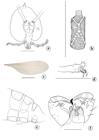
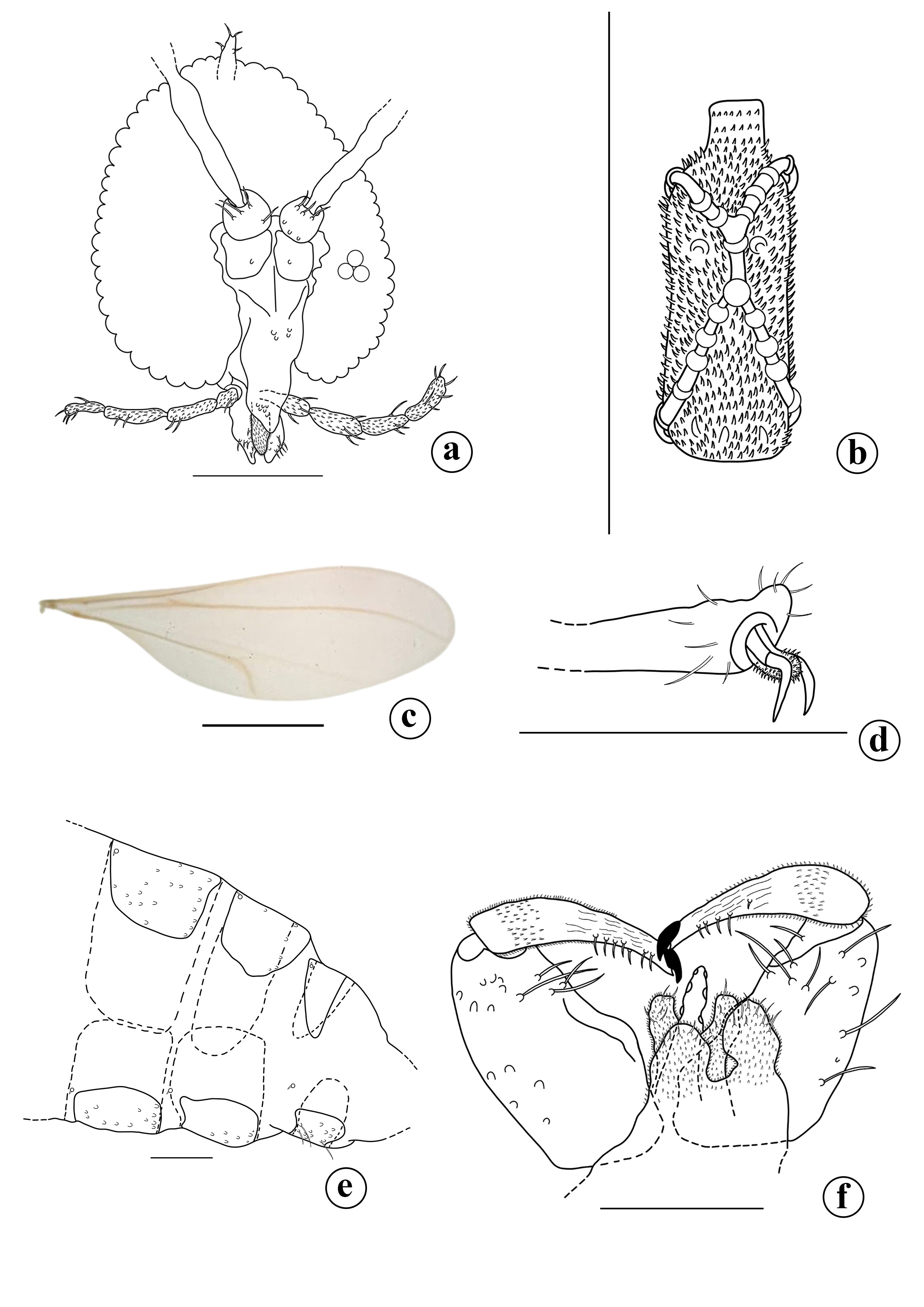
Lopesia tonteleae Proença & Maia, sp. nov. Male features. (a) head (frontal view); (b) flagellomere V; (c) male wing; (d) tarsal claws and empodium (foreleg, lateral view); (e) abdomen, segments 6-8 (lateral view); (f) terminalia (dorsal view). All scales represent 0.1 mm, except the wing, with 0.65 mm.
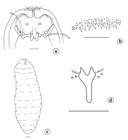
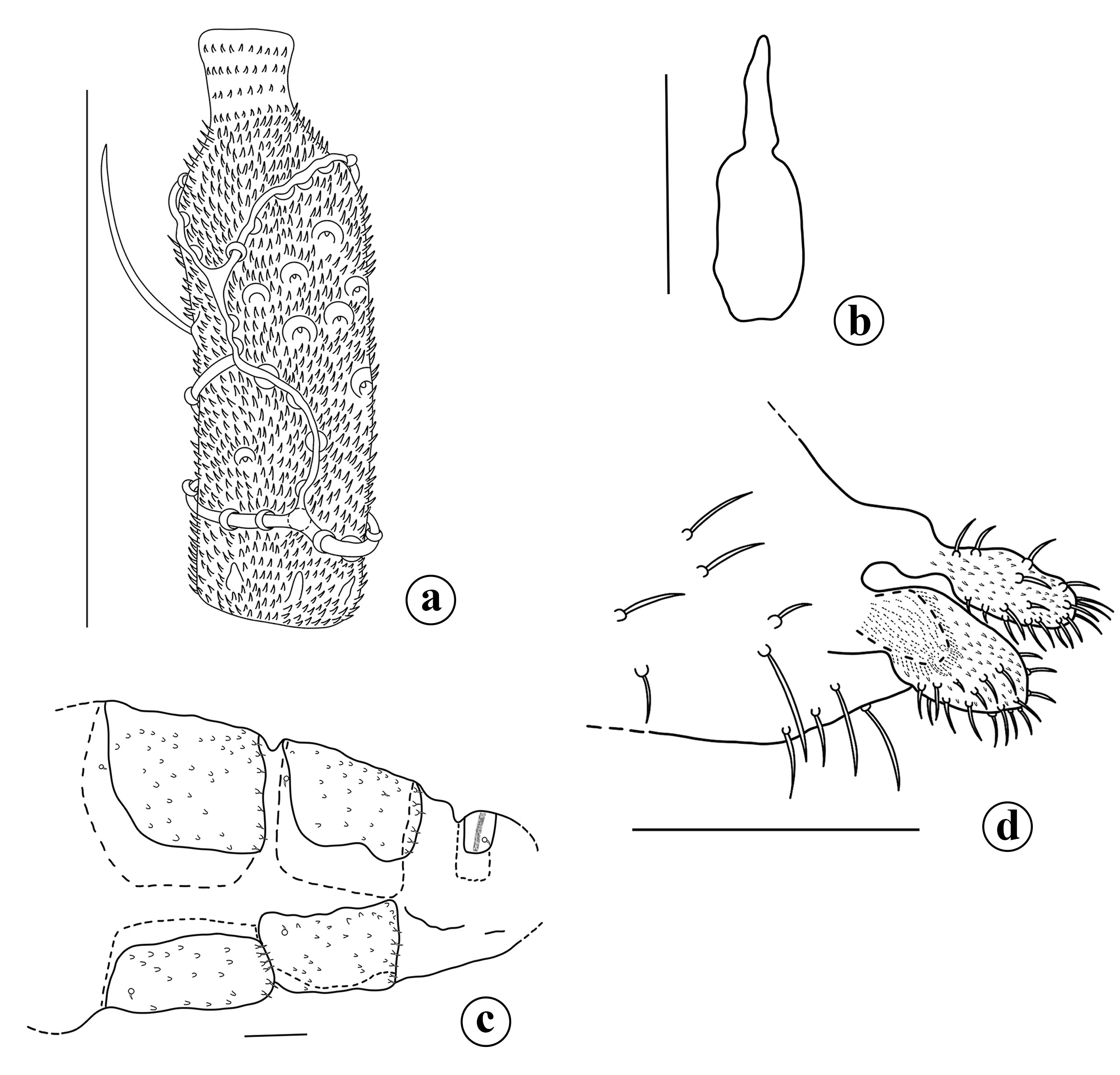
Lopesia tonteleae Proença & Maia. Immatures. Pupa: (a) head; (b) dorsal spines of abdominal segment V (dorsal view); Larva: (c) general aspect (ventral view); (d) spatula and lateral papillae (ventral view). All scales represent 0.1 mm.
urn:lsid:zoobank.org:act:3E0A991B-83BF-4147-8050-302F26D8D98B
Diagnosis. Adult: Eyes facets circular; male with gynecoid flagellomeres; female circumfila sinuose; female 12th flagellomere with fusiform apical process, flagellomeres with setulose neck in both sexes; palpi four-segmented; tarsal claws toothed, bent at basal third; empodia reaching the bend in claws. Male 8th tergite fusiform with only a anterior pair of trichoid sensilla; gonocoxites wider at the base; gonostylus claviform; cerci with two oval lobes; aedeagus triangular. Female 8th tergite weakly sclerotized, with a dark area forming a band nearby the trichoid sensillae; female cerci ovoid; hypoproct ovoid. Pupa: antennal horns short, as long as apical setae, triangular; upper facial horns semicircular; prothoracic spiracle long (5.4-6.0 times longer than apical setae), bent; abdominal segments 3-8 with three rows of spines. Larvae: two-toothed spatula.
Description. Male. Body length: 1.2–2.9 mm (n=16). Head (Fig. 5a): Occipital process present; eyes facets circular, all closely approximated, contiguous at vertex. Antenna 2+12: scape obconical with 5–7 setae (n=8); pedicel globose with 3–6 setae (n=8); flagellomeres cylindrical, setulose, with short setulose neck; setulosity of the neck shorter than the node’s; 1st and 2nd flagellomeres connate; 12th flagellomere with apical process; circumfila not sinuose (Fig. 5b). Frontoclypeus with 4 setae (n=8); labrum long-attenuated with 6 setae (n=7); hypopharynx apically setulose, slightly longer than labrum (n=7); labellae long, sharp at the apex, with 5 pairs of setae and two pairs of short mesal setae (n=4); palpus four-segmented, the first with 0.05 mm and the others with 0.06 mm (n=7). Thorax: Wing 1.3–2.0 mm long (n= 12) (Fig. 5c). Anepimeron with one irregular row of 7–10 setae (n=5). Other pleura bare. Scutum with two rows of dorsocentral setae; a group of lateral setae nearby the anterior area, one group of setae nearby the posterior area. Scutelum with sparse setae. Tarsal claws toothed; bent at basal third; empodia slightly reaching the bend in claws (Fig. 5d). Abdomen (Fig. 5e): Tergites more strongly sclerotized than sternites; with one pair of trichoid sensilla at the anterior margin; 1st-6th tergites with a posterior row of setae, mesal setae more abundant and sparse, some lateral setae, and scales elsewhere; 7th slightly shorter than 6th, with a posterior row of setae, no mesal and lateral setae, scales elsewhere; 8th tergite fusiform, shorter than the rest, without setae and scales. Sternites rectangular, narrower than tergites, with a pair of trichoid sensilla at the anterior margin; 2nd-8th sternites with a posterior row of setae, mesal setae irregularly distributed, and lateral setae; 2nd-7th sternites with scales elsewhere; 8th sternite with scales elsewhere except at the sub-basal area. Terminalia (Fig. 5f): gonocoxites well developed, wider at the base, with sparse setae, with rounded mesobasal lobes. Gonostylus claviform, elongated, shorter than gonocoxites, with a well sclerotized tooth at the apex, setulose at base, striated beyond. Cerci with two oval lobes, separated by a straight margin, setulose at all extension, with apical setae. Hypoproct setulose, longer than cerci, with two lobes, widely separated, narrower than the cercal lobes, with a convex margin and small apical setae. Aedeagus triangular, long, with asetose lateral papillae.
Female. Body length 1.8–3.0 mm (n=8). Flagellomeres cylindrical, circumfila sinuose (Fig. 6a), 12th flagellomere with apical process, flagellomeres with setulose neck (Fig. 6b). Wing: 2.0–2.5 mm long (n=8). Abdomen (Fig. 6c): all tergites rectangular, with a pair of trichoid sensillae; 1st-7th tergites more sclerotized than sternites, with a row of setae at posterior margin, mesal setae irregularly distributed, lateral setae, and scales elsewhere; 8th tergite weakly sclerotized, bare, with scales elsewhere and with a dark area forming a band nearby the trichoid sensillae; 2nd-7th sternites rectangular, narrower than tergites, posterior margin with a row of setae, mesal setae more abundant and irregularly distributed, scales elsewhere, a pair of trichoid sensillae; 8th sternite not sclerotized and bare. Ovipositor (Fig. 6d): short, with twice the length of the 7th sternite length, slightly protrusible, with separate cerci, ovoid, setulose, with dorsal setae longer than the ventral setae; setae concentrated at apical and ventral margins; hypoproct ovoid, setulose, with one pair of setae at the apex. Other characters as in male.
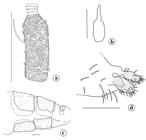
Lopesia tonteleae Proença & Maia. Female features. (a) flagellomere V; (b) flagellomere XII; (c) abdomen, segments 6-8 (lateral view); (d) ovipositor (dorsal/lateral view). All scales represent 0.1 mm.
Pupa: 1.5-2.2 mm long (n=3). Integument weakly sclerotized, except on the prothoracic spiracle, apical margin of the apical plate and apical margin of antennal horns. Head (Fig. 7a): integument rough laterally and smooth on the front, apical seta filiform, long, about 0.03–0.05 mm long (n=7); apical plate with rough integument in all extension, anterior margin with abundant short spines. Antennal horns sclerotized, smooth, triangular, short, 0.03–0.05 mm long (n=8), as long as apical setae. Antennal sheath with rough base. Two pairs of lower facial papillae: one asetose and one setose. Three pairs of lateral facial papillae: one setose and two asetose. Upper facial horns semicircular. Thorax: prothoracic spiracle strong sclerotized, long, 0.18-0.27 mm long (n=7), bent, with sharp apex, four times longer than the apical setae. Wings sheath reaching the posterior margin of 4th segment; fore, mid and hind legs sheath reaching the half of the 6th segment. Abdomen (Fig. 7b): 1st segment with spiny integument; 2nd and 3rd segments with 3 rows of small spines, weakly sclerotized; 3rd-8th segment with 3 rows of spines, well sclerotized, of increasing size, nearby the basal margin of each tergite, integument spiny except for a median elliptical area.
Third instar larva: Body: 1.9–2.1 mm long (n=2), cylindrical (Fig. 7c). Spatula strongly sclerotized, 0.2-0.3 mm long (n=2), with two well-developed teeth, parallel, triangular, well separated from each other. Spatula shaft slightly short, with truncate base (Fig. 7d). One asetose pair of sternal papillae; two groups of three lateral papillae on each side of the spatula, each group with two asetose papillae and one setose papillae. Terminal segment damaged.
Host plant: Type material collected from Tontelea Miers sp. (Celastraceae)
Gall: on leaf, conical, with a concavity at the apex, green, glabrous and one-chambered.
Etymology: The specific epithet “tonteleae” is the genitive of the host plant genus.
Type-locality: Cacaulândia municipality, Rondônia state, North Brazil.
Material examined:
Holotype. ♂ (slide), BRAZIL, North Brazil, Rondônia state, Cacaulândia municipality, Fazenda do Cabeça trail, 25.v.2012, Maia, V.C. and Ascendino, S. col., on Tontelea Miers sp. (Celastraceae) (MNRJ- ENT1 - 71796).
Paratypes. BRAZIL, North Brazil, 4♀♀ (MNRJ-ENT1 – 71810, MNRJ-ENT1 – 71811, MNRJ-ENT1 – 71812, MNRJ-ENT1 – 71815, MNRJ-ENT1 – 71817, MNRJ-ENT1 – 71823), 5 ♂♂ (MNRJ-ENT1 – 71813, MNRJ-ENT1 – 71814, MNRJ-ENT1 – 71822, MNRJ-ENT1 – 71818, MNRJ-ENT1 – 71819), 5 pupal exuviae (MNRJ-ENT1 – 71820), 4 pupal exuviae (MNRJ-ENT1 – 71816), 3 pupal exuviae (MNRJ-ENT1 – 71821) Cacaulândia municipality, Fazenda do Cabeça trail, 15.ix.2011. 6 ♂♂ (MNRJ- ENT1 - 71797, MNRJ-ENT1 – 71798, MNRJ-ENT1 – 71806, MNRJ-ENT1 – 71807, MNRJ-ENT1 – 71808, MNRJ-ENT1 – 71809) 25.v.2012, same collectors and locality. 5 ♂♂ (MNRJ- ENT1 - 71799, MNRJ-ENT1 – 71801, MNRJ-ENT1 – 71802, MNRJ-ENT1 – 71803, MNRJ-ENT1 – 71805), 1 ♀ (MNRJ-ENT1 – 71800), 2 larvae (MNRJ-ENT1 – 71804), Monte Negro municipality, Linha C 20 trail, 19.v.2012, Carvalho-Fernandes, S.P. and Ascendino, S. col.
Comments:
This is the first record of the genus Tontelea Miers as a host plant for insect galls to Amazon rainforest. This is also the first record of a species of Lopesia inducing galls on a species of the family Celastraceae. According to the key to Neotropical genera of Cecidomyiidae by Gagné (1994), this new species cannot be placed in Lopesia, because at this time, only one species was known to have toothed tarsal claw. Since then, five new species with simple tarsal claws were described: Lopesia eichhorniae Urso-Guimarães, 2015; L. licaniae Gagné, 1996; L. mimosae Maia, 2010; L. pernambucensis Maia, 2010 and L. spinosa Maia, 2004. The new species hereby described is morphologically more similar to L. caulinaris Maia, 2002 because among all described species of Lopesia only both share the following set of features: gynecoid male antennae, four segmented palpus, flagellomere necks setulose in both sexes, pupa with simple antennal horns and abdominal spines, and larval spatula 2-toothed. However, the new species differs from L. caulinaris in the following ways: adults with simple tarsal claws, bend in its half, while in the other species the tarsal claws have two basal teeth, and its bent near the basal third. The empodia in L. caulinaris is shorter than the tarsal claws bent, different from the new species. These two species also differ in the shape of the 8th female tergite - rectangular and reduced in the new species, and divided into two vertical bands in L. caulinaris. The pupa has longer antennal horns than the pupa of L. caulinaris, and the abdominal spines are distributed in three rows in L. tonteleae sp.nov. and in only one row in L. caulinaris. The larvae has a shorter stalk in the new species, whereas in L. caulinaris it is well developed. Furthermore, this is the first record of Cecidomyiidae on Tontelea.
Lopesia matogrossensis Proença & Maia sp.nov. (Figs. 8 -10)
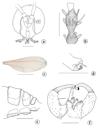
Lopesia matogrossensis Proença & Maia. Male features. (a) head (frontal view); (b) flagellomere V; (c) wing; (d) tarsal claws and empodium (foreleg, lateral view); (e) abdomen, segments 6-8 (lateral view); (f) terminalia (dorsal view). All scales represent 0.1 mm, except the wing, with 0.70 mm.
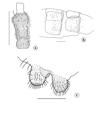
Lopesia matogrossensis Proença & Maia. Female features. (a) flagellomere V; (b) abdomen, segments 6-8 (lateral view); (c) ovipositor (dorsal view). All scales represent 0.1mm.
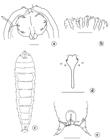
Lopesia matogrossensis Proença & Maia. Immatures. Pupa: (a) head; (b) dorsal spines of abdominal segment V (dorsal view); Larva: (c) general aspect (ventral view); (d) spatula and lateral papillae (ventral view); (e) terminal segment (ventral view). All scales represent 0.1mm.
urn:lsid:zoobank.org:act:07498858-AFC8-467E-BBA3-FE37A007E67E
Diagnosis. Adult: eye facets circular. Reduced male basal circumfila. Male flagellomere 12 with fusiform apical process. Flagellomeres with bare neck in both sexes. Palpi three-segmented. Tarsal claws one-toothed, bent at its midlength; empodia, short, not reaching the bend in claws. Male 8th tergite rectangular, narrow, with only a pair of trichoid sensilla as vestiture. Gonocoxites with mesobasal lobes; striate and elongate gonostylus cylindrical; cerci rounded, shorter than hypoproct; hypoproct bilobate; aedeagus triangular. Female 8th tergite not sclerotized with only a pair of trichoid sensilla as vestiture, cerci ovoid, not fused; hypoproct semicircular. Pupal exuviae: antennal horns short (slightly shorter or equal to apical setae); upper facial horns absent; prothoracic spiracle long and bent (five times longer than the apical setae); abdominal segments 2-8 with a row of serrate spines. Larvae: spatula two-toothed, with shallow teeth; terminal segment bilobated with four pairs of corniform terminal papillae.
Description. Male. Body length: 1.5-2.0 mm (n= 5): Head (Fig. 8a): Occipital process present. Eyes facets circular, all closely approximated, contiguous at vertex. Antenna: scape obconical with 2-3 setae at the basal margin (n=3); pedicel globose with 2-3 setae at the basal margin (n=3). Flagellomeres binodal and tricircumfilar (one circumfila on basal node, two on distal node) with bare neck (Fig. 8b); flagellomeres 1 and 2 not connate; loops of the basal circumfila shorter than the distal and middle loops; 12th flagellomere with fusiform apical process. Frontoclypeus with 2-3 setae (n=3); labrum with sharp apex, with 4 setae (n=3); hypopharynx apically setulose, slightly longer than labrum (n=3); labellae with sharp apex, with 2 pairs of setae and two pairs of short mesal sensory setae (n=3). Palpus three-segmented, setulose, the second longer than the rest (0.04 mm), segments 1 and 3 subequal in length (0.03 mm) (n=1). Thorax: Wings 2.1–2.8 mm long (n= 6) (Fig. 8c). Anepimeron with a row of setae. Other pleura bare. Scutum with two rows of dorsocentral setae; two rows of lateral setae; a group of lateral setae nearby the anterior area, forming a row of setae until de final portion of the scutum; Scutelum with sparse setae. Tarsal claws one-toothed, bent at the half; empodia short, setulose, not reaching the bend in claws (Fig. 8d).Abdomen (Fig. 8e): tergites more strongly sclerotized than sternites; both covered with scales; 1st-6th tergites rectangular, with a posterior row of setae; few mesal and lateral setae; bare discal portion; with one pair of trichoid sensilla at the anterior margin; 7th tergite rectangular; with lateral setae; absent posterior row of setae; one pair of trichoid sensilla at the anterior margin; 8th tergite rectangular, narrow, with only a pair of trichoid sensilla as vestiture. 2nd-7th sternites rectangular; a row of posterior setae; setae distributed all over its extension, more abundant than the setae on the tergites; with one pair of trichoid sensilla at the anterior margin. Terminalia (Fig. 8f): gonocoxites well developed, wider at the base, long, obtuse mesobasal lobes, with small setae. Gonostylus cylindrical, long, setulose at base and striated elsewhere. Cercus setulose with rounded lobes, separated from each other by a deep U-shaped incision, with apical margin irregular, shorter than the hypoproct; with apical setae. Hypoproct deeply bilobed, lobes not spaced apart, rounded at the apex, setulose, with several apical setae. Aedeagus long, triangular, with asetose lateral papillae.
Female: Body 2.5-3.1 mm long (n= 7). Flagellomeres cylindrical, circumfila sinuous (Fig. 9a). All specimens with broken antennae. Wings 3.5– 4.1 mm long (n=6). Tergites more strongly sclerotized than sternites; rectangular; covered with scales; 1st-7th tergites strongly sclerotized; with a posterior row of setae; sparse lateral and mesal setae; one pair of trichoid sensilla at the anterior margin; 8th tergite not sclerotized with only a pair of trichoid sensilla as vestiture. Sternites rectangular; with more setae than the tergites; covered with scales. 2nd-7th sternites with a posterior row of setae; some setae distributed mesally, more concentrated at the lateral area; one pair of trichoid sensilla at the anterior margin; 8th sternite not sclerotized with only a pair of trichoid sensilla as vestiture (Fig. 9b). Ovipositor (Fig. 9c): short, slightly protrusible, cerci ovoid, not fused; with dorsal, ventral and apical setae. Hypoproct semicircular, setulose, with two apical setae. Other characters as in male.
Pupa: Body 2.8-3.2 mm long (n=4). Integument sclerotized. Head (Fig. 10a): apical seta filiform, 0.05 mm long (n=4), surpassing the antennal bases. Antennal horns short with sharp apex, strongly sclerotized, 0.03-0.05 mm long (n=5) slightly shorter or equal to apical setae. Upper apical margin laterally thickened. Two pairs of lower facial papillae: one asetose and one setose. Three pairs of lateral facial papillae: two asetose and one setose. Apical integument smooth with lateral rough areas. Thorax: prothoracic spiracle strongly sclerotized, setiform, bent, long, 0.25 mm long (n=6), five times longer than the apical setae. Wings sheath reaching the anterior margin of segment 3; front and median legs subequal in length, reaching the anterior portion of segment 5; hind legs reaching the half of the segment 5. Abdomen (Fig. 10b): 1st segment with spiny integument; 2nd-8th segments with spiny integument, the spines longer than those of the 1st segment; a row of serrate spines at the dorsal area. Number of spines reduced on 8th segment. Male 8th segment with three spines; female 8th segment with 1 spine. Both sexes with two dorsal corniform projection strongly sclerotized in 8th segment.
Third instar larva: Body 1.15-1.20 mm long (n=3), fusiform, with white coloration (Fig. 10c). Integument dorsal and ventrally rough. Spatula well developed, 0.15-0.20 mm long (n=3) with two divergent teeth, rounded at the apex, shallow, serrated at the middle region of the inner margin, with a slightly lateral triangular process (Fig. 10d). Spatula shaft long, sharp; posterior portion truncate or widest posteriorly. Sternal papillae asetose. Two pairs of lateral papillae: one asetose and two setose. Terminal segment bilobated, long, with four pairs of corniform papillae, unequal in length (Fig. 10e).
Host plant: Type material collected from Protium Burm.f. sp. (Burseraceae)
Gall: on leaf, circular, green, glabrous and one chambered.
Etymology: The specific name matogrossensis refers to Mato Grosso state, in Brazil, where this species was collected.
Type-locality: Parque Nacional da Chapada dos Guimarães, Cuiabá and Chapada dos Guimarães municipalities, Mato Grosso state, Midwest Brazil.
Material examined:
Holotype. ♂ (slide), BRAZIL, Midwest Brazil, Cuiabá and Chapada dos Guimarães municipality, Parque Nacional da Chapada dos Guimarães, Interditada trail, 19.i.2012, Rodrigues, A.R. col., Protium Burm.f. sp. (Burseraceae), (MNRJ – ENT1- 71824).
Paratypes. BRAZIL, Midwest Brazil, 2 ♂♂ (MNRJ-ENT1 – 71827, MNRJ-ENT1 – 71831), 1 ♀, 3 pupal exuviae (MNRJ-ENT1 71830, MNRJ-ENT1 – 71829, MNRJ-ENT1 – 71828) and 8 larvae (MNRJ-ENT1 – 71826, MNRJ-ENT1 – 71825), same data and collectors.
Comments: The new species is morphologically similar to Lopesia bilobata Maia, 2003 because among all described species of Lopesia only these two share the following characters: adults with occipital process present; male flagellomeres with neck bare; empodia shorter than tarsal claws; pupal antennal horns simple, short and triangular; larva with two-toothed spatula and bilobated terminal segment. In addition, both species induce lenticular galls. However, the male circumfila have short loops in L. bilobata and long loops in the new species; the male cerci have a deep U-shaped incision, irregular apical margin, and narrower lobes in L. matogrossensis sp.nov. whereas in L. bilobata the cerci have shallow incision, regular apical margin, and wider lobes. The ovipositor is shorter in the new species; pupa has dorsal spines longer and numerous in the new species than in L. bilobata. Furthermore, the new species induces galls on Protium sp. (Burseraceae), whereas L. bilobata induce galls on Guapira sp. (Nyctaginaceae). Ten gall midges are known from Protium species, three of them belong to Lopesia: L. maricaensis Rodrigues & Maia 2010; L. similis Maia, 2004 and L. simplex Maia, 2002.
Acknowledgements
We thank to Alene Rodrigues, Sharlene Ascendino and Sheila Patrícia Carvalho-Fernandes for the field work and all the researchers involved on the Sisbiota Diptera project.
Data statement
The data supporting the findings of this study are included in the article.
-
urn:lsid:zoobank.org:pub:007D23FF-8B8F-4F1B-885E-89565CF0D9E2
-
Funding
This study was supported by CNPq (Conselho Nacional de Desenvolvimento Científico e Tecnológico, Proc. 563256/2010-9).
References
- Gagné, R. J., 1994. The Gall Midges of the Neotropical Region. Cornell University Press, Ithaca, 352 pp.
-
Gagné, R. J., Hibbard, K. L., 1996. A new species of gall midge (Diptera: Cecidomyiidae) from subterranean stem galls ofLicania michauxii(Chrysobalanaceae) in Florida. Fla. Entomol. 79 (3), 428-434. https://doi.org/10.2307/3495593
» https://doi.org/10.2307/3495593 - Gagné, R. J., Jaschhof, M., 2025. A Catalog of the Cecidomyiidae (Diptera) of the World. 6th ed. USDA, Washington, D.C., 818 pp.
-
Jardim Botânico do Rio de Janeiro – JBRJ, 2025. Flora and Funga do Brasil. JBRJ, Rio de Janeiro. Available in: https://reflora.jbrj.gov.br (accessed 8 November 2025).
» https://reflora.jbrj.gov.br -
Lamas, C. J. E., Fachin, D. A., Falaschi, R. L., Alcantara, D. M. C., Ale-Rocha, R., Amorim, D. S., Araújo, M. X., Ascendino, S., Baldassio, L., Bellodi, C. F., Bravo, F., Calhau, J., Capellari, R. S., Carmo-Neto, A. M., Cegolin, B. M., Couri, M. S., Carvalho, C. J. B., Dios, R. V. P., Falcon, A. V. G., Fusari, L. M., Garcia, C. A., Gil-Azevedo, L. H., Gomes, M. M., Graciolli, G., Gudin, F. M., Henriques, A. L., Krolow, T. K., Mendes, L. L., Limeira-de-Oliveira, F., Maia, V. C., Marinoni, L., Mello, R. L., Mello-Patiu, C. A., Morales, M. N., Oliveira, S. S., Patiu, C., Proença, B., Pujol-Luz, C. V. A., Pujol-Luz, J. R., Rafael, J. A., Riccardi, P. R., Rodrigues, J. P. V., Roque, F. O., Sallum, M. A. M., Santis, M. D., Santos, C. M. D., Santos, J. R., Savaris, M., Shimabukuro, P. H. F., Silva, V. C., Schelesky-Prado, D. C., Silva-Neto, A. M., Camargo, A., Sousa, V. R., Urso-Guimarães, M. V., Wiedenbrug, S., Yamaguchi, C., Nihei, S. S., 2023. The SISBIOTA-Diptera Brazilian network: a long-term survey of Diptera from unexplored Brazilian Western Arc of Amazon, Cerrado, and pantanal. Rev. Bras. Entomol. 67 (4), e20230051. https://doi.org/10.1590/1806-9665-rbent-2023-0051
» https://doi.org/10.1590/1806-9665-rbent-2023-0051 - Madeira, J. A., Maia, V. C., Monteiro, R. F., 2002. Gall makers (Cecidomyiidae, Diptera) onCalophyllum brasilienseCamb. (Clusiaceae): descriptions and biology. Arq. Mus. Nac. 61, 31-48.
-
Maia, V. C., 2001. New genera and species of gall midges (Diptera, Cecidomyiidae) from three restingas of Rio de Janeiro State, Brazil. Rev. Bras. Zool. 18 (Suppl.1), 1-32. https://doi.org/10.1590/S0101-81752001000500001
» https://doi.org/10.1590/S0101-81752001000500001 - Maia, V. C., Monteiro, R. F., Narahara, K. L., 2002. Two new species of gall midges (Diptera, Cecidomyiidae) associated withProtium icicariba(Burseraceae) in Brazil. Stud. Dipterol 9, 171-178.
- Maia, V. C., 2004. A new genus and six new species of gall midges (Diptera, Cecidomyiidae) from Serra de São José (Minas Gerais State), Brazil). Arq. Mus. Nac. 62, 69-82.
-
Maia, V. C., Fernandes, G. W., Magalhaes, H., Santos, J. C., 2010. Two new species ofLopesiaRübsaamen (Diptera, Cecidomyiidae) associated withMimosa hostilis(Mimosaceae) in Brazil. Rev. Bras. Entomol. 54 (4), 578-583. https://doi.org/10.1590/S0085-56262010000400007
» https://doi.org/10.1590/S0085-56262010000400007 -
Maia, V. C., Monteiro, R. F., 2017. Lopesia davillae (Diptera, Cecidomyiidae), a new species of gall midge from Brazil associated with Davilla rugosa (Dilleniaceae). Braz. J. Biol. 77 (4), 680-685. https://doi.org/10.1590/1519-6984.13815
» https://doi.org/10.1590/1519-6984.13815 - Maia, V. C., 2026. Lopesiini. In: Jardim Botânico do Rio de Janeiro (Ed.), Catálogo Taxonômico da Fauna do Brasil. JBRJ, Rio de Janeiro.
-
Narahara, K. L., Maia, V. C., Monteiro, R. F., 2004. Two new species of gall midges (Diptera, Cecidomyiidae) associated withProtium heptaphyllum(Aubl.) Marchand in Brazil. Rev. Bras. Entomol. 48 (4), 485-490. https://doi.org/10.1590/S0085-56262004000400010
» https://doi.org/10.1590/S0085-56262004000400010 -
Proença, B., Maia, V. C., 2021. The Cecidomyiidae (Insecta: Diptera) type collection of Museu Nacional/UFRJ (Brazil). BJAER 4 (4), 6164-6189. https://doi.org/10.34188/bjaerv4n4-106
» https://doi.org/10.34188/bjaerv4n4-106 -
Rodrigues, A. R., Maia, V. C., 2010. Duas novas espécies de Lopesia Rübsaamen (Diptera, Cecidomyiidae) do Brasil, com chave para as espécies. Biota Neotrop. 10 (1), 85-99. https://doi.org/10.1590/S1676-06032010000100008
» https://doi.org/10.1590/S1676-06032010000100008 -
Urso-Guimarães, M. V., Paláez-Rodríguez, M., Trivinho-Strixino, S., 2015. New species ofLopesia(Diptera, Cecidomyiidae) associated withEichhornia azurea(Pontederiaceae) from Brazil. Iheringia Ser. Zool. 104, 478-483. https://doi.org/10.1590/1678-476620141044478483
» https://doi.org/10.1590/1678-476620141044478483
Edited by
-
Associate Editor:
Sarah Oliveira