 Pincer wasps (Hymenoptera: Dryinidae) from Chile: first checklist, identification key, and new distribution records
ABSTRACT
Dryinidae, commonly known as pincer wasps, are parasitoids that attack both nymphs and adults of Auchenorrhyncha (Hemiptera). In the Neotropical region, their diversity is considered largely underestimated, making it one of the most species-rich regions for this family worldwide. This study presents the first comprehensive checklist of Dryinidae species from Chile, comprising 15 species distributed across six genera and four subfamilies: Aphelopinae, Aphelopus (3 spp.); Anteoninae, Deinodryinus (3 spp.), Metanteon (1 sp.); Apodryininae, Apodryinus (1 sp.); Gonatopodinae, Gonatopus (6 spp.), and Haplogonatopus (1 sp.). New distribution records are reported for Deinodryinus nigrorufus and Gonatopus chilensis, expanding their known ranges within the country. For each species, we provide extended diagnoses and updated distribution maps. For D. nigrorufus and G. chilensis, we also present high-resolution images, including scanning electron micrographs, for the first time. An illustrated identification key to all Chilean Dryinidae is also provided. By addressing critical gaps in the knowledge of South American Dryinidae, this work offers a valuable foundation for future taxonomic and faunistic studies in the region.
Keywords:
Aphelopus; Apodryinus; Chilean fauna; Deinodryinus; Gonatopus; Haplogonatopus; Metanteon; Taxonomy
Introduction
Dryinidae, commonly known as pincer wasps, is the second most diverse family within superfamily Dryinoidea (Hymenoptera: Aculeata). Members of this family are parasitoids and predators of leafhoppers (Hemiptera) (Guglielmino et al., 2013; Virla et al., 2023; Martins et al., 2024a, b). The predation habit is present in all chelate adult females, which need to prey on leafhopper nymphs to aid in the maturation of the eggs (Virla et al., 2023; Celante et al., 2025). Dryinidae has a worldwide distribution, with 1,926 species described in 56 genera and 23 subfamilies, with the highest species richness recorded in the Neotropical region (Olmi et al., 2019; Martins and Melo, 2024b; Celante et al., 2025).
In the Neotropical region, approximately 500 species belonging to 24 genera and seven subfamilies have been documented (Olmi and Virla, 2014; Martins and Melo, 2024b; Martins, 2026). Although considered the most diverse for the family globally, its dryinid fauna remains greatly underestimated (Olmi and Virla, 2014; Martins and Domahovski, 2022; Celante et al., 2025). Knowledge of South American Dryinidae has been consolidated in two major reviews by Olmi (1984) and Olmi and Virla (2014). Several smaller studies on Neotropical Dryinidae were subsequently published, primarily focusing on the Brazilian fauna (Olmi et al., 2000; Coelho et al., 2011; Martins, 2015, 2018, 2019, 2022, 2023; Martins and Krinski, 2016; Martins and Domahovski, 2017a, b, 2022; Martins and Melo, 2024b; Martins et al., 2015a, b, 2020a, b, 2024a, b; Speranza et al., 2019; Martins and Olmi, 2021; Santos et al., 2026; Silva et al., 2026).
Among Dryinidae genera, GonatopusLjungh, 1810 is the third most speciose genus and the most species-rich within the subfamily Gonatopodinae, with 450 described species worldwide. Traditionally, it is divided into 12 species groups, nine of which occur in the Neotropical region (Olmi and Virla, 2014; Celante et al., 2025; Santos et al., 2026). In Chile, three of these groups (groups 2, 6, and 7) are represented, encompassing six recorded species (Olmi and Virla, 2014).
In South America, Brazil harbors the highest documented diversity of Dryinidae in terms of both species and genera (Olmi and Virla, 2014; Martins and Melo, 2024a; Martins, 2026; Santos et al., 2026). In contrast, Chile presents one of the lowest recorded diversities on the continent, with only four subfamilies, six genera, and 15 species documented. Of these, only six species are considered endemic to Chile, all belonging to the genera DeinodryinusPerkins, 1907, Gonatopus Ljungh and HaplogonatopusPerkins, 1905 (Olmi et al., 2000; Olmi and Virla, 2014).
To systematize and enhance the understanding of the geographic distribution of Chilean Dryinidae, this study provides the first comprehensive checklist of species recorded in the country, including data on host associations, sex, and distribution maps. New distribution records are presented for Deinodryinus nigrorufus Olmi, 1984, and Gonatopus chilensis (Olmi, 1984). For each species studied, we provide an updated, extended diagnosis. Additionally, we present the first detailed illustrations, including digital photographs and scanning electron micrographs for D. nigrorufus and G. chilensis. Finally, an identification key to the subfamilies, genera, and species of Dryinidae known from Chile is provided.
Material and methods
The current knowledge of Dryinidae species recorded in Chile was compiled based on the major works of Olmi (1984) and Olmi and Virla (2014) as primary sources. For each species, the species name, type locality, host records, known sex, and distribution data were recorded. In addition, specimens of D. nigrorufus Olmi, 1984 and G. chilensis (Olmi, 1984) deposited at the Laboratorio de Entomología General y Aplicada, Universidad Católica del Maule, Talca, Chile (LEGA-UCM) and the Coleção de Hymenoptera do Departamento de Zoologia, Universidade Federal do Rio Grande do Sul, Porto Alegre, Rio Grande do Sul, Brazil (DZ/UFRGS) were analyzed.
Collections housing Chilean Dryinidae species cited in this study are listed below:
-
AMNH: American Museum of Natural History, New York, USA;
-
CAS: California Academy of Sciences, San Francisco, California, USA;
-
CNC: Canadian National Collection of Insects, Ottawa, Canada;
-
DZ/UFRGS: Coleção de Hymenoptera do Departamento de Zoologia da UFRGS;
-
EMUS: Department of Biology Insect Collection, Utah State University, Logan, UT, USA;
-
FSCA: Florida State Collection of Arthropods, Division of Plant Industry, Florida Department of Agriculture, Gainesville, Florida, USA;
-
LEGA-UCM: Laboratorio de Entomología General y Aplicada, Centro de Investigación de Estudios Avanzados del Maule, Universidad Católica del Maule, Talca, Chile;
-
MLP: Museo de La Plata, La Plata, Argentina;
-
MNHNS: Museo Nacional de Historia Natural, Santiago, Chile;
-
NHMUK: The Natural History Museum, London, UK;
-
USNM: National Museum of Natural History, Washington, DC, USA;
-
ZIL: Zoological Institute, Lund, Sweden.
The specimens were identified by the first author using identification keys proposed by Olmi and Virla (2014), following the terminology of Martins and Domahovski (2022) and Martins and Melo (2024a). The diagnosis for each species was based on its original description and on the redescription provided by Olmi and Virla (2014), complemented by observations from the material examined in this study.
In the extended diagnosis, the following abbreviations are used: POL, minimum distance between the inner edges of the lateral ocelli; OL, minimum distance between the inner edges of the lateral ocellus and the median ocellus; OOL, minimum distance from the outer edge of a lateral ocellus to the eye inner margin; OPL, minimum distance from the posterior edge of a lateral ocellus to the occipital carina; TL, minimum distance from the posterior edge of an eye to the occipital carina; 2r-rs, 2nd radial-radial sector and 3Rs&4Rs, 3rd and 4th radial sector. Label information was transcribed as follows: double quotation marks (“”) surround transcriptions between two or more labels present in the same specimen, and a backslash (\) indicates different lines on the label.
Digital images were obtained using a LEICA® DFC295 digital camera attached to the stereoscopic microscope Leica M125 and processed with Zerene Stacker software (1.04 version) at the Laboratorio de Biologia Comparada de Hymenoptera (LBCH), Universidade Federal do Paraná. Scanning electron micrographs taken with a VEGA3 TESCAN SEM were obtained at the Centro de Microscopia Eletrônica, Universidade Federal do Paraná. Figures were prepared using Adobe Photoshop (version 11.0). Geographical coordinates not indicated in the labels were obtained using Google Earth (version 4.0). The distribution maps were created using SimpleMappr (Shorthouse, 2010). An asterisk (*) in the distribution indicates new distribution records.
Results
A total of 15 species belonging to six genera and four subfamilies of Dryinidae are currently recorded from Chile: Aphelopinae, Apodryininae, Anteoninae, and Gonatopodinae. The species and their distributions within Chile are detailed below. For D. nigrorufus and G. chilensis, new provincial records are provided and indicated by an asterisk in the species listings.
Key to the subfamilies and genera of Dryinidae from Chile (adapted from Olmi et al., 2019)
1. Fore wing present; antenna without rhinaria on flagellomeres ...........2
- Fore wing absent; antenna with rhinaria in flagellomeres ...........3
2. Fore wing without closed cells; pterostigma developed and semicircular; fore leg without chela in females ...........Aphelopinae Perkins (Aphelopus Dalman)
- Fore wing with three closed cells; pterostigma narrow and elongated; fore leg with chela in females............4 (Anteoninae Perkins)
3. Females with ocelli absent; rhinaria present in 1–8 flagellomeres; occipital carina absent; chelae with elongated claw, with lamellae ...........Apodryininae Olmi (Apodryinus Olmi)
- Females with ocelli present; rhinaria absent or present in different flagellomeres, but not in all; occipital carina absent or incomplete; chelae with an elongated claw, without lamellae..............5 (Gonatopodinae Kieffer)
4. Enlarged claw with one row of, at least, four bristles ...........Metanteon Olmi (M. aerias)
- Enlarged claw with one seta in inner margin ...........Deinodryinus Perkins
5. Antenna with rhinaria present in flagellomeres 7–8; palpomeres in the following proportions 2/1; chela with enlarged claw with one subapical tooth and one line of lamellae ...........Haplogonatopus Perkins (H. insularis)
- Antenna without, or with rhinaria in different flagellomeres, including in flagellomeres 7–8; palpomeres in different proportions; chela without enlarged claw on subapical tooth and one line of bristles ...........Gonatopus Ljungh
Subfamily Aphelopinae Perkins, 1912
Genus AphelopusDalman, 1823
Key to the species of Aphelopus Dalman from Chile (adapted from Olmi and Virla, 2014)
1 Head with frontal line complete; mesosoma totally black or brown ...........A. tropicalis Olmi, 1984
- Head with frontal line absent, or incomplete; mesosoma with variable color...........2
2 Notauli about 0.4-0.5x length of mesoscutum; basivolsella, in males, without outer process (see figs 9B, 10B in Olmi and Virla, 2014) ...........A. diffusus Olmi, 1984
- Notauli about 0.65-0.75x length of mesoscutum; basivolsella, in males, with outer process (see figs 11A, B in Olmi and Virla, 2014) ...........A. trinitatis Olmi, 1984
Aphelopus diffusus Olmi, 1984
Aphelopus albopictusAshmead 1895: 787. Male holotype. Grenada: St. John’s River (USNM).
Aphelopus diffusus Olmi 1984: 79. Male holotype. Brazil: Santa Catarina, Nova Teutonia (NHMUK).
(Fig. 5A)
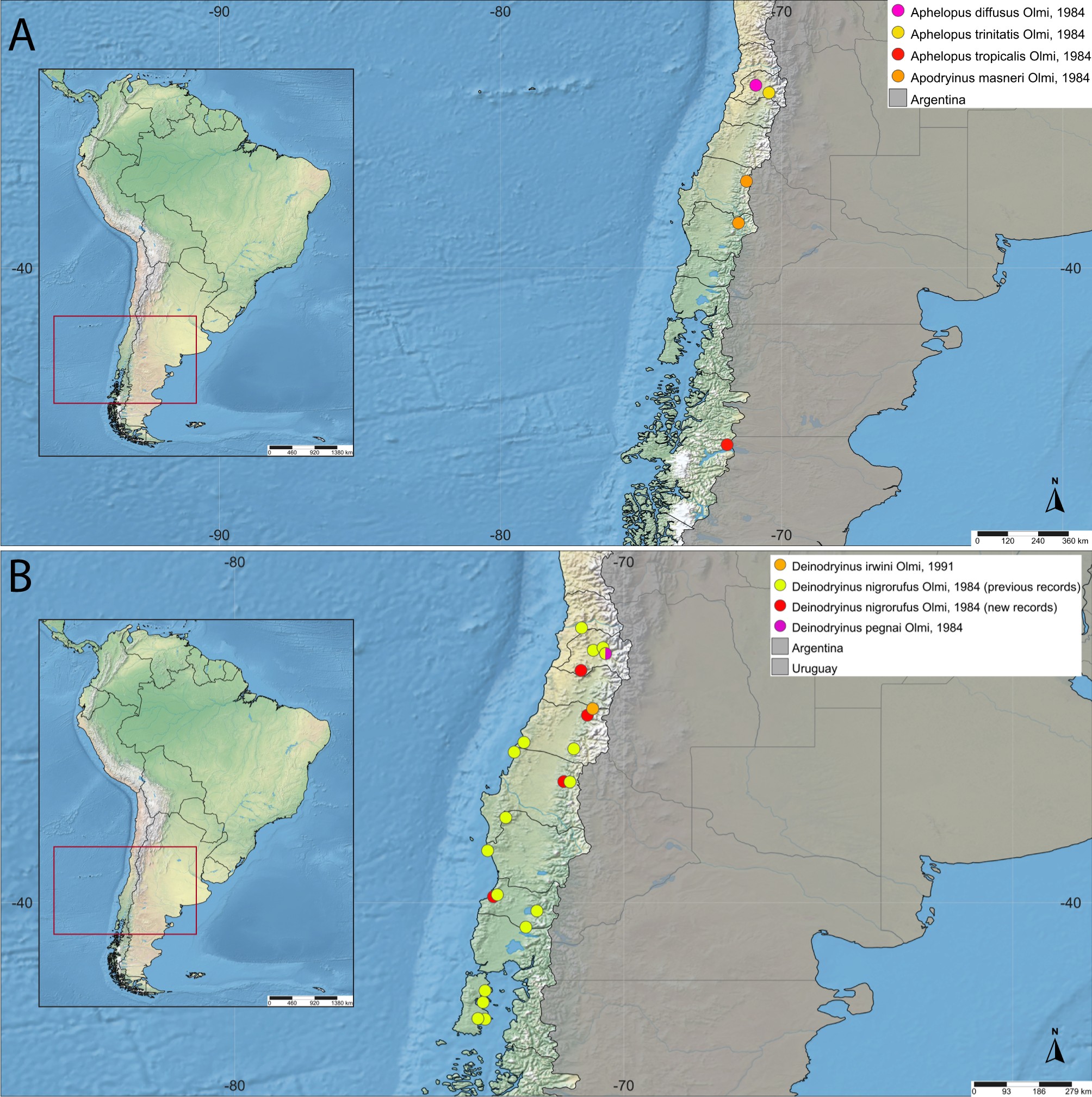
Distribution map of the species from Aphelopus, Apodryinus and Deinodryinus recorded from Chile. A. Aphelopus and Apodryinus species; B. Deinodryinus species.
Extended diagnosis.Female. Fully winged. Body 1.6–2.2 mm. Head with variable color: black, reddish, or testaceous, except mandible and clypeus whitish, testaceous, or black; face usually with more or less wide whitish spot; antenna brown, except scape and pedicel testaceous; mesosoma and metasoma with variable color: black, or reddish, or reddish-dark; fore wing hyaline; legs testaceous, except metafemur and metatibia brown. Head dull, mesoscutum, mesoscutellum, and metanotum granulated. Propodeum with dorsal surface reticulate rugose; posterior surface with two longitudinal carinae. Antennomeres in the following proportions: 4: 4: 5: 6: 7: 8: 8: 8: 7.5: 10. Frontal line absent. Ocellar ratio in the following proportion: POL = 7; OL = 3; OOL = 4; OPL = 1; TL = 2. Occipital carina complete; notauli incomplete, reaching approximately 0.5x length of mesoscutum. Tibial spurs 1/1/2.
Male. Fully winged. Body 1.6–2.2 mm. Head brown, except mandible, clypeus, gena, and anterior half of face testaceous-whitish and vertex partly black; antenna testaceous; mesosoma and metasoma brown; legs testaceous; fore wing hyaline. Head granulate, except face usually with more or less wide whitish spot. Mesoscutum, mesoscutellum and metanotum granulated. Notauli incomplete, reaching 0.5x the length of the mesoscutum. Dorsal surface of propodeum reticulate rugose; posterior surface with two longitudinal carinae, lateral areas reticulate rugose, median area smooth and shiny. Antennomeres in the following proportions: 5: 4: 6: 7: 8: 8.5: 8: 8: 8: 11.5. Frontal line absent. Ocellar ratio in the following proportion: POL = 7; OL = 3; OOL = 3; OPL = 2; TL = 2.5. Occipital carina complete. Basivolsella (see fig. 9B in Olmi and Virla, 2014) with 2 subdistal bristles, without outer process. Tibial spurs 1/1/2.
Hosts. Cicadellidae, Typhlocybinae: Empoasca kraemeri Ross and Moore; Empoasca manubriata Young (Olmi and Virla, 2014).
Sexes. Female and male are known.
Distribution. Antigua, Argentina, Bahamas, Belize, Bolivia, Brazil, Chile (Metropolitana Region: Santiago Province (Fig. 5A)), Colombia, Costa Rica, Cuba, Dominica, Ecuador, Grenada, Guatemala, Honduras, Mexico, Nicaragua, Panama, Paraguay, Peru, Puerto Rico, Trinidad and Tobago, Uruguay, Venezuela.
Aphelopus trinitatis Olmi, 1984
Aphelopus trinitatis Olmi 1984: 80. Male holotype. Trinidad and Tobago: Trinidad, St. George (NHMUK).
Aphelopus tropicalis Olmi 1984: 76. Male paratype. Trinidad and Tobago: Trinidad, Arima Valley (AMNH). Synonymized by Olmi and Virla (2014).
(Fig. 5A)
Extended diagnosis.Female. Fully winged. Body length 1.6–2.6 mm. Head black, except mandible and clypeus whitish or testaceous; face with whitish spot; antenna brown, except segments 1–2 or 1–3 testaceous; mesosoma and metasoma black; legs testaceous, except meso and metacoxa, meso and metafemur and metatarsus brown; fore wing hyaline. Head granulated; mesoscutum, mesoscutellum, and metanotum dull, granulated; dorsal surface of propodeum reticulate rugose, posterior surface with two longitudinal carinae, lateral areas reticulate rugose, and median area smooth and shiny. Antenna clavate. Antennomeres in the following proportions: 4: 3.5: 4: 5: 6: 6: 7: 6: 5: 7. Frontal line complete. Ocellar ratio in the following proportion: POL = 6; OL = 3; OOL = 3.5; OPL = 3; TL = 3. Occipital carina complete; notauli incomplete, reaching about 0.65–0.75x length of mesoscutum. Tibial spurs 1/1/2.
Male. Fully winged. Body length 1.6–2.6 mm. Head brown (holotype) or black, except mandible and clypeus whitish or testaceous; face with a whitish spot; antenna brown, except scape, pedicel, and 1st flagellomeres testaceous; mesosoma and metasoma black; legs testaceous; occasionally meso- and metacoxa, meso- and metafemur and metatarsus brown; fore wing hyaline. Head granulated; mesoscutum, mesoscutellum, and metanotum granulated; propodeum with dorsal surface reticulate rugose; posterior surface with two longitudinal carinae, lateral areas reticulate rugose, and median area smooth and shiny. Frontal line absent. Antenna filiform. Antennomeres in the following proportions: 5: 4: 4: 6: 6: 6: 5: 5: 5: 7. Frontal line complete. Ocellar ratio in the following proportion: POL = 6; OL = 4; OOL = 3; OPL = 3; TL = 3. Occipital carina complete; notauli incomplete, reaching 0.6–0.7x length of mesoscutum. Basivolsella (see fig. 11A in Olmi and Virla, 2014) with an outer process and one subdistal bristle. Tibial spurs 1/1/2.
Hosts. Cicadellidae, Typhlocybinae: Empoasca kraemeri Ross and Moore (Olmi and Virla, 2014).
Sexes. Female and male are known.
Distribution. Argentina, Belize, Bolivia, Brazil, Chile (Metropolitana Region: Santiago Province, Quebrada de la Plata and Santiago-Cordillera Provinces, Parque Nacional Río Clarillo (Fig. 5A)), Colombia, Costa Rica, Cuba, Dominica, Dominican Republic, Ecuador, El Salvador, Grand Cayman, Guatemala, Honduras, Jamaica, Mexico, Panama, Paraguay, Peru, Puerto Rico, Suriname, Trinidad and Tobago and Venezuela.
Aphelopus tropicalis Olmi, 1984
Aphelopus tropicalis Olmi 1984: 76. Female holotype. Ecuador: Chimborazo, 30 mi SW of Alausí (CAS).
(Fig. 5A)
Extended diagnosis.Female. Fully winged. Body length 1.6–2.6 mm. Head black except mandible and clypeus whitish or testaceous; antenna brown except scape and pedicel, and always 1st flagellomere testaceous; mesosoma and metasoma black; legs testaceous; fore wing hyaline. Head, mesoscutum, mesoscutellum, and metanotum granulated. Dorsal surface of propodeum reticulate rugose, posterior surface with two longitudinal carinae, lateral areas reticulate rugose, and median area smooth and shiny. Antennomeres in the following proportions: 4: 3.5: 4: 5: 6: 6: 7: 6: 5: 7. Ocellar ratio in the following proportion: POL = 6; OL = 3; OOL = 3.5; OPL = 3; TL = 3. Frontal line absent. Occipital carina complete. Notauli incomplete, reaching about 0.65–0.75x length of mesoscutum. Tibial spurs 1/1/2.
Male. Fully winged. Body length 1.8–2.2 mm. Head black except mandible and clypeus whitish; antenna brown, occasionally scape testaceous; mesosoma and metasoma black; legs testaceous except metacoxa, apex of metafemur and metatibia brown; occasionally apex of profemur darkened; fore wing hyaline. Head, mesoscutum, mesoscutellum, and metanotum granulated. Notauli incomplete, reaching about 0.6–0.9x length of mesoscutum. Propodeum with dorsal surface reticulate rugose, posterior surface with two longitudinal carinae, lateral areas reticulate rugose, and median area smooth and shiny. Antennomeres in the following proportions: 5: 5: 6: 9: 8: 8: 8: 7: 7: 9. Frontal line complete. Ocellar ratio in the following proportion: POL = 7; OL = 4; OOL = 4; OPL = 2.5; TL = 3. Occipital carina complete. Basivolsella (see fig. 11C in Olmi and Virla, 2014) without an outer process and two subdistal bristles. Tibial spurs 1/1/2.
Hosts. Unknown.
Sexes. Female and male are known.
Distribution. Argentina, Bolivia, Brazil, Chile (Aysén Region: Puerto Ingeniero Ibáñez (Fig. 5A)), Costa Rica, Ecuador, Guatemala, Honduras, Mexico, Panama, Venezuela.
Subfamily Anteoninae Perkins, 1912
Genus Deinodryinus Perkins, 1907
Key to the species of Deinodryinus Perkins from Chile (adapted from Olmi and Virla, 2014)
1 Female ...........2
- Male ...........3
2 Head and pronotum almost or totally testaceous-reddish; head partially smooth and rugose granulate; notauli almost complete ...........D. nigrorufus Olmi, 1984
- Head and pronotum black; head dull, strongly punctate, with punctures very dense and deep, similar to areolae; ...........D. pegnai Olmi, 1984 (♀)
3 Face reticulate rugose; paramere (see fig. 61D in Olmi and Virla, 2014) with distal inner pointed process without large branch wrapping penis ...........D. irwini Olmi, 1991 (♂)
- Face smooth and finely punctate; paramere (see fig. 66A in Olmi and Virla, 2014) with large inner branch wrapping penis...........D. nigrorufus Olmi, 1984
Deinodryinus irwini Olmi, 1991
Deinodryinus irwini Olmi 1991: 139. Male holotype. Chile: Maule Region, Curicó Province (CAS).
(Fig. 5B)
Extended diagnosis.Male. Fully winged. Body length 3.8 mm. Body black; fore wing with a small dark transverse band beneath pterostigma. Antenna filiform, with hairs shorter than the breadth of its segments. Head smooth except face reticulate rugose and vertex finely punctate, unsculptured among punctures; almost complete, interrupted in front of anterior ocellus in front of anterior ocellus; surface behind ocellar triangle without two carinae connecting posterior ocelli to occipital carina. Mesoscutum, mesoscutellum and metanotum smooth, finely punctate. Notauli incomplete, almost reaching the posterior margin of mesoscutum; propodeum dull, reticulate rugose, without transverse or longitudinal carinae, posterior surface reticulate rugose, with small central area smooth, shiny, and unsculptured. Antennomeres in the following proportions: 12: 7: 11: 11: 11: 10: 10: 9: 8: 10. Frontal line almost complete. Ocellar ratio in the following proportion: POL = 9; OL = 4; OOL = 8; OPL = 8; TL = 10. Occipital carina complete. Minimum distance between notauli longer than the greatest breadth of posterior ocelli. Fore wing with 3Rs&4Rs longer than 2r-rs. Paramere (see fig. 61D in Olmi and Virla, 2014) with a pointed distal inner branch. Tibial spurs 1/1/2.
Hosts. Unknown.
Sexes. Female unknown.
Distribution. Chile (Maule Region: Curicó Province (Fig. 5B)).
Deinodryinus nigrorufus Olmi, 1984
Deinodryinus nigrorufus Olmi 1984: 159. Female holotype. Chile: Los Lagos Region, Osorno Province (CAS).
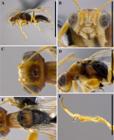
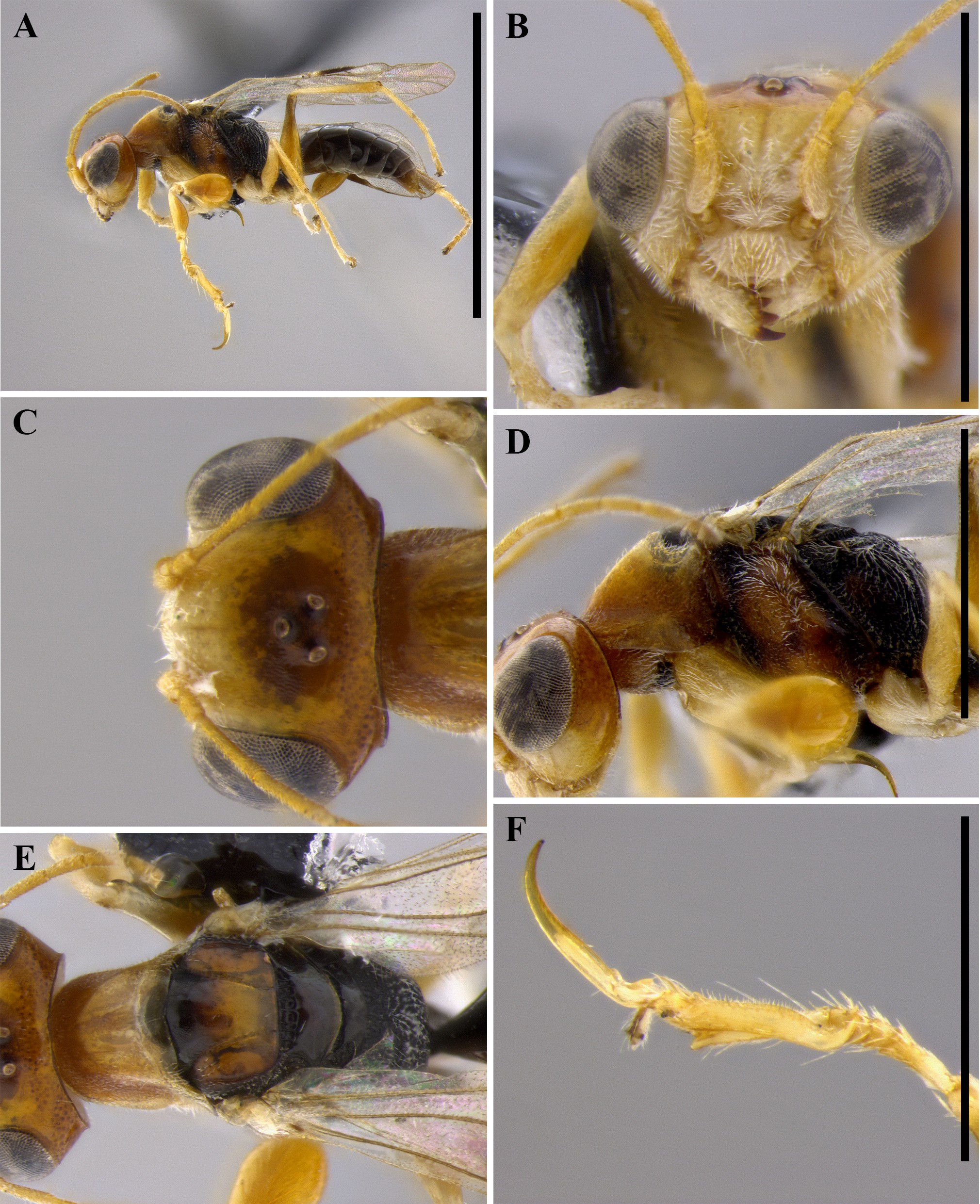
Female of Deinodryinus nigrorufus. A. Habitus, lateral view; B. Head, frontal view; C. Head, dorsal view; D. Mesosoma, lateral view; E. Mesosoma, dorsal view; F. Chela. Scale bars: A, 1.0 mm; B, C, 1.0 mm; D, E, 1.0 mm; F, 1.0 mm.
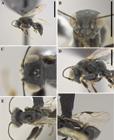
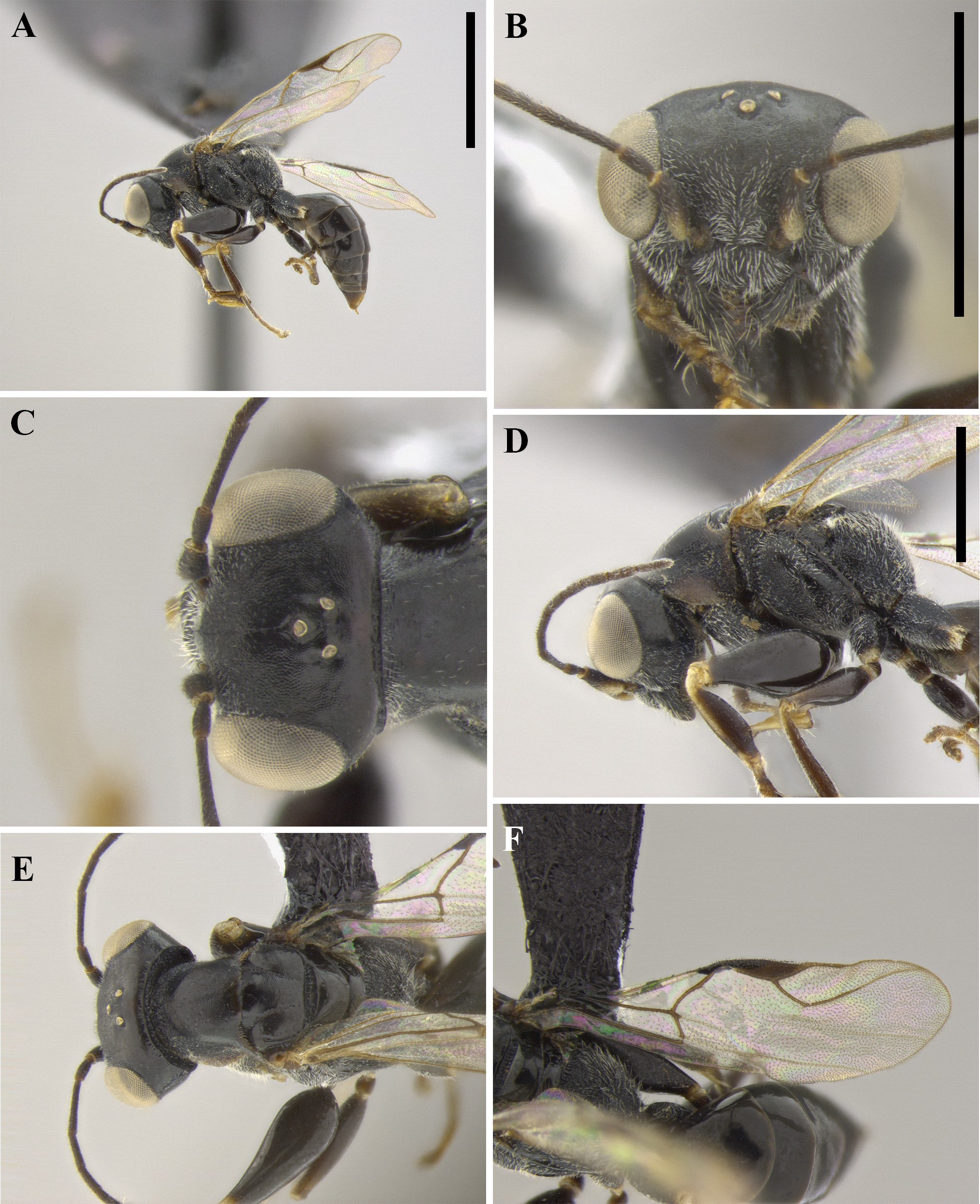
Female of Deinodryinus nigrorufus. A. Habitus, lateral view; B. Head, frontal view; C. Head, dorsal view; D. Mesosoma, lateral view; E. Mesosoma, dorsal view; F. Fore wing. Scale bars: A = 1.0 mm; B, C = 1.0 mm; D–F = 0.5 mm.
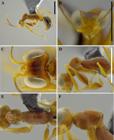
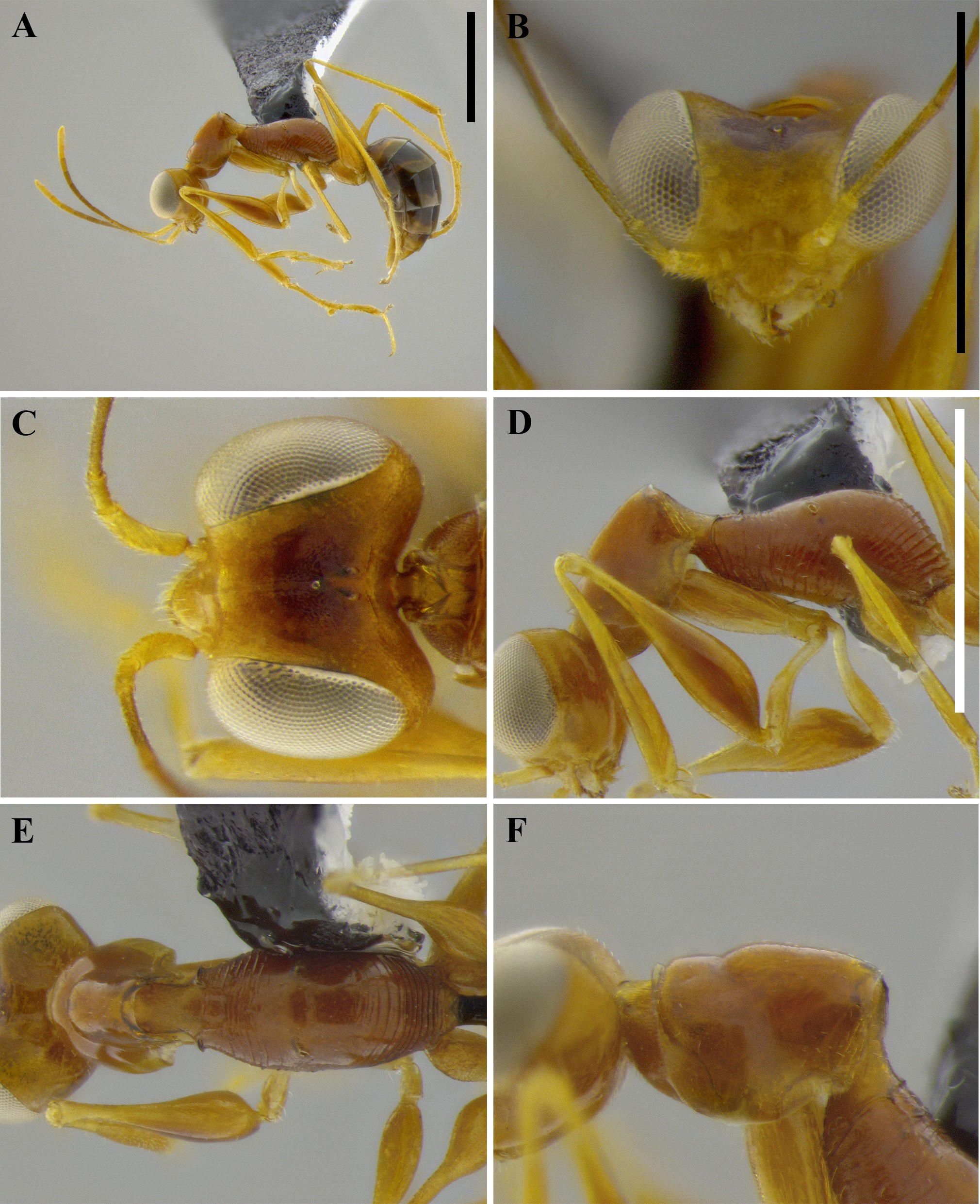
Female of Gonatopus chilensis. A. Habitus, lateral view; B. Head, frontal view; C. Head, dorsal view; D. Mesosoma, lateral view; E. Mesosoma, dorsal view; F. Pronotum, lateral view. Scale bars: A, 1.0 mm; B, C, F, 1.0 mm; D, E, 1.0 mm.

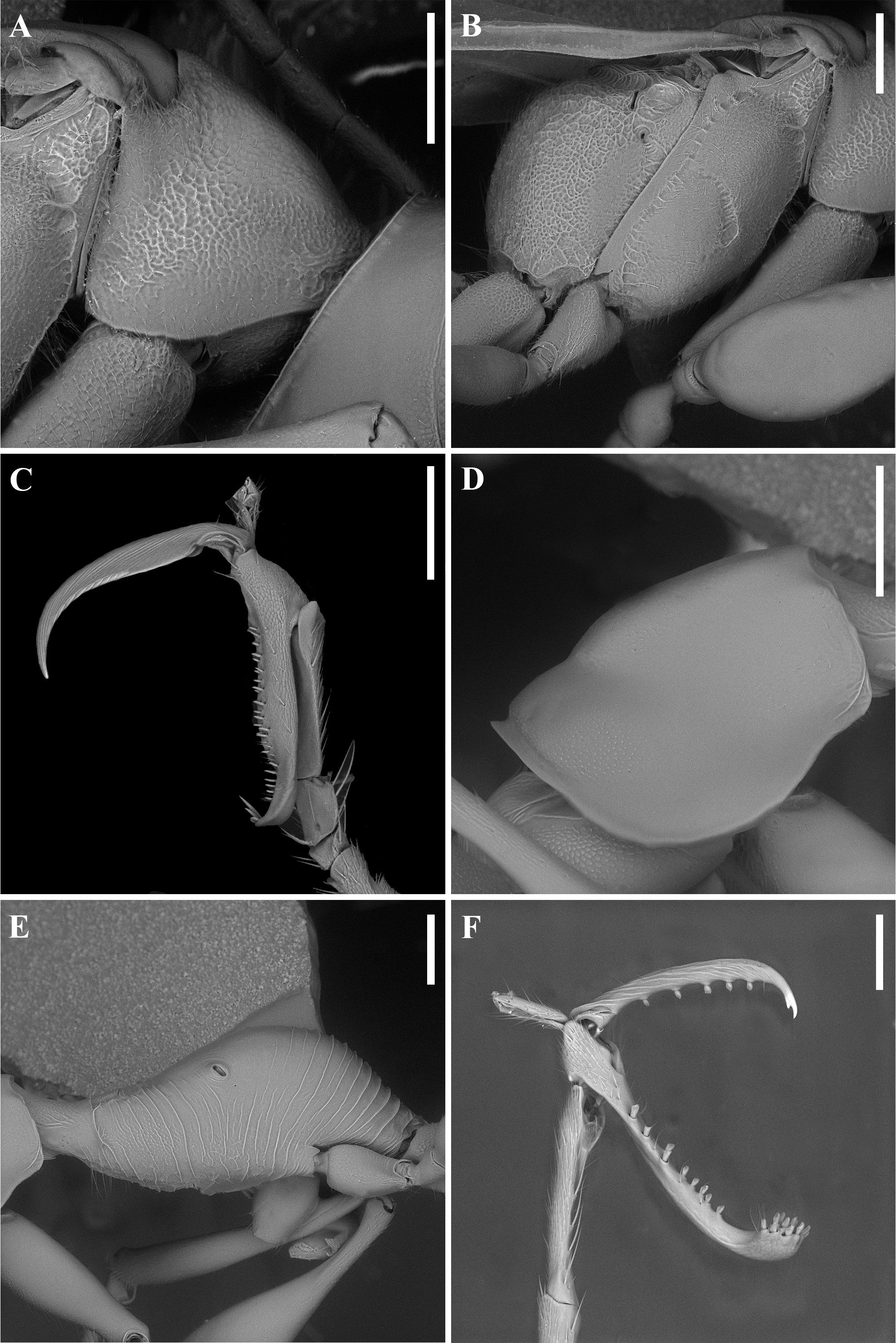
Electromicrography of the females of Deinodryinus and Gonatopus species. A. Pronotum of D. nigrorufus, lateral view; B. Mesosoma of D. nigrorufus, lateral view; C. Chela of D. nigrorufus; D. Pronotum of G. chilensis, latero-dorsal view; E. Mesosoma of G. chilensis, lateral view; F. Chela of G. chilensis. Scale bars: A-F, 200 µm.
Extended diagnosis.Female. Fully winged. Body length 3.1–3.2 mm. Head and prothorax testaceous-reddish; frons whitish, antenna testaceous; mandible whitish, except dark brown tooth; anterior margin of mesoscutum darkened and posterior margin testaceous; mesoscutellum dark brown testaceous; metanotum and propodeum black; fore wing hyaline; legs testaceous, except hind coxae darkened; metasoma dark brown testaceous. Head partially smooth and rugose granulate; pronotum and mesoscutum granulate; mesoscutum and central portion of metanotum smooth; lateral margin of metanotum, propodeum reticulate rugose, mesopleuron and metapleuron rugose, the last one with area partially smooth. Propodeum reticulate rugose, without longitudinal or transverse carina. Antennomeres in the following proportions: 26: 13: 26: 23: 18: 18: 16: 15: 15: 18. Frontal line incomplete. Ocellar ratio in the following proportion: POL = 4; OL = 2; OOL = 10; OPL = 7; TL = 8. Occipital carina complete; notauli incomplete, reaching 0.6-0.9x length of mesoscutum; fore wing with 2r-rs shorter than 3Rs&4Rs (23: 32). Protarsomeres in the following proportions: 20: 6: 10: 35: 50 and enlarged claw (= 48). Enlarged claw (Fig. 4C) with one bristle further distally than proximal prominence. 5th protarsomere with inner margin with two rows of 48 lamellae and apex with about 11 lamellae (Fig. 4C).
Male. Fully winged. Body length 2.8–3.1 mm. Body black, except brown legs. Fore wing hyaline. Head, mesoscutum, mesoscutellum, and metanotum smooth, finely punctate, unsculptured among punctures. Face without median or lateral carina. Propodeum dull, reticulate rugose, without longitudinal or transverse carina. Antenna not distally thickened, with hairs shorter than the breadth of segments. Antennomeres in the following proportions: 8: 6: 9.5: 10: 9.5: 9: 9: 9: 8: 9. Ocellar ratio in the following proportion: POL = 7; OL = 2; OOL = 6.5; OPL = 5; TL = 5. Occipital carina complete; notauli complete or incomplete. Fore wing with 3Rs&4Rs shorter than 2r-rs (9: 10). Paramere (see fig. 66A in Olmi and Virla, 2014) with a large and long inner apical branch wrapping penis. Tibial spurs 1/1/2.
Variations. Color (Fig. 2A–E): Body predominantly black except: part of protarsomeres dark brown testaceous, lateral margin of pronotum dark brown testaceous and apex of metasoma dark brown testaceous. Body length: 3.68 mm (reddish-testaceous specimens) – 4.7 mm (darkened specimens).
Hosts. Unknown.
Sexes. Female and male are known.
Distribution. Argentina, Chile (Biobío Region: Arauco Province; La Araucanía Region: Cautín Province; Los Lagos Region: Osorno Province; Los Ríos Region: Prov. Valdivia, Estancilla, Camino a Niebla*; Metropolitana Region: Melipilla Province, Pichi-Alhué* and Prov. Melipilla, Pichi-Alhué*; Maule Region: Prov. Curicó, 20 km E. Potreiro Grande*; Ñuble Region: Ñuble Province, Puente Marchant* (Fig. 5B)) and Costa Rica.
Additional material examined. 1 female: “04-003\ Chile, prov. Curicó, 20km E\ Potreiro Grande, El Relvo3,\ feb. 2004, fogging\ s/ Nothofagus dombeyi,\ leg. J. E. Barriga-Tuñón,\ 35°11,13’S 70° 56,1’W” “HI21”; 1 female: “04-003\ Chile, prov. Curicó, 20km E\ Potreiro Grande, El Relvo3,\ feb. 2004, fogging\ s/ Nothofagus dombeyi,\ leg. J. E. Barriga-Tuñón,\ 35°11,13’S 70° 56,1’W” “HI21”; 1 female: “04-003\ CHILE, prov. Curicó, 20km\ E Potreiro Grande, El Relvo\ 3 feb. 2004, fogging\ s/ Nothofagus dombeyi,\ leg. J. E. Barriga-Tuñón,\ 35°11,13’S 70° 56,1’W” “HI21”; 1 female: “04-003\ CHILE, prov. Curicó, 20km\ E Potreiro Grande, El Relvo\ 3 feb. 2004, fogging\ s/ Nothofagus dombeyi,\ leg. J. E. Barriga-Tuñón,\ 35°11,13’S 70° 56,1’W” “HI21”; 1 female: “04-003\ CHILE, prov. Curicó, 20km\ E Potreiro Grande, El Relvo\ 3 feb. 2004, fogging\ s/ Nothofagus dombeyi,\ leg. J. E. Barriga-Tuñón,\ 35°11,13’S 70° 56,1’W” “HI21”; 1 female: “04-003\ CHILE, prov. Curicó, 20km E\ Potreiro Grande, El Relvo 3\ feb. 2004, fogging\ s/ Nothofagus dombeyi,\ leg. J. E. Barriga-Tuñón,\ 35°11,13’S 70° 56,1’W” “HI21”; 1 female: “04-003\ Chile, prov. Curicó, 20km E\ Potreiro Grande, El Relvo 3\ feb. 2004, fogging\ s/ Nothofagus dombeyi,\ leg. J. E. Barriga-Tuñón,\ 35°11,13’S 70° 56,1’W” “HI21”; 1 female: “04-003\ Chile, prov. Curicó, 20km E\ Potreiro Grande, El Relvo 3\ feb. 2004, fogging\ s/ Nothofagus dombeyi,\ leg. J. E. Barriga-Tuñón,\ 35°11,13’S 70° 56,1’W” “HI21”; 1 female: “04-003\ CHILE, prov. Curicó, 20km\ E Potreiro Grande, El Relvo\ 3 feb. 2004, fogging\ s/ Nothofagus dombeyi,\ leg. J. E. Barriga-Tuñón,\ 35°11,13’S 70° 56,1’W” “HI21”; 1 female: “04-003\ CHILE, prov. Curicó, 20km\ E Potreiro Grande, El Relvo\ 3 feb. 2004, fogging\ s/ Nothofagus dombeyi,\ leg. J. E. Barriga-Tuñón,\ 35°11,13’S 70° 56,1’W” “HI21”; 1 female: “04-003\ CHILE, prov. Curicó, 20km\ E Potreiro Grande, El Relvo\ 3 feb. 2004, fogging\ s/ Nothofagus dombeyi,\ leg. J. E. Barriga-Tuñón,\ 35°11,13’S 70° 56,1’W” “HI21”; 1 female: “04-003\ CHILE, prov. Curicó, 20km\ E Potreiro Grande, El Relvo\ 3 feb. 2004, fogging\ s/ Nothofagus dombeyi,\ leg. J. E. Barriga-Tuñón,\ 35°11,13’S 70° 56,1’W” “HI21”; 1 female: “04-003\ Chile, prov. Curicó, 20km E\ Potreiro Grande, El Relvo 3\ feb. 2004, fogging\ s/ Nothofagus dombeyi,\ leg. J. E. Barriga-Tuñón,\ 35°11,13’S 70° 56,1’W” “HI21”; 1 female: “04-003\ CHILE, prov. Curicó, 20km\ E Potreiro Grande, El Relvo\ 3 feb. 2004, fogging\ s/ Nothofagus dombeyi,\ leg. J. E. Barriga-Tuñón,\ 35°11,13’S 70° 56,1’W” “HI21”; 1 female: “04-003\ CHILE, prov. Curicó, 20km\ E Potreiro Grande, El Relvo\ 3 feb. 2004, fogging\ s/ Nothofagus dombeyi,\ leg. J. E. Barriga-Tuñón,\ 35°11,13’S 70° 56,1’W” “HI21”; 1 female: “04-003\ CHILE, prov. Curicó, 20km\ E Potreiro Grande, El Relvo\ 3 feb. 2004, fogging\ s/ Nothofagus dombeyi,\ leg. J. E. Barriga-Tuñón,\ 35°11,13’S 70° 56,1’W” “HI21”; 1 female: “04-003\ Chile, prov. Curicó, 20km E\ Potreiro Grande, El Relvo 3\ feb. 2004, fogging\ s/ Nothofagus dombeyi,\ leg. J. E. Barriga-Tuñón,\ 35°11,13’S 70° 56,1’W” “HI21”; 1 female: “04-003\ Chile, prov. Curicó, 20km E\ Potreiro Grande, El Relvo 3\ feb. 2004, fogging\ s/ Nothofagus dombeyi,\ leg. J. E. Barriga-Tuñón,\ 35°11,13’S 70° 56,1’W” “HI21”; 1 female: “04-003\ CHILE, prov. Curicó, 20km\ E Potreiro Grande, El Relvo\ 3 feb. 2004, fogging\ s/ Nothofagus dombeyi,\ leg. J. E. Barriga-Tuñón,\ 35°11,13’S 70° 56,1’W” “HI21”; 1 female: “CHILE, prov. Ñuble,\ Puente Marchant,\ 36°53,5’S 71° 32.5’W, 1130m,\ 1.VI.2004, fogging s/Nothofagus,\ dombeyi\ Leg. J. E. Barriga-Tuñón” “HI21”; 1 female: “04-003\ CHILE, prov. Curicó, 20km\ E Potreiro Grande, El Relvo\ 3 feb. 2004, fogging\ s/ Nothofagus dombeyi,\ leg. J. E. Barriga-Tuñón,\ 35°11,13’S 70° 56,1’W” “HI21”; 1 female: “04-003\ CHILE, prov. Curicó, 20km\ E Potreiro Grande, El Relvo\ 3 feb. 2004, fogging\ s/ Nothofagus dombeyi,\ leg. J. E. Barriga-Tuñón,\ 35°11,13’S 70° 56,1’W” “HI21”; 1 female: “04-003\ Chile, prov. Curicó, 20km E\ Potreiro Grande, El Relvo 3\ feb. 2004, fogging\ s/ Nothofagus dombeyi,\ leg. J. E. Barriga-Tuñón,\ 35°11,13’S 70° 56,1’W” “HI21”; 1 female: “04-003\ CHILE, prov. Curicó, 20km\ E Potreiro Grande, El Relvo\ 3 feb. 2004, fogging\ s/ Nothofagus dombeyi,\ leg. J. E. Barriga-Tuñón,\ 35°11,13’S 70° 56,1’W” “HI21”; 1 female: “04-003\ Chile, prov. Curicó, 20km E\ Potreiro Grande, El Relvo 3\ feb. 2004, fogging\ s/ Nothofagus dombeyi,\ leg. J. E. Barriga-Tuñón,\ 35°11,13’S 70° 56,1’W” “HI21”; 1 female: “04-003\ CHILE, prov. Curicó, 20km E\ Potreiro Grande, El Relvo\ 35°11,13’S 70° 56,1’W\ 3.II.2004, fogging s/ Nothofagus\ dombeyi,\ leg. J. E. Barriga-Tuñón,\” “HI21”; 1 female: “04-003\ CHILE, prov. Curicó, 20km E\ Potreiro Grande, El Relvo\ 35°11,13’S 70° 56,1’W\ 3.II.2004, fogging s/ Nothofagus\ dombeyi,\ leg. J. E. Barriga-Tuñón,\” “HI21”; 1 female: “04-003\ CHILE, prov. Curicó, 20km\ E Potreiro Grande, El Relvo\ 3 feb. 2004, fogging\ s/ Nothofagus dombeyi,\ leg. J. E. Barriga-Tuñón,\ 35°11,13’S 70° 56,1’W” “HI21”; 1 female: “04-003\ CHILE, prov. Curicó, 20km E\ Potreiro Grande, El Relvo\ 35°11,13’S 70° 56,1’W\ 3.II.2004, fogging s/ Nothofagus\ dombeyi,\ leg. J. E. Barriga-Tuñón,\” “HI21”; 1 female: “04-003\ CHILE, prov. Melipilla,\ Pichi-Alhué,\ 8-28.XI.1998, Malaise trap.,\ Leg. G. Barriga” “HI8”; 1 female: “04-003\ Chile, prov. Curicó, 20km E\ Potreiro Grande, El Relvo 3\ feb. 2004, fogging\ s/ Nothofagus dombeyi,\ leg. J. E. Barriga-Tuñón,\ 35°11,13’S 70° 56,1’W” “HI21”; 1 female: “04-003\ Chile, prov. Curicó, 20km E\ Potreiro Grande, El Relvo 3\ feb. 2004, fogging\ s/ Nothofagus dombeyi,\ leg. J. E. Barriga-Tuñón,\ 35°11,13’S 70° 56,1’W” “HI21”; 1 female: “04-003\ CHILE, prov. Valdivia, Estancilla,\ Camino a Niebla,\ 39°51’S 73°21’W\ 15.I.2007, fogging s/ Nothofagus\ dombeyi, Myrceugenia sp.\ Leg. J.E. Barriga-Tuñón. 1 female: “04-003\ CHILE, prov. Curicó, 20km\ E Potreiro Grande, El Relvo\ 3 feb. 2004, fogging\ s/ Nothofagus dombeyi,\ leg. J. E. Barriga-Tuñón,\ 35°11,13’S 70° 56,1’W” “HI21”; 1 female: “04-003\ CHILE, prov. Curicó, 20km E\ Potreiro Grande, El Relvo\ 35°11,13’S 70° 56,1’W”\ 3.II.2004, fogging s/ Nothofagus\ dombeyi,\ leg. J. E. Barriga-Tuñón,\ “HI21”; 1 female: “CHILE, prov. Curicó, 20km E\ Potreiro Grande, El Relvo\ 35°11’9”S 70° 56’14.3”W\ 16.I.2004, fogging s/Nothofagus\ dombeyi, Laurelia sp., Colletia,\ hystrix, Podocarpus salignus\ Leg. J. E. Barriga-Tuñón,\ “H48”; 1 female: “CHILE, prov. Curicó, 20km E\ Potreiro Grande, El Relvo\ 35°11’9”S 70° 56’14.3”W\ 16.I.2004, fogging s/Nothofagus\ dombeyi, Laurelia sp., Colletia,\ hystrix, Podocarpus salignus\ Leg. J.E. Barriga-Tuñón,\ “H48”; 1 female: “CHILE, prov. Curicó, 20km E\ Potreiro Grande, El Relvo\ 35°11.13’S 70° 56.1”W\ 3.II.2004, fogging s/Nothofagus\ dombeyi\ Leg. J. E. Barriga-Tuñón,\ “H48”; 1 female: “CHILE, prov. Curicó, 20km E\ Potreiro Grande, El Relvo\ 35°11’9”S 70° 56’ 14.3”W\ 16.I.2004, fogging s/Nothofagus\ dombeyi, Laurelia sp., Colletia,\ hystrix, Podocarpus salignus\ Leg. J.E. Barriga-Tuñón,\ “H48”; 1 female: “CHILE, prov. Curicó, 15km E\ Potreiro Grande, El Relvo\ 35°11,145’S 70° 56, 11’W, 1100m,\ 19.XII.2004, fogging s/Nothofagus\ alpina, Nothofagus obliqua\ Leg. J. E. Barriga-Tuñón,\ “H44”; 1 female: “CHILE, prov. Curicó, 15km E\ Potreiro Grande, El Relvo\ 35°11,13’S 70° 56.1’W,\ 3.II.2004, fogging s/Nothofagus\ dombeyi,\ Leg. J. E. Barriga-Tuñón,\ “H121”; 1 female: “CHILE, prov. Curicó, 15km E\ Potreiro Grande, El Relvo\ 35°11,13’S 70° 56.1’W,\ 3.II.2004, fogging s/Nothofagus\ dombeyi,\ Leg. J. E. Barriga-Tuñón,\ “H121”; 1 female: “CHILE, prov. Curicó, 15km E\ Potreiro Grande, El Relvo\ 35°11,13’S 70° 56.1’W,\ 3.II.2004, fogging s/Nothofagus\ dombeyi,\ Leg. J. E. Barriga-Tuñón,\ “H121”; 1 female: “CHILE, prov. Curicó, 15km E\ Potreiro Grande, El Relvo\ 35°11,13’S 70° 56.1’W,\ 3.II.2004, fogging s/Nothofagus\ dombeyi,\ Leg. J. E. Barriga-Tuñón,\ “H121”; 1 female: “CHILE, prov. Curicó, 15km E\ Potreiro Grande, El Relvo\ 35°11,13’S 70° 56.1’W,\ 3.II.2004, fogging s/Nothofagus\ dombeyi,\ Leg. J. E. Barriga-Tuñón,\ “H121”; 1 female: “CHILE, prov. Curicó, 15km E\ Potreiro Grande, El Relvo\ 35°11,13’S 70° 56.1’W,\ 3.II.2004, fogging s/Nothofagus\ dombeyi,\ Leg. J. E. Barriga-Tuñón,\ “H121”; 1 female: “CHILE, prov. Curicó, 20km E\ Potreiro Grande, El Relvo\ 35°11’9”S 70° 56’14.3”W\ 16.I.2004, fogging s/Nothofagus\ dombeyi, Laurelia sp., Colletia,\ hystrix, Podocarpus salignus\ Leg. J.E. Barriga-Tuñón,\ “H48”; 1 female: “CHILE, prov. Curicó, 20km E\ Potreiro Grande, El Relvo\ 35°11’9”S 70° 56’14.3”W\ 16.I.2004, fogging s/Nothofagus\ dombeyi, Laurelia sp., Colletia,\ hystrix, Podocarpus salignus\ Leg. J.E. Barriga-Tuñón,\ “H48”; 1 female: “CHILE, prov. Curicó, 15km E\ Potreiro Grande, El Relvo\ 35°11,13’S 70° 56.1’W,\ 3.II.2004, fogging s/Nothofagus\ dombeyi,\ Leg. J. E. Barriga-Tuñón,\ “H121”; 1 female: “CHILE, prov. Curicó, 15km E\ Potreiro Grande, El Relvo\ 35°11,13’S 70° 56.1’W,\ 3.II.2004, fogging s/Nothofagus\ dombeyi,\ Leg. J. E. Barriga-Tuñón,\ “H121”; 1 female: “CHILE, prov. Curicó, 15km E\ Potreiro Grande, El Relvo\ 35°11,13’S 70° 56.1’W,\ 3.II.2004, fogging s/Nothofagus\ dombeyi,\ Leg. J. E. Barriga-Tuñón,\ “H121”; 1 female: “CHILE, prov. Curicó, 20km E\ Potreiro Grande, El Relvo\ 35°11’9”S 70° 56’14.3”W\ 16.I.2004, fogging s/Nothofagus\ dombeyi, Laurelia sp., Colletia,\ hystrix, Podocarpus salignus\ Leg. J.E. Barriga-Tuñón,\ “H48”; 1 female: “CHILE, prov. Curicó, 15km E\ Potreiro Grande, El Relvo\ 35°11,13’S 70° 56.1’W,\ 3.II.2004, fogging s/Nothofagus\ dombeyi,\ Leg. J. E. Barriga-Tuñón,\ “H121”; 1 female: “CHILE, prov. Curicó, 15km E\ Potreiro Grande, El Relvo\ 35°11,13’S 70° 56.1’W,\ 3.II.2004, fogging s/Nothofagus\ dombeyi,\ Leg. J. E. Barriga-Tuñón,\ “H121”; 1 female: “CHILE, prov. Curicó, 15km E\ Potreiro Grande, El Relvo\ 35°11,13’S 70° 56.1’W,\ 3.II.2004, fogging s/Nothofagus\ dombeyi,\ Leg. J. E. Barriga-Tuñón,\ “H121” (Fig. 5B).
Deinodryinus pegnai Olmi, 1984
Deinodryinus pegnai Olmi 1984: 186. Female holotype. Chile: Metropolitana Region, Santiago, El Canelo (EMUS).
(Fig. 5B)
Extended diagnosis.Female. Fully winged. Body length 4.5 mm. Head black, except mandible, lateral region of clypeus, and part of malar space yellow; antenna, mesosoma, and metasoma and legs black, except chelae testaceous. Fore wing with a dark transverse band beneath pterostigma. Head dull, strongly punctate, punctures very dense and deep, similar to areolae; face without median and lateral longitudinal carina; vertex behind ocellar triangle punctate, not rugose, without two oblique carinae connecting posterior ocelli to occipital carina. Pronotum hairy, shiny, crossed by a slight transverse impression, posterior surface smooth, finely punctate, unsculptured among punctures, approximately as long as broad, without dorsal lobes. Mesoscutum, mesoscutellum, and metanotum shiny, smooth, finely punctate, and unsculptured among punctures. Propodeum reticulate rugose, without transverse or longitudinal carinae, posterior surface almost completely smooth and shiny. Antennomeres in the following proportions: 14: 8: 20: 12: 11: 9: 9: 9: 9: 11. Ocellar ratio in the following proportion: POL = 7; OL = 5; OOL = 10; OPL = 10; TL = 14. Occipital carina complete. Notauli almost complete, almost reaching posterior margin of mesoscutum. Fore wing with 3Rs&4Rs longer than 2r-rs (16: 11). Protarsomeres in the following proportions: 11: 3: 8: 14: 29. Enlarged claw (see fig. 68D in Olmi and Virla, 2014) with two bristles further distally than proximal prominence. 5th protarsomere with inner margin (see fig. 68D in Olmi and Virla, 2014) with two rows of 38 lamellae and apex with about 11 lamellae.. Tibial spurs 1/1/2.
Hosts. Unknown.
Sexes. Male unknown.
Distribution. Chile (Metropolitana Region: Santiago, El Canelo (Fig. 5B)).
Genus Metanteon Olmi, 1984
Metanteon aerias (Walker, 1839)
Dryinus aerias Walker 1839: 92. Female holotype. Chile: no locality records (NHMUK).
Metanteon fuscum Olmi 1984: 116. Female holotype. Chile: Ñuble Region, Cobquecura (CNC).
(Fig. 6B)
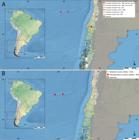
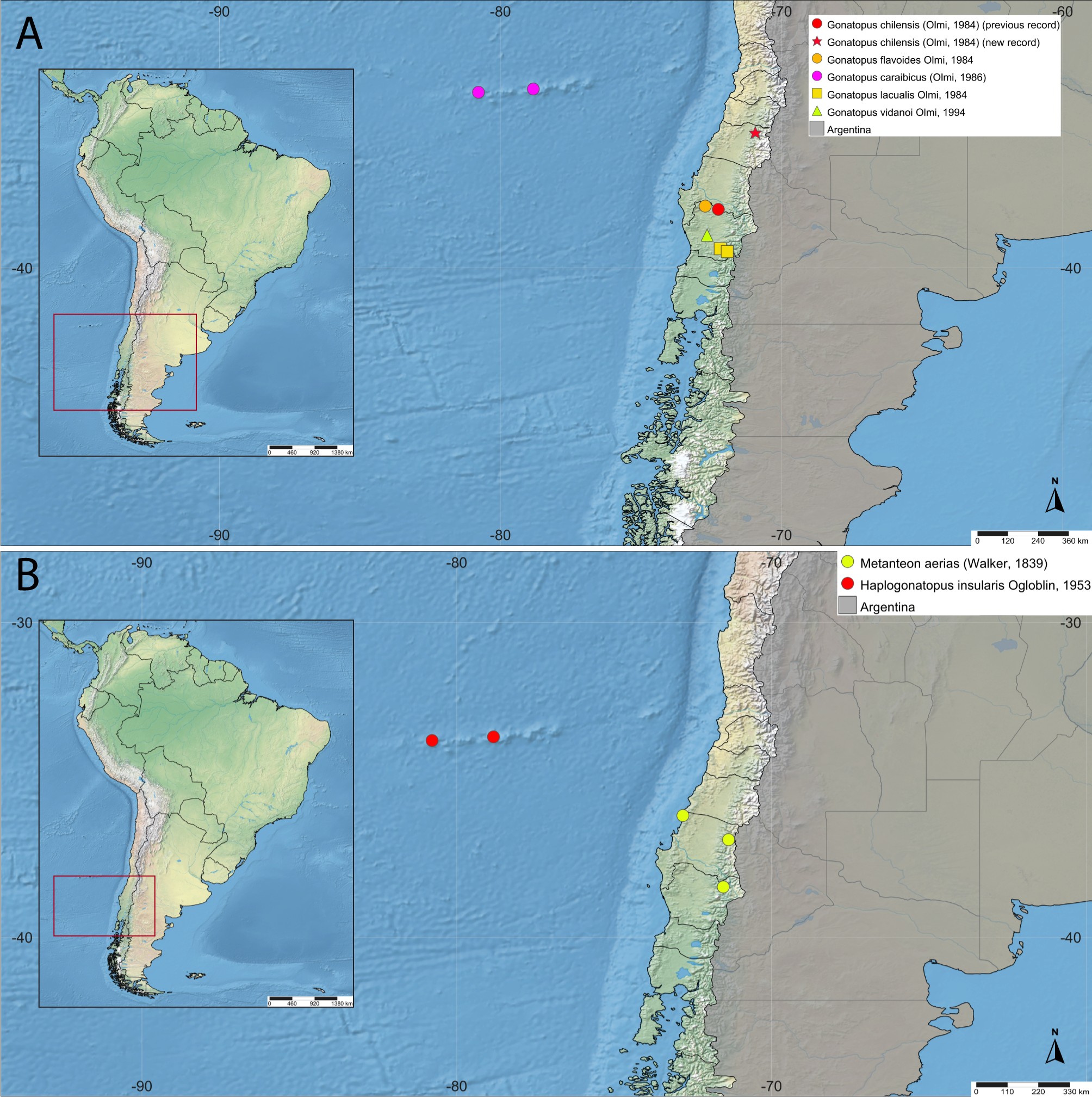
Distribution map of the species from Gonatopus, Haplogonatopus and Metanteon recorded from Chile. A. Gonatopus species; B. Haplogonatopus and Metanteon species.
Extended diagnosis.Female. Fully winged. Body length 2.8–4.6 mm. Head testaceous reddish, except flagellomere 8 slightly dark; mesosoma and metasoma black; legs testaceous, except metacoxa black; fore wing hyaline. Head smooth, granulate, or slightly punctate and unsculptured among punctures; mesopleuron smooth, slightly granulated; metapleuron and propodeum reticulate rugose, the last one reticulate rugose, without transverse carina between dorsal and posterior surface, posterior surface without longitudinal carina. Antennomeres in the following proportions: 9: 5: 11: 9: 9: 8: 7: 7: 7: 8. Ocellar ratio in the following proportion: POL = 3; OL = 2; OOL = 7; OPL = 5; TL = 5. Occipital carina complete; notauli reaching 0.65x posterior margin of mesoscutum; fore wing with 3Rs&4Rs longer than 2r-rs (16: 11). Protarsomeres in the following proportions: 10: 2: 3: 11: 17. Enlarged claw (see fig. 81C in Olmi and Virla, 2014) with a row of 6 short bristles. 5th protarsomere with inner margin (see fig. 81C in Olmiand Virla, 2014) with two rows of 26–55 lamellae, distal apex with 3–5 lamellae.
Male. Fully winged. Body length 2.5–2.7 mm. Head black, except mandible, clypeus, part of face and vertex testaceous; antenna testaceous; mesosoma and metasoma black; legs testaceous; fore wing hyaline. Head dull, granulated; mesoscutum, mesoscutellum, and metanotum shiny, punctate, and unsculptured among punctures. Propodeum dull, reticulate rugose, without transverse or longitudinal carinae. Antennomeres in the following proportions: 8: 6: 11: 14: 13.5: 13: 12: 11.5: 10: 12. Ocellar ratio in the following proportion: POL = 6; OL = 2.5; OOL = 6.5; OPL = 5; TL = 6. Frontal line and occipital carina complete; notauli incomplete, reaching about 0.6x length of mesoscutum. Fore wing with 3Rs&4Rs longer than 2r-rs (15: 12). Paramere (fig. 81F in Olmi and Virla, 2014) shorter than penis, with long and slender dorsal process. Tibial spurs 1/1/2.
Hosts. Unknown.
Sexes. Female and male are known.
Distribution. Argentina, Chile (Biobío Region: Arauco Province; La Araucanía Region: Cautín Province, Conguillío Lake, Malleco Province; Los Lagos Region: Chiloé Province; Maule Region: Curicó Province, Linares Province, Talca Province; Ñuble Region: Ñuble Province (Fig. 6B)).
Subfamily Gonatopodinae Kieffer in Kieffer and Marshall, 1906
Genus Gonatopus Ljungh, 1810
Key to the species groups and species of Gonatopus from Chile (adapted from Olmi and Virla, 2014)
1 Pronotum not crossed by transverse impression or slightly impressed ...........2
- Pronotum crossed by strong transverse impression species group...........7 … 4
2 Maxillary palpus with 5 segments species group 6...G. caraibicus (Olmi, 1986)
- Maxillary palpus with 2–4 segments species group 2 … 3
3 Antenna testaceous, except flagellomeres with variable color, 1-9 darkned or testaceous, except 3-6 dark brown; occipital carina absent; OOL 4x longer than POL G. chilensis (Olmi, 1984)
- Antenna testaceous, except flagellomere 8 whitish; occipital carina incomplete; OOL 7.5x longer than POL...........G. flavoides Olmi, 1984
4 Palpomeres in the proportion 6:3; enlarged claw (see fig. 196D in Olmi and Virla, 2014) with a small subapical tooth and a row of eight peg-like hairs ...........G. spinolai Olmi, 1983
- Palpomeres in different proportions; enlarged claw with a subapical tooth and a row of less than eight peg-like hairs...........5
5 Palpomeres in the proportions 4:2 or 5:2; occipital carina absent. Mesoscutum and mesoscutellum granulated, the first one sculptured by some longitudinal carinae and the second one crossed by strong transverse carina; metanotum with rounded protrusions; enlarged claw (see fig. 191A in Olmi and Virla, 2014) with one small subapical tooth and six–seven peg-like hairs...........G. lacualis Olmi, 1984
- Palpomeres in the proportions 3:2 or 4:2; mesoscutum granulated with transverse carina; enlarged claw (see fig. 198B in Olmi and Virla, 2014) with a small subapical tooth and a row of six–seven bristles...........G. vidanoiOlmi, 1994
Species Group 2
Gonatopus chilensis (Olmi, 1984)
Pseudogonatopus chilensis Olmi 1991: 318; Olmi and Virla 1993: 63.
Gonatopus chilensis Olmi: Guglielmino and Olmi 1997: 244–246. Female holotype. Chile: La Araucanía Region, Malleco Province (CAS).
Extended diagnosis.Female. Apterous. Body length 3.1–3.3 mm. Head and antenna testaceous, flagellomeres with variable color, 1-9 darkned or testaceous, except 3-6 dark brown; mesosoma testaceous-reddish; petiole black; metasoma brown, except apex testaceous; legs testaceous. Head rugose; pronotum smooth, except posterior margin rugose; mesosoma smooth with several transverse carinae. Head excavated, antenna clavate, rhinaria present in flagellomeres 7–8. Antennomeres in the following proportions: 25: 13: 33: 22: 17: 14: 14: 14: 13: 22. Frontal line complete. Ocellar ratio in the following proportion: POL = 4; OL = 6; OOL = 19. Occipital carina absent. Palpal formula 3/2. Pronotum crossed by slight transverse impression, shiny, smooth, unsculptured. Protarsomeres in the following proportions: 40: 6: 11: 32: 51 and enlarged claw (= 40). Enlarged claw (Fig. 4F) with a row of 5 lamellae and one bristle. 5th with two rows of three–four + 8 lamellae; distal apex with about 12-14 lamellae.
Male. Fully winged. Body length 2.1–2.6 mm. Head black, except mandible testaceous; antenna brown or black, with segments 1–2 brown; mesosoma black; metasoma brown; legs testaceous or brown. Fore wing hyaline. Head shiny, hairy, unsculptured; vertex with two oval smooth and shiny areas between posterior ocelli and eyes (areas not anteriorly surrounded by high carina); temple distinct; occiput concave. Metanotum shiny, finely punctate, unsculptured among punctures. Propodeum dull, reticulate rugose, with dorsal surface shiny and less rugose, without dark transverse bands. Antennomeres in the following proportions: 5: 5: 9: 9: 9.5: 10: 9: 9: 8.5: 11. Frontal line absent. Ocellar ratio in the following proportion: POL = 5; OL = 2; OOL = 2. Occipital carina absent. Palpal formula 3/2. Notauli complete. Dorsal process of paramere (see figs. 154B, C in Olmi and Virla, 2014) long and slender, approximately as long as the paramere. Tibial spurs 1/1/2.
Hosts. Delphacidae: Chionomus (= Delphacodes) haywardi (Muir); Delphacodes kuscheli Fennah; Delphacodes sitarea Remes Lenicov and Tesón; Dicranotropis fuscoterminata (Berg); Metadelphax argentinensis (Muir) (= Toya argentinensis (Muir)); Metadelphax (= Toya) propinqua (Fieber); Peregrinus maidis (Ashmead); Sogatella sp.; Tagosodes orizicolus (Muir) and Delphacodes aff. albinotata Crawford.
Sexes. Female and male are known.
Distribution. Argentina, Chile (La Araucanía Region: Malleco Province; Maule Region: Curicó Province* (Fig. 6A)), Colombia, Costa Rica, Ecuador and Peru.
Additional material examined. 1 female: “04-003\ CHILE, prov. Curicó, 20km E\ Potreiro Grande, El Relvo\ 35°11,13’S 70° 56,1’W”\ 3.II.2004, fogging s/ Nothofagus\ dombeyi,\ Leg. J. E. Barriga-Tuñón,\ “HI21”; 1 female: “04-003\ CHILE, prov. Curicó, 20km E\ Potreiro Grande, El Relvo\ 35°11,13’S 70° 56,1’W”\ 3.II.2004, fogging s/Nothofagus\ dombeyi,\ Leg. J. E. Barriga-Tuñón,\ “HI21”; 1 female: “04-003\ CHILE, prov. Curicó, 20km E\ Potreiro Grande, El Relvo\ 35°11,13’S 70° 56,1’W”\ 3.II.2004, fogging s/Nothofagus\ dombeyi,\ Leg. J. E. Barriga-Tuñón,\ “HI21”; 1 female: “04-003\ Chile, prov. Curicó, 20km E\ Potreiro Grande, El Relvo\ 35°11,13’S 70° 56,1’W”\ 3.II.2004, fogging s/Nothofagus\ dombeyi,\ Leg. J. E. Barriga-Tuñón,\ “HI21” (Fig. 6A).
Gonatopus flavoides Olmi, 1984
Pseudogonatopus flavus Olmi 1984: 1277. Female holotype. Guadeloupe: Guadeloupe (NHMUK).
Gonatopus flavoidesOlmi 1993: 80, new name.
(Fig. 6A)
Extended diagnosis.Female. Apterous. Body length 2.3–2.8 mm. Body yellow-testaceous except petiole black; antenna brown except segments 1–2 and 10 white; pronotum and vertex variable darkened. Head shiny, slightly alutaceous. Pronotum and mesoscutum granulated, the last one without lateral pointed apophyses; metanotum transversely carinate, with sides rounded, not hollow behind mesoscutellum (see fig. 158D in Olmi and Virla, 2014). Metathorax + propodeum with the anterior surface little inclined (fig. 158C in Olmi and Virla, 2014). Antennomeres in the following proportions: 13: 7: 18: 9: 8: 8: 6: 7: 7: 14. Frontal line complete. Ocellar ratio in the following proportion: POL = 2; OL = 3; OOL = 15. Occipital carina incomplete. Pronotum crossed by a strong transverse impression. Palpal formula 3/2. Protarsomeres in the following proportions: 8: 2: 2.5: 9: 14. Enlarged claw (see fig. 158A in Olmi and Virla, 2014) with a large subapical tooth and a row of four–five lamellae. 5th protarsomere with inner margin (see fig. 158A in Olmi and Virla, 2014) with two rows of 8–17 lamellae; distal apex with about 8–11 lamellae. Tibial spurs 1/0/1.
Hosts. Delphacidae: Metadelphax (= Toya) propinqua (Fieber).
Sexes. Male unknown.
Distribution. Argentina, Brazil, Chile (La Araucanía Region: Malleco Province (Fig. 6A)), Grenada, Guadeloupe, Saint Lucia.
Species Group 6
Gonatopus caraibicus (Olmi, 1986)
Tetrodontochelys caraibicus Olmi 1986: 89. Chile: Juan Fernández Islands. Female holotype. Probably lost (in MNHNS, there is only one slide of mouthparts).
(Fig. 6A)
Extended diagnosis.Female. Apterous. Body length 2.4–3.2 mm. Head testaceous or brown; antenna black, except segments 1–3 testaceous; mesosoma and metasoma black; legs testaceous, occasionally with apex of femora brown. Head shiny, slightly granulated. Pronotum shiny, slightly granulated, crossed by a very slight transverse impression. Metathorax + propodeum shiny, with anterior surface unsculptured and posterior surface transversely striate (see fig. 172A, B in Olmi and Virla, 2014). Meso- and metapleuron transversely striate and granulated. Meso-metapleural suture obsolete. Antenna clavate. Antennomeres in the following proportions: 9: 4: 11: 6: 7: 6: 6: 6: 5.5: 7. Frontal line complete. Ocellar ratio in the following proportion: POL = 2.5; OL = 2.5; OOL = 7. Occipital carina absent. Palpal formula 5/2. Protarsomeres in the following proportions: 12: 3: 4: 13: 20. Enlarged claw (see fig. 172D in Olmi and Virla, 2014) with a small subapical tooth and five peg-like hairs. 5th protarsomere with inner margin (see fig. 172D in Olmi and Virla, 2014) proximally serrate, with two rows of 20–21 lamellae; distal apex with 5–8 lamellae. Tibial spurs 1/0/1.
Male. Fully winged. Body length 2.2 mm. Head black, except mandible testaceous, clypeus brown with margins yellow, anterior region of face testaceous; antenna brown, except segments 1–2 testaceous; mesosoma black; metasoma brown; legs yellow, except coxae, apex of femora and tibiae partly brown. Fore wing hyaline. Head and mesoscutum granulated; mesoscutellum and metanotum smooth, finely punctate, unsculptured among punctures. Propodeum granulated. Antennomeres in the following proportions: 4: 4.5: 6.5: 6: 5: 5: 5: 5: 5: 6. Frontal line absent. Ocellar ratio in the following proportion: POL = 6.5; OL = 3; OOL = 3. Occipital carina absent. Palpal formula 5/2. Notauli complete. Fore wing with 3Rs&4Rs longer than 2r-rs (13: 7). Dorsal process of paramere (see fig. 172C in Olmi and Virla, 2014) reduced, lobe-shaped. Tibial spurs 1/1/2.
Hosts. Unknown.
Sexes. Female and male are known.
Distribution. Chile (Valparaíso Region: Juan Fernández Islands; Alejandro Selkirk Island; Robinson Crusoe Island (= Masatierra Island) (Fig. 6A)).
Species Group 7
Gonatopus lacualis Olmi, 1984
Gonatopus lacualis Olmi 1984: 1762. Female holotype. (N. 84/1997). Peru: Madre de Dios, Puerto Maldonado. (ZIL).
(Fig. 6A)
Extended diagnosis.Female. Apterous. Body length 3.0–3.4 mm. Body with color variable from totally testaceous to totally black. Antenna brown, except articles 1–2 yellow; pronotum reddish, with or without median brown spots on anterior collar and anterior margin of disc; rest of mesosoma and metasoma black; legs black, except trochanters, tarsi, and protibia reddish. Head excavated, granulated, except face unsculptured. Pronotum shiny, unsculptured, or with some regions granulated, crossed by strong transverse impression. Mesoscutum granulated, without lateral pointed protrusions, with some longitudinal carina, without lateral pointed apophyses. Metanotum strongly transversely striate, not hollow behind mesoscutellum (see fig. 191B, C in Olmi and Virla, 2014). Metathorax + propodeum (see fig. 191B, C in Olmi and Virla, 2014) with anterior surface shiny and unsculptured, with a track of longitudinal stripe, occasionally dull and granulated; posterior surface dull, granulated, transversely striate. Meso-and metapleuron rugose, granulated, and transversely carinate. Antennomeres in the following proportions: 8: 5: 14: 8: 7: 6: 6: 6: 6: 8. Frontal line complete; occipital carina absent. Palpal formula 4/2 or 5/2. Protarsomeres in the following proportions: 12: 2.5: 3.5: 14: 22. Enlarged claw (see fig. 191A in Olmi and Virla, 2014) with one small subapical tooth and six–seven peg-like hairs. 5th protarsomere with inner margin (see fig. 191A in Olmi and Virla, 2014) with two rows of 3–4 + 16–20 lamellae; distal extremity with about 11 lamellae. Tibial spurs 1/0/1.
Male. Fully winged. Body length 2.5 mm. Head black, except mandible testaceous; antenna brown; mesosoma and metasoma black; legs brown, except tarsi and protibia testaceous. Fore wing hyaline. Head granulated and rugose; face with a median longitudinal furrow. Mesoscutum granulated; mesoscutellum and metanotum shiny, finely punctate, unsculptured among punctures. Propodeum dull, reticulate, rugose, without transverse or longitudinal carinae. Antennomeres in the following proportions: 5: 4: 8: 7: 7: 7: 6.5: 7: 6: 8. Frontal line absent. Ocellar ratio in the following proportion: POL = 6; OL = 2; OOL = 4. Occipital carina absent. Notauli complete. Fore wing with 3Rs&4Rs longer than 2r-rs (13: 7). Dorsal process of paramere (see fig. 191D in Olmi and Virla, 2014) broad, shorter than paramere. Tibial spurs 1/1/2.
Hosts. Cicadellidae: Deltocephalinae: Amplicephalus glaucus (Blanchard).
Sexes. Female and male are known.
Distribution. Chile (La Araucanía Region: Cautín Province and Malleco Province (Fig. 6A)).
Gonatopus spinolai Olmi, 1983
Gonatopus spinolai Olmi 1983: 82. Female holotype. Chile: Coquimbo Region, La Serena (CAS).
(Fig. 6A)
Extended diagnosis.Female. Apterous. Body length 3.0 mm. Head brown-testaceous, except mandible, clypeus, occiput, and anterior region of face testaceous; antenna testaceous; mesosoma black, except brown spots on lateral regions of pronotum; metasoma black; legs testaceous, except coxae, tibiae, and apex of femora brown. Head excavated, shiny, granulated. Pronotum shiny, smooth, unsculptured, crossed by a strong transverse impression. Mesoscutum and mesoscutellum shiny, the first one sculptured by some longitudinal carinae, and the second, smooth. Metanotum hollow behind mesoscutellum. Metathorax + propodeum shiny, with numerous transverse carinae on the anterior and posterior surface; anterior surface with track of median longitudinal furrow. Meso- and metapleuron not transversely striate. Meso-metapleural suture distinct. Occipital carina absent. Palpal formula 6/3. Protarsal segments in the following proportions: 8: 2: 3: 8: 14. Enlarged claw (see fig. 196D in Olmi and Virla, 2014) with a small subapical tooth and a row of eight peg-like hairs. 5th protarsomere with inner margin (see fig. 196D in Olmi and Virla, 2014) with two rows of 22 lamellae and distal apex with about 11 lamellae. Tibial spurs 1/0/1.
Hosts. Unknown.
Sexes. Male unknown.
Distribution. Chile (Coquimbo Region: La Serena (Fig. 6A)).
Gonatopus vidanoi Olmi, 1994
Gonatopus vidanoi Olmi 1994: 327. Female holotype. Chile: La Araucanía Region, Cautín Province (AMNH).
(Fig. 6A)
Extended diagnosis.Female. Apterous. Body length 2.6–3.0 mm. Body testaceous or testaceous-reddish, except petiole and antennal segments 4–10 black. Occasionally mesosoma darkened or partly brownish. Head excavated, shiny, smooth, unsculptured, slightly granulated. Pronotum shiny, smooth, unsculptured, crossed by a strong transverse impression. Mesoscutum with two lateral pointed apophyses on the sides of the mesoscutellum (see fig. 198A in Olmi and Virla, 2014). Metanotum flat, rugose. Metathorax + propodeum shiny, unsculptured, with posterior surface transversely striate. Meso- and metapleuron dull, granulated, with few transverse striae. Meso-metapleural suture obsolete. Antennomeres in the following proportions: 7: 4: 9: 4: 4: 4.5: 4: 4: 4: 6. Frontal line complete. Ocellar ratio in the following proportion: POL = 1.5; OL = 2; OOL = 6. Occipital carina absent. Palpal formula 3/2 or 4/2. Protarsomeres in the following proportions: 11: 2: 3: 10: 15. Enlarged claw (see fig. 198B in Olmi and Virla, 2014) with a small subapical tooth and a row of six–seven bristles. 5th protarsomere with inner margin (see fig. 198B in Olmi and Virla, 2014) with 1–2 rows of 7–11 lamellae and distal apex with about 7–15 lamellae. Tibial spurs 1/0/1.
Male. Fully winged. Body length 2.1 mm. Head black, except mandible testaceous; antenna, mesosoma, and metasoma black; legs brown. Fore wing hyaline. Head shiny, granulated. Mesoscutum granulated; mesoscutellum and metanotum shiny, smooth, unsculptured, or in some regions slightly granulated. Propodeum reticulate rugose, without transverse or longitudinal carinae. Antennomeres in the following proportions: 5: 4: 9: 9: 9: 9: 8: 8: 7: 10. Frontal line absent. Ocellar ratio in the following proportion: POL = 6; OL = 2.5; OOL = 2. Occipital carina absent. Palpal formula 4/2. Notauli complete. Fore wing with 3Rs&4Rs longer than 2r-rs (15: 8). Dorsal process of paramere (see fig. 198C in Olmi and Virla, 2014) about as long as paramere, broad, with numerous short papillae on distal margin. Tibial spurs 1/1/2.
Hosts. Cicadellidae: Planicephalus flavicosta (Stål) (Virla, 2000); Amplicephalus glaucus (Blanchard) (Guglielmino and Olmi, 1997, 2007).
Sexes. Female and male are known.
Distribution. Argentina, Bahamas, Chile (La Araucanía Region: Cautín Province (Fig. 6A)).
Genus Haplogonatopus Perkins, 1905
Haplogonatopus insularis Ogloblin, 1953
Haplogonatopus insularis Ogloblin 1953: 113. Female holotype. Chile: Juan Fernández Islands (MLP).
(Fig. 6B)
Extended diagnosis.Female. Apterous. Body length 3.6–4.6 mm. Head testaceous, except ocellar triangle brown; mesosoma testaceous, except propleuron, mesoscutum, mesoscutellum, distal apex of propodeum brown and metathorax + propodeum reddish; petiole brown; metasoma partly brown or testaceous; legs testaceous. Head excavated, granulated; frontal line absent. Pronotum shiny, slightly granulated, not crossed by transverse impression. Mesoscutum granulated, sculptured by some longitudinal carinae; mesoscutellum distinct, short. Metanotum transversely carinate. Metathorax + propodeum dull, with transverse striae on anterior and posterior surfaces and mesopleuron. Meso-metapleural suture obsolete. Ocellar ratio in the following proportion: POL = 2; OL = 3; OOL = 10. Occipital carina absent. Palpal formula 2/1. Enlarged claw with a subapical tooth and a row of five lamellae (see fig. 206E in Olmi and Virla, 2014). 5th protarsomere with two rows of 8 lamellae and distal apex with 10 lamellae (see fig. 206E in Olmi and Virla, 2014). Tibial spurs 1/0/1.
Hosts. Unknown.
Sexes. Male unknown.
Distribution. Chile (Valparaíso Region: Juan Fernández Islands, Masatierra Island (= Robinson Crusoe Island) (Fig. 6B)).
Subfamily Apodryininae Olmi, 1984
Genus Apodryinus Olmi, 1984
Apodryinus masneri Olmi, 1984
Apodryinus masneri Olmi 1984: 1796. Female holotype. Chile: [La] Araucanía [Region], Malleco Province (CNC).
(Fig. 5A)
Extended diagnosis.Female. Apterous. Body length 3.2–3.4 mm. Head black, except mandible, clypeus, and narrow region near clypeus testaceous-dark; antenna testaceous; mesosoma black, except propleuron and anterior region of apparent pronotum testaceous; metasoma black, except distal apex testaceous; legs brown, except tarsi testaceous-brown. Head swollen, dull, reticulate rugose; temple and face hairy; temple very long, about twice as long as eye; ocelli absent; occipital carina absent; clypeus with ventral margin rounded; subocular sulcus absent; mandible with four irregular teeth. Pronotum, mesoscutum, mesoscutellum, metanotum, and propodeum fused, not recognizable. Apparent pronotum unsculptured, laterally with some longitudinal folds. Posterior region of mesosoma reticulate-rugose, shiny, unsculptured among areolae, laterally with two prominent dorsal apophyses and two additional lateral, less prominent apophyses. Dorsal area behind apparent pronotum less reticulate rugose than the posterior regions of mesosoma, probably corresponding to mesoscutum. Antennomeres in the following proportions: 16: 4: 8: 6: 5: 5: 5: 5: 5: 8. Rhinaria present on antennal segments 3–10. Frontal line present from clypeus to vertex. Palpal formula 4/3. Meso-metapleural suture absent. Protarsomeres in the following proportions: 18: 3: 4: 15: 18. Enlarged claw (see fig. 217E in Olmi and Virla, 2014) with a subapical tooth, a row of approximately 18 lamellae on inner side, and numerous hairs on outer side. 5th protarsomere with inner margin (see fig. 217E in Olmi and Virla, 2014) with two rows of 4 long + 13 short lamellae and distal apex with about 5 lamellae. Tibial spurs 1/1/1.
Male. Fully winged. Body length 2.4–2.5 mm. Head brown; antenna brown-testaceous; mesosoma brown; metasoma brown-testaceous; legs yellow, except coxae brown. Fore wing hyaline. Head convex, shiny, rugose; mandible tridentate (see fig. 217B in Olmi and Virla, 2014). Mesoscutum reticulate rugose; mesoscutellum and metanotum shiny, punctate, without sculpture among punctures. Propodeum reticulate rugose, with very broad areolae. Antennomeres in the following proportions: 8: 5: 15: 16: 16: 16: 15: 14: 12: 15. Frontal line complete; occipital carina complete. Ocellar ratio in the following proportion: POL = 6; OL = 2; OOL = 3; OPL = 1; TL = 7. Temple very long, slightly shorter than eye (7: 8). Palpal formula 6/3. Notauli absent or incomplete, reaching about 0.3x the length of mesoscutum. Fore wing with 3Rs&4Rs longer than 2r-rs (18: 13); paramere (see fig. 217A in Olmi and Virla, 2014). Tibial spurs 1/1/2.
Sexes. Female and male are known.
Hosts. Unknown.
Distribution. Argentina, Chile (La Araucanía Region: Malleco Province; Los Lagos Region: Chiloé Province; Ñuble Region (Fig. 5A)).
Discussion
Among the most diverse genera of Dryinidae from the Neotropical region, only Deinodryinus and Gonatopus have records for Chile (Olmi and Virla, 2014; Martins and Melo, 2024b). Currently, the Chilean pincer wasps comprise four subfamilies, six genera, and 15 species. Six of the 15 species occur exclusively in Chile, of which two belong to Deinodryinus: D. irwini Olmi and D. pegnai Olmi; three species of Gonatopus: G. caraibicus (Olmi), G. lacualis Olmi, and G. spinolai Olmi; and one species of Haplogonatopus: H. insularis Ogloblin (Olmi and Virla, 2014). Most of the species were described by Olmi (1984). Among the recorded genera, Gonatopus was the most diverse, with a total of six species belonging to three species groups, followed by Aphelopus and Deinodryinus with three species each, and the other two genera, Apodryinus and Haplogonatopus, with one species each.
However, based on knowledge of the fauna in South American countries, it is estimated that the Chilean species diversity is underestimated due to the lack of collections and researchers dedicated to studying these wasps. In other South American countries, such as Argentina and Brazil, there are more than 150 species among the more than 500 recorded in the Neotropics (Martins, 2026; Olmi and Virla, 2014). It is worth noting that Argentina has a researcher, Eduardo Virla, who has dedicated and continues to conduct studies on biological and taxonomic aspects of different groups of Dryinidae, and Brazil has a good history of collections carried out in different regions and has facilitated access to such material (Olmi and Virla, 2014; Martins et al., 2020a, b; Martins, unpublished data).
The current distribution of Dryinidae in Chile appears to be concentrated in the south-central regions, from Coquimbo south to Aysén, with a particularly high number of species recorded in the La Araucanía Region (Olmi and Virla, 2014). Interestingly, Pádua et al. (2024), in a study of Darwin wasps (Ichneumonidae) in Chile, found a bimodal pattern of species richness with peaks around latitude 34°S and 38°S – corresponding to the Metropolitan Region and La Araucanía Region, respectively.
The apparent scarcity of Dryinidae species in Chile is probably a result of under-sampling and a lack of taxonomic revision of existing collection material. Moreover, Chile’s unique environment harbors endemic vegetation and fauna, suggesting that further research may increase the number of known Dryinidae species, both by discovering species also present in adjacent countries and by finding species truly restricted to the Andean region.
In addition to new material for two Dryinidae species, Deinodryinus nigrorufus and Gonatopus chilensis, it was observed that D. nigrorufus exhibits variation in the integument coloration, a trait considered polymorphic. This characteristic is rarely observed in Dryinidae species, and differences are observed mainly in species with a wide distribution occurring in different types of vegetation. Deinodryinus nigrorufus has variation in body coloration.
This study presents the first checklist of pincer wasps from Chile, emphasizing the importance of compiling species records, distributional data, and identification tools as a foundation for future taxonomic and faunistic studies. The results also highlight the need for new collecting efforts and taxonomic revisions of existing material to improve knowledge of this poorly studied family in South America.
Acknowledgments
We thank the Center of Electron Microscopy of Universidade Federal do Paraná (UFPR) for the SEM photomicrographs. We also thank Gabriel A. R. Melo (LBCH) for providing the necessary infrastructure for this study.
-
Funding
Conselho Nacional de Desenvolvimento Científico e Tecnológico (CNPq), for fellowships provided for ALM (CNPq process 151844/2022-4). ROA and DGP (as coinvestigators) thank Agencia Nacional de Investigación y Desarrollo (ANID), Chile, for funding this study through the FONDECYT Regular nº 1260149 project.
-
Data statement
The entire dataset supporting the results of this study is available within the article itself.
References
- Ashmead, W.H., 1895. Report on the Parasitic Hymenoptera of the Island of Grenada comprising the families Cynipidae, Ichneumonidae, Braconidae and Proctotrypidae. Proc. Zool. Soc. Lond. 1895, 742–812.
-
Celante, G.L., Domahovski, A.C., Jahyny, B.J.B., Martins, A.L., 2025. Taxonomy and biological aspects of Gonatopus Ljungh (Hymenoptera: Dryinidae): description of a new species, sexual association and record of host from Northeast Brazil. Neotrop. Entomol. 54 (1), 38. https://doi.org/10.1007/s13744-024-01217-7
» https://doi.org/10.1007/s13744-024-01217-7 -
Coelho, B.W., Aguiar, A.P., Engel, M.S., 2011. A survey of Dryinidae (Hymenoptera, Chrysidoidea) from Caxiuanã, Amazon Basin, with three new taxa and keys to genera and species. Zootaxa 2907 (1), 1–21. https://doi.org/10.11646/zootaxa.2907.1.1
» https://doi.org/10.11646/zootaxa.2907.1.1 -
Dalman, J.W., 1823. Analecta Entomologica. Typis Lindhianis, Holmiae, 104 pp. https://doi.org/10.5962/bhl.title.66069
» https://doi.org/10.5962/bhl.title.66069 - Guglielmino, A., Olmi, M., 1997. A host-parasite catalog of world Dryinidae (Hymenoptera: Chrysidoidea). Contribution of Entomology, International 2 (2), 165–298.
- Guglielmino, A., Olmi, M., 2007. A host-parasite catalog of world Dryinidae (Hymenoptera: Chrysidoidea): second supplement. Boll. Zool. Agrar. Bachicolt 39 (2), 121–129.
-
Guglielmino, A., Olmi, M., Bückle, C., 2013. An updated host-parasite catalogue of world Dryinidae (Hymenoptera: chrysidoidea). Zootaxa 3740 (1), 1–113. https://doi.org/10.11646/zootaxa.3740.1.1
» https://doi.org/10.11646/zootaxa.3740.1.1 - Ljungh, S.J., 1810. Gonatopus, novum insectorum genus. Beitr. Naturkunde 2, 161–163.
-
Martins, A.L., 2015. A new species of Deinodryinus Perkins, 1907 (Hymenoptera, Dryinidae) from Minas Gerais, Brazil. Zootaxa 4032 (2), 236–240. https://doi.org/10.11646/zootaxa.4032.2.11
» https://doi.org/10.11646/zootaxa.4032.2.11 -
Martins, A.L., 2018. A new species of Esagonatopus Olmi (Hymenoptera, Dryinidae) from Central Brazil. Zootaxa 4379 (3), 441–444. https://doi.org/10.11646/zootaxa.4379.3.9
» https://doi.org/10.11646/zootaxa.4379.3.9 -
Martins, A.L., 2019. New record of the rare Gonatopus mariae Martins, Lara, Perioto and Olmi, 2015 (Hymenoptera, Dryinidae) for the state of Espírito Santo, Brazil. Check List 15 (4), 691–694. https://doi.org/10.15560/15.4.691
» https://doi.org/10.15560/15.4.691 -
Martins, A.L., 2022. A new species of pincer wasps of Deinodryinus Perkins (Hymenoptera, Dryinidae) from oceanic archipelago of Fernando de Noronha, Brazil. Pap. Avulsos Zool. 62, 1–5. https://doi.org/10.11606/1807-0205/2022.62.044
» https://doi.org/10.11606/1807-0205/2022.62.044 -
Martins, A.L., 2023. Contribution to the knowledge of pincer wasps (Hymenoptera: Dryinidae): new records from South America. Rev. Chil. Entomol. 49 (4), 801–811. https://doi.org/10.35249/rche.49.4.23.14
» https://doi.org/10.35249/rche.49.4.23.14 -
Martins, A.L., 2026. Dryinidae. Available at: http://fauna.jbrj.gov.br/fauna/faunadobrasil/2 (accessed 29 January 2026).
» http://fauna.jbrj.gov.br/fauna/faunadobrasil/2 -
Martins, A.L., Domahovski, A.C., 2017a. New record of Gonatopus flavoniger Olmi, 1991 (Hymenoptera: Dryinidae) from Paraná, Brazil, with notes on some aspects of its biology and morphology. Check List 13 (4), 95–99. https://doi.org/10.15560/13.4.95
» https://doi.org/10.15560/13.4.95 -
Martins, A.L., Domahovski, A.C., 2017b. Redescription and biology of Gonatopus amazonicus Olmi (Hymenoptera, Dryinidae) from Southern Brazil. Zootaxa 4324 (3), 592–596. https://doi.org/10.11646/zootaxa.4324.3.12
» https://doi.org/10.11646/zootaxa.4324.3.12 -
Martins, A.L., Domahovski, A.C., 2022. Revision of the Neotropical species of Pareucamptonyx Olmi (Hymenoptera, Dryinidae) with descriptions of new species. Eur. J. Taxon. 846, 152–176. https://doi.org/10.5852/ejt.2022.846.1975
» https://doi.org/10.5852/ejt.2022.846.1975 -
Martins, A.L., Olmi, M., 2021. Contribution to the knowledge of the Neotropical Anteoninae (Hymenoptera, Dryinidae), with the descriptions of two new species and new records. Pap. Avulsos Zool. 61, e20216171. https://doi.org/10.11606/1807-0205/2021.61.71
» https://doi.org/10.11606/1807-0205/2021.61.71 -
Martins, A.L., Krinski, D., 2016. First record of the parasitoid Gonatopus flavipes Olmi, 1984 (Hymenoptera, Dryinidae) in Brazil’s Amazon forest. J. Hymenopt. Res. 50, 191–196. https://doi.org/10.3897/JHR.50.8897
» https://doi.org/10.3897/JHR.50.8897 -
Martins, A.L., Lara, R.I.R., Perioto, N.W., 2015a. New records of Dryinidae (Hymenoptera: Chrysidoidea) from the Atlantic Rainforest of São Paulo, Brazil. Pan-Pac. Entomol. 91 (2), 196–199. https://doi.org/10.3956/2015-91.2.196
» https://doi.org/10.3956/2015-91.2.196 -
Martins, A.L., Lara, R.I.R., Perioto, N.W., Olmi, M., 2015b. Two new species of Dryinidae (Hymenoptera: Chrysidoidea) from areas of Atlantic Rainforest at São Paulo state, Brazil. Braz. J. Biol. 75 (2), 455–459. https://doi.org/10.1590/1519-6984.19613
» https://doi.org/10.1590/1519-6984.19613 -
Martins, A.L., Domahovski, A.C., Rendón-Mera, D.I., 2020a. Sexual association and cicadellid hosts of Dryinidae (Hymenoptera, Chrysidoidea): description of five new species from Brazil and a synopsis of the interaction with Gyponini (Hemiptera, Membracoidea). Insect Syst. Evol. 52 (2), 167–200. https://doi.org/10.1163/1876312X-bja10006
» https://doi.org/10.1163/1876312X-bja10006 -
Martins, A.L., Lemes, J.R.A., Lopes, P.R., Penteado-Dias, A.M., 2020b. The Chrysidoidea wasps (Hymenoptera, Aculeata) in conventional coffee crops and agroforestry systems in southeastern Brazil. Pap. Avulsos Zool. 60, 1–7. https://doi.org/10.11606/1807-0205/2020.60.58
» https://doi.org/10.11606/1807-0205/2020.60.58 -
Martins, A.L., Celante, G.L., Domahovski, A.C., Jahyny, B.J.B., 2024a. The pincer wasps of the genus Dryinus Latreille in northeastern Brazil: a new host record and distribution for two species (Hymenoptera, Dryinidae). J. Insect Biodivers. 55 (2), 28–36. https://doi.org/10.12976/jib/2024.55.2.1
» https://doi.org/10.12976/jib/2024.55.2.1 -
Martins, A.L., Muniz, D.B., Domahovski, A.C., 2024b. Description of the male Gonatopus pinhalensis (Dryinidae, Gonatopodinae) supported by DNA barcoding and new host records. Insect Syst. Evol. 56 (2), 1–14. https://doi.org/10.1163/1876312x-bja10067
» https://doi.org/10.1163/1876312x-bja10067 -
Martins, A.L., Melo, G.A.R., 2024a. Discovery of the pincer wasp Thaumatodryininae (Hymenoptera, Dryinidae) in Burmese amber, with description of a new genus and the first phylogenetic analysis of the subfamily. Arthropod Syst. Phylogeny 82, 235–252. https://doi.org/10.3897/asp.82.e106734
» https://doi.org/10.3897/asp.82.e106734 -
Martins, A.L., Melo, G.A.R., 2024b. Phylogenetic analysis of Neotropical Dryinus using morphological characters: new proposed classification for species groups and description of a new genus (Hymenoptera: Dryinidae). Zool. J. Linn. Soc. 202 (3), zlae122. https://doi.org/10.1093/zoolinnean/zlae122
» https://doi.org/10.1093/zoolinnean/zlae122 - Ogloblin, A.A., 1953. Los Insectos de las islas Juan Fernández. 14. Bethylidae y Dryinidae (Hymenoptera). Rev. Chil. Entomol. 3, 101–115.
- Olmi, M., 1983. I Dryinidae della collezione di Massimiliano Spinola: scoperta del materiale tipico di Anteon jurineanum Latreille, cambiamento di status sistematico per il genere Prenanteon Kieffer e descrizione di una nuova specie, Gonatopus spinolai (Hymenoptera, Dryinidae). Boll. Mus. Regionale. Sci. Nat. Torino 1, 77–86.
- Olmi, M., 1984. A revision of the Dryinidae (Hymenoptera). Mem. Am. Entomol. Inst. 37, 1–1913.
- Olmi, M., 1986. New species and genera of Dryinidae (Hymenoptera Chrysidoidea). Frustula Entomol. 7–8 (20–21), 63–105.
- Olmi, M., 1991. Supplement to the revision of the world Dryinidae (Hymenoptera Chrysidoidea). Frustula Entomol. 12 (25), 109–395.
- Olmi, M., 1993. A new generic classification for Thaumatodryininae, Dryininae and Gonatopodinae, with descriptions of new species (Hymenoptera Dryinidae). Boll. Zool. Agrar. Bachic. Ser. II 25, 57–89.
- Olmi, M., 1994. Descrizione di Gonatopus vidanoi, nuova specie del Cile, e del maschio di Gonatopus lacualis Olmi (Hymenoptera Dryinidae). Mem. Soc. Entomol. Ital. 72, 327–330.
- Olmi, M., Virla, E.G., Fernández, F.C., 2000. Las Avispas Dryinidae de la Región Neotropical (Hymenoptera: chrysidoidea). Biota Colomb. 1 (2), 141–163.
-
Olmi, M., Copeland, R.S., Van Noort, S., 2019. Dryinidae of the Afrotropical region (Hymenoptera, Chrysidoidea). Zootaxa 4630 (1), 1–619. https://doi.org/10.11646/zootaxa.4630.1.1
» https://doi.org/10.11646/zootaxa.4630.1.1 -
Olmi, M., Virla, E.G., 2014. Dryinidae of the Neotropical region (Hymenoptera: chrysidoidea). Zootaxa 3792 (1), 1–534. https://doi.org/10.11646/zootaxa.3792.2.1
» https://doi.org/10.11646/zootaxa.3792.2.1 - Perkins, R.C.L., 1905. Leafhoppers and their natural enemies (Pt. I. Dryinidae). Rep. Work Exp. Station Haw. Sugar Planters’ Assoc., Div. Ent. Bull. (1), 1–69.
- Perkins, R.C.L., 1907. Parasites of leaf-hoppers. Rep. Work Exp. Station Haw. Sugar Planters’ Assoc., Div. Ent. Bull. (4), 5–59.
- Perkins, R.C.L., 1912. Parasites of the Family Dryinidae. Rep. Work Exp. Station Haw. Sugar Planters’ Assoc., Div. Ent. Bull. 11, 5–20.
-
Pádua, D.G., Moreira-Muñoz, A., Morales-Fierro, V., Araujo, R.O., 2024. Chilean Darwin Wasps (Ichneumonidae): biogeographic relationships and distribution patterns. Insects 15 (6), 415. https://doi.org/10.3390/insects15060415
» https://doi.org/10.3390/insects15060415 -
Santos, E.M.R., Oliveira, M.L., Martins, A.L., 2026. Two new species of pincer wasps (Hymenoptera: Dryinidae: Gonatopodinae) from blackwater floodplain forest (igapó) in the Brazilian Amazon. Acta Amazonica. 56, 1–9. https://doi.org/10.1590/1809-4392202500053
» https://doi.org/10.1590/1809-4392202500053 -
Shorthouse, D.P., 2010. SimpleMappr, An Online Tool To Produce Publication Quality Point Maps. Available at: https://www.simplemappr.net (accessed 10 February 2026).
» https://www.simplemappr.net -
Silva, P., Martins, A.L., Barrigossi, J.A.F., Jesus, F.G., Almeida, A.C.S., 2026. Haplogonatopus hernandezae (Hymenoptera: Dryinidae) parasitizing the rice planthopper Tagosodes orizicolus (Hemiptera: Delphacidae) in Central-Western Brazil. Fla. Entomol. 109 (1), 20240093. https://doi.org/10.1515/flaent-2024-0093
» https://doi.org/10.1515/flaent-2024-0093 -
Speranza, S., Olmi, M., Capradossi, L., Guglielmino, A., 2019. Discovery of a new species of Gonatopus (Hymenoptera: Dryinidae) from Colombia. Zootaxa 4712 (3), 445–450. https://doi.org/10.11646/zootaxa.4712.3.10
» https://doi.org/10.11646/zootaxa.4712.3.10 - Virla, E.G., 2000. Los ejemplares de Dryinidae (Hymenoptera: Chrysidoidea) depositados en la colección entomológica del Instituto Fundación Miguel Lillo, Argentina. Rev. Soc. Entomol. Argent. 59, 161–170.
-
Virla, E.G., Moya-Raygoza, G., Guglielmino, A., 2023. A review of the biology of the pincer wasps (Hymenoptera: dryinidae). Austral Entomol. 62 (3), 274–299. https://doi.org/10.1111/aen.12658
» https://doi.org/10.1111/aen.12658 -
Walker, F., 1839. Monographia Chalciditum. Hippolyte Baillière, London, 100 pp. Species Collected by C. Darwin, esq. II. https://doi.org/10.5962/bhl.title.67725
» https://doi.org/10.5962/bhl.title.67725
Edited by
-
Associate Editor:
Marcel Hermes
The entire dataset supporting the results of this study is available within the article itself.