 Seven new species of Sceliomorpha Ashmead (Hymenoptera: Platygastroidea: Sparasionidae) from Brazil
ABSTRACT
The genus Sceliomorpha Ashmead is restricted to the New World, having mostly a Neotropical distribution. In this study we provide an update on the knowledge of Sceliomorpha from Brazil, with the description of seven new species: S. brunnipes sp. nov., S. dentata sp. nov., S. fulgida sp. nov., S. nigripes sp. nov., S. orbiculata sp. nov., S. porosa sp. nov. and S. signata sp. nov. Six of them are proposed based on specimens from the state of Paraná, in southern Brazil, and one from the state of Mato Grosso, in central Brazil. For the newly described species both males and females are reported for S. brunnipes sp. nov., S. fulgida sp. nov., S. orbiculata sp. nov. and S. signata sp. nov., while for the remaining ones only males are known. In addition, identification keys for males and females of Sceliomorpha are included.
Keywords:
Parasitoid; Proctotrupomorpha; Scelionidae; Taxonomy; Wasps
Introduction
The genus Sceliomorpha Ashmead, 1893 comprises only eight valid species (Ashmead, 1893; Kieffer, 1909, 1910; Szabó, 1956). Johnson et al. (2008) stated that these wasps are distributed from the southwestern United States to Paraguay, southern Brazil and northwestern Argentina. However, the only published records from the described species are from Santarém, in Brazil (Ashmead, 1893; Kieffer, 1910), the Pachitea River, in Peru (Kieffer, 1909), and Surubres, Costa Rica (Szabó, 1956).
When originally proposed, Ashmead (1893) described two species for Sceliomorpha: S. longicornis, originally designated as type species, and S. bisulca, the latter reassigned to SynoditellaMuesebeck (1972). Kieffer (1909) described an additional species, S. hirtipes, based on a female specimen from Peru. The following year, Kieffer (1910) described five more species from material collected by Charles Baker in Santarém, northern Brazil: S. deplanata, S. carinata, S. quadridens, S. rufithorax, and S. bakeri. Szabó (1956) described a new genus, Aliofreniger, based on a specimen from Costa Rica. However, Masner (1976) later synonymized Aliofreniger under Sceliomorpha, rendering S. rugosiceps Szabó the most recently described species of the genus.
The systematics of Sceliomorpha was addressed by Johnson et al. (2008) in their revision of the tribe Sparasionini Dahlbom, which was then treated as a part of Scelionidae. More recently, based on a molecular phylogeny of the Platygastroidea, Chen et al. (2021) changed the status of Sparasionini to family level, as Sparasionidae. According to these authors, in addition to Sceliomorpha and Sparasion Latreille, the family Sparasionidae contains Archaeoteleia Masner, †Electroteleia Brues, Mexon Masner & Johnson, and Listron Musetti & Johnson.
Sceliomorpha can be distinguished from the other extant genera within the family by the following characteristics: lack of a visible separation between the radicle and scape, base of scape strongly curved, presence of a ledge situated low on the face overhanging the toruli, absence of a transverse frontal shelf and presence of scattered long hairs on the body, including the eyes (Masner, 1976; Johnson et al., 2008). Although the genus is widespread across much of the neotropics and frequently collected in Malaise and pan traps, very little is known about its biology (Johnson et al., 2008).
In this study, we describe seven new Brazilian species of Sceliomorpha, six of them proposed based on specimens from the state of Paraná, in southern Brazil, and one from the state of Mato Grosso, in central Brazil. We also provide identification keys for males and females of Sceliomorpha.
Material and methods
The studied specimens belong to the DZUP – Coleção Entomológica Pe. Jesus Santiago Moure, Department of Zoology, Universidade Federal do Paraná, Curitiba, Brazil, where all type specimens have been deposited. Species identification was conducted using the key provided by Kieffer (1910) and original descriptions from Ashmead (1893), Kieffer (1909, 1910), and Szabó (1956). Morphological terminology and measurements follow Masner (1976, 1980), Huber and Sharkey (1993), Johnson et al. (2008) and Mikó et al. (2007, 2010). We measured the approximate body length of all individuals of each species. When available, we report the size range, indicating the smallest and largest individuals.
The following abbreviations are used in the descriptions: PD (puncture diameter); F1–F10 (first to tenth flagellomere); T1 (first metasomal tergite); LOL (lateral ocellar line), which is the shortest distance between the inner margins of median and lateral ocelli; OOL (ocular ocellar line), which is the shortest distance between the inner orbit of the compound eye and the outer margin of the lateral ocelli.
In the type material section, original data from the labels are provided as ipsis litteris transcriptions surrounded by double quotation marks (“ ”), with backslash (\) indicating different lines on the same label. High-resolution images were captured using a Leica DFC295 camera paired with a Leica M125 stereomicroscope. Image stacking was performed using Zerene Stacker software version 1.04 and the images were subsequently edited in Adobe Photoshop.
High-quality images of the type specimens of all eight valid species of the genus Sceliomorpha were examined for comparative purposes. Photographs of the type specimens of S. hirtipes, S. longicornis, and S. rugosiceps were accessed through the Ohio State University database (mbd-db.osu.edu). Images of the type specimens of S. bakeri, S. carinata, S. deplanata, S. quadridens and S. rufithorax, were obtained from the Insect Collection of the California Academy of Sciences and are available in the Supplementary File.
Taxonomy
Sceliomorpha Ashmead
Sceliomorpha Ashmead, 1893: 239. Type species: Sceliomorpha longicornis Ashmead, by original designation.
Aliofreniger Szabó, 1956: 49. Type species: Aliofreniger rugosiceps Szabó, by monotypy and original designation. Synonymized by Masner (1976).
Diagnosis.Sceliomorpha can be distinguished from the other genera within the family by the following features: lack of a visible separation between the radicle and scape (separation evident in Sparasion, Mexon and †Electroteleia), base of scape strongly curved, presence of a ledge situated low on the face overhanging the toruli, absence of a transverse frontal shelf (present in Listron and most Sparasion), lack of malar sulcus (present only in Archaeoteleia), outer orbit with a crenulate sulcus delimited posteriorly by a carina, and possession of scattered long hairs on the body, including the compound eyes.
Description of new species of Sceliomorpha
Sceliomorpha brunnipes sp. nov.
urn:lsid:zoobank.org:act:4ECFC377-B592-4808-B563-B9CE832B4358
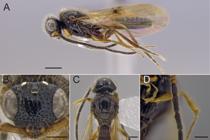
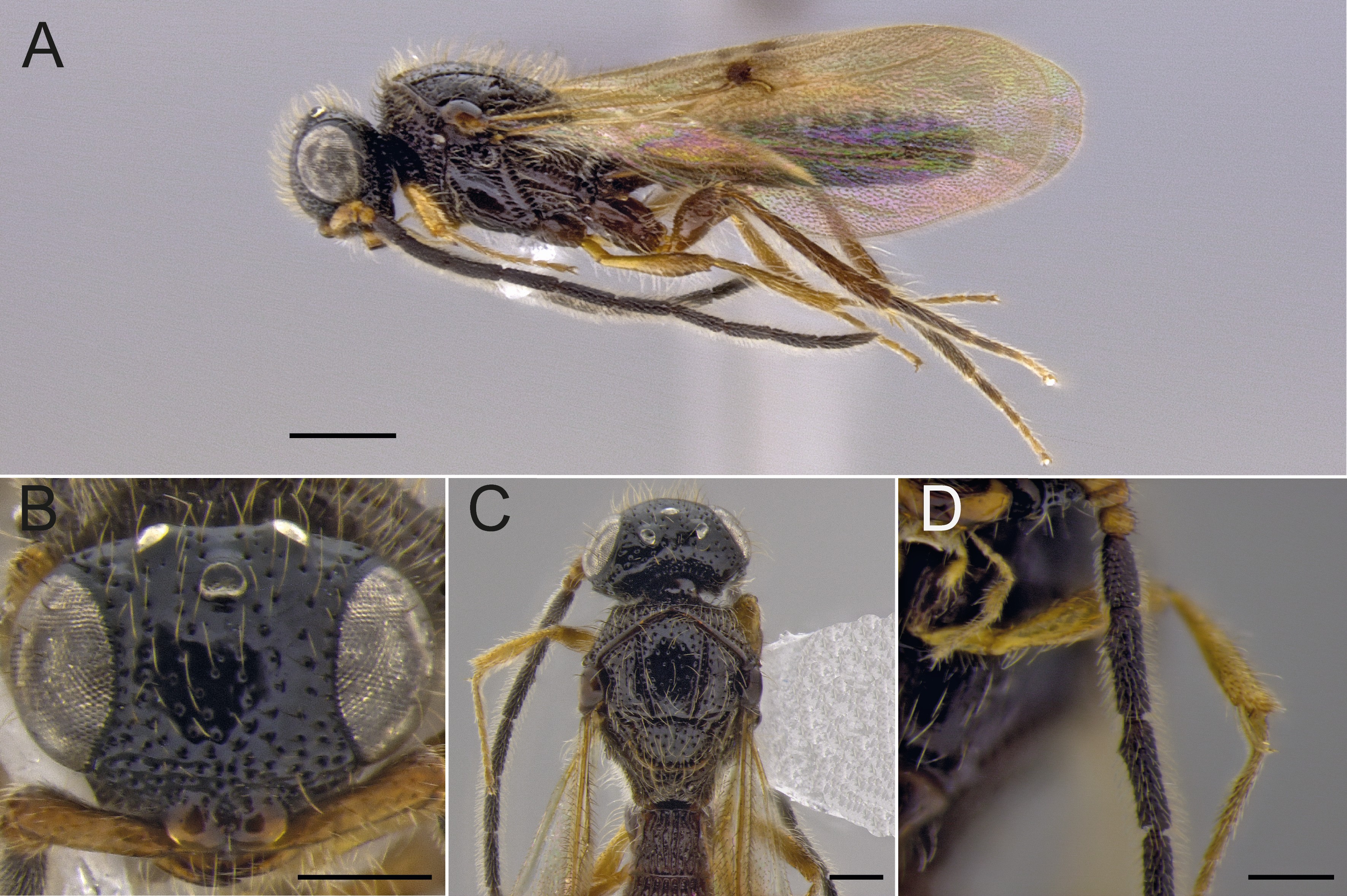
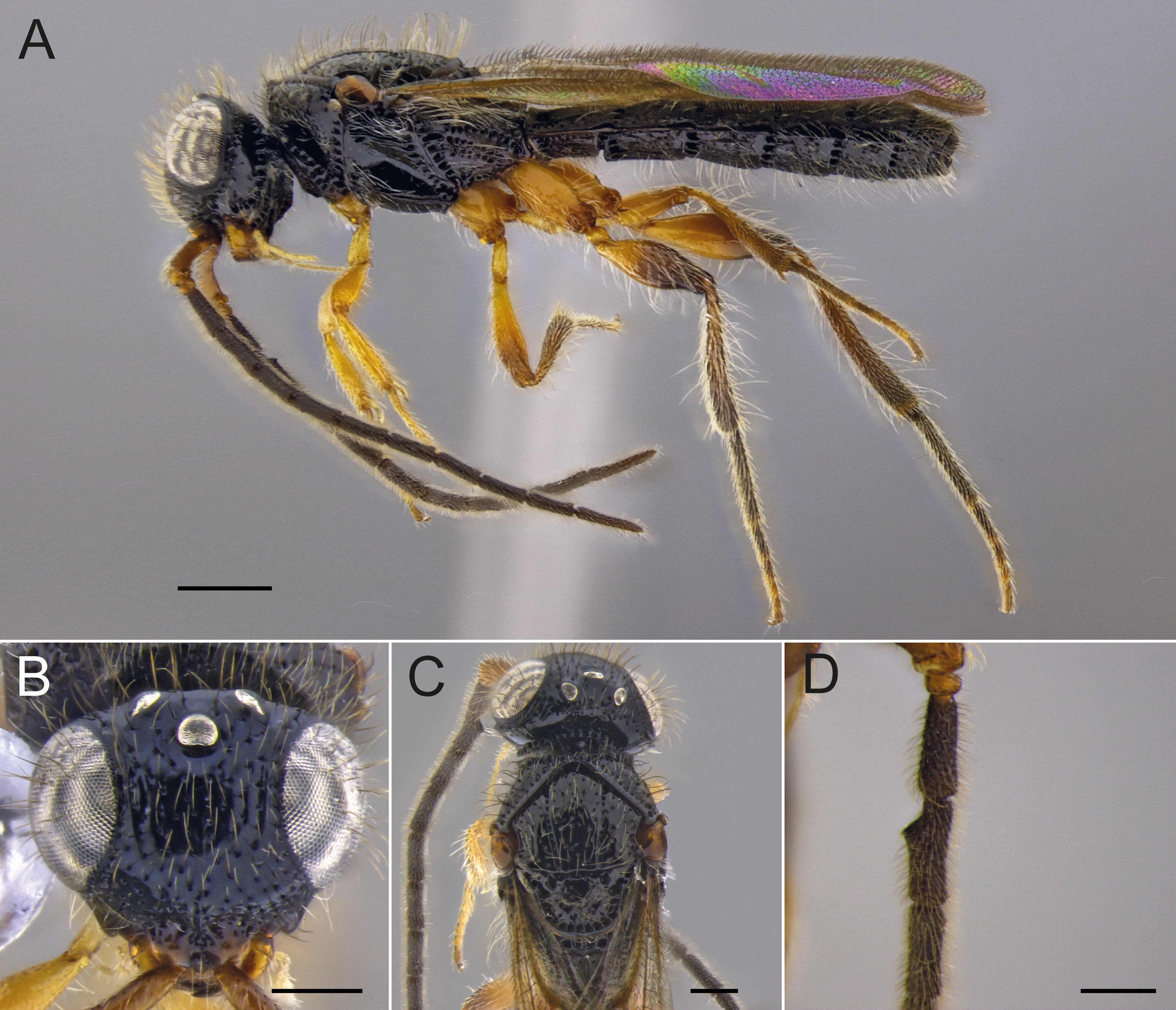
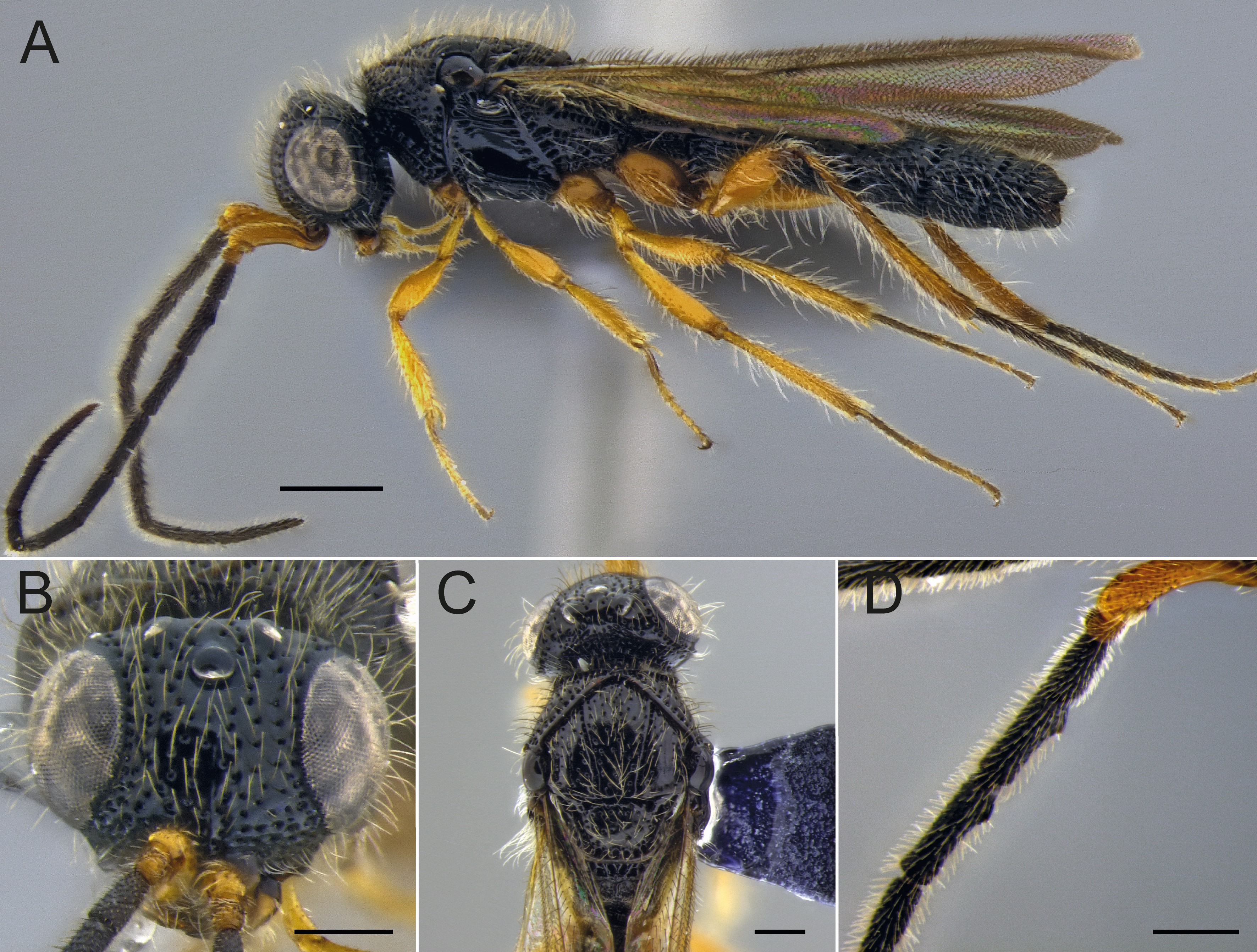
Sceliomorpha brunnipessp. nov. (holotype, male). A, habitus, lateral view; B, head, frontal view; C, head and mesosoma, dorsal view; D, flagellomeres 1-4 focusing on the toothlike projections. Scale bars: A, 1 mm; B–C, 0.5 mm; D, 0.4 mm.

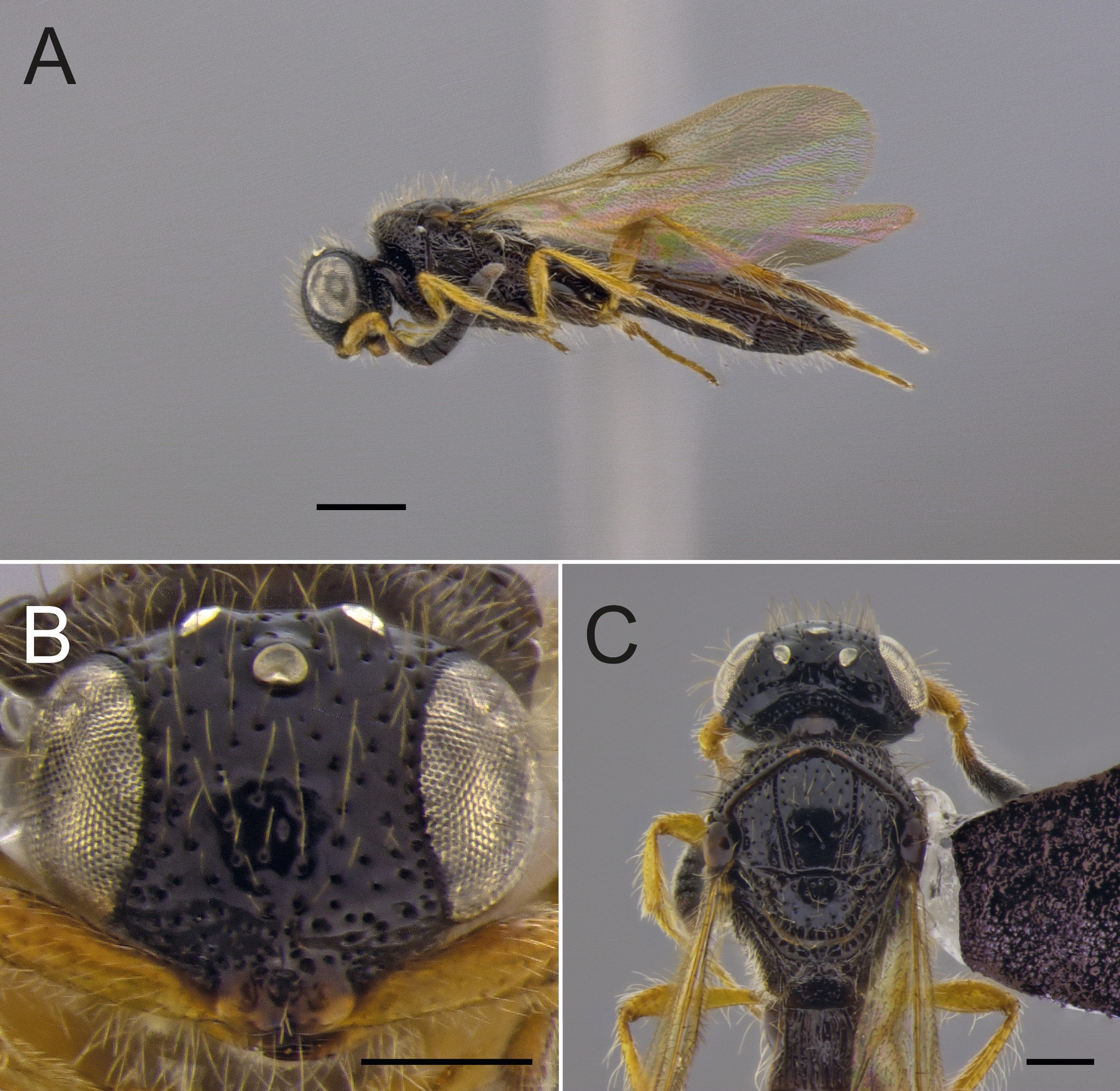
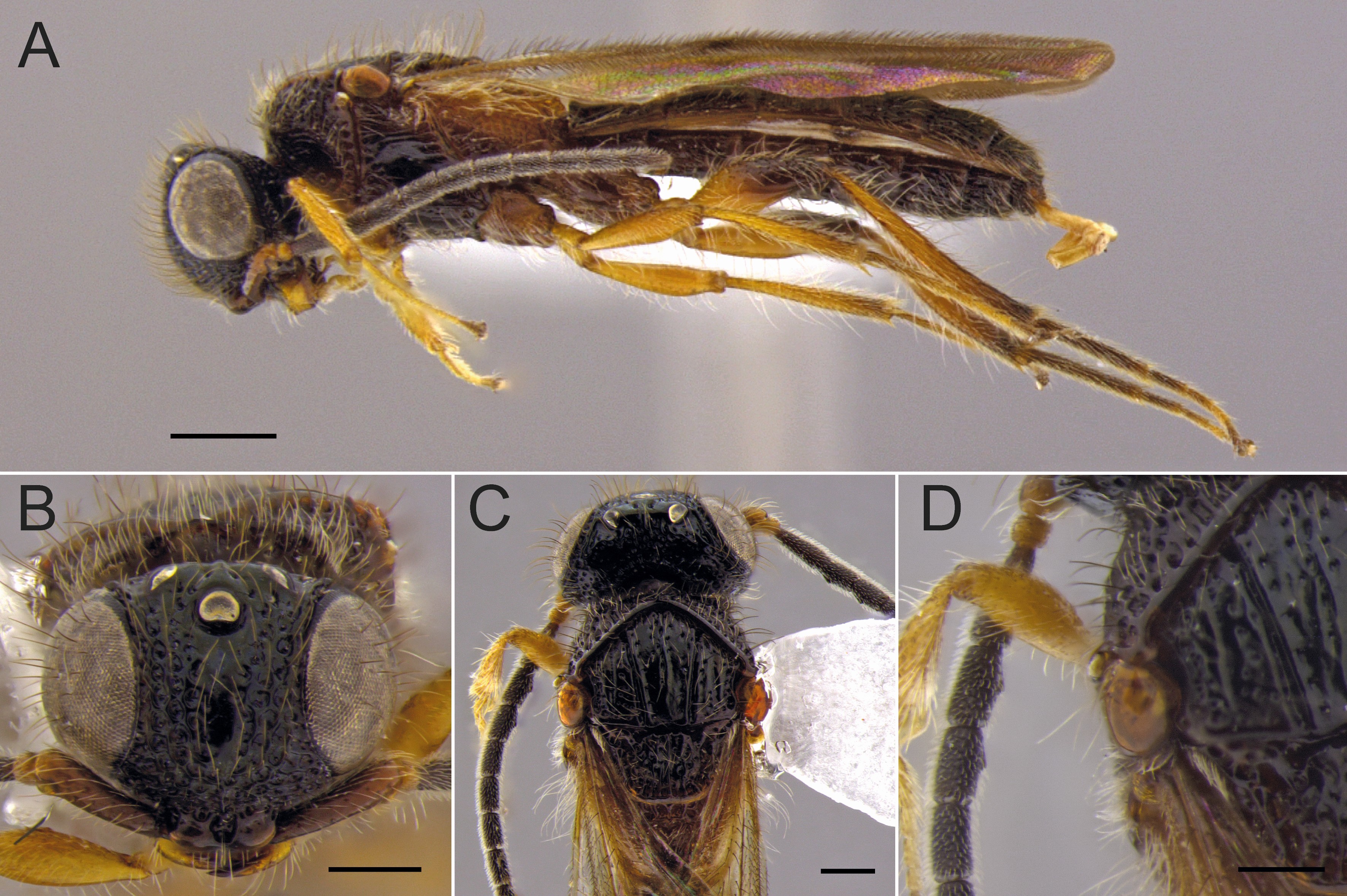
Sceliomorpha brunnipessp. nov. (paratype, female). A, habitus, lateral view; B, head, frontal view; C, head and mesosoma, dorsal view. Scale bars: A, 1 mm; B–C, 0.5 mm.
Diagnosis. Due to the body coloration, antenna size and projections on F2 and F3, Sceliomorpha brunnipes sp. nov. resembles Sceliomorpha porosa sp. nov. However, it can be distinguished from S. porosa sp. nov. by the following characteristics: sparsely punctured vertex, dark brown coxae, middle region of dorsal metapleural area mostly smooth and metapleural foveae mostly uniform in size. Body length: males, 3–3.32 mm; females, 3.12–3.32 mm.
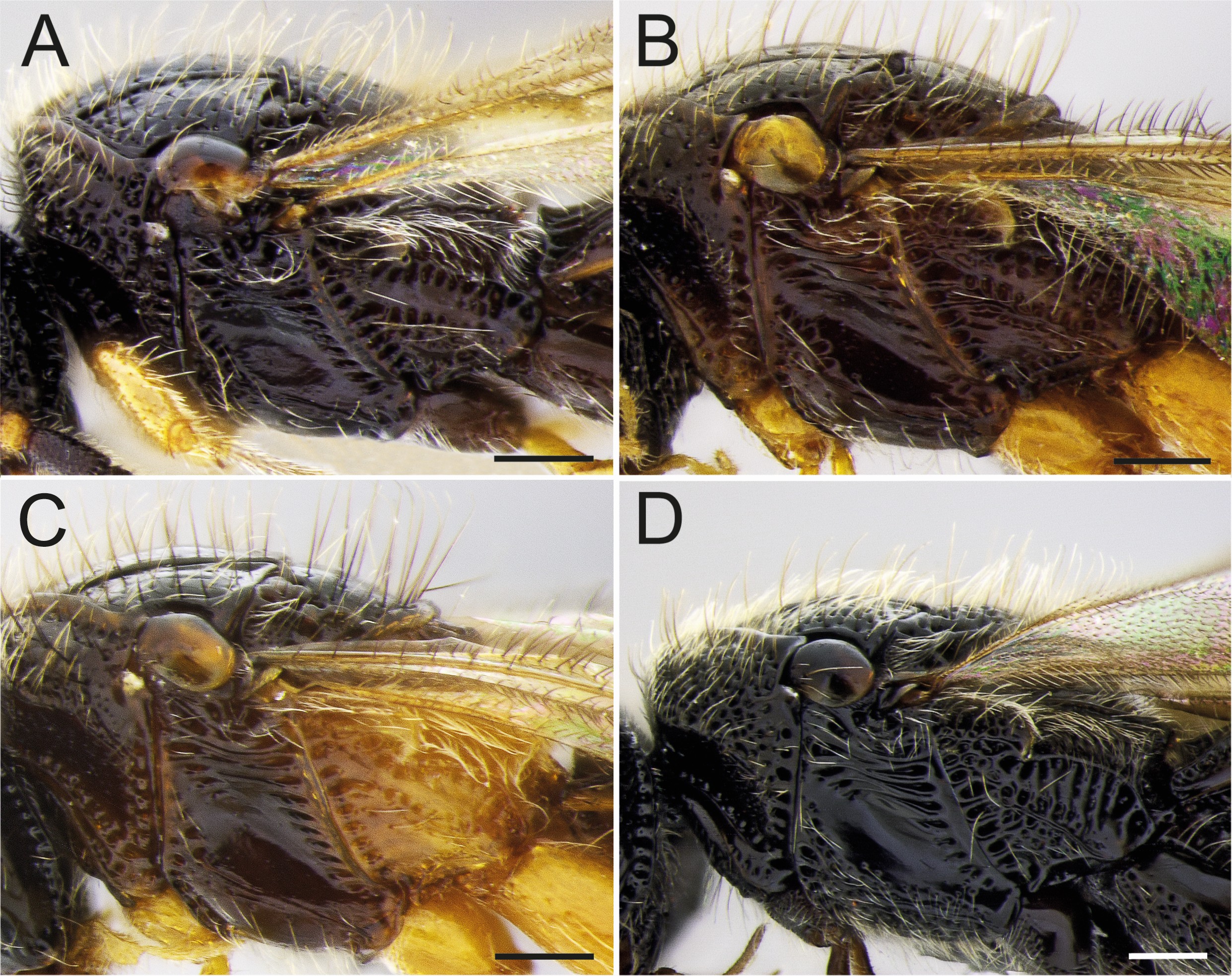
Description. Holotype male. Measurements (in mm). Approximate body length 3.27; forewing length, including tegula, 2.86; metasoma length 1.86; metasoma width 0.6; head length 0.73; head width 0.81; LOL 0.1; OOL 0.09. Color. Integument predominantly dark brown; head black; scape, pedicel, mandible, fore leg, except coxae, yellowish brown; coxae, mandible apex, wing veins, mid and hind leg mostly dark brown; wing membrane slightly infuscate. Pubescence. Mostly pale, except for brown long hairs on vertex and dorsal part of mesosoma; head, including eyes, pronotum, and mesonotum, with scattered, long, erect hairs; scape and pedicel with sparse, short, semi-decumbent hairs; F1 to F10 covered with dense, short, semi-decumbent hairs; lateral portion of propodeum and area near tegula with dense, long, erect hairs; metasoma with very sparse, long, erect hairs on both sterna and terga; wings with short black hairs. Integumental surface. Frons moderately punctured, punctures placed apart by about 1 to 1.5 PD; vertex with small, fine punctures; punctation sparse in the middle area; gena with small lines of punctation near the compound eye and occipital carina; pronotum coarsely punctured, distance between punctures less than 1 PD; mesoscutum and scutellum moderately punctured, punctures placed apart by 1 to 1.5 PD; ventral mesopleuron smooth; metapleural foveae mostly uniform in size; dorsal metapleural area regularly foveate dorsally near the metapleural carina and ventrally near the diagonal carina; middle region of dorsal metapleural area mostly smooth, with few punctures near hind coxa; ventral metapleural area with a row of relatively small punctures along the diagonal carina and with a narrow smooth area below; T1 with several well-delimited longitudinal carinae, surface between them with some rugulosity. Structure. Antennae in repose almost reaching posterior end of metasoma; F1 shorter than F2, approximately half its length; F1 to F9 about 3x as long as wide; F10 about 3.5x as long as wide; F2 and F3 each with a small, basal toothlike projection; dorsal and ventral metapleural area delimited by a diagonal carina in the middle of the metapleura; T1 1.2X as wide as long.
Female paratype (DZUP 028546). Measurements (in mm). Approximate body length 3.22; forewing length, including tegula, 2.80; metasoma length 1.9; metasoma width 0.6; head length 0.73; head width 0.80; LOL 0.1; OOL 0.09. Agreeing with male in color, pubescence, integumental surface and structure, except as follows: scape, mandible and legs tending to lighter yellow; antennae short, not reaching the metasoma; F1 slim, 2x as long as wide; F2 about 1.5x as wide as long; F3-F9 thickened, clublike, each flagellomere 2x as wide as long; F10 about 1.5x as long as wide; middle region of dorsal metapleural, with a row of small punctures; T1 visibly convex.
Type Material. Holotype male (DZUP), “DZUP\ 028535” “Brasil, Paraná, São José\ dos Pinhais, 23°36’18’’S\ 49°11’37’’W, 880m, 19-\ 26.xii.2016, A. C.\ Domahovski, FIT”. Paratypes (DZUP): 5 males “DZUP\ 028536, 028537, 028538, 028539, 028540” “Brasil, Paraná, São José\ dos Pinhais, 23°36’18’’S\ 49°11’37’’W, 880m, 19-\ 26.xii.2016, A. C.\ Domahovski, FIT”; 2 males “DZUP\ 028541, 028542” “Brasil, Paraná, São José\ dos Pinhais, 23°36’18’’S\ 49°11’37’’W, 880m, \ 30.v.2016, A. C.\ Domahovski leg.”; 4 females “DZUP\ 028543, 028544, 028545, 028546” “Brasil, Paraná, São José\ dos Pinhais, 23°36’18’’S\ 49°11’37’’W, 880m, 19-\ 26.xii.2016, A. C.\ Domahovski, FIT”.
Etymology. Named after the dark brown coxae, from brunneus, Latin for brown, and pes, meaning foot.
Sceliomorpha dentata sp. nov.
urn:lsid:zoobank.org:act:254D585D-9E98-4B0B-9922-34D1F83FBF95
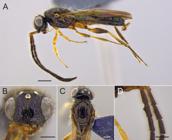
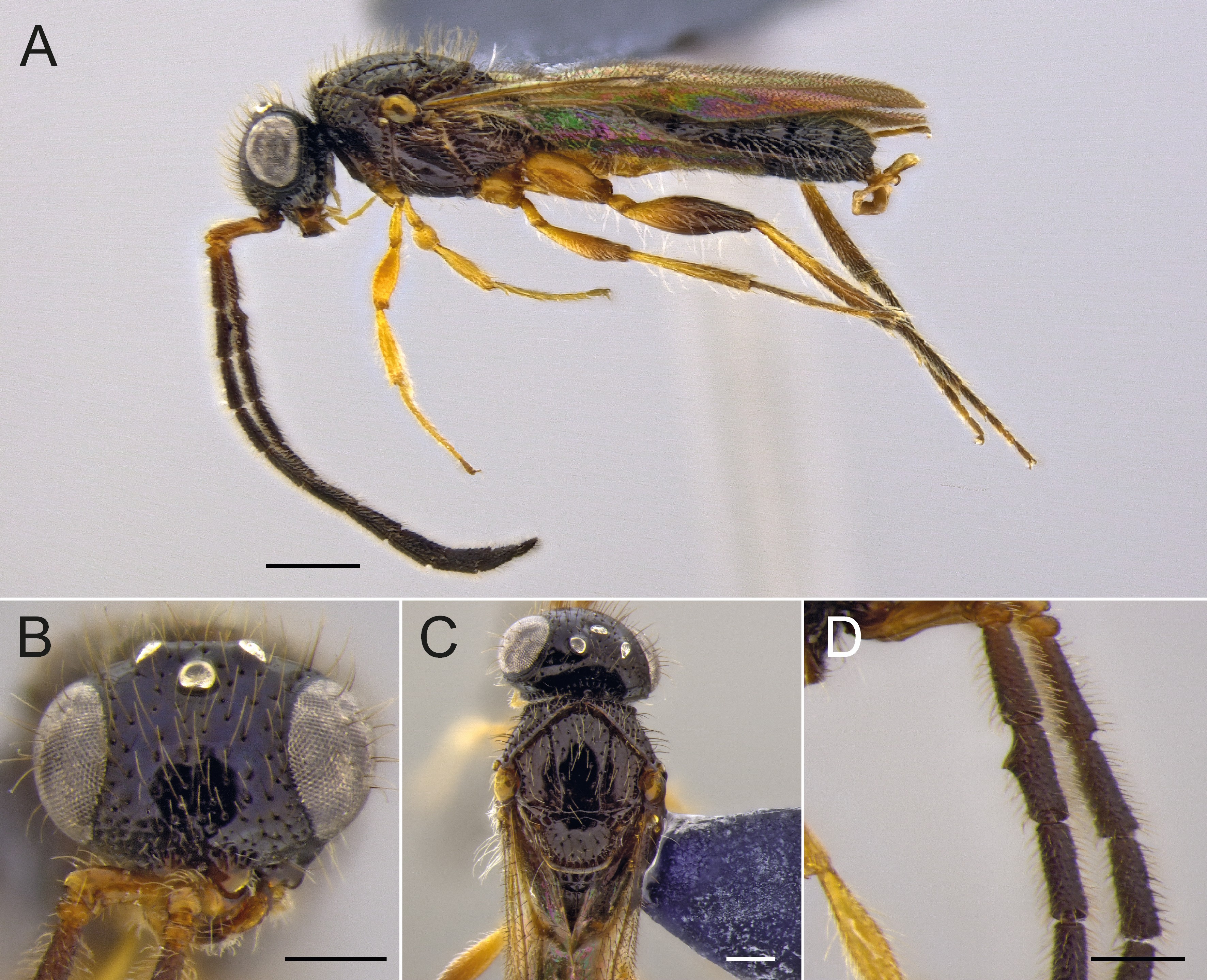
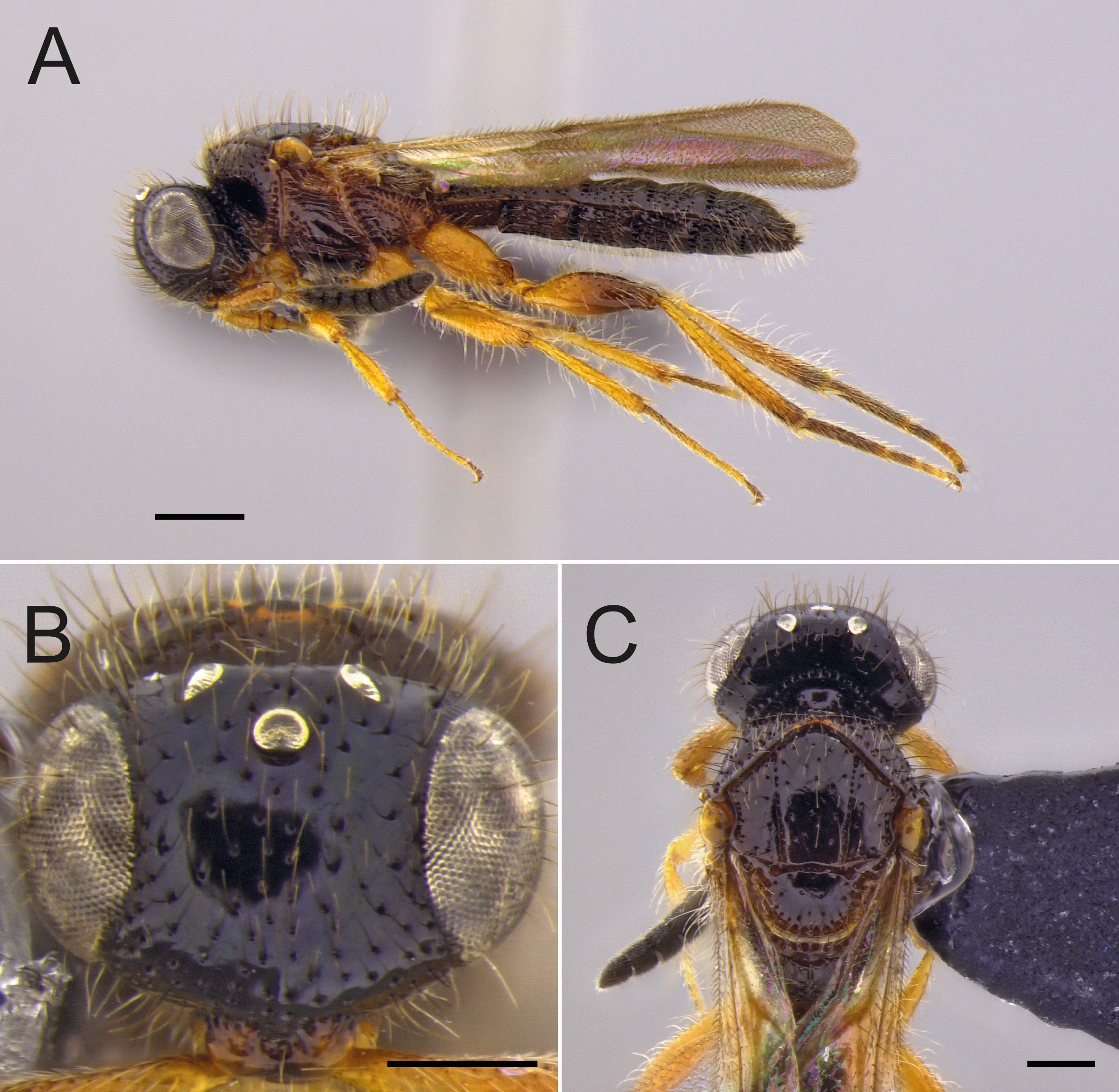
Sceliomorpha dentatasp. nov. (holotype, male). A, habitus, lateral view; B, head, frontal view; C, head and mesosoma, dorsal view; D, flagellomeres 1-4 focusing on the toothlike projections. Scale bars: A, 1 mm; B–C, 0.5 mm; D, 0.4 mm.
Diagnosis. Due to the body coloration, antenna size and projection on F2, Sceliomorpha dentata sp. nov. resembles Sceliomorpha orbiculata sp. nov. However, it can be distinguished from S. orbiculata sp. nov. by the following characteristics: carina of outer orbit ending near vertex, scutellum lacking a longitudinal carina and middle region of dorsal metapleural area with coarse irregular punctures. Body length: males, 3.44–3.6 mm.
Description. Holotype male. Measurements (in mm). Approximate body length 3.54; forewing length, including tegula, 3.01; metasoma length 2; metasoma width 0.52; head length 0.71; head width 0.90; LOL 0.07; OOL 0.09. Color. Integument predominantly black; scape, pedicel, mandible and tegula yellowish brown; legs yellowish brown, except for apical half of hind femur, tibia and tarsomeres tending to dark brown; wing membrane slightly infuscate. Pubescence. Mostly pale, except for brown long hairs on vertex and dorsal part of mesosoma; head, including eyes, pronotum and mesonotum with scattered, long and erect hairs; scape and pedicel with sparse, short and semi-decumbent hairs; F1 to F10 with dense, short and semi-decumbent hairs, with some few erect hairs; lateral portion of propodeum and near tegula with dense, long and erect hairs; legs with both long and short hair; metasoma with very sparse, long and erect hairs, on both sterna and terga; wings with short black hair. Integumental surface. Frons moderately punctured, distance between punctures ranging from 1 to 1.5 PD; vertex mostly shiny, with only a few punctures behind lateral ocelli; pronotum coarsely punctured, punctures placed apart by less than 1 PD; mesoscutum and scutellum mostly shiny, with sparse punctures, distance between punctures about 2 PD; ventral mesopleuron smooth; dorsal metapleural area regularly foveate dorsally near the metapleural carina and ventrally near the diagonal carina; middle region of dorsal metapleural area with coarse and deep irregular punctures; ventral metapleural area mostly smooth, with a row of small punctures near the diagonal carina and epicoxal sulcus; T1 with several well-delimited longitudinal carinae, surface between with some degree of rugosity. Structure. Antennae in repose almost reaching posterior end of metasoma; F1 a little longer than F2; F1 to F9 approximately 3x as long as wide; F10 approximately 3.5x as long as wide; F2 with a large, basal toothlike projection; dorsal and ventral metapleural area delimited by a diagonal carina in the middle of the metapleura; T1 as long as wide.
Type Material. Holotype male (DZUP), “DZUP\ 028556” “Brasil, PR, Antonina, Res.\ Rio Cachoeira, 50m. 20-\ 25.xi.2014, Entomologia\ UFPR, FIT – Trilha do\ Ferro”. Paratypes (DZUP): 2 males “DZUP\ 028557, 028558” “Brasil, PR, Antonina, Res.\ Rio Cachoeira, 50m. 20-\ 25.xi.2014, Entomologia\ UFPR, FIT – Trilha do\ Ferro”.
Etymology. The species is named after the large toothlike projection of the 2nd flagellomere, from Latin dentatus, meaning toothed or having teeth.
Sceliomorpha fulgida sp. nov.
urn:lsid:zoobank.org:act:82CFA33C-1D0B-4049-A421-9577B0CC0F9C
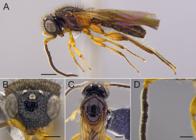
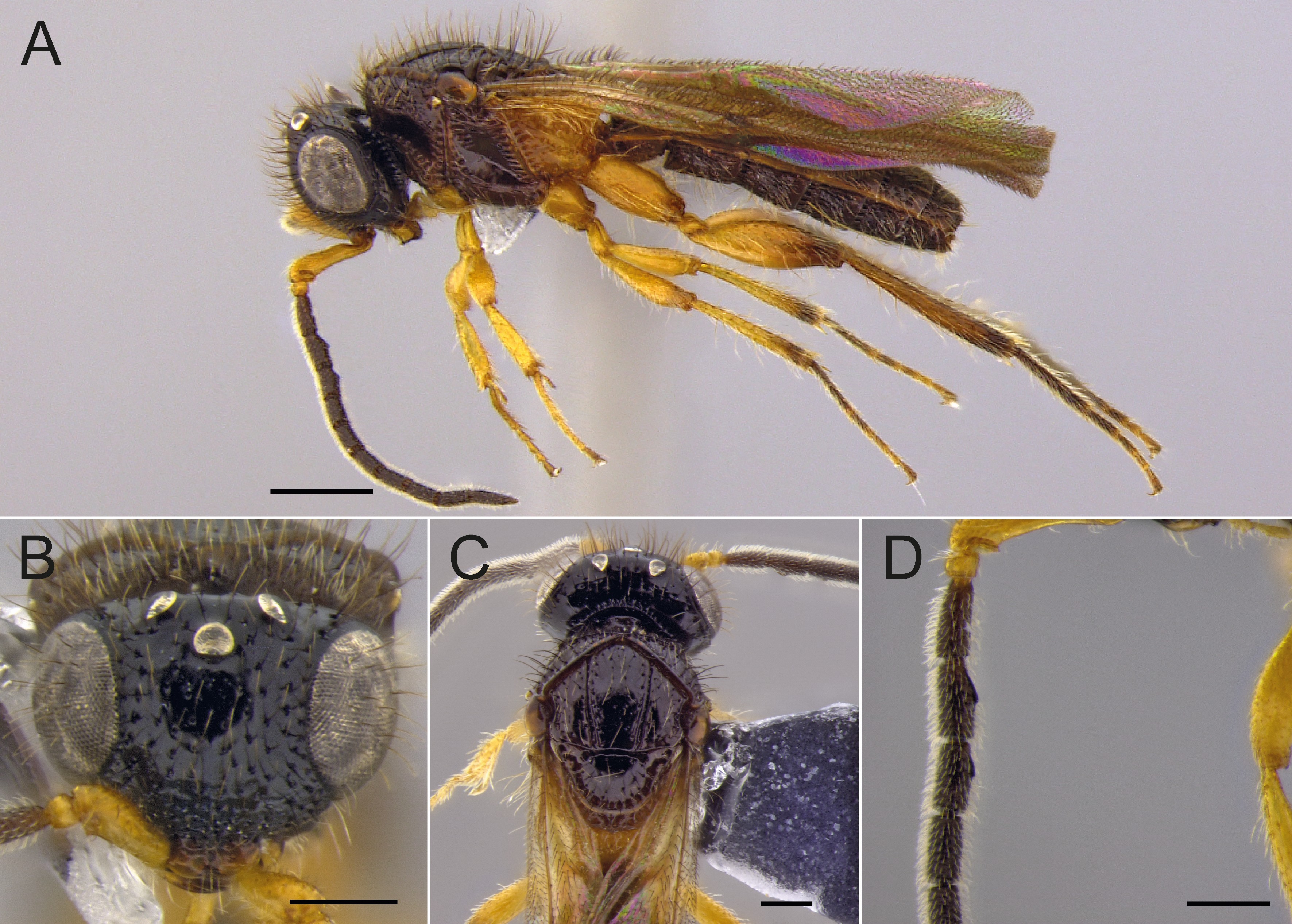
Sceliomorpha fulgidasp. nov. (holotype, male). A, habitus, lateral view; B, head, frontal view; C, head and mesosoma, dorsal view; D, flagellomeres 1-4 focusing on the toothlike projections. Scale bars: A, 1 mm; B–C, 0.5 mm; D, 0.4 mm.

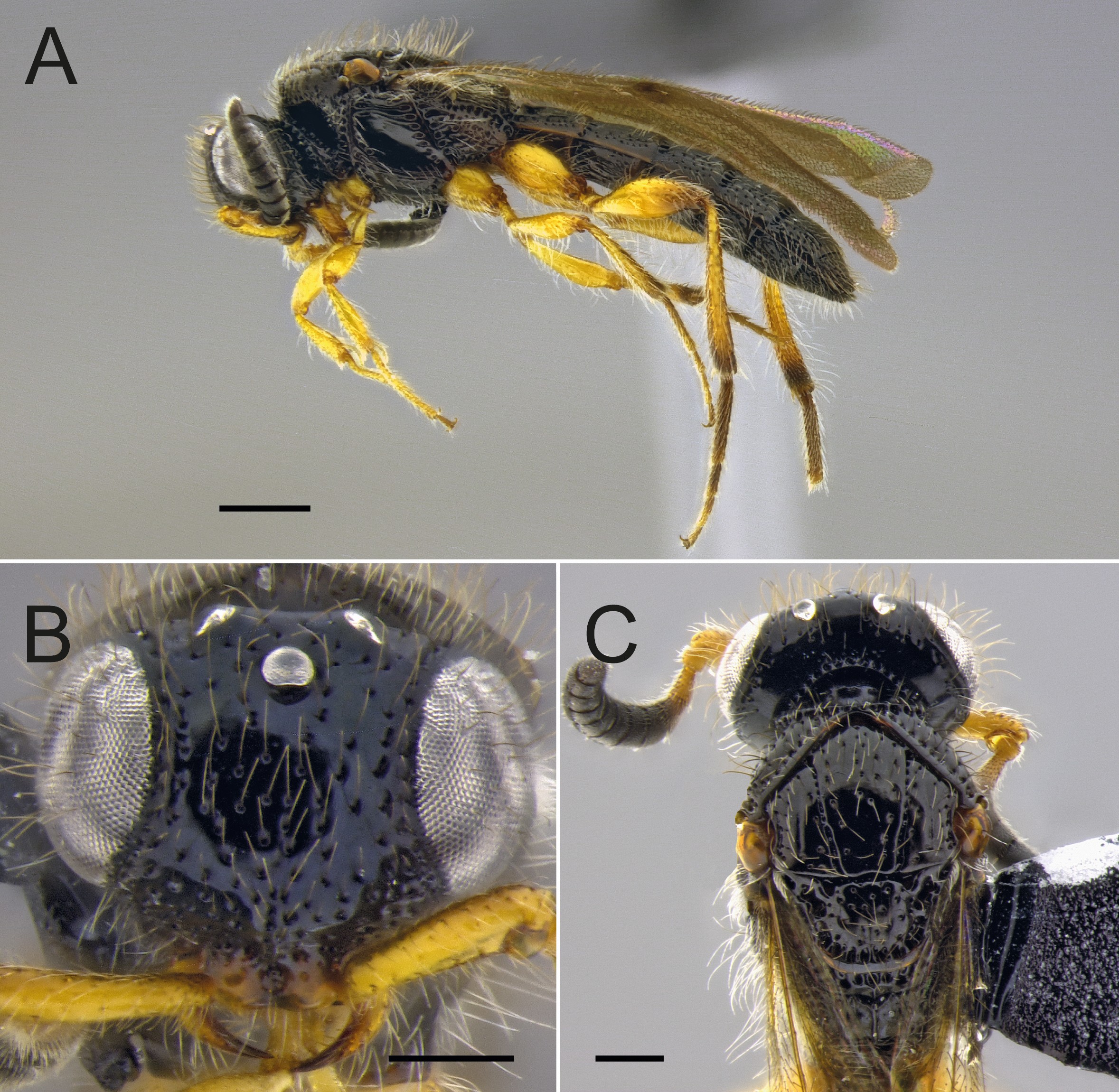
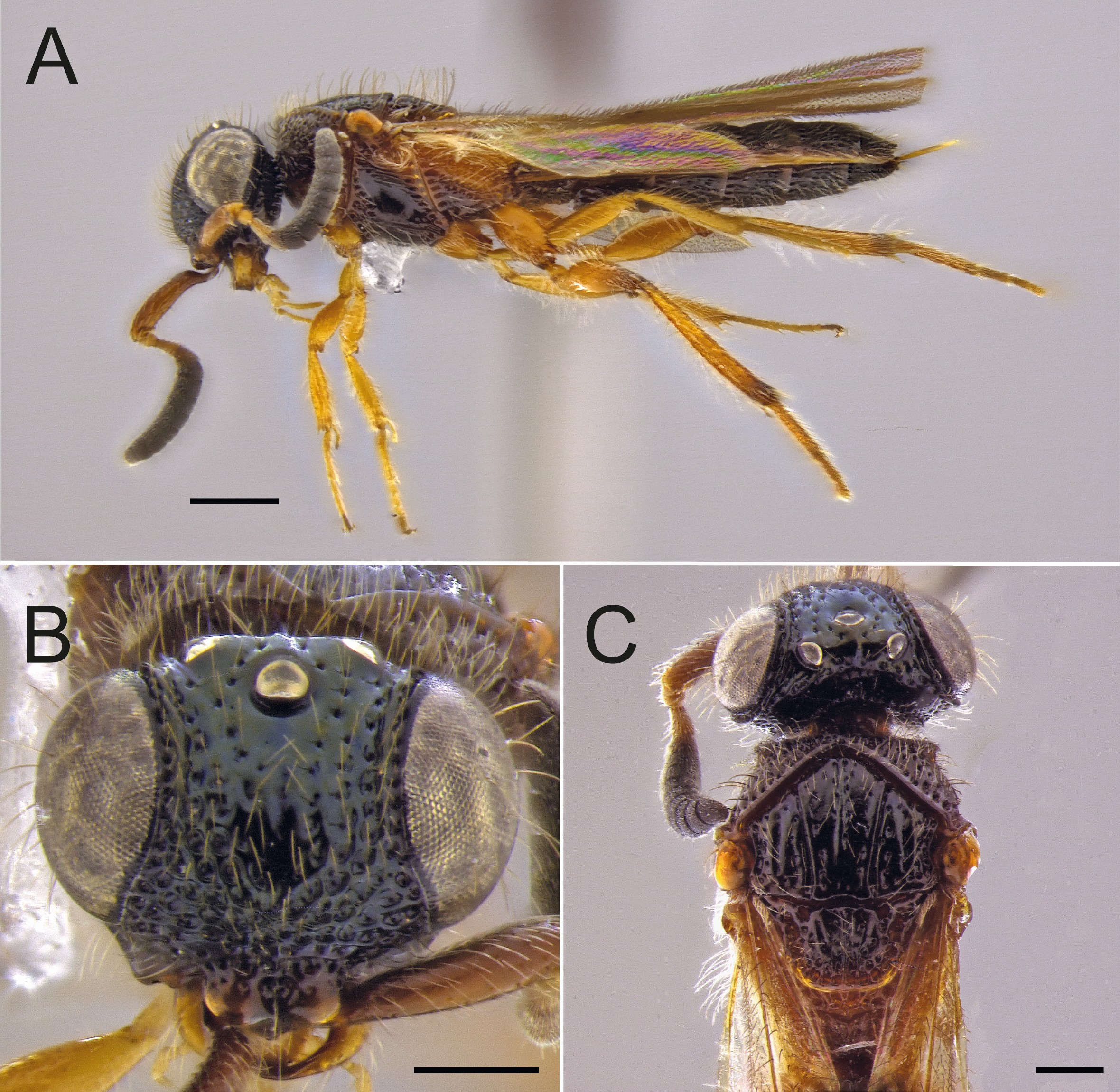
Sceliomorpha fulgidasp. nov. (paratype, female). A, habitus, lateral view; B, head, frontal view; C, head and mesosoma, dorsal view. Scale bars: A, 1 mm; B–C, 0.5 mm.
Diagnosis. Due to the body coloration, antenna size and projections on F2 and F3, Sceliomorpha fulgida sp. nov. resembles Sceliomorpha signata sp. nov. and Sceliomorpha quadridens. However, it can be distinguished by the following characteristics: finely punctured head and mesoscutum, middle region of dorsal metapleural area smooth and without punctures, ventral metapleural area mostly smooth.
Description. Holotype male. Measurements (in mm). Approximate body length 3.38; forewing length, including tegula, 2.91; metasoma length 1.7; metasoma width 0.64; head length 0.71; head width 0.92; LOL 0.07; OOL 0.1. Color. Integument predominantly dark brown; scape, pedicel and mandible yellow; legs yellow, except for apical half of hind femur, tibia and tarsomeres tending to dark brown; tegula, metapleuron and propodeum reddish brown; wing membrane slightly infuscate. Pubescence. Mostly pale, except for brown long hairs on vertex and dorsal part of mesosoma; head, including eyes, pronotum and mesonotum with scattered, long and erect hairs; scape and pedicel with sparse, short and semi-decumbent hairs; F1 to F10 with dense, short and semi-decumbent hairs, with some few erect hairs; lateral portion of propodeum and near tegula with dense, long and erect hairs; legs with both long and short hair; metasoma with very sparse, long and erect hairs, on both sterna and terga; wings with short black hair. Integumental surface. Frons moderately punctured, distance between punctures ranging from 1 to 1.5 PD; vertex mostly shiny, without punctures, except for transversal line of small and fine punctures behind lateral ocelli; pronotum coarsely punctured, punctures placed apart by less than 1 PD; mesoscutum and scutellum mostly shiny, with some very sparse punctures, distance between punctures more than 3 PD; ventral mesopleuron smooth; dorsal metapleural area regularly foveate dorsally near the metapleural carina and ventrally near the diagonal carina; middle region of dorsal metapleural area smooth and without punctures; ventral metapleural area smooth with only a few sparse and fine setigerous punctures; T1 with several longitudinal, equally developed, carinae, surface between them with sparse fine punctures. Structure. Antennae reaching at most the second or third metasomal segment; F1 equal in length to F2; F1 to F9 approximately 1.5x to 2x as long as wide; F10 approximately 3x as long as wide; F2 and F3 each with a small, basal toothlike projection, with the projection on F3 being smaller than that on F2; dorsal and ventral metapleural area delimited by a diagonal carina in the middle of the metapleura; T1 as long as wide.
Female paratype. Measurements (in mm). Approximate body length 3.43; forewing length, including tegula, 2.91; metasoma length 1.8; metasoma width 0.62; head length 0.73; head width 0.92; LOL 0.08; OOL 0.09. Agreeing with male in color, pubescence, integumental surface and structure, except as follows: metapleuron and propodeum darker colored compared to males; middle region of dorsal metapleural area with coarse and deep regular punctations; head, mesoscutum and scutellum punctation a little sparser than in the males; F1 slim, 2x as long as wide; F2 about 1.5x as long as wide; F3 to F9 thickened, clublike, each flagellomere 2x as wide as long; F10 about 1.5x as long as wide.
Type Material. Holotype male (DZUP), “DZUP\ 028553” “Brasil, PR, Antonina, Res.\ Rio Cachoeira, 50m. 20-\ 25.xi.2014, Entomologia\ UFPR, FIT – Trilha do\ Ferro”. Paratypes (DZUP): 1 male “DZUP\ 028554” “Brasil, PR, Antonina,\ Res. Nat. Guaricica,\ 25.3050°S 48.6609°W\ 31.i-4.ii.2022, A. C.\ Domahovski, FIT”; 1 female “DZUP\ 028555” “Brasil, PR, Piraquara,\ Mananciais da Serra,\ 25.49°S 48.98°W, 1010m\ 30.iii-24.iv.2019, G.\ Melo & A. Martins”.
Etymology. The species is named after its smooth and shiny mesoscutum and scutellum, from Latin fulgidus, meaning shining, gleaming.
Remarks. The male paratype has the propodeum, mandibles, legs, scape and pedicel coloration slightly darker than the holotype.
Sceliomorpha nigripes sp. nov.
urn:lsid:zoobank.org:act:36C083BF-86B3-4CFD-BC94-9297901AE8EA
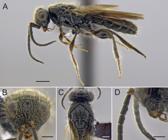
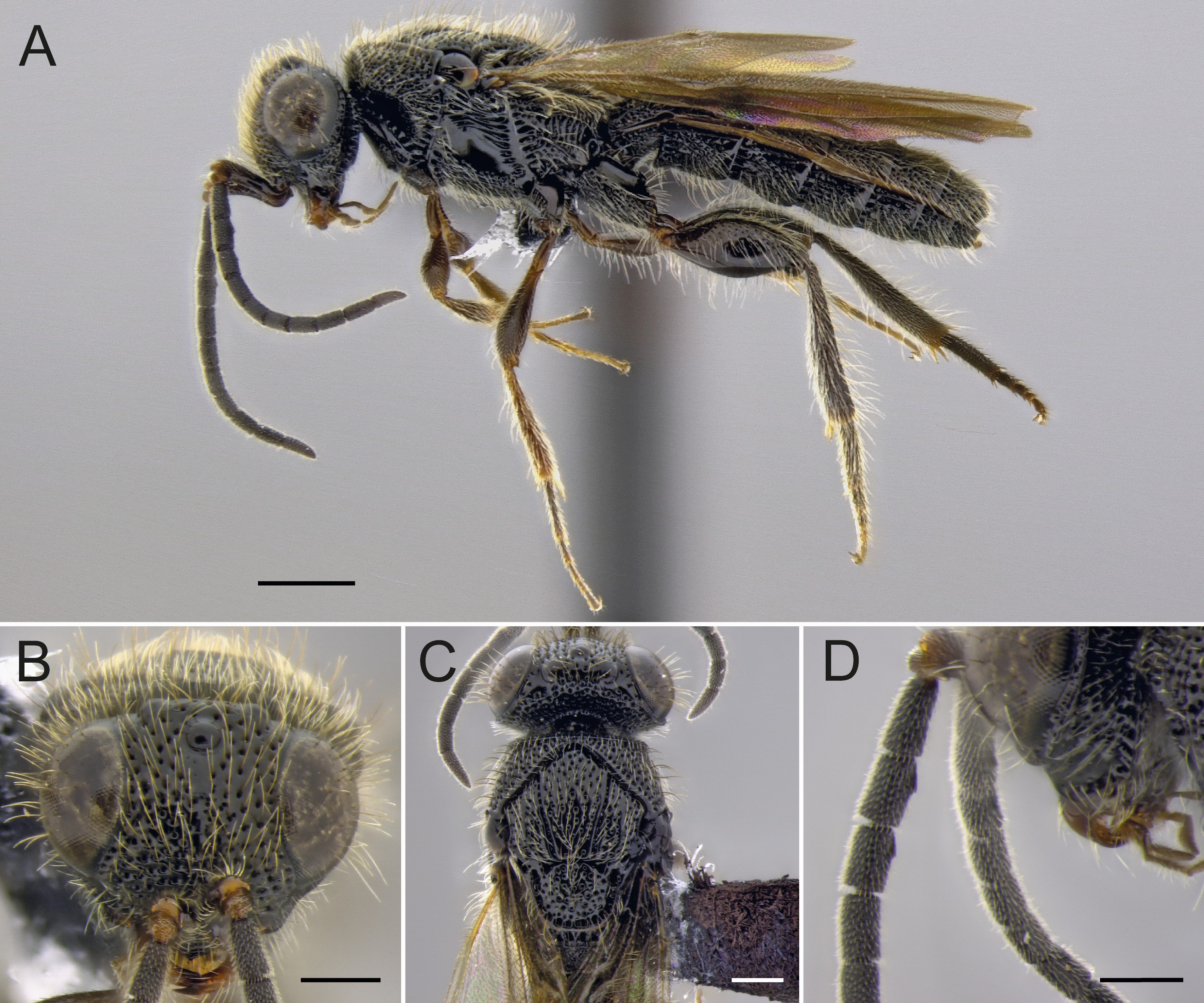
Sceliomorpha nigripessp. nov. (holotype, male). A, habitus, lateral view; B, head, frontal view; C, head and mesosoma, dorsal view; D, flagellomeres 1-4 focusing on the toothlike projections. Scale bars: A, 1 mm; B–C, 0.5 mm; D, 0.4 mm.
Diagnosis.Sceliomorpha nigripessp. nov. is a very distinctive species, resembling S. longicornis because of the densely punctured integument. However, it can be easily distinguished by the following characteristics: predominantly rugulose and setose ventral mesopleuron, strongly sculptured metapleura, very coarsely punctured hind coxae, flagellum articles approximately 1.5x to 2x as long as wide and by the black to dark brown legs.
Description. Holotype male. Measurements (in mm). Approximate body length 3.95; forewing length, including tegula, 3.27; metasoma length 2.2; metasoma width 0.7; head length 0.78; head width 0.95; LOL 0.09; OOL 0.08. Color. Integument predominantly black; scape, pedicel, mandible and legs very dark brown; wing membrane slightly infuscate. Pubescence. Mostly pale, except for brown long hairs on vertex and dorsal part of mesosoma; head, including eyes, pronotum and mesonotum with dense, long and erect hairs; scape with long and semi-decumbent hairs; pedicel to F10 with dense, very short and semi-decumbent hairs, with some few erect hairs; ventral mesopleuron densely setose; lateral portion of propodeum and near tegula with dense, long and erect hairs; legs with both long and short hair; metasoma with dense, long and erect hairs, on both sterna and terga; wings with short black hair. Integumental surface. Frons densely and coarsely punctured, distance between punctures less than 1 PD, except for a small, smooth and shiny area under the middle ocellus; vertex, gena, pronotum, mesoscutum, scutellum, inner portion of hind coxa and metasoma densely and coarsely punctured, distance between punctures less than 1 PD; ventral mesopleuron predominantly rugulose; dorsal metapleural area foveate dorsally near the metapleural carina and ventrally near the diagonal carina; middle region of dorsal metapleural area with small carinae connecting the dorsal and ventral foveae; ventral metapleural area with coarse and deep irregular punctures; T1 with three well-delimited longitudinal carinae, which do not reach the posterior margin of sclerite, surface between them densely and coarsely punctured. Structure. Antennae reaching at most the second or third metasomal segment; F1 equal in length to F2; F1 to F9 approximately 1.5x to 2x as long as wide; F10 about 3x as long as wide F2 and F3 each with a small, basal toothlike projection, with the projection on F3 being smaller than that on F2; dorsal and ventral metapleural area delimited by a diagonal carina in the middle of the metapleura; T1 about 1.2x as wide as long.
Type Material. Holotype male (DZUP), “DZUP\ 028559” “Brasil, MT, 14km N\ Chap. dos Guimarães,\ PNCG, 15-16.xi.2013,\ 15.336°S 55.786°W,\ 750m, Melo, Luz &\ Willians, FIT”.
Etymology. The species is named for its dark legs, from Latinniger, meaning black, andpes, meaning foot.
Remarks. This species is currently known only from the male holotype.
Sceliomorpha orbiculata sp. nov.
urn:lsid:zoobank.org:act:D1480D93-7560-422A-9818-E6B497F803CF
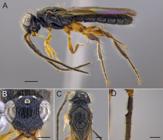
Sceliomorpha orbiculatasp. nov. (holotype, male). A, habitus, lateral view; B, head, frontal view; C, head and mesosoma, dorsal view; D, flagellomeres 1-4 focusing on the toothlike projections. Scale bars: A, 1 mm; B–C, 0.5 mm; D, 0.4 mm.
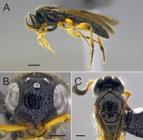
Sceliomorpha orbiculatasp. nov. (paratype, female). A, habitus, lateral view; B, head, frontal view; C, head and mesosoma, dorsal view. Scale bars: A, 1 mm; B–C, 0.5 mm.
Diagnosis. Due to the body coloration, antenna size and projection on F2, Sceliomorpha orbiculata sp. nov. resembles Sceliomorpha dentata sp. nov. However, it can be distinguished from S. dentata sp. nov. by the following characteristics: well-developed carina of outer orbit, which extends anteriorly to upper portion of inner orbit, scutellum with a longitudinal carina extending from the apical limit to the middle portion of the sclerite and middle region of dorsal metapleural area smooth. Body length: males, 3.9–4.31 mm; females, 3.8–4.24 mm.
Description. Holotype male. Measurements (in mm). Approximate body length 4.31; forewing length, including tegula, 3.64; metasoma length 2.3; metasoma width 0.7; head length 0.80; head width 0.97; LOL 0.07; OOL 0.08. Color. Integument predominantly black; scape, pedicel, mandible, tegula and legs yellowish brown; apical half of hind femur, tibia and tarsomeres tending to brown; wing membrane slightly infuscate. Pubescence. Mostly pale, except for brown long hairs on vertex and dorsal part of mesosoma; head, including eyes, pronotum and mesonotum with scattered, long and erect hairs; scape and pedicel with sparse, short and semi-decumbent hairs; F1 to F10 with dense, short and semi-decumbent hairs; lateral portion of propodeum and near tegula with dense, long and erect hairs; legs with both long and short hair; metasoma with very sparse, long and erect hairs, on both sterna and terga; wings with short black hair. Integumental surface. Frons punctures small and fine; frons moderately punctured, distance between punctures ranging from 1 to 1.5 PD; carina of outer orbit prolonged dorsally and extending anteriorly to upper portion of inner orbit; vertex with small striation present behind lateral ocellus; gena with small lines of punctation near compound eye and occipital carina; pronotum coarsely punctured, distance between punctures less than 1 PD; mesoscutum and scutellum moderately punctured, punctures placed apart by 1 to 1.5 PD; scutellum with a longitudinal carina extending from the apical limit to the middle portion of the sclerite; ventral mesopleuron smooth; dorsal metapleural area regularly foveate dorsally near the metapleural carina and ventrally near the diagonal carina; middle region of dorsal metapleural area smooth; ventral metapleural area with a row of large punctures along the diagonal carina and with a narrow smooth area below; T1 with a few well-delimited longitudinal carinae, surface between them mostly smooth. Structure. Antennae in repose almost reaching posterior end of metasoma; F1 equal in length to F2; F1 to F9 approximately 3x as long as wide; F10 approximately 3.5x as long as wide; F2 with a large, basal toothlike projection; dorsal and ventral metapleural area delimited by a diagonal carina in the middle of the metapleura; T1 1.1X as long as wide.
Female paratype (DZUP 028550). Measurements (in mm). Approximate body length 4.16; forewing length, including tegula, 3.59; metasoma length 2.2; metasoma width 0.67; head length 0.81; head width 1.02; LOL 0.1; OOL 0.07. Agreeing with male in color, pubescence, integumental surface and structure, except as follows: vertex very sparsely punctuated; scape, pedicel and legs tending to a lighter yellow; F1 slim, 2x as long as wide; F2 about 1.5x as wide as long; F3 to F9 thickened, clublike, each flagellomere 2x as wide as long; F10 about 1.5x as long as wide; middle region of dorsal metapleural area with a row of small punctures.
Type Material. Holotype male (DZUP), “DZUP\ 028547” “Brasil, PR, Antonina, Res.\ Rio Cachoeira, 50m. 20-\ 25.xi.2014, Entomologia\ UFPR, FIT – Trilha do\ Ferro”. Paratypes (DZUP): 1 male “DZUP\ 028548” “Brasil, PR, São José\ dos Pinhais, \ 01-31.i.2017, A. C.\ Domahovski, Malaise”; 3 females “ “DZUP\ 028549, 028550, 028563” “Brasil, PR, Piraquara,\ Mananciais da Serra,\ 25.4967°S 48.9839°W\ 1010m, 1-16.ii.2019,\ Melo & Martins, Malaise”; 1 female and one male “DZUP\ 028562, 028564” “Brasil, PR, Piraquara,\ Mananciais da Serra,\ 25.4967°S 48.9839°W\ 1.ii.2019, A. L. Martins”.
Etymology. The species is named after the carina around its eye orbit, from Latinorbiculus, meaning a small circle, and the suffix -ata, provided with.
Sceliomorpha porosa sp. nov.
urn:lsid:zoobank.org:act:610B88B7-5EB2-4C9A-9345-EF9D14F959BA
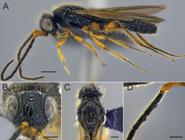
Sceliomorpha porosasp. nov. (holotype, male). A, habitus, lateral view; B, head, frontal view; C, head and mesosoma, dorsal view; D, flagellomeres 1-4 focusing on the toothlike projections. Scale bars: A, 1 mm; B–C, 0.5 mm; D, 0.4 mm.
Diagnosis. Due to the body coloration, antenna size and projections on F2 and F3, Sceliomorpha porosa sp. nov. resembles Sceliomorpha brunnipes sp. nov. However, it can be distinguished from S. brunnipes sp. nov. by the following characteristics: densely punctured vertex, light brown coxae and middle region of dorsal metapleural area with coarse irregular punctation.
Description. Holotype male. Measurements (in mm). Approximate body length 4; forewing length, including tegula, 3.38; metasoma length 2.2; metasoma width 0.6; head length 0.78; head width 0.95; LOL 0.08; OOL 0.07. Color. Integument predominantly black; scape, pedicel, mandible, legs yellowish brown; wing veins, apical portion of hind femur, tibia and tarsomeres light brown; wing membrane slightly infuscate. Pubescence. Mostly pale, except for brown long hairs on vertex and dorsal part of mesosoma; head, including eyes, pronotum and mesonotum with scattered, long and erect hairs; scape and pedicel with sparse, short and semi-decumbent hairs; F1 to F10 with dense, short and semi-decumbent hairs; lateral portion of propodeum and near tegula with dense, long and erect hairs; metasoma with very sparse, long and erect hairs, on both sterna and terga; wings with short black hair. Integumental surface. Frons moderately punctured, distance between punctures from 1 to 1.5 PD; vertex densely punctured, punctures placed apart by less than 1 PD, punctures restricted to the middle area, between lateral ocellus; gena with small lines of punctation near compound eye and occipital carina; pronotum coarsely punctured, punctures placed apart by less than 1 PD; mesoscutum and scutellum moderately punctured, distance between punctures from 1 to 1.5 PD; ventral mesopleuron smooth; metapleural foveae mostly irregularly sized; dorsal metapleural area regularly foveate dorsally near the metapleural carina and ventrally near the diagonal carina; middle region of dorsal metapleural area with coarse and deep irregular punctures; ventral metapleural area with coarse and deep irregular punctures; T1 with a strong medial longitudinal carina and weaker, more sinuous, lateral ones, surface between them with some degree of rugosity. Structure. Antennae in repose almost reaching posterior end of metasoma; F1 shorter than F2, approximately two-thirds of its length; F1 to F9 approximately 3x as long as wide; F10 approximately 3.5x as long as wide; F2 and F3 each with a small, basal toothlike projection, with the projection on F3 being the same size than that on F2; dorsal and ventral metapleural area delimited by a diagonal carina in the middle of the metapleura; T1 about 1.3x as long as wide.
Type Material. Holotype male (DZUP), “DZUP\ 028551” “Brasil, PR, São José\ dos Pinhais, \ 01-31.i.2017, A. C.\ Domahovski, Malaise”. Paratype (DZUP): 1 male “DZUP\ 028552” “Brasil, PR, São José\ dos Pinhais, \ 01-31.i.2017, A. C.\ Domahovski, Malaise”.
Etymology. The species is named after its densely punctured vertex, from Latin porosus, meaning full of holes.
Remarks. This species is currently known only from males.
Sceliomorpha signata sp. nov.
urn:lsid:zoobank.org:act:3C659F17-C0B9-4959-8711-62B7584B0747
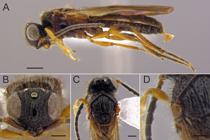
Sceliomorpha signatasp. nov. (holotype, male). A, habitus, lateral view; B, head, frontal view; C, head and mesosoma, dorsal view; D, flagellomeres 1-4 focusing on the toothlike projections. Scale bars: A, 1 mm; B–C, 0.5 mm; D, 0.4 mm.
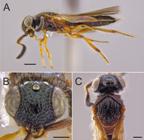
Sceliomorpha signatasp. nov. (paratype, female). A, habitus, lateral view; B, head, frontal view; C, head and mesosoma, dorsal view. Scale bars: A, 1 mm; B–C, 0.5 mm.
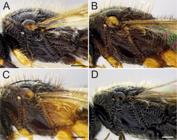
Mesosoma in lateral view. A, Sceliomorpha brunnipes sp. nov. (holotype, male); B, Sceliomorpha dentata sp. nov. (holotype, male); C, Sceliomorpha fulgida sp. nov. (holotype, male); D, Sceliomorpha nigripes sp. nov. (holotype, male). Scale bars: 0.2 mm.
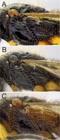
Mesosoma in lateral view. A, Sceliomorpha orbiculata sp. nov. (holotype, male); B, Sceliomorpha porosa sp. nov. (holotype, male); C, Sceliomorpha signata sp. nov. (holotype, male). Scale bars: 0.2 mm.
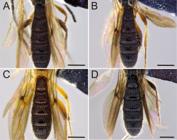
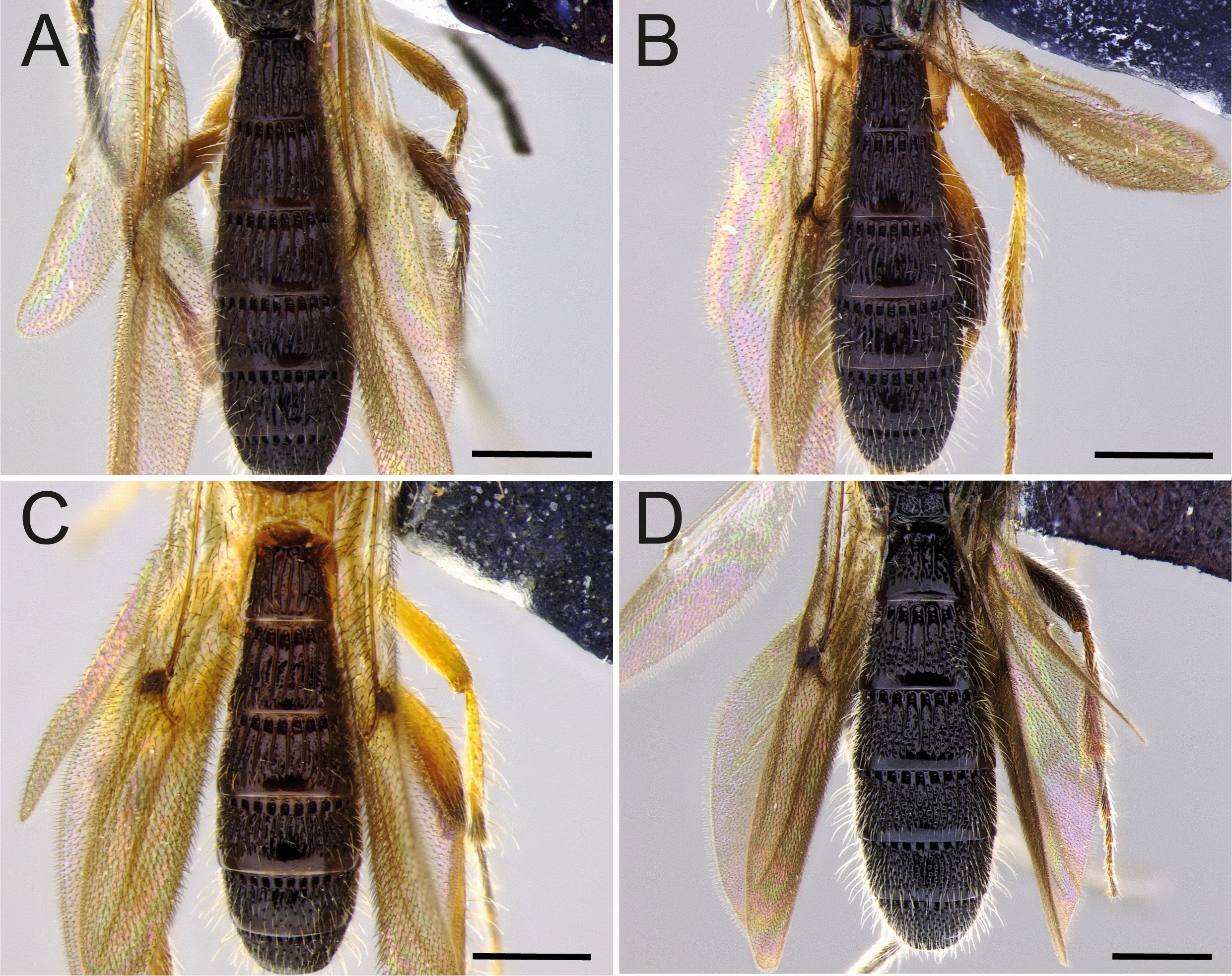
Metasoma in dorsal view. A, Sceliomorpha brunnipes sp. nov. (holotype, male); B, Sceliomorpha dentata sp. nov. (holotype, male); C, Sceliomorpha fulgida sp. nov. (holotype, male); D, Sceliomorpha nigripes sp. nov. (holotype, male). Scale bars: 0.5 mm.
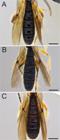
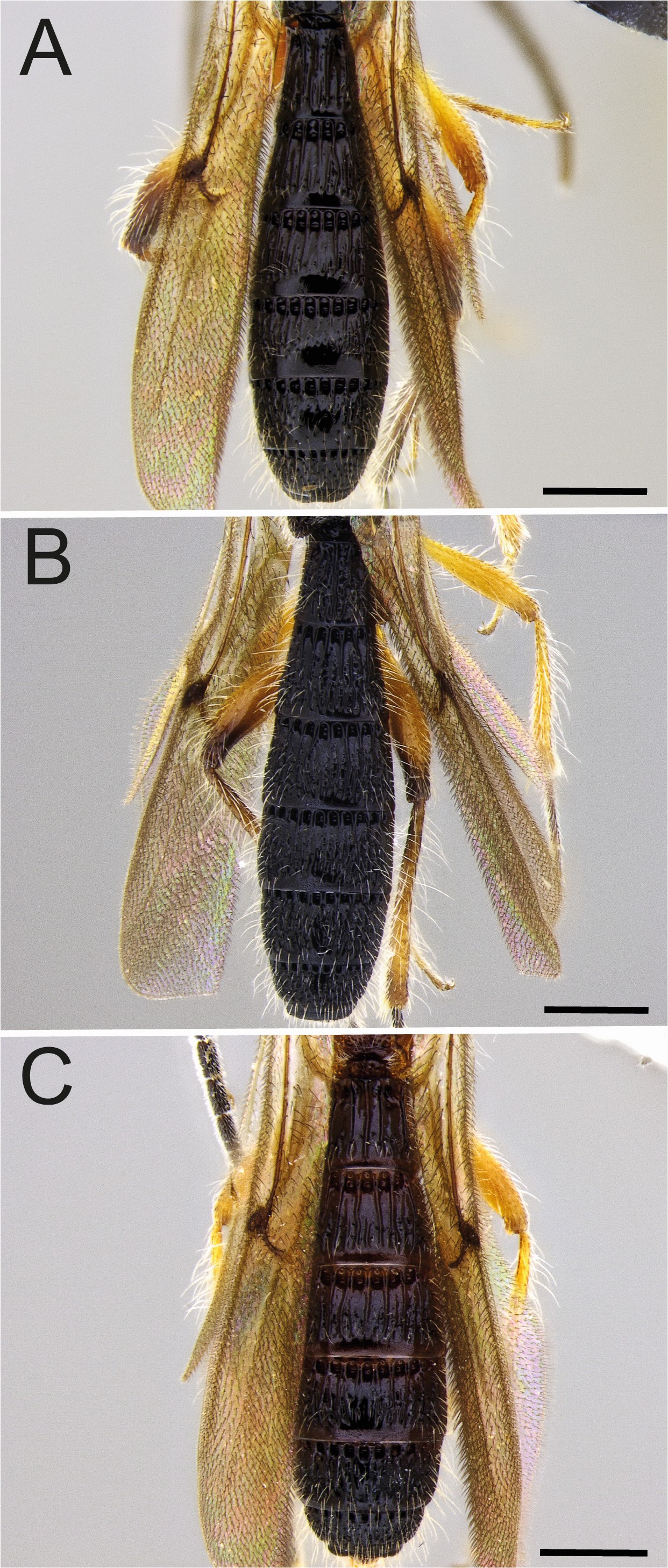
Metasoma in dorsal view. A, Sceliomorpha orbiculata sp. nov. (holotype, male); B, Sceliomorpha porosa sp. nov. (holotype, male); C, Sceliomorpha signata sp. nov. (holotype, male). Scale bars: 0.5 mm.
Diagnosis. Due to the body coloration, antenna size and projections on F2 and F3, Sceliomorpha signata sp. nov. resembles Sceliomorpha fulgida sp. nov. and Sceliomorpha quadridens. However, it can be easily distinguished by the following characteristics: frons coarsely punctured, middle region of dorsal metapleural area regularly foveate, presence of a longitudinal sulcus in the lateral area of mesoscutum, a crest in the central area of mesoscutum and a medial longitudinal crest on the scutellum. Body length: males, 3.9–4.21 mm.
Description. Holotype male. Measurements (in mm). Approximate body length 4.21; forewing length, including tegula, 3.69; metasoma length 2.2; metasoma width 0.7; head length 0.81; head width 1.2; LOL 0.1; OOL 0.09. Color. Integument predominantly brownish; scape, coxae, mandible apex, apical half of hind femur, tibiae, and tarsomeres dark brown; lateral portion of pronotum, tegula, metapleuron, and propodeum reddish brown; mandible and pedicel yellowish brown; fore and midlegs (excluding coxae) yellowish brown; wing membrane slightly infuscate; head and mesosoma with weak metallic reflexes. Pubescence. Mostly pale, except for brown long hairs on vertex and dorsal part of mesosoma; head, including eyes, pronotum, and mesonotum covered with scattered, long, erect hairs; scape and pedicel with sparse, short, semi-decumbent hairs; F1 to F10 with dense, short, semi-decumbent hairs, interspersed with a few erect hairs; lateral portion of propodeum and area near tegula with dense, long, erect hairs; legs with both long and short hairs; metasoma with very sparse, long, erect hairs on both sterna and terga; wings with short black hairs. Integumental surface. Frons coarsely punctured, punctures placed apart by less than 1 PD, except for a medial smooth, shiny area along frons, from median ocellus to its middle portion; vertex with small, fine punctures; punctation denser in the middle area between the lateral ocelli and sparser in the lateral areas; gena with small lines of punctation near the compound eye and occipital carina; pronotum, scutellum and lateral portion of propodeum coarsely punctured, punctures placed apart by less than 1 PD; mesoscutum sparsely punctured, punctures placed apart by more than 1.5 PD; lateral area of mesoscutum with longitudinal sulcus; central area of mesoscutum with small medial longitudinal crest; scutellum with medial longitudinal crest extending from the base to the apex; ventral mesopleuron smooth; entire dorsal metapleural area regularly foveate; ventral metapleural area with coarse and deep irregular punctures; T1 with three well-delimited longitudinal carinae, surface between them smooth and shiny. Structure. Antennae reaching at most the second or third metasomal segment; F1 about 1.5x longer than F2; F1 to F9 approximately 1.5x to 2x as long as wide; F10 approximately 3x as long as wide; F2 and F3 each with a small, basal toothlike projection; dorsal and ventral metapleural area delimited by a diagonal carina in the middle of the metapleura; T1 as long as wide.
Female paratype (DZUP 028533). Measurements (in mm). Approximate body length 4.05 (3.92 – 4.16); forewing length, including tegula, 3.38; metasoma length 2.1; metasoma width 0.6; head length 0.87; head width 1.05; LOL 0.1; OOL 0.09. Agreeing with male in color, pubescence, integumental surface and structure, except as follows: legs entirely light yellowish brown; lateral portion of pronotum, tegula, metapleuron and propodeum lighter colored compared to males; antenna short, not reaching the metasoma; F1 slim, 2x as long as wide; F2 about 1.5x as wide as long; F3-F9 thickened, clublike, each flagellomere 2x as wide as long; F10 about 1.5x as long as wide.
Type Material. Holotype male (DZUP), “DZUP\ 028521” “Brasil, PR, São José\ dos Pinhais, 879m.\ 25.604°S 49.493°W\ 08-11.ii.2017, A. C.\ Domahovski, Moericke”. Paratypes (DZUP): 5 males “DZUP\ 028522, 028523, 028524, 028525, 028526” “Brasil, PR, São José\ dos Pinhais, 879m.\ 25.604°S 49.493°W\ 08-11.ii.2017, A. C.\ Domahovski, Moericke”; 1 male “DZUP\ 028527” “Brasil, PR, Antonina, Res.\ Rio Cachoeira, 50m. 20-\25.xi.2014, Entomologia\ UFPR, FIT- Trilha do\ Ferro”; 1 male “DZUP\ 028528” “Brasil, PR, São José\ dos Pinhais, 01-31.i.2017,\ A. C. Domahovski,\ Malaise”; 2 males “DZUP\ 028529, 028530” “Brasil, PR, Antonina,\ Res. Nat. Guaricica,\ 25.3050°S 48.6609°W\ 31.i-4.ii.2022, A. C.\ Domahovski, FIT”; 3 females “DZUP\ 028531, 028532, 028533” “Brasil, PR, São José\ dos Pinhais, 879m.\ 25.604°S 49.493°W\ 08-11.ii.2017, A. C.\ Domahovski, Moericke”; 1 female “DZUP\ 028534” “Brasil, Paraná,\ Antonina,\ 18.i.1988,\ Profaupar, Malaise”.
Etymology. The species is named after the longitudinal crest along the mesoscutum and scutellum, from Latin signatus, meaning marked or distinguished by a mark.
Key to males of Sceliomorpha
(The males of S. hirtipes and S. rugosiceps are unknown)
1. Flagellomeres 2 to 9 at least three times as long as wide, erect pilosity longer, setae about as long as half of flagellomere (Figs. 3D, 4D, 7D, 9D) ………………………………2
- Flagellomeres 2 to 9 at most twice as long as wide, erect pilosity shorter, setae at most as long as one-third of flagellomere width (Figs. 4D, 6D, 10D) ………………………………8
2. Toothlike projection present only on flagellomere 2 (Figs. 3D, 7D) ………………………………3
- Toothlike projection present on flagellomeres 2 and 3 (Figs. 1D, 9D) ………………………………6
3. Mesosoma predominantly light reddish brown (Fig. S2) …………………………………………………………………Sceliomorpha carinata Kieffer
- Mesosoma predominantly black ………………………………4
4. Carina of outer orbit prolonged dorsally and extending anteriorly to upper portion of inner orbit (Fig. 7B); scutellum with a longitudinal carina extending from the apical limit to the middle portion of the sclerite (Fig. 7C); middle region of dorsal metapleural area smooth (Fig. 13A); upper frons and vertex finely punctured, puncture diameter distinctly smaller than that of pronotum and mesoscutum punctures (Fig. 7C) ………………………………Sceliomorpha orbiculata sp. nov.
- Carina of outer orbit ending near vertex and not extending anteriorly (Fig. 3B); scutellum lacking a longitudinal carina (Fig. 3C); middle region of dorsal metapleural foveate or with coarse irregular punctations (Fig. 12B); upper frons and vertex coarsely punctured, puncture diameter about as wide as that of pronotum and mesoscutum punctures ………………………………5
5. Head and mesosoma deeply punctured, distance between punctures less than one puncture diameter; middle region of dorsal metapleural foveate; antennae in repose reaching middle of metasoma; toothlike projection of flagellomere 2 very small, inconspicuous …………………… Sceliomorpha longicornis Ashmead
- Head and mesosoma less coarsely punctured, distance between punctures at least two puncture diameters (Figs. 3A, 3C); middle region of dorsal metapleural area with coarse irregular punctations (Fig. 12B); antennae in repose almost reaching posterior end of metasoma (Fig. 3A); toothlike projection of flagellomere 2 large, distinctly projecting over the surface (Fig. 3D) ………………………………Sceliomorpha dentata sp. nov.
6. Mesosoma predominantly light reddish brown and slightly flattened above; flagellomere 1 slightly longer than flagellomere 2 (Fig. S3) ………………………………Sceliomorpha deplanata Kieffer
- Mesosoma predominantly black and slightly convex above; flagellomere 1 shorter than flagellomere 2 (Figs. 1D, 9D) ………………………………7
7. Back of head, between ocelli and occipital carina, sparsely punctured (Fig. 1C); coxae dark brown (Fig. 1A); middle region of dorsal metapleural area mostly smooth (Fig. 13C); metapleural foveae mostly uniformly sized (Fig. 13C) ………………………………Sceliomorpha brunnipes sp. nov.
- Back of head, between ocelli and occipital carina, densely punctured (Fig. 9C); coxae light yellowish brown (Fig. 9A) middle region of dorsal metapleural area with coarse irregular punctation (Fig. 12A); metapleural foveae mostly irregularly sized (Fig. 12A) …………………. Sceliomorpha porosa sp. nov.
8. Mesosoma mostly light reddish brown (Figs. S1, S5) ………………………………9
- Mesossoma entirely black or mostly black with some parts of metapleuron and propodeum reddish brown ………………………………10
9. Toothlike projection present only on flagellomere 2; tegula and parts of the pronotum dark brown; vertex densely punctured; frons with transverse rugulae near antenna (Fig. S1) …………….. Sceliomorpha bakeri Kieffer
- Toothlike projection present on flagellomeres 2 and 3; tegula and pronotum light reddish brown; vertex sparsely punctured; frons lacking transverse rugulae near antenna (Fig. S5) ………… Sceliomorpha rufithorax Kieffer
10. Mesossoma entirely black to dark brown; hind coxae densely punctured (Figs. 6A, 12D) ………… Sceliomorpha nigripes sp. nov.
- Mesosoma with propodeum and metapleura reddish brown; hind coxae sparsely punctured (Figs. 4A, 10A, 12C, 13C) ………………………………11
11. Frons deep and coarsely punctured (Fig. 10B); mesoscutum and scutellum with a medial crest (Fig. 10C) ………………………………Sceliomorpha signata sp. nov.
- Frons fine and sparsely punctured (Figs. 4B, S4); mesoscutum and scutellum lacking a medial crest (Figs. 4C, S4) ………………………………12
12. T1 with some degree of rugulosity between longitudinal carinas; mesoscutum with rather coarse and sparse punctation (Fig. S4) ………………………………Sceliomorpha quadridens Kieffer
- T1 surface smooth between longitudinal carinas (Fig. 14C); mesoscutum with fine and very sparse punctation (Fig. 4C) ………………………………Sceliomorpha fulgida sp. nov.
Key to females of Sceliomorpha
(The females of S. bakeri, S. carinata, S. dentata, S. deplanata, S. longicornis, S. nigripes, S. porosa, S. quadridens and S. rufithorax are unknown)
1. Mesosoma predominantly red; frons and vertex coarsely and densely punctured ………….. Sceliomorpha rugosiceps (Szabó)
- Mesosoma predominantly black, tegula propodeum and metapleura can be reddish brown; frons and vertex punctation variable ………………………………2
2. Mesoscutum and scutellum with a medial crest (Fig. 11C) …………………………………... Sceliomorpha signata sp. nov.
- Mesoscutum and scutellum without crests (Figs. 2C, 5C, 8C) ………………………………3
3. Coxae dark brown (Fig. 2A) ………………………………4
- Coxae yellow or yellowish brown (Figs. 5A, 8A) ………………………………5
4. Gena densely punctured; back of head, between ocelli and occipital carina, densely punctured Sceliomorpha hirtipes Kieffer
- Gena smooth, except for small lines of punctation near the compound eye and occipital carina (Fig. 2A); back of head, between ocelli and occipital carina, sparsely punctured (Fig. 2C) ……… Sceliomorpha brunnipes sp. nov.
5. Carina of outer orbit prolonged dorsally and extending anteriorly to upper portion of inner orbit (Fig. 8B); tegula, metapleuron and propodeum brown (Fig. 8A); scutellum with a longitudinal carina extending from the apical limit to the middle portion of the sclerite (Fig. 8C) ……… Sceliomorpha orbiculata sp. nov.
- Carina of outer orbit ending near vertex and not extending anteriorly (Fig. 5B); tegula, metapleuron and propodeum reddish brown (Fig. 5A); scutellum lacking a longitudinal carina (Fig. 5C) ………………………………Sceliomorpha fulgida sp. nov.
Discussion
This study represents a significant advance in our understanding of Sceliomorpha diversity, expanding the number of known species from eight to 15. Of these, 13 species occur in Brazil, one in Peru, and another in Costa Rica. Additionally, this is the first time that both male and female descriptions for four species have been provided.
Kieffer (1910) used the proportion of flagellomeres as the first couplet in the male identification key for Sceliomorpha. Indeed, there appear to be two main morphological groups: those with flagellomeres at most twice as long as wide, and those with flagellomeres at least three times as long as wide. In most cases, males in the latter group have long antennae, nearly reaching the apex of the metasoma, while males in the former group have shorter antennae, reaching at most the middle of the metasoma. This pattern seems consistent, with the only exception being Sceliomorpha longicornis Ashmead, where the flagellomeres are three times as long as wide, but the antennae reach only the middle of the metasoma.
The Brazilian Atlantic Forest and Cerrado are recognized as global biodiversity hotspots (Myers et al., 2000); however, no species of Sceliomorpha were previously known from these biomes. Six of the new species were described from eastern Paraná, in a region of Atlantic Forest, and one species from the Chapada dos Guimarães, in the state of Mato Grosso, an area with typical Cerrado vegetation.
This group requires further taxonomic and biological studies, as the true diversity, distribution and behavior of these wasps remain largely unknown. Johnson et al. (2008) suggested that ongoing studies indicate the number of Sceliomorpha species is at least forty. Indeed, with only a small sample of specimens, we were able to describe seven new species and significantly expand the known geographic distribution of the group. Unfortunately, no confirmed host records are available, but the genus is presumed to have Orthoptera as host, given that Archaeoteleia Masner and Sparasion Latreille, other genera of Sparasionidae, are egg parasitoids of Tettigoniidae and Rhaphidophoridae, respectively (Chen et al., 2021). This hypothesis appears particularly plausible since Orthoptera likely represent the plesiomorphic host condition for the entire superfamily (Austin et al., 2005).
Supplementary material
The following online material is available for this article:
Figure S1
Figure S2
Figure S3
Figure S4
Figure S5
Acknowledgments
We thank our colleagues who contributed to the collection of the specimens examined in this study, particularly Alexandre Domahovski for providing Malaise trap samples from São José dos Pinhais. We are also grateful to Denise Montelongo and Chris Grinter of the Entomology Collection at the California Academy of Sciences for generously providing images of the type specimens deposited at that institution. We extend our appreciation to the Triplehorn Insect Collection for making available photographs of the type specimens of S. hirtipes, S. longicornis, and S. rugosiceps. We also thank Simon van Noort and an anonymous reviewer for their valuable comments and suggestions, which improved the manuscript, and Luiz R. R. Faria for his editorial work. Financial support was provided by the Conselho Nacional de Desenvolvimento Científico e Tecnológico (CNPq) and the Coordenação de Aperfeiçoamento de Pessoal de Nível Superior (CAPES).
Data statement
All the data supporting the results of this study was published in the article itself.
-
Funding
This work was supported by CAPES, and CNPq (research fellowship to GARM).
References
-
Austin, A. D., Johnson, N. F., Dowton, M., 2005. Systematics, evolution, and biology of scelionid and platygastrid wasps. Annu. Rev. Entomol. 50 (1), 553-582. https://doi.org/10.1146/annurev.ento.50.071803.130500.
» https://doi.org/10.1146/annurev.ento.50.071803.130500 - Ashmead, W. H., 1893. A monograph of the North American Proctotrypidae. Bull. U. S. Natl. Mus. 45, 1-472.
-
Chen, H., Lahey, Z., Talamas, E. J., Valerio, A. A., Popovici, O. A., Musetti, L., Klompen, H., Polaszek, A., Masner, L., Austin, A. D., Johnson, N. F., 2021. An integrated phylogenetic reassessment of the parasitoid superfamily Platygastroidea (Hymenoptera: Proctotrupomorpha) results in a revised familial classification. Syst. Entomol. 46 (4), 1088-1113. https://doi.org/10.1111/syen.12511.
» https://doi.org/10.1111/syen.12511 - Huber, J. T., Sharkey, M. J., 1993. Structure, in: Goulet, H., Huber, J. T. (Eds.), Hymenoptera of the World: An Identification Guide to Families. Agriculture Canada, Ottawa, pp. 13–59.
- Johnson, N. F., Masner, L., Musetti, L., 2008. Review of genera of the tribe Sparasionini (Hymenoptera, Platygastroidea, Scelionidae), and description of two new genera from the New World. Am. Mus. Novit. 3629, 1-41.
- Kieffer, J. J., 1909. Nouveaux scelionides de l’Amerique du Sud [Hym.]. Bull. Soc. Entomol. Fr. 1909, 247-250.
- Kieffer, J. J., 1910. Description de nouveaux microhyménopteres du Brésil. Ann. Soc. Entomol. Fr. 78, 287-348.
-
Masner, L., 1976. Revisionary notes and keys to world genera of Scelionidae (Hymenoptera: proctotrupoidea). Mem. Entomol. Soc. Can. 97, 1-87. https://doi.org/10.4039/entm10897fv.
» https://doi.org/10.4039/entm10897fv -
Masner, L., 1980. Key to genera of Scelionidae of the Holarctic region, with descriptions of new genera and species (Hymenoptera: proctotrupoidea). Mem. Entomol. Soc. Can. 113, 1-54. https://doi.org/10.4039/entm112113fv.
» https://doi.org/10.4039/entm112113fv -
Mikó, I., Masner, L., Deans, A. R., 2010. World revision of Xenomerus Walker (Hymenoptera: Platygastroidea, Platygastridae). Zootaxa 2708 (1), 1-73. https://doi.org/10.11646/zootaxa.2708.1.1.
» https://doi.org/10.11646/zootaxa.2708.1.1 -
Mikó, I., Vilhelmsen, L., Johnson, N. F., Masner, L., Pénzes, Z., 2007. Skeletomusculature of Scelionidae (Hymenoptera: Platygastroidea): head and mesosoma. Zootaxa 1571 (1), 1-78. https://doi.org/10.11646/zootaxa.1571.1.1.
» https://doi.org/10.11646/zootaxa.1571.1.1 -
Muesebeck, C. F. W., 1972. Nearctic species of Scelionidae (Hymenoptera: Proctotrupoidea) that parasitize the eggs of grasshoppers. Smithson. Contrib. Zool. 122, 1-33. https://doi.org/10.5479/si.00810282.122.
» https://doi.org/10.5479/si.00810282.122 -
Myers, N., Mittermeier, R. A., Mittermeier, C. G., Fonseca, G. A. B., Kent, J., 2000. Biodiversity hotspots for conservation priorities. Nature 403 (6772), 853-858. https://doi.org/10.1038/35002501.
» https://doi.org/10.1038/35002501 - Szabó, J. B., 1956. Neue Gattungen und Arten der Scelioniden aus Ost-Afrika und Mittel-Amerika. Opusc. Zool. Bp. 1, 47-52.
Edited by
-
Associate Editor:
Luiz Roberto Faria Jr.