 Temnogynidae fam. nov., a new fossil family of apoid wasps from the mid-Cretaceous (Hymenoptera, Apoidea)
ABSTRACT
Apoid hymenopterans are well represented in the fossil record, particularly in the mid-Cretaceous amber from northern Myanmar with 37 species and eight families. The fossils from this deposit are providing a glimpse into an astonishingly diverse fauna, including lineages with no counterpart in the present day. In this study, we describe two new genera and six new species of a remarkable new lineage of apoid wasps from Burmese amber: †Temnogyna gen. nov., containing †T. elegans sp. nov., †T. multiplex sp. nov., and †T. nyx sp. nov.; †Rhabdogyna gen. nov., containing †R. festiva sp. nov., †R. prima sp. nov. and †R. elongata sp. nov. These new fossil taxa have distinctive body morphology, particularly in the pattern of forewing venation and a remarkable anterior constriction in the 2nd metasomal segment, which sets them apart from all known apoid lineages. To accommodate these extinct taxa, a new family is introduced, †Temnogynidae fam. nov. (type genus †Temnogyna gen. nov.). Furthermore, the phylogenetic affinities of these new taxa are also discussed, based on the interpretations of the main morphological characters presented in previous studies. We also discuss how the discovery of this new family sheds light on the evolution of apoid wasps during the early Cretaceous.
Keywords:
Aculeata; Burmite; Insecta
Introduction
The superfamily Apoidea includes bees and a paraphyletic series of predatory wasps popularly known as apoid wasps. In recent decades, the apoid wasps have been classified into four living families: Ampulicidae, Crabronidae, Heterogynaidae, and Sphecidae (sensuMelo, 1999). The monophyly of Ampulicidae, Heterogynaidae and Sphecidae are corroborated by different phylogenetic studies (Alexander, 1992; Melo, 1999; Debevec et al., 2012; Branstetter et al., 2017; Peters et al., 2017; Sann et al., 2018). However, some results suggest that crabronid wasps are paraphyletic in relation to bees or even polyphyletic regarding bees and sphecids (Alexander, 1992; Debevec et al., 2012; Branstetter et al., 2017; Peters et al., 2017; Sann et al., 2018). Apoidea are recognized by four main synapomorphies: (1) posterolateral angle of the pronotum reduced dorsally above and anterior to the spiracular operculum, delimiting the pronotal lobe (figs. 21.2 and 21.2.1 in Brothers, 1975; and fig. 7 in Rosa and Melo, 2023); (2) metapostnotum expanded posteromesally, forming the “propodeal triangle”; (3) posterior margin of the dorsal portion of the pronotum forming a specialized articulation with the anterior portion of the mesoscutum (figs. 25, 26 and 45 in Melo, 1999; and fig. 7 in Rosa and Melo, 2023); and (4) the lateral portions of the pronotum compressed and forming an evident strangulation immediately anterior to the pronotal lobes (fig. 7 in Rosa and Melo, 2023).
According to molecular clock estimates, the origin of Apoidea can be traced back to the late Jurassic (~153 Mya) (Peters et al., 2017) or the early Cretaceous (~134.90 Mya) (Branstetter et al., 2017). Hypotheses suggesting older ages appear highly unlike (e.g., Ronquist et al., 2012; Sann et al., 2018). The diversification of apoids primarily took place during the Cretaceous period, with most of the extant families already established by the end of the Early Cretaceous and the beginning of the Late Cretaceous (Branstetter et al., 2017; Peters et al., 2017; Sann et al., 2018; Rosa and Melo, 2021; Rosa et al., 2022; Rosa and Melo, 2023). Evidence of this Cretaceous diversification event was widely preserved in the fossil record (Ohl, 2004; Grimaldi and Engel, 2005; Zhang et al., 2018; Rosa and Melo, 2021, 2023; Li et al., 2022; Pulawski, 2023). Most of these fossils are found in important insect fossil deposits such as the Burmese amber (Antropov, 2000; Rosa and Melo, 2021), the Crato formation (Darling and Sharkey, 1990; Rosa et al., 2022), and the Zaza formation (Rasnitsyn, 1975).
Regarding the Burmese amber, it represents one of the richest fossil deposits for insects, containing an astonishing entomofauna composed of at least 28 orders, 455 families and 1770 species (Grimaldi and Engel, 2005; Penney, 2010; Penney and Jepson, 2014; Ross, 2023). According to Shi et al. (2012), this deposit is estimated to have formed around 99-98 million years ago, aligning with a critical interval in the Cretaceous when major angiosperm lineages underwent diversification, accompanied by the emergence of numerous modern insect families (Grimaldi and Engel, 2005; Condamine et al., 2016; Barba-Montoya et al., 2018). Extensive studies on the biota of Burmese amber have revealed a notable endemic character (Rasnitsyn and Öhm-Kühnle, 2018; Zhang et al., 2018; Rosa and Melo, 2021, 2023), although the presence of widely distributed groups during the Early Cretaceous suggests a more complex composition (Zhang et al., 2018; Rosa and Melo, 2021, 2023; Lepeco and Melo, 2022; Lepeco et al., 2022; Rosa et al., 2022).
The Burmese amber also represents the richest deposit for apoid wasps, with eight families and 37 species (Antropov, 2000; Rosa and Melo, 2021, 2023). Based on the fauna of apoid wasps preserved in Burmese amber, Rosa and Melo (2021) suggest that the paleoenvironment of this deposit was not temporally or geographically entirely homogeneous, and likely was represented by a mosaic of vegetation types and under more dynamic environmental conditions, with alternating humid and more arid periods, either along the geological time or yearly in a monsoon-type climate. Therefore, the rich fauna of apoids being found in the Cretaceous Kachin amber represents a unique opportunity to explore the evolution of this lineage, containing both derived and clearly archaic groups remaining from the first diversifications of the superfamily (Rosa and Melo, 2021; Li et al., 2022). In this work, we describe a new fossil family of apoid wasps based on exceptionally well-preserved fossils from Burmese amber containing two new genera and six new species.
Material and methods
The studied amber pieces came from the Hukawng Valley, near Tanai, Kachin state, in northern Myanmar (see Fig. 1 in Dong et al., 2015). The mid-Cretaceous northern Myanmar has been dated as originating in the early Cenomanian, at about 99-98 mya (Shi et al., 2012). The pieces are deposited in the Department of Zoology (DZUP) of the Universidade Federal do Paraná (UFPR) under care of the second author. For a better view of the inclusions at least one surface of each piece was trimmed with a goldsmith’s saw and/or ground with wet emery paper by hand (grits 1200, 1600, 2200, 3000 and 5000). Final polishing was carried out using aluminum oxide (grits of 1 and 0.3 mm). Inclusions were studied using a Leica M125 stereomicroscope. Photographs were taken using a Leica DFC295 camera attached to the stereomicroscope. Images were improved using Zerene Stacker® software to combine multiple images then enhanced with Adobe Photoshop®. In addition, some technical drawings were made from the studied material. The line drawings were prepared using a camera lucida attached to a Leica M125 stereomicroscope. Figs. 3b, 3c and 5b were digitized in Adobe Illustrator® and the others figures were digitized in Sketchbook®.
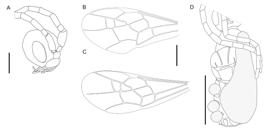
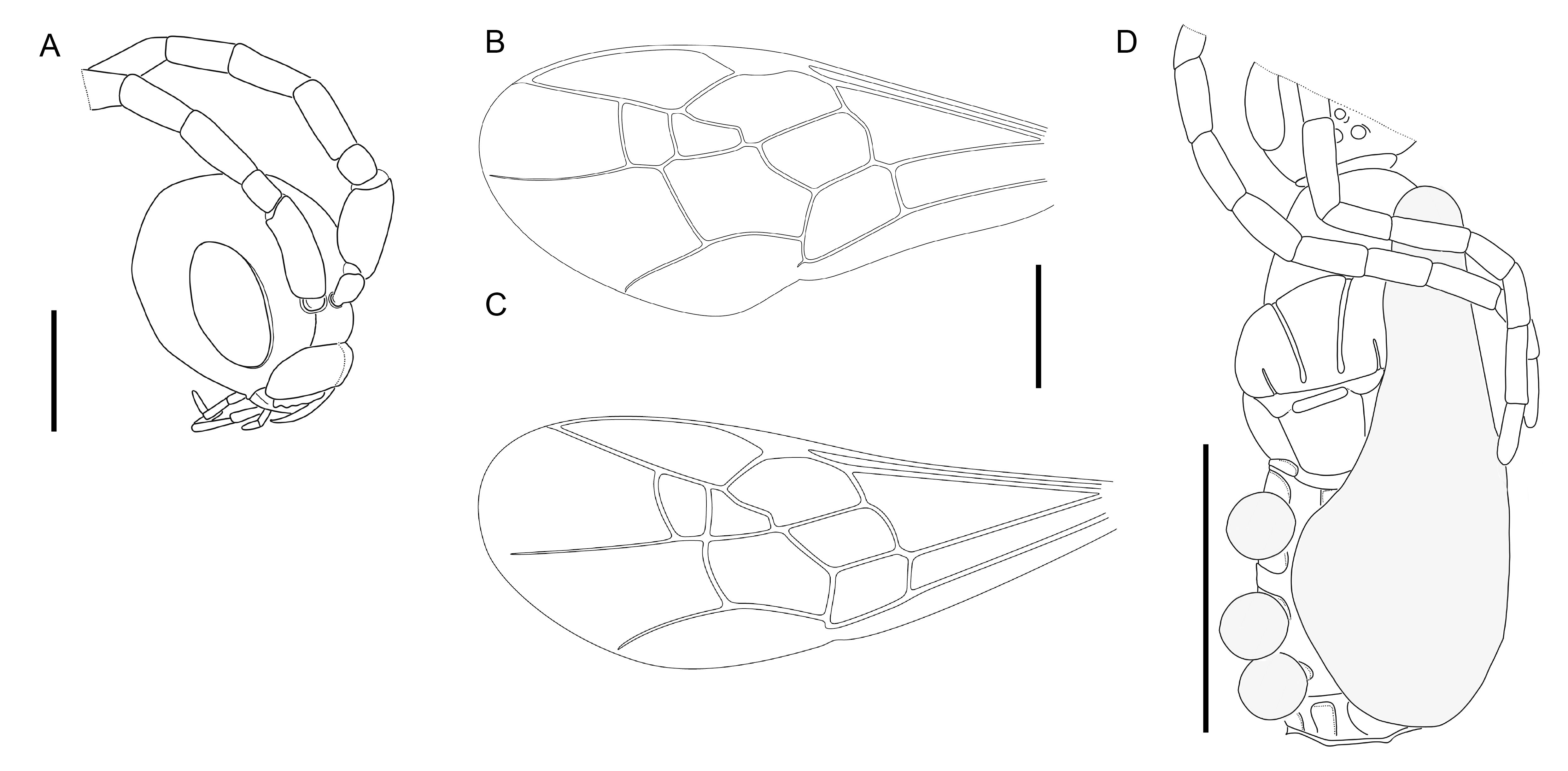
General morphology of †Temnogyna gen. nov. (a) lateral view of head of †Temnogyna nyx sp. nov., female holotype (DZUP Bur-1488); (b) forewing of †Temnogyna aff. elegans sp. nov., male (DZUP Bur-534); (c) forewing of †Temnogyna multiplex sp. nov., male (DZUP Bur-1559); (d) dorsal view of head and mesosoma of †Temnogyna nyx sp. nov., female holotype (DZUP Bur-1488); wings omitted; calcite nodules shown in grey. Scale bars, a: 0.5 mm; b, c: 0.5 mm; d: 1 mm.

General morphology of †Rhabdogyna gen. nov. (a) ventrofrontal view of head of †Rhabdogyna garruda sp. nov., female? holotype (DZUP, Bur-1795a); (b) forewing of †Rhabdogyna elongata sp. nov., female? holotype (DZUP, Bur-1361a); (c) dorsal view of mesosoma of †Rhabdogyna garruda sp. nov., female? holotype (DZUP, Bur-1795a); (d) dorsal view of mesosoma of †Rhabdogyna prima sp. nov., holotype (DZUP, Bur-2228); (e) dorsal view of mesosoma of †Rhabdogyna elongata sp. nov., holotype (DZUP, Bur-1361a). Scale bars, a: 0.5 mm; b: 0.5 mm; c-e: 1 mm.
The general morphological terminology follows Bohart and Menke (1976) and Melo (1999). Antennal flagellomeres are indicated as F1 to F10 in females and F1 to F11 in males; metasomal terga as T1 to T6 in females and T1 to T7 in males; metasomal sterna as S1 to S6 in females and S1 to S8 in males. Nomenclature for wing venation follows Rosa and Melo (2021; see their fig. 1). Proportions and measurements of head parts are provided in reference to the anterior-posterior axis. For the notauli we use the nomenclature “notauli complete” to designate notauli marked as deep sulcus and extending to transcutal inflection; for “notauli converging posteriorly” we refer to a condition in which the distance between the notauli anteriorly is longer than their distance posteriorly. For example, “notauli separated anteriorly by 2× their posterior distance” means that the distance between the notauli in the anterior portion of the mesoscutum is twice their distance at the point they reach the transcutal inflection posteriorly. Apoidea classification follows the phylogenetic results of Melo (1999), including crabronids and bees as single families, Crabronidae and Apidae, respectively.
Results
Taxonomy
Class Hexapoda Latreille
Order Hymenoptera Linnaeus
Superfamily Apoidea Latreille
†Temnogynidae fam. nov.
urn:lsid:zoobank.org:act:7F94AEA5-9C6E-40AD-8045-A26D5946787D
Type genus. †Temnogyna gen. nov.
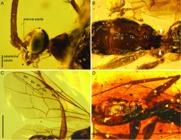
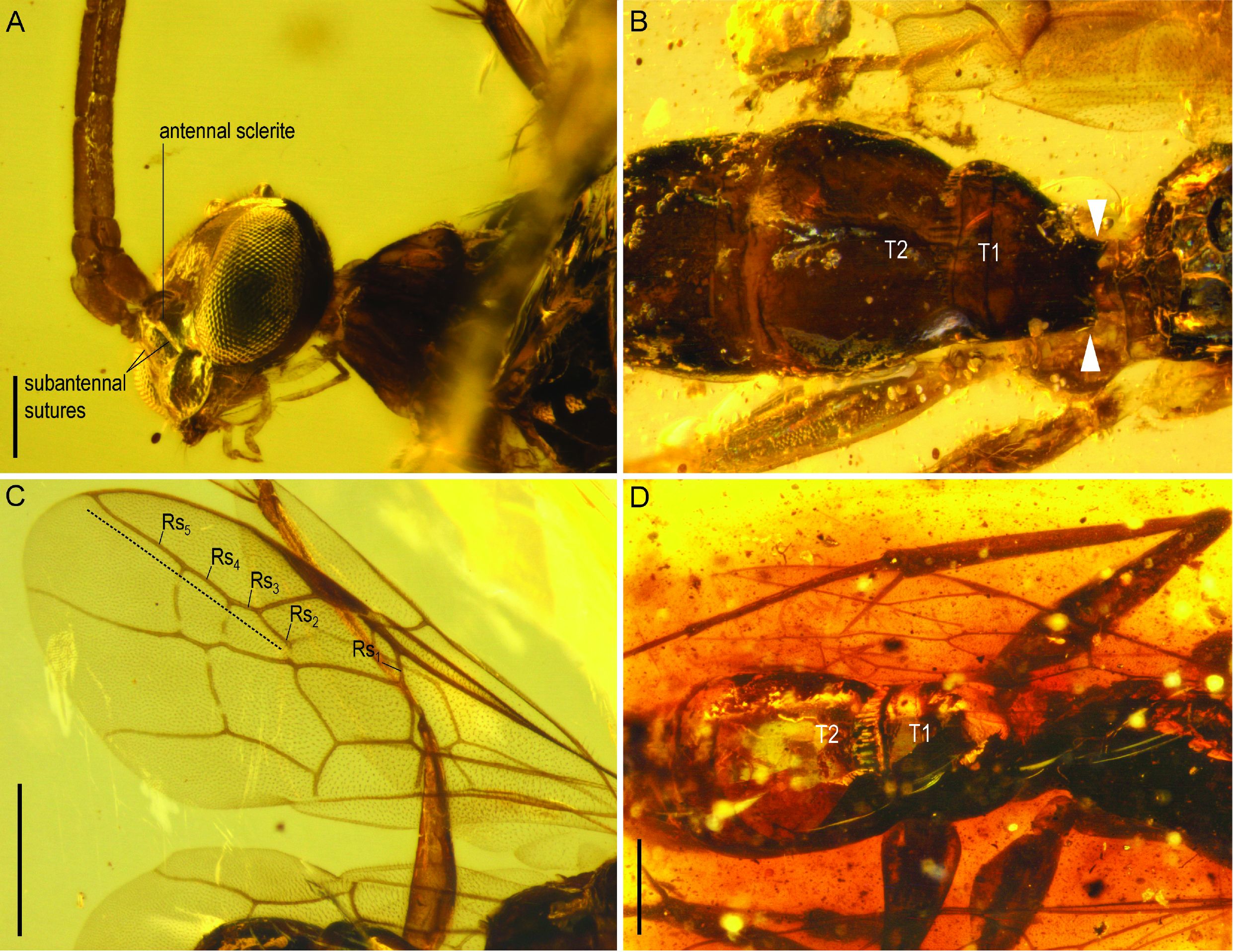
General morphology of †Temnogynidae. (a) Lateral view of head and pronotum of †Temnogyna elegans sp. nov., male holotype (DZUP Bur-1940a); (b) dorsal view of anterior part of metasoma of †Temnogyna aff. elegans sp. nov., male (DZUP Bur-208); arrows indicate the anterolateral lobes in the first metasomal segment; (c) fore and hindwing of †Temnogyna elegans sp. nov., male holotype (DZUP Bur-1940a); (d) dorsal view of anterior part of metasoma of †Rhabdogyna elongata sp. nov., holotype (DZUP Bur-1361a). Scale bars, a, b: 0.2 mm; c: 0.5 mm; d: 0.5 mm.
Diagnosis
This new family can be easily recognized by having the forewing with the vein 2r-rs distinctly elongated, abscissas 2Rs, 3Rs, 4Rs and 5Rs forming an almost straight line toward to the forewing apex (Figs. 1c, 3b, 3c, 5b), possession of anterolateral lobes in the first metasomal segment and a distinct anterior constriction in the 2nd metasomal segment, with fine, parallel longitudinal carinulae, both on T2 and S2 (Figs. 1b, 1d).
Description
Small wasps, 4.5 to 7 mm in length. Head: head shape variable, slightly longer than wide, somewhat spherical, or distinctly wider than long; maxillary palpus slender and very long, surpassing head length; apex of mandible variable; clypeus very short, much wider than long; subantennal sutures present, extending linearly between rim of antennal socket and clypeus (Fig. 1a); antennal sclerite raised above frons level (Fig. 1a); antenna very long, much longer than summed length of head plus mesosoma; flagellomeres slender, distinctly longer than wide; eye relatively large, occupying most of lateral surface of head; inner orbits parallel or subparallel; eye bare, facets uniform in size; occipital carina complete. Mesosoma: pronotum elongated, distinctly longer than wide; posterior margin of pronotum abutting mesoscutum, not overlaying its anterior portion, and raised in relation to anterior portion, delimiting a pronotal collar; female pronotal collar robust, high and with a rounded contour; male pronotum with its posterior portion elevated, forming a broad collar; ventral angle of pronotum slightly exceeding base of procoxa; notauli complete, indicated by deep sulci and converging posteriorly; parapsidial lines extending to transcutal articulation; propodeum box-like, with well-defined dorsal surface, longer than wide in females and as long as wide in males; dorsal and posterior surfaces set apart by transverse carina; metapostnotum restricted to dorsal surface of propodeum. Legs: legs distinctly long (Fig. 2); plantulae present; claws with subapical teeth, mid tibia with two spurs. Wings (Figs. 1c, 3b, 3c, 5b): forewing with three submarginal cells, 2nd cubital, 1st and 2nd medial, marginal cell with acute apex touching wing margin, vein 2r-rs distinctly elongated, about as long as or longer than 2rs-m, abscissas 2Rs, 3Rs, 4Rs and 5Rs forming an almost straight line toward to the forewing apex, vein 1m-cu ending at 1st or 2nd submarginal cell and vein 2m-cu ending at 3rd submarginal cell or coinciding with 2rs-m, veins M and CuA diverging at or distal to cu-a; hindwing C present, vein M diverging from CuA before or at cu-a, vein 2A absent, jugal lobe small. Metasoma: metasoma somewhat longer than mesosoma; 1st segment with distinct anterolateral lobes, its anterior portion narrow but not forming a petiole; 2nd segment almost as wide as long, distinctly constricted anteriorly, constriction crossed by fine longitudinal carinulae, both on T2 and S2 (Figs. 1b, 1d).
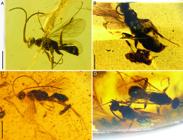
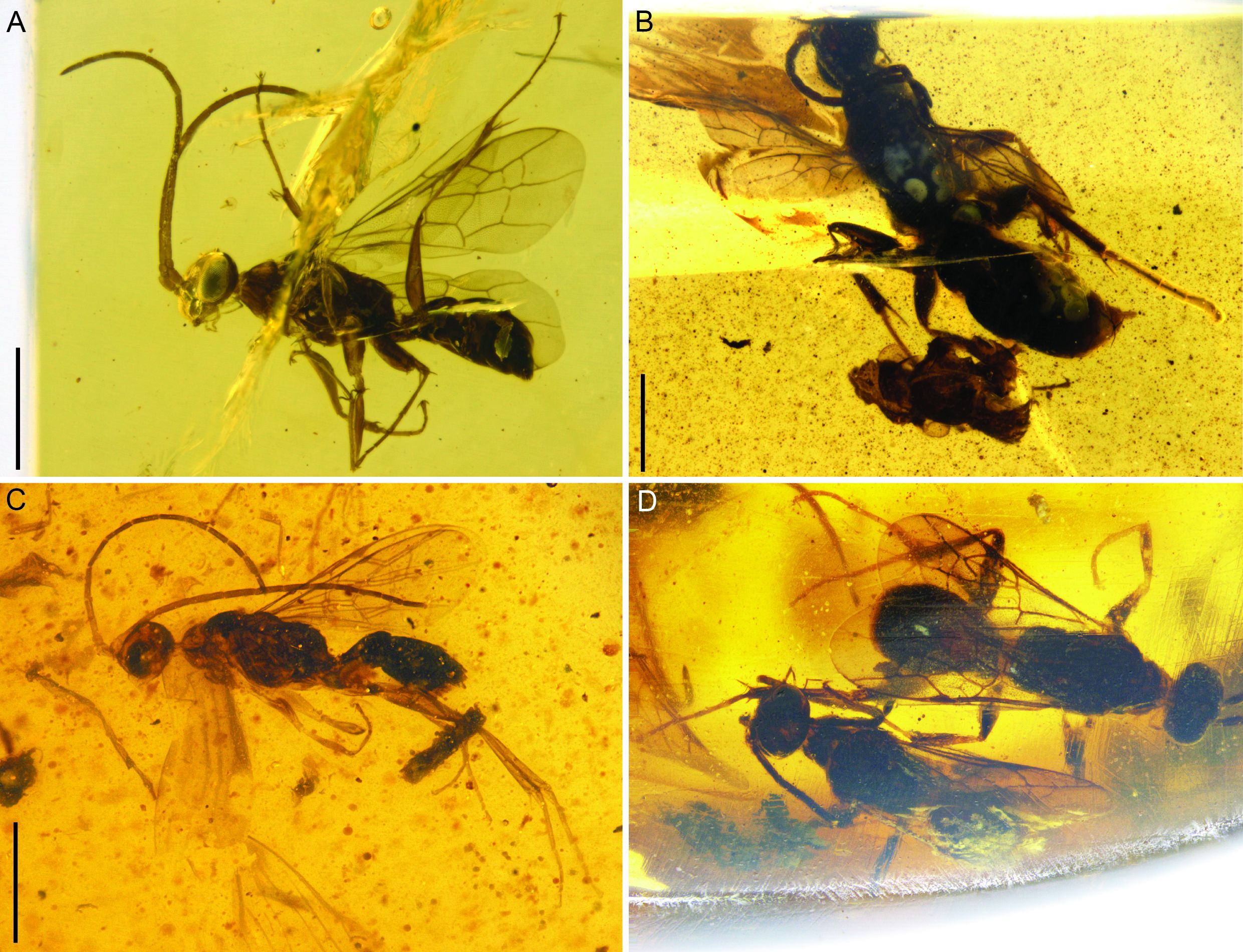
Species of †Temnogyna gen. nov. (a) Lateral habitus of †Temnogyna elegans sp. nov., male holotype (DZUP Bur-1940a); (b) dorsal habitus of †Temnogyna nyx sp. nov., female holotype (DZUP Bur-1488); (c) lateral habitus of †Temnogyna multiplex sp. nov., male holotype (DZUP Bur-002a); (d) dorsal habitus of two males of †Temnogyna multiplex sp. nov., (DZUP Bur-1559). Scale bars, a: 1 mm; b: 1 mm; c, d: 1 mm.
Included genera
†Temnogyna gen. nov. and †Rhabdogyna gen. nov.
Key to genera and species of †Temnogynidae fam. nov.
1. Notauli separated anteriorly by 2.5× their posterior distance or less (Fig. 3d); posterior margin of pronotum evenly continuous, without a medial notch; vertex strongly convex (Fig. 3a); posterior ocelli separated from eye by about 2× ocellus diameter (Fig. 3d); forewing with segment of vein M on 2nd submarginal cell distinctly longer than segment of M on 3rd submarginal cell (Figs. 3b and 3c); forewing vein 1m-cu ending at 1st submarginal cell (Figs. 3b and 3c); hindwing vein M diverging from CuA before cu-a (Figs. S4d); outer spur of hind leg about 1.5× longer than first tarsomere (Fig. S4c); female mandible falciform without subapical tooth, i.e. mandible simple (Fig. 3a); female first three flagellomeres subequal in length, about 3× as long as pedicel (Fig. 3d); clypeus about 2× wider than long (Fig. 3a) … †Temnogyna gen. nov. … 2
- Notauli separated anteriorly by 3.5× their posterior distance or more (Figs. 5c, 5d, 5e); posterior margin of pronotum with a medial notch (Figs. 5c, 5d, 5e); vertex flat (Fig. 4b); posterior ocelli close to eye, distance about one ocellus diameter (Fig. 4b); forewing with segment of vein M on 2nd submarginal cell about as long as segment of M on 3rd submarginal cell (Fig. 5b); forewing vein 1m-cu ending at 2nd submarginal cell (Fig. 5b); hindwing vein M diverging from CuA at cu-a; outer spur of hind leg notably long, about 3.2× longer than first tarsus (Figs. S6d, S7b, S7d); female mandible small with pointed apex with small subnotch and three subapical teeth decreasing in size (Figs. 5a, S6a); proportion of female first three flagellomeres, in relation to pedicel, as follows: F1= 4:1, F2= 6:1, F3= 5:1; clypeus about 3× wider than long, slightly rounded medially (Fig. 5a) …†Rhabdogyna gen. nov. … 4
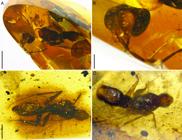
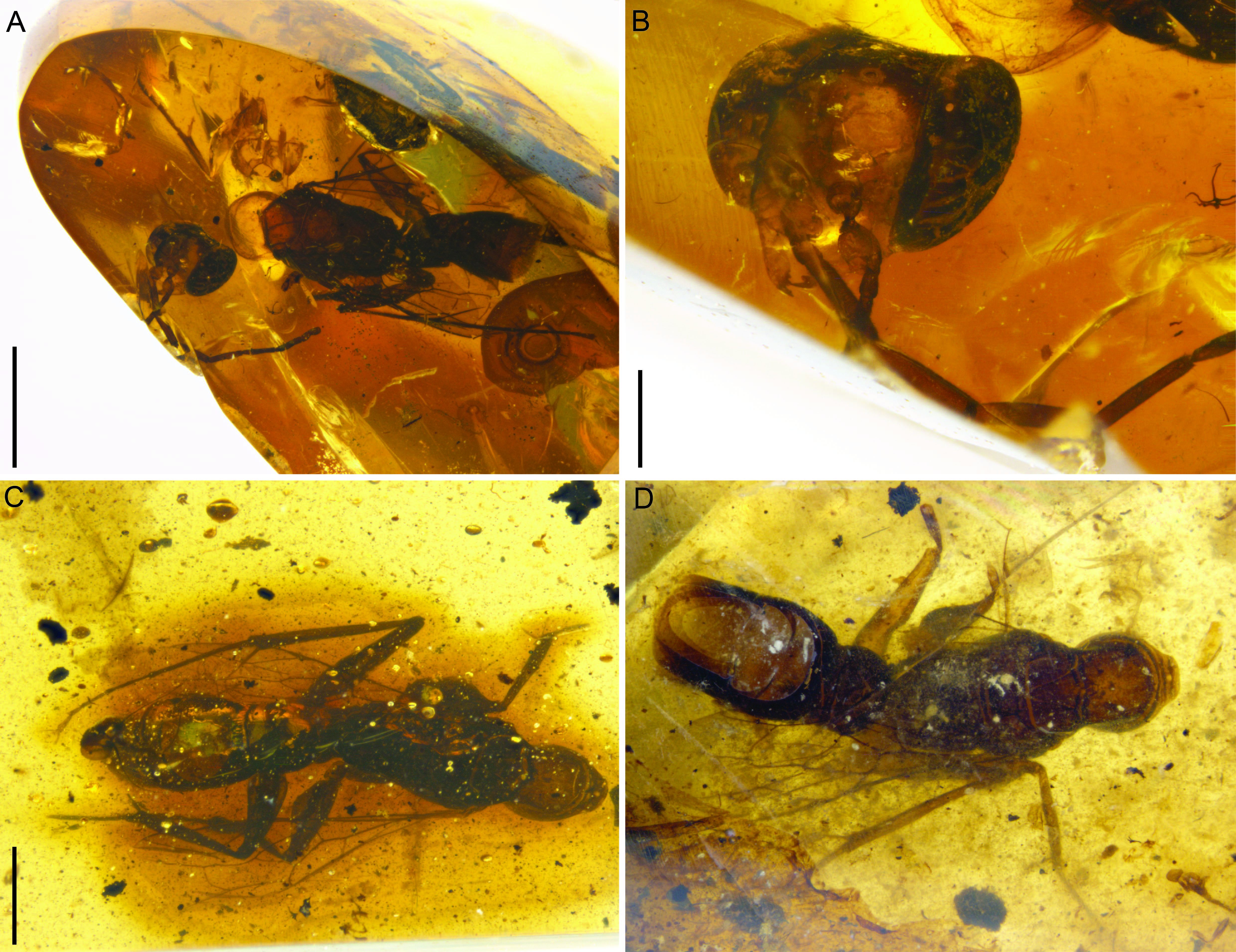
Species of †Rhabdogyna gen. nov. (a) Dorsal habitus of †Rhabdogyna festiva sp. nov., female? holotype (DZUP, Bur-1795a); (b) head of †Rhabdogyna festiva sp. nov., female? holotype (DZUP, Bur-1795a); (c) dorsal habitus of †Rhabdogyna elongata sp. nov., holotype (DZUP, Bur-1361a); (d) dorsal habitus of †Rhabdogyna prima sp. nov., holotype (DZUP, Bur-2228). Scale bars, a: 2 mm; b: 0.5 mm; c, d: 1 mm.
2. Females: antenna with 10 flagellomeres; metasoma with six exposed segments; mandible falciform without subapical tooth (i.e., simple); ocelli below upper orbit margin; pronotum robust and relatively short, almost as long as wide; pronotal collar robust, high, and rounded … †Temnogyna nyx sp. nov.
- Males: antenna with 11 flagellomeres; metasoma with seven exposed segments; mandible bidentate, with one subapical tooth in addition to pointed apex; ocelli above upper orbit margin; pronotum elongated, about 2× longer than wide; pronotal collar not well delimited, broadly rounded … 3
3. Forewing vein 2m-cu ending at 2rs-m (Fig. 3c); head somewhat spherical; compound eye about 1.5× longer than wide in lateral view; fore femur without peg-like setae … †Temnogyna multiplex sp. nov.
- Forewing vein 2m-cu ending at 3rd submarginal cell (Fig. 3b); head slightly longer than wide; compound eye about 2× longer than wide in lateral view; fore femur with row of five peg-like setae at base (Fig. S1c) … †Temnogyna elegans sp. nov.
4. Pronotum distinctly longer than wide (Figs. 5d and 5e); notauli separated anteriorly by nearly 4× their posterior distance (Fig. 5e); metaposnotum with a strong medial carina and a series of oblique fine carinae laterally; propodeum distinctly longer than wide (Fig. 5e) … †Rhabdogyna elongata sp. nov.
- Pronotum wider than long or as long as wide (Fig. 5c); notauli separated anteriorly by nearly 5× their posterior distance; metaposnotum mostly smooth; propodeum wider than long or as long as wide (Fig. 5c and 5d) …5
5. Pronotum and propodeum distinctly wider than long (Fig. 5c); M+CuA diverging at cu-a, 2nd abscissa of M+Cua almost absent … †Rhabdogyna festiva sp. nov.
- Pronotum and propodeum as long as wide (Fig. 5d); M+Cua diverging well after cu-a, 2nd abscissa of M+CuA almost as long as cu-a … †Rhabdogyna prima sp. nov.
†Temnogyna gen. nov.
urn:lsid:zoobank.org:act:9CDA7A57-EC40-4848-8874-57E62EBA440C
Type species. †Temnogyna elegans sp. nov.
(Figs. 1a-c, 2-3, S1-5)
Diagnosis
This genus can be recognized by notauli separated anteriorly by 2× their distance posteriorly (Fig. 3d), vertex convex, female mandible simple and falciform (Fig. 3a), male mandible with one subapical tooth, forewing with segment of vein M on 2nd submarginal cell distinctly longer than segment of M on 3rd submarginal cell (Figs. 1c, 3b, 3c, S4d), forewing vein 1m-cu ending at 1st submarginal cell (Figs. 1c, 3b, 3c, S4d) and hindwing vein M diverging from CuA before cu-a (Fig. S4d).
Description
Head: female head slightly longer than wide, somewhat spherical; male head longer than wide; maxillary palpus slender and very long, female maxillary palpus about 1.5× head length and male maxillary palpus about 1.2x head length; female mandible falciform without subapical tooth, simple, male mandible with one subapical tooth; clypeus very short, about 2x wider than long, distinctly convex medially; eye not in contact with clypeus; antennal socket distant from clypeus by one socket diameter; antennal sockets distant from one another by one half of socket diameter; antenna very long, female antenna about 5x longer than head length, male antenna about 6x to 6.5x longer than head length; scape longer than wide, about 2x longer than pedicel; flagellomeres distinctly longer than wide, female flagellomeres almost subequal in size and about 3x longer than pedicel; relative length of male flagellomeres in relation to pedicel, F1= 3:1, F1= 2.5:1, F3= 2:1 and almost subequal in diameter, remaining flagellomeres distinctly decreasing in length; eye large, longer than wide, occupying most of lateral surface of head; female inner orbits subparallel, slightly converging below, male inner orbits straight, slightly converging below or subparallel; ocelli relatively large, female ocelli below margin of upper orbits, male ocelli above margin of upper orbits; vertex strongly convex, posterior ocelli far from eye, placed about 2x ocelli diameter from eye margin; occipital carina complete. Mesosoma: female pronotum robust and relatively short, about 1.5x longer than wide, male pronotum elongated, about 2x longer than wide; female pronotal collar robust, high and rounded; male pronotal collar not well delimited, broadly rounded; pronotal sulcus restricted to 1/4 of pronotal collar; notauli separated anteriorly by 2× their distance posteriorly; female propodeum about 1.5x longer than wide, male about as wide as long. Wings: forewing with segment of vein M on 2nd submarginal cell distinctly longer than segment of M on 3rd submarginal cell, vein 1m-cu ending at 1st submarginal cell and vein 2m-cu ending at 3rd submarginal cell; hindwing vein M diverging from CuA before cu-a. Metasoma: metasoma somewhat longer than mesosoma; segments 1-3 distinctly longer than remaining ones; 2nd segment the longest, almost as wide as long and about 2x longer than 1st segment, 3rd about 1.5x longer than 1st.
Etymology
The genus is named after temno- (Greek: temno, cut, divide), which refers to the divided appearance of the 2nd segment of the metasoma, and -gyna (Greek: gyne, gynaikos, female), a reference to Heterogyna, the type genus of the family Heterogynaidae. The name is feminine.
Included species
†Temnogyna elegans sp. nov., †Temnogyna multiplex sp. nov. and †Temnogyna nyx sp. nov.
†Temnogyna elegans sp. nov.
urn:lsid:zoobank.org:act:54F9D828-1376-44F2-AA73-EF0DA1A1FC7A
(Figs. 1a-c, 2a, 3b, S1-3)
Diagnosis
This species can be recognized by combining the following characteristics: mandible with one subapical tooth; ocelli above upper orbits margin (Figs. S1d-S1e); pronotum longer than wide (Fig. 1a); pronotal collar not well delimited, broadly rounded (Figs. 1a, 1a); forewing vein 2m-cu ending at 3rd submarginal cell (Fig. 1c); head slightly longer than wide (Fig. S1d); compound eye about 2x longer than wide in lateral view (Fig. S1e); T1 about 1.2x longer than wide (Fig. 1b); dorsal surface of propodeum with very low carinae; and fore femur with row of five peg-like setae at base (Fig. S1c).
Description
Holotype male (DZUP Bur-1940a). Measurements (in mm): approximate body length, 3.14; maximum head width, 0.56; intertegular distance, 0.46; fore wing length, 2.44; maximum width of T2, 0.40. Coloration: not well preserved, antenna brown and head apparently light brown; mesosoma slightly diaphanized, apparently brown to light brown; metasoma dark brown; wings hyaline with brown to light brown veins. Pilosity: head, mesosoma with very short, erect, sparse and inconspicuous pilosity; metasomal pilosity not perceptible; inner surface of fore femur with row of five peg-like setae at base. Integumental surface: body mostly smooth and shiny; propodeum areolate with very low carinae. Structures (in mm): head slightly longer than wide (0.59:0.53); antenna about 4.35× head height (2.57:0.59); F1–F4 slender, respectively about 3, 2.88, 2.88 and 2.88× longer than wide (0.27:0.09; 0.26:0.09; 0.26:0.09; 0.26:0.09); F5 to F11 progressively decreasing in length (F11= 0.19:0.09); inner orbits parallel; eye, in lateral view, about 2.04× as long as its maximum eye width (0.43:0.21); ocello-orbital distance about 2.4× diameter of posterior ocellus (0.17:0.07); notauli separated anteriorly by 1.9× their distance posteriorly (0.17:0.09); legs slender, femur of hind leg almost as long as tibia (0.77:0.83); fore wing venation as in Fig. 3b and hindwing same as for the genus (Fig. S4d); propodeum longer than wide (0.34:0.26).
Remarks
The holotype (DZUP Bur-1940a) differs slightly from the additional material studied (DZUP Bur-208, DZUP Bur-534). In the holotype, the propodeum is areolate with very low carinae, instead of higher carinae seen in the other inclusions, especially in the DZUP Bur-208. However, we prefer to avoid at this moment unnecessarily describing new species without more material that could allow for a better delimitation of the species in the †Temnogyna elegans sp. nov. complex.
Etymology
The species is named for the delicate and slender body of the holotype, from the Latin elegans, with fine, elegant appearance.
Type material
Holotype male, in amber piece DZUP Bur-1940a (Burmese amber), the specimen is very well preserved. Syninclusions: some debris, plant stellate trichomes, parts of an insect and small acari.
Additional non-type material
We also studied: †Temnogyna aff. elegans, one male (DZUP Bur-208) and †Temnogyna aff. elegans, five males (DZUP Bur-534).
†Temnogyna multiplex sp. nov.
urn:lsid:zoobank.org:act:6E37ECC4-577C-4459-AA8B-AE4D5BAFB35D
(Figs. 2c-d, 3c, S5)
Diagnosis
This species can be recognized by combining the following characteristics: mandible with one subapical tooth; ocelli above upper orbits margin; pronotum longer than wide; pronotal collar not well delimited, broadly rounded; forewing vein 2m-cu ending at 2rs-m (Fig. 3c); head somewhat spherical (Fig. S5e); compound eye about 1.5x longer than wide in lateral view (Fig. S5e); and dorsal surface of propodeum with very low carinae.
Description
Holotype male (DZUP Bur-002). Measurements (in mm): approximate body length, 3.14; maximum head width, 0.5; intertegular distance, 0.43; fore wing length, 2.15; maximum width of T2, 0.33. Coloration: not preserved, body mostly diaphanized; head and mesosoma apparently brown; metasoma apparently black; wings hyaline with very light brown veins. Pilosity: not well preserved, not perceptible even at 100x magnification. Integumental surface: Not preserved, body mostly diaphanized; propodeum areolate with very low carinae. Structures (in mm): head somewhat spherical; antenna about 5.62× head width (2.81:0.5); F1–F4 very long and slender, respectively about 6.2, 5.2, 5.2 and 5.2× longer than wide (0.31:0.05; 0.26:0.05; 0.26:0.05; 0.26:0.05); F5 to F11 progressively decreasing in length (F11= 0.17:0.05); inner orbits parallel; eye, in lateral view, about 1.5× as long as its maximum eye width (0.31:0.21); legs slender, tibia of hind leg as long as femur (0.66:0.68); fore wing venation as in Fig. 3c and hindwing same as for the genus (Fig. S4d); propodeum about as long as wide.
Remarks
Although the holotype is diaphanized, the additional examined specimens have a better preserved integument. In the additional material, the integument is black, and the wing membrane hyaline with dark brown veins. Also, the pilosity of the head and mesosoma is apparently very short, erect, sparse, and inconspicuous, while the metasoma is apparently glabrous.
Etymology
The species is named for the numerous specimens found in the same piece (DZUP Bur-1559), from the Latin multiplex, manifold, numerous.
Type material
Holotype male, in amber piece DZUP Bur-002 (Burmese amber), the specimen is well preserved, mostly diaphanized. Syninclusions: some debris, very fine brown spheres (probably sap; see Lozano et al., 2020), and many disarticulated parts of other insects.
Additional non-type material
Eight males in a single amber piece (DZUP Bur-1559) (Fig. 2d).
†Temnogyna nyx sp. nov.
urn:lsid:zoobank.org:act:DC2AB016-0FBE-4BA2-907F-B254EEC3B7BA
Diagnosis
This species can be recognized by combining the following characteristics: mandible falciform and simple (Fig. 3a); ocelli below upper orbits margin (Fig. 3d); head slightly longer than wide; pronotum longer than wide; pronotal collar not well delimited, broadly rounded; forewing vein 2m-cu ending at 3rd submarginal cell (Fig. 3b); and propodeum dorsum with high carinae.
Description
Holotype female (DZUP Bur-1488). Measurements (in mm): approximate body length, 5.12; maximum head width, 0.59; intertegular distance, 0.69; fore wing length, 2.64; maximum width of T2, 0.76. Coloration: not well preserved, head and antennae apparently dark brown; mesosoma black, legs dark brown; metasoma black; wings hyaline with dark brown to brown veins. Pilosity: head, mesosoma and metasoma apparently with very short and erect pubescence; tibia, basitarsus and tarsomeres of mid and hind legs with conspicuous erect pilosity; outer surface of tibia with row of stout and erect setae. Integumental surface: not well preserved, body apparently mostly smooth; propodeum with high areolation. Structures (in mm): head slightly longer than wide (0.76:0.69); antenna about 3.56× head height (2.71:0.76); F1–F4 slender, respectively about 2.88, 2.66, 2.66 and 2.66× longer than wide (0.26:0.09; 0.24:0.09; 0.24:0.09; 0.24:0.09); F5 to F11 progressively slightly decreasing in length (F10= 0.20:0.09); inner orbits subparallel converging below; eye, in lateral view, about 1.41× as long as its maximum eye width (0.34:0.24); ocelli-orbital distance about 2.43× posterior ocelli (0.17:0.07); pronotum robust and relatively short, almost as long as wide (0.43:0.41); pronotal collar robust, high and rounded; notaulus anteriorly 2.4× posterior distance (0.24:0.10); legs slender, tibia of hind leg about as long as femur (0.77:0.68); fore wing venation as in Fig. 3b and hindwing same as for the genus (Fig. S4d); propodeum 1.18x longer than wide (0.51:0.48).
Etymology
The species is named for the very dark integument of the holotype, from the Greek nyx, night, used here as a noun in apposition.
Type material
Holotype female, in amber piece DZUP Bur-1488 (Burmese amber), the specimen is well preserved except for lacking part of the apex of the right forewing. Mesosoma and part of the metasoma covered by nodules of calcite. Syninclusions: some debris.
†Rhabdogyna gen. nov.
urn:lsid:zoobank.org:act:BBDBF35A-0A71-45D6-8104-2C76D3A10AEB
Type species. †Rhabdogyna festiva sp. nov.
Diagnosis
This genus can be recognized by posterior margin of pronotum with a medial notch, notauli separated anteriorly by at least 4× their distance posteriorly (Figs. 5c-5e, S6b, S7a, S7e), vertex flat (Fig. 4b), forewing vein 1m-cu ending at 2nd submarginal cell (Fig. 5b), forewing with segment of vein M on 2nd submarginal cell as long as segment of M on 3rd submarginal cell (Fig. 5b), hindwing vein M diverging from CuA at cu-a (Fig. S6d), outer spur of hind leg notably long, about 3.2x longer than first tarsomere (Figs. S6d, S7b) and female mandible with pointed apex followed by three small subapical teeth (Figs. 4b, 5a, S6a).
Description
Head (female?): head slightly wider than long; mandible small with pointed apex and three smaller subapical teeth; clypeus very short, about 3x wider than long, slightly convex medially; eye not in contact with clypeus; antennal socket distant from clypeus by one socket diameter; antennal sockets distant from one another by one half of socket diameter; antenna very long, about 6x longer than head length; scape slightly longer than wide, about 2x longer than pedicel; flagellomeres distinctly longer than wide, relative length of female flagellomeres in relation to pedicel, F1= 4:1, F2= 6:1, F3= 5:1; F4 and remaining flagellomeres about 2:1; eye large, 2x longer than wide, occupying most of lateral surface of head; inner orbits subparallel; ocelli relatively large, situated below upper orbits margin; vertex strongly flat; posterior ocelli close to eye, placed about one ocellus diameter from eye margin; occipital carina complete. Mesosoma: pronotum robust and relatively short, about 1.5x longer than wide, its posterior margin with a medial notch that fits in a medial projection of the mesoscutum; pronotal collar robust, high and rounded; notauli separated anteriorly by at least 4× their distance posteriorly. Wings: forewing with segment of vein M on 2nd submarginal cell as long as segment of M on 3rd submarginal cell, vein 1m-cu ending at 2nd submarginal cell and vein 2m-cu ending at 3rd submarginal cell. Metasoma: metasoma relatively longer than mesosoma; segments 1-3 distinctly longer than remaining ones; 2nd segment the longest, almost as wide as long and about 2x longer than 1st segment, 3rd about 1.5x longer than 1st.
Etymology
The genus is named after rhabdo- (Greek: rhabdos, rod, stick, staff), which refers to the unusually long vein 2r-rs in the forewing, and -gyna (Greek: gyne, gynaikos, female), a reference to Heterogyna, the type genus of the family Heterogynaidae.
Included species
†Rhabdogyna festiva sp. nov., †Rhabdogyna prima sp. nov. and †Rhabdogyna elongata sp. nov.
†Rhabdogyna festiva sp. nov.
urn:lsid:zoobank.org:act:2CCD8B7C-0536-418C-82E2-11800A979F89
(Figs. 4a, b, S6)
Diagnosis
This species can be recognized by combining the following characteristics: pronotum distinctly wider than long (Figs. 5c, S6b); notauli separated anteriorly by about 5× their distance posteriorly (Figs. 5c, S6b); metaposnotum smooth; and propodeum 1.5× longer than wide (Figs. 5c).
Description
Holotype unknown sex (female?), (DZUP Bur-1795a). Measurements (in mm): approximate body length, 6.17 (without part of metasoma); maximum head width, 1.49; intertegular distance, 1.09; fore wing length, 4.06; maximum width of T2, 1.09. Coloration: not preserved, body mostly diaphanized; head apparently brown; mesosoma apparently dark to brown; metasoma apparently dark; wings hyaline with dark to brown veins. Pilosity: head and mesosoma with very short and erect pubescence, especially in anterior portion of mesoscutum; legs with short, erect and conspicuous pilosity; outer surface of hind tibia with row of stout and erect setae; metasoma pilosity not perceptible. Integumental surface: not preserved, body mostly diaphanized, apparently smooth; metaposnotum smooth; propodeum dorsolaterally with low carinae forming an areolate pattern. Structure: head distinctly transverse, about 1.5× wider than long (1.49:0.96); clypeus small, about 2.6× wider than long (1.49:0.96); antenna (only F1-F7) about 3× head height (2.97:0.96); flagellomeres slender, F1 about 3.6× longer than wide (0.51:0.14), F2–F7 about 4.3× longer than wide (0.6:0.14); inner orbits parallel; eye, in lateral view, about 2× longer than wide (1.02:0.51); distance between posterior ocelli equal to ocelli-orbital distance (0.09:0.09); pronotum about 1.63× wider than long (1.11:0.68); mesoscutum about 1.28× wider than long (0.94:0.73); notaulus anteriorly 4.9× posterior distance (0.49:0.1); legs slender, tibia of hind leg almost as long as femur (1.53:1.65); forewing with M+CuA diverging at cu-a, 2nd abscissa of M+CuA almost absent; propodeum 1.5× wider than long (1.02:0.68).
Remarks
The holotype, DZUP Bur-1795, exhibits morphological features suggesting a potential female designation. The inference is drawn from the specimen’s robust body structure, particularly notable in the elongated and sturdy coxae, clearly cursorial. Additionally, the holotype displays a large head and specialized mandibles.
Etymology
The species is named for the joy brought from its discovery, from the Latin festivus, joyous, merry.
Type material
Holotype of unknown sex, likely female, in amber piece DZUP Bur-1795 (Burmese amber), the specimen is well preserved, mostly diaphanized. Head disarticulated from rest of body, mouthparts missing, left antenna missing apically to F2, right antenna missing apically to F8; propleura and forelegs disarticulated but present; 4th segment of the metasoma onwards disarticulated and missing, except for the 4th segment and the S5 which, even though disarticulated, are present near the remaining parts. Syninclusions: some debris.
†Rhabdogyna elongata sp. nov.
urn:lsid:zoobank.org:act:B87AA18E-E03E-4FED-AD17-6940DA1163CF
(Figs. 4c, S7a-d)
Diagnosis
This species can be recognized by combining the following characteristics: pronotum distinctly longer than wide (Figs. 5e, S7a); notaulus anteriorly near 4× posterior distance (Figs. 5e, S7a); metaposnotum costelated with low and longitudinal carinae; propodeum distinctly longer than wide (Figs. 5e, S7a).
Description
Holotype unknown sex (DZUP Bur-1361a). Measurements (in mm): approximate body length, 5.28 (without head and apex of metasoma); intertegular distance, 0.73; fore wing length, 3.83; maximum width of T2, 0.99. Coloration: not preserved, body mostly diaphanized; pronotum apparently brown; mesosoma, legs and metasoma apparently black; wings hyaline with dark to brown veins. Pilosity: mesosoma and metasoma pilosity not perceptible; tibia, basitarsus and tarsomeres of mid and hind legs with short, erect and conspicuous pilosity; outer surface of tibia with row of thin and erect setae. Integumental surface: not preserved, body mostly diaphanized, apparently smooth; metapostnotum costelated; propodeum with high carinae dorso-laterally, forming high areolations. Structure: pronotum about 1.3× longer than wide (1.09:0.83); mesoscutum about 1.43× wider than long (0.73:0.51); notaulus anteriorly 3.77× posterior distance (0.34:0.09); legs slender, tibia of hind leg almost as long as femur (1.79:1.62); forewing with M+CuA diverging well after cu-a, 2nd abscissa of M+CuA almost as long as cu-a; propodeum 1.96× longer than wide (1.53:0.78).
Etymology
The species is named for its slender body, from the Latin elongatus, prolonged.
Type material
Holotype of unknown sex, likely female, in amber piece DZUP Bur-1361a (Burmese amber), the specimen is very well preserved (mostly diaphanized) except for lacking head, propleura, forelegs, fourth segment of metasoma. Syninclusions: some debris and very fine dust (sand?).
†Rhabdogyna prima sp. nov.
urn:lsid:zoobank.org:act:02F215E6-D2F8-444C-8EE9-343CDB5F10D4
(Figs. 4d, S7e, f)
Diagnosis
This species can be recognized by combining the following characteristics: pronotum distinctly wider than long (Fig. 5d, S7e); notaulus anteriorly near 5× posterior distance or less (Fig. 5d, S7e); metaposnotum smooth; and propodeum 1.3× wider than long (Fig. 5d, S7f).
Description
Holotype unknown sex (DZUP Bur-2228). Measurements (in mm): approximate body length, 6.17 (without apex of metasoma); intertegular distance, 1.16; fore wing length, 4.03; maximum width of T2, 1.32. Coloration: not preserved, body mostly diaphanized; mesosoma and metasoma dark brown to black, legs apparently brown to light brown; wings hyaline with black to dark brown veins. Pilosity: head, mesosoma and metasoma pilosity not perceptible; tibia, basitarsus and tarsomeres of mid and hind legs with short, erect, and conspicuous pilosity; outer surface of tibia with row of very thin and erect setae. Integumental surface: not preserved, body mostly diaphanized, apparently smooth; most view of propodeum is obstructed by particles but as far as can be seen in metapostnotum it appears faired. Structure: pronotum as wide as long (1.09:1.02); mesoscutum about 1.6× wider than long (0.9:0.56); notaulus anteriorly 4.77× posterior distance (0.43:0.09); legs slender, tibia of hind leg almost as long as femur (1.96:1.7); forewing with M+CuA diverging well after cu-a, 2nd abscissa of M+CuA almost as long as cu-a; propodeum 1.3× wider than long (1.11:0.85).
Etymology
The species is named for the antiquity of the lineage to which it belongs, from the Latin primus, first, original.
Type material
Holotype of unknown sex, likely female, in amber piece DZUP Bur-2228 (Burmese amber), the specimen is well preserved (mostly diaphanized) except for lacking head, propleura, forelegs, most part of tibia of mid and hind leg, basitarsus and tarsomeres, fourth segment of metasoma, and most part of T2 and T3. Syninclusions: some debris, some disarticulated parts of arthropods, and very fine dust (sand?).
Discussion
Systematics and phylogenetic placement in Apoidea
Although the fossil record of Apoidea during the Cretaceous is abundant and very rich, defining the taxonomic units of these fossils has been a difficult task over the past 50 years (Rasnitsyn, 1975; Rasnitsyn et al., 1998, 1999; Antropov, 2000; Melo and Rosa, 2018; Rosa and Melo, 2021, 2023; Li et al., 2022; Rosa et al., 2022). Even with an astonishing diversity of taxa in the fossil record, most apoid wasp fossils from the Cretaceous have been traditionally described in a single family, †Angarosphecidae (Rasnitsyn, 1975; Rasnitsyn et al., 1998; Melo and Rosa, 2018). Recently, phylogenetic studies have shed light on the evolutionary questions surrounding the morphology of apoid fossils, resulting in a more consistent classification with the existing diversity (Rosa and Melo, 2023).
The new systematic arrangement proposed by Rosa and Melo (2023), mostly based on the character dataset proposed by Melo (1999), defines more accurately the classification at family level of apoid fossils. In this new arrangement, some Burmese amber taxa previously described in †Angarosphecidae were shown to be unrelated to †Angarosphex myrmicopterus, the taxon that bears the name †Angarosphecidae, therefore being allocated in a new family, the †Burmasphecidae. These results have exposed the need to better investigate the nature of the many fossil taxa still placed in †Angarosphecidae, reinforcing the expectation that other lineages still are included in this family in a spurious manner. For example, the new taxa described here could be included in it, considering the variable diagnosis for †Angarosphecidae provided in previous studies (Rasnitsyn, 1975; Rasnitsyn et al., 1998, 1999; Zheng et al., 2021).
Our systematic study indicates that †Temnogynidae fam. nov. certainly belongs to Apoidea as it exhibits a modified posterolateral angle of the pronotum (i.e., pronotum reduced dorsally above and anterior to the spiracular operculum), a posteromesally expanded metapostnotum, and mainly by the shape of the lateral portions of the pronotum, which are compressed and form an evident strangulation immediately anterior to the pronotal lobes. Furthermore, in †Temnogynidae fam. nov. the posterior margin of the dorsal portion of the pronotum is part of a specialized joint between the pronotum and the mesoscutum and the mesopleuron bears the mesepisternal clip in its anterior margin, thus indicating that this lineage clearly belongs to the clade composed of all apoid except †Burmasphecidae (for details on this arrangement see Rosa and Melo, 2023).
†Temnogynidae fam. nov. lacks the synapomorphies of the clade Sphecidae + Crabronidae + Apidae and therefore does not seem to be related to this lineage. †Temnogynidae fam. nov. resembles superficially the clade Ampulicidae + †Angarosphecidae judging from the elongated pronotum with not well-defined pronotal collar, notaulus marked as deep sulcus and extending to transcutal inflection, long and slender legs (especially in females), and the generalized pattern of wing venation. However, all these characteristics are likely due to plesiomorphic conditions and seem to be present in the common ancestor of all apoids (Melo, 1999; Rosa and Melo, 2023). In general, †Temnogynidae fam. n. seem to belong to an independent offshoot in Apoidea since it does not share unequivocal and robust similarities with the known families. On the other hand, the presence of subantennal sutures and the antennal sclerite distinctly elevated are also found in †Ptilocosminae, what could suggest a relationship between †Temnogynidae fam. n. and Heterogynaidae. In addition, we can also highlight the distinct sexual dimorphism found in both lineages, in which while males are delicate and slender, the females are more robust and possess cursorial legs.
In conclusion, regarding the identity of †Temnogynidae fam. nov., our systematic results also indicate that all the new fossil taxa described herein seems to form a monophyletic group. This conclusion is supported by the forewing venation pattern, in which the vein 2r-rs is distinctly elongated, the abscissas 2Rs, 3Rs, 4Rs and 5Rs form an almost straight line towards to the forewing apex, the first metasomal segment with anterolateral lobes, and especially by the distinct anterior constriction in the 2nd metasomal segment, with fine, parallel longitudinal carinulae, both on T2 and S2 (Fig. 1). These conditions are unique in Apoidea and clearly set them apart from known lineages of the superfamily.
Diversity and natural history of †Temnogynidae fam. nov.
In general, very little can be speculated about the biology of fossil taxa, even when they are well preserved. However, one notable aspect of the †Temnogynidae fam. nov. is the obvious sexual dimorphism. The males of †Temnogyna gen. nov. are characterized by their small, delicate, and slender bodies, long wings in proportion to their size, large eyes that occupy a significant portion of their heads, and relatively large mandibles, bearing two apical teeth (Figs. 2a, 2c, S1-3, S5). On the other hand, the female of †Temnogyna gen. nov. exhibits a noticeably more robust body, with stronger legs, relatively smaller eyes in relation to the head, and a small, simple, falciform mandible (Figs. 2b, 3a, 3d, S4). Also, males appear to be more easily trapped in amber compared to the females, with dozen specimens available, while only a single female was studied. Additionally, in two pieces (Figs. S2 and S5), multiple males were trapped together within the same inclusion.
Therefore, regarding these morphological and taphonomic evidence, it is reasonable to propose that males and females exhibited distinct biologies. The discrepancy in wing size, for instance, suggests that males possessed a highly mobile flight capability. The prevalence of these males in the samples could indicate the existence of flocks or even nuptial flights. Conversely, judging by their leg morphology, females seem to be more associated with cursorial habits, moving quickly through the substrate in search of prey.
The genus †Rhabdogyna, gen. nov. as described here, consists of three species based on inclusions whose sex is uncertain. However, considering the sexual dimorphism observed in †Temnogyna gen. nov. and its associated characteristics, it is reasonable to suggest that †Rhabdogyna festiva sp. nov. (DZUP Bur-1795) might be female. This assumption is based on its robust body structure and cursorial legs (particularly in the elongated and robust coxae), as well in the large head of the holotype and the unique mandibles (Figs. 4a, b, S6). Despite that, †Rhabdogyna gen. nov. is markedly distinct from the †Temnogyna gen. nov. female. The head is significantly wider, with very large eyes, and with notably large pronotum (Figs. 4a, b, 5a, S6). The mandibles exhibit a distinct and specialized morphology, with a relatively small size in relation to the overall head, featuring one long apical tooth and three smaller inner teeth (Figs. 4b, 5a, S6a). These characteristics clearly indicate that the two genera possessed distinct and considerably different biologies from each other. The size of the eyes, robustness of the body and legs, and especially distinct mandible structure could indicate differences in foraging sites or even variations in prey types between the two taxa.
†Temnogynidae fam. nov. lack a counterpart in the modern fauna, and for this reason presents additional challenges in inferring its biology. However, as previously indicated, a close relationship with Heterogynaidae could be expected. While sexual dimorphism is observed in various apoid groups, none display the degree of exceptional dimorphism observed in Heterogynaidae. In this family, while males are delicate and slender (in this aspect resembling males of †Temnogynidae fam. nov.), the females are more robust and possess cursorial legs (Day, 1984; Ohl, 2004; Ohl and Bleidorn, 2006). However, the most striking feature is that the females are brachypterous, meaning that they are incapable of flight (Day, 1984; Ohl, 2004; Ohl and Bleidorn, 2006). Considering the range of sexual dimorphism examples in Apoidea, it is reasonable to compare the unique dimorphism observed in †Temnogynidae fam. nov. to that of Heterogynaidae. However, our understanding of the biology of Heterogynaidae remains scarce and highly limited (Day, 1984; Ohl, 2004; Ohl and Bleidorn, 2006), and therefore, it is not possible to make any suggestions based on this enigmatic and relictual family.
Finally, it is important to highlight the notorious similarity of †Temnogynidae fam. nov. with ampulicids, burmasphecids and formicoids (especially the Cretaceous lineages). In these groups, the males are delicate and slender, the females are more robust and with clearly cursorial legs, and often the mandibles are specialized in different shapes (Bohart and Menke, 1976; Antropov, 2000; Ohl and Spahn, 2010; Barden and Grimaldi, 2014; Melo and Rosa, 2018; Rosa and Melo, 2023; Boudinot et al., 2020). As stated by Rosa and Melo (2023), the common ancestor between Formicidae and Apoidea probably already had the “formicoid-ampulicoid-like” form, thus representing a plesiomorphic condition for the entire lineage. Although the phylogenetic position of †Temnogynidae fam. nov. has not yet been tested, which goes beyond the objectives of the present study, judging by its morphology, this lineage is part of the clade containing all Apoidea excluding †Burmasphecidae and therefore, appears to have retained this ancestral morphotype.
Summary conclusion
The recognition of an entirely new lineage of Apoidea shows that the Burmese amber deposit is one of the most important fossil sources for understanding the entomofauna during the Mid-Cretaceous. The taxa described herein seem to belong to a monophyletic group based on the distinctive body morphology, particularly in the forewing venation pattern and a remarkable anterior constriction in 2nd metasomal segment. This unique morphology distinguishes †Temnogynidae fam. nov. as a separate family and expands our understanding of the diversity of the Cretaceous apoid fossils.
The discovery of this new family also provides valuable insights into the early evolution of Apoidea during the Early Cretaceous. Judging by the unique characters and the strong sexual dimorphism, a close relationship with Heterogynaidae could be expected in future phylogenetic analyses. This means that the “formicoid-ampulicoid-like” form of †Temnogynidae fam. nov. can be considered as a retention of this ancestral morphotype, and not that it necessarily has a more basal position in the Apoidea tree.
As the new family does not have a counterpart in the living fauna, it is even more difficult to make inferences about its biology. Based on the studied material, it is evident that the taxa described here have sexual dimorphism. Males are found more frequently in Burmese amber, and sometimes in large numbers in the same piece. These observations indicate that males and females likely had different biologies. While males were more mobile in flight, and consequently, much more susceptible to being trapped in amber, the females, with their specialized morphology, seem to be more associated with cursorial habits, making them less prone to amber entrapment.
Supplementary material
The following online material is available for this article:
Figure S1
Figure S2
Figure S3
Figure S4
Figure S5
Figure S6
Figure S7
Acknowledgments
We would like to thank Dr. Alexandr Rasnitsyn and one anonymous reviewer who helped improve the manuscript. Also, we would like to thank Isaac Jorge for vectorizing the line drawings of the Figures 3b and 3c. Financial support has been provided by Conselho Nacional de Desenvolvimento Científico e Tecnológico – CNPq (grants # 140263/2015-2, # 158310/2018-7 to BBR, and # 309641/2016-0, # 313588/2021-0 to GARM) and FAPESP – Fundação de Amparo à Pesquisa do Estado de São Paulo (grant # 2020/13943-4 to BBR).
-
urn:lsid:zoobank.org:pub:7D981C08-2348-4C33-AAE1-F9D1D752F967
-
This document has an erratum: https://doi.org/10.1590/1806-9665-RBENT-2024-0031er
References
- Alexander, B. A., 1992. An exploratory analysis of cladistic relationships within the superfamily Apoidea, with special reference to sphecid wasps (Hymenoptera). J. Hymenopt. Res. 1, 25-61.
- Antropov, A. V., 2000. Digger wasps (Hymenoptera, Sphecidae) in burmese amber. Bull. Nat. Hist. Mus. Lond. 56, 59-77.
-
Barba-Montoya, J., dos Reis, M., Schneider, H., Donoghue, P. C. J., Yang, Z., 2018. Constraining uncertainty in the timescale of angiosperm evolution and the veracity of a Cretaceous Terrestrial Revolution. New Phytol. 218 (2), 819-834. http://doi.org/10.1111/nph.15011
» http://doi.org/10.1111/nph.15011 -
Barden, P., Grimaldi, D., 2014. A diverse ant fauna from the mid-cretaceous of Myanmar (Hymenoptera: Formicidae). PLoS One 9 (4), e93627. http://doi.org/10.1371/journal.pone.0093627
» http://doi.org/10.1371/journal.pone.0093627 -
Bohart, R. R., Menke, A. S., 1976. Sphecid Wasps of the World: a Generic Revision. University of California Press, Berkeley. http://doi.org/10.1525/9780520309548
» http://doi.org/10.1525/9780520309548 -
Boudinot, B. E., Perrichot, V., Chaul, J. C. M., 2020. †Camelosphecia gen. nov., lost ant-wasp intermediates from the mid-Cretaceous (Hymenoptera, Formicoidea). ZooKeys 1005, 21-55. http://doi.org/10.3897/zookeys.1005.57629
» http://doi.org/10.3897/zookeys.1005.57629 -
Branstetter, M. G., Danforth, B. N., Pitts, J. P., Faircloth, B. C., Ward, P. S., Buffington, M. L., Gates, M. W., Kula, R. R., Brady, S. G., 2017. Phylogenomic insights into the evolution of stinging wasps and the origins of ants and bees. Curr. Biol. 27 (7), 1019-1025. http://doi.org/10.1016/j.cub.2017.03.027
» http://doi.org/10.1016/j.cub.2017.03.027 - Brothers, D. J., 1975. Phylogeny and classification of the aculeate Hymenoptera, with special reference to Mutillidae. Univ. Kans. Sci. Bull. 50, 483-648.
-
Condamine, F. L., Clapham, M. E., Kergoat, G. J., 2016. Global patterns of insect diversification: towards a reconciliation of fossil and molecular evidence? Sci. Rep. 6 (1), 1-13. http://doi.org/10.1038/srep19208
» http://doi.org/10.1038/srep19208 - Darling, D. C., Sharkey, M. J., 1990. Order Hymenoptera. In: Grimaldi, D.A. (Ed.), Insects from the Santa Formation, Lower Cretaceous, of Brazil. American Museum of Natural History, New York, pp. 123–153. (Bulletin of the American Museum of Natural History, 195).
-
Day, M. C., 1984. The enigmatic genus Heterogyna Nagy (Hymenoptera: Sphecidae; Heterogyninae). Syst. Entomol. 9 (3), 293-307. http://doi.org/10.1111/j.1365-3113.1984.tb00054.x
» http://doi.org/10.1111/j.1365-3113.1984.tb00054.x -
Debevec, A. H., Cardinal, S., Danforth, B. N., 2012. Identifying the sister group to the bees: A molecular phylogeny of Aculeata with an emphasis on the superfamily Apoidea. Zool. Scr. 41 (5), 527-535. http://doi.org/10.1111/j.1463-6409.2012.00549.x
» http://doi.org/10.1111/j.1463-6409.2012.00549.x - Dong, F., Shih, C., Ren, D., 2015. A new genus of Tanyderidae (Insecta: Diptera) from Myanmar amber, Upper Cretaceous. Cretac. Res. 54, 260-265. https://doi.org/10.1016/j.cretres.2014.12.011.
- Grimaldi, D. A., Engel, M. S., 2005. Evolution of the Insects. Cambridge University Press, New York.
-
Lepeco, A., Melo, G. A. R., 2022. The wasp genus †Holopsenella in mid-Cretaceous Burmese amber (Hymenoptera: †Holopsenellidae stat. nov.). Cretac. Res. 131, 105089. http://doi.org/10.1016/j.cretres.2021.105089
» http://doi.org/10.1016/j.cretres.2021.105089 -
Lepeco, A., Barbosa, D. N., Melo, G. A. R., 2022. A remarkable new family of stinging wasps from the Cretaceous of Myanmar and China (Hymenoptera, Aculeata). J. Hymenopt. Res. 94, 163-190. http://doi.org/10.3897/jhr.94.85613
» http://doi.org/10.3897/jhr.94.85613 -
Li, L., Rosa, B. B., Melo, G. A. R., Shih, C., Ren, D., 2022. A new wasp genus of Cirrosphecidae (Hymenoptera: Apoidea) from mid-Cretaceous amber of northern Myanmar. Cretac. Res. 140, 105333. http://doi.org/10.1016/j.cretres.2022.105333
» http://doi.org/10.1016/j.cretres.2022.105333 -
Lozano, R. P., Pérez-de-la-Fuente, R., Barrón, E., Rodrigo, A., Viejo, J. L., Peñalver, E., 2020. Phloem sap in Cretaceous ambers as abundant double emulsions preserving organic and inorganic residues. Sci. Rep. 10 (1), 9751. http://doi.org/10.1038/s41598-020-66631-4
» http://doi.org/10.1038/s41598-020-66631-4 -
Melo, G. A. R., 1999. Phylogenetic relationships and classification of the major lineages of Apoidea (Hymenoptera) with emphasis on the crabronid wasps. Sci. Pap. Nat. Hist. Mus. Univ. Kans. 14, 1-55. http://doi.org/10.5962/bhl.title.4053
» http://doi.org/10.5962/bhl.title.4053 -
Melo, G. A. R., Rosa, B. B., 2018. New genus of fossil apoid wasps (Hymenoptera, Apoidea) from the Cretaceous amber of Myanmar. Rev. Bras. Entomol. 62 (4), 319-323. http://doi.org/10.1016/j.rbe.2018.09.004
» http://doi.org/10.1016/j.rbe.2018.09.004 -
Ohl, M., Bleidorn, C., 2006. The phylogenetic position of the enigmatic wasp family Heterogynaidae based on molecular data, with description of a new, nocturnal species (Hymenoptera: Apoidea). Syst. Entomol. 31 (2), 321-337. http://doi.org/10.1111/j.1365-3113.2005.00313.x
» http://doi.org/10.1111/j.1365-3113.2005.00313.x -
Ohl, M., Spahn, P., 2010. A cladistic analysis of the cockroach wasps based on morphological data (Hymenoptera: Ampulicidae). Cladistics 26 (1), 49-61. http://doi.org/10.1111/j.1096-0031.2009.00275.x
» http://doi.org/10.1111/j.1096-0031.2009.00275.x -
Ohl, M., 2004. The first fossil representative of the wasp genus Dolichurus, with a review of fossil ampulicidae (Hymenoptera: apoidea). J. Kans. Entomol. Soc. 77 (4), 332-342. http://doi.org/10.2317/E12.1
» http://doi.org/10.2317/E12.1 - Penney, D., 2010. Biodiversity of Fossils in Amber from the Major World Deposits. Siri Scientific Press, Manchester.
- Penney, D., Jepson, J. E., 2014. Fossil Insects: an Introduction to Palaeontomology. Siri Scientific Press, Manchester.
-
Peters, R. S., Krogmann, L., Mayer, C., Donath, A., Gunkel, S., Meusemann, K., Kozlov, A., Podsiadlowski, L., Petersen, M., Lanfear, R., Diez, P. A., Heraty, J., Kjer, K. M., Klopfstein, S., Meier, R., Polidori, C., Schmitt, T., Liu, S., Zhou, X., Wappler, T., Rust, J., Misof, B., Niehuis, O., 2017. Evolutionary History of the Hymenoptera. Curr. Biol. 27 (7), 1013-1018. http://doi.org/10.1016/j.cub.2017.01.027
» http://doi.org/10.1016/j.cub.2017.01.027 -
Pulawski, W. J., 2023. Catalog of Sphecidae Sensu Lato. Available in: https://www.calacademy.org/scientists/projects/catalog-of-sphecidae (accessed 10 July 2023).
» https://www.calacademy.org/scientists/projects/catalog-of-sphecidae -
Rasnitsyn, A. P., Öhm-Kühnle, C., 2018. Three new female Aptenoperissus from mid-Cretaceous Burmese amber (Hymenoptera, Stephanoidea, Aptenoperissidae): unexpected diversity of paradoxical wasps suggests insular features of source biome. Cretac. Res. 91, 168-175. http://doi.org/10.1016/j.cretres.2018.06.004
» http://doi.org/10.1016/j.cretres.2018.06.004 - Rasnitsyn, A. P., 1975. Hymenoptera Apocrita of Mesozoic. Trans. Palaeontol. Inst. Acad. Sci. USSR 147, 1-134. (in Russian).
-
Rasnitsyn, A. P., Jarzembowski, E. A., Ross, A. J., 1998. Wasps (Insecta: Vespida=Hymenoptera) from the Purbeck and Wealden (Lower Cretaceous) of southern England and their biostratigraphical and palaeoenvironmental signif-icance. Cretac. Res. 19 (3-4), 329-391. http://doi.org/10.1006/cres.1997.0114
» http://doi.org/10.1006/cres.1997.0114 - Rasnitsyn, A. P., Pulawski, W. J., Martínez-Delclòs, X., 1999. Cretaceous digger wasps of the new genus Bestiola Pulawski and Rasnitsyn (Hymenoptera: Sphecidae: Angarosphecinae). J. Hymenopt. Res. 8, 23-34.
-
Ronquist, F., Klopfstein, S., Vilhelmsen, L., Schulmeister, S., Murray, D. L., Rasnitsyn, A. P., 2012. A total-evidence approach to dating with fossils, applied to the early radiation of the hymenoptera. Syst. Biol. 61 (6), 973-999. http://doi.org/10.1093/sysbio/sys058
» http://doi.org/10.1093/sysbio/sys058 -
Rosa, B. B., Melo, G. A. R., 2021. Apoid wasps (Hymenoptera: Apoidea) from mid-Cretaceous amber of northern Myanmar. Cretac. Res. 122, 104770. http://doi.org/10.1016/j.cretres.2021.104770
» http://doi.org/10.1016/j.cretres.2021.104770 -
Rosa, B. B., Melo, G. A. R., Ribeiro, G. C., 2022. The first crabronid wasps (Hymenoptera, Apoidea) from the Crato Formation (Northeastern Brazil) and implications for the evolution of apoid wasps and bees during the Early Cretaceous. Cretac. Res. 137, 105248. http://doi.org/10.1016/j.cretres.2022.105248
» http://doi.org/10.1016/j.cretres.2022.105248 -
Rosa, B. B., Melo, G. A. R., 2023. A new fossil family of aculeate wasp sheds light on early evolution of Apoidea (Hymenoptera). Syst. Entomol. 48 (3), 402-421. http://doi.org/10.1111/syen.12584
» http://doi.org/10.1111/syen.12584 -
Ross, A. J., 2023. Burmese (Myanmar) Amber Taxa, On-line Supplement v.2023.1. Available in: http://www.nms.ac.uk/explore/stories/natural-world/burmese-amber/ (accessed 10 July 2023).
» http://www.nms.ac.uk/explore/stories/natural-world/burmese-amber/ -
Sann, M., Niehuis, O., Peters, R. S., Mayer, C., Kozlov, A., Podsiadlowski, L., Bank, S., Meusemann, K., Misof, B., Bleidorn, C., Ohl, M., 2018. Phylogenomic analysis of Apoidea sheds new light on the sister group of bees. BMC Evol. Biol. 18 (1), 1-15. http://doi.org/10.1186/s12862-018-1155-8
» http://doi.org/10.1186/s12862-018-1155-8 -
Shi, G., Grimaldi, D. A., Harlow, G. E., Wang, J., Wang, J., Yang, M., Lei, W., Li, Q., Li, X., 2012. Age constraint on Burmese amber based on U-Pb dating of zircons. Cretac. Res. 37, 155-163. http://doi.org/10.1016/j.cretres.2012.03.014
» http://doi.org/10.1016/j.cretres.2012.03.014 -
Zhang, Q., Rasnitsyn, A. P., Wang, B., Zhang, H., 2018. Hymenoptera (wasps, bees and ants) in mid-Cretaceous Burmese amber: a review of the fauna. Proc. Geol. Assoc. 129 (6), 736-747. http://doi.org/10.1016/j.pgeola.2018.06.004
» http://doi.org/10.1016/j.pgeola.2018.06.004 -
Zheng, Y., Chen, J., Zhang, H., Rasnitsyn, A. P., 2021. New angarosphecid wasp (Hymenoptera: Apoidea, Angarosphecidae) from the mid-Cretaceous Burmese amber. Cretac. Res. 121, 104742. http://doi.org/10.1016/j.cretres.2020.104742
» http://doi.org/10.1016/j.cretres.2020.104742
Edited by
-
Associate Editor: Rodrigo Gonçalves