 Blueberry cultivation in mountainous areas of southeastern Brazil as a suitable environment for Drosophila suzukii establishment
ABSTRACT
The spotted-wing drosophila, Drosophila suzukii (Matsumura, 1931) (Diptera: Drosophilidae), is an invasive pest of thin-skinned and stone fruits with growing economic impact worldwide. In Brazil, it was first reported in 2013 and has since spread across major fruit-producing states. Although previously detected in Rio de Janeiro (RJ), records were limited to isolated individuals, never in commercial orchards. Here, we provide the first evidence of D. suzukii establishment in a commercial ‘Biloxi’ blueberry, Vaccinium corymbosum Linnaeus, field in Sapucaia, RJ. Initial vinegar traps captured seven females, confirmed in the laboratory. Subsequent banana–yeast bait traps collected both sexes, including one male, confirming establishment. Emergence assays from naturally damaged fruits demonstrated reproductive success, resulting in approximately 279 individuals (110 males and 169 females) from a total of 1.6 kg of damaged fruits. Monitoring also detected Zaprionus spp. (Diptera: Drosophilidae), another invasive drosophilid associated with fruit damage. To assess management options, we evaluated susceptibility of this D. suzukii population to imidacloprid. Bioassays showed that exposure to 0.140 mg/mL (LC50 for a susceptible reference strain) killed approximately 50% of adults, indicating local susceptibility, in contrast to reduced susceptibility reported in other Brazilian strains. Collectively, these findings confirm D. suzukii establishment in a new blueberry-producing region, reveal potential phytosanitary risks, and suggest that chemical control options remain effective locally. This integrated evidence highlights the importance of early monitoring and management strategies to safeguard Brazil’s expanding blueberry industry.
Keywords:
Fruit protection; invasive pests; Neotropical orchards; Spotted-wing drosophila; Vaccinium corymbosum
Introduction
The spotted-wing drosophila, Drosophila suzukii (Matsumura, 1931) (Diptera: Drosophilidae), is one of the most damaging invasive pests of fruit crops worldwide and is responsible for significant economic losses (Digiacomo et al., 2019). Unlike most drosophilids that attack only overripe or decaying fruits, D. suzukii females use a serrated ovipositor to infest intact, ripening fruits, which makes their management particularly challenging (Lee et al., 2011). Originally described in Japan in 1931, the species gained notoriety after causing severe outbreaks in the fruit-growing sectors of the United States (Hauser, 2011) and Europe (Calabria et al., 2012). Currently, D. suzukii is established on almost every continent, infesting a wide range of thin-skinned fruits, including Barbados cherry (Mendonça et al., 2019), strawberries (Andreazza et al., 2016c; Zanuncio-Junior et al., 2017), raspberries (Digiacomo et al., 2019), and grapes (Andreazza et al., 2016a).
In South America, D. suzukii was first detected in Brazil in 2013 in Santa Catarina, followed by reports in Rio Grande do Sul within the same year (Deprá et al., 2014; Geisler et al., 2015). The pest was later recorded in São Paulo in 2014, associated with blueberries originating from the São Joaquim region (Vilela and Mori, 2014) and its presence was also reported in the Federal District in 2014 (Paula et al., 2014). Since then, its distribution has expanded to Espírito Santo and Minas Gerais, where infestations have been confirmed in strawberry fields (Andreazza et al., 2016c), and it was again reported in Rio Grande do Sul infesting strawberry, blueberry, and blackberry fruits (Wollmann et al., 2020). Despite this progression, in Rio de Janeiro only isolated individuals (Bitner-Mathé et al., 2014) had been recorded and never in commercial orchards.
Blueberry, Vaccinium spp., cultivation has expanded rapidly worldwide, with North America and Europe currently leading production (Cantuarias-Avilés et al., 2014). Global cultivation reached 267,000 ha in 2023, a 7.2% increase compared to 2022, with the Americas accounting for 42% of the production area (EastFruit, 2025; IBO, 2025). In Brazil, commercial cultivation has been successfully established in Rio Grande do Sul, Santa Catarina, and São Paulo, and has more recently spread to southeastern states such as Rio de Janeiro and Minas Gerais (Cantuarias-Avilés et al., 2014). Blueberries are valued not only for their market potential but also for their nutritional benefits, including antioxidant and neuroprotective properties (Faria et al., 2005). However, the expansion of cultivation into new regions brings the risk of introducing or establishing invasive pests such as D. suzukii.
Current control of D. suzukii relies primarily on chemical insecticides (Van Timmeren and Isaacs, 2013). However, the repeated use of these compounds has led to cases of resistance in the United States (Ganjisaffar et al., 2022) and Brazil (Andreazza et al., 2025). Imidacloprid, a neonicotinoid widely applied in fruit crops, has been particularly affected, with resistant D. suzukii populations already reported (Andreazza et al., 2025; Ganjisaffar et al., 2022). In addition to the emergence of resistant populations, some insecticides exhibit toxicity to non-target organisms, such as pupal parasitoids of D. suzukii (Schlesener et al., 2019), and cause adverse effects on these organisms when exposed to sublethal doses (Lisi et al., 2023). Such challenges reinforce the importance of continuous monitoring and local susceptibility assessments to guide integrated management strategies.
Here, we report the first evidence of D. suzukii establishment in a commercial blueberry orchard in the mountainous region of Rio de Janeiro, Brazil. We describe its detection through field monitoring, confirm its reproductive success in naturally infested fruits, and evaluate the susceptibility of this local population to imidacloprid. Our findings expand the known distribution of D. suzukii in Brazil, highlight its phytosanitary risks for emerging blueberry-producing regions, and provide relevant insights for regional pest management.
Material and methods
Sampling site and fly traps
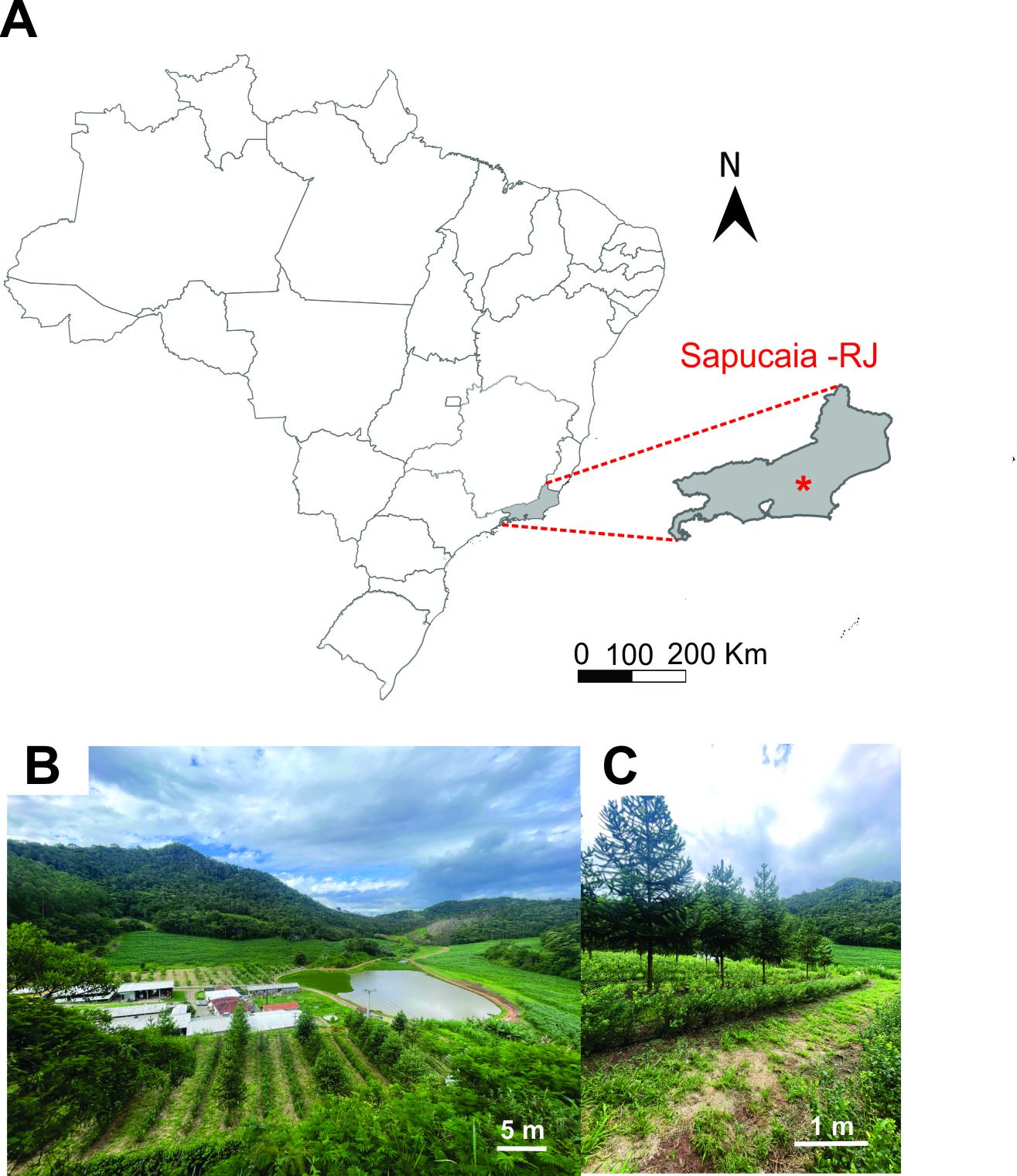
The study was conducted in Sapucaia (22°7′50″ S, 42°47′46″ W), Rio de Janeiro State, Brazil (Fig. 1), a mountainous region characterized by rugged terrain, mild temperatures, and high rainfall from October to March. Blueberry plants, Vaccinium corymbosum cv. Biloxi, were cultivated in a 3,000 m2 area at a spacing of 0.5 m between plants and 3.0 m between rows, totaling 1,500 plants. We used seedlings produced through micropropagation, specifically via somatic organogenesis.
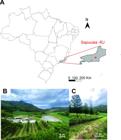
Geographic location and field site of blueberry orchards in Sapucaia county, Rio de Janeiro State, Brazil. (A) Map showing the municipality of Sapucaia (red star) within Rio de Janeiro State and its position in southeastern Brazil. (B - C) General views of the inter-row of blueberry–araucaria cropping system.
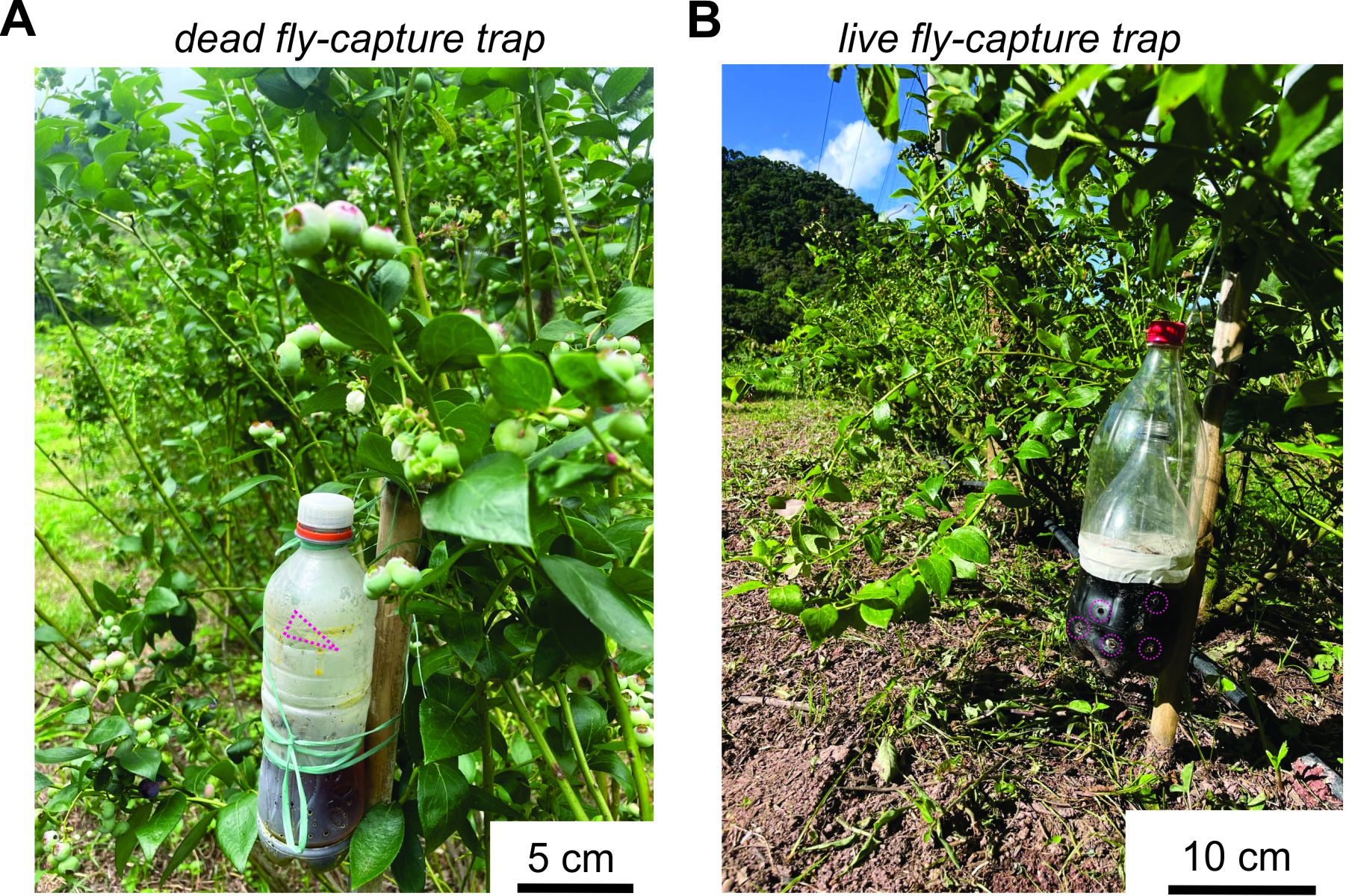
We used two types of traps that were designed to investigate the occurrence of invasive flies (Fig. 2). The first model, hereafter termed the vinegar trap, consisted of yellow-painted 350 mL polyethylene terephthalate (PET) bottles featuring three equilateral triangular holes (1 cm per side) spaced 120º apart in the upper third of the bottle, approximately 5 cm below the top (Fig. 2A). Each vinegar trap contained approximately 100 mL of a solution composed of apple or grape vinegar, water, and 1 mL of neutral detergent (Fig. 2A) and targeted adult flies, capturing and killing them. Ten vinegar traps were installed every three rows, alternating between the beginning, middle, and end of each row. The traps were positioned 1 m above ground and remained constantly available in the field, with only the attractive solution being replaced during fly collections.
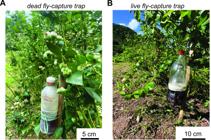
Traps used for capturing drosophilids in blueberry orchards in Sapucaia, Rio de Janeiro State, Brazil. (A) Dead fly-capture trap, consisting of a plastic bottle containing liquid attractant to retain and kill flies. (B) Live fly-capture trap, designed to allow the collection of Drosophila suzukii living flies for further laboratory studies.
The second trap model, hereafter termed as banana traps, was designed to capture live flies (Fig. 2B). These traps were assembled from sections of two liters (2L) polyethylene terephthalate (PET) bottles and consisted of three modules. The first module (reservoir) was formed from the lower portion of a 2L PET bottle cut approximately 13.5 cm from the base, with small incisions at the upper edge to facilitate attachment of the second module. The second module (inverted cone) was prepared from the upper portion of a 2L PET bottle cut about 12.8 cm below the threaded neck. This module was fitted onto the first module and secured with masking or adhesive tape. The third module (fly chamber) was mounted over the second module and constructed from the upper portion of a 2L PET bottle measuring approximately 21.0 cm from the cap. This chamber stores the captured flies and therefore remained sealed, while the second module functioned as an internal inverted cone that prevented flies from returning to the reservoir. A Petri dish containing an attractive diet was placed inside the reservoir. The diet consisted of mashed ripe banana mixed with brewer’s yeast (10% of the banana mass) and cornmeal added to obtain a pasty consistency, thereby preventing flies from drowning (Fig. 2B). The mixture was left at room temperature for 24 h to ferment, increasing its attractiveness to flies. The reservoir was coated with non-toxic matte black spray paint and had walls perforated with holes approximately four millimeters in diameter, beginning three centimeters above the trap bottom and spaced 2 cm apart. Three horizontal rows were created, each containing eight to 10 holes. A Petri dish containing the fermented mixture was placed inside.
Fly samplings using vinegar traps
Fly collection using vinegar traps was conducted by the grower between August and December 2024. Flies were removed from the vinegar traps once a week and placed in 70% alcohol in centrifuge microtubes labeled with the collection date and the corresponding trap number. After five months of sampling, with at least two sampling days per month, the flies were taken to the laboratory, where they were identified using a drosophilid identification key (Yuzuki and Tidon, 2020) and specimens were classified as D. suzukii, Zaprionus spp., and Drosophila spp., for the remaining drosophilids.
First sampling of live flies captured
Following the confirmation of D. suzukii specimens captured in vinegar traps, a second visit was made to the property on December 12th, 2024, during the next harvest. To collect living flies, we used 10 banana traps, which were distributed throughout the area, one trap every three rows of blueberry plants, installed approximately nine meters apart from each other. The banana traps were available for flies in the field for 24 h, after which the traps were taken to the laboratory, and the number of captured drosophilids was recorded.
To investigate the emergence of fruit flies on the property, visually damaged fruits were collected and placed into 250 mL plastic containers with 2.5 cm vermiculite to prevent moisture buildup, with 150 g of fruit per container, divided into four containers over the draining substrate layer. Both the live flies and the collected fruits were taken to the laboratory and kept at a temperature of 25°C. The D. suzukii flies captured in the banana traps were identified and stored in centrifuge microtubes with 70% alcohol. Zaprionus spp. and Drosophila spp. were counted and preserved in 70% alcohol following the same methodology. The main morphological characteristics used to identify the flies captured in traps were the spots located at the tips of the males’ wings and the serrated ovipositor of the females, as described by Hauser (Hauser, 2011). The damaged fruits were kept in the laboratory for 13 days after collection. Flies began to emerge from the fruits within six days. Once again, flies of the species D. suzukii were visually separated, counted, and maintained in the laboratory in rearing cages with artificial diet for the establishment of a new population.
Second collection of live flies captured
A second visit was made on January 17th, 2025, to collect additional fly specimens and damaged fruits. We installed nine traps for live fly capture in the cultivation field, one every three rows of blueberry plants. Damaged fruits were also collected, totaling 1.6 kg, and evenly divided into five 5 L containers with 2.5 cm of vermiculite to prevent excess moisture. It is worth noting that one of the sampled containers contained only slightly damaged fruits. Again, six days after collection, flies began to emerge from the damaged fruits and were subsequently classified as D. suzukii, Zaprionus spp., and Drosophila spp. The flies were separated and counted over five days following the onset of adult emergence. Once more, D. suzukii specimens were separated, counted, and kept in rearing cages with artificial diet to establish a new population for future toxicological studies to assess fly susceptibility to imidacloprid. The other species, Zaprionus spp. and Drosophila spp., were preserved in Falcon tubes containing 70% ethanol and later counted to evaluate the proportion of species found in the cultivation area.
Establishment of the new population and susceptibility to imidacloprid
The number of flies from the second collection was used to create a new laboratory colony, which was maintained in 5 L rearing cages with air openings protected by organza fabric for ventilation. The flies were reared on a solid nutritional diet at a ratio of 20 g of sugar to 10 g of brewer’s yeast. An oviposition diet was also used, made with water, agar, cornmeal, brewer’s yeast, and sugar, with adaptations (Dalton et al., 2011). The D. suzukii adults used in the experiments aged 3-5 days after emergence and maintained under laboratory conditions at a temperature of 25 ± 2 °C and a photoperiod of 14h of light. The experiments were conducted under the same laboratory conditions.
For the toxicological assays, we used 250 mL glass vials containing a cylinder of dental cotton soaked with 1.5 mL of a solution containing distilled water and 20% sucrose (control treatment) along with 0.140 mg/mL of imidacloprid (insecticide treatment). We used this insecticide concentration as it corresponds to the lethal concentration estimated for killing 50% of individuals of an imidacloprid-susceptible population, as proposed by Andreazza et al. (2025), following IRAC protocol N°. 02631. In the insecticide susceptibility bioassays, we used a D. suzukii population maintained as a susceptible reference strain. The colony originated from individuals collected in September 2014 from loquat orchards in Pelotas, Rio Grande do Sul State, Brazil (Andreazza et al., 2016b), a region that had been invaded approximately two years earlier following the first record of the species in the country. We used five replications for the imidacloprid and control treatments. Each replicate included 20 D. suzukii adult flies descended from flies either of Rio de Janeiro or from Rio Grande do Sul. The insects were counted the following day, after 24 h, to assess mortality and for subsequent statistical analysis.
Statistical analysis
The data for emergence of D. suzukii flies were subjected to analysis of variance (ANOVA) and compared by Tukey’s HSD test (P < 0.05) using SigmaPlot 14.0 (Systat Software, San Jose, CA, USA) after checking the assumptions of the normality of the residues and the homogeneity of variances. The mortality data were submitted to a Z-test for a binomial proportion with continuity adjustment (Roush and Miller’, 1986) (PROC POWER [SAS 2013]) (SAS Institute, 2013).
Results
Temporal dynamics of flies captured in vinegar traps
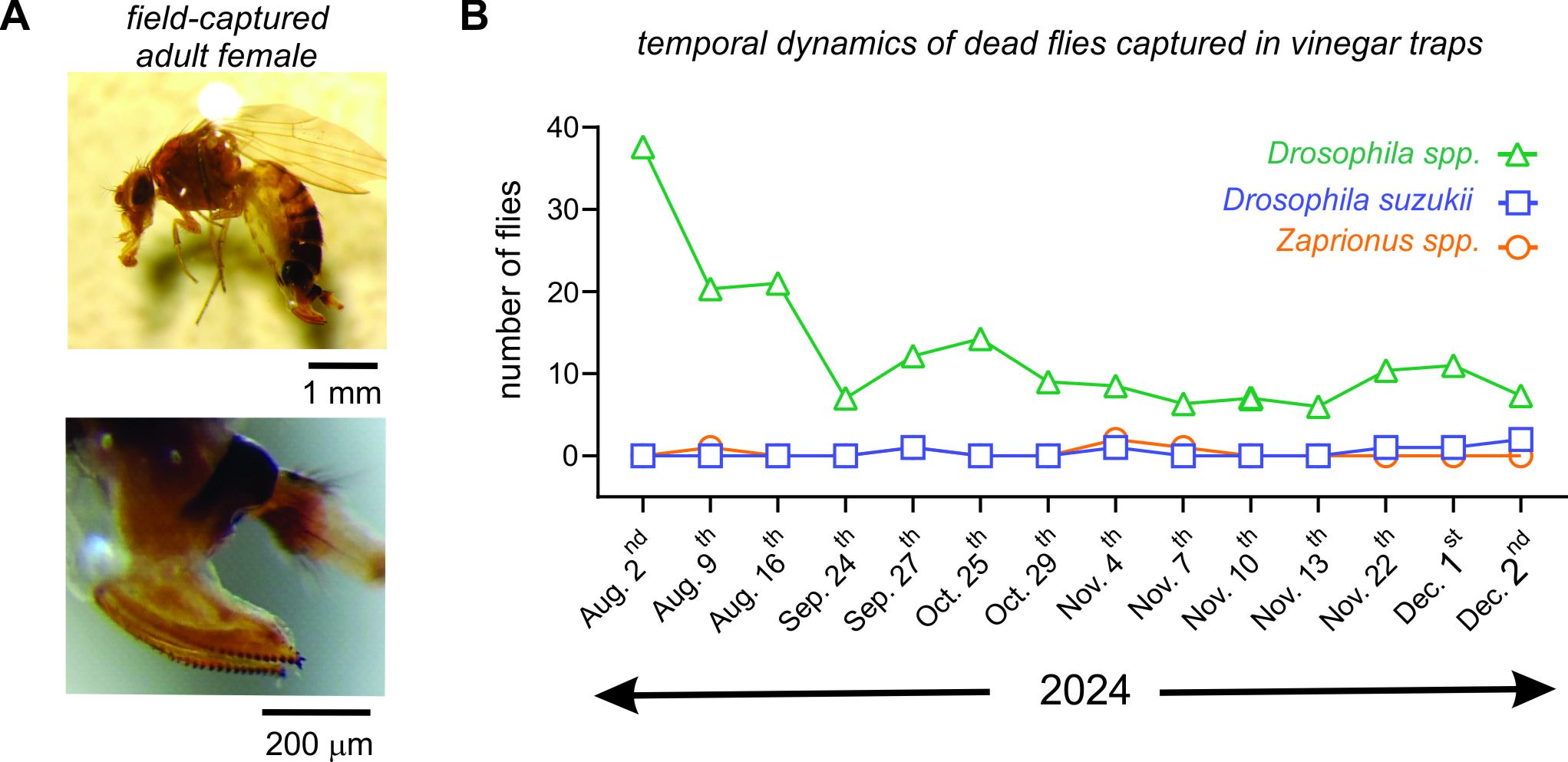
Sampling of flies in vinegar traps between August and December 2024 captured Drosophila spp., Drosophila suzukii, and Zaprionus spp. (Fig. 3). Non-target Drosophila species dominated trap collections (n =1,197), reaching nearly 40 individuals per trap in early August before stabilizing at lower but fluctuating levels (5–15 individuals) during subsequent months. In contrast, D. suzukii (7 females only) and Zaprionus spp. (10 individuals) were detected only sporadically and always at very low abundance, rarely exceeding two individuals per trap. The total number of D. suzukii collected by the vinegar traps was seven female specimens (Fig. 3).
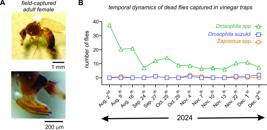
Identification and temporal dynamics of drosophilid flies captured in vinegar traps in blueberry orchards. (A) Field-captured adult female Drosophila suzukii and detail of the serrated ovipositor, a diagnostic trait of the species. (B) Temporal dynamics of dead flies captured from August to December 2024. Drosophila spp. was the most abundant taxon throughout the monitoring period, while D. suzukii and Zaprionus spp. were recorded at consistently lower numbers.
Living captured flies in banana traps and emerged from damaged fruits
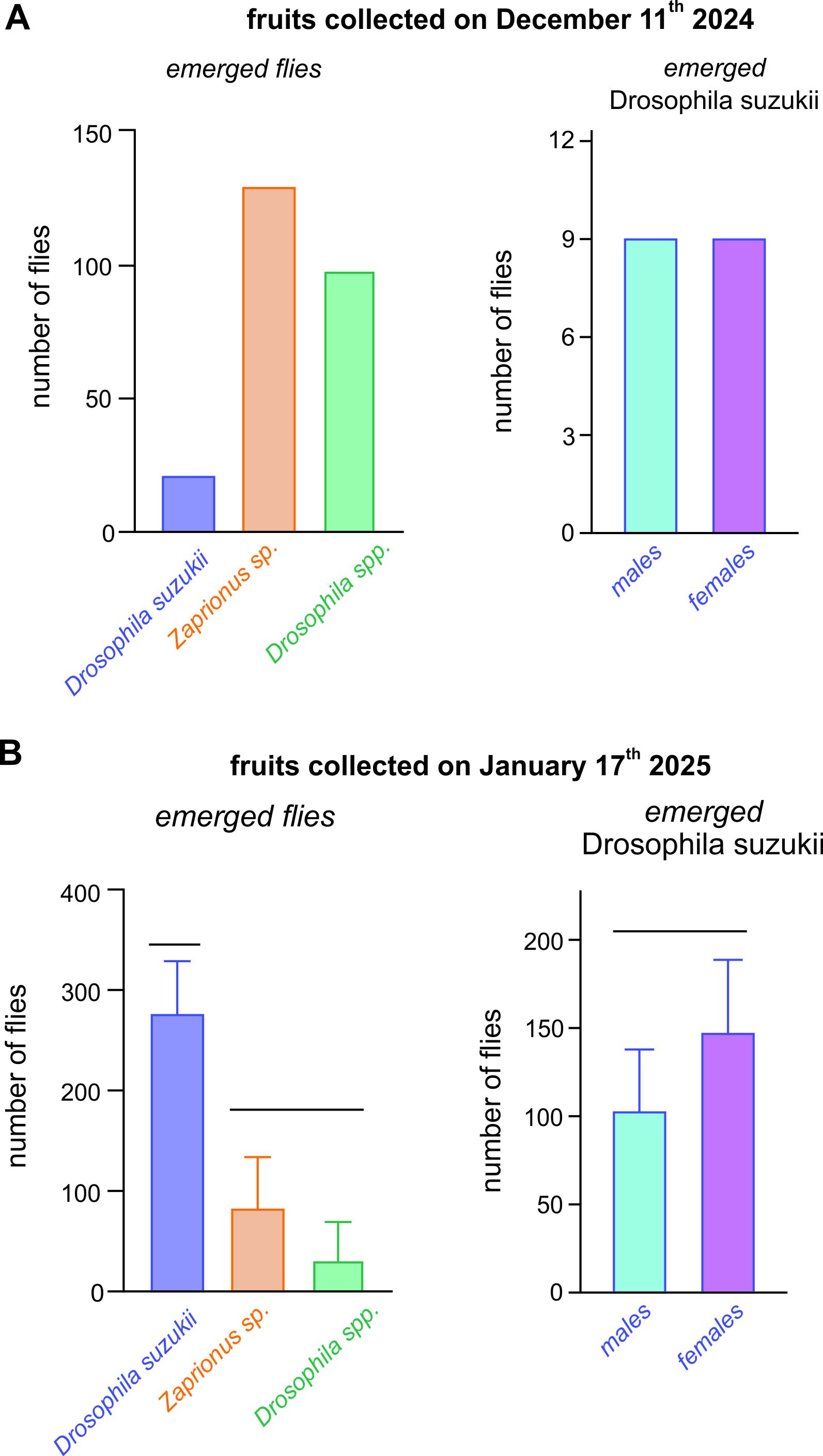
The emergence of drosophilid flies varied considerably between the two sampling dates (Fig. 4). Fruits collected on December 12ᵗʰ, 2024 yielded predominantly Zaprionus spp., which accounted for the highest number of emerged adults (n=135 individuals), followed by Drosophila spp. (96 individuals) and, at much lower abundance, D. suzukii (nine males and nine females) (Fig. 4a). By contrast, fruits collected on January 17ᵗʰ, 2025 were dominated by D. suzukii, with emergence surpassing 250 individuals, significantly higher than either Zaprionus spp. (76 individuals) or Drosophila spp. (28 individuals) (Fig. 4b). Within D. suzukii, females (n = 169) were more abundant than males (n = 110), although both sexes were consistently recovered in large numbers (Fig. 4b).
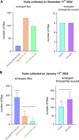
Emergence of drosophilid flies from fruits collected on December 11ᵗʰ, 2024 (A) and January 17ᵗʰ, 2025 (B). Left panels show the total number of adults emerged from each species group, including Drosophila suzukii, Zaprionus spp., and Drosophila spp. Right panels display the sex ratio of emerged D. suzukii. While in (A) no statistical analysis was conducted considering the total flies collected, in (B) the results originated of a 1.6 kg sample of damaged fruits, distributed evenly into 5 plastic cages. Bars aligned on the same horizontal line represent groups that are not significantly different, based on Tukey’s HSD test (P < 0.05).
Susceptibility of Drosophila suzukii to imidacloprid
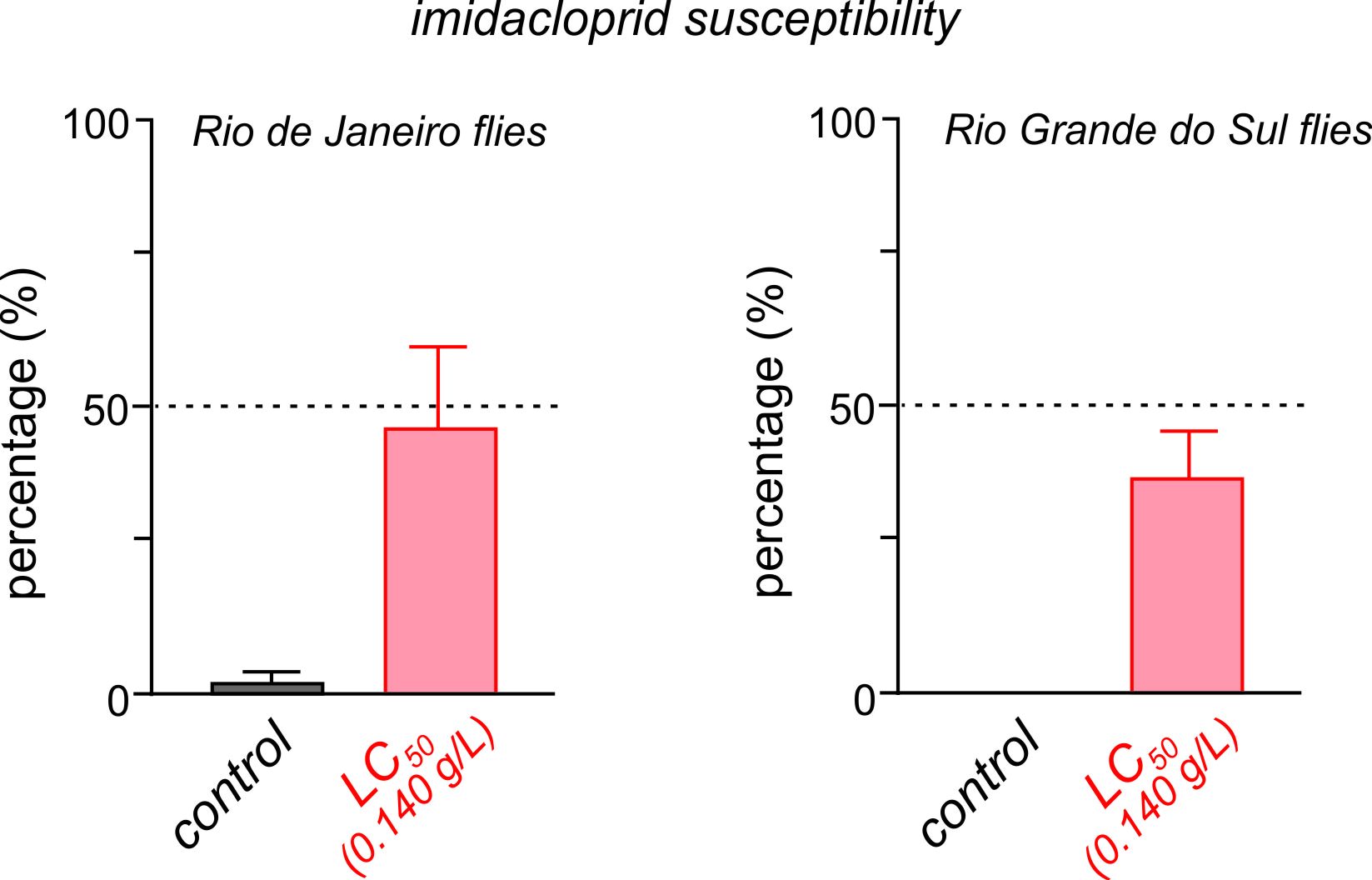
Both D. suzukii populations, from Rio de Janeiro and Rio Grande do Sul, exhibited similar susceptibility to 0.140 mg/mL of imidacloprid (Fig. 5), which is equivalent to the estimated LC50 concentration. Mortality rates were close to the expected 50% threshold in both cases (48% for Rio de Janeiro and 38% for Rio Grande do Sul flies), with only minor differences between populations. Control groups showed negligible background mortality.
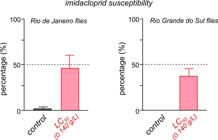
Susceptibility of Drosophila suzukii populations from Rio de Janeiro (left panel) and Rio Grande do Sul (right panel) to imidacloprid. Mortality was evaluated at the LC50 concentration (0.140 mg/mL). Both populations showed comparable responses, with values near the expected 50% mortality. Bars represent mean mortality (± SE), and the dotted line indicates the Z-test limit for the expected mortality mediated by the LC50.
Discussion
We reported the presence of D. suzukii and Zaprionus spp. in a newly established blueberry cultivation area in Rio de Janeiro. Furthermore, we assessed the susceptibility of this new D. suzukii population to imidacloprid, demonstrating that this novel infestation is still manageable with the application of such neonicotinoid. Our findings revealed a temporal shift in species composition highlighting a transition from Zaprionus spp. dominance in damaged fruits collected in December 2024 to D. suzukii prevalence in fruits collected in January 2025, which represents the preliminary observations for seasonal dynamics in fruit infestation and fly emergence. However, further sampling should be conducted over longer periods of time (e.g., a few years) to verify interannual variability of D. suzukii and to ensure replication across different properties and regions, which allows for more assertive management, both curative and preventive.
The expansion of berry cultivations into new areas may facilitate the establishment and dispersal of invasive pests such as D. suzukii. This species exhibits remarkable behavioral and physiological plasticity, which has enabled its rapid adaptation to novel climates, food resources, and ecological interactions, contributing to its invasion success across multiple continents (Santoiemma et al., 2018; Little et al., 2020; Estay et al., 2023; Shope et al., 2023; Abeijon et al., 2025). For instance, populations have spread across extensive berry-producing regions within only a few years through a combination of active movement and human-mediated transport (Leach et al., 2018; Estay et al., 2023). Furthermore, agricultural landscape features also play a key role in population dynamics. Complex landscapes and semi-natural habitats have been shown to increase D. suzukii abundance and crop damage, indicating that habitat structure should be considered when designing management strategies (Santoiemma et al., 2018; Martínez et al., 2025). Regarding novel blueberry production areas, previous studies have shown that improved blueberry varieties possess physicochemical traits favorable for fly oviposition, such as larger, firmer, and less acidic fruits. In these improved varieties, the oviposition rate is considerably higher than in native blueberry fruits (Rodriguez-Saona et al., 2019). Thus, considering climatic adaptability and dispersal ability, identifying emerging cultivation areas is essential for monitoring programs and for the early implementation of integrated practices for managing invasive pests such as D. suzukii.
The occurrence of D. suzukii has been reported in blueberry fields of all major Brazilian production areas (Wollmann et al., 2019). However, considering that blueberry cultivation has been gaining ground in Brazil, with the emergence of growing areas further southeast in the country, such as in the states of Rio de Janeiro, São Paulo, and Minas Gerais (Cantuarias-Avilés et al., 2014), the monitoring of potential D. suzukii infestations, is of fundamental importance for adopting preventive measures and to ensure effective control of these insects. Understanding the population dynamics of D. suzukii in the cultivation area is a fundamental strategy to support decisions on when to apply which control method. However, such investigations have to be conducted over several months or years to ensure the periods of pest increase and its main causes. For instance, it is reasonable to expect that during the winter season, the flies enter a diapause period, drastically reducing egg laying. Thus, controlling insects during the winter period through attractive traps and toxic baits can be a key tool to reduce the infestation rate at the beginning of production season (Rossi-Stacconi et al., 2016; Wiman et al., 2016; Panel et al., 2018). Furthermore, by understanding the population dynamics of the D. suzukii in association with the phenology of blueberry production and weather forecasts, scheduled applications of insecticides or other control methods in cultivation areas can support preventive or curative measures during production (Wiman et al., 2016; Winkler et al., 2020; Yeh et al., 2024).
The occurrence of Zaprionus spp. in damaged blueberry fruits is not surprising as these flies are the most relevant insect pests in orchards of fig (Renkema et al., 2013; Bragard et al., 2022) and are considered secondary pests in strawberry crops (Bragard et al., 2022) by affecting overripe fruits or those with visible physical damage (Van der Linde et al., 2006; Bernardi et al., 2017). The results also indicate a possible fluctuation of flies’ populations in the cultivation areas, with a considerable increase observed in a two-month interval (i.e., from December 2024 to January of 2025), when occurs the peak period of blueberry production Brazil (Daniela et al., 2018; Wollmann et al., 2019). This pattern may be related to the seasonal fruiting of the blueberry plants on the property. Initial harvest occurs in September/October with neglected number of infested/damaged fruits.
The increase in fly numbers in January may be associated with the two harvests being conducted during the rainy season in the region, which also alters the humidity and temperature conditions. December marks the first fruit harvest, during which damaged fruits tend to fall to the ground (Lee et al., 2016; Kienzle et al., 2020; Kienzle and Rohlfs, 2021). In addition, the pupal stage of the flies occurs outside the fruit, as the larvae exit and pupate in the soil (Evans et al., 2017; Kienzle et al., 2020; Saeed et al., 2020). The D. suzukii that emerged from the fruits of the first harvest are likely the same individuals responsible for the higher rate of fruit damage and increased pest incidence in the cultivation area the following month, as the previously green fruits began to ripen and give birth to new adults. However, to obtain a more conclusive response and to validate such a hypothesis regarding the population dynamics of D. suzukii, further sampling should be conducted over a higher number of harvest seasons, not only on the cultivation area used here, but also in adjacent areas.
Toxicological tests showed that the newly recorded D. suzukii population is susceptible to imidacloprid, with results aligning with a recent study that reported a lethal concentration (LC50) of 0.140 mg/mL (Andreazza et al., 2025). As imidacloprid is an insecticide used against D. suzukii (Gao et al., 2024; Andreazza et al., 2025), these findings suggest it may be effective for managing this pest in the newly identified area.
Conclusions
In addition to being the first study reporting the presence of D. suzukii in agricultural orchards in the state of Rio de Janeiro, our findings revealed the preliminary observations for seasonality of the invasive insect pest, with peaks of occurrence in December and January, which coincide with the peak production period of blueberry plants in the municipality of Sapucaia. Furthermore, we confirmed the susceptibility of this new population to imidacloprid, supporting future research related to the control of these flies in blueberry production fields in Brazil.
Acknowledgments
We are grateful to Dr. Elisabeth B. Epalanga Pires for fruitful discussion during the manuscript preparation and to Mr. Joshua L. Fernandes for excellent technical assistance during the field activities.
-
Funding
This work was partially supported by the Coordenação de Aperfeiçoamento de Pessoal de Nível Superior—Brasil (CAPES; Finance Code 001); the National Council of Scientific and Technological Development (CNPq; 309890/2022-5, 408598/2023-9); the Minas Gerais State Foundation for Research Aid (FAPEMIG; APQ-05316-23).
Data statement
The original contributions presented in this study are included in the article. Further inquiries can be directed at the corresponding author.
References
-
Abeijon, L. M., Gómez Llano, J. H., Robe, L. J., Ovruski, S. M., Garcia, F. R. M., 2025. Mapping the potential presence of the spotted wing drosophila under current and future scenario: an update of the distribution modeling and ecological perspectives. Agronomy 15 (4), 838. https://doi.org/10.3390/agronomy15040838
» https://doi.org/10.3390/agronomy15040838 -
Andreazza, F., Baronio, C. A., Botton, M., Valgas, R. A., Ritschel, P. S., Maia, J. D. G., Nava, D. E., 2016a. Suscetibilidade de bagas de genótipos de videira pela infestação por Drosophila suzukii, (Diptera: drosophilidae). Pesqui. Agropecu. Bras. 51 (5), 599-606. https://doi.org/10.1590/S0100-204X2016000500021
» https://doi.org/10.1590/S0100-204X2016000500021 - Andreazza, F., Bernardi, D., Marangon, R. B., Scheunemann, T., Botton, M., Nava, D. E., 2016b. Técnica de Criação de Drosophila suzukii (Matsumura, 1931) (Diptera: Drosophilidae) em Dieta Artificial. Embrapa Clima Temperado, Pelotas. Boletim de Pesquisa e Desenvolvimento 240.
-
Andreazza, F., Garcia, F. R. M., Silva, P. B., Barbosa, L. B., de Oliveira, J. M., Araújo, G. N., Oliveira, E. E., 2025. Imidacloprid resistance challenges in Brazilian strains of Drosophila suzukii (Diptera: drosophilidae). Insects 16 (5), 494. https://doi.org/10.3390/insects16050494
» https://doi.org/10.3390/insects16050494 -
Andreazza, F., Haddi, K., Oliveira, E. E., Ferreira, J. A. M., 2016c. Drosophila suzukii (Diptera: Drosophilidae) arrives at Minas Gerais State, a main strawberry production region in Brazil. Fla. Entomol. 99 (4), 796-798. https://doi.org/10.1653/024.099.0439
» https://doi.org/10.1653/024.099.0439 -
Bernardi, D., Andreazza, F., Botton, M., Baronio, C. A., Nava, D. E., 2017. Susceptibility and interactions of Drosophila suzukii and Zaprionus indianus (Diptera: Drosophilidae) in damaging strawberry. Neotrop. Entomol. 46 (1), 1-7. https://doi.org/10.1007/s13744-016-0423-9
» https://doi.org/10.1007/s13744-016-0423-9 - Bitner-Mathé, B. C., Victorino, J., Faria, F. S., 2014. Drosophila suzukii has been found in tropical Atlantic Rainforest in southeastern Brazil. Drosoph. Inf. Serv. 97, 136-137.
-
Bragard, C., Baptista, P., Chatzivassiliou, E., Di Serio, F., Gonthier, P., Jaques Miret, J. A., Justesen, A. F., Magnusson, C. S., Milonas, P., Navas-Cortes, J. A., Parnell, S., Potting, R., Reignault, P. L., Stefani, E., Thulke, H. H., Van der Werf, W., Vicent Civera, A., Yuen, J., Zappalà, L., Grégoire, J. C., Malumphy, C., Kertesz, V., Maiorano, A., MacLeod, A., 2022. Pest categorisation of Zaprionus indianus. EFSA J. 20 (3), https://doi.org/10.2903/j.efsa.2022.7144
» https://doi.org/10.2903/j.efsa.2022.7144 -
Calabria, G., Máca, J., Bächli, G., Serra, L., Pascual, M., 2012. First records of the potential pest species Drosophila suzukii (Diptera: Drosophilidae) in Europe. J. Appl. Entomol. 136 (1-2), 139-147. https://doi.org/10.1111/j.1439-0418.2010.01583.x
» https://doi.org/10.1111/j.1439-0418.2010.01583.x -
Cantuarias-Avilés, T., Silva, S. R., Medina, R. B., Moraes, A. F. G., Alberti, M. F., 2014. Cultivo do mirtilo: atualizações e desempenho inicial de variedades de baixa exigência em frio no Estado de São Paulo. Rev. Bras. Frutic. 36 (1), 139-147. https://doi.org/10.1590/0100-2945-453/13
» https://doi.org/10.1590/0100-2945-453/13 -
Dalton, D. T., Walton, V. M., Shearer, P. W., Walsh, D. B., Caprile, J., Isaacs, R., 2011. Laboratory survival of Drosophila suzukii under simulated winter conditions of the Pacific Northwest and seasonal field trapping in five primary regions of small and stone fruit production in the United States. Pest Manag. Sci. 67 (11), 1368-1374. https://doi.org/10.1002/ps.2280
» https://doi.org/10.1002/ps.2280 -
Daniela, F. K., Regis, S. S. dos S., Luciano, G., Lucas, R. M., 2018. Population fluctuation and infestation of Drosophila suzukii in berry crops in Southern Brazil. Afr. J. Agric. Res. 13 (11), 499-511. https://doi.org/10.5897/AJAR2018.12999
» https://doi.org/10.5897/AJAR2018.12999 -
Deprá, M., Poppe, J. L., Schmitz, H. J., De Toni, D. C., Valente, V. L. S., 2014. The first records of the invasive pest Drosophila suzukii in the South American continent. J. Pest Sci. 87 (3), 379-383. https://doi.org/10.1007/s10340-014-0591-5
» https://doi.org/10.1007/s10340-014-0591-5 -
Digiacomo, G., Hadrich, J., Hutchison, W. D., Peterson, H., Rogers, M., 2019. Economic impact of spotted wing Drosophila (Diptera: Drosophilidae) yield loss on minnesota raspberry farms: a grower survey. J. Integr. Pest Manag. 10 (1), 11. https://doi.org/10.1093/jipm/pmz006
» https://doi.org/10.1093/jipm/pmz006 -
EastFruit, 2025. Global Fresh Blueberry Outlook 2025–2030. Available in: https://east-fruit.com/en/horticulture-market/market-reviews/global-fresh-blueberry-outlook-2025-2030/(accessed September 2025).
» https://east-fruit.com/en/horticulture-market/market-reviews/global-fresh-blueberry-outlook-2025-2030/ -
Estay, S. A., Silva, C. P., López, D. N., Labra, F. A., 2023. Disentangling the spread dynamics of insect invasions using spatial networks. Front. Ecol. Evol. 11, 1124890. https://doi.org/10.3389/fevo.2023.1124890
» https://doi.org/10.3389/fevo.2023.1124890 -
Evans, R. K., Toews, M. D., Sial, A. A., 2017. Diel periodicity of Drosophila suzukii (Diptera: Drosophilidae) under field conditions. PLoS One 12 (2), e0171718. https://doi.org/10.1371/journal.pone.0171718
» https://doi.org/10.1371/journal.pone.0171718 -
Faria, A., Oliveira, J., Neves, P., Gameiro, P., Santos-Buelga, C., De Freitas, V., Mateus, N., 2005. Antioxidant properties of prepared blueberry (Vaccinium myrtillus) extracts. J. Agric. Food Chem. 53 (17), 6896-6902. https://doi.org/10.1021/jf0511300
» https://doi.org/10.1021/jf0511300 -
Ganjisaffar, F., Demkovich, M. R., Chiu, J. C., Zalom, F. G., 2022. Characterization of Field-Derived Drosophila suzukii (Diptera: Drosophilidae) resistance to Pyrethroids in California berry production. J. Econ. Entomol. 115 (5), 1676-1684. https://doi.org/10.1093/jee/toac118
» https://doi.org/10.1093/jee/toac118 -
Gao, H., Wang, Y., Chen, P., Zhang, A., Zhou, X., Zhuang, Q., 2024. Toxicity of eight insecticides on Drosophila suzukii and its pupal parasitoid Trichopria drosophilae. Insects 15 (11), 910. https://doi.org/10.3390/insects15110910
» https://doi.org/10.3390/insects15110910 -
Geisler, F. C. S., Santos, J., Holdefer, D. R., Garcia, F. R. M., 2015. Primeiro registro de Drosophila suzukii (Matsumura, 1931) (Diptera: Drosophilidae) para o estado do Paraná, Brasil e de novoshospedeiros. Rev. Cienc. Ambient. 9 (2), https://doi.org/10.18316/1981-8858.15
» https://doi.org/10.18316/1981-8858.15 -
Hauser, M., 2011. A historic account of the invasion of Drosophila suzukii (Matsumura) (Diptera: Drosophilidae) in the continental United States, with remarks on their identification. Pest Manag. Sci. 67 (11), 1352-1357. https://doi.org/10.1002/ps.2265
» https://doi.org/10.1002/ps.2265 - International Blueberry Organization – IBO, 2025. Global State of the Blueberry Industry Report 2025. IBO, El Dorado Hills, CA.
-
Kienzle, R., Groß, L. B., Caughman, S., Rohlfs, M., 2020. Resource use by individual Drosophila suzukii reveals a flexible preference for oviposition into healthy fruits. Sci. Rep. 10 (1), 3132. https://doi.org/10.1038/s41598-020-59595-y
» https://doi.org/10.1038/s41598-020-59595-y -
Kienzle, R., Rohlfs, M., 2021. Mind the wound!: fruit injury ranks higher than, and interacts with, heterospecific cues for Drosophila suzukii oviposition. Insects 12 (5), 424. https://doi.org/10.3390/insects12050424
» https://doi.org/10.3390/insects12050424 -
Leach, H., Hagler, J. R., Machtley, S. A., Isaacs, R., 2018. Spotted wing drosophila (Drosophila suzukii) utilization and dispersal from the wild host Asian bush honeysuckle (Lonicera spp.). Agric. For. Entomol. 21 (2), 149-158. https://doi.org/10.1111/afe.12315
» https://doi.org/10.1111/afe.12315 -
Lee, J. C., Bruck, D. J., Dreves, A. J., Ioriatti, C., Vogt, H., Baufeld, P., 2011. In focus: spotted wing drosophila, Drosophila suzukii, across perspectives. Pest Manag. Sci. 67 (11), 1349-1351. https://doi.org/10.1002/ps.2271
» https://doi.org/10.1002/ps.2271 -
Lee, J. C., Dalton, D. T., Swoboda-Bhattarai, K. A., Bruck, D. J., Burrack, H. J., Strik, B. C., Woltz, J. M., Walton, V. M., 2016. Characterization and manipulation of fruit susceptibility to Drosophila suzukii. J. Pest Sci. 89 (3), 771-780. https://doi.org/10.1007/s10340-015-0692-9
» https://doi.org/10.1007/s10340-015-0692-9 -
Lisi, F., Mansour, R., Cavallaro, C., Alınç, T., Porcu, E., Ricupero, M., Zappalà, L., Desneux, N., Biondi, A., 2023. Sublethal effects of nine insecticides on Drosophila suzukii and its major pupal parasitoid Trichopria drosophilae. Pest Manag. Sci. 79 (12), 5003-5014. https://doi.org/10.1002/ps.7702
» https://doi.org/10.1002/ps.7702 -
Little, C. M., Chapman, T. W., Hillier, N. K., 2020. Plasticity is key to success of Drosophila suzukii (Diptera: Drosophilidae) invasion. J. Insect Sci. 20 (3), 5. https://doi.org/10.1093/jisesa/ieaa034
» https://doi.org/10.1093/jisesa/ieaa034 -
Martínez, A. S., Germano, M. D., Chillo, V., Franza, F., Fischbein, D., Cardozo, A., Masciocchi, M., 2025. Understanding key population drivers of the spotted wing Drosophila in cultivated and natural areas in the Andes. Sci. Rep. 15 (1), 6208. https://doi.org/10.1038/s41598-025-90147-4
» https://doi.org/10.1038/s41598-025-90147-4 -
Mendonça, L. D. P., Oliveira, E. E., Andreazza, F., Rezende, S. M., Faroni, L. R. D. A., Guedes, R. N. C., Haddi, K., 2019. Host potential and adaptive responses of Drosophila suzukii (Diptera: Drosophilidae) to Barbados cherrieS. J. Econ. Entomol. 112, 3002-3006. https://doi.org/10.1093/jee/toz195
» https://doi.org/10.1093/jee/toz195 -
Panel, A. D. C., Zeeman, L., van der Sluis, B. J., van Elk, P., Pannebakker, B. A., Wertheim, B., Helsen, H. H. M., 2018. Overwintered Drosophila suzukii are the main source for infestations of the first fruit crops of the season. Insects 9 (4), 145. https://doi.org/10.3390/insects9040145
» https://doi.org/10.3390/insects9040145 - Paula, M. A., Lopes, P. H. S., Tidon, R., 2014. First record of Drosophila suzukii in the Brazilian Savanna. Drosoph. Inf. Serv. 97 (0), 113-115.
- Renkema, J. M., Miller, M., Fraser, H., Légaré, J. P., Hallett, R. H., 2013. First records of Zaprionus indianus Gupta (Diptera: Drosophilidae) from commercial fruit fields in Ontario and Quebec, Canada. J. Entomol. Soc. Ont. 144, 125-130.
-
Rodriguez-Saona, C., Cloonan, K. R., Sanchez-Pedraza, F., Zhou, Y., Giusti, M. M., Benrey, B., 2019. Differential susceptibility of wild and cultivated blueberries to an invasive frugivorous pest. J. Chem. Ecol. 45 (3), 286-297. https://doi.org/10.1007/s10886-018-1042-1
» https://doi.org/10.1007/s10886-018-1042-1 -
Rossi-Stacconi, M. V., Kaur, R., Mazzoni, V., Ometto, L., Grassi, A., Gottardello, A., Rota-Stabelli, O., Anfora, G., 2016. Multiple lines of evidence for reproductive winter diapause in the invasive pest Drosophila suzukii: useful clues for control strategies. J. Pest Sci. 89 (3), 689-700. https://doi.org/10.1007/s10340-016-0753-8
» https://doi.org/10.1007/s10340-016-0753-8 -
Roush, R. T., Miller, G. L., 1986. Considerations for design of insecticide resistance monitoring programs. J. Econ. Entomol. 79 (2), 293-298. https://doi.org/10.1093/jee/79.2.293
» https://doi.org/10.1093/jee/79.2.293 -
Saeed, N., Tonina, L., Battisti, A., Mori, N., 2020. Postharvest short cold temperature treatment to preserve fruit quality after Drosophila suzukii damage. Int. J. Pest Manag. 66 (1), 23-30. https://doi.org/10.1080/09670874.2018.1539531
» https://doi.org/10.1080/09670874.2018.1539531 -
Santoiemma, G., Mori, N., Tonina, L., Marini, L., 2018. Semi-natural habitats boost Drosophila suzukii populations and crop damage in sweet cherry. Agric. Ecosyst. Environ. 257, 152-158. https://doi.org/10.1016/j.agee.2018.02.013
» https://doi.org/10.1016/j.agee.2018.02.013 -
SAS Institute, 2013. SAS 9.4 Statistical Software Platform. Available in: https://www.sas.com(accessed 21 September 2025).
» https://www.sas.com -
Schlesener, D. C. H., Wollmann, J., Pazini, J. B., Padilha, A. C., Grützmacher, A. D., Garcia, F. R. M., 2019. Insecticide Toxicity to Drosophila suzukii (Diptera: Drosophilidae) parasitoids: Trichopria anastrephae (Hymenoptera: Diapriidae) and Pachycrepoideus vindemmiae (Hymenoptera: Pteromalidae). J. Econ. Entomol. 112 (3), 1197-1206. https://doi.org/10.1093/jee/toz033
» https://doi.org/10.1093/jee/toz033 -
Shope, J., Polk, D., Mansue, C., Rodriguez-Saona, C., 2023. The contrasting role of climate variation on the population dynamics of a native and an invasive insect pest. PLoS One 18 (4), e0284600. https://doi.org/10.1371/journal.pone.0284600
» https://doi.org/10.1371/journal.pone.0284600 -
Van Timmeren, S., Isaacs, R., 2013. Control of spotted wing drosophila, Drosophila suzukii, by specific insecticides and by conventional and organic crop protection programs. Crop Prot. 54, 126-133. https://doi.org/10.1016/j.cropro.2013.08.003
» https://doi.org/10.1016/j.cropro.2013.08.003 -
Van der Linde, K., Steck, G. J., Hibbard, K., Birdsley, J. S., Alonso, L. M., Houle, D., 2006. First records of Zaprionus indianus (Diptera: Drosophilidae), a pest species on commercial fruits from Panama and the United States of America. Fla. Entomol. 89 (3), 402-404. https://doi.org/10.1653/0015-4040(2006)89[402:FROZID]2.0.CO;2
» https://doi.org/10.1653/0015-4040(2006)89[402:FROZID]2.0.CO;2 -
Vilela, C. R., Mori, L., 2014. The invasive spotted-wing Drosophila (Diptera, Drosophilidae) has been found in the city of São Paulo (Brazil). Rev. Bras. Entomol. 58 (4), 371-375. https://doi.org/10.1590/S0085-56262014000400004
» https://doi.org/10.1590/S0085-56262014000400004 -
Wiman, N. G., Dalton, D. T., Anfora, G., Biondi, A., Chiu, J. C., Daane, K. M., Gerdeman, B., Gottardello, A., Hamby, K. A., Isaacs, R., Grassi, A., Ioriatti, C., Lee, J. C., Miller, B., Stacconi, M. V. R., Shearer, P. W., Tanigoshi, L., Wang, X., Walton, V. M., 2016. Drosophila suzukii population response to environment and management strategies. J. Pest Sci. 89 (3), 653-665. https://doi.org/10.1007/s10340-016-0757-4
» https://doi.org/10.1007/s10340-016-0757-4 -
Winkler, A., Jung, J., Kleinhenz, B., Racca, P., 2020. A review on temperature and humidity effects on Drosophila suzukii population dynamics. Agric. For. Entomol. 22 (3), 179-192. https://doi.org/10.1111/afe.12381
» https://doi.org/10.1111/afe.12381 -
Wollmann, J., Schlesener, D. C. H., Ferreira, M. S., Kruger, A. P., Bernardi, D., Garcia, J. A. B., Nunes, A. M., Garcia, M. S., Garcia, F. R. M., 2019. Population dynamics of Drosophila suzukii (Diptera: Drosophilidae) in berry crops in southern Brazil. Neotrop. Entomol. 48 (4), 699-705. https://doi.org/10.1007/s13744-019-00686-5
» https://doi.org/10.1007/s13744-019-00686-5 -
Wollmann, J., Schlesener, D. C. H., Mendes, S. R., Krüger, A. P., Martins, L. N., Bernardi, D., Garcia, M. S., Garcia, F. R. M., 2020. Infestation index of Drosophila suzukii (Diptera: Drosophilidae) in small fruit in southern Brazil. Arq. Inst. Biol. (Sao Paulo) 87, e0432018. https://doi.org/10.1590/1808-1657000432018
» https://doi.org/10.1590/1808-1657000432018 -
Yeh, D. A., Dai, B., Gómez, M. I., Walton, V. M., 2024. Does monitoring pests pay off? a bioeconomic assessment of Drosophila suzukii controls. Pest Manag. Sci. 80 (2), 708-723. https://doi.org/10.1002/ps.7801
» https://doi.org/10.1002/ps.7801 -
Yuzuki, K., Tidon, R., 2020. Identification key for drosophilid species (Diptera, Drosophilidae) exotic to the Neotropical Region and occurring in Brazil. Rev. Bras. Entomol. 64 (1), e2019100. https://doi.org/10.1590/1806-9665-rbent-2019-100
» https://doi.org/10.1590/1806-9665-rbent-2019-100 -
Zanuncio-Junior, J. S., Fornazier, M. J., Andreazza, F., Culik, M. P., Mendonça, L. P., Oliveira, E. E., Martins, D. S., Fornazier, M. L., Costa, H., Ventura, J. A., 2017. Spread of two invasive flies (Diptera: Drosophilidae) infesting commercial fruits in Southeastern Brazil. Fla. Entomol. 101 (3), 522-525. https://doi.org/10.1653/024.101.0328
» https://doi.org/10.1653/024.101.0328
Edited by
-
Associate Editor:
Marcelo Picanço