 Exploring the application of the CCM approach and UDL as conceptual frameworks to enhance inclusive teacher training through Lesson Study
Abstract:
This study explores how the Constructionist, Contextualized, and Meaningful (CCM) approach, in tandem with Universal Design for Learning (UDL), can be realized through Lesson Study to serve as a foundation for inclusive education. The paper provides an insight into a research project undertaken to train future teachers for inclusion within a Brazilian university. It examines how both CCM and UDL contributed to teacher development and engendered inclusive practices, providing a possible pathway through the application of Lesson Study that has relevance for educational policies and practices in teacher training contexts. The analysis suggests that the use of Lesson Study, alongside the combined integration of CCM pedagogies and UDL, leads to the promotion of effective inclusive teaching practices that address the multiple educational needs of all students. The results demonstrate that, when Lesson Study is used to ground the iterative processes required for teacher professional development, and when CCM and UDL further inform these processes, then the requisite conditions are attained for significantly enhancing diverse students’ learning outcomes, thereby enabling inclusive education to flourish.
Keywords:
inclusive education; Lesson Study; Universal Design for Learning; CCM approach
Resumo:
Este artigo examina como a abordagem Construcionista, Contextualizada e Significativa (CCS), em articulação com o Desenho Universal para a Aprendizagem (DUA), pode ser operacionalizada por meio do Lesson Study como referencial para a promoção da educação inclusiva. A investigação foi conduzida no âmbito de um curso de formação inicial de professores em uma universidade brasileira, com foco na preparação de futuros docentes para práticas inclusivas. A análise contempla de que modo a abordagem CCS e o DUA contribuíram para o desenvolvimento profissional docente e para a implementação de práticas pedagógicas inclusivas, apontando o Lesson Study como uma metodologia com potencial para fundamentar políticas e práticas educacionais voltadas à formação de professores. Os resultados do estudo indicam que a integração do Lesson Study com os princípios pedagógicos da abordagem CCS e do DUA favorece a constituição de práticas docentes inclusivas, capazes de responder às múltiplas necessidades educacionais dos estudantes. Evidencia-se que, ao ancorar os processos formativos docentes nos ciclos colaborativos do Lesson Study, orientados pelos fundamentos da abordagem CCS e do DUA, foi possível estabelecer condições adequadas para a melhoria das aprendizagens dos estudantes, contribuindo para a consolidação da educação inclusiva.
Palavras-chave:
educação inclusiva; Lesson Study; Desenho Universal para a Aprendizagem; abordagem CCS
Resumen:
Este artículo examina cómo el Enfoque Constructivista, Contextualizado y Significativo (CCS),en articulación con el Diseño Universal para el Aprendizaje (DUA), el enfoque puede ponerse en práctica a través del "Lesson Study" como referencia para la promoción de la educación inclusiva. La investigación se llevó a cabo en el contexto de un curso de formación inicial de docentes en una universidad brasileña, centrado en la preparación de futuros docentes para prácticas inclusivas. El análisis contempla de cómo el enfoque CCS y el DUA contribuyeron al desarrollo profesional docente y a la implementación de prácticas pedagógicas inclusivas, señalando el "Lesson Study" como una metodología con potencial para fundamentar políticas y prácticas educativas orientadas a la formación docente. Los resultados del estudio indican que la integración del "Lesson Study" con los principios pedagógicos del enfoque CCS y del DUA favorece la construcción de prácticas docentes inclusivas, capaces de responder a las múltiples necesidades educativas de los estudiantes. Se evidencia que, al anclar los procesos formativos docentes en los ciclos colaborativos del "Lesson Study", orientados por los fundamentos del enfoque CCS y del DUA, fue posible establecer condiciones adecuadas para la mejora del aprendizaje de los estudiantes, contribuyendo así a la consolidación de la educación inclusiva.
Palabras clave:
Educación Inclusiva; "Lesson Study"; Diseño Universal para el Aprendizaje; Enfoque CCS.
Introduction
The importance of an education system that includes all learners has been broadly recognized globally (Unesco. IBE, 2016). There is a growing emphasis in international education policy on the necessity for national education systems to deliver inclusive and equitable education for every student (e.g., United Nations Convention on the Rights of People with Disabilities, 2006; United Nations Convention on the Rights of People with Disabilities, 2020; and Progress towards the Sustainable Development Goals). Although particular focus is frequently given to the most vulnerable students, an inclusive approach to education is increasingly acknowledged as advantageous for all pupils (Fluminhan et al., 2022). In response to shifts in international conventions and national education policies, numerous education systems have started to explore how innovative pedagogical approaches can enhance inclusive education practices (Jwad et al., 2022; Lanuti; Mantoan, 2021; Norwich; Benham-Clarke; Goei, 2021; Oliveira et al., 2023).
Motivated by the need to transform pedagogical practices to assist with knowledge construction during teaching while fostering autonomy and inclusion, the Constructionist, Contextualized, and Meaningful (CCM) approach (Schlünzen et al., 2020) has gained substantial prominence in contemporary education. Its rise is primarily attributed to its strong focus on the contextualized and meaningful construction of knowledge (Lima, 2024). In tandem with the CCM approach, this study discusses the role of the Universal Design for Learning (UDL) framework as an appropriate framework for proactively addressing inclusive education. UDL anticipates and plans for inherent student variability in all learning spaces. It also incorporates flexibility and decision-making in how students engage in learning and facilitates greater learner centeredness with both formative and summative aspects of assessment (Bray et al., 2024; Hanesworth; Bracken; Elkington, 2019).
Despite a growing interest in both the CCM approach and UDL being recognized as relevant frameworks for inclusive education (Orndorf et al., 2022), there is a lack of understanding of how schools can create quality teaching and support teachers and pre-service teachers to incorporate this knowledge into their pedagogical practices (Bray et al., 2024; Norwich; Benham-Clarke; Goei, 2021). Thus, as suggested by Lanuti; Baptista; Mantoan (2022, p. 109, own translation), “if the goal is to establish a new theory of education for all, grounded in difference itself, there is a need to be consistent in the training of those who are part of the process and participate in the re-articulation of the school: the teachers”. With this in mind, our research explores the use of the Lesson Study methodology as a means of engaging said teachers (Clivaz et al., 2025; Seleznyov et al., 2025; Uffen et al., 2025).
Teacher education is a definitive contributory factor influencing pedagogical processes, potentially initiating profound transformation in schools and society. Consequently, mere training in teaching and learning processes is insufficient for the future educational workforce. Nóvoa (2024, p. 2, own translation) contends that teachers must be prepared to navigate cultural, symbolic, social, and political dimensions while valuing “their central role in the construction of a new social contract for education.” Educating teachers to be inclusive is not a task that can be accomplished simply through workshops, theoretical reading and discussions, rather there is a necessity to base future practices in research informed approaches (Bó et al., 2022).
According to Darling-Hammond, Hyler and Gardner (2017), effective teacher professional development should (1) be content-focused, (2) incorporate active learning strategies, (3) support structured teacher collaboration, (4) make use of models and modeling of effective practice, (5) integrate coaching and support of experts, and (6) provide opportunities for feedback and reflection. The Lesson Study methodology includes all six aforementioned elements. These components collectively establish a robust foundation for initial and ongoing professional development, as well as the potential to foster improved teaching practices. Lesson Study is a form of collaborative professional development methodology that includes clear learning objectives for students, a shared curriculum, support from administrators, and the dedicated efforts of teachers striving to improve their practice over time. The idea behind Lesson Study is that improving student learning requires understanding their interests, motivations, and difficulties and finding ways to offer a teaching methodology that addresses their needs (Stigler; Hiebert, 1999).
This paper explores how the CCM approach, in conjunction with UDL, can be realized through Lesson Study to serve as a foundation for inclusive education. This discussion resulted from a transnational collaboration between universities in Brazil and the U.K., fitting as Lesson Study's historical genesis evolved from the cross-fertilization of educational ideas and practices between Japan and the United States in the 19th century. The collaborations, aided by CCM, provided valuable lessons in designing effective professional development for promoting inclusive teaching at any school level or educational context.
Need for pedagogical development models
In this paper, according to the CCM approach and the UDL model, inclusion is a process through which society and education collaborate to anticipate learners’ differences, recognize their abilities, and utilize various technological resources to help individuals reach their full potential. To achieve this, the educational environment needs to be restructured to ensure learners have access to, remain engaged in, and actively participate in formative processes while appreciating each person’s unique differences.
Access involves using assistive technology, ranging from simple adaptations, such as modified tools, to more advanced digital technologies. Furthermore, careful planning and preparation are essential when utilizing digital material, such as animations, audio files, e-books, videos, and other technologies. For instance, texts should be formatted in PDF or HTML to ensure compatibility with screen readers and voice synthesizers. Visual materials should feature audio descriptions, including images, videos, games, and animations. At the same time, auditory content must include sign language, which in Brazil is referred to as Brazilian Sign Language (Libras), and captions. When designing a Virtual Learning Environment (VLE), it is essential to ensure that the platform is easy to navigate for all users, and that those requiring accessible resources do not need to search for them. Preferably, once users complete their profiles, they should automatically receive accessible materials, fostering autonomy and equal opportunities for everyone (Schlünzen Junior et al., 2015). This approach aligns with what Bracken (2019) refers to as 'anticipatory inclusive design,' where educational resources are designed to be inclusive from the outset rather than being subsequently customized or adapted.
In terms of retention and participation, educators still face challenges in adhering to the principles of inclusive education. This is because ensuring all students learn at the same pace and within the same timeframe in such a heterogeneous classroom is complex. As Haug (2017, p. 206) states:
Inclusive education faces challenges connected to ideals and action. If we turn to different international organizations, such as UNICEF, UNESCO, the Council of Europe, the United Nations, and the European Union, the definitions of inclusion have several common ideal elements (Hardy and Woodcock, 2015; Kiuppis, 2011). Inclusion then involves the right to education for all students. The values associated with inclusion have links to interactionist ideology and revolve around fellowship, participation, democratization, benefit, equal access, quality, equity, and justice. Inclusion involves fellowship and participation in school culture and curricula for all students (Booth, 1996).
According to Haug (2017), following the 1994 Salamanca Statement, most European countries started recognizing that inclusive education is essential for ensuring equal educational rights for all individuals with specific needs. In Brazil, the 1988 Federal Constitution already incorporated provisions for including people with disabilities, further strengthened by this declaration. The 2008 National Policy on Special Education in the Perspective of Inclusive Education (PNEEPEI) established the groups for Special Education to include individuals with disabilities (auditory, physical, intellectual, and visual), those with Global Developmental Delay (GDD), now referred to as Autism Spectrum Condition (ASC), and those with high abilities or intellectual giftedness.
Although inclusive education also encompasses special education, the challenges of inclusion became more complex when learners identified as students with specific educational needs gained the right and duty to attend regular schools. Educational institutions struggled to integrate these students into their pedagogical practices designed for a standard student profile. This was particularly challenging due to the methodological approach adopted by schools. This approach focused on homogenizing students, aiming for all to learn using the same material at the same time, in the same manner, and at the same pace, with assessments that hindered students' ability to progress and succeed. As a result, schools attempted to enforce homogeneity in a context where students are inherently diverse, especially those with specific needs, and limited the recognition and appreciation of students for their individual differences.
Responding to the identified issues, in the 1980s, UDL emerged as a systems-based approach to consider the diversity and differences of students. UDL encourages educators to creatively envision the curriculum in a way that eases learner progression by promoting their development within an inclusively designed learning, social, and technological environment. Sebastián-Heredero (2020) indicates that UDL is founded on principles that, beyond ensuring physical access to the classroom and materials, facilitate access to the aspects of learning. According to Bracken and Novak (2019, p. 25), “Increasingly, international research illustrates that UDL can transform educational provision through a framework that uses multiple means of engagement, multiple means of representation and multiple means of expression […].” The engagement facet of the framework ensures that learners’ identities and interests are considered; the representation feature enables learners and their teachers to plan for ways that knowledge can be built in a variety of forms, including maximizing the affordance of information and assistive technologies. The concept of action and expression provides scope for learning to be formatively scaffolded, showcased, and assessed so that learning plays to the strengths of what diverse learners are capable of doing.
UDL is intrinsically related to the curriculum, which should be open and flexible. School actors should review and modify this curriculum to make it accessible to students, aiming for their integral development. Beyond cognitive aspects, such development includes social, political, emotional, and affective dimensions, which should be valued in the society and educational environment where it is implemented. Robinson et al. (2013, p. 1211) counter criticism of UDL by stating that “Universal” does not mean “one size fits all”; rather, it implies that curricula and materials are conceived and designed to accommodate the broadest possible range of learner needs and preferences.
Thus, for students to develop their skills and discover their potential, it is necessary to eliminate communicational, pedagogical, technological, and methodological barriers through accessible and diversified materials and to review the teaching and learning process. To achieve this, it is essential to consider a new pedagogical approach and reconsider how assessment is conducted, employing tools that enable student engagement and development in tasks.
Considering this panorama, API´s researchers sought to build a collaborative trajectory with educators in regular education environments to reassess teaching methods and introduce new methodological concepts. They researched pedagogical practices that value differences and diversity in classrooms and focused on providing opportunities for students with specific educational needs (SEN) to discover their own skills, competencies, and potential.
In this regard, Perrenoud (1999) emphasizes the demand to develop an approach that fosters the competencies of both teachers and students, according to their perspectives. Based on these premises, Schlünzen's (2000) doctoral research defined the basic principles to guide teachers in constructing a methodology that includes technological resources to create a CCM that seeks to awaken students' potential and skills, employing project development as a strategy.
In this approach, the environment is constructionist because students use Information and Communication Technologies (ICTs) to produce a tangible product and build knowledge based on their interests (Valente, 2005). It is contextualized because the project topic is chosen based on the real data stemming from the student's field of experience and interest, with knowledge being constructed from their context. Using a generative theme, the project is developed from their experiences, life, and reality. It is meaningful, firstly, because during the project development, students come across new concepts, and the teacher seizes this opportunity to provide pedagogical mediation to formalize and systematize these concepts, giving substance to the learning process. Secondly, each student can act according to their capabilities, skills, and interests.
With the results obtained from Schlünzen (2000), the Research Group for the Promotion of Inclusive Environments (API, according to its Portuguese acronym) was created and registered in 2003 with the Brazilian National Council for Scientific and Technological Development (CNPq). According to the CCM approach, this group seeks to develop research projects and formative processes focused on investigating resources that promote digital, social, and school inclusion and studying teaching practices for students with specific educational needs.
One noteworthy factor is that, during the nearly 25 years of API´s activities, it has been observed that undergraduate and continuing education programs face difficulties in preparing professionals who work in the school context and the process of including students with specific educational needs. The main issues faced by schools in building an inclusive school culture are related to the following aspects: (1) the gaps in training and preparation of teachers, both in regular classrooms and among specialists; (2) pedagogical practices, which have generally focused on addressing the difficulties of students with specific educational needs at the expense of exploring their potential; (3) the inadequate physical and architectural structure of the school environment hindering accessibility; (4) the lack of knowledge among school administrators and leaders to meet the accessibility requirements outlined in public education policies; and (5) the misconception about the meaning of inclusive education (Schlünzen et al., 2020). Together, these challenges provide a strong rationale for researchers to investigate the complexity of the topic and explore how to provide in-depth training that supports teachers in becoming effective, inclusive educators.
The articulation of the CCM approach with the UDL framework
To enable inclusive education and address the proposals for reorganizing the school curriculum to meet the demands set forth by the 2008 PNEEPEI and the Brazilian Law on the Inclusion of Persons with Disabilities, which call for the implementation of a high-quality public school for all, API adopted the CCM approach. As new investigations were conducted, researchers advanced along a path of scientific maturation. The research validated the CCM approach, which has been increasingly consolidated, demonstrating its effectiveness in supporting teaching and learning in both schools and universities and opening up possibilities for the formative processes of educators striving for an inclusive society.
Notably, the CCM approach eased the integration of everyday life into the classroom, enabling practical applications and learning grounded in the student’s context and reality, which Masetto (1988) considers paramount. Consequently, educators who participated in the formative processes offered by Schlünzen (2000) leveraged the richness of each moment to address curriculum content, thereby formalizing and contributing to the meaningful construction of knowledge. The curriculum was delivered based on issues of interest to educators and students, without the segmentation of disciplines, as Hernández and Ventura (2017) advocated. In each activity, educators conducted inquiries within their immediate environment, encouraging reflection, formalization, and systematization of the concepts addressed. These processes honed skills they could apply in their classrooms. Thus, the curriculum was fulfilled even when concepts were not addressed linearly. In summary, the CCM approach emphasizes that content should be drawn from students’ everyday experiences and advocates for teachers to continuously analyze potential angles of investigation, allowing upcoming activities to be designed and planned through a reflective process.
In this process, the individual undergoing training, whether a manager, teacher, or student, becomes an active participant who applies technology to create something of personal interest in a co-creative situation. The logic of the training shifts, with the focus moving away from purely academic goals toward preparation for life and professional practice in the school setting. In continuing education, theory underpins practice, with data gathered from the educators' contexts rather than delivering content or techniques that professionals often struggle to apply. The CCM approach is based on the premise that knowledge is fostered through experience, reflection, and theory, which, while necessary, should not be the sole source of knowledge construction. Moreover, an open education system utilizing digital educational resources enables the development of pedagogical practices centered on the individual.
From the perspective of the CCM approach, assessment aims to encourage individuals to reflect on and become aware of their growth and skills to continuously develop and refine their abilities and self-image for participation in society. In this context, self-assessment, peer assessment, and group assessment are crucial for understanding individual and collective perceptions. When properly designed, they become essential in shaping formative assessment. The teacher should not disregard formative assessment (Perrenoud, 1999), as this assessment allows for analyzing students' various social, emotional, affective, and cognitive manifestations in learning processes. As an active participant, this is important because the student perceives the challenges and solutions of reasoning, proportion, articulation, and sociability (Hoffmann, 2014).
Based on the experiences garnered through the research conducted by Schlünzen (2000), adopting the CCM approach facilitates collective group work, which fosters collaborative learning and aids in overcoming challenges, aligning with Vygotsky's Theory of the Zone of Proximal Development (Vygotsky, 1993). Moreover, learning does not occur solely within a dependent relationship with teachers (Masetto, 1998); instead, it emerges from a robust partnership between teachers and students. Notably, each participant in the research conducted from the perspective of the CCM approach contributed significantly, transitioning from the role of spectator to becoming a protagonist in the alterations that transpired.
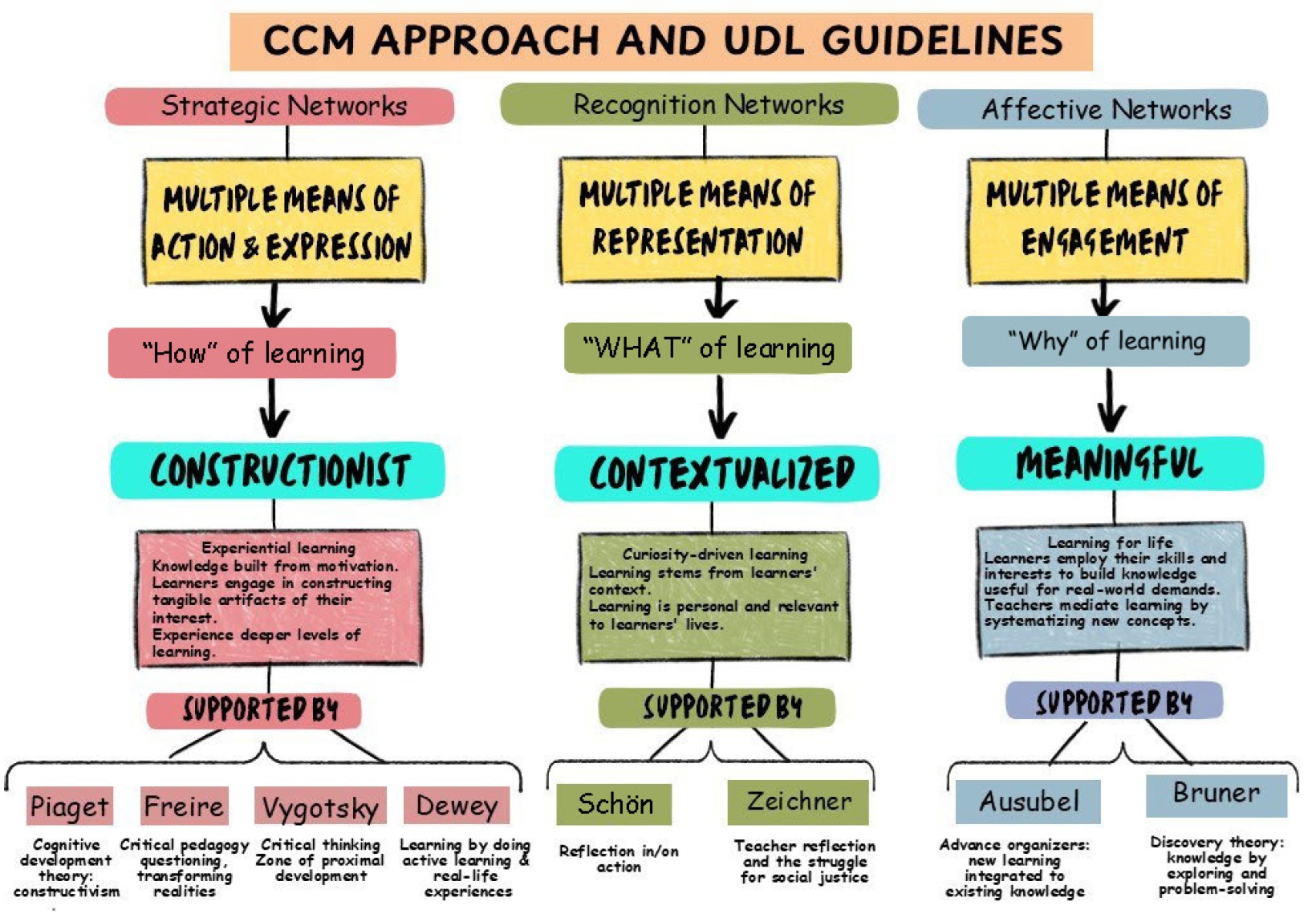
The three fundamental principles of the CCM approach - constructionism, contextualized learning, and meaningful learning - are foundational values supporting inclusive education's advancement through experiential learning. These principles align with the UDL framework, enabling its integration with the CCM approach to ensure accessibility for all types of learners within the educational environment. The UDL framework encompasses critical principles designed to overcome barriers within the learning environment. These principles include i) representation, which ensures resource accessibility; ii) action and expression, which provide alternative methods of communication; and iii) engagement, which employs strategies to foster active participation in learning (Cast, 2024). Figure 1 demonstrates how the CCM approach and the UDL framework can be interwoven, as well as the pedagogical foundations that support the theories.
As evidenced, the CCM approach is based on pedagogical theories that emphasize collaborative learning that is meaningful to the learner’s life and valuable for constructing knowledge through experimentation. In this process, the constructionist dimension, conceptualized by Papert (1986) and disseminated by Valente (2005), attests that people learn best when actively involved in creating something meaningful to them through the use of ICT. This dimension is grounded in the theories of Piaget, Freire, Dewey, and Vygotsky. Co-creation may involve a computer program, a piece of art, or a physical model. Papert (1986) posits that learning occurs in authentic and meaningful contexts. Rather than grasping concepts abstractly, learners engage in projects that interest them, making learning more relevant and motivating. The Spiral of Learning by Valente (2005) emphasizes that learning is not a linear process but a dynamic, evolving cycle. Each iteration through the spiral deepens understanding and knowledge as learners continually build on prior experiences, refine their thinking, and apply what they have learned in increasingly complex manners, enabling the “How to” and “Multiple representations,” thus addressing the construct of UDL.
The contextualized dimension of learning asserts the value of acquiring knowledge within authentic, real-world contexts, contrasting with traditional learning methods, which often depend on abstract, decontextualized knowledge. The concept of reflective practice in action proposed by Schön (2017) argues that students and professionals, including teachers, learn best by reflecting on their experiences while they are engaged in practice (before, during, and after action). This reflection allows them to adjust and make decisions in the moment, grounded in the specific context they are working within. Zeichner (1993) extends these ideas into the field of teacher education, advocating for a more contextualized approach to learning. He asserts that teachers should engage in reflective practice, critically examining their teaching methods and decisions within the context of their classrooms. This reflection helps teachers understand how their actions impact student learning and how they can improve their practice. This dimension enables the teacher to define the disciplinary concepts that students must learn, aligning with the "what to learn" and facilitating "multiple means of action and expression" within a context conducive to knowledge construction.
The meaningful dimension of learning involves deeply understanding content, integrating new knowledge with existing cognitive structures, and applying this knowledge to new situations to form new organizers. Ausubel’s Advance Organizers Theory is a tool or framework presented before new learning content. It helps bridge the gap between what the learner already knows and what they are about to learn, easing the integration of new knowledge and ensuring the learning is substantial and relevant. As proposed by Bruner (1973), discovery learning highlights the value of learners actively engaging in discovering and constructing their understanding of concepts rather than passively receiving information from a teacher. Bruner's theory is based on the idea that learning is most effective when students explore, inquire, and solve problems independently. This approach aligns with the concept of instructional scaffolding, which involves supporting students as they develop their skills and understanding.
Providing multiple means of representation is a principle that emphasizes the importance of accommodating learner variability in accessing, engaging with, interpreting, and comprehending educational content. Teachers should present information through various media and methods to effectively support this diversity. In doing so, they reduce barriers to learning, fostering an inclusive educational experience for all students (Cast, 2024). Through careful and creative anticipatory instructional design, teachers can address varying levels of prior knowledge, experience, skills, and abilities while honoring the diverse backgrounds and identities of their students, thereby supporting “broader access to and deeper engagement with the learning concept” (Chen; Evans; Luu, 2023, p. 2).
The principle of providing multiple methods of engagement is rooted in the belief that learning environments should be designed in a flexible manner to allow every student to find their own path into the learning process, participate meaningfully, build their capacities, and remain motivated when faced with challenges (Cast, 2024). This principle emphasizes the importance of creating learning experiences that resonate with students. When students can incorporate their identity, prior knowledge, and experiences into the learning process, and when these elements are valued, they are more likely to be motivated and actively engaged. Simultaneously, teachers must be mindful of managing students' cognitive load. If the learning environment is overwhelming, students may struggle to focus or to know where to direct their cognitive energy. Therefore, teachers must ensure that students can access the necessary language, background knowledge, and skills for engagement without introducing additional layers of complexity that could hinder their meaningful participation (Flood; Banks, 2021).
These three dimensions, constructionist, contextualized, and meaningful learning, intertwine to form a comprehensive and dynamic pedagogical framework within the CCM approach. Together, these dimensions create a learning perspective that is engaging, relevant, and inclusive of learners' evolving needs, ultimately leading to more effective and lasting educational outcomes. The UDL framework complements this by accommodating the multidimensional aspects of inclusive education. The specific model of inclusive education adopted by API´s researchers acknowledges the potential for the framework to further augment the CCM approach, especially since subsequent development of the framework 3.0, which recognizes and validates wider attributes of learner identities, such as appreciation for the socio-economic and the wider community cultural contexts within which learners and their schools are situated (Cast, 2024).
The UDL framework is grounded in three core principles, one of which is providing multiple means of action and expression. This principle asserts that rigid summative assessments should not determine students' success. Instead, assessments should be personalized, offering choice and flexibility through ongoing formative and summative evaluations. These assessments allow students to demonstrate their knowledge, understanding, skills, and values in ways that align with their learning goals. Therefore, to ensure an inclusive curriculum, it must offer diverse options for students to showcase their learning and abilities, recognizing that there is no one-size-fits-all approach (Edyburn, 2005).
These principles have emerged as a framework to improve the learning of all students (Cast, 2024). However, achieving inclusivity involves qualifications and requires careful consideration of various factors. Transformations in pedagogical practices must account for what teachers do, feel, and say, as well as their interactions with others (students, colleagues, parents, and communities), all within the context of the demanding nature of teaching. This includes imparting meaning to students and operating within a specific work environment shaped by a particular social context (Schlünzen et al., 2020). To address these challenges, it is essential to promote professional teaching-learning methodologies and to encourage teachers to adopt a multidimensional perspective in their work, fostering a reflective approach to their initial and ongoing professional development (Lima, 2024).
Lesson Study
Lesson Study, which originated in Japan, has garnered increasing global interest. While much of the research has been conducted in Asia and the United States, an expanding body of research is emerging from European countries (Fang; Wang, 2021) and Latin America (Lima, 2024). Research on Lesson Study has focused on enhancing academic teaching and learning, particularly in mathematics and science (Ponte, 2017; Lima, 2024). However, recent studies suggest that Lesson Study also holds promise for fostering inclusion (Norwich; Benham-Clarke; Goei, 2021). Given its emphasis on collaborative, reflective practices, Lesson Study has significant potential and the required credentials to advance in inclusive education.
In Lesson Study, one or more groups of teachers work together to develop their practice. The methodology centers around research lesson, in which teacher groups work collaboratively to establish objectives for student learning and long-term development, meticulously planning the lesson. During lesson implementation, one group member teaches while others observe, gathering evidence on student learning and development. The teachers meet to deliberate and discuss the collected evidence after the lesson. In the final phase of the Lesson Study cycle, all groups come together to share and discuss their insights, cultivating collective learning and contributing to developing the school's culture (Lewis, 2002). Through observing various students, teachers gain insights into how students engage with and learn from the lesson. This emphasis on understanding student thinking and learning is fundamental to Lesson Study. Rather than merely seeking to create effective lessons, Lesson Study is better understood as a research process designed to facilitate teacher learning and enhance future instruction (Stigler; Hiebert, 2016).
In the Lesson Study process, weighing on how teaching impacts student learning, observing student learning, and anticipating students' lesson experiences are crucial elements (Fujii, 2014). Cerbin and Kopp (2006) refer to this practice as cognitive empathy, which involves understanding students' perspectives and comprehending their thoughts, motivations, and intentions. These insights can then be used to plan lessons that better support student learning (Aas, 2021). Lesson Study systematically provides opportunities for teachers to develop and apply this form of cognitive empathy, thereby aiding in the incorporation of the inclusive CCM way of being educators.
Pinto (2022), an API member, investigated whether and how the Lesson Study methodology could contribute to the understanding and implementation of the Technology and Innovation curriculum component during the transition from remote to face-to-face teaching. It also intended to explore how this methodology could support the professional development of teachers in this curricular area in alignment with the CCM approach. The CCM approach led to reflective practices, encouraging teachers to leave their traditional roles and adopt the students' perspective. This shift enabled them to develop anticipatory and empathetic thinking about their lesson plans' environmental conditions and curriculum, leading to a re-evaluation of teaching and learning processes. A vital outcome of this reflection was a significant revision of the lesson plan between the first and second implementations. New elements were added to the teacher's script to foment more substantial interaction with students and ensure that all students could engage in deep, meaningful learning activities aligned with the principles of the UDL framework. These new activities included prompts to elicit student responses and supported formative assessment, carefully managing the level of challenge and support each student required throughout the learning process.
Another example, in line with the CCM approach, was identifying elements relevant to the student's age group that could enhance learning. The teachers recognized that Digital Information and Communication Technologies (DICT) offer valuable opportunities in the teaching and learning process, provided they are used intentionally. As a result, they decided to retain the online game activity. However, it should be noted that other possibilities for using DICT were suggested, which could have encouraged additional experiences in terms of student agency. Despite this, collective decision-making always served as the final authority, as the group often justified maintaining certain activities due to time constraints related to covering the curriculum content and addressing various school demands.
In a recent study an API´s researcher examined how Microteaching Lesson Study (MLS) grounded in the CCM approach could advance meaningful, collaborative, and inclusive educational practices among 33 pre-service teachers in Brazil. The CCM approach provided participants with a transformative experience. During the study, it was observed that pre-service teachers who initially felt anxious, nervous, and uncertain about their ability to engage in the MLS process became central figures in their learning journey. They worked individually and collaboratively to study, plan, teach, revise, and reflect on a lesson that was not focused on meeting the expectations of the subject teacher or the researcher. Instead, participants centered their learning on their interests and contexts, making their learning and teaching active practices.
Integrating the CCM approach with the MLS methodology primarily contributed to redefining teaching practice, shifting away from mere adaptation to a specific group of students. The CCM approach advocates for an educational system designed for all, acknowledging that learning varies in pace and style. The UDL principles supported the researcher and participants in removing barriers to achieving high-quality education for everyone. It provided scaffolding and flexibility in lesson planning, class delivery, and assessments. This approach meant that participants did not follow uniform learning paths, encouraging them to reflect on their lesson plans and ensure inclusivity. The focus was on shaping pre-service teachers into inclusive educators, equipping them to meet contemporary educational demands beyond just a 'lesson' and improving their development as autonomous, reflective practitioners (Lima, 2024).
Final considerations
Based on the research conducted by Schlünzen since the 2000s in teaching, research, and outreach, formative processes were developed to find ways for educators to be trained with a thorough understanding of the CCM approach. The study sought to contribute to the inclusion of students with and without specific necessity needs in school environments and to enhance research production at the levels of undergraduate research, master's, doctoral, and postdoctoral studies. The CCM approach has demonstrated transformative potential by reducing inequalities in information and communication technologies, addressing digital, technological, and knowledge exclusions, and accelerating progress toward implementing the 2030 Agenda (Unesco, 2021).
Education in Brazil is currently under critical review and constant debate. With ongoing discussions about promoting inclusive education for all and aligning with national legislation, now may be an ideal time to proactively integrate the CCM approach and UDL principles into policy, curriculum design, and teaching practices. The CCM approach, combined with flexible UDL principles, promotes lifelong learning and equitable learning opportunities. We argue that Lesson Study is a suitable teacher-training methodology that supports teachers in understanding how to become CCM educators in a sustainable, steady teaching improvement.
Based on the studies and experiences in teacher education carried out by API, a strong, solid educational alignment between CCM and UDL has been identified, as outlined in this paper. Lesson Study, on the other hand, has emerged as a teacher development methodology that, when grounded in the principles of CCM and UDL, creates learning opportunities that foment the establishment of inclusive cultures within educational environments across diverse contexts. Ongoing formative processes may further advance the consolidation of CCM, UDL, and Lesson Study as a cohesive, inclusive educational framework, aligning with global efforts to achieve inclusive schools.
Acknowledgment
The authors Elisa Tomoe Moriya Schlünzen and Klaus Schlünzen Junior express gratitude to the Brazilian National Council for Scientific and Technological Development (CNPq) for the support provided through their research productivity fellowships.
References
- AAS, H. K. Learning through communication: exploring learning potential in teacher teams lesson study talk. International Journal for Lesson and Learning Studies, [S. l.], v. 10, n. 1, p. 47-59, 2021.
- BÓ, R. G. D. et al. Teacher education towards educational inclusion from the perspective of master’s and doctoral research. DELTA: Documentação de Estudos em Linguística Teórica e Aplicada, São Paulo, v. 38, p. 1-23, 2022.
- BRACKEN, S. Developing a systematic whole school approach to inclusive practice through Universal Design for Learning. Educational Developments, [S. l.], v. 20, n. 1, p. 24-27, Mar. 2019.
- BRACKEN, S.; NOVAK, K. (Ed.). Transforming higher education through Universal Design for Learning: an international perspective. London: Routledge, 2019.
- BRAY, A. et al. What next for Universal Design for Learning? a systematic literature review of technology in UDL implementations at second level. British Journal of Educational Technology, [S. l.], v. 55, n. 1, p. 113-138, Jan. 2024.
- BRUNER, J. The relevance of education New York: W. W. Norton & Company, 1973.
-
CENTER FOR APPLIED SPECIAL TECHNOLOGY (CAST). The UDL guidelines [Lynnfield, MA], 2024. Available in: Available in: http://udlguidelines.cast.org/ Access: 11 Oct. 2025.
» http://udlguidelines.cast.org/ - CERBIN, W.; KOPP, B. Lesson Study as a model for building pedagogical knowledge and improving teaching. International Journal of Teaching and Learning in Higher Education, [S. l.], v. 18, n. 3, p. 250-257, 2006.
- CHEN, H.; EVANS, D.; LUU, B. Moving towards inclusive education: secondary school teacher attitudes towards Universal Design for Learning in Australia. Australasian Journal of Special and Inclusive Education, [S. l.], v. 47, n. 1, p. 1-13, 2023.
- CLIVAZ, S. et al. Lesson study in Switzerland: from research to dissemination and back. International Journal for Lesson and Learning Studies , [S. l.], v. 14, n. 2, p. 171-182, 2025
-
DARLING-HAMMOND, L.; HYLER, M. E.; GARDNER, M. Effective teacher professional development Palo Alto: CA: Learning Policy Institute, 2017. Available in: Available in: https://learningpolicyinstitute.org/product/effective-teacher-professional-development-report Access: 11 Oct. 2025.
» https://learningpolicyinstitute.org/product/effective-teacher-professional-development-report - EDYBURN, D. L. Universal Design for Learning. Special Education Technology Practice, [S. l.], v. 7, n. 5, p. 16-22, 2005.
- FANG, Y.; WANG, H. Trends of and implications for the diffusion of lesson study: thematic analysis of WALS2019 Conference presentations. International Journal for Lesson and Learning Studies , [S. l.], v. 10, n. 1, p. 61-74, 2021.
- FLOOD, M.; BANKS, J. Universal Design for Learning: is it gaining momentum in Irish education? Education Sciences, [S. l.], v. 11, n. 7, p. 1-11, 2021.
- FLUMINHAN, C. S. L. et al. Articulating the CCM approach and lesson study: a promising teacher professional development towards inclusive education. Video Journal of Social and Human Research, [S. l.], v. 1, n. 1, p. 84-96, 2022.
- FUJII, T. Implementing Japanese lesson study in foreign countries: misconceptions revealed. Mathematics Teacher Education and Development, [S. l.], v. 16, n. 1, p. 1-18, 2014.
- HANESWORTH, P.; BRACKEN, S.; ELKINGTON, S. A typology for a social justice approach to assessment: learning from universal design and culturally sustaining Pedagogy. Teaching in Higher Education: Critical Perspectives, [S. l.], v. 24, n. 1, p. 98-114, 2019.
- HAUG, P. Understanding inclusive education: ideals and reality. Scandinavian Journal of Disability Research, [Stockholm], v. 19, n. 3, p. 206-217, 2017.
- HERNÁNDEZ, F.; VENTURA, M. A organização do currículo por projetos de trabalho: o conhecimento é um caleidoscópio. 5. ed. Porto Alegre: Penso, 2017.
- HOFFMANN, J. Avaliação mediadora: uma prática em construção da pré-escola à universidade. 33. ed. Porto Alegre: Mediação, 2014.
-
JWAD, N. et al. Universal Design for Learning in tertiary education: a scoping review and recommendations for implementation in Australia. [Launceston, Australia], 2022. Available in: Available in: https://research.monash.edu/en/publications/universal-design-for-learning-in-tertiary-education-a-scoping-rev Access: 11 Oct. 2025.
» https://research.monash.edu/en/publications/universal-design-for-learning-in-tertiary-education-a-scoping-rev - LANUTI, J. E. O. E.; BAPTISTA, M. I. S. D.; MANTOAN, M. T. E. Desconstruir a prática para recriar a teoria: como formamos professores para a educação inclusiva. TICs & EaD em Foco, São Luís, v. 8, n. 2, p. 103-116, maio/ago. 2022.
- LANUTI, J. E. O. E.; MANTOAN, M. T. E. Como os estudantes considerados com deficiência atrapalham “os demais”? Revista Ensin@ UFMS, Três Lagoas, v. 2, n. 6, p. 57-67, 2021.
- LEWIS, C. C. Lesson Study: a handbook of teacher-led instructional change. Philadelphia: Research for Better Schools, 2002.
- LIMA, C. S. S. Lesson study and the Constructionist, Contextualized, and Meaningful approach for initial teacher education 2024. 183 f. Tese (Doutorado em Educação) - Faculdade de Ciências e Tecnologia, Universidade Estadual Paulista “Júlio de Mesquita Filho”, Presidente Prudente, 2024.
- MASETTO, M. T. Aula na universidade. In: FAZENDA, I. C. A. (Org.). Didática e interdisciplinaridade Campinas: Papirus, 1998. p. 179-192.
- NORWICH, B.; BENHAM-CLARKE, S.; GOEI, S. L. Review of research literature about the use of lesson study and lesson study-related practices relevant to the field of special needs and inclusive education. European Journal of Special Needs Education, [S. l.], v. 36, n. 3, p. 309-328, 2021.
- NÓVOA, A. Formação de professores: uma terceira revolução? Educação, Sociedade & Culturas, [Porto], n. 67, p. 1-14, 2024.
- OLIVEIRA, J. P. et al. Lesson study as a pedagogical practice in higher education from an inclusive perspective: strategies and resources indicated by professors. Práxis Educativa, Ponta Grossa, v. 18, e21306, 2023.
- ORNDORF, H. C. et al. Opening the pathway: an example of Universal Design for Learning as a guide to inclusive teaching practices. CBE: Life Sciences Education, [S. l.], v. 21, n. 2, p. 1-11, 2022.
- PAPERT, S. Constructionism: a new opportunity for elementary science education. Cambridge, MA: Massachusetts Institute of Technology, Media Laboratory, Epistemology and Learning Group, 1986.
- PERRENOUD, P. Avaliação: da excelência à regulação das aprendizagens: entre duas lógicas. Porto Alegre: Artmed, 1999.
- PINTO, F. C. R. Componente curricular tecnologia e inovação no contexto da Lesson Study: oportunidades e desafios na formação de professores. 2022. 449 f. Tese (Doutorado em Educação) - Universidade Estadual Paulista, Presidente Prudente, 2022.
- PONTE, J. P. Lesson studies in initial Mathematics teacher education. International Journal for Lesson and Learning Studies , [S. l.], v. 6, n. 2, p. 169-181, 2017.
- ROBINSON, K. H. et al. Universal Design for Learning and elementary school science: exploring the efficacy, use, and perceptions of a web-based Science notebook. Journal of Educational Psychology, [S. l.], v. 105, n. 4, p. 1220-1225, 2013.
- SCHÖN, D. A. The reflective practitioner: how professionals think in action. New York: Routledge, 2017.
- SCHLÜNZEN, E. T. M. Mudanças nas práticas pedagógicas do professor: criando um ambiente construcionista contextualizado e significativo para crianças com necessidades especiais físicas. 2000. 249 f. Tese (Doutorado em Educação) - Pontifícia Universidade Católica de São Paulo, São Paulo, 2000.
- SCHLÜNZEN, E. T. M. et al. Abordagem construcionista, contextualizada e significativa: formação, extensão e pesquisa no processo de inclusão. São Paulo: Appris, 2020.
- SCHLÜNZEN JUNIOR, K. et al. Ambientes virtuais de aprendizagem autoconfiguráveis. In: MOREIRA, J. A.; BARROS, D.; MONTEIRO, A. (Org.). Inovação e formação na sociedade digital Santo Tirso: Whitebooks, 2015. v. 1, p. 37-52.
- SEBASTIÁN-HEREDERO, E. Diretrizes para o Desenho Universal para a Aprendizagem (DUA). Revista Brasileira de Educação Especial, Bauru, v. 26, n. 4, p. 733-768, out./dez. 2020.
- SELEZNYOV, S. et al. Exploring the implementation of lesson study in Portugal and England through the lens of institutionalism. International Journal for Lesson and Learning Studies , [S. l.], v. 14, n. 2, p. 133-152, 2025.
- STIGLER, J. W.; HIEBERT, J. Lesson study, improvement, and the importing of cultural routines. ZDM: Mathematics Education, [S. l.], v. 48, p. 581-587, 2016.
- STIGLER, J. W.; HIEBERT, J. The teaching gap: best ideas from the world’s teachers for improving education in the classroom. New York: Free Press, 1999.
- UFFEN, I. et al. Facilitating teachers’ talk about their understanding, experienced relevance and attitudes toward Lesson Study. International Journal for Lesson and Learning Studies , [S. l.], v. 14, n. 5, p. 17-30, 2025.
- UNITED NATIONS EDUCATIONAL, SCIENTIFIC AND CULTURAL ORGANIZATION (UNESCO). International Bureau of Education (IBE). Training tools for curriculum development: reaching out to all learners: a resource pack supporting inclusive education. Geneva: Unesco/IBE, 2016.
-
UNITED NATIONS EDUCATIONAL SCIENTIFIC AND CULTURAL ORGANIZATION (UNESCO). Unesco recommendation on open science [Paris], 2021. Available in: Available in: https://unesdoc.unesco.org/ark:/48223/pf0000379949 Access: 11 Oct. 2025.
» https://unesdoc.unesco.org/ark:/48223/pf0000379949 - VALENTE, J. A. A espiral da espiral da aprendizagem: o processo de compreensão do papel das tecnologias de informação e comunicação na educação. 2005. 238 f. Tese (Livre Docência) - Instituto de Artes, Universidade Estadual de Campinas, Campinas, 2005.
- VYGOTSKY, L. S. Pensamento e linguagem São Paulo: Martins Fontes, 1993.
- ZEICHNER, K. M. A formação reflexiva de professores: ideias e práticas. Lisboa: Educa, 1993.
Disponibilidade de dados:
Os dados de pesquisa estão disponíveis no corpo do documento.
-
Editora científica responsável:
Cássia Ferri.https://orcid.org/0000-0003-2774-9655
History
-
Received
17 Nov 2024 -
Accepted
18 Aug 2025 -
Preprint posted on
09 Oct 2024
https://osf.io/preprints/socarxiv/423nj_v1

 Source: Elaborated by the authors based on