 Time series analysis (2015-2022): dengue risk scenario in Goiás, Brazil
Objective: To analyze confirmed cases of dengue in Goiás, Brazil between 2015 and 2022 and to estimate the risk of new outbreaks until 2026.
Methods: A time series study using data from the Notifiable Diseases Information System (SINAN) was conducted. Monthly records of cases confirmed by laboratory or clinical-epidemiological criteria were included. The Seasonal Autoregressive Integrated Moving Average (SARIMA) model was applied using the R software (v.4.2.1). Stationarity, trend, seasonality, residual autocorrelation, and model fit were evaluated, with estimates obtained by maximum likelihood and 95% confidence intervals.
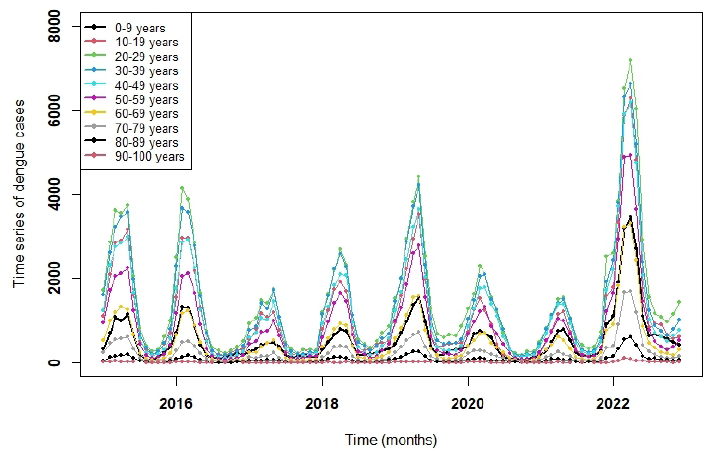
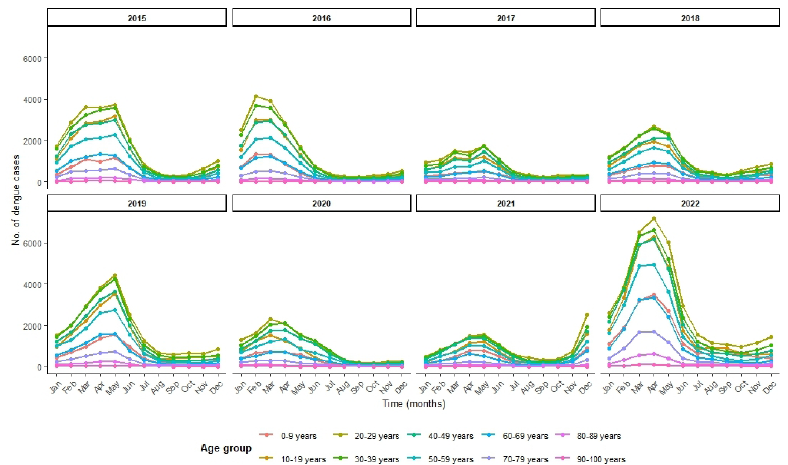
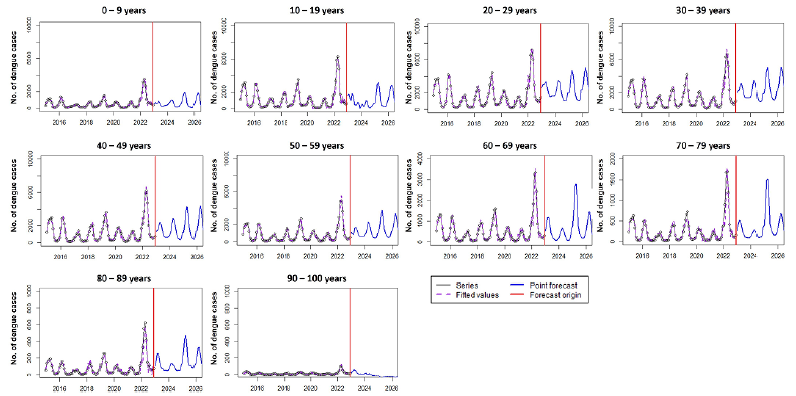
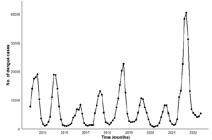
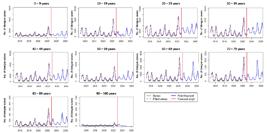
Results: During the study period, 709,270 confirmed cases were recorded. Epidemics occurred cyclically every two years, with peaks in 2015 (101,261), 2016 (82,077), 2018 (70,794), 2019 (107,589), and 2022 (189,998), interspersed with years of lower incidence such as 2017 and the COVID-19 pandemic years (2020-2021). Serotype replacement was observed preceding major outbreaks. The SARIMA model showed good fit (Akaike Information Criterion - 1768.9; Bayesian Information Criterion - 1786.8) and predicted new peaks in 2025 (177,775 cases) and 2026 (224,100 cases).
Conclusion: Dengue in Goiás displayed recurrent epidemic cycles, pointing to an increase in cases and reinforcing the need for integrated strategies based on prevention and control. The SARIMA model proved useful for surveillance and public health planning, although its accuracy may be influenced by external factors.
Keywords:
Dengue; Epidemiological models; Time series; Forecasting; Epidemiology
 Thumbnail
 Thumbnail
 Thumbnail
 Thumbnail
 Thumbnail
 Thumbnail
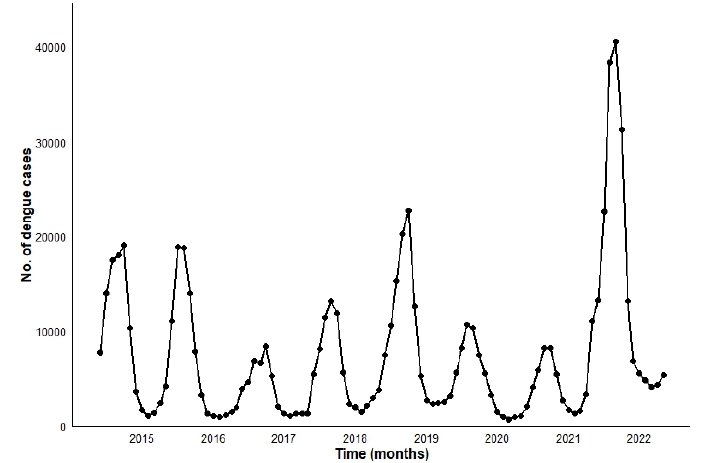
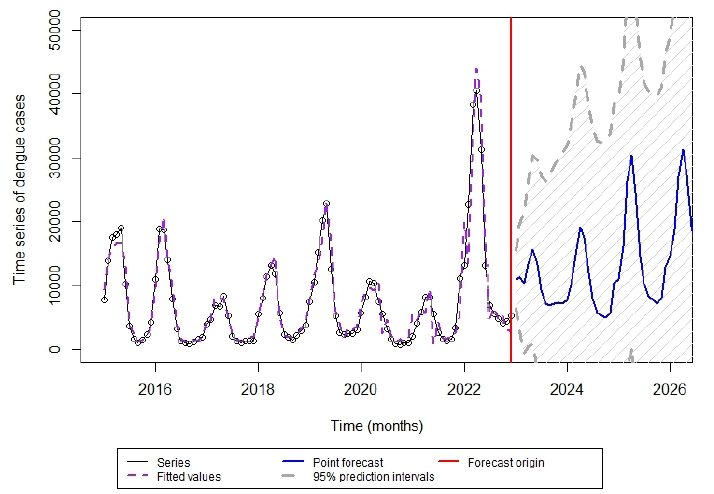
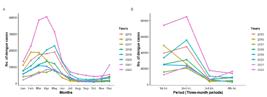
 A: Number of dengue cases reported per month over the years; B: Number of dengue cases reported per trimester; 1st tri: First trimester; 2nd tri: Second trimester; 3rd tri: Third trimester; 4th tri: Fourth trimester.