
 Reflections on Latin American Urban Thought: Contributions to a Political Ecology of Urbanization
Abstract
This article examines theoretical pathways toward a non-city-centered conception of urbanization in the Latin American context, drawing on an extended review of the literature. Although Latin American urban-regional thought has advanced understandings of North-South structural dependence and its urban consequences, a theoretical gap has remained in analyses of urbanization beyond the centrality of urban spaces, particularly in relation to urban-rural and society-nature dynamics. By integrating contributions from Political Ecology and Urban Political Ecology, the article proposes a Political Ecology of Urbanization that articulates rural concerns, socio-environmental conflicts, and extractivist activities with multiscalar processes of urbanization. This approach moves beyond linear interpretations of rural-urban flows, emphasizing relational continuities across spaces. Lastly, the article advocates a perspective attuned to the region’s complexity and specificities, promoting knowledge production in collaboration with diverse social actors and movements.
Keywords:
Urban Theories; Urbanization; Latin America; Political Ecology, Urban Political Ecology; Urban Studies; Political Ecology of Urbanization
Resumo
O artigo se baseia em uma revisão de literatura estendida para apontar possíveis caminhos teóricos que contribuam para uma teoria da urbanização não centrada nas cidades, a partir da América Latina. Apesar dos avanços do pensamento urbano-regional latino-americano na compreensão da dependência estrutural Norte-Sul e de suas implicações urbanas, percebe-se uma lacuna teórica no entendimento da urbanização para além da centralidade dos espaços citadinos, especialmente em relação às dinâmicas urbano-rurais e sociedade-natureza. O artigo incorpora contribuições da Ecologia Política e da Ecologia Política Urbana para a construção de uma Ecologia Política da Urbanização que articule questões rurais, conflitos socioambientais e atividades extrativistas à urbanização em múltiplas escalas, superando leituras lineares dos fluxos rural-urbano e evidenciando continuidades relacionais entre esses espaços. Por fim, defende-se uma perspectiva que contemple a complexidade e as especificidades da região, promovendo a produção de conhecimento junto a atores e movimentos sociais diversos.
Palavras-chave:
Teorias Urbanas; Urbanização; América Latina; Ecologia Política; Ecologia Política Urbana; Estudos Urbanos; Ecologia Política da Urbanização
Introduction
Is it possible, from a Latin American perspective, to develop a theory of urbanization that is not centered on cities? This article aims to reflect on how the urbanization process has been theorized in the Latin American context and, on that basis, to propose possible theoretical pathways for constructing a theory of urbanization that moves beyond methodological cityisms (Angelo; Wachsmuth, 2015). Like all knowledge production, Latin American urban thought is a dynamic field of conceptual elaboration and interpretive contestation. Discourses on urban space and urbanization1, far from being neutral, have always been embedded in ideological frameworks that define the urban problem, identify the legitimate agents, and guide proposed solutions (Villaça, 1999). Throughout the twentieth century, cities have been alternately conceptualized as epicenters of modernization and emancipation or as loci of inequalities inherent to dependent capitalism. These distinctions underscore that the Latin American city is not a naturally determined entity, but a socially and culturally constructed object (Gorelik, 2022; Villaça, 1999).
Although critical contributions have advanced the analysis of urban inequalities and the multiscalar logics that structure the production of an unequal space (Abarca; Moraes, 2019; Montoya, 2009; Pradilla Cobos, 2014; Sabatini et al., 2007), attention to forms of urbanization beyond frameworks of the urban footprint, metropolization, peripheralization, and labor exploitation has remained limited. These approaches reveal hegemonic processes that are manifested in Latin America through intense, subordinated, and uneven urbanization.2 The challenge, however, lies in expanding the understanding of these dynamics in terms of urbanization as a spatial expression of capitalist production, encompassing the unity between urban-rural relations and society-nature interactions.
Hence, the challenge is to shift this analytical field, extending its epistemological and geographical boundaries to enable an interpretation of urbanization that is not confined to the centrality of cities. Addressing this challenge, the article situates its analysis in the Latin American context, shaped by dependent integration into the global economy and characterized by extractivism, rural dynamics, and socio-environmental conflicts - elements often overlooked in urban theory. In doing so, it engages with recent debates in Political Ecology and Urban Political Ecology.
Political Ecology is a relevant field in the Latin American context as it enables an understanding of the structuring dynamics of the region’s dependent insertion the global economy. Despite its broad thematic scope, however, discussions have largely focused on rural environments and socio-environmental conflicts (Leff, 2021, 2024), with limited engagement in urban studies and in debates on the unequal, precarious conditions of Latin American cities. Emerging in the 1990s3 as an interdisciplinary subfield, Urban Political Ecology sought to bridge this gap by fostering dialogue between urban and rural environments, placing conflicts and interventions both within and beyond cities as the center of its research agenda. Its theoretical foundation maintained urbanization as the primary analytical concern, while examining urban-rural and society-nature relations without presupposing an ontological divide between these domains (Souza, 2024; Villar Navascués, 2017; Zimmer, 2010). Notwithstanding these contributions, ontological fixity persists since urban spaces are still regarded as the starting point for understanding spaces beyond them - resulting in a form of methodological cityism (Angelo; Wachsmuth, 2015). By contrast, the Latin American context, understood as a heterogeneous formation within the global capitalist system (Osorio, 2012), offers the potential to advance alternative interpretations of this process. We therefore draw on the contributions of Latin American Political Ecology and on the efforts of Urban Political Ecology to engage more directly with the urban, in order to reflect on possible pathways for Latin American urban theory.
In the first half of the twentieth century, analyses of Latin American social reality framed the city-centered urban question as the locus of social disorder (Ribeiro; Cardoso, 1994). This period was marked by the prominence of models and theories from core countries, particularly from the European tradition, which were imported and adapted to the Latin American context, seeking to “resolve” this problem through “modernization” and to construct the idea of a nation (Villaça, 1999; Ribeiro; Cardoso, 1994). Urbanization was subsequently theorized primarily as an economic issue, to be addressed through national developmentalist policies, with the city assuming a central role in modernizing planning paradigms (Ribeiro; Cardoso, 1994). Urban issues came to be conceptualized at expanded scales, with the emergence of notions such as urban networks, urban hierarchies, and systems of cities emerge, which broadened the analytical scope while maintaining the city as a central reference point (ibid.; Villaça, 1999; Gorelik, 2022).
From the 1970s onward, the emergence of the environmental question reoriented the frameworks of the debate. Political Ecology has become established as an interdisciplinary field concerned with addressing the socio-environmental impacts of urbanization and industrialization, which have disproportionately affected the most vulnerable populations. In Latin America, this gave rise to analyses focusing on the transfer of undesirable environmental burdens to the global peripheries as a result of capital mobility, intensifying territorial conflicts and deepening the region’s ecological dependency (Acselrad, 2006, 2013; Leff, 2021; Walker, 2005). Originating in the Anglophone world, Urban Political Ecology has contributed to conceptualizing the city as a socio-natural hybrid that organizes material flows - such as water, energy, and waste - beyond its physical and administrative boundaries, through infrastructures and power relations that produce socio-environmental inequalities and injustices. Within this framework, the urban question is understood as a socio-ecological process rooted in capitalist metabolism, linking urban centers, peripheries, productive zones, rural areas, extractive territories, and the flows of energy, matter, and power (Heynen; Kaika; Swyngedouw, 2006; Kaika; Swyngedouw, 2000, 2012; Swyngedouw, 1996).
Recent contributions have advanced the notion of a Political Ecology of Urbanization (EPUr) as a specifically Latin American perspective, addressing a key limitation of Urban Political Ecology, namely its focus on city spaces in analyses of society-nature and urban-rural relations (Glitz Mayrink et al., 2021; Osorio Ardila et al., 2020; Quimbayo Ruiz; Vásquez Rodríguez, 2016). This approach reconceptualizes urbanization as a relational geographical phenomenon, in which cities do not play a leading role. It is particularly relevant to the Latin American context, where urbanization has historically been linked to extractivism in the primary export sector rather than to factory production. Whereas perspectives from the Global North have tended to privilege factory spaces in interpreting urbanization, recent Latin American critiques have underscored the importance of rural and extractive spaces in shaping urbanization processes across both core and peripheral countries (Aráoz, 2020).
There is, therefore, a theoretical-methodological impasse in interpreting urbanization: where does it begin? Or, indeed, does it, in fact, begin in a single place at all? These questions guide the analysis and call for an articulation of dimensions historically constructed as dichotomous - urban and rural, center and periphery, society and nature. Latin American thought has advanced understandings of North-South dependency, while Urban Political Ecology has destabilized the division between the social and the natural in the production of the urban. Accordingly, the article systematizes the literature review around three axes - (i) Latin American urbanization, (ii) the urban-rural relationship, and (iii) the society-nature relationship - to identify recent contributions and highlight gaps that may inform the construction of a critical theory of urbanization through Latin America.
Methodology
The reflection is grounded in an extended review of the literature and qualitative methods aimed at expanding and developing theoretical interpretations of urbanization. To this end, we employ thematic synthesis to generate analytical themes and third-order theoretical constructs (Xiao; Watson, 2017). The selected references were critically reviewed in dialogue with other relevant works in the field, incorporating established theoretical frameworks and prior contributions of this research in order to strengthen the robustness and precision to the analytical foundation.
Literature Review and Preliminary Selection
-
Inclusion criteria: To examine how the process of urbanization has been theorized in the Latin American context, the preliminary selection comprised articles published between 2000 and 2025 that address urbanization in Latin America from a general theoretical perspective. Studies focused on case studies and/or specific contexts were excluded. The search was conducted in three languages - Spanish, Portuguese, and English - within the field of Urban Studies and related disciplines.
-
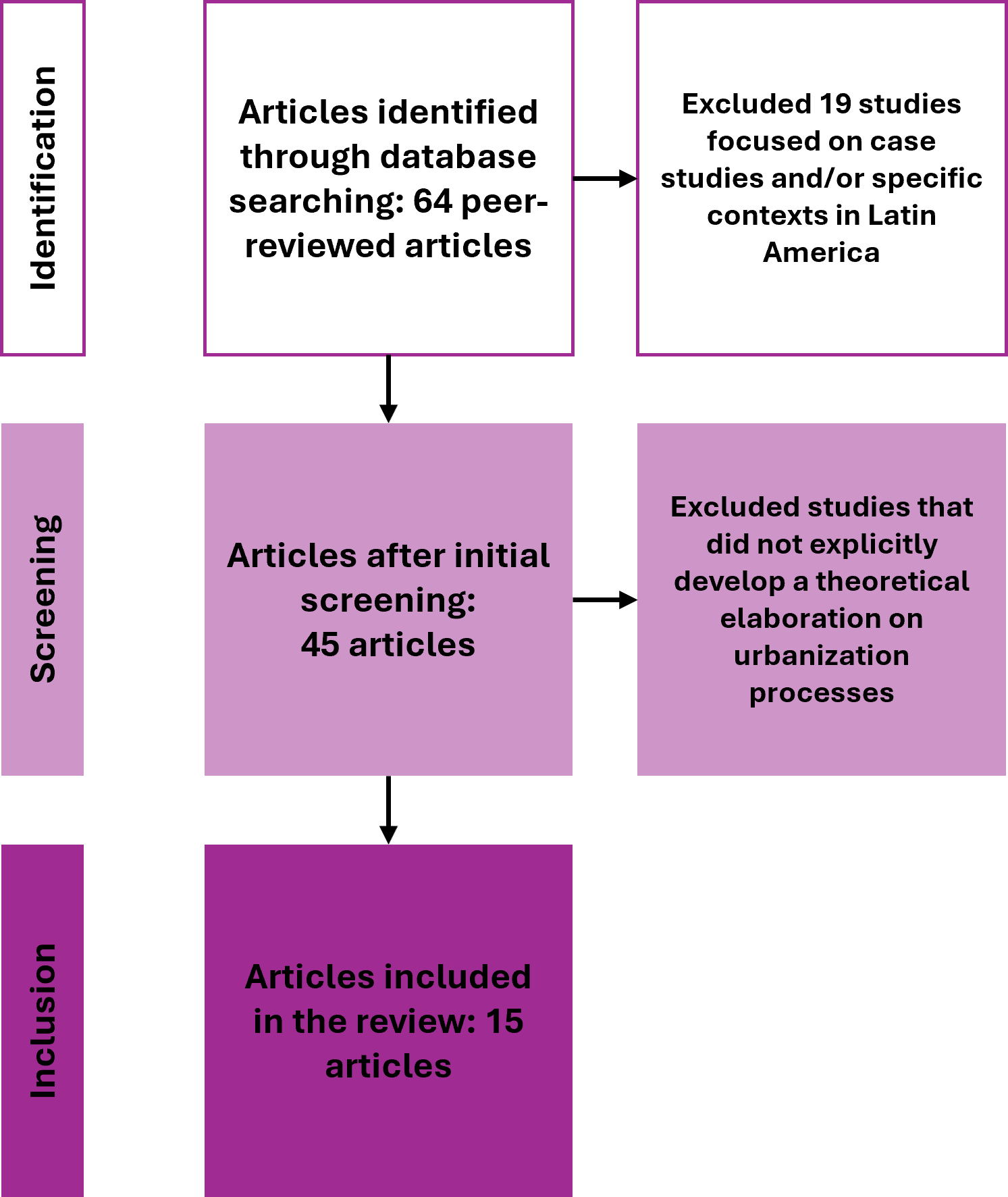
Identification of literature: The search for articles was conducted using key words and expressions such as “Latin American urbanization”, “urbanization AND Latin America”, “suburbanization AND Latin American”, “suburbanization AND Latin America”, “political AND ecology AND urban AND Latin America”, and “political AND ecology AND urbanization AND Latin America”, in all three languages. Searches were carried out across major databases and search engines - including Google Scholar, Web of Science, Scopus, SciELO, and DOAJ - as well as in leading journals related to urban studies with a focus on Latin America. The preliminary selection was conducted in two stages: first, based on titles, and second, on abstracts and theoretical framings. In total, 64 peer-reviewed articles were preselected.
-
Assessment for inclusion: Subsequently, 45 articles that met the selection criteria and addressed the main research question - How has the urbanization process been theorized based on the Latin American context? - were retained. From this set, 15 articles (Table 1) that explicitly develop broader theoretical elaborations on Latin American urbanization were selected for in-depth reading, taking into account the relevance of the works and the feasibility of their review by the three researchers (Figure 1).

Data Extraction and Analysis
After a second reading of the abstracts, four central themes were identified to organize the texts into analytical blocks: (i) the urban-rural relationship, (ii) metropolization and regionalization, (iii) Urban Political Ecology, and (iv) the society-nature relationship. Subsequently, the following data were extracted during the in-depth analysis of the articles: a general synthesis, identifying the context, objectives, hypotheses, justification, contributions, methodology, and conclusions; a theoretical-conceptual analysis, identifying the concepts employed, their definitions, the theoretical frameworks adopted, their contributions, and the main bibliographic references; and urbanization, determining whether and how the articles addressed the following questions:
-
How is the process of urbanization understood?
-
What are the specificities of urbanization in Latin America?
-
How is the society-nature relationship addressed?
-
How is the urban-rural, or city-countryside, relationship addressed?
Upon completing the readings and the systematization of the extracted information, three thematic axes were defined to present the discussion: (i) Latin American urbanization; (ii) the urban-rural relationship; and (iii) the society-nature relationship, which are presented below (Table 1).
1. Latin American Urbanization
In the second half of the twentieth century, the major cities of Latin America expanded beyond their physical and administrative boundaries. This process triggered more dispersed urban morphologies, decentralizing activities, and configured new urban-regional arrangements connecting flows “of people, commodities, knowledge, and power relations”5 (Moura, 2012, p. 12) through the articulation of urban centers, urban and rural areas, metropolises, functionally relevant centers, and weakly integrated municipalities (ibid.). Among the explanations of these processes, we identify an approach grounded in morphological analysis, which understands regional specificities as characteristic of a segregated, accelerated, impoverished, and so-called “disharmonious” urbanization, linking spaces described as legal and illegal (Abarca; Moraes, 2019).
In contrast to this reading, another approach, grounded in Marxist theory and aligned with the socio-critical tradition, emphasizes historical aspects, such as the presence of Indigenous peoples, diverse property regimes, land-market illegality, and economic informality, as well as structural poverty, militarization, and widespread violence, primarily related to drug trafficking, in the production of the city (Pradilla Cobos, 2014). Aguirre, Arroyo, and Buitrago Bermúdez (2023) highlight the role of the socio-critical school, influenced by European and North American thought, in understanding the urban and metropolization as processes that emerge from cities as spaces of wealth accumulation under capitalism and as sites producing socio-ecological inequalities6. Within these processes, diverse social agents capture the State through power relations in order to advance their interests and plans, often in opposition to collective imaginaries and interests (Brenner, 2009 apud Aguirre; Arroyo; Buitrago Bermúdez, 2023; Lefebvre, 2013 apud ibid.; Santos, 1994, 2017 apud ibid.).
Socio-critical thought also provided a foundation for Urban Political Ecology, which conceives urban and metropolitan processes as socially produced natures in hybrid human and non-human relations, traversed by asymmetries of power (Aguirre; Arroyo; Buitrago Bermúdez, 2023). Within this approach, urbanization is understood as an open system that exchanges energy and matter with its environment through processes in which power relations are expressed - either by reinforcing relations of domination by certain groups, and thereby deepening socio-spatial segregation (Abarca; Moraes, 2019), or by unevenly distributing flows of energy, matter, and material stocks (Delgado Ramos, 2015). There is therefore a view of urbanization as being intrinsically unequal in social, economic, ecological, and environmental terms.
Additionally, world-systems theory, also inspired by Marxism, interprets urbanization on a global scale. Montoya (2009) and Osorio (2012), for example, analyze the region from a relational perspective, drawing on dependency theory and its origins in the Economic Commission for Latin America and the Caribbean (ECLAC)7, which frames the region as occupying a dependent and peripheral position within the world system. This position is explained by differences in the international division of labour and by the historical dynamics of colonialism (Osorio, 2012). Mattos (2001), in turn, examined urbanization within the context of globalization through the lens of the global cities debate, which views certain cities as performing global functions, such as concentrating high wages and generating demand for “sophisticated” urban artefacts. However, this discussion is conducted in a generalized manner, without addressing Latin American specificities.
One critique of applying this theory in Latin America is its tendency to “homogenize urban processes” (Montoya, 2009, p. 10). Authors such as Fortanell Ruiz (2020), Montoya (2009), and Pradilla Cobos (2014) argue that there are no global cities in Latin America in the sense defined by Northern theorists. The largest metropolises, while exhibiting some of the characteristics identified by Mattos (2001), primarily function as conduits for the flow of resources from the periphery to the center of capitalism (Guevara, 2015). Montoya (2009) explains that neither import substitution nor globalization have diminished the traditional importance of the region’s largest cities, as they were the most prepared for integration into the transnational economy. From this perspective, major Latin American metropolises maintain closer ties with global cities abroad than with other cities in the region. For example, the urban system in the Caribbean is strongly influenced by Miami (Montoya, 2009).
The relationships between cities and diverse territorial spaces are also examined through the lens of so-called urban-regional arrangements. Moura (2012) drawing on the Brazilian case, links the formation of such arrangements to industrialization and the migrations associated with this process in Latin America. However, it is necessary to account for Latin American heterogeneity, the low level of industrialization in many countries, and regional specificities, such as the Amazon, in order to analyze the influence of migrations driven by armed conflicts and socio-environmental disputes over urbanization. Therefore, the centrality of industrialization in these processes and in the consolidation of what is understood as the urban system as an analytical phenomenon would be limited.
In parallel with these flows connecting territorial spaces, there are symbolic aspects, including the circulation of ideas, concepts, discourses, and practices involved in the production of cities. Some authors note, however, that although concepts circulate among countries of the Global South, the influence of the Global North remains strong, as theories and concepts are often adapted to the region’s reality - not always critically. This incorporation has frequently overlooked regional specificities or has interpreted them using terms and analyses suited to foreign contexts convenient for foreign realities. Delgadillo (2014), Jajamovich, Saraiva, and Silvestre (2021), Hiernaux-Nicolas and Gonzáles Gómez (2017), and Navarrete Escobedo (2013) identify a tendency to adjectivize cities with foreign terms, concepts, and theories, such as global, smart, heritage, and sustainable cities, which circulate in the scientific community and inform urban policies. These concepts may be implemented through interventions and urban projects in specific areas, such as initiatives in historic centers developed with support from international organizations, private companies, and external agents, often with limited participation from local populations, who are sometimes displaced (Jajamovich; Saraiva; Silvestre, 2021). This generates an exclusive and exclusionary logic (Delgadillo, 2014), reinforced by discourses that mask private economic gains derived from the valorization of these urban areas and the exploitation of differential income.
Guevara (2015), Jajamovich, Saraiva, and Silvestre (2021), and Pradilla Cobos (2014) argue that, while targeted interventions of this kind are increasing, the planning of the city as a whole is in decline, with urban plans functioning as contested instruments for regulating and distributing the burdens and benefits of urbanization. Urban expansion often bypasses the plans, should they exist, due to political disputes over the applicability of planning and financing instruments, which, according to some authors, helps explain informal8 dynamics. Pradilla Cobos (2014), for example, links the inadequate provision of land and housing for low-income populations to the search for cheaper land, a process that drives urban expansion through the conversion of rural land to urban use. Hence, it is necessary to examine the role of local power dynamics in the context of neoliberal and capitalist globalization (Jajamovich; Saraiva; Silvestre, 2021).
These illegalisms are politically constructed processes that illustrate how groups with political and economic power capture the State9, often disregarding the impacts on the broader population, including middle- and high-income groups (Pradilla Cobos, 2014). Authors such as Aguirre, Arroyo, and Buitrago Bermúdez (2023) and Sabatini et al. (2017) go beyond merely abstract explanations of these dynamics by identifying the specific role of real estate developers, while Viale (2017) emphasizes the influence of the media in this process of capture.
Both the peripheral and dependent insertion into the global context, together with local dynamics of State capture and the region’s multiple specificities, contribute to processes of forced removals and displacement that underpin and intensify inequality, sociospatial segregation, fragmentation, and gentrification (Lopez; Paraizo, 2022). However, there has been very limited in-depth examination of how, in highly segregated cities, lower-income groups disproportionately located in risk-prone areas. Existing studies on this issue tend to focus on specific cases, drawing on debates around segregation and environmental justice, but without theorizing urbanization as a broader systemic process.
2. The urban-rural relationship in the urbanization process
In Latin America, from the mid-twentieth century onward, urban-rural relations have been defined through theoretical frameworks grounded in epistemological and ontological assumptions derived from other contexts, thereby obscuring regional actors and specificities. Among the earliest of these formulations are modernization theories, associated with notions of development, progress, and the construction of a modern society (Aguirre; Arroyo; Buitrago Bermúdez, 2023; Berardo, 2019; Dueñas Checa, 2017; Pérez-Martínez, 2016; Picciani, 2018).
This dualistic, stage-based perspective contributed to associating stereotypes with a spatial divide, linking the rural to backwardness and the urban to modernity, thereby promoting partial and exclusionary analyses. Among the paradigms underpinning this approach is the rural-urban continuum, which conceptualized the transition from rural to urban as a process entailing the dissolution of a traditional society. Within this framework, the rural and the urban are differentiated according to variables such as size, density, employment, and environment (Dueñas Checa, 2017; Méndez, 2005; Picciani, 2018). Among the concepts emerging from this paradigm is that of rururbanization, which, unlike the peri-urban, identifies rural areas through the presence of dispersed and isolated single-family dwellings located alongside agricultural and forested areas - an arrangement akin to the urbanization of agricultural spaces (Bauer; Roux, 1976 apud Dueñas Checa, 2017; Picciani, 2018).
In the mid-twentieth century, urban-rural relations were theorized through a range of approaches. Socio-critical perspectives identified forms of complementarity, dependency, and functional interrelation (Berardo, 2019; Dueñas Checa, 2017; Pérez-Martínez, 2016; Picciani, 2018), highlighting the asymmetrical and dialectical relations between rural society and urban-industrial society from a historical materialist standpoint. From this perspective, there is no linear transition from one stage to another; rather, these dynamics are understood through a dialectical framework. In other words, such approaches stress “the interrelation, interaction, and interdependence of the rural and urban-industrial milieu” (Dueñas Checa, 2017, p. 279). Moreover, they link this separation to the territorial division of labor, within which the city is conceptualized as a parasitic agent.
Dueñas Checa (2017) identifies three positions linked to critical theories. The first, described by Rubio (2002 apud Dueñas Checa, 2017) as the industry-agriculture linkage and exclusionary subordination, explains the marginalization of peasant production by agribusiness within the dynamics of capital reproduction. The second, termed the heterogeneity of rural processes in their articulation with capital, with Emilio Pradilla Cobos (2002) as its main exponent, argues that rural transformations are shaped by the logics of capital accumulation, leading to processes of depeasantization. The third, the theory of de-ruralization (Wallerstein, 2005), interprets the urban-rural relationship within the framework of the world-economy, in which cyclical crises employ resolution strategies, such as the valorization of natural resources and the urbanization of the countryside through de-ruralization (Corredor, 2014 apud Dueñas Checa, 2017; Pérez-Martínez, 2016; Picciani, 2018).
After the 1970s, the rural came to be understood primarily as a space for metropolitan expansion, increasingly transformed into what are now recognized as urban peripheries, thereby establishing a relationship of interdependence and hierarchy (Aguirre; Arroyo; Buitrago Bermúdez, 2023). This theoretical approach remains hegemonic in research across the region. According to reviews conducted by these authors, framing the rural in terms of metropolitan expansion serves the interests of capitalist agents who, through the relocation of infrastructure and services and the development of gated communities, have contributed to processes of spatial fragmentation and segregation (Hidalgo et al., 2005; Salazar et al., 2011 apud Aguirre; Arroyo; Buitrago Bermúdez, 2023).
Currently, several authors are developing new theoretical perspectives that call for a review of categories and analytical frameworks (Pérez-Martinez, 2016; Picciani, 2018). Two approaches have been identified to understand this relationship in the contemporary context. The first (Picciani, 2018) draws on the perspective of uneven geographical development to reconsider the urban-rural relationship through theoretical frameworks attuned to Latin America’s geo-historical specificities. To this end, it mobilizes two key categories: (i) the territorial division of labor and (ii) used territory (Santos, 1996), along with its reinterpretation for the twenty-first century by Silveira (2009). Picciani (2018) has argued that this connection is expressed in organizational forms that are re-created, coexist, and resist in the face of newly articulated processes linked to their functions. Moreover, she emphasizes that the urban-rural relationship should be studied as a “dynamic association” (ibid., p. 11), attentive to elements that persist, those that transform, and those that endure.
For Picciani, the Argentine case illustrates that rural spaces are far from representing backwardness. On the contrary, they reveal a complex relationship between the financial system, transnational firms, and technology, resulting in a corporate use of space. She maintains that the influence of the city over the countryside concerns “forms of territory that result from a modernization that generates new spatial configurations which are functionally redefined […] now it is the countryside that demands the updating of the city in order to increase levels of productivity” (Picciani, 2018, p. 25). Therefore, these spaces must be understood as products of juxtaposition, superimposition, and vertical and horizontal orders from which new sociospatial formations emerge (ibid.).
A second approach is grounded in critical post-structuralism. Pérez-Martinez (2016) proposed understanding rural-urban relations through the concept of the rururban territorial assemblage, defined as “scenarios of systemic confluence that encompass spatiotemporal continuities and discontinuities, expressing boundaries of differentiation or zones in political-strategic articulation” (ibid., p. 107). He further argues that, beyond scalar interrelations at the local and global levels, there exists a third relational space - local-place-global - that enables the identification of rururban identity, thereby contributing to an understanding of the symbolic meaning of this triple interaction. He goes on to introduce the notion of discursive simulacra, or dialogical constitution, to grasp the political-symbolic dimension of rururban identity. These methodological resources consist of listening, attentiveness, sensitivity, and cooperation in order to understand how subjects construct their identities as a whole and, thus, to identify the politics of place (ibid.).
Despite the advances, these perspectives and theories remain insufficient to explain certain processes unfolding in Latin America. First, the scales of analysis tend to gravitate toward extremes; on the one hand, there is an emphasis on situating urbanization processes within the world-system; on the other, micro-scales fall outside the analytical horizon, which may contribute to epistemic injustices and the invisibilization of forms of resistance and re-existence enacted by diverse actors. In addition, many analyses of Latin American cities are conducted without adequate consideration of their historical, political, social, and economic contexts. This lack of contextualization may lead to a-historical syntheses detached from situated processes. Moreover, extractivism in Latin America is often absent from these discussions, despite being a key dimension for understanding the production of space, as evidenced in emerging geographical configurations - for example, spaces of extraction or operational landscapes (Arboleda, 2015). Lastly, questioning the socio-natural relationship is likewise largely absent from theories that examine the urban-rural nexus.
3. The society-nature relationship in Latin American urbanization
Latin American urban theory continues to face the challenge of integrating the articulations between society and nature into its analytical frameworks on urbanization. Aspects of this relationship are generally addressed only indirectly and tangentially, when they are not relegated to the realm of the unspoken. Nature is frequently treated as a neutral or passive substrate for territorial transformations driven by capitalist dynamics, with “natural” space often being absorbed, fragmented, or reconfigured through urban processes. Underpinning this perspective is an implicit assumption of the dominance of urban over rural space and of society over nature. Even when nature is considered within critiques of capitalist political economy, extractive activity is typically invoked merely as the mechanism linking the core and dependent systems (Osorio, 2012), without further theoretical elaboration.
Contemporary urbanization is often reduced to the physical expansion of cities into territories previously classified as rural or natural, thereby profoundly transforming the use and configuration of these spaces (Aguirre; Arroyo; Buitrago Bermúdez, 2023; Dueñas Checa, 2017; Moura, 2012; Pradilla Cobos, 2014). Such approaches tend to overlook the socio-environmental consequences of this process, as well as its relationship to pre-existing socio-environmental conditions that may either constrain or drive urban expansion. Nature is therefore understood as an external backdrop, separate from urban logic - an element passively incorporated into urban space as cities expand.
At a conceptual level, terms such as peri-urbanization and extended metropolitanization have emerged (Aguirre; Arroyo; Buitrago Bermúdez, 2023; Arboleda, 2015; Berardo, 2019; Guevara, 2015; Moura, 2012). These concepts emphasize the social, economic, and technological dynamics that lead to the occupation and reconfiguration of territory, with implications for both urban areas and adjacent rural areas. However, the characterization of this relationship in Latin American urban spaces is often only superficially addressed in terms of “socio-environmental impacts intensified by population volumes and predatory uses” (Moura, 2012, p. 16). This limited treatment reveals a lack of theoretical elaboration on the ecological dimension of urbanization, particularly insofar as it fails to account for processes such as the loosening of regulatory frameworks, locational blackmail, and economic dependency.
The defense of the right to the city, a central principle in critical urban studies, extends to the right to nature, based on mobilization for the protection of green areas and threatened ecosystems. Thus, environmental concerns have been integrated into urban struggles, giving rise to a form of environmentalization of urban social movements (Acselrad, 2010; Quimbayo Ruíz, 2018). This phenomenon has been recognized in urban theory alongside other urban movements, such as those focused on racial and gender issues (Carrión; Dammert Guardia, 2016; Pradilla Cobos, 2014; Scarpacci; Siqueira, 2022), yet it remains insufficiently articulated within broader theories of urbanization processes. For this reason, it is important to further develop the theorization of these dynamics and the potential pathways toward what Viale terms “the struggle for a change in the paradigm of urban growth” (2017, p. 15).
It is within this theoretical impasse that Urban Political Ecology has been mobilized in a small number of recent articles10 as an epistemological field capable of reframing the debate, drawing on the concept of urban metabolism to operationalize an interpretation of socio-spatial production in ways that foreground the society-nature relationship. Delgado Ramos (2015) advocates a holistic approach to overcome the analytical separation between society and nature, articulating multiple theoretical fields and subfields - including Urban Political Ecology, environmental history, political economy, and urban studies. In doing so, he proposes a methodology for assessing social metabolism typologies and urban metabolic transitions as complex systems - composed of heterogeneous components with multiscale and multidimensional relations and implications (Delgado Ramos, 2015). Furthermore, he underscores how conceptual choices and analytical categories are processed through power relations, suggesting the need to develop new theoretical frameworks capable of understanding and challenging Latin American modes of urbanization and their implications for emancipatory strategies.
The notions of “social metabolism typology” and “metabolic transitions” (Delgado Ramos, 2015, p. 111) may indicate a pathway for a deeper understanding of the specificities of the Latin American context, while potentially guiding proposals aimed at proactively transforming urban and social metabolism. Problematizing metabolic transitions presents an opportunity not only for a critical analysis of the Latin American context but also for developing alternative social metabolism projects capable of challenging prevailing accumulation paradigms.
Other approaches establish the society-nature relationship by linking socio-spatial and socio-environmental inequalities in cities, recognizing that the most impoverished areas are disproportionately affected by the burdens of urbanization (Abarca; Moraes, 2019)11. However, these approaches often lack a critical perspective on the category of nature, which is frequently understood in common sense terms as consisting of elements separate from human activity. Advancing this discussion requires engaging with literature that examines how certain materialities and objects are strategically classified as nature to justify mechanisms of appropriation and domination (Castree, 2001; Demeritt, 2001), thereby contributing to the production of social injustices.
Urban Political Ecology, by displacing the society-nature duality and emphasizing the socio-natural production of space, emerges as a theoretical field that seeks to link debates on metabolism, socio-environmental justice, and territorial transformation associated with urbanization. Nonetheless, it is evident that even when studies within this framework adopt relational approaches, urban needs continue to dominate and shape territorial transformations in rural spaces, often subordinating them to the interest of core countries. The role of the agro-extractive sector, which has historically wielded significant political power throughout Latin America, is for example, rarely addressed or critically analyzed in discussions on the city-countryside metabolic relationship, even within the largest metropolitan areas.
Final remarks
The production of urban knowledge in Latin America, across its successive historical and theoretical inflections, has been marked by interpretative disputes and by the predominance of analytical frameworks that conceive of the city as both the object and the explanatory horizon of urbanization processes. By shifting the theoretical focus of urbanization per se to the nexuses connecting urban space, rural space, nature, and society within the territory, we have situated our inquiry around the need to advance an understanding of urbanization that extends beyond the mere expansion of urban footprints, metropolitan growth, socio-spatial inequalities, and the exploitation of urban labor. While these elements remain essential for comprehending dependent and peripheral urbanization in the region, the Latin American context also underscores the importance of rural dynamics, socio-environmental conflicts within and beyond cities, and extractive activities (Acselrad; Michelotti; Rbeur, 2024)12.
In this context, we ask whether it is possible to construct a theory of urbanization from a Latin American perspective that is not centered on the city. We review theoretical approaches that link diverse environments and territories in their explanations of urbanization, while critically examining the interpretative limitations that arise from prioritizing cities. In the section on Latin American urbanization, we have proposed a theoretical-methodological reorientation focused on seizing the multiscalar, socioecological, and historically situated complexity of urban processes in the region. Contributions from the critical social tradition, particularly those informed by Marxism and Urban Political Ecology, have been instrumental in revealing how the urban is constituted as an expression of the contradictions of capital; however, significant gaps remain in acknowledging the epistemic, political, and territorial specificities that structure peripheral urbanization (Richmond; Jesus; Legroux, 2025)13. We have also noted the use of concepts that, while relevant for producing scientific knowledge on urbanization, remain insufficiently grounded in local realities. We highlight the need to consolidate a critical theory of Latin American urbanization that, beyond mere critique, develops its own analytical categories committed to the co-production of knowledge and socio-environmental justice, and capable of revalorizing subaltern forms of knowledge as a condition for the epistemological reworking of the urban-regional field.
Although authors have advanced the debate by advocating for overcoming the rural-urban divide and broadening of the concept of socio-spatial metabolism, it still neglects the heterogeneity of local experiences, multiscalar dynamics, and, in particular, the structuring role of extractivism and its associated landscapes in shaping territorial reorganization. Theoretical challenges therefore persist, including the absence of intermediate scales that could mediate between totality and local specificities; the limited problematization of urban metabolism and the territorial subordination imposed by extractivism; and the nascent integration of insurgent epistemologies emerging from historically marginalized actors. Advancing the construction of a critical theory of urbanization therefore requires expanding disciplinary and epistemic boundaries and developing analytical tools to incorporate socio-natural conflicts, territorial power devices, and spatial reconfigurations produced by rural transformations and by what is understood as “nature” under dependent capitalism. We have also observed the ongoing marginalization of the society-nature relationship in Latin American debates on urbanization. The limited problematization of the role of extractivism, the emerging critique of the concept of nature within urban theory frameworks themselves, and the infrequent integration of environmental and urban struggles all indicate that the field still lacks any systematic approaches capable of addressing the specific challenges of the Latin American context.
Thus, a relational and multiscalar approach that links urban and rural environments, society and nature, and the associated power relations, may contribute to a Latin American interpretation of urbanization. This perspective broadens the understanding of how flows of capital, people, resources, and knowledge circulate across different spaces, connecting diverse built environments. By promoting a process-oriented, dialectical perspective, such theoretical and methodological efforts move beyond the conventional view of urbanization flows as a unidirectional process, with a “starting point” (rural) and an “endpoint” (urban). Instead, they emphasize the continuous dynamics and the relational continuity of practices across multiple scales and directions. To clarify the contributions of this article, Table 2 presents the identified gaps and the proposed theoretical shifts. The matrix synthesizes the reflections developed herein so as to support the construction of a Latin American research agenda on urbanization.
Open Data
The full dataset supporting the findings of this study is made available within the article itself.
References
-
ABARCA, A. L. F.; MORAES, L. M. Ecologia Política Urbana no estudo da cidade segregada latino-americana. Revista de Desenvolvimento Econômico, v. 2, n. 43, p. 274-295, 2019. DOI: http://dx.doi.org/10.36810/rde.v2i43.6296. Acesso em: 16 maio. 2025.
» https://doi.org/10.36810/rde.v2i43.6296 -
ACSELRAD, H. Tecnologias sociais e sistemas locais de poluição. Horizontes Antropológicos, v. 12, n. 25, 2006. DOI: https://doi.org/10.1590/S0104-71832006000100007. Acesso em: 15 jun. 2025.
» https://doi.org/10.1590/S0104-71832006000100007 -
ACSELRAD, H. Ambientalização das lutas sociais - O caso do movimento por justiça ambiental. Estudos Avançados, v. 24, n. 68, p. 103-119, 2010. DOI: https://doi.org/10.1590/S0103-40142010000100010. Acesso em: 15 jun. 2025.
» https://doi.org/10.1590/S0103-40142010000100010 -
ACSELRAD, H. Desigualdade ambiental, economia e política. Astrolabio, n. 11, 2013. DOI: https://doi.org/10.55441/1668.7515.n11.5549. Acesso em: 5 jun. 2025.
» https://doi.org/10.55441/1668.7515.n11.5549 -
ACSELRAD, H.; MICHELOTTI, F.; COMISSÃO EDITORIAL RBEUR. Neoextrativismo: entre critérios quantitativos e qualitativos. Revista Brasileira de Estudos Urbanos e Regionais, v. 26, n. 1, 2024. DOI: 10.22296/2317-1529.rbeur.202430. Disponível em: Disponível em: https://rbeur.anpur.org.br/rbeur/article/view/7783 Acesso em: 5 jun. 2025.
» https://doi.org/10.22296/2317-1529.rbeur.202430» https://rbeur.anpur.org.br/rbeur/article/view/7783 -
AGUIRRE, M. A.; ARROYO, M. M.; BUITRAGO BERMÚDEZ, O. Processos de urbanização e metropolização na América Latina. Alguns elementos para sua reflexão. Finisterra - Revista Portuguesa de Geografia, v. 58, n. 122, p. 117-134, 2023. DOI: https://doi.org/10.18055/Finis28339. Acesso em: 10 abr. 2025.
» https://doi.org/10.18055/Finis28339 -
ANGELO, H.; WACHSMUTH, D. Urbanizing urban political ecology: A critique of methodological cityism. International Journal of Urban and Regional Research, v. 39, n. 1, p. 16-27, 2015. DOI: https://doi.org/10.1111/1468-2427.12105. Acesso em: 5 jun. 2025.
» https://doi.org/10.1111/1468-2427.12105 - ARÁOZ, H. M. Mineração, genealogia do desastre: o extrativismo na América como origem da modernidade. São Paulo: Elefante, 2020.
-
ARBOLEDA, M. Spaces of Extraction, Metropolitan Explosions: Planetary Urbanization and the Commodity Boom in Latin America. International Journal of Urban and Regional Research , v. 40, p. 96-112, 2015. DOI: https://doi.org/10.1111/1468-2427.12290. Acesso em: 10 out. 2025.
» https://doi.org/10.1111/1468-2427.12290 -
BERARDO, M. Más allá de la dicotomía rural-urbano. QUID 16. Revista del Área de Estudios Urbanos, n. 11, p. 316-324, 2019. Disponível em: Disponível em: https://publicaciones.sociales.uba.ar/index.php/quid16/article/view/3607 Acesso em: 17 mar. 2025.
» https://publicaciones.sociales.uba.ar/index.php/quid16/article/view/3607 -
CARRIÓN, F.; DAMMERT GUARDIA, M. Los estudios urbanos en América Latina: Un espejo donde mirarse. In: METZGER, P.; REBOTIER, J.; ROBERT, J, URQUIETA, P.; VEGA CENTENO, P. La cuestión urbana en la región andina. Miradas sobre la investigación y la formación. Quito: Pontificia Universidad Católica de Ecuador, 2016. p. 241-280. Disponível em: Disponível em: https://dialnet.unirioja.es/servlet/libro?codigo=859658 Acesso em: 19 mar. 2025.
» https://dialnet.unirioja.es/servlet/libro?codigo=859658 -
CASTREE, N. Socializing Nature: Theory, Practice, and Politics. In: CASTREE, N.; BRAUN, B. (ed.). Social Nature: Theory, Practice, and Politics. Oxford: Blackwell, 2001. p. 1-21. Disponível em: Disponível em: https://share.google/nIdAa5cxuLKWMtNtK Acesso em: 10 out. 2025.
» https://share.google/nIdAa5cxuLKWMtNtK -
DELGADILLO, V. Urbanismo a la carta: teorías, políticas, programas y otras recetas urbanas para ciudades latinoamericanas. Cadernos Metrópole, v. 16, n. 31, p. 89-111, 2014. Dísponível em: Dísponível em: http://www.redalyc.org/articulo.oa?id=402833927004 Acesso em: 22 mar. 2025.
» http://www.redalyc.org/articulo.oa?id=402833927004 -
DELGADO RAMOS, G. C. Complejidad e interdisciplina en las nuevas perspectivas socioecológicas: la ecología política del metabolismo urbano. Letras Verdes. Revista Latinoamericana de Estudios Socioambientales, n. 17, p.108-130, 2015. DOI: https://doi.org/10.17141/letrasverdes.17.2015.1442. Acesso em: 10 out. 2025.
» https://doi.org/10.17141/letrasverdes.17.2015.1442 -
DEMERITT, D. Being Constructive about Nature. In: CASTREE, N.; BRAUN, B. (ed.). Social Nature: Theory, Practice, and Politics . Oxford: Blackwell , 2001. p. 22-40. Disponível em: Disponível em: https://share.google/nIdAa5cxuLKWMtNtK Acesso em: 10 out. 2025.
» https://share.google/nIdAa5cxuLKWMtNtK -
DUEÑAS CHECA, L. A. Elementos para el análisis contemporáneo de la tensión entre lo urbano y lo rural. Revista Virtual Universidad Católica del Norte, n. 51, p. 272-291, 2017. DOI: DOI: https://revistavirtual.ucn.edu.co/index.php/RevistaUCN/article/view/847/1365 Acesso em: 12 out. 2025.
» https://revistavirtual.ucn.edu.co/index.php/RevistaUCN/article/view/847/1365 -
FORTANELL RUIZ, M. A. Ciudades sustentables en América Latina. Una reflexión desde la descolonialidad del poder. Utopia y Praxis Latinoamericana, v. 25, n. 91, 2020. Disponível em: Disponível em: https://www.redalyc.org/articulo.oa?id=27965041009 Acesso em: 30 mar. 2025.
» https://www.redalyc.org/articulo.oa?id=27965041009 -
GLITZ MAYRINK, P.; LOPEZ JAVIER, S. E.; QUIMBAYO RUIZ, G. A.; VÁSQUEZ, F. Miradas a la ecología política de la urbanización desde Suramérica. In: ARIZA-MONTOBBIO, P.; CARRIÓN, A. (coord.). Ecología política urbana ante el cambio climático Quito: Flacso Ecuador, 2021. p. 37-76. Disponível em: Disponível em: https://www.flacso.edu.ec/cambioclimatico/publicaciones/ecologia-politica-urbana-ante-el-cambio-climatico /. Acesso em: 10 jun. 2025.
» https://www.flacso.edu.ec/cambioclimatico/publicaciones/ecologia-politica-urbana-ante-el-cambio-climatico -
GORELIK, A. La ciudad latinoamericana, una figura de la imaginación social del siglo XX Buenos Aires: Siglo XXI, 2022. Disponível em: Disponível em: https://revistas.uncu.edu.ar/ojs3/index.php/revihistoriargenyame/article/view/6955 Acesso em: 30 mar. 2025.
» https://revistas.uncu.edu.ar/ojs3/index.php/revihistoriargenyame/article/view/6955 -
GUEVARA, T. Abordajes teóricos sobre las transformaciones sociales, económicas y territoriales en las ciudades latinoamericanas contemporáneas. EURE (Santiago), v. 41, n. 124, p. 5-24, 2015. DOI: http://dx.doi.org/10.4067/S0250-71612015000400001. Acesso em: 16 maio 2025.
» https://doi.org/10.4067/S0250-71612015000400001 -
HEYNEN, N.; KAIKA, M.; SWYNGEDOUW, E. Urban political ecology: Politicizing the production of urban natures. In: HEYNEN, N.; KAIKA, M.; SWYNGEDOUW, E. (ed.). In the Nature of Cities: Urban political ecology and the politics of urban metabolism. London and New York: Routledge, 2006. p. 1-19. Disponível em: Disponível em: https://share.google/3RB2HZ06mf5Jvl6X0 Acesso em: 12 mar. 2025.
» https://share.google/3RB2HZ06mf5Jvl6X0 -
HIDALGO, R.; SALAZAR, A.; LAZCANO, R.; ROA, F.; ÁLVAREZ, L.; CALDERÓN, M. Transformaciones socioterritoriales asociadas a proyectos residenciales de condominios en comunas de la periferia del Área Metropolitana de Santiago. Revista INVI, v. 20, n. 54, 2005. DOI: 10.5354/0718-8358.2005.62174. Disponível em: Disponível em: https://revistainvi.uchile.cl/index.php/INVI/article/view/62174 Acesso em: 16 mar. 2026.
» https://doi.org/10.5354/0718-8358.2005.62174» https://revistainvi.uchile.cl/index.php/INVI/article/view/62174 -
HIERNAUX-NICOLAS, D.; GONZÁLES-GÓMEZ, C. I. La ciudad maquillada: las nuevas máscaras de la ciudad en el siglo XXI. In: HIERNAUX-NICOLAS, D.; GONZÁLES-GÓMEZ, C. I. (coord.). La ciudad latinoamericana a debate, perspectivas teóricas México: Universidad Autónoma de Querétaro, 2017. p. 93-124. Disponível em: Disponível em: https://reddidacticageografia.wordpress.com/2018/06/15/libro-la-ciudad-latinoamericana-a-debate-perspectivas-teoricas-daniel-hiernaux-nicolas-carmen-imelda-gonzalez-gomez /. Acesso em: 20 mar. 2025.
» https://reddidacticageografia.wordpress.com/2018/06/15/libro-la-ciudad-latinoamericana-a-debate-perspectivas-teoricas-daniel-hiernaux-nicolas-carmen-imelda-gonzalez-gomez -
JAJAMOVICH, G.; SARAIVA, C.; SILVESTRE, G. Circulación de ideas de planificación urbana y de políticas urbanas en América Latina. In: PÍREZ, P.; RODRÍGUEZ, M. C. Las políticas neoliberales y la ciudad en América Latina: Desafíos teóricos y políticos. Buenos Aires: Instituto de Investigaciones Gino Germani, 2021. p. 331-357. Disponível em: Disponível em: https://repositorio.flacsoandes.edu.ec/items/d400cf5a-3639-4f8b-8e47-4ffd3bc03c35 Acesso em: 25 jun. 2025.
» https://repositorio.flacsoandes.edu.ec/items/d400cf5a-3639-4f8b-8e47-4ffd3bc03c35 -
KAIKA, M.; SWYNGEDOUW, E. Fetishizing the modern city: The phantasmagoria of urban technological networks. International Journal of Urban and Regional Research , v. 24, n. 1, p. 120-138, 2000. DOI: https://doi.org/10.1111/1468-2427.00239. Acesso em: 16 out. 2025.
» https://doi.org/10.1111/1468-2427.00239 - KAIKA, M.; SWYNGEDOUW, E. The Urbanization of Nature: Great Promises, Impasse, and New Beginnings. In: BRIDGE, G; WATSON, S. The New Blackwell Companion to the City Oxford: Blackwell , 2012. p. 96-107.
-
LEFF, E. Ecologia Política: Da desconstrução do capital à territorialização da vida. Campinas: Editora da Unicamp, 2021. Disponível em: Disponível em: https://share.google/T6MRNnfGTmA6gQpnd Acesso em: 16 out. 2025.
» https://share.google/T6MRNnfGTmA6gQpnd - LEFF, E. Ecologia Política. In: PORTO-GONÇALVES, C. W.; MALHEIRO, B. C. P.; BARCELOS, E.; MONTENEGRO, J.; GÓMEZ, L. M. H.; PÉREZ, M. S.; CRUZ, V. do C. (org.). Dicionário de Ecologia Política Rio de Janeiro: Consequência, 2024. p. 28-33.
-
LOPEZ, S.; PARAIZO, R. Los desplazamientos sociales en los programas de renovación urbana del Centro Histórico de Lima (1996-2016). EURE (Santiago) , v. 48, n. 145, 2022. DOI: https://dx.doi.org/10.7764/eure.48.145.12. Acesso em: 15 jun. 2025.
» https://doi.org/10.7764/eure.48.145.12 -
MATTOS, C. A. Metropolización y suburbanización. EURE (Santiago) , v. 27, n. 80, p. 5-8, 2001. DOI: http://dx.doi.org/10.4067/S0250-71612001008000001. Acesso em: 7 abr. 2025.
» https://doi.org/10.4067/S0250-71612001008000001 -
MÉNDEZ, M. Contradicción, complementariedad e hibridación en las relaciones entre lo rural y urbano. In: ÁVILA SANCHEZ, H. Lo urbano-rural, ¿nuevas expresiones territoriales? México: Unam, Centro Regional de Investigaciones Multidisciplinarias, 2005. p. 87-121. Disponível em: Disponível em: https://biblioteca.clacso.edu.ar/Mexico/crim-unam/20100503120801/Lo_urbano_rural.pdf Acesso em: 7 abr. 2025.
» https://biblioteca.clacso.edu.ar/Mexico/crim-unam/20100503120801/Lo_urbano_rural.pdf -
MONTOYA, J. W. Globalización, dependencia y urbanización: la transformación reciente de la red de ciudades de América Latina. Revista de geografía Norte Grande, n. 44, p. 5-27, 2009. DOI: http://dx.doi.org/10.4067/S0718-34022009000300001. Acesso em: 7 abr. 2025.
» https://doi.org/10.4067/S0718-34022009000300001 -
MOURA, R. A dimensão urbano-regional na metropolização contemporânea. EURE (Santiago) , v. 38, n. 115, p. 5-31, 2012. DOI: http://dx.doi.org/10.4067/S0250-71612012000300001. Acesso em: 10 abr. 2025.
» https://doi.org/10.4067/S0250-71612012000300001 -
NAVARRETE ESCOBEDO, D. Formas y conceptos de la urbanización planetaria para una lectura de la ciudad latinoamericana. Andamios, v. 10, n. 22, p. 69-90, 2013. Disponível em: Disponível em: http://www.scielo.org.mx/scielo.php?script=sci_arttext&pid=S1870-00632013000200005&lng=es&nrm=iso Acesso em: 25 de mar. 2025.
» http://www.scielo.org.mx/scielo.php?script=sci_arttext&pid=S1870-00632013000200005&lng=es&nrm=iso -
OSORIO, J. Elementos para una construcción teórica sobre América Latina. Argumentos, v. 25, n. 69, p. 187-202, 2012. Disponível em: Disponível em: http://www.scielo.org.mx/scielo.php?script=sci_arttext&pid=S0187-57952008000300006&lng=es&nrm=iso Acesso em: 10 abr. 2025.
» http://www.scielo.org.mx/scielo.php?script=sci_arttext&pid=S0187-57952008000300006&lng=es&nrm=iso -
OSORIO ARDILA, G. A.; QUIMBAYO RUIZ, G.; LOPEZ, S.; VASQUEZ, F. R.; GLITZ MAYRINK, P. Urbanización de la naturaleza, pandemia del covid-19 y desigualdades socio-ecológicas en Sur América. Boletín Geocrítica Latinoamericana, n. 5, p. 25-43, 2020. Disponível em: Disponível em: https://www.clacso.org/boletin-5-geocritica-latinoamericana /. Acesso em: 25 de mar. 2025.
» https://www.clacso.org/boletin-5-geocritica-latinoamericana -
PÉREZ-MARTINEZ, M. E. Las territorialidades urbano rurales contemporaneas: Un Debate Epistemológico y Metodológico para su Abordaje. Revista Bitácora Urbano Territorial, v. 26, n. 2, p. 103-112, 2016. DOI: https://doi.org/https://dx.doi.org/10.15446/bitacora.v26n2.56216. Acesso em: 30 de mar. 2025.
» https://doi.org/10.15446/bitacora.v26n2.56216 -
PICCIANI, A. L. Discusiones teóricas sobre la dinámica funcional en el vínculo espacial urbano y rural. Pampa (Santa Fe), v. 14, p. 9-28, 2016. Disponível em: Disponível em: https://www.scielo.org.ar/scielo.php?script=sci_arttext&pid=S2314-02082016000200001&lng=es&nrm=iso Acesso em: 7 abr. 2025.
» https://www.scielo.org.ar/scielo.php?script=sci_arttext&pid=S2314-02082016000200001&lng=es&nrm=iso -
PRADILLA COBOS, E. Campo y ciudad en el capitalismo actual. Cidades, n. 14, p. 3-8, 2002. Disponível em: Disponível em: http://www.emiliopradillacobos.com/artsabril2011/campoyciudadenelcapactual.pdf Acesso em: 7 abr. 2025.
» http://www.emiliopradillacobos.com/artsabril2011/campoyciudadenelcapactual.pdf -
PRADILLA COBOS, E. La ciudad capitalista en el patrón neoliberal de acumulación en América Latina. Cadernos Metrópole, Dossiê: teoria urbana e cidade neoliberal na América Latina, v. 16, n. 31, 2014. DOI: https://doi.org/10.1590/2236-9996.2014-3102. Acesso em: 7 abr. 2025.
» https://doi.org/10.1590/2236-9996.2014-3102 -
QUIMBAYO RUIZ, G. A. People and urban nature: The environmentalization of social movements in Bogotá. Journal of Political Ecology, v. 25, n. 1, p. 526-547, 2018. DOI: https://doi.org/10.2458/v25i1.23096. Acesso em: 25 mar. 2025.
» https://doi.org/10.2458/v25i1.23096 -
QUIMBAYO RUIZ, G. A.; VÁSQUEZ RODRÍGUEZ, F. Hacia una ecología política de la urbanización en América Latina. Ecología política, cuadernos de debate internacional, n. 51, p. 43-51, 2016. Disponível em: Disponível em: https://www.ecologiapolitica.info/hacia-una-ecologia-politica-de-la-urbanizacion-en-america-latina /. Acesso em: 30 mar. 2025.
» https://www.ecologiapolitica.info/hacia-una-ecologia-politica-de-la-urbanizacion-en-america-latina -
RIBEIRO, L. C. de Q.; CARDOSO, A. L. Planejamento urbano no Brasil: paradigmas e experiências. Revista Espaço & Debates, n. 37, p. 77-89, 1994. Disponível em: Disponível em: https://urbandatabrasil.fflch.usp.br/producoes-em-periodicos-cientificos/planejamento-urbano-no-brasil-paradigmas-e-experiencias Acesso em: 25 mar. 2025.
» https://urbandatabrasil.fflch.usp.br/producoes-em-periodicos-cientificos/planejamento-urbano-no-brasil-paradigmas-e-experiencias -
RICHMOND, M. A.; JESUS, P. M. de; LEGROUX, J. Editorial: A “poliperiferia” e o “giro periférico” nos Estudos Urbanos. Revista Brasileira de Estudos Urbanos e Regionais , v. 27, n. 1, 2025. DOI: 10.22296/2317-1529.rbeur.202535pt. Disponível em: Disponível em: https://rbeur.anpur.org.br/rbeur/article/view/7975 Acesso em: 25 mar. 2025.
» https://doi.org/10.22296/2317-1529.rbeur.202535pt» https://rbeur.anpur.org.br/rbeur/article/view/7975 -
SABATINI, F.; RASSE, A.; CÁCERES, G.; SARELLA ROBLES, M.; TREBILCOCK, M. P. Promotores inmobiliarios, gentrificación y segregación residencial en Santiago de Chile. Revista mexicana de sociología, v. 79, n. 2, p 29-259, 2017. Disponível em: Disponível em: http://www.scielo.org.mx/scielo.php?script=sci_arttext&pid=S0188-25032017000200229&lng=es&nrm=iso Acesso em: 3 abr. 2025.
» http://www.scielo.org.mx/scielo.php?script=sci_arttext&pid=S0188-25032017000200229&lng=es&nrm=iso -
SANTOS, M. Metamorfosis del espacio habitado Barcelona: Oikostan, 1996. Disponível em: Disponível em: https://share.google/e33C1BR11uwohT6TL Acesso em: 13 out. 2025.
» https://share.google/e33C1BR11uwohT6TL -
SCARPACCI, M.; SIQUEIRA, H. Fricciones epistémicas para construir una teoría crítica urbana-regional situada, dinámica y política. In: PRADILLA COBOS, E. La producción de la ciudad latinoamericana durante el neoliberalismo México: Universidad Autónoma Metropolitana, 2022. p. 515-545. Disponível em: Disponível em: https://casadelibrosabiertos.uam.mx/gpd-produccion-de-la-ciudad-latinoamericana-durante-el-neoliberalismo-la.html Acesso em: 3 out. 2025.
» https://casadelibrosabiertos.uam.mx/gpd-produccion-de-la-ciudad-latinoamericana-durante-el-neoliberalismo-la.html -
SILVEIRA, M. L. Región y división territorial del trabajo: desafíos en el período de la globalización. Investigación y Desarrollo, v. 17, n. 2, p. 434-445, 2009. Disponível em: Disponível em: http://www.scielo.org.co/scielo.php?script=sci_arttext&pid=S0121-32612009000200010&lng=en&nrm=iso Acesso em: 24 mar. 2025.
» http://www.scielo.org.co/scielo.php?script=sci_arttext&pid=S0121-32612009000200010&lng=en&nrm=iso - SOUZA, M. L. Ecologia Política Urbana. In: PORTO-GONÇALVES, C. W.; MALHEIRO, B. C. P.; BARCELOS, E.; MONTENEGRO, J.; GÓMEZ, L. M. H.; PÉREZ, M. S.; CRUZ, V. do C. (org.). Dicionário de Ecologia Política . Rio de Janeiro: Consequência , 2024. p. 34-40.
-
SWYNGEDOUW, E. The city as a hybrid: On nature, society and cyborg urbanization. Capitalism Nature Socialism, v. 7, n. 2, p. 65-80, 1996. DOI: https://doi.org/10.1080/10455759609358679. Acesso em: 3 abr. 2025.
» https://doi.org/10.1080/10455759609358679 -
VIALE, E. El extractivismo urbano. In: VÁSQUEZ, A. M. (org.). Extractivismo urbano. Debates para una construcción colectiva de las ciudades. Buenos Aires: Fundación Rosa de Luxemburgo, 2017. p. 15-20. DOI: https://doi.org/10.30972/crn.24242942. Acesso em: 24 mar. 2025.
» https://doi.org/10.30972/crn.24242942 - VILLAÇA, F. Uma contribuição para a história do planejamento urbano no Brasil. In: DEÁK, C.; SCHIFFER, S. O processo de urbanização no Brasil São Paulo: Edusp, 1999. p.169-198.
-
VILLAR NAVASCUÉS, R. A. La ecología política urbana: veinte años de crítica, autocrítica y ampliación de fronteras en el estudio del metabolismo urbano. Documents d’Anàlisi Geogràfica, v. 63, n. 1, p. 173-204, 2017. DOI: http://dx.doi.org/10.5565/rev/dag.325. Acesso em: 3 abr. 2025.
» https://doi.org/10.5565/rev/dag.325 - WALLERSTEIN, I. Análisis de sistemas-mundo. Una introducción México: Siglo XXI, 2005.
-
WALKER, P. Political ecology: Where is the ecology? Progress in Human Geography, v. 29, n. 1, p. 73-82, 2005. DOI: https://doi.org/10.1191/0309132505ph530pr. Acesso em: 10 abr. 2025.
» https://doi.org/10.1191/0309132505ph530pr -
XIAO, Y.; WATSON, M. Guidance on Conducting a Systematic Literature Review. Journal of Planning Education and Research, v. 39, n. 1, p. 93-112, 2017. DOI: https://doi.org/10.1177/0739456X17723971. Acesso em: 24 mar. 2025.
» https://doi.org/10.1177/0739456X17723971 -
ZIMMER, A. Urban political ecology: Theoretical concepts, challenges, and suggested future directions. Erdkunde, v. 64, n. 4, p. 343-354, 2010. DOI: https://doi.org/10.3112/erdkunde.2010.04.04. Acesso em: 24 mar. 2025.
» https://doi.org/10.3112/erdkunde.2010.04.04
-
1
Urban thought differs from discourses on urban space. While the former refers to the theoretical and conceptual production of understanding about this environment, urban discourses are not limited to the production of urban knowledge, as they also encompass the discourses and practices of different actors, as well as their proposals concerning and aimed at urbanization.
-
2
Latin America is the second most urbanized region in the world (United Nations, 2019) and the most unequal (United Nations Development Programme, 2025). UNITED NATIONS. Population Division. World Urbanization Prospects 2018: highlights. New York: Department of Economic and Social Affairs, 2019. ISBN: 978-92-1-148318-5. Available at: https://www.un-ilibrary.org/content/books/9789210043137/read. Accessed on: October 23, 2025. UNITED NATIONS DEVELOPMENT PROGRAMME. Regional human development report 2025: under pressure: recalibrating the future of development in Latin America and the Caribbean. Overview. New York: UNDP, 2025. 32 p. Available at: https://www.undp.org/sites/g/files/zskgke326/files/2025-06/eng_lac_hdr_overview_web.pdf. Accessed on: October 25,. 2025.
-
3
The theoretical foundations of Urban Political Ecology were first articulated by Erik Swyngedouw (1996), whose work developed an understanding of the city as a socio-natural hybrid.
-
4
Unless otherwise indicated, article titles are presented in the original language, followed by their published English titles where available, reproduced as published, including any errors or inconsistencies. Where no official English title exists, translations have been provided by the authors.
-
5
This and all other non-English citations hereafter have been translated by the authors.
-
6
Aguirre, Arroyo, and Buitrago Bermúdez (2023) identify Mark Gottdiener, David Harvey, and Edward Soja as key authors within the socio-critical school.
-
7
Since the 1950s, ECLAC theorists have referred to the structural inequalities between core and peripheral countries within the framework of the international division of labour, adopting a different approach from classical theories of economic development and international trade, which understood development as a succession of stages. This approach constitutes the so-called “epistemic turn” of ECLAC (Scarpacci; Siqueira, 2022), which inspired some of the formulations of dependency theory.
-
8
Categories such as “informal” versus “formal” or “illegal city” versus “legal city” can hinder the understanding of these spaces in relational terms. It is necessary to advance the comprehension of how these forms of illegality are managed, produced, repressed, or maintained as expressions of power relations, as well as the role of so-called “informal” spaces in Latin American urbanization.
-
9
State capture is understood as the “influence, co-optation, and political domination over the State that distorts public policy decisions in favor of certain privileged actors who concentrate decision-making power, which may include economic or political elites, as well as families and parties” (Durand, 2016, p. 9). Thus, for example, it is important to pay attention to the concentration of power in the real estate sector and its influence on urban expansion through its interference in public decision-making by means of co-optation mechanisms. DURAND. F. Cuando el poder extractivo captura el Estado: lobbies, puertas giratorias y paquetazo ambiental en Perú [When Extractive Interests Capture the State: Lobbies, Revolving Doors, and Environmental Policy Rollbacks in Peru]. Lima: Oxfam, 2016.
-
10
Only two selected articles employed the theoretical framework of Urban Political Ecology: Delgado Ramos (2015) and Abarca and Moraes (2019).
-
11
This relationship has also been addressed by Acselrad (2006, 2013), who demonstrated how the mobility of capital exploits the immobility of impoverished majorities to dispose of unwanted production wastes in their residential spaces.
-
12
See the 2024 issue (vol. 26, no. 1) of Revista Brasileira de Estudos Urbanos e Regionais for recent discussions on Latin American neoextractivism.
-
13
See the 2025 issue (vol. 27, no. 1) of Revista Brasileira de Estudos Urbanos e Regionais for discussions on the “peripheral turn” in urban studies.
-
Information on the use of Artificial Intelligence
Search, systematization, and final organization of references: No.Organization of databases and the respective preparation of charts, tables, and graphs: No.Final text review for grammar and spelling improvement, in order to comply with formal language standards: ChatGPT.
-
Editores
Maria do Livramento Miranda Clementino - https://orcid.org/0000-0001-7972-4869Rodrigo José Firmino - https://orcid.org/0000-0002-0831-6603Sara Raquel Fernandes Queiroz de Medeiros - https://orcid.org/0000-0003-0712-6135
-
Dossier Editors
Jeroen Johannes Klink - https://orcid.org/0000-0001-6264-001XVictor Ramiro - https://orcid.org/0000-0002-4854-7553Guillermo Jajamovich - https://orcid.org/0000-0001-9628-2468

 Source: Own elaboration.