 Regional/local (trans) migrations of school materials culture
Abstract
In this article, we deal with the transregional and translocal migration processes of objects of school material culture. We took the Province/State of Maranhão as a reference territory, in different temporalities. We focused the analysis and exemplifications on furniture, buildings and school books to answer the question: how the flows of these artifacts were processed in different regional and local locations and their contribution to meeting the demands of school institutions. We used reports from provincial presidents and state governors, reports from education inspectors, letters from teachers and school directors and the press. This study highlighted the existence of “networks” of producers, both industrial and artisanal suppliers of materials that contributed to the formation of a school consumer market and the ways in which school agents (teachers, students and managers) make use of natural resources and staff to meet your daily demands.
Keywords:
school material culture; migrations of school artifacts; school as a market
Resumo
Tratamos neste artigo dos processos migratórios transregionais e translocais dos objetos da cultura material escolar, tomando como território de referência a Província/Estado do Maranhão em diferentes temporalidades. Centra-se a análise e exemplificações nos mobiliários, prédios e livros escolares para respondermos à pergunta: como se processaram os fluxos de produção, distribuição e consumo desses artefatos em diferentes localidades regionais e locais e como contribuíram para atender às demandas das instituições escolares? Recorre-se aos relatórios de presidentes de província e dos governadores do estado, aos dos inspetores da instrução, aos ofícios de professores e dos diretores dos estabelecimentos e à imprensa, cruzando-se dados na perspectiva da História Cultural. Evidencia-se a existência de “redes” de produtores e fornecedores, tanto industrial como artesanal, de materiais que contribuíram para a formação de um mercado consumidor escolar e a existência de diferentes práticas pelas quais os agentes escolares (professores, alunos e gestores) fazem dos recursos naturais a mão de obra local para atender às suas demandas cotidianas.
Palavras-chave:
cultura material escolar; migrações de artefatos escolares; escola como mercado
Resumen
En este artículo abordamos los procesos migratorios transregionales y translocales de los objetos de la cultura material escolar, tomando como territorio de referencia la Provincia/Estado de Maranhão en diferentes temporalidades. El análisis y las ejemplificaciones se centran en el mobiliario, los edificios y los libros escolares con el fin de responder a la pregunta: ¿cómo se procesaron los flujos de producción, distribución y consumo de estos artefactos en diferentes localidades regionales y locales y cómo contribuyeron a atender las demandas de las instituciones escolares? Para ello se recurrió a informes de presidentes de provincia y de gobernadores del estado, informes de inspectores de instrucción, oficios de profesores y directores de establecimientos, así como a la prensa, cruzando los datos desde la perspectiva de la Historia Cultural. Se evidencia la existencia de “redes” de productores y proveedores, tanto industriales como artesanales, de materiales que contribuyeron a la formación de un mercado consumidor escolar y la existencia de diferentes prácticas mediante las cuales los agentes escolares (profesores, alumnos y gestores) utilizan los recursos naturales y la mano de obra local para atender sus demandas cotidianas.
Palabras clave:
cultura material escolar; migraciones de artefactos escolares; escuela como mercado
Introduction
Studies and research on School Material Culture are promising, given the quantity of work produced nationally and locally, in different formats, and disseminated in History of Education events, scientific articles, books, among others; “studies [that] reveal how discursive practices, modes of pedagogical organization, consolidation of teaching methods [...] among other approaches revealed by researchers in the field were instituted around school materials” (Souza, 2013, p. 106). In this direction, Castro and Castellanos (2010, p. 11) agree when they state that:
School Material Culture as an object of study or as a source of research is a topic that is increasingly gaining relevance in the field of History of Education, whether due to the prolific and fertile productions launched in academia, or due to the stimulating debates established in international, national and local events.
These works address various objects, such as furniture, writing and reading instruments, school buildings, among many others1, starting from diverse approaches and levels of description that address the processes of production, circulation, and use of these artifacts and their respective materialities, with special attention to those studies that consider the school as a consumer market “[...] so important that it mobilized the economy on a global scale [national, regional, and local]” (Vidal & Alcântara, 2024, p. 24), whether in the (trans)national/Atlantic spheres or in the (trans)regional/local spheres, especially in the last decades of the 19th century.The economy and exchange of products, ideas, and practices, driven by universal and industrial expositions2, the expansion of schools and compulsory education, among other factors, allow us to "understand not only the emergence of a national/local school industry, but also of companies whose 'networks' of operation in different countries [regions, provinces, states] promoted a trade [...] in school supplies and furniture [...]" (Vidal & Alcântara, 2024, p. 46). Therefore, the history of the school as a market must...
include demand analysis [that is], the structuring of needs, the classification of consumers, distribution channels and the spatial organization of supply; above all, small businesses have a role that has not yet been sufficiently highlighted (Roche, 2000, p. 29, emphasis added).
However, the literature in the field of History of Education/School Material Culture has given little emphasis to small-scale trade - regional and local - and the processes of transferring models, objects, people, and practices between the various Brazilian territories. That is, trade between provinces/states, between capitals and the interior, forms a "network" of producers and suppliers who use local/regional inputs and labor for the production, distribution, and consumption of school artifacts as a way to overcome geographical distances and financial constraints in acquiring objects nationally and/or internationally, mainly to meet the growing and immediate demands of teachers, students, and administrators due to mass schooling and the reorganization of public education.
According to Castro (2011, p. 14), understanding this transit allows for a broader view of School Material Culture, considering regional aspects (resources, people and culture), the relationship between object and type/level of education, and the relationship between education/culture/gender, since “the social [and educational] system in which it [the culture of school materials] unfolds [...] and the set in which different elements are transformed, but not necessarily at the same pace” (Roche, 2000, p. 26) of time, institutions and territories.
In this work, territories are understood as "particular spaces that allow for mediation between the individual and the outside world" (Pecqueur, 2005, p. 84), which interact with each other, becoming a complex analytical category, insofar as "they are objects and actions, synonymous with human space, inhabited space" (Santos, 2002, p. 14) formed by social systems and groups.
It is from this reality that we find new divisions in the territory today, beyond the old category of region; and this is a result of the new construction of space and the new functioning of the territory, through what I am calling horizontalities and verticalities. Horizontalities will be the domains of contiguity, of those neighboring places united by a territorial continuity, while verticalities would be formed by points distant from each other (Santos, 2002, p. 15, author's emphasis).
In our view, horizontal and vertical interaction between territories contributes to preventing the erasure of school culture and objects, obscured or silenced by the imposition of the global economy that blurs history, people and their "banal things" (Roche, 2000), and the actions of thinking and acting within educational institutions with all their school paraphernalia, such as tables, chairs, pens, benches, among others, made and used by students and teachers; by the many hands that worked on writing school grammar and contributed to unveiling its "black boxes," sometimes kept under lock and key in the depths of the memories of those who lived outside and inside these spaces and made use of this set of artifacts for diverse purposes, from those that sanitized and punished to those that drew, in color or in black and white, the context in which they were integrated.
Therefore, in this article, we aim to discuss the migrations of objects of School Material Culture that occurred within Brazil, between the various regions with their provinces and/or states (vertical territories) and between these locations from the center to the interior (horizontal territories), highlighting school furniture, buildings, and books, even while acknowledging the complex diversity of materials that were part of Maranhão and Brazilian school institutions at different times and places.
This article is justified if we consider that Brazil is divided into five geographic regions3, with 26 states and the Federal District, and 5,570 municipalities, which, on the one hand, allows for the exchange of knowledge and cultures of different peoples, ethnicities, and genders, making this country a "melting pot of school material culture," insofar as objects transit, ideas circulate, and practices reinvent themselves. On the other hand, it creates centers of production and peripheries of consumption of the "webs of things" (Cordeiro et al., 2021) that have organized the meaning and ways of doing teaching and learning in different times and spaces of rural and urban populations, riverside dwellers and rubber tappers, from centers to peripheries, from the city to the countryside, etc., thus broadening the concept of historical-educational heritage from the perspective of school material and immaterial culture.
Based on the examples presented throughout the text, we analyze the migrations between transregional and translocal territories of objects of School Material Culture. By transregional territories, we understand the spaces of belonging in which the processes of production, displacement, and use of school objects occur between the various Brazilian regions (North-South, Northeast-Central West, Southeast-Northeast) and between provinces/states (Maranhão-Piauí, São Paulo-Porto Alegre). By translocal territories, we mean the spaces of belonging in which the processes of production, circulation, and use of school objects occur intermunicipally, that is, operated within the provinces/states (Baixada Maranhense-Litoral, Cerrado-Sertão, among others).
School material culture, from the perspective of (trans)national, regional, etc. migrations, allows us to understand the "instrumental uses and narrative value that the actors" (Escolano, 2017, p. 26), such as teachers, students, and librarians, attribute to material objects, taking into account the processes of production, circulation, and use, in different times and territories.
For the purposes of this work, Maranhão is the point of reference, and from this territory, we analyze the migratory processes/actions of material culture without, however, following a given temporality, since the intention is to describe and analyze these processes/actions using as sources the reports of provincial presidents and state governors, inspectors of Education, the official letters of teachers and directors of establishments, and the press of São Luís.
The migration of school supplies
Antônio Falcão, director of the Casa dos Educandos Artífices do Maranhão (House of Apprentice Artisans of Maranhão), in a report sent to the provincial president Ambrósio Leitão da Cunha, describes the trajectory and work of Manuel Felinto de Morais. Pereira was born in the village of Gama, in the parish of Pinheiro, province of Maranhão, and at the age of 12 he entered the Casa dos Educandos Artífices, in the carpentry workshop, due to his young age, where he stood out for his "ability to work with the making of furniture to meet the needs of the institution's primary school" (Maranhão, 1862, p. 1). The quality of his work caught Falcão's attention, who then entrusted him with the responsibility for...
[...] requests from the Inspector of Public Instruction to meet the demands of schools in the capital and the interior of the Province, for chairs for students, tables for teachers, blackboards and other objects that would meet the needs of these institutions (Maranhão, 1862, p. 1).
Pereira, due to his meticulous craftsmanship in furniture making, was nicknamed "master carpenter of the schools". For the manufacture of the furniture, he used woods from the region, "such as Sucupira, Andiroba and Bacuri" (Maranhão, 1862, p. 2).
Manuel Pereira's furniture was featured at the Maranhense Industrial Exhibition of 1878, as published by the newspaper O Paiz on January 15, 1878.
Mr. Editor: - As a visitor to the Maranhense Industrial Exhibition, which opened yesterday in this House of Apprentice Artisans, I do not know how to express my joy and satisfaction at seeing the efforts of the organizers of this exhibition crowned with the happiest success. Besides the many exquisitely finished art objects and curiosities on display, I could not help but admire the large number of paintings containing drawings of various styles, the majority made by ladies and the master carpenter of the schools, the artist Manuel Felinto de Morais, the tables for teachers, the cases and the [portable] desks for reading and writing, all of excellent taste and finish (O Paiz, 1878, p. 2, emphasis added).
His fame as a master carpenter in the making of school furniture transcended the borders of the province of Maranhão, reaching Piauí, Amazonas, and Pará, being hired by the government of the latter territory to, in one year, “make the furniture for various school institutions” (Publicador Maranhense, 1873, p. 2), explaining that “the school chairs should use wood, [and] the seats [...] backrests and legs iron,” whose probable model would have originated from Europe and the United States. Could it be that Manuel Felinto Pereira did not have access to the “Descriptive and Illustrated Catalogues of school furniture, appliances, globes, maps, graphs, blackboards, mathematical instruments, etc.” (Sousa, 2019, p. 123) that circulated in Pará in 1879?
Due to the lack and/or quantity of materials to meet the demands of the growing number of establishments for both sexes, the creation of school groups, normal schools, and secondary education, the government of Maranhão appealed to local producers and suppliers to solve the frequent complaints of teachers, literary delegates, and inspectors of Public Instruction, as exemplified by the letter from José Raimundo de Sá Moscovo, a primary school teacher from the city of Pastos Bons.
I am informing you [Inspector of Public Instruction] that the schools in this locality lack primers, notebooks, and writing materials, as well as blackboards, benches, and tables for the work of students and teachers, which has led us to improvise these materials with whatever we can find in this abandoned land, and that we need Your Excellency's intervention with the president of the province (Apem, Public Instruction Manuscripts Sector, box 4, 1871).
To resolve this request, Augusto Olímpio Gomes, president of the province, authorized Sá Moscovo to have benches and tables made for himself, his students, and schools in the surrounding localities, and that “carpenters from the region be hired to carry out the work.” In response, Sá Moscovo reports that he hired “two brothers who were carpenters to carry out the work, with 20 chairs for his school, 10 for the girls' school in Carolina, and 20 for those in Santo Antônio de Balsas” (Maranhão, 1871, p. 12). Sá Moscovo also informs that all the furniture was made with “Cumaru, Jatobá, and Perola Rosa wood, with care and quality, equaling those of the capital.”
This process/action of migrating school materials occurred between "reference institutions," such as the Lyceums, and those environments where teachers used rented houses or adaptations of domestic spaces, many without adequate hygienic conditions. This compromised not only the progress of pedagogical activities but also all other aspects of the daily life of the schools, as revealed by Augusto Bayma, Inspector of Public Instruction of Maranhão, on September 28, 1882.
The furniture [of the Liceu Maranhense] is worn out, the classrooms lack the conditions essential for teaching, they are cramped, poorly ventilated and, if not filthy, at least not very clean. The public instruction office occupies a very limited space, (illegible) the employees and further restricting it is a part of the archive kept there. I found the record-keeping to be outdated and deficient. [...] the destruction of cultural habits and manners seen as outdated and degenerative to the image of progress and the preaching of practices and conduct authorized by the prevailing aesthetics (Maranhão, 1882).
Thus, in addition to conceiving school furniture as a reference for the modernization of schools, we see it as an indispensable means to accommodate objects for reading and writing, organize spaces, distribute students according to their level of advancement, and to store records and administrative procedures, and to highlight, through tables and platforms, the place of authority of teachers and possible physical punishments (via ruler, paddle, and whip4); materials produced and supplied to meet the dynamics of teaching and learning, and the control of the bodies of children and young people.
Apparently, this picture of "shack schools" (Faria Filho, 2000) during the Empire and the first years of the Republic was present throughout the national territory. Studies that reveal and unveil scaffolding and hoardings over the construction of school institutions, resorting to a varied set of sources, such as "autobiographies and diaries, inspection visit reports, descriptions of the building, classrooms or school life in general, architects' memoirs, photographs and plans [...]", among others (Frago & Escolano, 1998, p. 14).
To address this topic, we have used the official letters of teachers, such as the one sent on February 15, 1870, by João da Cruz from the city of Flores (present-day Timon), in which the primary school teacher requested authorization from the Inspector of Public Instruction to collect carnauba palm leaves from the "forests of Piauí" to cover his school. He argued that this "material was abundant" in the region and offered advantages such as "durability, preventing heat and leaks" (Cruz, 1870, p. 1). For the walls, he suggested clay from the banks of the Parnaíba River, and the poles would be "tied with bark." Finally, he stated that this renovation would cost the provincial coffers nothing, as it would use "local labor," and the benches would be donated by the parish priest. However, he emphasized that, even with a building, "there were no notebooks, reading books, or tables for writing lessons" (Cruz, 1870, p. 1). p. 1).
During the renovation of the Carmo Convent in 1837 for the installation of the Liceu Maranhense, Ayres de Vasconcelos, a mathematics professor, requested resources from Sotero dos Reis, director of the Congregation, to adapt the classrooms. The wood was to be purchased in the city of Viseu, in the province of Pará, and transported by boat to São Luís, and the nails, paints, and tiles brought from the province of Ceará. In addition, chairs and tables for the teachers, desks for the students, and cabinets to store the institution's materials were to be purchased from specialized shops in the neutral municipality, since:
[…] the railing that adorns the entrance staircase [of the Lyceum] needs to be painted and the tile in the corridor leading from the main door of the establishment [to] the secretary's office needs to be renewed in some parts. Above the entrance door and on the facade of the building it is also necessary to place a sign; bearing the name of the establishment in gold letters. The benches, tables and few chairs that remain, both in the classrooms and in the secretary's office, are in total disrepair and unusable, and therefore new furniture must be provided to furnish the establishment (Maranhão, 1856).
Thus, the strategies adopted by teachers and school administrators to address the lack of materials for the construction, renovation, and adaptation of environments that should meet the growing expansion of primary schools, for both sexes or for secondary education, become evident.
This situation is no different from that of the creation of Maranhão's school groups in the early years of the Republic, where the demands of director Barbosa de Godóis (1910) were frequent. He argued that, for the installation of these "model schools" and to align them with other similar establishments created in Brazil, such as São Paulo and Rio de Janeiro, adaptations of spaces were necessary in order to guarantee a hygienic environment, with wide corridors, large windows for the entry of "the prevailing winds", instead of "broken windows, aspects of an old and poorly maintained school" (Silva, 2011, p. 101).
To solve these “urgent needs,” Godóis (1910) suggested purchasing tiles from Rio de Janeiro, iron handrails, and other objects to make the “elegant building” for teachers, students, and all “those who visited the establishment,” so that it could serve as a reference building for other school groups to be created in the interior of the state. However, when there were no resources to meet the demands, the communities took on the role of the state, as happened in the city of Coroatá.
Upon receiving the school [Grupo Escolar] and realizing the state of disrepair of the building and the furniture, which was almost unusable due to its age and wear, and lacking financial resources, they decided to involve the community and call upon it to join forces to rehabilitate the classroom environment. They went visiting families, from house to house, asking for help, held auctions, raffles, fireworks, and organized parties to raise funds. Having obtained some money, they acquired the necessary materials and began the work of physically restoring the school, actively participating in it, to the admiration of the people, surprised by the behavior and dynamism of the new teachers (Ferro, 1996, p. 119).
Silva (2011), in his research on these institutions, reveals the difficulties in establishing primary, secondary, and normal schools, as well as school groups, especially in the interior of the state of Maranhão. The physical and financial conditions there did not favor adherence to hygienic principles, and overcrowding led to the transmission of diseases such as measles, smallpox, and lice infestations, which is why parents withdrew their children from these schools. The lack of school supplies, on the other hand, complicated the progress of classes in these schools, particularly in the subjects that they depended on teaching materials for objective instruction, lessons on things and feminine skills. To meet the needs of these institutions, symbols of modernity and civility, and to minimize the lack of supplies, Barbosa de Godóis requested the state government to purchase school supplies from the United States and France, including chairs, teachers' desks, and parent boards, among others.
The purchase receipts for furniture include Chandler-type school furniture, bought for the Rosário, São Luís, and São Bento school groups. Those acquired from Casa Fils d’Emille Deyrolle in Paris and from commercial establishments in Rio de Janeiro were intended for the Normal School and the Model School. The items for the chemistry and physics laboratories were to be acquired from “the best establishments in the field in São Paulo or Recife” (Silva, 2011, pp. 108-109).
Setting up the chemistry and physics laboratory or cabinet presented a specific problem due to the lack of space in the buildings (despite the legal requirements and public instruction regulations of 1896 mentioning this problem); the lack of qualified teachers to teach classes and handle chemical reagents; and an insufficient quantity of supplies.
Due to the difficulty of importing furniture from the United States, "which always arrived damaged" (Maranhão, 1905), and because of the price, the state of Maranhão, in order to supply the expanding school groups, turned to the representative of the Cimo5 company in Recife, since:
With the success of the strategy of establishing agreements with local entrepreneurs, the factory expanded its business, appointing representatives in several cities, such as Belo Horizonte, Porto Alegre, Florianópolis, Joinville, Curitiba, Maceió, Aracaju, Recife, Salvador and Recife” (Silva et al., 2018, p. 18).
However, with the expansion of school groups, "artisanal companies" (Maranhão, 1905) were contracted to meet the demands, mainly in the regions furthest from São Luís, such as the carpentry workshop of the Pereira and Sons brothers, from the city of Imperatriz, who made furniture for the municipalities in the south of the state, or the Olaria Comércio de Barro, from the city of Rosário, which "served the municipalities of the North Region and Baixada Maranhense, with tiles, pots and filters" (Maranhão, 1905). In turn, due to the proximity to the state of Pará, these materials were acquired from furniture makers and potters from the cities of Bragança or Viseu for the "schools of Carutapera and Turiaçu" (Maranhão, 1905).
This expanding market contributed to the formation of a skilled workforce in furniture making, which took as a reference the models current in Brazil and which reached their hands, probably through factory catalogs, such as Cimo, or through models acquired by local governments that were then reproduced, thus forming a design transposition that slowly occupied the spaces of school institutions in the Maranhão territory.
On the other hand, geographical distance, the government's economic difficulties, and access obstacles due to the lack of roads and dependence on maritime and river navigation in Maranhão, led municipal leaders and teachers to appeal for the supply of school materials from nearby cities and regions to supply urban and rural primary and secondary schools, school groups, isolated school, and home schools.
In the 19th [and 20th] centuries, the local [regional] and artisanal production of furniture [and other objects] was the quickest and most accessible way to equip schools that were further away or that received little investment from the public authorities (Vidal & Alcântara, 2024, p. 116)
In the state of Maranhão, artisanal production had served both rural and urban schools since the 19th century; only from the 1910s and 1930s, with the policy of expanding primary, secondary, and teacher training colleges under the governments of Benedito Leite and Paulo Ramos, did "industrial-scale production become the predominant mode of supplying school furniture" (Maranhão, 1909, p. 16). This reality transformed state and municipal governments into a promising market for the consumption and acquisition of artifacts produced in other parts of the country, especially in the Center-South, with a less frequent presence of the international market6. This new dynamic is probably justified by the ease of access, the value of the objects, and the possibility of returning them when damaged or by the ease of transportation.
However, small, easily transportable artifacts such as maps, parent charts, and globes were acquired from Maison Deyrolle to serve the Normal School and the Model School, according to the interests of the school subjects and the authorized resources, as noted by Barbosa de Godóis, director of these institutions, in a 1906 report to Governor Benedito Leite. In 1920, at conferences held during the Maranhão Pedagogical Congress, Professor Rosa Castro and Professor Fran Paxeco drew attention to the need for the government to create school funds specifically for the importation of school materials "that are easy to transport and low-cost" (Oliveira, 2004, p. 56) from the European market or the United States, as the Maranhão Institute did when it published in the newspaper A Pacotilha, on May 22, 1925, that: "The pieces of important school furniture that the board will order from the American Sitting Co. of Chicago, in order to properly prepare the classrooms, are already at customs."
From Rio de Janeiro came the writing materials acquired in the local market, tables and shelves for storing the secretary's books: "Everything of the most modern kind and in accordance with the strictest precepts of pedagogical hygiene" (A Pacotilha, 1925, p. 2).
The "ultra-modern" furniture, writing materials, administrative and pedagogical supplies, and hygiene principles were distinguishing elements to attract the interest of parents, as advertised by Colégio Conceição de Maria in the Jornal do Maranhão in 1954:
Do you want to give your children an excellent education? Pay a visit to the "Conceição de Maria" School, the newest of the educational establishments in São Luís. Specialized teachers - state-of-the-art teaching materials and school furniture” (School, 1954, p. 2).
Therefore, it is possible to demonstrate that the production, circulation, and use of objects of School Material Culture present in Maranhão originated from various territories, from those manufactured locally and regionally to those of national and international origin, as a way to enable schools to function and to keep teachers and students at the forefront of the most current aspects of teaching and learning activities.
For this school machinery to function, it was necessary that school spaces, instead of being "cramped and deprived of sunlight [...] and with furniture comprising old coffins and desks from bygone eras and an ABC chart" (Anajatuba, 1910, p. 2), be transformed from "shacks into palaces" (Faria Filho, 2000). These palaces would be designed to house students, teachers, and administrators and to solve the growing demands of students who needed places outside of domestic environments, outside of sacristies, even if they were built of "mud and straw, with latrines instead of bathrooms, with backyards instead of courtyards, but which were called schools" (Anajatuba, 1910, p. 2).
If this movement occurred within the scope of school furniture and in the context of the construction/renovation/adaptation of school spaces, between Maranhão and other territories, with regard to the books adopted in schools, it seems to us that the transposition of objects at a trans(regional/local) level is most marked. This is due to the expansion of the press in various localities, the demands arising from the expansion of access to education and, certainly, the encouragement given by provincial or state governments to teachers to "write compendiums, or any books, that by their clarity, conciseness and truth" (Oliveira, 2003, p. 226) could teach reading, writing and arithmetic, and meet the knowledge requirements at different levels of education, such as secondary, teacher training and vocational education. Knowledge that should instill moral and national values, since books were "one of the engines of the world, or that their influence encompassed the material, moral and intellectual life of peoples" (p. 273). According to Veríssimo (2015, p. 6), the textbooks to be adopted in schools should be written by Brazilians "because of the subjects, the spirit, the authors quoted, the poets reproduced," with descriptions, news, and geographical and historical illustrations of the country, thus creating "national sentiment."
The theme of school textbooks as artifacts of school material culture has proven to be a promising field of investigation in the state of Maranhão, with the work of Castellanos (2022, 2010), who seeks to delve into the processes of production and circulation of these objects in the 19th century in different spaces of sociability such as "in libraries, the Provincial Public Library, the Popular Library, the Military Library and the Portuguese Reading Room" [...] (Castellanos, 2022, p. 154), seeking to analyze "the nature of the works, the authors mentioned, the places of production, distribution and consumption" (Castellanos, 2022, p. 155), whether national, local or foreign works, especially those originating from France, since: "the references to French works recommended, adopted and distributed for primary and secondary education, for public and private schools, presented or translated" (Castellanos, 2010, p. 35), which circulated and/or were adopted to meet the needs of the school. The demands of education and the reading interests of students from Maranhão, to a certain extent, carried within them the prevailing idea of São Luís's French origins.
While Castellanos (2022) explored the field of reading books, Soares (2018) focused on books adopted for teaching mathematics, in which the “contents [...] did not differ from other books used in Brazil, especially those aimed at primary schools” (Soares, 2018, p. 49), corroborating Bittencourt (2008, p. 189), who stated “that the large number of books produced by teachers at that time showed few variations among themselves, initiating the practice of plagiarism, a systematic approach that came to characterize didactic production”.
Research reveals the strength of school book production in Maranhão in the 19th century, not only due to the typographical quality, but also the quantity of copies, such as the Livro do Povo (People's Book), which "marked the history of the press in Maranhão, both for its circulation and for its adoption in several provinces of Brazil" (Costa, 2013, p. 117).
Among the works printed by the two most important publishers from Maranhão, Belarmino de Mattos and José Maria Correia de Frias, the didactic works for elementary and secondary schools stood out. One of them, published by Frias at the very beginning of his career, was Antônio Marques Rodrigues's Livro do povo (Book of the People), in a first edition in 1861 with 4,000 copies, which in a few years reached a print run of more than forty thousand copies and was read, with its more than two hundred illustrated pages and very "well printed," by "successive generations of Brazilian children, particularly in the Northeast" (Arroyo, 1968, p. 16, emphasis added).
This movement surrounding the production of schoolbooks was largely due to two printers - Belarmino de Mattos and José Maria Correia de Frias - who boosted the printing market in Maranhão and a distribution market, represented by commercial establishments that sold, in addition to meat, flour, beverages, fabrics, and footwear, books and school supplies such as notebooks, pencils, slates, maps, and globes, as well as musical instruments. Among them, we can mention the house of Antônio Monteiro da Silva & Irmão, that of Magalhães & family, and bookstores such as Inglesa, Moderna, and especially Universal, which offered the greatest variety of national and international titles. In 1929, the newspaper O Imparcial published:
The branch of Livraria Universal, from the reputable and well-known firm Ramos de Azevedo [...] in Praça João Lisboa, was inaugurated yesterday morning [March 2nd]. The new bookstore is pleasantly laid out, impressing [the authors] with its book displays, which include works by various national and foreign authors. [...], it has a vast stock of schoolbooks [...] so that students who visit can find advantages in acquiring everything necessary for their learning (Livraria Moderna, 1929, p. 3).
Regarding political influences on the book distribution process, Bittencourt (2008, p. 231) states that:
Government approval meant guaranteed sales, and the school textbook became the preferred printed text for companies that were responsible for distributing it nationwide through a network of bookstores, reinforcing the official ideology of promoting a uniform and standardized school education.
From Castellanos' studies (2022), it is understood that the adopted books came from various national territories and that works printed by authors from Maranhão were recommended in schools in Pernambuco, Bahia, and Rio de Janeiro, such as Antônio Marques Rodrigues's Livro do Povo (People's Book). To promote his work, "Antônio Marques Rodrigues sent copies of Livro do Povo to the city of Porto in Portugal. Back in Brazil, [...] the author sent crates with copies of the book to Rio de Janeiro, Bahia, Alagoas, Pará, Ceará, Pernambuco, Paraíba, and Rio Grande do Norte" (Costa, 2013, p. 56).
According to Costa (2013, p. 160), in the interior of Maranhão, 22 localities and 733 schools received this work, with emphasis on those institutions with the largest number of students, and among these, those who "most distinguished themselves by their attendance, achievement, and morality." In this movement of school textbook migrations, the works of Sotero dos Reis, a Latin teacher at the Liceu Maranhense and the Instituto de Humanidades, followed the same direction as the People's Book - from Maranhão to the territories of Brazil. The works of this author: Postilhas de Gramática Geral aplicada à língua portuguesa pela análise dos clássicos and Gramática Portuguesa confortável aos princípios gerais da palavra seguidos da imediato aplicação prática received praise in Rio de Janeiro, especially from the Correio Mercantil and the *Diário do Rio*, and were adopted at the Colégio Pedro II, the Liceu de Pernambuco, the Liceu do Pará, the Liceu do Amazonas, the Liceu da Bahia, and the Ateneu de Sergipe, among other locations.
Sotero dos Reis became known as the first Brazilian to propose writing a literary history that reserved a specific space for each of the two literatures (Portuguese and Brazilian), even though he recognized their complex colonial ties. Contrary to what this separation might suggest, the author was by no means an extremist nationalist; far from it, he shared a Lusophile sentiment that defended the idea that Brazilian literature possessed strong cultural ties that allowed the consolidation of national culture in Brazil (Melo, 2018, p. 562).
While Marques Rodrigues' works focused on teaching reading and Sotero dos Reis' on Literature, in the 19th century there were groups of teachers dedicated to teaching Mathematics, such as João Antônio Coqueiro, Gomes de Souza, Fernando Luiz Ferreira, among others, who dealt with Algebra, the Decimal Metric System, and Accounting. The works dedicated to these latter subjects were adopted at Colégio Pedro II and became recommended materials for similar institutions in Pará, Pernambuco, Minas Gerais, São Paulo, and Santa Catarina.
While the works of these authors circulated across regions, others remained confined to Maranhão and were produced to meet the needs of students whose access to these materials was limited due to the geographical distance from the capital. To this end, they took advantage of the expansion of printing presses beyond São Luís, which facilitated the printing of books. The text *Selecta escolar* (1886), by J. S. Castello Branco, composed of short stories of a religious and moral nature, had its first edition printed in the city of Caxias and, due to its reception by students, was acquired by the state government in 1900 and distributed to schools in the cities of Codó, Pastos Bons, São Bento, and Santa Helena. The books "O Livro de Lúcia" (1933), by Rosa Castro, and "A Cartilha de Luiz" (1933), by Zuleide Bogéa7, both trained teachers, gained great prominence and acceptance in the schools of São Luís during the 1930s, becoming mandatory reading in schools both in the capital and in the interior, and circulating widely in the states of Ceará, Piauí, Pará, and Amazonas.
Lucia's Book
In a gesture of noble distinction towards us, the venerable educator Mrs. Rosa Castro entrusted us with reading her booklet entitled, Lucia's Book, where, alongside the pure language accessible to the child's intelligence, the illustrious teacher sought to gather lessons of true utility in the broad domains of modern education. To us, because unfortunately we could not do so - it is not for us to say these words with airs of someone who, with sufficient authority, could speak with mathematical precision, pointing out the shortcomings that the booklet Lucia's Book might have. However, enthralled by the considerable effort expended by its author, satisfied to see once again, under the weight of irresistible tenacity, obstacles posed by the sterility of our environment crumble, and finally, sublimated by the goal pursued by the tireless educator from Maranhão, for her ideal is to always work for the progress of education in our Maranhão - all this contributes to the fact that, even lacking the guarantees spoken of by experts, we do not shy away from the grateful opportunity we have to bring to the public the extraordinary capacity for work of a lady who, thanks to her talent, has managed to assert herself in public administration, making her name unforgettable in the hearts of well-intentioned people from Maranhão for many reasons. It is a pity that this work, for which Mrs. Rosa Castro has so long aspired, cannot immediately replace the other works adopted in our primary schools, some riddled with errors that only the experience of a shrewd teacher can correct. Lucia's book contains lessons that will not only adapt to the childlike spirit due to the ease and elegance with which they were written, but also to the teachers of tomorrow who will find in it a good source for acquiring the knowledge they need (Lucia's Book, 1924, p. 4).
Regarding Luís's Primer (1933), the newspaper O Imparcial published the following article in 1933:
PUBLICATIONS
“LUIS'S PRIMER” - ZULEIDE BOGÉA Offered by its author, the venerable educator Mrs. Zuleide Bogéa, we have on the table a copy of the 1st edition of “Luis's Primer”, printed at the M. Silva Printing House. Leafing through this didactic work from the crucible of Maranhão, we see clearly that Mrs. Zuleide Bogéa, contradicting and even disregarding old and outdated analytical methods, sought and did create a book that fulfills practical purposes [...], synthetic and based on the teaching of basic literacy, as it is in reality. The long experience of the educator Mrs. Zuleide Bogéa is her own authority, because although the pedagogues of Decroly's school shout, only assiduous contact with children, only long years of teaching can give authority to educators. We thank Mrs. Zuleide Bogéa for her offer. Zuleide Bogéa, greeting her (Publications, 1933, p. 2).
Therefore, the objects of bibliographic material culture offered to schools for reading, writing, arithmetic, and other learning, printed by teachers from Maranhão to meet the demands of primary and secondary education, circulated in various national territories, forming a producer and consumer market. This situation was facilitated by the advancement of typographic arts, which, in addition to texts, began to include illustrations as a way to attract the interest of readers.
This movement of producing texts aimed at schools was a market disputed by Maranhão's printing houses, as it was a way in which they could increase their profits on a large scale, and the state became a coveted buyer, unlike newspapers, which survived on subscriptions or individual purchases. Hence, the typographers offered teachers from the most prestigious institutions in the state, such as the Liceu and the School Groups, percentages of the profits from the sales of the works. They also served as a vehicle for propaganda for educational institutions, especially private ones, as they had books published by their teachers, such as the Institute of Humanities, when it published the works of Sotero dos Reis, and the Rosa Castro Primary Normal School. That being said, it provided an opportunity for the publication of "bad, incomplete books" (Diário de São Luiz, 1922, p. 3).
Given this growth in the book market and the production of school textbooks, the government of Maranhão should maintain control and concern in the adoption of books. Many exist, under the guise of didactic compendiums, but which, strictly speaking, are not. And these books, with their poor, incomplete, and anti-pedagogical aspects, are a great hindrance to education, whether primary or secondary. In order to avoid this inconvenience, it would be necessary for a Public Instruction Council to meet every year to proceed with the selection of books for secondary education, just as the government has adopted for primary education (Diário de São Luiz, 1922, p. 3).
This “Political Pedagogy” (Political Pedagogy, 1924, p. 1) in the adoption of school textbooks should prevail over those dealing with language and history, since these were works “that ardently assist us in the formation of the individuality of Brazilians, and this begins to be characterized in the school benches.” Similarly, “this ascending commodity” caused “a true and merciless exploitation that goes through the book trade.” One of the government's actions, which “would put a brake on this unbridled greed, was to oblige publishers to print the price on the books.”
The origins of requests for the acquisition of school materials and supplies began with teachers or literary delegates, who, through official letters sent to the Inspector of Public Instruction, described the deficiencies, the physical condition of the buildings, furniture, and books, and, finally, listed precise quantities to meet the demands of teachers and students. This document, upon being received by the president of the province or governor of the state and approved in whole or in part, was sent to the Public Treasury, which forwarded the requests to commercial houses in São Luís representing national and international companies located in Rio de Janeiro or Recife. Translocal purchases were made directly with the producer or supplier in specific situations, mediated by commercial establishments in São Luís, such as the Ramos de Azevedo company. If the requests were fulfilled, the process was reversed - treasury, inspectorate, teachers/schools.
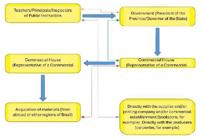
Objects needed for specific subjects in teacher training and vocational schools, as well as for primary and secondary school groups, such as "sculpture models, painting paper, cards, compasses" for drawing classes at the Liceu Maranhense, or "embroidery and crochet threads and needles, crepe paper, and silk fabrics for making flowers" for domestic skills classes, were purchased in the markets of Ceará, Pernambuco, and Rio de Janeiro. This acquisition reveals differences between schools in the interior and those in the capital, especially in territories further from São Luís, with greater financial difficulties and difficult access, except for those where agriculture and import/export products dominated the economy, such as Viana, Itapecuru, and Alcântara.
The scarcity of school supplies is a fact among us, and no one can dispute it. And often, alongside scarcity, there is the worst - the lack of materials. In many places, everything is lacking! Here in the capital, we have not yet seen such serious negligence [...] at least blackboards, chalk, sponges (Paxeco, 1920, p. 2).
A different picture existed in private schools, as presented by the Primary Normal School, created in 1916 by teacher Rosa Castro, where “school materials were the best possible. Blackboards, murals, for teaching geography, physics and natural history, [as well as] globes, atlases, a school museum, modern equipment and desks” (Schools, 1921, p. 1), or as in the Santa Tereza College, where “all parts of the building [...] offer comfort, constant ventilation, plenty of light and refined cleanliness [...]” (College, 1924, p. 1).
The reverse perspective of the migrations of School Material Culture; that is, from other territories to Maranhão, was processed in the following way: the description and quantity of artifacts to be acquired and the suppliers - place of origin and the payment conditions and delivery date, such as “Casa Salvador Mesquita & Cia, from the Province of Pará, [which supplied] 20 slates, 130 notebooks to meet the needs of the first literacy classes of Educandos Artífices and the Santa Tereza Asylum and for the parish schools of Bacanga” (Maranhão, 1882, p. 3). In the case of furniture, such as chairs and tables purchased in other locations or in commercial establishments in São Luís, details of the quantity, the material used in the manufacture - type of wood - and the specification of each piece - size, height, width, etc. Regarding the objects of bibliographic School Material Culture, details of the work, title, author, subject, grade and level of education and individual value of the copy, as described in the purchase note of the Externato Codoense, in 1920, when it invested in the analytical primer by Arnaldo Barreto, [...] [in] the Calculus by Joaquim Santos; [in] intuitive Arithmetic - [and in] the elementary course by Olavo Brito (Externato Codoense, 1930, p. 3). In some situations, schools sent lists of books to bookstores to be purchased and put up for sale, as was the case with Octavio Silveira, a bookseller in the city of Codó, who “in addition to books, supplied notebooks for writing, pencils and other items for the students of the city of Codó.
Regarding the circulation of school textbooks in Maranhão, Castellanos (2022, pp. 276-277) describes:
As for distribution strategies, usage prescriptions, and the actual consumption of books in school spaces, it is clear that while the production of these works, their distribution and adoption depended on the content presented, the teaching methods suggested, the implicit theoretical-methodological assumptions, and the acceptance in the pedagogical practices of teachers, in view of the results obtained; on the other hand, the place occupied by its author/sender in the political and educational scenario, the relationships established in the different spheres of power, and the recognition of the recipient of the works by the intellectuals, authors, politicians, and educators who offered the books, constituted a configuration of relational aspects that guaranteed their approval and adoption, their distribution and dissemination, not only because of the cultural and school importance of the work, but also because of the social capital of the author or sender.
Books, more than just transmitters of school content, constitute a privileged artifact for instilling norms of civility and moral behavior, and their circulation across diverse territories allows for a possible uniformity of content and forms of disciplining students in relation to society and national values.
Final remarks
Understanding school material culture from a transregional and translocal perspective offers a fertile opportunity to review the processes of production, circulation, and use in different times and spaces, and to identify the individuals who used the various materials that entered school environments and consolidated the use of a school material culture. At the same time, it allows us to examine the divergences present in Brazil in terms of access, production, and supply of physical and material resources so that teachers and students could carry out their daily activities.
This proposal explores the history of material culture and reveals the methods adopted by school administrators and teachers, using readily available materials, to construct tables, chairs, and benches, roofs, or walls so that boys and girls could explore the world of reading, writing, and arithmetic. These materials and objects traverse savannas and forests, navigate rivers and seas, and move between regional territories - from South to North, from the Sertão to the Cerrado, from the forests to the pampas - thus forming a network of individuals who used them, crafted them, and met the needs of schools, especially in the most remote regions far from the centers of provinces and/or states. But they also brought together those in distant, isolated areas where the industrial school market was not always present, either due to costs or the difficulties faced by governments in meeting the growing number of students entering institutions who lacked books, notebooks, pencils, and other supplies. Could it be that straw, clay, tables and chairs made of Angelim, Araucaria, and Cedar wood have occupied Brazilian school spaces more than those acquired in France or the United States?
Analyzing the migration of artifacts from School Material Culture between provinces and/or states, from capitals to the interior, is to understand the school as an institution that, to make its machinery function, used the means, resources, and skills of people to build "webs of things" so that teaching and learning could reach the most distant Brazilian territories. Here, we seek to highlight how the production, circulation, and use of furniture, building constructions, and books used in school spaces migrated from Maranhão to other territories (and vice versa), forming a network of builders and suppliers of objects of School Material Culture that, to a certain extent, rivaled industrial and artisanal processes, the latter specifically aimed at meeting local and immediate demands, creating dialogues between people from Maranhão and agents from other territories who, even from a distance, were brought closer by the sharing of school materials.
Finally, we were able to understand that migratory flows offer a possibility for expanding studies and investigations into the artifacts of School Material Culture that were produced, circulated, and used by students, teachers, and administrators (public and private) to address the daily processes and actions of Brazilian schools, particularly those in Maranhão, based on the practices and differentiation of these practices.
References
- Anajatuba. (1910, 23 de junho). A Pacotilha
- Arroyo, L. (1968). Literatura infantil brasileira Melhoramentos.
- Bittencourt, C. M. F. (2008). Livro didático e saber escolar (1810-1910) Autêntica.
- Castelo Branco, J. S. (1886). Selecta escolar Tipografia de Frias.
- Castellanos, S. L. V. (2010). Práticas leitoras no Maranhão na Primeira República: Entre apropriações e representações Edufma.
- Castellanos, S. L. V. (2022). A circulação dos livros escolares franceses no Maranhão Império Edufma.
- Castro, C. A. (2010). A presença dos materiais escolares no Maranhão oitocentista. In C. A. Castro & C. E. Cury (Orgs.), Objetos, práticas e sujeitos escolares no Norte e Nordeste Edufma.
- Castro, C. A. (2011). Cultura material escolar: A escola e seus artefatos (MA, SP, PR, SC e RS, 1870-1925) Edufma.
- Castro, R. (1933). O livro de Lucia (5ª ed.). Typografia Teixeira.
- Colégio. (1924, 21 de março). O Imparcial
- Colégio. (1954, 13 de maio). Jornal do Maranhão, p. 2.
-
Cordeiro, A. B., Garcia, G. A., Kinchescki, A. P. S., & Kanazawa, J. N. (Orgs.). (2021). A teia das coisas: Cultura material escolar e pesquisa em rede (1ª ed.). CRV; NEPIE/UFPR. https://doi.org/10.24824/978652511965.6
» https://doi.org/10.24824/978652511965.6 -
Costa, O. A. da. (2013). O livro do povo na expansão do ensino primário no Maranhão (1861-1881) [Tese de doutorado, Universidade de São Paulo]. http://www.teses.usp.br/teses/disponiveis/48/48134/tde-24042013-134450/
» http://www.teses.usp.br/teses/disponiveis/48/48134/tde-24042013-134450/ - Cruz, J. da. (1870, 15 de fevereiro). Carta ao inspetor da Instrução Pública.
- Diário de São Luiz. (1922, 12 de junho). (n. 161, p. 3).
- Escolas. (1921, 12 de março). O Imparcial
- Escolano, A. (2017). A escola como cultura: experiência, memória e arqueologia (H. H. P. Rocha & V. L. G. da Silva, Trad.). Alínea.
- Externato Codoense. (1930, 13 de setembro).
- Faria Filho, L. M. de. (2000). Dos pardieiros aos palácios: Cultura escolar e urbana em Belo Horizonte na Primeira República UPF.
- Ferro, M. do A. B. (1996). Educação e sociedade no Piauí republicano Fundação Cultural Monsenhor Chaves.
- Frago, A. V., & Escolano, A. (1998). Currículo, espaço e subjetividade: A arquitetura como programa DP&A.
- Livraria Moderna. (1929, 2 de março). O Imparcial
- Livro de Lúcia. (1924, 15 de maio). Diário de São Luís, p. 4.
- Maranhão. (1856). Relatório de Ayres de Vasconcelos sobre o Liceu Maranhense. Arquivo Público do Estado do Maranhão.
- Maranhão. (1862). Relatório do diretor da Casa dos Educandos Artífices Antônio Falcão. Arquivo Público do Estado do Maranhão.
- Maranhão. (1871). Relatório apresentado na instalação da Assembleia Legislativa da Província (3 de maio de 1871).
- Maranhão. (1882). Relatório de Augusto Bayma, inspetor da Instrução Pública do Maranhão, apresentado na Assembleia Legislativa da Província (28 de setembro de 1882).
-
Maranhão. (1905). Relatório de Antônio Baptista Barbosa de Godóis ao governador do Estado Alexandre Collares Moreira (Anexo 5). Typ. Frias. http://brazil.crl.edu/bsd/bsd/u383/000002.html
» http://brazil.crl.edu/bsd/bsd/u383/000002.html - Maranhão. (1909). Mensagem apresentada ao Congresso Legislativo do Estado do Maranhão em 11 de fevereiro de 1909
- Melo, C. A. de. (2018). Francisco Sotero dos Reis e a escrita das histórias literárias no Brasil. Muitas Vozes, 7(2), 556-570.
- Oliveira, A. (2003). O ensino público Brasília: Senado Federal.
- Oliveira, R. S. (2004). Do contexto histórico às ideias pedagógicas predominantes na escola normal maranhense e no processo de formação das normalistas na Primeira República [Dissertação de mestrado, Universidade Federal do Maranhão].
- O Paiz. (1878, 15 de janeiro). (n. 32).
- Paxeco, F. (1920, 23 de setembro). Penúria das escolas. O Imparcial
-
Pecqueur, B. (2005). O desenvolvimento territorial: Uma nova abordagem dos processos de desenvolvimento para as economias do sul. Raízes: Revista de Ciências Sociais e Econômicas, 24(1-2), 10-22. https://doi.org/10.37370/raizes.2005.v24.243
» https://doi.org/10.37370/raizes.2005.v24.243 - Pedagogia Política. (1924, 10 de março). Diário de São Luiz, (n. 59).
- Publicador Maranhense. (1873, 20 de março), p. 2.
- Roche, D. (2000). História das coisas banais: Nascimento do consumo - séculos XVII-XIX Rocco.
-
Santos, M. (2002). O retorno do território. In M. L. Silveira (Org.), Território: Globalização e fragmentação Hucitec. http://bibliotecavirtual.clacso.org.ar/ar/libros/osal/osal16/D16Santos.pdf
» http://bibliotecavirtual.clacso.org.ar/ar/libros/osal/osal16/D16Santos.pdf - Silva, D. R. da. (2011). A institucionalização dos grupos escolares no Maranhão (1903-1920) [Dissertação de mestrado, Universidade Federal do Maranhão].
-
Silva, V. L. G. da, Souza, G. de, & Castro, C. A. (Orgs.). (2018). Cultura material escolar em perspectiva histórica: Escritas e possibilidades (Coleção Horizontes, Vol. 14). Edufes. https://edufes.ufes.br/items/show/565
» https://edufes.ufes.br/items/show/565 - Soares, W. de J. B. (2018). Uma história, uma cidade e os primórdios da matemática escolar Appris.
-
Sousa, M. do S. A. de. (2019). O mobiliário escolar na instrução pública primária do Pará na Primeira República: Entre as “vitrines do progresso” e o “estado de ruínas” [Tese de doutorado, Universidade Federal do Pará]. http://repositorio.ufpa.br/jspui/handle/2011/11913
» http://repositorio.ufpa.br/jspui/handle/2011/11913 -
Souza, R. F. de. (2013). Objetos de ensino: A renovação pedagógica e material da escola primária no Brasil, no século XX. Educar em Revista, (49), 103-120. https://doi.org/10.1590/S0104-40602013000300007
» https://doi.org/10.1590/S0104-40602013000300007 - Veríssimo, J. (2015). A educação nacional Editora PUC Minas.
- Vidal, D. G., & Alcântara, W. R. (2024). História econômica da escola Editora Unesp.
-
Peer review rounds:
R1: three invitations; no reviews received.R2: three invitations; one review received.R3: two invitations; one review received.
-
How to cite this article:
Castro, C. A. Regional/local (trans) migrations of school materials culture. Revista Brasileira de História da Educação, 26, e408. DOI: https://doi.org/10.4025/rbhe.v26.2026.e408en
-
Funding:
The RBHE has financial support from the Brazilian Society of History of Education (SBHE) and the Editorial Program (Call No. 30/2023) of the National Council for Scientific and Technological Development (CNPq).
-
Licensing:
This article is published under the Creative Commons Attribution 4.0 (CC-BY 4) license.
-
Data availability:
All data generated or analyzed during this study are included in this published article.
-
1
Regarding the different types of school materials, see Castro, Cesar Augusto. School material culture: the school and its artifacts (MA, SP, PR, SC and RS) - 1870-1925. EDUFMA: São Luís, 2011.
-
2
Similar to the Industrial Exhibitions held in Maranhão from 1870 to 1880 at the Casa dos Educandos Artífices (House of Apprentice Artisans).
-
3
During the Empire, Brazil was divided into 20 provinces, with the city of Neutra serving as the country's capital.
-
4
Material made of leather with a wooden handle that was used to hide animals.
-
5
A company founded in 1921 in the city of Rio Negrinho, in the north of the state of Santa Catarina, that supplied school furniture to various schools in Brazil.
-
6
The international market for access to school supplies became more prominent after the creation of the School Groups; prior to this period (1905), it was almost entirely focused on the acquisition and production of books and the construction and renovation of school buildings.
-
7
From its first edition (1933) to the seventh (1950), 61,000 books were published.
All data generated or analyzed during this study are included in this published article.

