Thygeson's keratitis with post-corticosteroid recurrence in a child: sustained response to topical immunomodulation with tacrolimus
ABSTRACT
Thygeson's keratitis is a chronic bilateral inflammation of the cornea, characterized by recurrent intraepithelial opacities, intense photophobia, and visual fluctuations, especially in children. Topical corticosteroids are effective, but their prolonged use carries risks and frequent recurrences. We report the case of an 11-year-old girl with refractory Thygeson's keratitis treated with topical tacrolimus 0.03%. After an initial response to corticosteroids, an early recurrence occurred within 15 days. With the introduction of tacrolimus, there was complete resolution of signs and symptoms, with sustained control and no adverse effects. Clinical follow-up lasted 8 months, including serial evaluation and photographic documentation. Topical tacrolimus 0.03% proved to be a safe and effective immunomodulatory alternative, reducing corticosteroid dependence and its associated complications. This case highlights the potential of tacrolimus in the long-term management of pediatric Thygeson's keratitis.
Keywords:
Cornea; Immunomodulators; Keratitis; Child
RESUMO
A ceratite de Thygeson é uma inflamação crônica bilateral da córnea, marcada por opacidades intraepiteliais recorrentes, fotofobia intensa e flutuações visuais, especialmente em crianças. Corticosteroides tópicos são eficazes, mas seu uso prolongado implica riscos e recidivas frequentes. Relatamos o caso de uma paciente de 11 anos com ceratite de Thygeson refratária, tratada com tacrolimus 0,03% tópico. Após resposta inicial aos corticosteroides, houve recidiva precoce em 15 dias. Com a introdução do tacrolimus, houve resolução completa dos sinais e sintomas, com controle sustentado e ausência de efeitos adversos. O seguimento clínico foi de 8 meses, com avaliação seriada e documentação fotográfica. O tacrolimus 0,03% mostrou-se seguro e eficaz como alternativa imunomoduladora, reduzindo a dependência de corticosteroides e suas complicações. Este caso reforça o potencial do tacrolimus no manejo de longo prazo da ceratite de Thygeson em pediatria.
Descritores:
Córnea; Ceratite; Imunomoduladores; Criança
INTRODUCTION
Thygeson's superficial punctate keratitis is a chronic bilateral inflammatory corneal disease, first described by Phillips Thygeson in 1950,(1) characterized by multiple elevated, grayish-white granular intraepithelial opacities, predominantly located in the central cornea. The disease follows a variable course with remissions and exacerbations and may persist for several years until spontaneous resolution, generally without serious sequelae.(2) Diagnostic criteria include bilateral superficial punctate keratitis, chronic course with exacerbations and remissions, healing without scarring, lack of response to antibiotics, and significant symptomatic response to topical corticosteroids.(3)
The pathophysiology remains incompletely understood, although increasing evidence suggests the involvement of immunological mechanisms.(4) Pediatric experience is limited, with few cases reported in the literature.(2) Functional impact may be significant, especially in children, due to intense photophobia, ocular discomfort, and visual fluctuations. In Brazil, the first cases were reported in 1981 in the Revista Brasileira de Oftalmologia, in which the authors emphasized the need for semiological systematization in diagnosing superficial keratitis.(5)
First-line treatment traditionally involves low-dose topical corticosteroids, which offer rapid symptomatic relief.(3) However, prolonged corticosteroid use carries risks such as ocular hypertension and cataract formation.(6) Additionally, many patients become corticosteroid-dependent or experience relapses after discontinuation.(7) In this context, topical immunomodulators have emerged as promising alternatives, with tacrolimus showing ten to one hundred times greater potency than cyclosporine.(8,9)
This case report was approved by the local ethics committee (CAAE: 89688825.7.0000.0139). An 11-year-old patient with refractory Thygeson's keratitis was treated with topical tacrolimus 0.03%. Clinical follow-up lasted 8 months, with slit-lamp and photographic documentation. Informed consent and assent were obtained. No experimental intervention was performed, and all data were anonymized to ensure patient confidentiality.
CASE REPORT
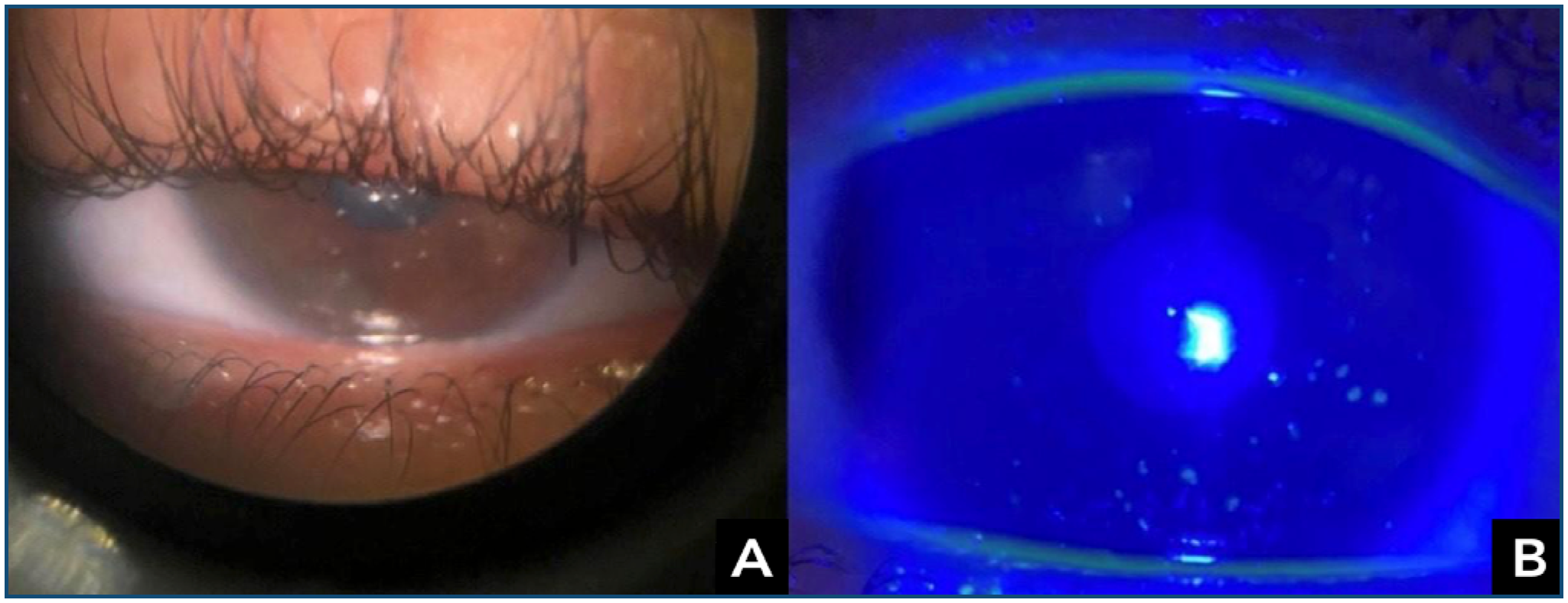
An 11-year-old previously healthy female presented with a 1-year history of intense bilateral photophobia, tearing, burning sensation, and blurred vision. The clinical course was marked by periods of exacerbation alternating with partial improvement, but without complete symptom resolution. Initial ophthalmic examination revealed best corrected visual acuity of 20/40 in the right eye and 20/30 in the left eye. Slit-lamp examination of both eyes showed no conjunctival hyperemia, multiple slightly elevated intraepithelial opacities with central and paracentral corneal distribution, and positive fluorescein staining (Figures 1A and 1B). The anterior chamber was quiet, and the lenses were clear in both eyes.

(A) Biomicroscopy: intraepithelial opacities with slight elevation and central and paracentral corneal distribution; (B) Positive fluorescein.
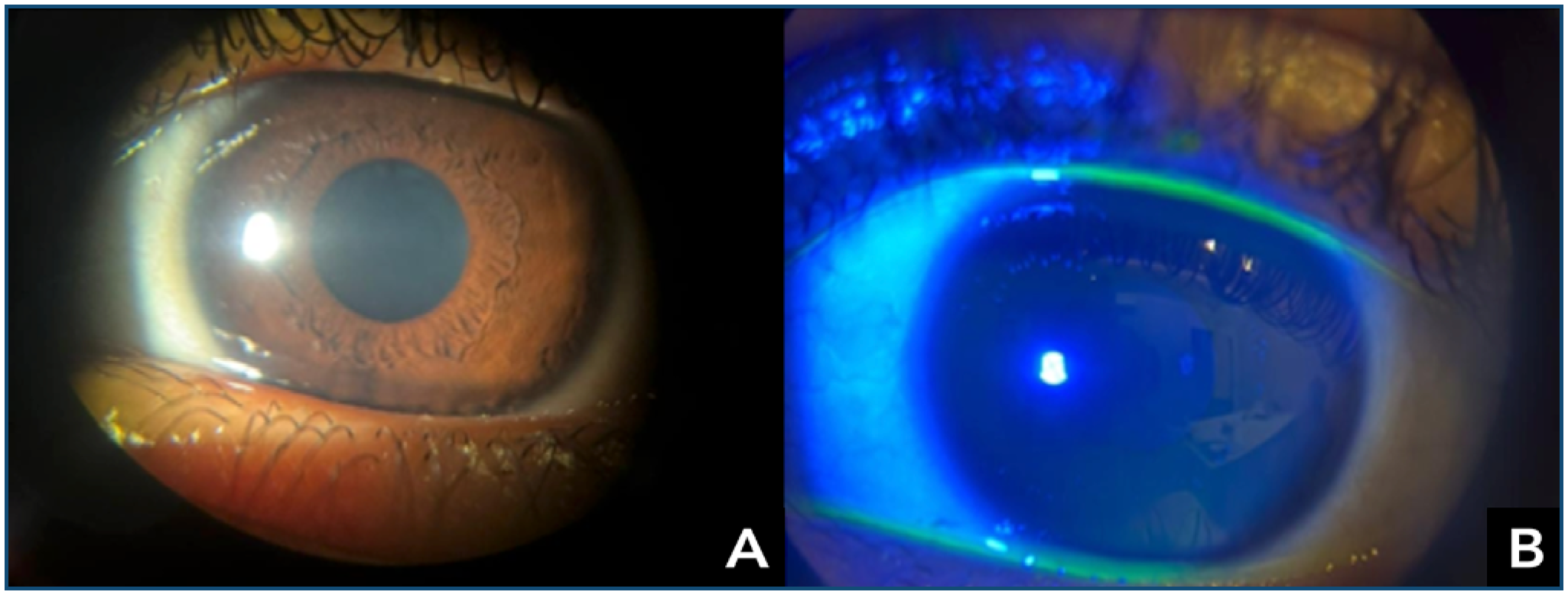
Based on the clinical findings and characteristic slit-lamp appearance, a diagnosis of Thygeson's keratitis was established. Treatment was initiated with topical prednisolone acetate 1% following a tapering regimen for 20 days. The patient showed an excellent initial response, with complete resolution of clinical signs. At follow-up after completing the taper, corrected visual acuity was 20/20 in both eyes and slit-lamp examination showed clear corneas bilaterally, with negative fluorescein staining (Figures 2A and 2B).

(A) Biomicroscopy: clear cornea (clinical improvement after corticosteroid use); (B) Negative fluorescein.
Fifteen days after discontinuing topical corticosteroids, the patient experienced early recurrence with return of photophobia, tearing, and typical corneal opacities seen on slit-lamp exam (Figures 3A and 3B). Given the corticosteroid dependence and the risks of prolonged use in a pediatric patient, topical immunomodulation was initiated. Tacrolimus 0.03% eye drops were prescribed twice daily for 6 months, along with a second short course of prednisolone acetate 1% tapered over 15 days to control the acute flare.
(A) Biomicroscopy: exacerbation of the condition, with recurrence of keratitis after discontinuation of topical corticosteroid use; (B) Positive fluorescein.
The patient showed favorable response to tacrolimus within the first few weeks of treatment, with progressive resolution of symptoms and signs. Throughout the 8-month follow-up, she remained asymptomatic and free of relapses, with clear corneas on slit-lamp examination (Figures 4A and 4B). No local or systemic adverse effects were observed, and intraocular pressure remained within normal limits for age.

(A) Clear corneas on slit-lamp examination during tacrolimus use; (B) Negative fluorescein.
DISCUSSION
Thygeson's keratitis represents a significant therapeutic challenge in pediatric ophthalmology and is one of the leading causes of chronic bilateral keratitis in children. Since its initial description by Phillips Thygeson in 1950,(1) the understanding of this nosological entity has evolved substantially, although its etiology remains obscure. The rarity of the condition, particularly in pediatric patients, leads to limited clinical experience and difficulty in establishing standardized therapeutic protocols.(2)
The pathophysiology of Thygeson's keratitis involves complex immunological mechanisms that justify the use of immunomodulatory agents. Studies suggest a T-cell-mediated immune response with abnormal activation of inflammatory pathways on the ocular surface.(4) This rationale supports the use of calcineurin inhibitors as a therapeutic alternative. Tacrolimus, derived from the fungus Streptomyces tsukubaensis, is ten to one hundred times more potent than cyclosporine A in inhibiting T-cell activation.(5,10)
The mechanism of action of tacrolimus involves binding to cytoplasmic proteins called immunophilins, forming complexes that selectively inhibit calcineurin. This inhibition prevents the dephosphorylation of nuclear factor of activated T cells (NFAT), blocking its nuclear translocation and subsequent transcription of pro-inflammatory cytokines such as interleukin-2 and tumor necrosis factor-α.(10,11) Additionally, recent studies have demonstrated the neuroprotective properties of tacrolimus, promoting axonal regeneration and corneal reinnervation with minimal systemic exposure.(12)
Clinical experience with ophthalmic tacrolimus in Thygeson's keratitis is based mainly on observational studies and case reports. The pioneering study by Marquezan et al.(8) represents the largest published case series, evaluating 14 patients (aged 9 to 65 years) treated with 0.03% tacrolimus for an average of 6 years. Results showed sustained improvement in visual acuity, symptoms, and signs during treatment, with only two patients showing poor response due to low adherence. Although treatment was not curative, the need for long-term maintenance therapy was evident.
Koh et al.(13) conducted the most extensive safety study of long-term topical tacrolimus use in pediatrics, analyzing 72 patients under 18 years (mean age: 10.8 ± 3.9 years) with various refractory ocular surface inflammatory diseases. With an average follow-up of 23.12 ± 19.07 months (range 12 to 98 months), they confirmed the long-term safety and efficacy of the treatment. Among the 34 patients followed for ≥ 12 months, no significant systemic adverse effects were observed, supporting a favorable safety profile in pediatric patients.
More recent studies corroborate these findings. García-Ferrer et al.(14) evaluated 12 pediatric patients (mean age: 9 years) treated with 0.03% topical tacrolimus, demonstrating clinical improvement in 92% of cases, with a significant reduction in the mean clinical score from 4.5 to 0.6 (p = 0.0002). The average follow-up was 23 months, and the average treatment duration with tacrolimus was 19.6 months, highlighting the need for long-term therapy to maintain clinical control.
The safety of topical tacrolimus at higher concentrations has also been demonstrated. Fukushima et al.(15) evaluated 135 patients with severe allergic ocular diseases treated with 0.1% tacrolimus, with an average follow-up of 8.4 ± 2.9 years, confirming efficacy and safety even at higher doses. Miyazaki et al.(16) demonstrated the steroid-sparing effect of 0.1% tacrolimus in the treatment of shield ulcers and corneal epitheliopathy in refractory allergic ocular diseases.
Topical immunomodulators offer substantial advantages over prolonged corticosteroid use. The absence of steroidogenic effects eliminates the risk of secondary glaucoma, cataract formation, and increased susceptibility to ocular infections.(6,17) Comparative studies show that corneal infections occur in 0.35% of patients treated with tacrolimus versus 0.84% with topical cyclosporine, indicating a superior safety profile.(17)
National experience with Thygeson's keratitis is limited. Silva et al.(5) reported the first Brazilian cases in 1981, emphasizing the need for diagnostic systematization in superficial keratitis. Since then, few cases have been documented in national literature, contributing to limited awareness of the disease among Brazilian ophthalmologists. This case represents one of the first detailed reports of topical tacrolimus use in pediatric Thygeson's keratitis in Brazil.
International studies on topical cyclosporine A show variable efficacy. Del Castillo et al.(6) reported success with 1 to 2% cyclosporine in three patients, while Reinhard et al.(18) observed improvement in refractory cases. Hasanreisoglu et al.(19) described long-term control with topical cyclosporine A, though requiring continuous use. These studies suggest both calcineurin inhibitors are effective, but tacrolimus demonstrates greater potency and better tolerability.(8,9)
The therapeutic approach to Thygeson's keratitis has evolved significantly. Nagra et al.(7) analyzed a 10-year experience with 28 patients and found that conservative treatment with lubricants may suffice in mild cases, reserving immunomodulators for symptomatic patients or those with visual impairment. This stepwise strategy optimizes outcomes while minimizing exposure to potentially toxic medications.
Pharmacokinetic aspects favor the topical use of tacrolimus. Studies show adequate corneal penetration with minimal systemic absorption (< 0.5% of applied dose).(11) The 0.03% ointment formulation provides sustained release and longer contact time with the ocular surface compared to aqueous solutions. This is especially advantageous in pediatrics, where cooperation with frequent instillation can be limited.
Important limitations must be considered in interpreting these findings. The off-label use of ophthalmic tacrolimus for Thygeson's keratitis requires specific informed consent and rigorous clinical monitoring.(9) Its higher cost compared to corticosteroids may limit access, especially in resource-constrained healthcare systems. Furthermore, the rarity of the disease hampers the execution of randomized controlled trials, limiting the level of available evidence.(8)
Long-term considerations include the need for prolonged maintenance therapy, as shown in the available studies.(8,13,14) The optimal treatment duration remains undefined and is usually individualized based on clinical response and tolerability. Future studies should investigate tapering strategies and identify predictive factors of therapeutic response.
The growing understanding of immunological mechanisms on the ocular surface has revolutionized the treatment of chronic inflammatory eye diseases.(10,17) The ocular surface is now recognized as a specialized compartment of the mucosal immune system, dynamically responding to inflammatory stimuli.(20) This perspective supports the rational use of topical immunomodulators as an alternative to corticosteroids in recurrent chronic conditions.
The present case illustrates the practical application of these concepts in a pediatric patient, demonstrating the efficacy and safety of 0.03% tacrolimus in controlling refractory Thygeson's keratitis. The sustained 6-month control without recurrences and absence of adverse effects confirm the potential of this therapeutic approach. These results are consistent with the international literature and support the incorporation of topical tacrolimus in the treatment algorithm for pediatric Thygeson's keratitis.
This case demonstrates the efficacy and safety of topical tacrolimus 0.03% in treating Thygeson's keratitis in a pediatric patient with disease refractory to conventional treatment.(8) The sustained 6-month control without relapses and absence of adverse effects confirm the promising role of topical immunomodulators as alternatives to long-term corticosteroid therapy.(10) The experience reported here, along with growing evidence in international literature,(8,13,14) suggests that tacrolimus should be considered as a second-line treatment in Thygeson's keratitis cases with corticosteroid dependence or frequent recurrences, especially in pediatric patients, where the risks of prolonged steroid use are amplified.(7,17)
Data Availability Statement:
The datasets generated and/or analyzed during the current study are included in the manuscript.
REFERENCES
- 1 Thygeson P. Superficial punctate keratitis. JAMA. 1950;144(18):1544-9.
- 2 Tang XJ, Liu Q, Pi LH, Chen XK, Chen L. Thygeson's superficial punctate keratitis (TSPK): a paediatric case report and review of the literature. BMC Ophthalmol. 2020;20(1):480.
- 3 Gock G, Ong K, McClellan K. A classical case of Thygeson's superficial punctate keratitis. Aust N Z J Ophthalmol. 1995;23(1):76-7.
- 4 Tabbara KF, Ostler HB, Dawson C, Oh J. Thygeson's superficial punctate keratitis. Ophthalmology. 1981;88(1):75-7.
- 5 Silva LM, Barbosa CS, Rodrigues MC. Ceratite punctata superficial de Thygeson. Rev Bras Oftalmol. 1981;40(2):109-14.
- 6 Del Castillo JM, Del Castillo JB, Garcia-Sanchez J. Effect of topical cyclosporin A on Thygeson's superficial punctate keratitis. Doc Ophthalmol. 1996;93(3):193-8.
- 7 Nagra PK, Rapuano CJ, Cohen EJ, Laibson PR. Thygeson's superficial punctate keratitis: ten years’ experience. Ophthalmology. 2004;111(1):34-7.
- 8 Marquezan MC, Nascimento H, Vieira LA, Serapião M, Ghanem RC, Belfort R Jr, et al. Effect of topical tacrolimus in the treatment of Thygeson's superficial punctate keratitis. Am J Ophthalmol. 2015;160(4):663-8.
- 9 Shoughy SS, Tabbara KF. Topical tacrolimus in Thygeson superficial punctate keratitis. Cornea. 2020;39(6):742-44.
- 10 Chung JL, Raevis JJ, Cohen EJ. Immunomodulatory agents in the treatment of ocular surface disease. Curr Opin Ophthalmol. 2020;31(4):300-6.
- 11 Connell PP, O’Reilly J, Coughlan S, Collum LM, Power WJ. The role of common viral ocular pathogens in Thygeson's superficial punctate keratitis. Br J Ophthalmol. 2007;91(8):1038-41.
- 12 Sekhon S, Singh R. Thygeson's superficial punctate keratitis: current perspective and treatment. Ophthalmol Ther. 2021;10(1):25-33.
- 13 Koh K, Jun I, Kim TI, Kim EK, Seo KY. Long-term results of topical 0.02% tacrolimus ointment for refractory ocular surface inflammation in pediatric patients. BMC Ophthalmol. 2021;21(1):265.
- 14 García-Ferrer A, López-González R, Martínez-Costa L, et al. Topical tacrolimus for the treatment of external eye inflammation in children. Expert Rev Ophthalmol. 2022;17(1):23-8.
- 15 Fukushima A, Ohashi Y, Ebihara N, Uchio E, Okamoto S, Kumagai N, et al. Therapeutic effects of 0.1% tacrolimus eye drops for refractory allergic ocular diseases with proliferative lesion or corneal involvement. Br J Ophthalmol. 2014;98(8):1023-7.
- 16 Miyazaki D, Fukushima A, Ohashi Y, Ebihara N, Uchio E, Okamoto S, et al. Steroid-sparing effect of 0.1% tacrolimus eye drop for treatment of shield ulcer and corneal epitheliopathy in refractory allergic ocular diseases. Ophthalmology. 2017;124(3):287-94.
- 17 Gagrani M, Conner EA, Scanga H, Ebihara N, Uchio E, Okamoto S, et al. Thygeson's superficial punctate keratitis in children. Eye (Lond). 2023;37(16):3455-60.
- 18 Reinhard T, Sundmacher R. Topical cyclosporin A in Thygeson's superficial punctate keratitis. Graefes Arch Clin Exp Ophthalmol. 1999;237(2):109-12.
- 19 Hasanreisoglu M, Avisar R. Long-term topical cyclosporin A therapy in Thygeson's superficial punctate keratitis: a case report. Cases J. 2008;1(1):415.
- 20 Darrell RW. Thygeson's superficial punctate keratitis: natural history and association with HLA-DR3. Trans Am Ophthalmol Soc. 1981;79:486-516.
Edited by
-
Associate editor:
Ricardo Augusto Paletta Guedes Universidade Federal de Juiz de Fora, Juiz de Fora, MG, Brazil https://orcid.org/0000-0002-9451-738X